Begin
14 pages · ~28 min
Dark Matter and Dark Energy
An introductory course on dark matter and dark energy, covering the evidence for their existence and current theories about their nature in modern cosmology.
A digital instructor presents all 14 pages. Hold “Ask” at any point and ask out loud — the answer comes from this course. No sign-up needed.
What you’ll learn
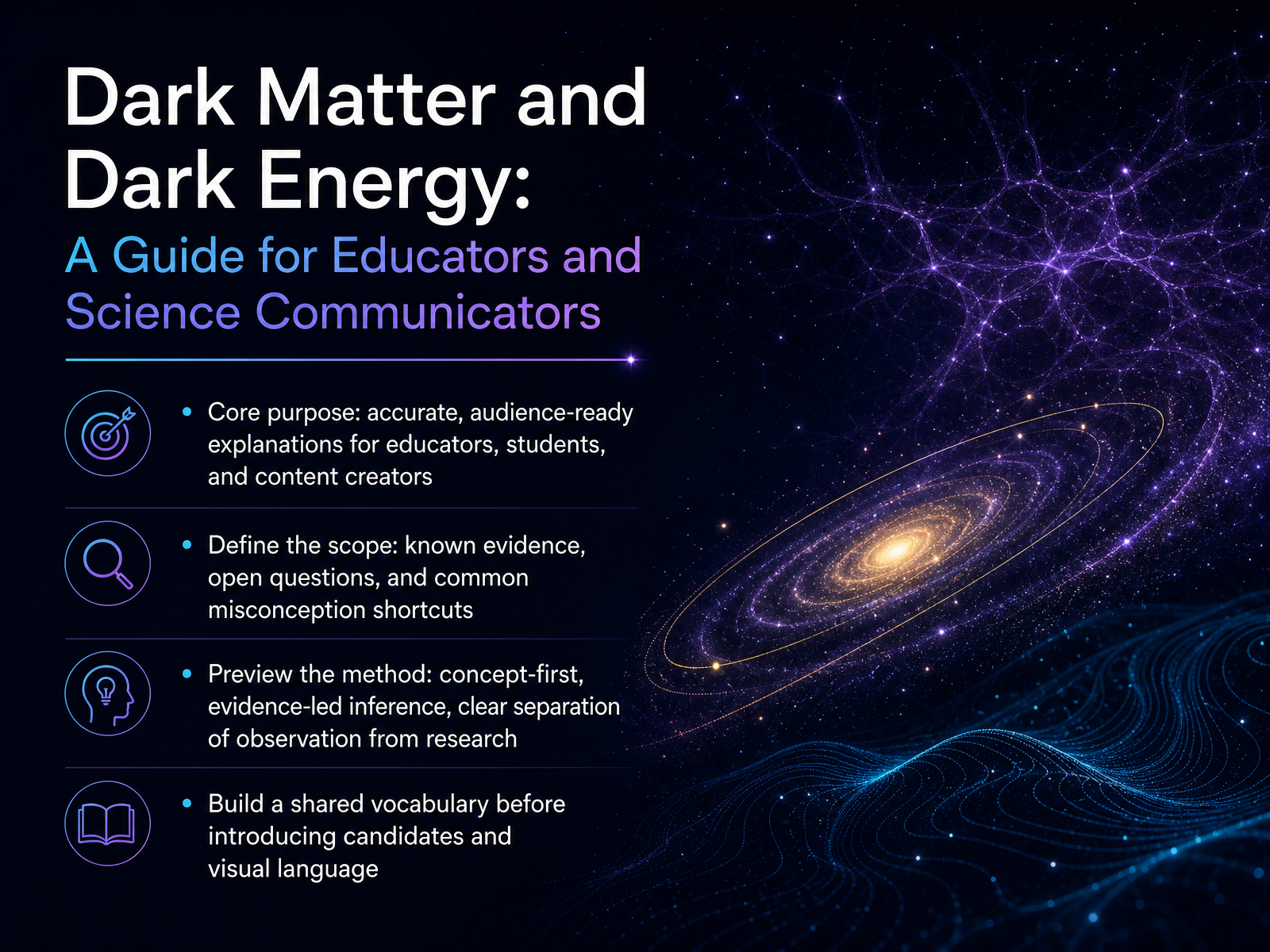
- 01Dark Matter and Dark Energy: A Guide for Educators and Science CommunicatorsWelcome. Today, we're going to explore two of the most profound mysteries in modern science: dark matter and dark energy. Our goal is to give you a clear and reliable foundation, whether you're teaching in a classroom or sharing science with the public. We will focus on what we actually observe, the open questions that remain, and the common shortcuts that often lead to confusion. Think of our approach as concept first. We'll build understanding from evidence before introducing candidates or visual metaphors. By the end, you'll have a shared vocabulary to talk about the invisible parts of our universe with confidence. Let's begin with the fundamental question of why the universe needs more than we can see.iopscience.iop.orgiopscience.iop.orgepjc.epj.org+21 min
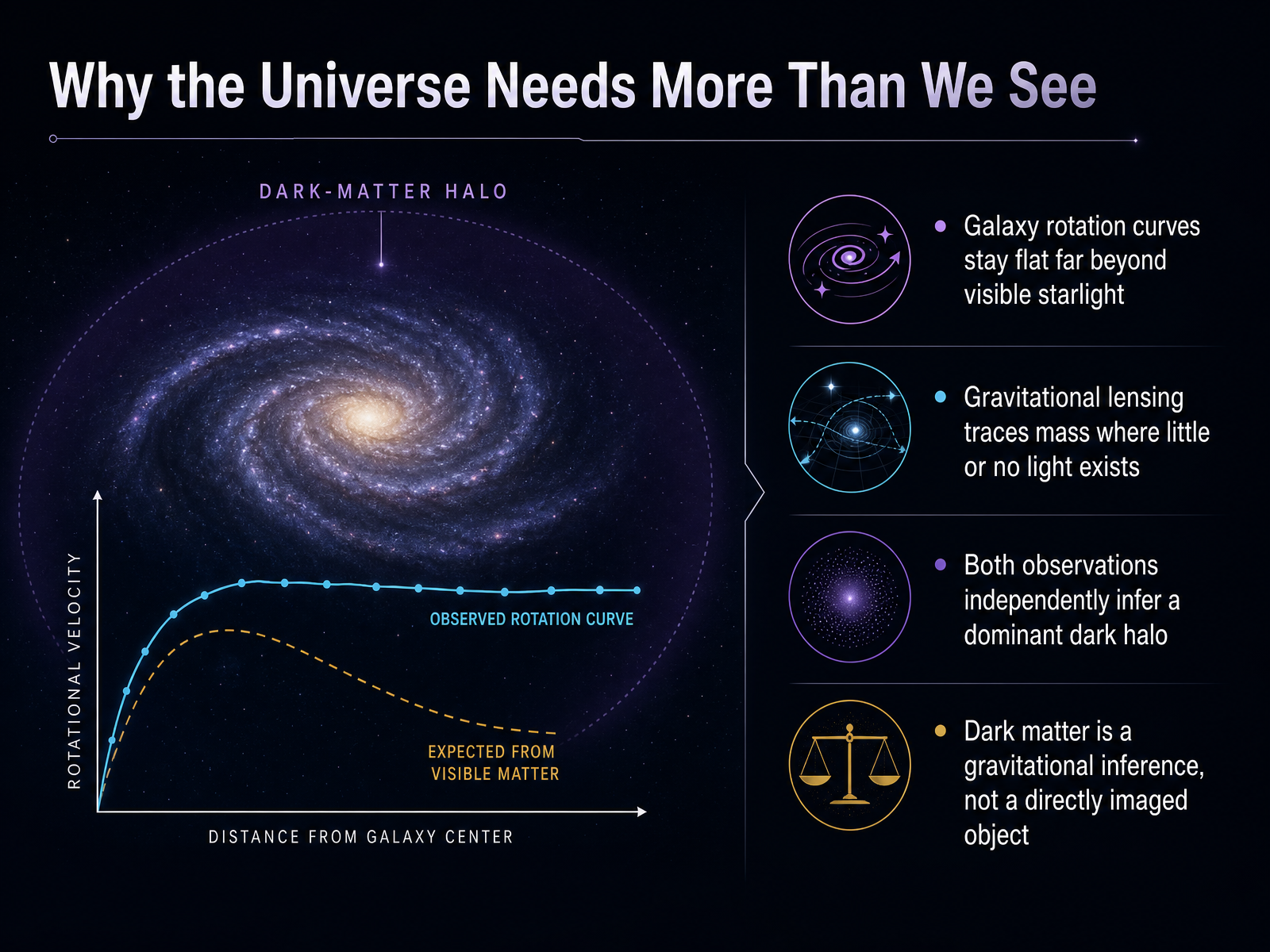
- 02Why the Universe Needs More Than We SeeWhen we look at a galaxy, we see stars and glowing gas. But the way those stars move tells a very different story. In a spiral galaxy, we would expect stars far from the center to orbit more slowly, just like the outer planets in our solar system move more slowly around the Sun. Instead, the speeds stay surprisingly flat, even far beyond the visible starlight. That flat rotation curve is our first clue. It means there is a great deal of invisible mass surrounding the galaxy, what we call a dark halo. Our second clue comes from gravity itself. Massive objects bend the path of light, an effect called gravitational lensing. Astronomers see light bending around regions of space that look almost empty, tracing enormous amounts of mass where little or no light exists. What makes this evidence powerful is that these clues come from completely different kinds of measurement. Both rotation curves and lensing independently point to the same conclusion: most of the matter in a galaxy is dark. It is a gravitational inference, a presence we map by its pull, not by its glow. Now let us look closer at how galaxies and clusters reveal this hidden scaffolding.
 ned.ipac.caltech.eduscience.nasa.goviopscience.iop.org+22 min
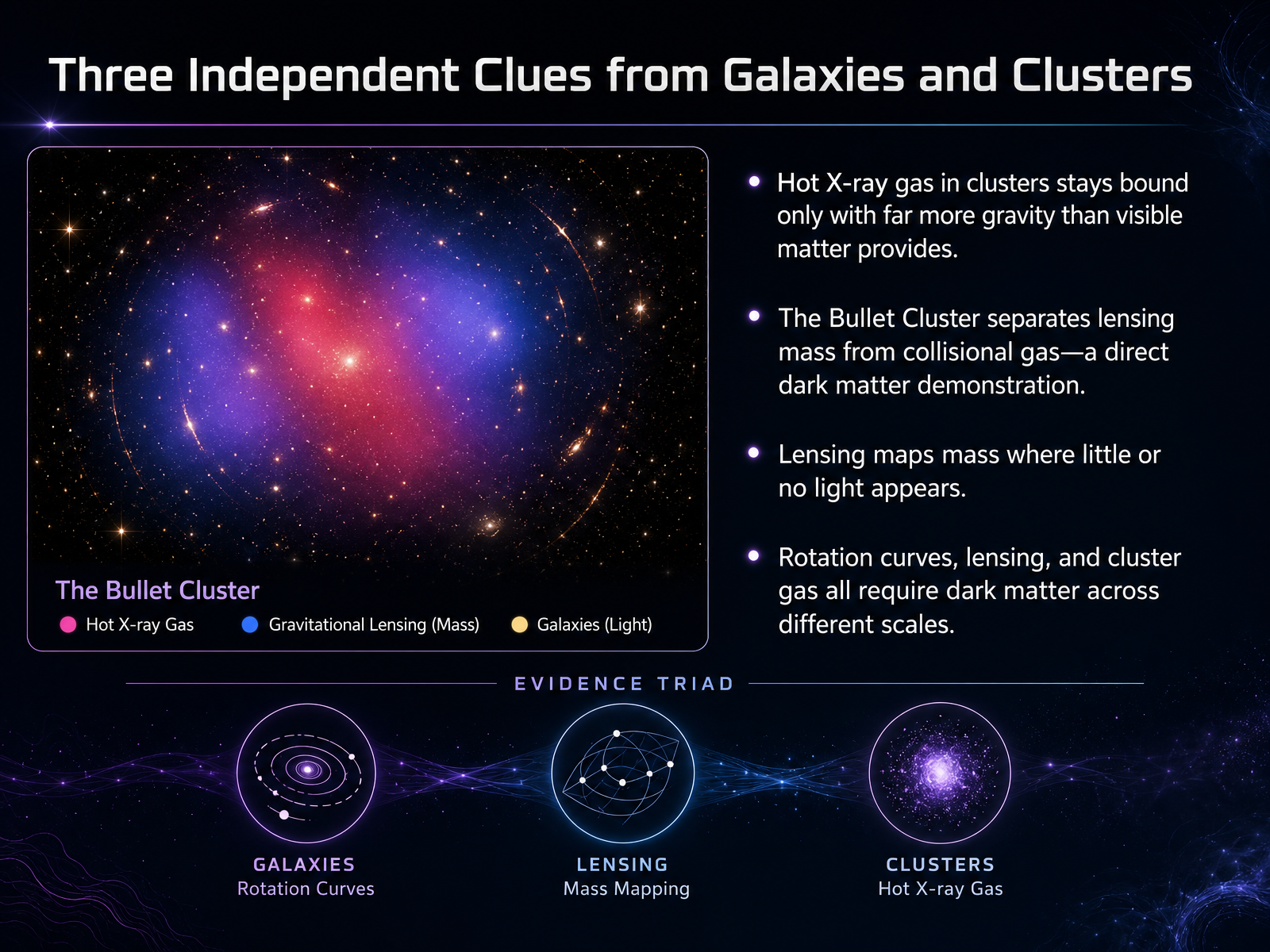
 - 03Three Independent Clues from Galaxies and ClustersNow let us look at three independent clues that point to the same conclusion. First, in galaxy clusters, there is hot gas glowing in X rays. That gas is moving so fast that visible matter alone cannot hold it in place. So something else must be supplying the extra gravity. Second, consider the Bullet Cluster. Two clusters collided, and the hot gas slowed down and piled up. But lensing measurements show that most of the mass moved straight through. The mass and the gas ended up in different places. That separation is a direct sign of dark matter, matter that does not collide the way ordinary gas does. Third, lensing maps show mass where there is little or no light. So rotation curves, gravitational lensing, and cluster gas all require dark matter, but on different scales. That is important because one clue could be a mistake. Three independent clues make the case much stronger. Next, we turn from dark matter to a different puzzle, cosmic acceleration and the discovery of dark energy.
 ned.ipac.caltech.eduscience.nasa.goviopscience.iop.org+22 min
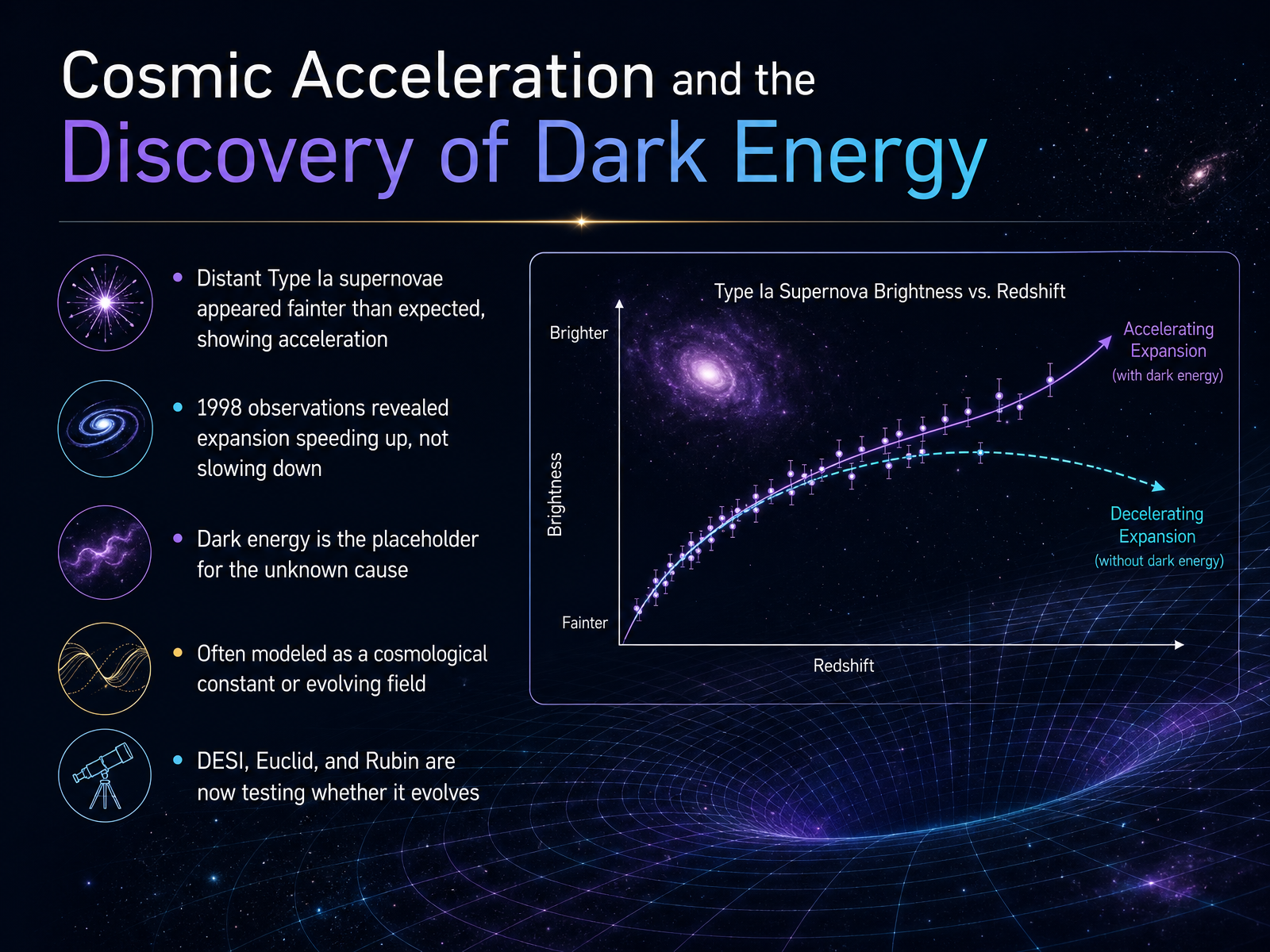
 - 04Cosmic Acceleration and the Discovery of Dark EnergyNow think about what that means. In nineteen ninety-eight, two teams measured distant Type Ia supernovae. These are exploding stars with a predictable brightness. The teams expected gravity to be slowing the universe down. Instead, the supernovae appeared fainter than expected. They were farther away. The expansion was speeding up. This was cosmic acceleration, and it pointed to something new. Scientists gave this unknown driver a name, dark energy. It is a placeholder for what we do not yet understand. Some models treat it as a cosmological constant, a steady energy spread through space. Others suggest it is an evolving field that changes over time. Today, instruments like DESI, Euclid, and Rubin are testing these ideas by mapping the universe in greater detail. Up next, we will look at what current data do and do not say about dark energy.
 iopscience.iop.orgiopscience.iop.orgepjc.epj.org+21 min
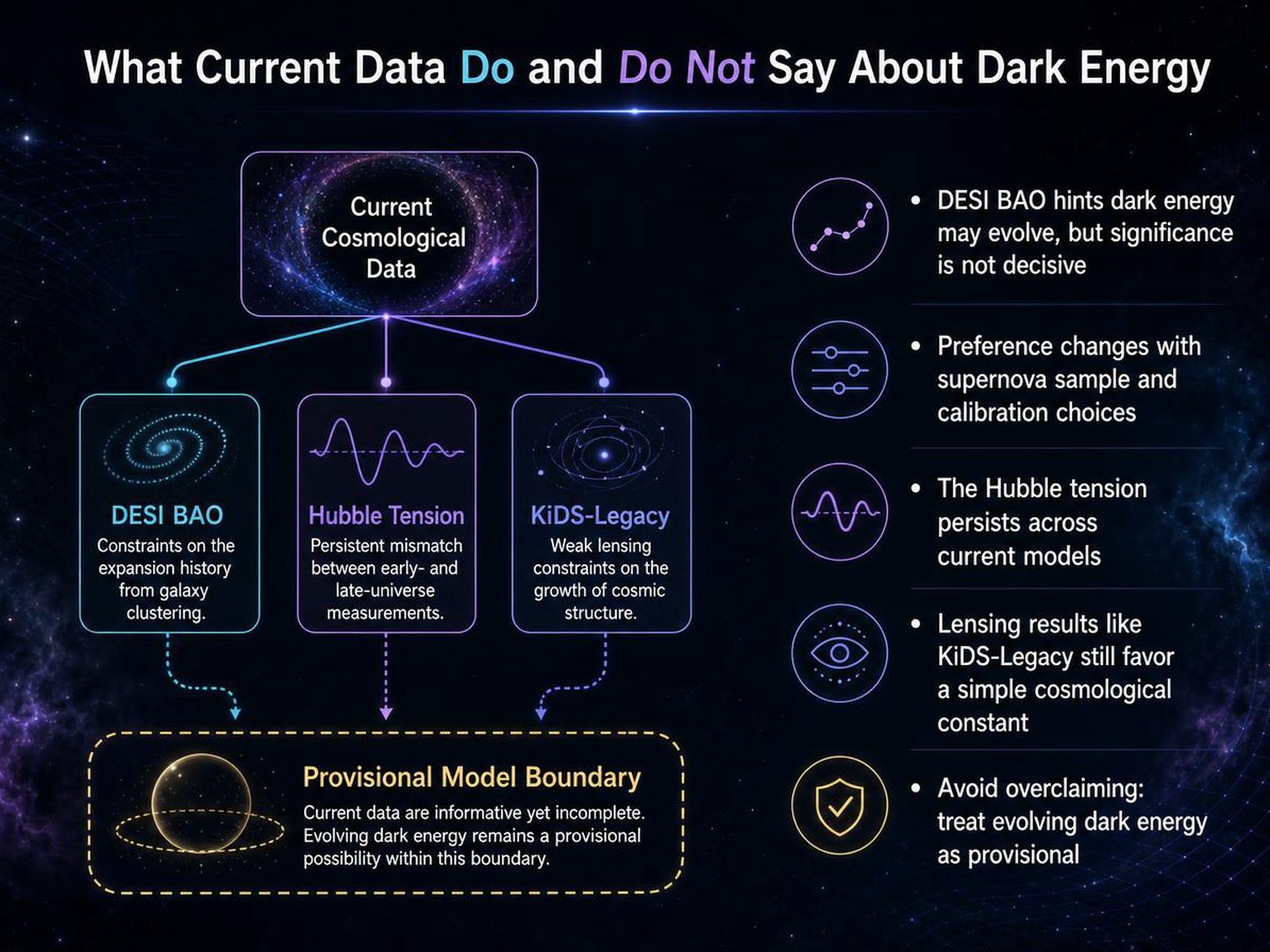
 - 05What Current Data Do and Do Not Say About Dark EnergyLet's look carefully at what the data are actually telling us right now about dark energy. The DESI survey's baryon acoustic oscillation measurements hint that dark energy may change over time. But that hint is not yet decisive. The strength of the preference shifts depending on which supernova sample we use, and on small choices in how those supernovae are calibrated. So the evidence is real but fragile. Meanwhile, a separate problem called the Hubble tension persists. Different ways of measuring the expansion rate still disagree, and current dark energy models do not resolve that. Then there is weak gravitational lensing. Results like the KiDS-Legacy survey still lean toward a simple cosmological constant, not an evolving dark energy. So the honest position is one of caution. Treat evolving dark energy as provisional, not proven. Keep all the more ordinary explanations on the table until the next generation of data arrives. That perspective connects directly to our next topic, leading candidates and how we search for them.
 iopscience.iop.orgiopscience.iop.orgepjc.epj.org+21 min
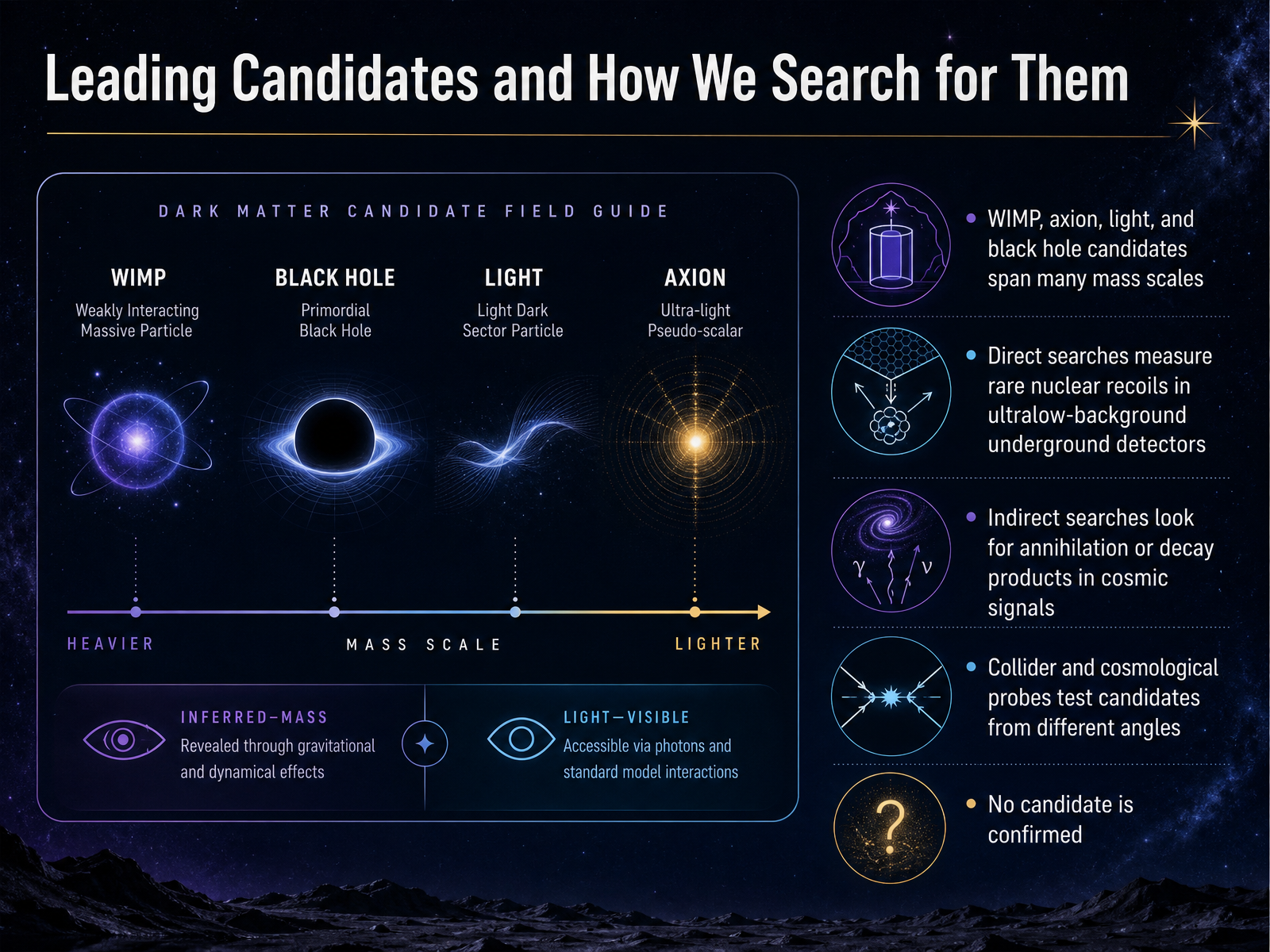
 - 06Leading Candidates and How We Search for ThemNow let's look at the leading candidates, and how scientists are actually searching for them. The names can sound strange at first, WIMPs, axions, light dark matter, and even primordial black holes. The key idea is that these candidates could have very different masses. Some might be heavy, like a whole atomic nucleus. Others could be astonishingly light. Because of this, no single experiment can cover everything. So researchers use several different strategies at the same time. Direct searches try to catch a dark matter particle bumping into an atom. These detectors sit deep underground, shielded from ordinary cosmic rays, and wait for a rare, tiny nuclear recoil. Indirect searches take a different path. They look into space for the byproducts of dark matter particles annihilating or decaying. Collider experiments try to produce dark matter in high energy collisions, while cosmological probes study how dark matter shapes the universe on the largest scales. Each method tests the candidates from a different angle. And so far, no candidate has been confirmed. That's what makes this a genuine open puzzle. Next, let's look at the state of dark matter searches right now.
 indico.in2p3.frnature.comarxiv.org+22 min
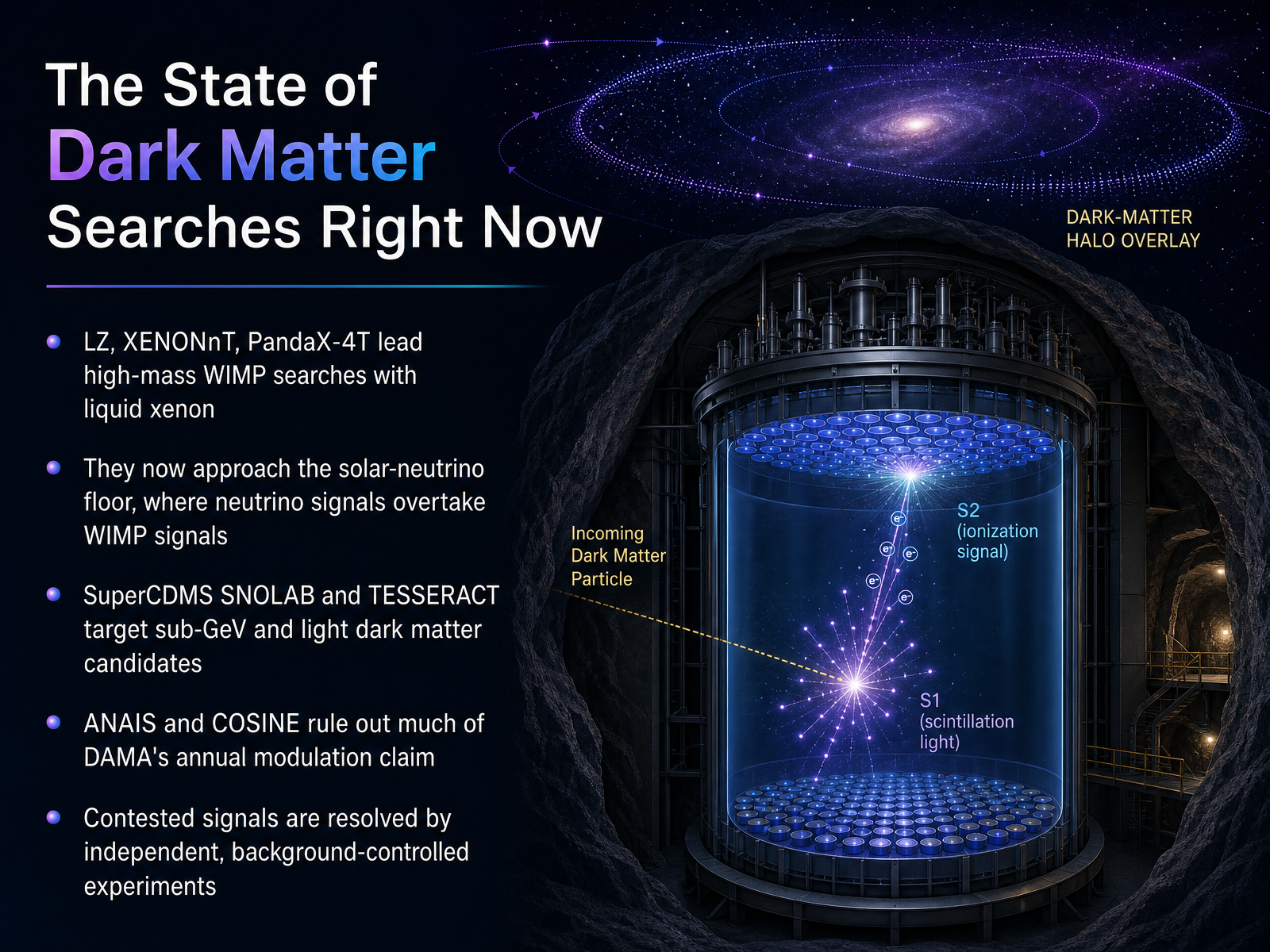
 - 07The State of Dark Matter Searches Right NowSo where does the search actually stand right now? The leading high-mass experiments, LZ, XENONnT, and PandaX 4T, all use huge tanks of liquid xenon. They have pushed their sensitivity so far that they are now running into a natural limit. This is the solar neutrino floor, where signals from the Sun's own neutrinos start to drown out the faint signals a dark matter particle would make. Below that floor, the search gets much harder. Meanwhile, other teams are looking in a different direction. SuperCDMS SNOLAB and TESSERACT are designed to catch much lighter, sub-GeV dark matter using supercooled crystals. There is also the long-running DAMA controversy, which claimed to see a seasonal signal. Independent experiments like ANAIS and COSINE have now ruled out most of that claim with their own background-controlled data. The key takeaway is that contested signals are not trusted until an independent experiment can confirm or refute them. Next, we will look at how we communicate these invisible ideas, starting with the visual language we use for phenomena we cannot see.
 indico.in2p3.frnature.comarxiv.org+22 min
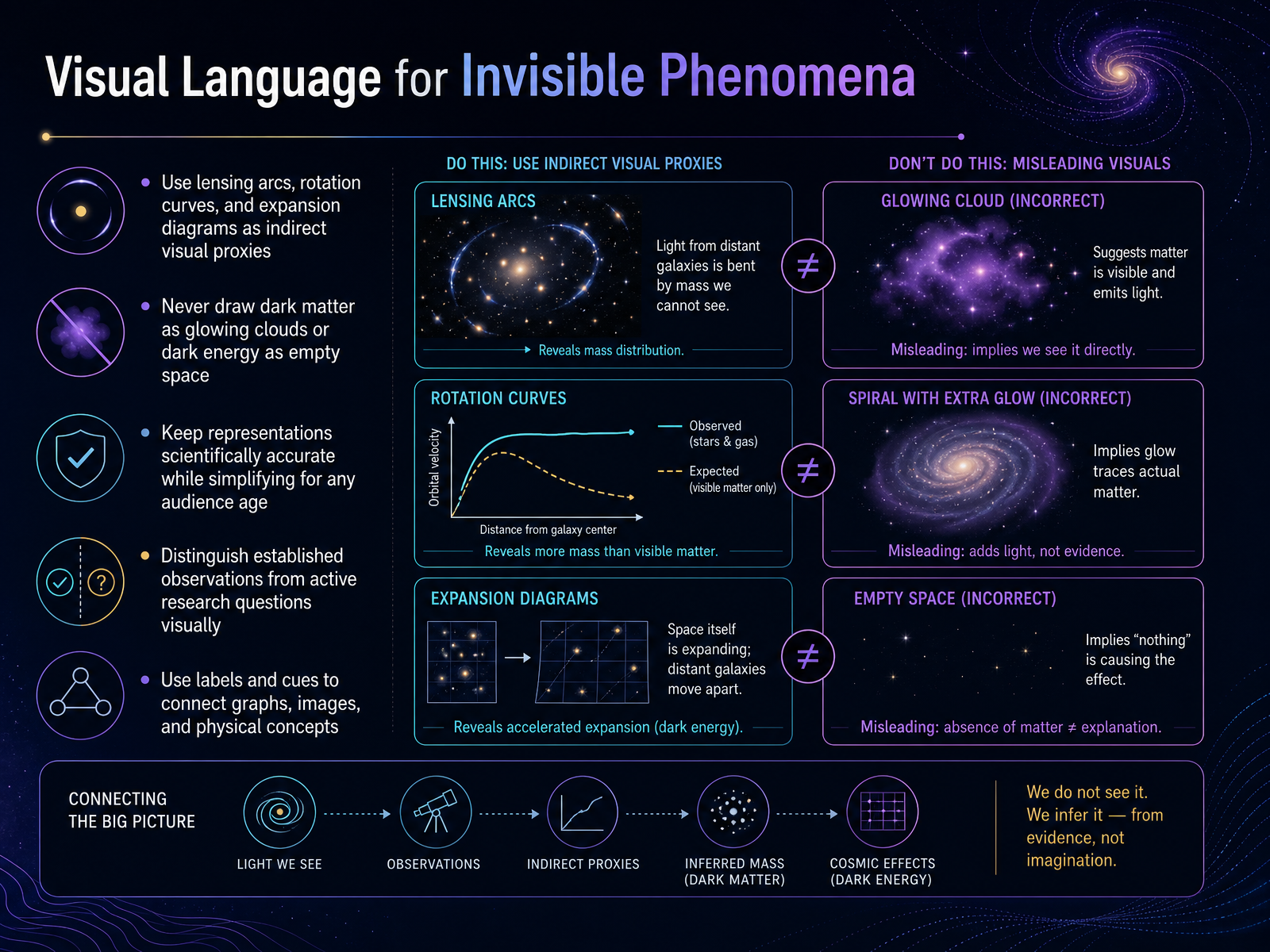
 - 08Visual Language for Invisible PhenomenaSo how do we show something that cannot be seen? We rely on visual proxies. A gravitational lensing arc is one example. It is the curved image of a distant galaxy, and that curve is caused by invisible mass in front of it. A rotation curve is another. It is a simple graph, but its flat shape tells us there is far more gravity than the visible stars can explain. And an expansion diagram can show dark energy at work, as a force that stretches space itself. A key rule here is restraint. We should not draw dark matter as a glowing blue cloud, or dark energy as empty space. Those choices create a false picture. Instead, we show the effect, not the substance. We also need honesty. Some ideas are established observations. Others are active research questions. Our visuals should make that difference clear through labels and color cues. In the next slide, we will turn these ideas into classroom ready explanations and demonstrations.
 ned.ipac.caltech.eduscience.nasa.goviopscience.iop.org+21 min
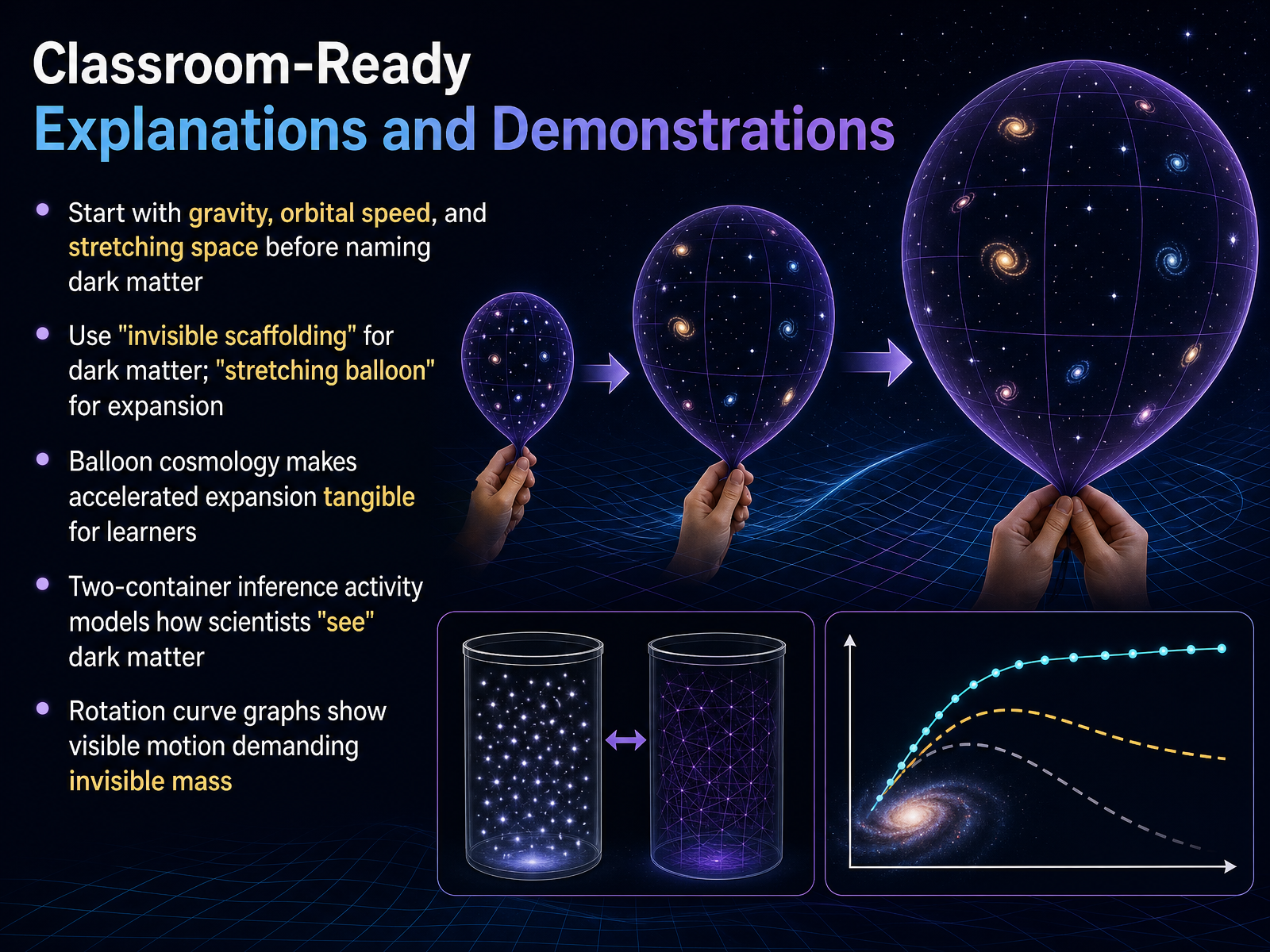
 - 09Classroom-Ready Explanations and DemonstrationsLet's turn now from the concepts themselves to how you can bring them into your classroom. A good starting point is to build on what students already know about gravity and orbits before you even name dark matter. For example, talk about how fast stars move around a galaxy, and then ask whether the visible matter is enough to hold them all together. When the numbers do not add up, you can introduce the idea of invisible scaffolding. That is a helpful phrase for dark matter. It gives students an image of a hidden structure that keeps everything in place. For cosmic expansion, a stretching balloon works well. Marks on the balloon move apart as it inflates, and that makes the idea of expanding space more tangible. There is also a nice inference activity using two closed containers. Students can shake them, weigh them, and listen to them, but they cannot open them. That mimics how scientists deduce the presence of dark matter without ever seeing it directly. Finally, galaxy rotation curve graphs are powerful. When students see that the outer stars are moving way too fast for the visible mass, the demand for invisible mass becomes clear. Next, we will anticipate and address some common misconceptions.
 jpl.nasa.govjpl.nasa.govimagine.gsfc.nasa.gov+21 min
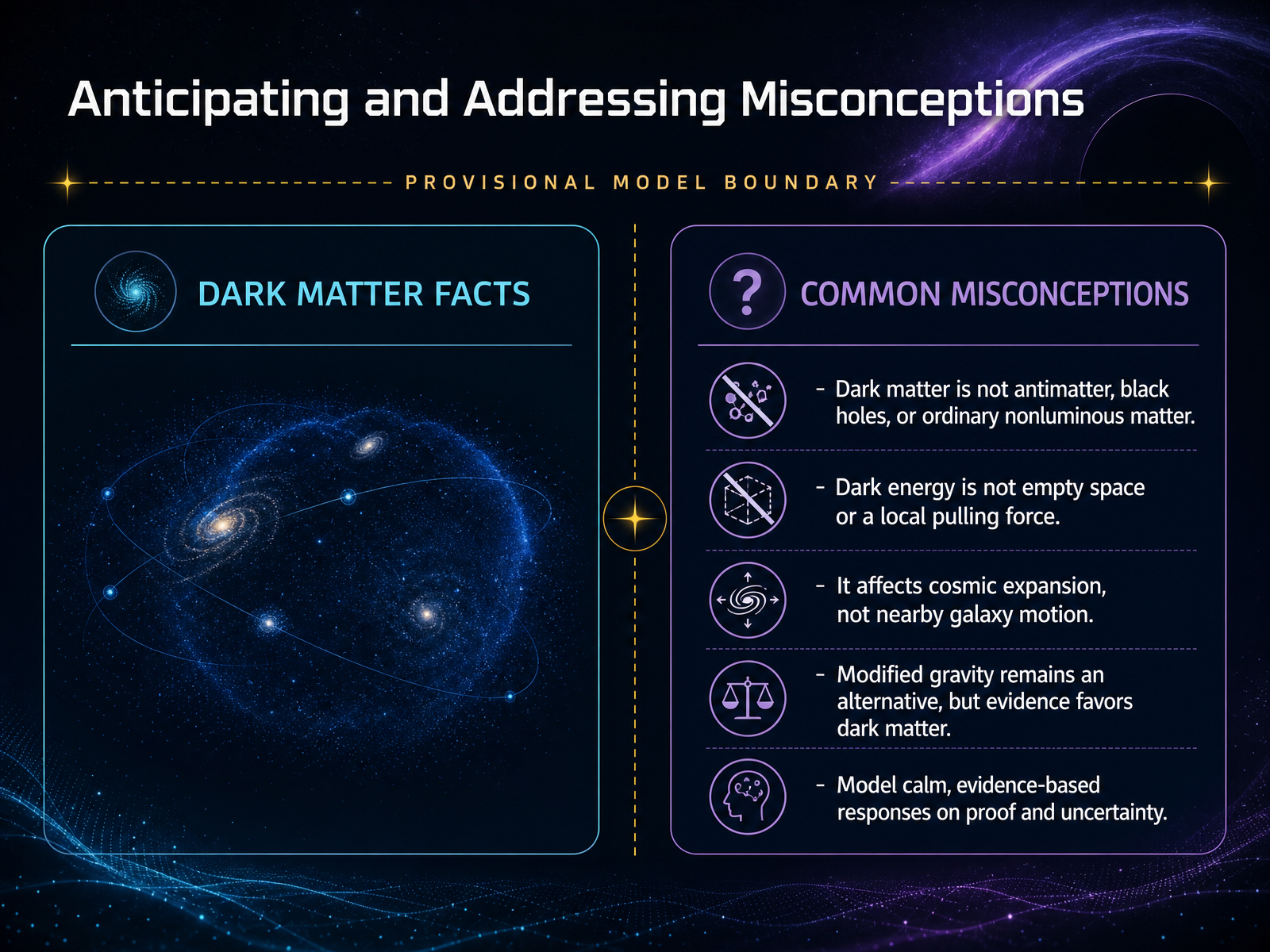
 - 10Anticipating and Addressing MisconceptionsLet's take a moment to clear up some common misconceptions, because the names themselves can be misleading. Dark matter is not antimatter, and it's not black holes. It is an invisible form of matter that we detect through gravity, but it is not just ordinary stuff that happens to be dark. Dark energy, on the other hand, is not a force pulling on nearby galaxies. It is a property of space that causes the expansion of the universe to speed up. This affects the very fabric of the cosmos, not the motion of local objects. Some scientists have proposed changing our theory of gravity, called modified gravity, as an alternative. While it is a valid line of inquiry, the evidence from colliding clusters strongly favors the existence of dark matter. When we teach this, it is powerful to show our own uncertainty, using evidence-based answers rather than just stating facts. Next, let's look ahead to the open questions and the next observatories.
 ned.ipac.caltech.eduscience.nasa.goviopscience.iop.org+22 min
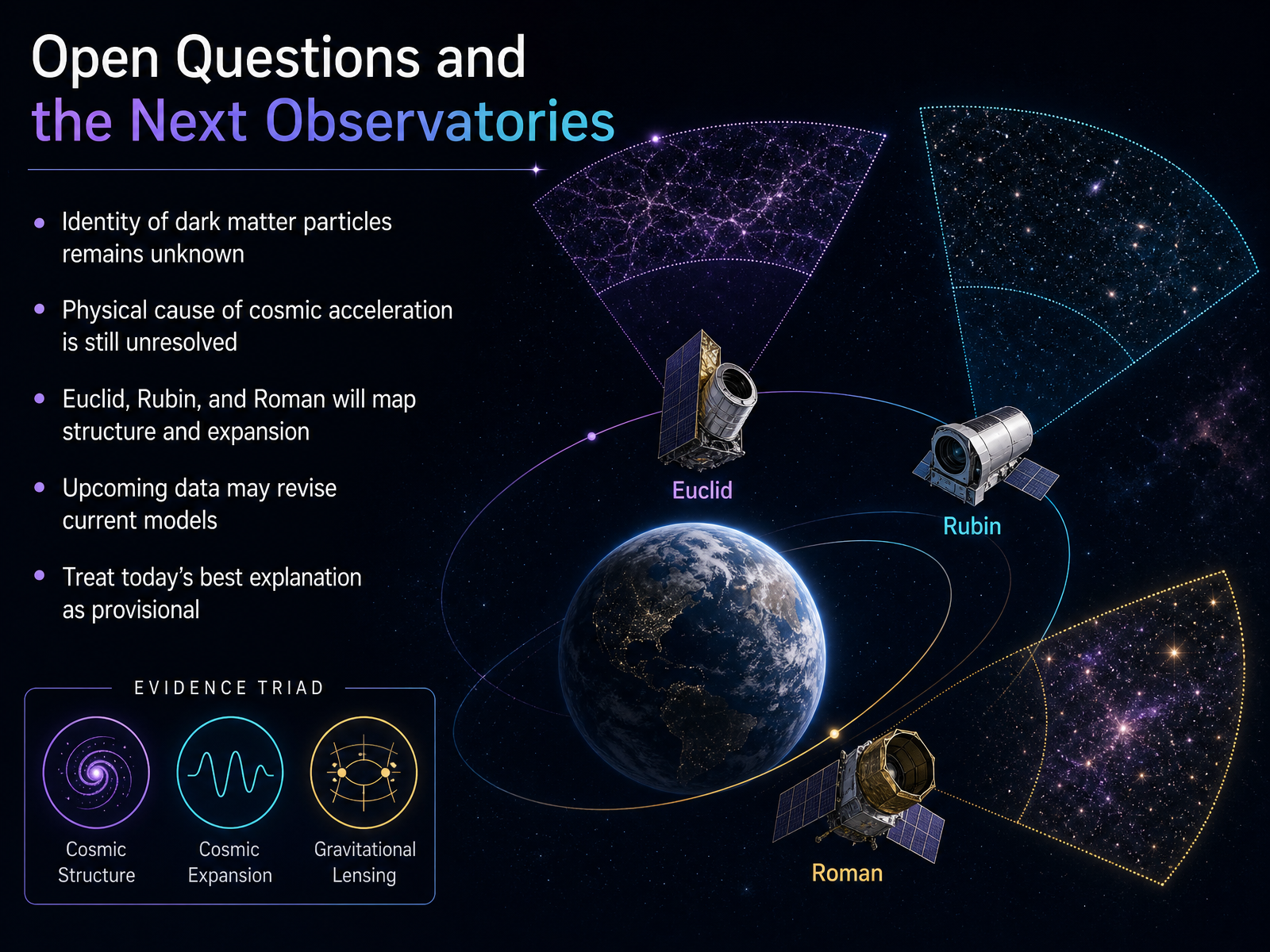
 - 11Open Questions and the Next ObservatoriesSo where does that leave us? The identity of dark matter particles is still unknown. No detector has yet captured a confirmed signal. And the physical cause of cosmic acceleration remains unresolved. Recent data even hint that dark energy may change over time, but the evidence is not yet strong enough to rewrite our models. New observatories are designed to change that. Euclid, the Rubin Observatory, and the Nancy Grace Roman telescope will map cosmic structure and expansion in far greater detail. Their data may confirm the standard picture, or it may force us to revise it. That is exactly how science should work. Treat today's best explanation as provisional, not final. Up next, we turn to a practical teaching and content roadmap.
 iopscience.iop.orgiopscience.iop.orgepjc.epj.org+21 min
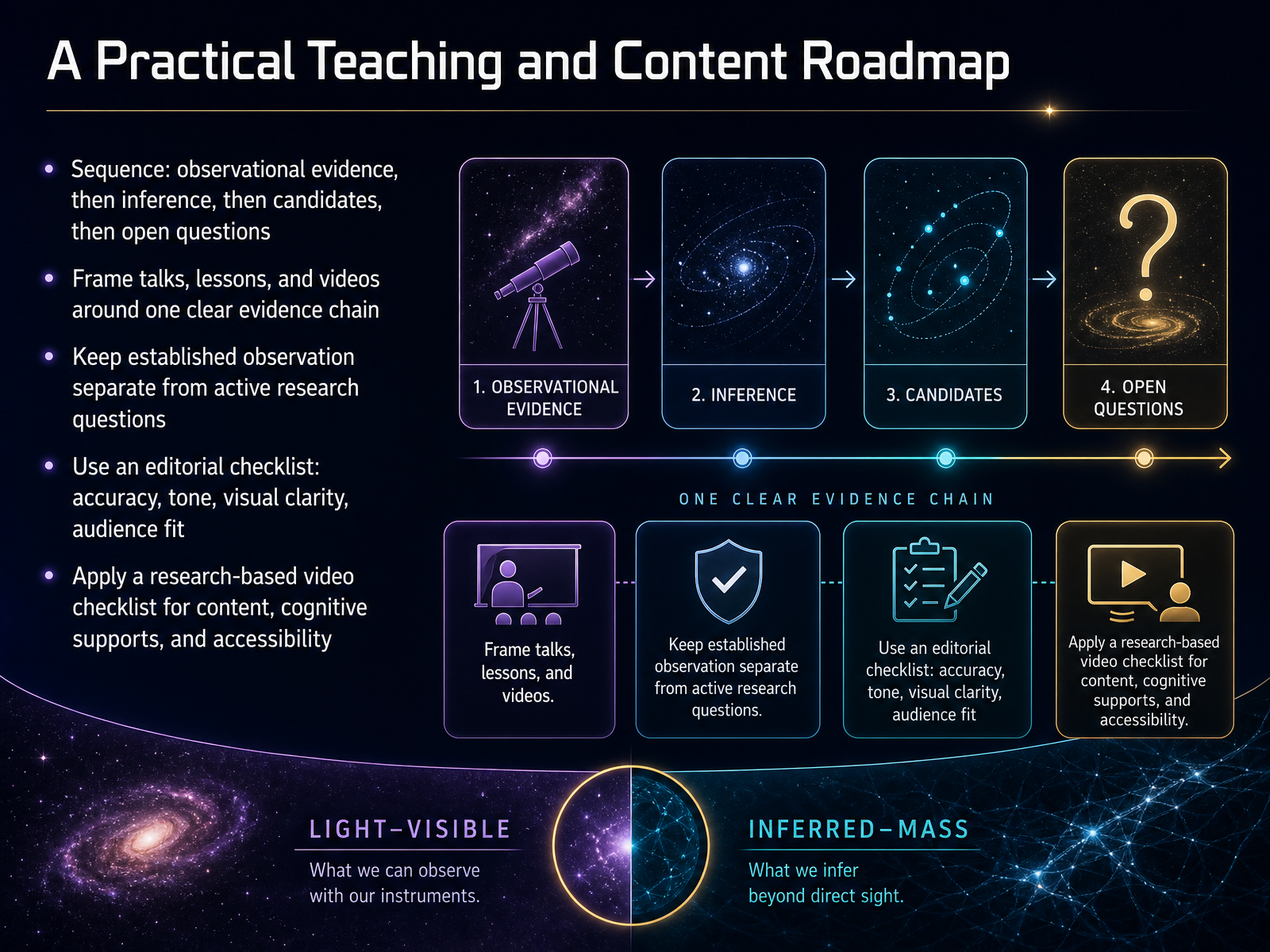
 - 12A Practical Teaching and Content RoadmapLet's turn this mystery into a practical teaching pathway. The strongest approach follows a clear sequence. Start with what we observe, like fast-moving galaxies or bent light. Then move to what we infer from those observations. Only after that should you introduce candidate explanations. Finally, leave room for the open questions. This keeps the evidence chain visible to your audience. When you build a talk or a video, frame it around that one chain. It gives learners a solid place to stand. Also, clearly separate well-established observations from active research questions. This simple boundary helps avoid confusion. Before you share, use a short editorial checklist. Check for accuracy, tone, visual clarity, and whether the material fits your audience. For video work, add a research-based checklist. Look at content, cognitive supports, and accessibility. Short segments, clear signals, and captions all help. With this roadmap, the science becomes easier to teach and easier to learn. Next, we will explore resources, updates, and where to learn more.
 jpl.nasa.govjpl.nasa.govimagine.gsfc.nasa.gov+22 min
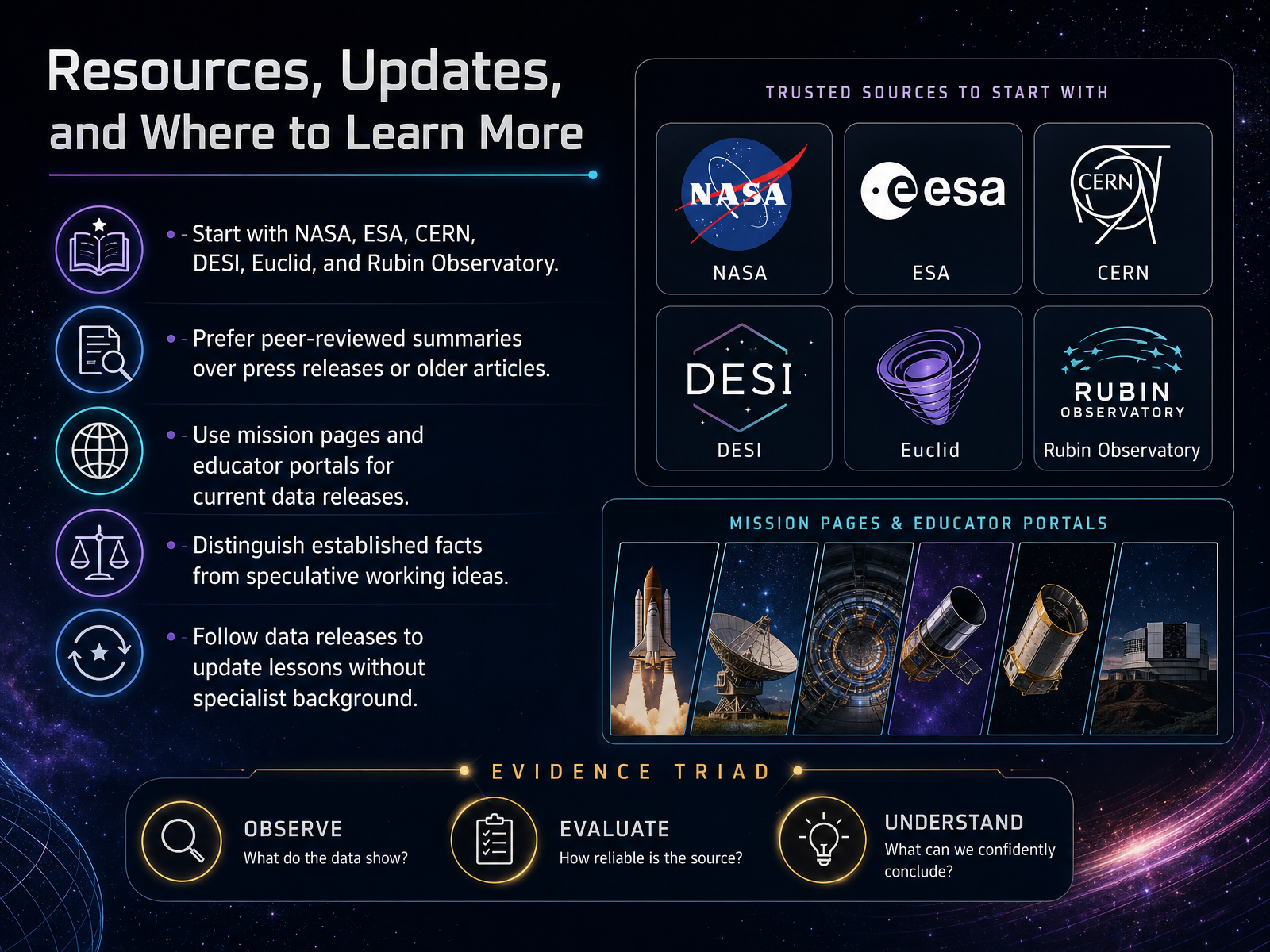
 - 13Resources, Updates, and Where to Learn MoreSo where should you turn when you want reliable, current information? Start with the major mission and observatory pages from NASA, the European Space Agency, CERN, D E S I, Euclid, and the Rubin Observatory. These are the places where new data releases and findings appear first. When you look deeper, prefer peer reviewed summaries over press releases or older articles. Science moves quickly here, and some early claims get revised. Use mission pages and educator portals for current data releases, because they often pair the data with explanations designed for teaching. As you build your own materials, make a clear distinction between established facts and speculative working ideas. For example, dark energy causing accelerated expansion is well supported. But claims that dark energy is evolving with time are still being tested. Following data releases lets you update your lessons without needing a specialist background. You simply check what has changed and bring that into your classroom. Next, we will pull this together with a short review and some practical next steps.
 jpl.nasa.govjpl.nasa.govimagine.gsfc.nasa.gov+21 min
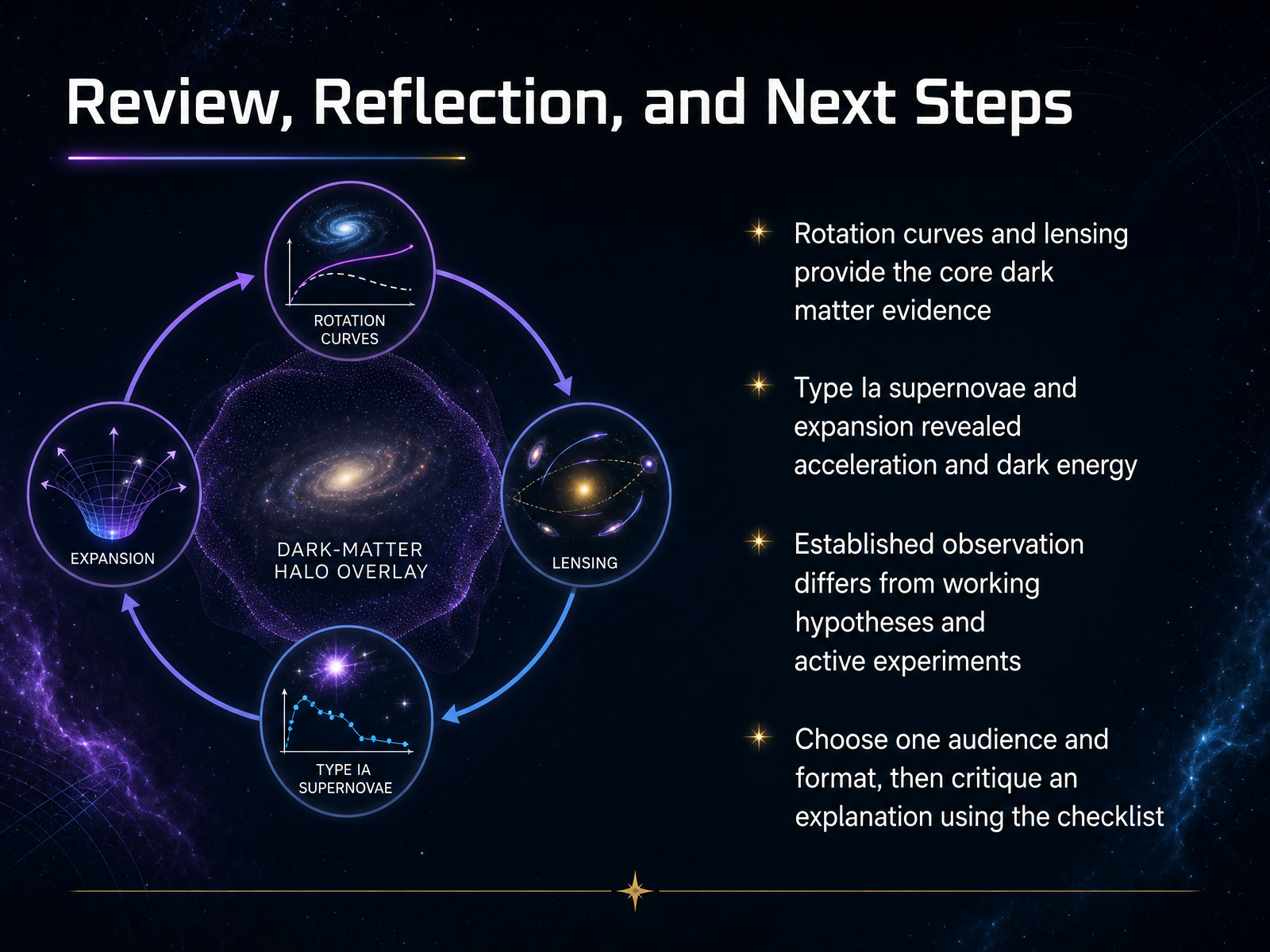
 - 14Review, Reflection, and Next StepsLet's bring the pieces together. We saw that galaxy rotation curves and gravitational lensing give us the strongest evidence for dark matter. We also saw that type Ia supernovae revealed an accelerating expansion, pointing directly to dark energy. Here is the key distinction to carry forward. What we directly observe is different from our working hypotheses and the active experiments now searching for answers. Your next step is a practical one. Choose one audience and one format, then critique an explanation using the checklist. Ask whether the concepts build logically, whether the visuals support the words, and whether the tone is clear and accessible. That single exercise will turn these ideas from something you understand into something you can teach. Thank you for working through this material. Stay curious, and keep looking for better questions.
 ned.ipac.caltech.eduscience.nasa.goviopscience.iop.org+21 min
Take the deck with you
Download this course as a file — free, no sign-up needed.
- PDF handoutEvery slide page, ready to print or share.15 pages · 4.4 MBDownload
- Narrated PowerPointThe deck that presents itself — every slide carries the digital human's narration video.15 pages · 15.1 MBDownload
- PowerPoint slidesThe full deck as a .pptx — open it in PowerPoint, Keynote, or Google Slides.15 pages · 4.4 MBDownload
Free to use in your own training — please keep the PersonWise credit page at the end.
Have your own deck? Turn it into a course
Sources consulted
Web sources consulted while building this course.
- Dark Energy in the DESI Era: A Brief Review of Evidence, Beyond-ΛCDM Interpretations, and Tensions - IOPscience — iopscience.iop.org
- New insights into dark energy from DESI DR2 with CMB and SNIa - IOPscience — iopscience.iop.org
- Revisiting the equation of state of dark energy from DESI BAO with SNe Ia and CMB | The European Physical Journal C (EPJ C) — epjc.epj.org
- Dynamical Dark Energy and the Unresolved Hubble Tension: Multi-model Constraints from DESI 2025 and Other Probes - IOPscience — iopscience.iop.org
- DESI Reaches Mapping Milestone, Surpassing Expectations — desi.lbl.gov
- Dark Matter in Galaxies and Clusters — ned.ipac.caltech.edu
- Dark Matter - NASA Science — science.nasa.gov
- A Direct Empirical Proof of the Existence of Dark Matter - IOPscience — iopscience.iop.org
- DISENTANGLING BARYONS AND DARK MATTER IN THE SPIRAL GRAVITATIONAL LENS B1933+503 - IOPscience — iopscience.iop.org
- Observational evidence of evolving dark matter profiles at z ≤ 1 | Astronomy & Astrophysics (A&A) — aanda.org
- Status and perspectives of Direct Dark Matter searches — indico.in2p3.fr
- Progress and prospects in the underground laboratories' search ... — nature.com
- Dark matter direct detection: status, results and future plans - arXiv — arxiv.org
- jmonroe_IDM_2026-v2-updated — indico.capa.unizar.es
- The SuperCDMS SNOLAB experiment_mwilson_20260729 — indico.global
- Exploring the Mystery of Our Expanding Universe – Teachable Moment | NASA JPL Education — jpl.nasa.gov
- Model the Expanding Universe – Science Lesson | NASA JPL Education — jpl.nasa.gov
- Cosmic Times — imagine.gsfc.nasa.gov
- Helping Audiences Learn About Dark Energy and Dark Matter | NASA's UoL — universe-of-learning.org
- For Educators - NASA — nasa.gov