Root Cause Analysis for Teams
Begin
13 pages · ~26 min
Root Cause Analysis for Teams
A training for teams on identifying and addressing the root causes of problems to prevent recurrence and improve processes.
What you’ll learn
- 01Root Cause Analysis for Teams: From Recurring Symptoms to Verifiable CausesWelcome. I'm glad you're here. Over the next few sessions, we're going to tackle something every team faces: problems that keep coming back. This course is called Root Cause Analysis for Teams, and our goal is straightforward. Together, we'll move from chasing recurring symptoms to uncovering the verifiable causes behind them. You know those issues that seem solved, only to reappear a week later? That's exactly what we'll learn to stop. We'll start by building a shared investigative language and a foundation in diagnostic rigor. From there, we'll explore practical analysis tools, walk through how to verify causes with evidence, and then apply everything to real situations you recognize. All of the techniques we cover are grounded in up-to-date practice and evidence standards as of July 2026. By the end, you and your team will have a reliable, repeatable way to uncover what's truly driving problems, and then fix them for good. Let's get started. Next, we'll look at the high price of solving symptoms instead of causes.asq.org6sigma.usbecht.com+22 min
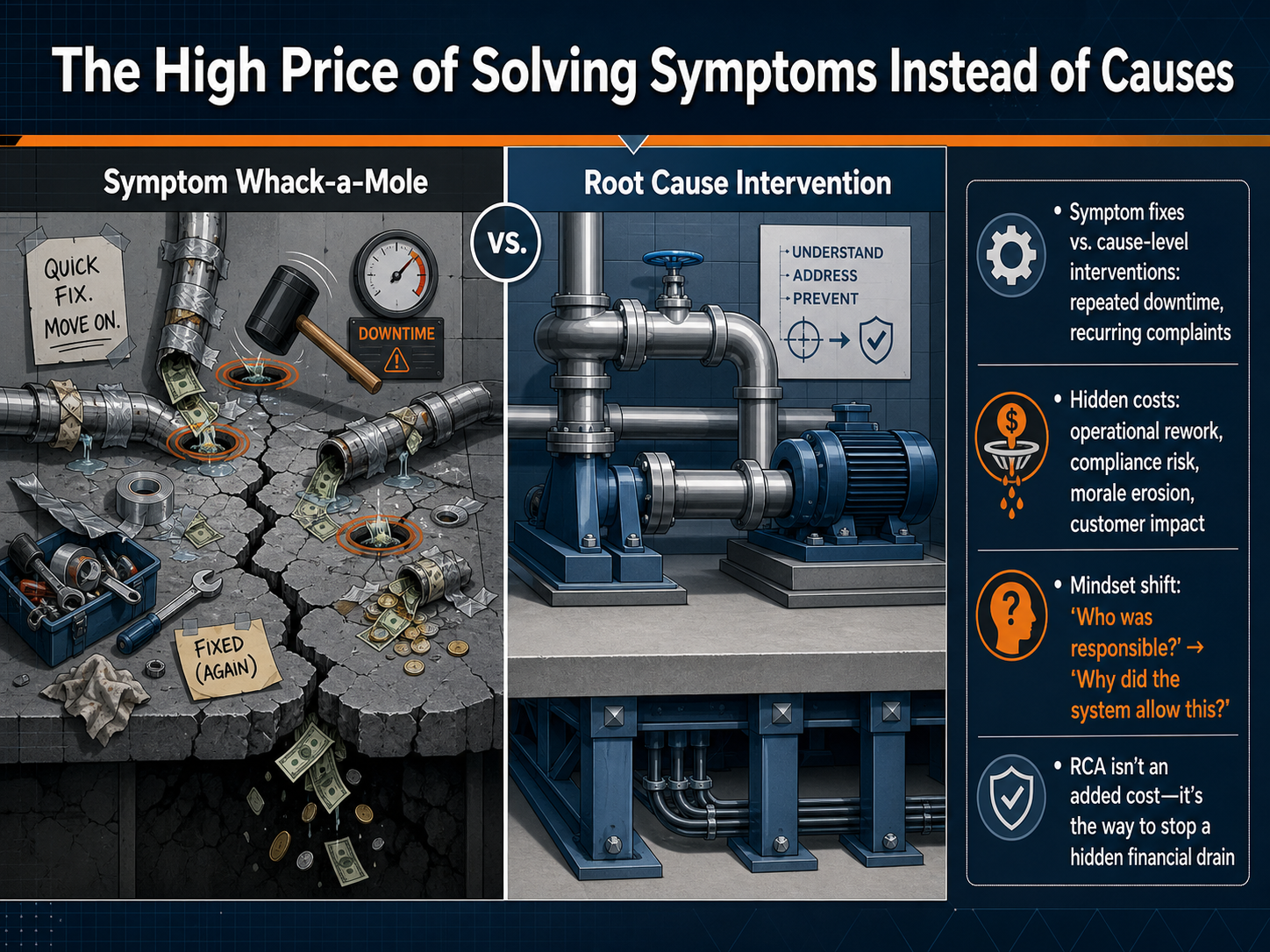
- 02The High Price of Solving Symptoms Instead of CausesNow let's get concrete about the price of solving symptoms instead of causes. When equipment keeps failing or the same complaint keeps showing up, we're often stuck in a cycle of symptom fixes—resetting a tripped conveyor, reissuing a work order, apologizing to a customer. Those feel necessary in the moment, but they don't stop the next occurrence. In reality, research shows the cost of poor quality can eat fifteen to twenty percent of sales revenue in many sectors. The hidden costs go deeper: operational rework piles up, compliance risk increases, team morale erodes when people get tired of fixing the same thing, and customers lose trust. The mindset shift is simple but powerful. Instead of asking “Who was responsible?” we start asking “Why did the system allow this to happen?” A single chronic failure—like a fifteen-minute conveyor trip that happens forty times a week—can quietly drain over two and a half million dollars a year. Root cause analysis isn't an added cost. It's the way to stop a hidden financial drain that's already in your budget. Next, we'll build the foundation for that approach in RCA Foundations: Cause, Mechanism, and Evidence.
 etq.comreliamag.comwhytrace.com+22 min
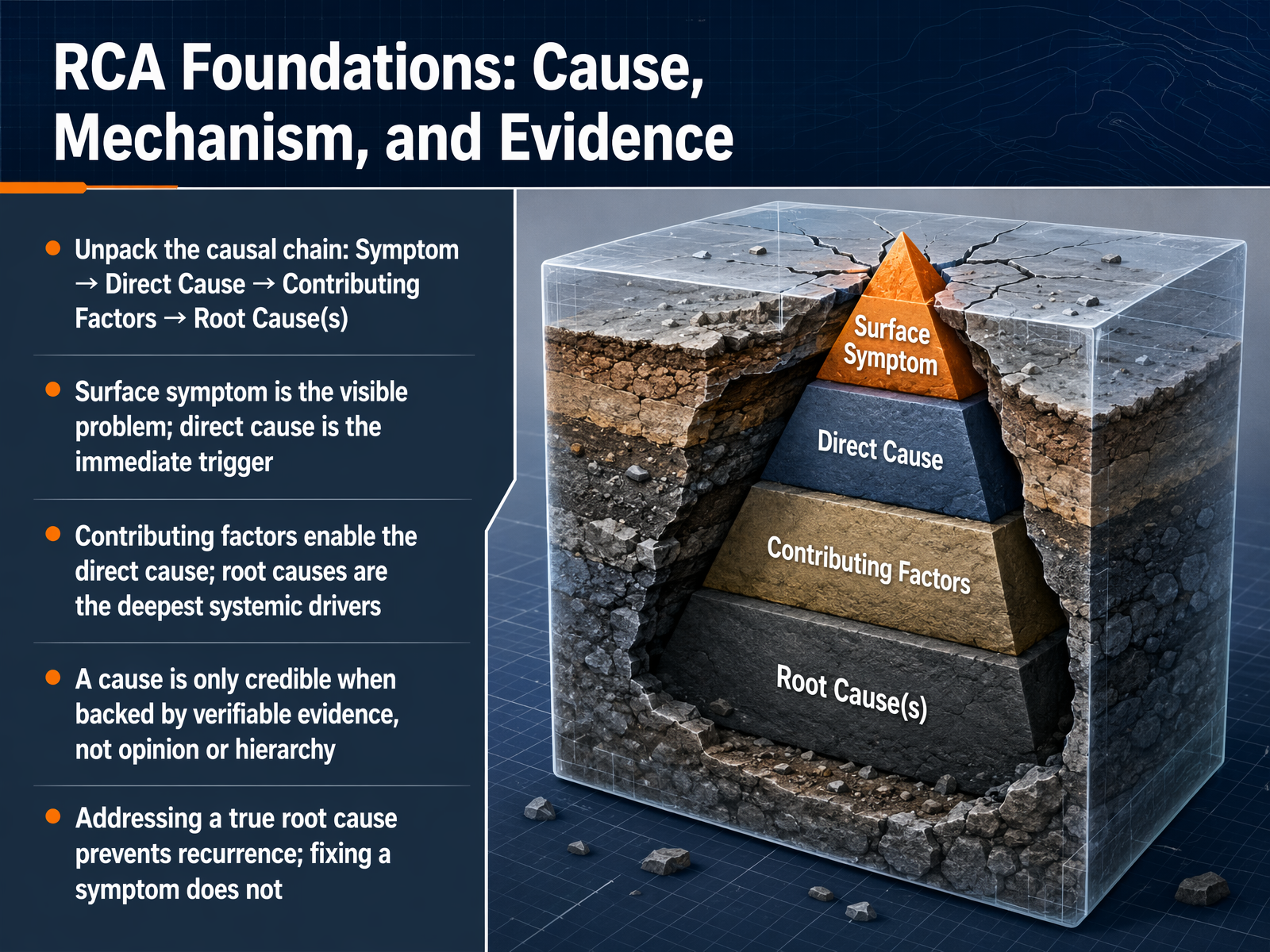
 - 03RCA Foundations: Cause, Mechanism, and EvidenceWhen teams hear 'root cause,' they often picture a single, elusive answer at the bottom of a deep well. In practice, what we are really unpacking is a causal chain. Think of it as four connected links. First, the surface symptom: the visible problem that grabbed your attention, like a recurring batch defect or a missed deadline. Second, the direct cause: the immediate trigger that set the problem in motion. Third, contributing factors: the conditions that allowed that trigger to have an impact, like an unclear handoff or an outdated checklist. Finally, the root cause: the deepest systemic driver. The key rule here is that a cause is only credible when you can back it up with verifiable evidence, not just strong opinions or the loudest voice in the room. This distinction matters for one practical reason: if you only fix the symptom, the problem almost always returns. But when you act on a true root cause, you prevent recurrence. Let's apply this logic in our next step, where we'll focus on framing the problem clearly before we start analyzing it.
 asq.orgcms.goven.wikipedia.org+22 min
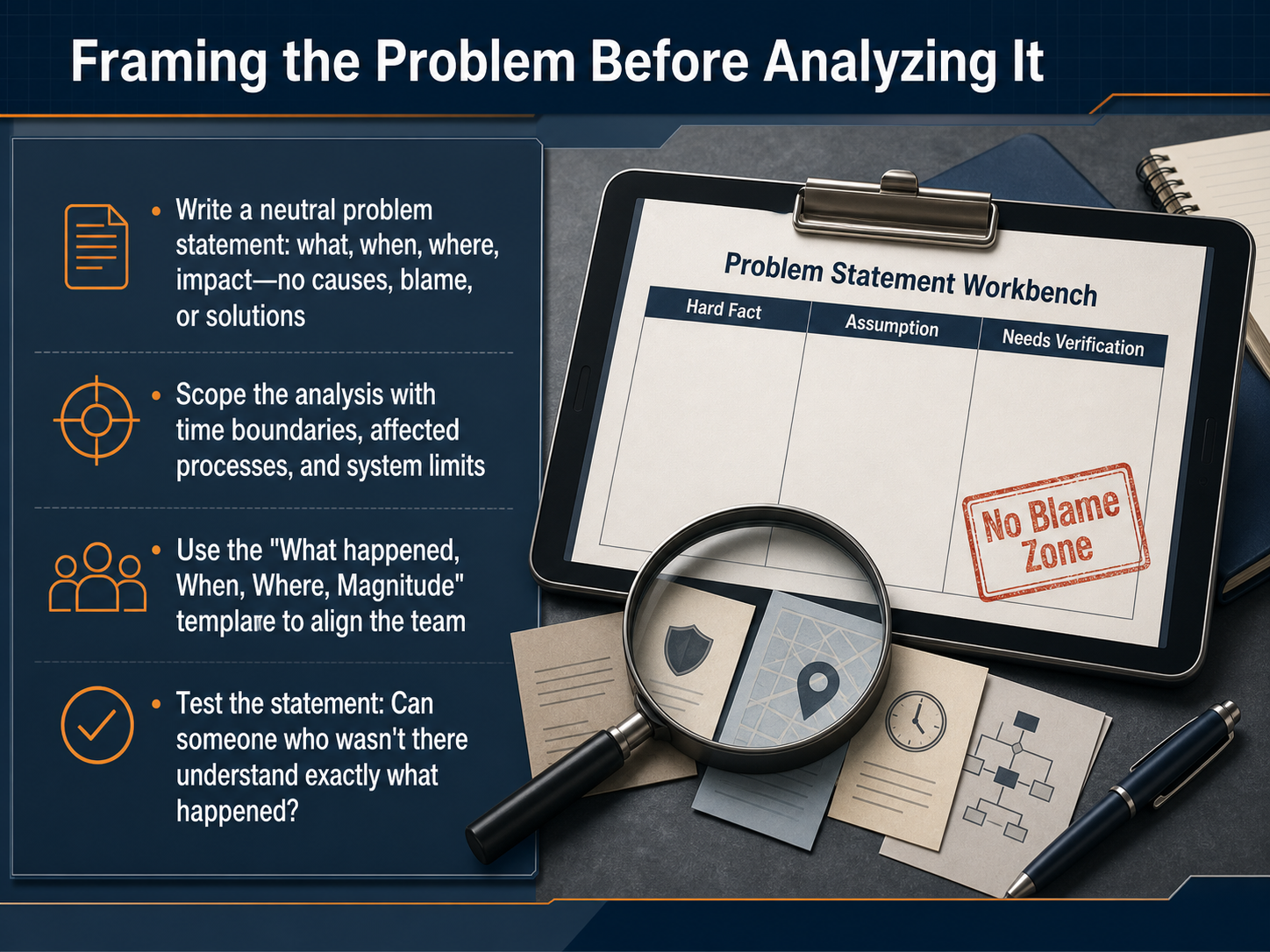
 - 04Framing the Problem Before Analyzing ItLet's talk about framing the problem before you analyze it. This is the step where you define exactly what happened, so the whole team starts from the same point. Write a neutral problem statement that answers four questions: what happened, when it happened, where it happened, and the measurable impact. For example, instead of saying 'the checkout process is broken,' you might say, 'On March fifth, between two and three PM, the checkout service returned errors for two thousand three hundred customers, blocking an estimated eighteen thousand dollars in transactions.' Notice there is no cause, no blame, and no solution in that sentence. It is purely factual. Next, scope the analysis by setting clear boundaries: define the time window, the affected processes, and the system limits. A simple template is 'What happened, When, Where, and Magnitude.' This aligns everyone quickly. Finally, test your statement: if you read it to someone who wasn't there, can they understand exactly what occurred without asking follow-up questions? If they can, your problem statement is ready. Once your team agrees on a solid frame, you can start the real work of backward mapping, moving from the visible event to the hidden triggers that caused it.
 5xwhys.comsologic.comretrium.com+22 min
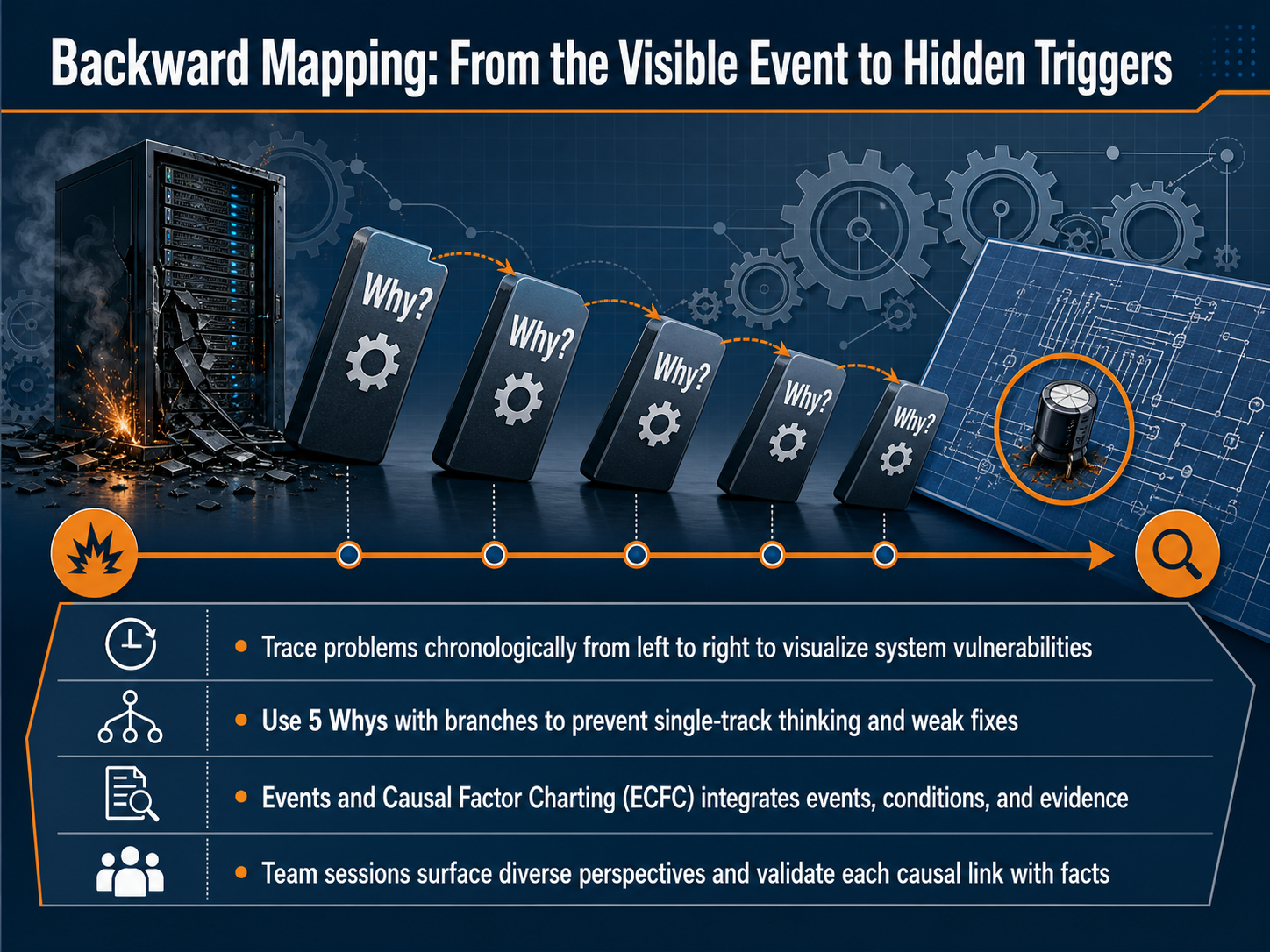
 - 05Backward Mapping: From the Visible Event to Hidden TriggersNow let's bring these ideas together with a practical tool: backward mapping from the visible event to its hidden triggers. Think of a problem you've seen before—maybe a recurring delay or a quality escape. Backward mapping helps you lay out the whole sequence, left to right, so the team can spot exactly where the system was vulnerable. We use the 5 Whys, but here's the key: we branch the questions. If you ask a single, straight-line why chain, you risk a weak fix that only addresses one path. Branching reveals multiple conditions that had to be true at the same time. To capture this visually, many teams use Events and Causal Factor Charting—or E C F C. It integrates actions, conditions, and the evidence that backs them up. The primary event line runs horizontally, with contributing conditions placed above or below, all tied to verified facts. When you build this chart together, different perspectives surface assumptions you didn't know you had and force you to validate every causal link with data. What you get is a shared, fact-based map that replaces opinions with logic. Next, we'll widen the lens and examine systemic factors across process, people, equipment, and environment.
 asq.orgcms.goven.wikipedia.org+22 min
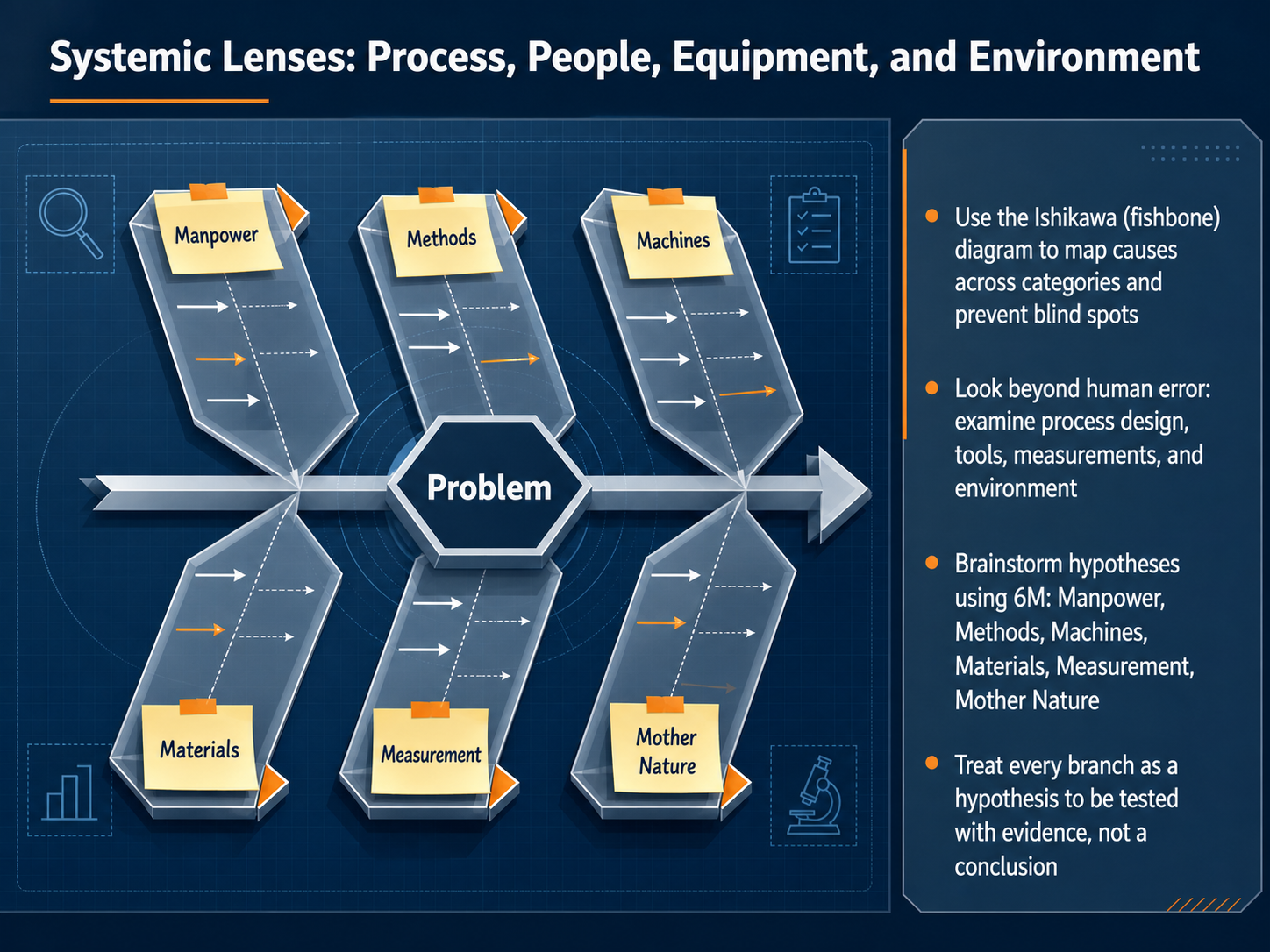
 - 06Systemic Lenses: Process, People, Equipment, and EnvironmentNow we look through systemic lenses to map our causes: process, people, equipment, and environment. The tool for this is the Ishikawa diagram, or fishbone diagram. Picture a fish skeleton where the head is our problem, and the bones branching from the spine are categories of causes. This visual structure prevents blind spots by forcing us to examine every dimension of the failure, not just the most obvious technical trigger. We use the six M categories as a starting framework: Manpower, Methods, Machines, Materials, Measurement, and Mother Nature for the environment. As we brainstorm, we treat every contribution added to a branch as a hypothesis to be tested with evidence. We are not drawing conclusions yet. Asking 'why did the training fail?' is more useful than simply labeling a branch 'training.' This collaborative mapping shows us which categories have the most contributing factors so we know where to focus our deeper investigation. Next, we will move from mapping to verification, separating plausible stories from proven causes.
 2 min
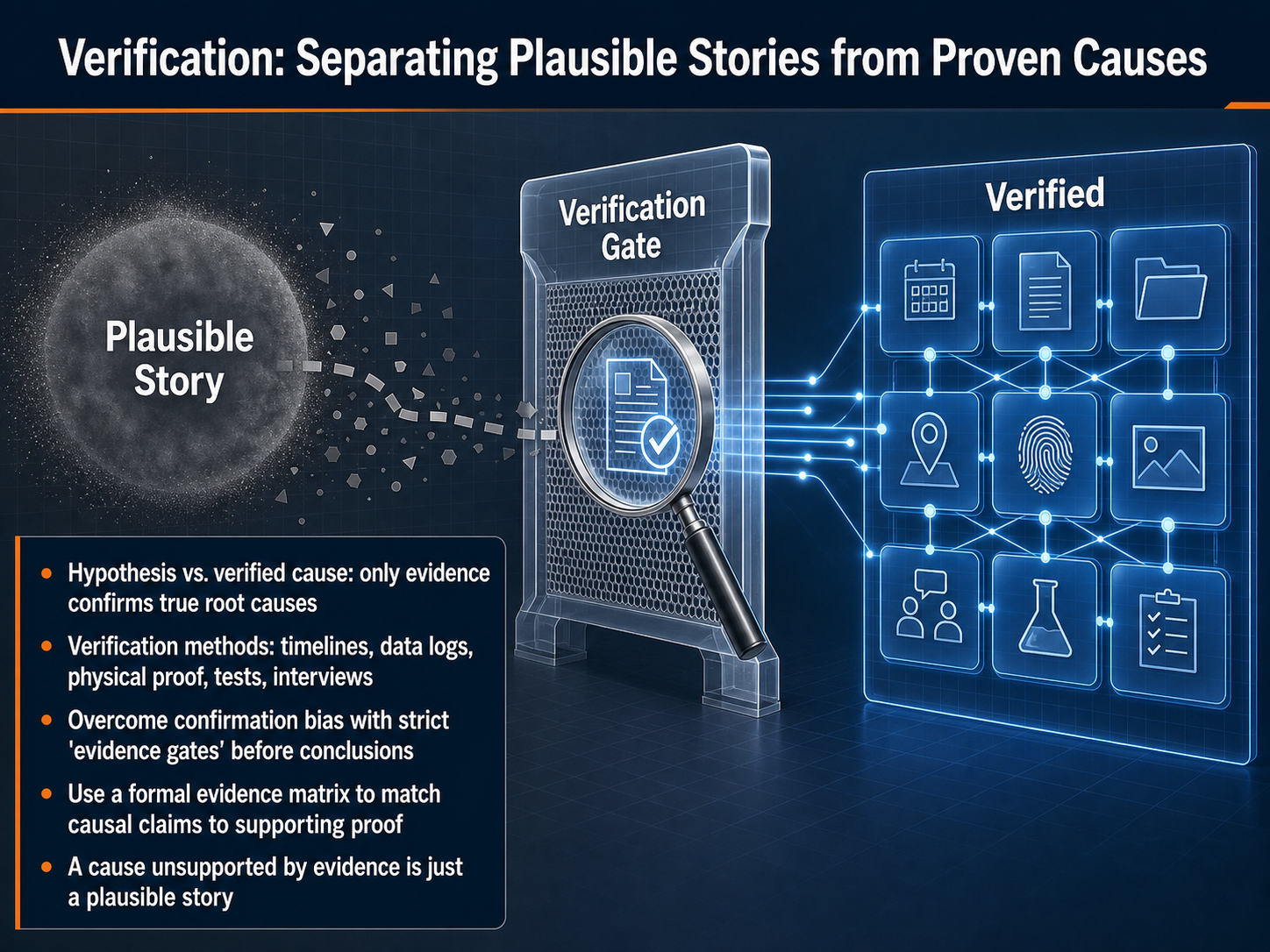
2 min - 07Verification: Separating Plausible Stories from Proven CausesA hypothesis is a plausible story about what might have caused a problem—but a verified cause is a completely different thing. Only evidence confirms the true root causes. So think of this as separating good hunches from proven facts. How do you get that proof? You use verification methods: build a precise timeline of events, pull data logs, locate physical evidence, run a targeted test, or conduct a structured interview. But here’s the trap: our brains naturally prefer evidence that matches our early guesses. That’s confirmation bias. To overcome it, install strict evidence gates. Make your team ask, “What would prove us wrong?” before accepting a conclusion. Use a formal evidence matrix to match every causal claim to its supporting proof. If a cause claims that a procedure was outdated, link it directly to a version date or a timestamped log showing it wasn't followed. A cause unsupported by any verifiable evidence is not a cause at all—it’s just a plausible story. Let’s take this logic into our next topic, where we’ll explore navigating cognitive bias in team investigations.
 asq.orgcms.goven.wikipedia.org+22 min
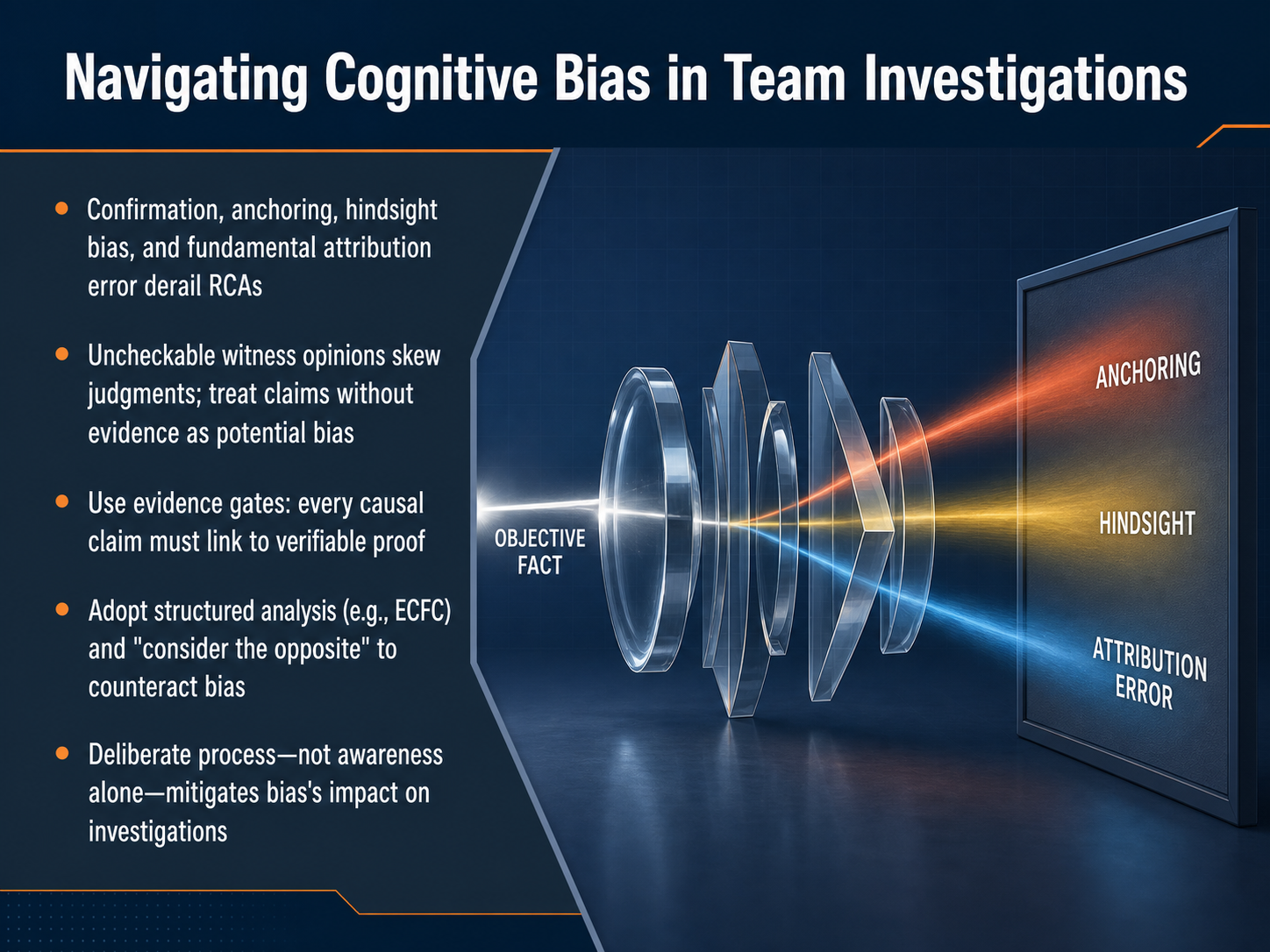
 - 08Navigating Cognitive Bias in Team InvestigationsLet's talk about something that quietly shapes every investigation: cognitive bias. Four biases trip up teams the most. Confirmation bias makes us favor evidence that supports our early hunch. Anchoring bias locks us onto the first piece of information we receive. Hindsight bias tricks us into thinking the incident was predictable all along. And fundamental attribution error pushes us to blame a person's character while ignoring the situation they were in. These aren't signs of carelessness, they're just how our minds work. The real risk comes from uncheckable witness opinions. A statement like 'he's always sloppy' feels revealing, but it's just a value judgment. It has no specific details you can verify. Treat claims without evidence as potential bias, not fact. To counter this, use evidence gates. Every causal claim must link to verifiable proof. Adopt a structured analysis method like E C F C and deliberately practice 'consider the opposite.' Ask the team, what would prove this wrong? Awareness alone won't protect you. A deliberate, structured process will. Let's take the disciplined causes we identify here and turn them into corrective and preventive actions that stick.
 2 min
2 min - 09From Root Causes to Corrective and Preventive ActionsNow, let's move from verified causes to meaningful action. The purpose of every root cause analysis is to drive corrective and preventive actions that stick. Start by translating each verified root cause into a smart corrective action—one that is specific, measurable, achievable, relevant, and time-bound. Remember to distinguish between short-term containment, which stops the immediate bleed, long-term corrective actions that fix the underlying process, and preventive measures that keep the problem from spreading to similar areas. When you prioritize solutions, use the hierarchy of controls. Elimination, substitution, and engineering controls are more sustainable than relying on procedures or training alone. Then, close the investigation loop by assigning a clear owner and a deadline for every action. A strong action plan addresses the true root cause, is sustainable under real operating conditions, and does not introduce new risks. Let's shift now to verifying effectiveness and answering the question: did the fix really work?
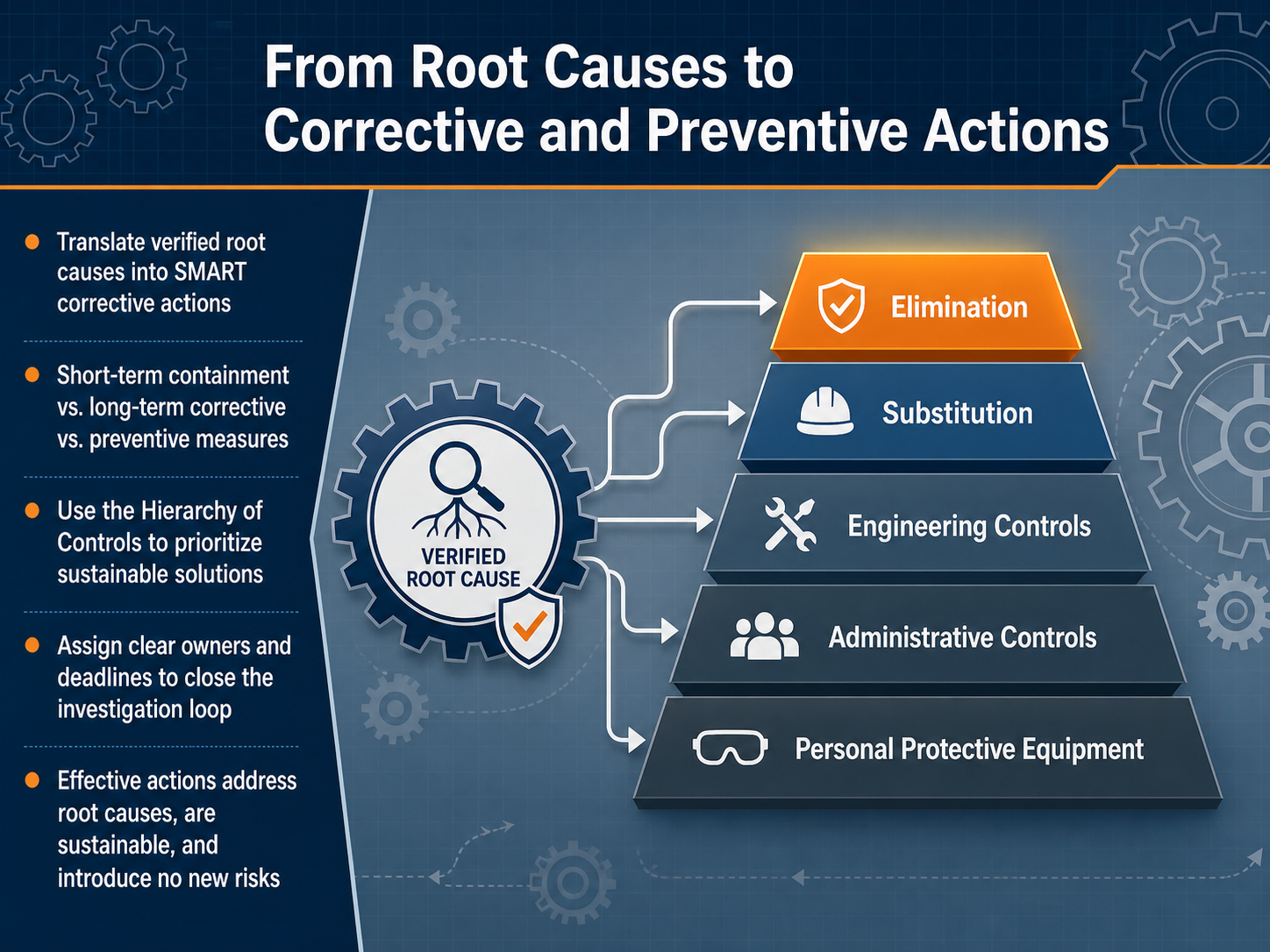 asq.orgcms.goven.wikipedia.org+22 min
 - 10Verifying Effectiveness: Did the Fix Really Work?Now we turn to a critical question: did the fix actually work? Implementation does not equal effectiveness. Just because we completed an action does not mean we've reduced the risk. To know for sure, we need a verification plan. Start by defining both leading and lagging metrics that will tell you if the solution is taking hold. Combine those with audits and direct field observation to see what is really happening. Next, establish a monitoring period and agree on objective criteria that say, yes, this problem is solved. If the evidence shows the solution is not working, do not guess again. Loop back. Reassess the accuracy of your root cause and the design of your solution. This closed-loop discipline is what turns a one-time fix into lasting prevention. Let's carry that discipline forward by exploring how we build a team-based RCA culture.
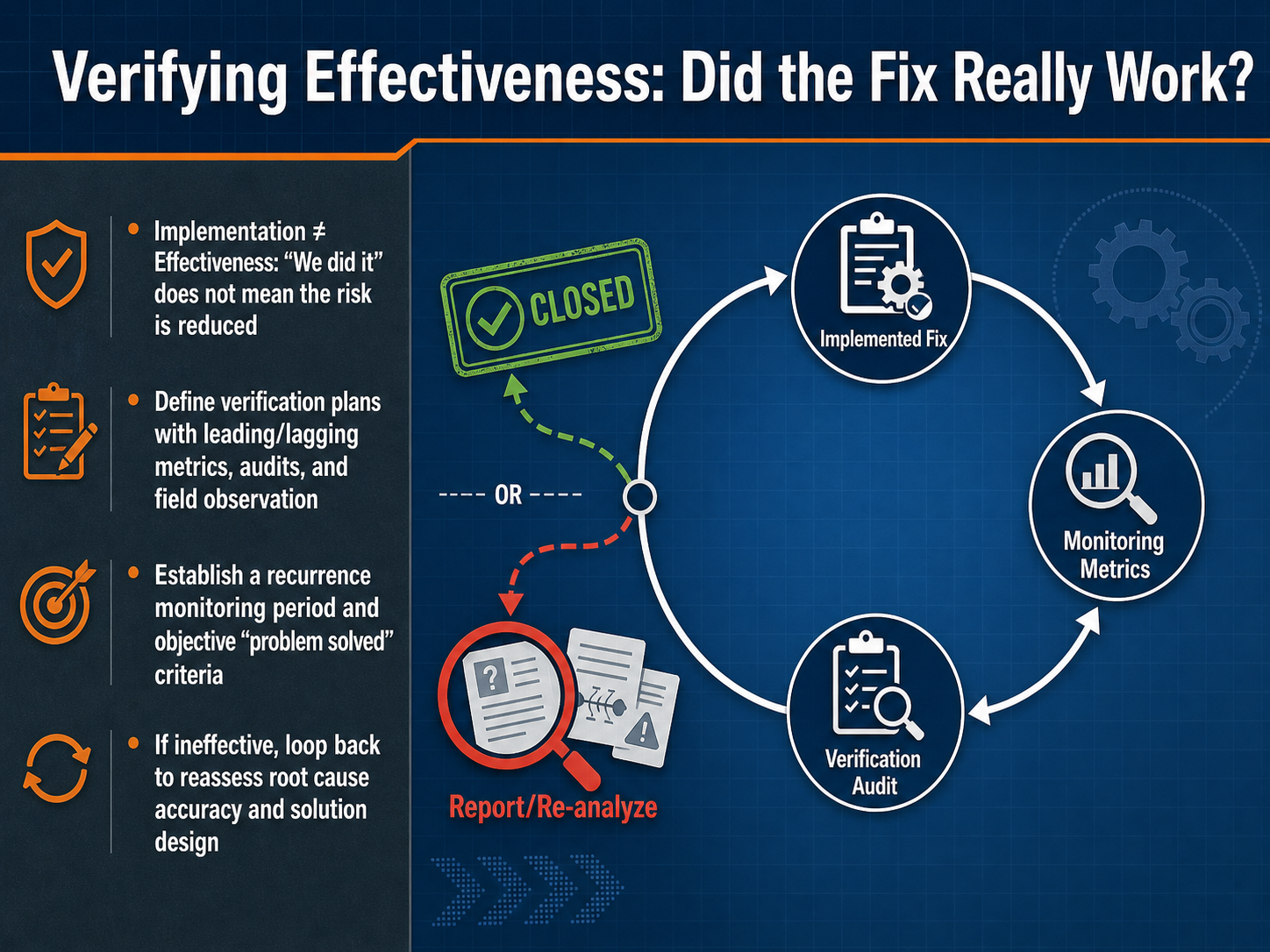 asq.orgcms.goven.wikipedia.org+21 min
 - 11Building a Team-Based RCA CultureNow let's turn our culture into something that makes this work sustainable. Building a team-based RCA culture starts with defining four key roles. First is the facilitator, who guides the process without driving a personal agenda. Next is the sponsor, a leader who removes roadblocks and authorizes resources. You also need subject matter experts who bring deep process knowledge, and administrative support to handle documentation and logistics. With these roles clear, we must actively build a blame-free, 'just culture.' Our focus is on system vulnerabilities, not individual fault. To counteract bias, we use structured communication like pre-scripted meetings and evidence matrices. These tools keep every conversation grounded in facts, not assumptions. Finally, we deliberately leverage diverse team perspectives. When you include operations, engineering, and quality together, you enrich the causal map and catch things any single viewpoint would miss. Culture isn't an accident; it's what you consistently design and protect.
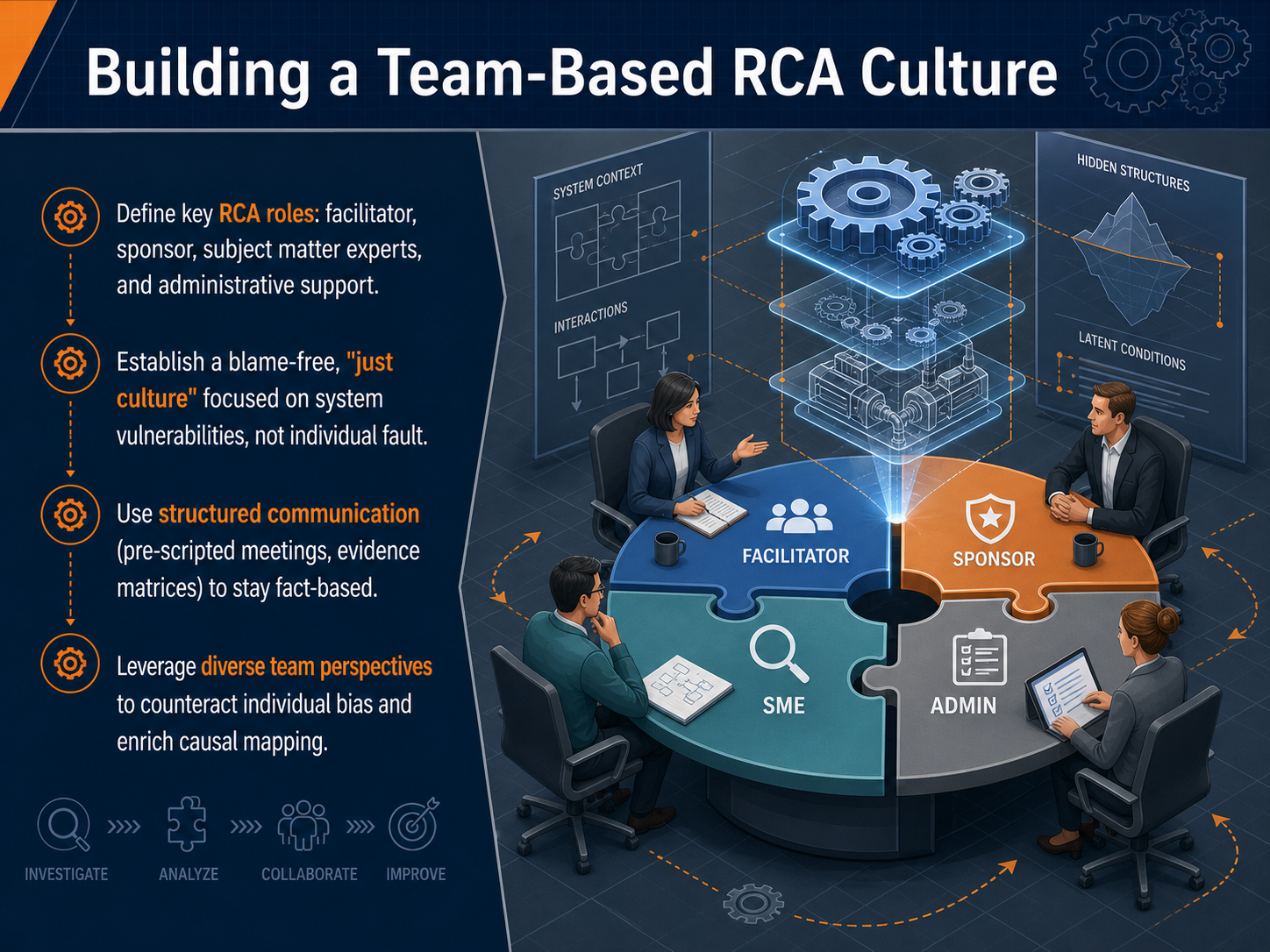 asq.org6sigma.usbecht.com+22 min
 - 12Communicating Findings and Driving Organizational LearningYour investigation is only as valuable as your ability to share what you learned. Structuring your report is the first step. Start by defining the problem, then present the evidence, the causal chart, and finally, the action and verification plan. This logical flow builds credibility. Next, adjust how you present the causal logic. The frontline needs the practical story of what happened, leadership needs the systemic impact, and technical teams need the logic to be bulletproof. Tailoring the message ensures everyone can act. Once the RCA is complete, don't just file it away. Store it in a searchable knowledge base. This prevents the team from paying the high cost of re-learning the same lesson on a future project. Even better, aggregate your past RCAs. Scanning across multiple reports reveals systemic trends. This shifts the team from reactive firefighting to launching proactive, enterprise-wide improvements.
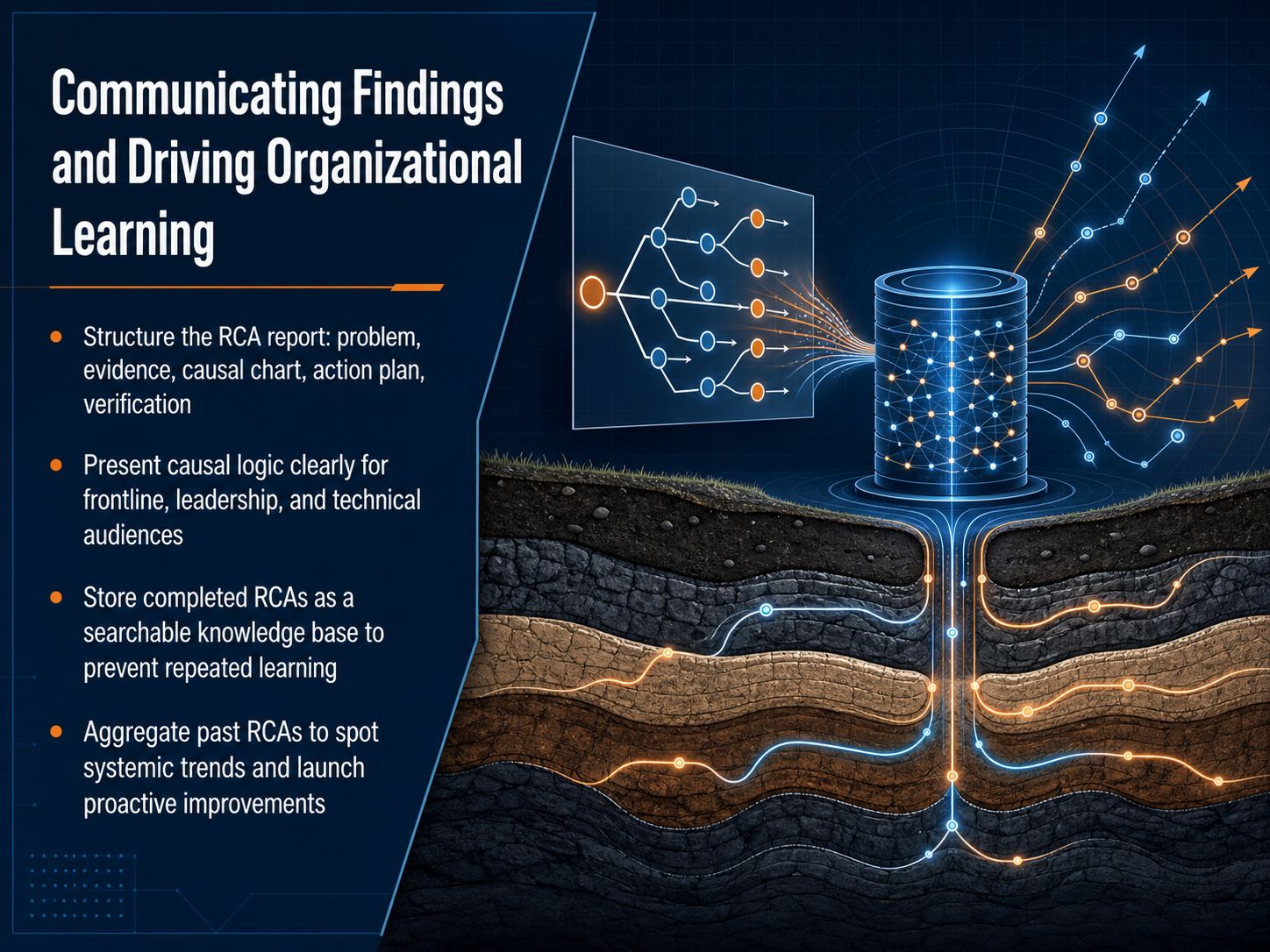 asq.org6sigma.usbecht.com+21 min
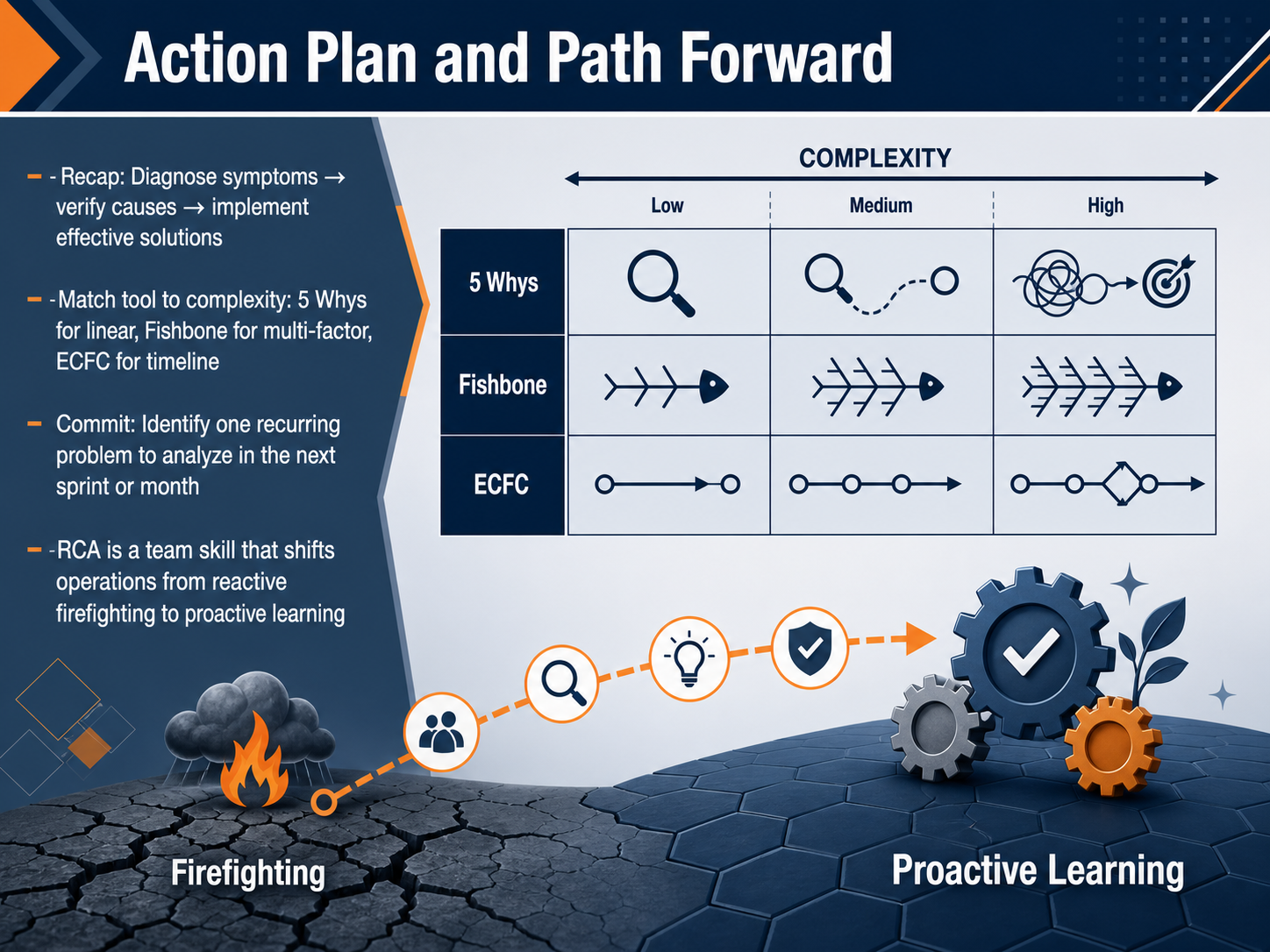
 - 13Action Plan and Path ForwardLet's bring everything together and look at your path forward. The core loop of root cause analysis is straightforward: diagnose the symptoms, verify the actual causes, and then implement solutions that stick. You've learned that matching the right tool to your problem's complexity makes all the difference. When you're facing a linear chain of events, reach for the Five Whys. When multiple factors from people, process, and technology are tangled together, the Fishbone diagram is your map. And when you need to sequence events over time, the Events and Causal Factors Chart keeps your investigation on track. Here is your immediate commitment: before you leave today, identify one recurring problem your team will analyze in the next sprint or month, starting with a clear, factual problem statement. Remember, RCA is a team skill. Every investigation you run shifts your operations away from reactive firefighting and toward a culture of proactive learning. Thank you for your time and focus. Go make your work more reliable, one verified cause at a time.
 5xwhys.comsologic.comretrium.com+22 min
Take the deck with you
Download this course as a file — free, no sign-up needed.
- PDF handoutEvery slide page, ready to print or share.14 pages · 4.3 MBDownload
- Narrated PowerPointThe deck that presents itself — every slide carries the digital human's narration video.14 pages · 13.1 MBDownload
- PowerPoint slidesThe full deck as a .pptx — open it in PowerPoint, Keynote, or Google Slides.14 pages · 4.2 MBDownload
Free to use in your own training — please keep the PersonWise credit page at the end.
Have your own deck? Turn it into a course
Sources consulted
Web sources consulted while building this course.
- Root Cause Analysis - Training — asq.org
- Root Cause Analysis (RCA) Training | SixSigma.us — 6sigma.us
- Root Cause Analysis Training Workshop — becht.com
- Root Cause Analysis 2025 | College of American Pathologists — education.cap.org
- Problem Solving with Root Cause Analysis (RCA) Training Course — nobleprog.be
- The True Business Impact of RCA Findings: Beyond the Factory Floor - ETQ — etq.com
- How to Prevent Root Cause Analysis from Becoming a Money Pit — reliamag.com
- The Cost of Unresolved Incidents: Building the Business Case for RCA Software | WhyTrace Plus Blog | WhyTrace Plus — whytrace.com
- Root Cause Analysis: Solving Problems at Their Source — brightmetrics.com
- What Are The Potential Drawbacks Of Not Conducting Root Cause Analysis? | StrategicLeadersConsulting — strategicleadersconsulting.com
- What is Root Cause Analysis (RCA)? — asq.org
- Guidance for Performing Root Cause Analysis (RCA) with PIPs — cms.gov
- Root-cause analysis — en.wikipedia.org
- INTERNATIONAL — elstandard.se
- 8D RCCA PROBLEM SOLVING GUIDEBOOK — sp-i.org
- How to Write a Problem Statement for RCA (2026) — 5xwhys.com
- How to Write a Root Cause Analysis Problem Statement — sologic.com
- How to write a problem statement for root cause analysis — retrium.com
- Defining a Problem Statement for Root Cause Analysis — skills.visual-paradigm.com
- How to Write an Effective Problem Description: A Complete Guide to Root Cause Analysis - Lean 6 Sigma Hub — lean6sigmahub.com