Marketing Analytics Roadmap
Begin
13 pages · ~26 min
Marketing Analytics Roadmap
This training helps marketing teams prioritize analytics initiatives, define milestones, and communicate progress to stakeholders effectively.
What you’ll learn
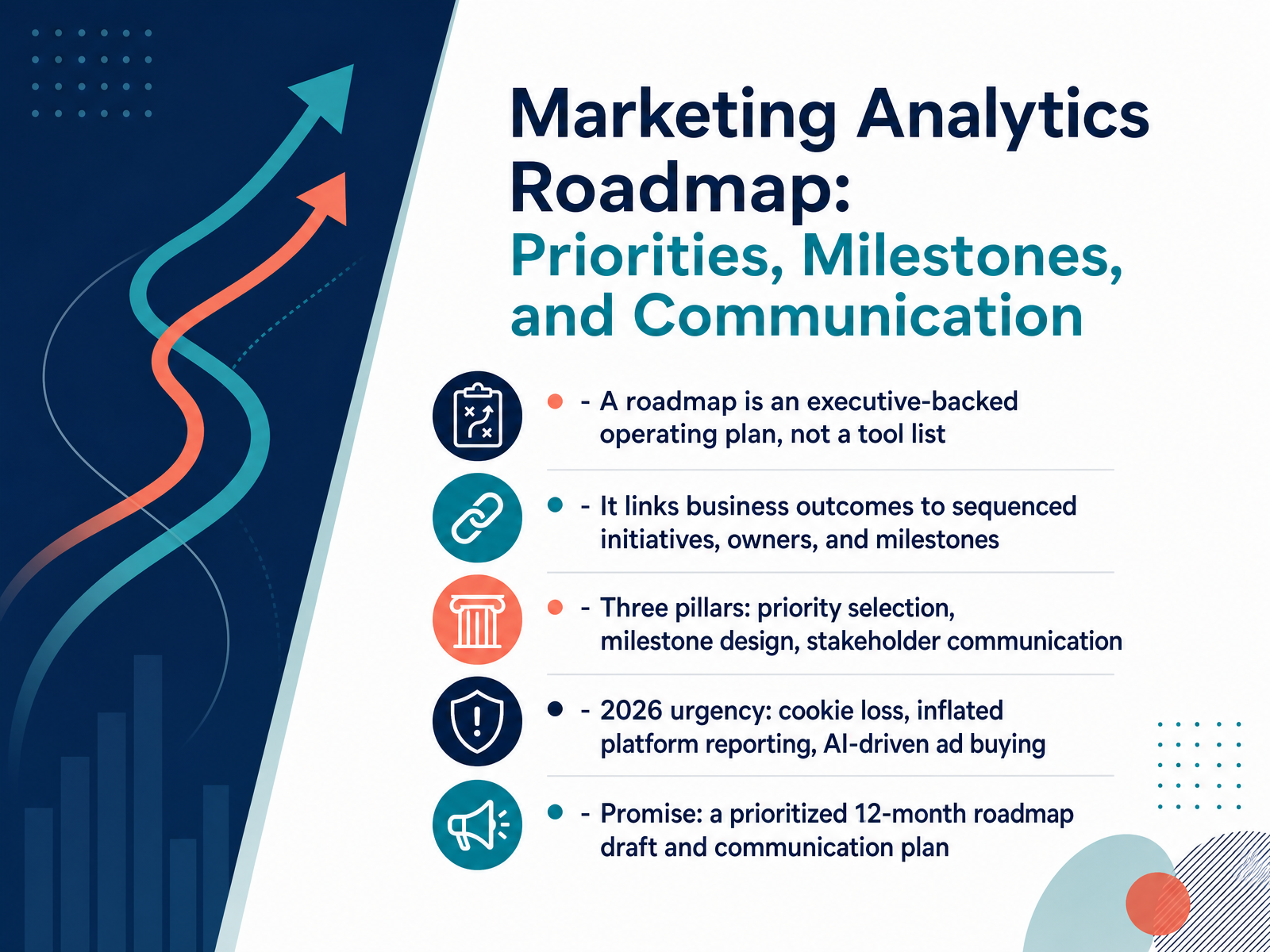
- 01Marketing Analytics Roadmap: Priorities, Milestones, and CommunicationWelcome. Over the next few minutes, we're going to build a marketing analytics roadmap you can actually defend in a budget meeting.
Start with the core idea. A roadmap is an executive-backed operating plan. It is not a tool list. Nobody funds a tool list. Executives fund a plan that links business outcomes to sequenced initiatives, named owners, and milestones they can track.
So we'll work through three pillars. First, priority selection. Second, milestone design. Third, stakeholder communication. Get those right and the roadmap survives contact with reality.
The urgency is real. Cookies are gone. Platform reporting inflates conversions by one and a half to three times. And AI-driven ad buying means platforms now grade their own homework. If you allocate budget on those numbers alone, you're funding fiction.
Here's the promise. By the end, you'll have a prioritized twelve-month roadmap draft and a communication plan to go with it. Decision-ready, not theoretical.
Next, let's look at why roadmaps fail, and how measurement maturity shapes what you can promise.mbuzz.coumbrex.comliftlab.com+22 min
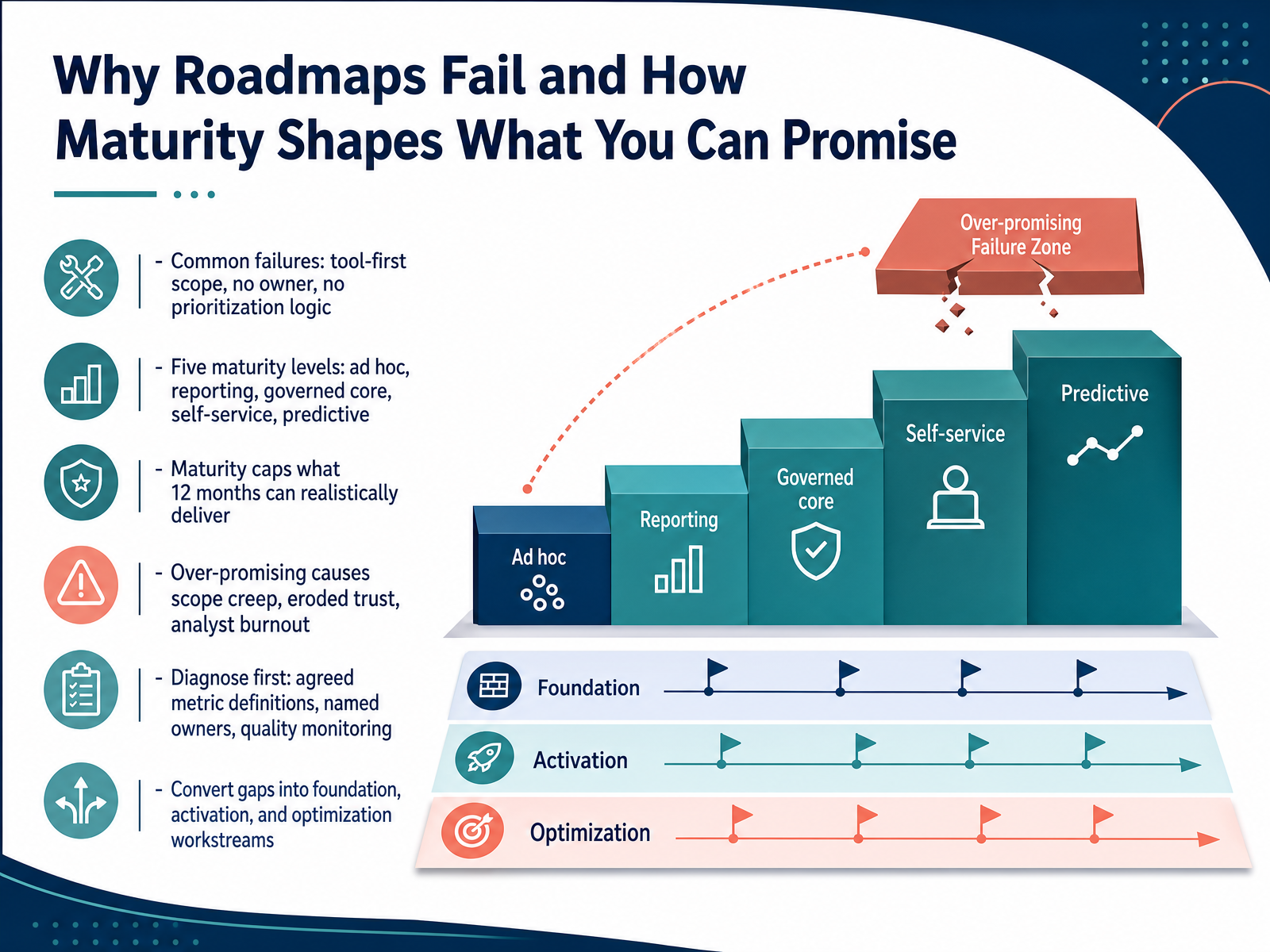
- 02Why Roadmaps Fail and How Maturity Shapes What You Can PromiseLet's talk about why analytics roadmaps fail, and how maturity shapes what you can promise. Three failures show up again and again. Tool-first scope: you buy the platform before you define the questions. No owner: nobody is accountable when a number breaks. No prioritization logic: everything is urgent, so nothing ships. Maturity caps what twelve months can realistically deliver. The five levels are ad hoc, reporting, governed core, self-service, and predictive. A level two team cannot promise predictive models in two quarters. Over-promising causes scope creep, eroded trust, and analyst burnout. So diagnose first. Do you have agreed metric definitions, named owners, and quality monitoring? Then convert each gap into one of three workstreams: foundation, activation, or optimization. That structure is what makes the rest of this roadmap defensible. Now let's move into setting priorities from business goals.
 gitnexa.comlytical.aivaliotti.com+21 min
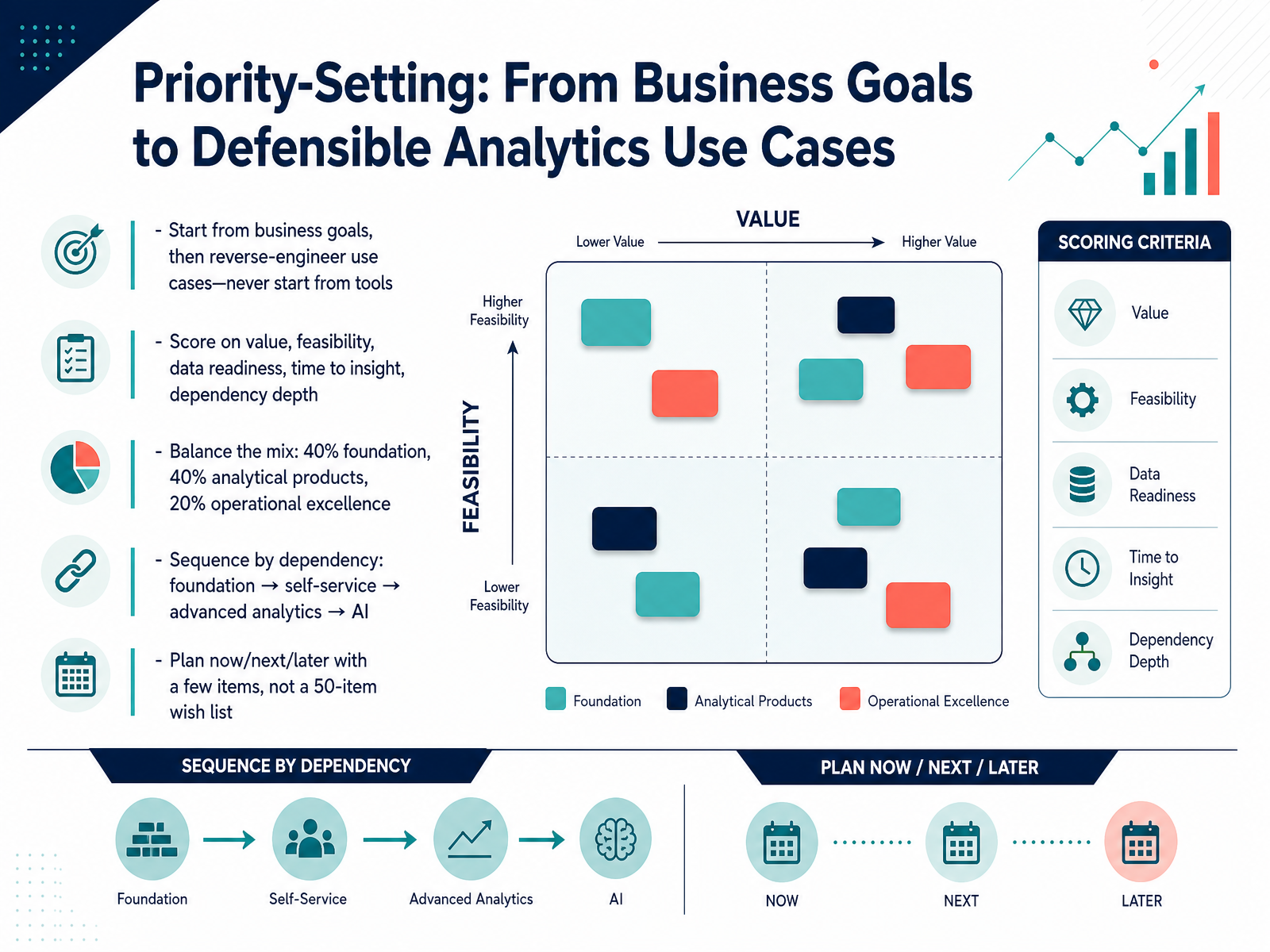
 - 03Priority-Setting: From Business Goals to Defensible Analytics Use CasesNow let's turn that into a defensible set of analytics use cases. Start with the business goals, then reverse-engineer the use cases. Never start with tools. Tools are a decision you make later, not a starting point. Score every candidate on value, feasibility, data readiness, time to insight, and dependency depth. Remember, a use case that scores high on value but sits behind three unfunded prerequisites will not ship on time. Balance your mix deliberately: roughly forty percent foundation, forty percent analytical products, and twenty percent operational excellence. That ratio keeps the lights on while you build visible wins. Then sequence by dependency: foundation first, then self-service, then advanced analytics, and finally AI. Skip a layer and the whole roadmap stalls. Finally, plan in now, next, and later horizons with just a few items each. A short list forces real trade-offs. A fifty-item wish list creates the illusion of planning. So before you leave this slide, make sure every use case can trace a line back to a business goal, and that your top three are genuinely staffable this quarter. Next, we look at Milestone Design: Phasing, Dependencies, and Definition of Done.
 thestarrconspiracy.comhouseofmartech.comessaiapp.com+22 min
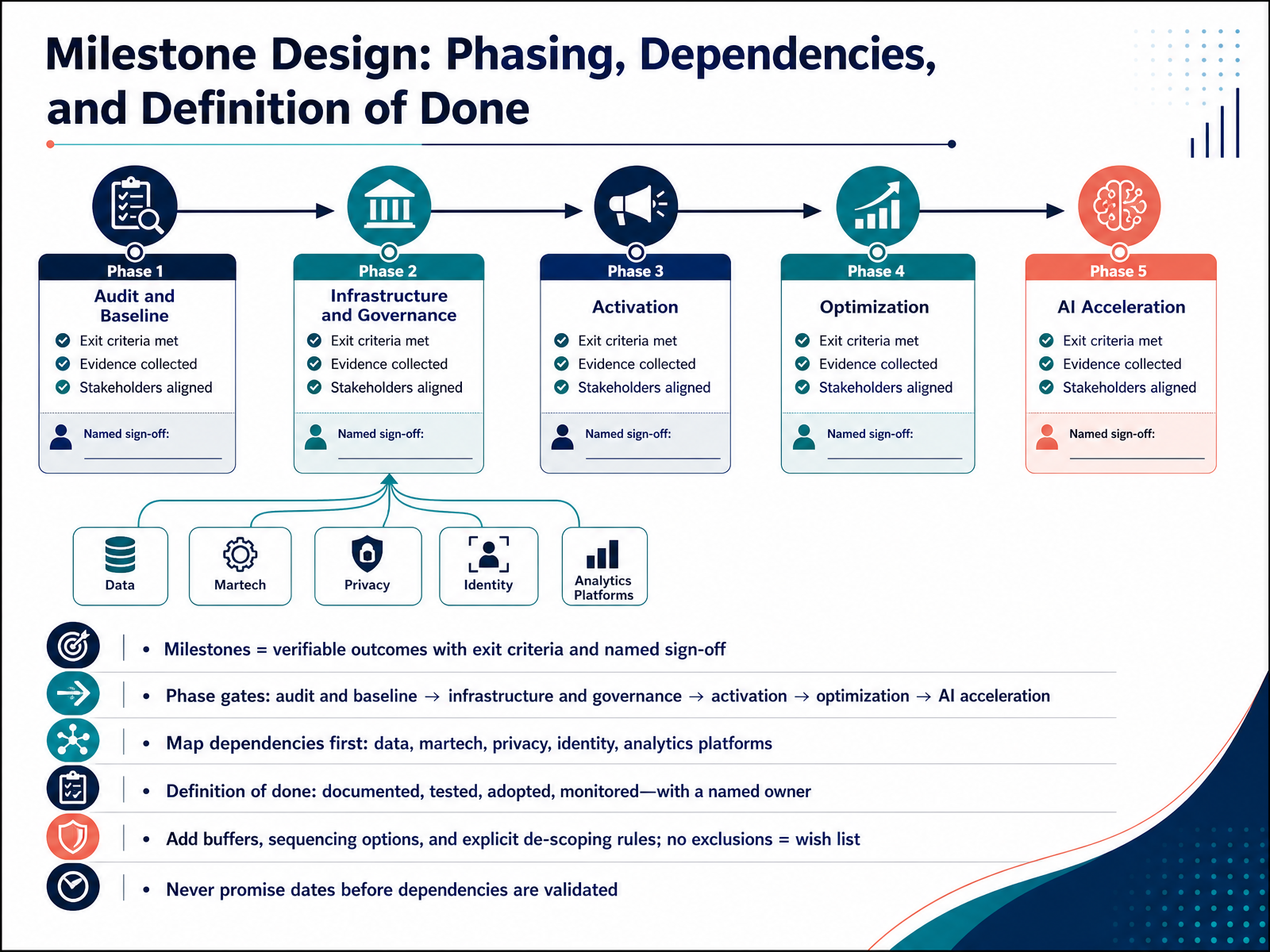
 - 04Milestone Design: Phasing, Dependencies, and Definition of DoneNow let's talk about how we actually design milestones. A milestone is not a date. It's a verifiable outcome with exit criteria and a named person who signs off. That definition alone will save you arguments later. Our phase gates run in a fixed order: audit and baseline, then infrastructure and governance, then activation, then optimization, and finally AI acceleration. Each gate produces the input the next one needs, so skipping ahead just moves the work to a more expensive phase. Before you commit to sequence, map dependencies: data, martech, privacy, identity, and analytics platforms. And be honest about definition of done. Documented, tested, adopted, monitored, with a named owner. If a deliverable doesn't meet all five, it isn't done. Then add buffers, sequencing options, and explicit de-scoping rules. No exclusions means you have a wish list, not a plan. One hard rule: never promise dates before dependencies are validated. Validate first, then commit. Next, we'll look at measurement foundations, governed metrics, and trusted data.
 skopx.combuildwithaitoday.comlatentview.com+22 min
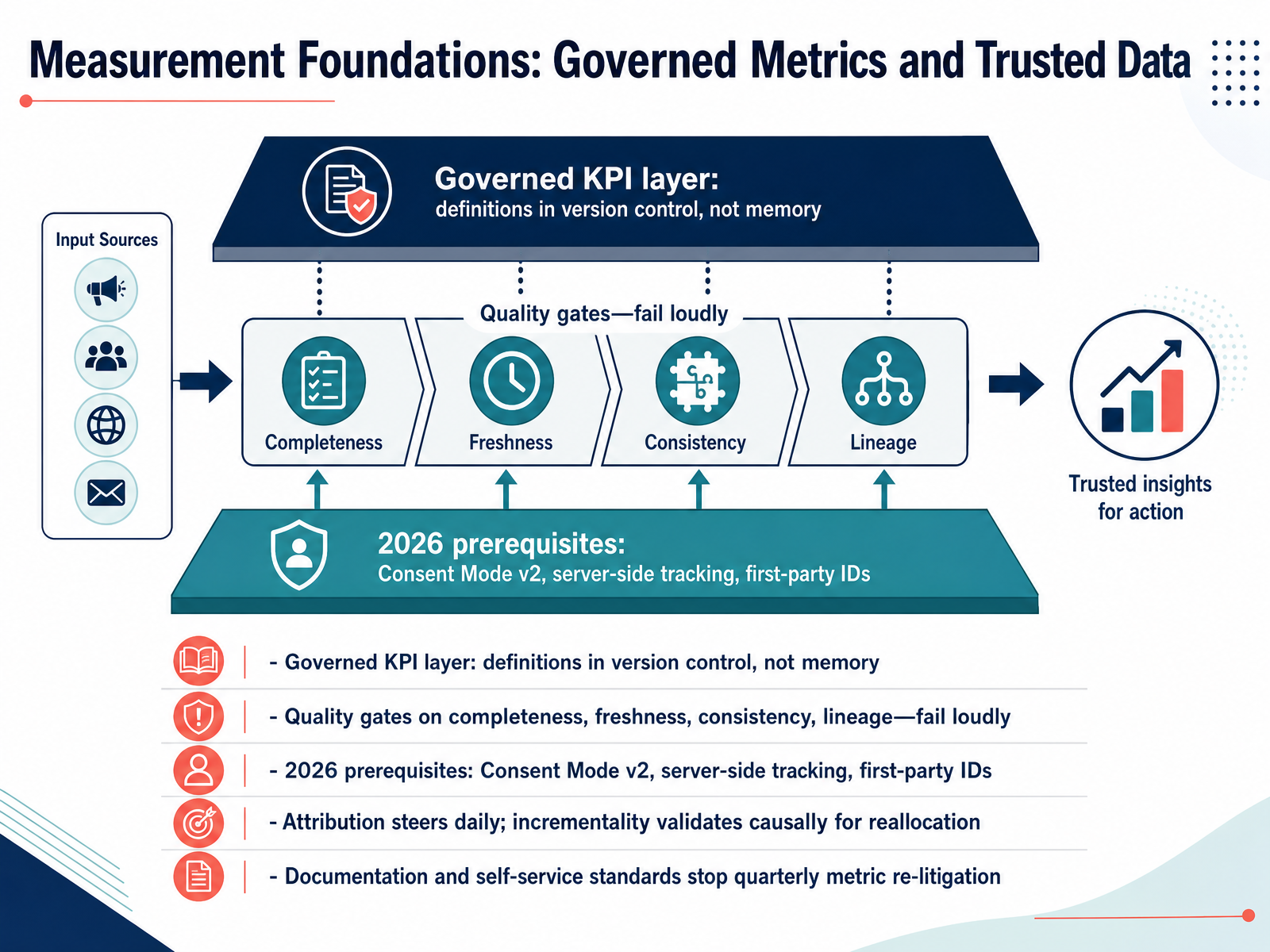
 - 05Measurement Foundations: Governed Metrics and Trusted DataNow, let's talk about the measurement foundations. Everything downstream depends on two things: governed metrics and data you actually trust.
Start with the governed KPI layer. Put your metric definitions in version control, not in someone's memory. When a definition lives in a document nobody owns, you re-litigate it every quarter. When it lives in version control, you review it like code.
Next, run quality gates on every dataset. Check completeness, freshness, consistency, and lineage. When a gate fails, fail loudly. Silent schema drift is the most expensive failure mode in analytics. A dashboard keeps rendering, now wrong.
For 2026, three prerequisites are non-negotiable: Consent Mode version two, server-side tracking, and first-party identifiers. Server-side tracking captures thirty to forty percent more data than client-side. Consent Mode without correct setup does nothing. Check yours before anything else.
Then separate your jobs. Attribution steers daily work. Incrementality validates causally, so you can defend a reallocation in front of finance.
Lock the plumbing first. Documentation and self-service standards stop the quarterly fight over whose number is right. That's how trust compounds.
Next, we'll look at the 2026 Measurement Triangulation: MMM, Attribution, and Incrementality.
 mbuzz.coumbrex.comliftlab.com+22 min
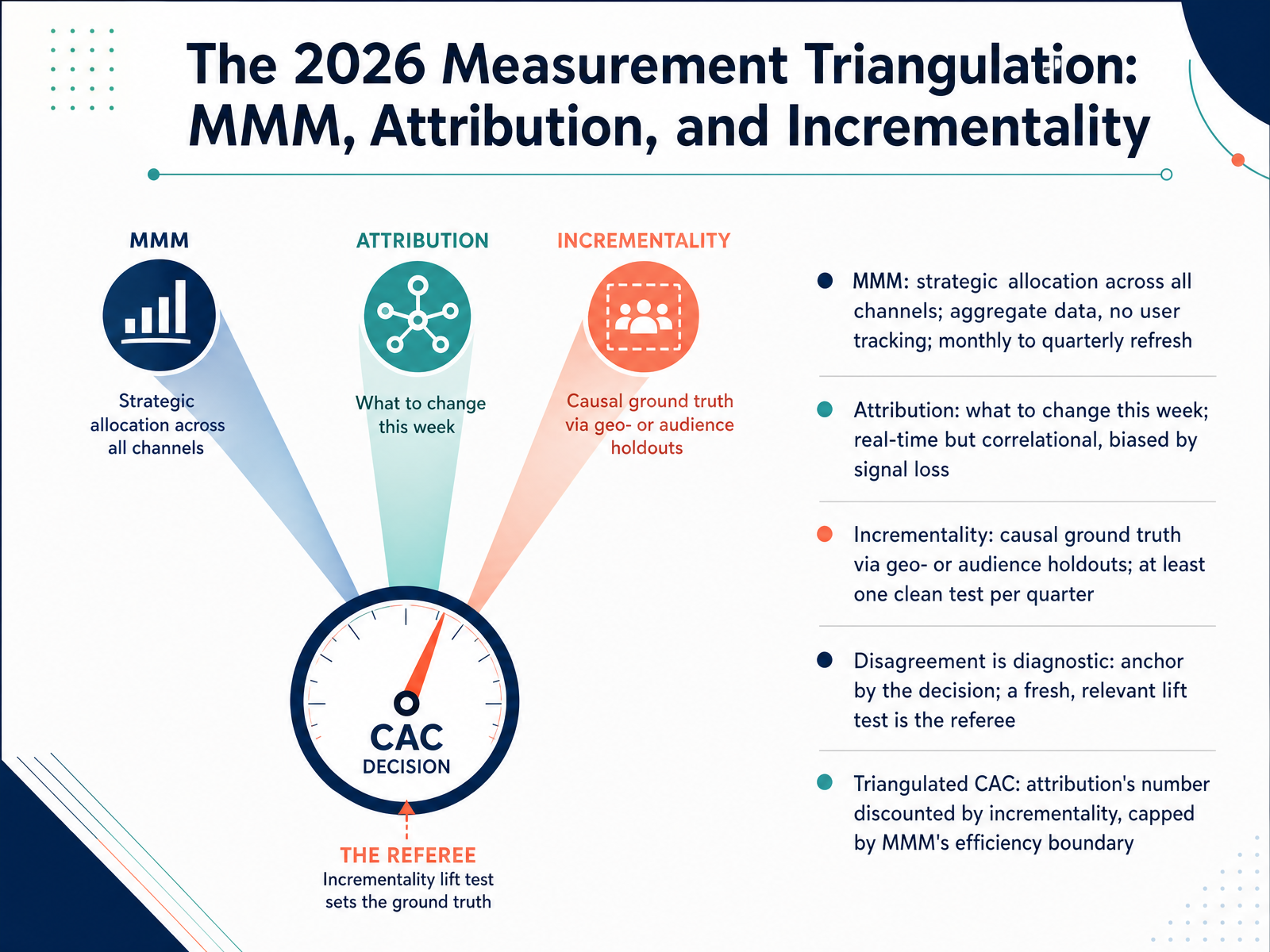
 - 06The 2026 Measurement Triangulation: MMM, Attribution, and IncrementalityLet's look at how the three measurement methods actually fit together in 2026. MMM handles strategic allocation across all channels. It runs on aggregate data with no user tracking, refreshed monthly to quarterly. Attribution tells you what to change this week. It's real-time, but it's correlational and biased by signal loss. Incrementality gives you causal ground truth through geo or audience holdouts. Target at least one clean test per quarter. Here's the key point. When these three disagree, that gap is diagnostic, not a failure. Anchor by the decision you're making, and let a fresh, relevant lift test be the referee. Now put it together. Your triangulated cost per acquisition takes attribution's number, discounts it by the incrementality factor, then caps it with MMM's efficiency boundary. One metric, all three signals, and your team can act on it daily. So don't pick a winner. Give each method a job and let them calibrate each other. Next, we'll cover how to bring these findings to stakeholders with the right audiences, cadence, and narrative.
 mbuzz.coumbrex.comliftlab.com+22 min
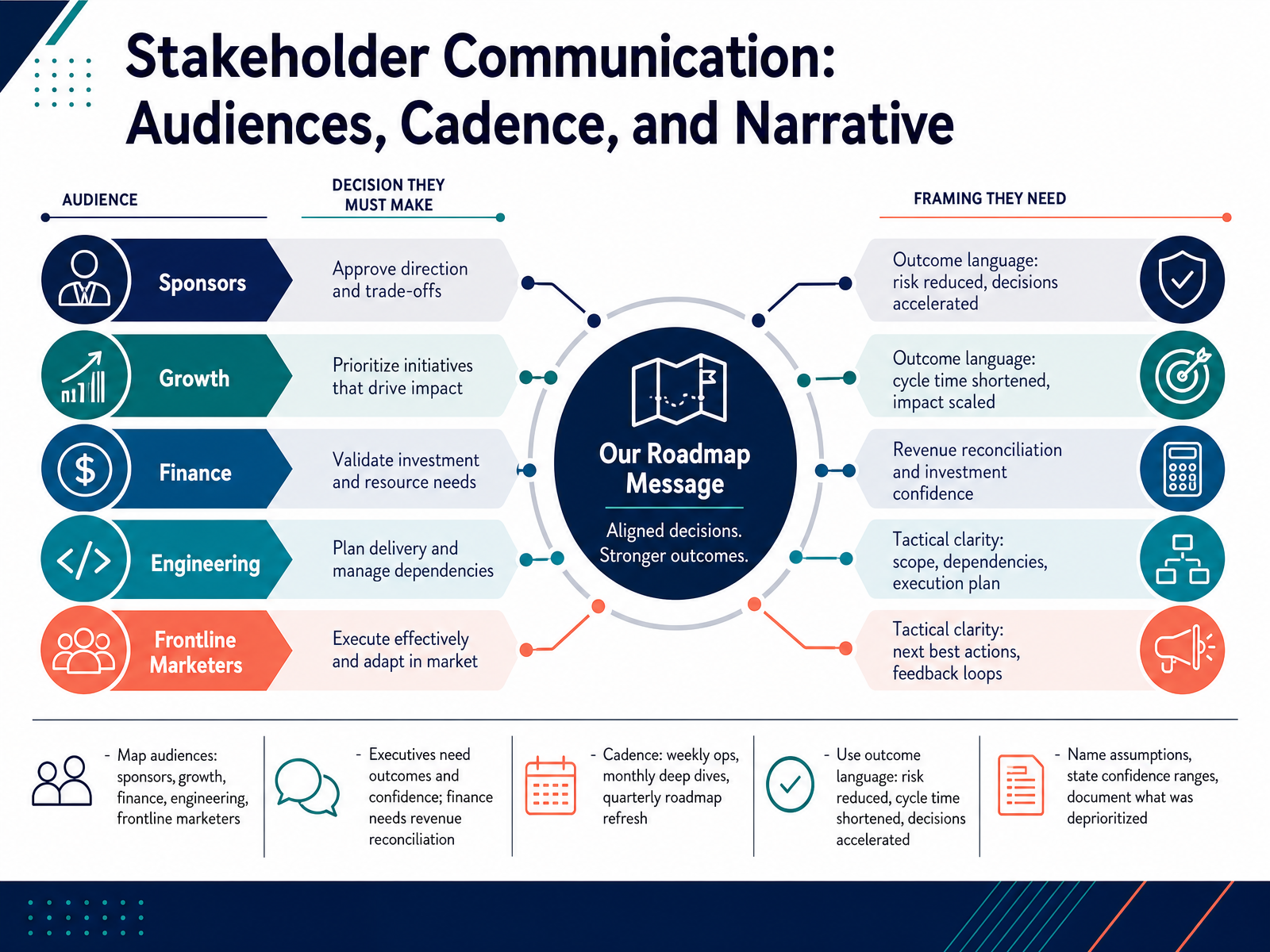
 - 07Stakeholder Communication: Audiences, Cadence, and NarrativeNow let's talk about how we communicate the roadmap. Different audiences need different things. Sponsors want confidence. Finance wants revenue reconciliation. Engineering wants scope clarity. Frontline marketers want to know what changes for them. So map your audiences, then tailor the message. Cadence matters too. Weekly ops keeps execution tight. Monthly deep dives surface root causes. Quarterly refreshes let you reprioritize. When you present, use outcome language. Say risk reduced, cycle time shortened, decisions accelerated. That is what gets funded. Also name your assumptions. State confidence ranges honestly. And document what you deprioritized, because silence on tradeoffs creates political debt later. When finance asks why a number moved, you should already have the reconciliation. When engineering asks what to build first, your sequencing should be clear. When a frontline marketer asks what is changing for them, you need a plain answer. That is how you keep five audiences aligned on one plan. Next, we will look at dashboards, reviews, and feedback loops that keep the roadmap alive.
 datameaning.comlatentview.comskopx.com+12 min
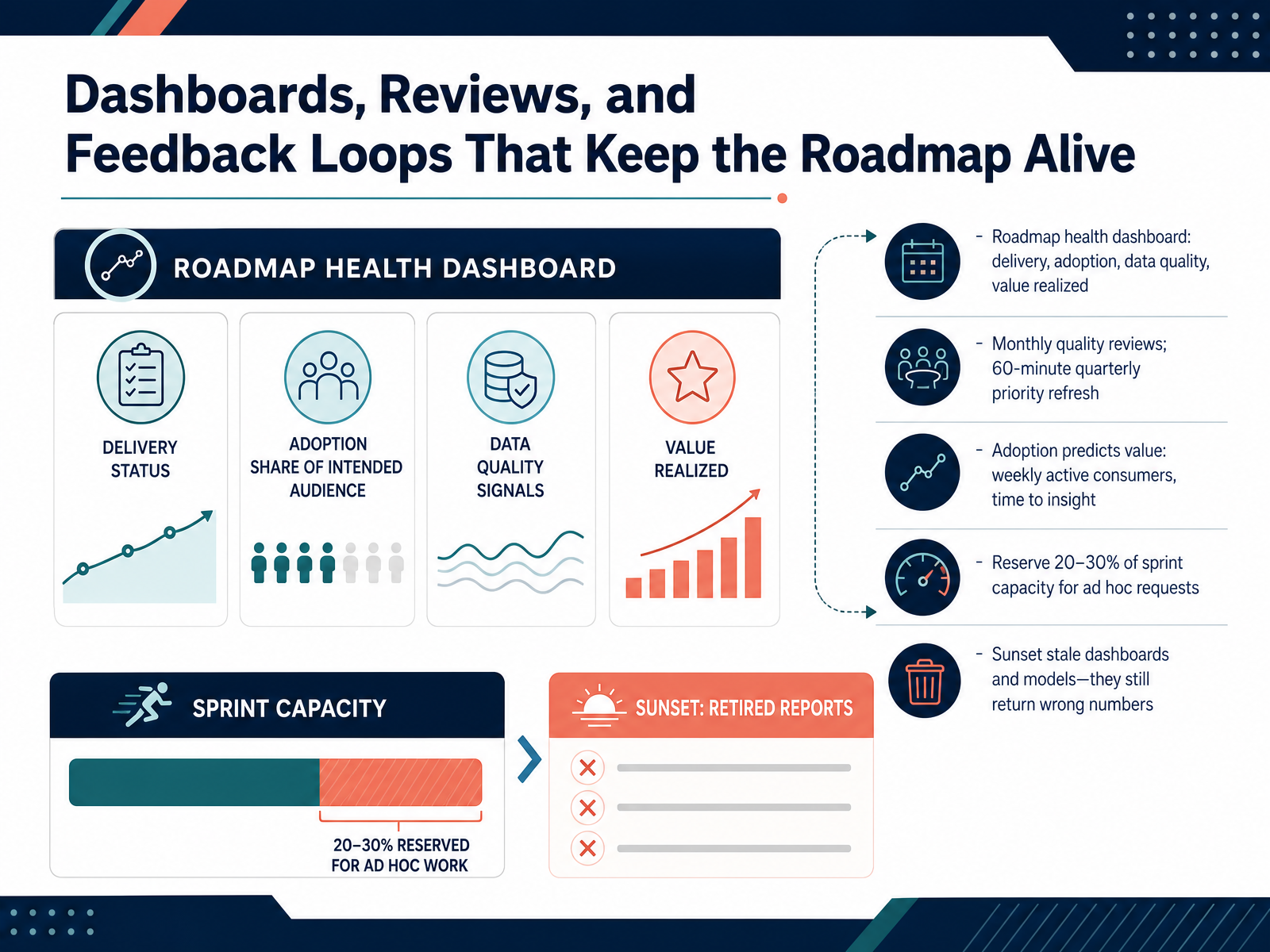
 - 08Dashboards, Reviews, and Feedback Loops That Keep the Roadmap AliveLet's talk about the operating rhythm that keeps your roadmap from going stale. Start with one dashboard that tracks four things: delivery, adoption, data quality, and value realized. Treat those as separate signals, because strength in one hides weakness in another. Then set your cadence. Run a monthly review on quality exceptions and new definitions, and hold a sixty minute quarterly priority refresh. Keep it to sixty minutes. If it needs three hours, your roadmap is too long. Adoption is your leading indicator, so watch weekly active consumers and time to insight. Value follows adoption, never the reverse. Now, protect the plan. Reserve twenty to thirty percent of sprint capacity for ad hoc requests, and communicate that budget to stakeholders so urgent work does not quietly eat your roadmap. Finally, sunset what you no longer maintain. Dead dashboards are worse than no dashboards, because they still return numbers, just wrong ones. Next, we look at AI-Augmented Analytics: Where It Changes the Roadmap.
 skopx.comthomasnys.combuildwithaitoday.com+21 min
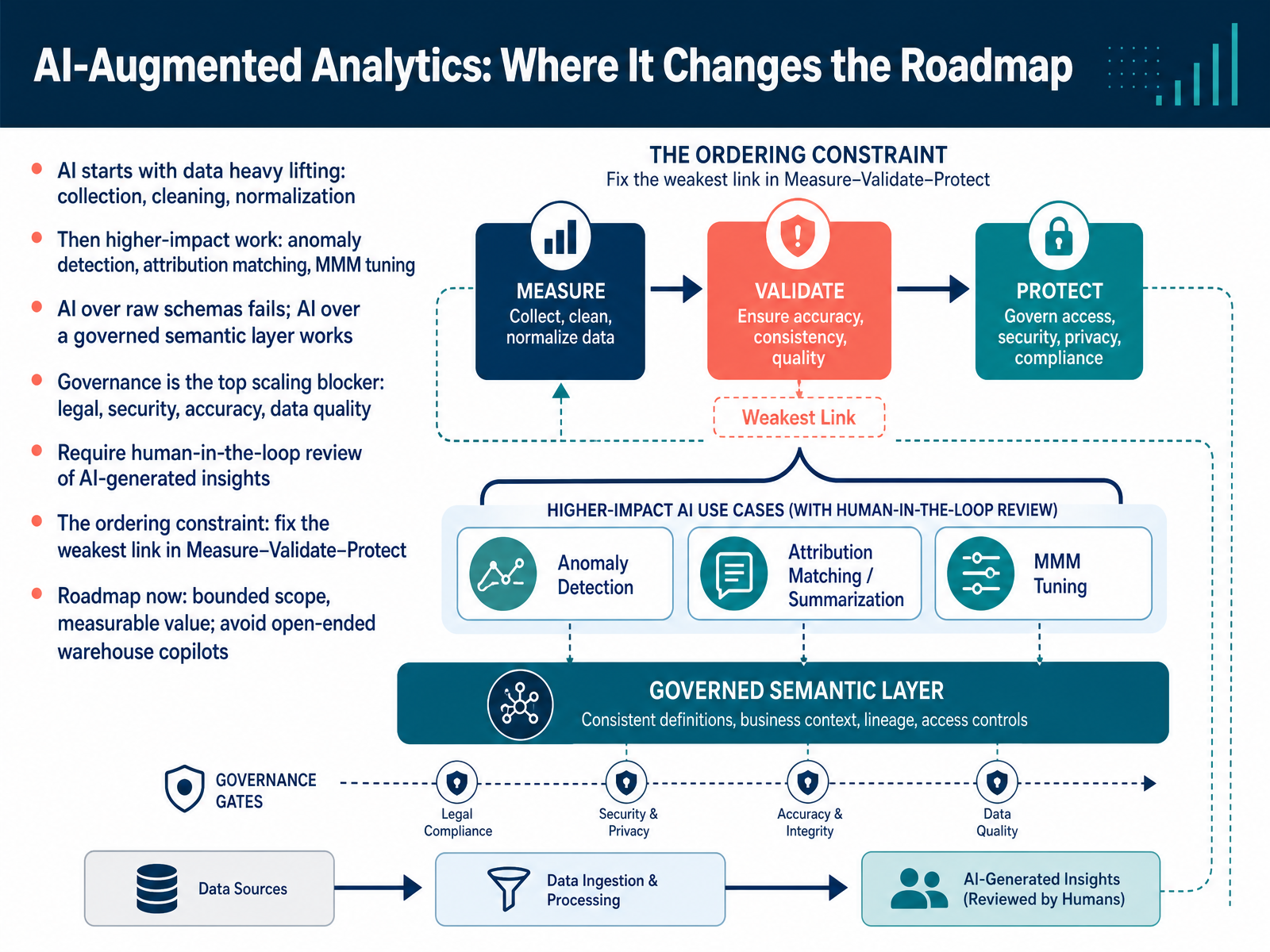
 - 09AI-Augmented Analytics: Where It Changes the RoadmapNow let's talk about where AI actually changes the analytics roadmap. Start with the honest part. AI begins with data heavy lifting: collection, cleaning, normalization. That's unglamorous work, and it's where you get real leverage first. Higher-impact work comes next: anomaly detection, attribution matching, and MMM tuning. But here's the constraint. AI over raw schemas fails. AI over a governed semantic layer works. And governance is the top scaling blocker, spanning legal, security, accuracy, and data quality. So require human-in-the-loop review of any AI-generated insight before it drives a decision. Underneath all of this sits an ordering constraint. Fix the weakest link across Measure, Validate, and Protect before you upgrade an already-strong component. For the roadmap itself, keep scope bounded and value measurable. Avoid open-ended warehouse copilots. Next, we move into the operating model, roles, and a cross-functional RACI.
 mbuzz.coumbrex.comliftlab.com+21 min
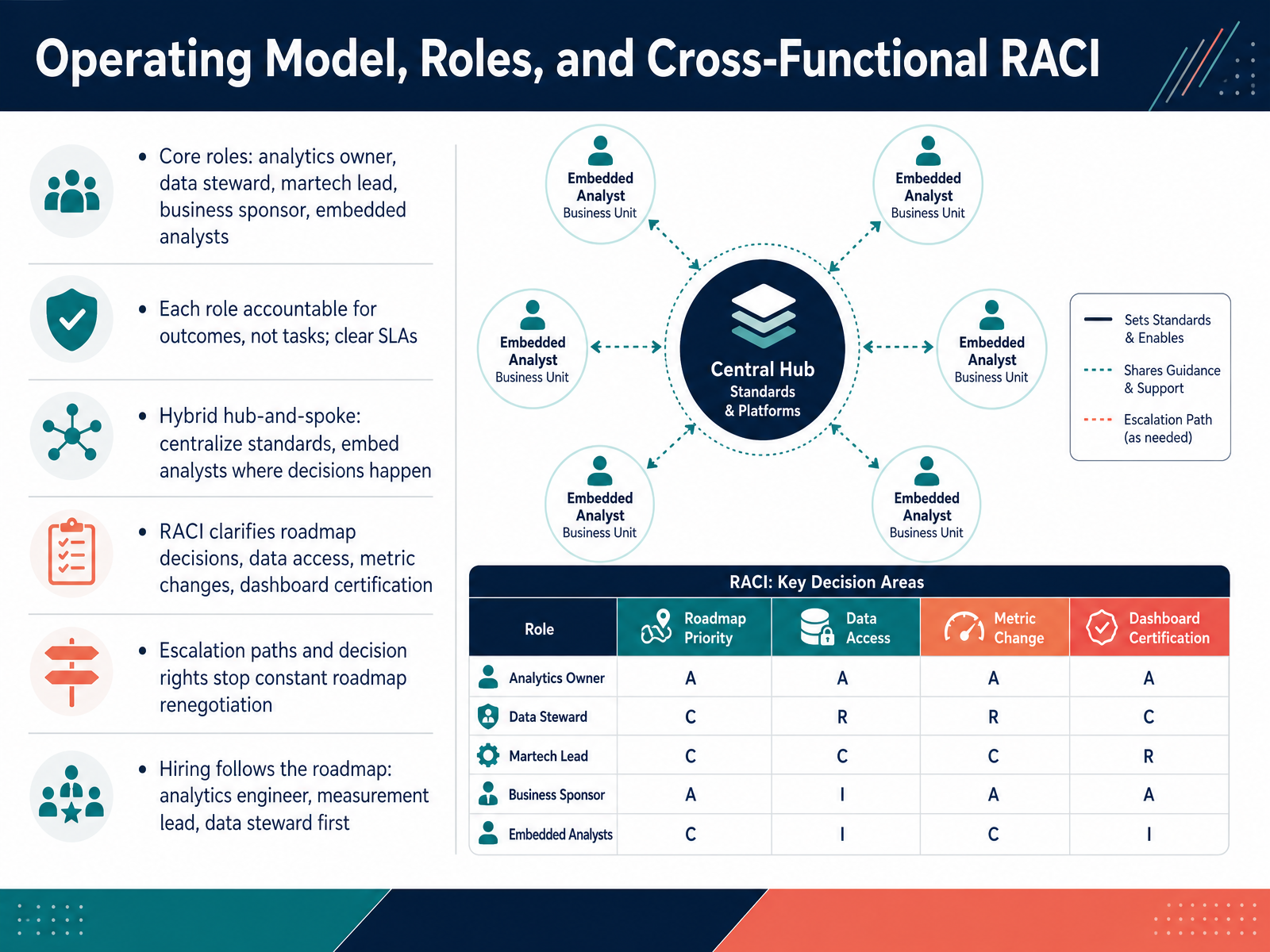
 - 10Operating Model, Roles, and Cross-Functional RACINow let's make the operating model concrete. Start with five core roles. You have an analytics owner, a data steward, a martech lead, a business sponsor, and embedded analysts. The critical shift is this. Each role is accountable for outcomes, not tasks. So you set clear service level agreements and stop hiding behind activity. The structure that works at scale is a hybrid hub-and-spoke. Centralize the standards, the taxonomy, the identity, and the pipelines. Then embed analysts where decisions actually happen. Use a R A C I to remove ambiguity on four things specifically. Roadmap decisions, data access, metric changes, and dashboard certification. That clarity is what stops the constant renegotiation of the roadmap every quarter. And it tells you when to escalate versus when to decide locally. Finally, hiring has to follow the roadmap. Your first three hires are usually an analytics engineer, a measurement lead, and a data steward. Get the accountability right and the operating model carries the strategy. Next, we'll look at building the roadmap, including templates, sequencing logic, and quality criteria.
 2 min
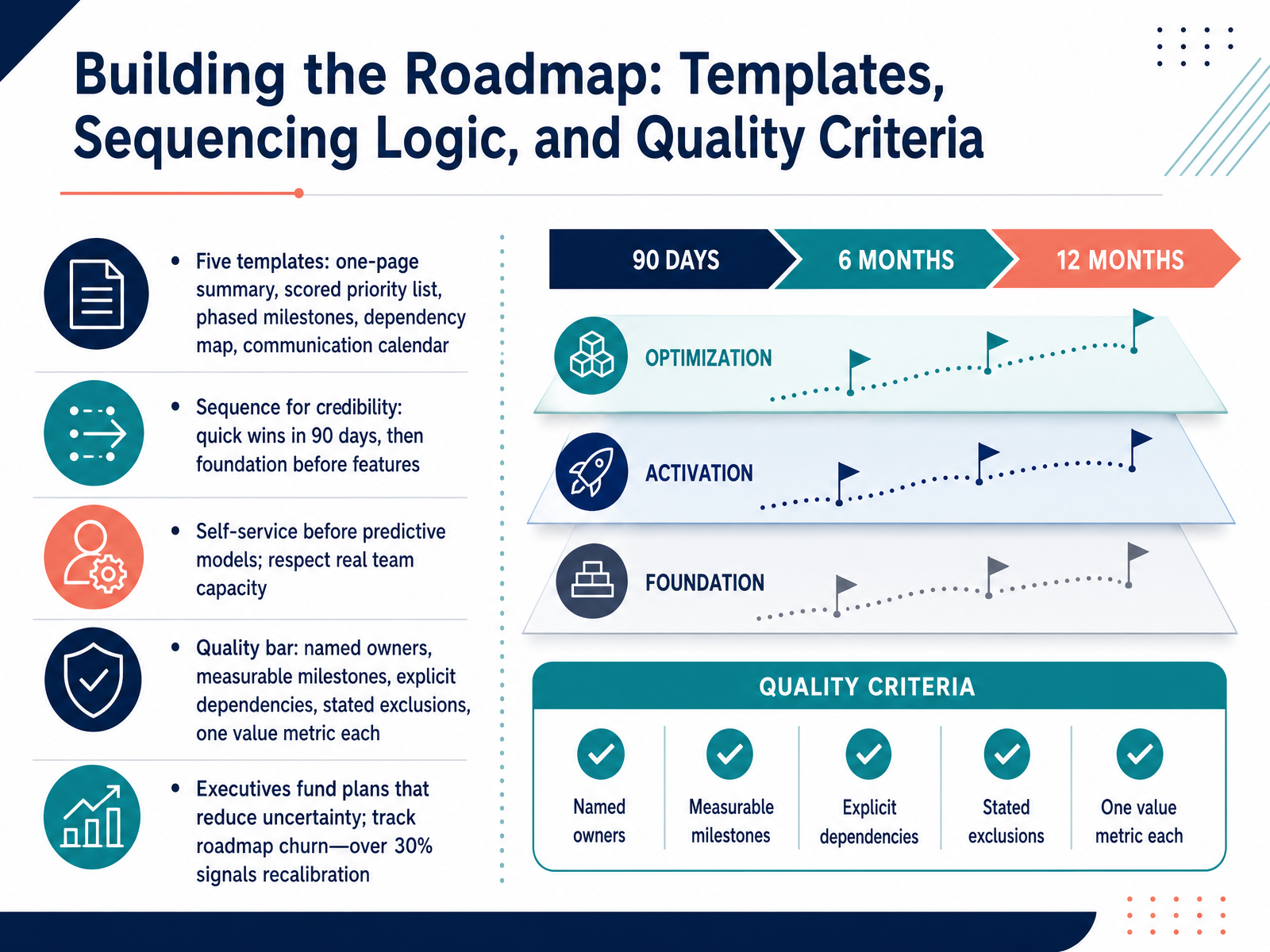
2 min - 11Building the Roadmap: Templates, Sequencing Logic, and Quality CriteriaNow let's talk about how you actually build the roadmap. Five templates do the work: a one-page summary, a scored priority list, phased milestones, a dependency map, and a communication calendar. Keep them short. Executives fund plans that reduce uncertainty, not plans that create reading assignments.
Sequencing is where credibility is won or lost. Put quick wins in the first ninety days. Then foundation before features. Self-service before predictive models. And respect your team's real capacity, because an overloaded roadmap fails quietly and takes your reputation with it.
Then hold a quality bar. Every milestone needs a named owner, measurable outcomes, explicit dependencies, stated exclusions, and one value metric. Be specific about what you are not doing. Exclusions prevent scope creep and awkward conversations later.
One last check: track roadmap churn. If more than thirty percent of committed items change within a quarter, that signals recalibration, not failure. It tells you to slow down and fix your sequencing before you present again. In the next workshop, you will draft your twelve month roadmap and communication plan.
 gitnexa.comlytical.aivaliotti.com+22 min
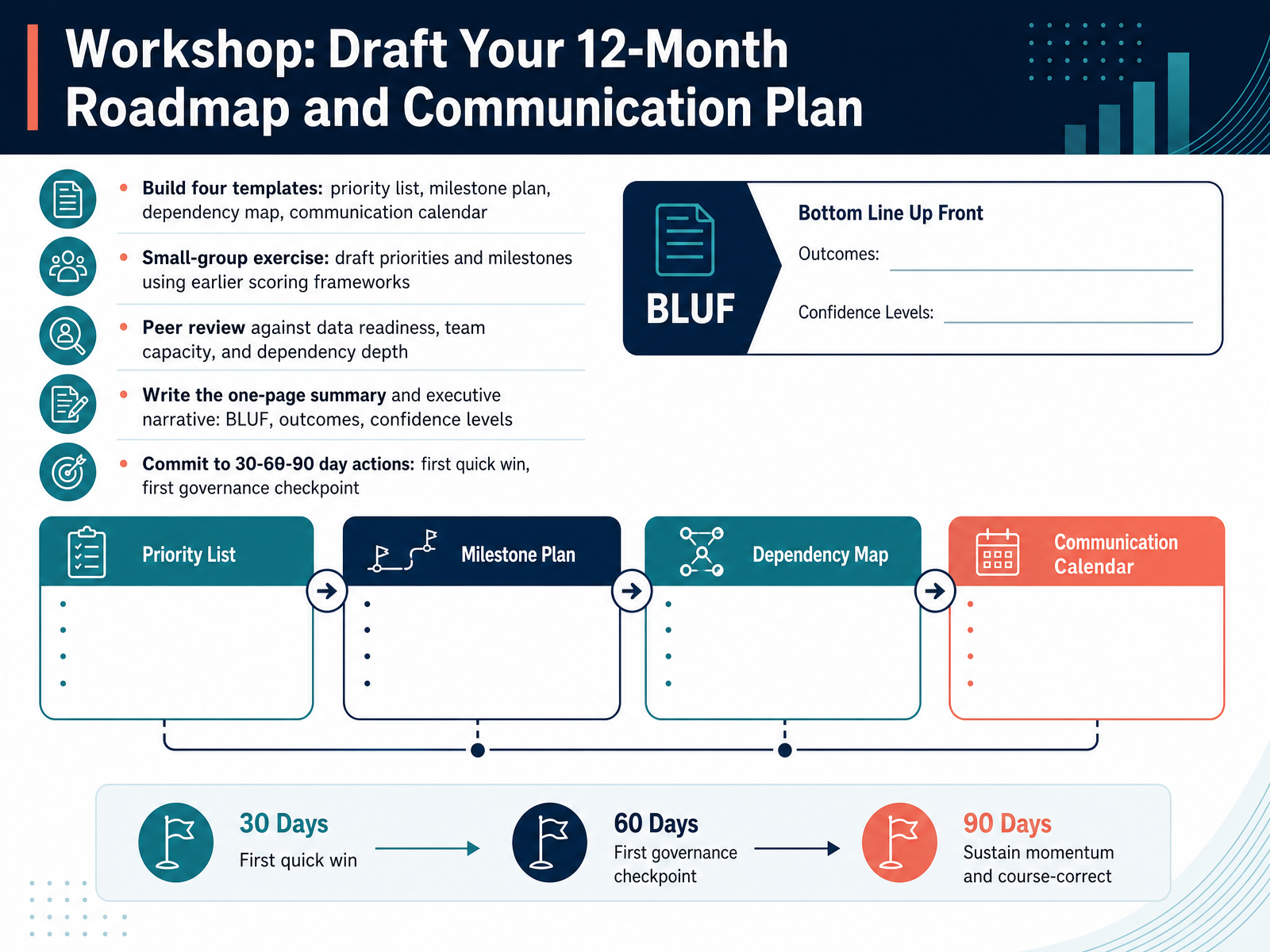
 - 12Workshop: Draft Your 12-Month Roadmap and Communication PlanNow it is time to build. This workshop turns everything we have covered into four working templates: a priority list, a milestone plan, a dependency map, and a communication calendar. You will work in small groups to draft priorities and milestones using your earlier scoring frameworks. Then you swap drafts and peer review against three filters that break most roadmaps: data readiness, team capacity, and dependency depth. If a milestone needs data you do not have yet, or a person who is already booked, move it. Next, write the one page summary and executive narrative. Lead with the bottom line up front, state the outcomes, and attach a confidence level to each bet. Finally, commit to thirty, sixty, and ninety day actions. Name your first quick win and your first governance checkpoint. Leave this room with a draft you can defend, not a wish list. Next, we look at putting it into practice. That means governance, adoption, and continuous refinement.
 gitnexa.comlytical.aivaliotti.com+21 min
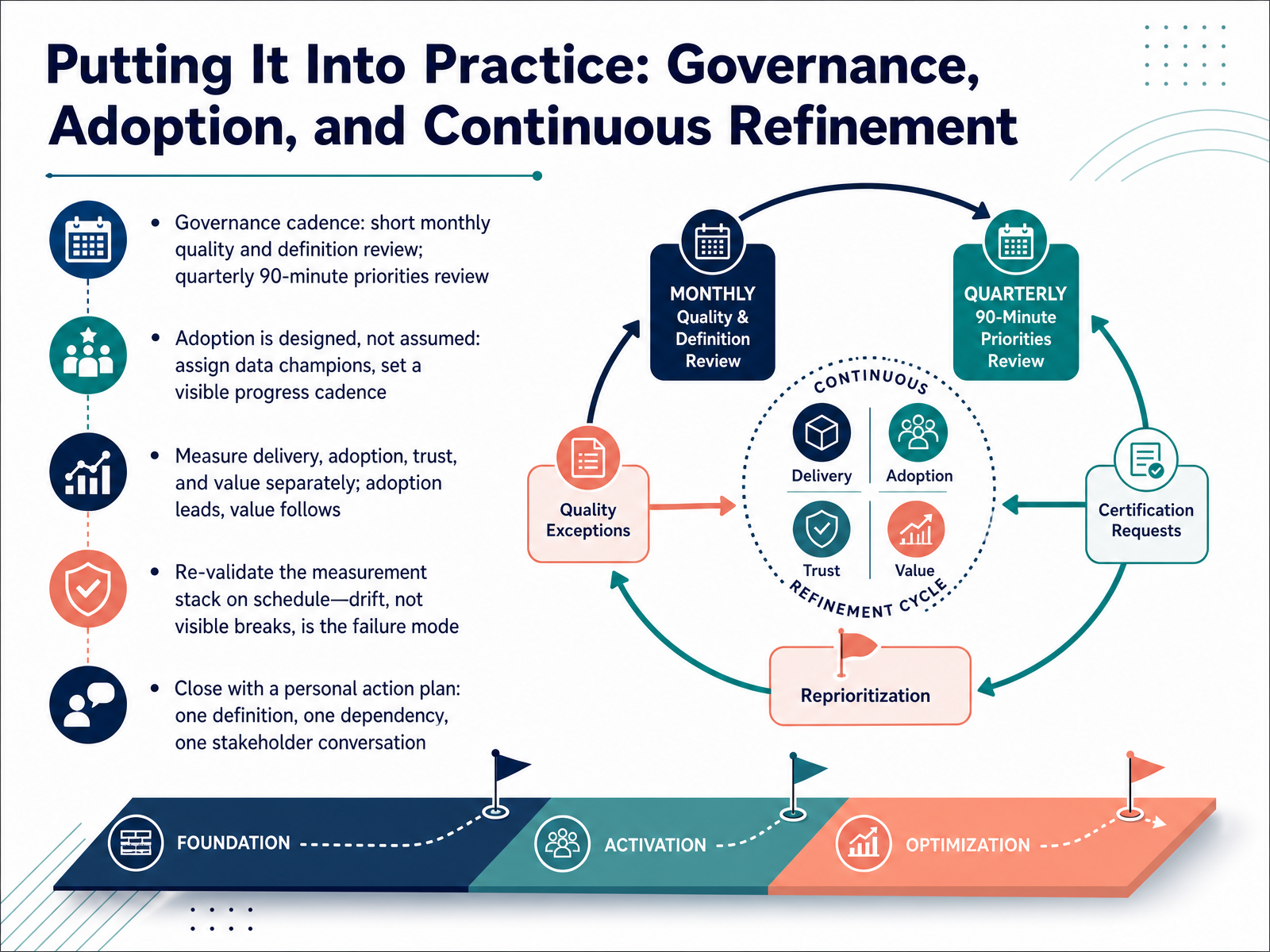
 - 13Putting It Into Practice: Governance, Adoption, and Continuous RefinementLet's close by turning the roadmap into how you run the work, not just how you present it.
Set a governance cadence you'll actually keep. A short monthly review on quality exceptions and definition changes. A quarterly ninety-minute session on priorities. Attach both to a decision log so choices are visible.
Adoption is designed, not assumed. Assign data champions in each business unit, and publish a visible progress rhythm. Measure delivery, adoption, trust, and value separately, because strength in one can hide weakness in another. Adoption leads. Value follows.
And re-validate the measurement stack on schedule. The failure mode is drift, not a visible break. A renamed field keeps the dashboard rendering, now wrong. Build a check for that instead of trusting someone to notice. Decide the cadence, and name the owner.
Before you leave today, write one personal action plan. One definition to settle, one dependency to unblock, one stakeholder conversation to schedule this week. That's the roadmap in practice.
You've done the hard thinking across these thirteen slides. Now pick those three items, act on them, and keep the cadence going. Thank you for your time, and good luck.
 datameaning.comlatentview.comskopx.com+22 min
Take the deck with you
Download this course as a file — free, no sign-up needed.
- PDF handoutEvery slide page, ready to print or share.14 pages · 3.6 MBDownload
- Narrated PowerPointThe deck that presents itself — every slide carries the digital human's narration video.14 pages · 16.0 MBDownload
- PowerPoint slidesThe full deck as a .pptx — open it in PowerPoint, Keynote, or Google Slides.14 pages · 3.5 MBDownload
Free to use in your own training — please keep the PersonWise credit page at the end.
Have your own deck? Turn it into a course
Sources consulted
Web sources consulted while building this course.
- Measurement Maturity Map: 4 Levels From Ad Hoc to Leader | mbuzz — mbuzz.co
- Advance Strategy with Marketing Analytics Data Maturity — umbrex.com
- Marketing Measurement Maturity Model: CPG Brands | LiftLab — liftlab.com
- Trustworthy AI for Marketing Measurement: A Systematic Review of Attribution, Media Mix Modeling, and Privacy-Preserving Methods — doi.org
- Marketing Measurement in 2026: MMM, Attribution & Incrementality | Khalid Hamadeh — khalidhamadeh.com
- Ultimate Marketing Analytics Roadmap for 2026 | GitNexa | GitNexa Blog | GitNexa — gitnexa.com
- Marketing Analytics Guide | Key Metrics, Tools, and Trends in 2026 | Lytical — lytical.ai
- Marketing Analytics Guide: From Data to Decisions | Valiotti Data — valiotti.com
- Sprint vs Marathon Martech Roadmap (2026) — dashbroad.com
- Marketing Analytics Maturity Model: A Roadmap to ROI — analyzenest.com
- AI Use Case Prioritization Framework | The Starr Conspiracy — thestarrconspiracy.com
- CDP Use Case Scoring: Prioritize When Everything Is Urgent — houseofmartech.com
- AI Use-Case Prioritisation Matrix | ESSAI Frameworks — essaiapp.com
- The Marketing Prioritization Framework That Replaces Gut Feel With Compounding Wins | Spike — getspike.ai
- The CRUISE Framework: A Guide to Prioritizing Your Analytics Use Cases - Evalueserve — evalueserve.com
- Business Intelligence Implementation Roadmap for 2026 — skopx.com
- Analytics Roadmap Planning - AI Is Easy — buildwithaitoday.com
- What Is an Analytics Roadmap? Complete Guide, Use Cases & Best Practices — latentview.com
- Data Strategy Roadmap: 12-Month Implementation Plan | Thomas Nys — thomasnys.com
- What a Real Data Strategy Roadmap Looks Like (and How to Build One That Actually Gets Funded) — datameaning.com