Begin
14 pages · ~28 min
Linear Perspective in Renaissance Art
This training explores how Renaissance artists used linear perspective to create depth, teaching learners the core principles behind this foundational technique.
A digital instructor presents all 14 pages. Hold “Ask” at any point and ask out loud — the answer comes from this course. No sign-up needed.
What you’ll learn
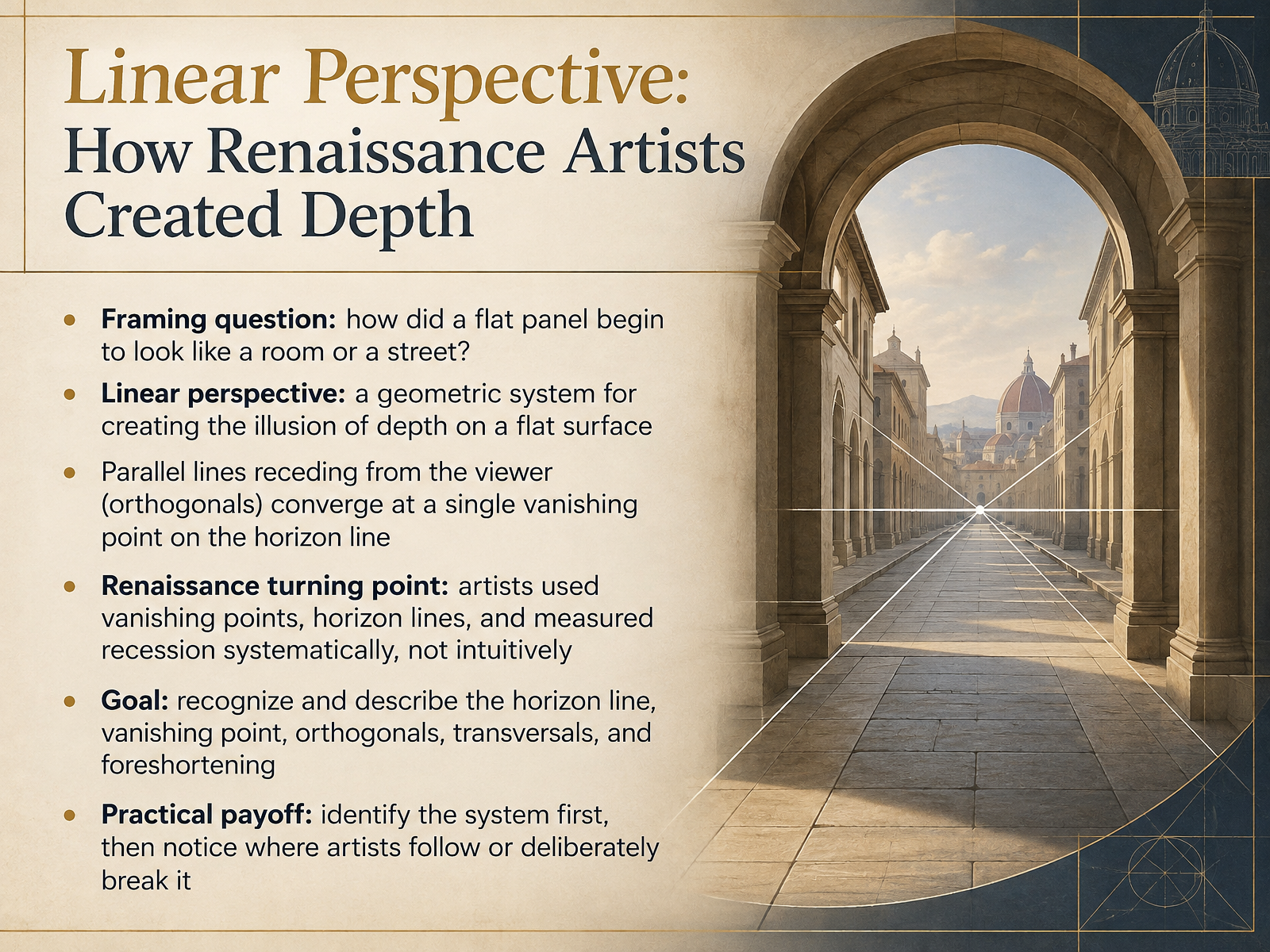
- 01Linear Perspective: How Renaissance Artists Created DepthWelcome. I'm so glad you're here. Together, we're going to explore one of the most quietly powerful ideas in Western art: linear perspective, the system that let a flat wooden panel begin to look like a real room, or a street you could walk down. So here's our guiding question. How does a painting convince your eye that it has depth when the surface is completely flat? The answer is a geometric system. Artists learned to make parallel lines that recede away from you, called orthogonals, appear to converge at a single vanishing point on the horizon line. Picture railroad tracks meeting in the distance. That's the effect. In the Renaissance, this became a turning point. Painters didn't just suggest depth by instinct anymore. They measured it, using vanishing points, horizon lines, and carefully spaced recession. By the end of this course, you'll be able to recognize and describe the horizon line, the vanishing point, orthogonals, transversals, and foreshortening. And here's the practical payoff. Learn to spot the system first, then notice where artists follow it, and where they deliberately break it. Let's begin with the core vocabulary for reading pictorial space.britannica.comtate.org.ukmath.dartmouth.edu+22 min
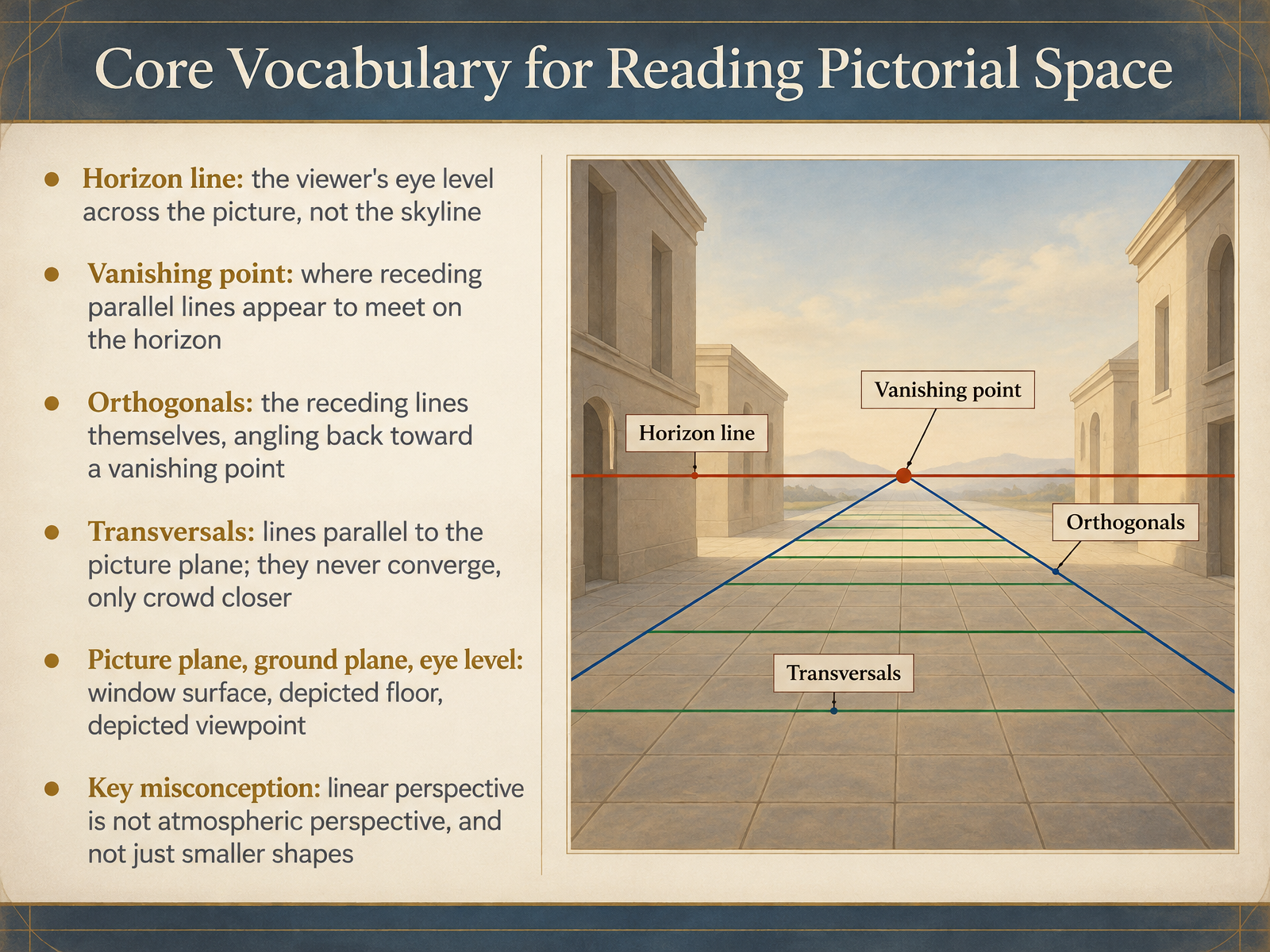
- 02Core Vocabulary for Reading Pictorial SpaceLet's build a shared vocabulary, so you can read any perspectival painting with confidence. Picture a straight road stretching to the horizon. The horizon line is simply your eye level across the picture. It is not the skyline. Now watch those road edges. If you extend them, they seem to meet at one spot. That is the vanishing point, where receding parallel lines appear to converge. The receding lines themselves are called orthogonals. They angle back toward that vanishing point. And the lines running parallel to the picture plane, like the rungs of a ladder, are transversals. They never converge. They only crowd closer together with distance. Three more terms: the picture plane is the window surface, the ground plane is the depicted floor, and eye level matches the horizon. One key misconception. Linear perspective is not atmospheric perspective, which uses haze and fading color. And it is more than just drawing things smaller. It is a full geometric system. Keep those terms in mind. Next, we look at the space that came before this system, in Before Perspective: Medieval and Byzantine Space.
 britannica.comtate.org.ukmath.dartmouth.edu+22 min
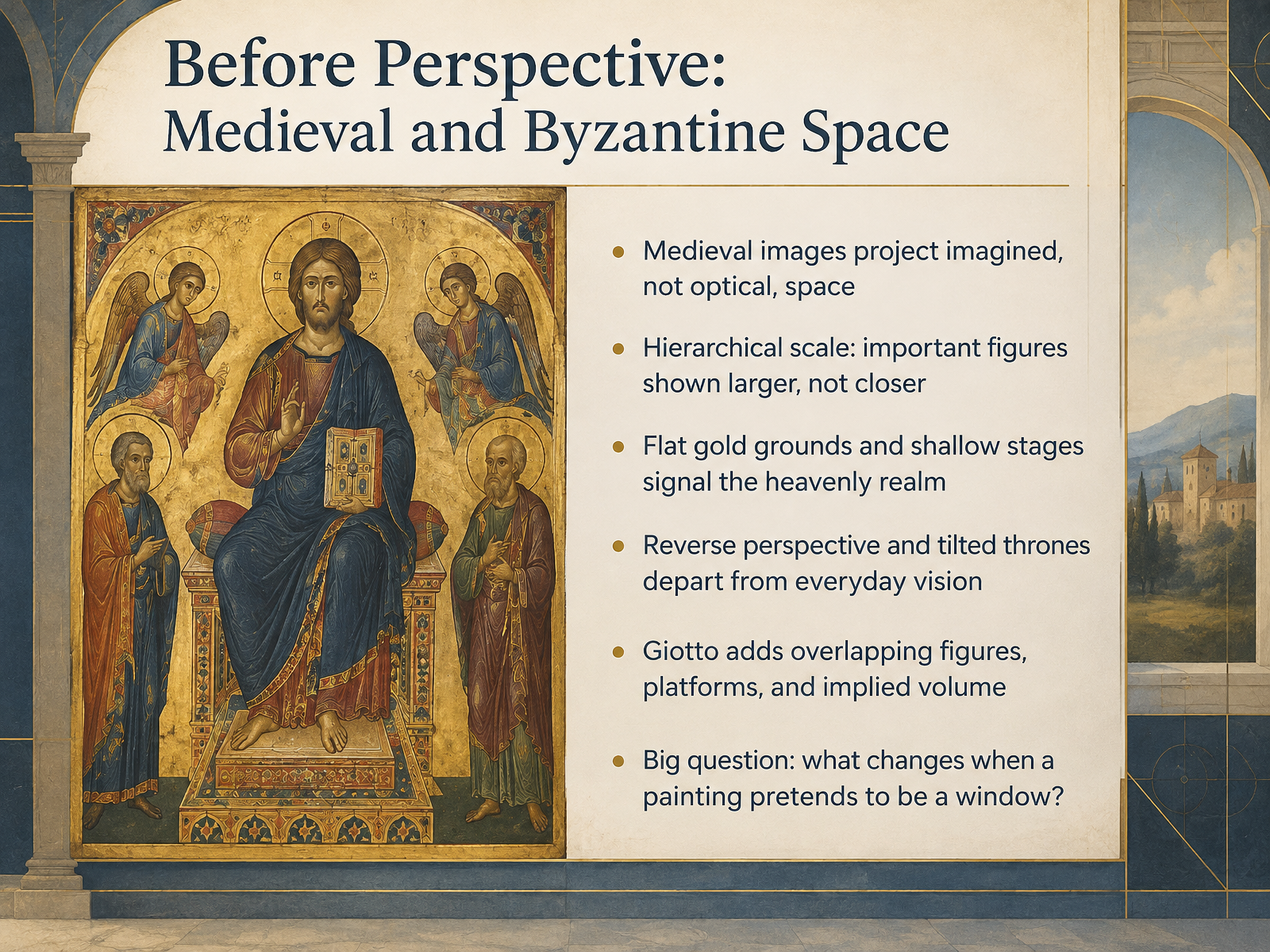
- 03Before Perspective: Medieval and Byzantine SpaceLet's step back a moment, to a time before perspective existed. In medieval and Byzantine painting, space was imagined, not observed. Artists weren't trying to copy what the eye sees. They were building a picture of a spiritual world. One clue is size. An important figure, like the Virgin Mary or Christ, might be painted much larger than everyone else, not because they stood closer, but because they mattered more. This is called hierarchical scale. You'll also notice flat gold backgrounds. That gold isn't a wall or a sky. It signals the heavenly realm, a place outside ordinary space. And look at thrones or platforms. They often tilt strangely, widening as they go back. This is reverse perspective, and it deliberately departs from everyday vision. Then comes Giotto, around thirteen hundred. He starts overlapping figures, adding platforms and steps, and suggesting real volume. His people occupy a stage you feel you could walk into. So here is the big question. What changes when a painting stops being a symbol and pretends to be a window? Next, we'll see how Giotto pushed toward that window, with converging lines, before the rules were written.
 reference-global.comexa.aicambridgepublish.com+22 min
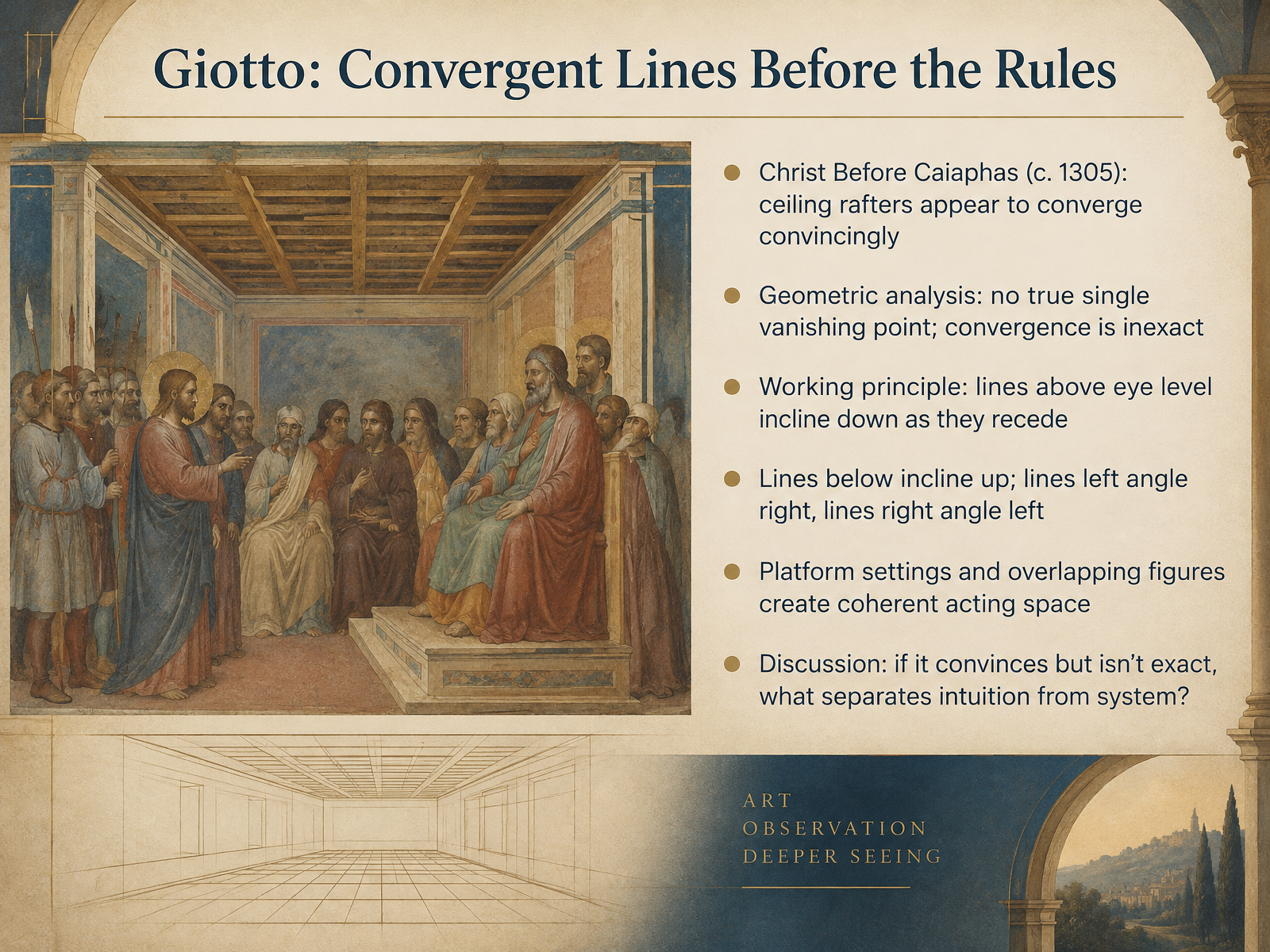
- 04Giotto: Convergent Lines Before the RulesNow, let's look at a moment when depth began to appear, roughly a hundred years before anyone wrote down the rules. In Giotto's Christ Before Caiaphas, painted around 1305, the ceiling rafters seem to converge as they recede. Stand in front of it, and the room feels convincing. Yet careful measurement shows the lines never meet at one true vanishing point. The convergence is close, but inexact. So what principle was Giotto using? Simple observation. Lines above your eye level appear to slope downward as they go back. Lines below eye level slope upward. Lines on the left angle inward to the right, and lines on the right angle inward to the left. Giotto also built a stage-like platform and overlapped his figures, giving the scene a coherent space where the actors move. Here is the question worth holding onto. If an image convinces without being exact, what separates intuition from a system? Next, we follow an experiment that began to answer that. Brunelleschi's Experiment: Perspective as Demonstration.
 reference-global.comexa.aicambridgepublish.com+22 min
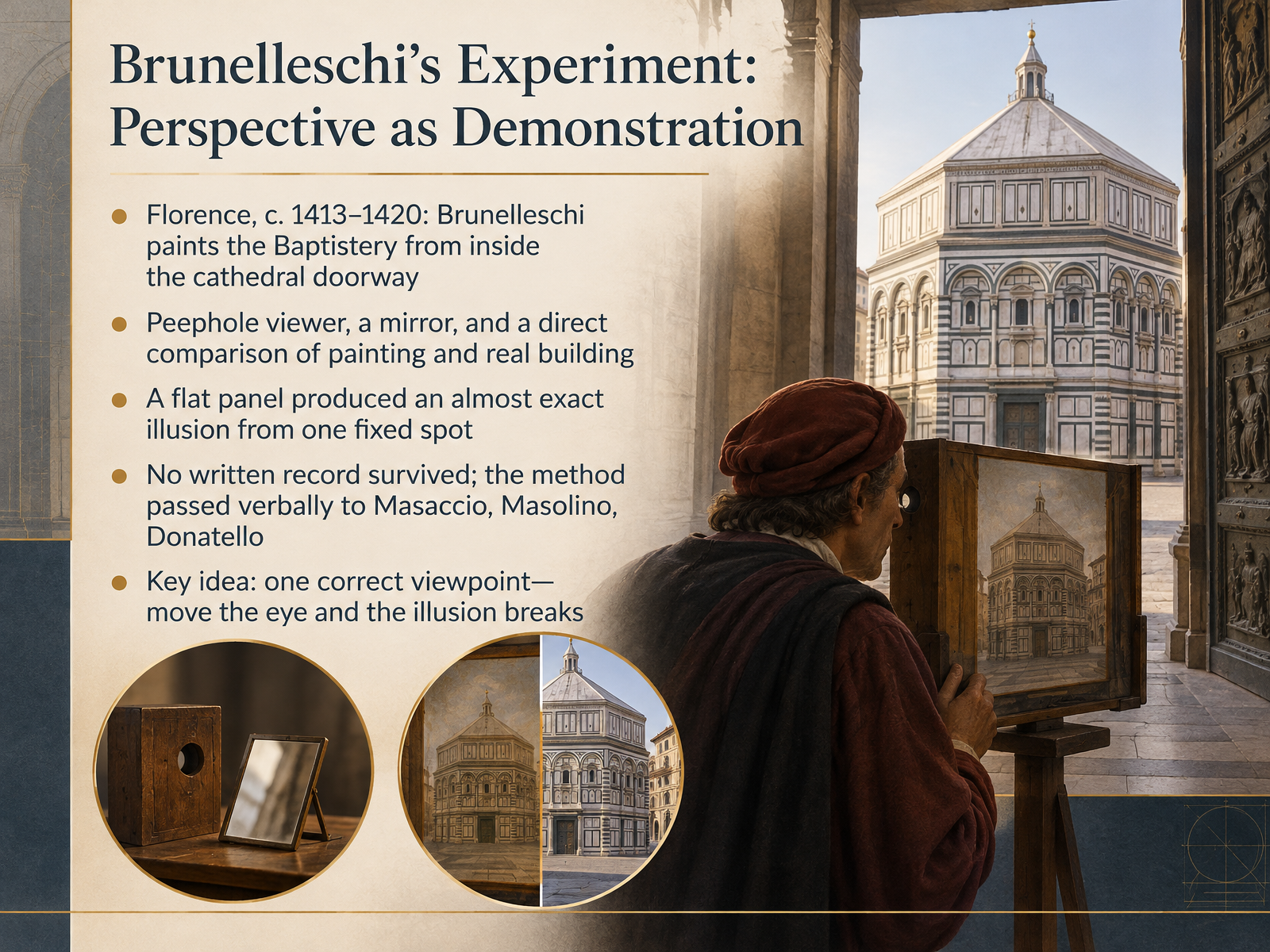
- 05Brunelleschi's Experiment: Perspective as DemonstrationNow let's step into the piazza in Florence, around fourteen twenty. Picture Brunelleschi standing just inside the doorway of the cathedral, looking across at the Baptistery. He paints that octagonal building on a small flat panel, then drills a tiny hole through it, no bigger than a lentil. To see his picture, you hold the panel to your eye and raise a mirror with your other hand. The painted Baptistery appears in the mirror. Lower the mirror, and the real one is right there. Same shape, same angles, almost impossible to tell apart. That is the vanishing point at work. One fixed spot gives one correct view, and if you move your eye even slightly, the illusion collapses. Brunelleschi wrote nothing down. The method passed by word of mouth to Masaccio, Masolino, and Donatello. That one fixed viewpoint is the heart of linear perspective. Next, Alberti's Rules: On Painting and the Legitimate Construction.
 noteaccess.comwwwhomes.uni-bielefeld.dejosmfs.net+22 min
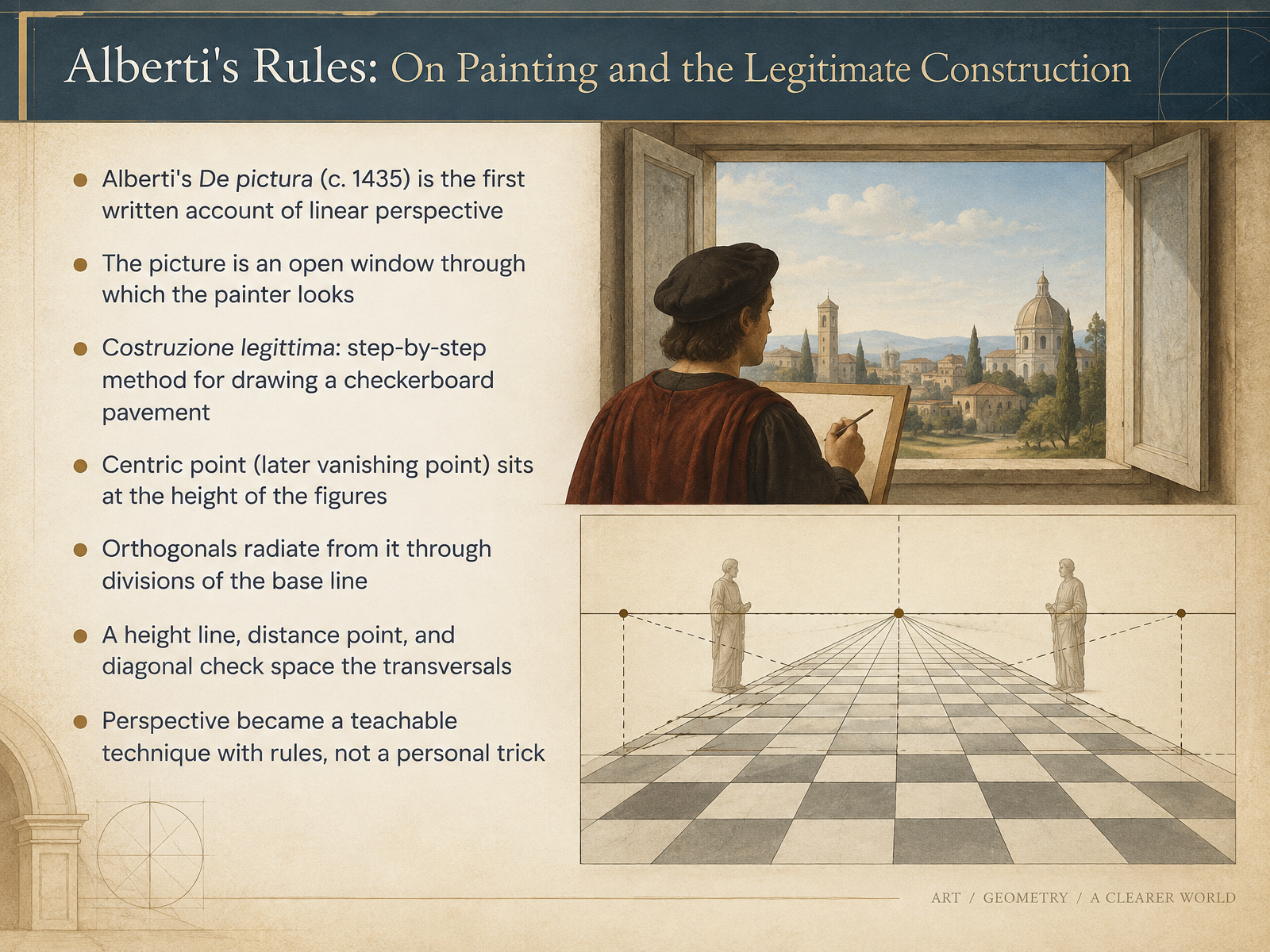
- 06Alberti's Rules: On Painting and the Legitimate ConstructionNow that you have seen how perspective works in practice, let us look at the book that turned it into a method. Around fourteen thirty five, the architect Leon Battista Alberti wrote De pictura, On Painting, the first written account of linear perspective. He asked you to imagine the picture as an open window, a frame through which the painter looks out at the world. And then, calmly, he gives you steps. This is his costruzione legittima, the legitimate construction, a reliable way to draw a checkerboard pavement receding into depth. You place a centric point, which we now call the vanishing point, at the height of the figures in your scene. From that point, straight lines radiate down through the divisions of the base line. These are the orthogonals, the receding edges of your floor. A height line, a distance point, and a diagonal then check where each horizontal row should fall, so the tiles shrink at the correct rate. Pause here and picture it: a simple grid of squares, drawn with a ruler, becoming a floor you could walk across. That was the real breakthrough. Perspective was no longer a personal trick. It was a teachable technique, with rules anyone could learn. Next, we will see how those rules change with your viewpoint, in One-Point, Two-Point, Three-Point: Which Grid Fits the View?
 webexhibits.orgams.orgjsklensky.webspace.wheatoncollege.edu+22 min
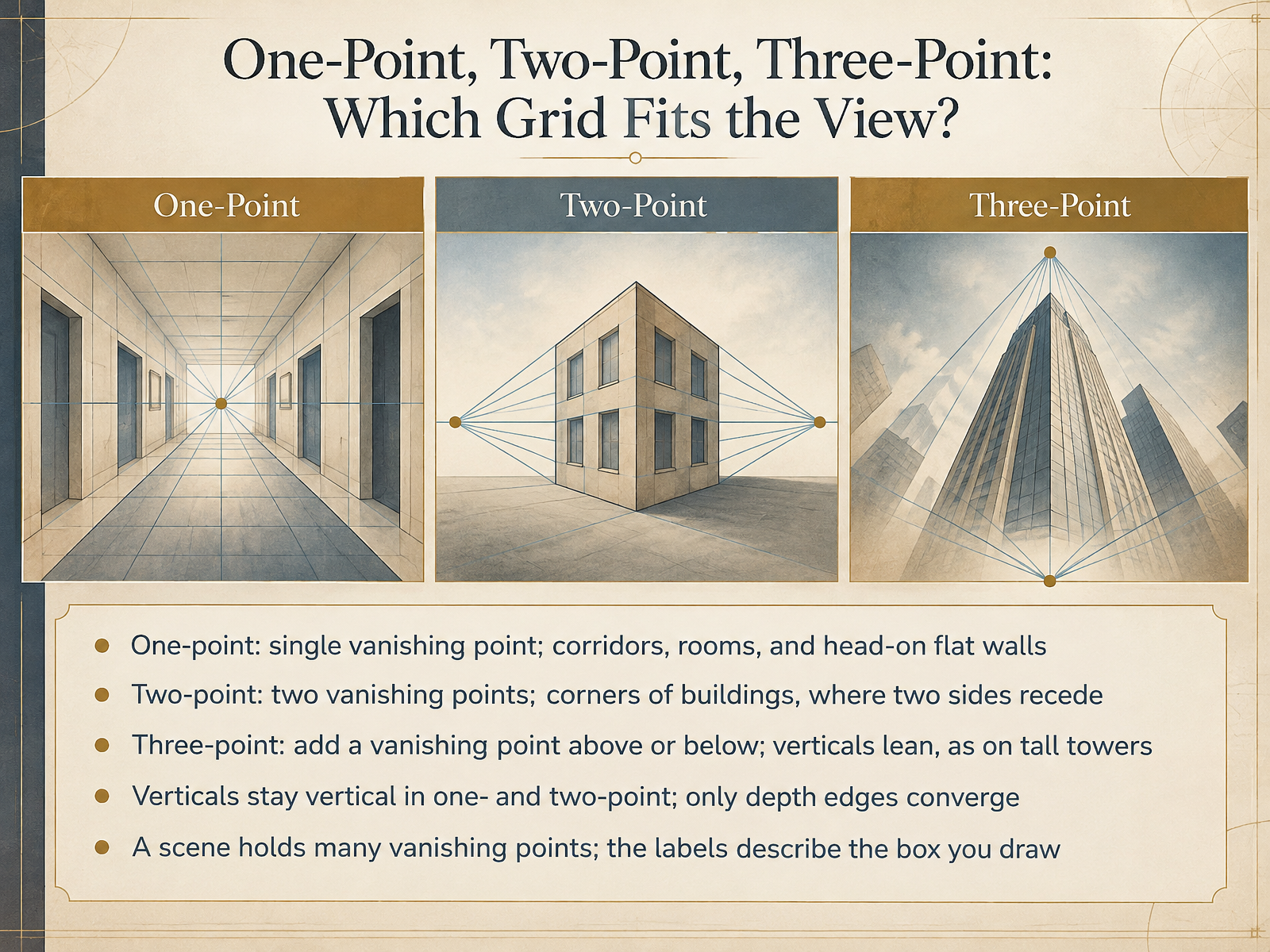
- 07One-Point, Two-Point, Three-Point: Which Grid Fits the View?Let's bring these ideas together now, by asking a simple question. How are you looking at the subject? Each answer gives you a different grid. One-point perspective uses a single vanishing point. It suits corridors, rooms, and any flat wall you face head-on. Two-point perspective uses two vanishing points on the horizon. Reach for it when you see the corner of a building, where two sides recede away from you. Three-point adds one more vanishing point, above or below the horizon. That is what you want for tall towers, where the verticals visibly lean. Here is a useful rule. In one-point and two-point views, vertical lines stay vertical. Only the edges running into depth converge. And remember, a real scene holds many vanishing points. The labels simply describe the box you choose to draw. Now, let's build depth step by step, in the construction process.
 human.libretexts.orgfinearttutorials.com1 min
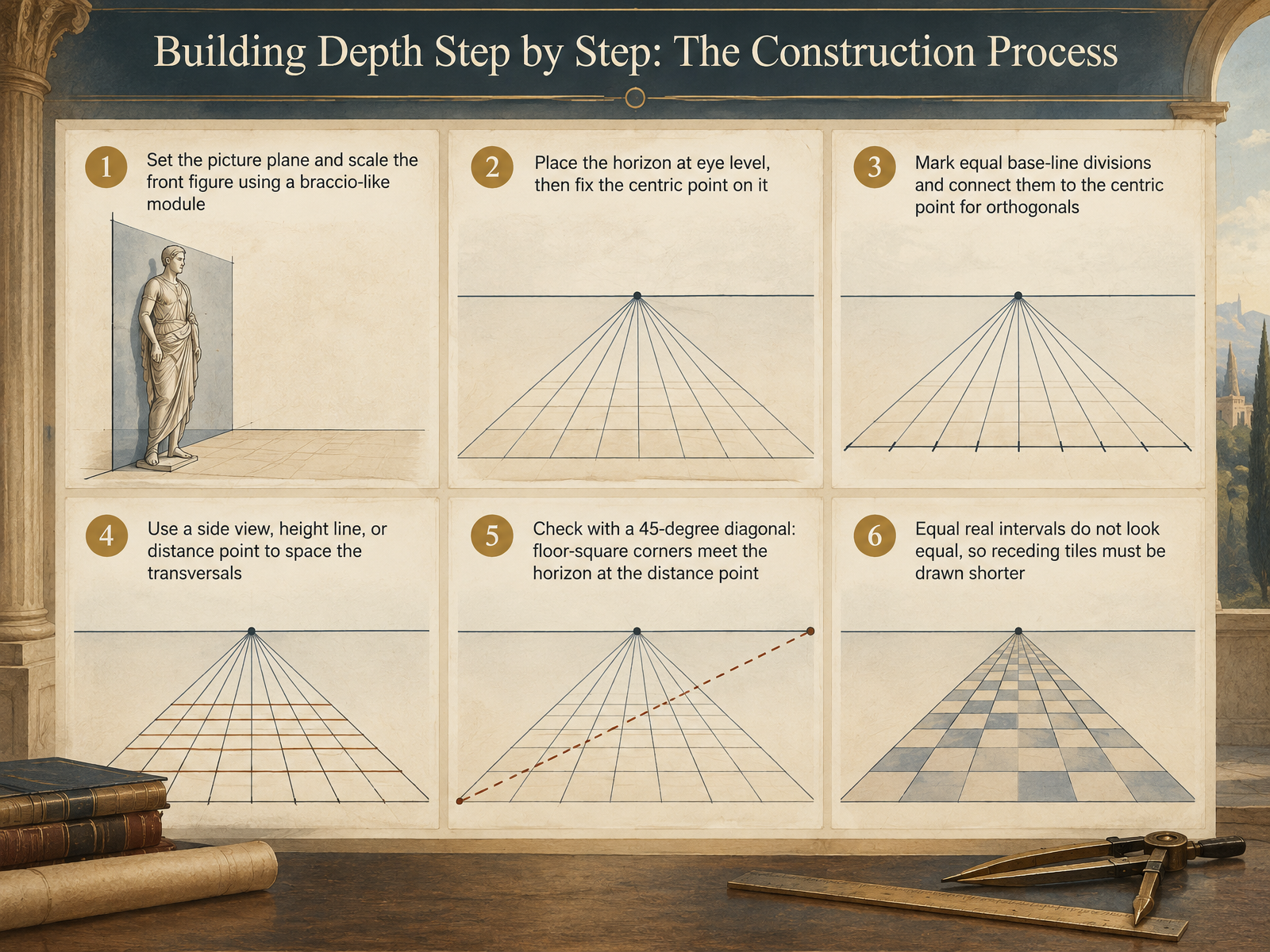
- 08Building Depth Step by Step: The Construction ProcessNow let's build the depth step by step, the way a Renaissance artist would. First, you set the picture plane, that imaginary window, and scale your front figure using a repeated unit of measure. Alberti used the braccio, roughly the length of a man's forearm. Next, you place the horizon at eye level, then fix your centric point, the spot where the viewer's central gaze lands. Then you mark equal divisions along the base line and connect each one to that point. Those lines are called orthogonals, and they carry every receding edge into the distance. But here is the real problem. Equal real intervals do not look equal. Square tiles that are the same size in life must be drawn shorter and shorter as they recede, so that the floor does not appear to tilt. To space them correctly, artists used a side view, a height line, or a distance point. And they checked the work with a diagonal at forty five degrees. Where that diagonal meets the horizon, every floor square corner should line up precisely. That is your proof the pavement is true. Let's look at how one painter used all of this to perfection: Masaccio's Holy Trinity.
 webexhibits.orgams.orgjsklensky.webspace.wheatoncollege.edu+21 min
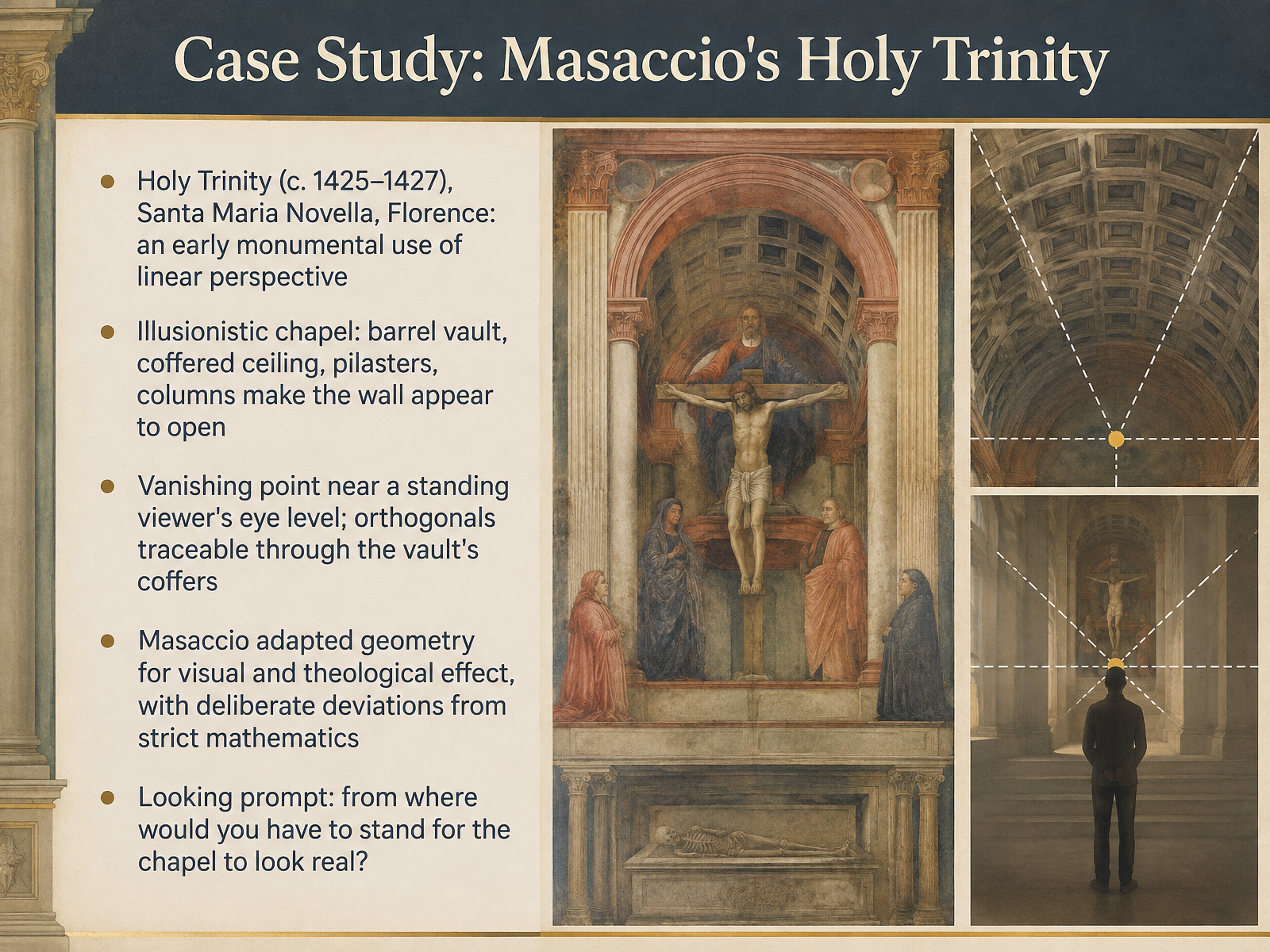
- 09Case Study: Masaccio's Holy TrinityLet's look closely at one painting that put these ideas to work. In the 1420s, in the church of Santa Maria Novella in Florence, Masaccio painted the Holy Trinity, and it is one of the earliest monumental uses of linear perspective. What you see is an illusionistic chapel. A barrel vault, a coffered ceiling, pilasters, and columns all make the flat wall appear to open. The vanishing point sits near a standing viewer's eye level, and you can trace the orthogonals through the coffers of the vault. Interestingly, Masaccio adjusted the geometry for visual and theological effect, with deliberate deviations from strict mathematics. So here is a question to hold in your mind. From where would you have to stand for the chapel to look real? Keep that thought, because next we turn to Piero della Francesca and the ideal space.
 1 min
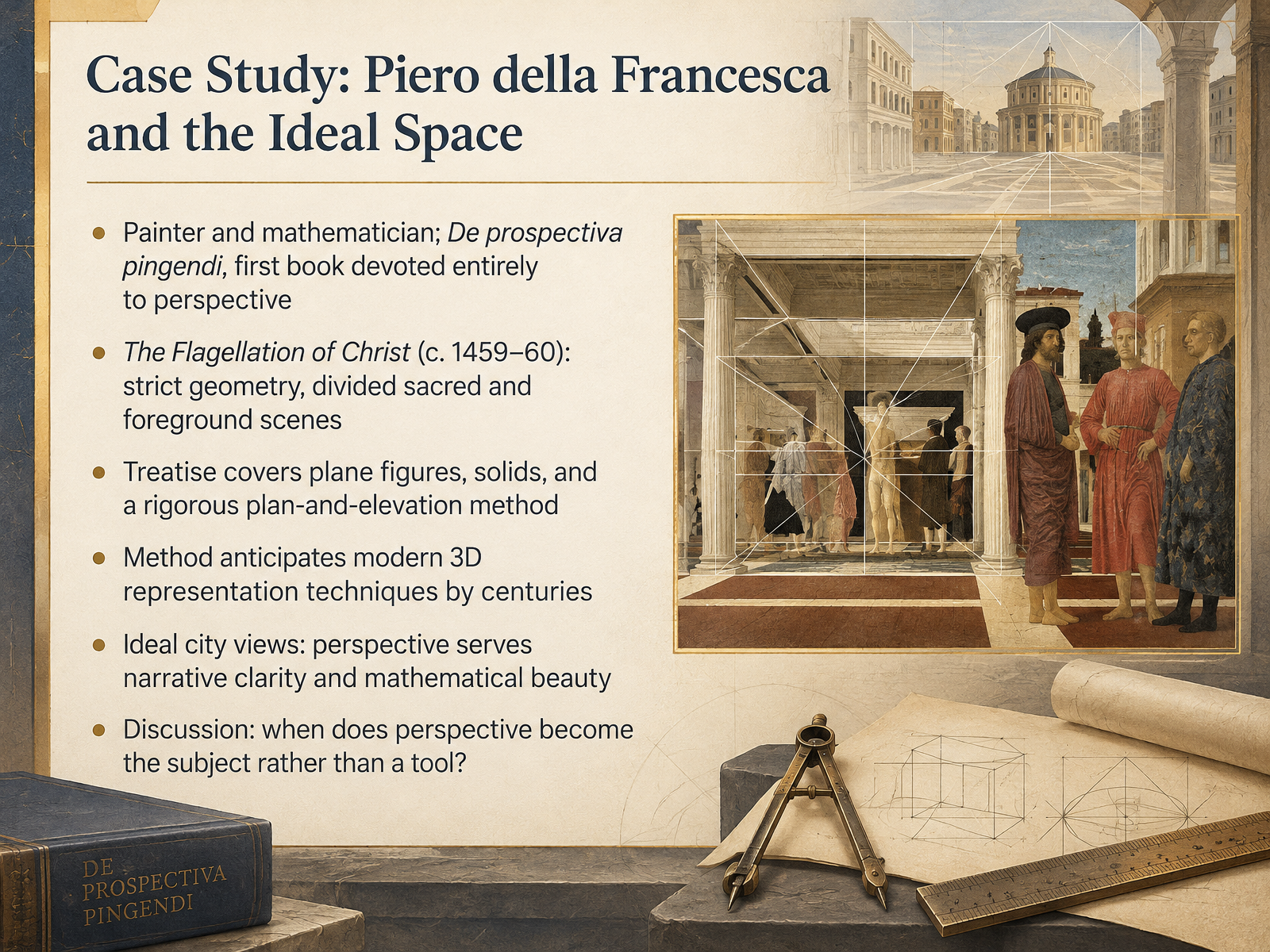
- 10Case Study: Piero della Francesca and the Ideal SpaceNow let's look at one painter who took perspective further than anyone of his time: Piero della Francesca. He was both an artist and a mathematician, and he wrote the first book devoted entirely to perspective, called On the Perspective of Painting. In it, he explains how to draw flat shapes, solid objects, and even how to work from a plan and an elevation, much like architects and 3D designers do today. His method anticipated modern three-dimensional representation by centuries. You can see this in The Flagellation of Christ, painted around fourteen fifty-nine to fourteen sixty. Notice how strict geometry divides the scene: the sacred event unfolds in the background, while three calm figures stand in the foreground. The space feels measured, almost silent. In his Ideal City views, perspective is not just a tool for depth. It becomes part of the beauty and clarity of the story itself. So here is a question to hold onto. When does perspective stop being a technique and become the subject of the painting? Next, we'll see how Leonardo and Raphael pushed these ideas in different directions, in Leonardo's Last Supper and Raphael's School of Athens.
 britannica.comtate.org.ukmath.dartmouth.edu+22 min
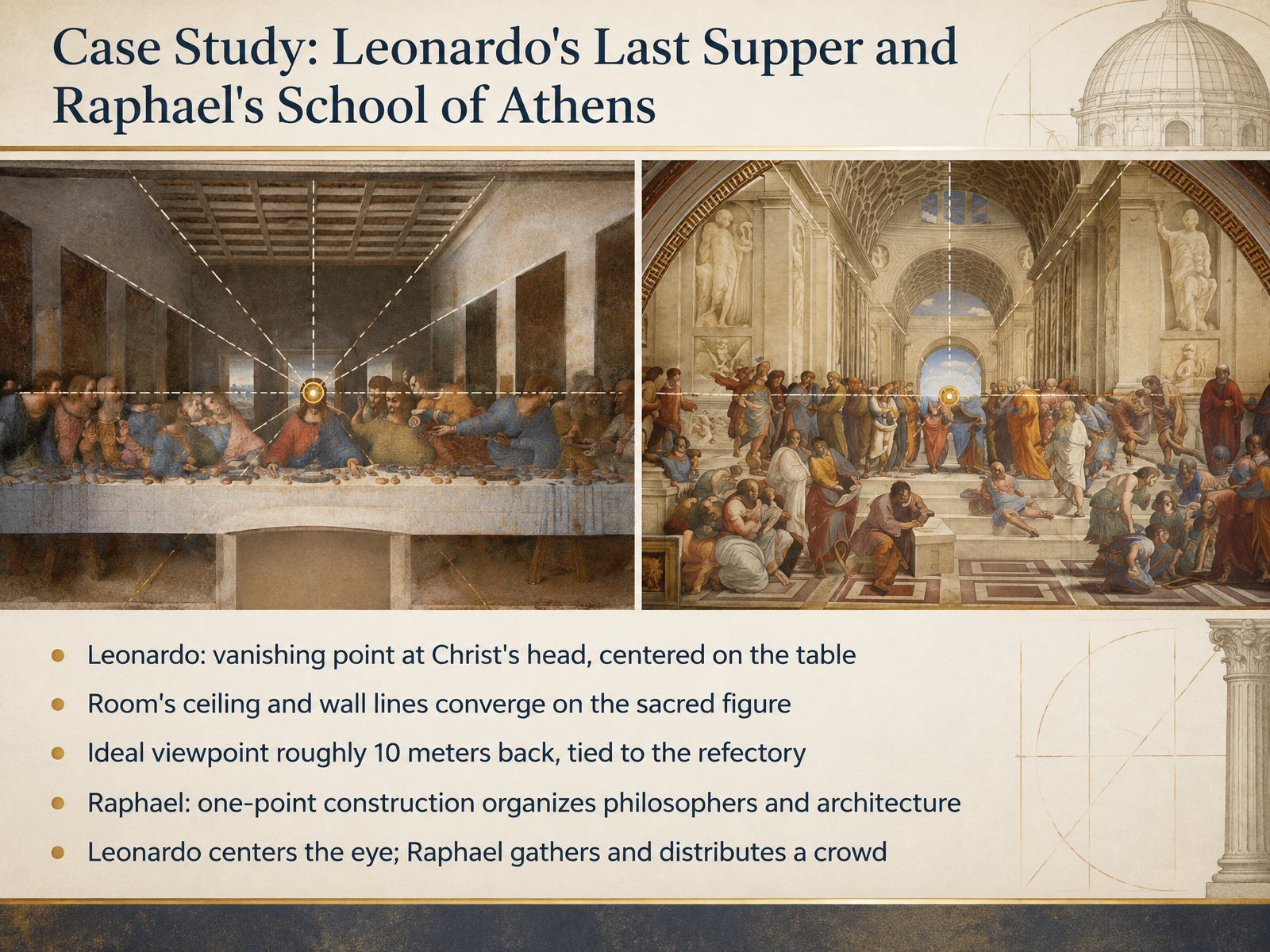
- 11Case Study: Leonardo's Last Supper and Raphael's School of AthensNow let us look at two famous examples side by side. In Leonardo's Last Supper, the vanishing point sits right at Christ's head, at the center of the table. Notice how the ceiling lines and the wall lines all quietly converge on that sacred figure, so the room itself draws your eye to him. Leonardo even tuned the room so that the ideal viewing spot was about ten meters back, roughly where a monk would stand in the refectory. Raphael takes a different approach in the School of Athens. One-point construction organizes both the philosophers and the architecture, but instead of centering a single figure, Raphael gathers and distributes the crowd across that grand, measured space. So Leonardo centers the eye, while Raphael guides it through a whole community of thinkers. Both painters used the same geometry for very different purposes. That contrast between geometric space and the air around us leads naturally into our next topic: Linear Perspective plus Atmospheric Perspective.
 britannica.comtate.org.ukmath.dartmouth.edu+22 min
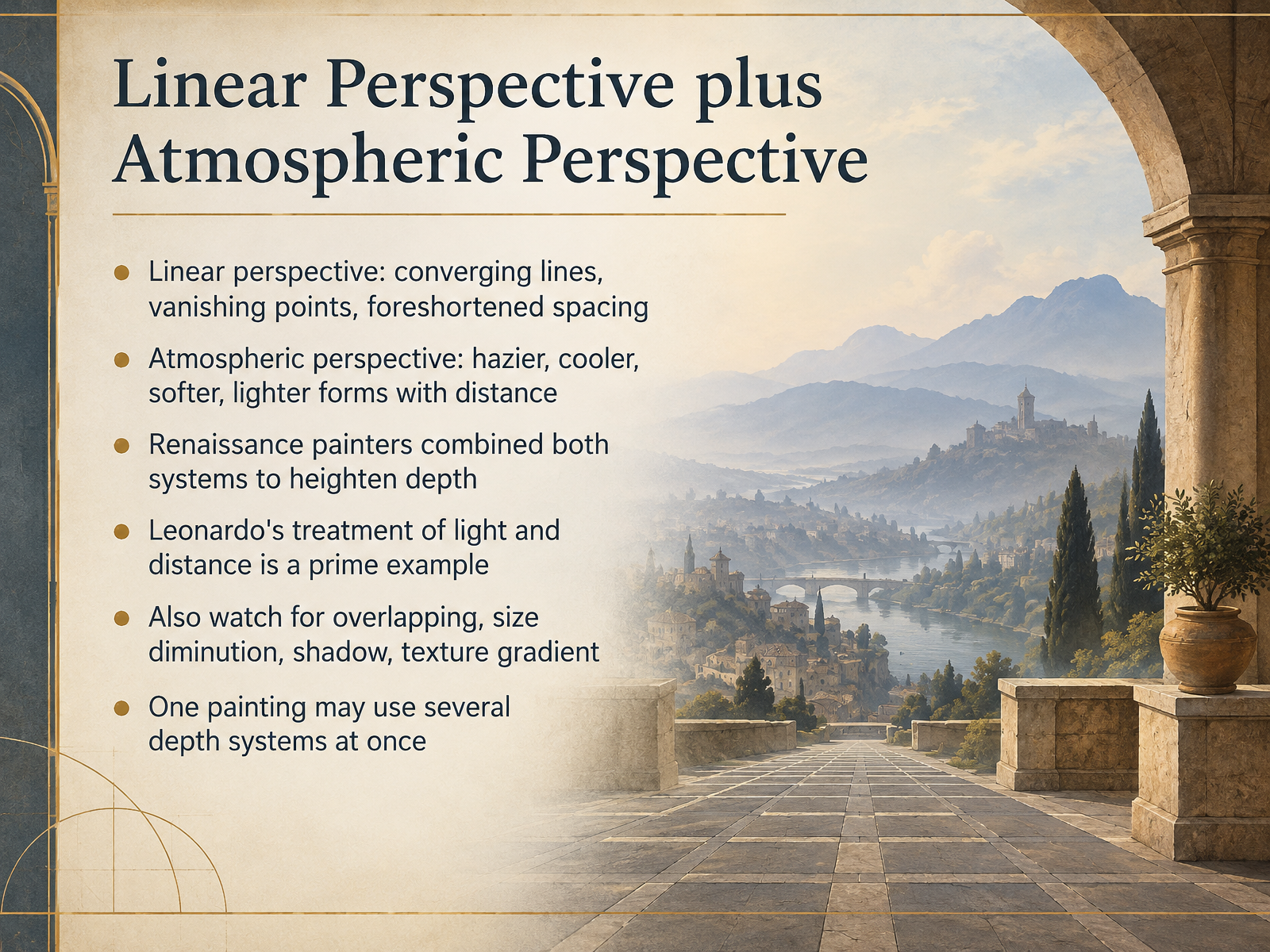
- 12Linear Perspective plus Atmospheric PerspectiveNow, let's bring two depth systems together. Linear perspective works through structure: parallel lines converge toward a vanishing point on the horizon, and spacing grows tighter as it recedes. Atmospheric perspective works through air and light: distant forms turn hazier, cooler, softer, and lighter. Renaissance painters often combined both systems to heighten depth. Leonardo's treatment of light and distance is a fine example. As you look at a painting, also watch for overlapping shapes, size diminution, shadow, and texture that grows finer with distance. One painting may use several depth systems at once. When the Rules Break: Mannerism, Baroque, and Anamorphosis.
 britannica.comtate.org.ukmath.dartmouth.edu+21 min
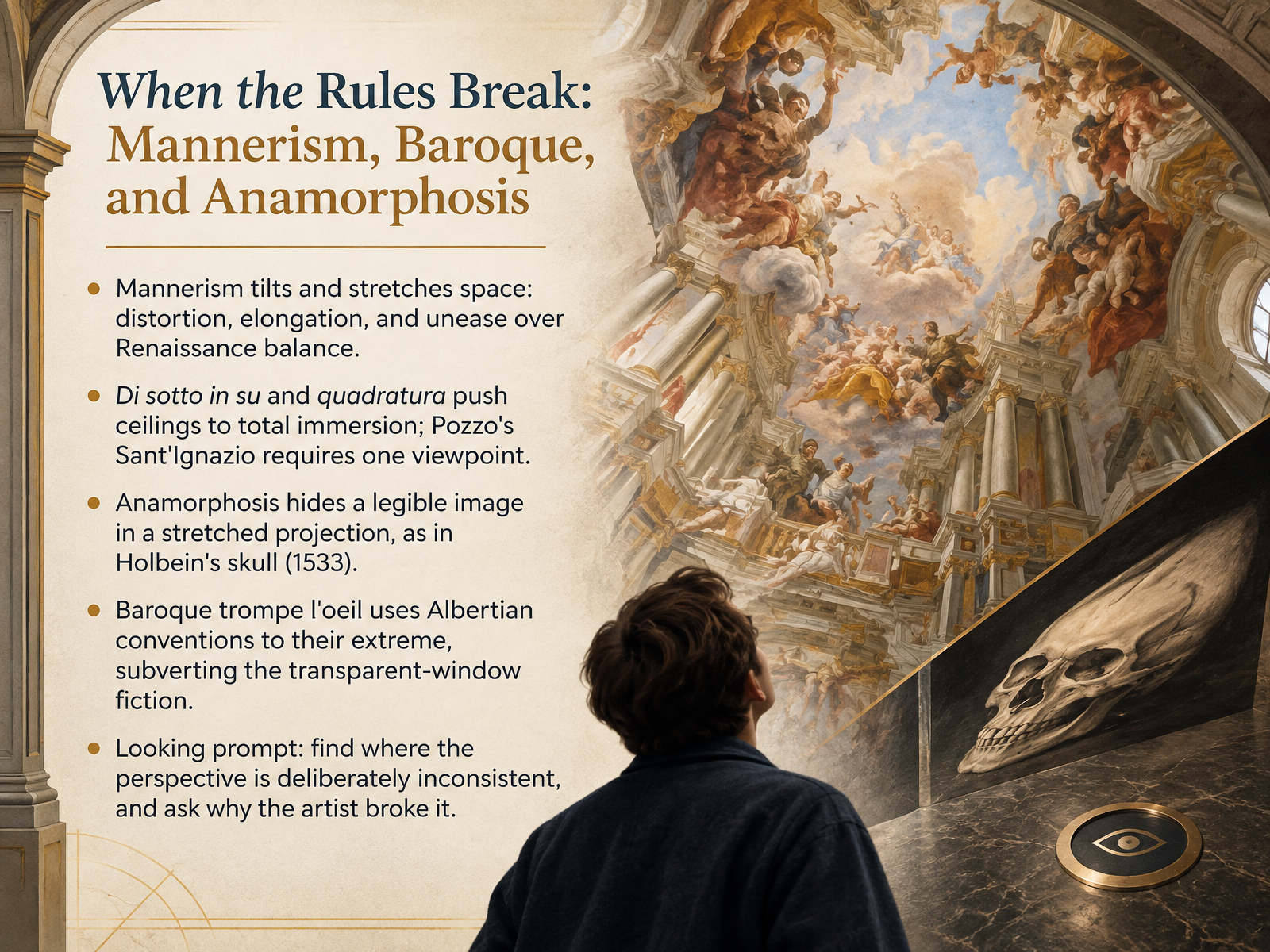
- 13When the Rules Break: Mannerism, Baroque, and AnamorphosisNow let's look at what happens when artists deliberately break these rules. In Mannerism, painters took the calm balance of the Renaissance and pushed it out of shape. Figures stretch unnaturally long, and space feels tilted and unstable. The goal was unease, not harmony. Then came the Baroque, where artists used the very same perspective system, but pushed it to its limits. Look up at a painted ceiling, and the walls seem to dissolve into open sky. One famous example is Andrea Pozzo's ceiling in Sant'Ignazio in Rome. It only looks right from one precise spot. Step away, and the illusion warps. There's also anamorphosis, where a hidden image appears only from a certain angle. Think of the stretched skull in Holbein's painting The Ambassadors. From the front, it's a blur, but viewed from the side, it becomes clear. So here's your looking prompt. When you spot a perspective that seems deliberately inconsistent, don't assume it's a mistake. Ask instead why the artist chose to break the rules. Next, we'll take these ideas into real museum galleries with a visit checklist.
 human.libretexts.orgfinearttutorials.com2 min
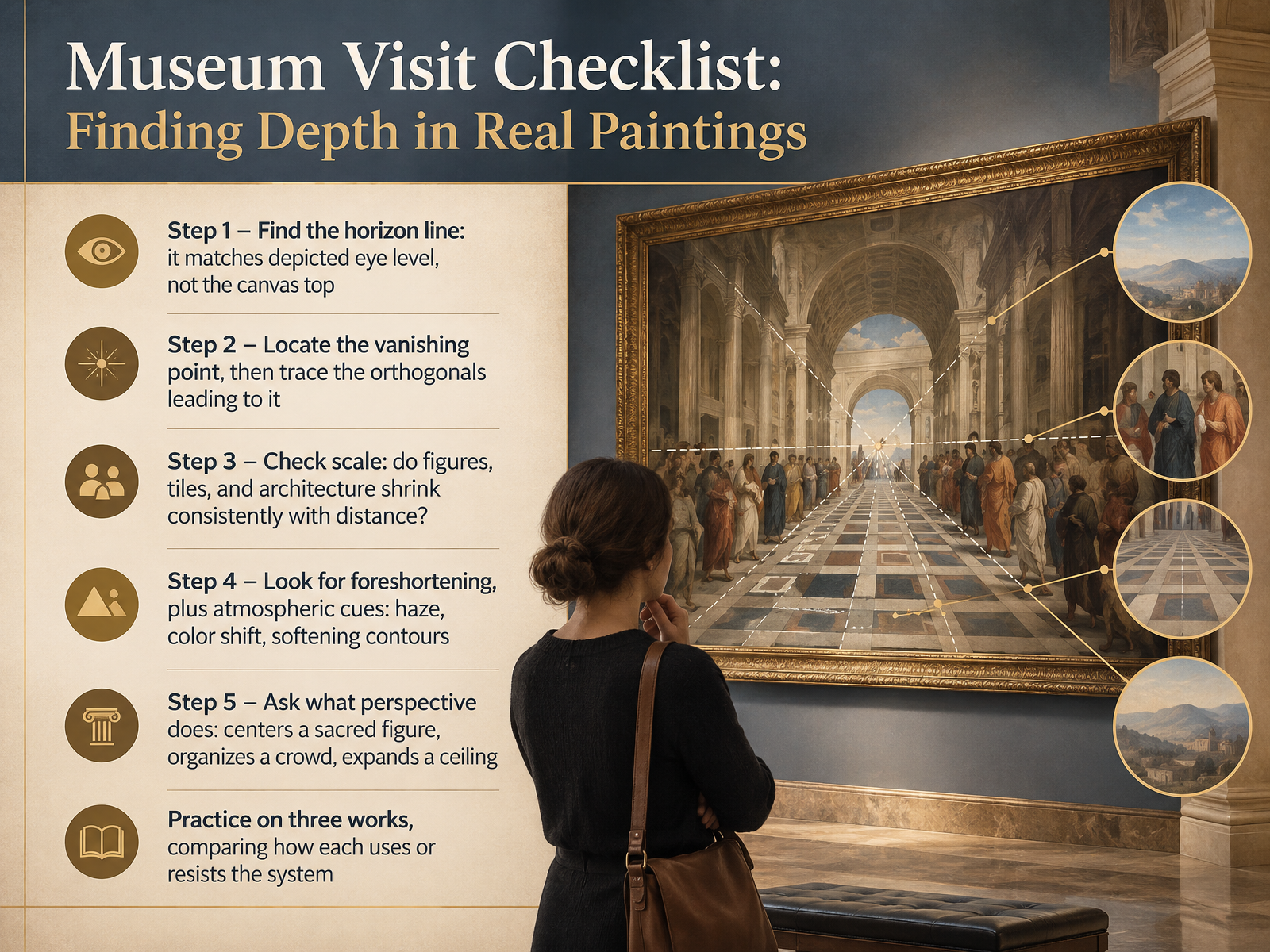
- 14Museum Visit Checklist: Finding Depth in Real PaintingsSo here we are at the end, and this is where everything comes together. Let's turn what we've learned into a simple checklist you can carry into any museum. First, find the horizon line. Remember, it sits at the viewer's eye level, not at the top of the canvas. Second, locate the vanishing point, then trace the orthogonals, those receding lines, back to it. Third, check the scale. Do figures, floor tiles, and architecture all shrink at a consistent rate as they move into the distance? Fourth, look for foreshortening, and for atmospheric cues like haze, cooler colors, and softening contours. And fifth, ask what perspective is doing. Is it centering a sacred figure, organizing a crowd, or opening up a ceiling? Try this on three works, and notice how each one either embraces the system or quietly resists it. Thank you for joining me. Now go look closely, and trust what your eye already knows.
 human.libretexts.orgfinearttutorials.combritannica.com+22 min
Take the deck with you
Download this course as a file — free, no sign-up needed.
- PDF handoutEvery slide page, ready to print or share.15 pages · 5.8 MBDownload
- Narrated PowerPointThe deck that presents itself — every slide carries the digital human's narration video.15 pages · 15.7 MBDownload
- PowerPoint slidesThe full deck as a .pptx — open it in PowerPoint, Keynote, or Google Slides.15 pages · 5.8 MBDownload
Free to use in your own training — please keep the PersonWise credit page at the end.
Have your own deck? Turn it into a course
Sources consulted
Web sources consulted while building this course.
- Linear perspective — britannica.com
- Perspective | Tate — tate.org.uk
- Geometry in Art & Architecture Unit 11 — math.dartmouth.edu
- Linear Perspective — new.math.uiuc.edu
- How one-point linear perspective works — smarthistory.org
- Space and Scale in Medieval Painting Reflects Imagination... — reference-global.com
- Concerning the chronology of Cimabue's oeuvre and the origin of pictorial depth in Italian painting of the later middle ages — exa.ai
- A study on the painting language of Giotto, a pioneer of the renaissance — cambridgepublish.com
- "Things Not Seen" in the Frescoes of Giotto: An Analysis of Illusory and Spiritual Depth — repository.lsu.edu
- The History of Perspective — essentialvermeer.com
- Notebook — noteaccess.com
- BRUNELLESCHI’S PERSPECTIVE PANELS. RUPTURE AND CONTINUITY IN THE HISTORY OF THE IMAGE Johannes Grave — wwwhomes.uni-bielefeld.de
- Alberti’s Perspective Construction — josmfs.net
- Notebook — noteaccess.com
- The Arrow in the Eye: Chapter II: The Elements of Perspective (page 7) — webexhibits.org
- AMS :: Feature Column from the AMS — ams.org
- Drawing a grid or tile floor in perspective — jsklensky.webspace.wheatoncollege.edu
- How to draw a tiled floor in two-point perspective — graemewilkin.github.io
- 4: Linear Perspective - Humanities LibreTexts — human.libretexts.org
- Linear Perspective in Art — finearttutorials.com