Begin
14 pages · ~28 min
Historical Causation Analysis
This training helps history learners analyze causation, contingency, and consequences, building skills to explain why events happened and evaluate their outcomes.
A digital instructor presents all 14 pages. Hold “Ask” at any point and ask out loud — the answer comes from this course. No sign-up needed.
What you’ll learn
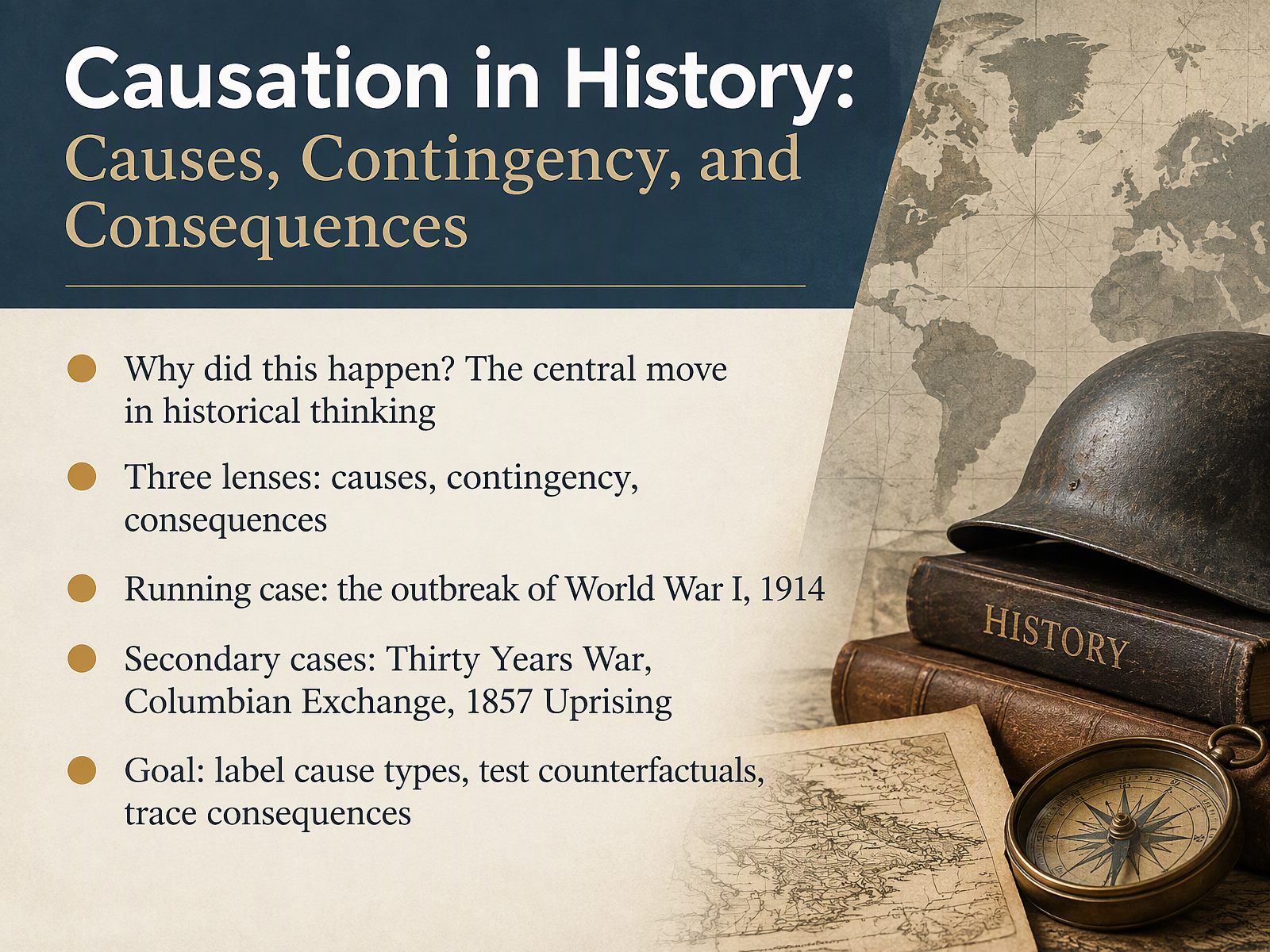
- 01Causation in History: Causes, Contingency, and ConsequencesWelcome. I am glad you are here, because we are about to take on one of the most powerful questions in history: why did this happen? That question is the central move in historical thinking. It turns a list of facts into an explanation you can examine and test. You will look through three lenses: causes, contingency, and consequences. Causes are the conditions and actions that made an event possible. Contingency means that outcomes were not inevitable, because different choices could have led elsewhere. Consequences are the effects that followed. Our main running case is the outbreak of World War One in nineteen fourteen. We will also touch on the Thirty Years War, the Columbian Exchange, and the 1857 Uprising. By the end, your goal is to label cause types, test counterfactuals, and trace consequences. Next, we look at why historical causation is harder than it looks.historicalthinking.cahistoricalthinking.cadoi.org+21 min
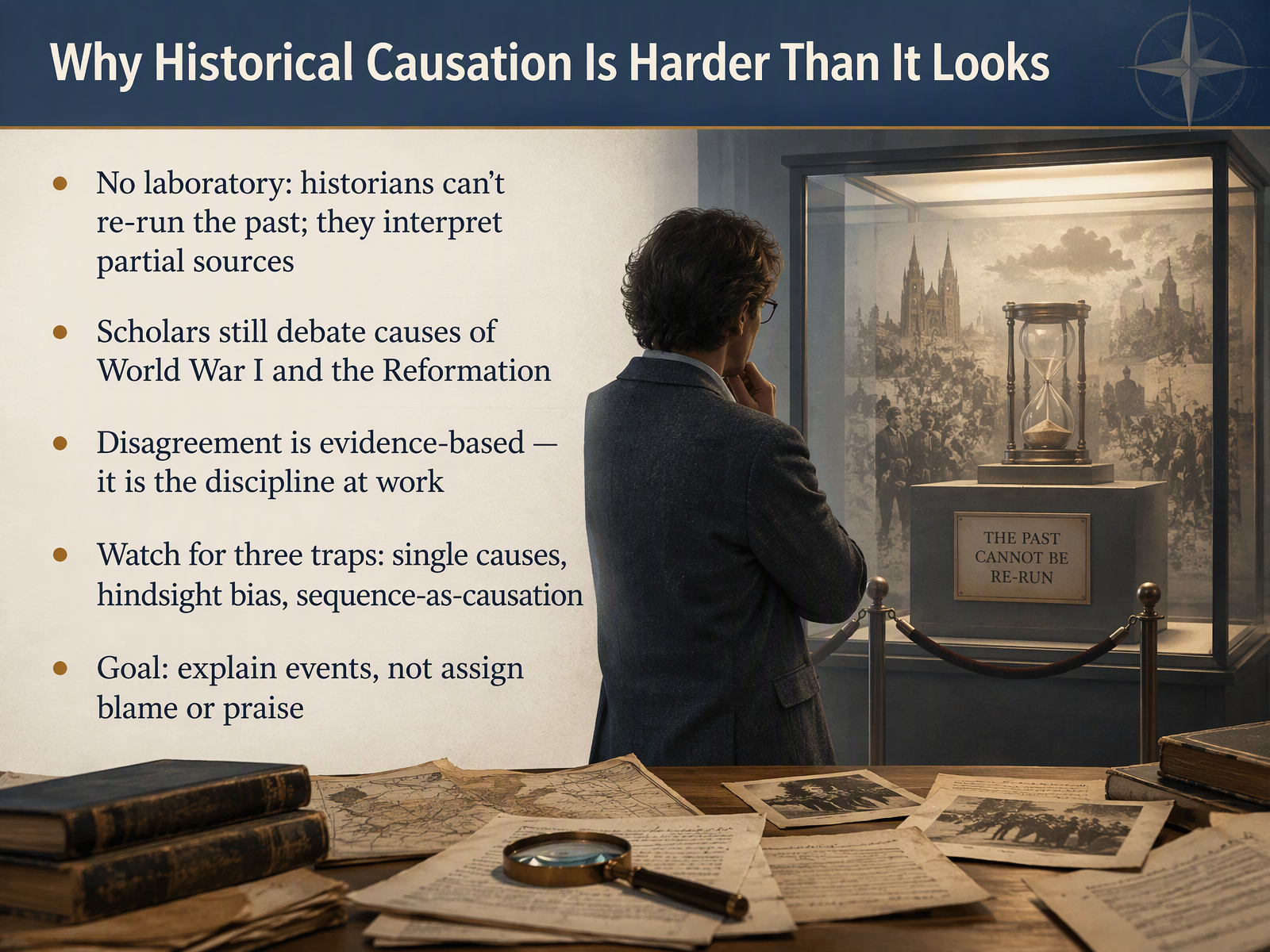
- 02Why Historical Causation Is Harder Than It LooksLet's turn to why historical causation is harder than it looks. First, there is no laboratory. Historians cannot re-run the past. They interpret partial sources, and the evidence often supports more than one explanation. That is why scholars still debate the causes of World War One and the Reformation. Here is the key point. Disagreement is not a failure. When it is evidence-based, it is the discipline at work. Now consider three traps to watch for. Single causes, where one factor is blamed for everything. Hindsight bias, where we assume people at the time knew how things would end. And sequence as causation, where we treat one event following another as proof that the first caused the second. Our goal is to explain events, not to assign blame or praise. So test every claim against the sources, and stay honest about uncertainty. Where Causation Sits in Historical Thinking.
 historicalthinking.cahistoricalthinking.cadoi.org+22 min
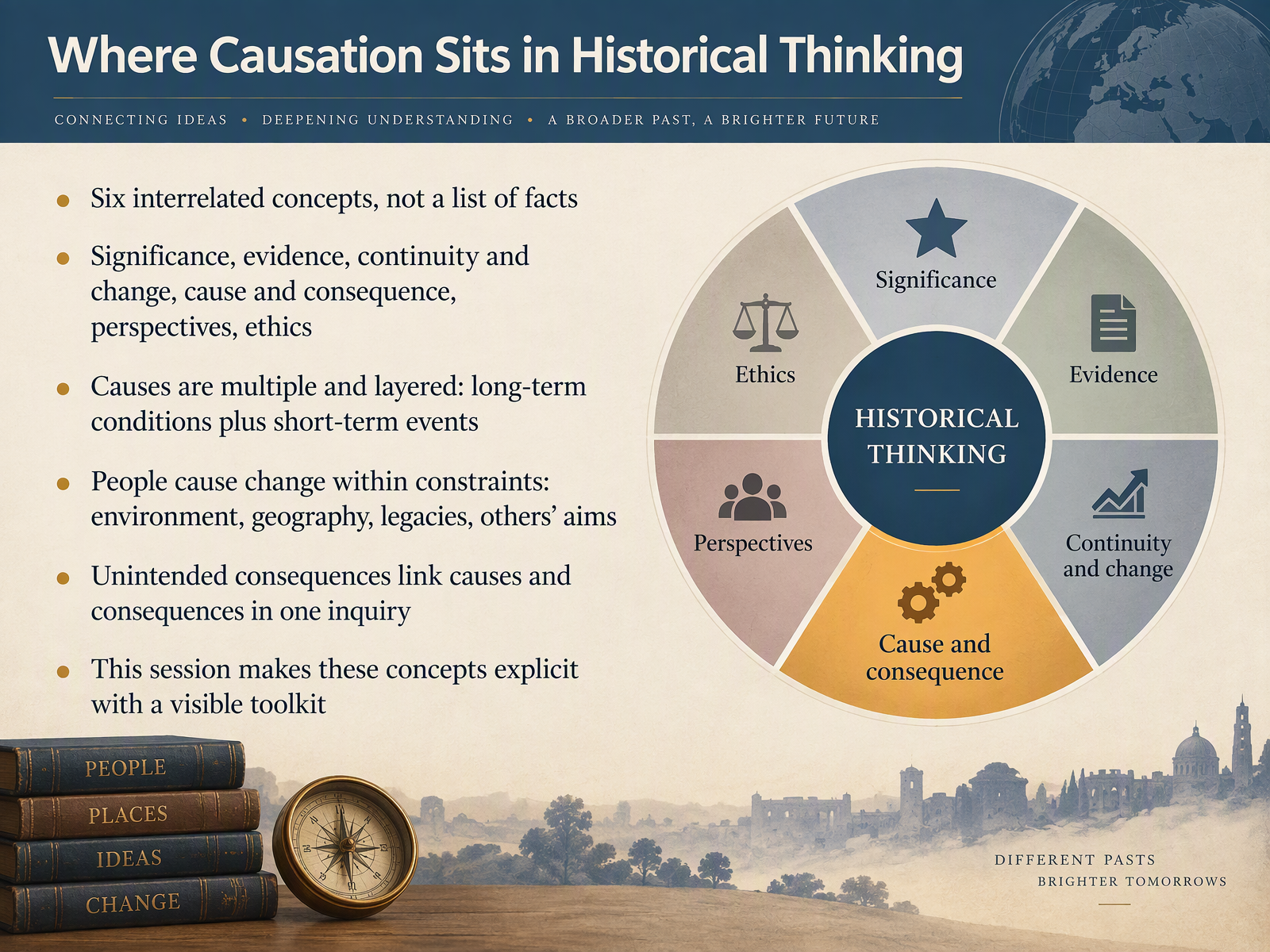
- 03Where Causation Sits in Historical ThinkingSo where does causation actually sit within historical thinking? Here is the key point. Historical thinking rests on six concepts, and they work together, not as a list of facts to memorize. They are significance, evidence, continuity and change, cause and consequence, perspectives, and ethics. Causation is one of them, but it connects to all the others. Now consider how causes work in practice. Causes are multiple and layered. Long-term conditions, like an economic system or a belief, sit alongside short-term events, like a decision or a protest. People do cause change, but always within constraints. The environment, geography, inherited legacies, and other people's aims all limit what is possible. And actions often have unintended consequences, so causes and consequences become one inquiry. Throughout this session, we will make these concepts explicit with a visible toolkit. What makes a cause? Conditions, pressures, and triggers.
 historicalthinking.cahistoricalthinking.cadoi.org+22 min
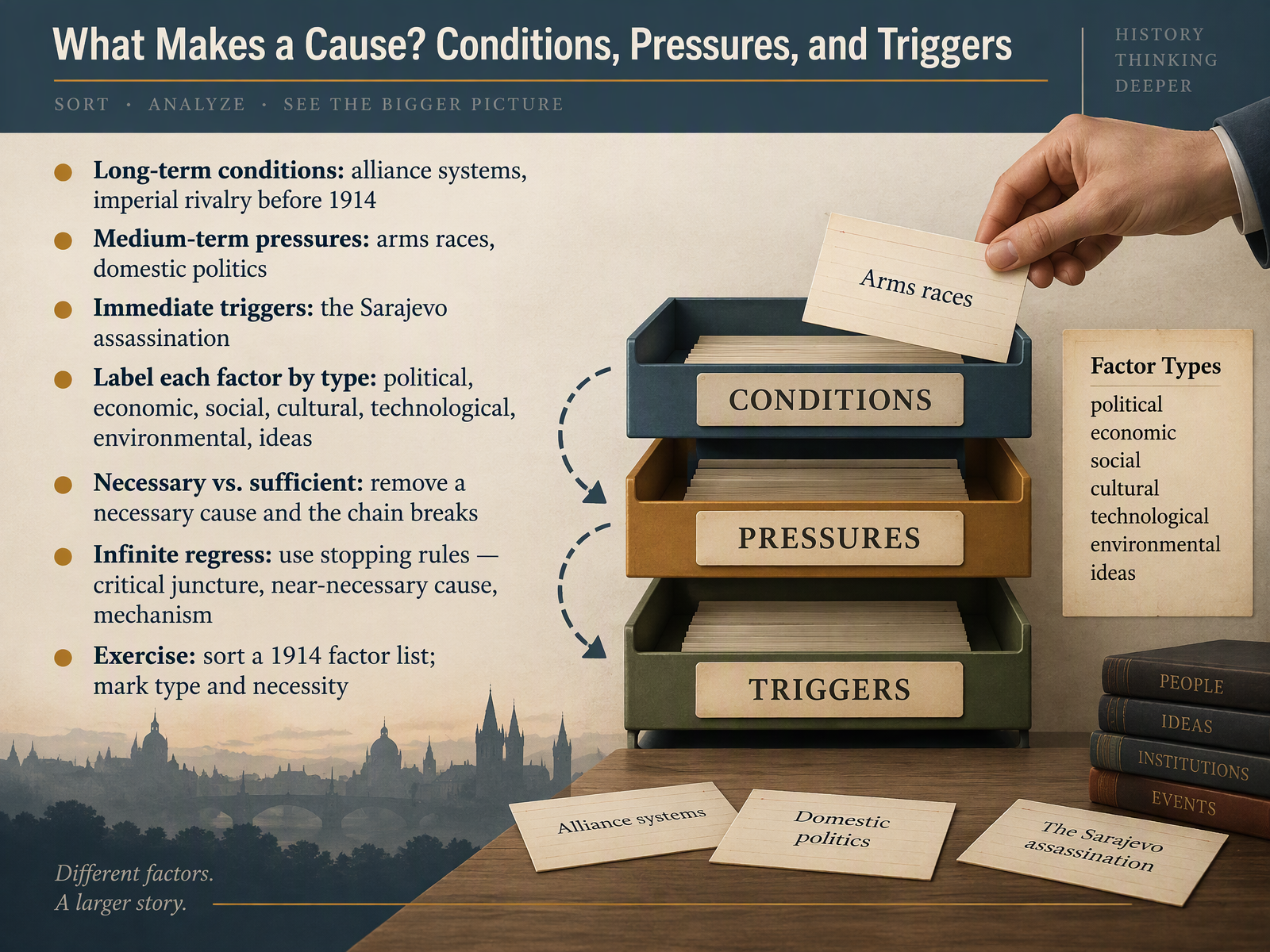
- 04What Makes a Cause? Conditions, Pressures, and TriggersLet's look at what actually makes a cause. Start with timing. Long-term conditions are the deep background, like the alliance systems and imperial rivalries that built up before nineteen fourteen. Medium-term pressures sit closer to the event, such as arms races and domestic politics. And immediate triggers are the spark, like the assassination at Sarajevo. Here's the key point. Label each factor by type as well as timing: political, economic, social, cultural, technological, environmental, or ideas. Now consider necessary versus sufficient. A necessary cause is one you can't remove without breaking the chain. So if you take it away, the outcome doesn't happen. The trouble is infinite regress, because every cause seems to have its own cause. That's why historians use stopping rules, like a critical juncture, a near-necessary cause, or an identifiable mechanism. Your exercise: sort a list of nineteen fourteen factors, and mark each one by type and by necessity. Then ask what evidence would change your mind. Next, we turn to weighting causes, and asking which ones matter most.
 fas-polisci.rutgers.edujstor.orgcambridge.org+22 min
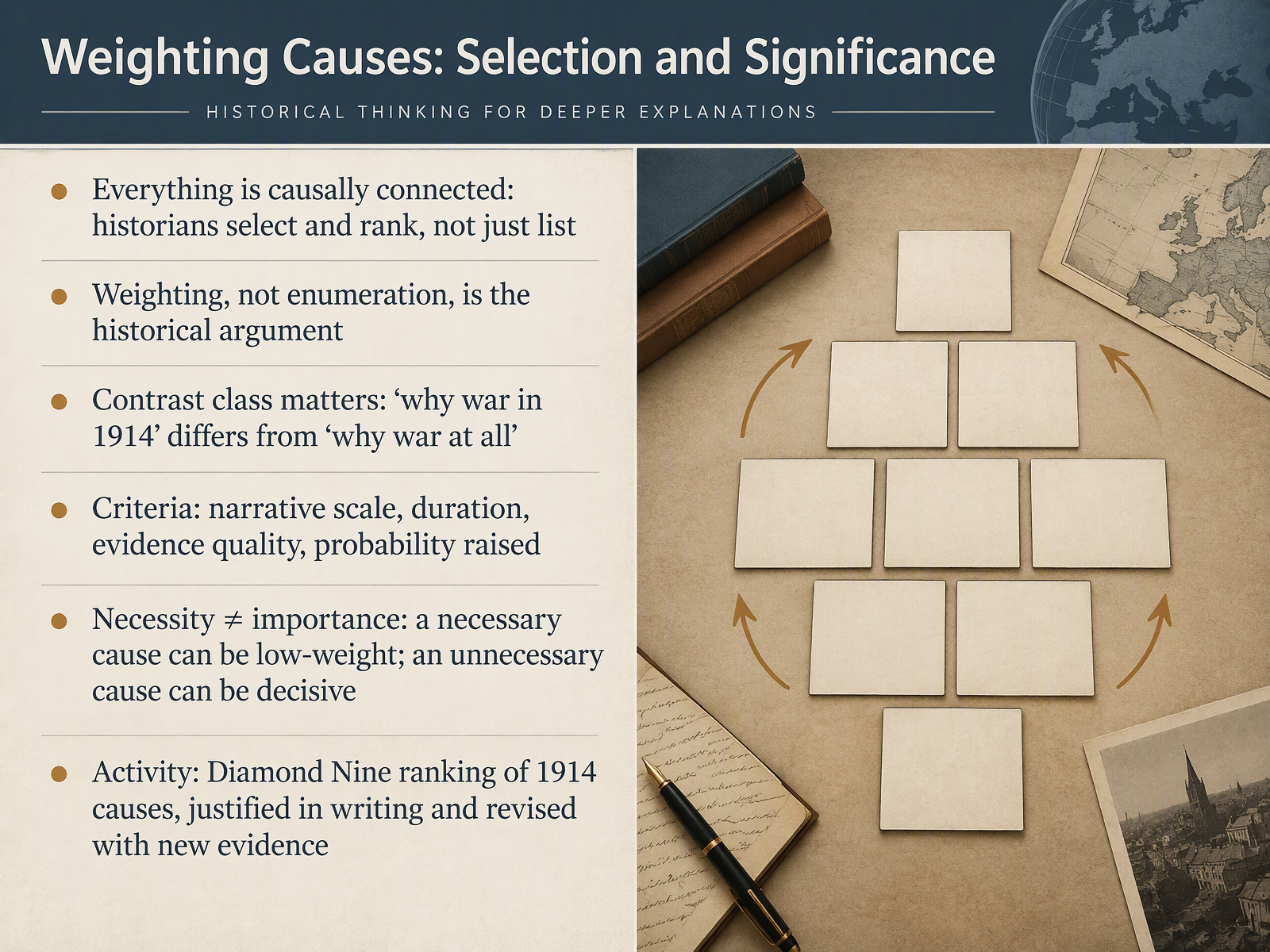
- 05Weighting Causes: Selection and SignificanceNext, let's talk about weighting causes, because not all causes carry equal weight. Everything in history is causally connected in some way. So historians select and rank causes; they don't just list them. Here is the key point: weighting, not enumeration, is the historical argument. The question you ask also matters, what we call the contrast class. Asking why war broke out in nineteen fourteen is different from asking why war happens at all. Historians weigh causes using criteria like narrative scale, duration, evidence quality, and how much a cause raised the probability of the outcome. Now consider the alternative: necessity does not equal importance. A necessary cause can be low weight, and an unnecessary cause can be decisive. So here is an activity for you. Take the causes of nineteen fourteen and rank them in a Diamond Nine shape, with the most important cause at the top and the least at the bottom. Justify each placement in writing, then revise your ranking as new evidence appears. That revision is where real historical thinking happens. Let's move on to levels of explanation: structure, institutions, and individuals.
 fas-polisci.rutgers.edujstor.orgcambridge.org+22 min
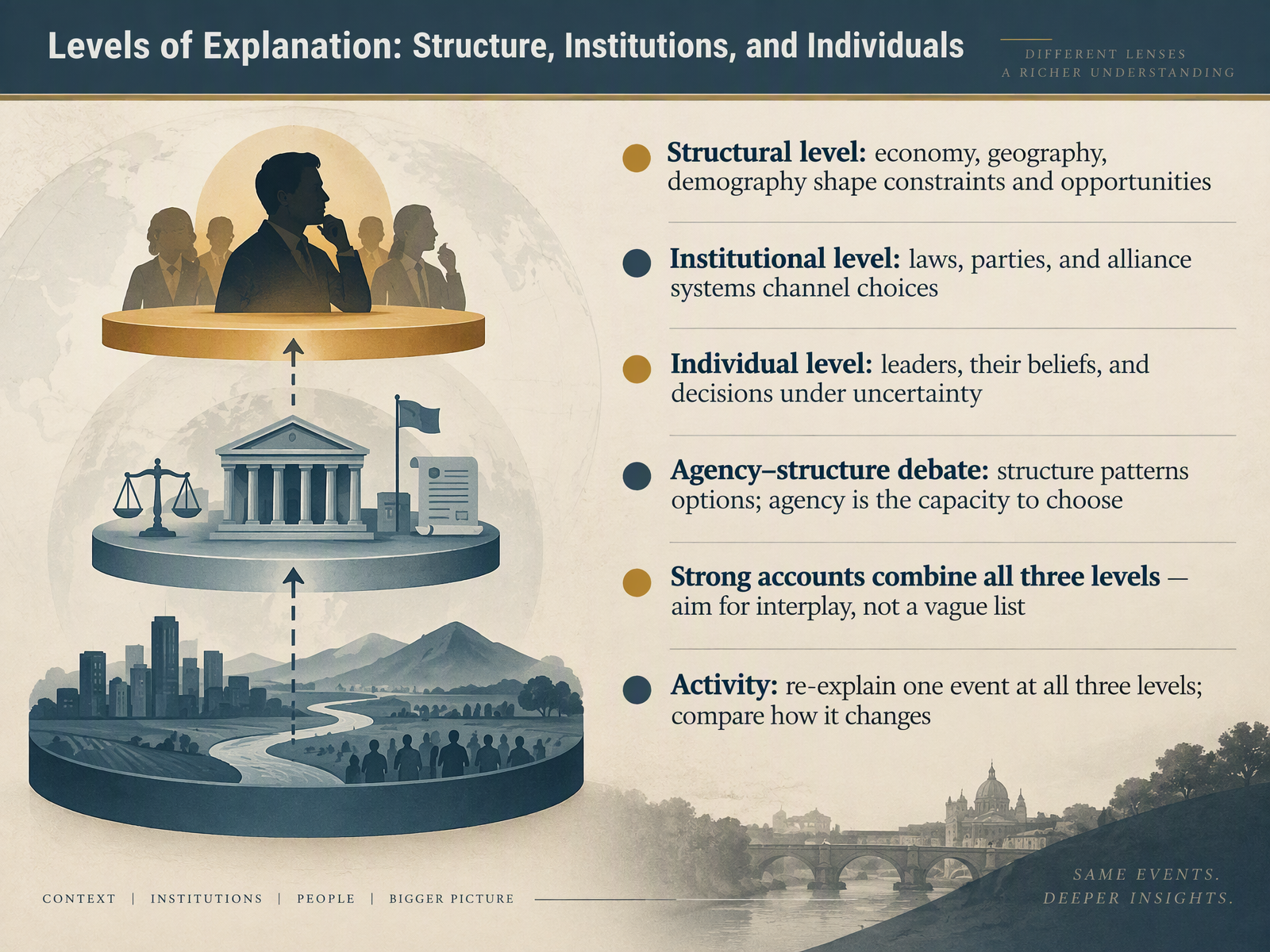
- 06Levels of Explanation: Structure, Institutions, and IndividualsNow let's look at levels of explanation. The key point is that strong historical accounts usually combine three levels, and aim for interplay, not a vague list. First, the structural level. Economy, geography, and population shape the constraints and opportunities people face. Second, the institutional level. Laws, parties, and alliance systems channel choices. Third, the individual level. Leaders, their beliefs, and decisions under uncertainty matter. Now consider the alternative. The agency structure debate asks how much is pattern and how much is choice. Structure patterns the options. Agency is the capacity to choose. But these levels interact. For example, difficult conditions, tight alliances, and a confident leader can combine, and the outcome depends on how they combine. So try this activity. Re-explain one event at all three levels. Then compare how the explanation changes. Next, we turn to contingency. How open was the outcome?
 doi.orgdoi.orgsage.cnpereading.com+22 min
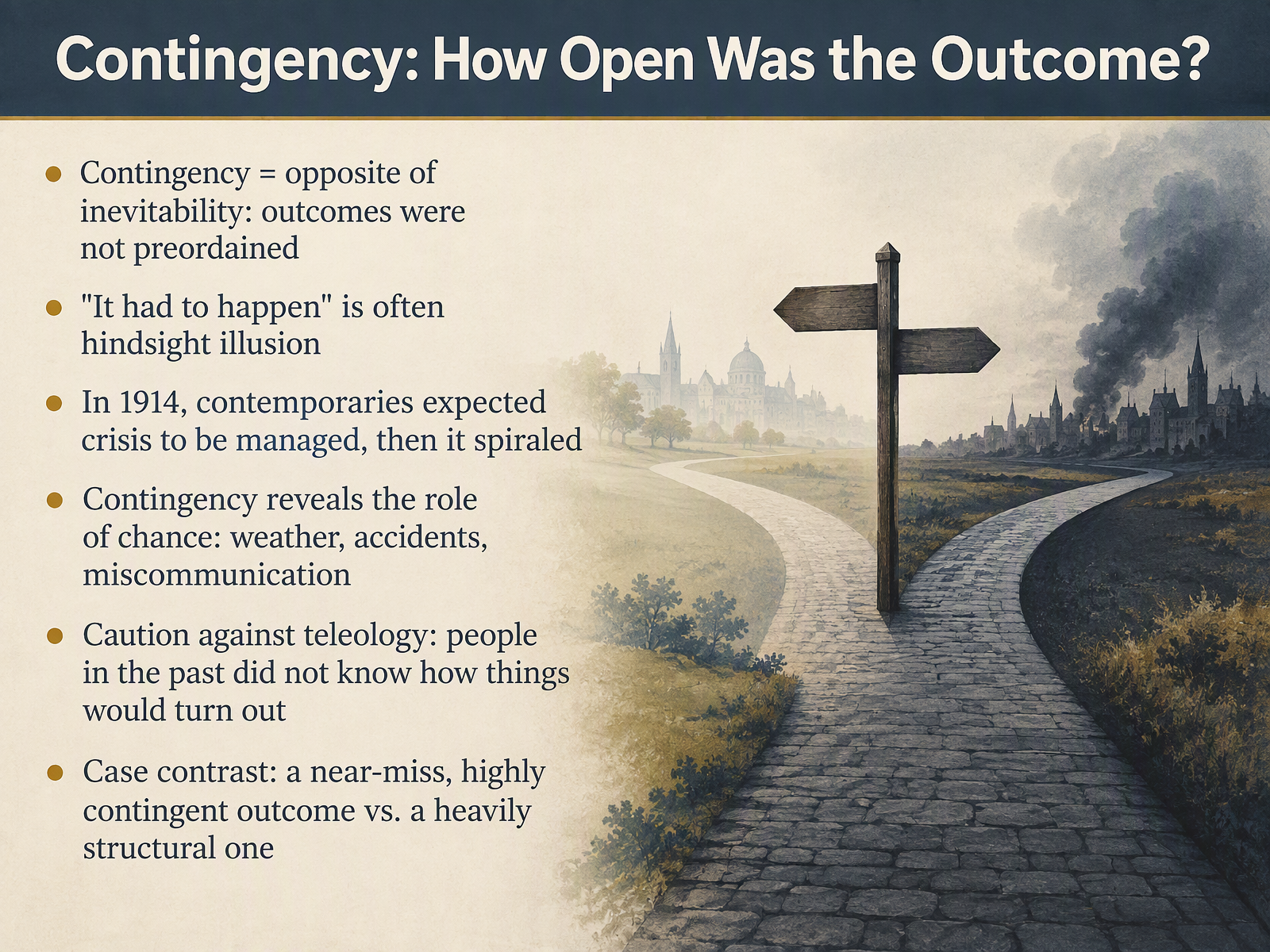
- 07Contingency: How Open Was the Outcome?Let's turn now to contingency, and ask a simple question. How open was the outcome? Contingency is the opposite of inevitability. It means outcomes were not preordained. When we say an event had to happen, that is often a hindsight illusion. Here is the key point. In nineteen fourteen, many contemporaries expected the crisis to be managed, and then it spiraled. Contingency also reveals the role of chance, things like weather, accidents, and miscommunication. Now consider the alternative. We must be careful about teleology, the mistaken idea that events march in a straight line to a known end. People in the past did not know how things would turn out. Compare two cases. A near miss, where a small shift could have changed everything, is highly contingent. A heavily structural outcome, shaped by deep forces, is not. Both can be real. The skill is telling them apart. Next, we look at counterfactuals done responsibly.
 historicalthinking.cahistoricalthinking.cadoi.org+22 min
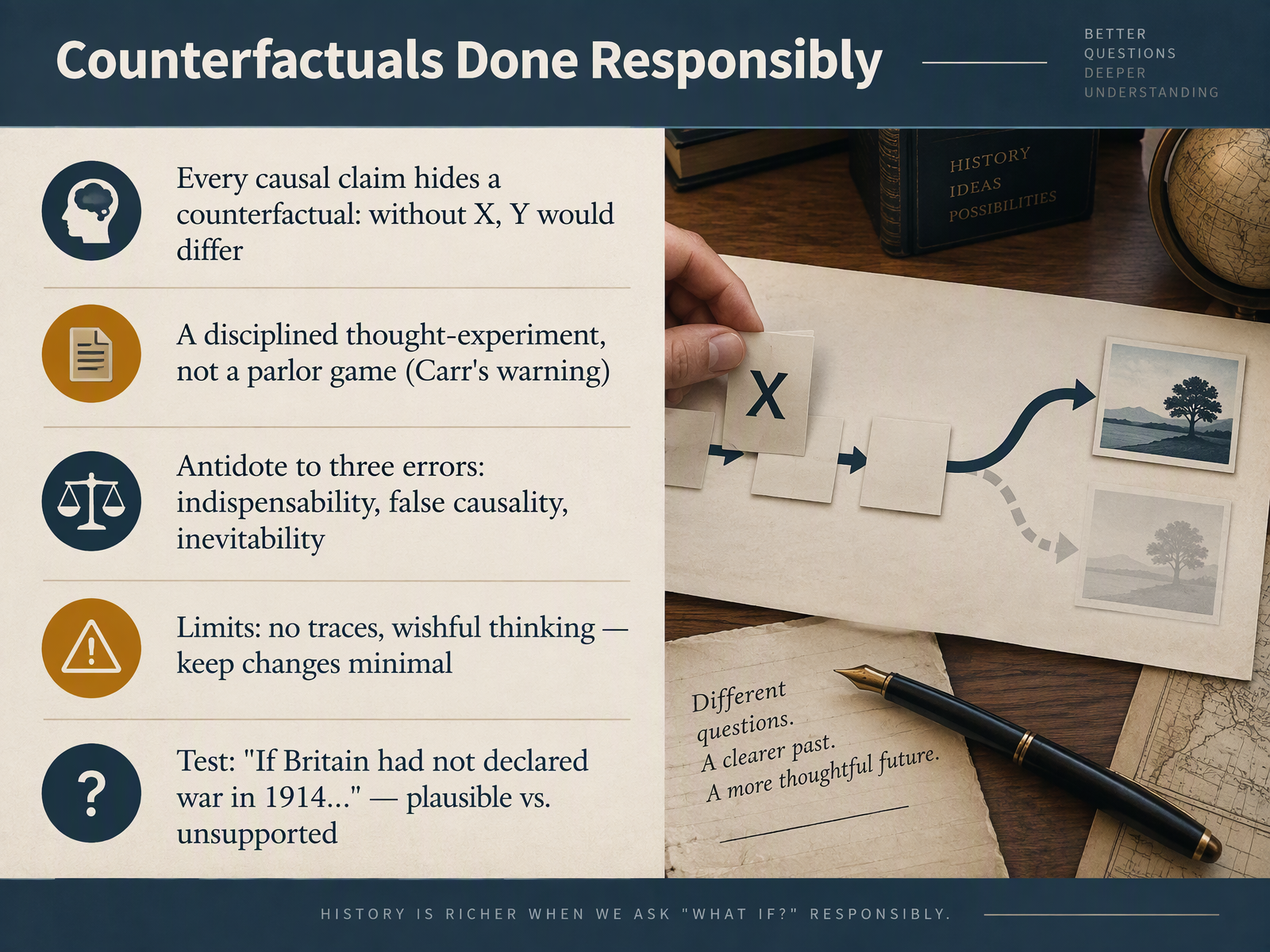
- 08Counterfactuals Done ResponsiblyNow let's look at counterfactuals done responsibly. Here is the key point. Every causal claim hides a counterfactual. When you say X caused Y, you are also saying that without X, Y would have turned out differently. So counterfactual thinking is not a parlor game, as the historian E. H. Carr warned. Done well, it is a disciplined thought experiment. It protects you from three common errors. First, assuming a person or event was indispensable. Second, mistaking a coincidence for a cause, which is false causality. And third, assuming what happened had to happen, which is inevitability. But there are limits. A past that never happened leaves no traces, so evidence is thin. And we are prone to wishful thinking. So keep your change minimal and test it against evidence. Take the question, what if Britain had not declared war in 1914. Ask whether the alternative is plausible and supported, or merely imagined. That test separates real reasoning from storytelling. Next, we turn to consequences: short-term, long-term, and unintended.
 doi.orgdoi.orgsage.cnpereading.com+22 min
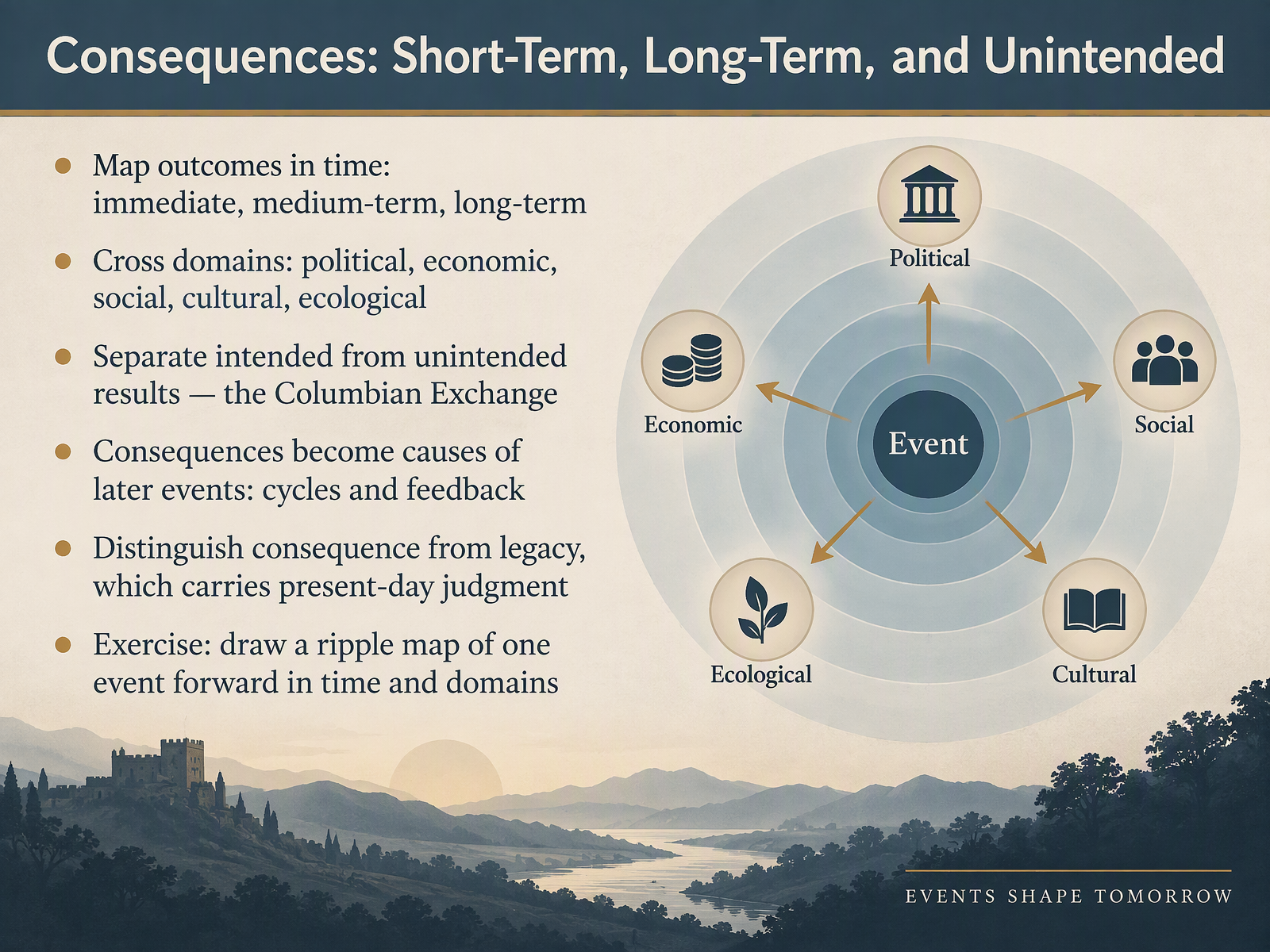
- 09Consequences: Short-Term, Long-Term, and UnintendedLet's turn now to consequences. Here is the key point. Consequences unfold in time. So map them as immediate, medium-term, and long-term. They also cross domains, so ask what happened politically, economically, socially, culturally, and ecologically. Now consider the Columbian Exchange. Spanish colonists brought bananas on purpose because they wanted a useful food. But they accidentally brought scale insects too, and those insects helped trigger swarms of fire ants. Unintended results, rippling outward. Also notice that consequences become causes of later events, creating feedback loops. And keep one distinction clear. A consequence is what happened. A legacy is how we judge it today. Your exercise is to draw a ripple map of one event, forward in time and across domains. This takes us to historians at work, reading competing explanations.
 historicalthinking.cahistoricalthinking.cadoi.org+21 min
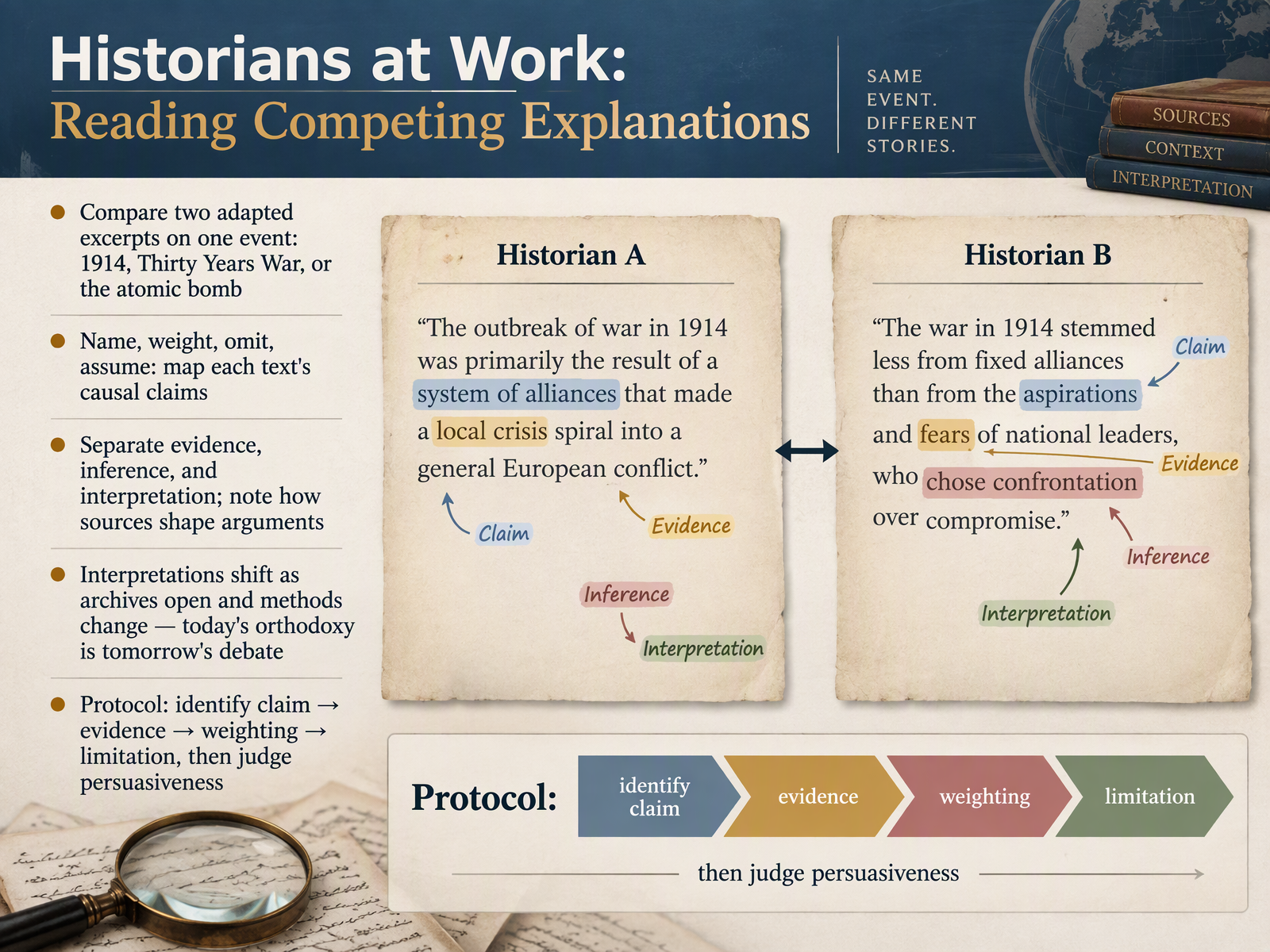
- 10Historians at Work: Reading Competing ExplanationsNow let's see how historians actually do this work. Picture two short excerpts on the same event. Suppose both are about nineteen fourteen, the outbreak of the First World War. Your job is to map each author's causal claims. What do they name as a cause? How much weight do they give it? What do they leave out, and what do they simply assume? Here is the key point. Separate evidence from inference and interpretation. Evidence is what the source shows. Inference is the reasoning you build on it. Interpretation is the larger story that reasoning supports. Watch how each author's sources shape the argument. Historians working mainly from government archives may tell a different story than those reading diaries, newspapers, or testimony from ordinary people. That matters, because interpretations shift as archives open and methods change. Today's settled view can become tomorrow's controversy. So keep a simple protocol. Identify the claim, the evidence, the weighting, and the limitation. Then ask yourself, how persuasive is this, and why? That habit will protect you as we move on to pitfalls and biases in causal thinking.
 historicalthinking.cahistoricalthinking.cadoi.org+22 min
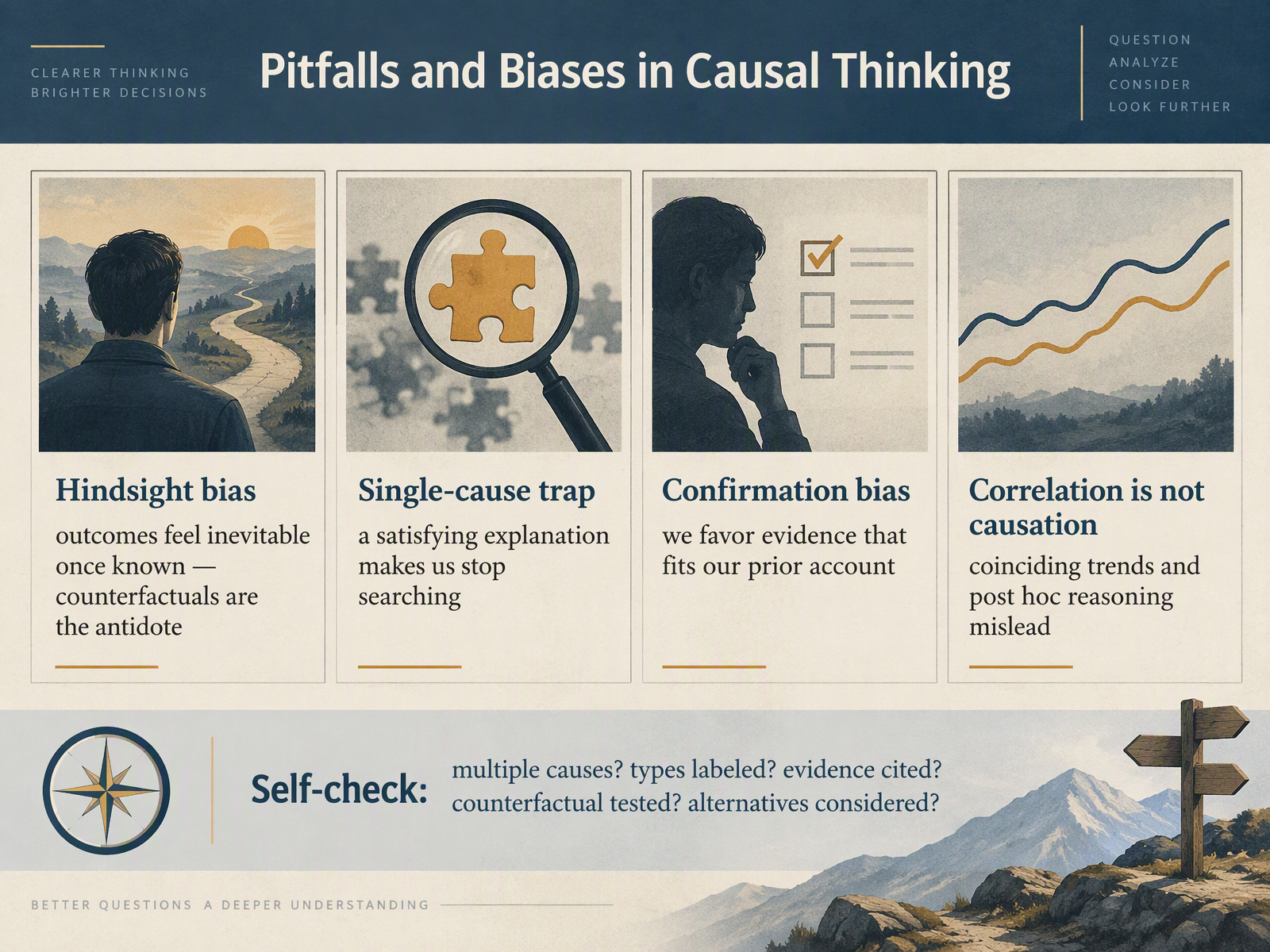
- 11Pitfalls and Biases in Causal ThinkingNow let's look at the traps that catch even careful thinkers. First, hindsight bias. Once you know how something ended, the outcome feels inevitable. Counterfactuals are the antidote, because asking what if this had gone differently restores the sense that history could have branched. Second, the single cause trap. A satisfying explanation tempts us to stop searching, but causes are usually multiple and layered. Third, confirmation bias. We favor evidence that fits the story we already believe, so deliberately look for what contradicts you. And remember, correlation is not causation. Two trends rising together, or one event following another, does not prove that one caused the other. Here is a quick self-check. Did I name multiple causes? Did I label their types? Did I cite evidence? Did I test a counterfactual and consider alternatives? Next, we turn to practical tools in Methods Toolkit: Source Analysis and Causal Mapping.
 historicalthinking.cahistoricalthinking.cadoi.org+21 min
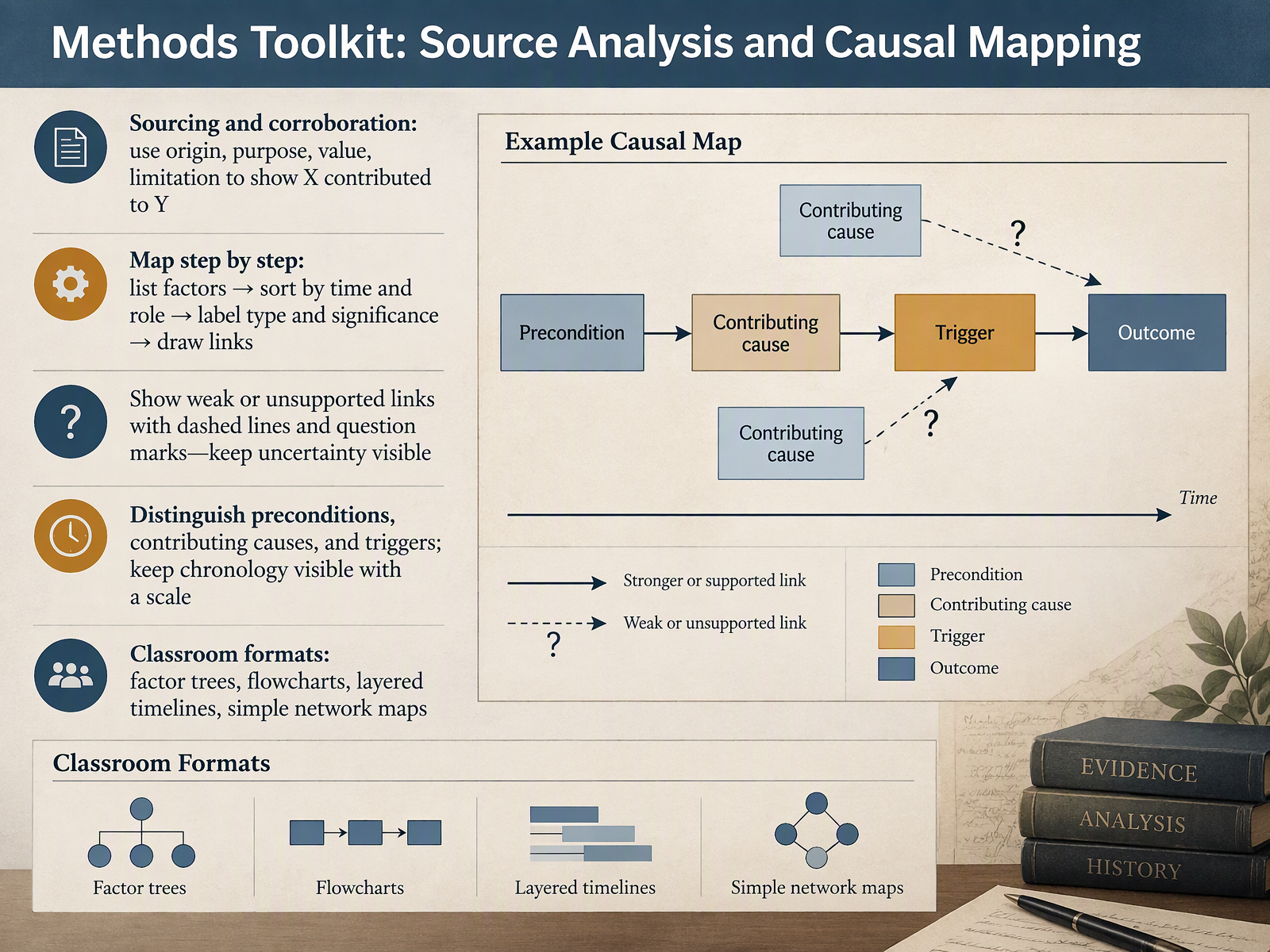
- 12Methods Toolkit: Source Analysis and Causal MappingLet's move from ideas to tools you can actually use. First, sourcing and corroboration. For each source, ask about its origin, purpose, value, and limitation. That shows whether source X really supports the claim that X contributed to Y. Here is the key point: a source you know little about can only carry a weak link. Next, map causation step by step. List the factors, sort them by time and role, label their type and significance, then draw links between them. Where a link is weak or unsupported, use a dashed line and a question mark, because keeping uncertainty visible is honest, not a failure. Also distinguish preconditions, contributing causes, and triggers, and keep chronology visible with a scale. You can try factor trees, flowcharts, layered timelines, or simple network maps in class. Pick one, and test it against your evidence. In the workshop ahead, you'll build a causal account of a turning point yourself.
 historicalthinking.cahistoricalthinking.cadoi.org+22 min
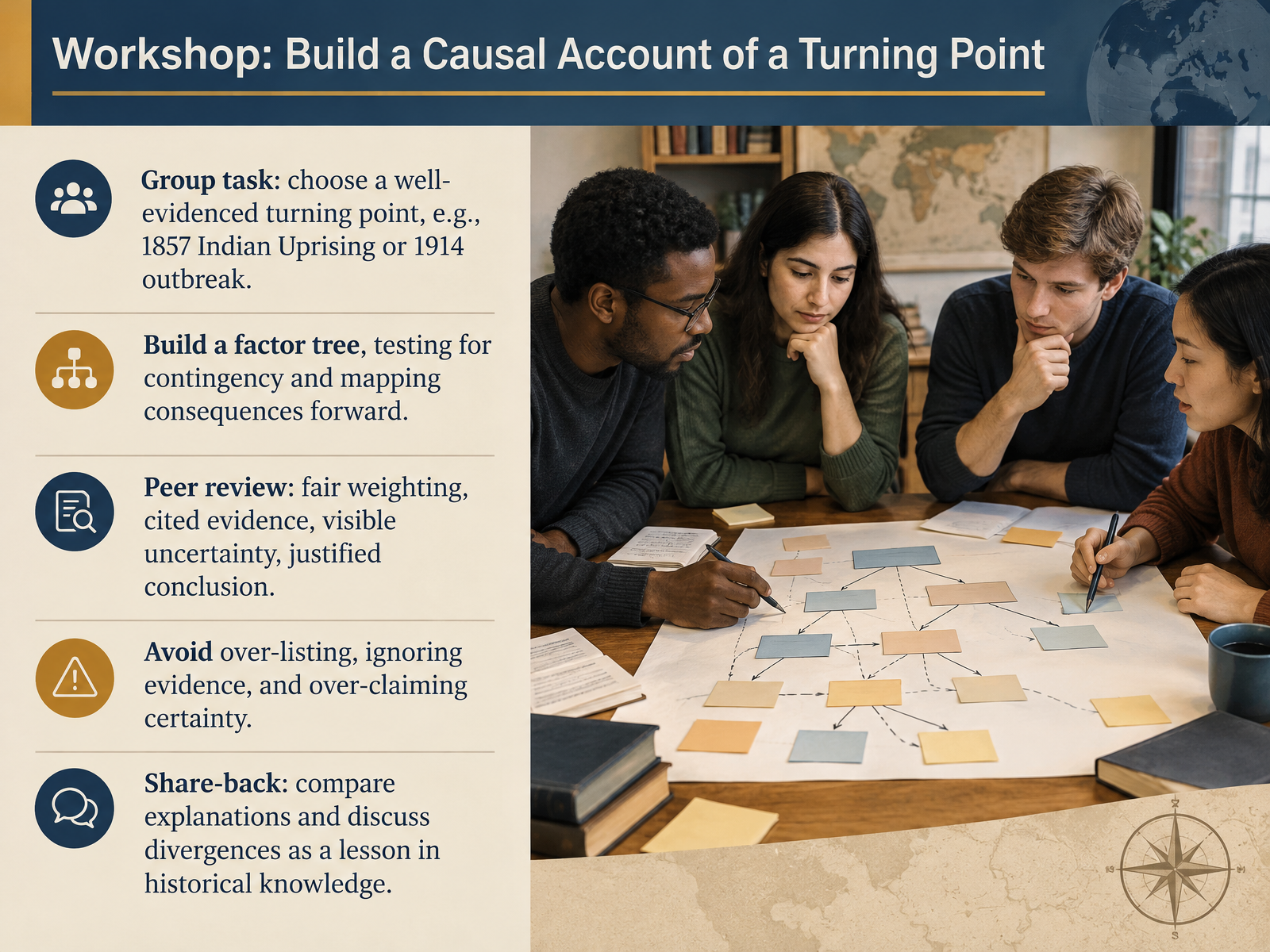
- 13Workshop: Build a Causal Account of a Turning PointNow let's put these ideas into practice with a workshop. Your group will choose a turning point that is well supported by evidence, such as the 1857 Indian Uprising or the outbreak of the First World War in 1914. Then build a factor tree. That means you list the causes, sort them by time frame and type, and ask where chance and human choice made a difference. Because a turning point rarely has one cause, you test whether events could have gone another way, and you map the consequences forward. Next comes peer review. Check that the weighting is fair, that evidence is cited, that uncertainty is visible, and that the conclusion is justified. Avoid three traps: over-listing causes, ignoring evidence that does not fit, and claiming more certainty than your sources allow. In the share-back, compare your explanations. Where they diverge, treat that as a lesson in how historical knowledge is built. That leads us to the final step, assessment and transfer, where you judge causal claims.
 2 min
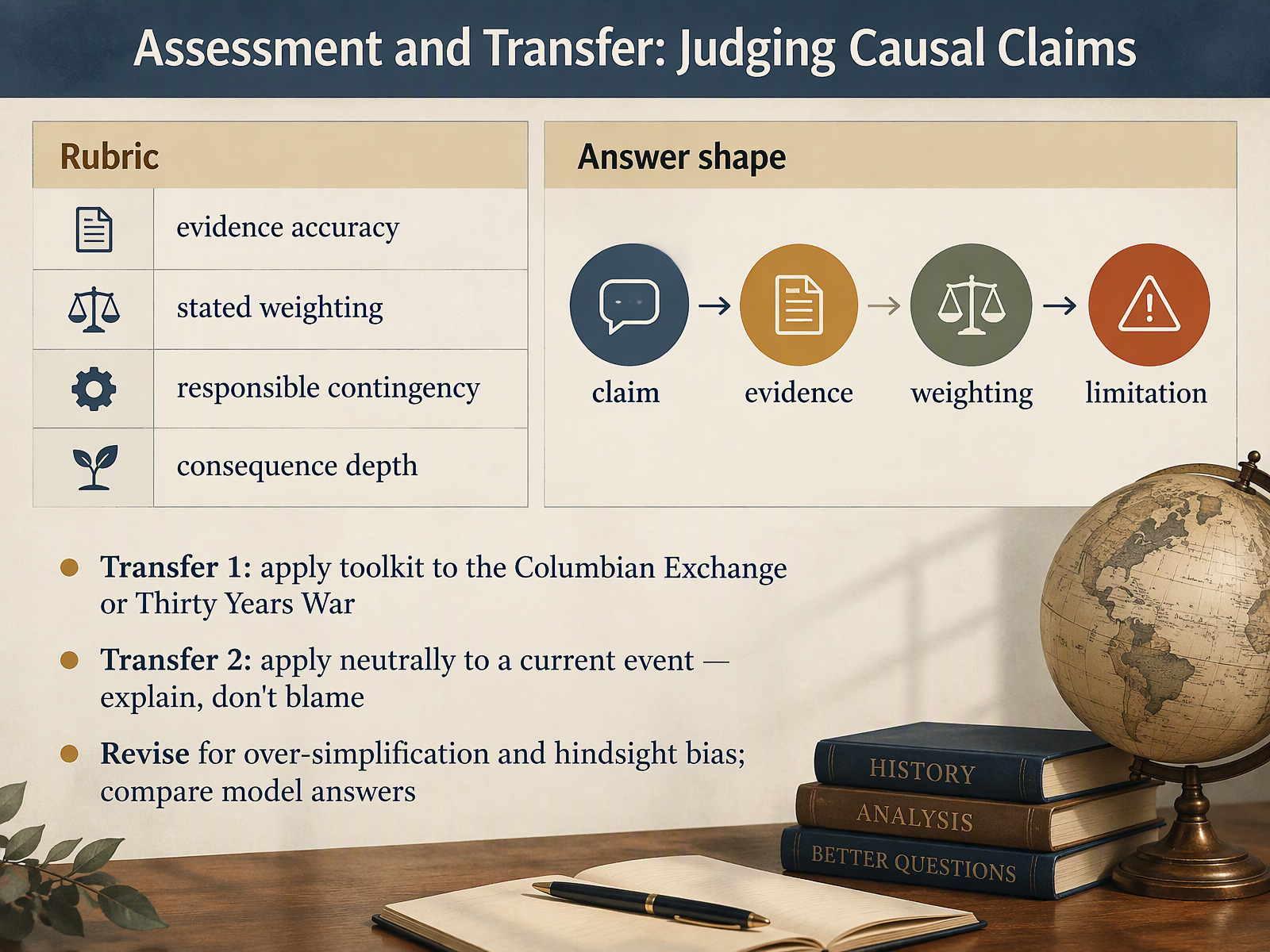
- 14Assessment and Transfer: Judging Causal ClaimsLet's finish by putting your toolkit to the test. When you judge a causal claim, use four criteria: evidence accuracy, stated weighting, responsible contingency, and consequence depth. Here is a simple answer shape. State your claim, give the evidence, explain how you weight the causes, then name one limitation. Now try transfer. Apply the toolkit to the Columbian Exchange or the Thirty Years War. Then try a current event. Your job there is to explain, not to blame. Finally, revise your answer for over-simplification and hindsight bias, and compare it with a model answer. Here is the key takeaway. Historians build careful arguments from partial evidence, so hold your conclusions with honest uncertainty. You have learned to weigh causes, respect contingency, and trace consequences. Thank you for learning with me, and keep asking why.
 historicalthinking.cahistoricalthinking.cadoi.org+22 min
Take the deck with you
Download this course as a file — free, no sign-up needed.
- PDF handoutEvery slide page, ready to print or share.15 pages · 4.9 MBDownload
- Narrated PowerPointThe deck that presents itself — every slide carries the digital human's narration video.15 pages · 15.2 MBDownload
- PowerPoint slidesThe full deck as a .pptx — open it in PowerPoint, Keynote, or Google Slides.15 pages · 4.8 MBDownload
Free to use in your own training — please keep the PersonWise credit page at the end.
Have your own deck? Turn it into a course
Sources consulted
Web sources consulted while building this course.
- BENCHMARKS OF HISTORICAL THINKING: — historicalthinking.ca
- HISTORICAL THINKING CONCEPTS | Historical Thinking Project — historicalthinking.ca
- Re-positioning historical thinking: a framework for classroom practice — doi.org
- Contingency | TeachingHistory.org — teachinghistory.org
- Historical Thinking | Integrated Action Civics Project — iacp.berkeley.edu
- https://fas-polisci.rutgers.edu/levy/articles/Goertz%20&%20Levy%20-%20Causal%20Explanation.pdf — fas-polisci.rutgers.edu
- Historical Counterexamples and Sufficient Cause — jstor.org
- Causation in History — cambridge.org
- Weighted Explanations in History — doi.org
- Causal Explanation in Historiography — doi.org
- Agency–Structure Relationship — doi.org
- AGENCY-STRUCTURE DEBATE: THE LIMIT OF SOCIOLOGICAL KNOWLEDGE — doi.org
- The agency-structure antinomy as social form: Towards a historical critique of sociological reason — sage.cnpereading.com
- Agency, Structure — doi.org
- Social Integration and System Integration: Developing the Distinction — journals.sagepub.com
- On the Function and Nature of Historical Counterfactuals. Clarifying Confusions — doi.org
- CHALLENGING CERTAINTY: THE UTILITY AND HISTORY OF COUNTERFACTUALISM — doi.org
- When to Use Counterfactuals in Causal Historiography: Methods for Semantics and Inference — sage.cnpereading.com
- Counterfactual History: Three Worries and Replies — doi.org
- Counterfactuals, Thought Experiments, and Singular Causal Analysis in History | Philosophy of Science | Cambridge Core — cambridge.org