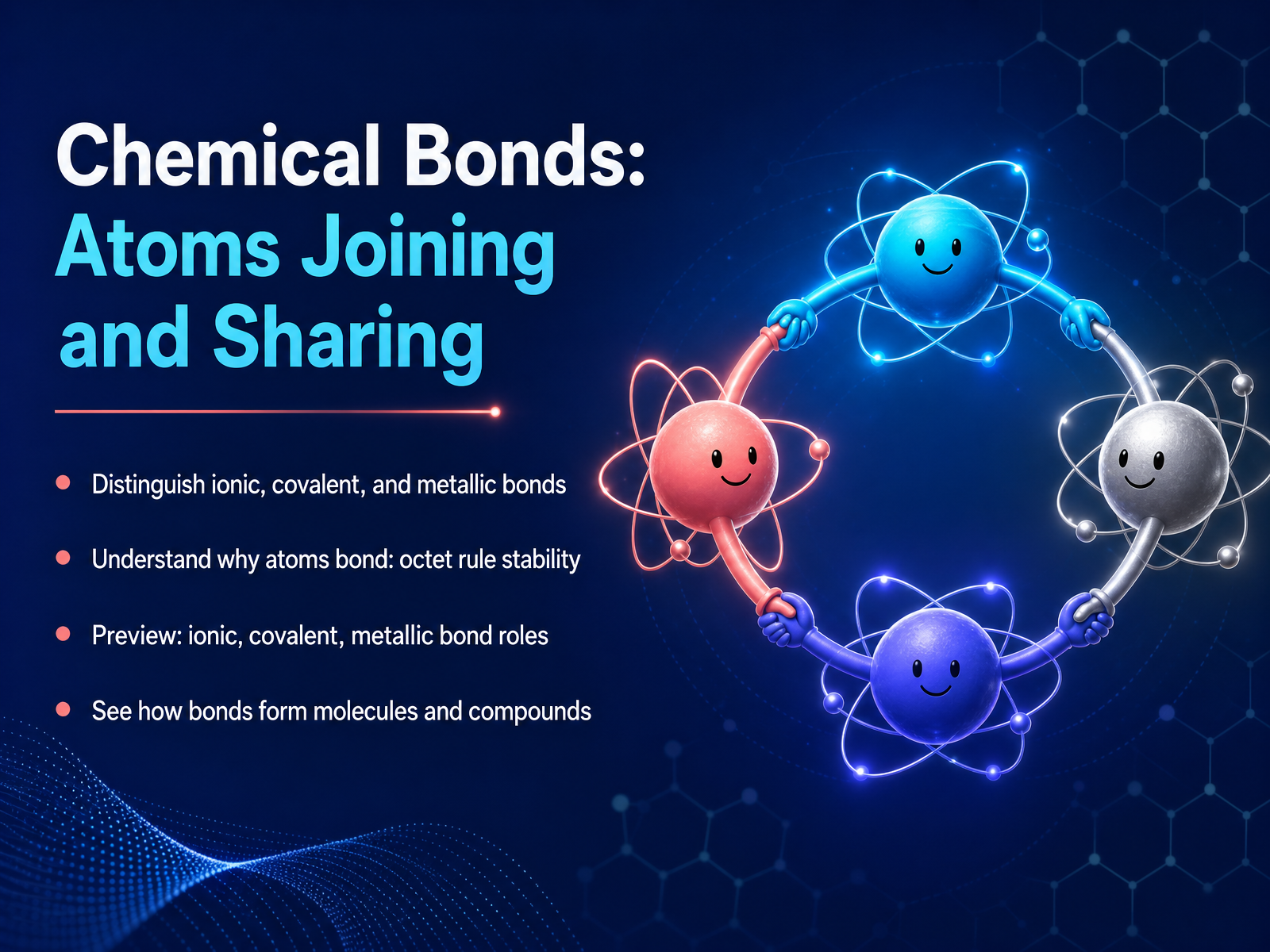
Chemical Bonds: Atoms Joining and Sharing
Begin
15 pages · ~30 min
Chemical Bonds: Atoms Joining and Sharing
Learn how atoms bond through ionic and covalent interactions to form molecules in this foundational chemistry training.
What you’ll learn
- 01Chemical Bonds: Atoms Joining and SharingWelcome to this lesson on chemical bonds. Today, we are going to explore how atoms join and share to build the world around us. Our goal is clear: by the end, you will be able to distinguish between ionic, covalent, and metallic bonds. We will start by understanding why atoms bond in the first place, looking at a driving force called the octet rule, which pushes atoms toward stability. Then, we will preview the unique roles each bond type plays in forming molecules and compounds. Think of this as your roadmap. Let's begin our journey by laying the groundwork with the basic structure of the atom itself.1 min
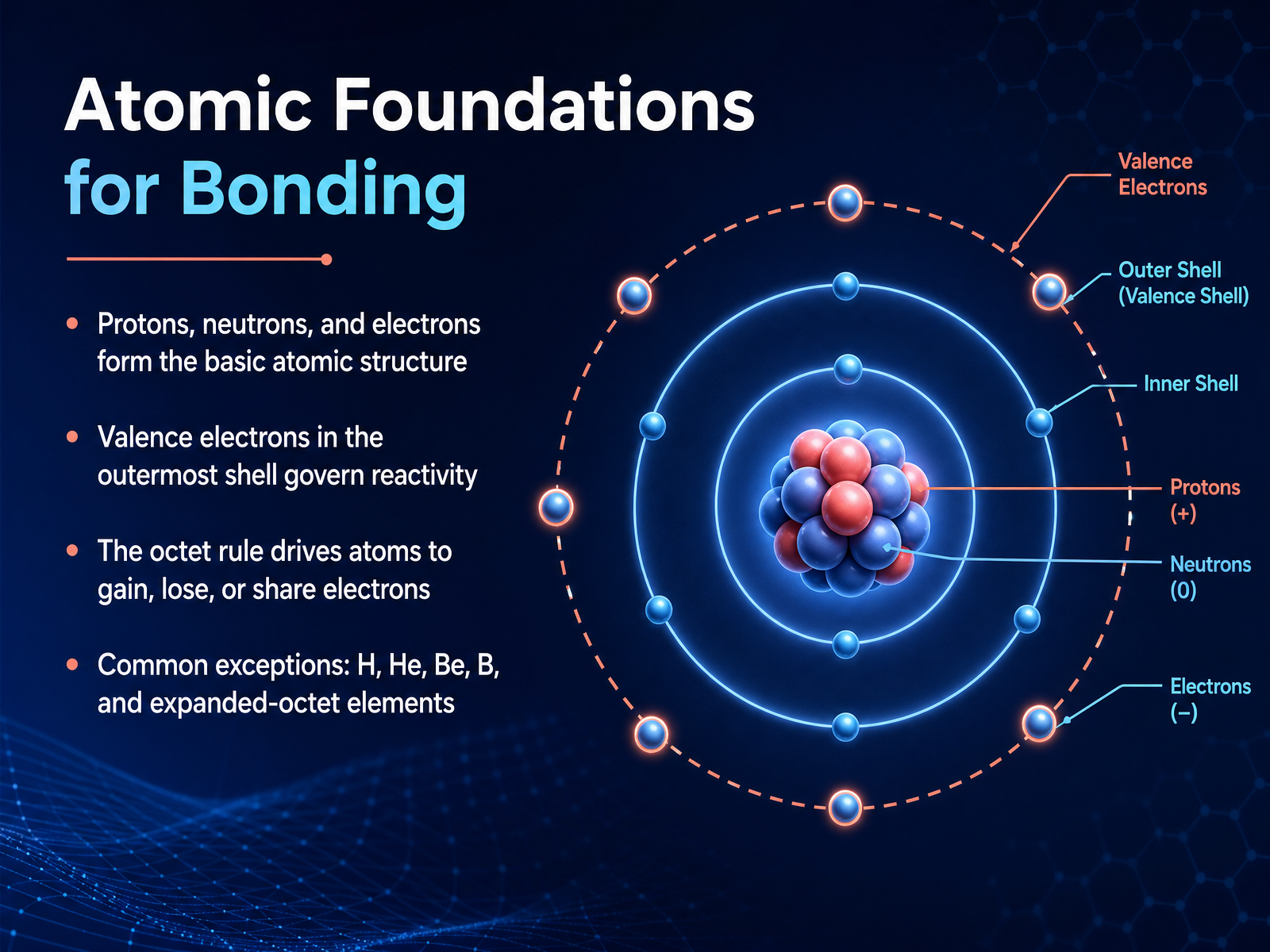
- 02Atomic Foundations for BondingNow let's build the atomic foundations we need to understand bonding. An atom has a tiny, dense nucleus made of protons and neutrons, with electrons moving around it in layers called shells. The electrons in the outermost shell are the valence electrons, and they determine how the atom behaves chemically. Atoms tend to follow a pattern known as the octet rule: they are most stable when they have eight valence electrons, like a full outer shell. To reach that stable state, atoms will gain, lose, or share electrons with other atoms. A few atoms are exceptions. Hydrogen and helium are stable with just two valence electrons. Beryllium and boron can be stable with fewer than eight, and some elements beyond the second period can expand their octet and hold more than eight electrons. These simple rules about valence electrons and the drive to fill the outer shell set the stage for how atoms join together. Next, we will apply these ideas to atoms, molecules, and compounds.
 1 min
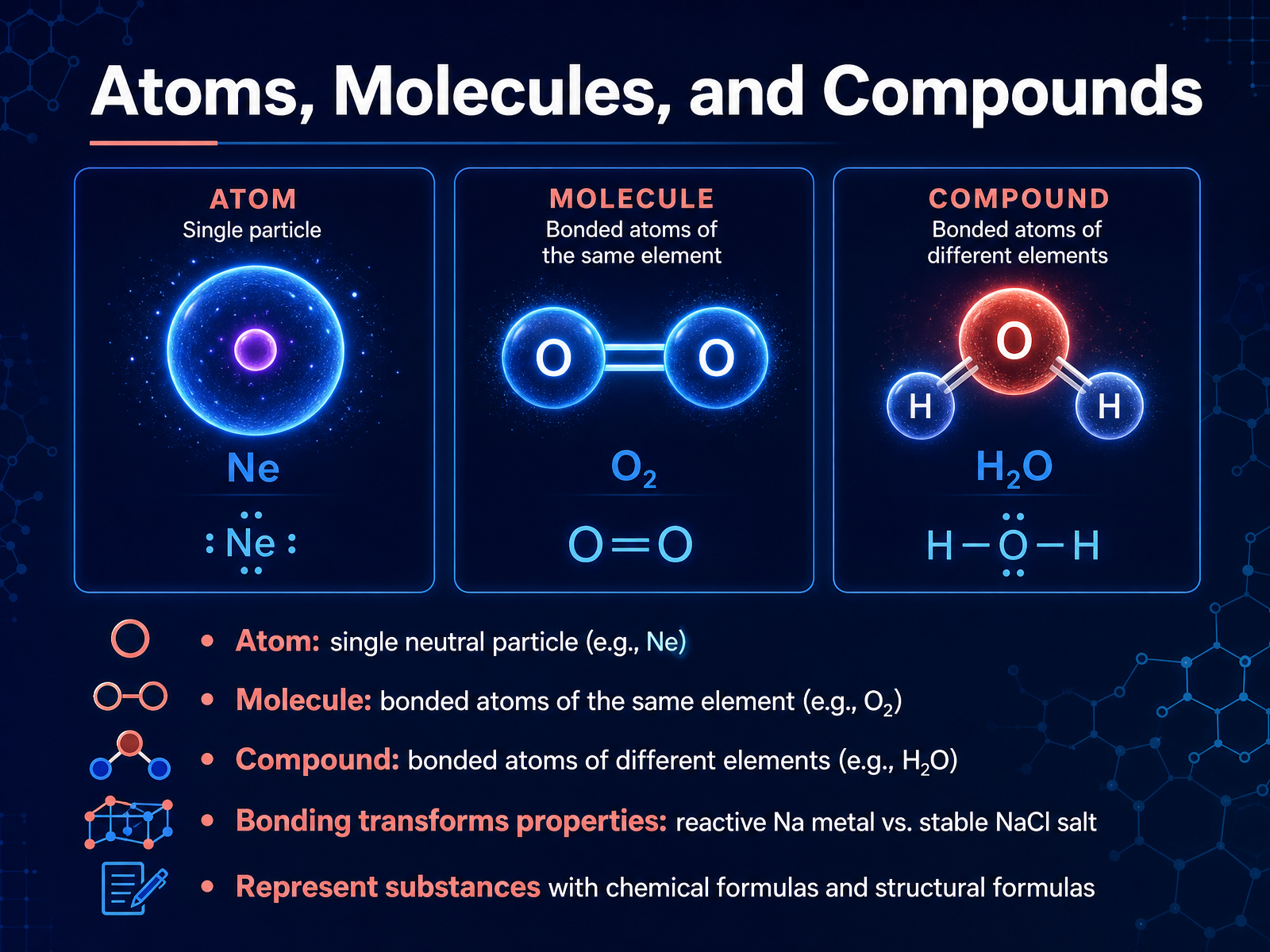
1 min - 03Atoms, Molecules, and CompoundsNow let's clarify three key labels we use in chemistry: atoms, molecules, and compounds. An atom is a single, neutral particle—think of a lone neon atom, symbol Ne. A molecule forms when atoms of the same element bond together, like the two oxygen atoms in an O₂ molecule. A compound is made when atoms of different elements bond—water, with its two hydrogens and one oxygen, is a classic example. Bonding also transforms properties entirely. Take sodium, a highly reactive metal, and chlorine, a toxic gas. When they bond, they become sodium chloride—ordinary table salt, something we safely sprinkle on food. To represent these substances, we use chemical formulas like NaCl and structural formulas that show how atoms are arranged. That foundation brings us right to our first major bond type: Ionic Bonds, where electrons are transferred.
 1 min
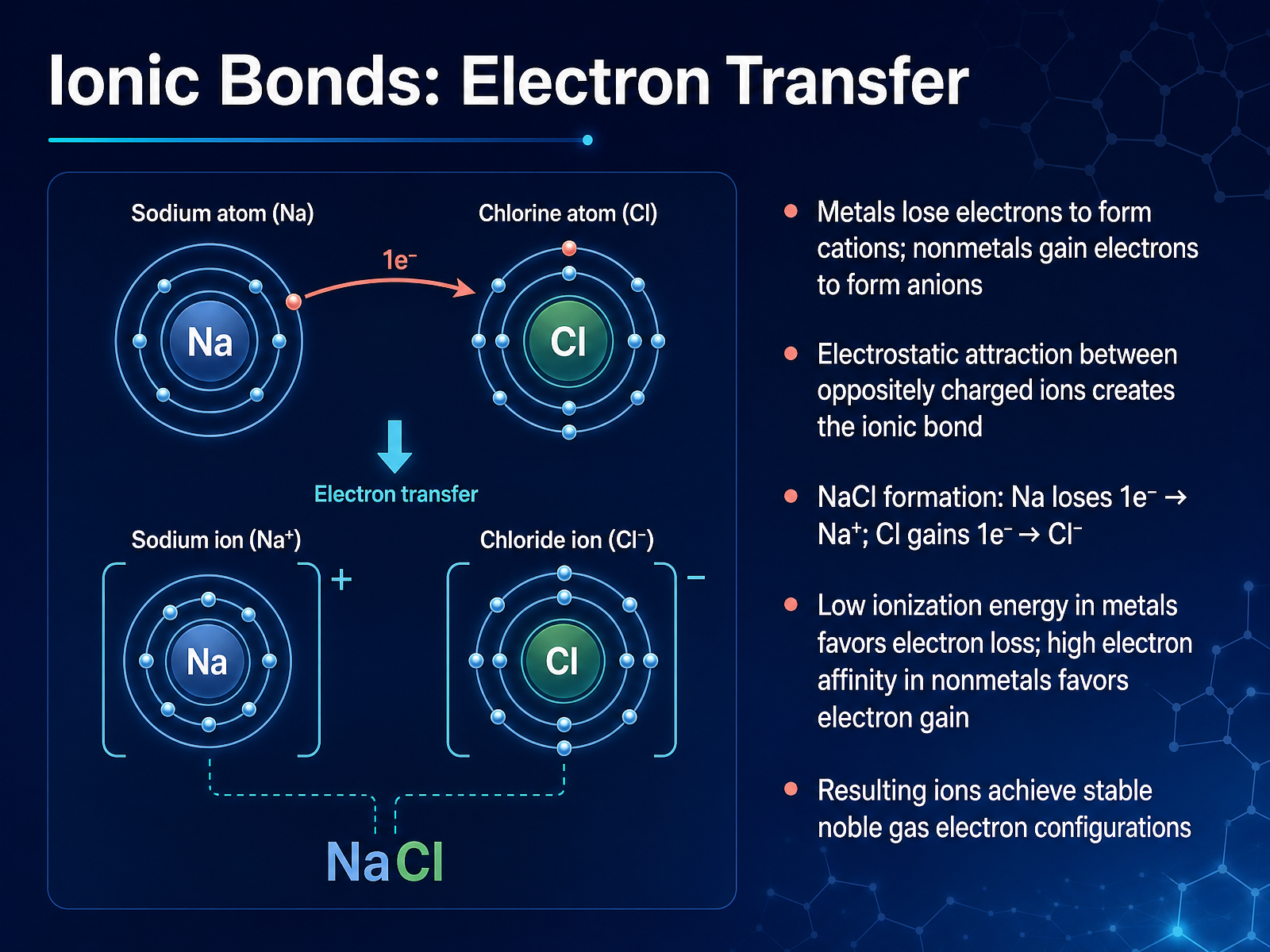
1 min - 04Ionic Bonds: Electron TransferNow let's focus on ionic bonds. Think of an ionic bond as a complete transfer of electrons, like one person handing a gift to another. This happens between metals and nonmetals. Metals, like sodium, have low ionization energy, meaning they easily lose electrons to become positive ions, or cations. Nonmetals, like chlorine, have high electron affinity; they eagerly gain electrons to become negative ions, or anions. Let's see this with table salt, sodium chloride. A sodium atom loses one electron to become a Na plus cation. That electron is gained by a chlorine atom, forming a Cl minus anion. These oppositely charged ions are then held together by a strong electrostatic attraction—that's the ionic bond. Both ions now achieve a very stable electron arrangement, similar to a noble gas. Next, we'll explore the structure and properties of these ionic compounds.
 pubchem.ncbi.nlm.nih.goven.wikipedia.orgpubchem.ncbi.nlm.nih.gov+21 min
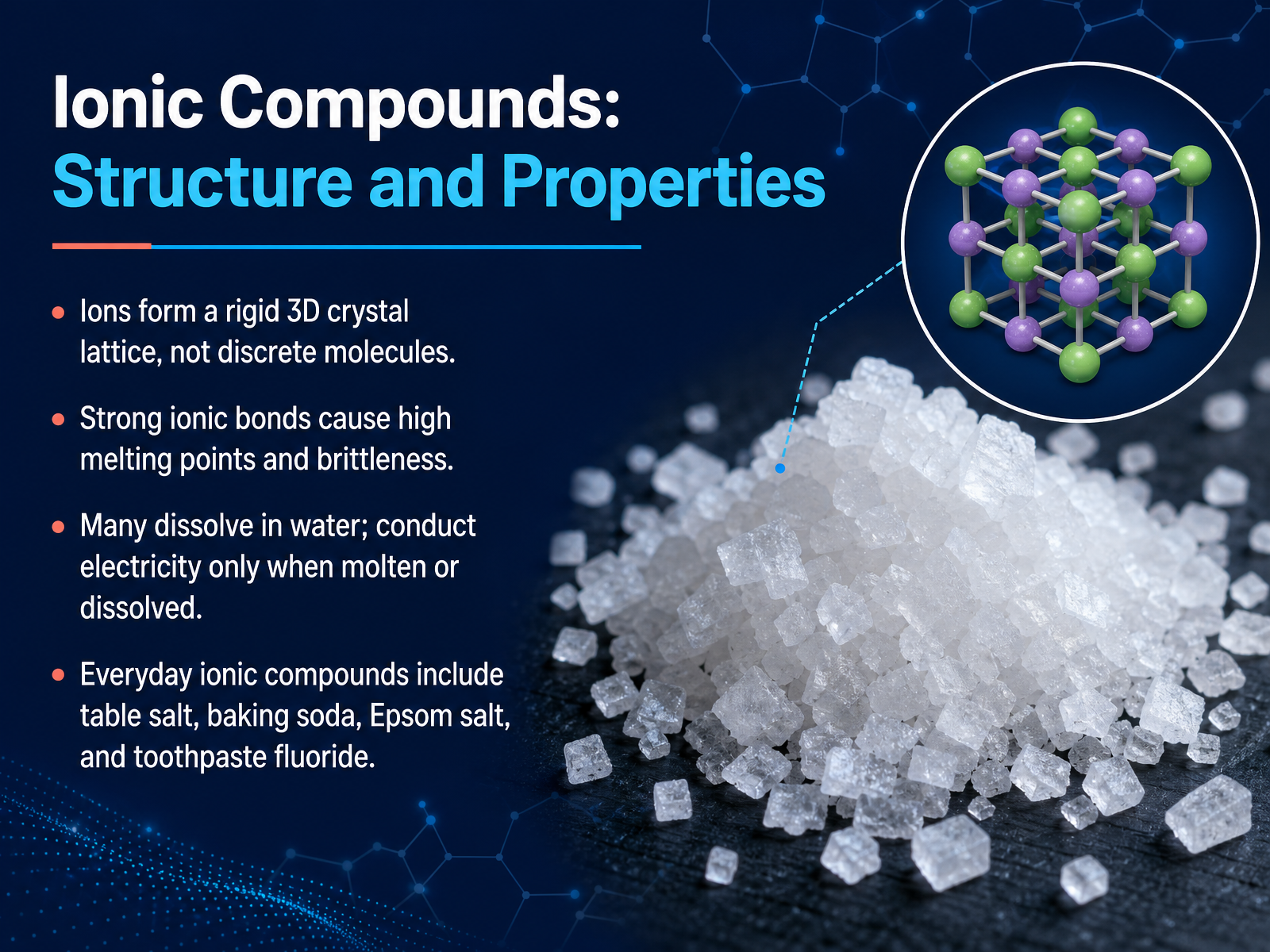
 - 05Ionic Compounds: Structure and PropertiesLet's now explore what happens when countless ions come together to form a solid. Ionic compounds don't exist as separate, tiny pairs of ions. Instead, they build a rigid, three-dimensional crystal lattice. This repeating structure is a strong network, not a discrete molecule. Because of these strong ionic bonds throughout the lattice, these compounds have very high melting points. They're also brittle; a sharp knock can shift the layers and cause like charges to repel each other, shattering the crystal. Many ionic compounds dissolve in water, but here's a key property: they only conduct electricity when molten or dissolved in water. In those states, the ions are free to move and carry a charge. In their solid form, the ions are locked in place and cannot conduct. You actually encounter these compounds every day. Table salt is sodium chloride. Baking soda is sodium bicarbonate, and Epsom salt is magnesium sulfate. Even the fluoride in your toothpaste, often sodium fluoride, is an ionic compound. Next, we'll shift our focus to a completely different type of bond: covalent bonds, where atoms share electrons.
 sciencenotes.orgechemi.comstudiousguy.com+22 min
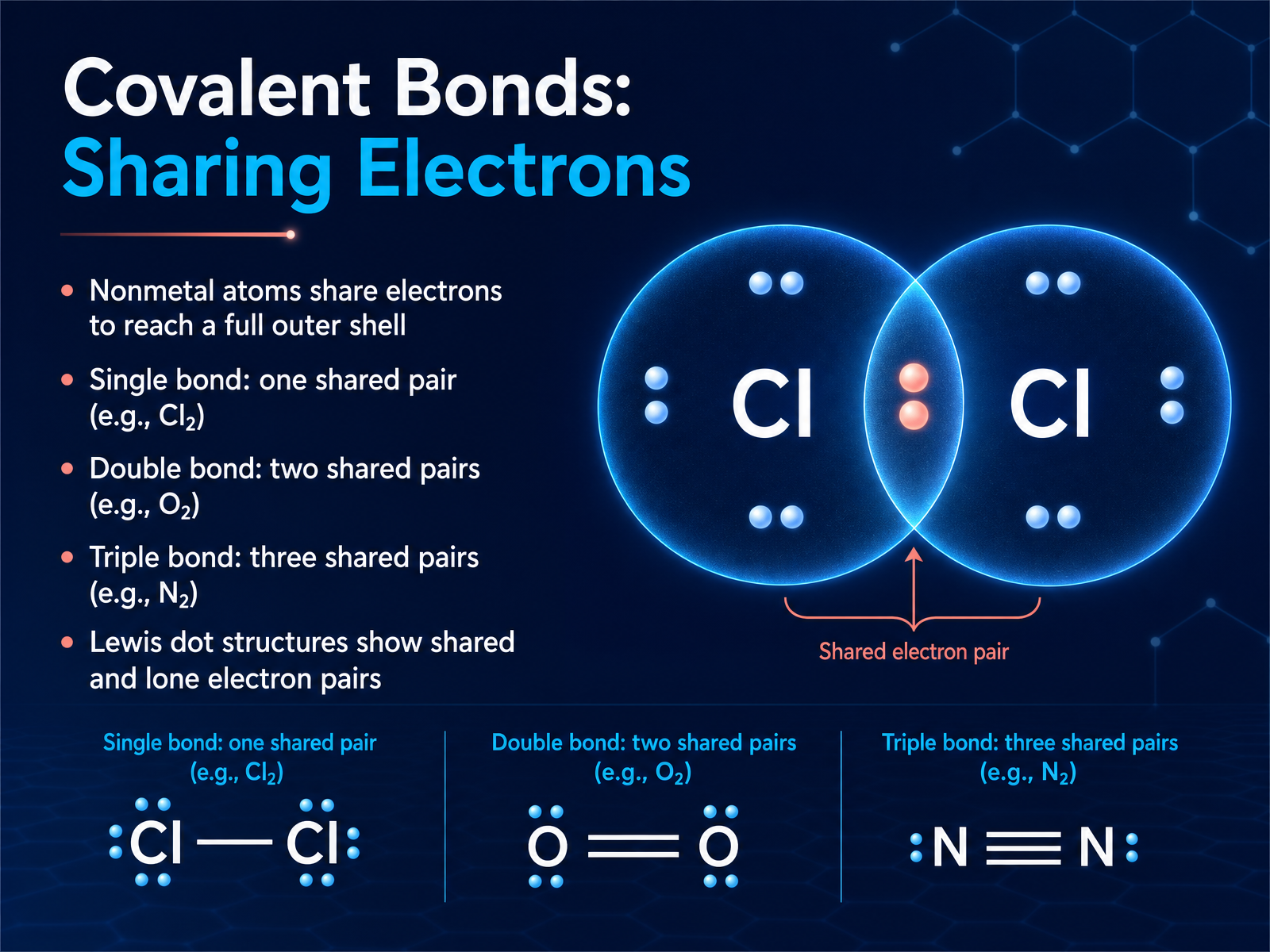
 - 06Covalent Bonds: Sharing ElectronsNow, let's look at a different kind of bond. Instead of giving electrons away, some atoms choose to share. This is called a covalent bond. It happens between nonmetal atoms. Think of it like two partners sharing a resource so both can reach their goal. Here, the goal is a full outer shell of electrons. There are different levels of sharing. A single bond is just one shared pair, like the two electrons holding two chlorine atoms together in chlorine gas. A double bond uses two shared pairs to link atoms, which is what you see in an oxygen molecule. A triple bond is even stronger, with three shared pairs connecting the atoms, like in nitrogen gas. We use Lewis dot structures to draw these bonds. They show the shared electron pairs as lines and the unshared, lone pairs as dots around the atoms. Next, we will see what happens when this sharing is not perfectly equal, as we explore electronegativity and bond polarity.
 1 min
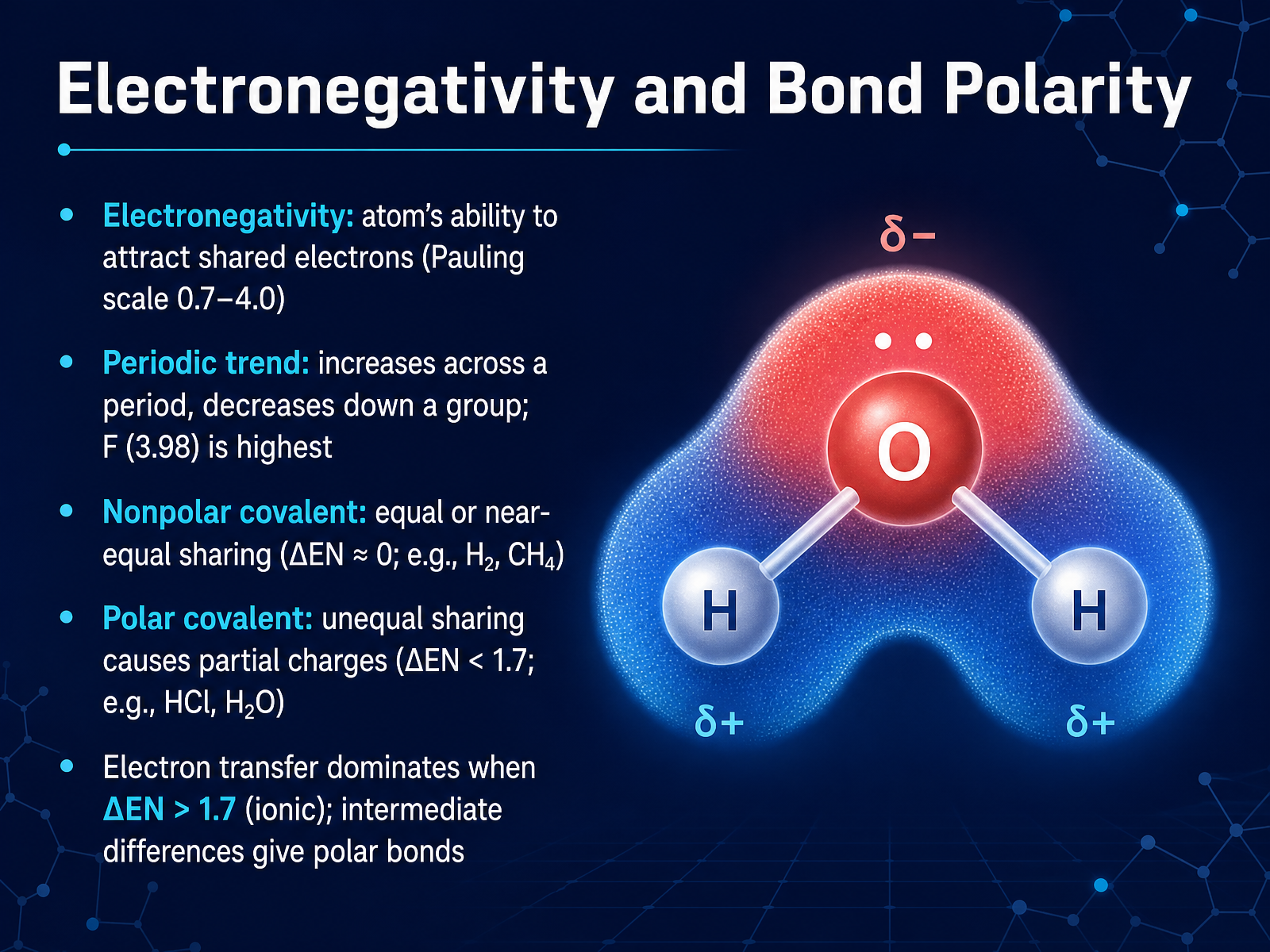
1 min - 07Electronegativity and Bond PolarityNow, let's turn to electronegativity and bond polarity. Think of electronegativity as an atom's pulling power—its ability to attract shared electrons in a bond. We measure this on the Pauling scale, which runs from about 0.7 to 4.0. As you move across a period on the periodic table, electronegativity generally increases. As you go down a group, it decreases. Fluorine holds the highest value at 3.98. This ranking lets us predict how electrons are shared. When two identical atoms bond, like in hydrogen gas, the difference in electronegativity is about zero. They share electrons equally, and we call this a nonpolar covalent bond. When different atoms bond, the more electronegative atom pulls the electrons more strongly. This unequal sharing creates slight charges within the molecule, which we call a polar covalent bond. Water and hydrochloric acid are classic examples here. This happens when the electronegativity difference is less than 1.7. Once the difference climbs above 1.7, electron transfer dominates, and we get an ionic bond. Intermediate differences give us those polar covalent bonds. Next, we will compare ionic and covalent bonds side by side.
 pubchem.ncbi.nlm.nih.goven.wikipedia.orgpubchem.ncbi.nlm.nih.gov+22 min
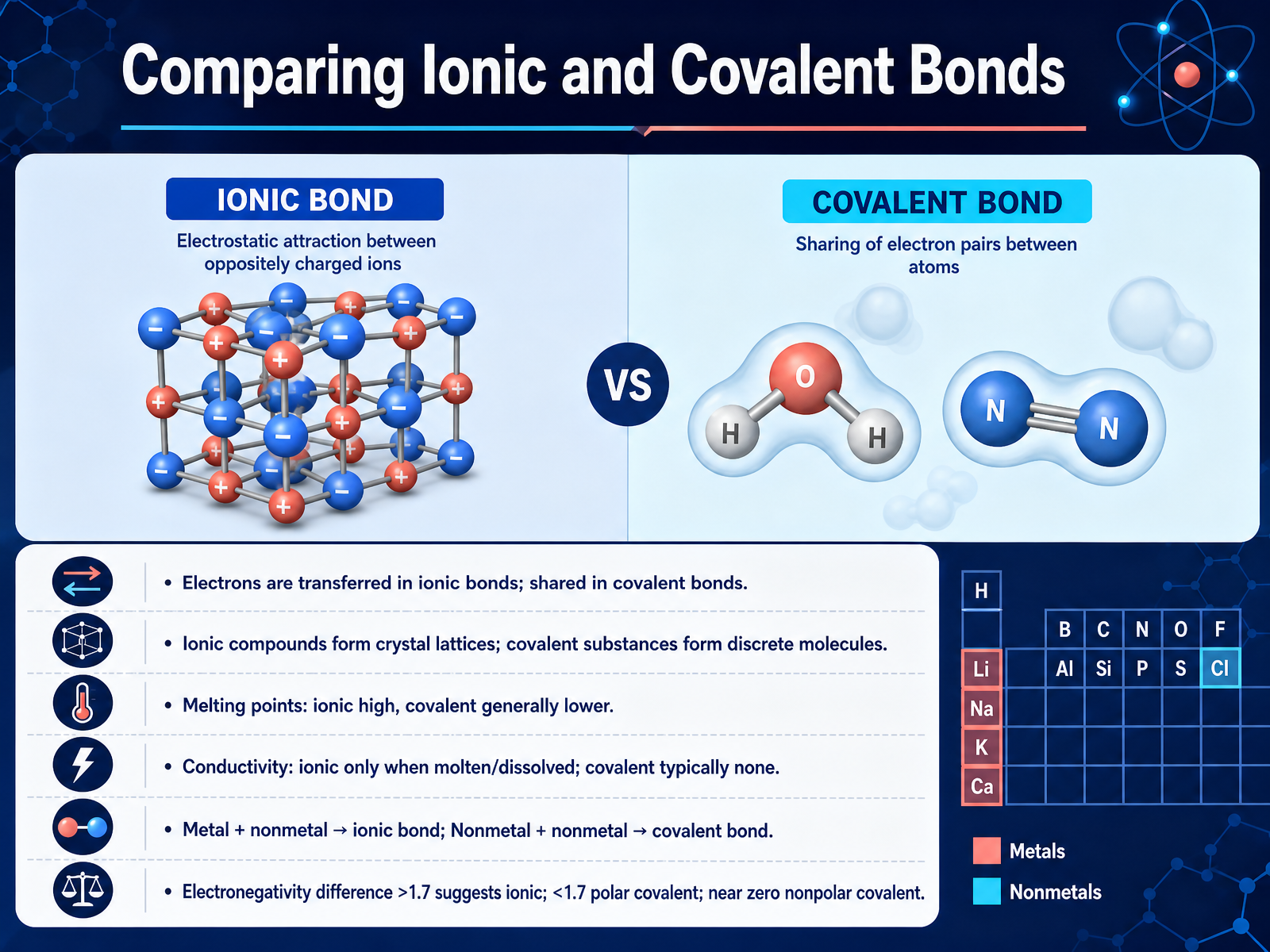
 - 08Comparing Ionic and Covalent BondsNow let's directly compare ionic and covalent bonds side by side. The core difference is what happens to the electrons. In an ionic bond, electrons are fully transferred from one atom to another, like giving away a possession. In a covalent bond, electrons are shared, more like partners cooperating. This leads to very different structures. Ionic compounds arrange themselves into repeating crystal lattices. Covalent substances form distinct, discrete molecules. Because of these structural differences, their properties diverge sharply. Ionic compounds typically have very high melting points, while covalent substances melt at generally lower temperatures. For electrical conductivity, ionic compounds only conduct when molten or dissolved in water; covalent substances typically do not conduct at all. You can often predict the bond type just by looking at the elements involved. A metal combined with a nonmetal usually forms an ionic bond. A nonmetal combined with a nonmetal usually forms a covalent bond. For a more precise prediction, you can use electronegativity. If the difference in electronegativity is greater than one point seven, the bond is likely ionic. If the difference is less than one point seven, it is a polar covalent bond. And when the difference is near zero, you have a nonpolar covalent bond. Up next, we will explore edge cases and the unique behavior of metalloids.
 pubchem.ncbi.nlm.nih.goven.wikipedia.orgpubchem.ncbi.nlm.nih.gov+22 min
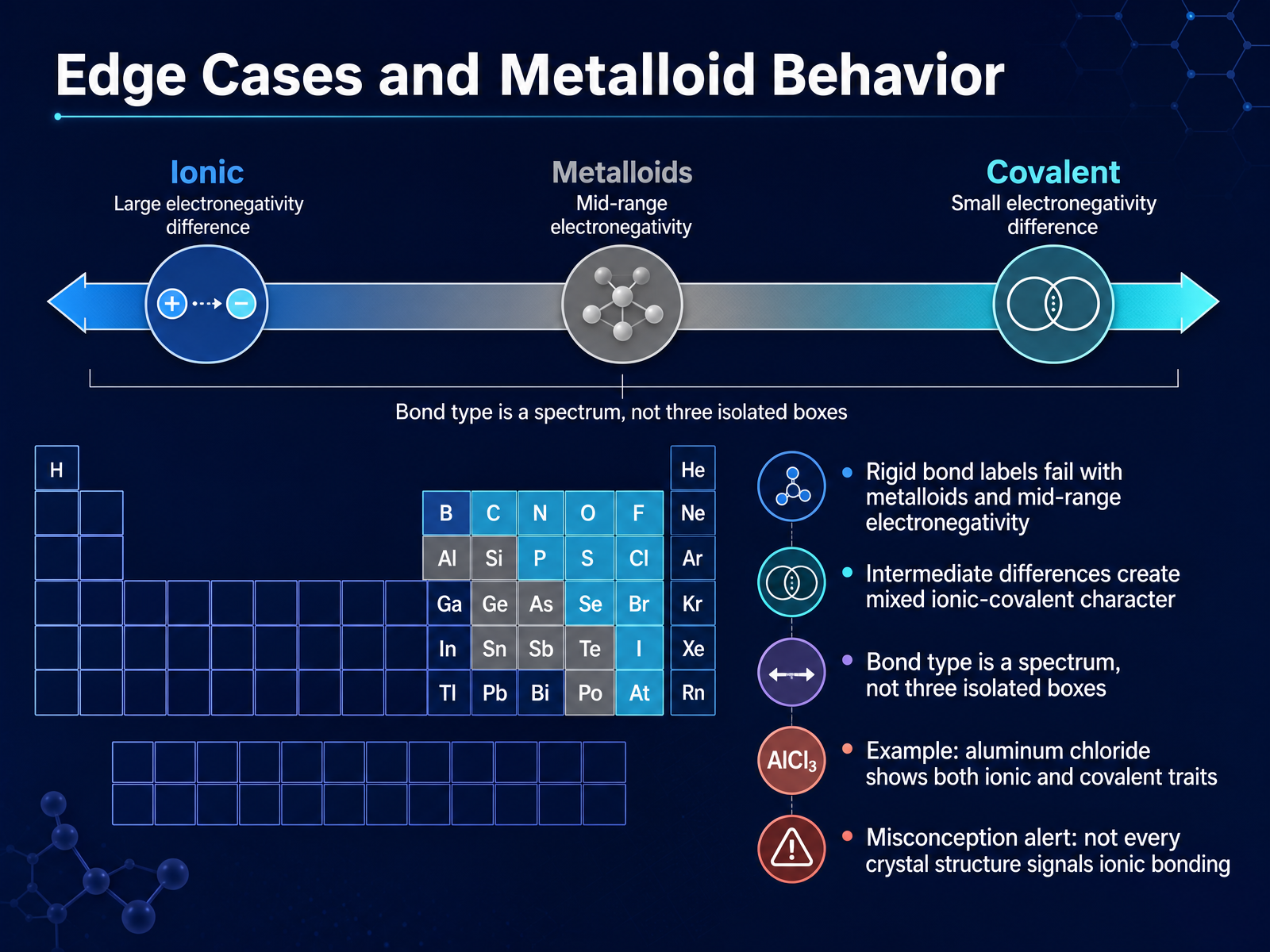
 - 09Edge Cases and Metalloid BehaviorNow let's address a common misconception. The labels ionic and covalent are not always clear-cut boxes. Some atoms, especially metalloids, have an intermediate electronegativity. This means their electron pull is neither strong enough to fully steal nor weak enough to simply share. The result is a bond with mixed ionic-covalent character. Think of it as a spectrum rather than three isolated containers. Take aluminum chloride as an example. In its solid-state structure, it behaves like an ionic compound. But in vapor form, it shifts toward covalent behavior. This serves as a key warning: do not assume every crystal structure signals a pure ionic bond. Up next, we will explore a completely different type of bonding in the electron sea of metallic bonds.
 1 min
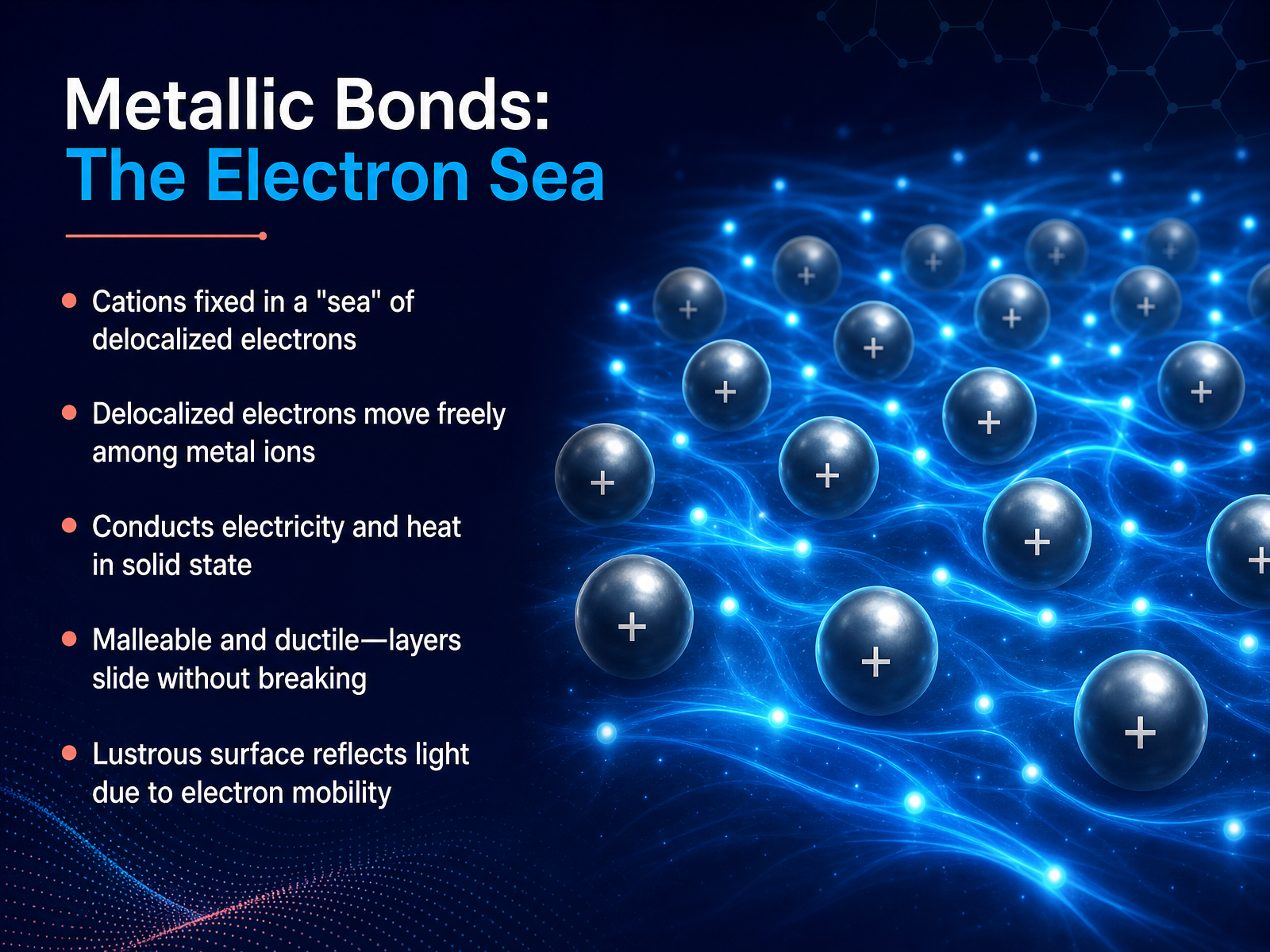
1 min - 10Metallic Bonds: The Electron SeaNow let's look at a completely different kind of bond, the metallic bond. Imagine a fixed grid of positive metal ions, what we call cations, submerged in a fluid sea of electrons. These are not locked to any single atom. They are delocalized, meaning they can move freely throughout the entire structure. This electron mobility explains some remarkable properties. When you apply an electric current, these freely moving electrons carry the charge, making metals excellent conductors of electricity. Heat is transferred the same way, through the rapid motion of these electrons. And because there are no specific bonds to break, when you hammer a metal, layers of ions can slide past each other without shattering the crystal. This is why metals are malleable and ductile. Finally, that shiny, lustrous surface we see is a direct result of this electron sea. When light hits the surface, the mobile electrons vibrate and immediately re-emit the light, giving it a reflective shine. Next, we'll see how these principles come together in the world around us, as we explore metallic bonding in everyday alloys.
 2 min
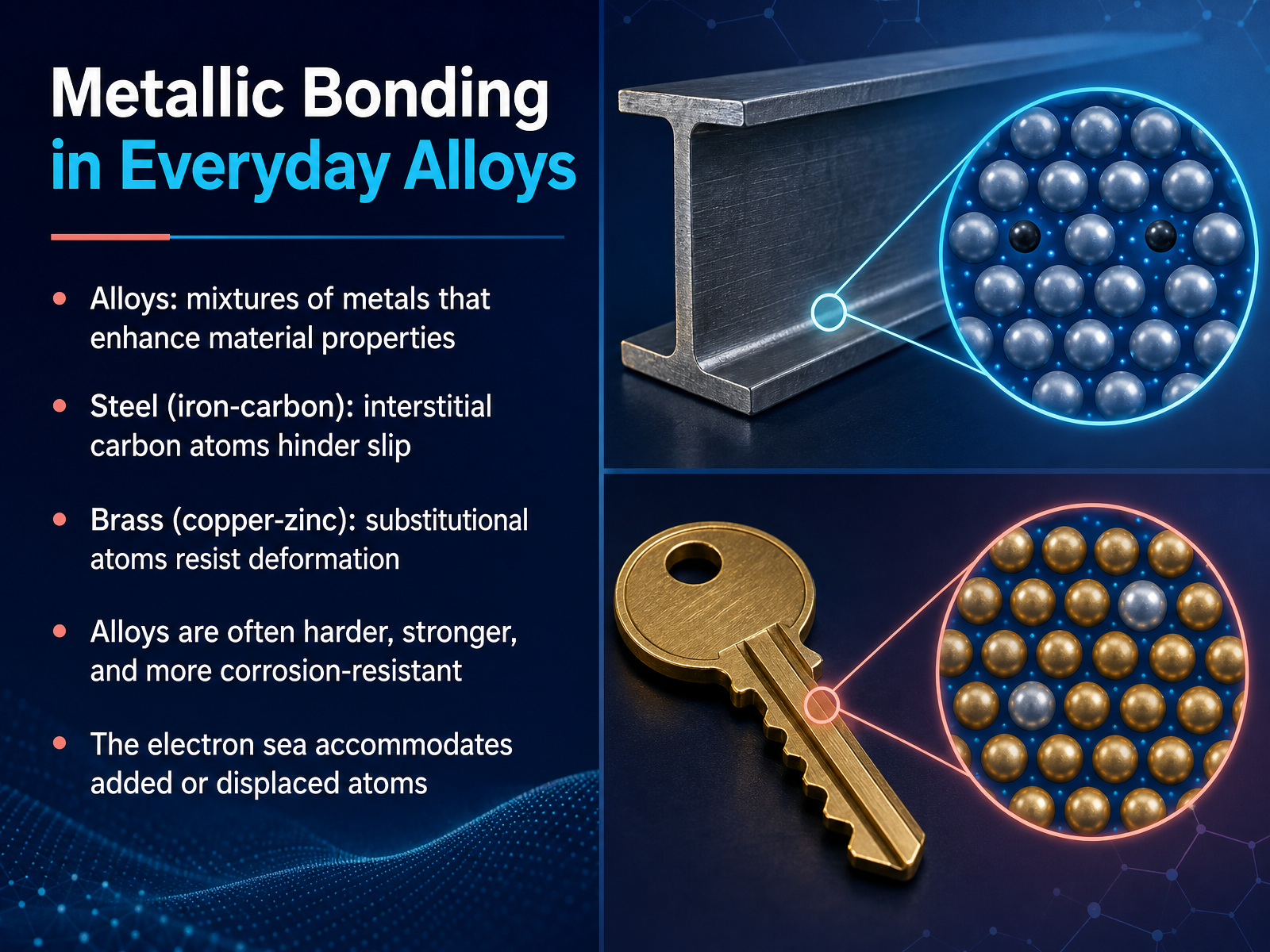
2 min - 11Metallic Bonding in Everyday AlloysNow let's see how the sea of electrons creates the alloys we use every day. An alloy is simply a mixture of metals designed to improve material properties. Think of the metallic bond's electron sea as a flexible glue. In steel, which is mostly iron, tiny carbon atoms sit in the gaps between iron atoms. These interstitial atoms act like wedges that make it harder for layers of atoms to slide past each other. In brass, made from copper and zinc, the zinc atoms actually replace some copper atoms in the lattice. These substitutional atoms are a different size and disrupt the orderly rows, resisting deformation. Because the electron sea can easily accommodate these extra or differently sized atoms, alloys are often harder, stronger, and more resistant to corrosion than pure metals. Next, we'll use what we've learned to build a decision framework for classifying bond types.
 2 min
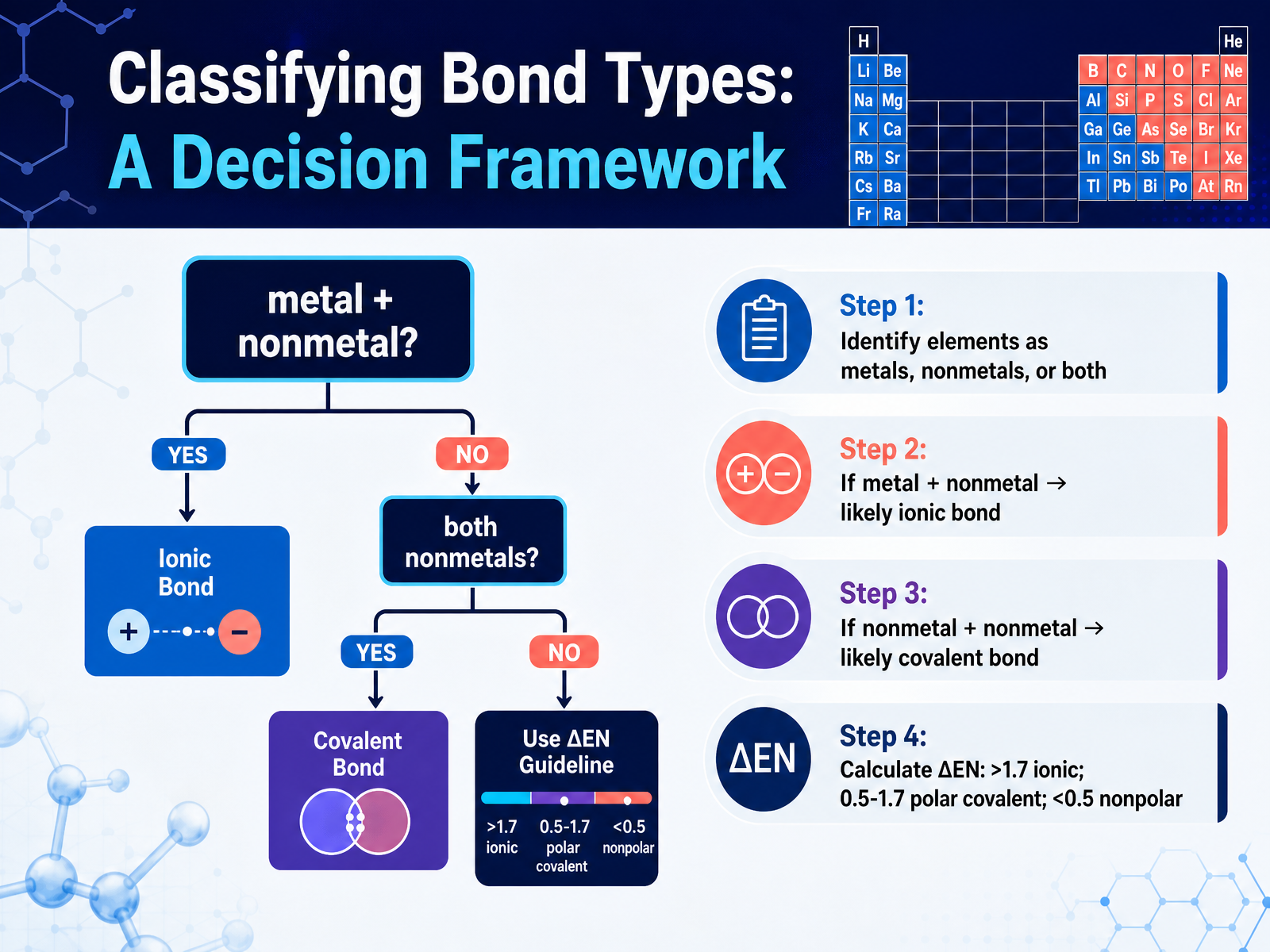
2 min - 12Classifying Bond Types: A Decision FrameworkNow let's bring everything together with a simple decision framework for classifying bond types. Think of this as a step-by-step checklist you can use whenever you encounter a new pair of atoms. Step one, identify the elements involved. Are they metals, nonmetals, or a combination of both? Step two, apply this rule. If you have a metal and a nonmetal, the bond is most likely ionic. For example, sodium, a metal, combining with chlorine, a nonmetal, gives us an ionic bond in table salt. Step three, if both elements are nonmetals, you are almost certainly looking at a covalent bond, where atoms share electrons, like the two oxygen atoms in the oxygen gas we breathe. Step four adds extra precision. Calculate the difference in electronegativity, or Delta E N. A difference greater than one point seven confirms an ionic bond. A difference between zero point five and one point seven indicates a polar covalent bond, where sharing is unequal. A difference less than zero point five means the bond is nonpolar covalent, with electrons shared equally. This framework turns a complex idea into a clear, practical tool. Next, we will apply these rules in the slide, "Practice: Identifying Bonds in Common Substances."
 2 min
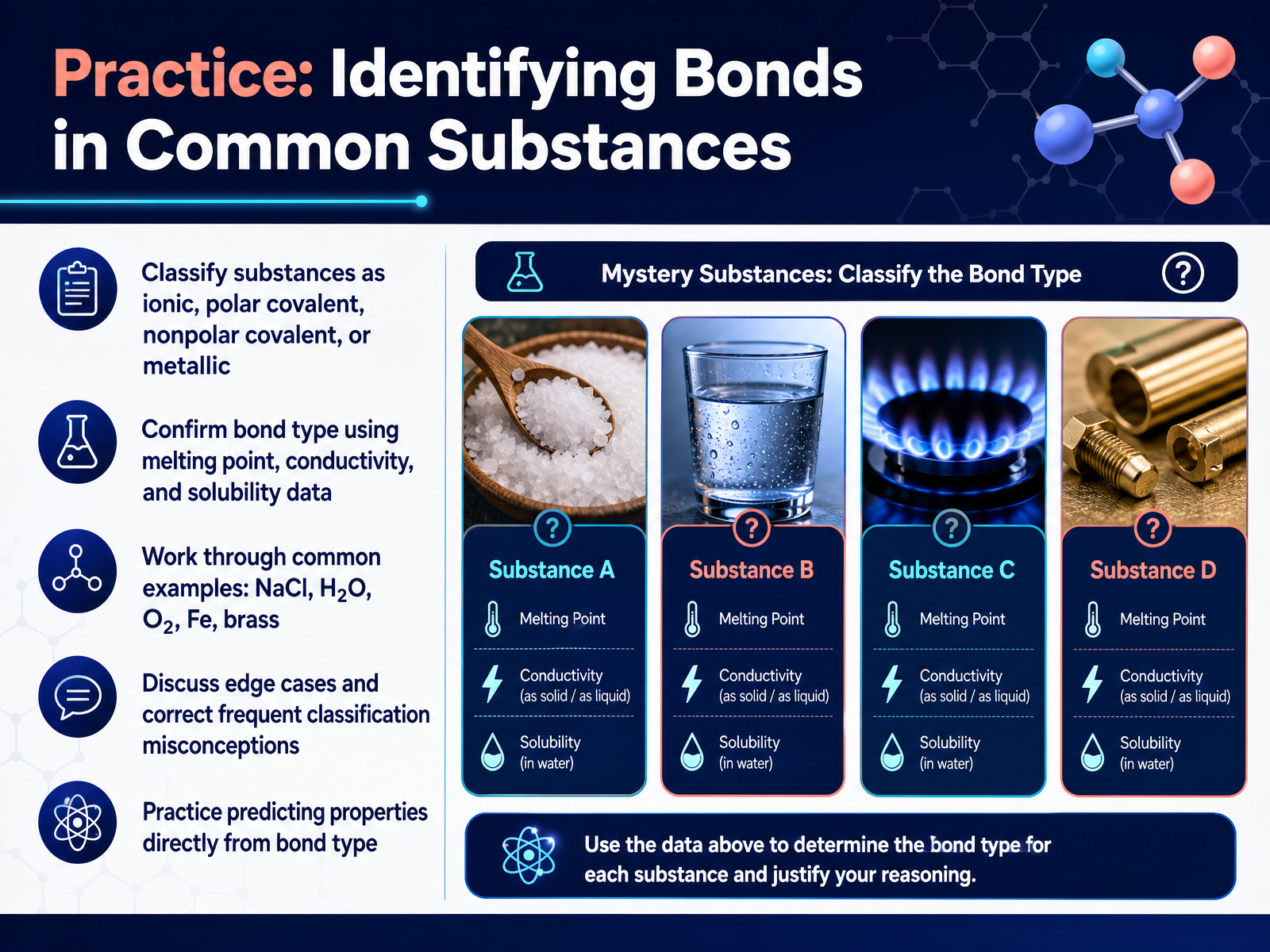
2 min - 13Practice: Identifying Bonds in Common SubstancesNow let's apply what we've learned to some everyday substances. We'll classify each one as ionic, polar covalent, nonpolar covalent, or metallic. Then we'll check our classification using real data, like melting point, conductivity, and solubility. Think of it as detective work, where the properties are the clues. Let's start with table salt, sodium chloride. The high melting point and the fact that it conducts electricity when dissolved point clearly to an ionic bond. Next, water. Its moderate melting point and slight conductivity reveal that it's polar covalent. For oxygen gas, the very low boiling point tells us it's nonpolar covalent, with atoms sharing equally. Pure iron and the alloy brass both show metallic bonding through their high conductivity and malleability. Be careful with edge cases. For example, some substances might seem ionic but don't dissolve well. Always cross-check multiple properties. You can even start predicting a substance's properties just from its bond type. A hard, high-melting crystal is likely ionic, while a soft, non-conducting solid is probably covalent. Coming up next, we'll pull everything together in a summary of bond types at a glance.
 2 min
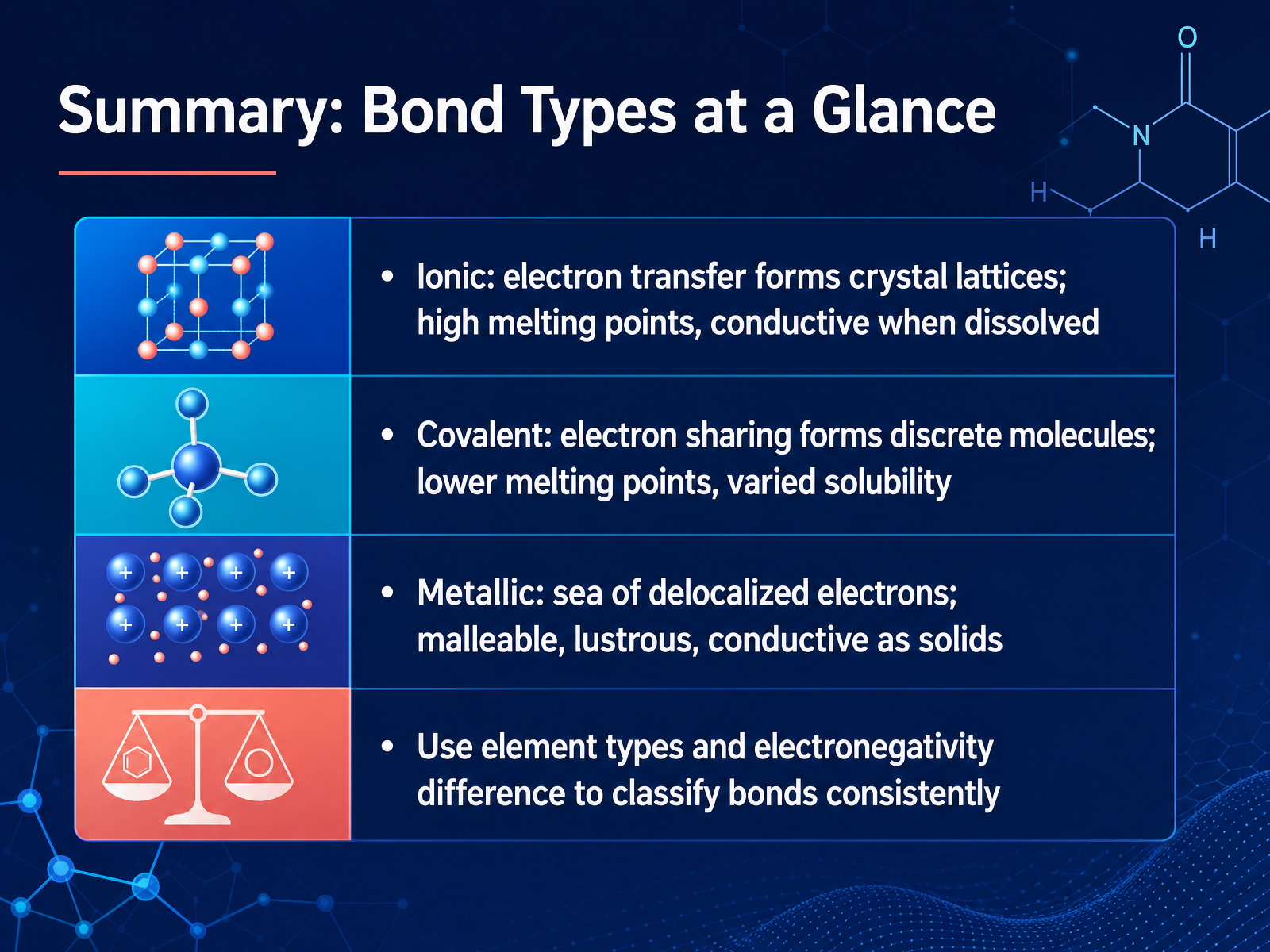
2 min - 14Summary: Bond Types at a GlanceNow let's bring everything together in one quick overview. In an ionic bond, an electron is fully transferred, creating ions that arrange into a crystal lattice. These compounds tend to have high melting points and conduct electricity when dissolved in water. A covalent bond is different. Here, atoms share electrons, forming discrete molecules. You'll typically see lower melting points and varied solubility with these substances. Then we have the metallic bond, where electrons form a mobile sea around positive metal ions. This structure explains why metals are shiny, can be hammered into sheets, and conduct electricity even as solids. To identify which bond type you're dealing with, look at the types of elements involved and the difference in their electronegativity values. This approach will help you classify bonds consistently. Next, we'll put these concepts to work in a quick knowledge check and then explore what comes next.
 1 min
1 min - 15Knowledge Check and Next StepsWe have covered a lot of ground together. Now it is time to test your knowledge. You will see a multiple-choice quiz where you will classify different substances by their bond type and predict their properties. You will also work through application scenarios that link bond behavior to how materials perform in the real world, like why a ceramic mug cracks when you drop it, but a plastic bottle just bounces. As a final note, keep in mind that the chemical bonds we studied today are not the only forces at play between particles. In the next course, we will explore intermolecular forces, which are distinct because they happen between molecules, not inside them. Thank you for your focus today. You have built a strong foundation, and with a little review, these concepts will become second nature. Great work, and keep going.
 2 min
2 min
Take the deck with you
Download this course as a file — free, no sign-up needed.
- PDF handoutEvery slide page, ready to print or share.16 pages · 4.1 MBDownload
- Narrated PowerPointThe deck that presents itself — every slide carries the digital human's narration video.16 pages · 14.8 MBDownload
- PowerPoint slidesThe full deck as a .pptx — open it in PowerPoint, Keynote, or Google Slides.16 pages · 4.1 MBDownload
Free to use in your own training — please keep the PersonWise credit page at the end.
Have your own deck? Turn it into a course
Sources consulted
Web sources consulted while building this course.
- Electronegativity | Periodic Table of Elements - PubChem - NIH — pubchem.ncbi.nlm.nih.gov
- Electronegativities of the elements (data page) — en.wikipedia.org
- https://pubchem.ncbi.nlm.nih.gov/periodic-table/pdf/Periodic_Table_of_Elements_w_Electronegativity_PubChem.pdf — pubchem.ncbi.nlm.nih.gov
- List of Electronegativity Values of the Elements — sciencenotes.org
- Electronegativity (Pauling) Chart — periodictable.chemicalaid.com
- Examples of Ionic Compounds in Everyday Life — sciencenotes.org
- What Are the Uses of Ionic Compounds in Daily Life? — echemi.com
- 9 Ionic Bond Examples in Daily Life – StudiousGuy — studiousguy.com
- Chapter 3 - An Introduction to Chemistry: Chemical Compounds — webassign.net
- Common Salts — hyperphysics.gsu.edu