Begin
14 pages · ~28 min
Customer Success Plan Patterns and Pitfalls
This training helps customer success teams identify effective patterns, strengths, and common pitfalls when building customer success plans. Ideal for CSMs and managers refining plan quality.
A digital instructor presents all 14 pages. Hold “Ask” at any point and ask out loud — the answer comes from this course. No sign-up needed.
What you’ll learn
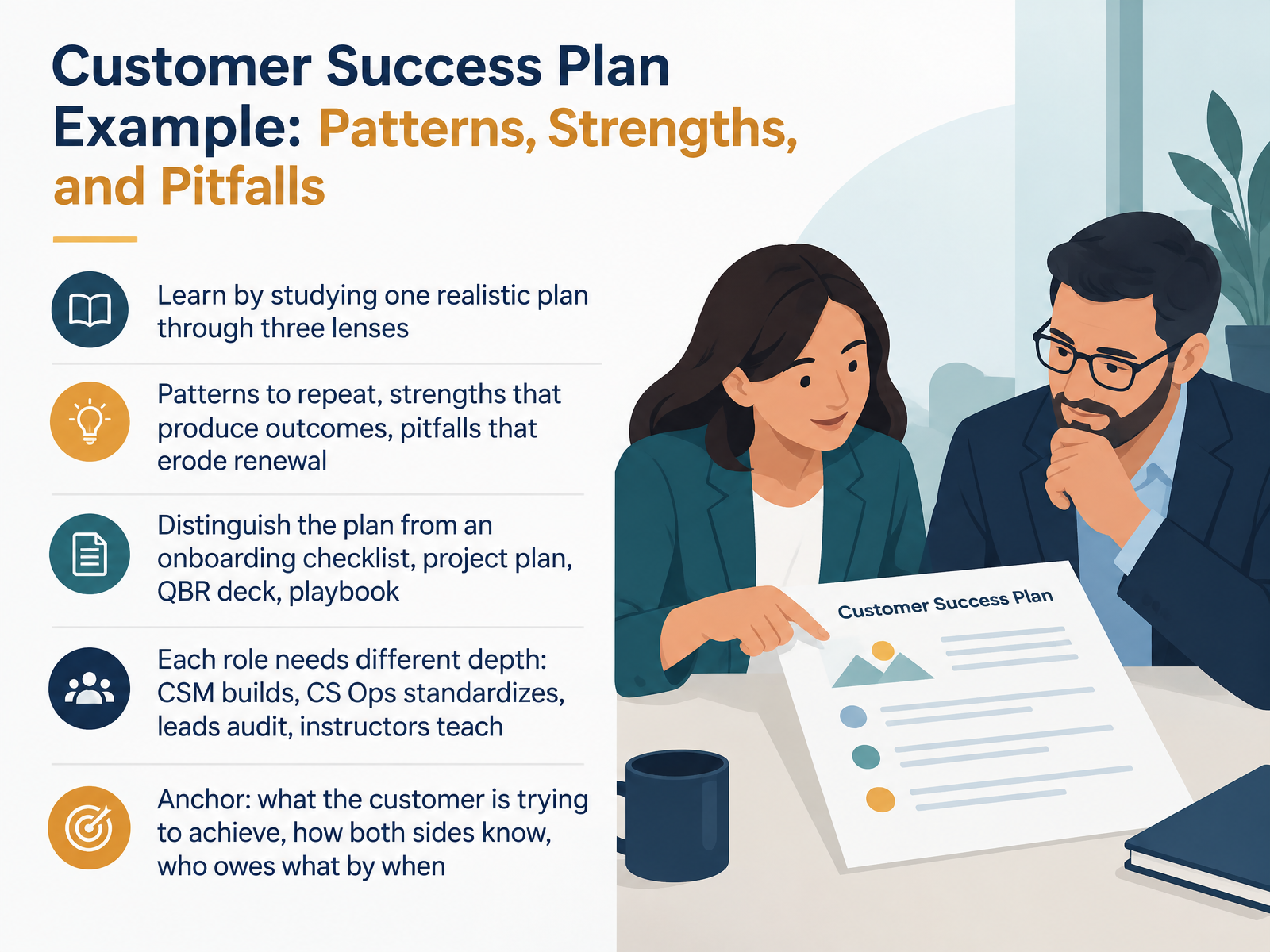
- 01Customer Success Plan Example: Patterns, Strengths, and PitfallsWelcome. Over the next few minutes, we'll work through one realistic customer success plan and study it through three lenses: patterns worth repeating, strengths that actually produce outcomes, and pitfalls that quietly erode renewal. Here's the framing. This plan is not an onboarding checklist, not a project plan, not a QBR deck, and not a playbook. It's a shared statement of what the customer is trying to achieve, how both sides will know it happened, and who owes what by when. Each role takes something different from it. CSMs build it. CS Ops standardizes the structure. Team leads audit it before renewal conversations. Instructors teach it. So as we go, keep your own role in mind. Where does your version of this plan hold up, and where does it fall apart? Let's start by drawing a clean line between what a customer success plan is and what it is not.zendesk.comgigradar.iokiolo.com+21 min
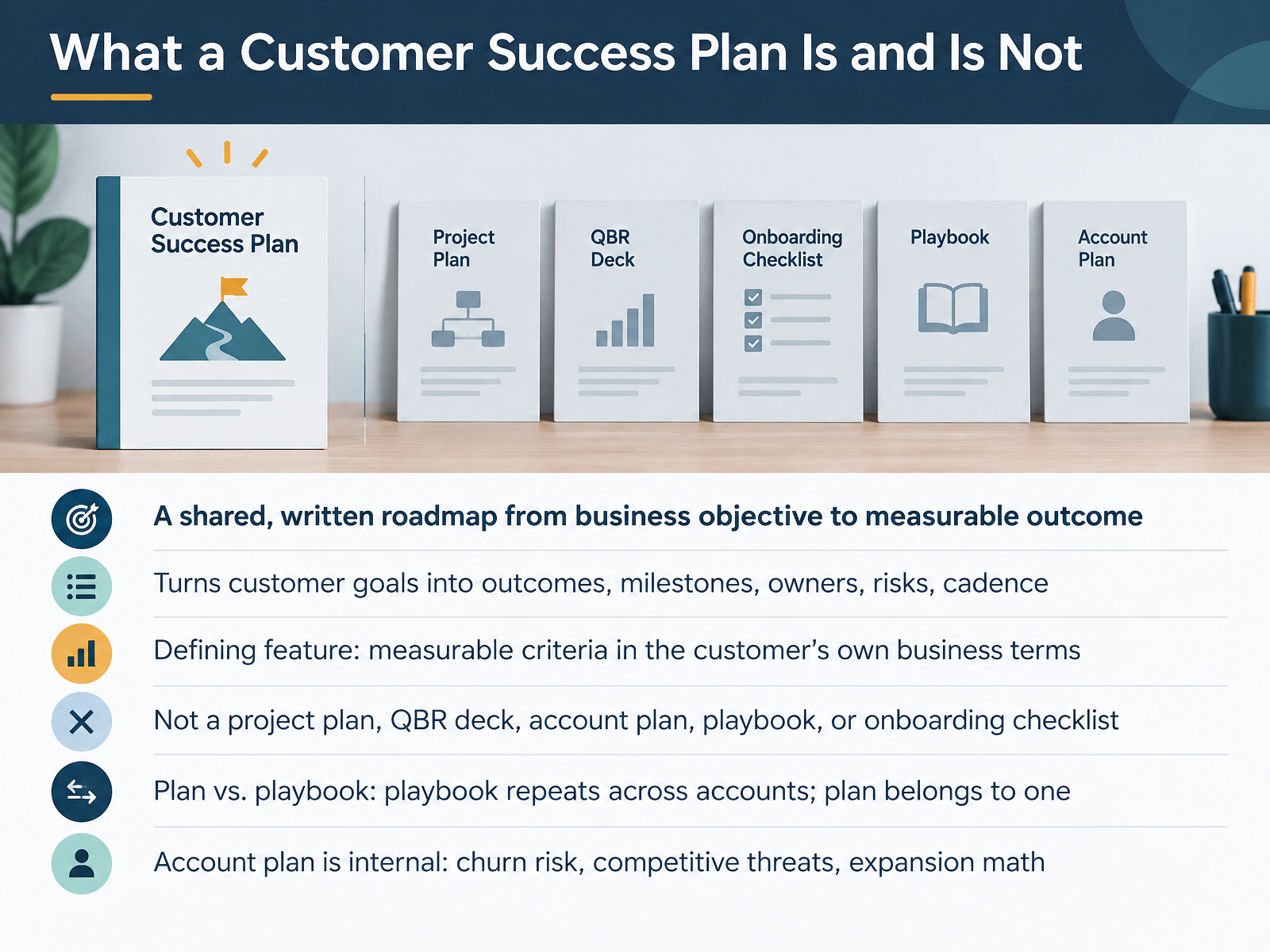
- 02What a Customer Success Plan Is and Is NotLet's draw a clear line around what a Customer Success Plan actually is. At its core, it's a shared, written roadmap that starts with a business objective and ends in a measurable outcome. It turns customer goals into outcomes, milestones, owners, risks, and a review cadence. The defining feature is measurable criteria expressed in the customer's own business terms, not yours. Here's the part that trips people up. A success plan is not a project plan. It's not a QBR deck, an account plan, a playbook, or an onboarding checklist. The cleanest distinction: a playbook repeats across accounts, while a plan belongs to one account and one customer. And an account plan is internal, covering churn risk, competitive threats, and expansion math the customer never sees. Quick test for you. If your document reads the same for every account, it's a playbook. If the customer's numbers are in it and they'd notice if those numbers moved, it's a plan. Next, we'll walk through the example plan, section by section.
 zendesk.comgigradar.iokiolo.com+21 min
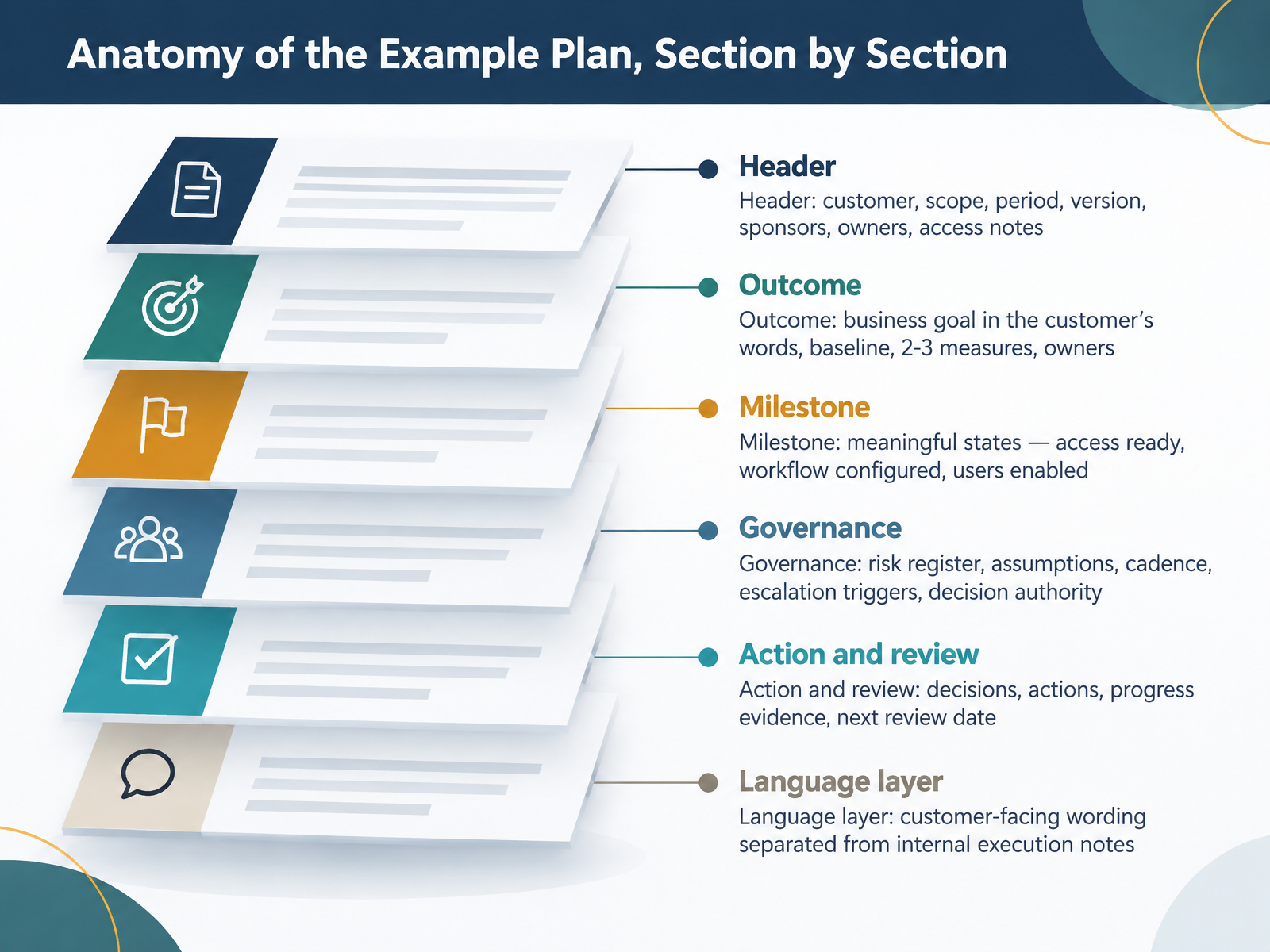
 - 03Anatomy of the Example Plan, Section by SectionLet's walk the example plan section by section. Six parts, and each one earns its place.
First, the header. Customer, scope, period, version, sponsors, owners, and access notes. Boring? Yes. But version and access notes are what stop two teams working from different copies.
Second, the outcome. State the business goal in the customer's own words, with a baseline, two or three measures, and owners. "Reduce month-end close from nine days to five" is an outcome. "Improve efficiency" is not.
Third, milestones. These are meaningful states, not tasks. Access ready, workflow configured, users enabled. Each one observable without asking anyone.
Fourth, governance. A risk register, assumptions, meeting cadence, escalation triggers, and who holds decision authority. Agree the escalation path before you need it.
Fifth, action and review. Decisions, actions, progress evidence, and the next review date. Keep the review inside a meeting that already exists.
Sixth, the language layer. Separate customer-facing wording from internal execution notes. One document, two audiences, kept clean.
Get these six right and the plan stays short, shared, and actually opened between calls. Next, the Compact Five-Column Version Customers Actually Use.
 zendesk.comgigradar.iokiolo.com+22 min
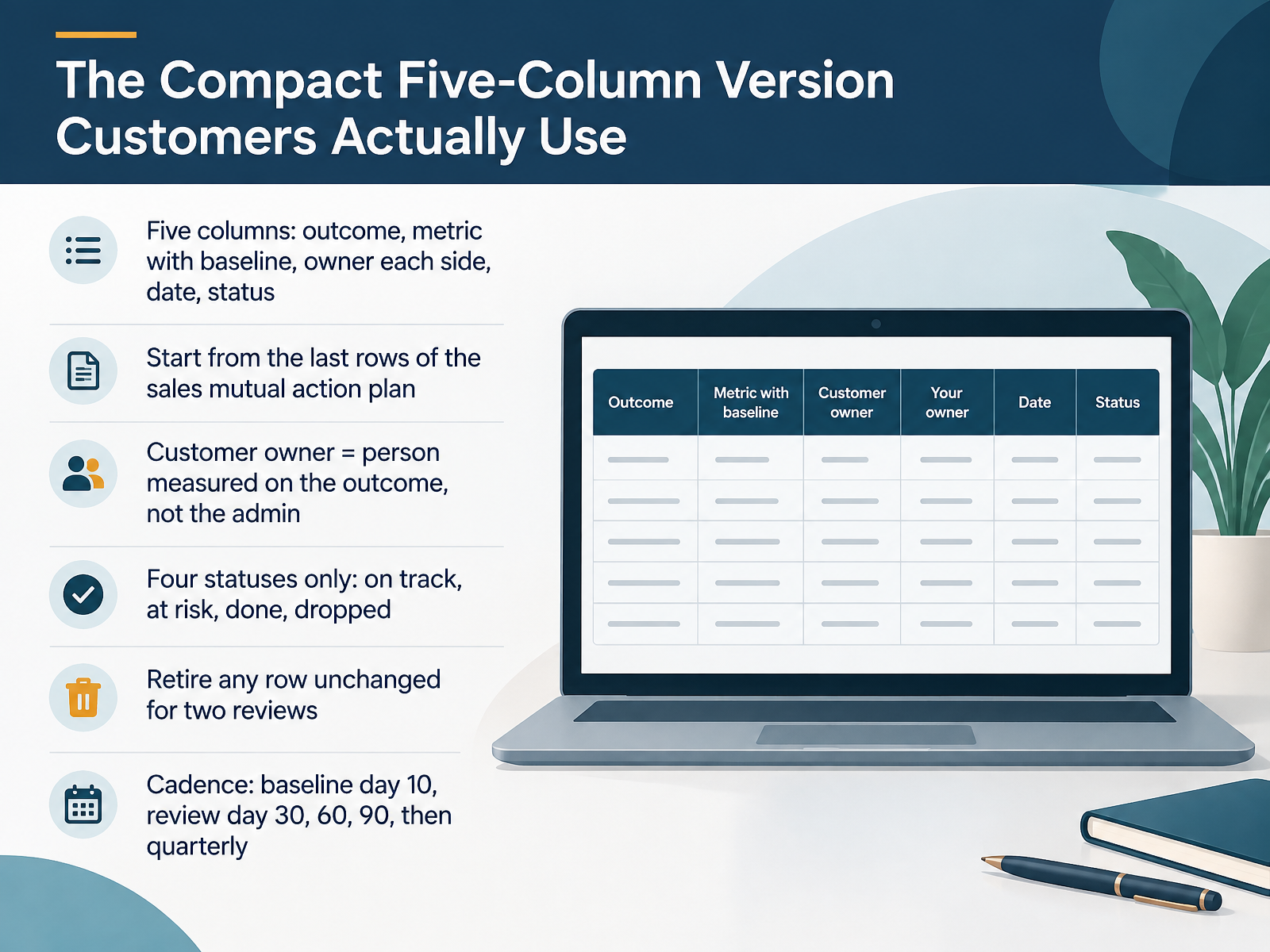
 - 04The Compact Five-Column Version Customers Actually UseNow that we've covered the full plan, let's look at the compact version customers actually use: five columns, no more.
Column one is the outcome. Column two is the metric, with a baseline and a target. Column three is the customer owner. Column four is your owner. Column five is the date and the status.
Where do the rows come from? Start with the last rows of the sales mutual action plan. Those usually say why the customer bought. Turn them into outcomes before kickoff, and you arrive with a draft in the sponsor's own words.
One distinction worth pausing on. The customer owner is the person measured on the outcome, not the admin. The admin executes. The plan needs the person who can move their own organization.
Keep status to four words: on track, at risk, done, and dropped. Dropped is the one most plans lack, and it's what keeps the document honest.
Then protect the plan. Retire any row unchanged for two reviews. Either it's done and unrecorded, or it's dead. Ask which.
Finally, the cadence. Baseline by day ten. Review on day thirty, sixty, and ninety. Then quarterly until renewal. Book those dates at kickoff.
Pattern 1: Outcome-First Framing With a Captured Baseline.
 kompassify.comcustify.comlyniro.com+22 min
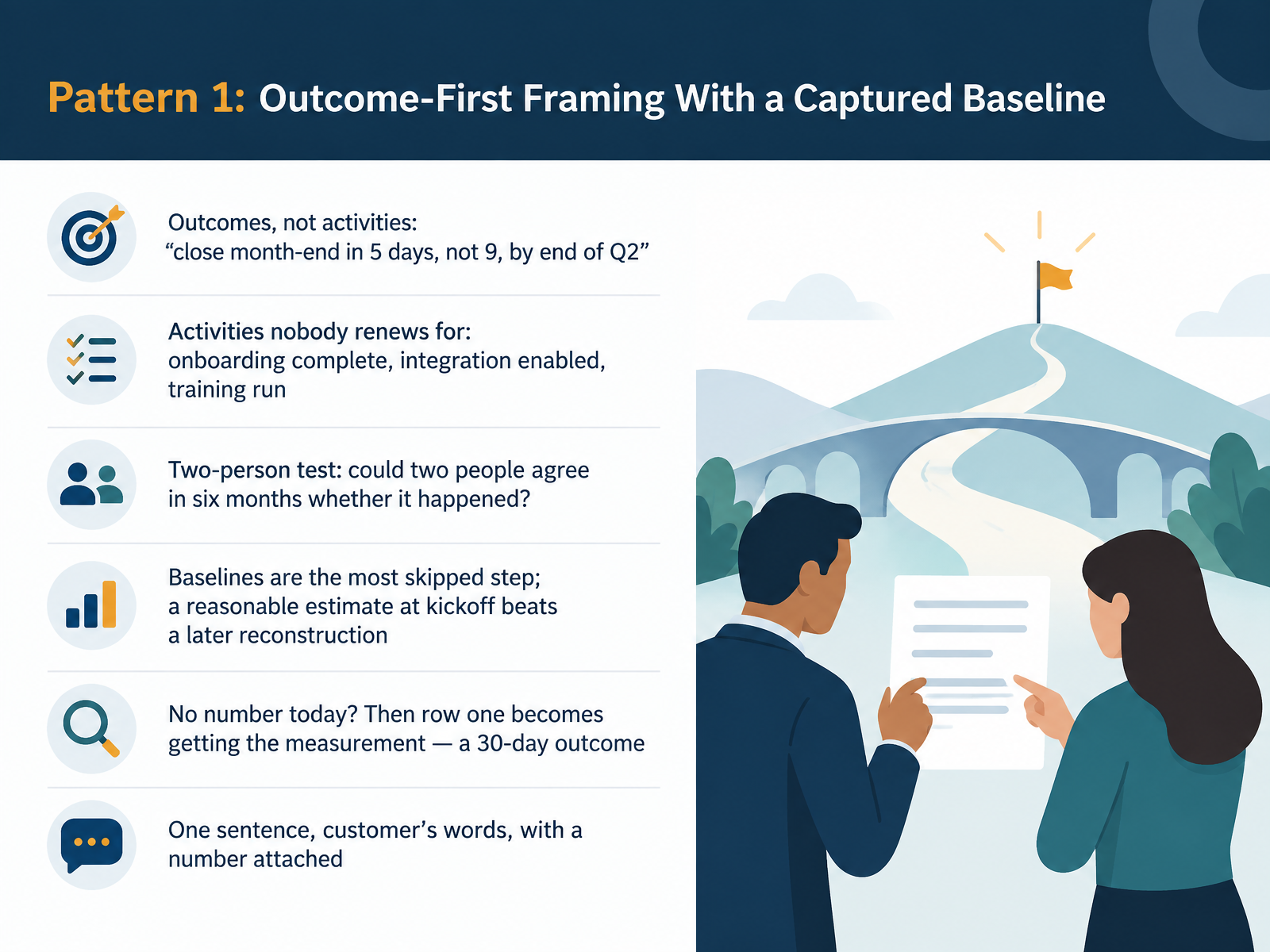
 - 05Pattern 1: Outcome-First Framing With a Captured BaselineLet's look at the first pattern: outcome-first framing, with a captured baseline. Start with outcomes, not activities. "Close month-end in five days, not nine, by the end of Q2" is an outcome. Onboarding complete, integration enabled, training run. Those are activities, and nobody renews because activities occurred. Here's a quick test. Could two people independently look at the evidence in six months and agree on whether it happened? If not, rewrite it, because ambiguity resurfaces at renewal, which is the worst possible time. Now, the baseline is the most skipped step. Customers rarely have the number precisely, and a reasonable estimate agreed at kickoff beats a reconstruction attempted a year later by someone who has since changed jobs. So if there is no number today, then row one of your plan simply becomes getting the measurement. Treat that as a legitimate thirty-day outcome. And keep it to one sentence, in the customer's words, with a number attached. That single line anchors everything else. Next, pattern two: stakeholder mapping and joint accountability.
 blog.hubspot.comhandbook.gitlab.comkompassify.com+22 min
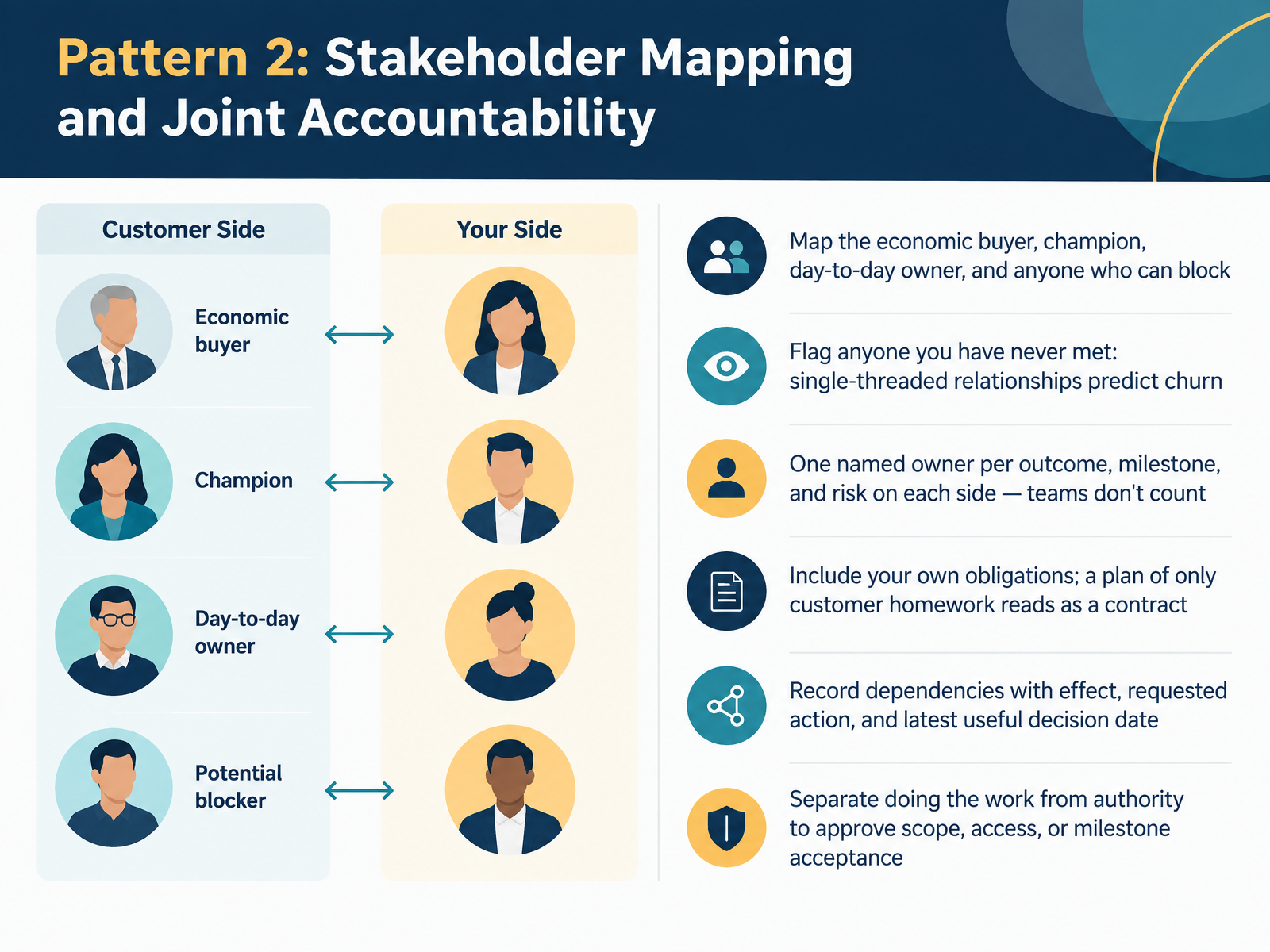
 - 06Pattern 2: Stakeholder Mapping and Joint AccountabilityLet's talk about Pattern 2: Stakeholder Mapping and Joint Accountability. Start by naming four roles on every plan: the economic buyer, the champion, the day-to-day owner, and anyone who can block. Here's the hard question. Who on that list have you never actually met? Single-threaded relationships predict churn, so flag those gaps early. Next, one named owner per outcome, per milestone, and per risk, on each side. Teams don't count. And include your own obligations. A plan listing only customer homework reads as a contract, not a partnership. For dependencies, record three things: the effect, the requested action, and the latest useful decision date. Finally, separate doing the work from the authority to approve scope, access, or milestone acceptance. Those are often different people, and mixing them up stalls progress quietly. So the takeaway is simple. Name people, not teams, and make accountability mutual. That sets up Pattern 3: Milestone Sequencing From Onboarding to Value Realization.
 blog.hubspot.comzendesk.comhandbook.gitlab.com+22 min
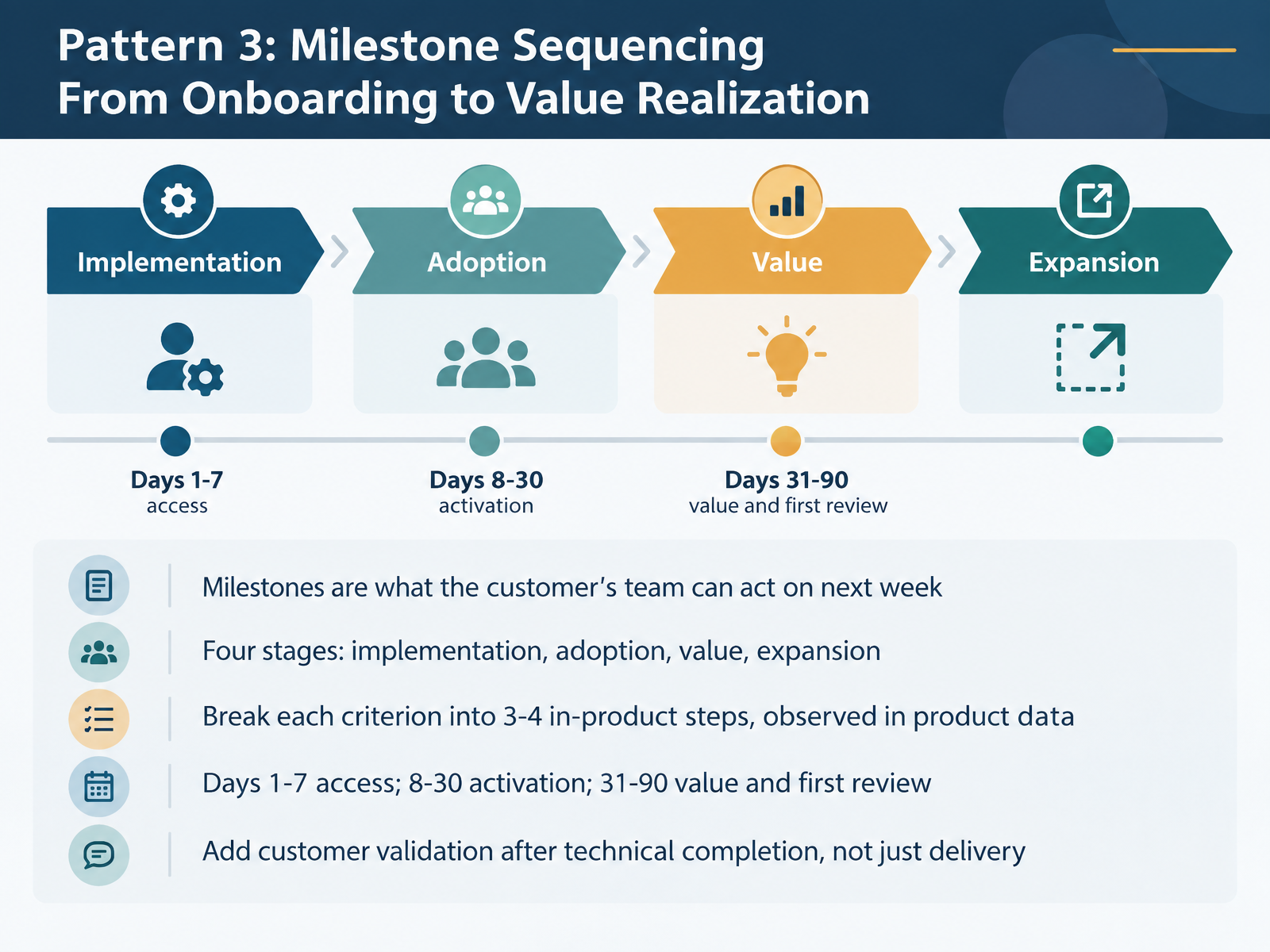
 - 07Pattern 3: Milestone Sequencing From Onboarding to Value RealizationLet's look at Pattern 3: milestone sequencing from onboarding to value realization. Here's the reframe that matters. Milestones are not your project phases. They are what the customer's team can actually act on next week. So sequence four stages: implementation, adoption, value, and expansion. Then break each success criterion into three or four in-product steps you can observe in product data. Not reported on a call. Observed. A workable rhythm: days one to seven for access, days eight to thirty for activation, days thirty-one to ninety for value and the first review. And one addition people skip. Add a customer validation point after technical completion, not just delivery. A configuration can ship while the workflow stays unusable because permissions or local process are unresolved. Who accepts that milestone, and against what evidence? That is the difference between a delivered task and realized value. Next, Pattern 4: Risk, Dependency, and Cadence Discipline.
 blog.hubspot.comhandbook.gitlab.comkompassify.com+22 min
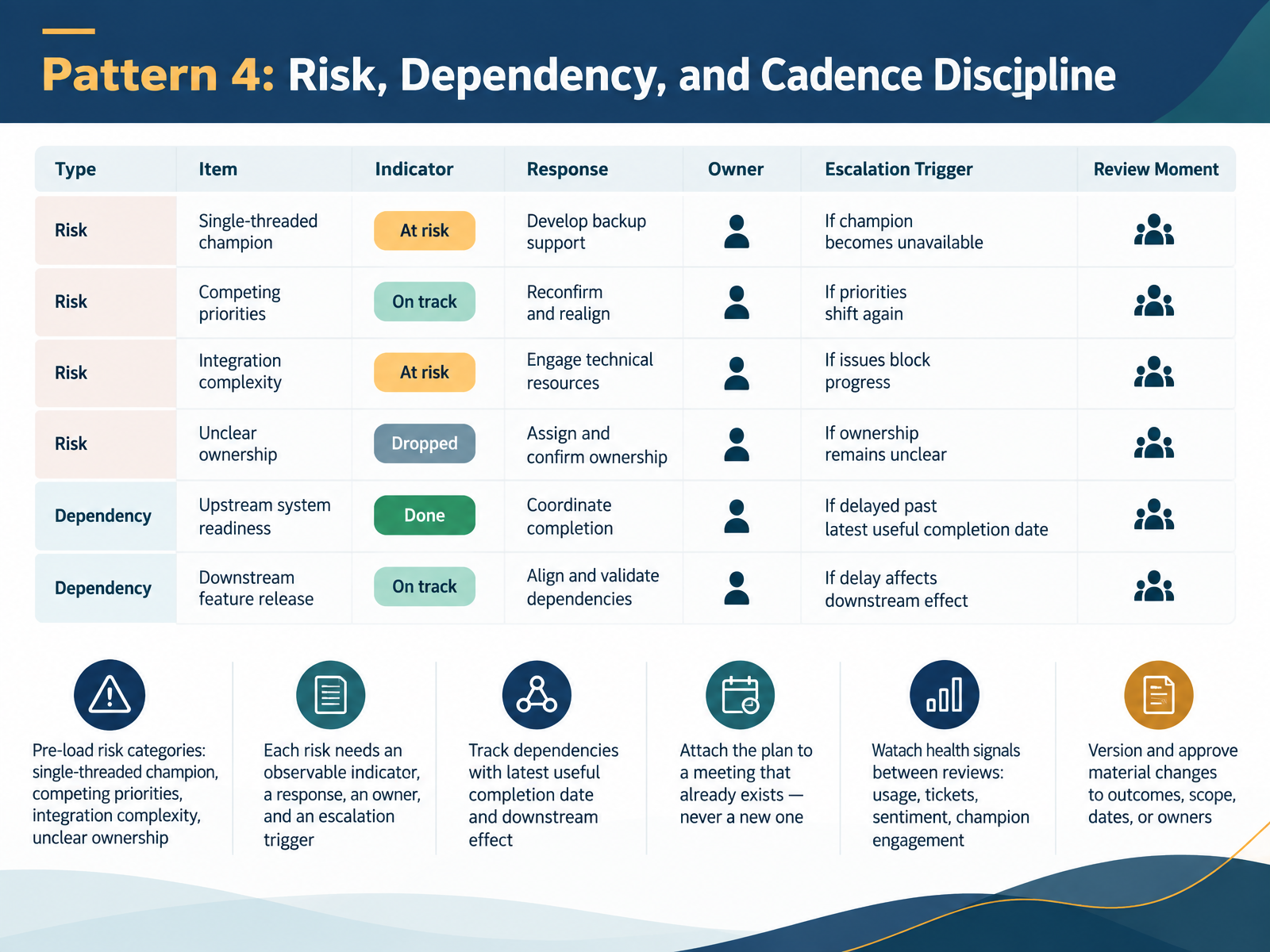
 - 08Pattern 4: Risk, Dependency, and Cadence DisciplineNow let us look at Pattern Four: risk, dependency, and cadence discipline. This is the pattern that separates plans that survive first contact with reality from plans that quietly die after kickoff.
Start by pre-loading your risk categories, so you are not inventing them account by account: a single-threaded champion, competing priorities, integration complexity, and unclear ownership. Each risk needs four things: an observable indicator, a response, an owner, and an escalation trigger. A risk with no trigger is just a worry.
Track dependencies the same way. Capture the latest useful completion date and the downstream effect. That phrasing matters, because a blocked dependency is a conversation about impact, not blame.
Here is the cadence discipline part. Attach the plan to a meeting that already exists. Never create a new one. A plan reviewed at the start of every regular call survives. A plan that needs its own meeting does not.
And between those reviews, watch the health signals: usage, tickets, sentiment, champion engagement. Finally, version and approve material changes to outcomes, scope, dates, or owners. If it changed and nobody approved it, it is not the plan.
Next, strengths to replicate from the example.
 blog.hubspot.comzendesk.comhandbook.gitlab.com+22 min
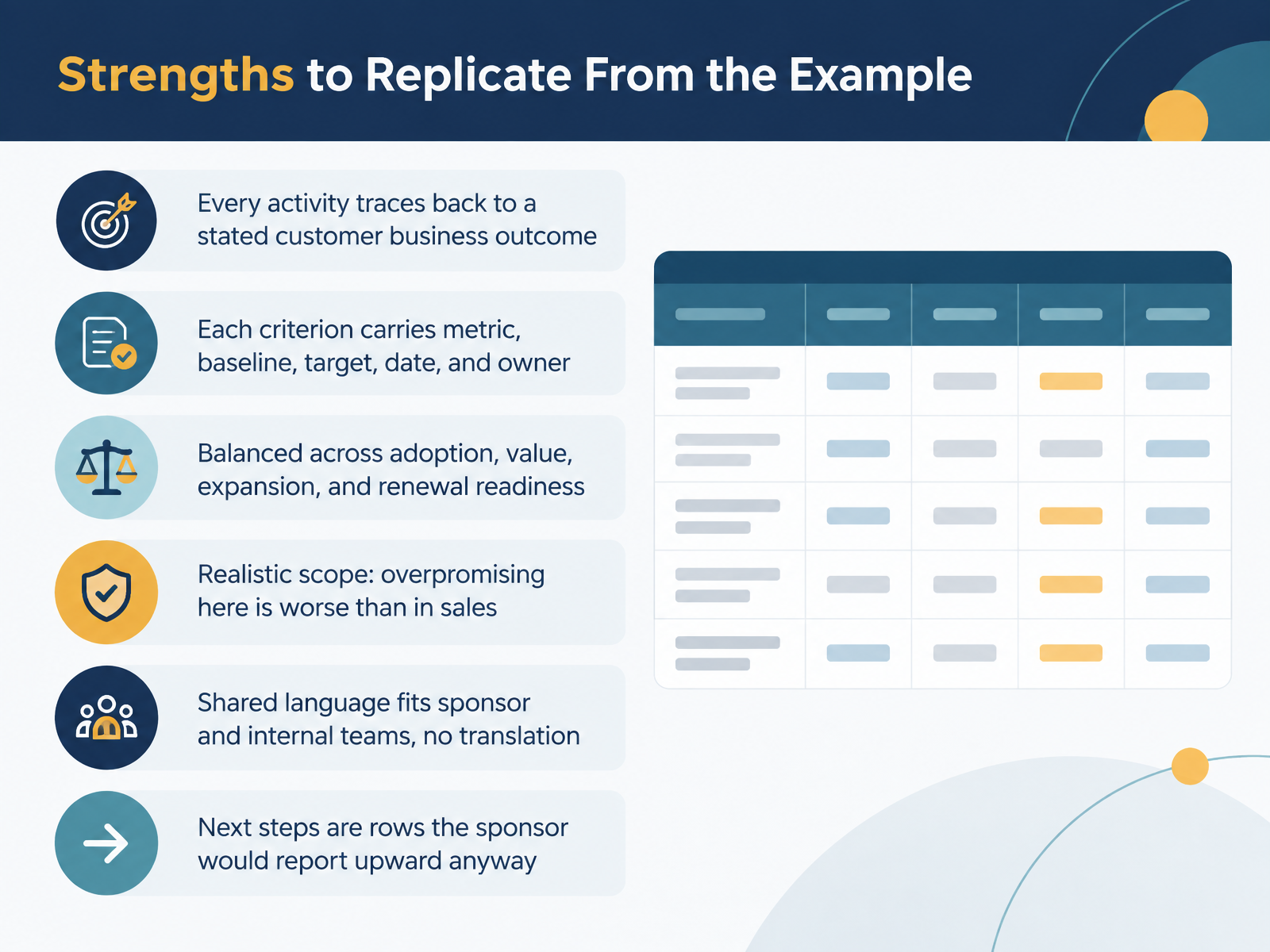
 - 09Strengths to Replicate From the ExampleLet's pull out the strengths worth copying from that example. First, every activity traces back to a stated customer business outcome. If a task cannot be tied to something the customer cares about, question whether it belongs. Second, each success criterion carries five things: metric, baseline, target, date, and owner. Leave any one out and you leave room for argument at renewal. Third, look at the balance. The plan spans adoption, value, expansion, and renewal readiness, so early wins do not crowd out the commercial conversation. Fourth, the scope stays realistic. Overpromising in a success plan is worse than in sales, because the customer now holds a written commitment. And fifth, the language is shared. The sponsor and your internal teams read the same rows without translation. One test worth applying: would the sponsor report these rows upward anyway? If yes, you have built something that lives beyond the kickoff. Keep these patterns in mind, because next we look at the flip side: Pitfalls, Common Failure Modes and How to Catch Them Early.
 blog.hubspot.comzendesk.comhandbook.gitlab.com+22 min
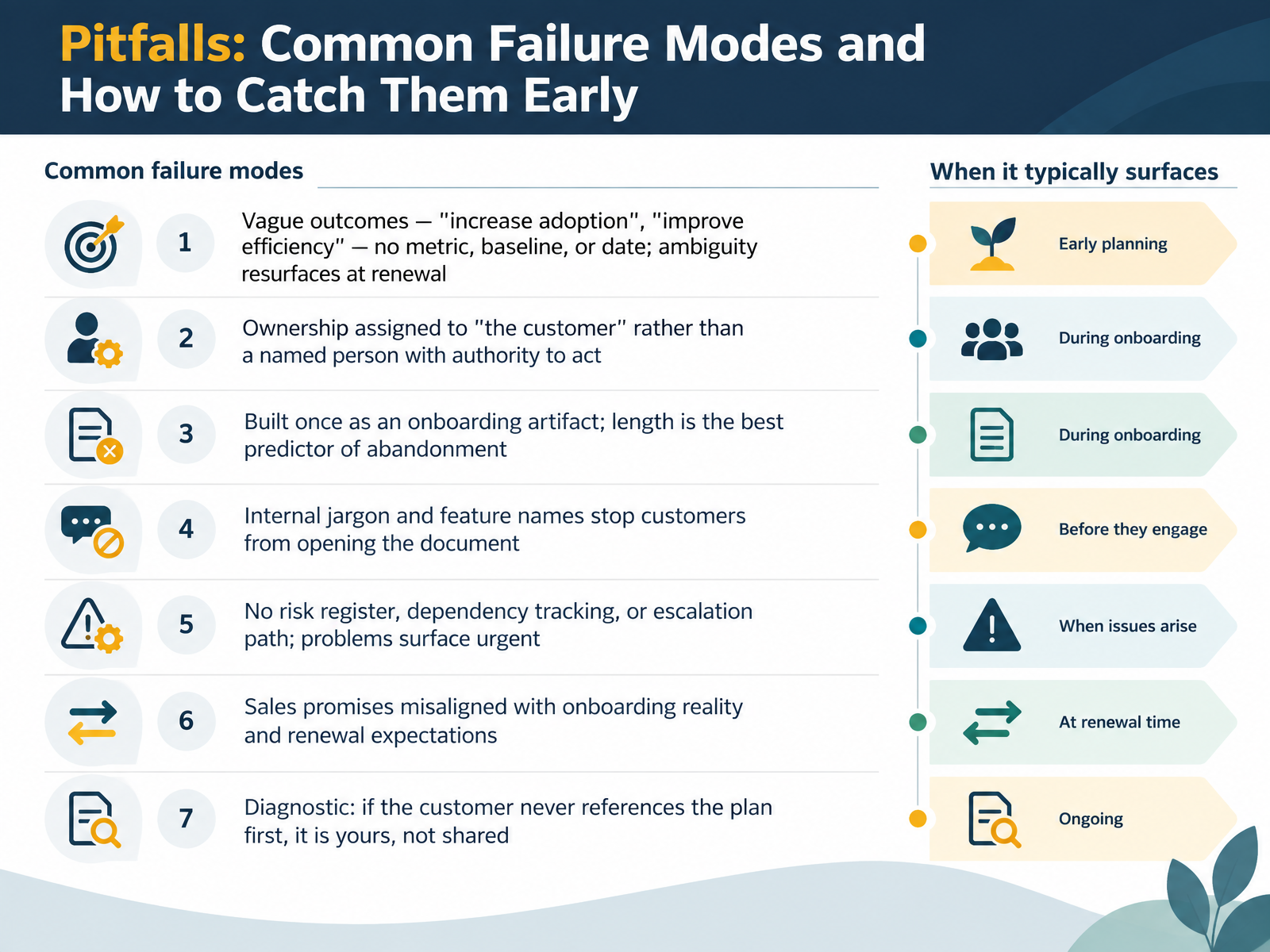
 - 10Pitfalls: Common Failure Modes and How to Catch Them EarlyLet's talk about the failure modes, and more importantly, how to catch them early. The first trap is vague outcomes. "Increase adoption" is an intention, not a plan. It needs a metric, a baseline, a target, and a date, or the ambiguity resurfaces at renewal. Second, watch ownership. Assigning a task to "the customer" means nobody owns it. You need a named person with authority to act. Third, beware the plan built once as an onboarding artifact. Length is the best predictor of abandonment, so keep it short. Fourth, internal jargon and feature names stop customers from opening the document. Write it in their language. Fifth, a missing risk register, dependency tracking, or escalation path means problems surface urgent instead of early. And sixth, sales promises that don't match onboarding reality create friction at renewal. Here's your quick diagnostic. If the customer never references the plan before you do, it's your document, not a shared one. Treat that as your early warning signal. Building and Co-Creating Your Own Plan From the Example.
 customersuccesssnack.comblog.hubspot.comchurnzero.com+22 min
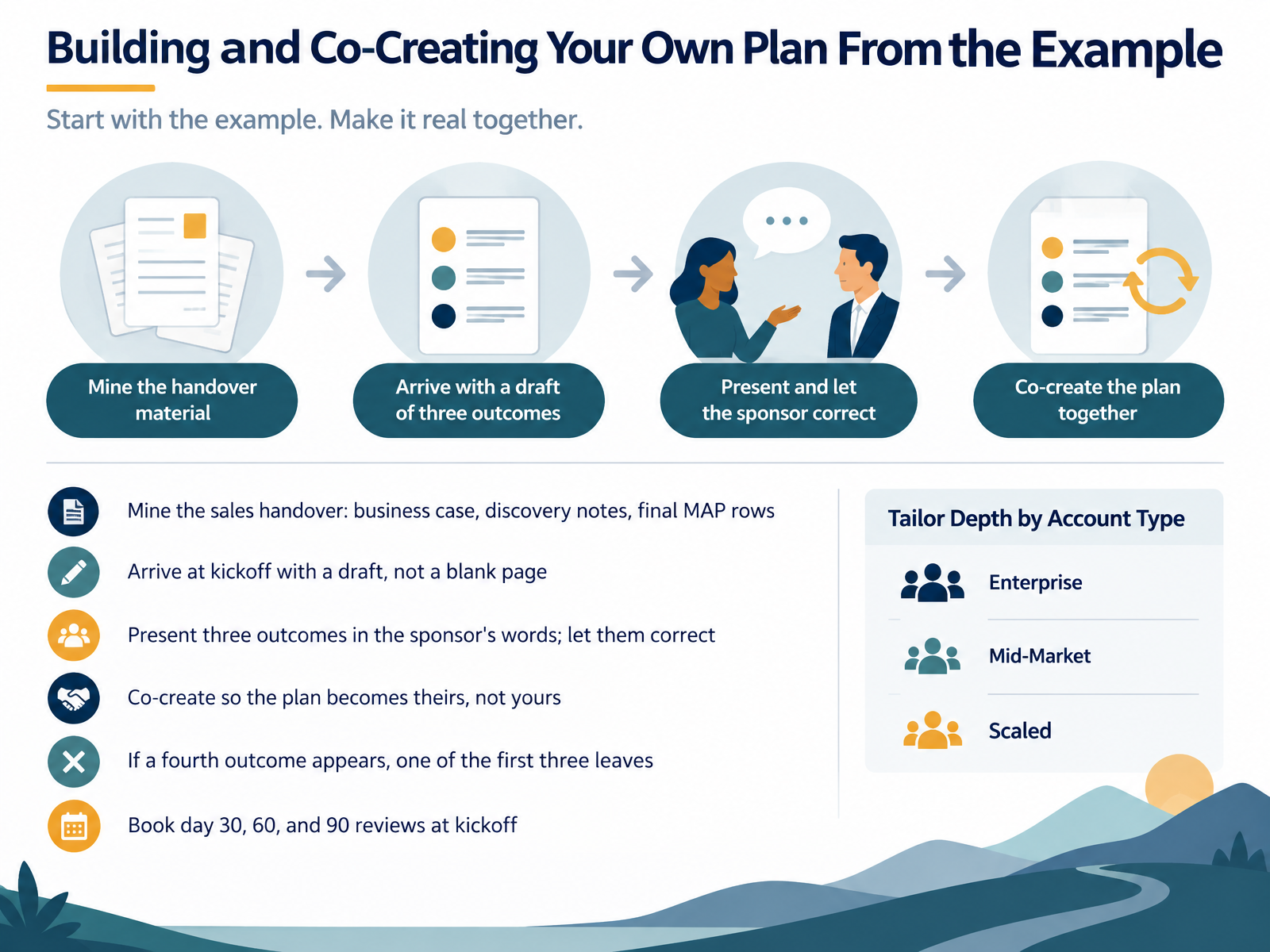
 - 11Building and Co-Creating Your Own Plan From the ExampleLet's put the example to work and build your own version of it. The engine here is the sales handover. Go back and mine the business case, the discovery notes, and the last few rows of the sales mutual action plan. Those rows usually tell you why the buyer actually signed. Draft three outcomes in the sponsor's own words before kickoff. Arrive with a draft, not a blank page. Then present those three outcomes and let the sponsor correct them. That correction is where the real information shows up, so write it down verbatim. The goal is co-creation. If the plan feels like a vendor template they approved, it gets ignored. If it feels like their commitment, they open it before you do. One discipline: if a fourth outcome appears, ask which of the first three it replaces. Three outcomes get reviewed in fifteen minutes. And book day thirty, sixty, and ninety reviews at kickoff, before everyone leaves the call. Next, we look at the rhythm that keeps this plan alive in Metrics, Reviews, and Governance Rhythm.
 blog.hubspot.comcustify.comf.hubspotusercontent30.net+22 min
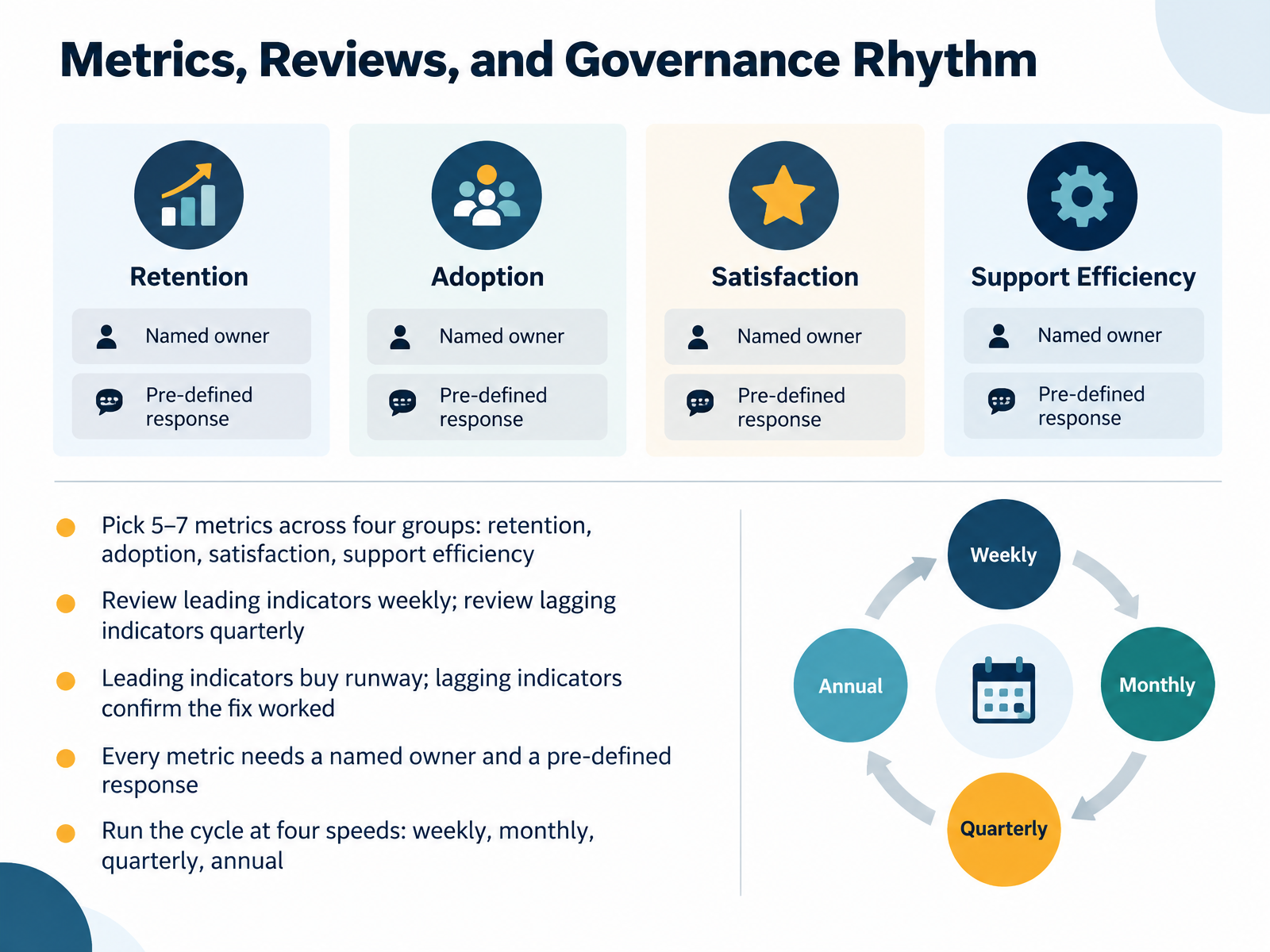
 - 12Metrics, Reviews, and Governance RhythmLet's talk about the rhythm that keeps a success plan alive: metrics, reviews, and governance. Start with five to seven metrics across four groups: retention, adoption, satisfaction, and support efficiency. Not thirty. Pick a small set, then review leading indicators weekly and lagging indicators quarterly. Here's the distinction that matters. Leading indicators buy you runway. Lagging indicators confirm the fix worked. A dropping health score is a signal you can still act on. Net revenue retention is settled history. Every metric needs two things: a named owner and a pre-defined response. If a number moves and nobody owns it, it's decoration. And run the cycle at four speeds. Weekly for account signals, monthly for team capacity, quarterly for the system, annual for strategy. Skip a level and the one above it starves for input. So keep it deliberate, keep it owned, and keep it moving. Let's put this into practice with the review checklist and scenario critiques.
 procontentstudio.netlaunchweek.aijrgpartners.com+21 min
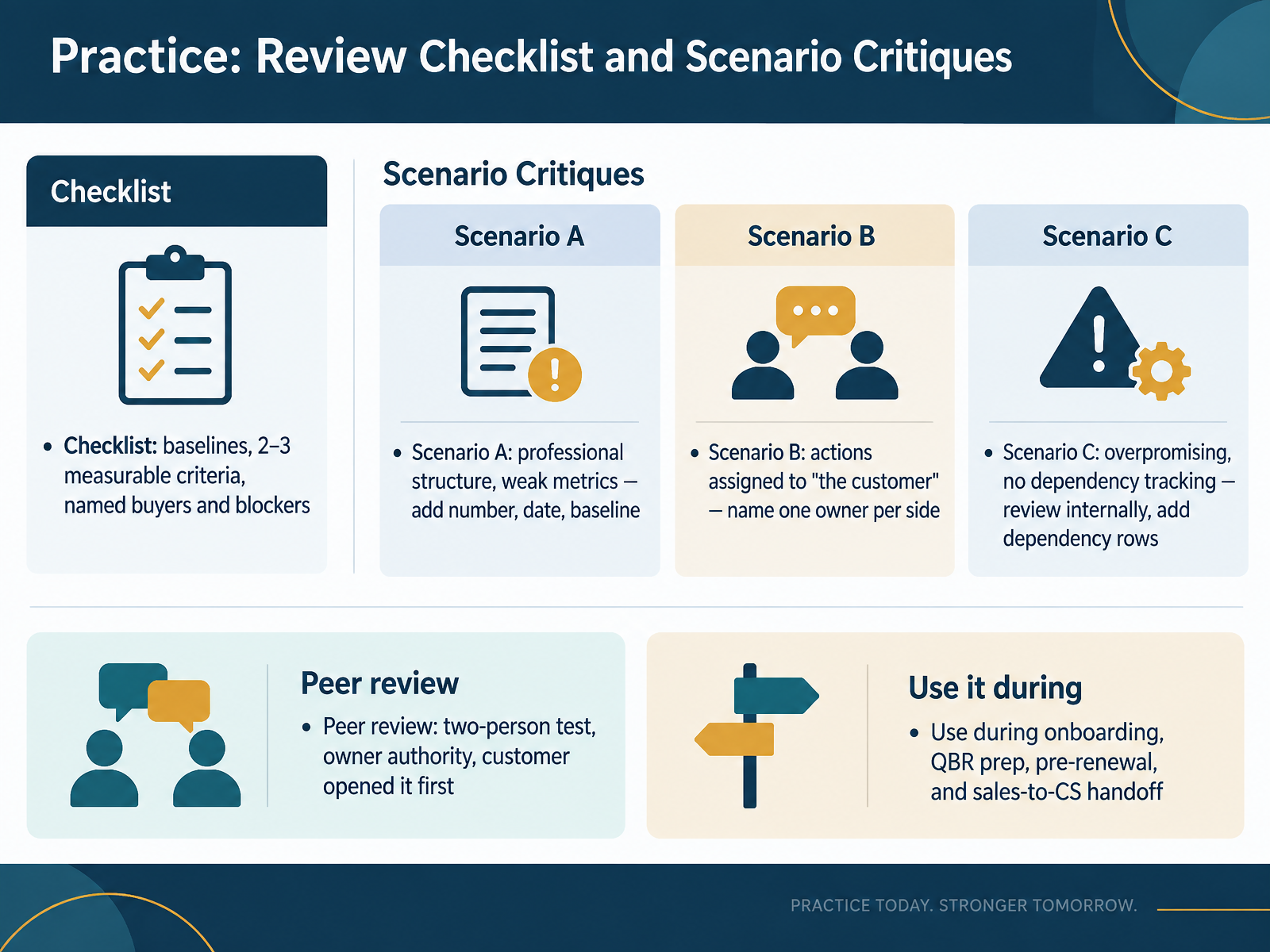
 - 13Practice: Review Checklist and Scenario CritiquesLet's put this into practice with a review checklist and some scenario critiques. Before any plan review, check three things: a baseline for every metric, two or three measurable criteria, and named buyers and blockers. Not teams, names. Now, three common scenarios. Scenario A has professional structure but weak metrics. The fix is simple: add a number, a date, and a baseline. Scenario B assigns actions to, quote, the customer. That means nobody owns them. Name one owner per side. Scenario C overpromises with no dependency tracking. Review it internally first, then add dependency rows so blocked work is visible. For peer review, run a two-person test, confirm the owner has real authority, and check whether the customer opened the plan before you did. Use this checklist during onboarding, QBR prep, pre-renewal, and the sales-to-CS handoff. Next, we'll look at adapting the example across segments and roles, then acting on it.
 customersuccesssnack.comblog.hubspot.comchurnzero.com+22 min
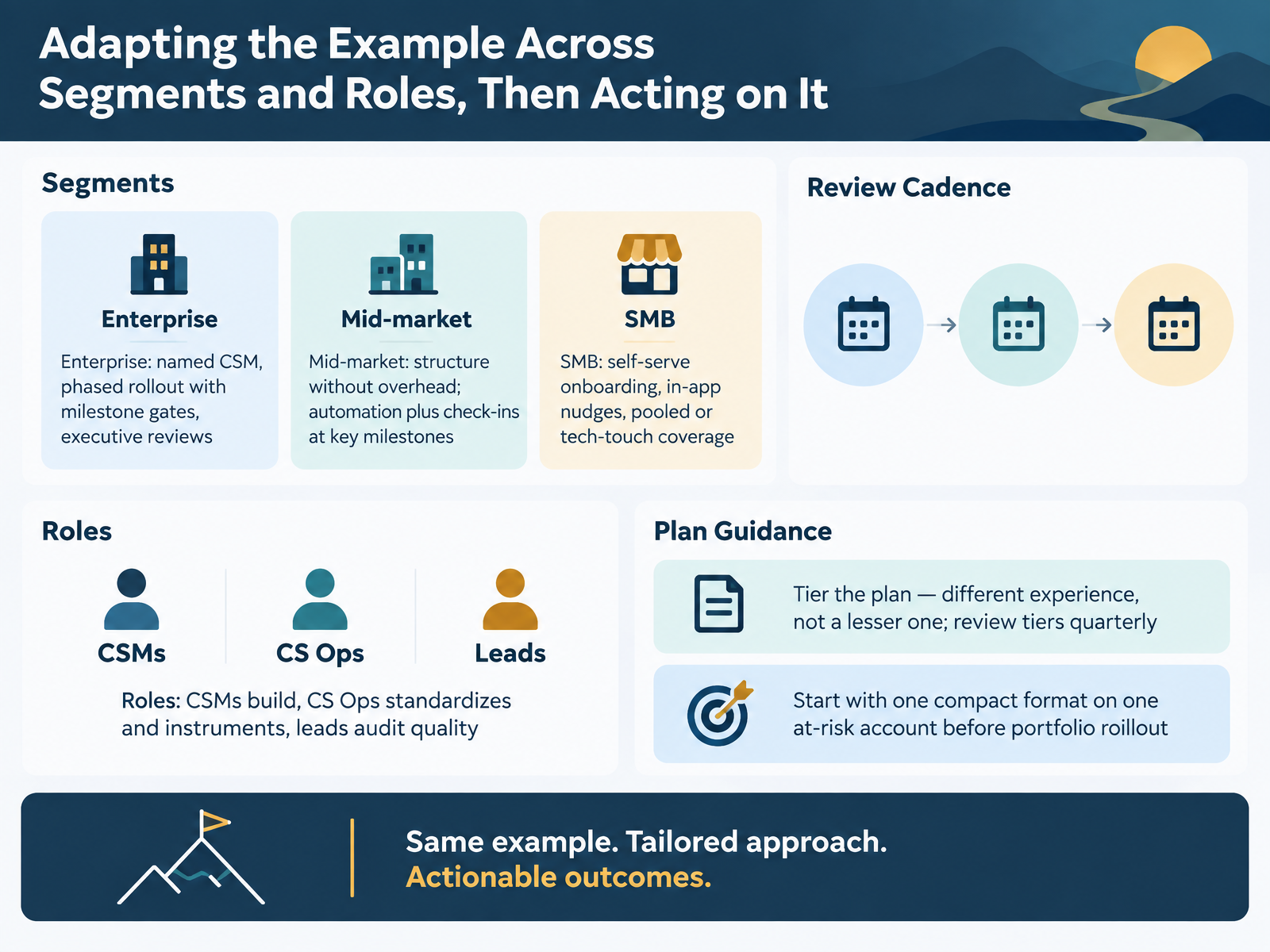
 - 14Adapting the Example Across Segments and Roles, Then Acting on ItLet's bring this home. One example, three adaptations. For enterprise, you want a named CSM, a phased rollout with milestone gates, and executive reviews. For mid-market, structure without overhead: automation plus check-ins at key milestones. For SMB, self-serve onboarding, in-app nudges, and pooled or tech-touch coverage. Tiering gives different customers a different experience, not a lesser one. And review those tiers quarterly, because a segment assignment from last year is often wrong today. On roles: CSMs build the plan, CS Ops standardizes and instruments it, and team leads audit quality. So here's your next step. Don't roll this out across the whole portfolio. Start with one compact format on one at-risk account. Prove it works. Then scale. Thank you for working through this course, and good luck putting it into practice.
 blog.hubspot.comprocontentstudio.netlaunchweek.ai+22 min
Take the deck with you
Download this course as a file — free, no sign-up needed.
- PDF handoutEvery slide page, ready to print or share.15 pages · 3.2 MBDownload
- Narrated PowerPointThe deck that presents itself — every slide carries the digital human's narration video.15 pages · 26.0 MBDownload
- PowerPoint slidesThe full deck as a .pptx — open it in PowerPoint, Keynote, or Google Slides.15 pages · 3.1 MBDownload
Free to use in your own training — please keep the PersonWise credit page at the end.
Have your own deck? Turn it into a course
Sources consulted
Web sources consulted while building this course.
- Customer success plan: Tips and templates — zendesk.com
- Customer Success Plan Template + Free Builder (2026) — gigradar.io
- Customer Success Plan Template: Align Outcomes, Milestones, Risks and Owners — kiolo.com
- Free Customer Success Plan Template & Examples — xtensio.com
- Customer Success Plan: Framework, Template & How to Build One (2026) — kompassify.com
- How to Create a Joint Success Plan | Custify Blog — custify.com
- Mutual Action Plan Template for CS Teams | Lyniro — lyniro.com
- The Mutual Success Action Plan Framework for B2B Sales | Caliber (formerly pclub.io) — caliber.io
- Customer success plan: How to build one to stay on track ... — blog.hubspot.com
- Success Plans | The GitLab Handbook — handbook.gitlab.com
- How to create an effective customer success plan (+ a template) | Zendesk Singapore — zendesk.com
- What Goes in a Mutual Success Plan Template Customers Keep Using? — gaintrace.com
- Why Customer Success Plans Keep Failing — customersuccesssnack.com
- What happens when metrics become customer success goals. - ChurnZero — churnzero.com
- Customer Success Plan: Build One That Reduces Churn — themarketingjuice.com
- Success — f.hubspotusercontent30.net
- Customer Success Governance: A Proven 6-Stage Operating Cycle — procontentstudio.net
- Customer Success Metrics Framework: The Numbers That Tell You Who's About to Churn (and Who's About to Expand) — LaunchWeek.ai — launchweek.ai
- How to Measure VP of Customer Success Performance: KPIs, Scorecards, and Benchmarks - JRG Partners LLC — jrgpartners.com
- Metric Trees for Customer Success - KPI Tree — kpitree.co