Begin
13 pages · ~26 min
B2B Content Marketing Strategy
This training helps B2B marketers set content marketing goals, make strategic choices, and manage tradeoffs to build an effective content strategy.
A digital instructor presents all 13 pages. Hold “Ask” at any point and ask out loud — the answer comes from this course. No sign-up needed.
What you’ll learn
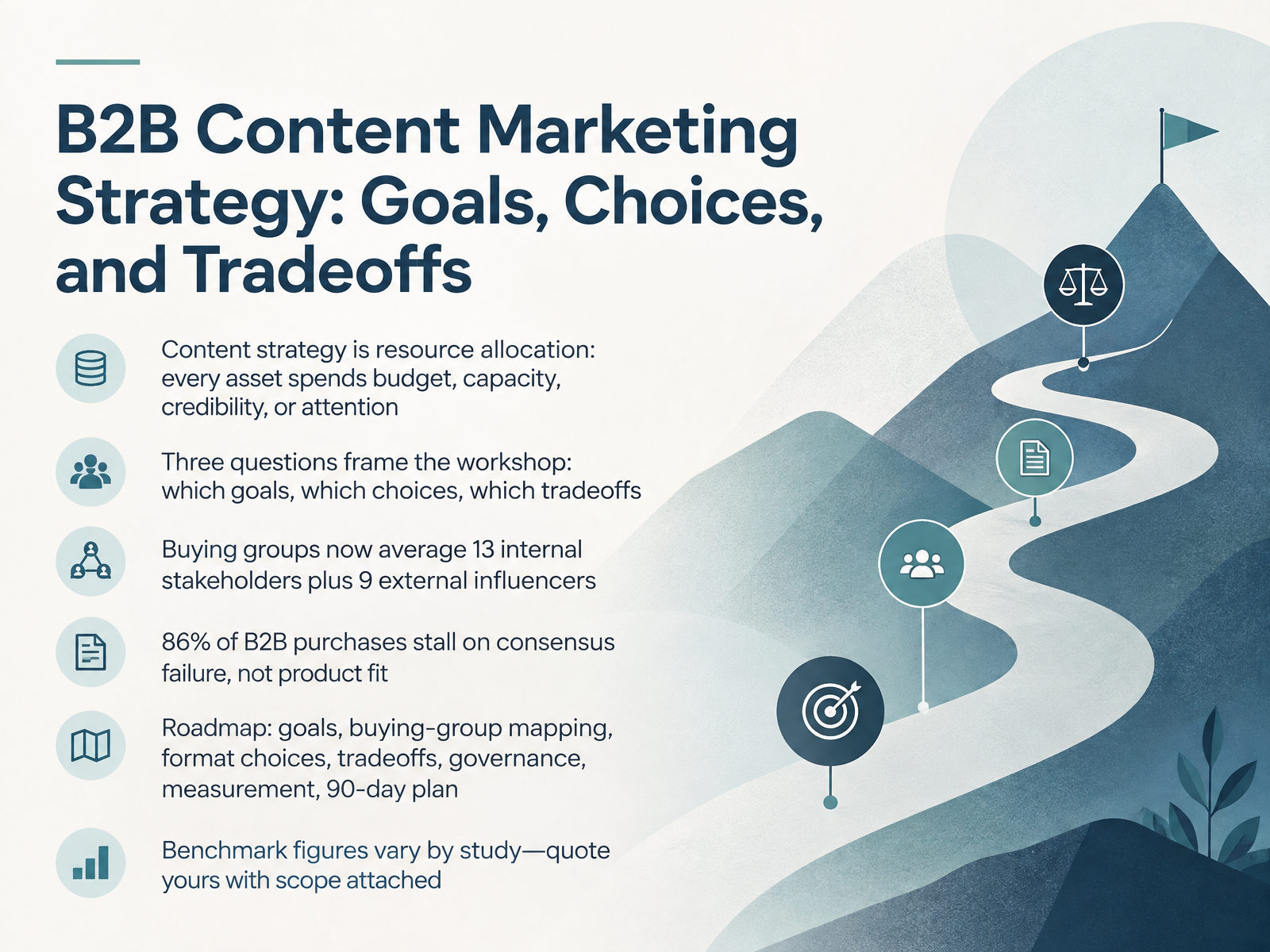
- 01B2B Content Marketing Strategy: Goals, Choices, and TradeoffsWelcome. I'm glad you're here. Over the next several slides, we'll work through B2B content marketing strategy, and we'll frame it as what it really is: resource allocation. Every asset you publish spends something. Budget, capacity, credibility, or attention. You rarely get all four back at once.
So we'll organize the workshop around three questions. Which goals are we actually pursuing? Which choices follow from those goals? And which tradeoffs are we willing to accept?
Here's why this matters now. Buying groups have grown to roughly thirteen internal stakeholders plus nine external influencers. And eighty-six percent of B2B purchases stall on consensus failure, not on product fit. That reframes content. It isn't just demand generation. It's consensus support, across a group, over a long cycle.
Our roadmap covers goals, buying-group mapping, format choices, tradeoffs, governance, measurement, and a ninety-day plan. One note before we start. Benchmark figures vary by study, so quote yours with the scope attached.
Let's begin with the background. Why content confidence outpaces content capability.242630298.fs1.hubspotusercontent-na2.netsona.comb2bcontentos.com+22 min
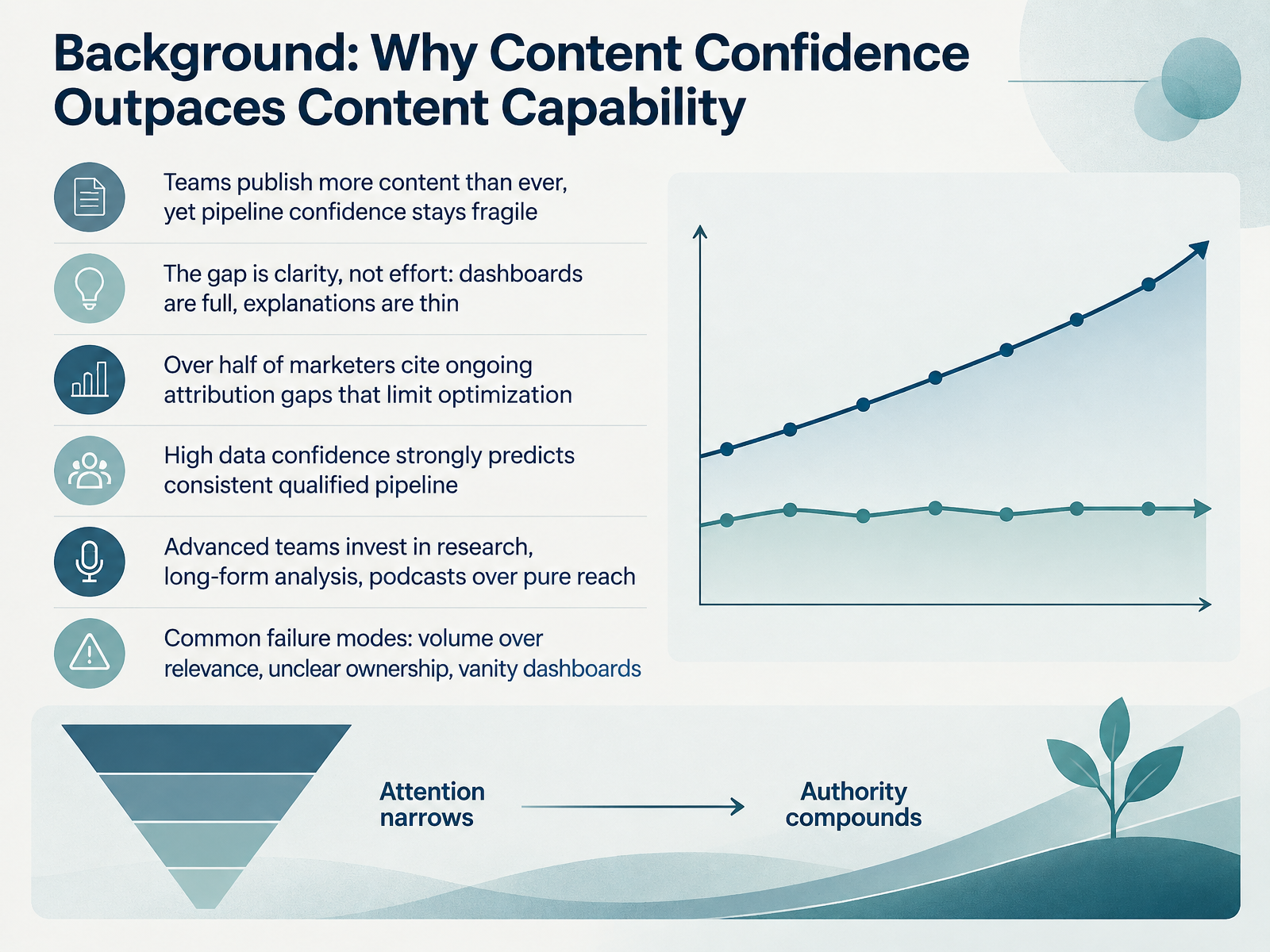
- 02Background: Why Content Confidence Outpaces Content CapabilityLet's ground this in what the data is telling us. Teams are publishing more content than ever. Better tooling, more channels, more visibility. Yet confidence in content's ability to drive predictable pipeline stays fragile. That gap is not about effort. It is about clarity. Dashboards are full, but the explanations are thin. More than half of marketers cite ongoing attribution gaps that limit how well they can optimize. Meanwhile, high confidence in data strongly predicts consistent qualified pipeline. So data quality is not a back-office detail. It is a credibility signal. Now look at where advanced teams place their bets. They invest in research, long-form analysis, and podcasts. Formats that build authority and support late-stage decisions, rather than pure reach. And the failure modes are familiar. Volume over relevance. Unclear ownership. Vanity dashboards. So before we design anything, ask one question. Can you explain why pipeline moved, not just what content published? Next, we will bring goals, choices, and tradeoffs together as one system.
 242630298.fs1.hubspotusercontent-na2.netsona.comb2bcontentos.com+22 min
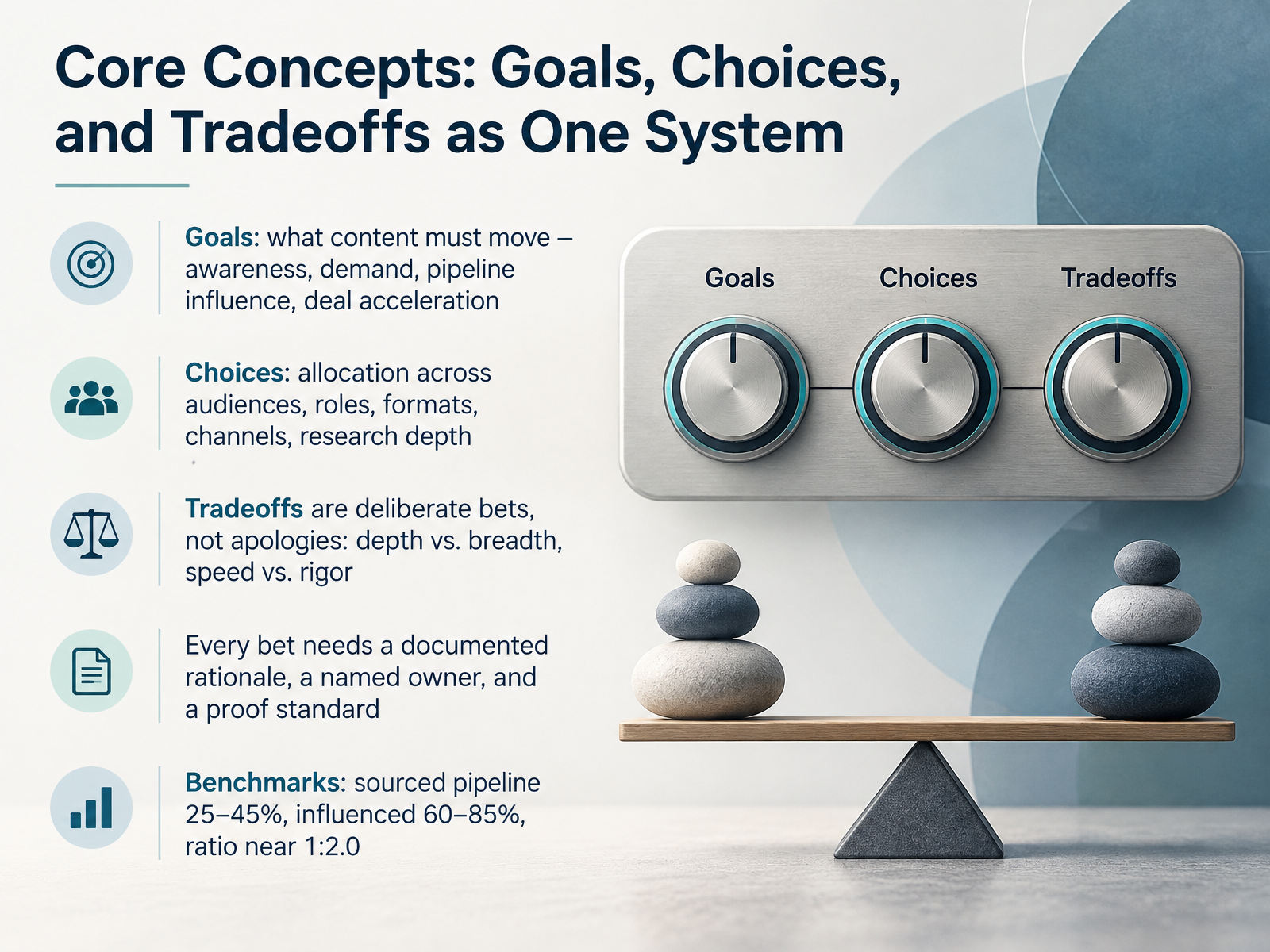
- 03Core Concepts: Goals, Choices, and Tradeoffs as One SystemLet's pull these three ideas together, because in practice they are one system, not three separate conversations. Goals define what content must move: awareness, demand, pipeline influence, or deal acceleration. Choices cover how you allocate effort across audiences, buying roles, formats, and channels. Tradeoffs are the deliberate bets in between. Depth versus breadth. Speed versus rigor. Treat them as decisions, not apologies. Here's the discipline that makes it work. Every bet needs a documented rationale, a named owner, and a proof standard agreed before you start. For benchmarks, healthy programs show marketing sourced pipeline around twenty five to forty five percent, influenced pipeline around sixty to eighty five percent, and a sourced to influenced ratio near one to two. So pick your goal, make your choices, and name the tradeoff out loud. Next, let's map the buying group before you plan content.
 242630298.fs1.hubspotusercontent-na2.netsona.comb2bcontentos.com+21 min
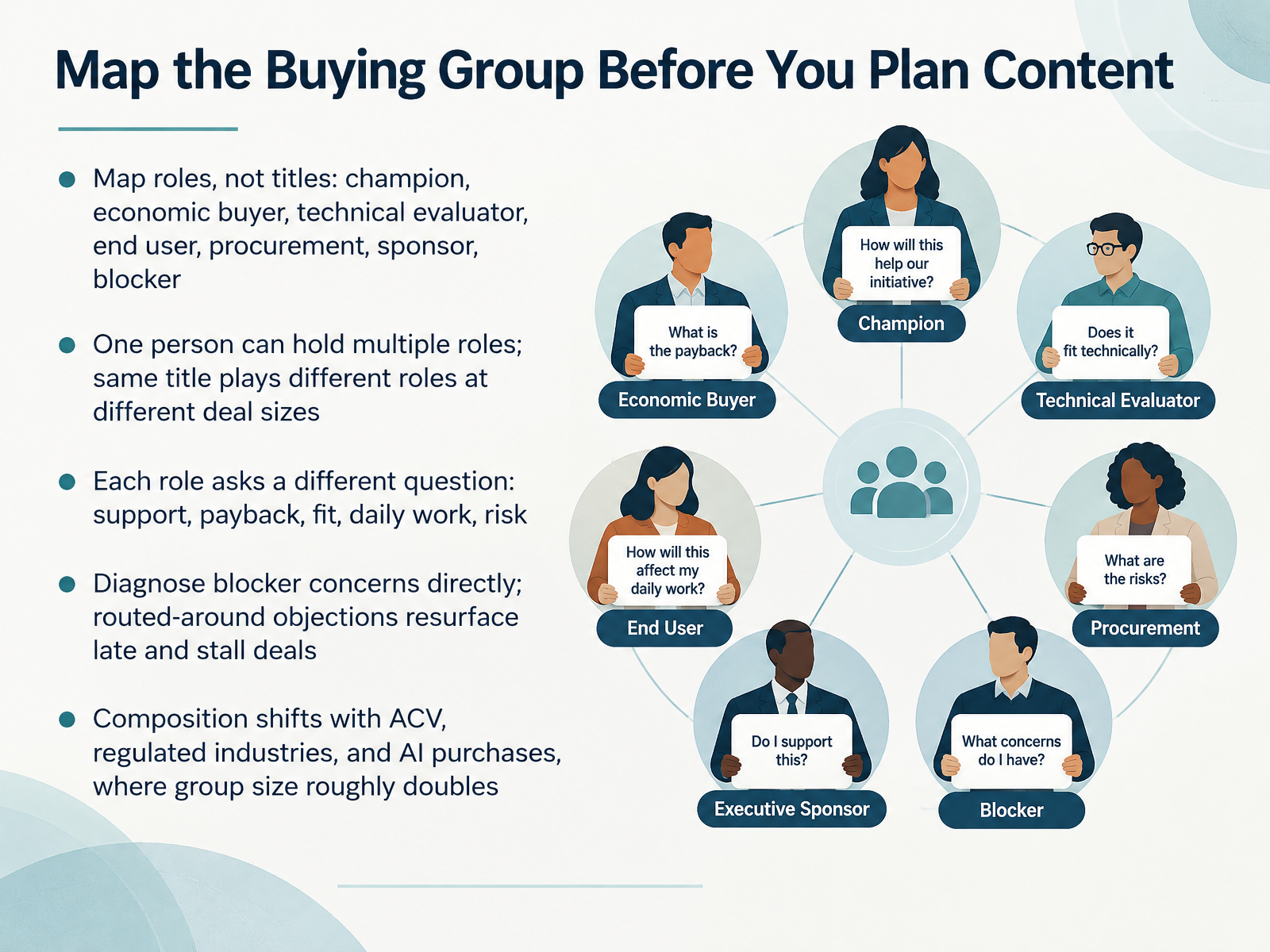
- 04Map the Buying Group Before You Plan ContentBefore you plan any content, map the buying group. And map roles, not titles. Think champion, economic buyer, technical evaluator, end user, procurement, sponsor, and blocker. Titles shift constantly. Roles don't. One person can hold several roles at once, and the same title plays a different role at different deal sizes. A director of operations might be your champion on a fifty thousand dollar deal and just an end user on a five hundred thousand dollar one. Each role asks a different question. The champion asks, how do I build support? The economic buyer asks, what's the payback? The evaluator asks, does this actually fit? The end user asks, will this make my day easier? Procurement asks, is this low risk? So diagnose blocker concerns directly. Objections you route around resurface late and stall deals. And remember, composition shifts with deal size and industry. In regulated sectors and AI purchases, the group roughly doubles. Build for the full group, not just the friendly contact. Design for consensus, not just for the champion.
 forrester.commadisonlogic.comchiefcontentmarketer.com+22 min
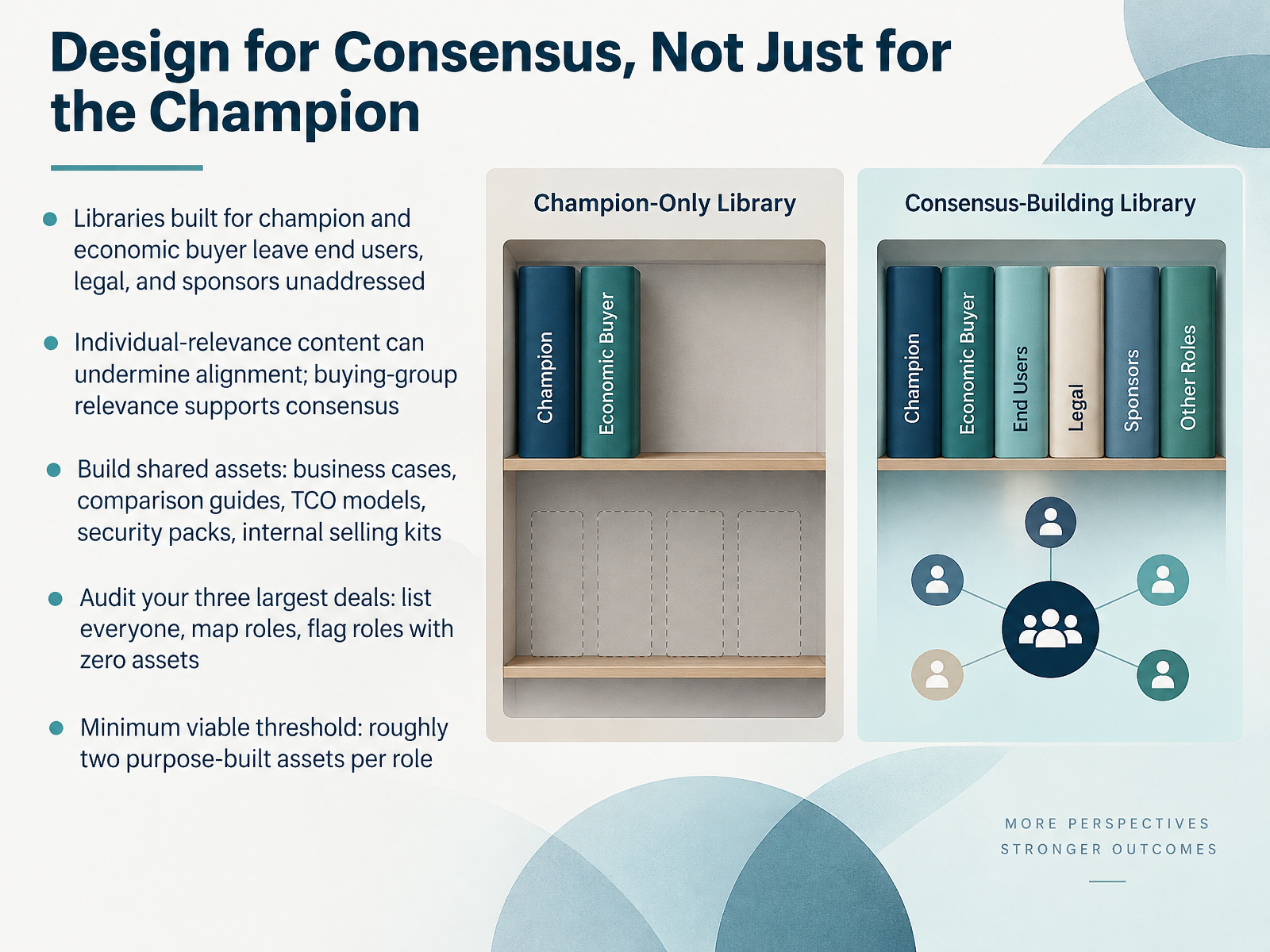
- 05Design for Consensus, Not Just for the ChampionNow let's talk about designing content for consensus, not just for the champion. Most libraries get built for the champion and the economic buyer. That leaves end users, legal, and executive sponsors unaddressed. And those are often the roles that stall a deal late. Here's a nuanced point. Content built for individual relevance can actually undermine alignment. Buying-group relevance supports consensus. Ask what the CFO needs to hear that helps them align with the champion, not just what they want to hear. So build shared assets. Business cases, comparison guides, total cost of ownership models, security packs, internal selling kits. Here's a practical audit. Take your three largest deals. List everyone involved, map each person to a role, and flag any role with zero assets. That gap is a pipeline risk. For a minimum viable threshold, aim for roughly two purpose-built assets per role. Let's move on to setting goals that ladder to pipeline and revenue.
 forrester.commadisonlogic.comchiefcontentmarketer.com+22 min
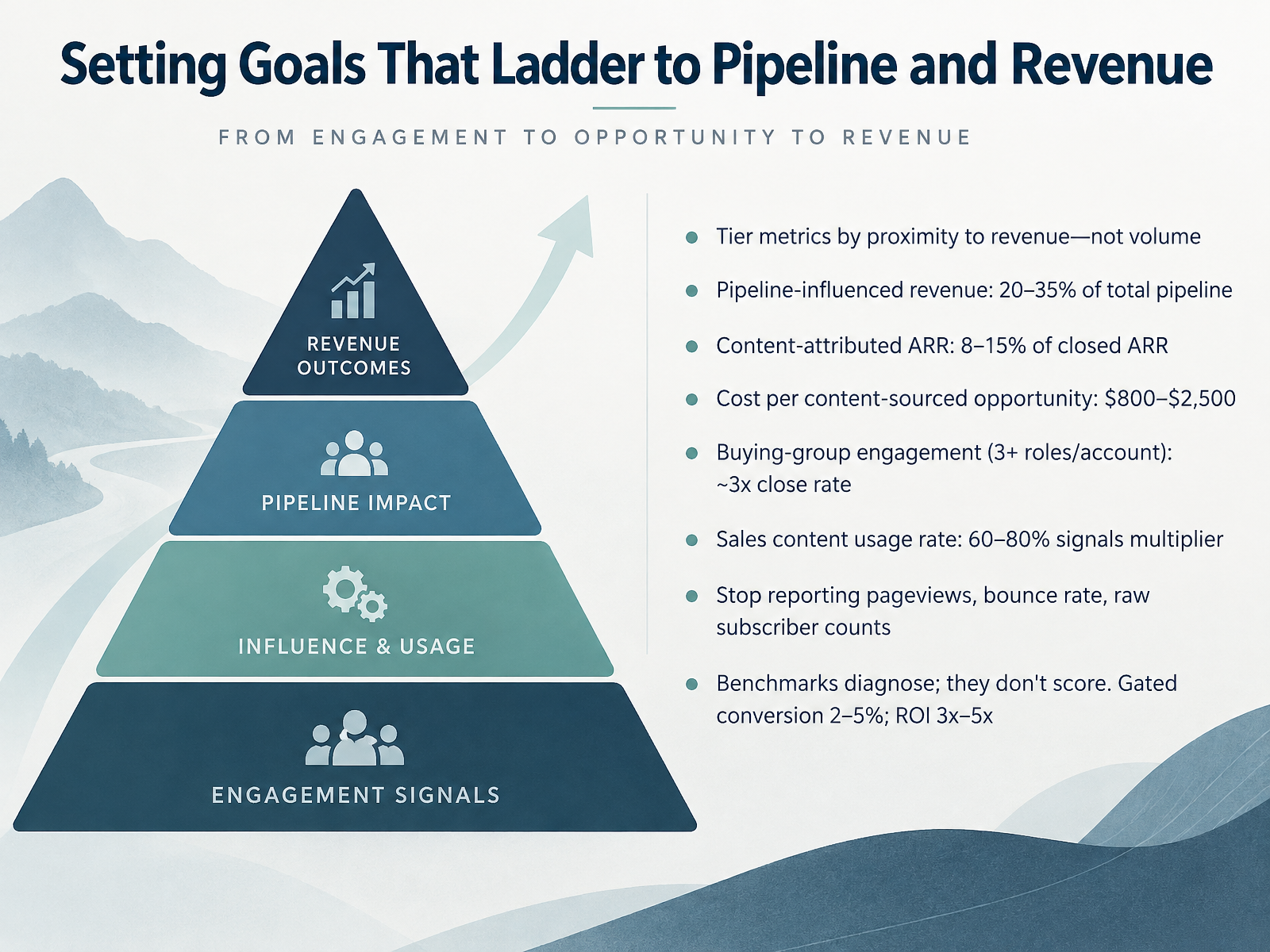
- 06Setting Goals That Ladder to Pipeline and RevenueNow let's talk about goals. The core principle here is simple: rank your metrics by how close they sit to revenue, not by volume. Start with three revenue-tier numbers. Pipeline-influenced revenue should land around twenty to thirty-five percent of total pipeline. Content-attributed A R R, a stricter measure, should run eight to fifteen percent of closed annual recurring revenue. And cost per content-sourced opportunity typically falls between eight hundred and twenty-five hundred dollars. Next, watch buying-group behavior. When three or more roles from the same account engage your content, close rates run roughly three times higher. That is a signal worth chasing. Sales content usage rate is the other lever. When sixty to eighty percent of reps actively use your content, you have a multiplier, not a cost center. So here is the practical tradeoff. Stop reporting pageviews, bounce rate, and raw subscriber counts. They feel safe, but they do not move budget conversations. Benchmarks diagnose, they do not score. Gated conversion of two to five percent and ROI of three to five times are reference points, not report cards. Pick the tier that most changes a conversation you are about to have, and build that metric this quarter. That naturally leads us into Choosing Formats, Channels, and Distribution Priorities.
 242630298.fs1.hubspotusercontent-na2.netsona.comb2bcontentos.com+22 min
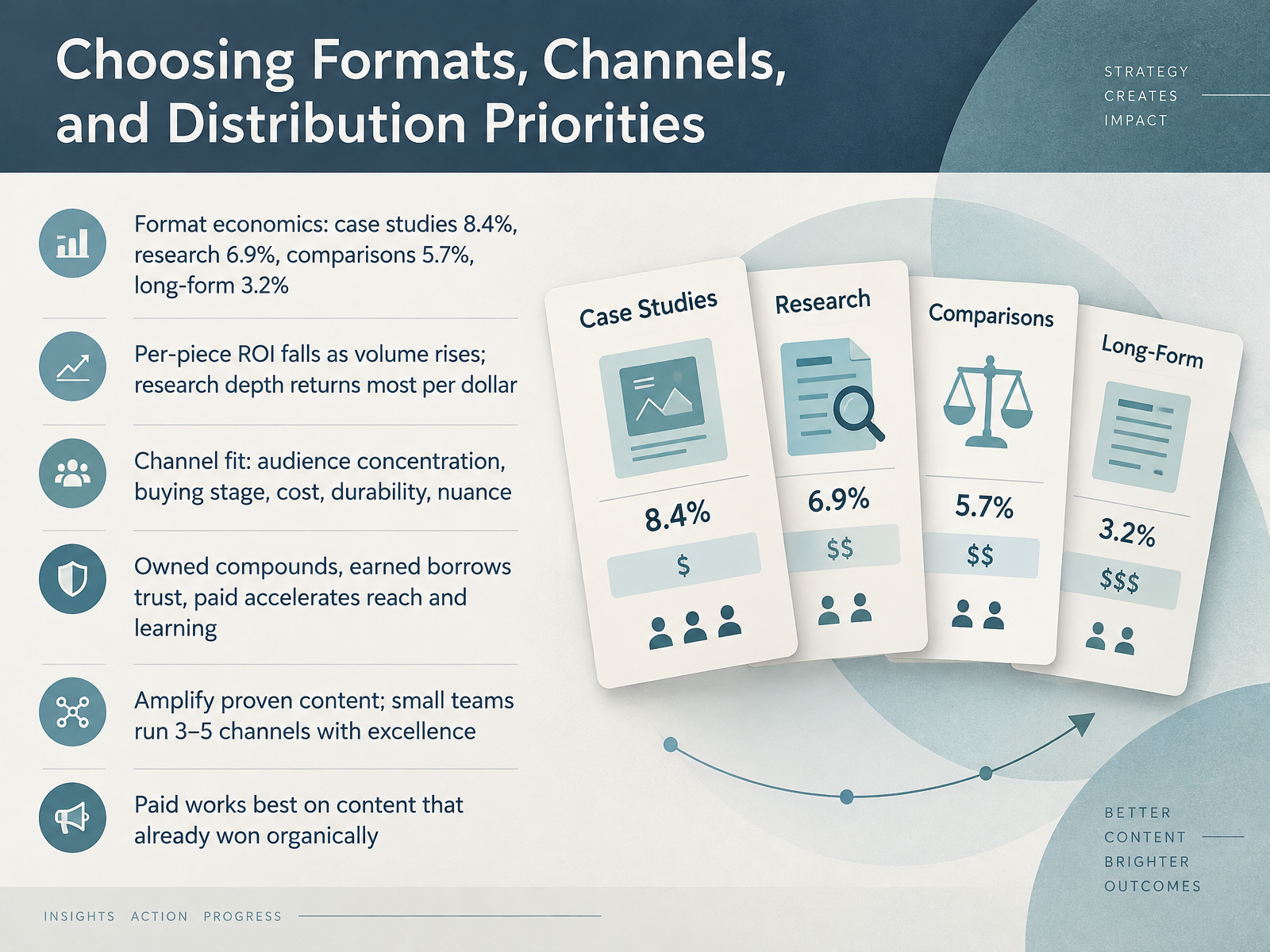
- 07Choosing Formats, Channels, and Distribution PrioritiesNow let's talk about formats, channels, and distribution priorities. Start with format economics. Case studies return 8.4 percent. Research, 6.9. Comparisons, 5.7. Long-form, 3.2. The pattern is clear: per-piece ROI falls as volume rises. Research depth returns the most per dollar. So invest where proof lives. Next, channel fit. Judge each channel on five things: audience concentration, buying stage, cost, durability, and nuance. Then know the roles. Owned compounds. Earned borrows trust. Paid accelerates reach and learning. A practical rule: amplify proven content. Small teams run three to five channels with excellence, not ten with mediocrity. And paid works best on content that already won organically. That sequencing protects your budget and your credibility. Next, the gated versus open decision, asset by asset.
 readsignal.ioethosengine.iocontentmarketinginstitute.com+21 min
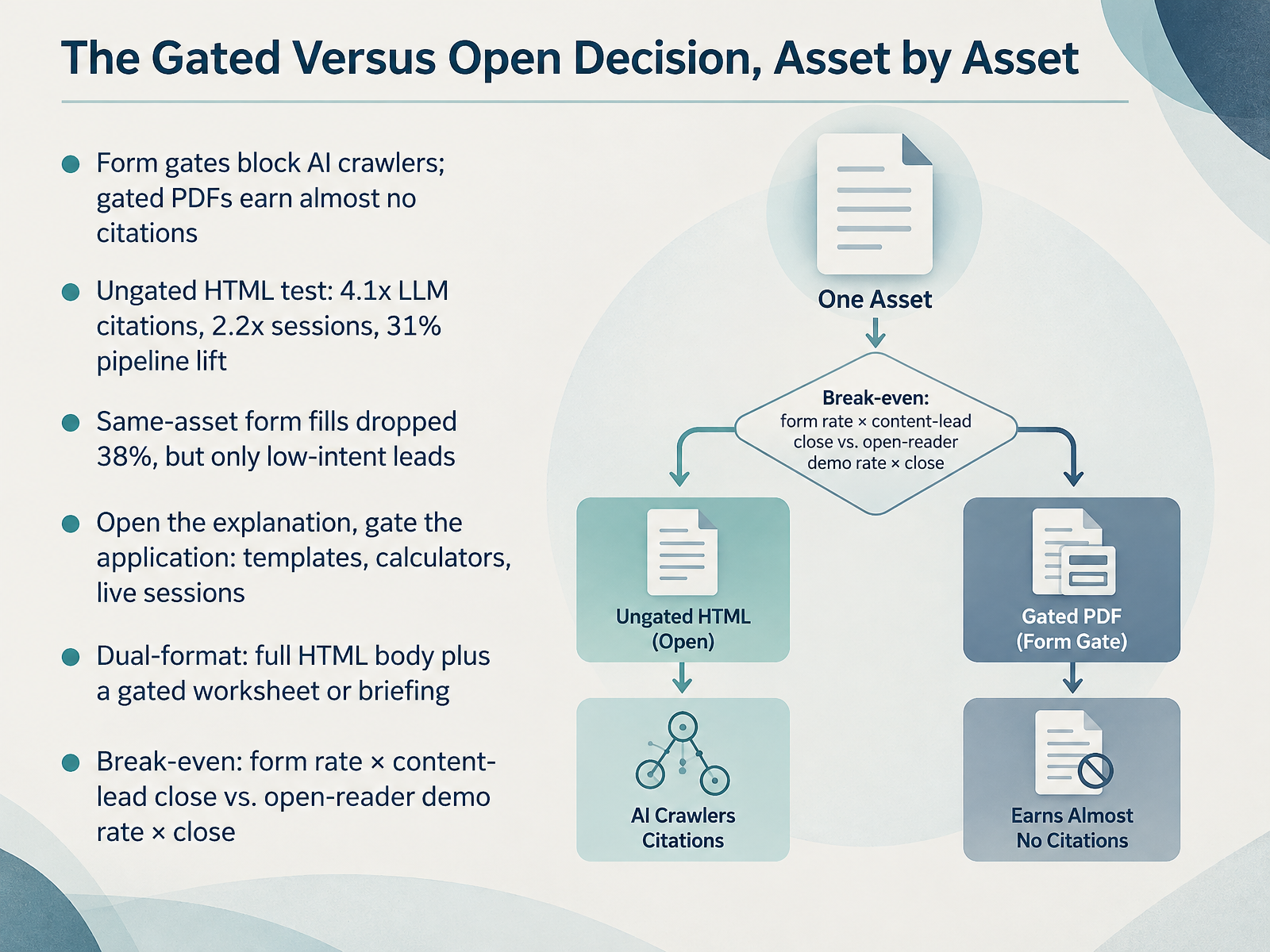
- 08The Gated Versus Open Decision, Asset by AssetNow let's make the gated versus open decision asset by asset. Here's the core tension. Form gates block AI crawlers. Gated PDFs earn almost no citations. In a two hundred page test, ungated HTML versions pulled four point one times the LLM citations, two point two times the sessions, and a thirty one percent pipeline lift. Same asset form fills dropped thirty eight percent. But those were mostly low intent leads, and downstream demo requests actually rose. So the practical rule is this. Open the explanation. Gate the application. Templates, calculators, and live sessions earn a form. How to guides and research findings do not. If you want both, run a dual format. Full HTML body for crawlers, plus a gated worksheet or briefing. Then check the math. Compare form rate times content lead close rate against open reader demo rate times demo close rate. Whichever side is larger tells you where the gate belongs, asset by asset. That sets up the next tension. Tradeoffs: Depth Versus Scale, Speed Versus Credibility.
 readsignal.ioethosengine.iocontentmarketinginstitute.com+22 min
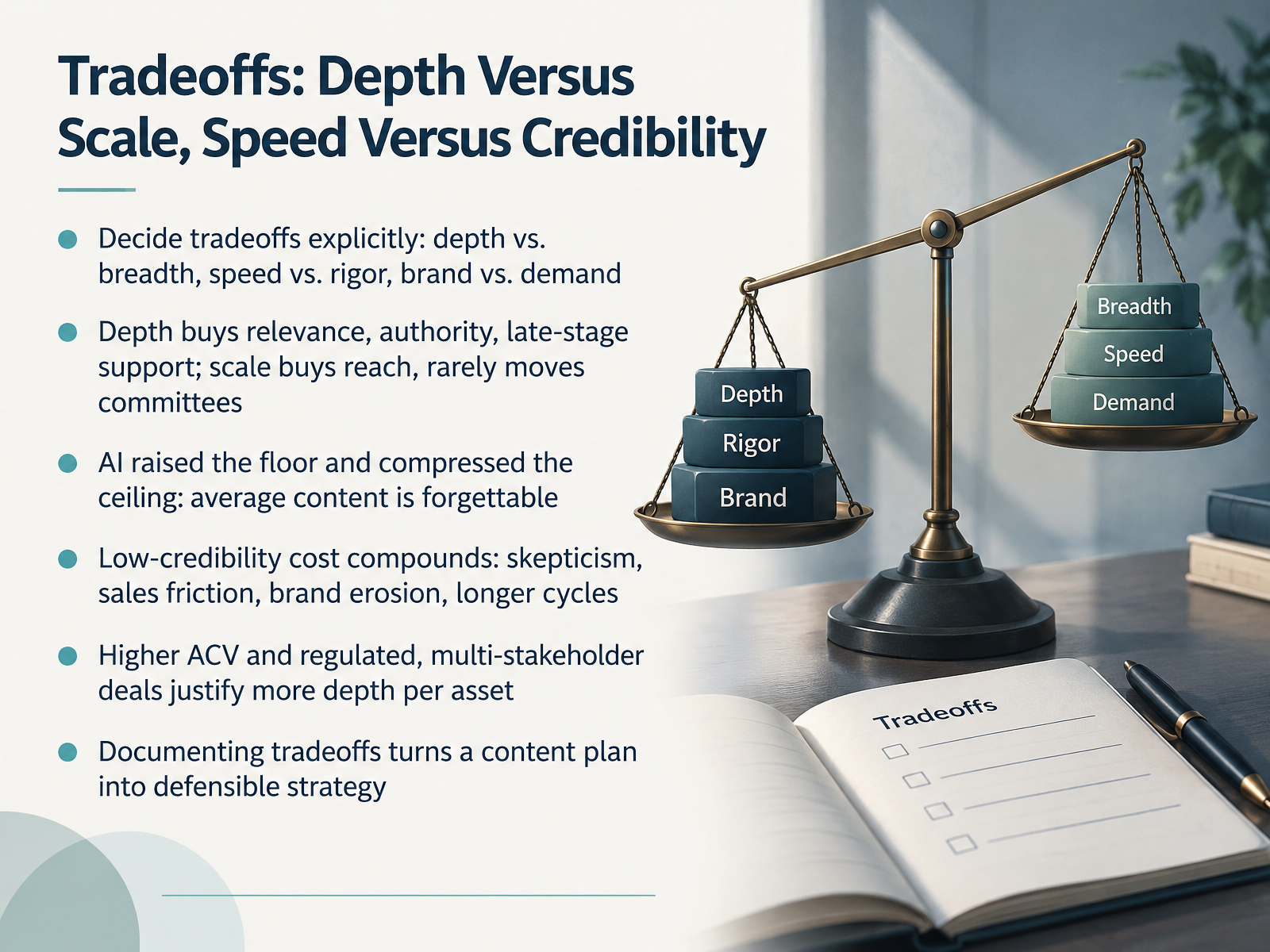
- 09Tradeoffs: Depth Versus Scale, Speed Versus CredibilityLet's make the tradeoffs explicit, because that is what separates a plan from a wish list. Depth versus scale. Speed versus rigor. Brand versus demand. You cannot maximize all of them, and pretending otherwise is how content plans lose credibility with leadership. Depth buys relevance, authority, and late-stage support for a buying committee. Scale buys reach, but reach rarely moves a committee. AI raised the floor and compressed the ceiling. Average content is clean, structured, and forgettable. And low credibility compounds. Skepticism grows, sales handoffs get harder, brand equity erodes, and cycles get longer. So calibrate to the deal. Higher contract values and regulated, multi-stakeholder deals justify more depth per asset. Lower-value, self-serve motions often do not. Here is the practical takeaway. Write your tradeoffs down and defend them. That turns a content plan into defensible strategy. Next, we move into content operations, governance, and AI guardrails.
 242630298.fs1.hubspotusercontent-na2.netsona.comb2bcontentos.com+21 min
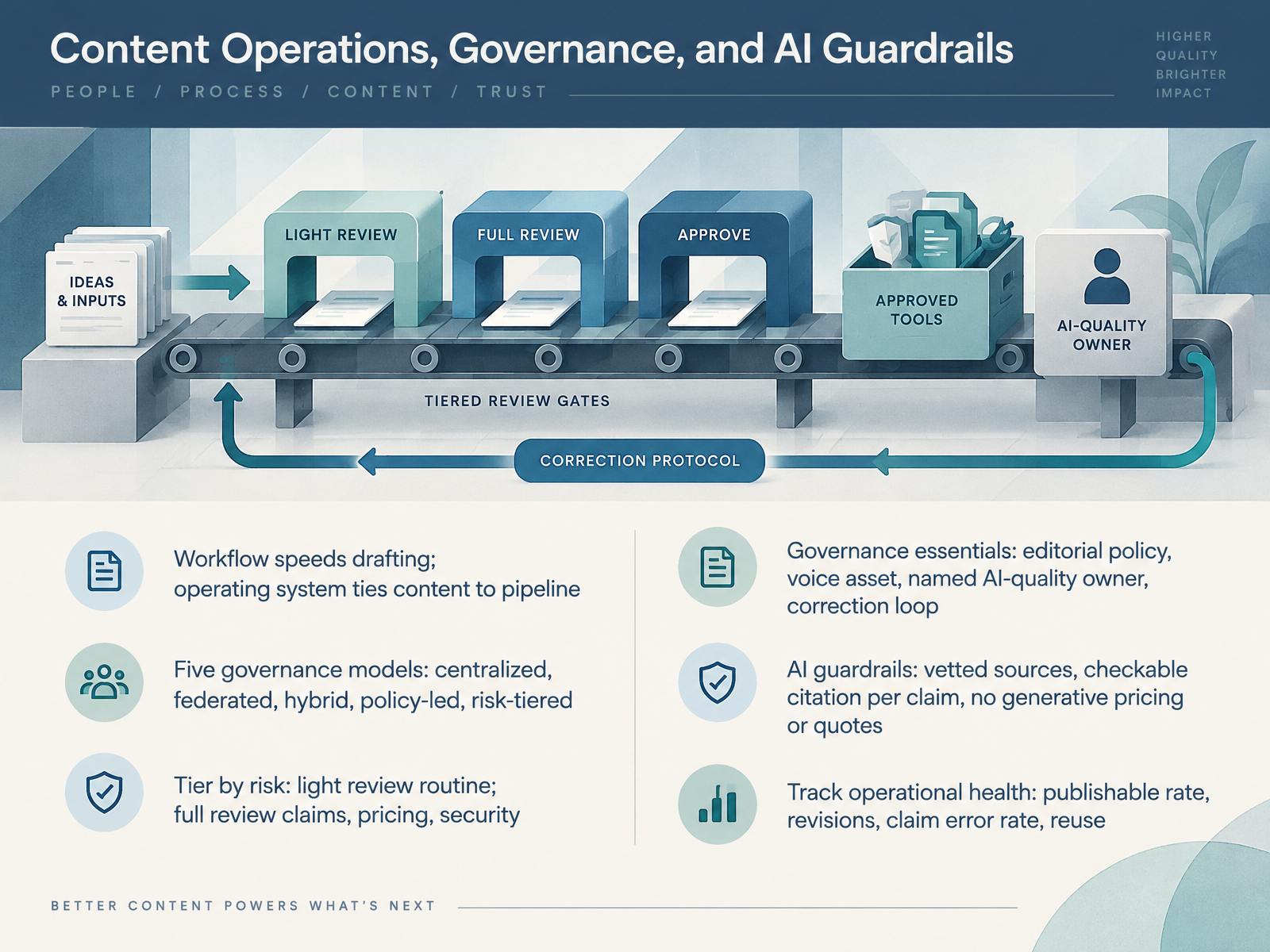
- 10Content Operations, Governance, and AI GuardrailsNow let's talk about the layer that makes all of this repeatable: content operations and governance. A workflow speeds up drafting. An operating system ties content to pipeline. The difference matters more than any tool you buy. When teams ask how to structure oversight, there are five common models: centralized, federated, hybrid, policy-led, and risk-tiered. The practical question isn't which sounds cleanest on paper. It's which matches how your business actually works. Most large teams land on hybrid or risk-tiered. Tier your reviews by risk. Routine content gets light review. Claims, pricing, and security content get full review. That's where a hallucinated number becomes a brand event. On governance essentials, get four things in place: an editorial policy, a codified voice asset, a named AI-quality owner, and a correction loop. For AI guardrails, restrict generation to vetted sources only. Every claim needs a checkable citation. And keep generative models away from pricing and customer quotes entirely. Inject real data at publish time. Finally, track operational health, not just volume: your publishable rate, revision cycles, claim error rate, and reuse. These are the numbers that tell you whether the system is actually getting better. Let's move on to measurement, experimentation, and proving impact.
 aprimo.comthestarrconspiracy.comfubyte.com+22 min
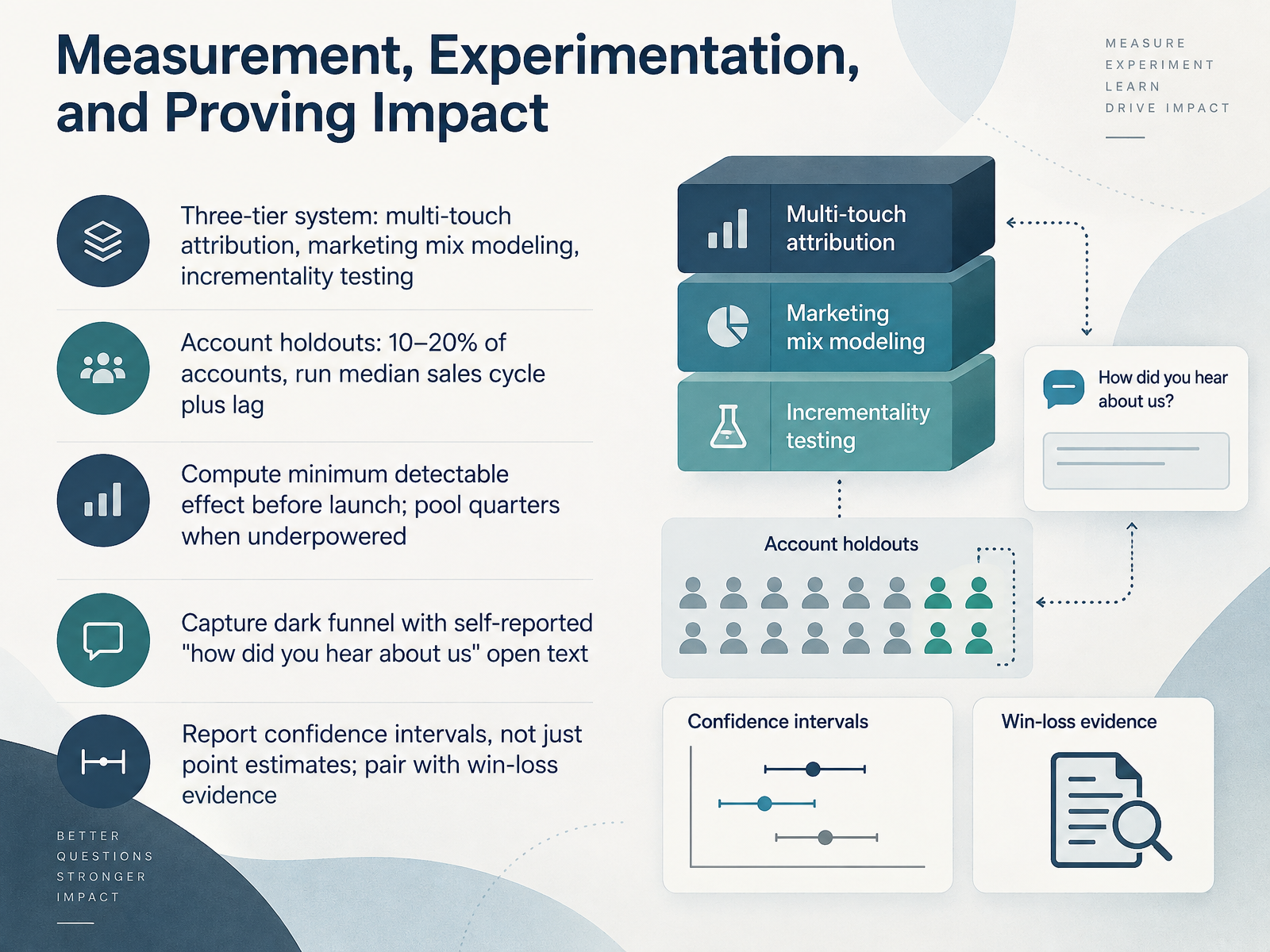
- 11Measurement, Experimentation, and Proving ImpactLet's talk about proving impact, because this is where content programs either earn trust or lose budget. Start with a three tier system. Multi-touch attribution shows where content surfaced. Marketing mix modeling shows whether total content investment moves with pipeline over time. Incrementality testing asks the harder question: what would not have happened without the content? Run account holdouts on ten to twenty percent of accounts, and let them run your median sales cycle plus reporting lag. Before launch, compute your minimum detectable effect. If one quarter is underpowered, pool two quarters. Capture the dark funnel with one open text question at demo or contract: how did you hear about us? Then report confidence intervals, not just point estimates, and pair the numbers with win loss evidence. The takeaway is simple. Attribution alone cannot defend a budget. Experiments can. Next, we put this framework into practice with scenarios and decision exercises.
 242630298.fs1.hubspotusercontent-na2.netsona.comb2bcontentos.com+22 min
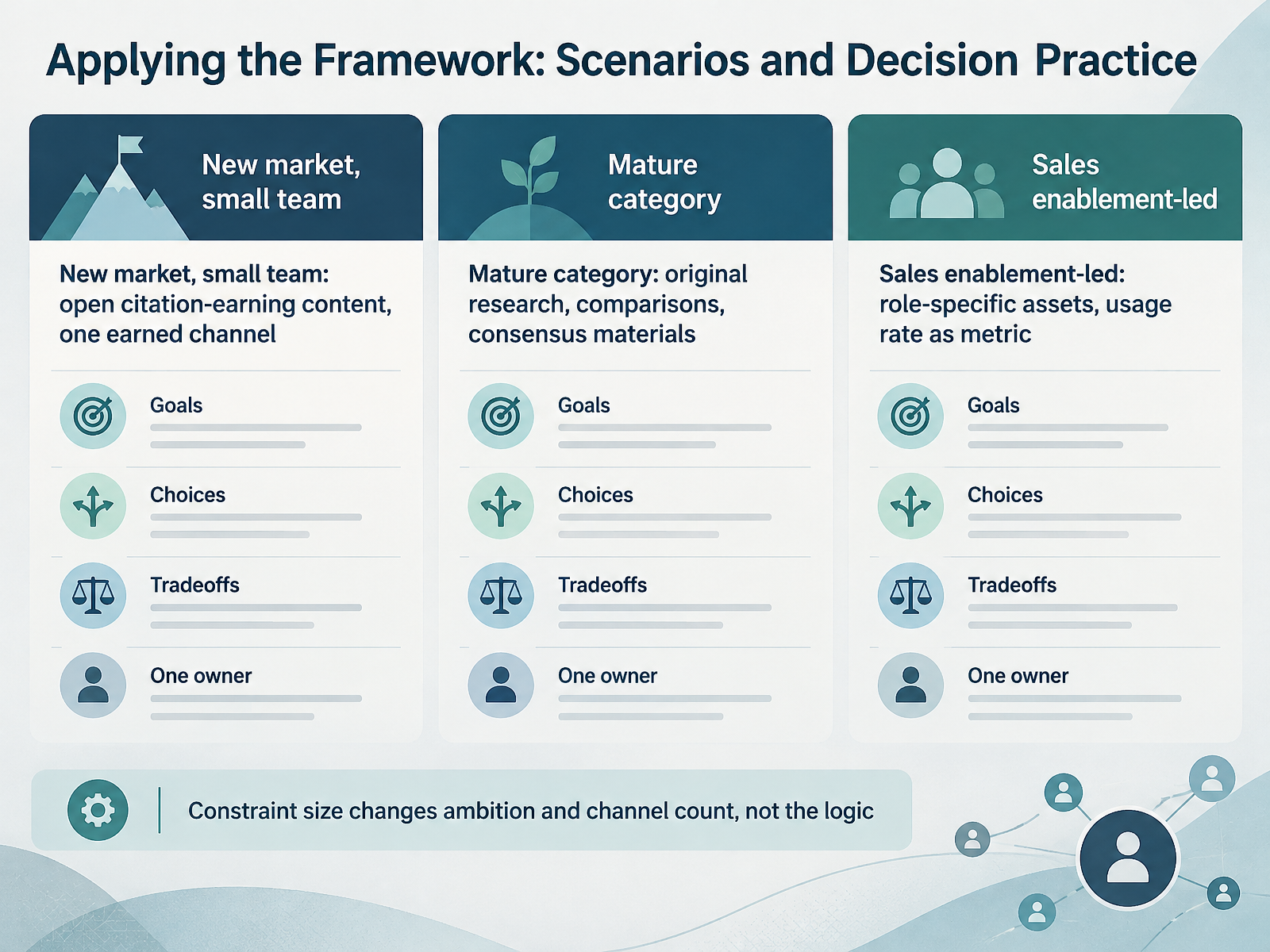
- 12Applying the Framework: Scenarios and Decision PracticeLet's put the framework to work. You won't apply it the same way in every situation. Start with a new market and a small team. Your best move is open, citation-earning content, paired with one earned channel. You're building credibility before you build reach. In a mature category, the game changes. Buyers already know the players, so original research, comparison guides, and consensus materials help you stand out and reduce perceived risk. Then there's the sales enablement-led scenario, which is common in complex, multi-stakeholder deals. Here, role-specific assets matter most, and your key metric is usage rate. If reps aren't using it, it isn't working. Now, the decision practice itself comes down to five things: goals, choices, tradeoffs, proof standard, and one owner. And the constraint principle ties it together. A smaller budget or a leaner team changes your ambition and your channel count, not the underlying logic. The thinking stays the same. Next, we turn strategy into action. From strategy to a ninety-day content roadmap.
 aprimo.comthestarrconspiracy.comfubyte.com+22 min
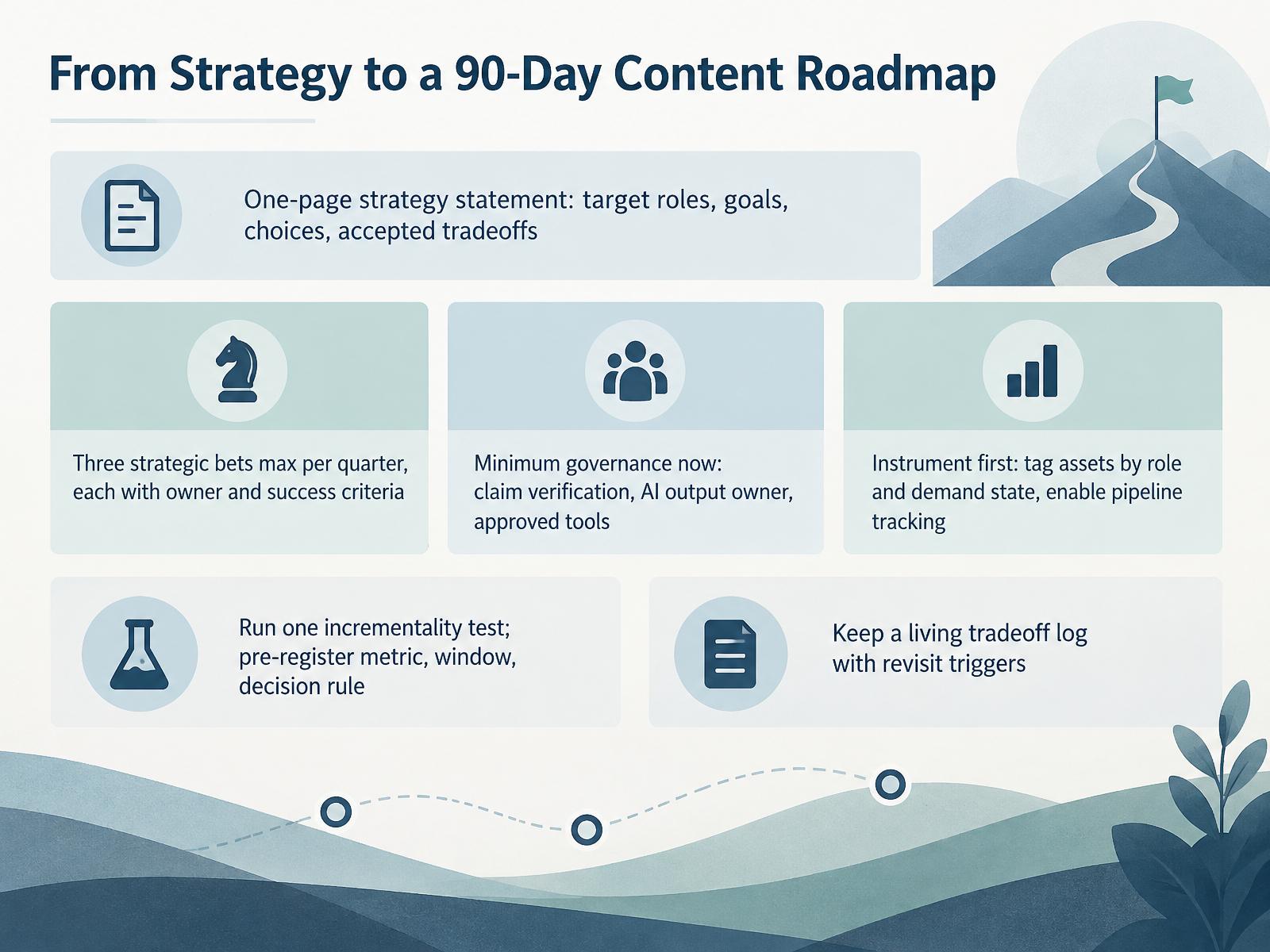
- 13From Strategy to a 90-Day Content RoadmapLet's close by turning strategy into a ninety-day roadmap you can actually run. Start with a one-page strategy statement. Name your target roles, your goals, your choices, and the tradeoffs you've accepted. That page ends a lot of repeat debates. Next, limit yourself to three strategic bets per quarter. Each one needs a single owner and clear success criteria, so progress is visible and accountability stays clean. Then put minimum governance in place now: claim verification, a named owner for AI output, and a short list of approved tools. Keep it simple enough to enforce through workflow, not just policy. Instrument before you scale. Tag every asset by role and demand state, and enable pipeline tracking in your CRM. Otherwise you're publishing, not operating. Run one incrementality test this quarter. Pre-register the metric, the time window, and the decision rule before you start. And keep a living tradeoff log with revisit triggers, so choices get reopened deliberately, not by accident. That's the whole arc: goals, choices, tradeoffs, and evidence. Thank you for working through this with me, and go build the version that fits your team.
 aprimo.comthestarrconspiracy.comfubyte.com+22 min
Take the deck with you
Download this course as a file — free, no sign-up needed.
- PDF handoutEvery slide page, ready to print or share.14 pages · 3.5 MBDownload
- Narrated PowerPointThe deck that presents itself — every slide carries the digital human's narration video.14 pages · 13.4 MBDownload
- PowerPoint slidesThe full deck as a .pptx — open it in PowerPoint, Keynote, or Google Slides.14 pages · 3.4 MBDownload
Free to use in your own training — please keep the PersonWise credit page at the end.
Have your own deck? Turn it into a course
Sources consulted
Web sources consulted while building this course.
- From Confidence to Capability — 242630298.fs1.hubspotusercontent-na2.net
- Content Marketing Benchmarks: What They Are, Why They Matter, and How to Use Them — Sona — sona.com
- B2B Content Marketing KPIs: What to Track in 2026 — b2bcontentos.com
- B2B Content Marketing ROI in 2026: What Actually Generates Leads (Data From 312 Companies) - V12 AI — v12.ai
- B2B content marketing and pipeline generation benchmarks 2026 — research.mental-momentum.ai
- Get To Know Your B2B Buying Group — forrester.com
- Buying Group Content Engagement Guide — madisonlogic.com
- The Buying Committee Content Playbook: How to Engineer Content That Accelerates Consensus - Chief Content Marketer — chiefcontentmarketer.com
- How do you deliver lifecycle content based on buying group roles? — pedowitzgroup.com
- Buying Group Marketing: How to Reach Every Member — contactlevel.com
- Forbes Contributor for AEO: 6-Month Data on Citations, ROI, and the Hidden Tax | Signal — readsignal.io
- Gate the guide or leave it open? A break-even test for lead magnets · Ethos Engine — ethosengine.io
- Buyers Want To Trust Content. But Do They Value Yours? ... — contentmarketinginstitute.com
- Gated vs Ungated Content in B2B: A Decision Rule | COSEOM® — coseom.com
- TrustRadius 2026 B2B Buying Disconnect Report Reveals AI Has Changed How Buyers Research, But Not What They Trust — streetinsider.com
- AI Governance Models for Enterprise Content Operations | Aprimo — aprimo.com
- AI-Augmented B2B Content Operations, A Practitioner View — thestarrconspiracy.com
- AI Content Operations and Governance for B2B in 2026:… | FUBYTE — fubyte.com
- How AI is Redefining Enterprise Content Operations — optimizely.com
- Enterprise content operations in the AI era — sitecore.com