Begin
14 pages · ~28 min
Chemical Formulas and Compound Naming
Learn to write and interpret chemical formulas and name ionic and covalent compounds using systematic IUPAC rules. Ideal for introductory chemistry students.
A digital instructor presents all 14 pages. Hold “Ask” at any point and ask out loud — the answer comes from this course. No sign-up needed.
What you’ll learn
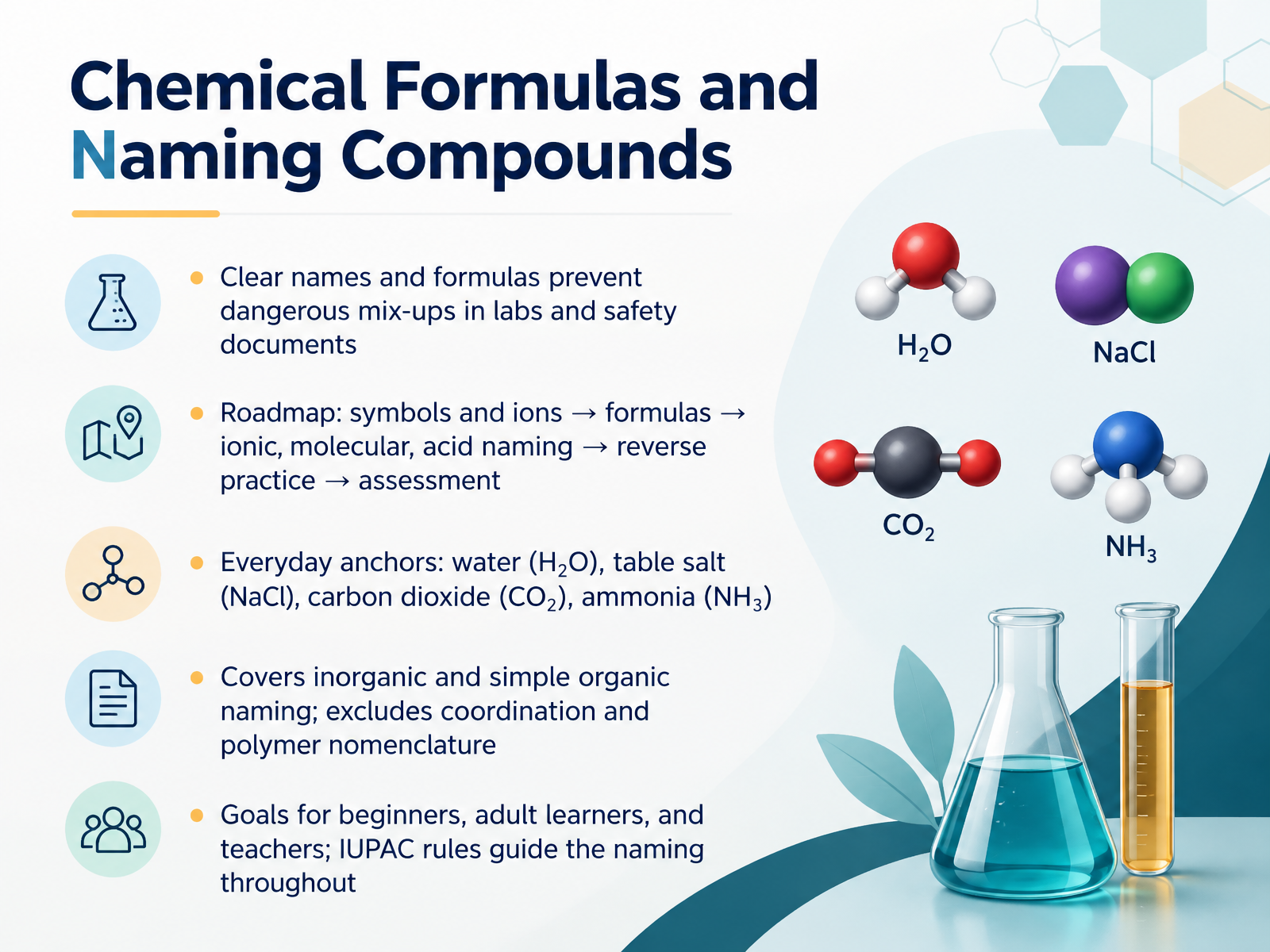
- 01Chemical Formulas and Naming CompoundsWelcome. This course is called Chemical Formulas and Naming Compounds. In plain terms, we will learn how chemists write formulas and how they give compounds clear, standard names. And this matters. Clear names and formulas prevent dangerous mix-ups in labs and in safety documents. Here is our roadmap. First, we cover symbols and ions. Next, we build formulas. Then we name ionic compounds, molecular compounds, and acids. After that, we practice in reverse, from name to formula. Finally, we finish with a short assessment. We will use everyday anchors you already know. Water is H two O. Table salt is N a C l. Carbon dioxide is C O two. And ammonia is N H three. This course covers inorganic naming and simple organic naming. It does not cover coordination compounds or polymer nomenclature. The goals are set for beginners, for adult learners, and for teachers. Throughout, the IUPAC rules guide the naming. So by the end, you will read a formula and say its name, and hear a name and write its formula. Let's begin with the building blocks. Next, we look at elements, symbols, and the periodic table.2 min
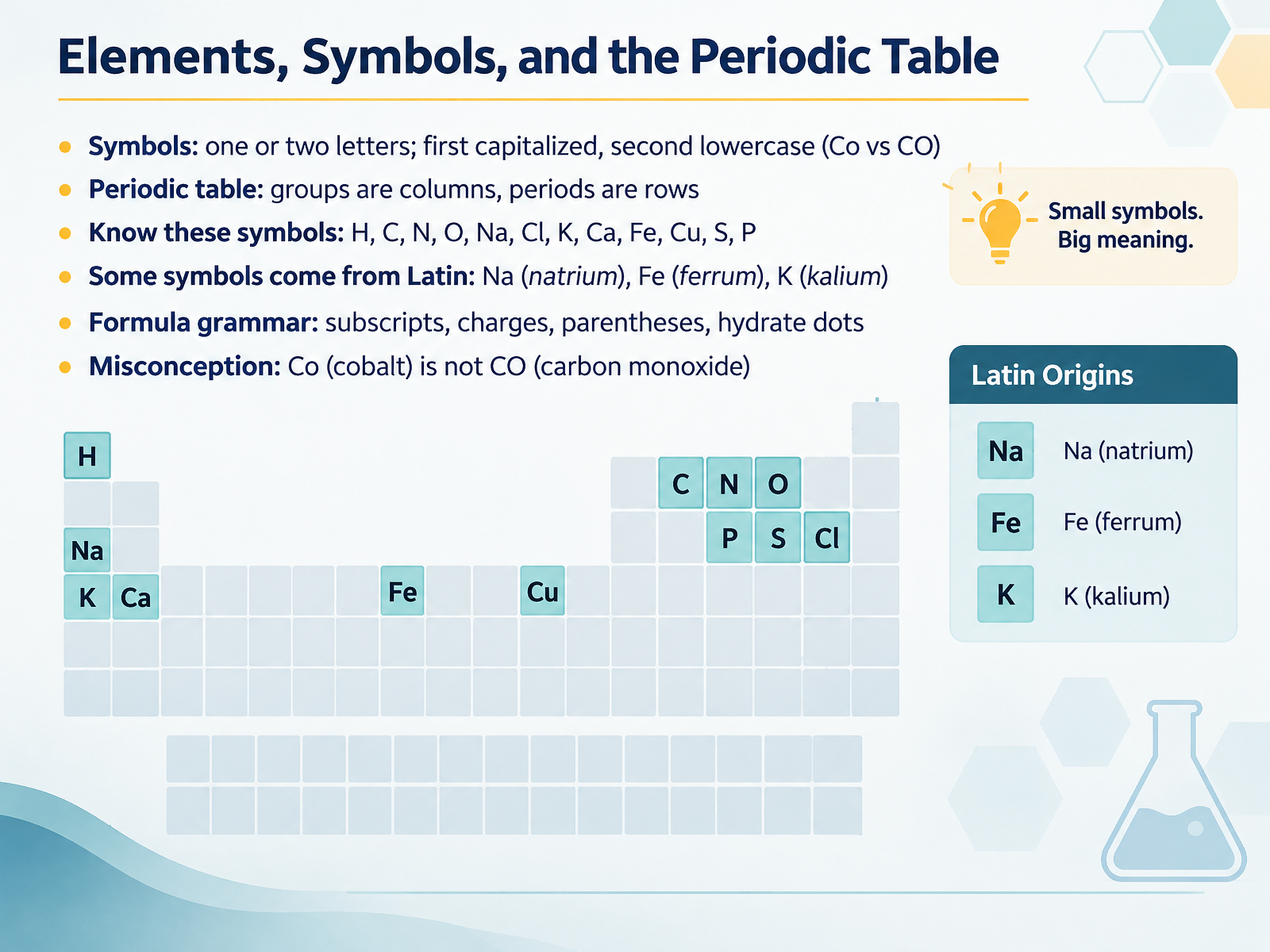
- 02Elements, Symbols, and the Periodic TableLet's move on to elements and their symbols. A chemical symbol is a short code for an element. It has one or two letters. The first letter is always capitalized, and the second letter, if there is one, is always lowercase. Now think about the periodic table. Groups are the columns, and periods are the rows. In this course you should know these symbols: H, C, N, O, Na, Cl, K, Ca, Fe, Cu, S, and P. Some symbols come from Latin names. For example, Na comes from natrium, Fe from ferrum, and K from kalium. Next, formula grammar. When you read a chemical formula, pay attention to subscripts, charges, parentheses, and hydrate dots. Here is a common point of confusion. Co with a capital C and lowercase o means cobalt, which is one element. But CO, with both letters capitalized, means carbon monoxide, which is a compound. The capital and lowercase letters matter. Next, we will look at ions and charges, the building blocks of ionic formulas.
 2 min
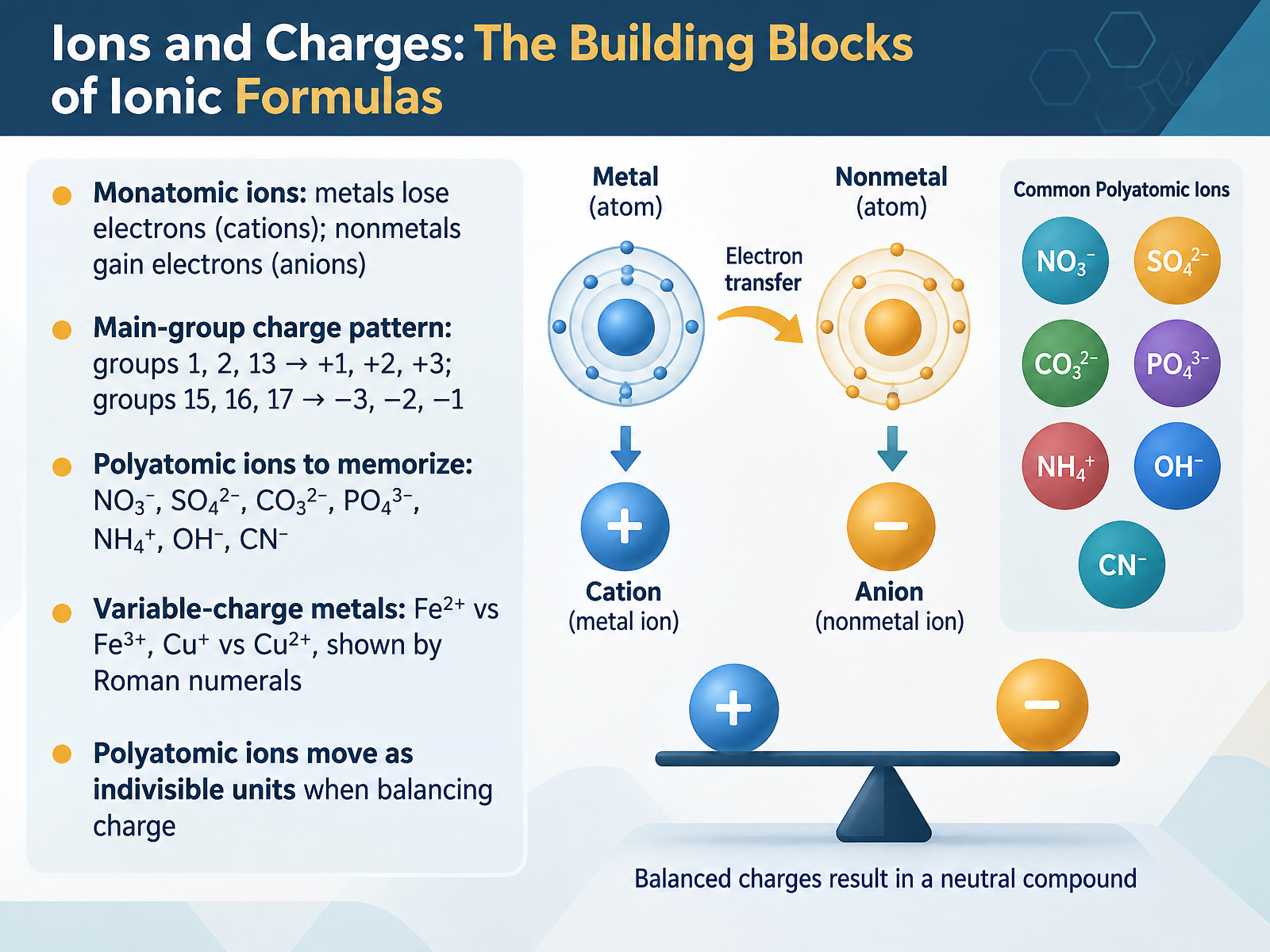
- 03Ions and Charges: The Building Blocks of Ionic FormulasNow let's look at ions and charges, the building blocks of ionic formulas. A monatomic ion is a single atom that has gained or lost electrons. Metals tend to lose electrons and become positive ions, called cations. Nonmetals tend to gain electrons and become negative ions, called anions. For main-group elements, the charge follows a simple pattern. Groups one, two, and thirteen form plus one, plus two, and plus three cations. Groups fifteen, sixteen, and seventeen form minus three, minus two, and minus one anions. Some polyatomic ions are worth memorizing: nitrate, sulfate, carbonate, phosphate, ammonium, hydroxide, and cyanide. Polyatomic ions are groups of atoms that stay together as one unit. Some metals have variable charges, such as iron two plus versus iron three plus, and copper one plus versus copper two plus. Roman numerals in the name show which charge is present. When balancing charge, treat each polyatomic ion as an indivisible unit. Next, we will move on to writing and reading chemical formulas.
 2 min
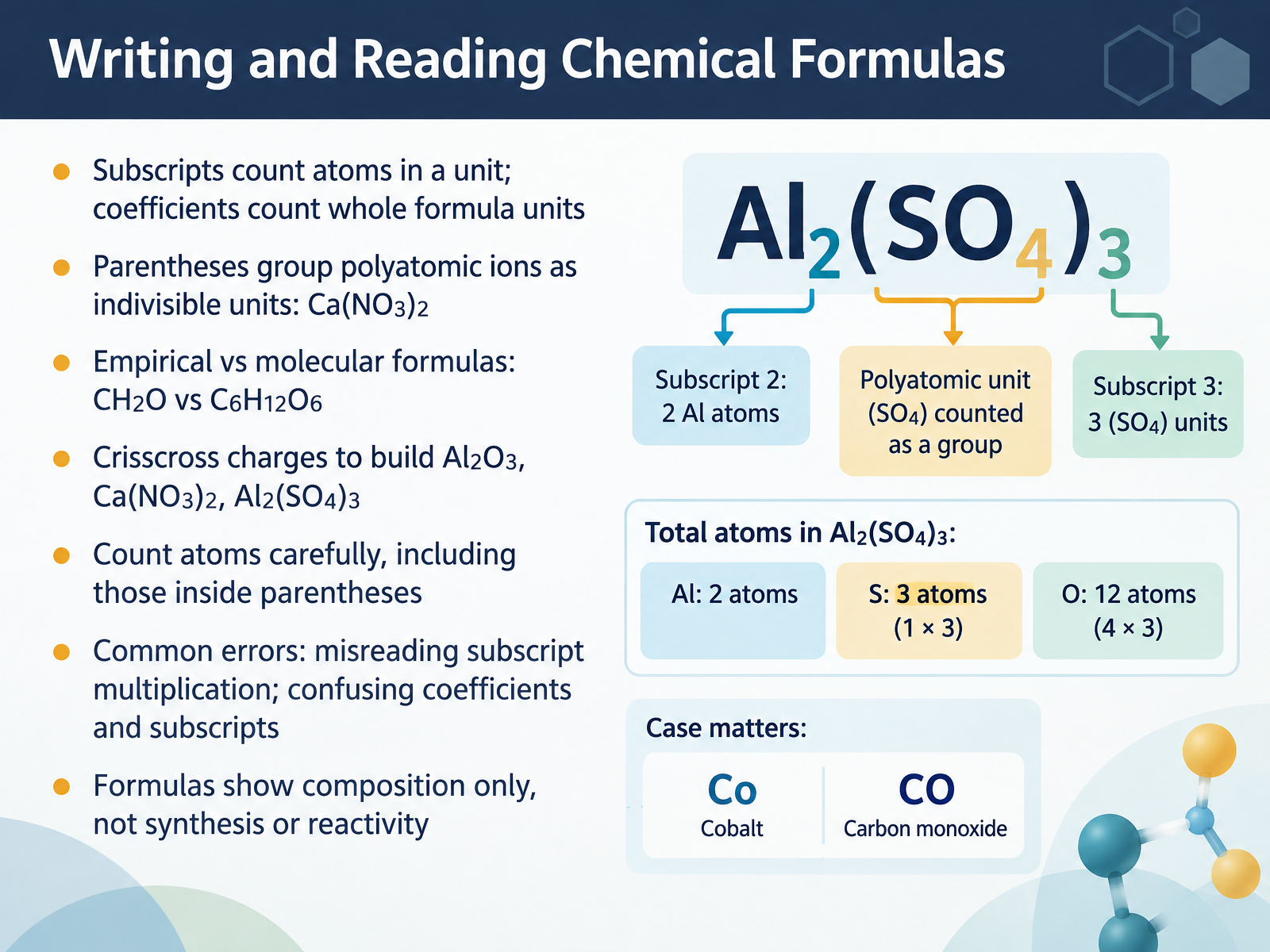
- 04Writing and Reading Chemical FormulasNow let's focus on writing and reading chemical formulas. A subscript counts atoms within one unit, while a coefficient counts whole formula units. Parentheses group polyatomic ions as indivisible units, as in calcium nitrate, written C a, open parenthesis, N O three, close parenthesis, subscript two. An empirical formula shows the simplest ratio, like C H two O. A molecular formula shows the actual number, like C six H twelve O six. To build a formula, crisscross the ion charges. For example, aluminum oxide becomes A l two O three. Calcium nitrate becomes C a, open parenthesis, N O three, close parenthesis, subscript two. Aluminum sulfate becomes A l two, open parenthesis, S O four, close parenthesis, subscript three. When counting atoms, do not forget the atoms inside parentheses. A common mistake is misreading subscript multiplication. Another is confusing coefficients with subscripts. Remember, formulas show composition only, not how a substance is made or how it reacts. Next, we will look at naming ionic compounds.
 1 min
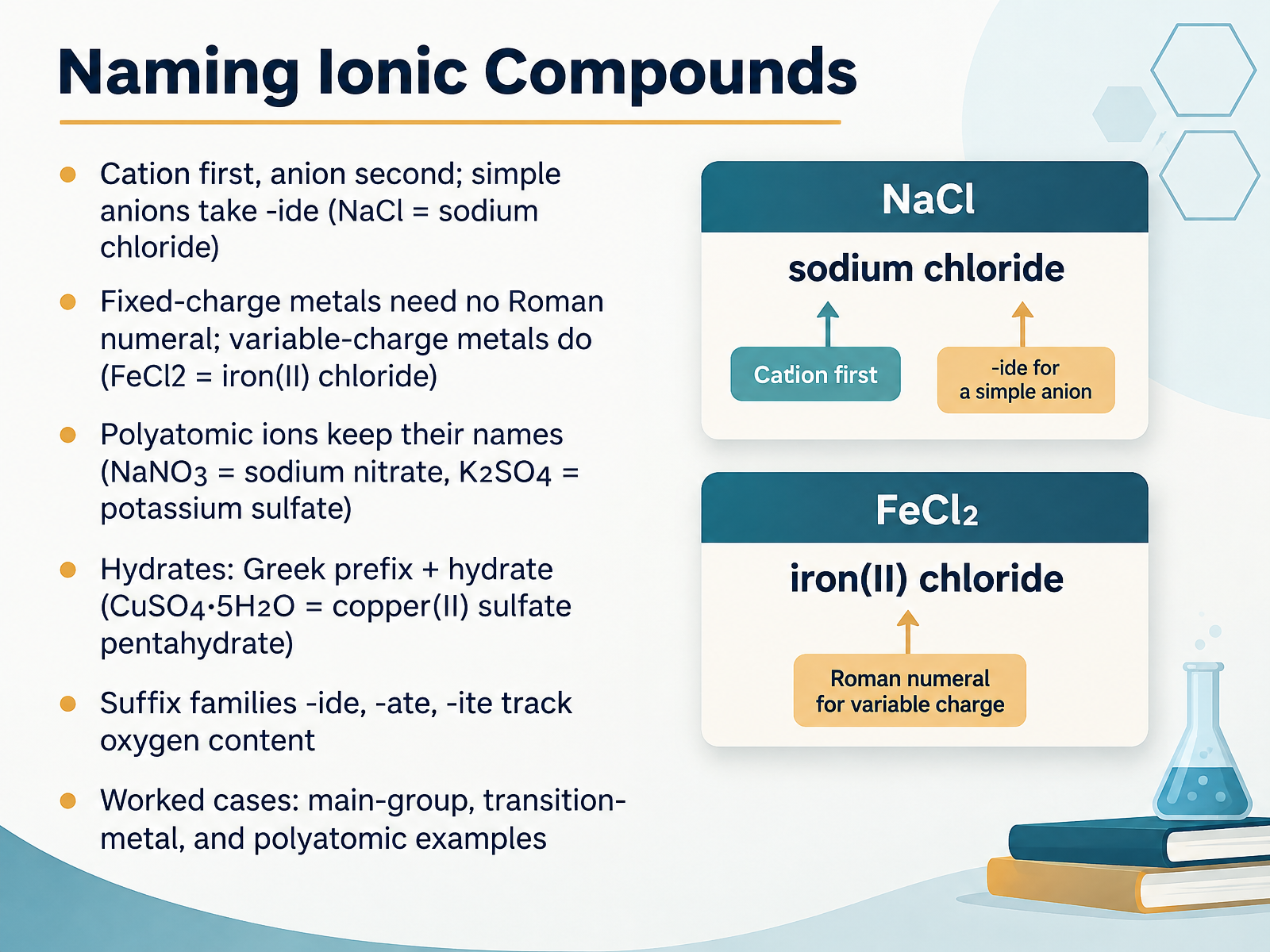
- 05Naming Ionic CompoundsNow let's turn to naming ionic compounds. The rule is simple. Say the cation first, then the anion. A simple anion takes the suffix ide, so N a C l is sodium chloride. Metals with a fixed charge need no Roman numeral. But metals with a variable charge do. For example, F e C l 2 is iron two chloride, written iron with a Roman numeral two. Polyatomic ions keep their names. N a N O 3 is sodium nitrate. K 2 S O 4 is potassium sulfate. For hydrates, add a Greek prefix plus hydrate. C u S O 4 dot five H 2 O is copper two sulfate pentahydrate. Remember the suffix families. Ide, ate, and ite track oxygen content. Let's work through three cases. A main group example is calcium chloride. A transition metal example is copper two oxide. A polyatomic example is sodium nitrate. That gives you a reliable path for ionic names. Next, we will look at naming molecular compounds.
 2 min
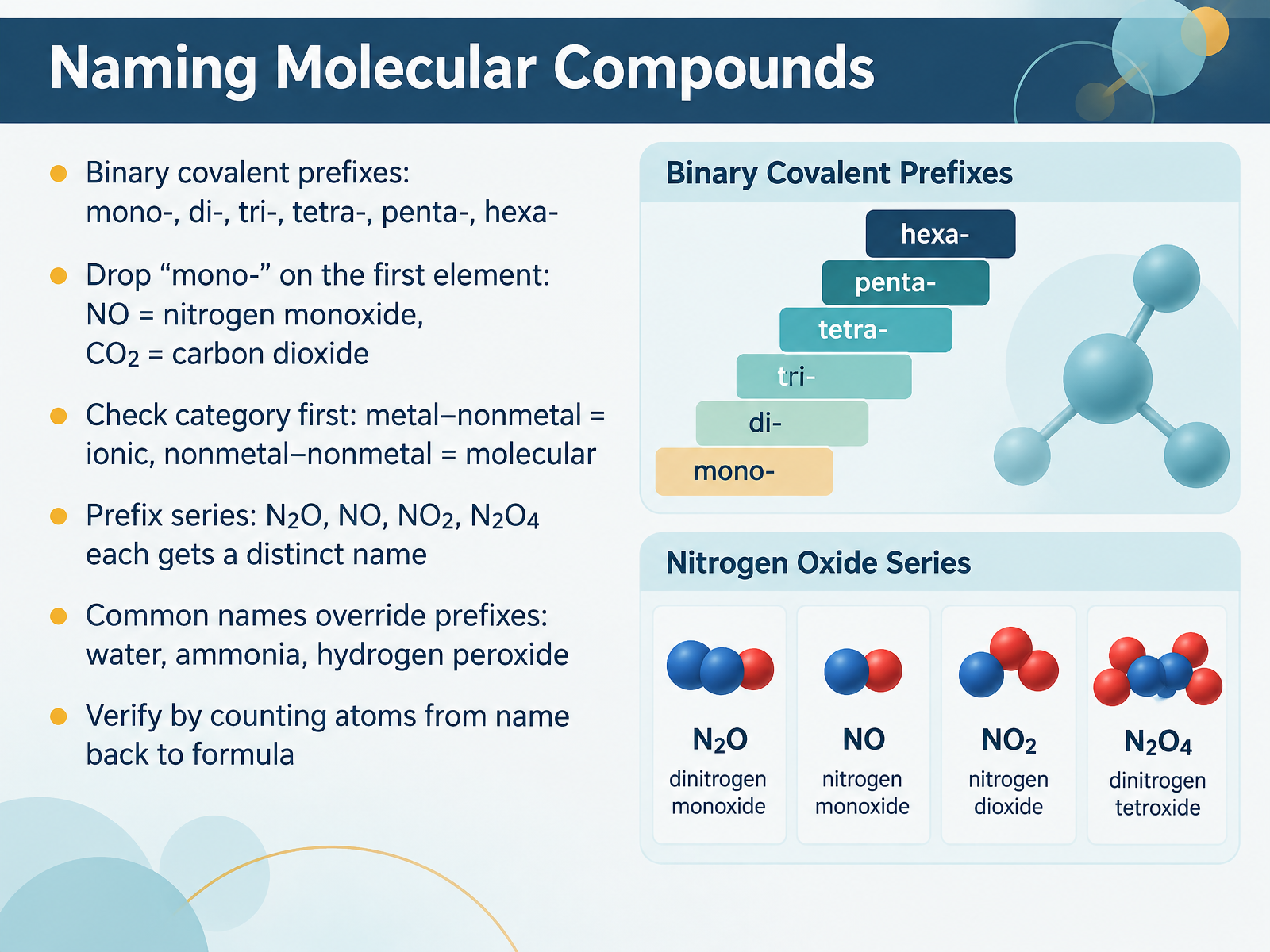
- 06Naming Molecular CompoundsNow let's name molecular compounds. These are made of two nonmetals, and we use prefixes to count atoms. The prefixes are mono, meaning one; di, two; tri, three; tetra, four; penta, five; and hexa, six. One rule to remember: drop mono on the first element. So nitrogen monoxide is written N O, and carbon dioxide is written C O two. Before naming anything, check the category first. A metal plus a nonmetal is ionic. A nonmetal plus a nonmetal is molecular. Try this prefix series: N two O, N O, N O two, and N two O four. Each one gets a distinct name because the prefixes change. A few common names override the prefixes: water, ammonia, and hydrogen peroxide. Finally, verify your name by counting atoms from the name back to the formula. That habit catches most mistakes. Next, we move on to acids, bases, and special naming cases.
 2 min
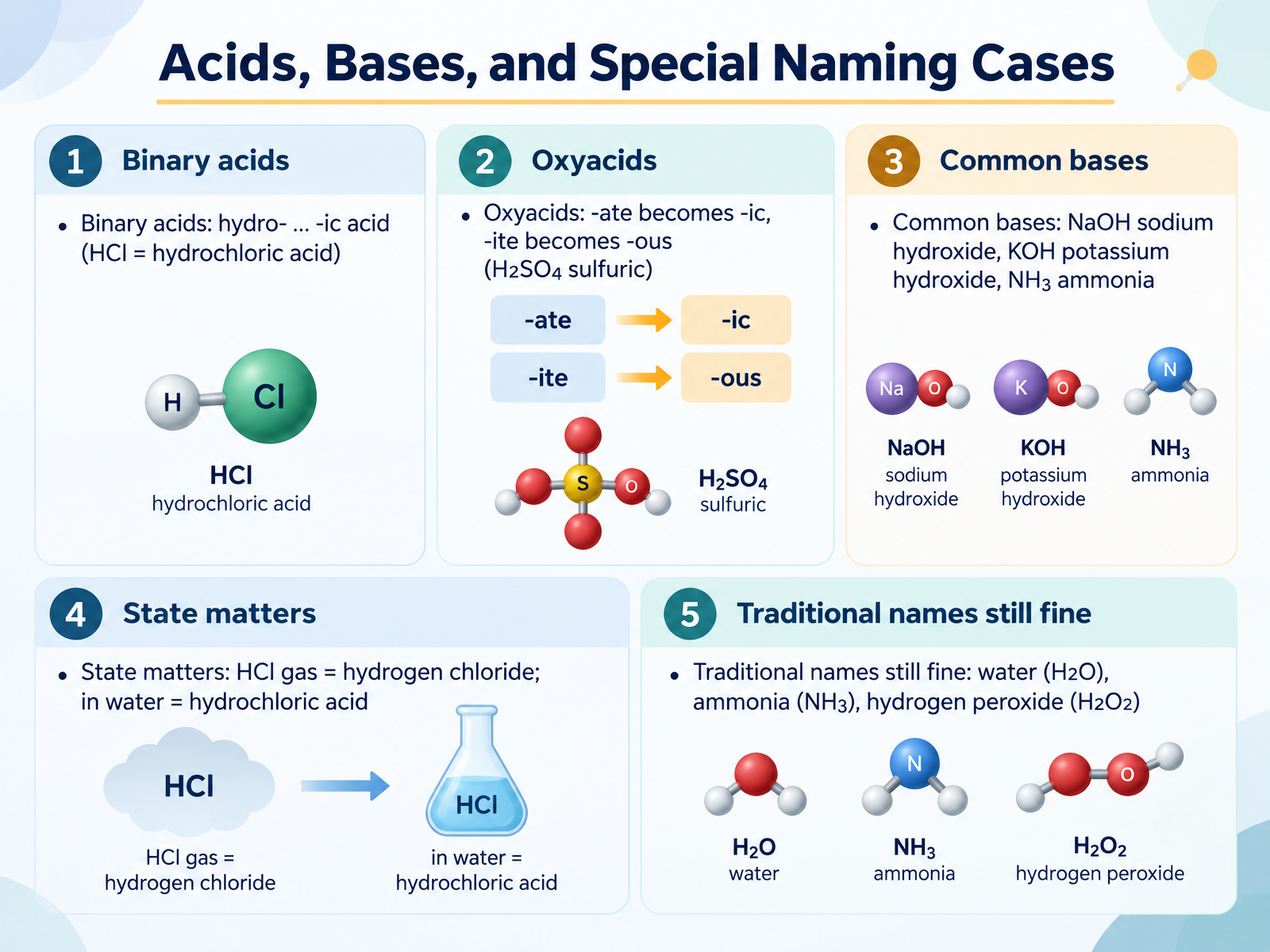
- 07Acids, Bases, and Special Naming CasesNow let's look at acids, bases, and a few special naming cases. A binary acid contains hydrogen and one other element. We name it with the prefix hydro, then the element root, then the ending ic, followed by the word acid. For example, H C L is hydrochloric acid. Oxyacids contain hydrogen, oxygen, and usually one more element. Here is the pattern. If the polyatomic ion ends in a t e, change it to i c. So sulfate becomes sulfuric acid. If it ends in i t e, change it to o u s. So sulfite becomes sulfurous acid. Common bases include sodium hydroxide, N a O H, potassium hydroxide, K O H, and ammonia, N H 3. Here is a point that often confuses people. The state matters. H C L as a gas is called hydrogen chloride. Dissolved in water, it is hydrochloric acid. Finally, some traditional names are still perfectly fine. Water, H 2 O, ammonia, N H 3, and hydrogen peroxide, H 2 O 2. Next, we will turn this around and practice going from a name to a formula.
 2 min
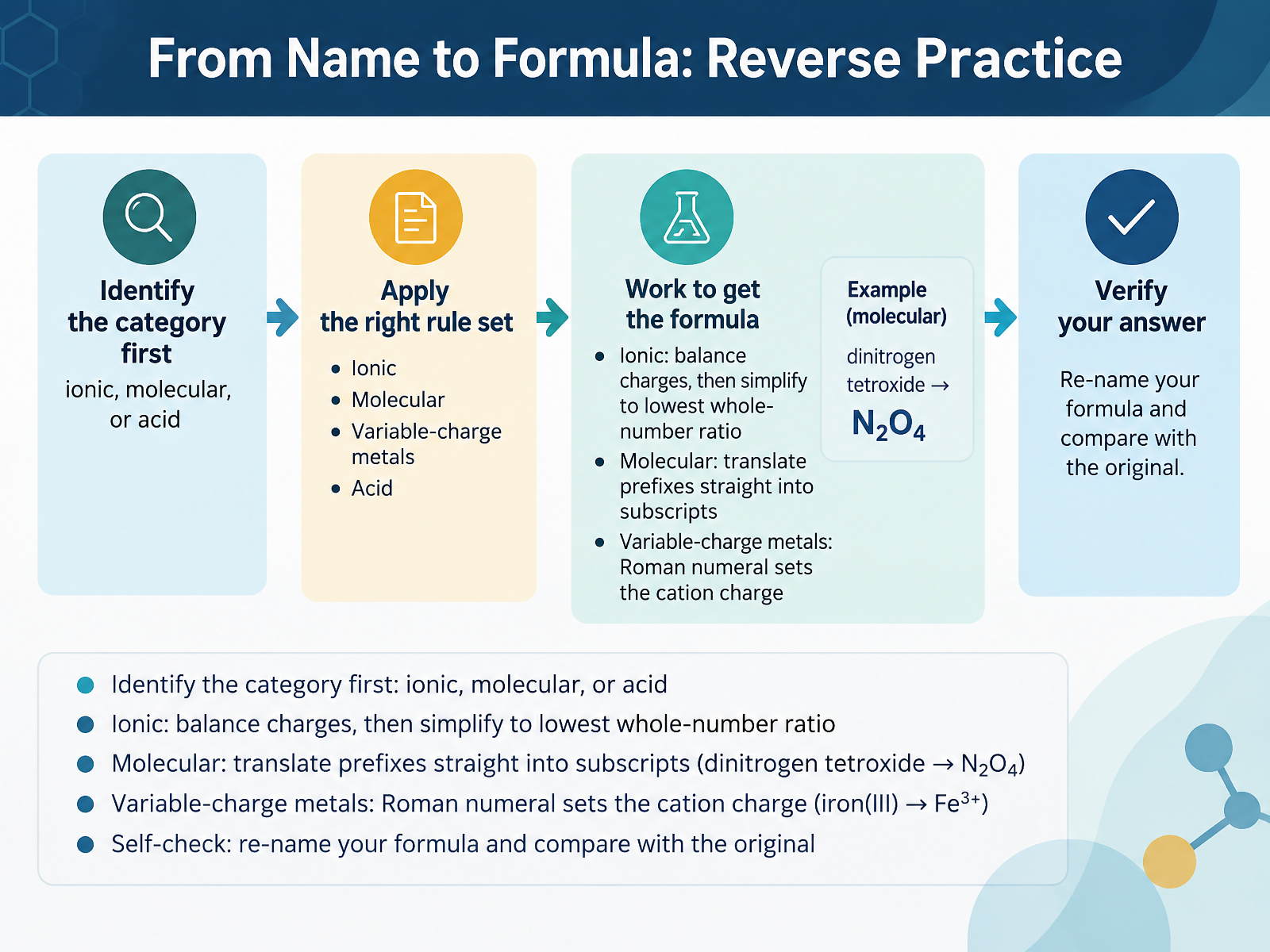
- 08From Name to Formula: Reverse PracticeNow let's reverse the process and build a formula from a name. First, identify the category: is it ionic, molecular, or an acid? For ionic compounds, balance the charges, then simplify to the lowest whole number ratio. For molecular compounds, translate the prefixes straight into subscripts. For example, dinitrogen tetroxide becomes N two O four. With variable charge metals, the Roman numeral sets the cation charge. Iron three means F e three plus. Finally, self check by re naming your formula and comparing it with the original. This catches small errors before they become habits. Next, we will look at common pitfalls and quick checks.
 1 min
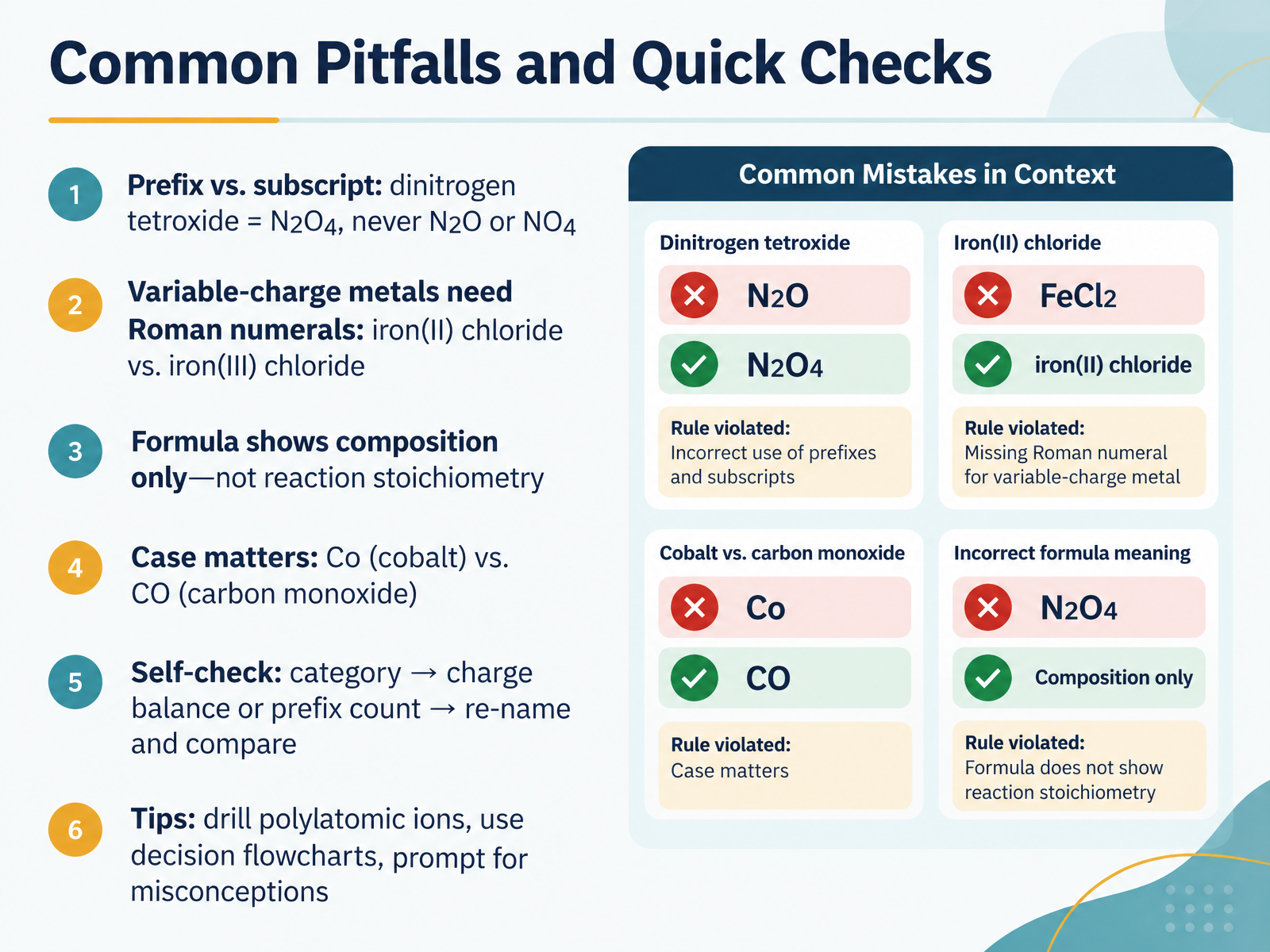
- 09Common Pitfalls and Quick ChecksLet's pause and look at some common pitfalls, plus a few quick checks you can use. First, watch the difference between a prefix and a subscript. Dinitrogen tetroxide is N two O four, never N two O or N O four. Second, metals with variable charge need Roman numerals. Iron two chloride is different from iron three chloride. Third, a formula shows composition only, not reaction stoichiometry. Fourth, case matters. C O written as Co is cobalt, while CO in capitals is carbon monoxide. Here is a self-check. First, identify the category. Second, check charge balance or prefix count. Third, re-name the compound and compare. To improve, drill polyatomic ions, use decision flowcharts, and prompt yourself about likely misconceptions. Next, we will try a practice set on mixed naming and formula writing.
 2 min
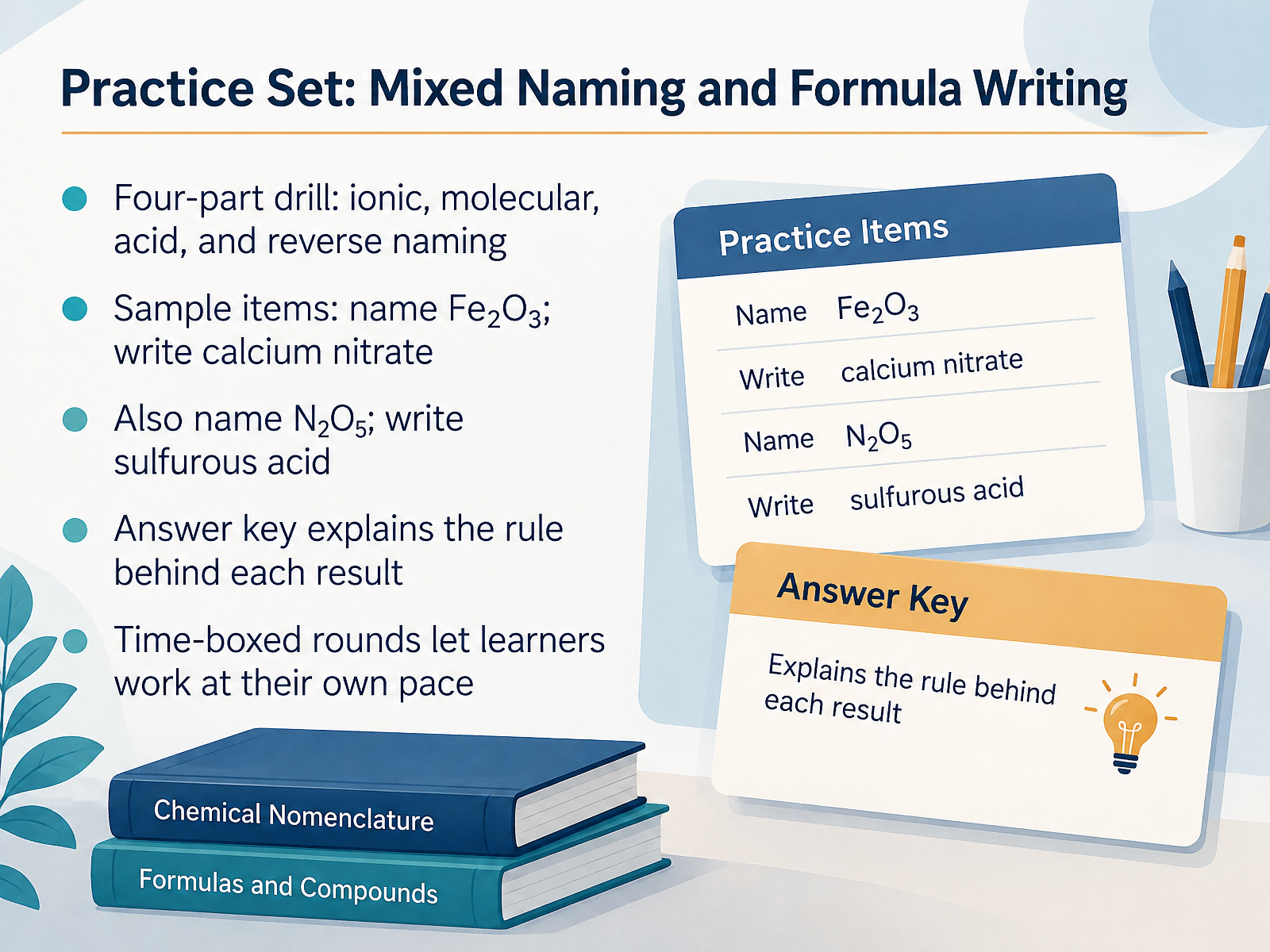
- 10Practice Set: Mixed Naming and Formula WritingNow let's put everything into practice. This is a four-part drill covering ionic compounds, molecular compounds, acids, and reverse naming, where you go from a name to a formula. Here are your sample items. First, name Fe two O three. That is iron three oxide. Notice the Roman numeral, because iron can form more than one charge. Next, write the formula for calcium nitrate. Calcium is Ca two plus, and nitrate is NO three minus, so the formula is Ca NO three, all taken twice, written as Ca parentheses NO three parentheses subscript two. Then name N two O five. That is dinitrogen pentoxide, a molecular compound, so we use prefixes. Finally, write sulfurous acid. That is H two S O three, because the suffix ous with no hydro prefix means the acid is formed from the sulfite ion. After each round, check the answer key. It explains the rule behind every result, so you learn the why, not just the answer. Each round is time-boxed, which means you get a set amount of time, but you can work at your own pace. Pause and rewind whenever you need to. When you are ready, we will move on to assessment design and feedback.
 2 min
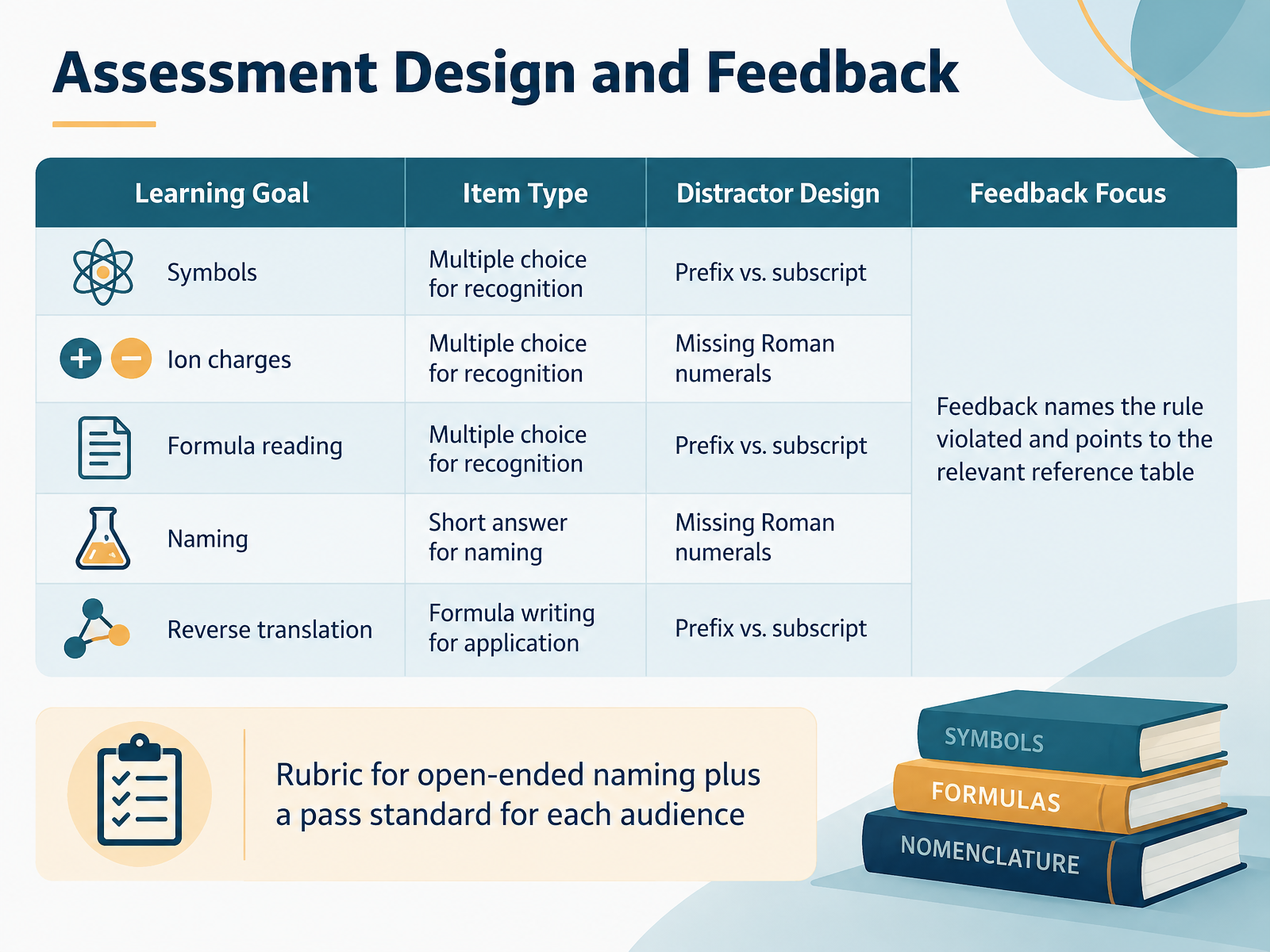
- 11Assessment Design and FeedbackLet's turn to assessment design and feedback. A good assessment blueprint starts with your goals. You want to check five things: reading symbols, ion charges, reading formulas, naming compounds, and reverse translation from a name to a formula. Match item types to those goals. Use multiple choice for recognition, short answer for naming, and formula writing for application. Write distractors that target known misconceptions. For example, a choice that confuses a prefix with a subscript. Or one that leaves out a Roman numeral where it is needed. Feedback should do two things. Name the rule the learner violated, and point to the reference table that covers it. For open-ended naming, use a short rubric so scoring stays consistent. For example, correct formula, correct naming, correct use of prefixes or Roman numerals. Then set a pass standard for each audience, such as introductory students, adult learners, and teachers. Next, we will look at classroom activities and teaching strategies.
 2 min
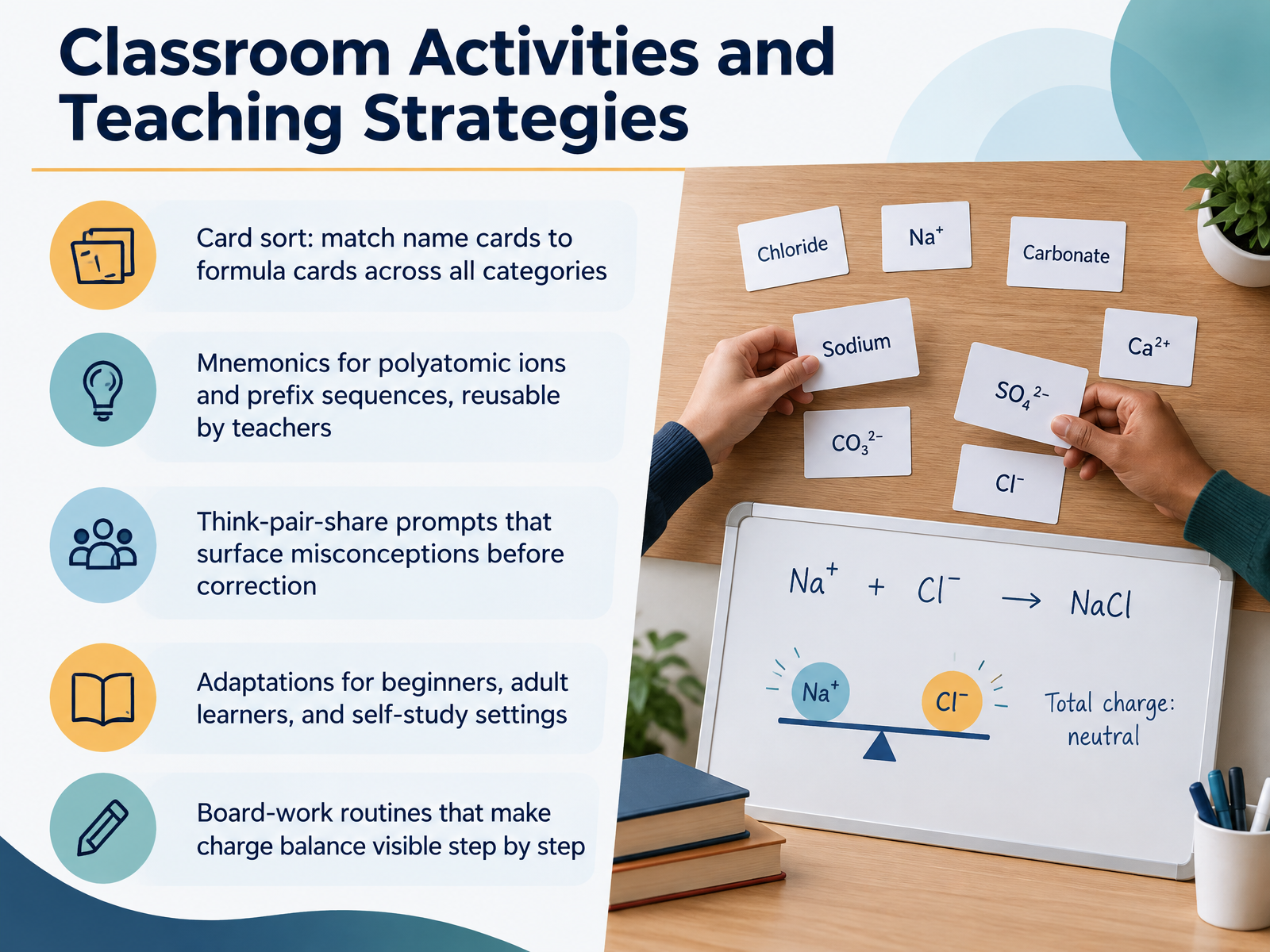
- 12Classroom Activities and Teaching StrategiesNow let's turn all of this into classroom practice. These activities work across every compound category we covered. Start with a card sort. Students match name cards to formula cards. Circulate and listen, because their reasoning reveals misconceptions before you correct anything. Use think-pair-share prompts for the same purpose. Ask, for example, why calcium chloride is CaCl2 and not CaCl. Let students talk it out first. Mnemonics help with polyatomic ions and prefix sequences. A classic example is that nitrate has three oxygens while nitrite has two. Share these memory aids so teachers can reuse them year after year. Adapt the pace for beginners, adult learners, and self-study settings. Finally, use board-work routines that make charge balance visible, writing each charge above the formula, step by step. Next, let's look at reference tables and where to find reliable guidance.
 1 min
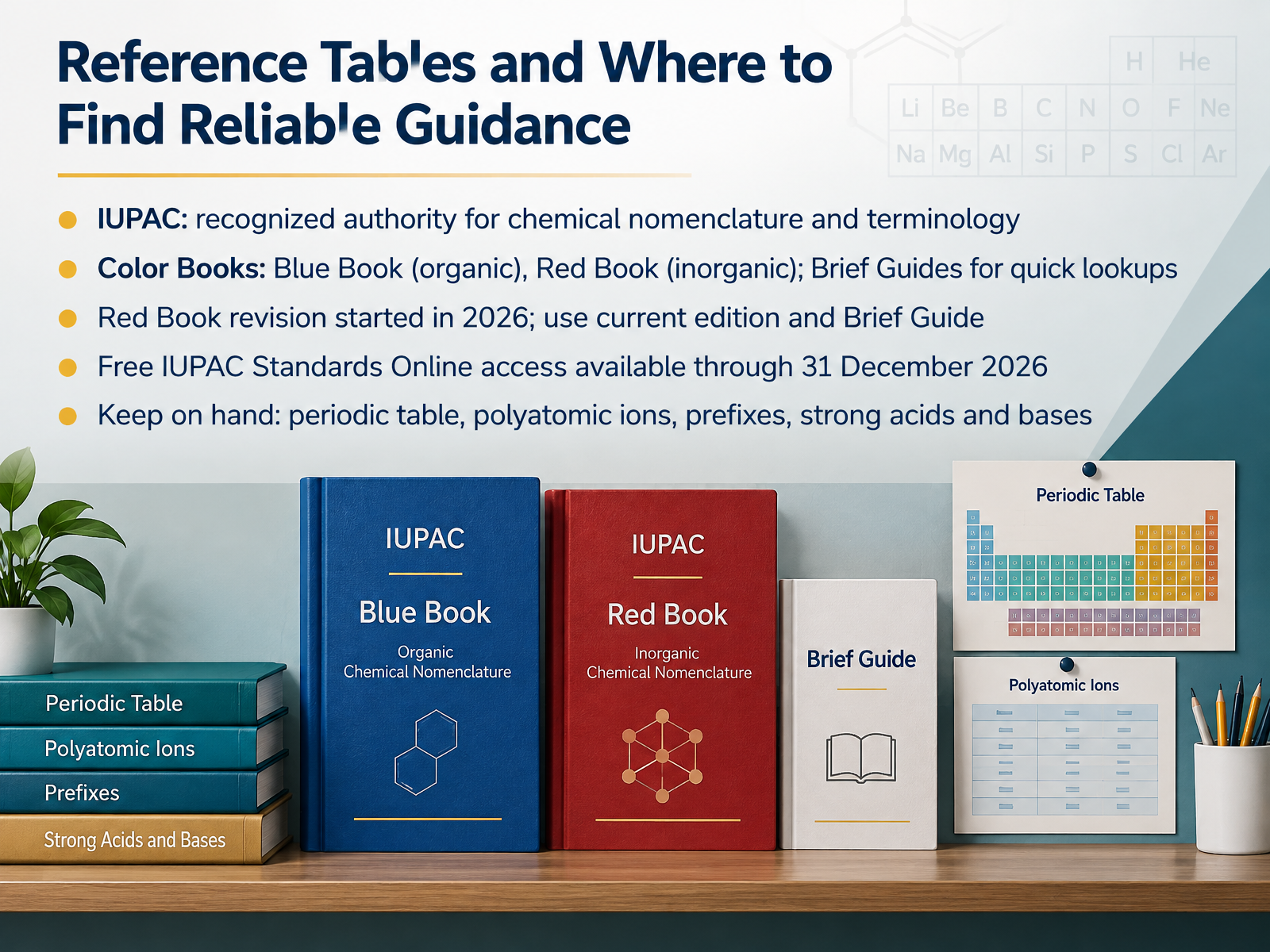
- 13Reference Tables and Where to Find Reliable GuidanceLet's talk about where to find reliable guidance on chemical names. Your recognized authority is the International Union of Pure and Applied Chemistry, or I U P A C. I U P A C publishes the Color Books. The Blue Book covers organic nomenclature, and the Red Book covers inorganic nomenclature. For everyday lookups, use the Brief Guides, which are short and easy to navigate. One important note: a revision of the Red Book started in twenty twenty-six. So always use the current edition and the current Brief Guide. Free access to I U P A C Standards Online is available through December thirty-first, twenty twenty-six. Finally, keep a few references on hand: a periodic table, a list of polyatomic ions, common prefixes, and a table of strong acids and bases. These will answer most naming questions quickly. Next, we'll bring the course together in Course Wrap-Up and Next Steps.
 2 min
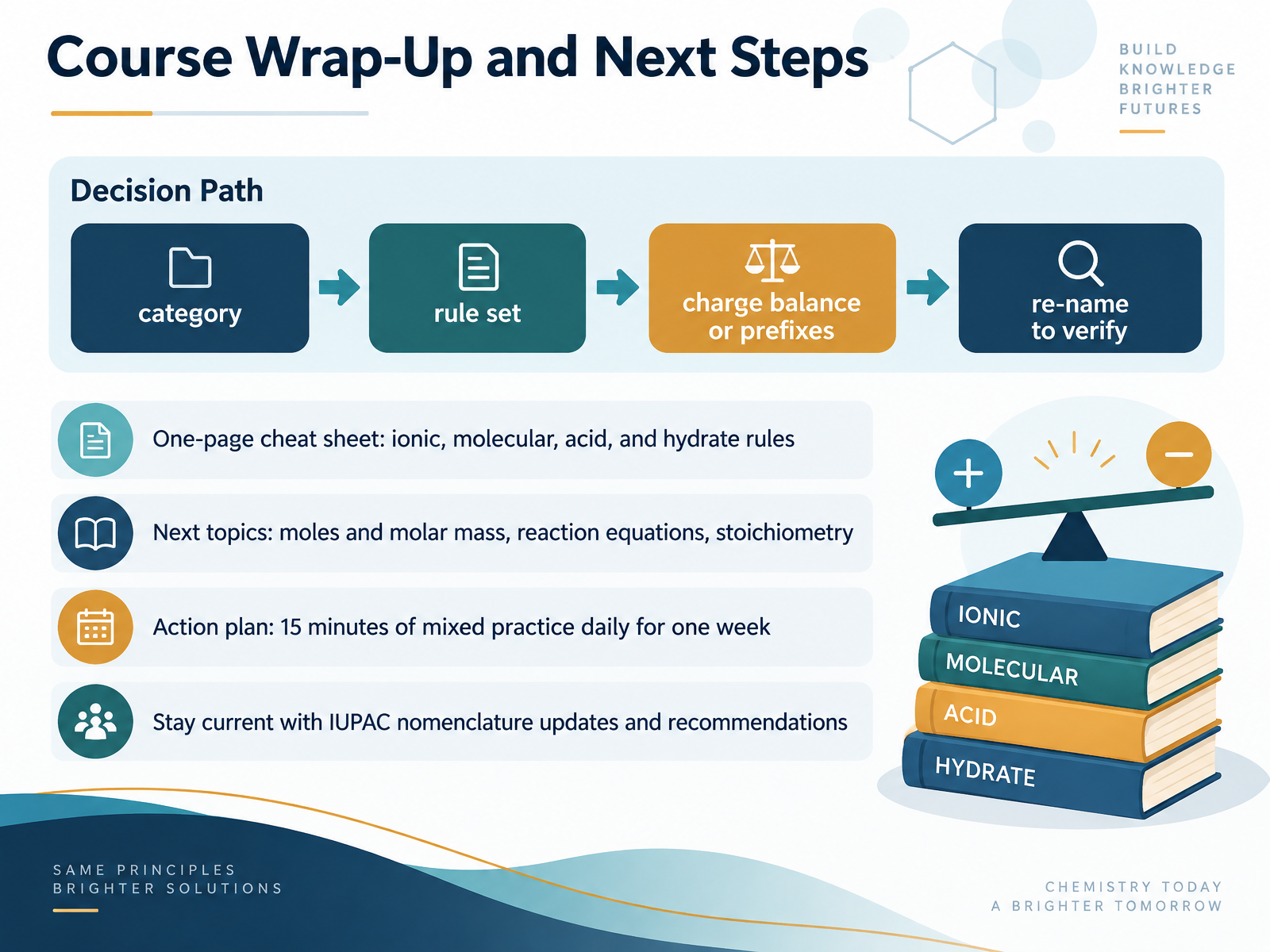
- 14Course Wrap-Up and Next StepsLet's pull everything together. When you see a new formula, follow one decision path. First, identify the category. Is it ionic, molecular, an acid, or a hydrate? Second, apply the matching rule set. For ionic compounds, balance the charges. For molecular compounds, use prefixes. Third, re-name the compound from your answer to verify it. If the name rebuilds the same formula, you are correct. Keep a one-page cheat sheet with all four rule sets: ionic, molecular, acid, and hydrate rules. That single page will save you time. Next, you will study moles and molar mass, then reaction equations, and after that, stoichiometry. Each topic builds on clean naming, so your foundation matters. Here is your action plan. Practice mixed problems for fifteen minutes every day for one week. Also, stay current with IUPAC nomenclature updates and recommendations. You now have a reliable system for reading, naming, and checking compounds. Thank you for your attention and your effort throughout this course. Keep practicing with curiosity, and you will name compounds with confidence. Well done, and good luck.
 2 min
Take the deck with you
Download this course as a file — free, no sign-up needed.
- PDF handoutEvery slide page, ready to print or share.15 pages · 3.6 MBDownload
- Narrated PowerPointThe deck that presents itself — every slide carries the digital human's narration video.15 pages · 16.0 MBDownload
- PowerPoint slidesThe full deck as a .pptx — open it in PowerPoint, Keynote, or Google Slides.15 pages · 3.5 MBDownload
Free to use in your own training — please keep the PersonWise credit page at the end.
Have your own deck? Turn it into a course