Begin
13 pages · ~26 min
Social Media Marketing: Patterns and Pitfalls
This training reviews real social media marketing examples to help marketers recognize effective patterns, strengths, and common pitfalls.
A digital instructor presents all 13 pages. Hold “Ask” at any point and ask out loud — the answer comes from this course. No sign-up needed.
What you’ll learn
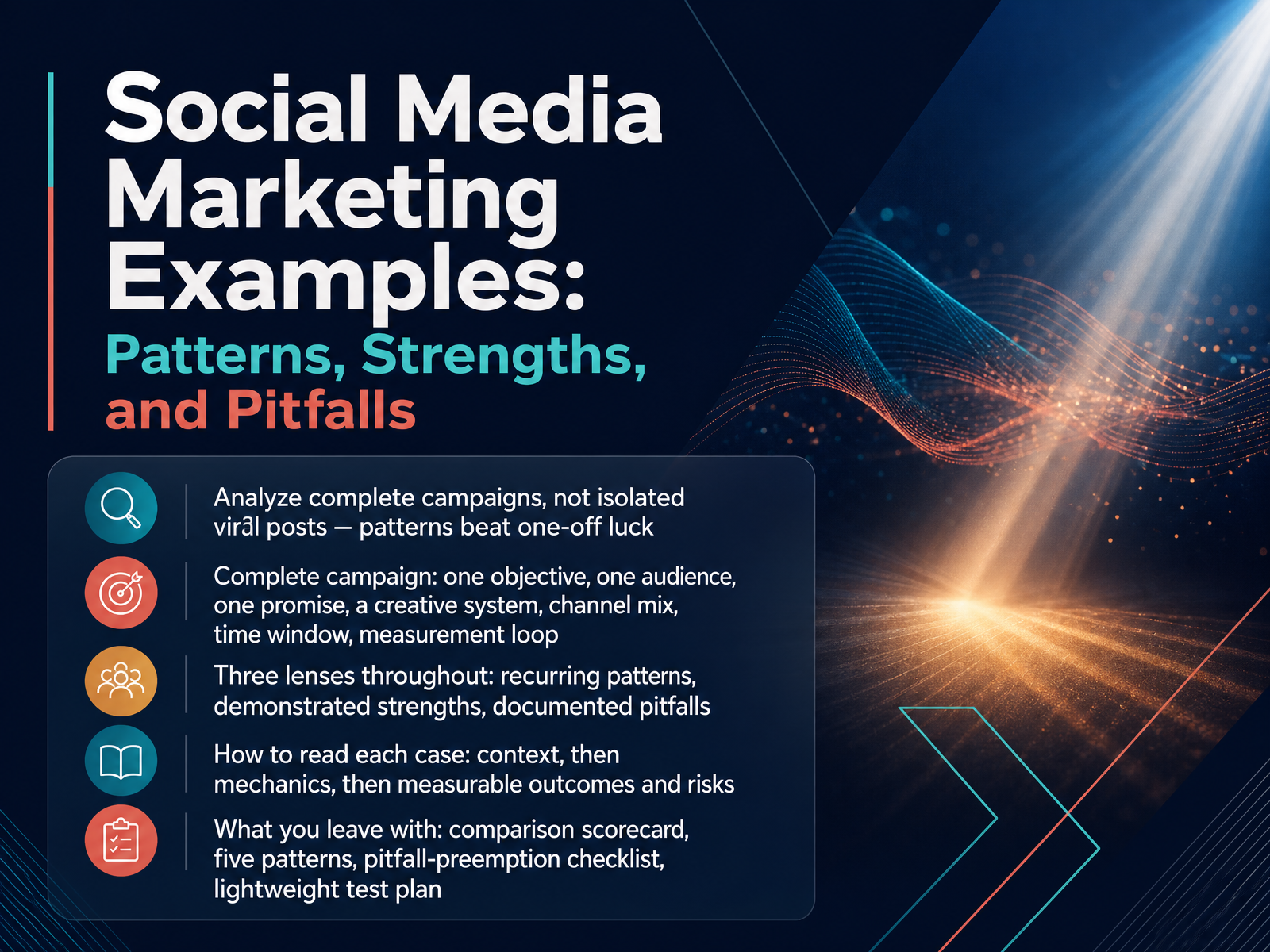
- 01Social Media Marketing Examples: Patterns, Strengths, and PitfallsWelcome. If you manage social media, you've probably been asked the same question: why did that campaign work? In this course, we're going to answer it with evidence, not vibes. Our focus is on analyzing complete campaigns rather than isolated viral posts, because patterns beat one-off luck. A complete campaign means one objective, one audience, one promise, a creative system built for variation, a deliberate channel mix, a defined time window, and a measurement loop that starts before launch day. Throughout, we'll use three lenses: recurring patterns, demonstrated strengths, and documented pitfalls. And for every example, you'll read it the same way. First the context, then the mechanics, then the measurable outcomes and the risks that came with them. By the end, you'll leave with a comparison scorecard, five patterns you can reuse, a pitfall-preemption checklist, and a lightweight test plan you can run on your next campaign. Let's get into how to read a campaign example without being fooled.filipkonecny.compostsyncer.comstartupeditor.com+22 min
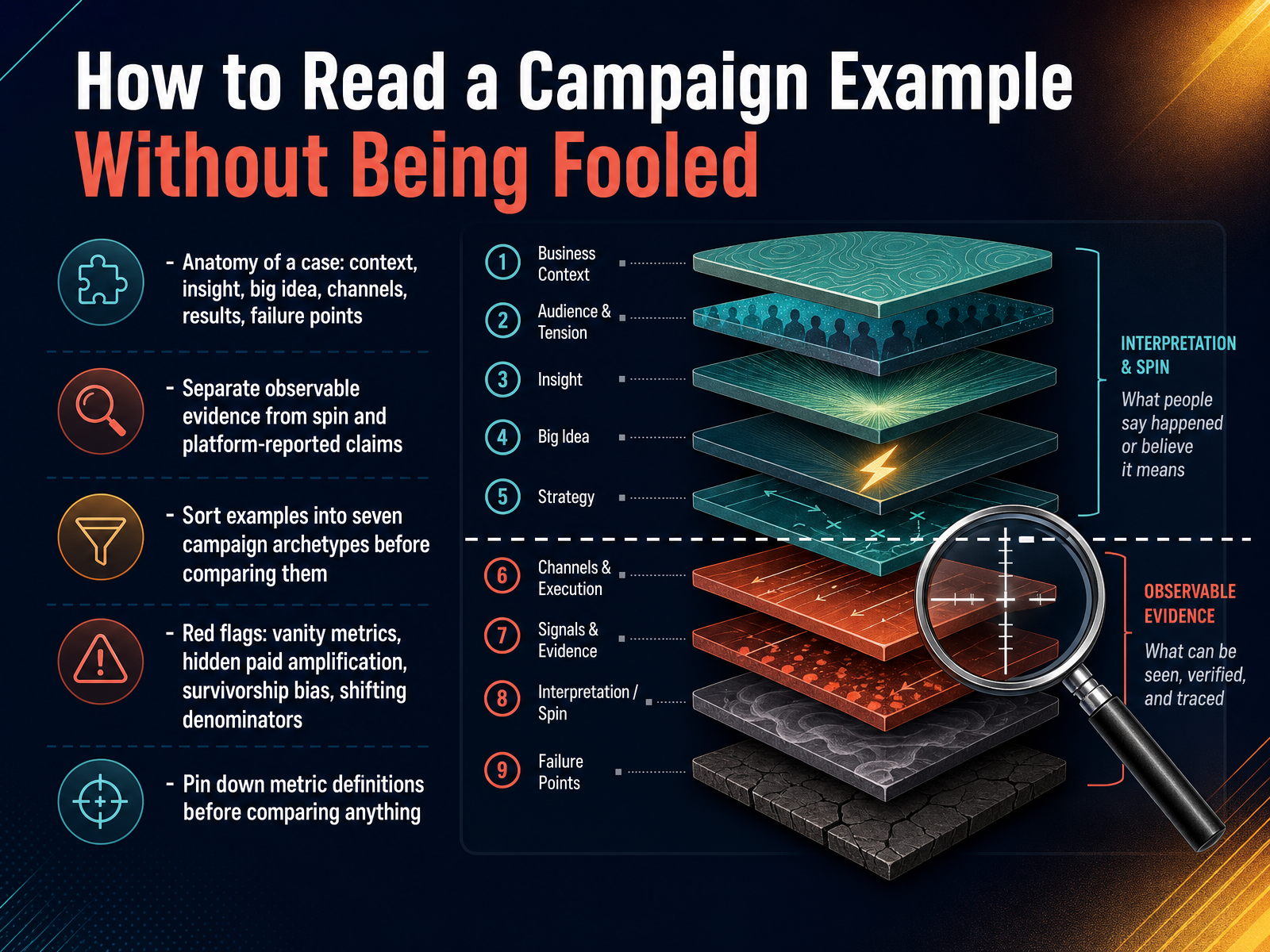
- 02How to Read a Campaign Example Without Being FooledLet's talk about how to read a campaign example without being fooled. Start by mapping the anatomy: context, insight, the big idea, the channels used, the results, and the failure points. That last part matters most, because most case studies quietly drop it. Next, separate observable evidence from spin. A screenshot of a trending post is observable. A platform-reported reach number is a claim, not proof, so treat it accordingly. Then sort examples into archetypes before comparing them, because a creator-led stunt and a paid always-on program are not the same species. Watch for red flags: vanity metrics that look big but don't connect to a goal, hidden paid amplification behind "organic" wins, survivorship bias that ignores the campaigns that flopped, and shifting denominators that make percentages look better than they are. Before you compare anything, pin down how each metric is defined. One team's engagement rate includes saves and shares. Another counts only comments. Same label, different math. So as you review examples today, write down your assumptions, your definitions, and the condition under which the pattern actually works. That discipline is what turns a case study into judgment you can reuse. From here, let's look at a repeatable scorecard for comparing campaigns.
 2 min
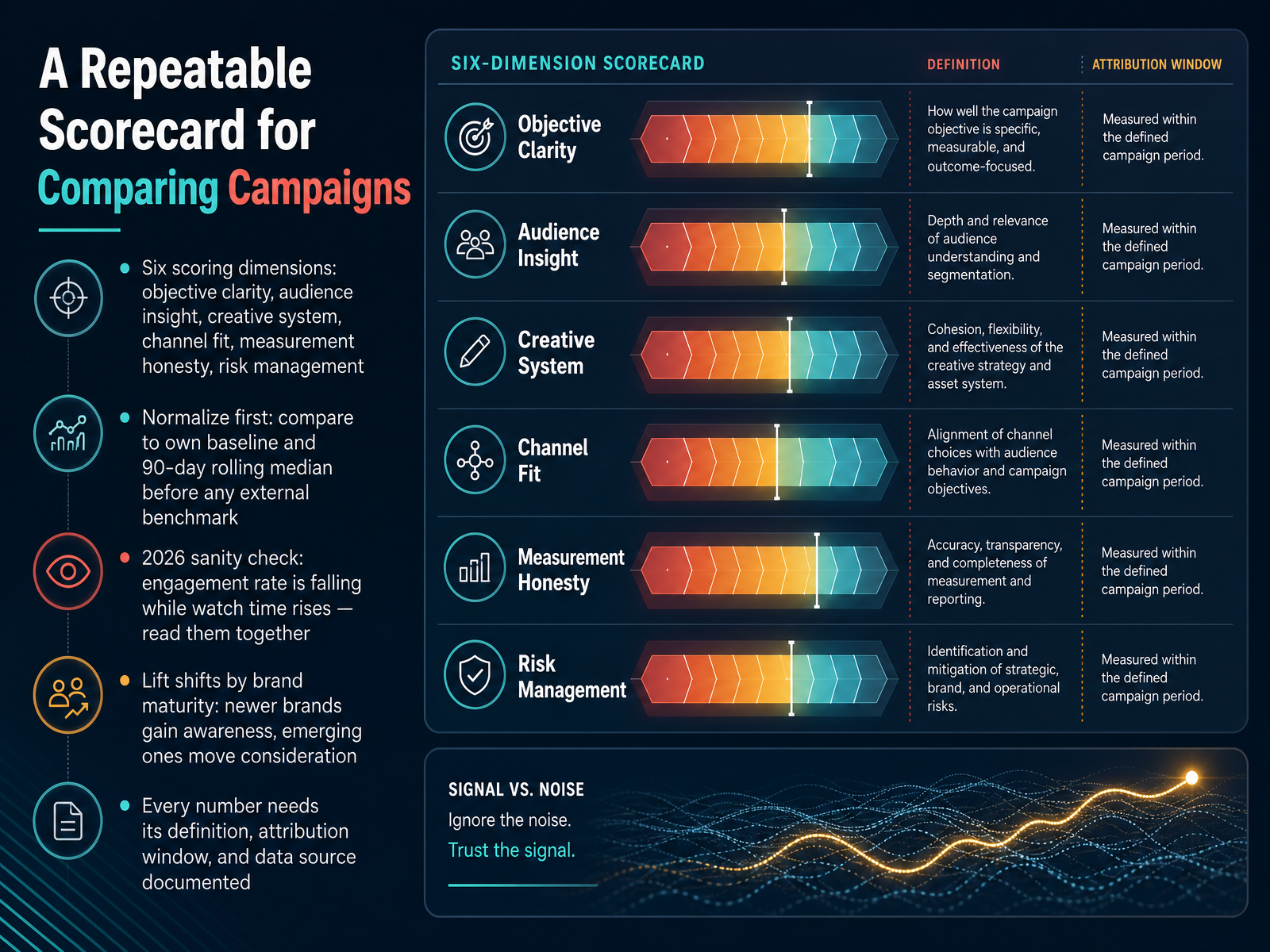
- 03A Repeatable Scorecard for Comparing CampaignsNow let's make this practical with a scorecard you can reuse for any campaign you're comparing. Score six dimensions: objective clarity, audience insight, creative system, channel fit, measurement honesty, and risk management. Give each a simple score against a rubric you define up front, so you're not grading on vibes after the fact.
Before you benchmark externally, normalize. Compare results to your own baseline and your ninety day rolling median first. Every number also needs three things documented: its definition, its attribution window, and its data source. A view on one platform is not a view everywhere.
Here's your twenty twenty six sanity check. Engagement rate is falling while watch time is rising, so read them together. High watch time with weak engagement often signals passive viewing rather than active intent, which matters when you're judging creative quality versus distribution.
Expect lift to shift by brand maturity. Newer brands tend to gain awareness, while emerging brands move consideration. Judge the campaign against the job it was actually hired to do.
Next, we'll look at our first pattern: audience first insight and real community.
 2 min
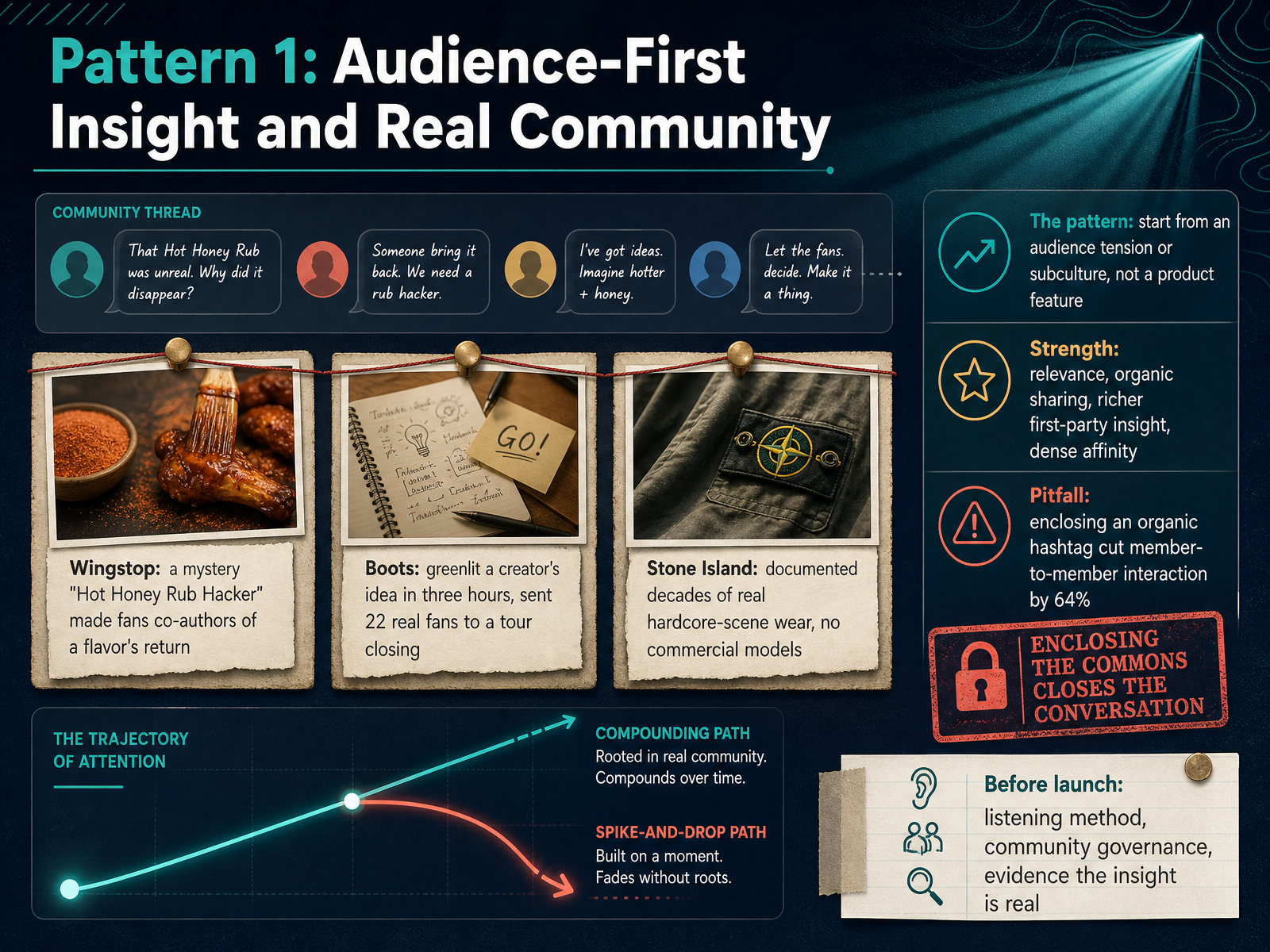
- 04Pattern 1: Audience-First Insight and Real CommunityLet's look at the first pattern: starting from audience insight and real community, not from a product feature. Wingstop Singapore is the clean example. Fans kept begging for Hot Honey Rub, so instead of announcing its return, the brand staged a mystery hacker takeover. Comments and speculation became part of the story, and fans became co-authors. Then there is Boots, which greenlit a creator's idea in three hours and sent twenty two real fans to a tour closing. No lengthy brief, just speed and instinct. Stone Island went the opposite way. It documented decades of real hardcore-scene wear using personal and archival garments, no commercial models. So what's the strength? Relevance, organic sharing, richer first-party insight, and dense affinity. The pitfall is enclosure. When a brand makes an organic hashtag official, member-to-member interaction dropped by sixty four percent in one study. So before launch, build your listening method, community governance, and evidence the insight is real. Now let's move to Pattern 2: Platform-Native Creative and Format Discipline.
 production.marketing-interactive.comandjelicaaa.substack.comxandsing.com+22 min
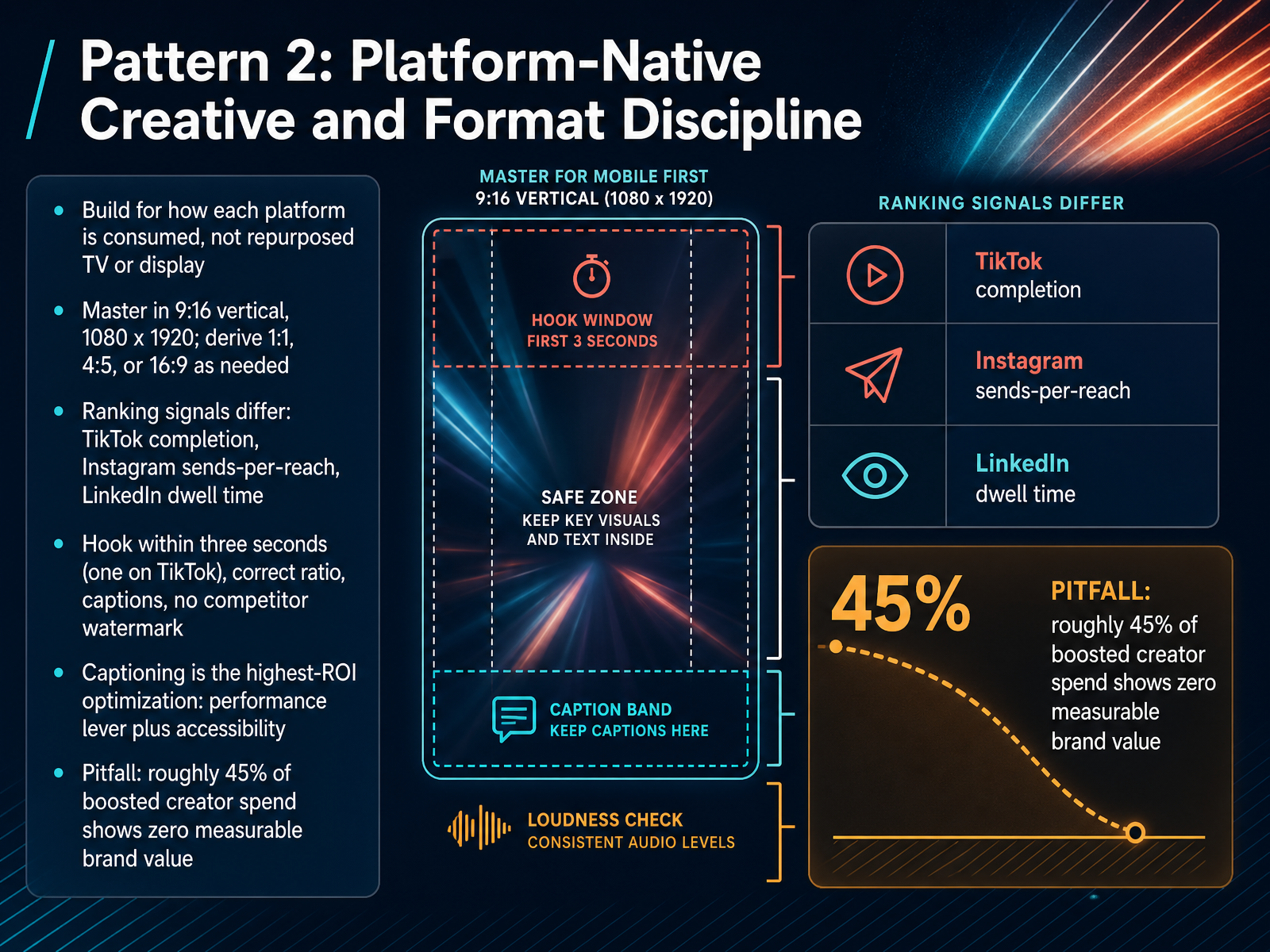
- 05Pattern 2: Platform-Native Creative and Format DisciplineNow let's talk about Pattern Two: platform-native creative and format discipline. The core rule is simple. Build for how each platform is actually consumed, rather than repurposing your television or display assets. In practice, that means mastering a nine by sixteen vertical at ten eighty by nineteen twenty, then deriving one by one, four by five, or sixteen by nine as needed. Ranking signals differ too. TikTok rewards completion, Instagram weights sends per reach, and LinkedIn measures dwell time. So your hook needs to land within three seconds, or one second on TikTok, with the correct ratio, captions, and no competitor watermark.
Captioning is your highest return optimization, because it is a performance lever and an accessibility win at the same time. Watch the pitfall here. Roughly forty five percent of boosted creator spend shows zero measurable brand value, usually because the creative was never adjusted for the platform it ran on. Keep that in mind as we move into Pattern Three: creator-led and user-generated amplification.
 2 min
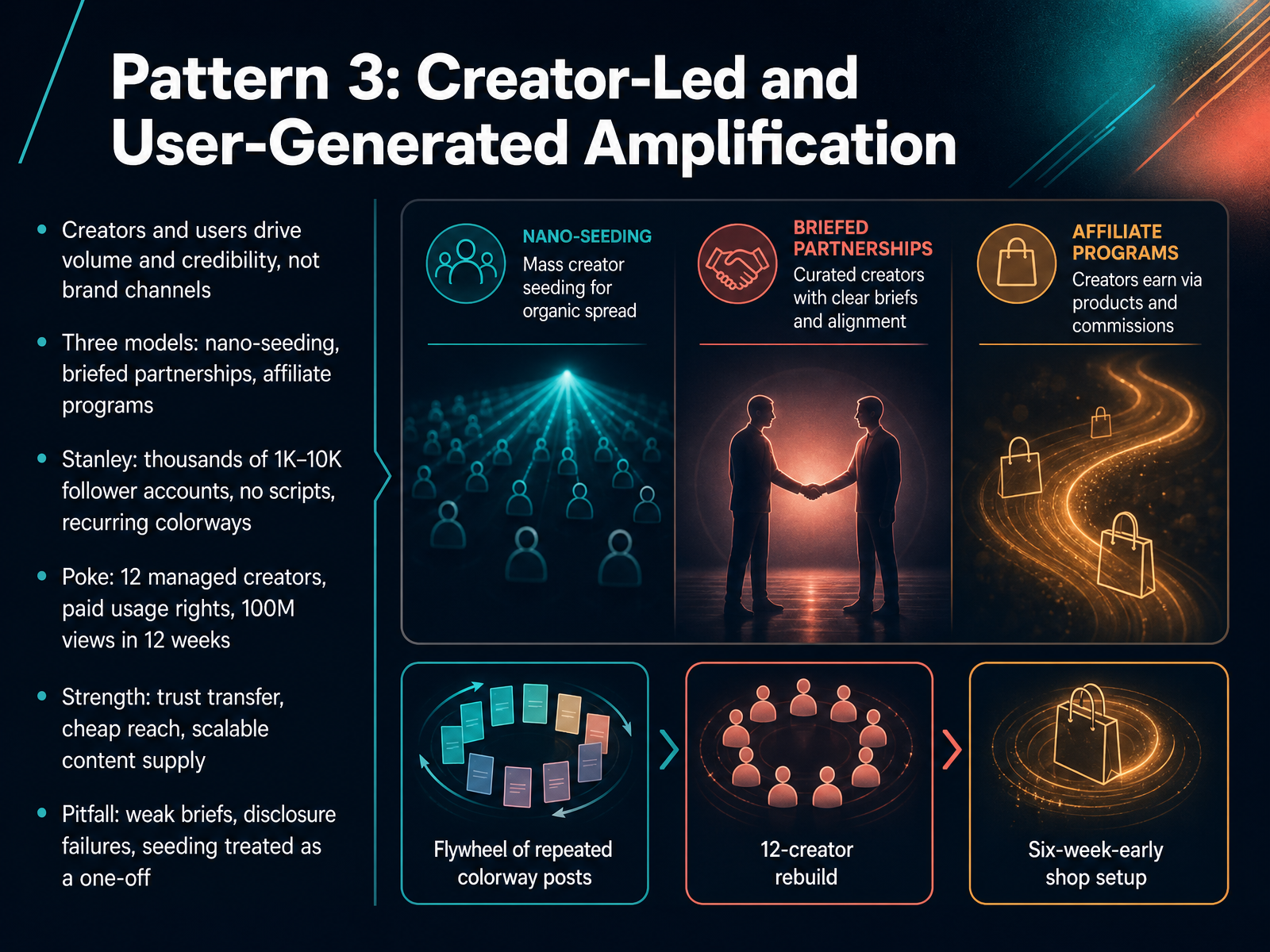
- 06Pattern 3: Creator-Led and User-Generated AmplificationNow let's look at Pattern 3: creator-led and user-generated amplification. Here, volume and credibility come from creators and customers, not your brand channel. You'll see three models: nano-seeding, briefed partnerships, and affiliate programs.
Stanley leaned into nano-seeding. Thousands of accounts with roughly one thousand to ten thousand followers posted unscripted content, helped by recurring colorways. Low cost, high trust, continuous supply.
Poke took a tighter route: twelve managed creators with paid usage rights, and it drove one hundred million views in twelve weeks. Fewer voices, but controlled assets and clearer reporting.
The strength is trust transfer, cheap reach, and scalable content supply. The pitfalls: weak briefs that flatten the message, disclosure failures that damage credibility, and seeding treated as a one-off. Seed continuously, brief what must be true, and let the community do the rest.
Next, Pattern 4: participatory, challenge, and stunt campaigns.
 2 min
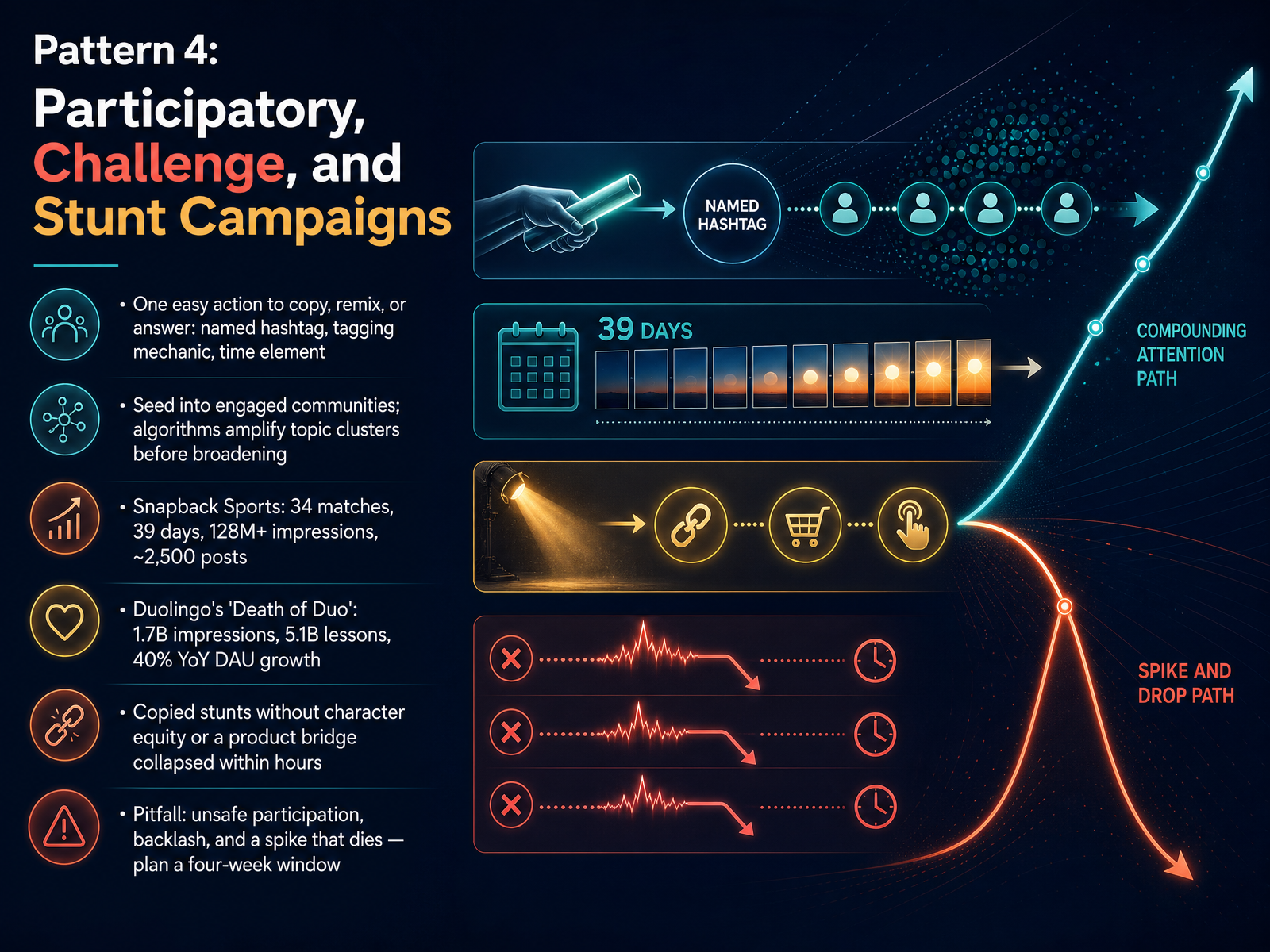
- 07Pattern 4: Participatory, Challenge, and Stunt CampaignsLet's look at Pattern 4, participatory, challenge, and stunt campaigns. The mechanic is simple: give people one easy action to copy, remix, or answer. That means a named hashtag, a tagging mechanic, and a time element, like a twenty-four hour deadline. Then seed it into engaged communities. Algorithms amplify a topic cluster before broadening, so niche depth beats generic reach. Snapback Sports ran thirty-four matches across thirty-nine days, generating over one hundred twenty-eight million impressions from roughly twenty-five hundred posts. Duolingo's Death of Duo stunt hit one point seven billion impressions and five point one billion lessons, with forty percent year over year daily active user growth. But note the failure mode: copied stunts without character equity or a product bridge collapsed within hours. Also watch for unsafe participation and backlash. The spike can die fast, so plan a four week active window. Now, Pattern 5: Commerce, Performance, and Full-Funnel Integration.
 cyabra.comamericanguerrillamarketing.comgraphika.com+22 min
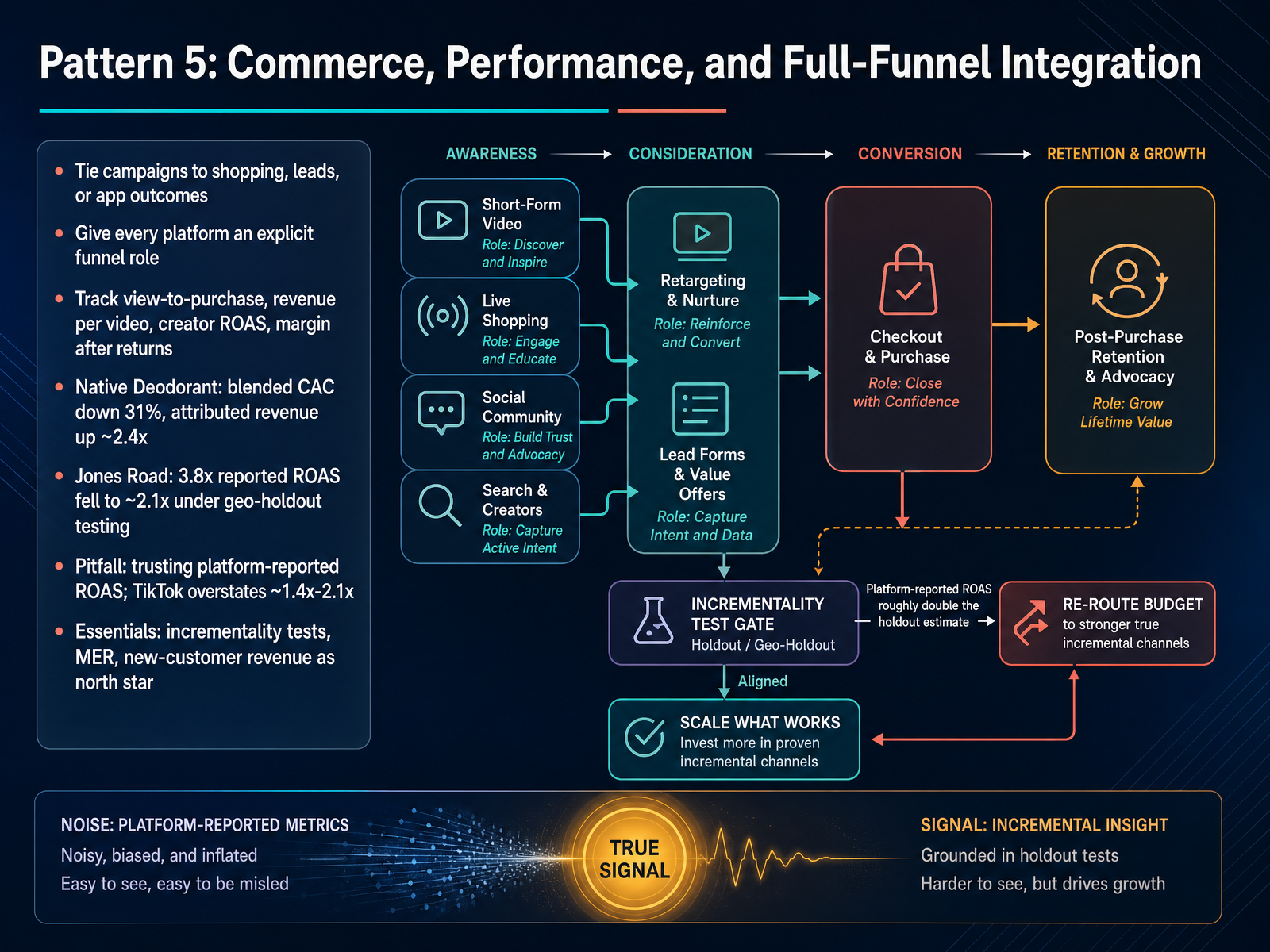
- 08Pattern 5: Commerce, Performance, and Full-Funnel IntegrationNow let's look at pattern five, commerce, performance, and full funnel integration. In this pattern, every campaign ties to a shopping, lead, or app outcome, and every platform gets an explicit funnel role. That means you track view to purchase, revenue per video, creator return on ad spend, and margin after returns, not just clicks. Native Deodorant is a strong example. With this discipline, blended customer acquisition cost dropped thirty one percent, and attributed revenue rose about two point four times. Jones Road shows the caution. Its reported three point eight times return on ad spend fell to roughly two point one times under geo holdout testing. The pitfall is trusting platform reported return on ad spend. On TikTok, it can overstate by about one point four to two point one times. So build incrementality tests, monitor marketing efficiency ratio, and treat new customer revenue as your north star. Next, we will move into case set one, community, creator, and participation campaigns.
 2 min
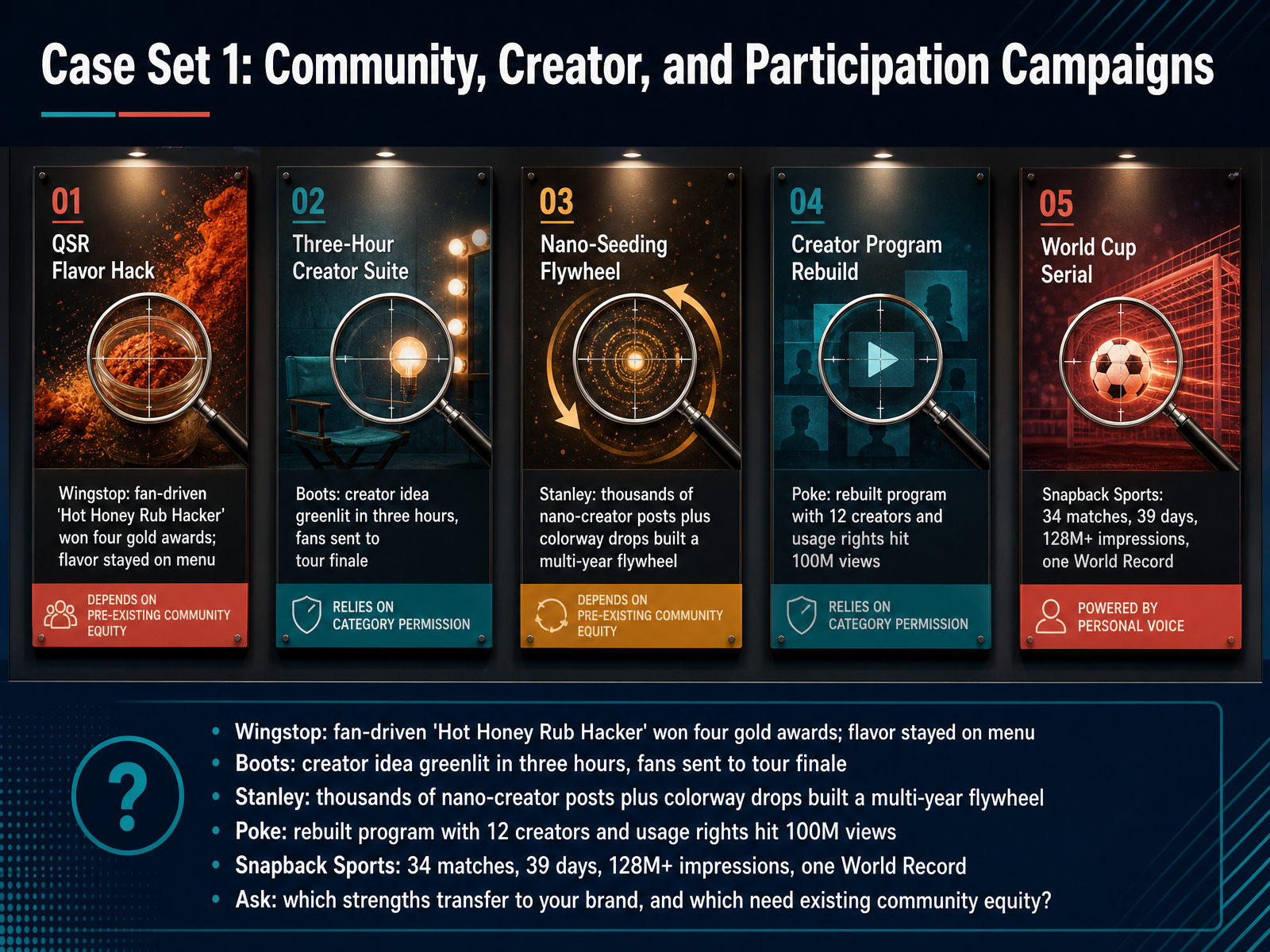
- 09Case Set 1: Community, Creator, and Participation CampaignsLet's look at community, creator, and participation campaigns, where the audience does real work. Wingstop's fan-driven Hot Honey Rub Hacker earned four gold awards, and the flavor stayed on the menu. The pattern is co-creation, and it works when fans already have a sandbox to play in. Boots greenlit a creator idea in three hours and sent fans to the tour finale. That speed only works if your approval chain is short and someone owns the decision. Stanley built a flywheel from thousands of nano-creator posts plus colorway drops, a multi-year pattern that depends on consistent design language and steady seeding. Poke rebuilt its program with twelve creators, and with usage rights, hit one hundred million views. Note the condition: rights turned posts into paid media. Snapback Sports ran thirty-four matches across thirty-nine days for more than one hundred and twenty-eight million impressions and a world record. Volume plus a single measurable goal made it work. So ask which strengths transfer to your brand, and which need existing community equity you do not have yet. Next, Case Set 2: Commerce and Stunt Campaigns, Including the Failures.
 2 min
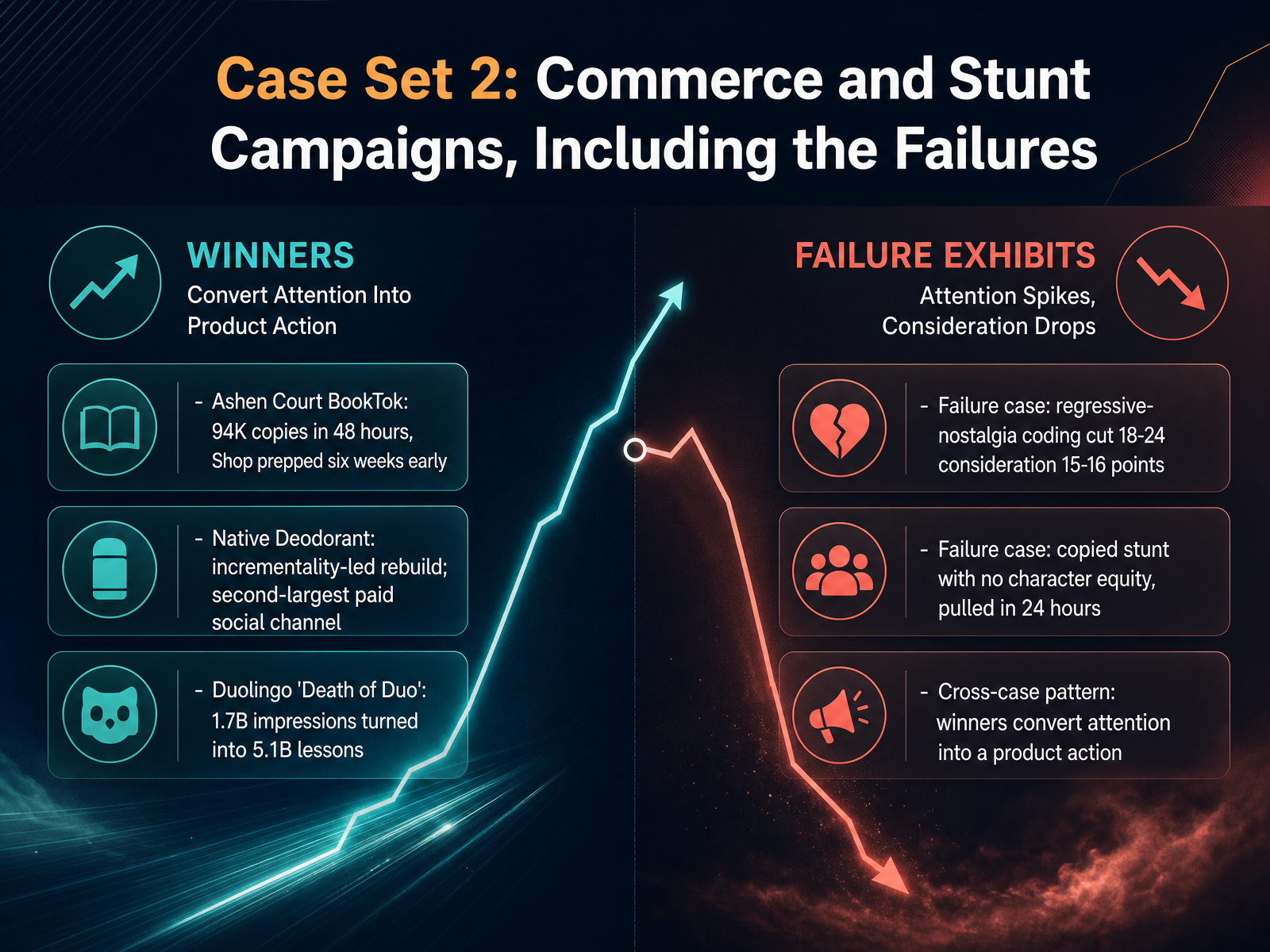
- 10Case Set 2: Commerce and Stunt Campaigns, Including the FailuresLet's move to commerce and stunt campaigns, and the failures worth studying. Ashen Court on BookTok sold ninety-four thousand copies in forty-eight hours, but the real pattern was operational. The Shop was prepped six weeks early, so when the algorithm found traction, inventory and checkout were ready. Native Deodorant rebuilt around incrementality, measuring incremental conversions instead of plugging into attribution. They made paid social their second-largest paid channel by scaling only where spend created new orders. Duolingo's Death of Duo turned one point seven billion impressions into five point one billion lessons by tying the stunt to a product action. Now the failures. A nostalgia campaign coded regressively cut consideration among eighteen to twenty-four year olds by fifteen to sixteen points. Meanwhile, a copied stunt with no character equity was pulled in twenty-four hours. The cross-case pattern is simple: winners convert attention into a product action. So before you greenlight a stunt, ask what action attention will trigger, and whether your operations can handle it.
 2 min
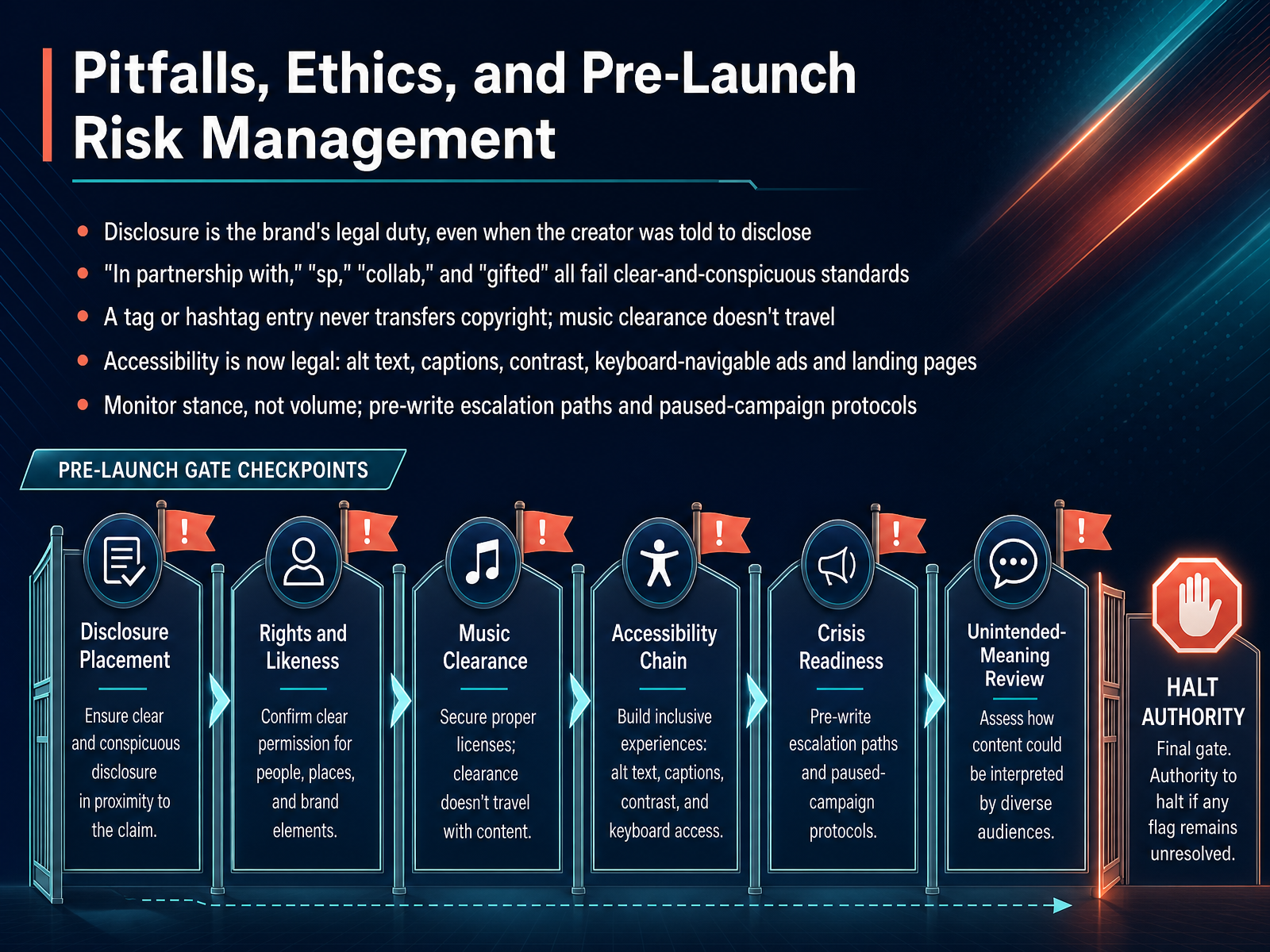
- 11Pitfalls, Ethics, and Pre-Launch Risk ManagementNow let's get into the pitfalls, ethics, and pre-launch risk management that decide whether a campaign survives contact with the public. Start with disclosure. It's the brand's legal duty, even when you told the creator to disclose. If the post goes out unlabeled, you carry liability alongside them. And the wording matters. Phrases like in partnership with, sp, collab, and gifted fail the clear-and-conspicuous standard. Regulators treat those as vague. Use ad, hashtag ad, or a plain-language sentence at the very start, before the caption truncates. Second, remember that rights don't travel. A tag or hashtag entry never transfers copyright, and music cleared for one platform doesn't clear the next placement, so you need a written license plus fresh disclosure on every recut and repost. Third, accessibility is now legal, not a nice-to-have. Alt text, captions, contrast, and keyboard-navigable ads and landing pages are baseline obligations for your creative and your destination pages. Finally, monitor stance, not volume. Watch for tone shifts and ethical objections, and pre-write your escalation paths and paused-campaign protocols before launch, so no one is improvising in the middle of a backlash. From Examples to Your Own Campaign Playbook.
 nbcnews.comauditsocials.commarketing-interactive.com+22 min
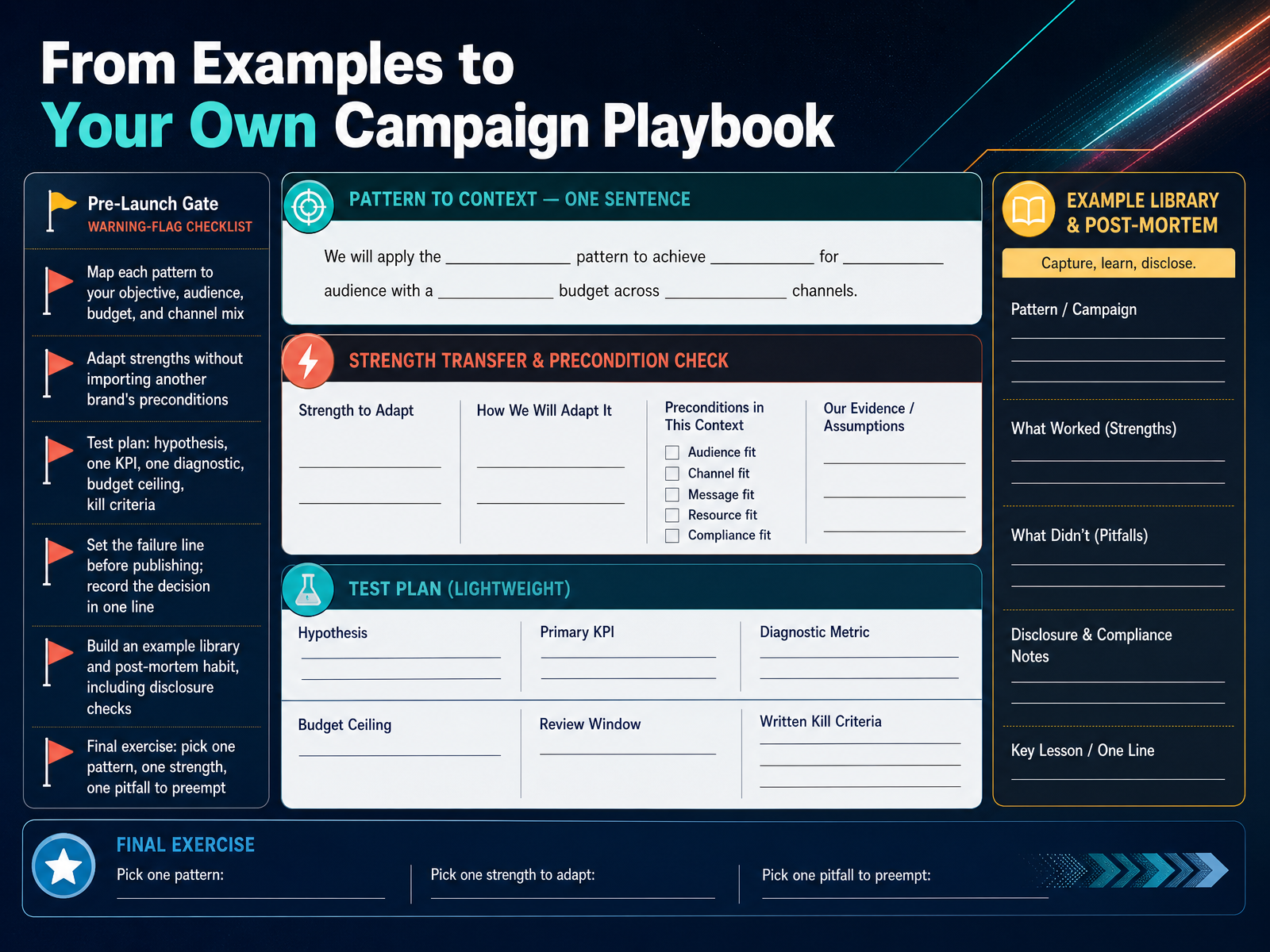
- 12From Examples to Your Own Campaign PlaybookSo, how do you turn these examples into your own campaign playbook? Start by mapping each pattern to four things: your objective, your audience, your budget, and your channel mix. A pattern that thrives on TikTok trends may fall flat in a LinkedIn feed, not because the idea is weak, but because the preconditions are different. Adapt strengths without importing another brand's preconditions, like their existing community or paid amplification. Write a test plan before you spend: one hypothesis, one KPI, one diagnostic metric, a budget ceiling, and kill criteria. Set the failure line before publishing, and record the decision in one line so you can revisit it honestly. Build an example library with a post-mortem habit, including disclosure checks for sponsored content. For your final exercise, pick one pattern, one strength, and one pitfall to preempt. Now let's move on to the Knowledge Check and Next Steps.
 1 min
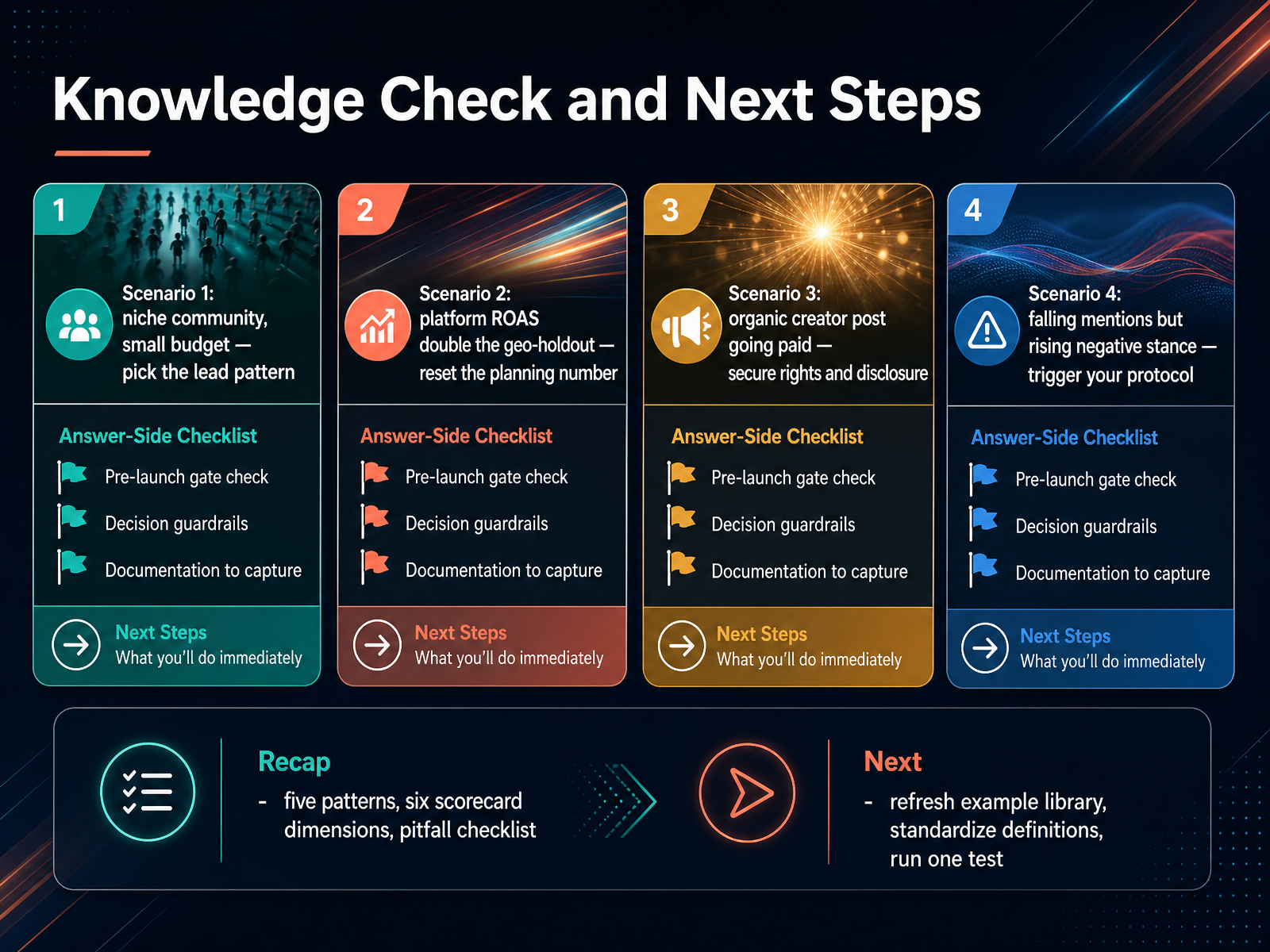
- 13Knowledge Check and Next StepsLet's close with a quick knowledge check, then your next steps. Scenario one. You're in a niche community with a small budget. Pick the lead pattern, and match it to how that community already talks and shares. Scenario two. Your platform reported return on ad spend comes back at double your geo-holdout test. Trust the holdout. Reset the planning number downward, or you'll scale a result that isn't real. Scenario three. An organic creator post performs and you want to put paid behind it. Before you boost, secure usage rights in writing and confirm the disclosure stays intact. Scenario four. Mentions are falling but negative stance is rising. Don't wait. Trigger your protocol, because shrinking volume plus rising negativity signals a real problem. So, the recap. Five patterns, six scorecard dimensions, one pitfall checklist. Keep them where you plan. And your next moves: refresh your example library quarterly, standardize your metric definitions, and run one test this month. Thank you for working through this with me. You now have the judgment to read a campaign, not just watch it. Go apply it.
 2 min
Take the deck with you
Download this course as a file — free, no sign-up needed.
- PDF handoutEvery slide page, ready to print or share.14 pages · 4.4 MBDownload
- Narrated PowerPointThe deck that presents itself — every slide carries the digital human's narration video.14 pages · 16.8 MBDownload
- PowerPoint slidesThe full deck as a .pptx — open it in PowerPoint, Keynote, or Google Slides.14 pages · 4.4 MBDownload
Free to use in your own training — please keep the PersonWise credit page at the end.
Have your own deck? Turn it into a course
Sources consulted
Web sources consulted while building this course.
- Social Media Campaign: A Practical Framework for Planning, Launching, and Measuring Results | Filip Konecny — filipkonecny.com
- Master Social Media Campaign Planning: 2026 Guide | PostSyncer Blog — postsyncer.com
- How to Create a Social Media Campaign? Complete 2026 Guide — startupeditor.com
- Social Media Campaign Planner Guide for 2026 · iHatePosting — ihateposting.com
- The Ultimate Social Campaign Planning Checklist | Emplifi — emplifi.io
- How Wingstop turned a fan-favourite flavour into a social media takeover | Marketing-Interactive — production.marketing-interactive.com
- Fandom is not a marketing channel - by Ana Andjelic — andjelicaaa.substack.com
- Your Official Community Hashtag Is Killing Your Organic Reach | Xand Sing — xandsing.com
- STONE ISLAND HARDCORE SUBCULTURE PROJECT — casawi.eu
- Boots’ reactive marketing strategy capitalises on influencer’s idea to give back to Ariana Grande fans - CORQ — corq.studio
- Viral Backlash Hits American Eagle Ad - Cyabra — cyabra.com
- Viral Challenges in Marketing: Why They Capture Attention in 2026 — americanguerrillamarketing.com
- What the Neutrogena Backlash Reveals About Monitoring Reputational Risk Online | Graphika — graphika.com
- Everyone is talking about this ad, so does 'outrage marketing' work? — thejournal.ie
- Doritos’ Controversial Influencer Campaign: Backlash, Lessons & Brand Safety — getphyllo.com
- California tightens disclosure rules for influencers who post political ads — nbcnews.com
- Social Media Ad Accessibility Compliance 2026: ADA & EAA — auditsocials.com
- Consumer backlash ushers in an era of accountability for influencer marketing | Marketing-Interactive — marketing-interactive.com
- The Complete Guide to Influencer Post Disclosure: UK Rules, Platform Requirements and Brand Liability in 2026 | IAB UK — iabuk.com
- Is your content accessible? Resources for social media ... — sites.newpaltz.edu