Begin
13 pages · ~26 min
Archives: Finding and Handling Historical Records
This training teaches researchers and historians how to locate, evaluate, and properly handle archival historical records.
A digital instructor presents all 13 pages. Hold “Ask” at any point and ask out loud — the answer comes from this course. No sign-up needed.
What you’ll learn
- 01Using Archives: Finding and Handling Historical RecordsWelcome. I am glad you are here. This course is called Using Archives: Finding and Handling Historical Records. It is built for students, academic researchers, family historians, and museum staff. Our promise is practical. By the end, you will know how to locate, evaluate, request, and use archival records responsibly. Let us start with one core distinction. Archives hold unique, often unpublished materials. Libraries hold published, mass-produced sources. That difference shapes everything, from how collections are organized to how you request them. Along the way, we will cover archival organization, search planning, finding aids, digital records, and family history research. We will also look at handling original documents, copyright and ethics, and how to cite what you find. You will finish with a reusable research workflow. And remember, research can be slow. That is normal, and it is part of doing it well. Next, we look at what archives are and how they differ from libraries.files.archivists.orgguides.library.jhu.edunmu.edu+22 min
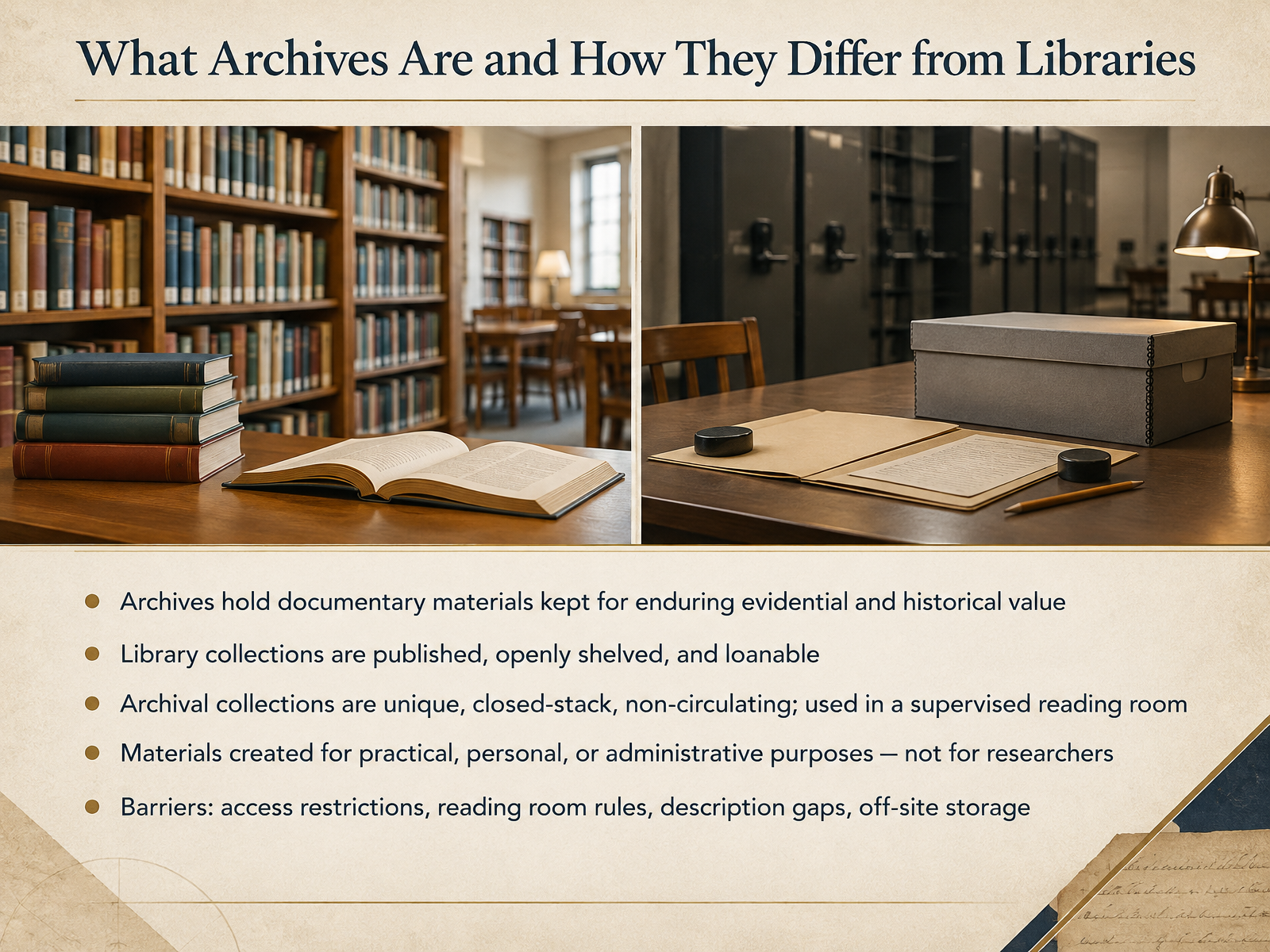
- 02What Archives Are and How They Differ from LibrariesLet's begin with a key distinction. Archives and libraries both exist to share information, but they work very differently. Archives hold documentary materials kept for enduring evidential and historical value. Library collections are mostly published works. They sit on open shelves, and you can check them out and take them home. Archival collections are unique. They stay in closed stacks and do not circulate. You use them in a supervised reading room. Here is an important point to understand. These materials were not created for researchers. Letters, diaries, and administrative records were made for practical, personal, or business purposes. They were kept later because they had lasting value. That difference shapes your whole experience. You may meet access restrictions, reading room rules, gaps in description, or items stored off-site. None of that means you are doing something wrong. It simply reflects how archives protect rare and irreplaceable materials. So expect to plan ahead, and expect the process to take patience. Next, we will look at how archives are organized, through provenance and original order.
 www2.archivists.orgguides.libraries.indiana.eduresearchguides.library.yorku.ca+22 min
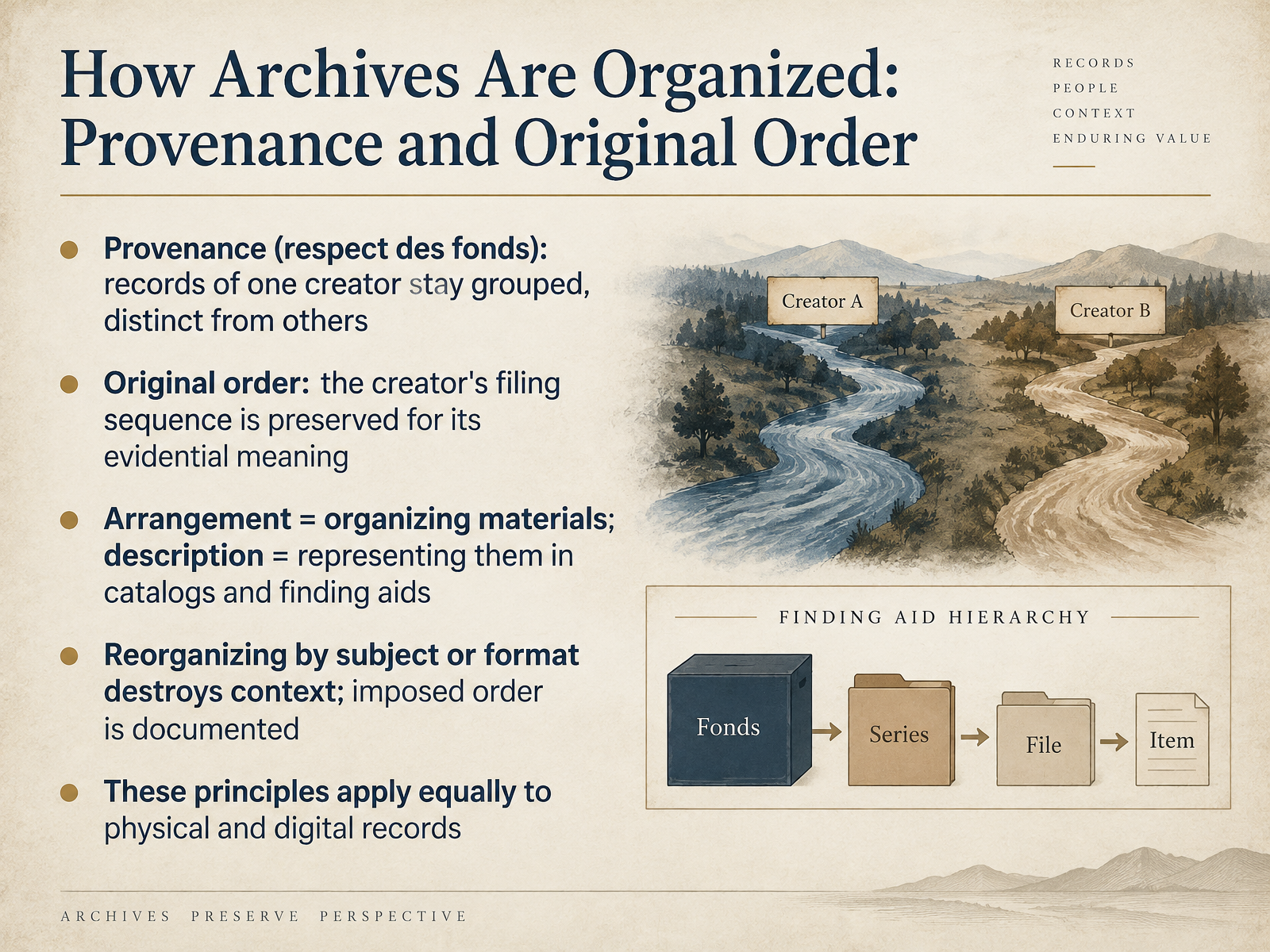
- 03How Archives Are Organized: Provenance and Original OrderNow let's look at how archives are organized. Two core principles guide almost everything: provenance and original order. Provenance, sometimes called respect des fonds, means the records of one creator stay grouped together and separate from anyone else's. Original order means we keep the creator's own filing sequence, because that arrangement carries meaning as evidence. It's easy to think tidy is better, but here, tidy can erase the story. For example, town building files arranged by year of development should stay that way, not be alphabetized by street, because the original order shows how the office actually worked. Alongside this, two terms matter. Arrangement is organizing the materials. Description is representing them in catalogs and finding aids. If a collection arrives with no usable order, archivists may impose one. But any imposed order must be documented, so researchers can tell the creator's choices from ours. When we rearrange by subject or format, we destroy context. These principles apply equally to physical and digital records. So the takeaway is this: keep records with their creator, keep their order when you can, and describe what you did. Next, we'll break down the hierarchy of description: fonds, collection, series, file, and item.
 files.archivists.orgguides.library.jhu.edunmu.edu+22 min
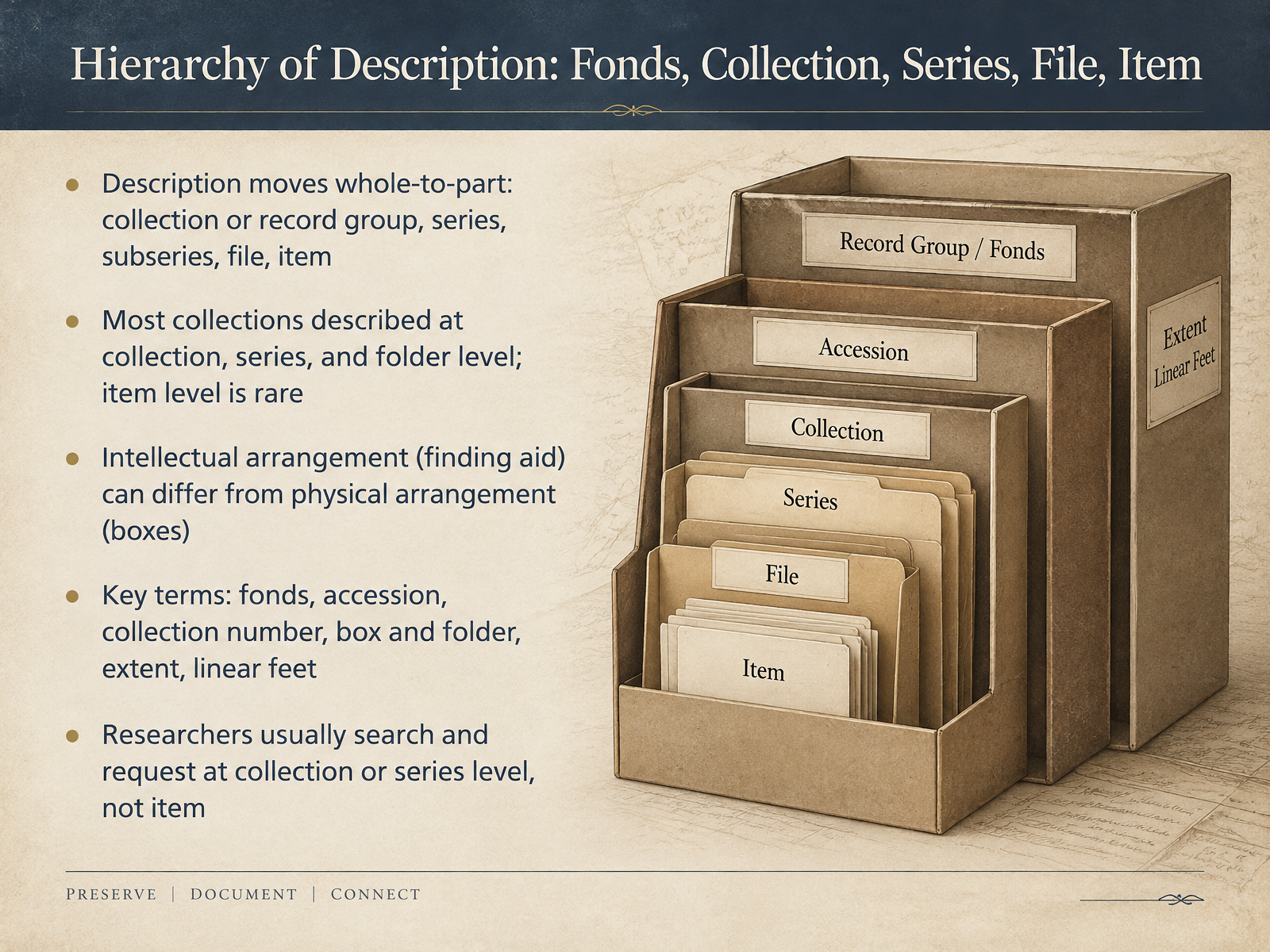
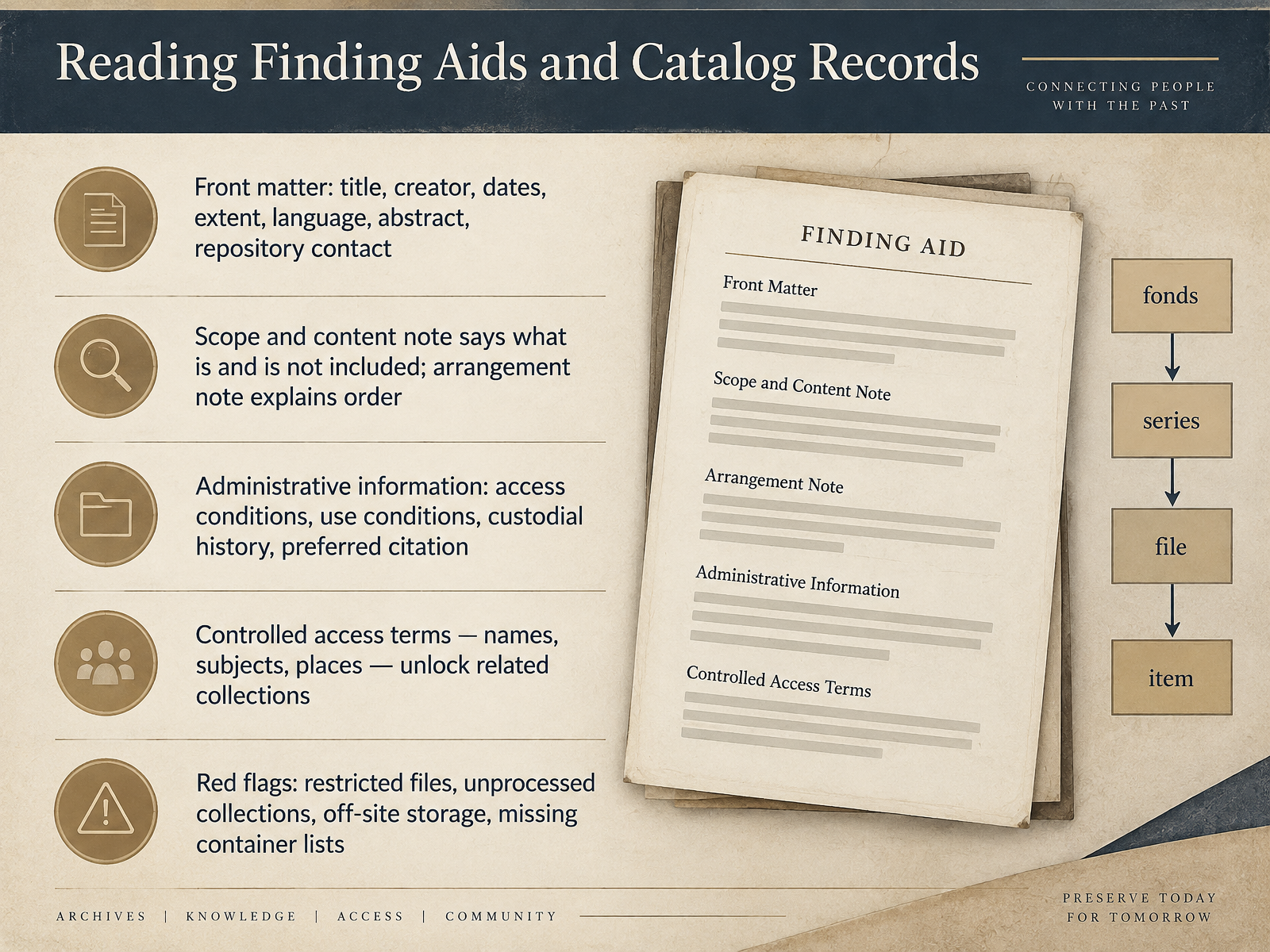
- 04Hierarchy of Description: Fonds, Collection, Series, File, ItemLet's look at how archivists organize description. Think of it like a family tree for records. Description moves from whole to part. At the top is the collection, also called a fonds or record group. Below that come series and subseries, then files or folders, and finally individual items. Most collections are described at the collection, series, and folder level. Item level description is rare. One important thing to remember: the intellectual arrangement, the order you see in the finding aid, can differ from the physical arrangement, the order things sit in the boxes. A few key terms will help you read finding aids. Fonds means all the records of one creator. Accession is a group of materials received at one time. The collection number identifies the whole collection. Box and folder numbers tell you exactly where to look. And extent, often measured in linear feet, tells you how big the collection is. When you search and request materials, you will usually work at the collection or series level, not the item level. That is normal and expected. Next, we will talk about planning a search before you arrive.
 files.archivists.orgguides.library.jhu.edunmu.edu+22 min
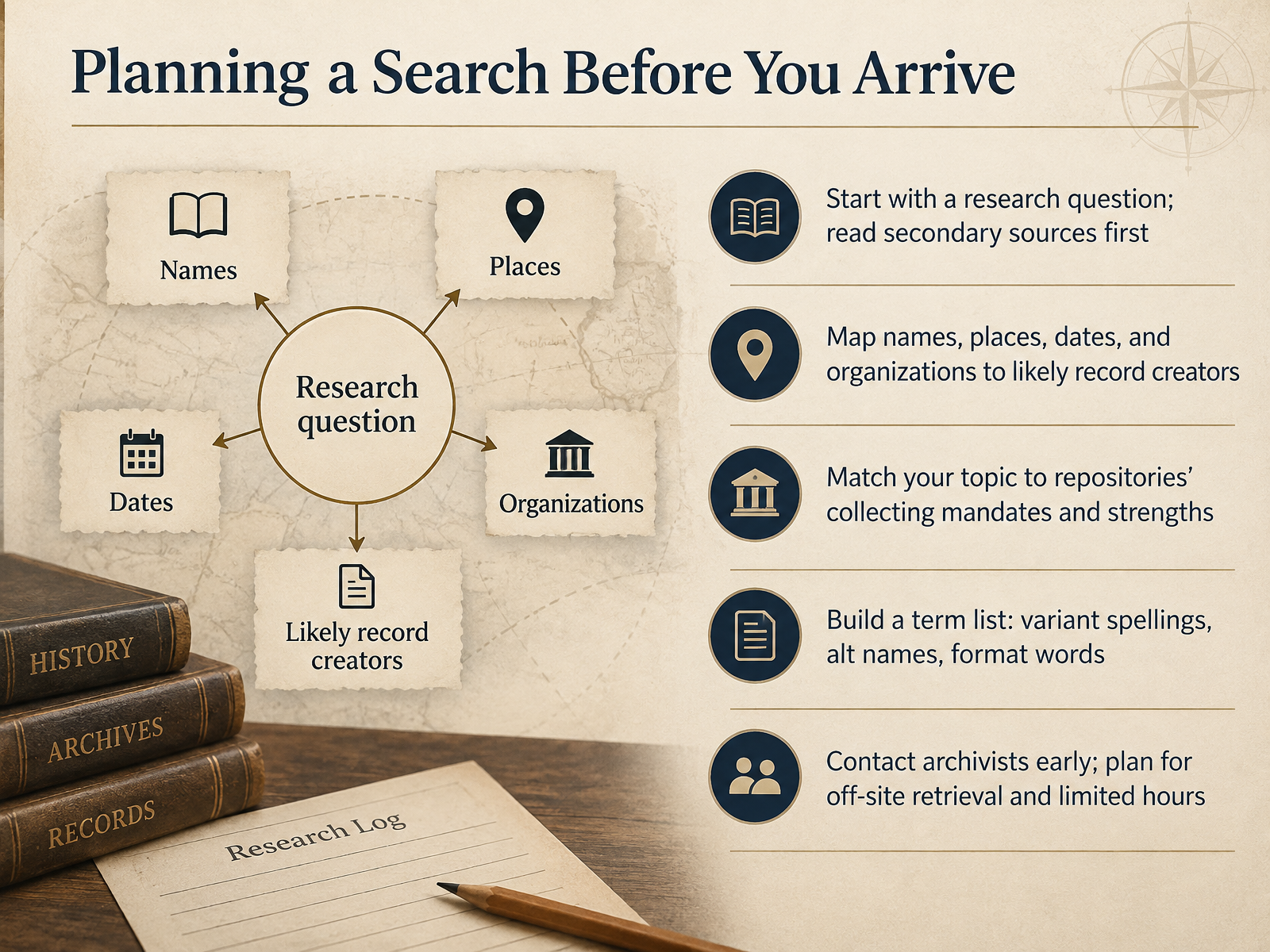
- 05Planning a Search Before You ArriveSo let's talk about planning your search before you arrive. Start with a clear research question, and read secondary sources first. They give you context and better search terms. Next, map the names, places, dates, and organizations connected to your topic, and think about who likely created those records. Then match your topic to a repository's collecting mandate. Archives have strengths and specialties, and knowing them saves time. Build a word list as you go. Include variant spellings, alternative names, and format words like correspondence or microfilm. Here is an important step. Contact the archivist early. Ask about access restrictions, limited hours, and materials stored off-site, since those can take days to retrieve. A little planning now means more time with the records later. Next, we will look at reading finding aids and catalog records.
 guides.lib.berkeley.edulibguides.mcmaster.caguides.library.cornell.edu+21 min
- 06Reading Finding Aids and Catalog RecordsLet's look at how to read a finding aid, which is your roadmap to a collection. Start with the front matter. That tells you the title, the creator, the dates, how big the collection is, the language, a short abstract, and who to contact. Next, the scope and content note. This is one of the most useful parts, because it says what is included and, just as importantly, what is not. The arrangement note then explains the order, usually describing series and subseries. After that comes the administrative information. This covers access conditions, use conditions, custodial history, and the preferred citation. Take a moment here, because these details tell you how to handle and credit the material properly. Then look at the controlled access terms. These are names, subjects, and places, and they help you find related collections you might not have thought of. Finally, watch for red flags. You may see restricted files, unprocessed collections, off-site storage, or missing container lists. If any of those appear, contact the repository before you visit. Next, we turn to finding digitized and born-digital records.
 files.archivists.orgguides.library.jhu.edunmu.edu+22 min
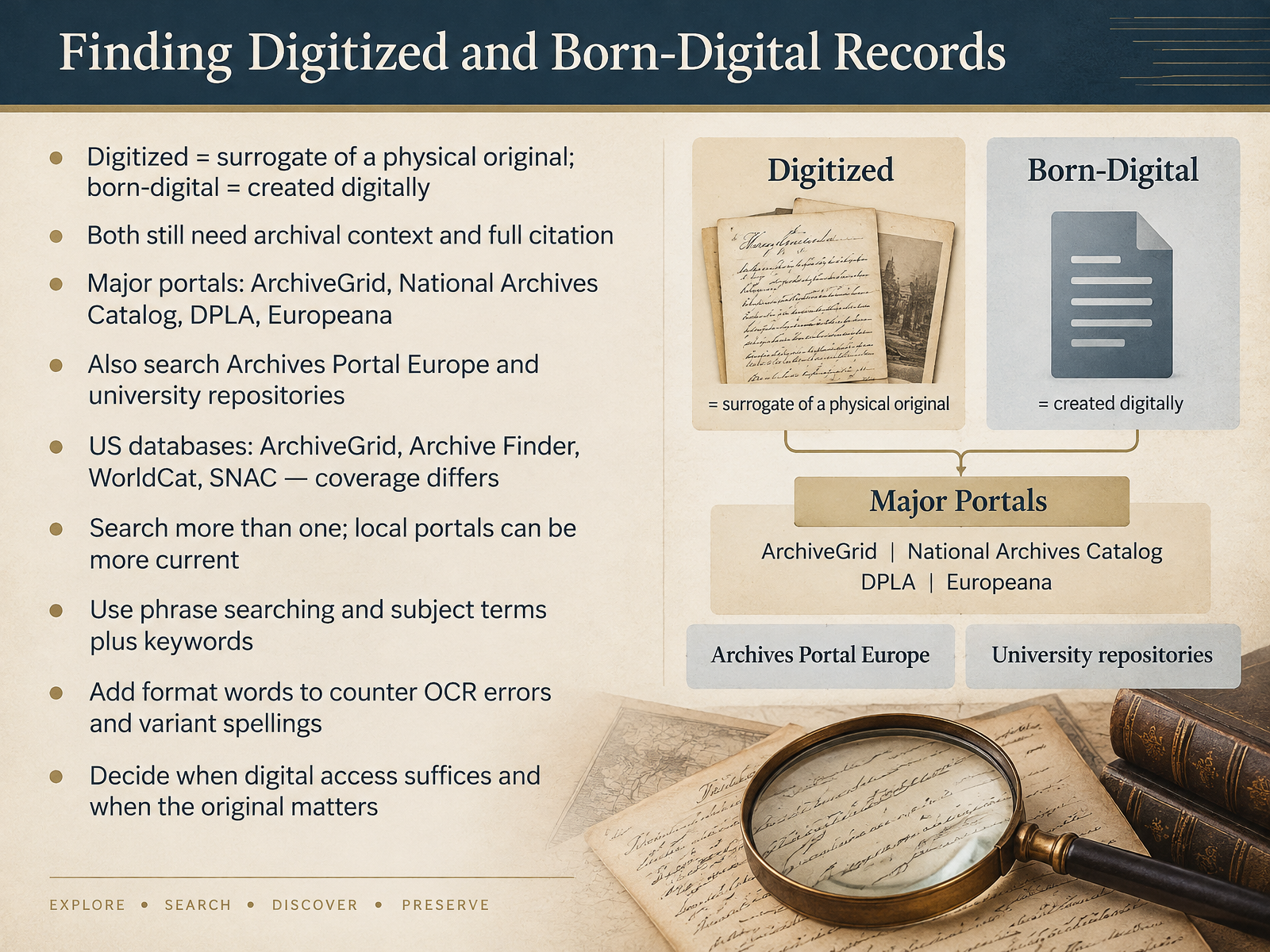
- 07Finding Digitized and Born-Digital RecordsNow let's look at finding digitized and born-digital records. A digitized record is a surrogate, a copy of a physical original. A born-digital record was created digitally from the start. Both still need archival context and a full citation, so you always know where the material came from. For major portals, start with ArchiveGrid, the National Archives Catalog, the Digital Public Library of America, and Europeana. Also search Archives Portal Europe and university repositories, which often hold unique collections. In the United States, key databases include ArchiveGrid, Archive Finder, WorldCat, and SNAC, but their coverage differs, so search more than one. Local portals can be more current than national ones. When you search, use phrase searching, subject terms plus keywords, and add format words like correspondence or microfilm to counter OCR errors and variant spellings. Finally, decide when digital access suffices and when you need to consult the original. Next, we turn to family history and genealogy in archives.
 guides.lib.berkeley.edulibguides.mcmaster.caguides.library.cornell.edu+22 min
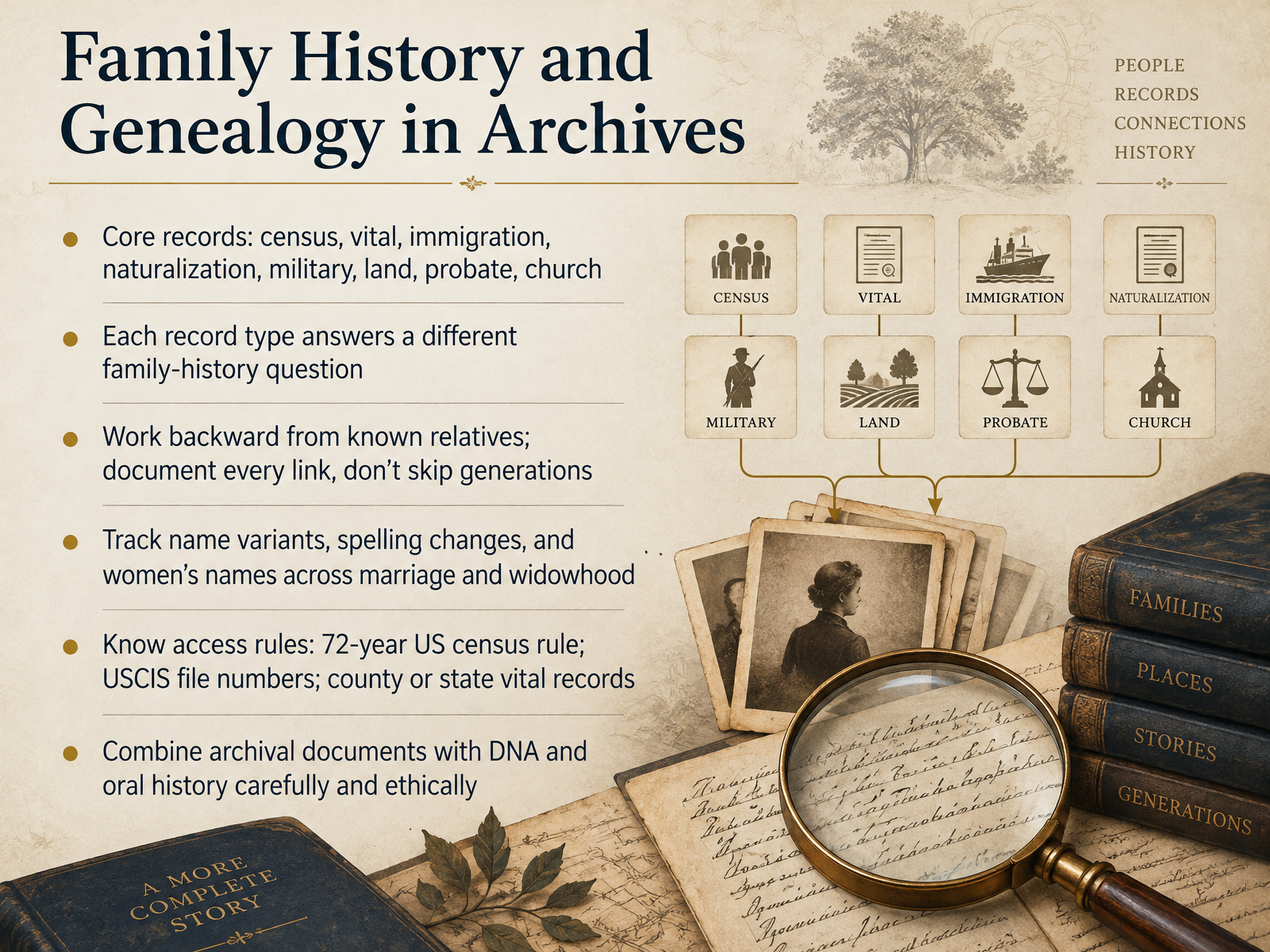
- 08Family History and Genealogy in ArchivesNow let's talk about family history and genealogy in archives. Several record types do most of the work here: census, vital, immigration, naturalization, military, land, probate, and church records. Each one answers a different question. A census places a family in a time and place. A passenger list shows a journey. A probate file can name heirs and relationships you would not find anywhere else.
Here is the method that works. Work backward from relatives you already know. Document every link, and do not skip generations. If you jump ahead, you may attach the wrong person to your tree, and unwinding that takes far longer than doing it carefully.
Expect names to shift. Watch for spelling changes and for women's names across marriage and widowhood.
And know the access rules. United States census records stay closed for seventy-two years. Immigration files from the USCIS Genealogy Program require a file number. Birth, marriage, and death records usually live with county or state agencies, not the National Archives. Combine archival documents with DNA and oral history carefully and ethically.
Next, we move on to handling physical records and reading room rules.
 archives.govcensus.govcensus.gov+22 min
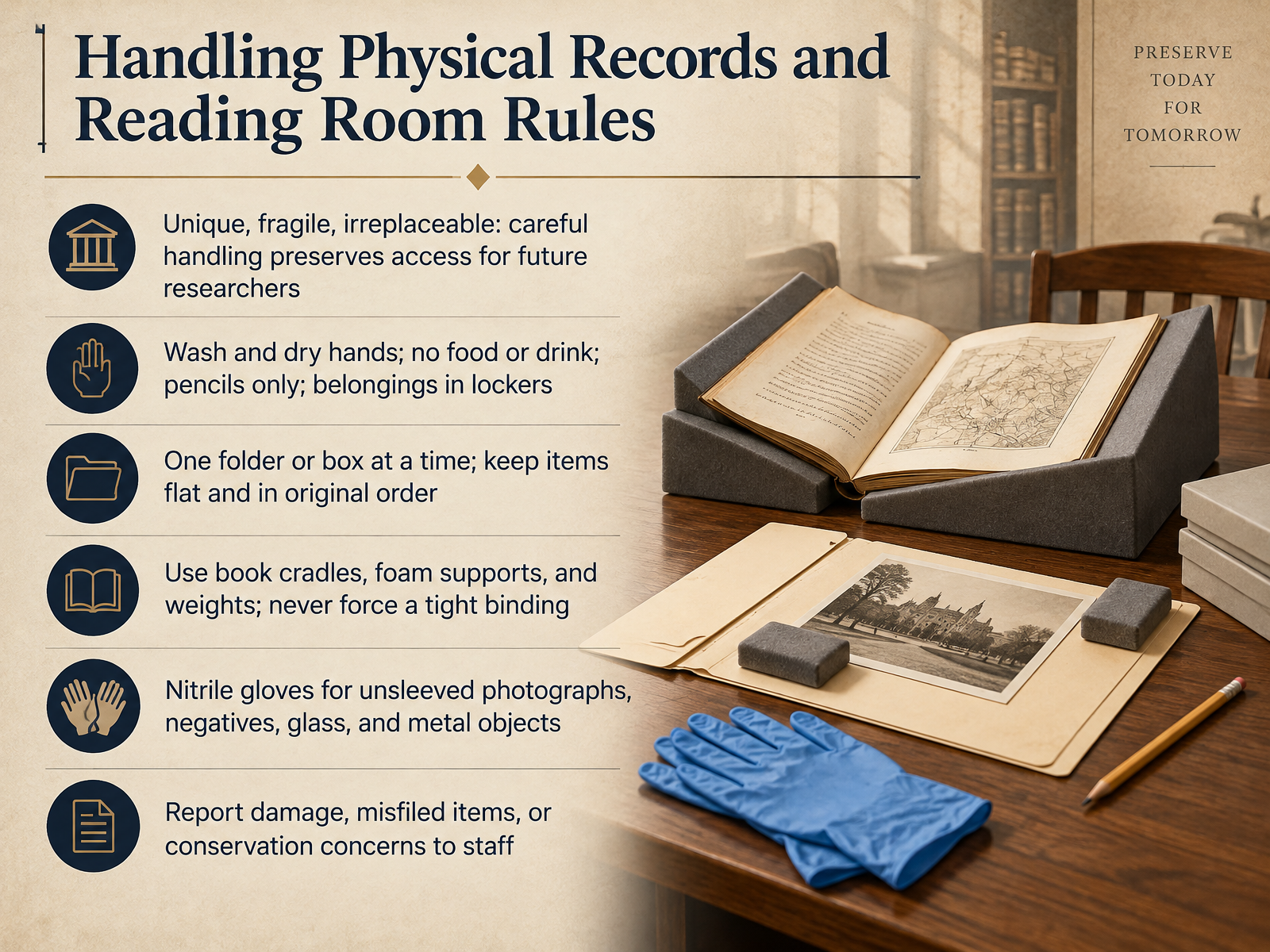
- 09Handling Physical Records and Reading Room RulesNow let's talk about handling physical records and the rules of the reading room. The documents you will work with are often unique, fragile, and irreplaceable. Your careful handling is what keeps them available for the researchers who come after you. Before you touch anything, wash and dry your hands. Food and drink stay outside. Use pencils only, never pens, and place your belongings in a locker. Take out just one folder or box at a time, keep items flat on the table, and preserve their original order. Use book cradles, foam supports, and weights so you never have to force a tight binding. Wear nitrile gloves for unsleeved photographs, negatives, glass, and metal objects. And if you notice damage, a misfiled item, or anything that worries you, report it to the staff right away. That is not a scolding. It is exactly how we protect the collection together. Next, we will look at copyright, permissions, and ethical use.
 1 min
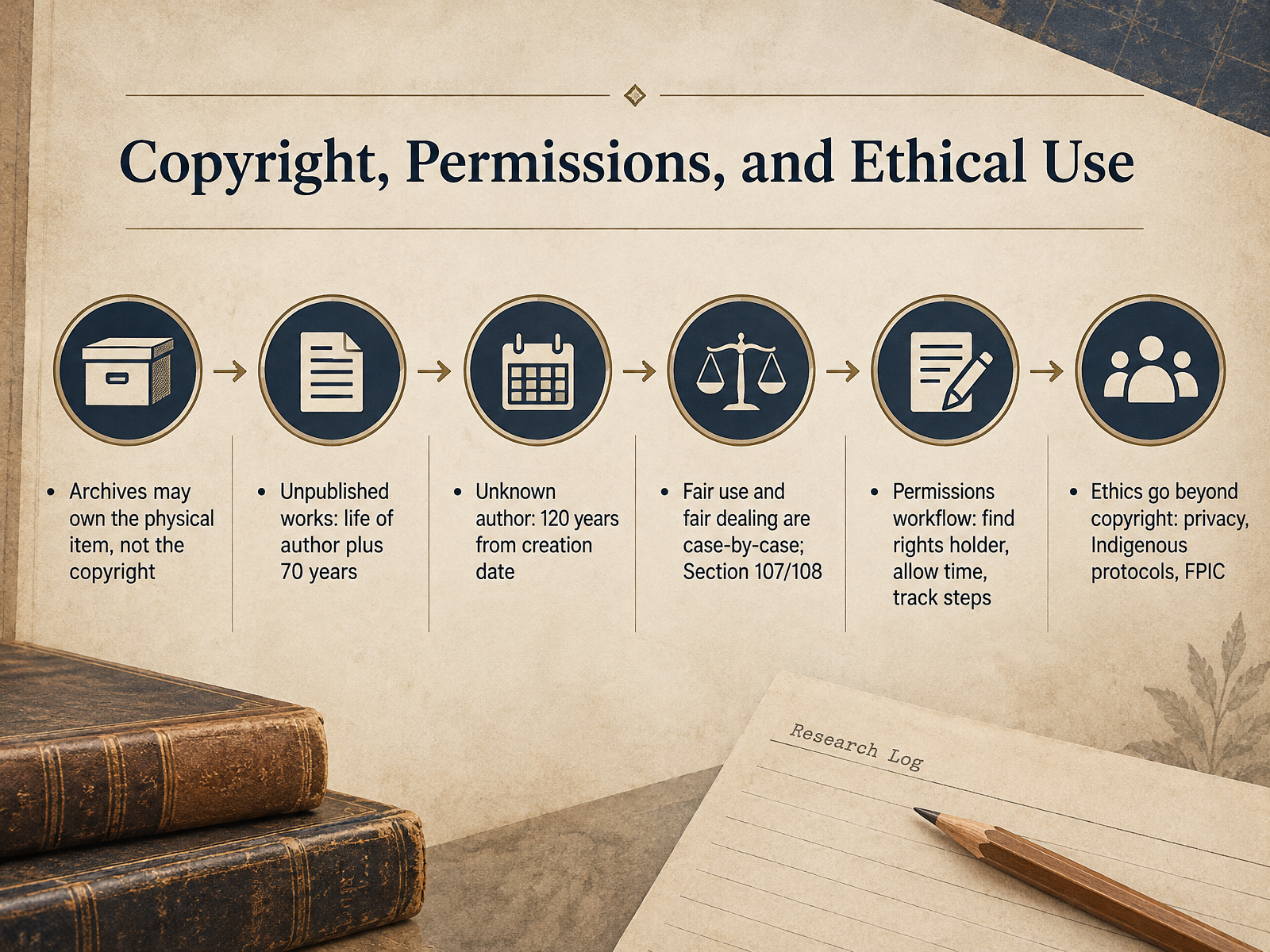
- 10Copyright, Permissions, and Ethical UseLet's talk about copyright, permissions, and ethical use. This is where good intentions meet real limits. First, remember that owning a physical item is not the same as owning its copyright. An archive can hold the letter, but the writer or their estate may still control reproduction. For unpublished works, copyright generally lasts for the life of the author plus seventy years. If the author is unknown, it usually runs one hundred twenty years from creation. Fair use and fair dealing are decided case by case, and in the United States, Sections one hundred seven and one hundred eight provide limited exceptions for research, scholarship, and preservation. When you need permission, start early. Find the rights holder, allow plenty of time, and track every step. And pause here. Ethics go beyond copyright. Privacy, Indigenous protocols, and free, prior, and informed consent all matter, even when the law says yes. Next, we'll look at citing archival sources and documenting your process.
 1 min
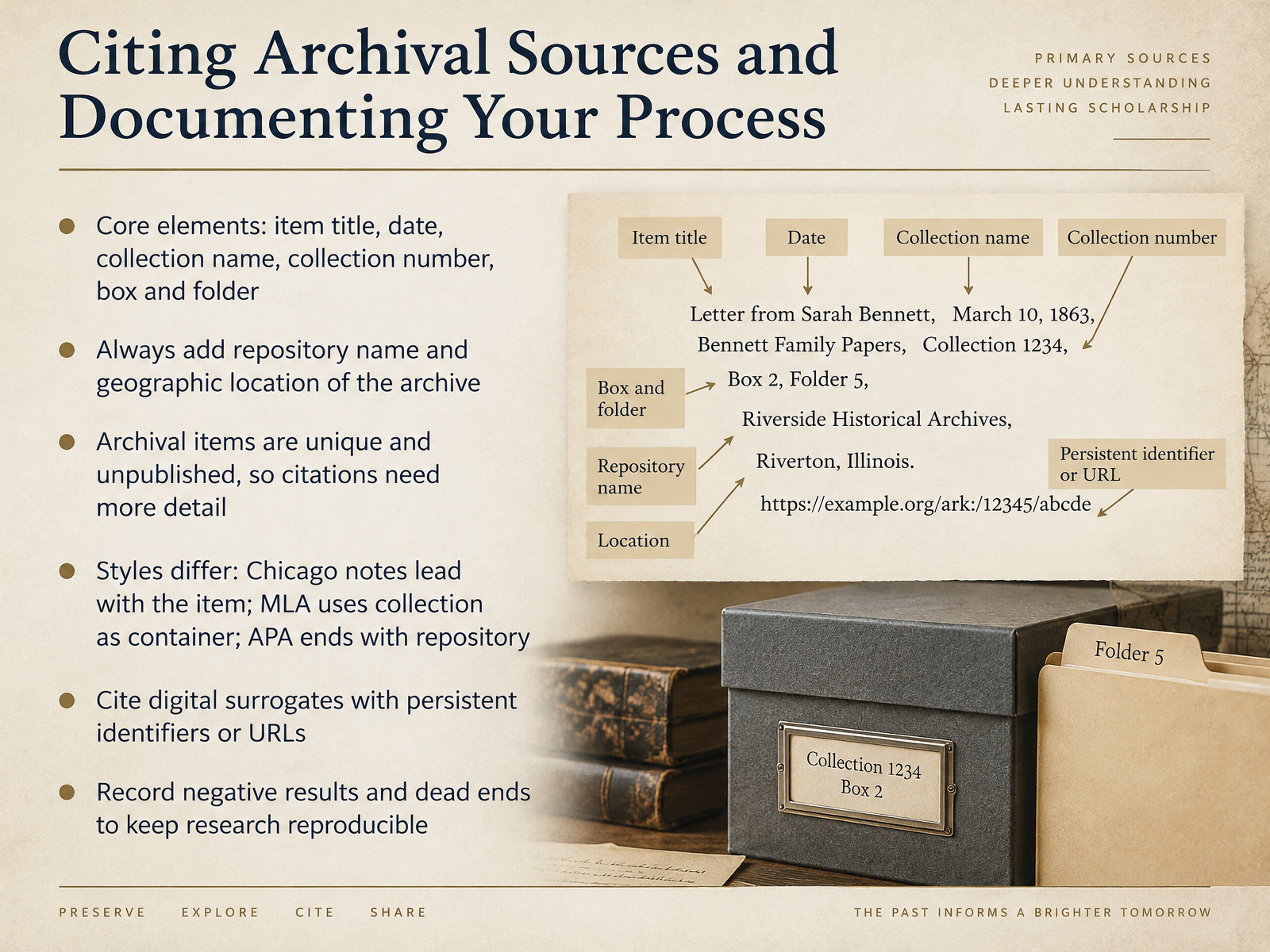
- 11Citing Archival Sources and Documenting Your ProcessNow let's talk about citing archival sources and documenting your process. Archival items are unique and unpublished, so citations need more detail than you would use for a book or an article. A strong citation includes the item title, the date, the collection name, the collection number, and the box and folder. Always add the repository name and its geographic location. Pause here and note where you found the item. That detail is what lets another researcher retrieve the exact same document. Citation styles differ. Chicago notes lead with the item. MLA treats the collection as the container. APA ends with the repository. If you are citing a digital surrogate, include a persistent identifier or URL so the link stays stable. And finally, record your negative results and dead ends. Documenting what you did not find keeps your research reproducible, and it saves the next person time. For example, a Chicago style note might read: Letter from Jane Doe to John Smith, 14 March 1910, box 2, folder 7, Jane Doe Family Papers, State University Archives, Springfield. Next, we will look at building a reusable research workflow.
 2 min
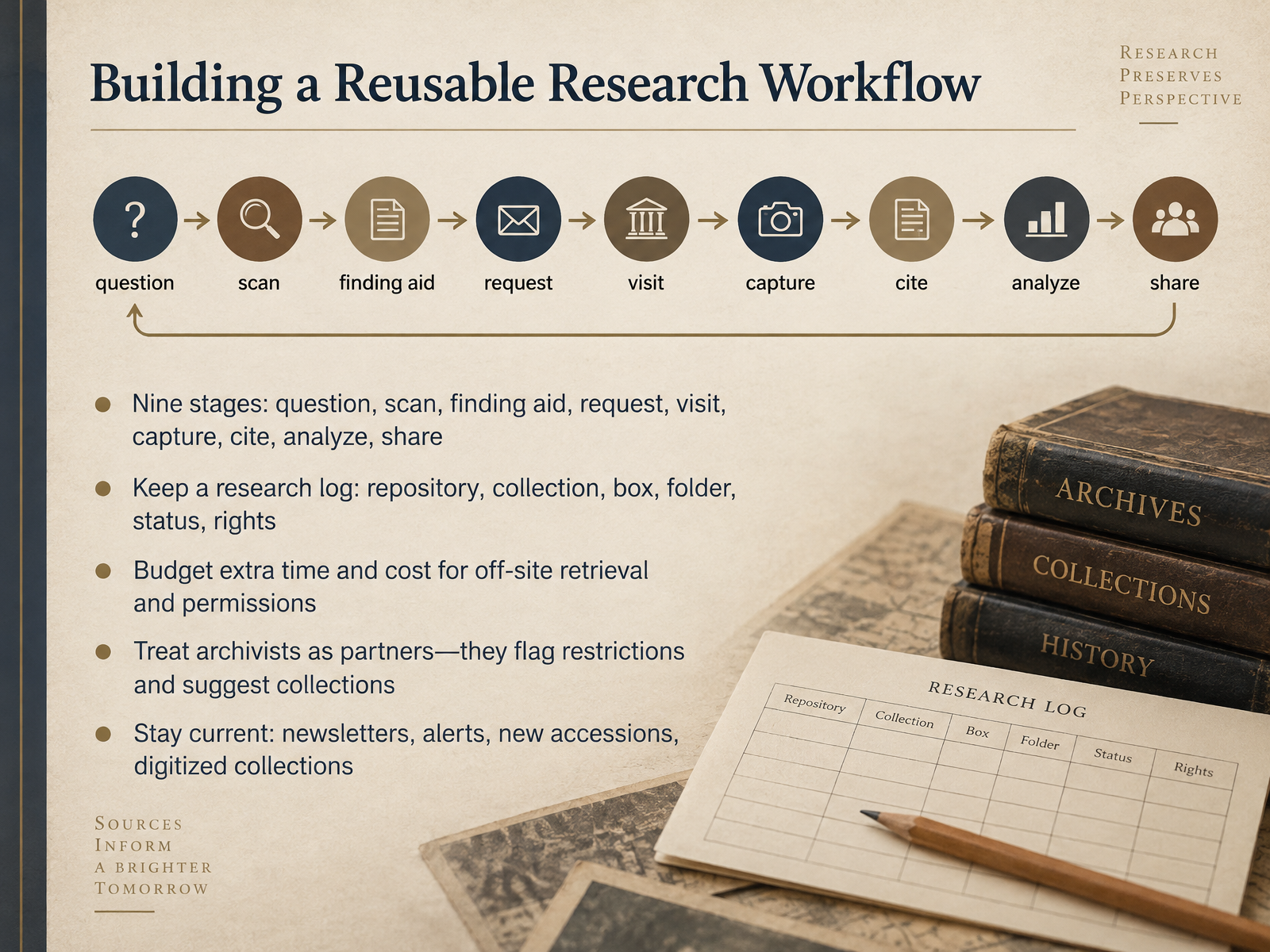
- 12Building a Reusable Research WorkflowLet's put everything together into a reusable research workflow. Think of it as nine stages: form your question, scan for repositories, read the finding aids, request materials, visit, capture what you find, cite it, analyze it, and share it. Keep a research log as you go. Record the repository, collection, box, folder, status, and rights for every item. Then budget extra time and cost for off-site retrieval and permissions, because both can take days or weeks. And treat archivists as partners. They flag restrictions and often suggest collections you would never have found alone. Finally, stay current. Follow newsletters, alerts, new accessions, and digitized collections. That is how your workflow keeps getting better. Next, let's practice building one from a real research question in Hands-On Practice: From Research Question to Citation.
 guides.lib.berkeley.edulibguides.mcmaster.caguides.library.cornell.edu+22 min
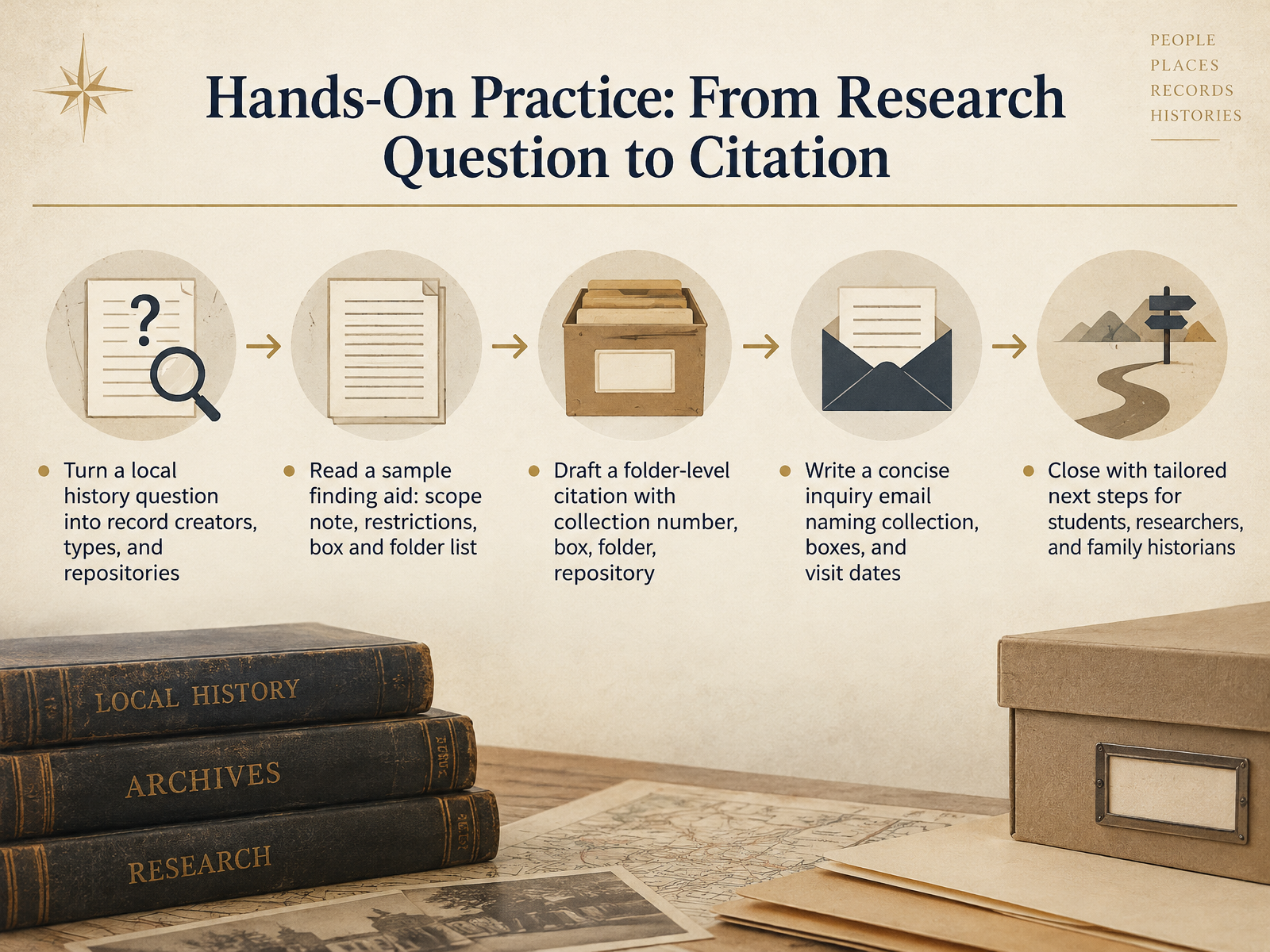
- 13Hands-On Practice: From Research Question to CitationLet's bring everything together with some hands-on practice. Start with a local history question, then work backward to the record creators, the types of records they left, and the repositories that hold them. Next, open a sample finding aid and read three parts closely: the scope note, the access restrictions, and the box and folder list. That tells you what exists and what you can actually see. Now draft a folder-level citation. Include the collection number, box, folder, and repository. For example: a letter dated 1910, box 4, folder 12, Smith Family Papers, MC 218, City History Archive. Keep that format consistent, and citing your sources becomes much easier. Then write a short inquiry email. Name the collection, the boxes you want, and your visit dates, and send it a few days ahead. Archival research can feel slow, and that is normal. Be patient, be specific, and be kind to the people and the records. To close, choose your next step: students, confirm your citation style with your instructor. Researchers, build your box list before you travel. Family historians, gather names, places, and dates first. Thank you for learning with me. You now have a clear path from question to citation, so go and put it to work. Good luck with your research.
 guides.lib.berkeley.edulibguides.mcmaster.caguides.library.cornell.edu+22 min
Take the deck with you
Download this course as a file — free, no sign-up needed.
- PDF handoutEvery slide page, ready to print or share.14 pages · 4.9 MBDownload
- Narrated PowerPointThe deck that presents itself — every slide carries the digital human's narration video.14 pages · 15.7 MBDownload
- PowerPoint slidesThe full deck as a .pptx — open it in PowerPoint, Keynote, or Google Slides.14 pages · 4.9 MBDownload
Free to use in your own training — please keep the PersonWise credit page at the end.
Have your own deck? Turn it into a course
Sources consulted
Web sources consulted while building this course.
- Describing Archives : A Content Standard — files.archivists.org
- Processing - Special Collections & University Archives Best Practices Manual - Guides at Johns Hopkins University — guides.library.jhu.edu
- Arrangement & Description — nmu.edu
- Physical Processing — www2.mnhs.org
- Archival Processing Manual — rit.edu
- What Are Archives and How Do They Differ from Libraries? | Society of American Archivists — www2.archivists.org
- Utilizing Archives - Introduction to Primary Source Research - Library Research Guides at Indiana University — guides.libraries.indiana.edu
- Differences between archives and libraries - Archival Research Tutorial - LibGuides at York University — researchguides.library.yorku.ca
- Getting Started - Research Using Primary Sources - Research Guides at University of Maryland Libraries — lib.guides.umd.edu
- What are Archives? — archiveshub.jisc.ac.uk
- How to plan your visit to an archive - Introduction to Primary ... — guides.lib.berkeley.edu
- The Archival Research Process Part 1: Before you visit the archives - A Guide to Archival Research - McMaster LibGuides at McMaster University — libguides.mcmaster.ca
- Preparing in Advance - Tools & Techniques for Archival Research - LibGuides at Cornell University — guides.library.cornell.edu
- Preparing to Search - Getting Started with Archives - Research Guides at New York Public Library Research Centers — libguides.nypl.org
- Using Archives — files.archivists.org
- Frequently Asked Questions | National Archives — archives.gov
- Genealogy FAQs — census.gov
- The 72-Year Rule — census.gov
- Searching the Index Frequently Asked Questions | USCIS — uscis.gov
- Requesting Records | USCIS — uscis.gov