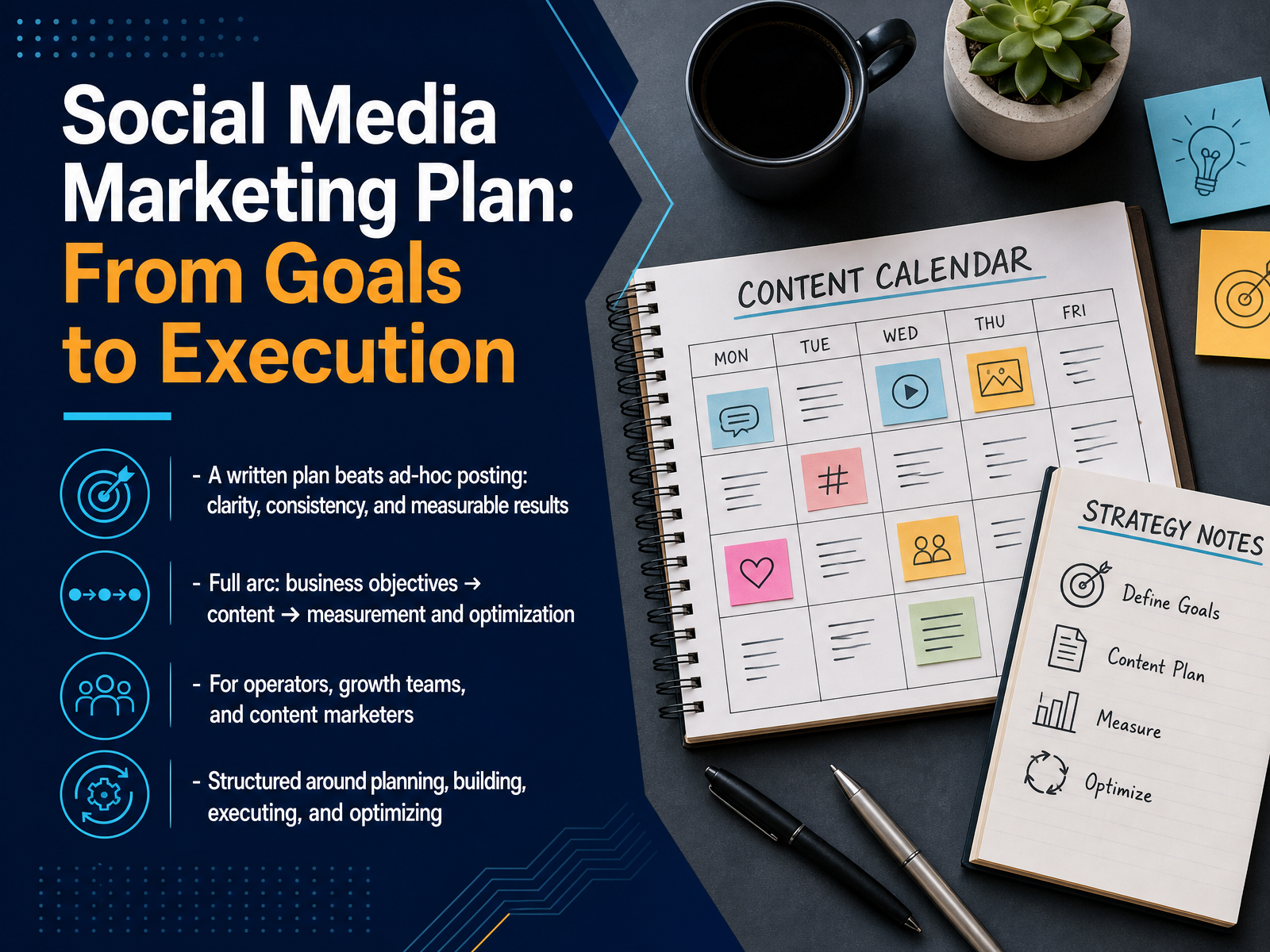
Social Media Marketing Plan Execution
Begin
14 pages · ~28 min
Social Media Marketing Plan Execution
Develop a strategic social media marketing plan from goal setting through content creation and performance measurement for professionals seeking a practical, step-by-step approach.
What you’ll learn
- 01Social Media Marketing Plan: From Goals to ExecutionWelcome. If you are here, you already know that posting on a whim is not a strategy. It is a gamble. The brands winning on social today are not the loudest; they are the most deliberate. This course is built to take you from scattered activity to a streamlined system. We are going to cover the entire arc, from tying social goals to real business objectives, to building a content engine, to measuring what actually matters and optimizing. Whether you are an operator, on a growth team, or in content marketing, the goal here is practical. Everything we discuss needs to translate into an operational task you can execute this week. So, let us stop guessing and start building. First, we need to understand why a structured plan consistently beats spontaneous posting. That is exactly where we are headed next.blog.hootsuite.comblog.hubspot.combuffer.com+21 min
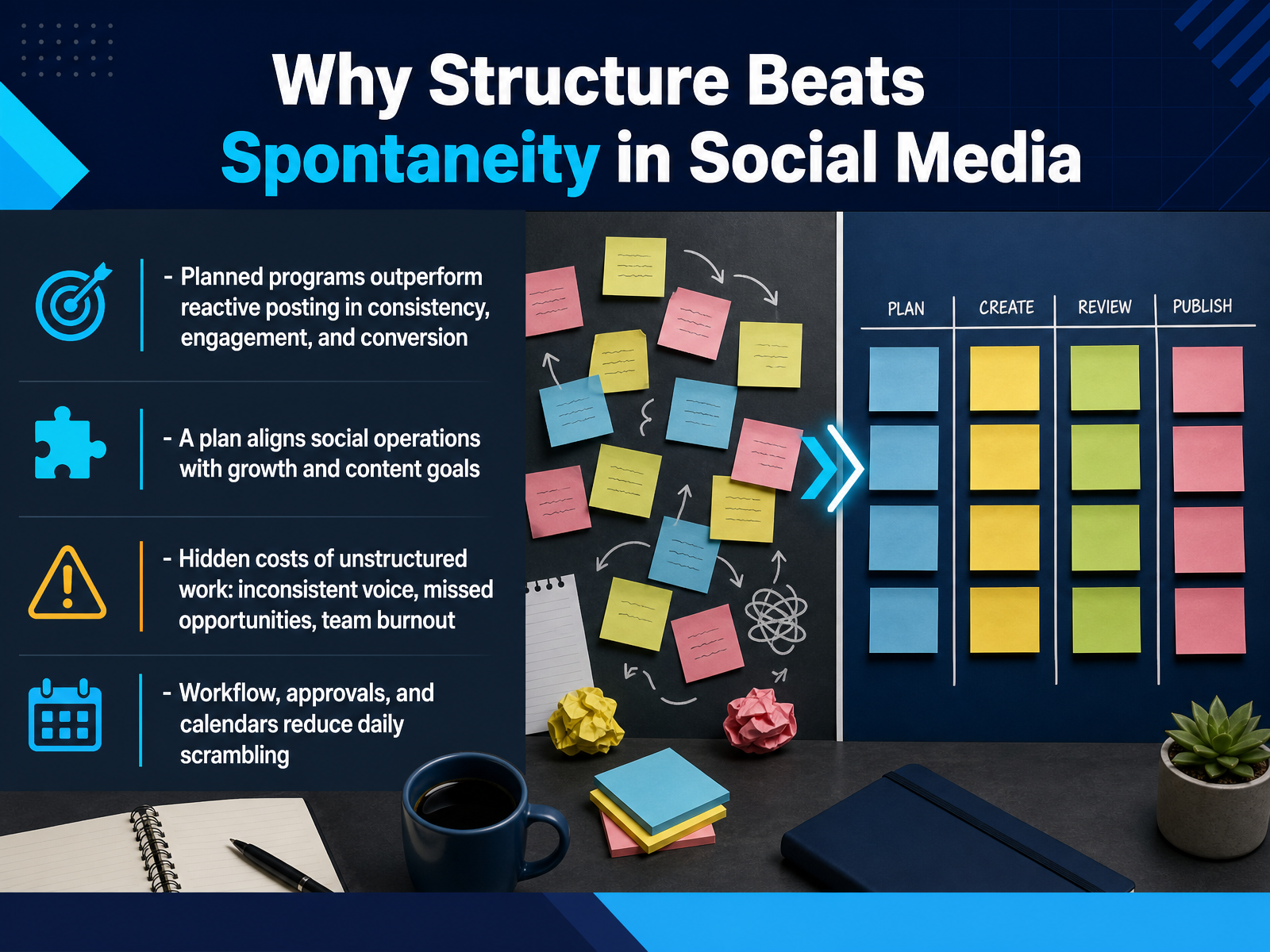
- 02Why Structure Beats Spontaneity in Social MediaLet’s be honest: reactive posting might fill the calendar, but it rarely fills the pipeline. Structure beats spontaneity. Planned programs consistently outperform reactive posting across engagement, reach, and conversion. A documented plan is the connective tissue between your daily posts and your growth targets. Without it, you’re exposed to hidden costs. An inconsistent brand voice confuses your audience, you miss timely opportunities, and your team burns out chasing last-minute requests. The fix is operational. Set up clear workflows, a defined approval process, and a content calendar. This isn’t about stifling creativity; it’s about freeing it up so your team can focus on crafting high-impact content instead of scrambling for what to post today. Now, let’s align that structure with your broader business objectives and translate them into concrete social media goals.
 7milemedia.comsocinator.comcontentstudio.io+22 min
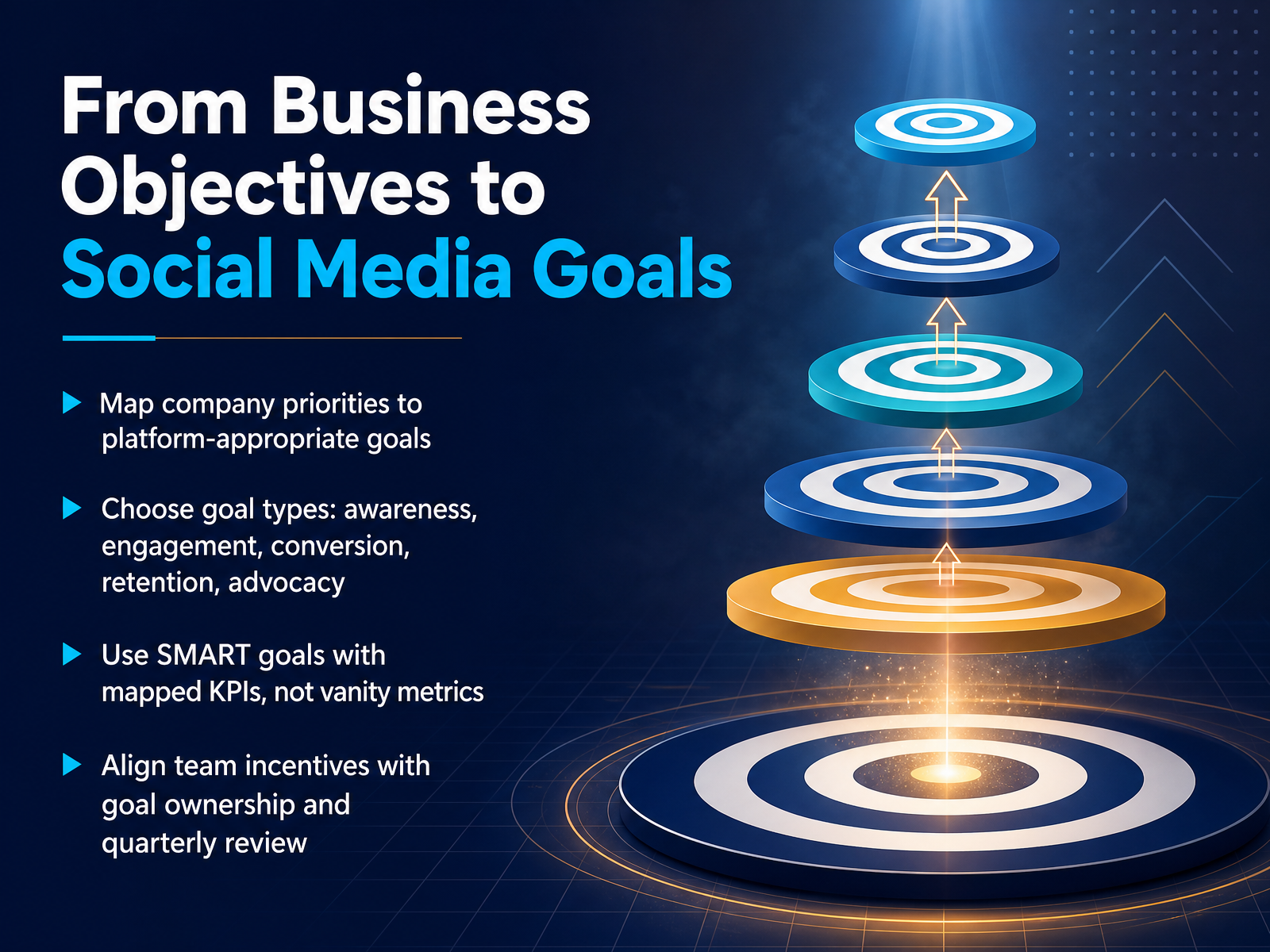
 - 03From Business Objectives to Social Media GoalsLet's make this practical. Before you publish another post, map your company's priorities to the metrics that actually move the needle. Start by choosing a goal type: awareness, engagement, conversion, retention, or advocacy. Each maps to a different stage of the funnel, and each demands a different KPI. Don't say 'grow engagement.' Say 'increase Instagram engagement rate from 2 percent to 4 percent by the end of the quarter.' That's a SMART goal—specific, measurable, achievable, relevant, and time-bound. Also, be honest about the vanity metrics. Likes and follower counts are not business outcomes. Tie team incentives to goal ownership. One person owns lead generation from LinkedIn, another owns customer response time. Review progress quarterly. Then ask, what does this mean for tomorrow's content calendar? That's how execution stays aligned. Now, let's sharpen focus with audience, competition, and positioning.
 blog.hootsuite.comismartcom.comsocialrails.com+22 min
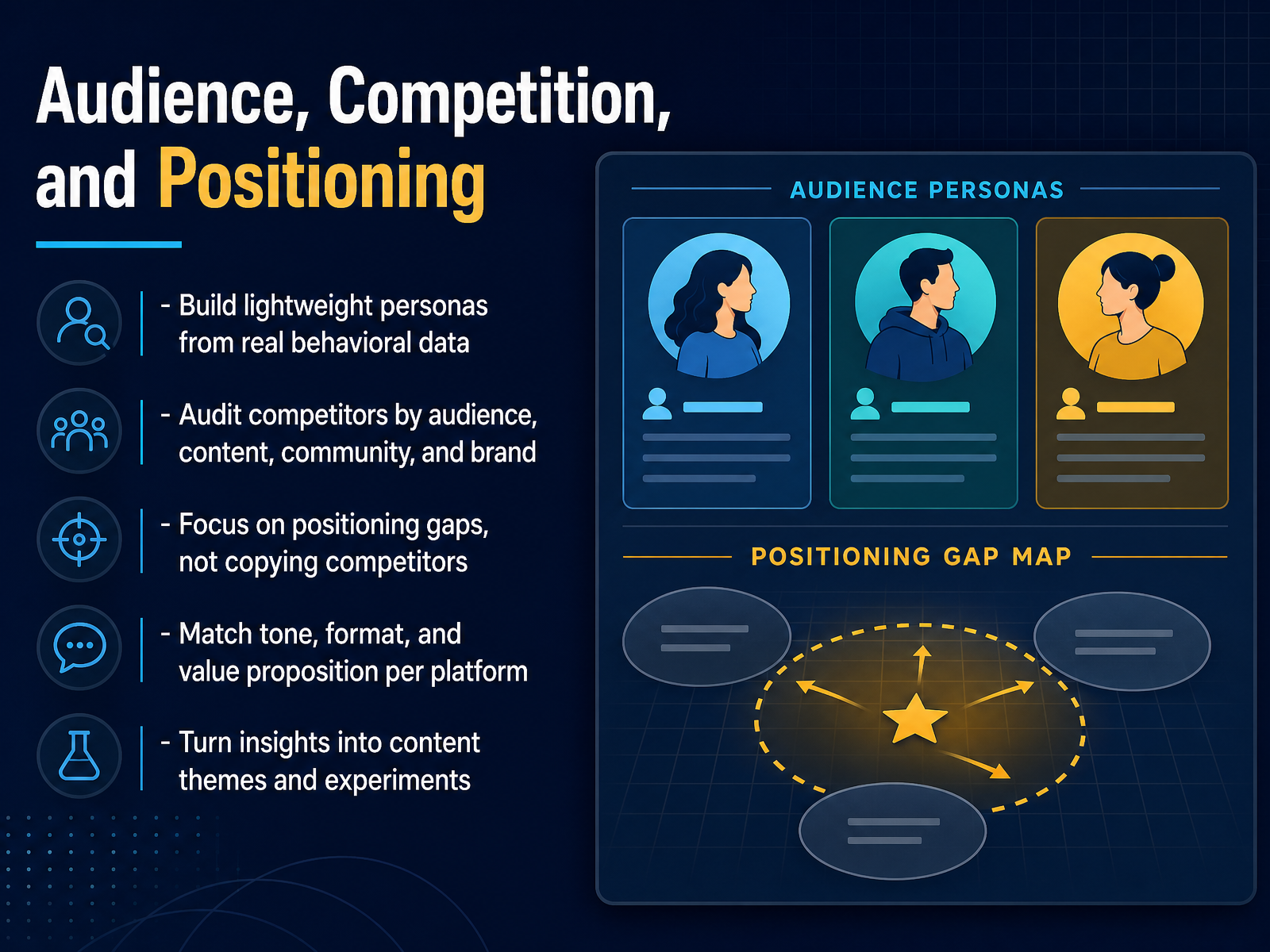
 - 04Audience, Competition, and PositioningNow let’s get into the strategic foundation: audience, competition, and positioning. Start by building lightweight personas from real behavioral data, not guesswork. Look at how your audience actually engages, what they save, what they comment on. Then audit competitors across four dimensions: audience, content, community, and brand. Check their growth rate, not just follower counts. Note their formats, topics, and posting cadence. See how quickly they respond to comments and what their visual identity signals. The key is to focus on positioning gaps, not copying what they do. If they dominate educational carousels, maybe you win with quick, personality-driven videos. Match your tone, format, and value proposition to each platform. A formal whitepaper style won’t land on TikTok, just as a meme approach won’t work on LinkedIn. Turn your insights into content themes and experiments. Every finding should lead to a test you can measure. That’s how you move from analysis to action. Next, we’ll map those insights to platform selection and channel strategy.
 hootsuite.comwordstream.comrivaliq.com+22 min
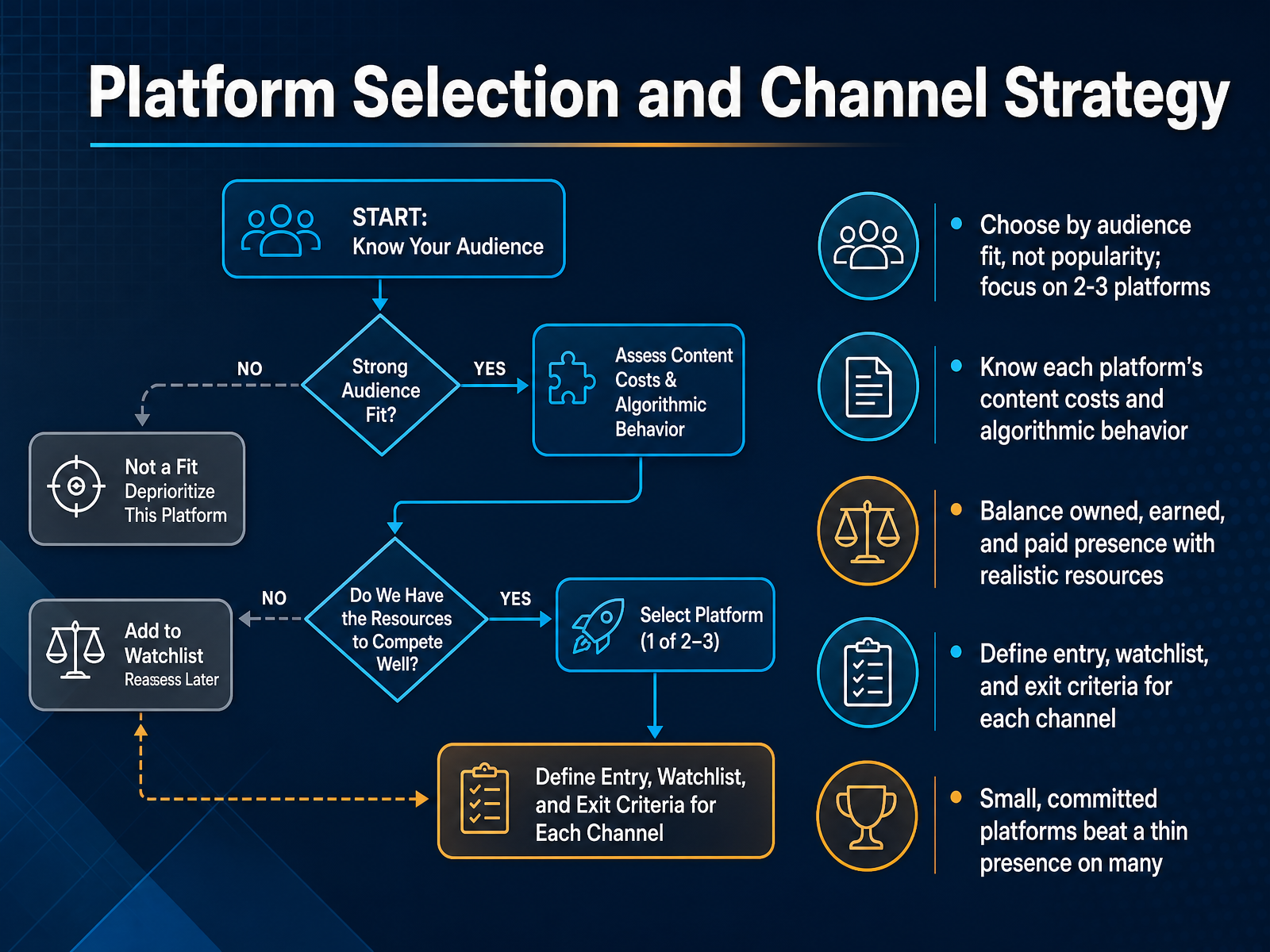
 - 05Platform Selection and Channel StrategyNow let's talk about where you'll actually show up. Platform selection is a resource allocation problem, not a popularity contest. Every platform you add has a real cost: creation time, editing, scheduling, and the mental overhead of tracking one more context. That's why 94 percent of successful creators we analyzed focus on one to two primary platforms. Choose by audience fit first. Where does your buyer actually spend time in a professional or discovery mindset? Not where everyone is. Then, consider content costs. A text platform like LinkedIn charges far less per post than a video-heavy TikTok or YouTube channel. Measure your effort price against your team's real capacity. And don't forget the balance of owned, earned, and paid presence. You need realistic resources to sustain all three. Now, define your entry, watchlist, and exit criteria for each channel. Document them. What evidence triggers adding a new platform? What KPIs would prompt you to deprioritize an active one? And critically, commit to a small, focused set. Two or three platforms done well will always beat a thin presence on six. Remember, consistent accounts earn 450 percent more engagement per post than sporadic ones. So, be reliably somewhere. Next, we'll move into defining your content pillars and building sustainably repeatable formats.
 7milemedia.comsocinator.comcontentstudio.io+22 min
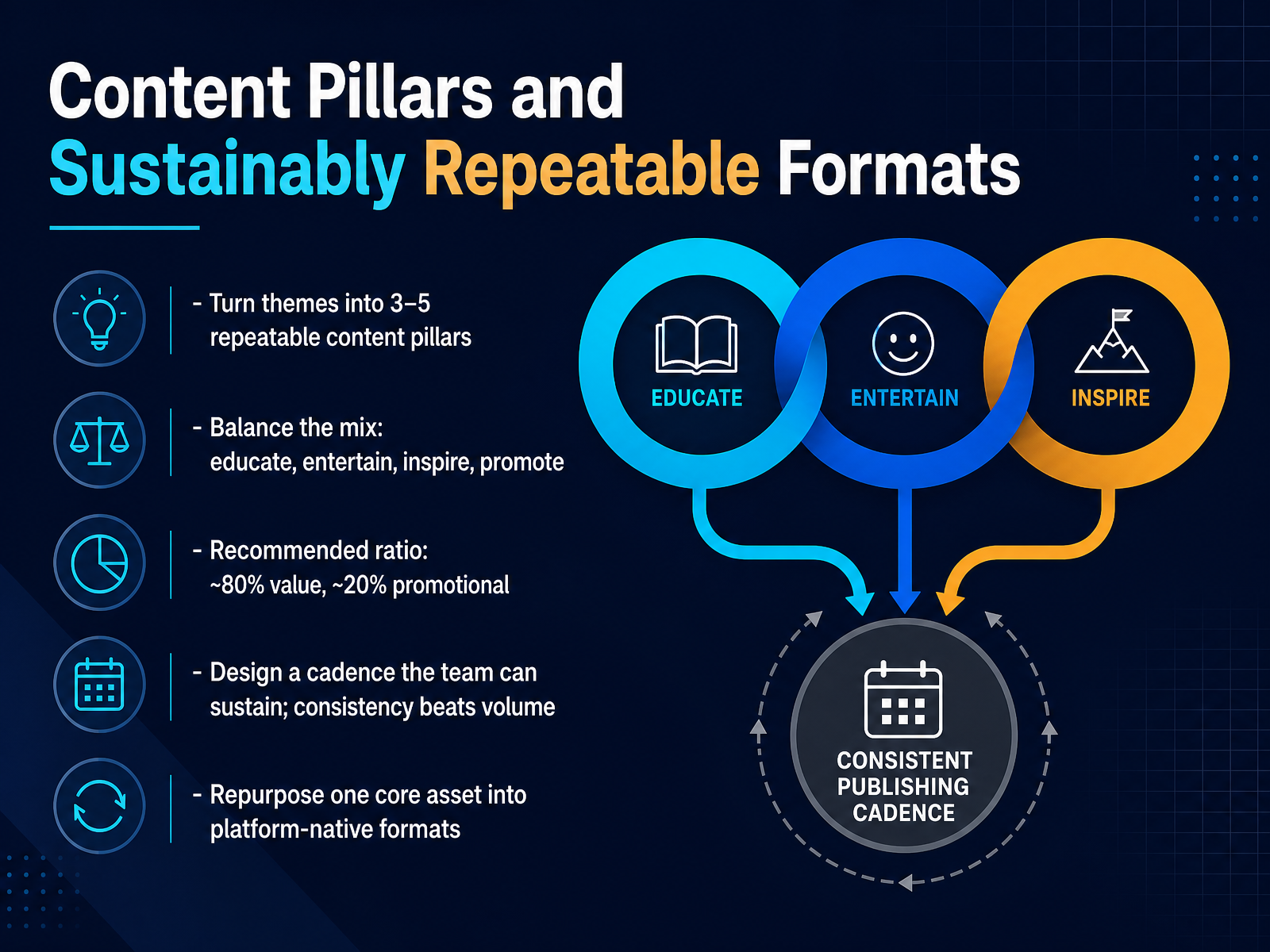
 - 06Content Pillars and Sustainably Repeatable FormatsNow let's turn your themes into a content system that actually holds up. Here's the rule: define three to five repeatable content pillars. Think of them as the recurring shows your brand runs. Each pillar gets a fixed place in the mix: educating your audience, entertaining them, inspiring them, and yes, promoting. The sustainable ratio is roughly eighty percent value, twenty percent promotional. That's the margin that keeps your reach from collapsing while still feeding the funnel. Now, the cadence is where strategy meets reality. Set a rhythm your team can actually sustain. Consistency beats volume every time. Three strong posts a week for a year outperform daily output that burns out in ninety days. Finally, design for reuse. Repurpose one core asset across platforms. One long video becomes short clips, a carousel, and a quote graphic. You save production time and keep the message coherent. Stay repeatable, stay balanced, and you won't reinvent the wheel every Monday. Next, we'll build the execution calendar and workflow to make this system run on autopilot.
 7milemedia.comsocinator.comcontentstudio.io+21 min
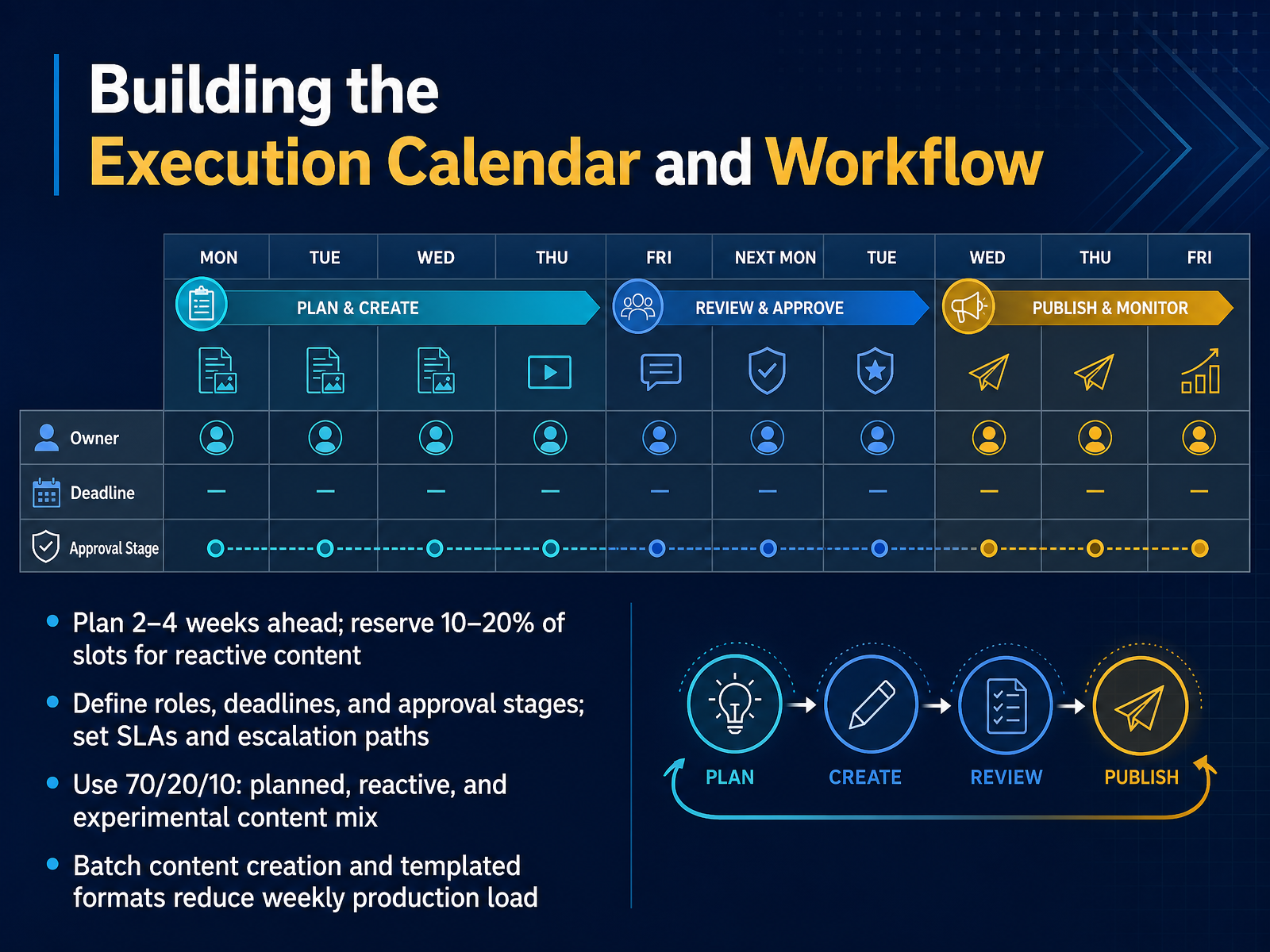
 - 07Building the Execution Calendar and WorkflowNow let's turn strategy into execution. The calendar is where your plan becomes a workflow. Start by planning two to four weeks ahead. That gives your team enough lead time for design and approvals without locking you in too far. But leave ten to twenty percent of slots open for reactive content. Trends move fast, and your calendar needs to move with them. Use the seventy-twenty-ten split: seventy percent planned, twenty percent reactive, ten percent experimental. That preserves consistency while leaving room for creative risks. Next, define ownership. Every post needs an owner, a deadline, and an approval stage. If approvals take more than twenty-four hours, simplify the process. Set clear SLAs and escalation paths so nothing stalls in limbo. Finally, batch your production. Dedicate one block to content creation, another to design, another to scheduling. Use templates for recurring formats. This cuts your weekly production load dramatically. A flexible, well-defined calendar keeps your team consistent and responsive. Now let's look at how we measure what matters, report it, and build learning loops into the system.
 7milemedia.comsocinator.comcontentstudio.io+22 min
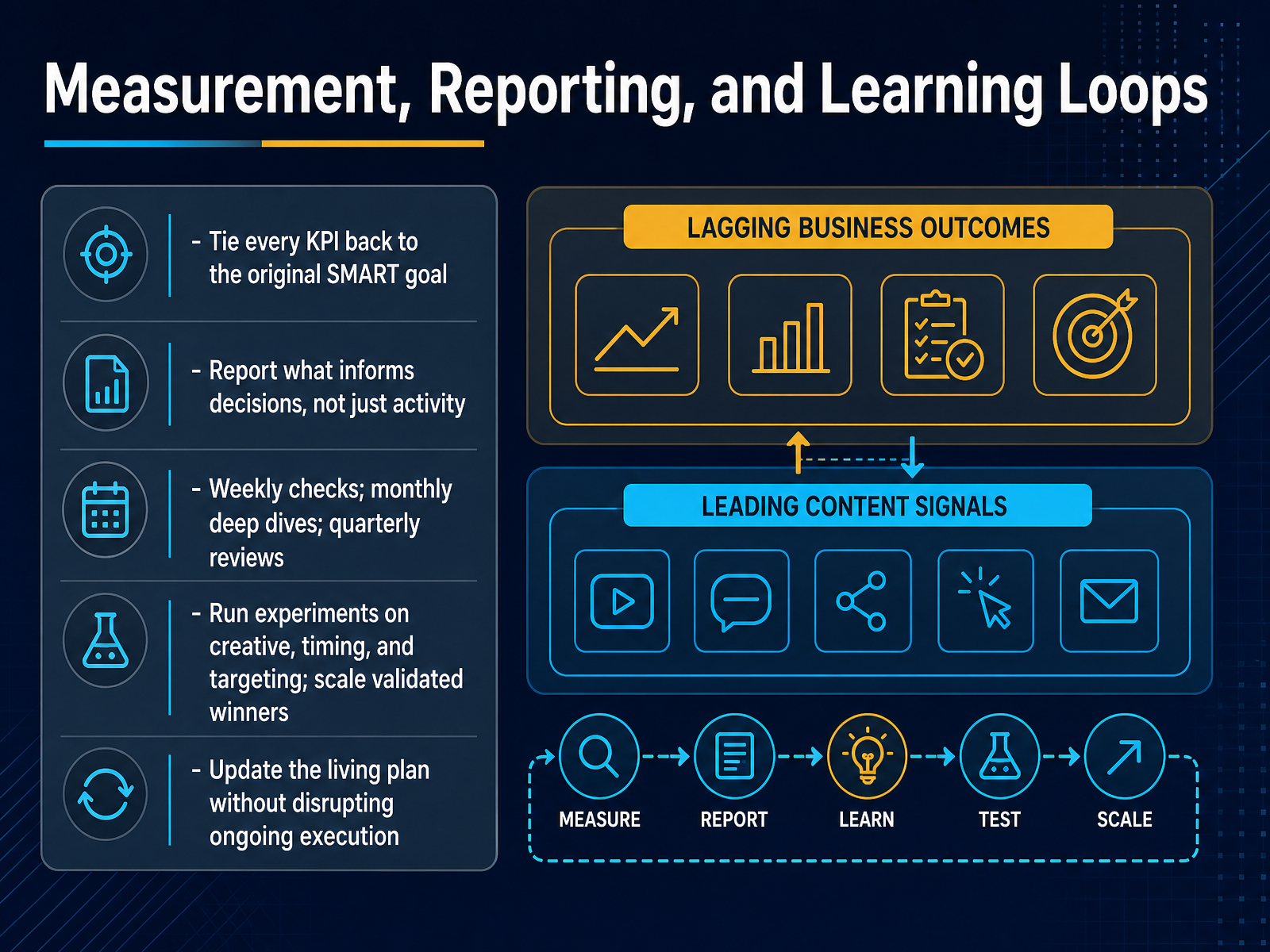
 - 08Measurement, Reporting, and Learning LoopsLet's talk about measurement, reporting, and learning loops, because this is where strategy gets honest. Every KPI on your dashboard needs to trace back to the original SMART goal. No exceptions. If a metric doesn't inform a decision, it's just a vanity number. Report what drives action, not just activity. Instead of showing raw likes, highlight the insight: this format outperformed by forty percent, so we're doubling down on it next month. Structure your cadence like this. Weekly checks to spot anomalies and pivot quickly. Monthly deep dives to assess what's working against your targets. And quarterly reviews to step back, reassess benchmarks, and update the plan itself. Now, run experiments on creative, timing, and targeting. Don't just post; test. One variable at a time. When something wins, allocate more budget to it. Scale validated winners. And remember to keep the live plan as a living document. Update it without disrupting ongoing execution. The goal is to improve the system, not to throw it out every week. Here's the team takeaway: every report should answer three questions. What happened? Why do we think it happened? And what are we changing because of it? If you can't answer the third question, you're documenting history. Next, we'll look at how to allocate budget, choose tools, and structure team capabilities to support this measurement framework.
 blog.hootsuite.comblog.hubspot.combuffer.com+21 min
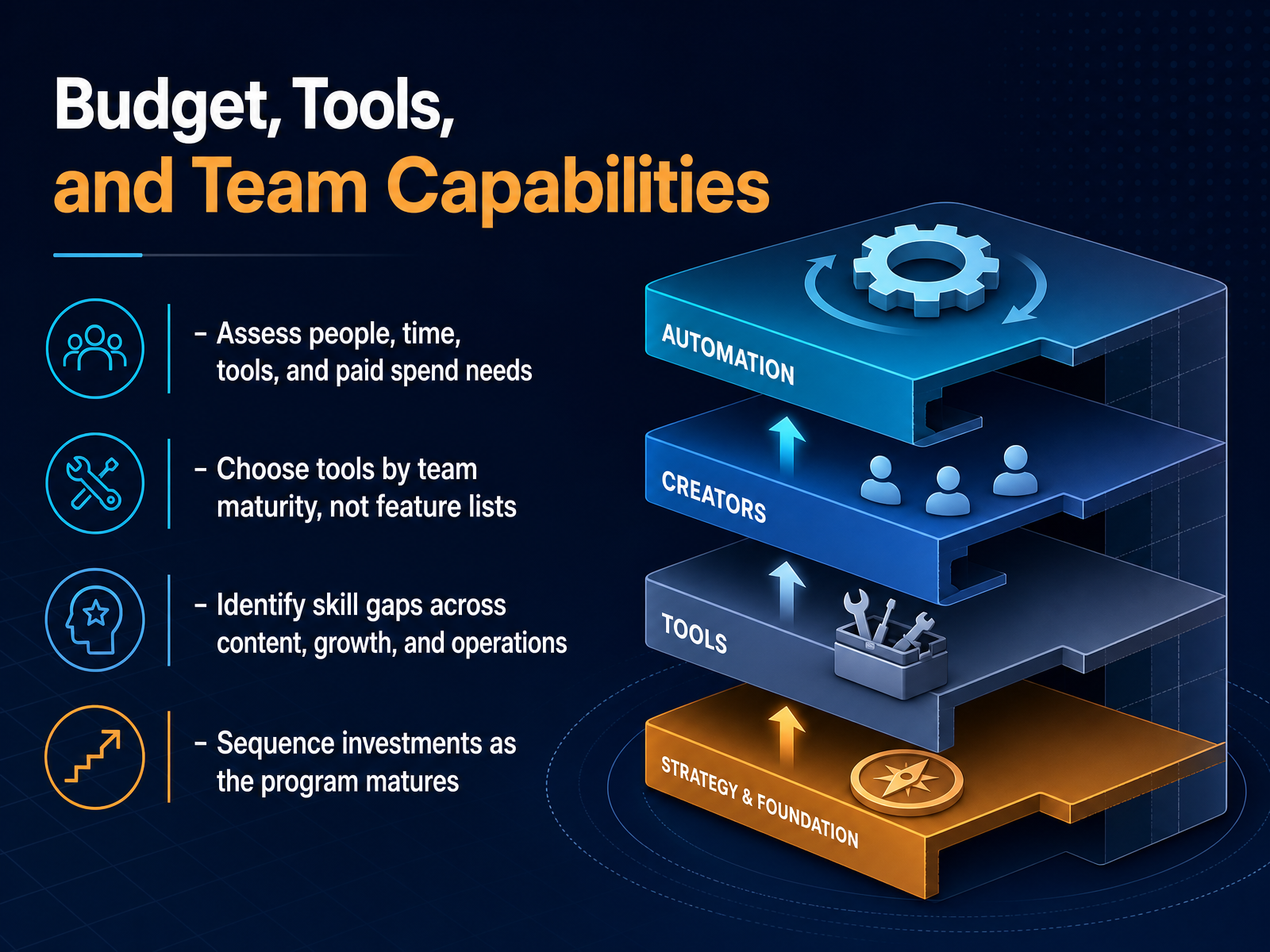
 - 09Budget, Tools, and Team CapabilitiesLet's talk about the operational reality check: budget, tools, and team capabilities. Because the best plan on paper fails if the team can't execute it. Start by assessing people, time, tools, and paid spend. Don't guess. Map your weekly production tasks and count the hours they actually take. Here's the key decision rule: choose tools by team maturity, not by feature lists. A solo operator needs speed and simplicity. A team of five needs governance, permissions, and reporting depth. Buffer and Sprout Social are both solid, but they solve different problems — one is fast and light, the other is enterprise-grade. Pick the one that matches your workflow, not their marketing page. Next, identify the skill gaps across content, growth, and operations. In 2026, that often means prompt engineering and AI editing skills, not just copywriting and design. Finally, sequence your investments as the program matures. Don't buy an enterprise listening tool before you have a consistent publishing rhythm. Start lean, prove the workflow, then scale the stack. This discipline keeps your budget aligned with actual needs, not aspirational ones. Next, we'll cover launch, governance, and rapid response.
 blog.hootsuite.comblog.hubspot.combuffer.com+22 min
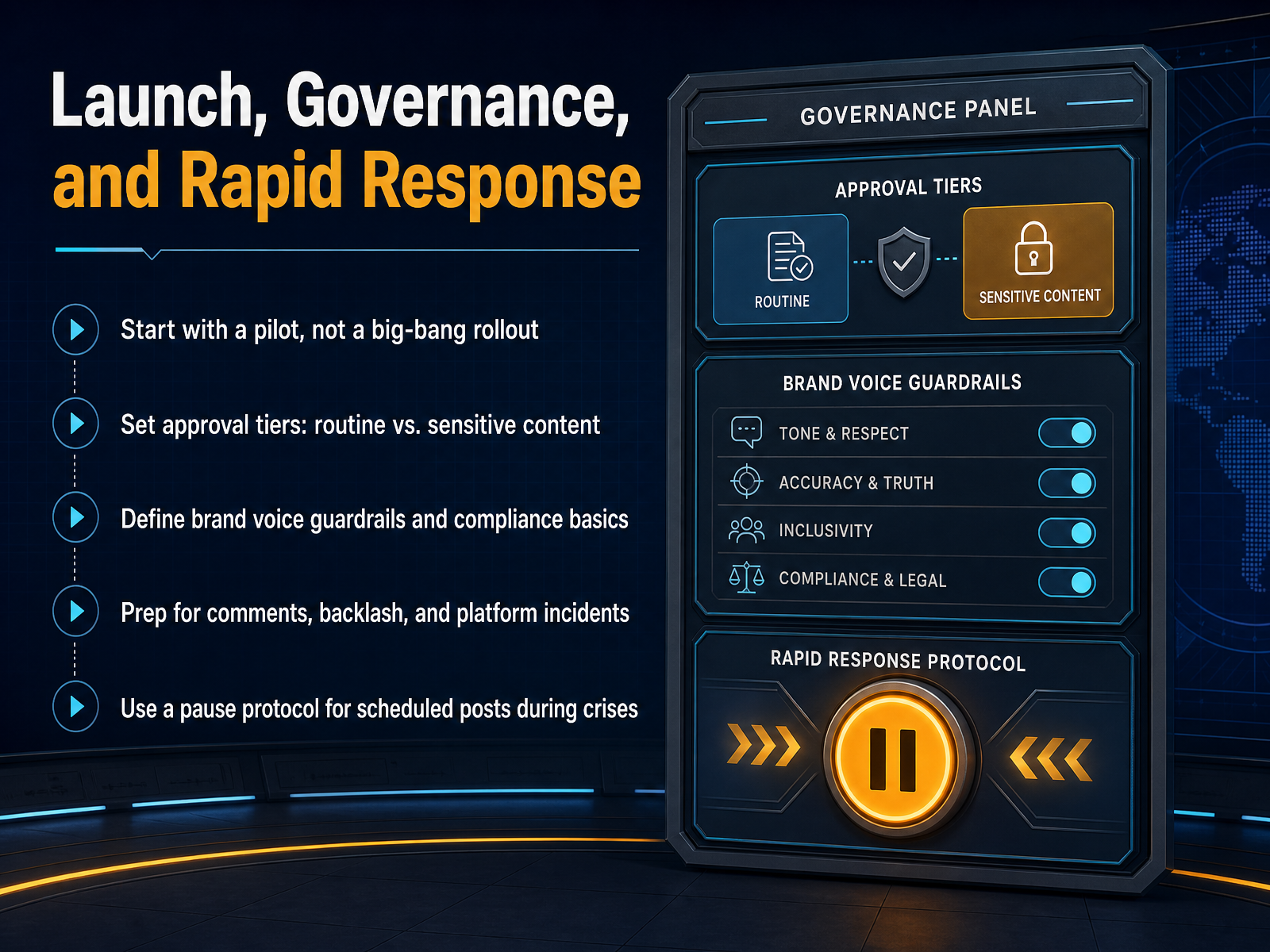
 - 10Launch, Governance, and Rapid ResponseNow let's talk about launch, governance, and rapid response. Start with a pilot, not a big-bang rollout. Choose one brand or one region, run the full workflow there for two weeks, and iron out the kinks before you scale. Next, set approval tiers. Routine content publishes within brand guardrails; anything sensitive, like offers, claims, or regulated topics, needs a named reviewer. And define your brand voice guardrails now, including approved and banned language, so your team doesn't have to guess. Then, prep for the unexpected. Pre-write holding statements for common scenarios like outages or backlash. Assign a first responder and an escalation path. And here's the critical piece: a pause protocol. When something breaks, you need to stop all scheduled posts network-wide within minutes, not hours. That's what turns a bad hour into a bad week. So, test that pause procedure before you need it. A governance system that's enforced inside your workflow, not just a PDF, is what keeps you consistent and safe. The planned content will follow the same principles as we turn this into a repeatable operating rhythm.
 blog.hootsuite.comblog.hubspot.combuffer.com+21 min
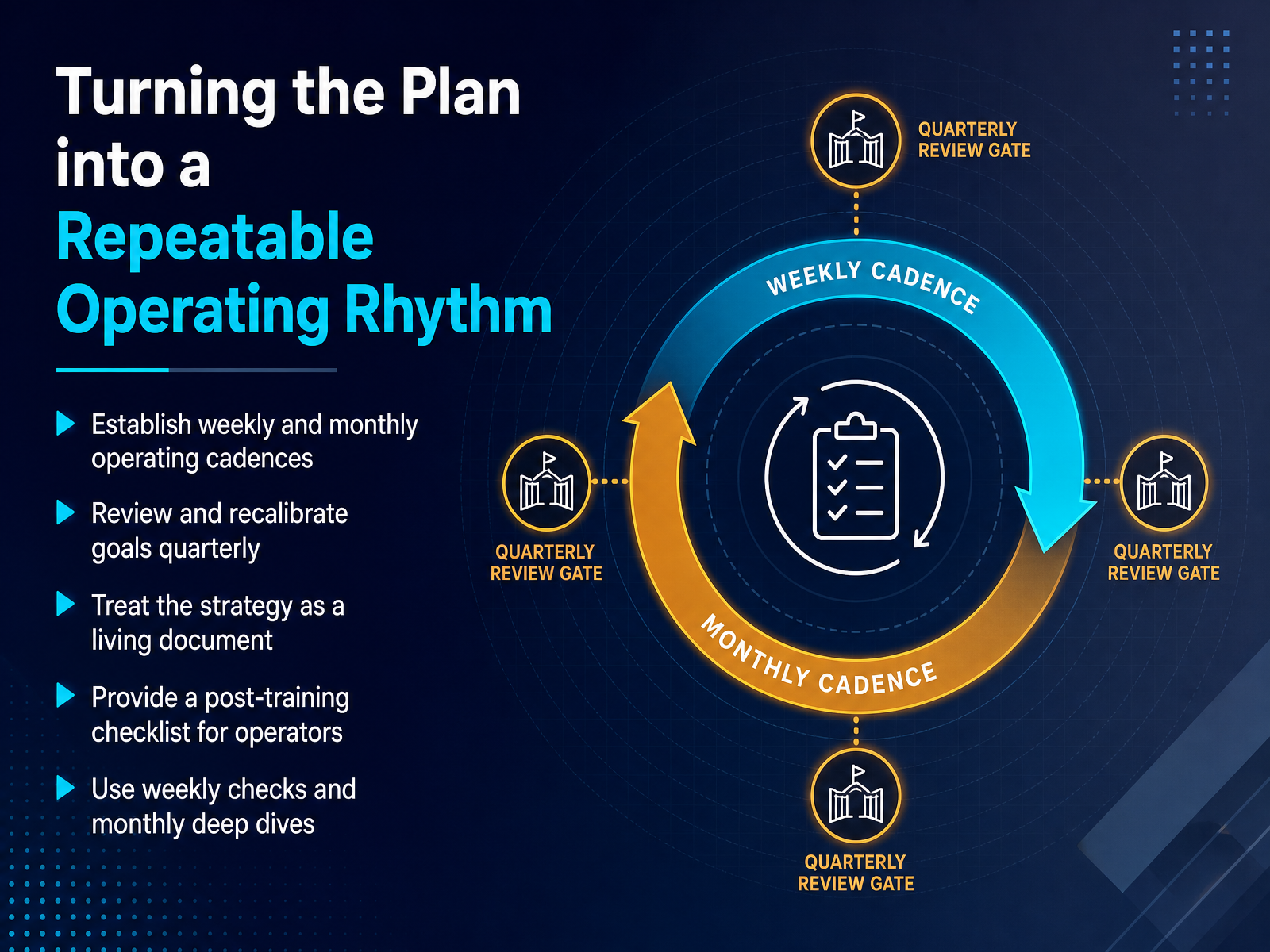
 - 11Turning the Plan into a Repeatable Operating RhythmSo we've built the plan. Now we lock in the rhythm. Start with a weekly cadence. Block thirty minutes every Monday to pull platform analytics, check engagement rates, and flag any content that's underperforming. That's your pulse check. Then, once a month, go deeper. Compare performance against your KPIs, review your content pillars, and decide what gets repurposed or retired. Quarterly is when you recalibrate. Look at your goals, your funnel metrics, and the broader business context. Adjust targets if the data calls for it. Most strategies need a full quarter of data before you see real impact, so resist the urge to tear things up after two weeks. Treat this strategy as a living document, not a static deck. Your operators need a clear checklist: weekly checks for optimization, monthly deep dives for trends, and quarterly reviews for direction. This operating rhythm keeps your team proactive instead of reactive. Now let's wrap up with a concrete action plan you can hand to your operators today.
 blog.hootsuite.comblog.hubspot.combuffer.com+22 min
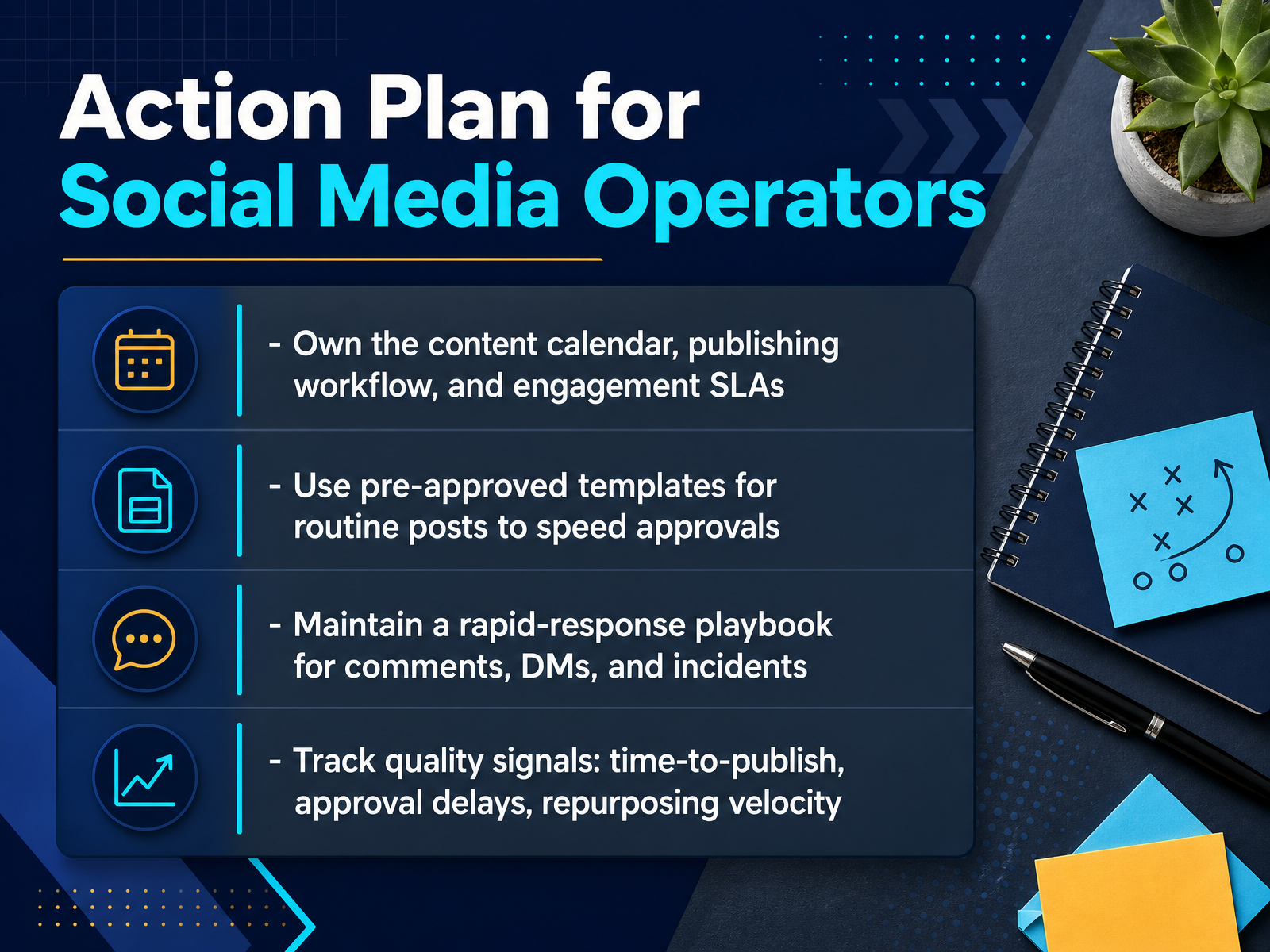
 - 12Action Plan for Social Media OperatorsNow let's translate strategy into daily operator execution. Own the content calendar end to end: publishing workflow, approval status, engagement SLAs. If approvals routinely take over 24 hours, the bottleneck is process and tooling, not content volume. For routine posts, build pre-approved templates that match your brand framework. This cuts approval cycles dramatically and frees your senior editor to focus on high-risk or high-visibility content. Your rapid-response playbook should cover comments, DMs, and incident escalation. Pre-write holding statements for common scenarios and test a pause procedure so scheduled posts never go live during a crisis. Finally, track quality signals, not just output. Measure time to publish, approval delays, and repurposing velocity. If a Reel performs well on Instagram, how fast can your team spin it out to TikTok and Shorts? That velocity is your true operational health metric. Next, let's look at the action plan for growth teams.
 2 min
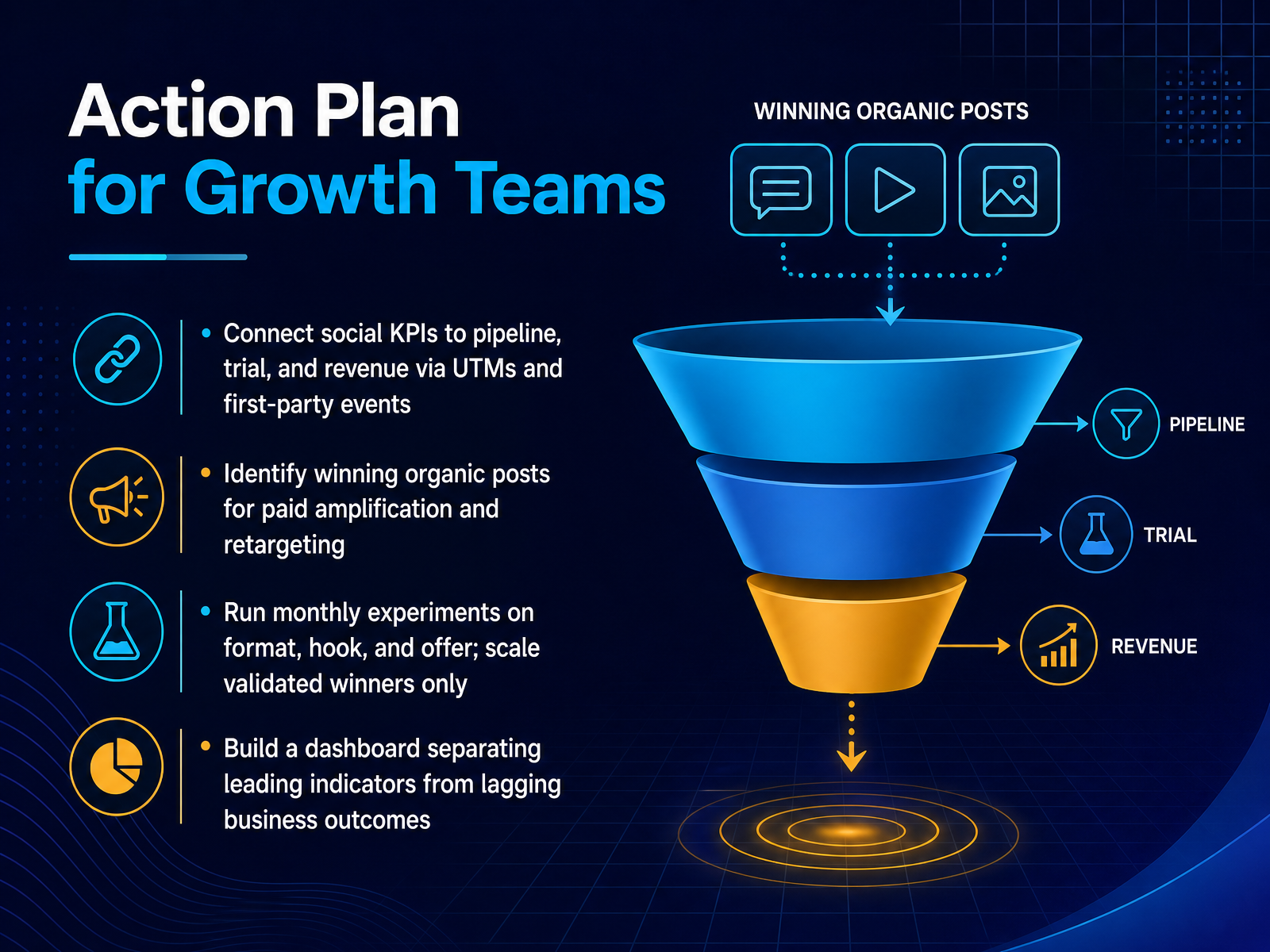
2 min - 13Action Plan for Growth TeamsNow let's turn this plan into your team's operating rhythm. First, connect every social KPI to real business outcomes. Use UTMs and first-party events so you can trace a post from click all the way to trial signup and revenue. Next, audit your organic content weekly. Identify the top 10 to 20 percent of posts by save rate and watch time, then amplify those with paid budget. Retarget anyone who engages. Run monthly experiments on format, hook, and offer. Test in small batches, and only scale the validated winners. Finally, build a dashboard that separates leading indicators from lagging outcomes. Put saves, shares, and CTR in one view. Put pipeline and revenue in another. Your content team steers by the first set, and you report to leadership with the second. That separation keeps everyone focused. Up next, we'll get specific on the action plan for your content marketers.
 blog.hootsuite.comblog.hubspot.combuffer.com+21 min
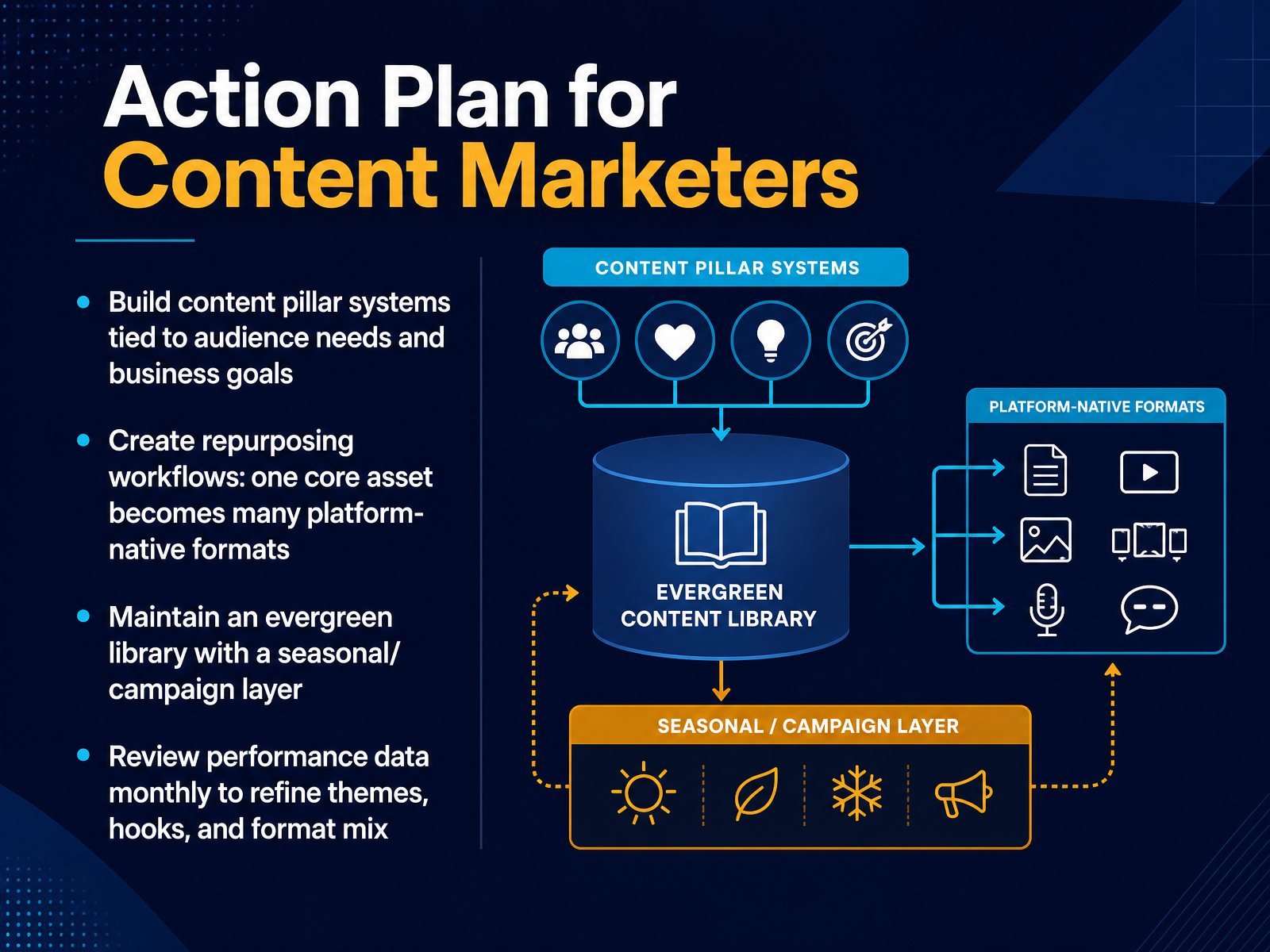
 - 14Action Plan for Content MarketersHere's your action plan. First, build content pillar systems that tie directly to audience needs and business goals, not just what's easy to produce. Then, create repurposing workflows. One strong core asset, like a research report, becomes a carousel, three short videos, and a LinkedIn post. This multiplies your reach without multiplying your hours. Next, maintain an evergreen library with a seasonal layer. Your foundational content drives consistent traffic month after month, while seasonal posts capture timely attention. Finally, review performance data monthly. Look at engagement rates, click-throughs, and conversions to refine your themes, hooks, and format mix. This cadence prevents guessing and ensures you're doubling down on what actually works. Thanks for joining. You now have the blueprint to move from scattered posting to strategic execution. Start small, build your systems, and let the data guide you.
 7milemedia.comsocinator.comcontentstudio.io+21 min
Take the deck with you
Download this course as a file — free, no sign-up needed.
- PDF handoutEvery slide page, ready to print or share.15 pages · 3.8 MBDownload
- Narrated PowerPointThe deck that presents itself — every slide carries the digital human's narration video.15 pages · 15.3 MBDownload
- PowerPoint slidesThe full deck as a .pptx — open it in PowerPoint, Keynote, or Google Slides.15 pages · 3.7 MBDownload
Free to use in your own training — please keep the PersonWise credit page at the end.
Have your own deck? Turn it into a course
Sources consulted
Web sources consulted while building this course.
- Master your 2026 social media strategy [free template ... — blog.hootsuite.com
- How to create a great social media strategy in 2026 [+New ... — blog.hubspot.com
- How to Create a Social Media Marketing Strategy in 2026 — 7-Step Guide — buffer.com
- Social Media Marketing Strategy 2026: A Complete Step-by-Step Guide — AllAble — allable.ai
- How to Make Social Media Plans (With Templates & Tips) — canva.com
- Social Media Content Planning In 2025: A Data-Driven Blueprint For High-Impact Campaigns That Convert - 7 Mile Media — 7milemedia.com
- The Ultimate Guide To Social Content Planning In 2025 — socinator.com
- How to create a winning social media marketing plan: Complete 2025 guide — contentstudio.io
- Content Calendar for Social Media: 2025 Guide |... — influenceflow.io
- Social Media Content Planning Guide Dec 2025 — tryordinal.com
- How to set social media goals in 2026 [10 examples] — blog.hootsuite.com
- Social Media SMART Goals for 2025 - Best Lead Generation Agency in Singapore and Asia: iSmart Communications — ismartcom.com
- SMART Goals for Social Media: The Framework That Actually Gets Results (2026) — socialrails.com
- Setting SMART Goals for Your Small Business Social Media Campaigns - Orvol — orvol.com
- Social Media Strategies That Drive Real Business Growth with SMART Goals — blog.breakthrough3x.com
- Social Media Competitive Analysis Template — hootsuite.com
- How to Do a Social Media Competitor Analysis | WordStream — wordstream.com
- Social Media Competitive Analysis Template (Free ... — rivaliq.com
- Social media competitive analysis: A guide + free template | The Social Journal — zoho.com
- How to Do a Social Media Competitor Analysis (Free Template) | Aibrify — aibrify.com