Begin
14 pages · ~28 min
User Research Methods and Patterns
Learn to identify, select, and apply key user research methods, including types and patterns, through practical examples to inform design decisions.
A digital instructor presents all 14 pages. Hold “Ask” at any point and ask out loud — the answer comes from this course. No sign-up needed.
What you’ll learn
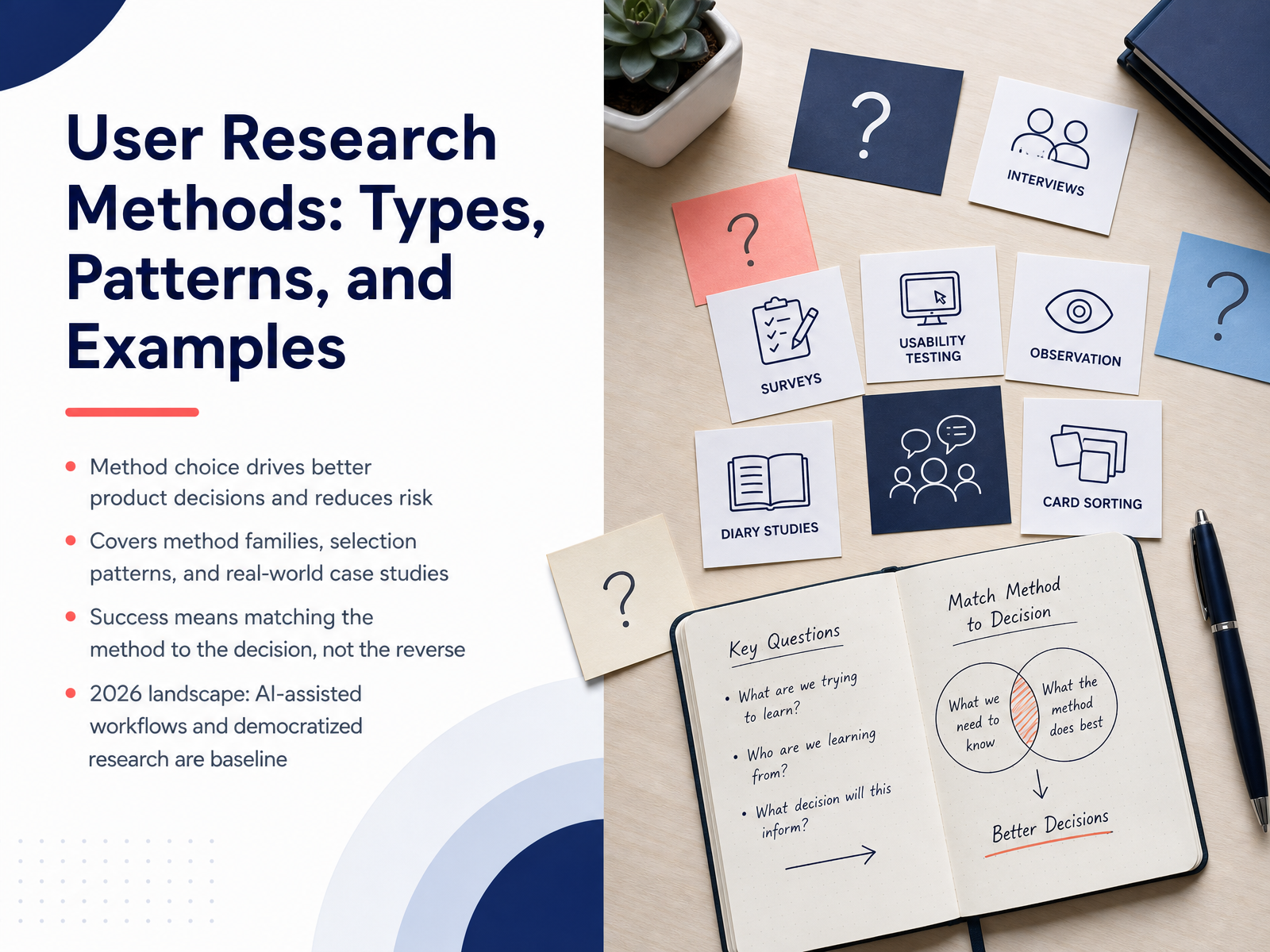
- 01User Research Methods: Types, Patterns, and ExamplesWelcome, everyone. Today we are diving into user research methods, specifically how to choose the right method for the decision you need to make. Over the next few minutes, we will cover the core method families, the selection patterns that expert teams use, and some real world case studies. The most important idea to carry with you is this: success means matching the method to the decision, not forcing a decision to fit your favorite method. And as we look at the landscape in 2026, we have to acknowledge a major shift. AI-assisted workflows and democratized research are no longer future predictions. They are the baseline. So our goal is to help you plan studies with rigor, while using the new tools responsibly. Let's start by laying the foundation with the most fundamental distinction in our field: generative versus evaluative research.maze.cocleverx.comusehubble.io+21 min
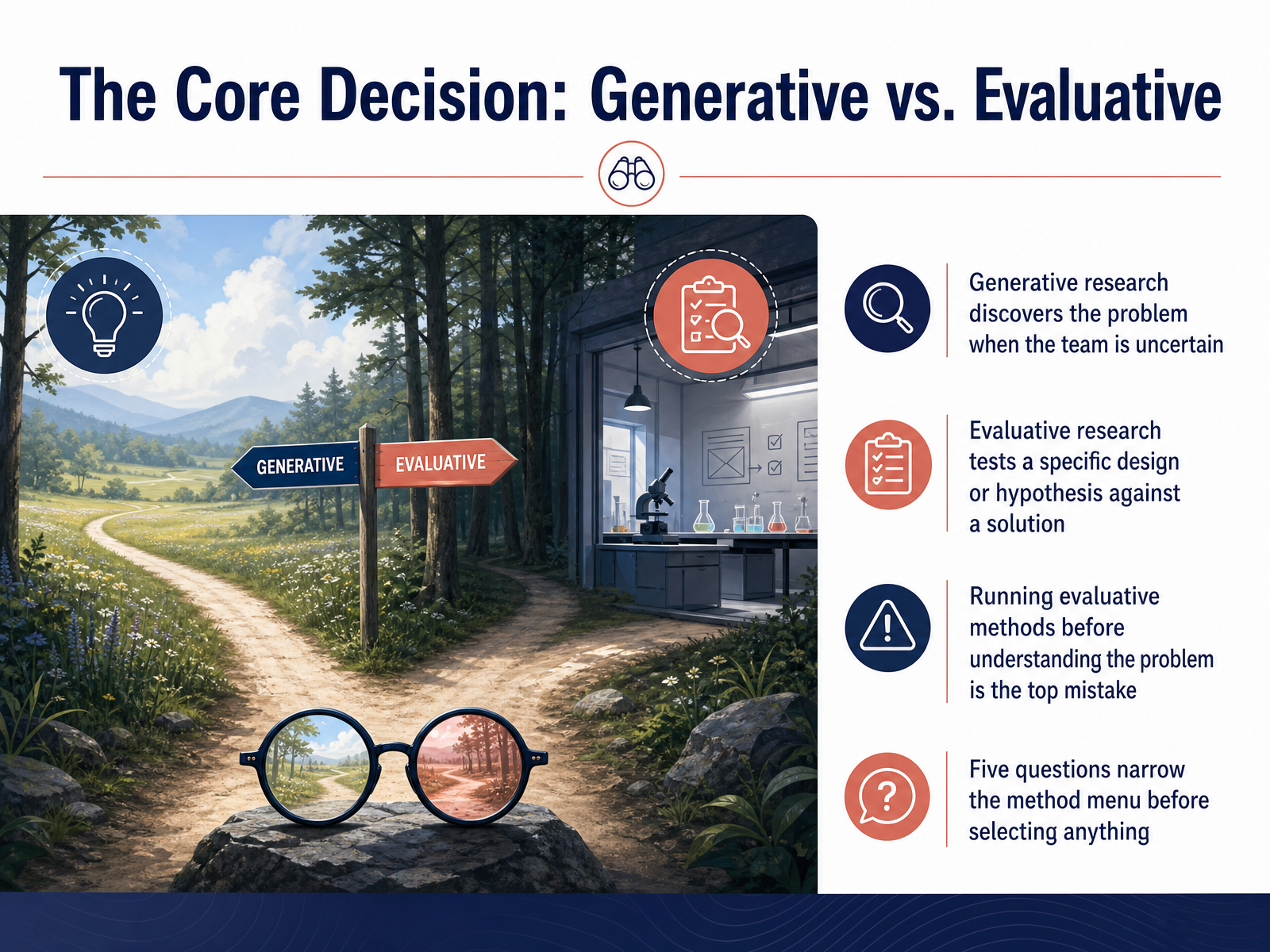
- 02The Core Decision: Generative vs. EvaluativeLet's talk about the decision that shapes every study you'll plan. The core question is whether you're running generative or evaluative research. Generative research discovers the problem. You use it when the team is uncertain, when you need to find new directions and opportunities. Methods here include interviews, field studies, and diary studies. Evaluative research tests a specific design or hypothesis against a solution. Think usability testing or A B testing. It tells you if what you've built actually works. The top mistake I see teams make is jumping to evaluative methods before the problem is understood. Running a usability test on a prototype won't tell you if you're solving the right problem. It will only tell you if the prototype is usable. To avoid this, narrow your method menu by asking five questions before selecting anything. What decision will this inform? Do we know the problem? Do we need depth or scale? What's the cost of being wrong? And what can the team actually act on? Answer these first, and the method choice becomes much clearer. Next, let's look at the three organizing dimensions of research methods.
 handbook.gitlab.comusertesting.comnngroup.com+21 min
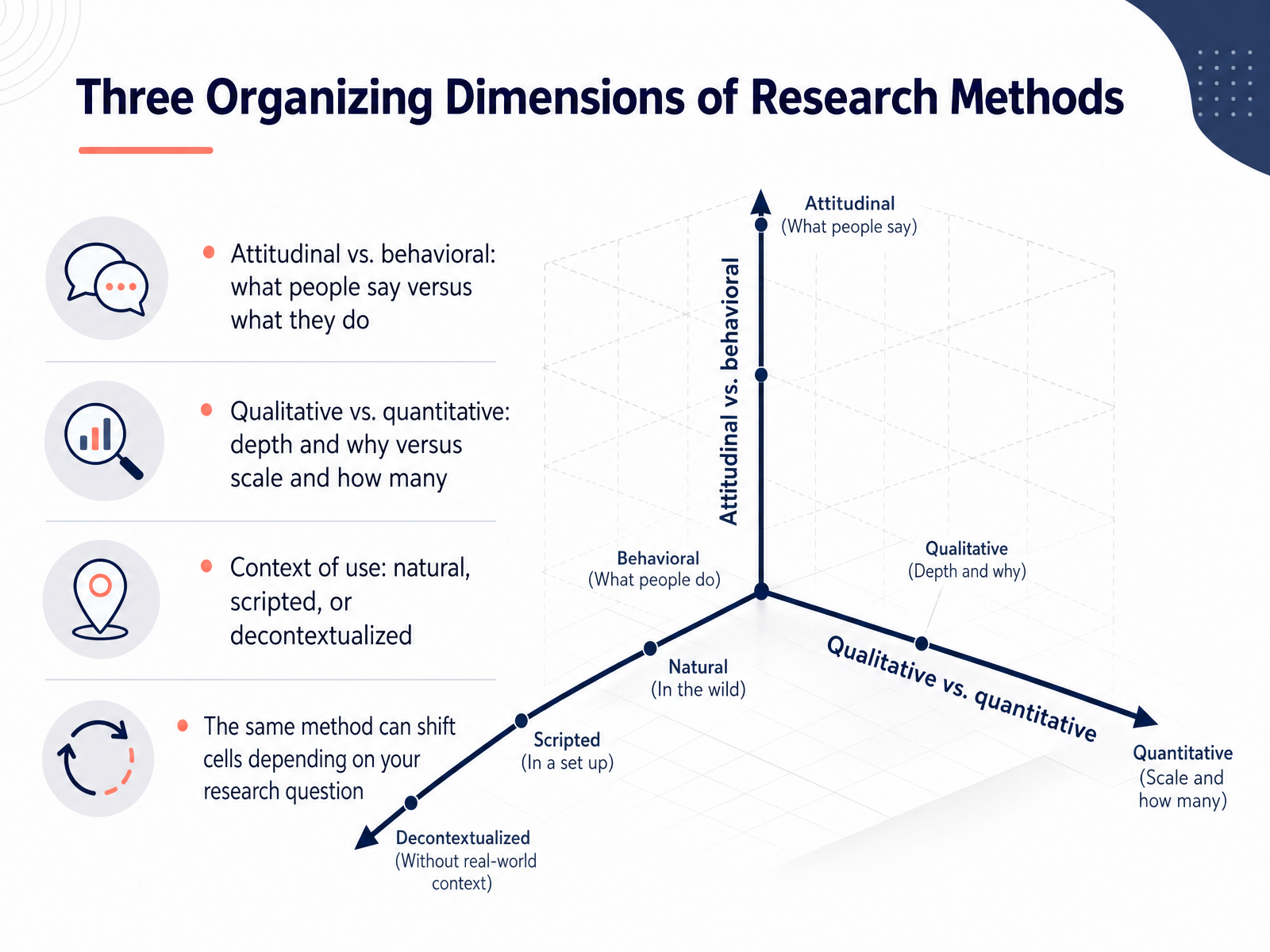
 - 03Three Organizing Dimensions of Research MethodsNow, when you're planning a study, it helps to step back and look at research methods through three organizing dimensions. These aren't rigid boxes, but lenses that help you match the right tool to the right question. The first dimension is attitudinal versus behavioral. This is the gap between what people say they do, and what they actually do. For example, an interview captures attitudes, while watching someone navigate a live prototype captures behavior. Both are valuable, but they answer different things. The second dimension is qualitative versus quantitative. Qualitative gives you depth and the why behind a problem, often with just a handful of participants. Quantitative gives you scale and the how many, letting you measure prevalence across a larger sample. Finally, we consider the context of product use. This ranges from natural use in a field study, to scripted tasks in a usability lab, to fully decontextualized methods like a card sort where the product isn't used at all. What's important to remember is that the same method can shift between these dimensions depending on your research question. A survey, for instance, is typically attitudinal and quantitative, but you can design it to focus on recalled behavior. Understanding these dimensions will help you see why some methods are a better fit for certain phases of the product lifecycle. That's exactly what we'll explore next with generative and discovery methods.
 handbook.gitlab.comusertesting.comnngroup.com+22 min
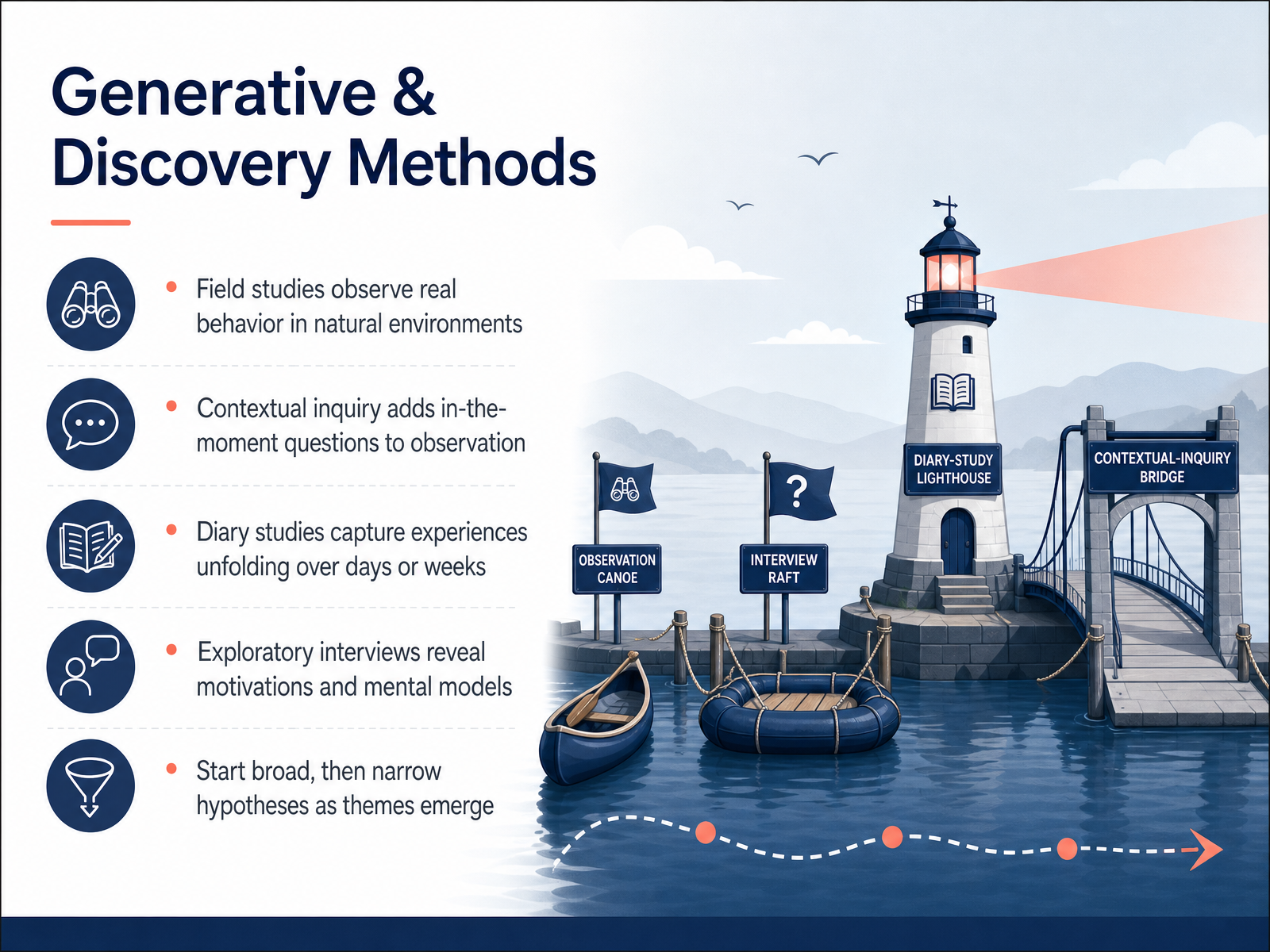
 - 04Generative & Discovery MethodsGenerative methods are where we build our foundational understanding of the problem space, before we even start thinking about solutions. These are your discovery tools. And they all share a common thread: they get you out of the lab and into the user's real context. Field studies let us observe actual behavior in natural environments. We're the fly on the wall, watching workflows unfold without interrupting. Contextual inquiry takes that a step further. We're still in the environment, but now we can ask in-the-moment questions. It's a master-apprentice dynamic: the participant demonstrates their expertise, and we probe to understand the reasoning behind their actions. Diary studies, on the other hand, capture experiences that unfold over days or weeks. They're invaluable for mapping long-term habits or episodic behaviors, like planning a vacation, that a single session could never reveal. And exploratory interviews help us dig into motivations and mental models. The key principle across all of these is to start broad. Gather rich, messy, real-world data. Let the themes emerge from that data before you narrow down into specific hypotheses. That's the generative phase. Next, we'll shift gears to the other side of the research spectrum: evaluative and usability methods.
 nngroup.comuxcrush.comnngroup.com+22 min
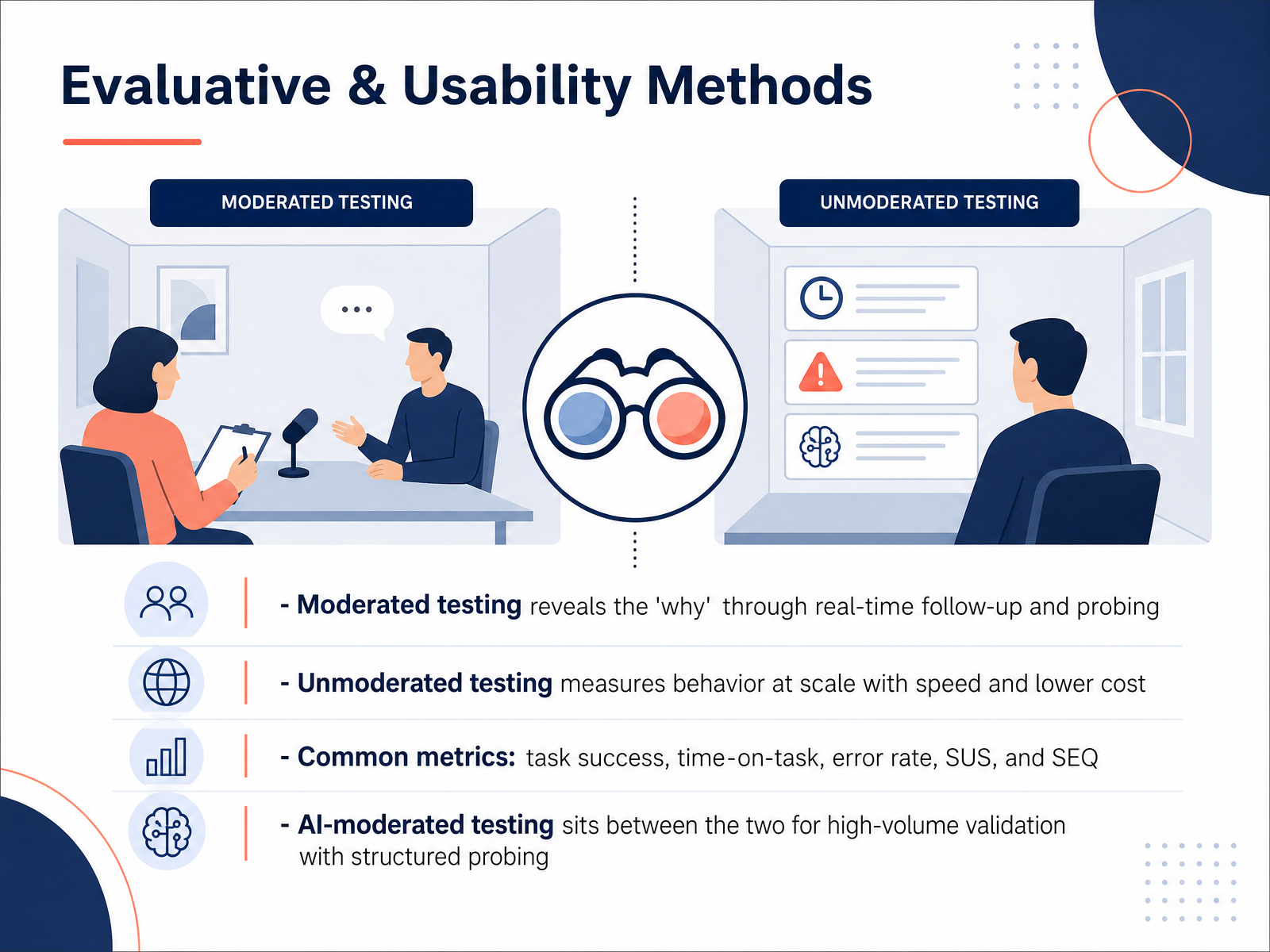
 - 05Evaluative & Usability MethodsNow let's move into evaluative methods, where the goal shifts from understanding to measuring. Moderated testing is still your best tool for depth because you can probe in real time. When a participant hesitates or takes an unexpected path, you can ask why, and that follow-up is where the real insight lives. The trade-off is scale. You are limited by researcher time and scheduling. Unmoderated testing flips that trade-off. You lose the live conversation, but you gain speed and sample size. A well-designed unmoderated study can run fifty participants in the time it takes to schedule five moderated sessions. Here, your core metrics are task success, time on task, error rate, and standardized scores like SUS for overall system usability, or SEQ for quick post-task difficulty. And in 2026, there is a genuine middle option. AI-moderated testing can now run structured follow-up questions at volume, so you get some probing, but without the cost of human moderation for every session. It is not a replacement for either method, but it is useful for high-volume validation. Next, we will look at behavioral, attitudinal, and hybrid patterns to see how these methods map to the type of data you are collecting.
 cleverx.comcleverx.comgreatquestion.co+22 min
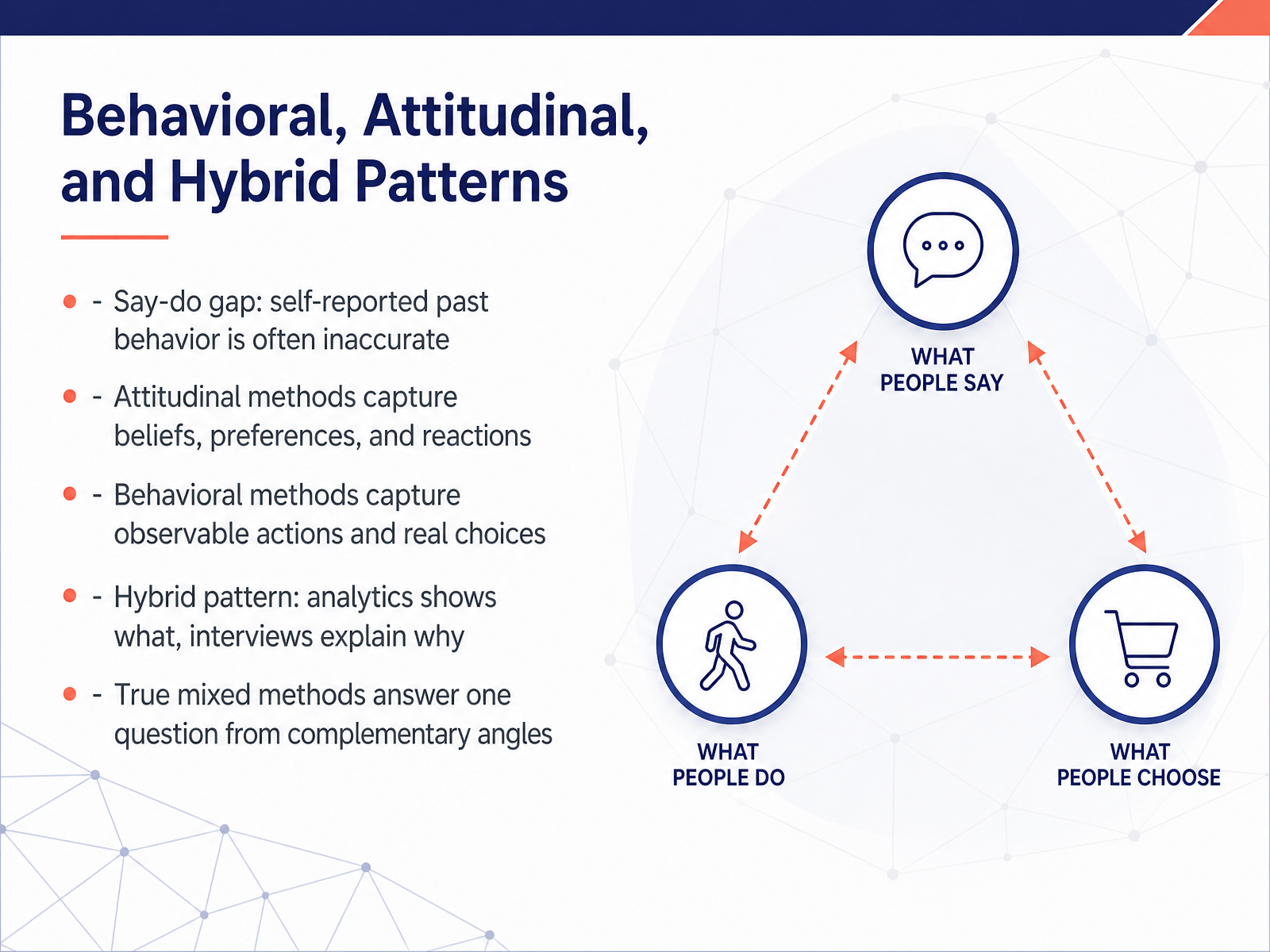
 - 06Behavioral, Attitudinal, and Hybrid PatternsNow let's talk about how research methods map to what we're actually capturing. The say-do gap is essential here. Self-reported past behavior is often inaccurate, not because participants are lying, but because memory is imperfect and social desirability creeps in. Attitudinal methods capture beliefs, preferences, and reactions. Think interviews and surveys. Behavioral methods capture observable actions and real choices. Think usability testing and clickstream analytics. These give us different lenses, not competing truths. A hybrid pattern is where the real power lives. Analytics shows what users do. Interviews explain why they do it. Together, they close that say-do gap. One caution though. True mixed methods means both streams are designed to answer the same overarching research question from complementary angles. Running a survey and some interviews on different topics does not qualify. We'll build on this when we look at choosing methods by project phase.
 handbook.gitlab.comusertesting.comnngroup.com+21 min
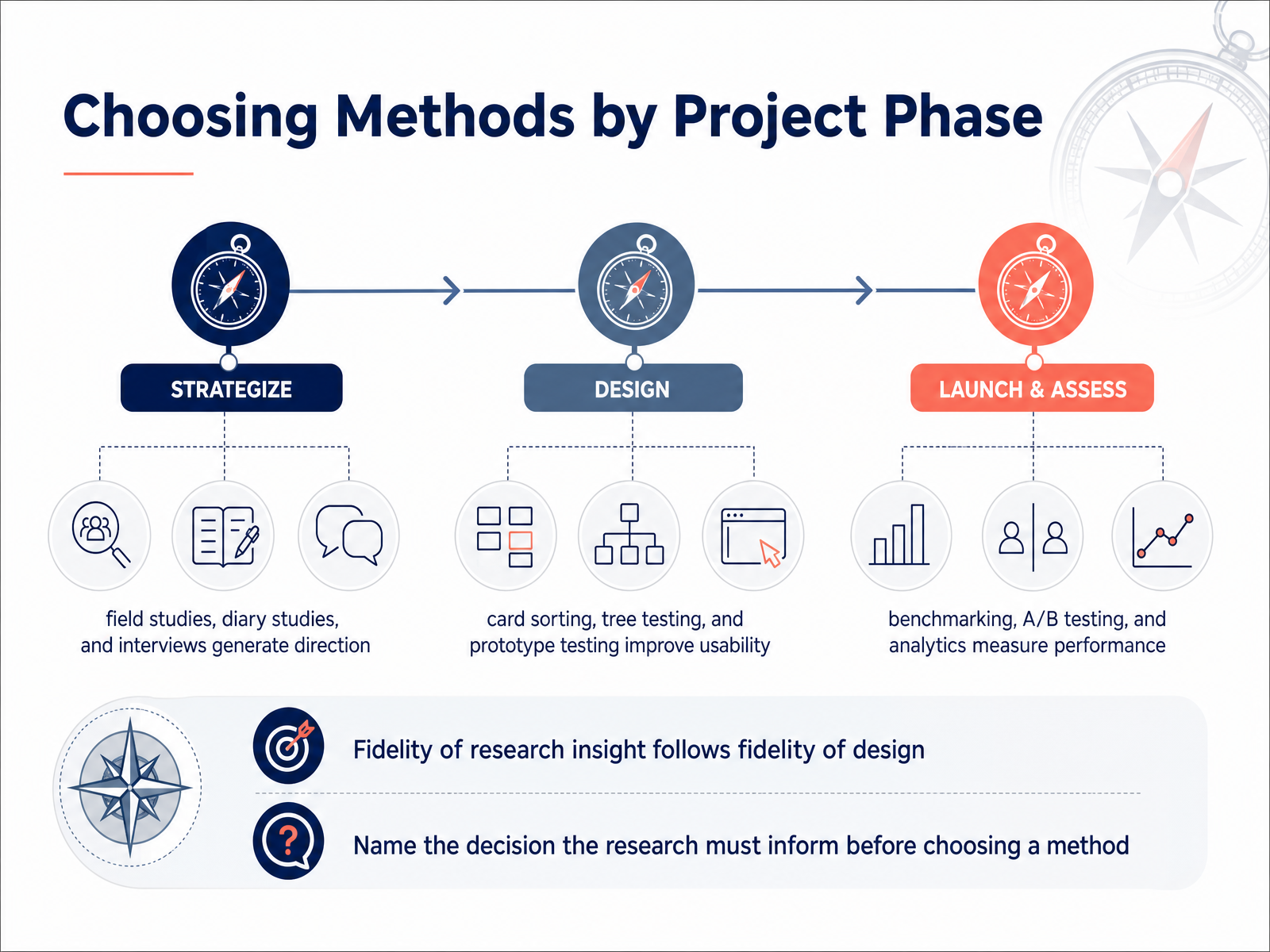
 - 07Choosing Methods by Project PhaseChoosing a method is less about picking a tool and more about matching the method to where you are in the product lifecycle. During the strategize phase, methods like field studies, diary studies, and interviews help generate direction. They reveal what problems exist and what users actually need. Once you move into design, the goal shifts to improving usability. Card sorting, tree testing, and prototype testing give you formative feedback on structure, labels, and task flow. And at launch and assessment, you are measuring performance. Benchmarking, A and B testing, and analytics tell you how the product performs against its own past versions or competitors. Keep in mind that the fidelity of your research insight follows the fidelity of your design. A rough paper prototype gives you high level direction, not detailed metrics. A production interface allows for precise measurement. Most importantly, before you choose any method, name the specific decision this research must inform. That decision is what makes the method selection defensible. Next, we will look at common trade-offs and anti-patterns.
 handbook.gitlab.comusertesting.comnngroup.com+21 min
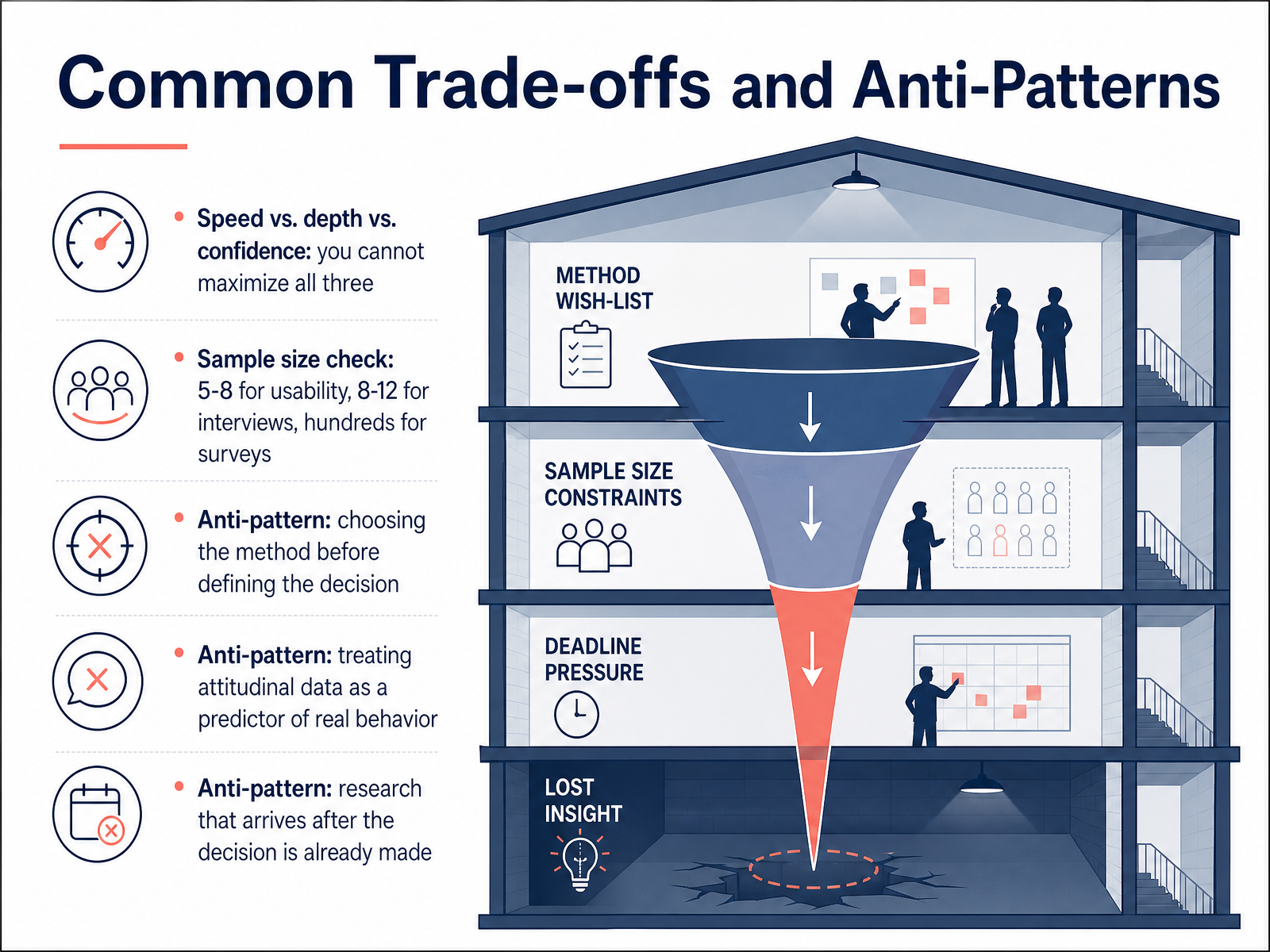
 - 08Common Trade-offs and Anti-PatternsSo far, we've focused on matching methods to decisions. But every method comes with trade-offs, and there are a few anti-patterns worth naming directly. First, the classic tension: speed versus depth versus confidence. You simply cannot maximize all three at once. A quick unmoderated test gives you speed, but not the depth of a moderated interview. A longitudinal diary study gives you depth and confidence, but not speed. So the question becomes, which trade-off is right for the decision you're making? Next, a sample size check. For usability testing, five to eight participants per segment usually surfaces most issues. For generative interviews, eight to twelve per segment is a solid range. And surveys need hundreds of responses if you want meaningful statistical signal. Now, the anti-patterns. Choosing the method before defining the decision. You've heard this before, but it's the most common research mistake. If someone says, we should run some interviews this quarter, without a decision attached, that research is likely to land nowhere. Second, treating attitudinal data as a predictor of behavior. What people say they would do and what they actually do are different things. Self-reported preferences are not the same as observed task performance. Third, research that arrives after the decision is already made. A study delivered a week after the design is committed isn't bad research, it's late research. Lateness is a research failure. So for each project, name the decision first, choose the method second, and watch for those traps. In our next section, we'll look at a real-world pattern where quantitative and qualitative benchmarking were combined to close that gap.
 handbook.gitlab.comusertesting.comnngroup.com+22 min
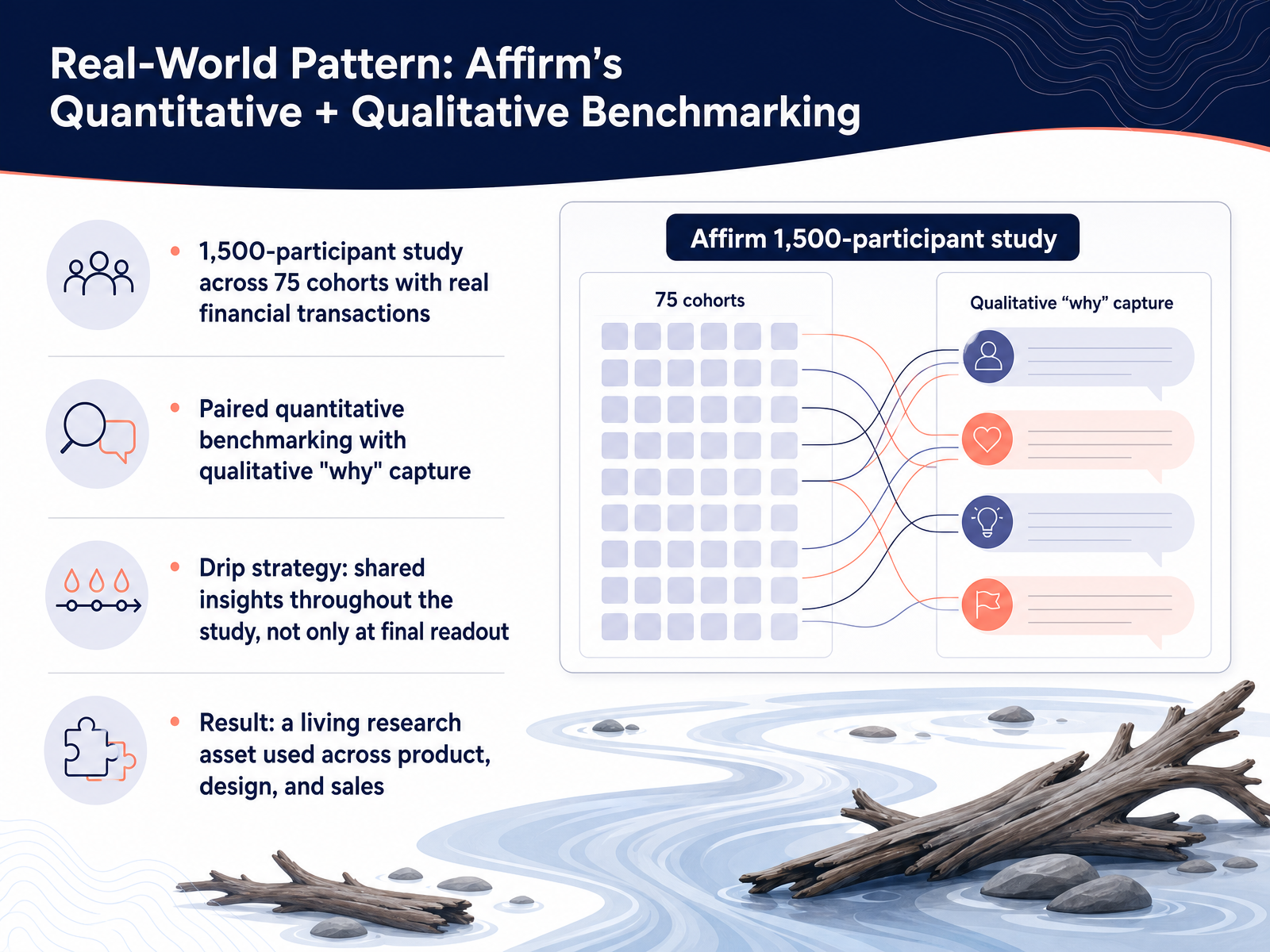
 - 09Real-World Pattern: Affirm's Quantitative + Qualitative BenchmarkingLet's look at a real-world pattern that combines quantitative and qualitative methods at scale. Affirm ran a massive benchmarking study with fifteen hundred participants across seventy five cohorts, and these were not hypothetical exercises. Participants made real financial transactions, which meant the team had to manage both logistical complexity and data ethics very carefully. The key decision here was pairing quantitative benchmarking with qualitative why capture. Earlier versions of this study were purely quantitative, so the team had numbers but no narrative. By capturing the reasoning behind each click, they turned a standard metrics exercise into a foundational research asset. They also used a drip strategy, sharing insights throughout each wave instead of waiting for one final readout. This built stakeholder confidence and kept the research connected to live product decisions. The result was a living repository still used across product, design, and sales. Next, we'll examine another pattern focused on speed, scale, and AI moderation.
 1 min
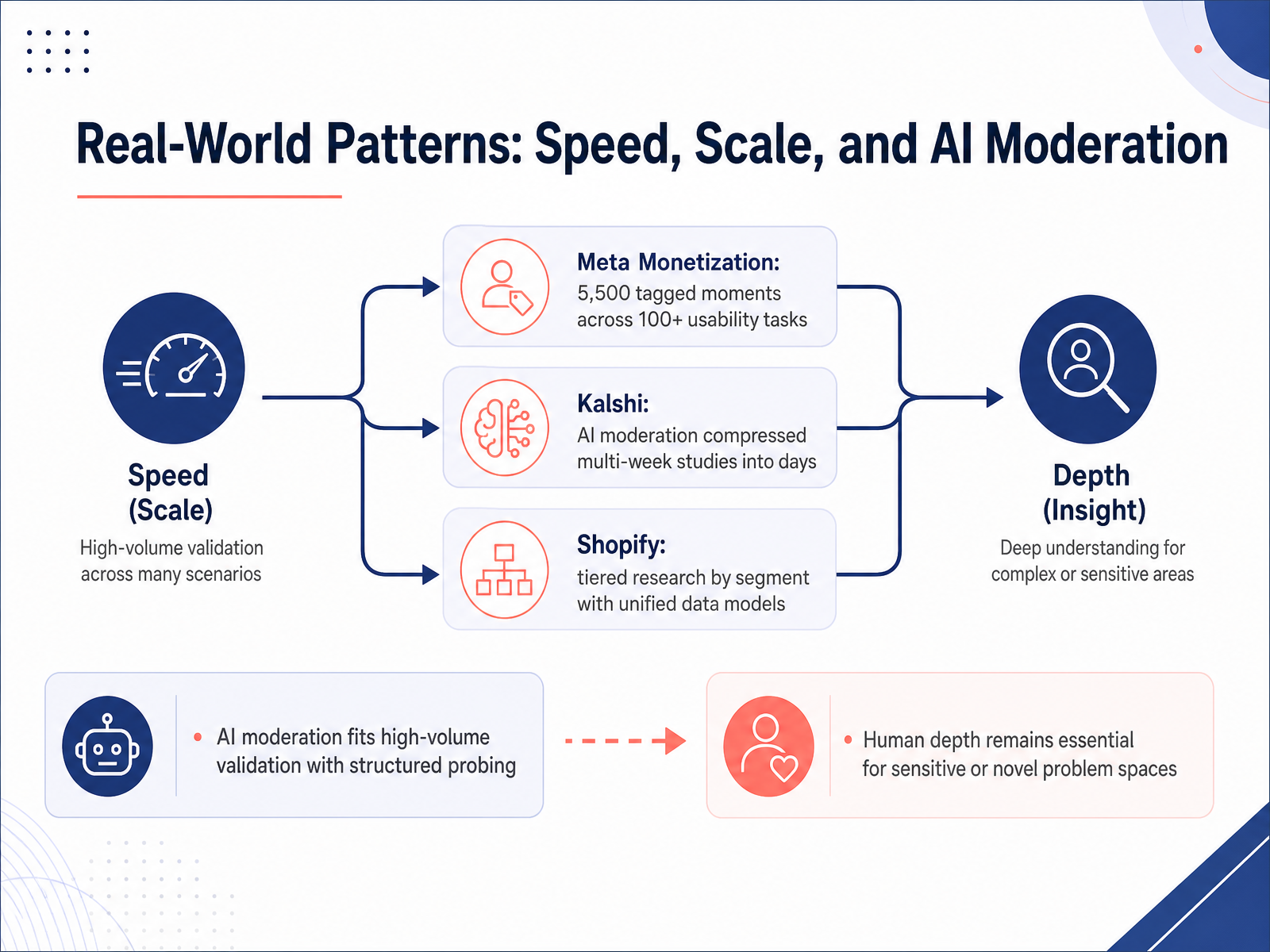
1 min - 10Real-World Patterns: Speed, Scale, and AI ModerationNow let’s look at how real teams are putting these research patterns into practice, especially when balancing speed, scale, and depth. At Meta’s monetization team, the focus was on building a repeatable evidence base. They saved over five thousand tagged moments across more than one hundred usability tasks. That created a searchable library of behavioral clips, which let product and engineering teams ground decisions in direct observation instead of just metrics. Kalshi took a different path, using AI moderation to compress multi week study cycles into days. The AI could ask structured follow up questions at scale, which worked well for high volume validation. But the team still relied on human judgment to read between the lines on nuanced problems. Shopify shows us how to manage scale across very different customer bases. They tiered their research by segment, using lighter touch methods for small businesses and deeper interviews for enterprise brands. The key was unifying all those findings in a shared data model, so insights stayed comparable across the organization. The takeaway here is clear. AI moderation fits high volume validation with structured probing. But human depth remains essential when you are exploring sensitive topics, or novel problem spaces where the questions themselves are still emerging. Next, we’ll continue looking at real world patterns, focusing on mixed methods in consumer and luxury contexts.
 2 min
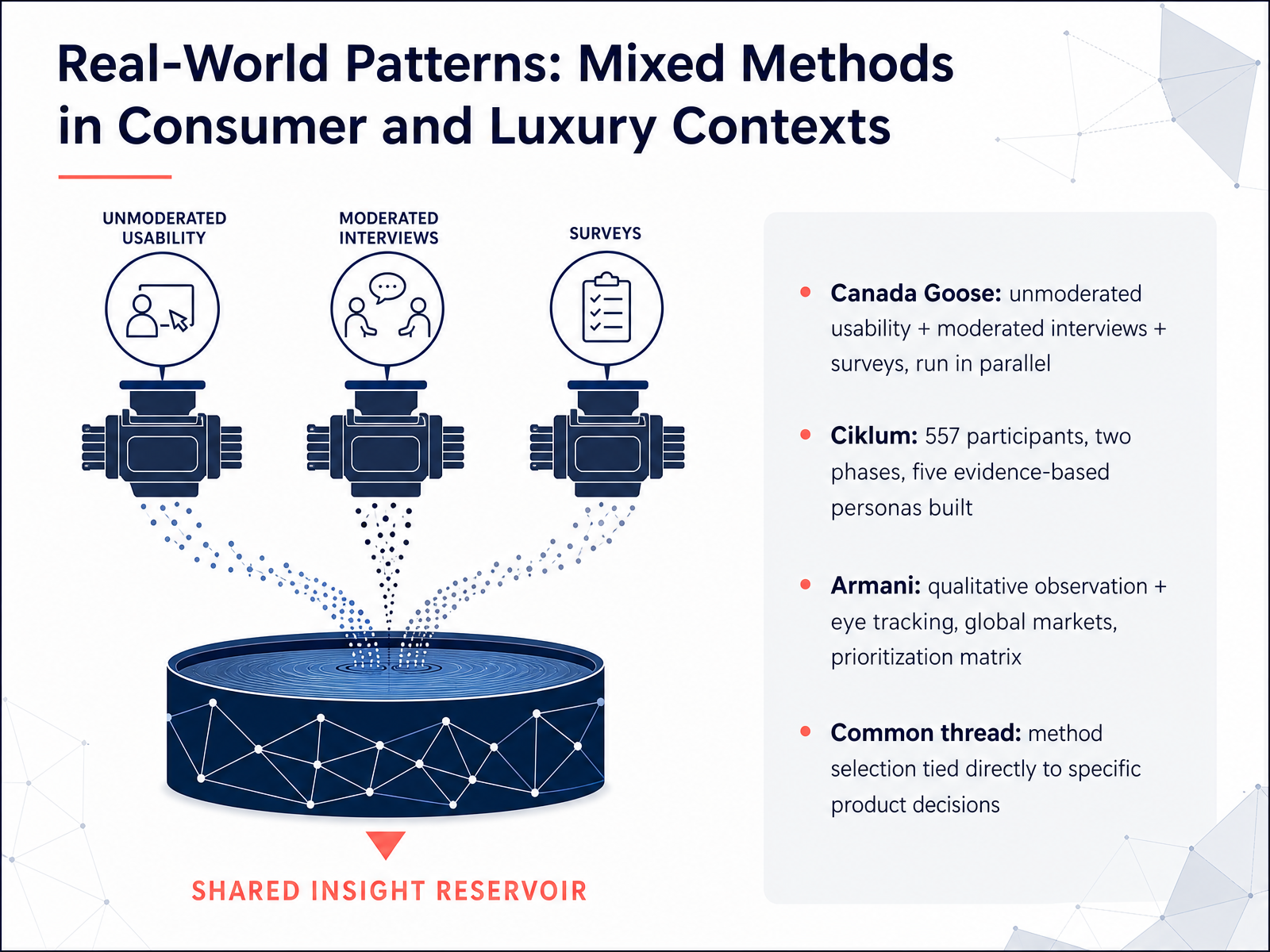
2 min - 11Real-World Patterns: Mixed Methods in Consumer and Luxury ContextsNow let's look at how these patterns play out in practice, because the clearest proof of good research design is seeing how method selection connects directly to product decisions. Take Canada Goose. They ran unmoderated usability tests, moderated interviews, and surveys in parallel. The unmoderated tests surfaced friction at scale, the interviews revealed the reasoning behind accessibility challenges, and the surveys added statistical confidence before anything shipped. That triage is deliberate, not decorative. Ciklum ran a larger program with five hundred fifty seven participants across two phases. Qualitative interviews and usability tests came first, then a survey validated those findings at scale. The result was five evidence based personas, twenty three product insights, and fourteen strategic feature opportunities. The size of the study mattered because the decisions were roadmap level. Armani combined qualitative observation with eye tracking in multiple global markets. The eye tracking showed where attention actually went, and a prioritization matrix separated immediate fixes from strategic opportunities. The common thread is that method selection was tied to a specific product decision, not to research tradition. When the choice of method is driven by the decision you need to make, the research stops being a deliverable and starts being a decision support system. And that principle scales even further when we look at how research operations and democratization are changing the field.
 2 min
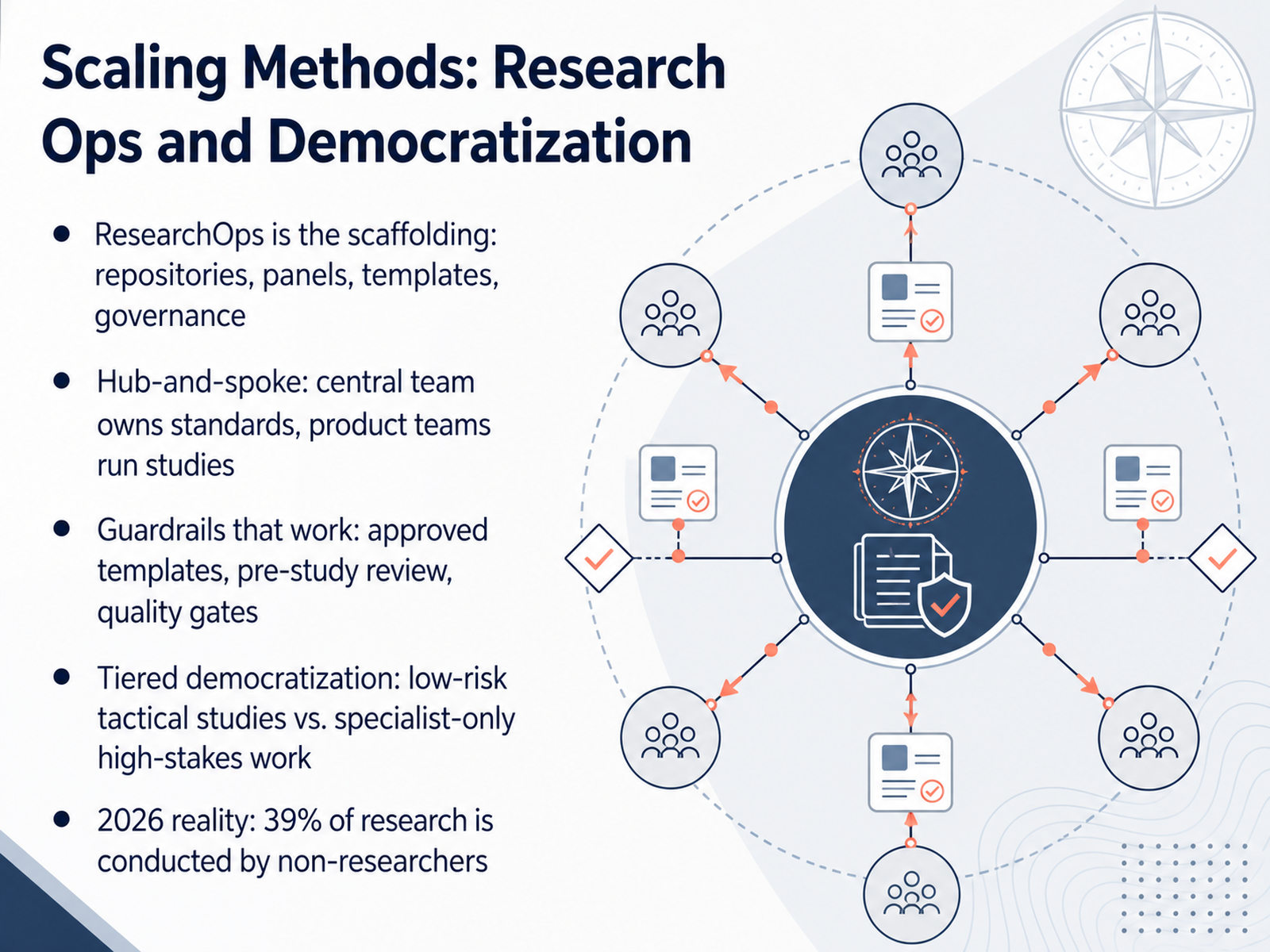
2 min - 12Scaling Methods: Research Ops and DemocratizationNow let's talk about what it actually takes to scale research across a whole organization. This is where ResearchOps stops being a nice-to-have and becomes the scaffolding. We're talking repositories, participant panels, templates, and governance. Without that foundation, democratization just creates noise. The model that works is hub and spoke. A small central research team owns standards, quality gates, and the highest-stakes studies. Product teams run the tactical work from approved templates. The guardrails that actually protect quality are pre-study reviews, shared screeners, and a weekly spot-check of completed studies. We tier the work too. Low-risk usability tests and concept checks go to the spokes. Pricing studies, regulated populations, and generative exploration stay with specialists. The reality in 2026 is this: thirty-nine percent of research is already conducted by non-researchers. So the question is not whether to democratize, but how to do it without losing trust. Next, we'll look at building the reusable method patterns and playbooks that make all of this possible.
 1 min
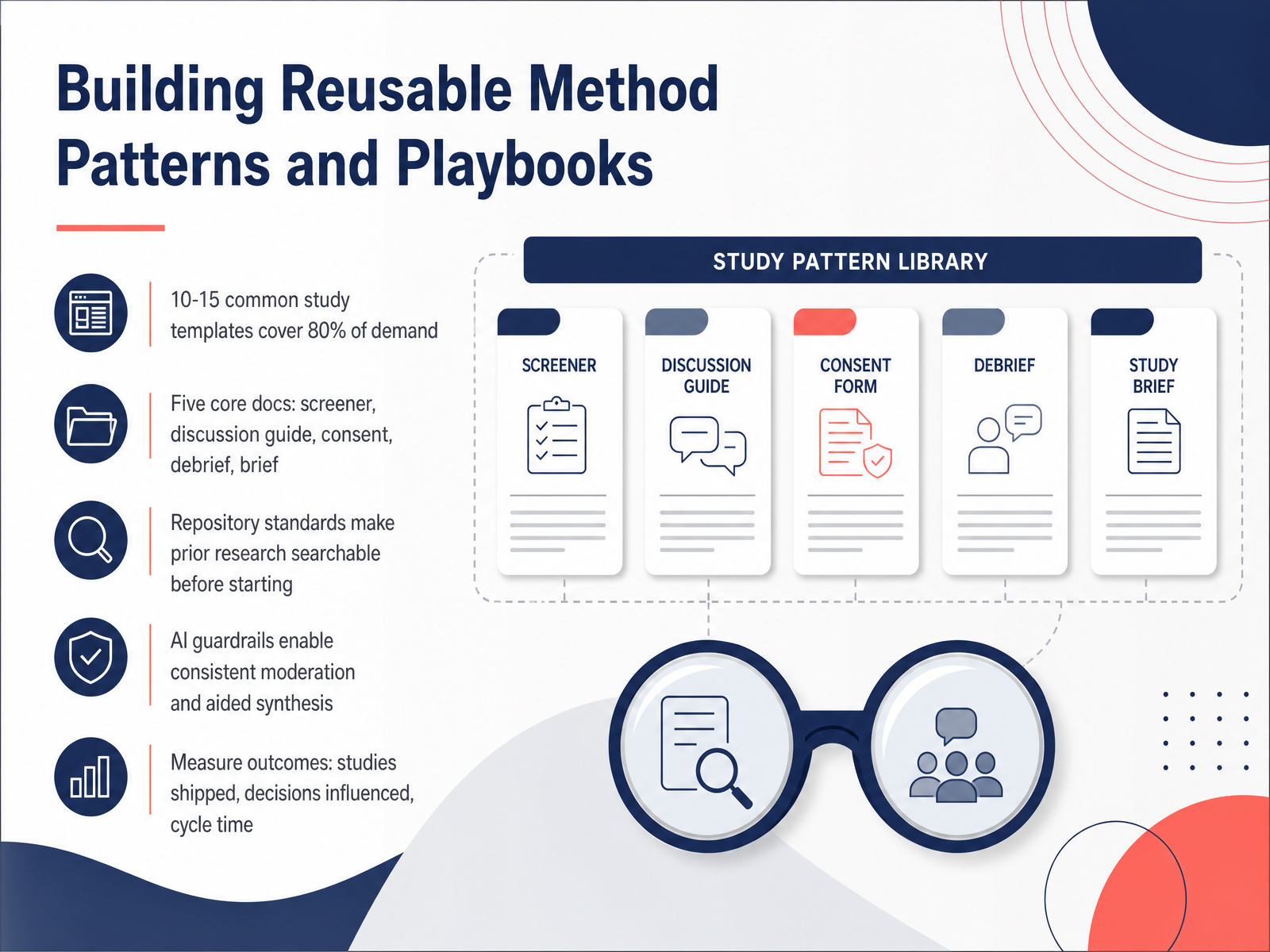
1 min - 13Building Reusable Method Patterns and PlaybooksWhen research starts to scale, the thing that keeps quality from collapsing is having reusable method patterns and a clear playbook. In practice, that usually means ten to fifteen common study templates, like discovery interviews, usability tests, churn conversations, and concept tests. That set alone tends to cover roughly eighty percent of what product teams actually request. The core documentation is also fairly stable. You need five working docs as the backbone. A screener, a discussion guide, a consent form, a debrief template, and a one-page study brief. Once those are standardized, non-researchers can launch studies without rebuilding the method from scratch every time. Repository standards matter just as much. If prior research is searchable before any new study starts, you avoid re-asking questions that were answered six months ago. AI guardrails also help here. They can keep interview moderation consistent and support aided synthesis without requiring every teammate to become a trained analyst. And finally, measurement. Track studies shipped, decisions influenced, and overall cycle time. Those are the signals that show whether your playbook is actually working. Next, we will walk through applying these methods to your next study.
 2 min
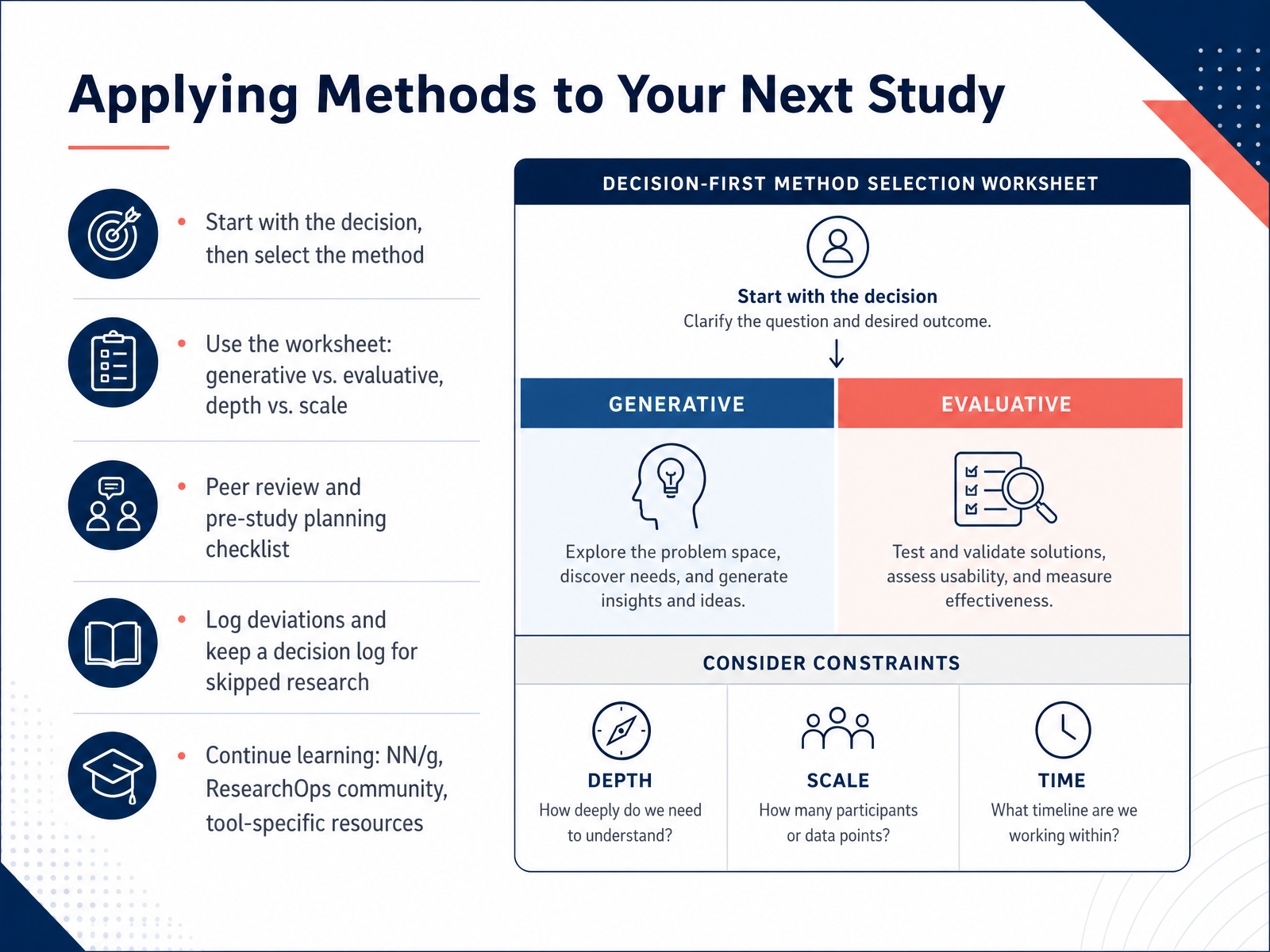
2 min - 14Applying Methods to Your Next StudyAnd that brings us to the part that makes all of this real. Applying these methods to your next study. The most important habit is this. Start with the decision, then select the method. Never the other way around. Ask what call this research needs to inform, and let that answer drive whether you run interviews, a usability test, or a survey. Then use a simple worksheet to pressure-test your choice. Mark the study as generative or evaluative, and decide whether you need depth or scale. If the two pull in different directions, that is a signal to split the work into two studies. Before you launch, run a peer review. Have another researcher walk through the interview protocol or the test script and check the screener, the tasks, and the analysis plan. And when a study gets skipped or reduced under time pressure, write it down. Keep a decision log that names the risk you accepted and why. That log becomes institutional memory. It prevents the same trade-off from being made silently twice. Finally, keep learning through the usual community resources. NN group, the ResearchOps community, and the documentation for the tools you already use. Every study is a chance to sharpen the next one. Thanks for working through this with me, and good luck with your next research plan.
 handbook.gitlab.comusertesting.comnngroup.com+22 min
Take the deck with you
Download this course as a file — free, no sign-up needed.
- PDF handoutEvery slide page, ready to print or share.15 pages · 3.6 MBDownload
- Narrated PowerPointThe deck that presents itself — every slide carries the digital human's narration video.15 pages · 16.3 MBDownload
- PowerPoint slidesThe full deck as a .pptx — open it in PowerPoint, Keynote, or Google Slides.15 pages · 3.5 MBDownload
Free to use in your own training — please keep the PersonWise credit page at the end.
Have your own deck? Turn it into a course
Sources consulted
Web sources consulted while building this course.
- The Future of User Research Report 2026 — maze.co
- User Research Industry Benchmarks 2026: Team Size, Budget, Methods, and Maturity Data | CleverX Guides — cleverx.com
- 2026 State of User Research in the Age of AI and Agentic ... — usehubble.io
- The Future of UX Research: Navigating AI-Powered Tools and Methods :: UXmatters — uxmatters.com
- 3 UX research trends product teams can’t ignore in 2026 - LogRocket Blog — blog.logrocket.com
- Choosing a research methodology | The GitLab Handbook — handbook.gitlab.com
- The UX research methodology guidebook — usertesting.com
- When to Use Which UX Research Method (Video) - NN/G — nngroup.com
- Choosing the Right User Research Method (DDN2-J11) - CSPS — csps-efpc.gc.ca
- When to Use Which User-Experience Research Methods — nngroup.com
- When to Use Context Methods: Field and Diary Studies — nngroup.com
- UX Research Methods Guide (2026): When to Use Which — uxcrush.com
- Diary Studies: Understanding Long-Term User Behavior and Experiences - NN/G — nngroup.com
- Field Studies - NN/G — nngroup.com
- Field Studies vs. Diary Studies (Video) - NN/G — nngroup.com
- Best Remote Usability Testing Tools in 2026: 10 Platforms for Distributed UX Teams | CleverX Blog — cleverx.com
- Usability testing platform comparison: the top tools compared (2026) | CleverX Blog — cleverx.com
- Usability Testing Tools Comparison: Find the Right Fit — greatquestion.co
- Moderated vs Unmoderated Usability Testing 2026 Guide — theysaid.io
- Moderated vs Unmoderated Usability Testing 2026 | CleverX Blog — cleverx.com