ML in Marketing Analytics
Begin
14 pages · ~28 min
ML in Marketing Analytics
This training equips marketing professionals with machine learning fundamentals to apply predictive analytics for customer segmentation, targeting, and campaign optimization.
What you’ll learn
- 01Machine Learning in Marketing AnalyticsWelcome. If you’re a marketing analyst or on a growth team, you’re used to looking backward — at dashboards, at last quarter’s performance, at what already happened. That’s where machine learning changes the game. It helps you stop reporting on the past and start predicting the future, then acting on it. This course isn’t built for ML theoreticians. It’s built for you — the practitioners who live in campaign data. We’ll walk through real use cases: customer segmentation, predictive scoring, recommendations, and media mix modeling. You’ll learn the data prep that makes models work, and the responsible AI guardrails you need to stay compliant. By the end, you’ll know where ML gets you real lift and where it’s just noise. So let’s talk about why ML matters for marketing analytics today.1clickreport.cominfoq.comtech.target.com+21 min
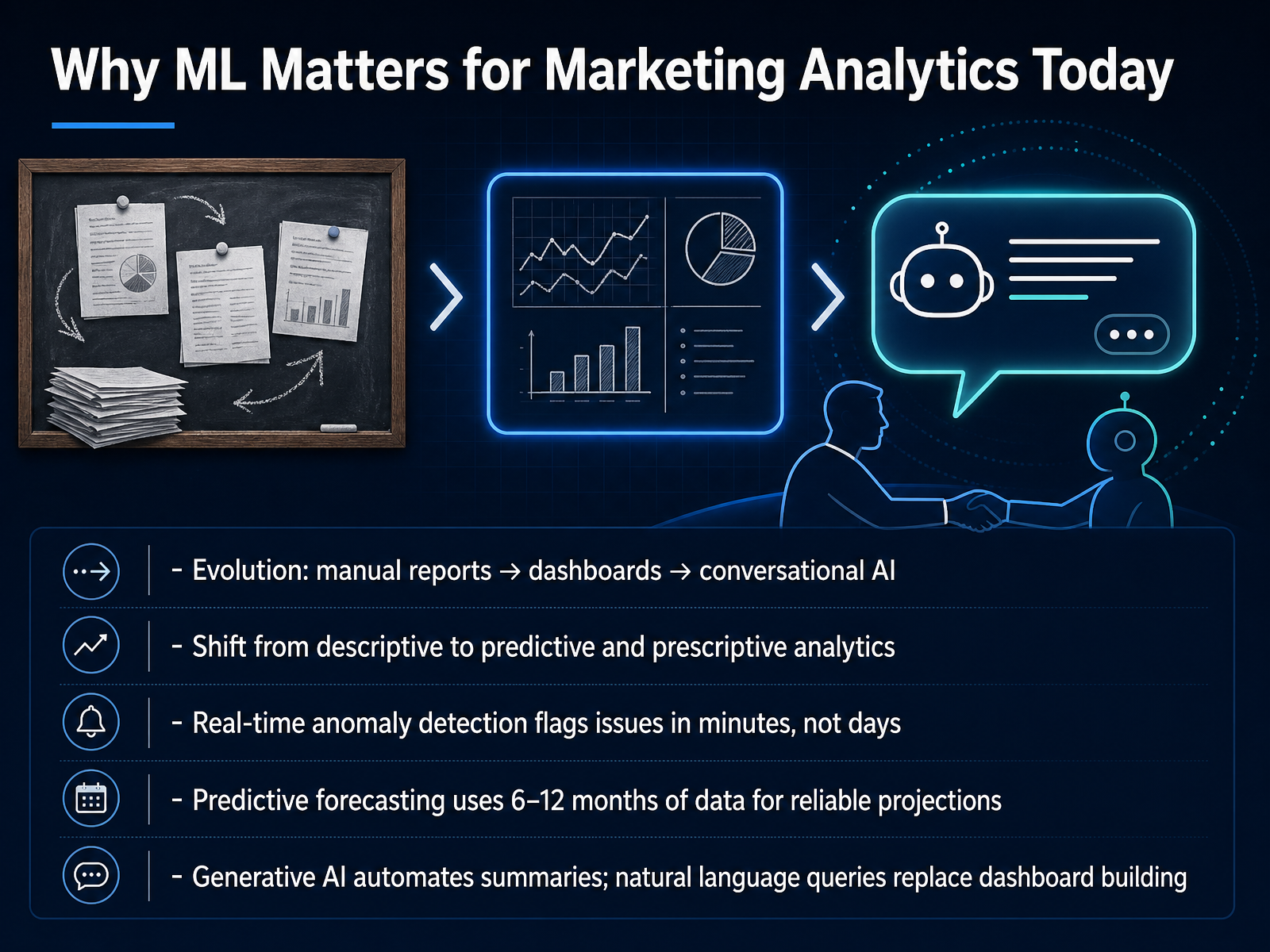
- 02Why ML Matters for Marketing Analytics TodayLet's talk about why machine learning matters for marketing analytics right now. For years, our work was mostly descriptive. We pulled the data, built the dashboards, and explained what already happened. That phase is over. We've shifted from manual reports to automated dashboards, and now, to systems that actually understand the data. This evolution moves us from descriptive analytics into predictive and prescriptive territory. Instead of just reporting a drop in conversion rate, ML flags it in minutes as an anomaly, not days later in a weekly review. Instead of hoping we hit the quarterly number, predictive forecasting uses six to twelve months of historical data to tell us if we're on track. And we're not just talking about better charts. Generative AI now writes the performance summaries for us, and natural language queries mean you ask your data a question instead of building another dashboard filter. The through-line is simple: ML lets us stop reporting on the past and start acting on the future.
 1clickreport.cominfoq.comtech.target.com+21 min
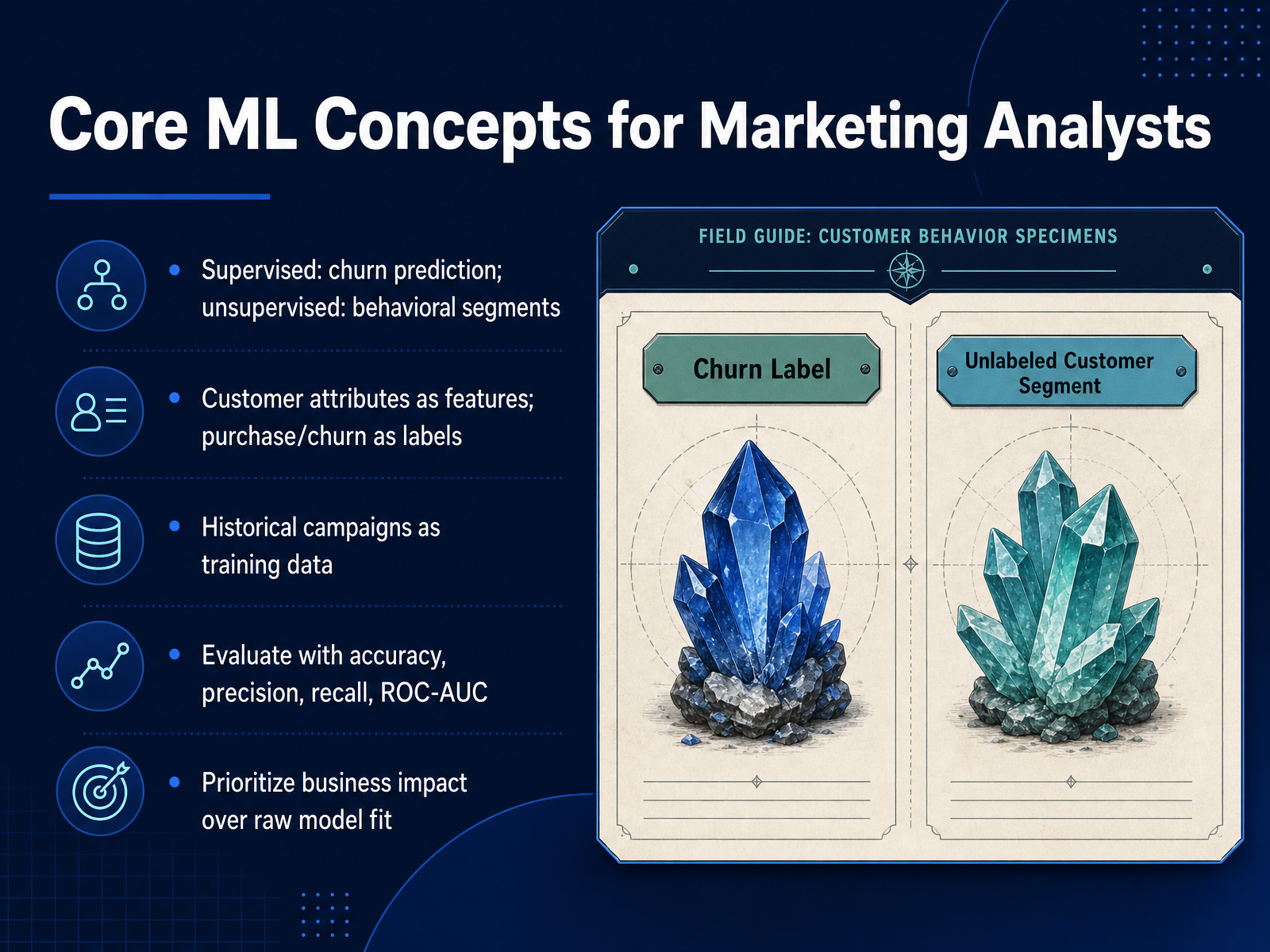
 - 03Core ML Concepts for Marketing AnalystsNow let’s map the core machine learning concepts to your everyday marketing work. Start with the two main types: supervised and unsupervised learning. In supervised learning, you have labeled data. For example, churn prediction uses past customer outcomes to teach the model which signals lead to churn. In unsupervised learning, there are no labels. You let the algorithm find patterns on its own, like grouping customers into behavioral segments. Think of your customer attributes, such as age, purchase frequency, or engagement scores, as features. The outcomes you want to predict, like a purchase or churn, become labels. Historical campaigns are your training data. They show how different customers responded, teaching the model what works and what doesn’t. When evaluating models, don’t just look at accuracy. Use precision, recall, and ROC-AUC to understand false positives and false negatives in a business context. Finally, prioritize business impact over raw model fit. A slightly less accurate model that boosts campaign ROI is better than a perfect one that doesn’t move metrics. Next, we’ll dive into data preparation and feature engineering for marketing data.
 2 min
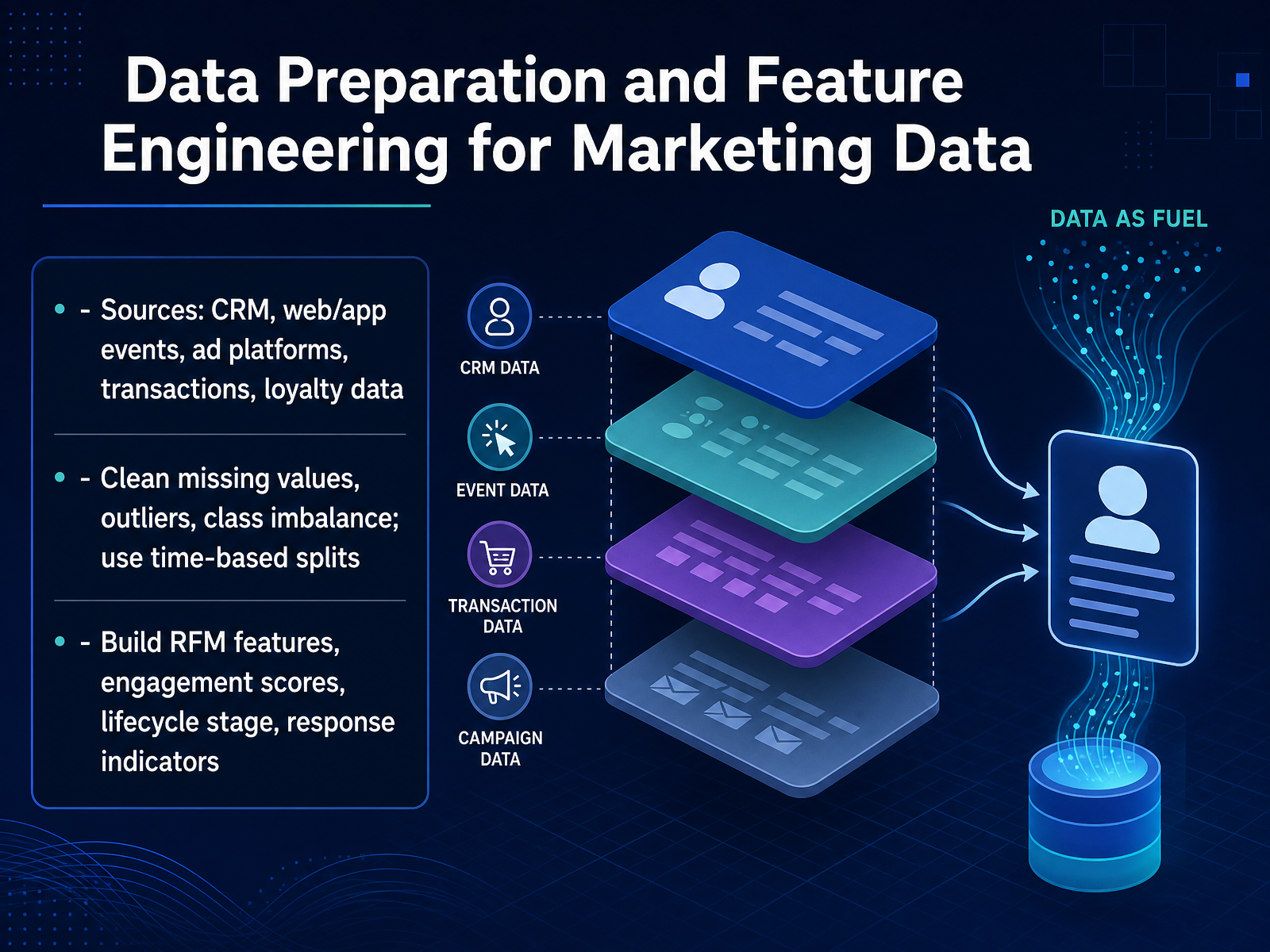
2 min - 04Data Preparation and Feature Engineering for Marketing DataNow let’s talk about getting your marketing data ready for machine learning. You’ll pull from CRM systems, web and app events, ad platforms, transaction logs, and loyalty data. That’s a lot of messy, disconnected information. First, handle the basics: clean missing values, deal with outliers, and fix class imbalance—for example, if only two percent of customers churn, your model will struggle to learn from that tiny group. But here’s a key point: always split your data by time, not randomly. You want to train on past behavior and test on future outcomes, just like a real campaign. Now, feature engineering. This is where domain knowledge shines. Build RFM features—recency, frequency, and monetary value—from transactions. Create engagement scores from email opens, clicks, or app sessions. Define lifecycle stages like new, active, at-risk, or churned. And add response indicators from past campaigns so your model learns what actually worked. These features turn raw logs into levers your model can use. Next up, we’ll see how to group those customers with clustering.
 1 min
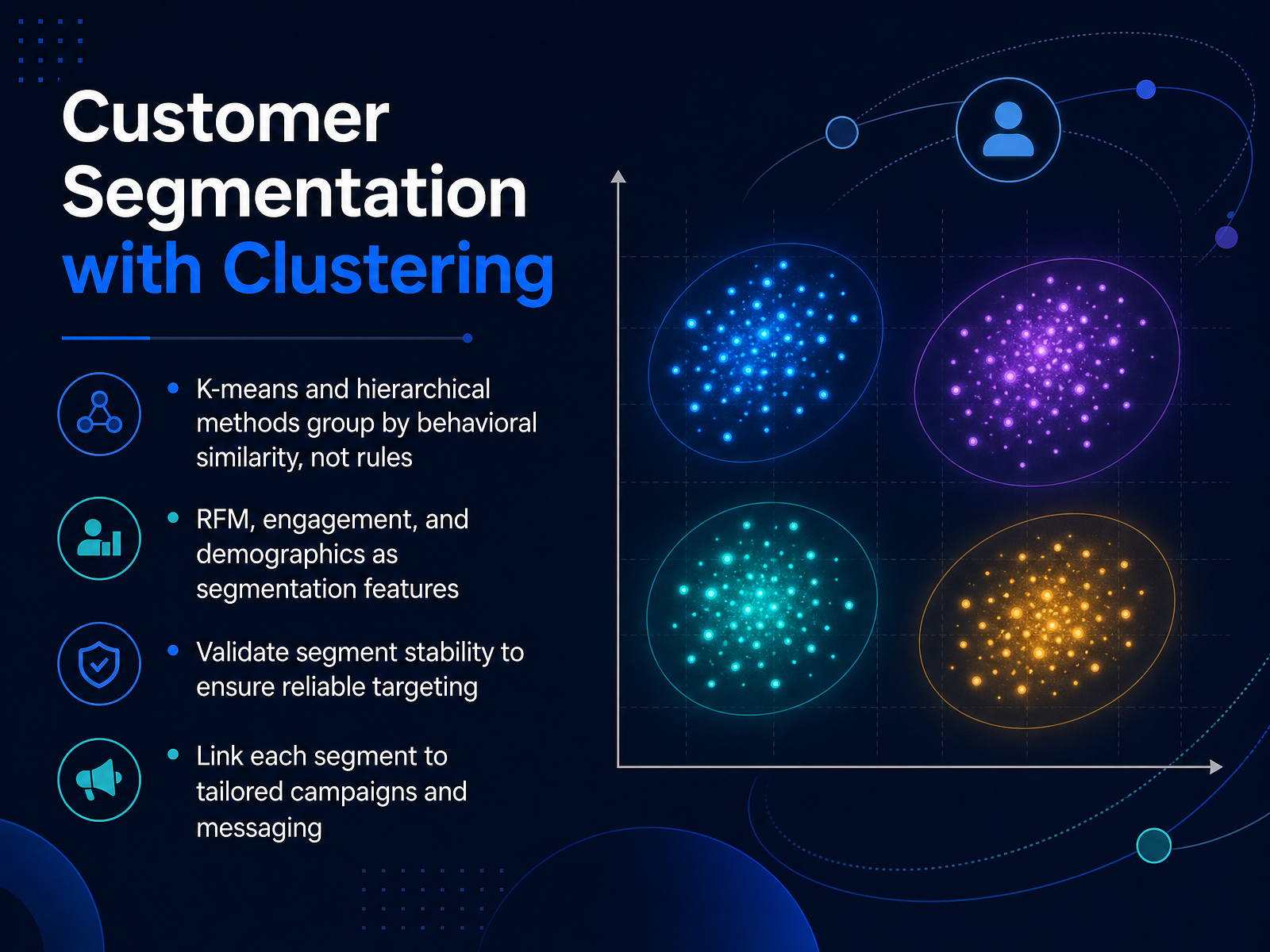
1 min - 05Customer Segmentation with ClusteringNow let's talk about customer segmentation with clustering. Instead of manually defining segments based on rules, we can let the data reveal natural groupings. K-means and hierarchical methods cluster customers by behavioral similarity, which means customers in the same segment behave alike, even if they fit no simple rule-based category. For features, you can use RFM values—recency, frequency, and monetary—along with engagement metrics and demographics. But don't just run the algorithm and trust the output. You need to validate segment stability. If you re-run the clustering with slightly different data, do the same customers stay together? Stable segments give you confidence that your targeting won't fall apart next month. Once you have stable segments, link each one to a tailored campaign. For example, a high-frequency, low-monetary segment might respond best to a loyalty program, while a high-monetary but low-frequency segment could be a candidate for product bundles. The goal is to turn clusters into actionable marketing strategies. Next, let's explore how to predict churn and customer lifetime value.
 1 min
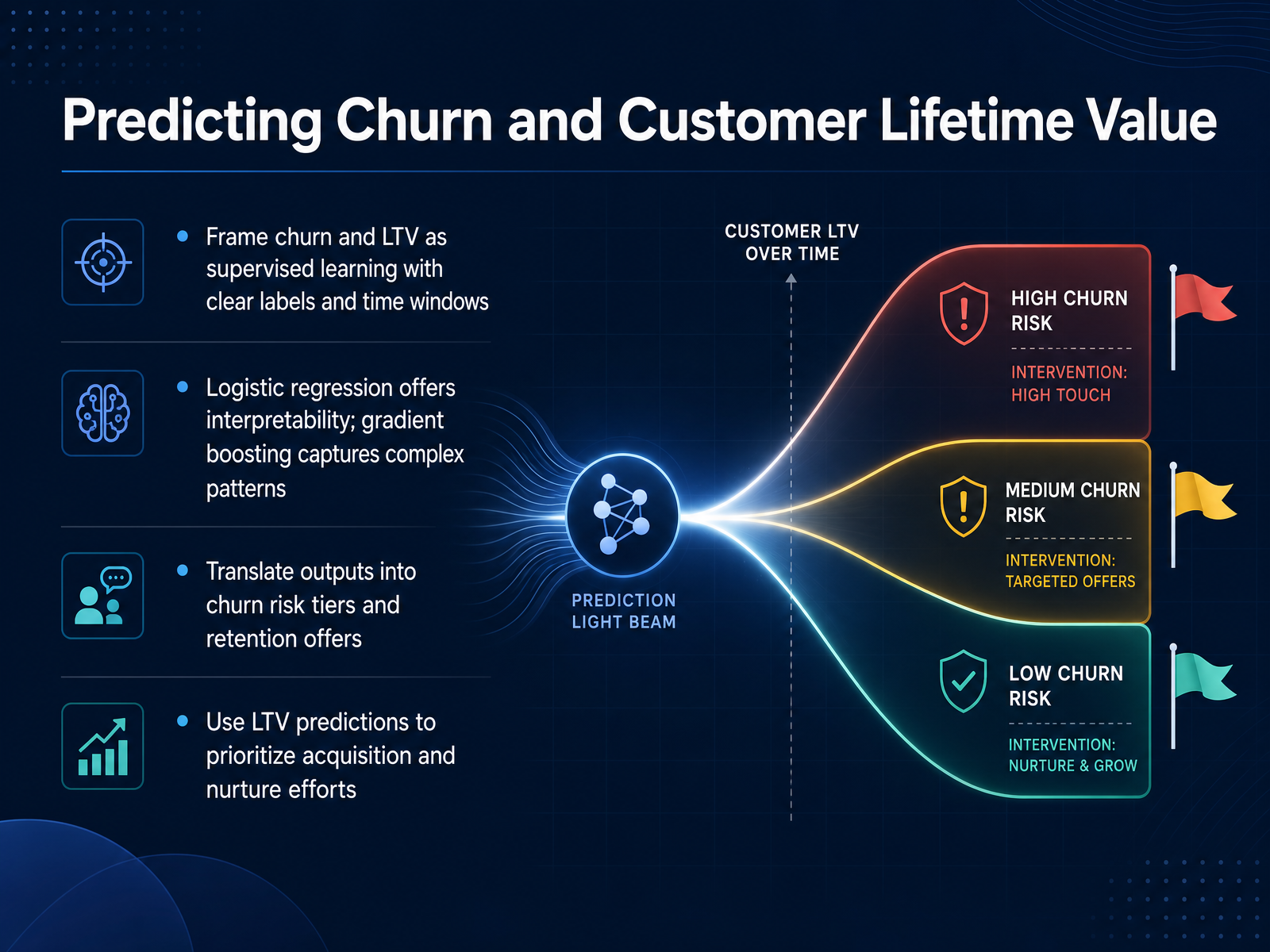
1 min - 06Predicting Churn and Customer Lifetime ValueNow let’s shift to two of the most valuable predictions a marketing team can make: churn and customer lifetime value. Both are classic supervised learning problems. That means you need clearly defined labels and time windows. For churn, the label might be whether a customer made no purchase in the next ninety days. For LTV, it’s the actual revenue they generate over the next year. The time window matters because it keeps your predictions consistent and actionable. When it comes to modeling, start with logistic regression for churn. It gives you clean, interpretable coefficients, and you can see exactly which behaviors drive risk. But if you have complex patterns in your data, like interactions between usage and support tickets, gradient boosting will capture those better. The key is to translate model output into something your team can act on. Instead of just a probability, group customers into churn risk tiers and assign a retention offer to each one. High risk gets a win-back discount; medium risk gets a targeted email campaign. For LTV, use your predictions to guide acquisition budgets and nurture flows. Spend more on high-LTV segments and adjust messaging that moves mid-tier customers up. The takeaway is this: don’t build models for accuracy alone. Build them so you can make a clear business decision at the end. In our next section, we’ll look at how to use similar models for campaign targeting and recommendation engines.
 2 min
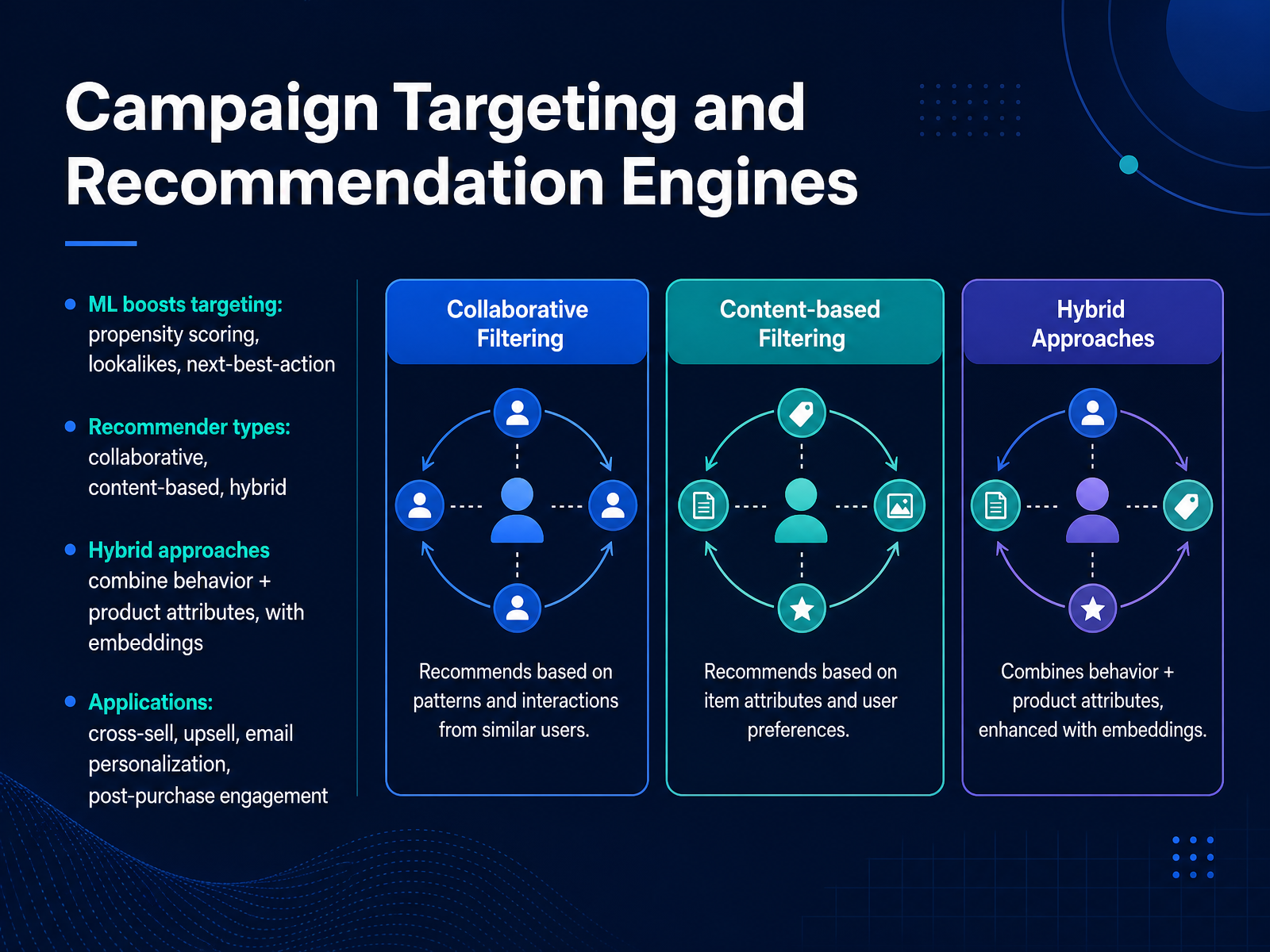
2 min - 07Campaign Targeting and Recommendation EnginesNow let's shift to how machine learning sharpens campaign targeting. Propensity scoring tells you which customers are most likely to convert, lookalike modeling finds similar high-value audiences, and next-best-action models recommend the optimal offer or channel for each individual. Under the hood, recommender systems power much of this. Collaborative filtering learns from patterns across users—people like you also bought this—but it struggles with new users or products. Content-based filtering matches items by their attributes, which works even with sparse history. In practice, you'll want a hybrid that blends behavioral signals with product features, often using embeddings to place users and items in a shared vector space. That lets you find similar items instantly and handle cold starts gracefully. The payoff shows up across cross-sell, upsell, email personalization, and post-purchase follow-ups. For example, a hybrid model might suggest accessories based on a recent purchase plus similar customers' behavior. The key is to start with a clear KPI like incremental revenue per session, and run controlled A/B tests against a holdout group. Next, we'll look at how marketing mix modeling and AI-assisted measurement round out your analytics toolkit.
 agenticmarketingpro.comcone.redabmatic.ai+22 min
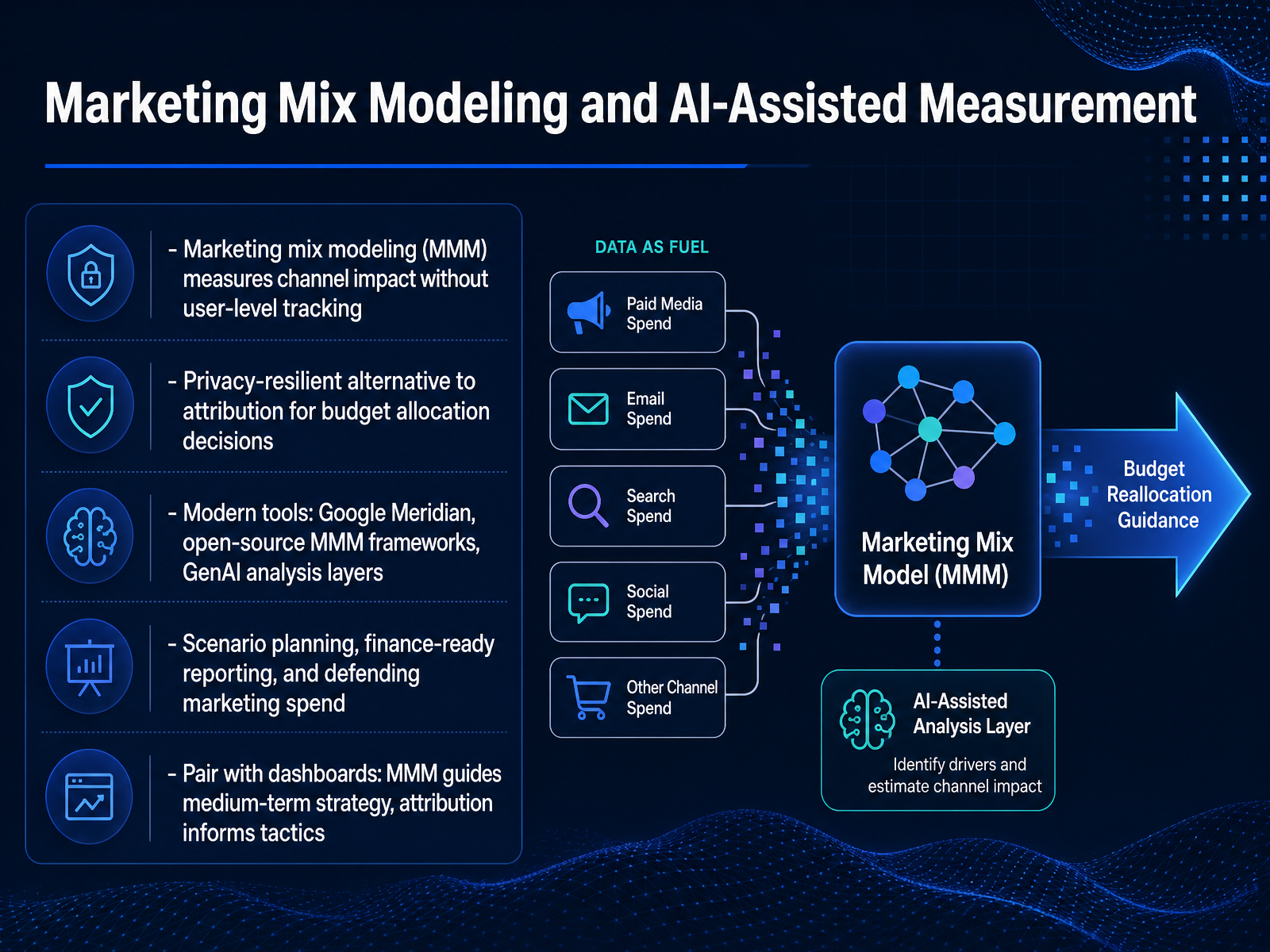
 - 08Marketing Mix Modeling and AI-Assisted MeasurementNow let's shift to the measurement layer where machine learning is changing the game: marketing mix modeling, or MMM. If you've struggled with attribution gaps, especially after privacy changes, MMM is your answer. It looks at aggregate data to understand the impact of every channel without needing user-level tracking. Think of it as a macro lens for your marketing. Modern tools like Google Meridian and open-source frameworks make this more accessible than ever. They give you what we call a glass-box view—full transparency into inputs and assumptions. This is crucial when you're presenting to finance. You can run scenario planning, defend your budget, and answer the tough question: what really drove that growth? The strongest approach is pairing MMM with your existing dashboards. Use MMM for your medium-term strategy and budget allocation. Use your attribution data for the day-to-day tactical moves. This gives your team a complete, defensible picture of performance. Next, we'll look at how to evaluate model performance from a business perspective.
 prophet.mlinfocepts.ailayerfive.com+21 min
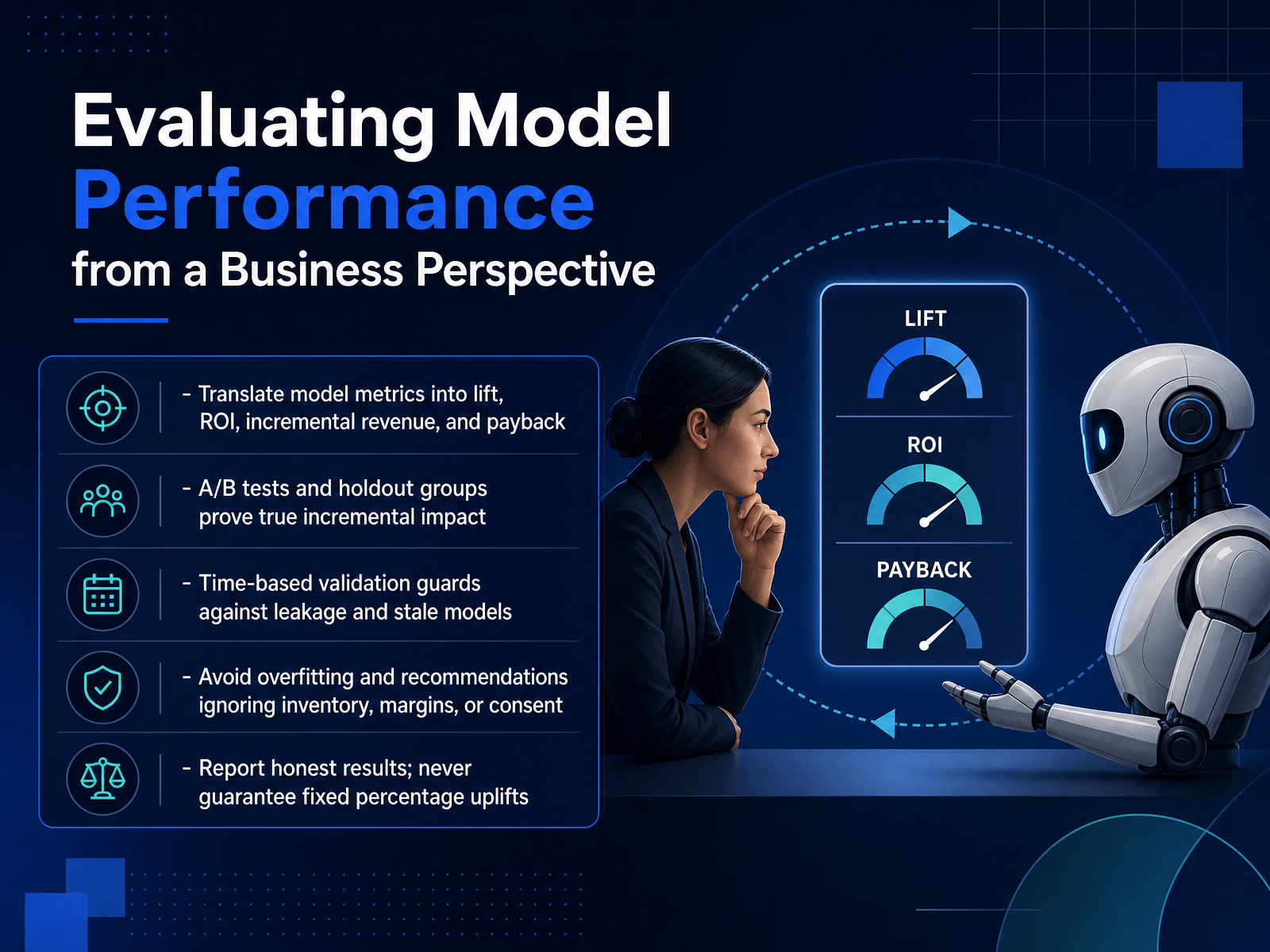
 - 09Evaluating Model Performance from a Business PerspectiveLet’s walk through how model evaluation translates into business terms your stakeholders actually care about. The real currency here is lift and incremental revenue, not just clicks. A model that looks great on precision could still fail to move the bottom line. So anchor on metrics that tie to payback and return on ad spend. The only way to prove real impact is through A/B tests and holdout groups. If your personalized segment outperforms a random control, that difference is true incrementality. Anything else is just correlation theater. Time-based validation is another safeguard. Train on past data, validate on recent data, so you spot leakage and avoid deploying a stale model that can’t handle today’s shopping behavior. And watch for overfitting. A model can memorize historical patterns but fail to generalize. Always check the business constraints. Optimizing for conversion that ignores inventory, margins, or consent is a fast way to erode trust and profitability. Finally, report honest results. Never guarantee a fixed percentage uplift. Real performance depends on data quality, market shifts, and seasonality. Frame numbers as ranges, and let the experiment tell the story. Give your stakeholders a clear view of payback windows and incremental gains, and you’ll build confidence that lasts. Next, let’s look at implementation, tools, and the actual team workflows that make this possible in production.
 agenticmarketingpro.comcone.redabmatic.ai+22 min
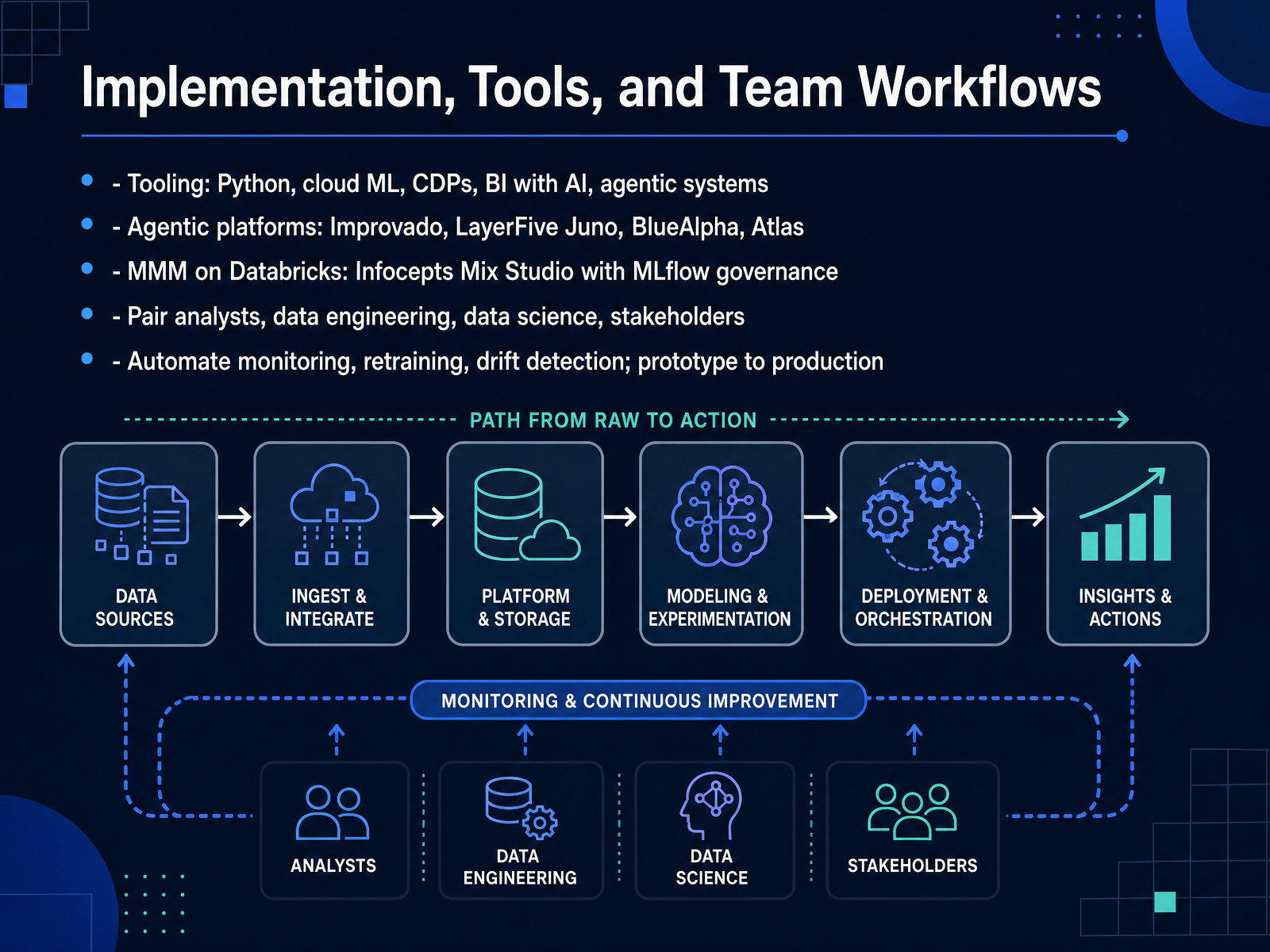
 - 10Implementation, Tools, and Team WorkflowsOnce you've validated your models, the real work begins: moving from prototype to production. Your toolkit will likely span Python for modeling, cloud ML for scale, and BI tools for consumption. Agentic platforms like Improvado, LayerFive Juno, and Atlas now sit between your data and your decisioning. BlueAlpha even manages spend like a portfolio. For market mix, look at glass-box solutions like Infocepts Mix Studio on Databricks; it uses open-source frameworks, so you own the model instead of renting it, with MLflow tracking every version for full auditability. The team structure matters as much as the tech. You need analysts who own the business questions and stakeholders who make decisions. Data engineering and data science build and scale the pipeline, but no one works in a silo; create paired workflows across these groups. Automation is what separates a pilot from a program. Automate monitoring, retraining, and drift detection so the model doesn't silently degrade. The goal is to get from experiment to always-on system, and the teams that do this well build trust as they scale. Which brings us to a critical topic: ethics, bias, and responsible marketing ML.
 prophet.mlinfocepts.ailayerfive.com+22 min
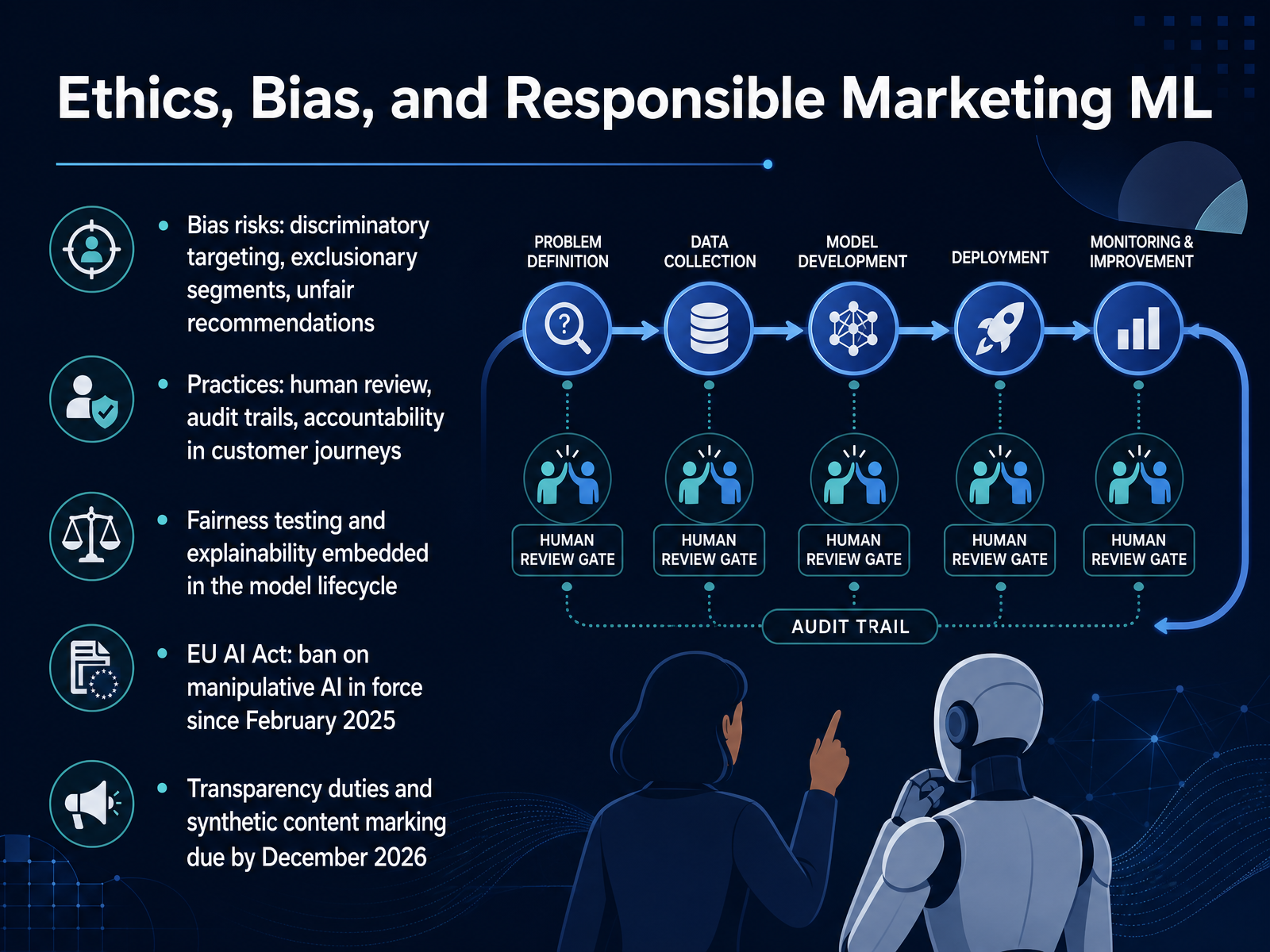
 - 11Ethics, Bias, and Responsible Marketing MLLet’s shift to the part of machine learning that doesn’t show up in a confusion matrix: ethics, bias, and responsible use. Models trained on historical data can easily encode past bias, which in marketing means discriminatory targeting, exclusionary segments, or recommendations that are simply unfair to certain groups. The fix isn’t just better algorithms; it’s embedding human review, audit trails, and accountability directly into the customer journey. You want fairness testing and explainability built into the model lifecycle from day one, not bolted on after a problem surfaces. And the legal landscape is catching up. Under the EU AI Act, the ban on manipulative AI has been in force since February 2025. And by December 2026, you must mark synthetic content and meet transparency duties. The practical takeaway here is that responsible ML is a design constraint, not a PR exercise. Bake the checks in early. Everything else is just cleanup. Next, let’s walk through the specifics of AI disclosure requirements and privacy regulations.
 confir.euicctunisia.orgregulatoryai.eu+22 min
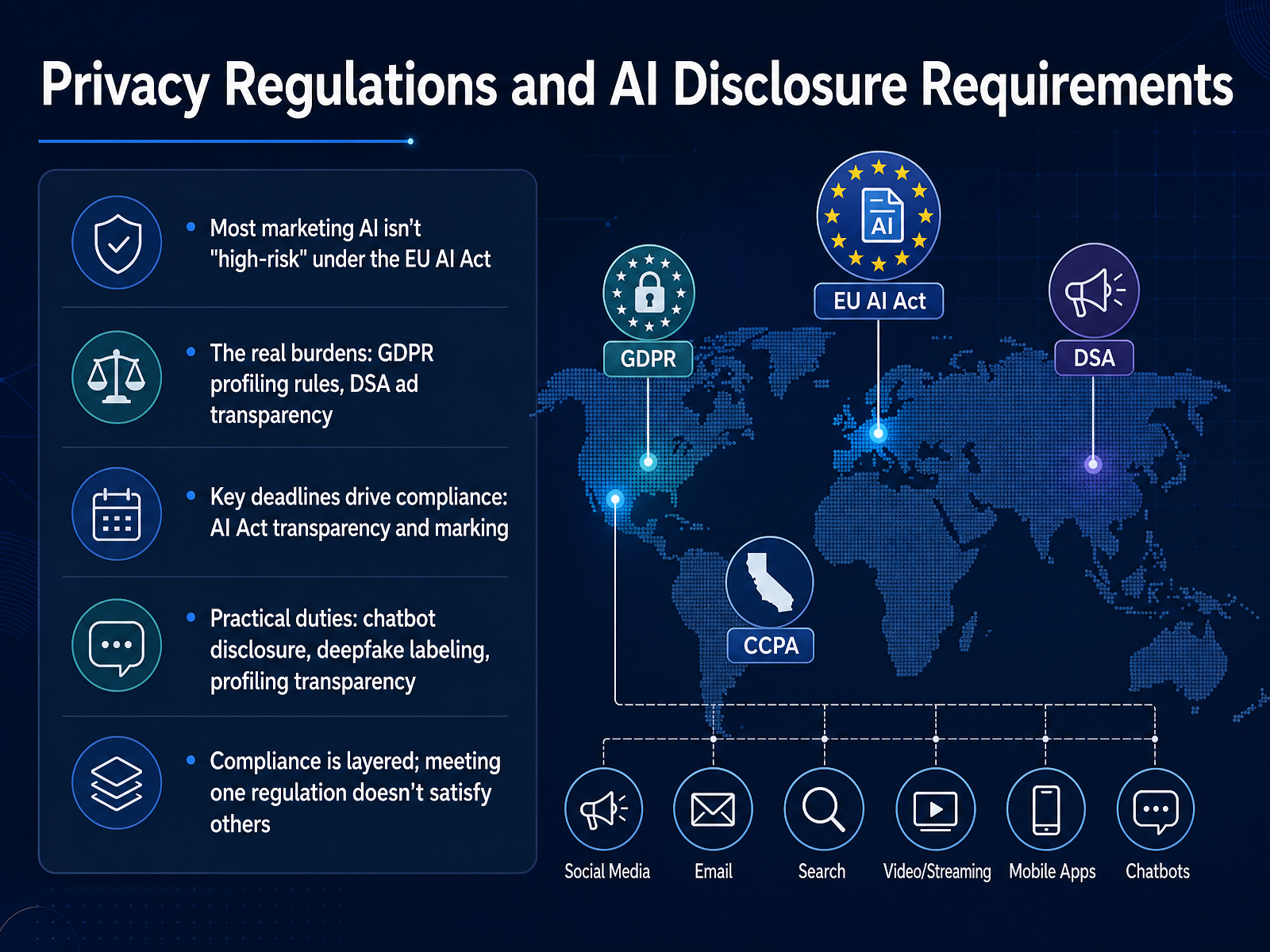
 - 12Privacy Regulations and AI Disclosure RequirementsLet’s talk about compliance, because this is where a lot of ML marketing projects actually stumble. Here’s the good news first: most marketing AI is not high-risk under the EU AI Act. Targeting, recommenders, chatbots, generative creative—none of those are on the high-risk list. So you don’t need a conformity assessment for your standard campaign stack. But that doesn’t mean you’re off the hook. The real weight comes from GDPR profiling rules and the DSA’s ad transparency duties. Those apply regardless of the AI Act tier, and in practice they often bite harder. On timing, most transparency duties under Article 50 apply from August second, 2026. The content-marking and watermarking obligations for synthetic media land on December second, 2026. Practically, that means a few concrete duties. If you run a marketing chatbot, tell users they’re talking to an AI, right at the point of interaction. If you publish synthetic spokespeople or deepfake-style ads, label them clearly, and make sure the output is machine-readable. And if you profile users for targeting, that’s GDPR profiling—so you need a lawful basis, transparency, and often consent. One more thing: don’t assume checking one box covers another. The AI Act, GDPR, and DSA run in parallel. A campaign can be fully GDPR-compliant and still breach the AI Act’s ban on manipulative AI. Treat them as separate checks that all have to pass. And this has implications for how you operationalize models, which is exactly where we’re headed next.
 confir.euicctunisia.orgregulatoryai.eu+22 min
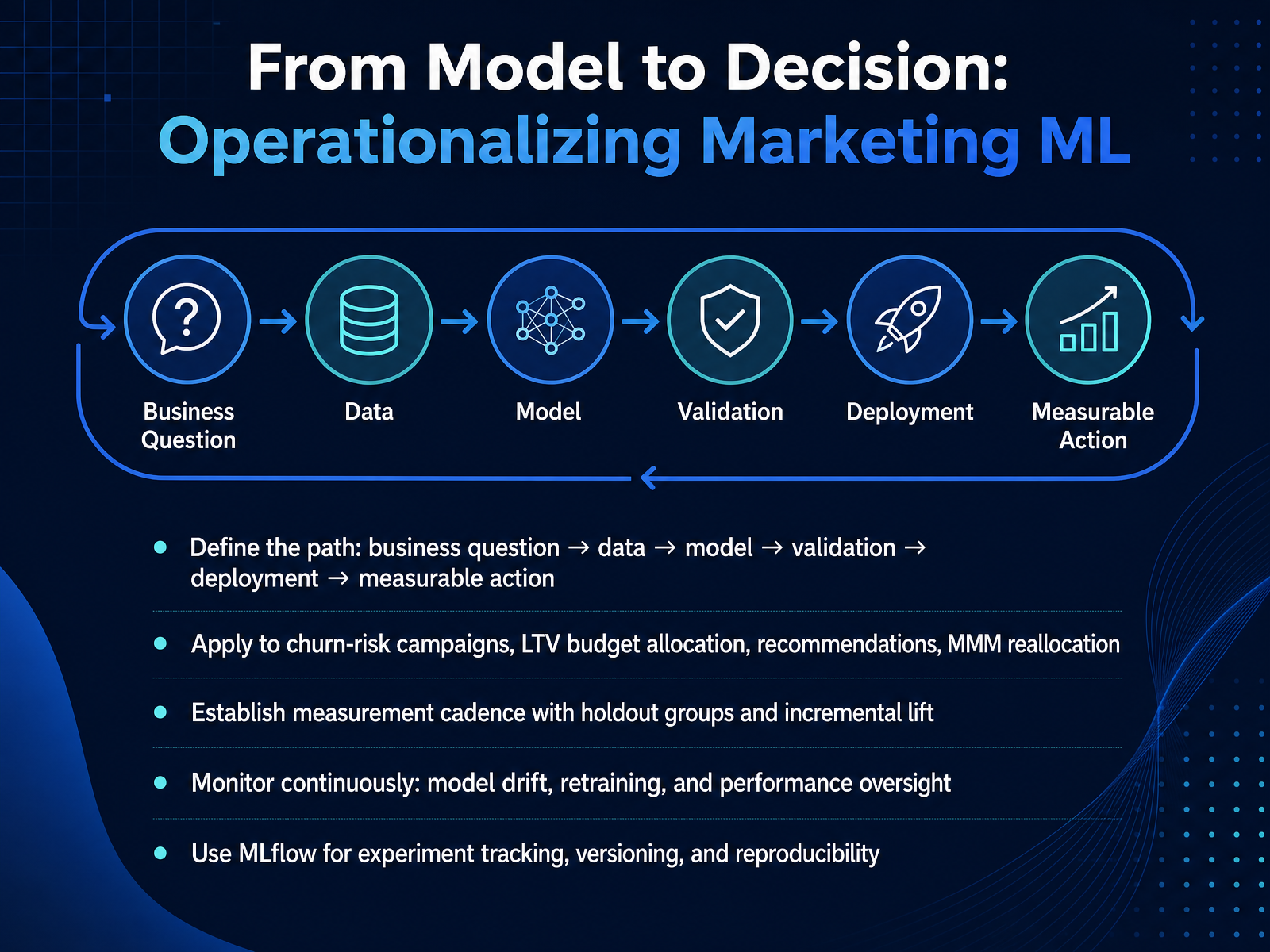
 - 13From Model to Decision: Operationalizing Marketing MLNow, let's walk the full path from model to decision. It starts with a clear business question, flows through data, model building, validation, and then deployment into a measurable action. For churn risk, that action might be a win-back campaign. For lifetime value, it means shifting budget toward your high-value segments. The key is to establish a measurement cadence from day one. Use holdout groups and track incremental lift, so you know the model is driving real impact, not just noise. And stay vigilant. Models drift as customer behavior changes, so continuous monitoring and retraining are non-negotiable. Tools like M Lflow help here, giving you experiment tracking, versioning, and full reproducibility. This is how you keep your marketing machine learning trustworthy, auditable, and ready for the next decision. Let’s wrap up with the key takeaways and next steps.
 prophet.mlinfocepts.ailayerfive.com+22 min
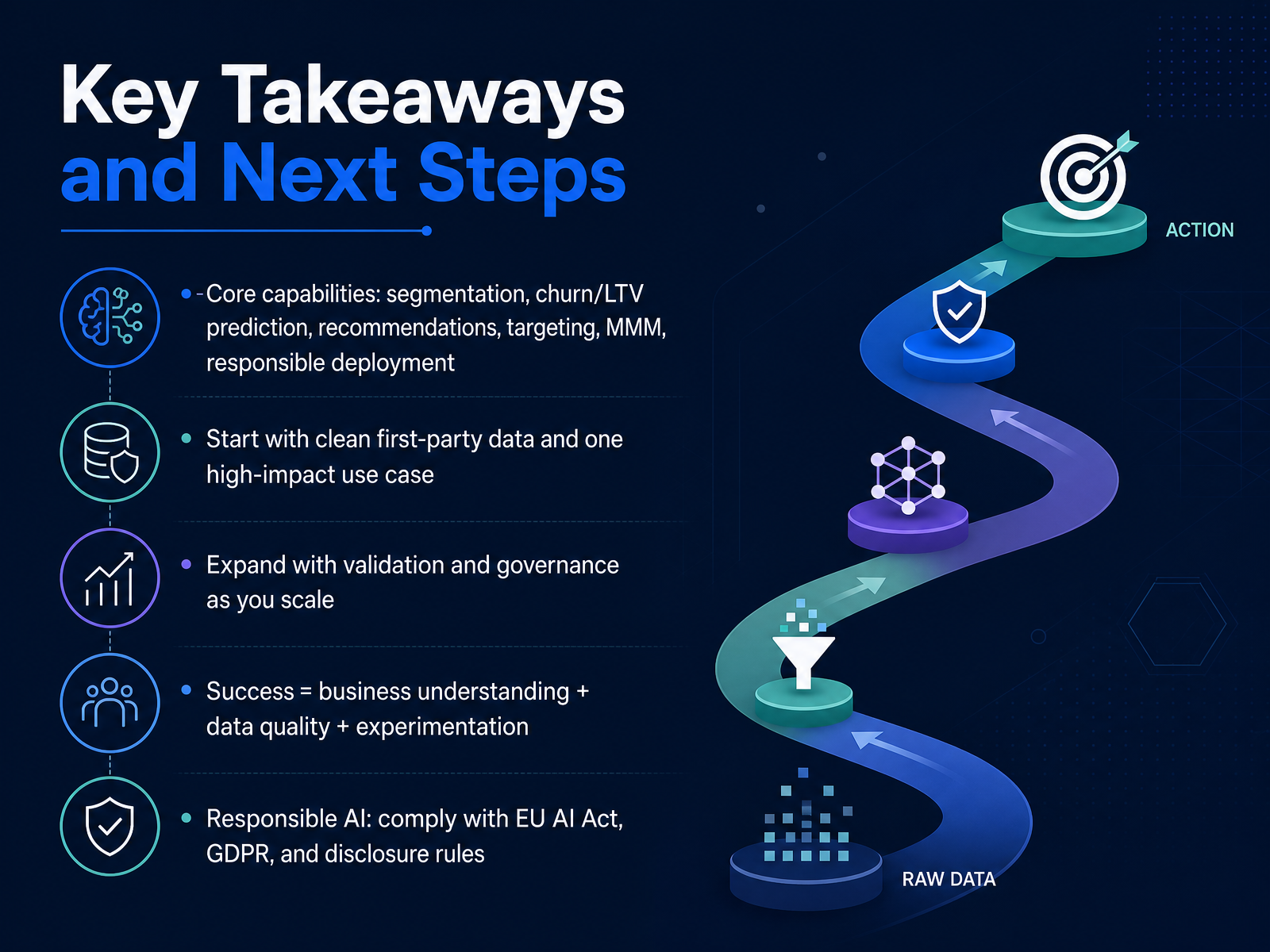
 - 14Key Takeaways and Next StepsLet's pull the key takeaways together. Your ML toolkit now covers segmentation, churn and LTV prediction, recommendations, targeting, and marketing mix modeling. The common thread is always the same: start with clean first-party data and pick one high-impact use case. Validate that model against your business metrics, and build governance in as you scale. Success isn't about the algorithm. It's about business understanding, data quality, and honest experimentation. And as you deploy, treat responsible AI as a core requirement. The EU AI Act bans manipulative systems, and the transparency and disclosure rules are now in force or coming into effect throughout 2026. GDPR profiling rules apply to your targeting regardless. So audit your models, disclose AI interactions, and always keep a human in the review loop. You now have the framework. Go test it on your next campaign. Thanks for your time and attention.
 confir.euicctunisia.orgregulatoryai.eu+22 min
Take the deck with you
Download this course as a file — free, no sign-up needed.
- PDF handoutEvery slide page, ready to print or share.15 pages · 3.7 MBDownload
- Narrated PowerPointThe deck that presents itself — every slide carries the digital human's narration video.15 pages · 15.2 MBDownload
- PowerPoint slidesThe full deck as a .pptx — open it in PowerPoint, Keynote, or Google Slides.15 pages · 3.6 MBDownload
Free to use in your own training — please keep the PersonWise credit page at the end.
Have your own deck? Turn it into a course
Sources consulted
Web sources consulted while building this course.
- AI in Marketing Analytics: Use Cases, Tools & Future (2026) | 1ClickReport — 1clickreport.com
- Inside Target’s LLM-Based System for Semantic Matching in Marketing Forecast Pipelines - InfoQ — infoq.com
- Scaling Marketing Campaign Forecasting with Generative AI — tech.target.com
- AI Marketing Use Cases in 2026: Real Examples & Strategies — blog.coupler.io
- Machine Learning in Marketing: A Guide (2026) - Salesforce — salesforce.com
- Modern Recommendation Engines for Marketing: Moving the Needle in 2026 — agenticmarketingpro.com
- AI Recommendation & Personalization Systems (2026) | CONE RED — cone.red
- Personalized product recommendations in 2026: how to build — abmatic.ai
- The Complete Guide to Marketing Personalization in 2026 — evokad.com
- AI Personalization Engine: Complete 2026 Guide & Implemen... — manyforce.com
- https://www.prophet.ml/ — prophet.ml
- Infocepts Mix Studio | Glass-Box MMM on Databricks — infocepts.ai
- AI Marketing Analytics & Insights Assistant | LayerFive Juno — layerfive.com
- Improvado, Your Marketing Runs Itself. The AI Agent That Connects, Analyzes, Creates & Optimizes. — improvado.io
- 15 Marketing Analytics Tools for 2026 + How to Choose — domo.com
- EU AI Act for Marketing & Adtech (2026) | Confir — confir.eu
- Responsible AI in marketing: How to apply the ICC Advertising and Marketing Communications Code | — icctunisia.org
- EU AI Act & Marketing / AdTech AI — regulatoryai.eu
- Ethics of Agentic AI Marketing: FTC and Privacy 2026 — themarketingshelf.com
- The EU AI Act Is Fully Enforceable by August 2, 2026: What This Means for Enterprise Marketing Teams - Marrina Decisions — marrinadecisions.com