Begin
14 pages · ~28 min
Japanese Woodblock Prints: Making and Reading Ukiyo-e
This training explores how Japanese ukiyo-e woodblock prints were produced and interpreted, guiding learners through the collaborative process and visual reading of these works.
A digital instructor presents all 14 pages. Hold “Ask” at any point and ask out loud — the answer comes from this course. No sign-up needed.
What you’ll learn
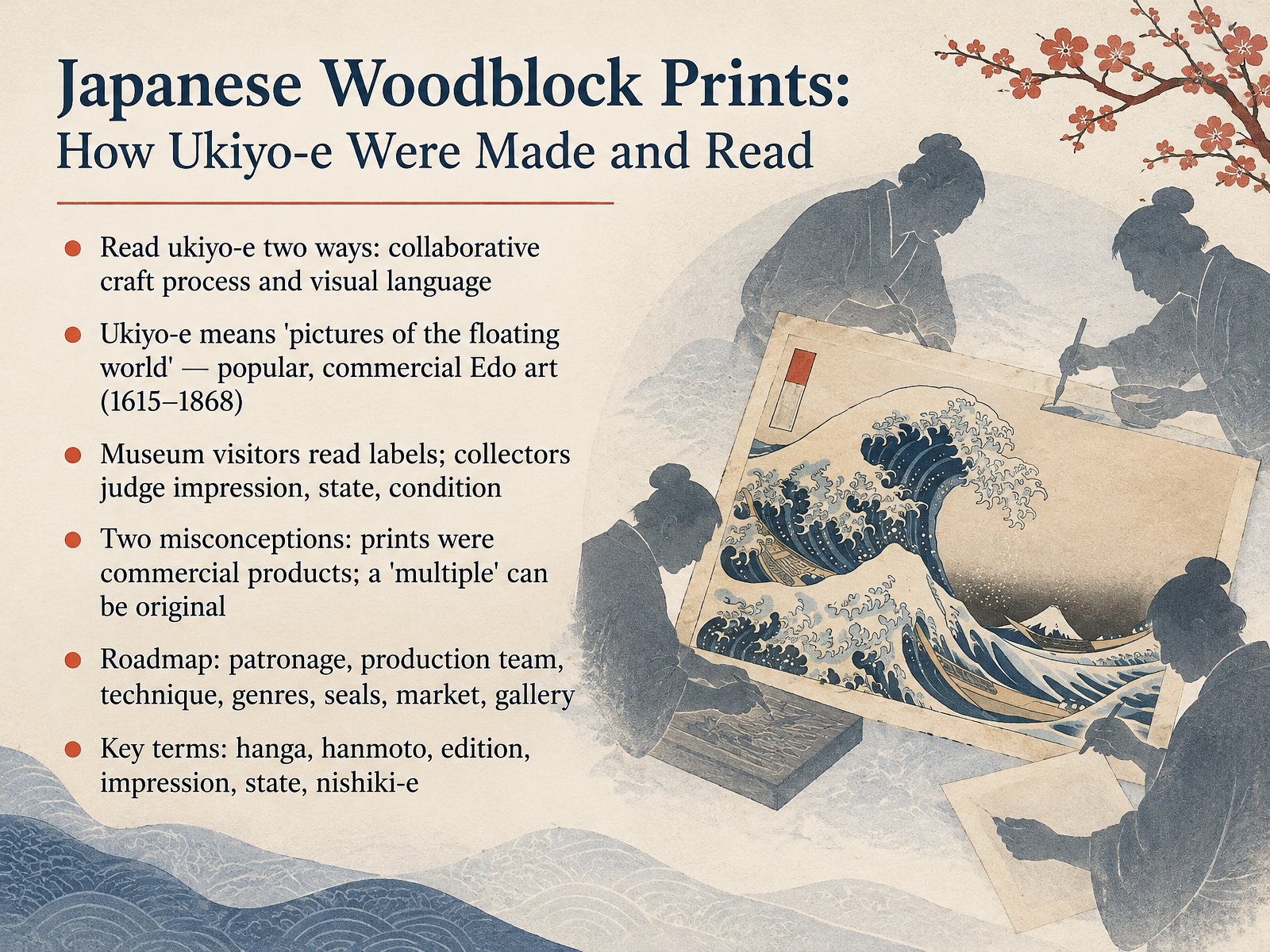
- 01Japanese Woodblock Prints: How Ukiyo-e Were Made and ReadWelcome. Over the next fourteen slides, we're going to look closely at Japanese woodblock prints, the art we call ukiyo-e, and learn to read them in two ways at once. First, as the product of a collaborative craft process, where a publisher, an artist, a carver, and a printer each shaped the final image. Second, as a visual language, with its own conventions for color, composition, and subject. The word ukiyo-e means pictures of the floating world, a popular, commercial art born in Edo, present-day Tokyo, during the Tokugawa period, from 1615 to 1868. Here's something worth keeping in mind. Museum visitors often read the label and move on, while collectors study impression, state, and condition. Both habits have value. And let's clear up two common misconceptions. These prints were commercial products, yes, but that doesn't make them less artistic. And a multiple, a print pulled in an edition, can still be an original. If this is new to you, don't worry. Along the way we'll meet key terms like hanga, meaning woodblock print, hanmoto, the publisher, plus edition, impression, state, and nishiki-e, the full-color brocade pictures. Next, we'll step into Edo society and see who paid for these prints and why.loc.govvam.ac.ukmetmuseum.org+22 min
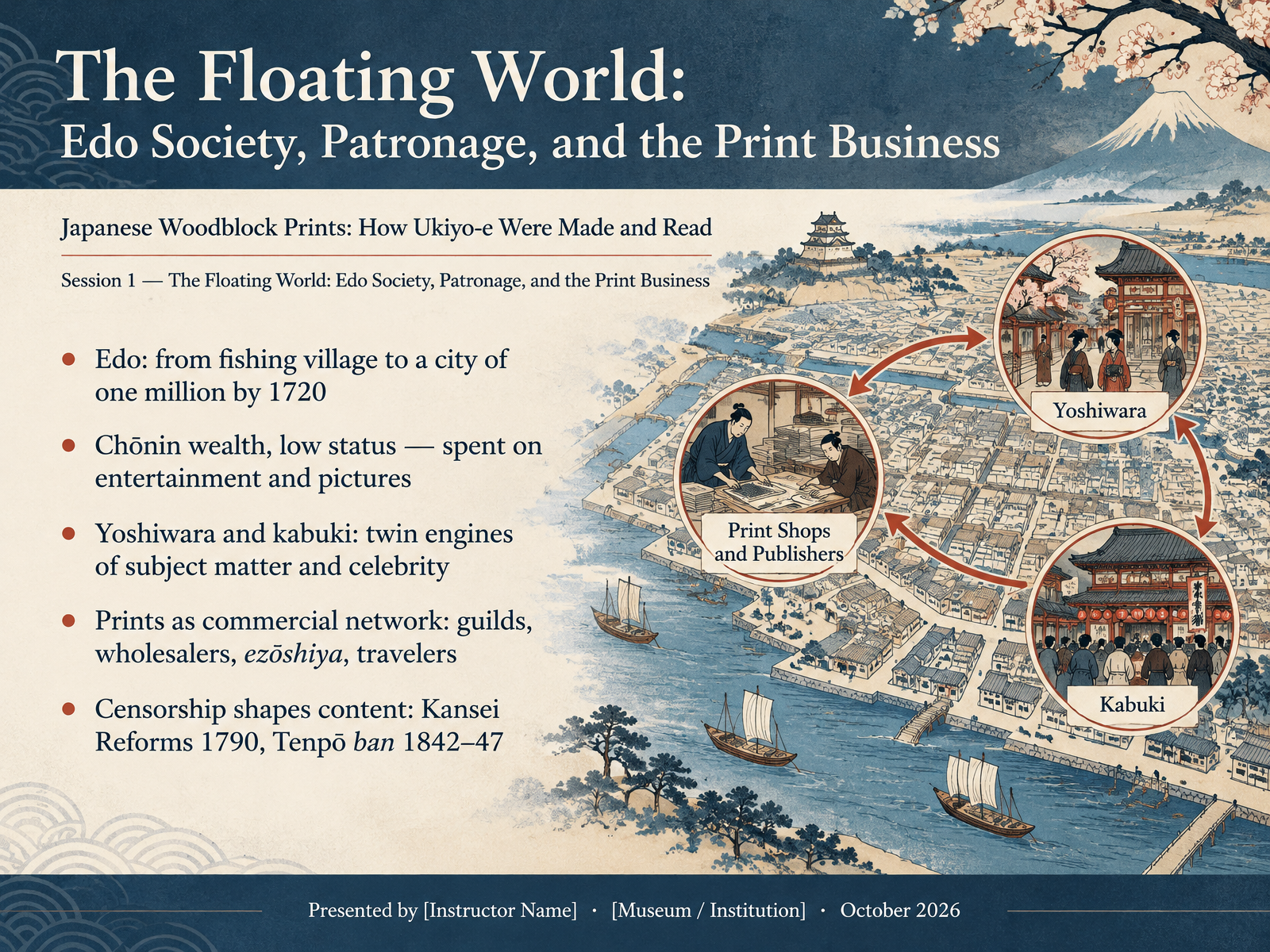
- 02The Floating World: Edo Society, Patronage, and the Print BusinessNow let's set the stage. Ukiyo-e did not appear in a quiet museum. It came out of Edo, a fishing village that grew into a city of over a million people by 1720, the largest in the world at the time. Merchants and craftsmen, the chōnin, held low social status, but they had money, and they spent it on pleasure and pictures. The Yoshiwara pleasure district and the kabuki theaters became the twin engines of subject matter, turning courtesans and actors into celebrities. Prints moved through a commercial network of guilds, wholesalers, and print shops called ezōshiya, with travelers carrying images far beyond the city. But this was also a controlled world. The Kansei Reforms of 1790 and the Tenpō bans of 1842 through 1847 restricted what could be published, shaping both content and style. So when you look at a print, remember it was a business, a pleasure, and a negotiation with power. Next, we look at the four hands behind every sheet: Four Hands, One Print: Publisher, Artist, Carver, Printer.
 hdl.handle.netdegruyterbrill.comdoi.org+22 min
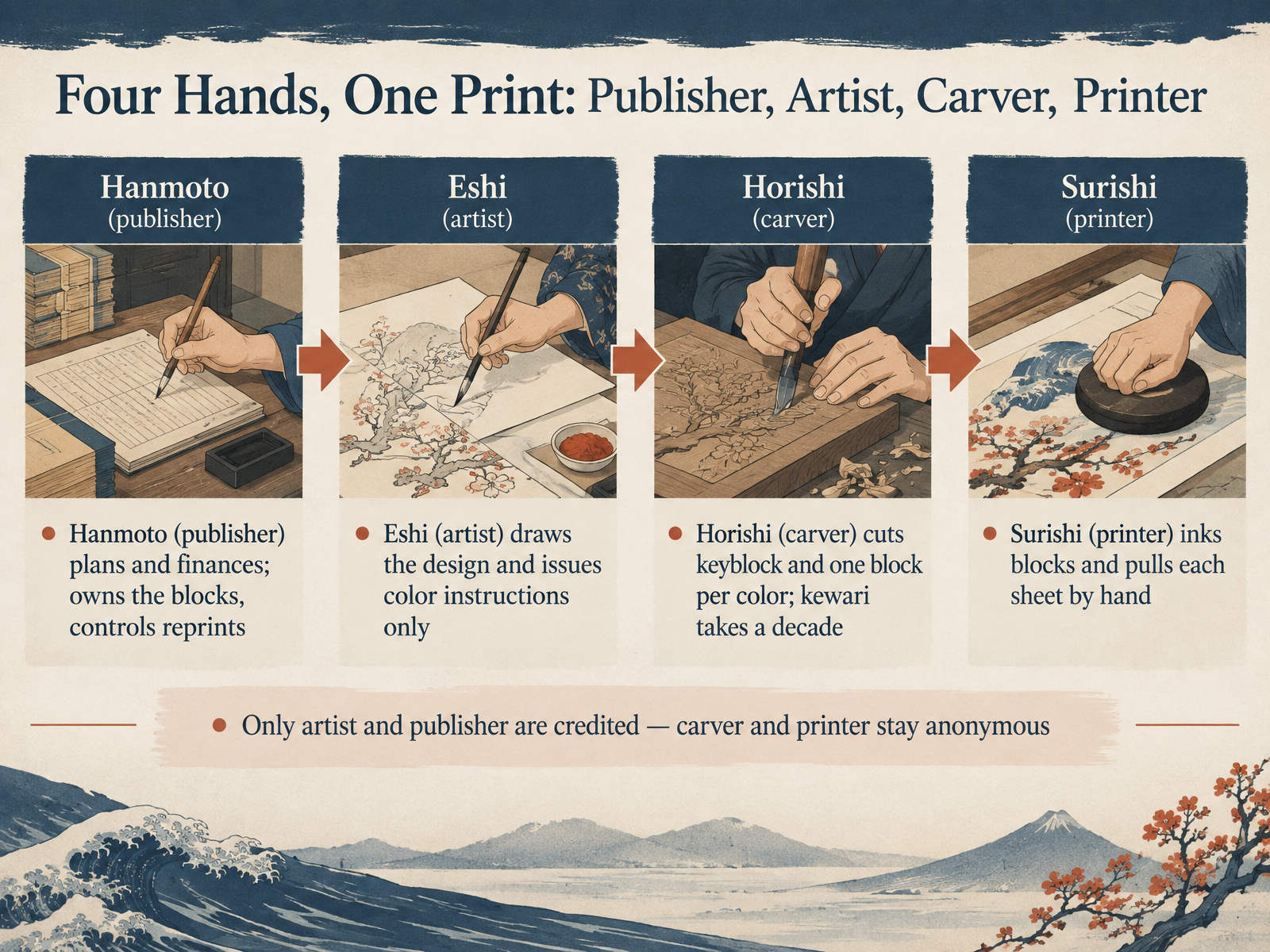
- 03Four Hands, One Print: Publisher, Artist, Carver, PrinterNow let's meet the four hands behind every print. First, the hanmoto, the publisher, plans the whole project, pays for it, and owns the woodblocks. That ownership matters, because the publisher controls any later reprints. Second, the eshi, the artist, draws the design in black ink and issues color instructions, but never carves or prints. Third, the horishi, the carver, cuts the keyblock for the outlines, then one block for every color. His finest skill, kewari, splitting a hairline strand by strand, can take over ten years to master. Fourth, the surishi, the printer, inks each block and pulls every sheet by hand, aligning paper to the kento marks and judging color and pressure by touch alone. Here is the surprising part. Only the artist and publisher are credited on the finished print. The carver and printer stay anonymous, yet without them, the print never exists. From drawing to block, materials and the carving stage.
 education.asianart.orgmetmuseum.orgukiyoe-japan.jp+22 min
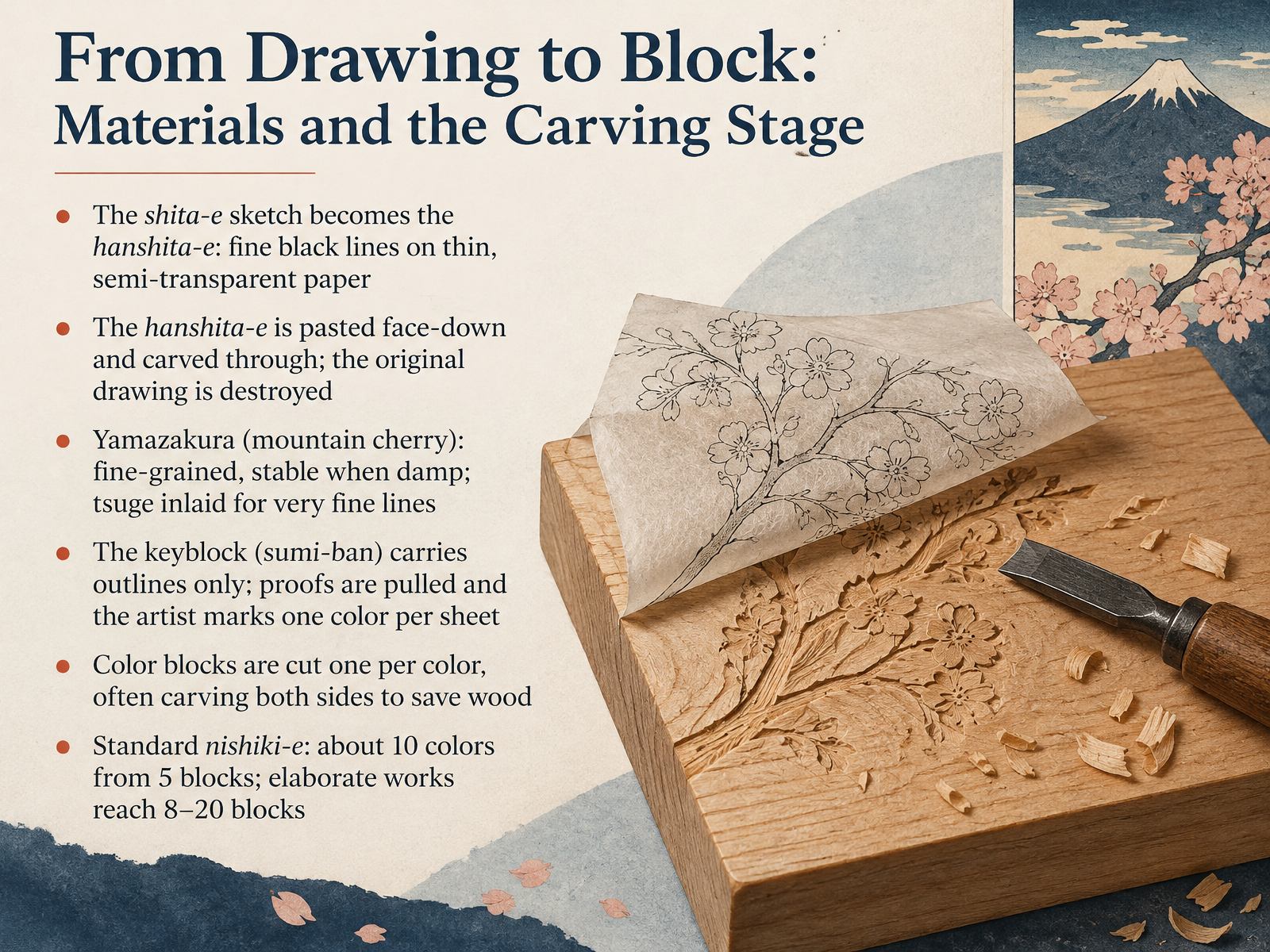
- 04From Drawing to Block: Materials and the Carving StageSo the artist's drawing leaves the studio, and now it enters the carver's workshop. That finished sketch is copied onto thin, semi-transparent paper to become the hanshita-e, the fine black lines that everything else will follow. Then the carver pastes that sheet face-down onto the block and cuts straight through it. Notice what that means. The original drawing is destroyed in the process. The paper is shaved away as the carving proceeds, so what survives is the block itself. The wood is yamazakura, mountain cherry, prized for its fine, straight grain and its stability when damp. For hairline details, a harder wood called tsuge is inlaid into the cherry block. The first block cut is the keyblock, or sumi-ban. It carries the outlines only. Proofs are pulled from it, and the artist marks one color per sheet. Those marked proofs guide the carving of the color blocks, one per color, and carvers often cut both sides of a block to save wood. A standard nishiki-e needs about ten colors from five blocks, while elaborate prints can run from eight to twenty blocks. Next, registration and printing, how color lands in the right place.
 viewingjapaneseprints.netmetmuseum.orgukiyoe-japan.jp+22 min
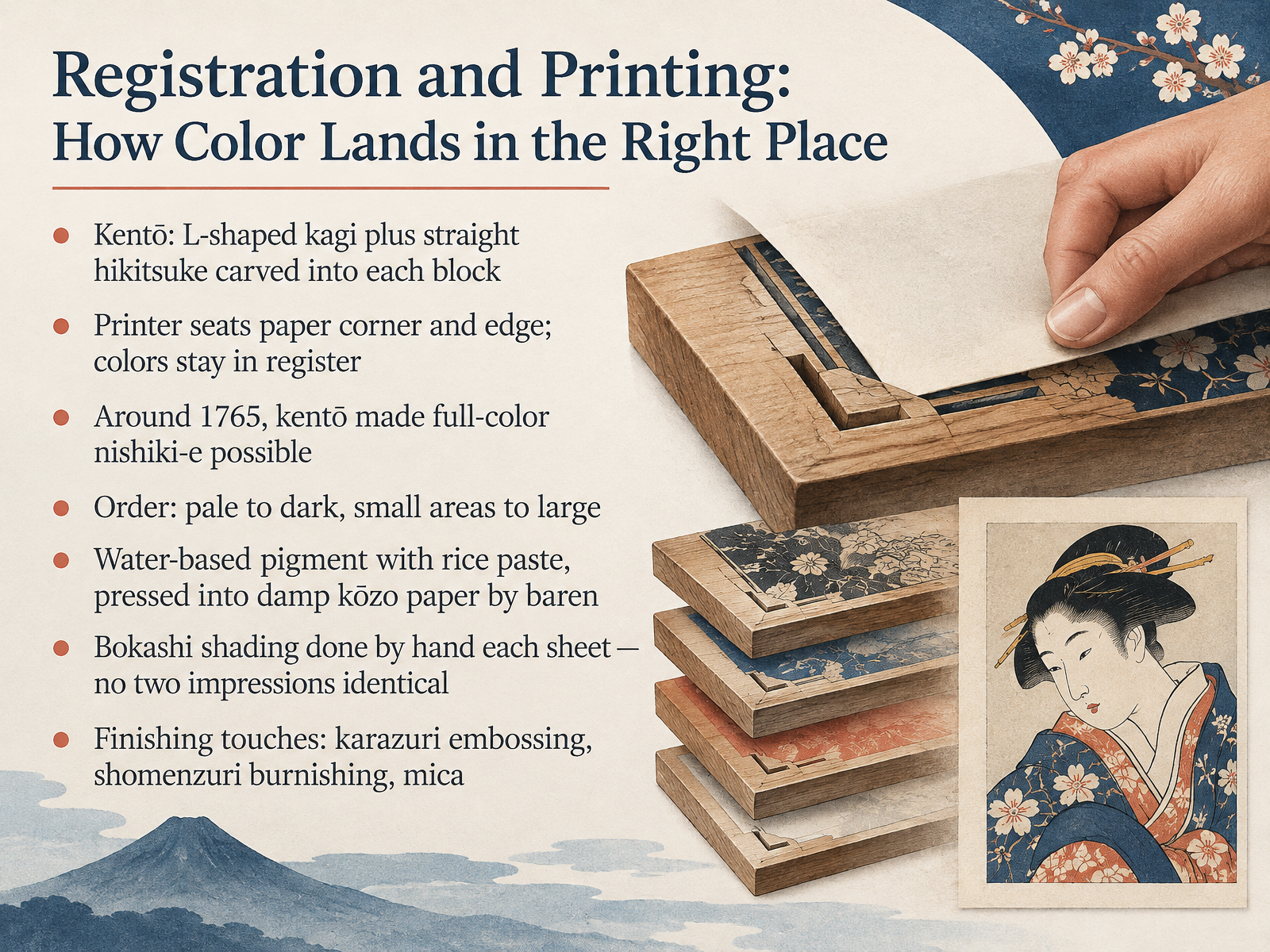
- 05Registration and Printing: How Color Lands in the Right PlaceSo how does each color land in exactly the right place? The answer is the kentō. Picture two small guide marks carved into the edge of every block: an L-shaped notch called the kagi, and a straight line called the hikitsuke. The printer simply seats one corner and one edge of the paper against them. Change the block, and the paper sits in the same spot. Colors stay in register. This invention, around seventeen sixty-five, is what made full-color nishiki-e possible. The printer then works from pale to dark, small areas to large, so a dark color never smears into a fresh one. Water-based pigment, mixed with rice paste, is brushed on and pressed into damp kōzo paper with the baren. For bokashi, that soft shading in a sky, the printer wipes pigment unevenly across the block by hand for every single sheet. So no two impressions are truly identical. Some prints finish with karazuri, an uninked block pressed for blind embossing, with shomenzuri burnishing, or with flecks of shimmering mica. Next, let's trace how those techniques took printmaking from single-color images to the full glory of nishiki-e, in The Color Revolution: From Sumizuri-e to Nishiki-e.
 viewingjapaneseprints.netmetmuseum.orgukiyoe-japan.jp+22 min
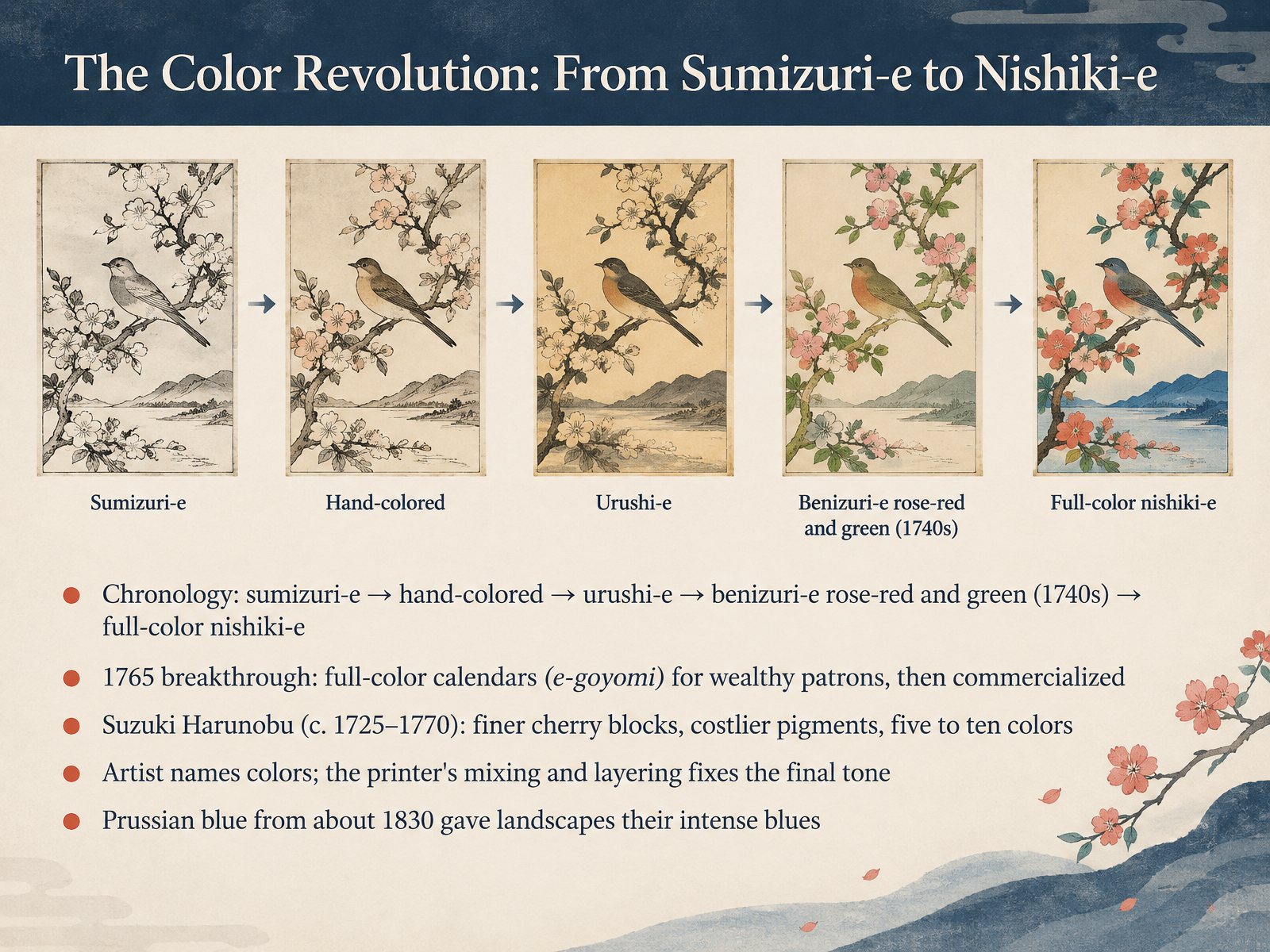
- 06The Color Revolution: From Sumizuri-e to Nishiki-eNow let's look at how color completely transformed these prints. Early ukiyo-e were sumizuri-e, simple black-and-white images, sometimes colored by hand. By the seventeen forties, printers were adding limited colors, usually rose-red and green, in prints called benizuri-e. Then came the real breakthrough in seventeen sixty-five: full-color calendars commissioned by wealthy patrons, soon commercialized. Suzuki Harunobu drove this change, using finer cherry wood blocks, costlier pigments, and as many as five to ten colors. The artist named the colors, but the printer's mixing and layering fixed the final tone. And from about eighteen thirty, imported Prussian blue gave landscape prints their intense, unforgettable blues. So color was never just decoration. It was a collaboration between designer, carver, and printer. Next, we will explore the genres these prints brought to life: Reading the Genres: Actors, Beauties, Warriors, and Landscapes.
 projects.mcah.columbia.edumetmuseum.orgrepository.upenn.edu+22 min
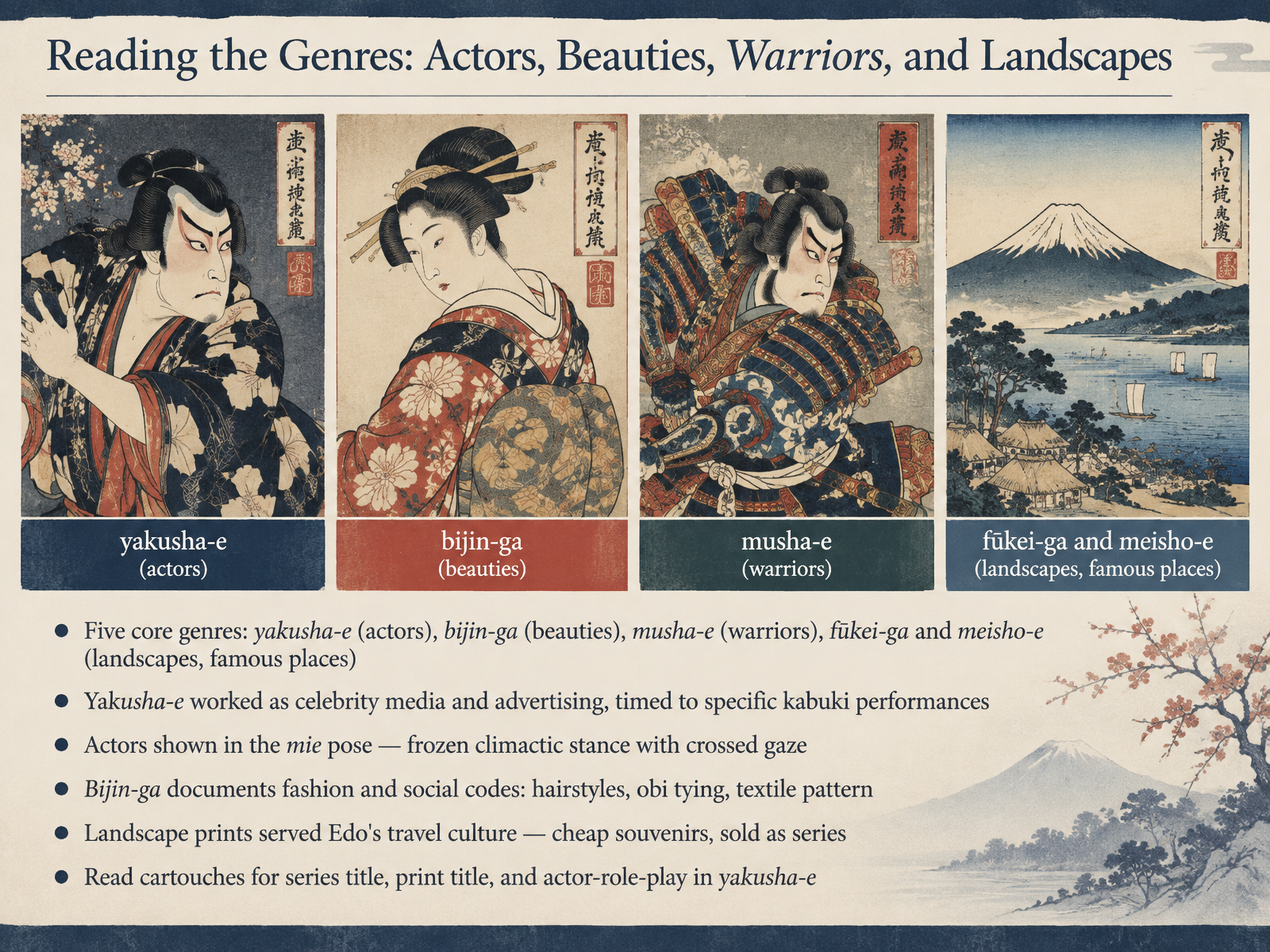
- 07Reading the Genres: Actors, Beauties, Warriors, and LandscapesLet's look at the five genres you'll meet most often in a gallery. Yakusha-e are actor prints. Think of them as celebrity media and advertising, timed to specific kabuki performances. You'll often see an actor frozen in the mie pose, that climactic stance with a crossed, intense gaze. Bijin-ga, pictures of beauties, are really fashion documents. Look closely at hairstyles, how the obi is tied, and textile patterns. Landscape prints, fukei-ga and meisho-e, served Edo's travel culture, sold as cheap souvenirs in series. And musha-e gave you warriors and legendary heroes in dramatic scenes. Finally, read the cartouches, those little banners of text. They carry the series title, the print title, and, in actor prints, the actor's name, role, and play. Next, how Edo viewers read a print: visual codes and playful allusions.
 loc.govvam.ac.ukmetmuseum.org+22 min
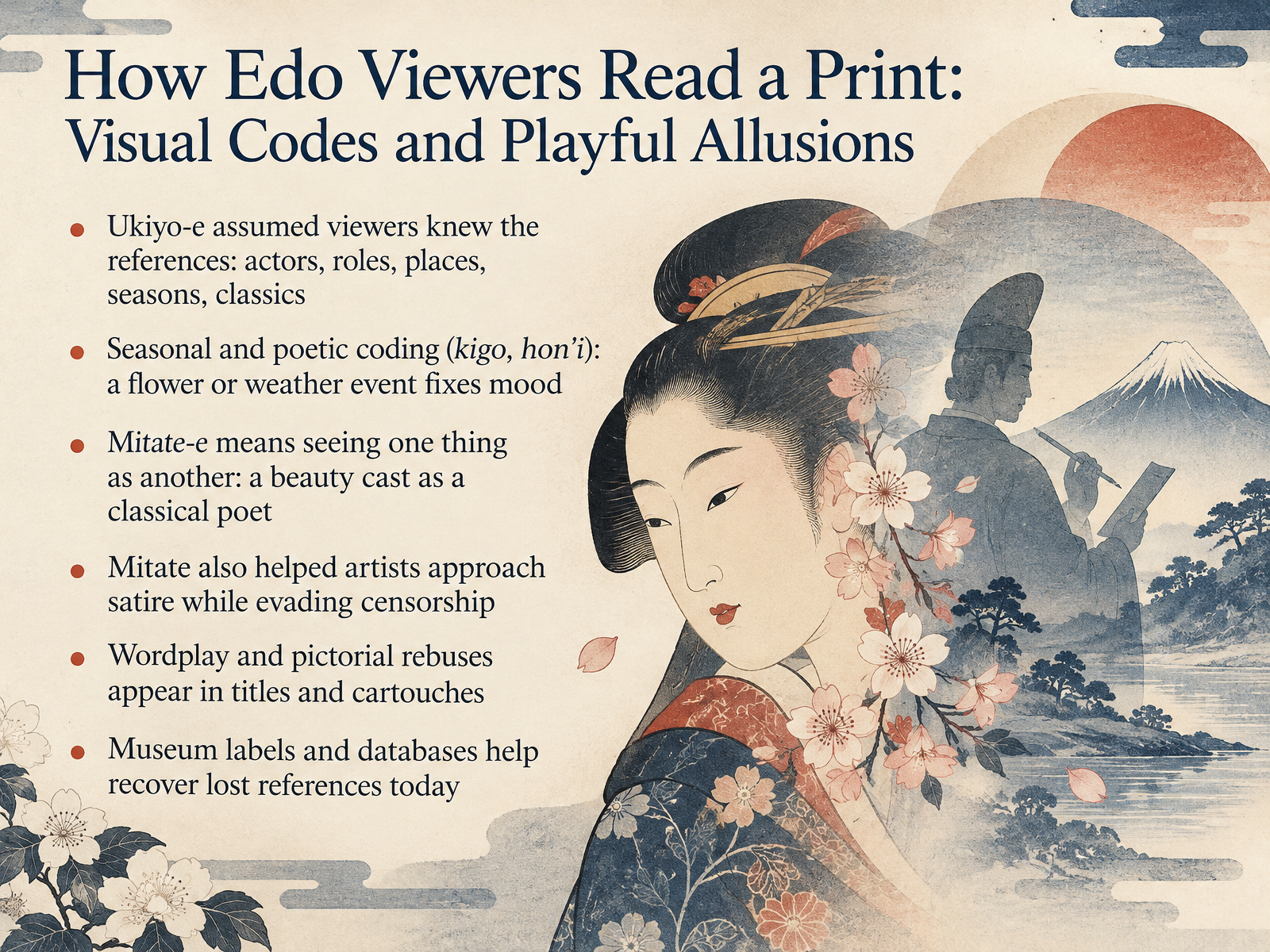
- 08How Edo Viewers Read a Print: Visual Codes and Playful AllusionsNow let's look at how Edo viewers actually read a print. Ukiyo-e assumed you knew the references. Actors, roles, famous places, seasons, classical tales. Miss the reference, and half the picture goes quiet.
Season and poetry did much of the work. A flower, or a particular weather event, fixed the mood, because certain images carried conventional associations. Think of it as a visual shorthand.
Then there's mitate-e, which means seeing one thing as another. A beauty could be cast as a classical poet, and the pleasure came from spotting the link yourself. Mitate also let artists approach satire, dressing up a pointed comment so it slipped past the censors.
Wordplay mattered too. Puns and pictorial rebuses appear in titles and cartouches, where a small drawn object quietly spells out a name. Today, museum labels and databases help recover references that time has worn away. So read slowly, and let the layers surface.
Next, decoding the marks. Signatures, publisher seals, and censor seals.
 hdl.handle.netdegruyterbrill.comdoi.org+22 min
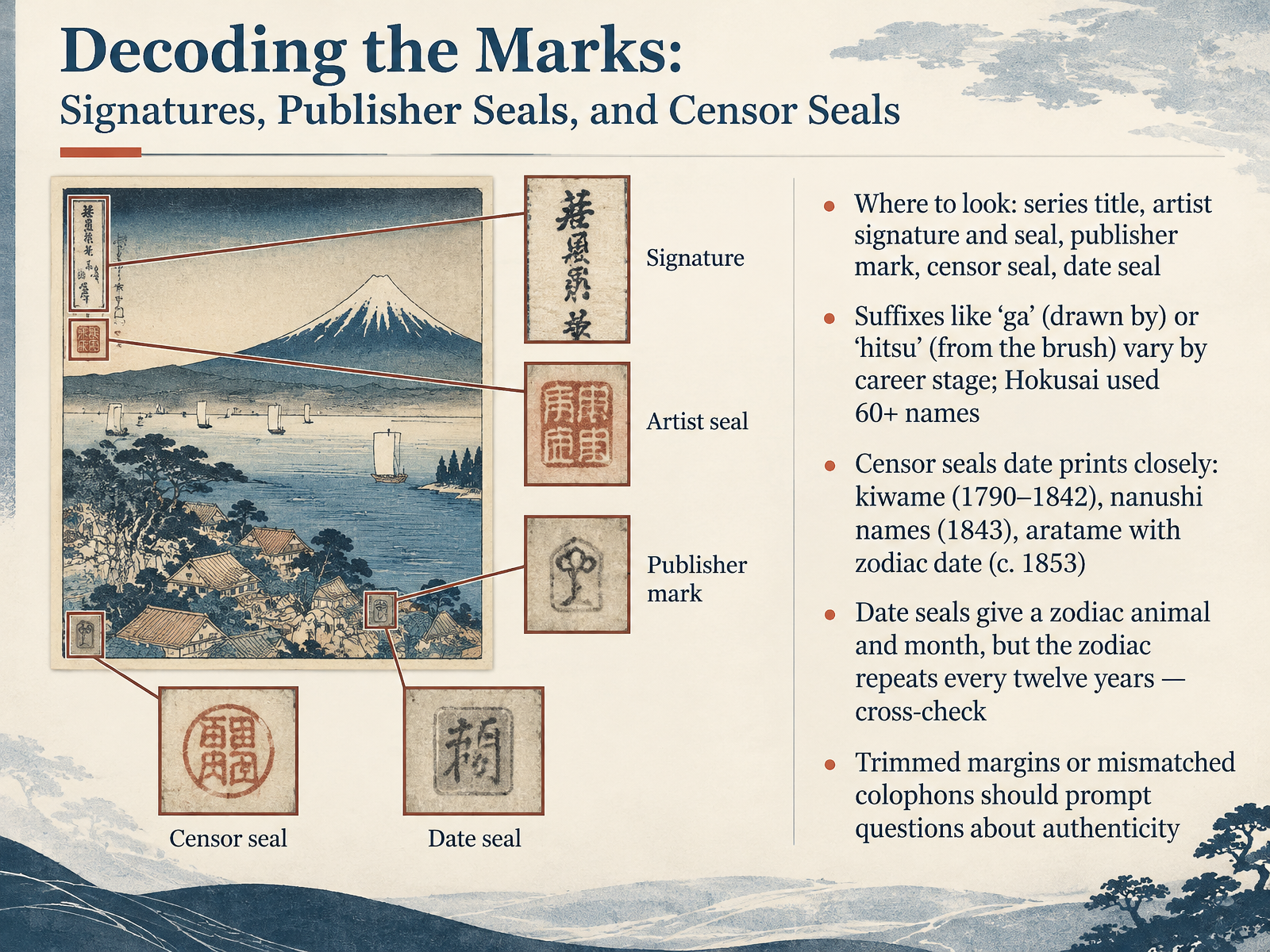
- 09Decoding the Marks: Signatures, Publisher Seals, and Censor SealsNow let's decode the marks. When you hold a print, your eye may go to the image, but the real clues hide in the corners. Look for the series title, then the artist's signature and seal, the publisher's mark, and the censor and date seals. Signatures shift over a career. A suffix like ga means drawn by, while hitsu means from the brush. Hokusai used more than sixty names. Censor seals help narrow the date. Kiwame, meaning approved, runs from seventeen ninety to eighteen forty-two. Nanushi names appear around eighteen forty-three, and aratame with a zodiac date starts about eighteen fifty-three. Date seals give a zodiac animal and month, but that cycle repeats every twelve years, so cross-check with the artist and publisher. And if the margins are trimmed or the colophon seems mismatched, treat that as a question about authenticity. Next, let's look at judging impression, state, and condition.
 hdl.handle.netdegruyterbrill.comdoi.org+21 min
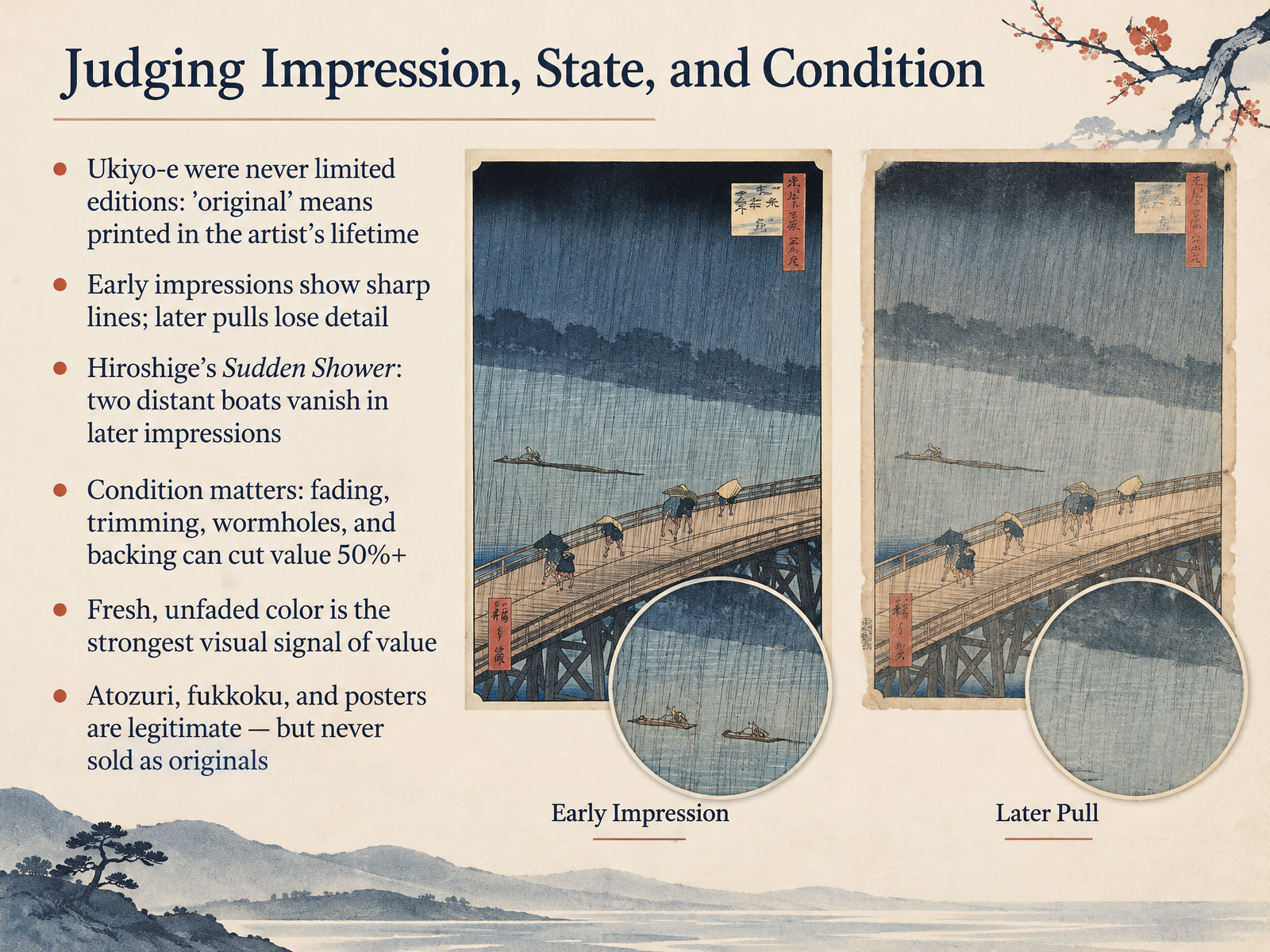
- 10Judging Impression, State, and ConditionLet's talk about one of the most practical skills in collecting: judging impression, state, and condition. First, a surprise for many newcomers. Ukiyo-e were never limited editions. There was no set number. So "original" simply means printed in the artist's own lifetime, from the first blocks. Because those woodblocks wore down with repeated use, early impressions show clean, sharp lines, while later pulls go thin and lose detail. A famous example is Hiroshige's Sudden Shower over Shin-Ohashi Bridge. In early impressions, two distant boats are visible beside the far shore. In later impressions, they simply vanish. Condition matters just as much. Fading, trimming, wormholes, and backing can cut a print's value by more than half. Fresh, unfaded color is the strongest visual signal of value. And remember, later reprints, called atozuri, modern reproductions, called fukkoku, and machine-made posters are all legitimate things to own. They just should never be sold as originals. Next, let's look at the market landscape and caring for prints.
 2 min
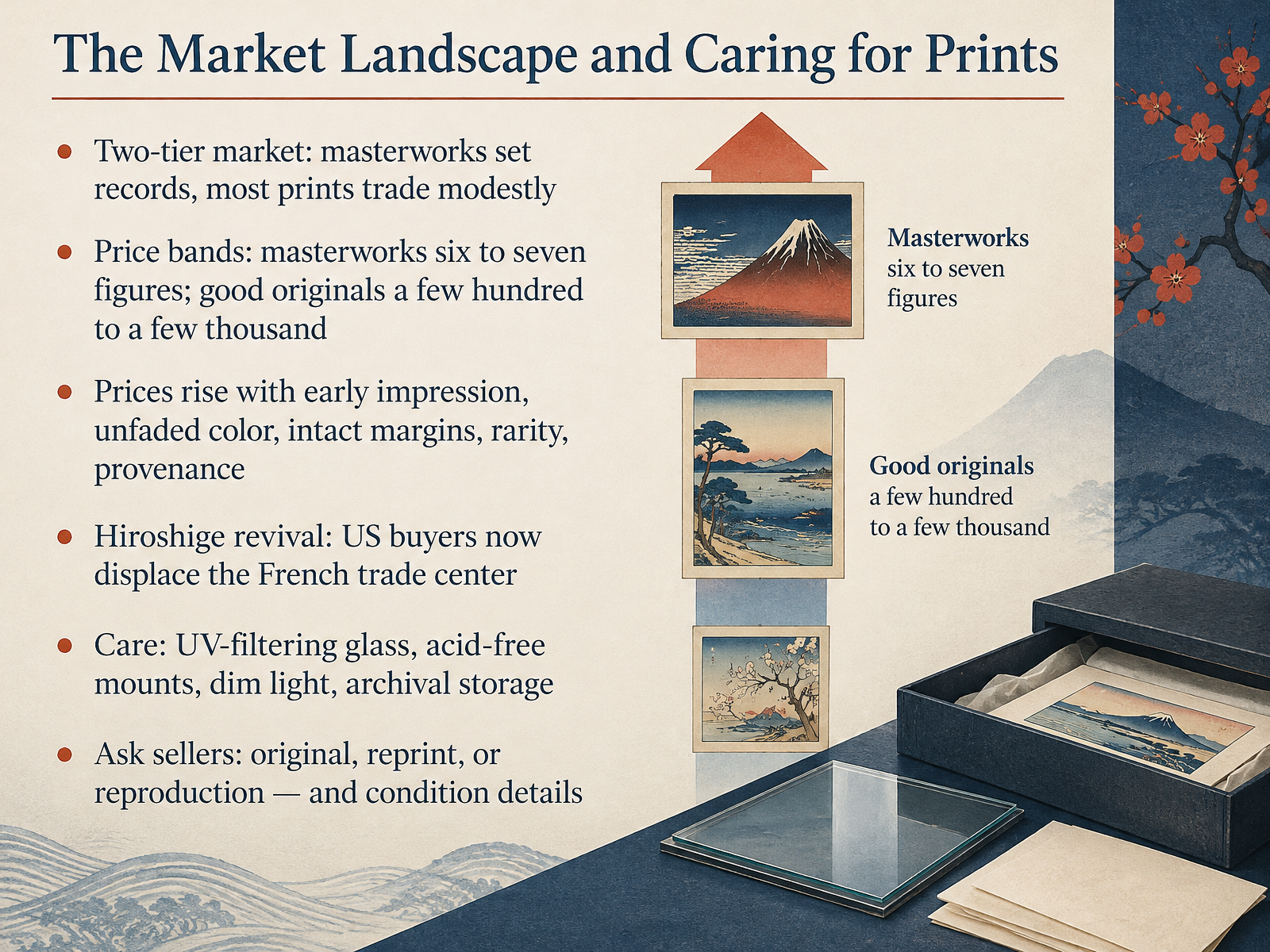
- 11The Market Landscape and Caring for PrintsNow let's talk about the market you're stepping into, and how to protect what you buy. Think of it as two tiers. At the top, masterworks set records. In twenty twenty-four, Hokusai's Thirty-six Views of Mount Fuji sold for three million five hundred fifty-nine thousand dollars. But that's the rare exception. Most prints trade modestly. A good, genuine original, like a nice Hiroshige landscape, often costs a few hundred to a few thousand dollars. Prices climb with early impressions, unfaded color, intact margins, rarity, and provenance. Provenance matters enormously. When a Hiroshige from Freddie Mercury's collection sold in twenty twenty-three, it fetched three hundred sixty-five thousand dollars, nearly ten times its estimate. One more shift: Hiroshige's market has revived, and American buyers have now displaced the French trade center. Then, care. Woodblock prints fade in light, and that fading cannot be undone. Frame them behind UV-filtering glass on an acid-free mount, hang them in dim light, out of direct sun, or store them flat in archival boxes. And always ask a seller one plain question: is this an original, a later reprint, or a reproduction, and what's the condition? A good seller answers without fuss. That one question can save you from a costly mistake. Next, we'll take that knowledge into the gallery with a practical checklist. Looking Closely in the Gallery: A Practical Checklist.
 2 min
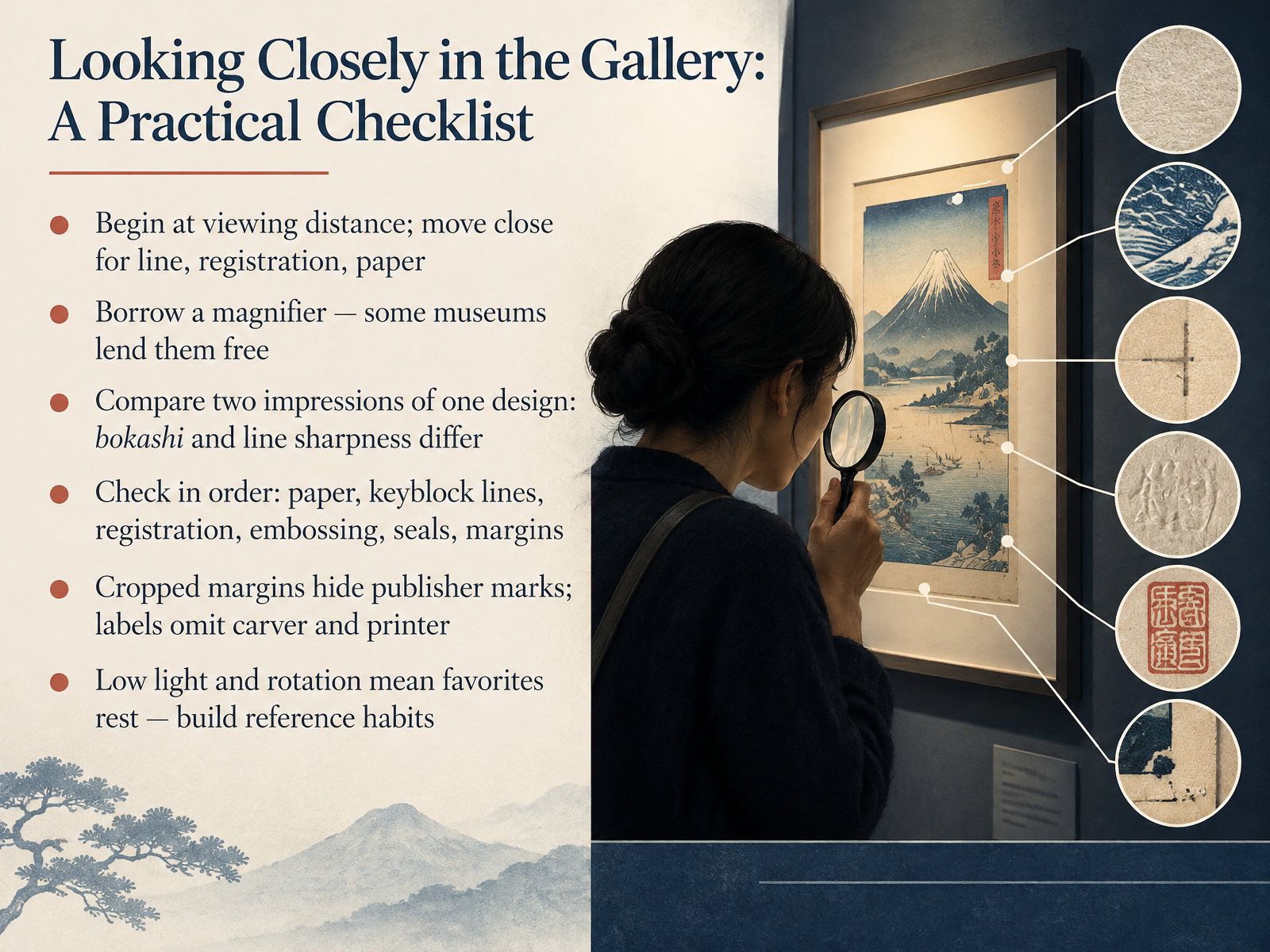
- 12Looking Closely in the Gallery: A Practical ChecklistNow let's bring all of this into the gallery, with a practical checklist you can actually use. Start at a comfortable viewing distance to take in the whole composition, then move closer to study the line quality, the registration, and the paper itself. Many museums lend magnifiers free of charge, so borrow one. It changes everything. Whenever you can, compare two impressions of the same design side by side. The gradation, called bokashi, and the sharpness of the keyblock lines will differ, often dramatically. Then work through a consistent order: paper first, then the black keyblock outlines, then registration, embossing, seals, and finally the margins. Cropped margins hide publisher marks, and gallery labels often omit the carver and the printer, even though their names are essential. Remember that low light and rotation mean your favorite prints rest between showings, so build steady reference habits. Visit often, note what you see, and let your eye sharpen over time. Next, we'll look at four masters in depth: Hokusai, Hiroshige, Utamaro, and Sharaku.
 britishmuseum.orgtnm.jp1 min
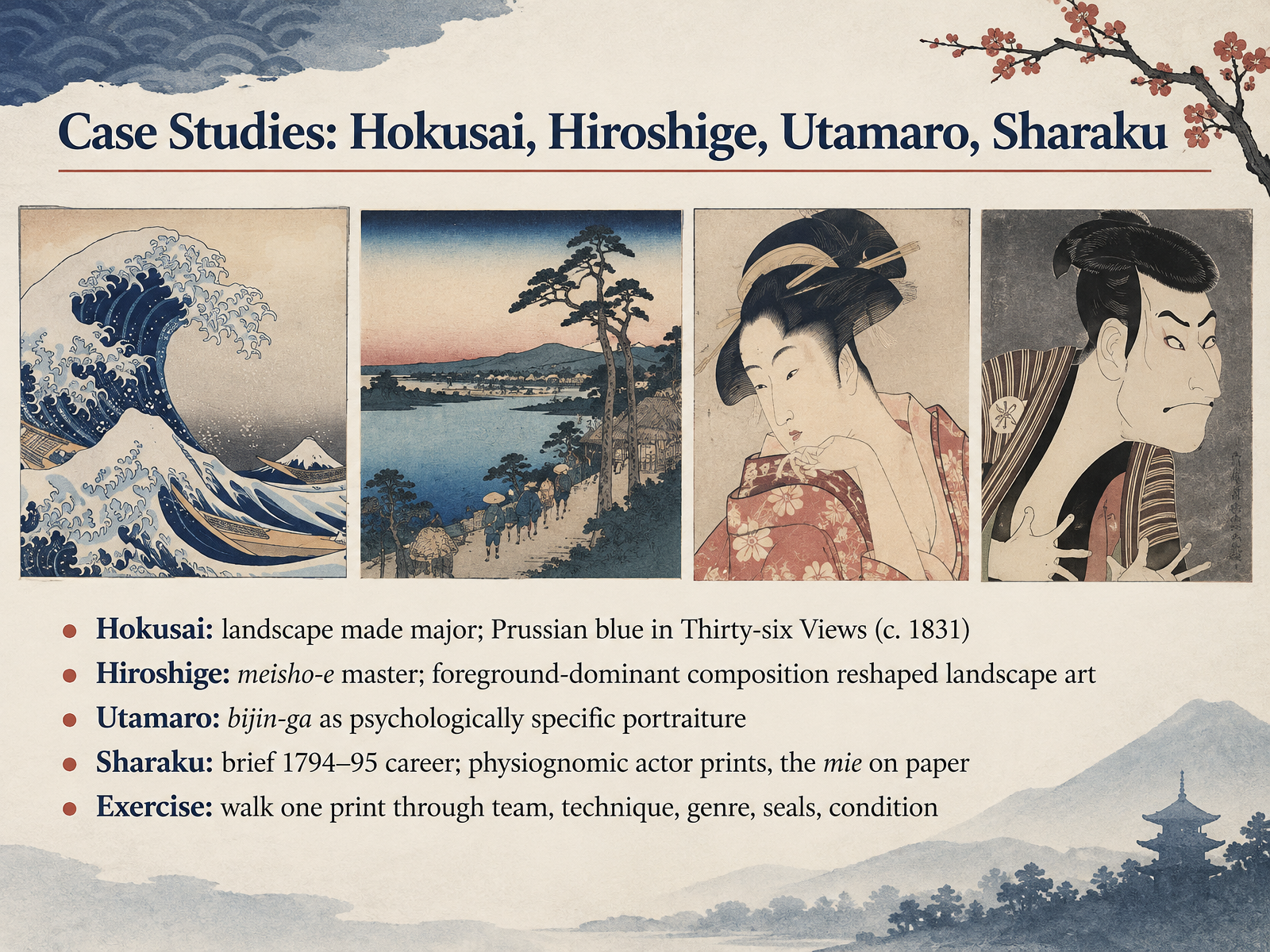
- 13Case Studies: Hokusai, Hiroshige, Utamaro, SharakuNow let's put names to what we've learned, with four artists every collector meets early. Hokusai made landscape a major ukiyo-e genre. In his Thirty-six Views of Mount Fuji, around eighteen thirty-one, the landscape itself becomes the subject, and Prussian blue, a stable synthetic pigment, gave those skies and seas their famous intensity. Hiroshige was a master of meisho-e, pictures of famous places. Look for his foreground-dominant composition, where a large motif looms close to the viewer while the landscape unfurls behind it. That bold device reshaped landscape art worldwide. Utamaro turned bijin-ga into psychologically specific portraiture, so a woman's posture or a downward glance reads as character, not just beauty. And Sharaku worked for only two years, roughly seventeen ninety-four to ninety-five, yet his actor prints capture the mie, that frozen climactic kabuki pose, as sheer physiognomic drama. Your exercise for this section: take one print and walk it through five questions. Who, or which school, made it? How was it printed? What genre is it? What do the seals tell you, including the censor's mark? And what condition is it in? Bring your answers and observations to the group discussion. That prepares us for the next slide, Bringing It Together: From Looking to Understanding.
 britishmuseum.orgtnm.jpprojects.mcah.columbia.edu+22 min
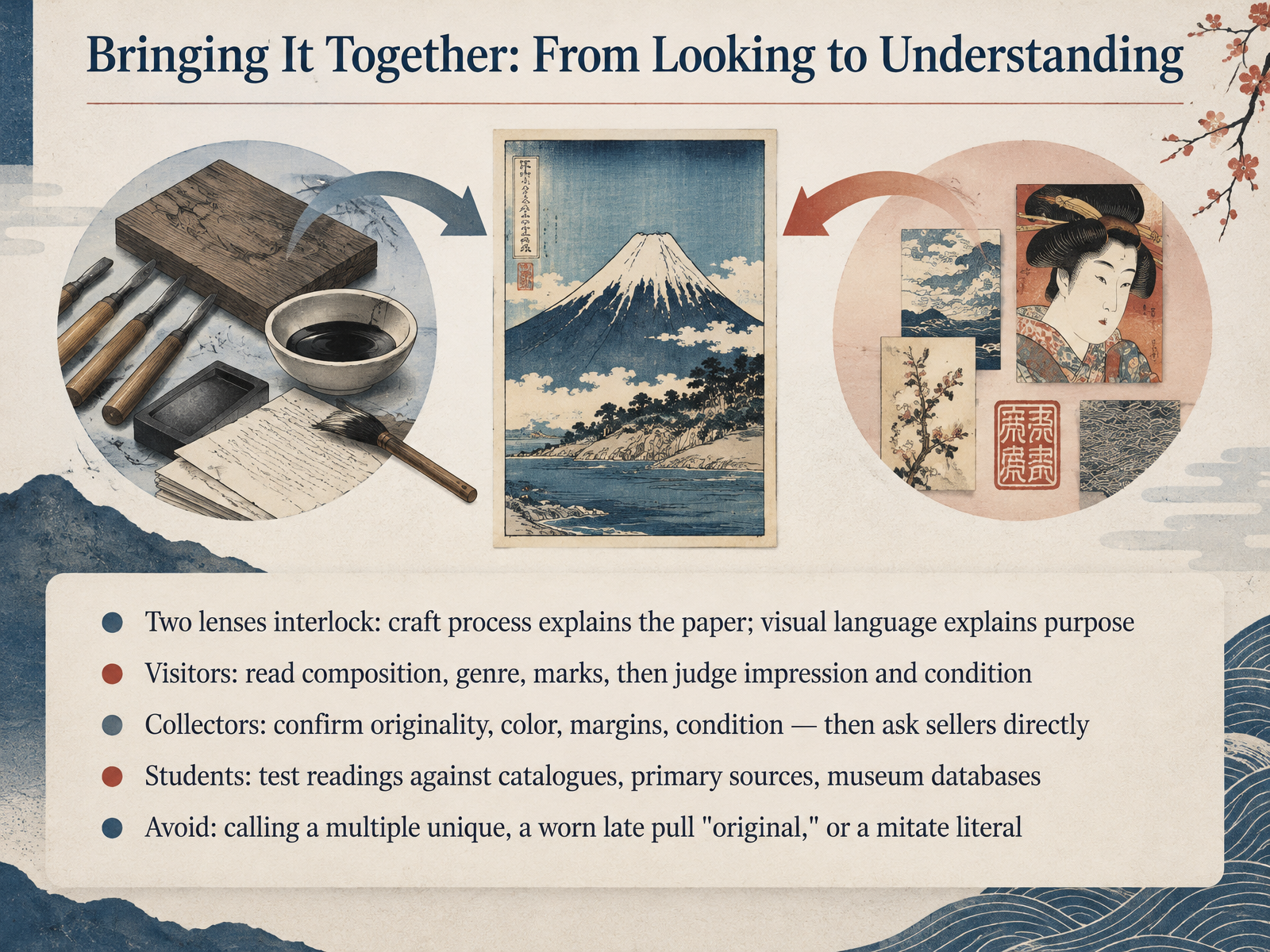
- 14Bringing It Together: From Looking to UnderstandingSo let's bring it all together. Two lenses interlock here. The craft process explains the paper you're holding, while the visual language explains its purpose. For visitors, read the composition, the genre, and the marks, then judge the impression and its condition. For collectors, confirm originality, color, margins, and condition, then ask the seller directly about date and restoration. For students, test your readings against catalogues, primary sources, and museum databases. And avoid three common mistakes. A print made as a multiple is never unique. A worn late pull is not an original in the collector's sense. And a mitate image is not a literal scene. It works on layered allusion. Thank you for joining me. Keep looking closely, and let curiosity guide you.
 britishmuseum.orgtnm.jp1 min
Take the deck with you
Download this course as a file — free, no sign-up needed.
- PDF handoutEvery slide page, ready to print or share.15 pages · 6.4 MBDownload
- Narrated PowerPointThe deck that presents itself — every slide carries the digital human's narration video.15 pages · 18.0 MBDownload
- PowerPoint slidesThe full deck as a .pptx — open it in PowerPoint, Keynote, or Google Slides.15 pages · 6.4 MBDownload
Free to use in your own training — please keep the PersonWise credit page at the end.
Have your own deck? Turn it into a course
Sources consulted
Web sources consulted while building this course.
- Overview - The Floating World of Ukiyo-e | Exhibitions - Library of Congress — loc.gov
- Japanese woodblock prints (ukiyo-e) · V&A — vam.ac.uk
- Woodblock Prints in the Ukiyo-e Style - The Metropolitan Museum of Art — metmuseum.org
- Ukiyo-e | Woodblock Printing, Edo Period & Japanese Prints | Britannica — britannica.com
- TOKYO NATIONAL MUSEUM - Exhibitions and Events Exhibitions Japanese Gallery (Honkan) The Art of Ukiyo–e | 17th–19th century Item List — tnm.jp
- Publishing culture in eighteenth-century Japan : the case of the Edo publisher Tsutaya Jūzaburō(1751-97) — hdl.handle.net
- 4. Edo Publishing and Ukiyo-e — degruyterbrill.com
- Compendio de leyes sobre el control de materiales impresos. Japón, 1657-1842 — doi.org
- Fox-Kuzunoha: The Actor Print and the Expression of Female as ‘Other’ in the Late Edo Period — arches.union.edu
- Viewing Japanese Prints: Sumptuary Edicts during the Edo Period — viewingjapaneseprints.net
- The Ukiyo-e (Woodblock) Printing Process - Education - Asian Art Museum — education.asianart.org
- Woodblock Prints in the Ukiyo-e Style - The Metropolitan Museum of Art — metmuseum.org
- Publisher, Artist, Carver, Printer — How the Work Was Divided | Ukiyo-e Notes — ukiyoe-japan.jp
- History and Techniques of Ukiyo-e Woodblock Prints — jstage.jst.go.jp
- Production of Japanese Woodblock Prints — mercury.lcs.mit.edu
- Viewing Japanese Prints: Making a Japanese Woodblock Print — viewingjapaneseprints.net
- Following the Process — How a Single Nishiki-e Was Made | Ukiyo-e Notes — ukiyoe-japan.jp
- The technique of making a good impression | British Museum — britishmuseum.org
- nishiki-e 錦絵 | JAANUS — projects.mcah.columbia.edu
- The color revolution: Printed books in eighteenth-century Japan — repository.upenn.edu