Social Media Marketer Role Overview
Begin
14 pages · ~28 min
Social Media Marketer Role Overview
This training explains the role, responsibilities, and daily tasks of a social media marketer for aspiring marketers and professionals exploring this career path.
What you’ll learn
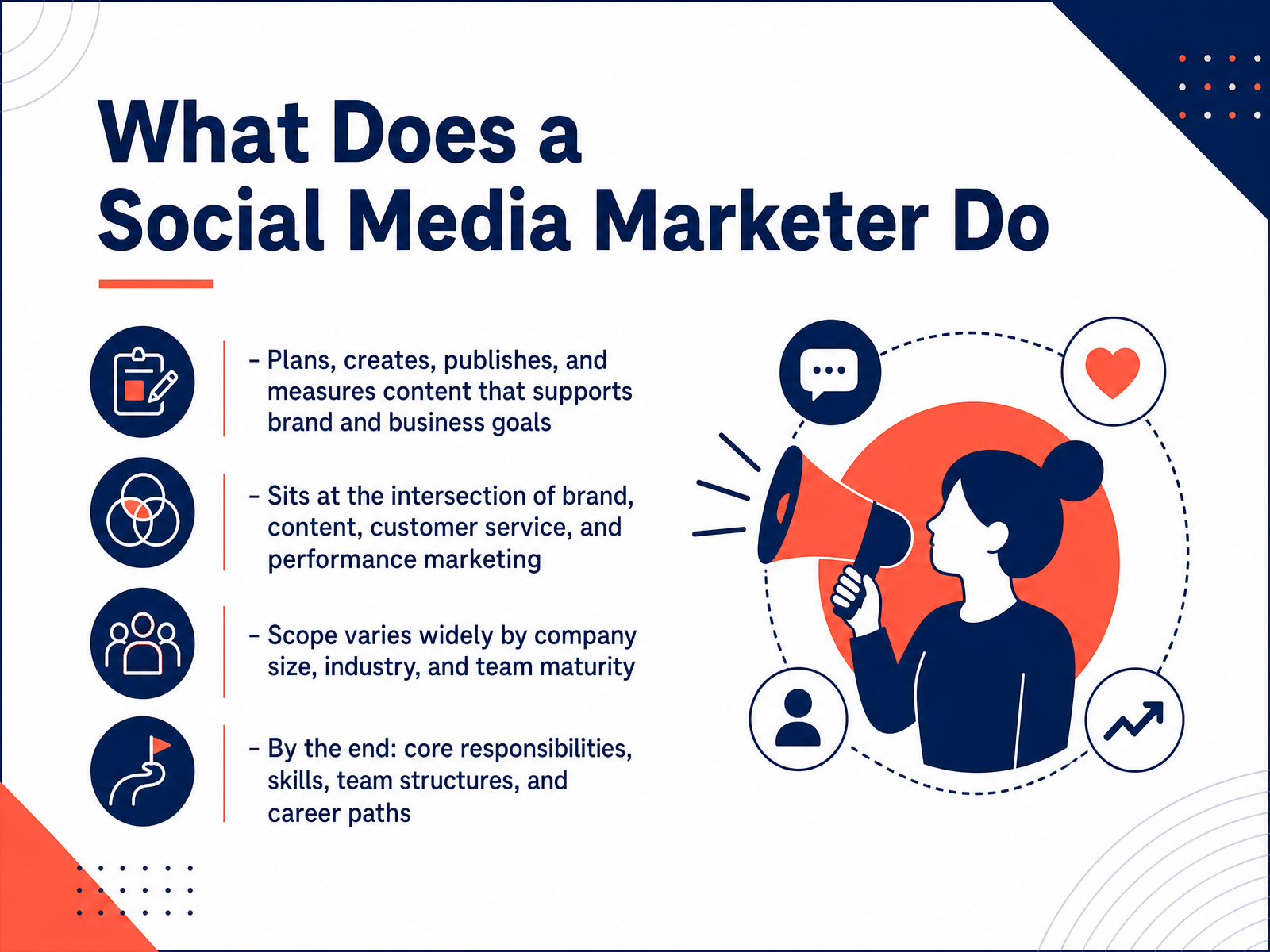
- 01What Does a Social Media Marketer DoWelcome. I'm glad you're here, because if you've ever wondered whether social media marketing is a real career, let me put that to rest right now. It absolutely is. And over the next fourteen slides, we're going to unpack exactly what a social media marketer does all day. Here's the short version. They plan, create, publish, and measure content that supports brand and business goals. That means sitting at the intersection of brand, content, customer service, and performance marketing. One hour you might draft a content calendar. The next, you're replying to comments, briefing a designer, and checking weekly analytics. Scope varies widely. A solo marketer at a startup might do all of it, while someone at a larger company might focus only on paid ads or community. By the end of this course, you'll understand the core responsibilities, the skills that matter, how teams are structured, and where this career can take you. So take a breath. No experience yet? That's fine. Algorithms feel intimidating? They will make sense. Let's start with the modern role, which is so much more than posting.toptal.comindeed.comsugarpixels.com+22 min
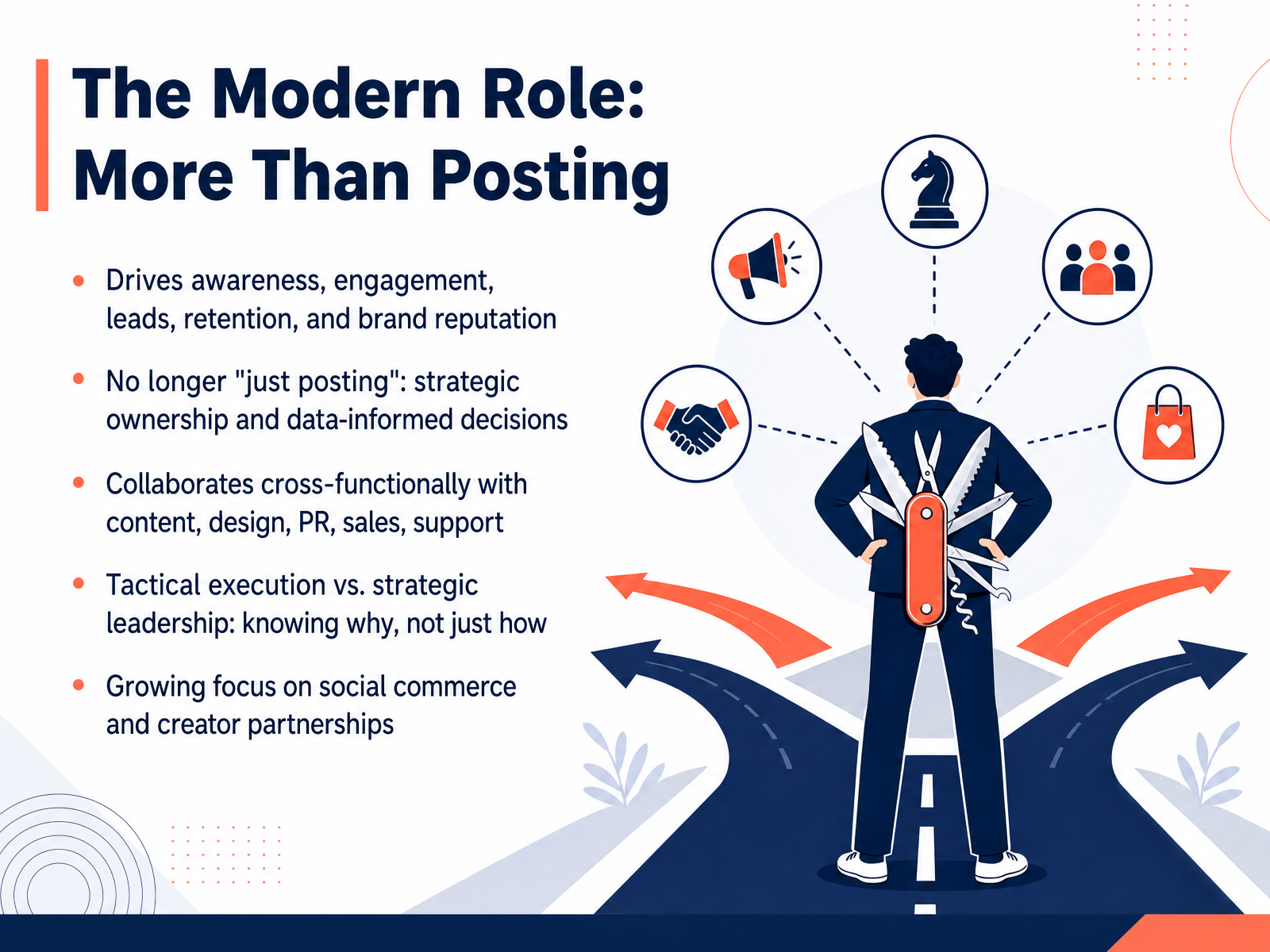
- 02The Modern Role: More Than PostingSo let's clear up the biggest myth right away. This job is not just posting. A social media marketer drives awareness, engagement, leads, retention, and brand reputation. Strategic ownership is the whole game now. Take a typical Tuesday. You might refine a content calendar in the morning, reply to comments before lunch, then explain to your sales team why last week's campaign underperformed. That decision-making, knowing why, not just how, is what separates tactical execution from strategic leadership. And you rarely work alone. You collaborate with content, design, public relations, sales, and support. In 2026, there's also a growing focus on social commerce and creator partnerships, so you may brief a creator one day and track shoppable post results the next. Here's your nudge. Picture day one. What would you check first, the comments or the analytics? Either way, you are already thinking like a strategist. Next, let's look at where the role sits in the marketing team.
 toptal.comindeed.comsugarpixels.com+22 min
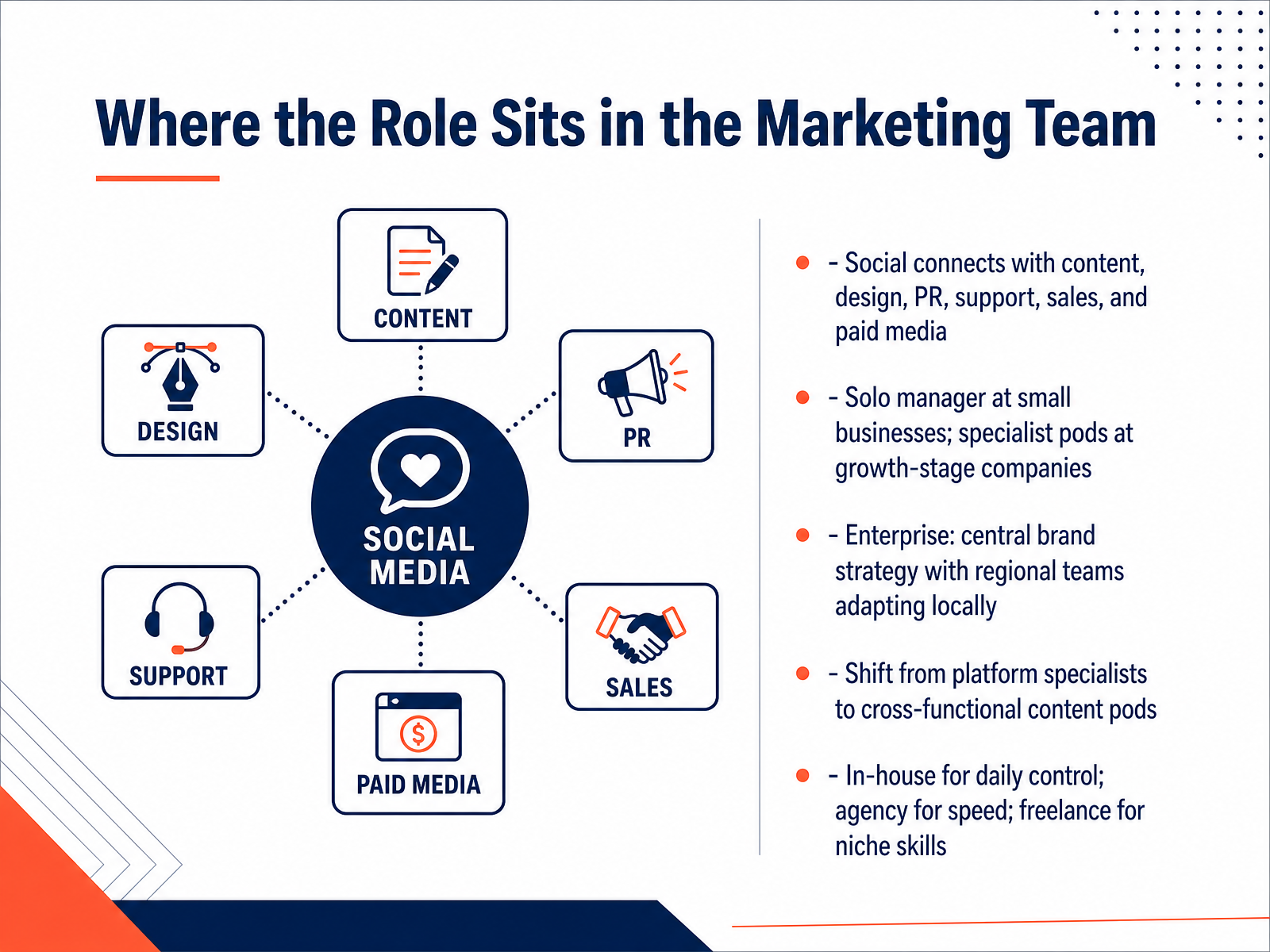
 - 03Where the Role Sits in the Marketing TeamLet's talk about where social media actually sits inside a marketing team. Here's the truth: social doesn't live in a silo. It touches content, design, public relations, customer support, sales, and paid media. You'll be the bridge, sharing feedback from comments with the product team, or handing a great customer story to the PR lead.
What that looks like depends on company size. At a small business, you might be the solo social media manager doing everything from strategy to replying to direct messages. At a growth-stage company, you'll often join a small specialist pod with a content creator, a community manager, and maybe an analyst. At an enterprise, there's usually a central brand strategy team, while regional teams adapt content for local audiences.
One big shift is happening right now. Teams are moving away from having one person per platform. Instead, they're building cross-functional content pods, because a single vertical video might run on TikTok, Instagram, YouTube Shorts, and LinkedIn within two days.
And where do you work? In-house gives you daily control and deep brand knowledge. An agency gives you speed across many clients. Freelancing is perfect for niche skills like video editing or paid ads.
So ask yourself: does a solo role or a team pod energize you more? On day one, you'll likely meet the people you'll collaborate with most. Next, let's picture what your week actually looks like in A Realistic Week in the Life.
 constantcontact.comemarketer.comaitoolsync.com+22 min
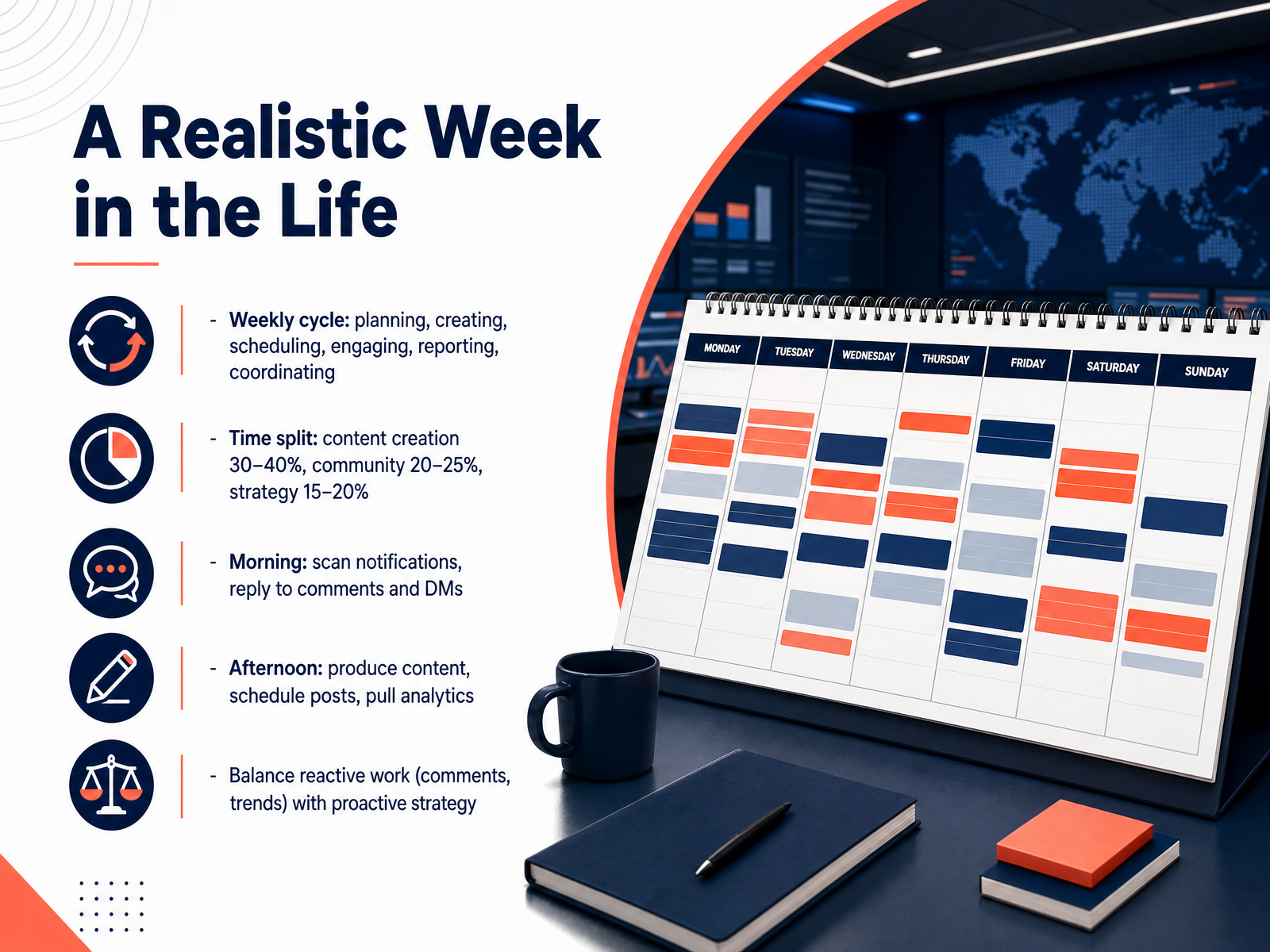
 - 04A Realistic Week in the LifeSo let's get real about what a week actually looks like. Because this job is a cycle, not a to-do list. You plan, you create, you schedule, you engage, you report, and you coordinate with other teams. Then it starts again. Here's how the time usually splits. Content creation takes the biggest chunk, roughly thirty to forty percent. Community management, so replying to comments and messages, is about twenty to twenty-five percent. And strategy, the thinking work, gets fifteen to twenty percent. Your mornings tend to be reactive. You scan notifications, answer comments and direct messages, and handle anything urgent. Afternoons are for producing content, scheduling posts, and pulling your analytics. The trick is balancing the reactive stuff with a little proactive strategy, because the proactive work is what actually moves the needle. So here's a question for you. Could you start your day by checking messages and still protect an hour for creating? On day one, that's already the job. Next, we'll go deeper into those core responsibilities.
 buffer.comentri.appblog.picmim.com+21 min
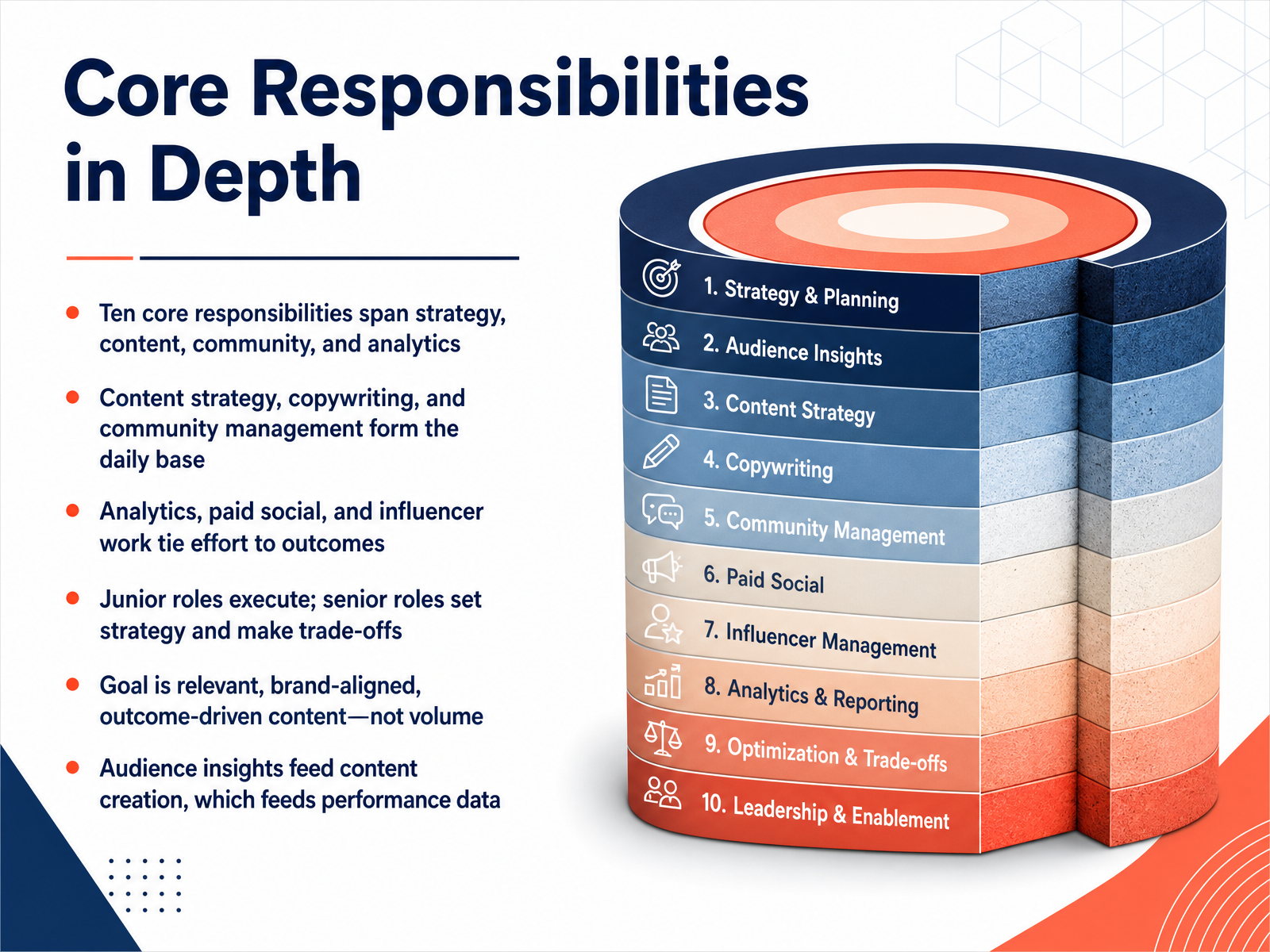
 - 05Core Responsibilities in DepthNow let's dig into the core responsibilities, because ten of them span strategy, content, community, and analytics. Three form your daily base: content strategy, copywriting, and community management. That's planning the calendar, drafting the captions, and replying to comments and messages. Then analytics, paid social, and influencer work tie all that effort to real outcomes, like traffic, leads, and sales. Here's the key shift as you grow: junior roles execute, and senior roles set strategy and make trade-offs. So a coordinator publishes and reports; a manager decides what to stop doing. And remember the goal. It's relevant, brand-aligned, outcome-driven content, not volume. Think of it as a loop: audience insights feed content creation, which feeds performance data, which feeds better content. Here's what day one looks like. You audit the calendar, review last month's top posts, and ask why they worked. So, what would you check first? Next, we'll cover the skills that matter in 2026.
 toptal.comindeed.comsugarpixels.com+22 min
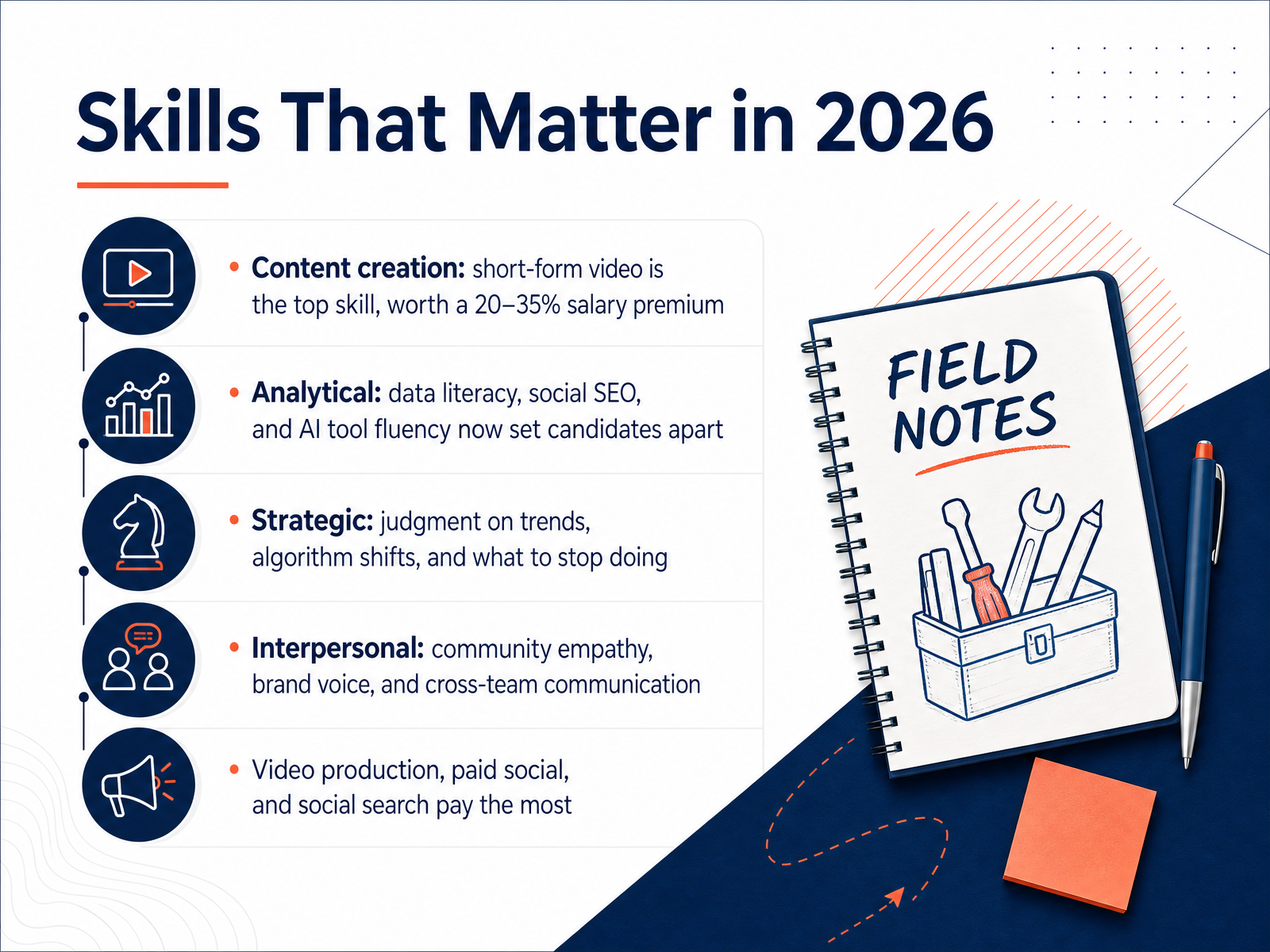
 - 06Skills That Matter in 2026Let's talk about the skills that actually matter in 2026. First, content creation. Short-form video is the top skill right now, and it comes with a salary premium of twenty to thirty-five percent. That's not hype. It's what hiring managers are paying for. Next, analytical skills. Data literacy, social SEO, and fluency with AI tools are what set candidates apart. You don't need to be a data scientist. You need to read a dashboard, spot a pattern, and adjust. Then there's strategy. That means judgment. Which trends to join, which algorithm shifts matter, and what to stop doing. Knowing what to quit is as valuable as knowing what to start. Interpersonal skills round it out. Community empathy, brand voice, and cross-team communication. You'll brief designers, coordinate with paid media, and talk to customers. So here's your day-one snapshot. You'll check analytics, draft a short video script, reply to comments, and decide one thing to test. That's the job. And the skills that pay the most? Video production, paid social, and social search. Now let's look at platforms, formats, and content types.
 socialpilot.coeverestx.cominfluencerdb.net+22 min
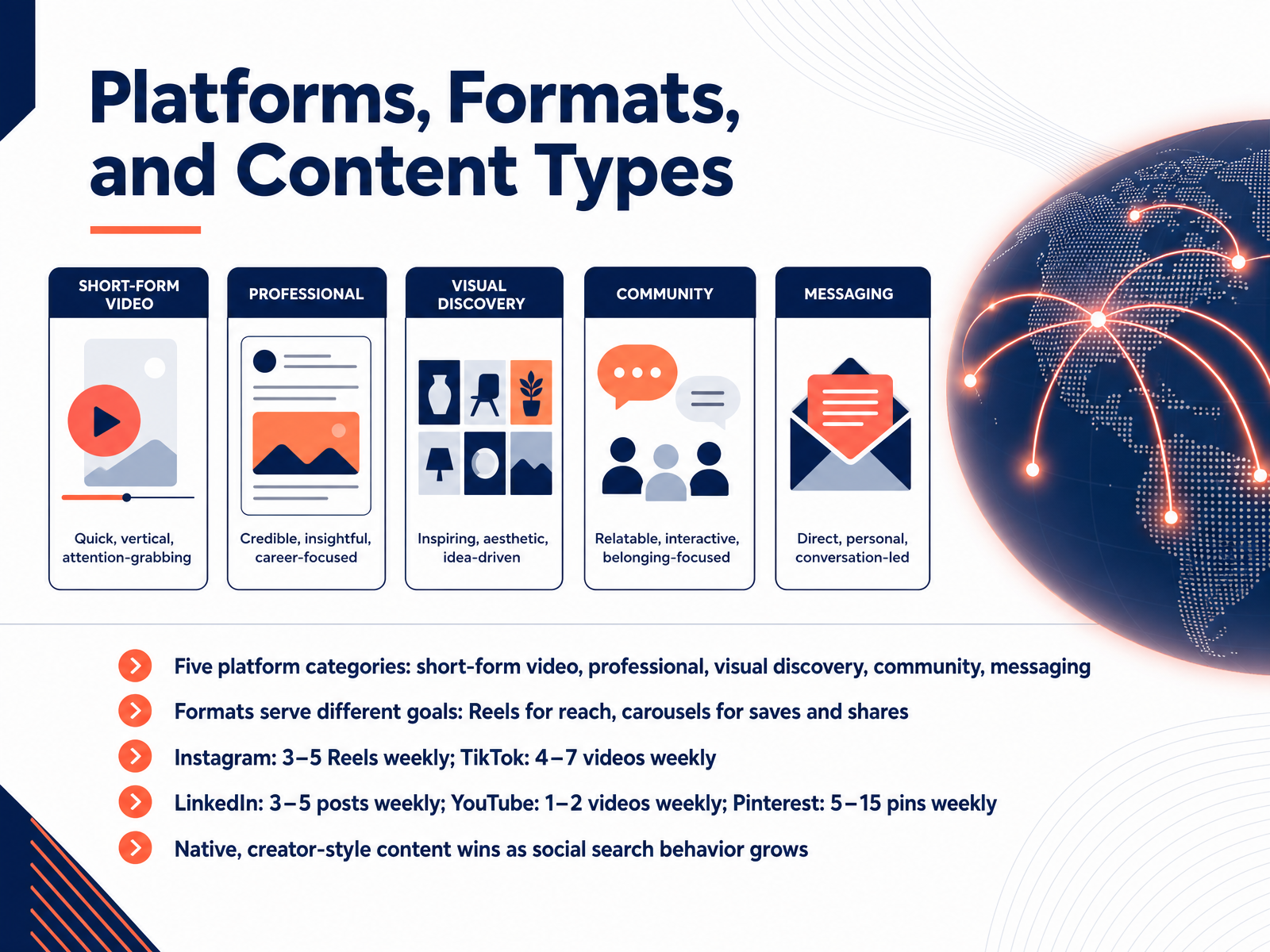
 - 07Platforms, Formats, and Content TypesSo let's talk about where your content actually lives. Most platforms fall into five broad categories: short-form video, like TikTok and Reels; professional, like LinkedIn; visual discovery, like Pinterest; community, like Reddit and Facebook groups; and messaging, like WhatsApp and D M s. Why does this matter? Because each category rewards different formats. Reels are built for reach, pulling in people who've never heard of you. Carousels are built for saves and shares, because every swipe is an engagement signal. So a working marketer might post three to five Reels a week on Instagram, four to seven videos a week on TikTok, three to five posts on LinkedIn, one or two videos on YouTube, and five to fifteen pins on Pinterest. That sounds like a lot, and honestly, it is. Which is why the smart move is posting natively, in a creator-style voice, rather than copy-pasting the same asset everywhere. People search social platforms now the way they once searched Google, and native content is what gets found. Here's your day-one snapshot: open one platform, check which formats your top competitors use, and build your first weekly mix from there. Next up, we'll look at how you track whether any of it is working, in Metrics, Tools, and Data-Driven Decisions.
 2 min
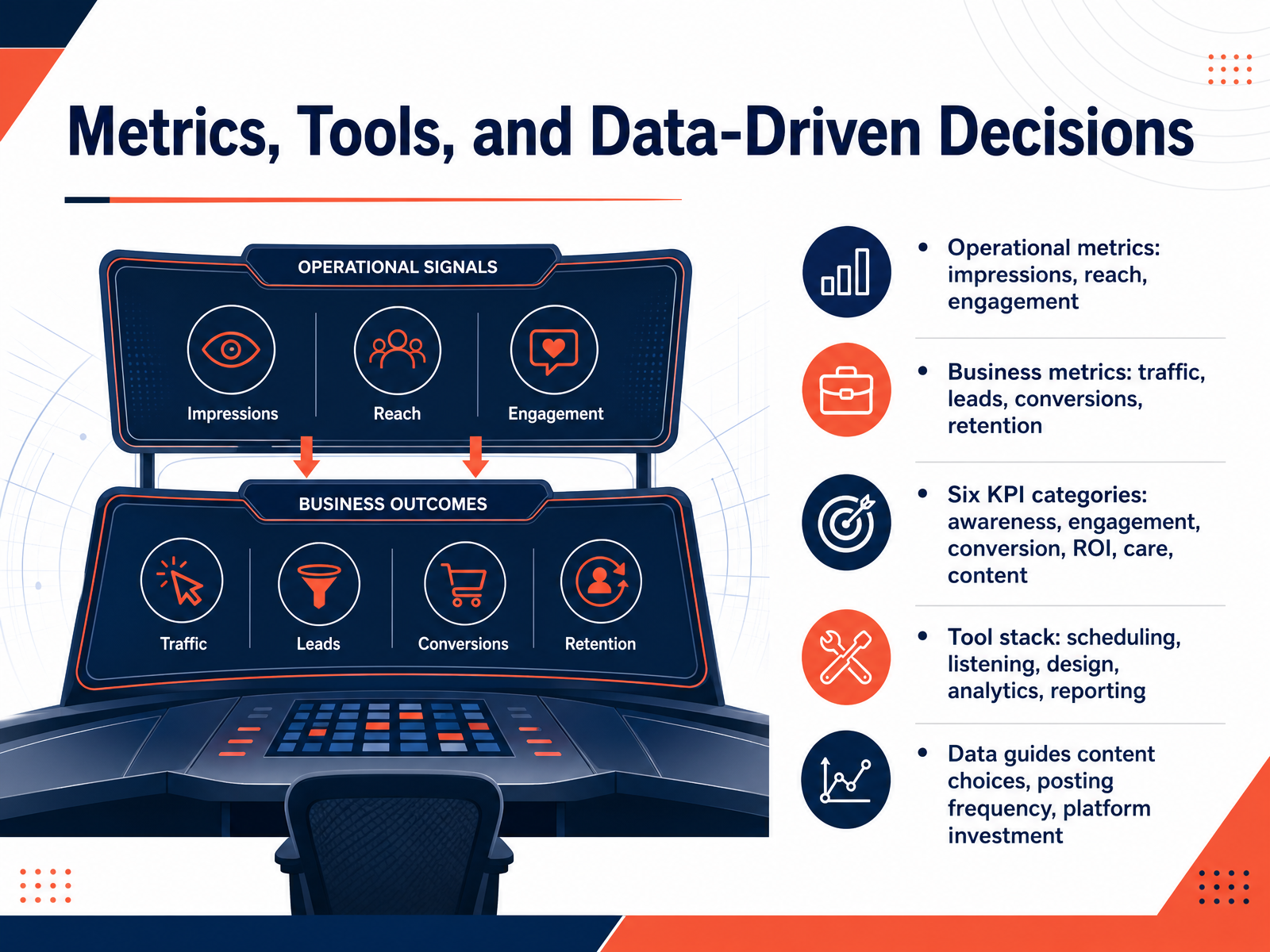
2 min - 08Metrics, Tools, and Data-Driven DecisionsNow let's talk about the numbers, because this is where social media stops feeling like guesswork. You'll track two layers of metrics. Operational metrics show day to day movement: impressions, reach, and engagement. Business metrics show real impact: traffic, leads, conversions, and retention. Most teams organize their key performance indicators into six categories: awareness, engagement, conversion, return on investment, customer care, and content performance. Your tool stack usually covers scheduling, social listening, design, analytics, and reporting. And here's the important part. Data guides your content choices, your posting frequency, and where you invest your platform time. For example, if saves are high but clicks are low, you may need a stronger call to action, not more posts. So on day one, ask yourself: which three numbers actually prove my work is helping the business? Next, we'll look at Career Paths and Entry Routes.
 socialpilot.coeverestx.cominfluencerdb.net+22 min
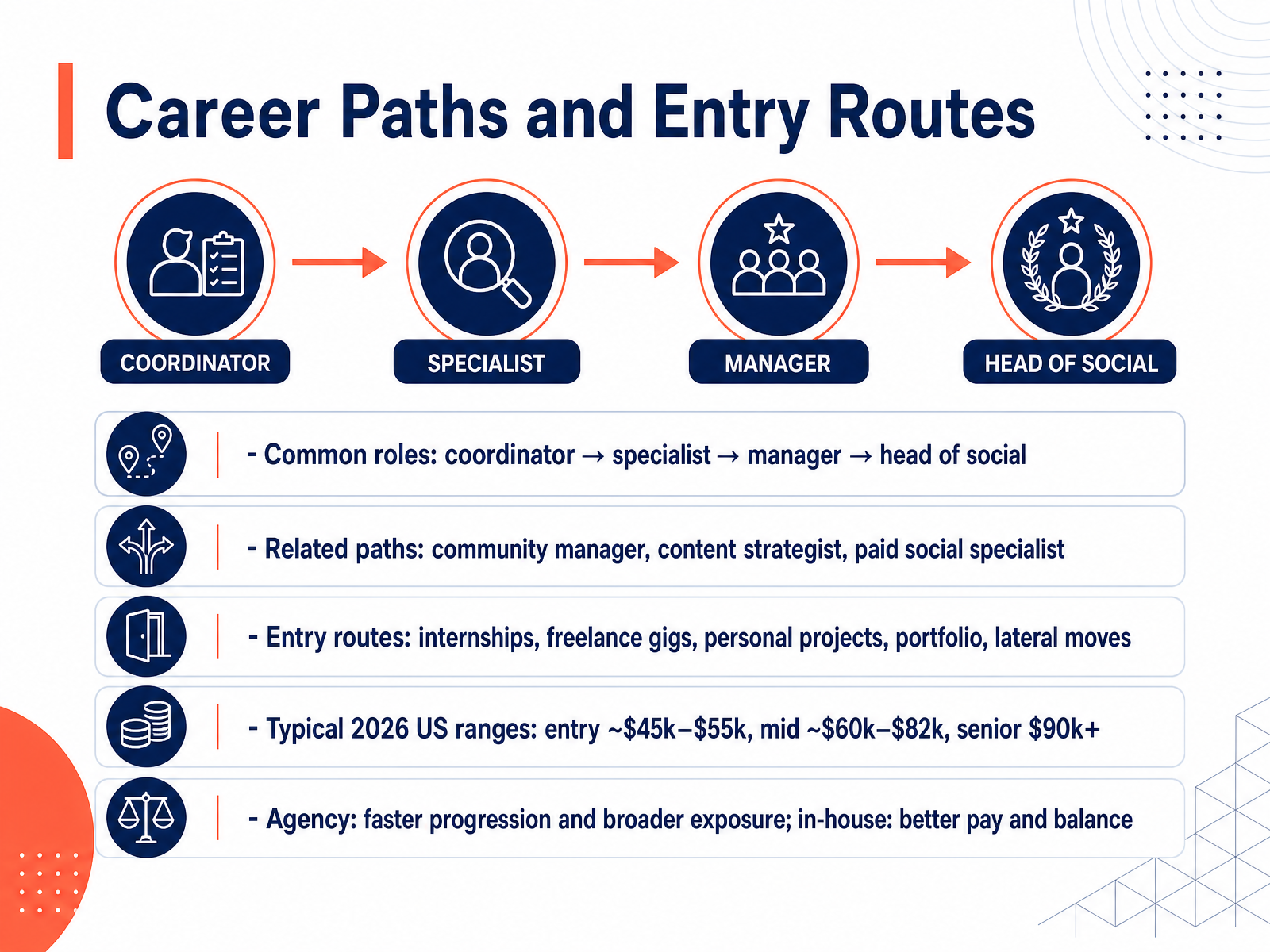
 - 09Career Paths and Entry RoutesSo what does this career actually look like over time? The most common path runs from coordinator, to specialist, to manager, to head of social. You might also branch into community management, content strategy, or paid social. And you do not need a perfect resume to get in. Internships, freelance gigs, personal projects, and a strong portfolio all count. Even a lateral move from customer service or communications can work. On pay, in two thousand twenty-six, entry roles sit around forty-five to fifty-five thousand dollars. Mid-level lands near sixty to eighty-two thousand. Senior roles clear ninety thousand and up. One more choice matters: agencies give you faster growth and wider exposure, while in-house roles often mean better pay and balance. So picture your first year. Which entry route could you start building this month? Next, we look at what hiring managers actually evaluate.
 2 min
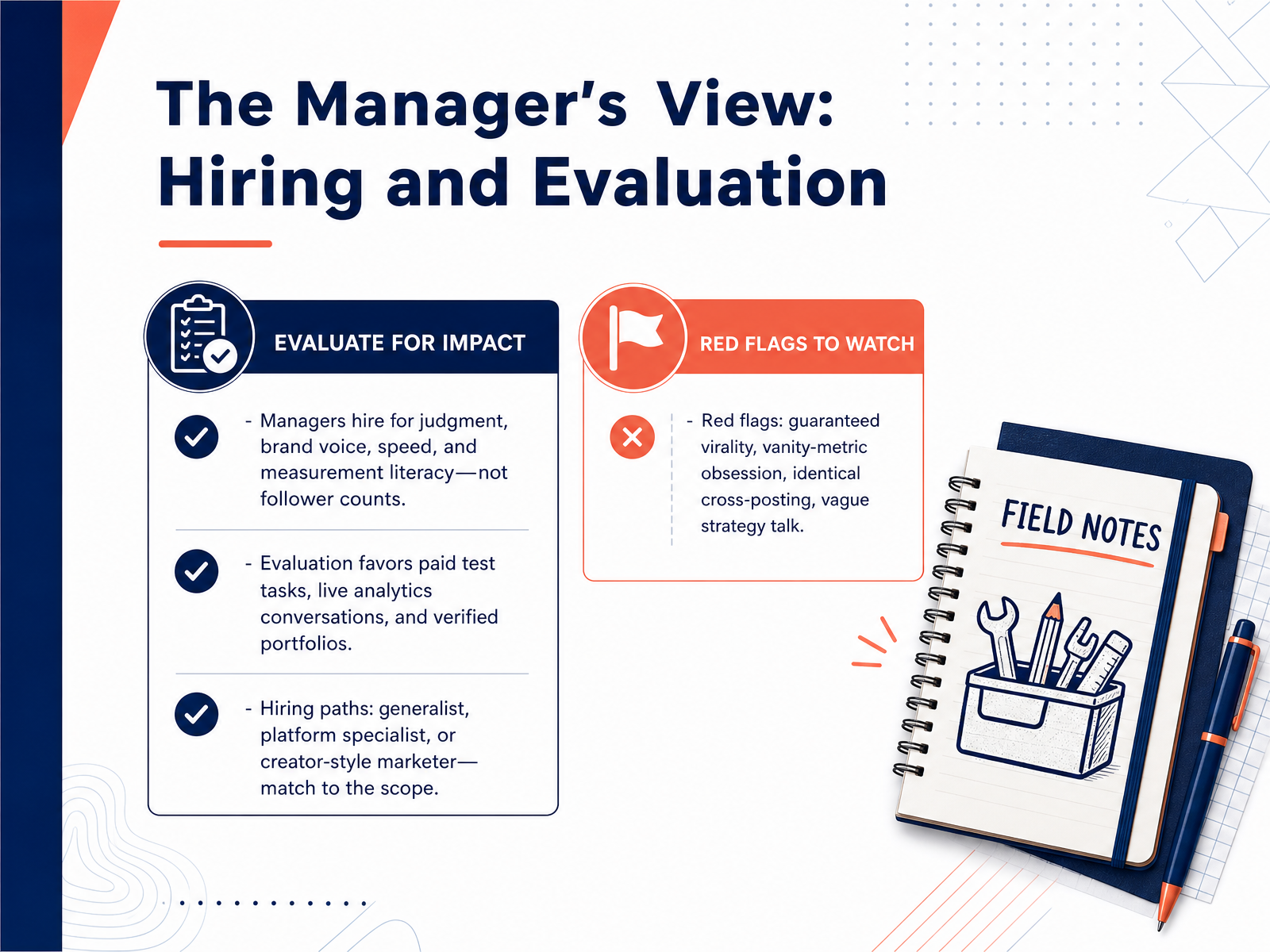
2 min - 10The Manager’s View: Hiring and EvaluationNow let's flip the camera around. How do managers actually decide who to hire, and who to promote? Here is the good news. They are not hiring for follower counts. They hire for judgment, brand voice, speed, and measurement literacy. In plain terms: can you make good calls fast, sound like the brand, and explain what the numbers mean? Evaluation usually favors paid test tasks, live analytics conversations, and verified portfolios. So if a manager hands you a real dashboard and asks what you notice, that is your moment. Talk about goals first, then what you would test next. Now, red flags, because you will want to avoid these in your own answers. Guaranteed virality. Vanity-metric obsession. Identical cross-posting everywhere. And vague strategy talk. Any one of those ends the conversation. Finally, know the hiring paths. You might be a generalist, a platform specialist, or a creator-style marketer who makes content on camera. The trick is matching your path to the scope of the role, not overselling it. Quick reflection before we move on. If a manager showed you their analytics today, what is the first question you would ask? Next, we turn that thinking into action, with Building Your Portfolio and Readiness Checklist.
 2 min
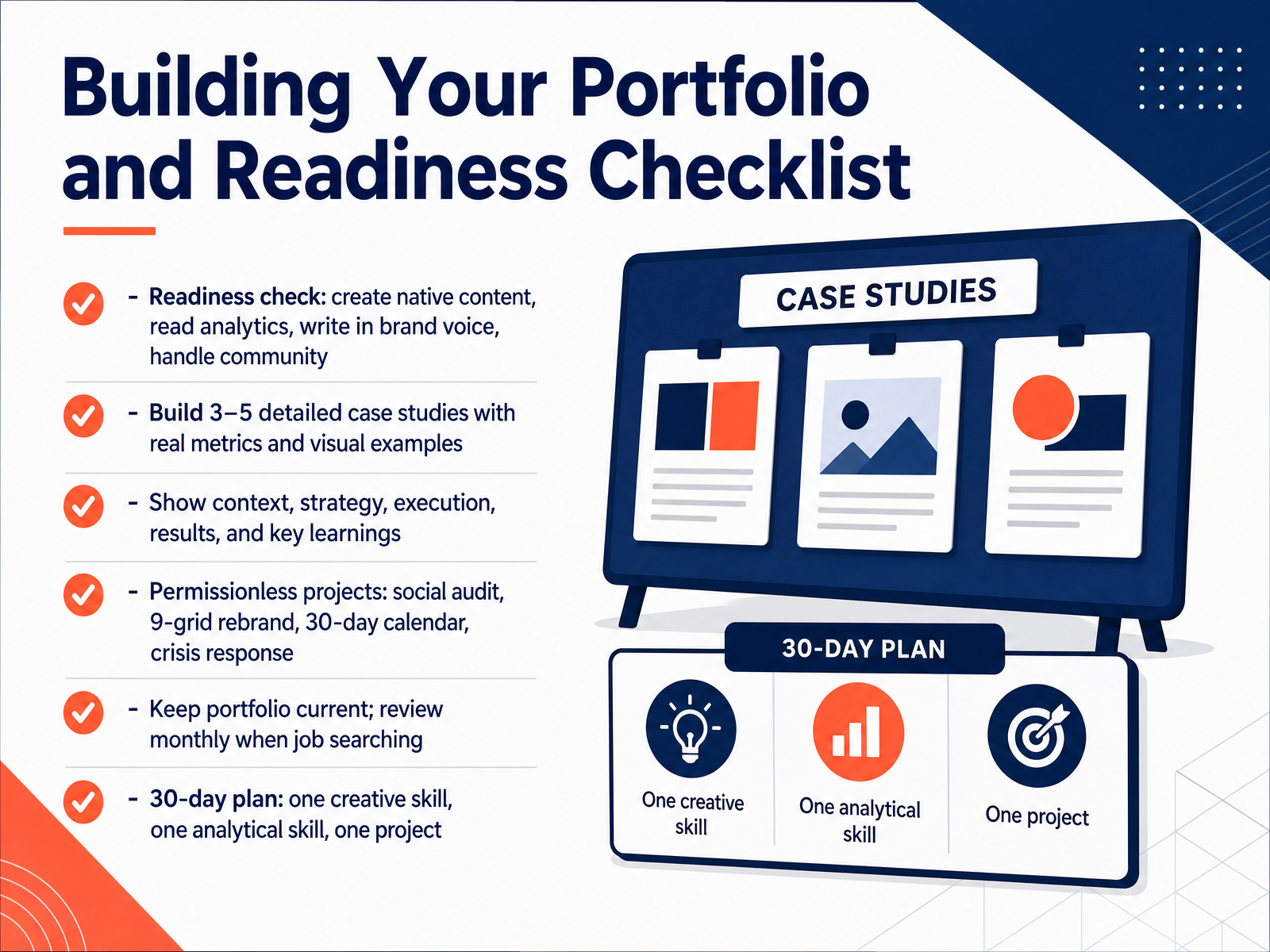
2 min - 11Building Your Portfolio and Readiness ChecklistNow let's talk about proving you're ready, because your portfolio is your strongest job-search tool. Start with a quick self-check. Can you create native content, read analytics, write in a brand voice, and handle community? If any of those feel shaky, that's your practice list. Then build three to five detailed case studies with real metrics and visual examples. Think of each one as the full story: context, strategy, execution, results, and key learnings. No client work yet? That's fine. Permissionless projects are the workaround. Do a social audit, a nine-grid rebrand, a thirty-day calendar, or a crisis response. Label it clearly as concept work. Keep your portfolio current and review it monthly when you're job searching. And here's your next step: a thirty-day plan with one creative skill, one analytical skill, and one project. That small habit is how you become ready. Next up, let's clear the air with common misconceptions about the role.
 socialpilot.coeverestx.cominfluencerdb.net+22 min
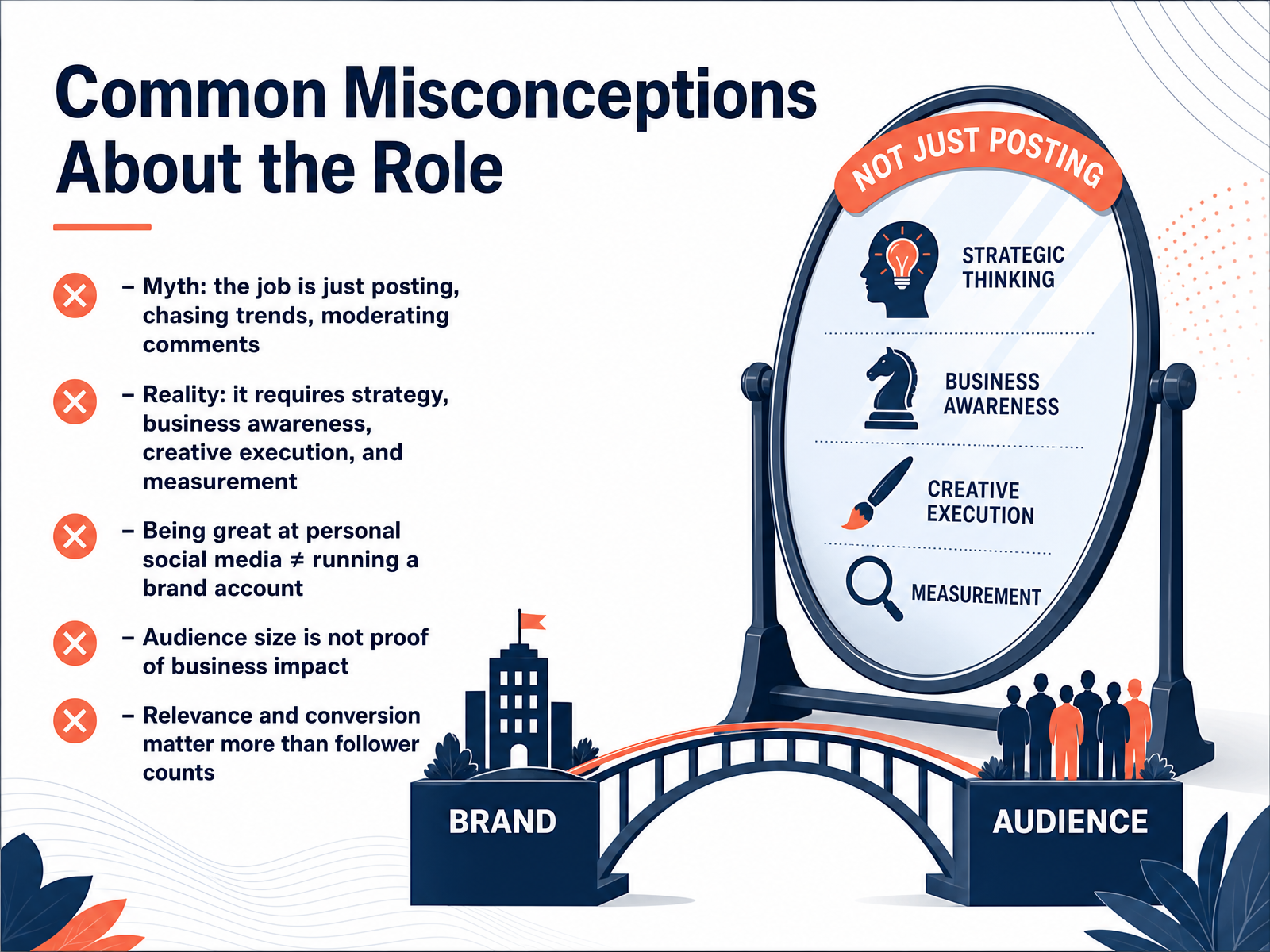
 - 12Common Misconceptions About the RoleLet's clear up a few myths about this role, because they trip up a lot of newcomers. The biggest one? That social media marketing is just posting and chasing trends and replying to comments. Here's the reality. It takes strategy, business awareness, creative execution, and measurement, all working together. Something else to untangle: being great at your own personal social media does not mean you can run a brand account. They are genuinely different skills. Then there's the follower count trap. A big audience is not proof of business impact. What matters more is relevance and conversion. So on day one, you would not be counting likes. You would ask who you are reaching and whether they actually take action. That mindset is exactly what hiring managers want to see. Now let's pull this together with one actionable definition of the role.
 toptal.comindeed.comsugarpixels.com+21 min
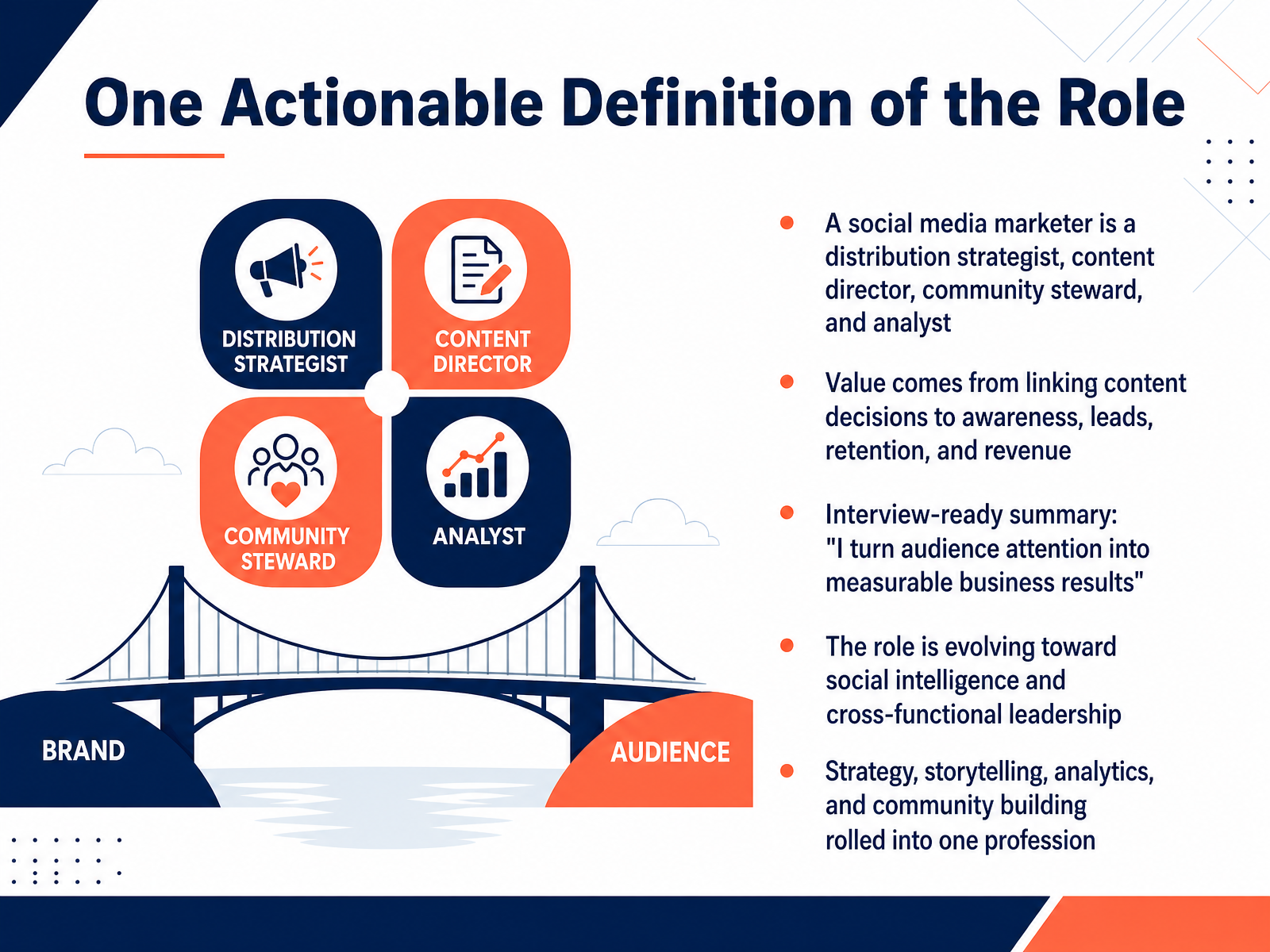
 - 13One Actionable Definition of the RoleNow, let's bring it all together with one actionable definition of the role. A social media marketer is four things at once: a distribution strategist, a content director, a community steward, and an analyst. You decide where content goes and who sees it. You shape how it looks and sounds. You show up in the comments and protect the brand. And you read the numbers to prove what's working. Here's the part that separates a job from a career. Value comes from linking content decisions to awareness, leads, retention, and revenue. Not just likes. So when you sit down with a hiring manager, you can say it simply: I turn audience attention into measurable business results. And the role keeps evolving, toward social intelligence and cross-functional leadership. Strategy, storytelling, analytics, and community building, all rolled into one profession. That should feel a little intimidating and a lot exciting. Ask yourself right now: which of those four strengths is your starting point, and which one will you build next? Hold that thought, because next we'll walk through your next steps and learning resources.
 toptal.comindeed.comsugarpixels.com+22 min
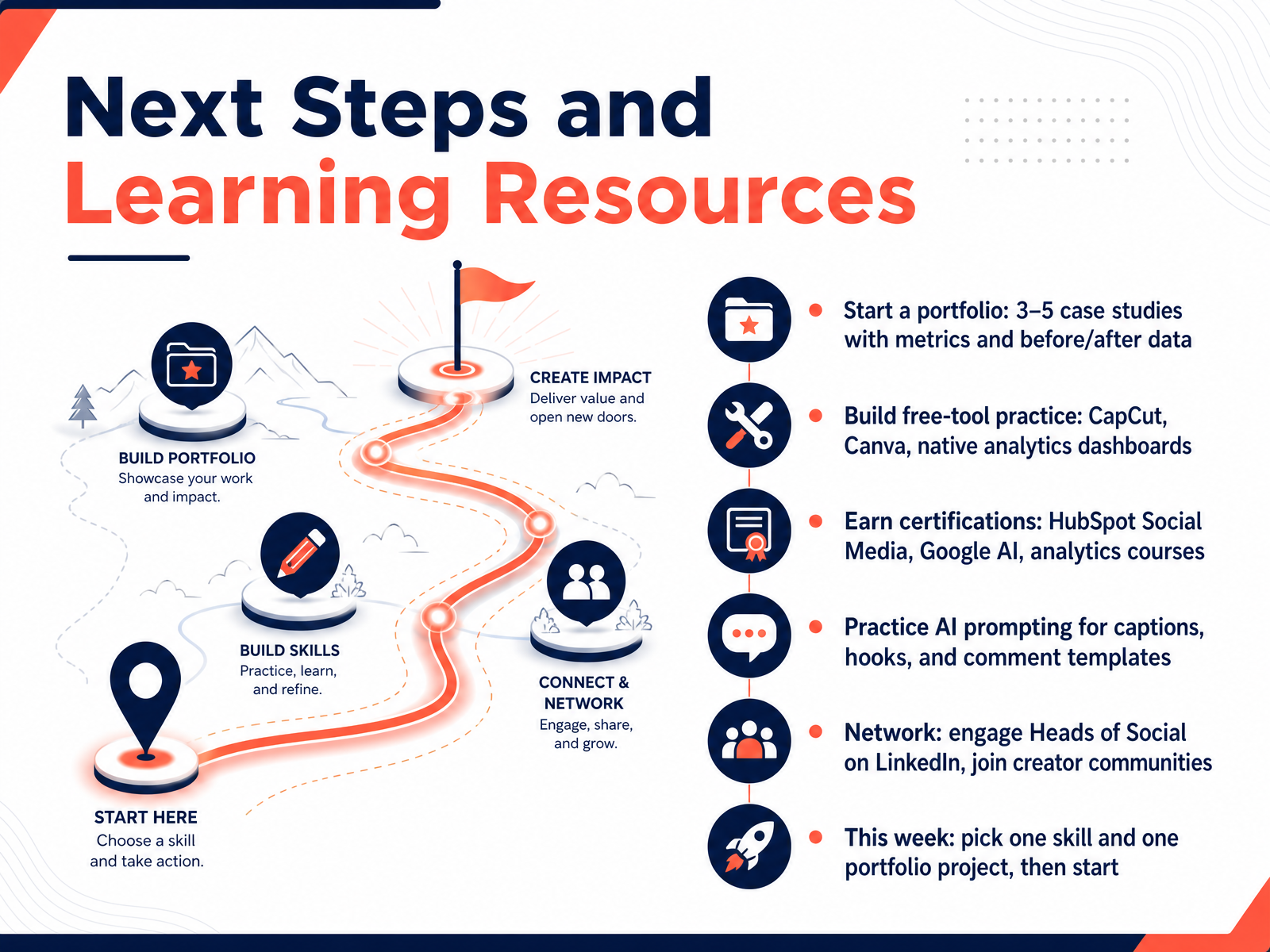
 - 14Next Steps and Learning ResourcesSo let's bring it all together. You don't need permission to start. Pick three to five case studies for your portfolio, and show your metrics with before and after data. Practice with free tools like CapCut, Canva, and the native analytics dashboards. Earn certifications, like HubSpot Social Media and Google AI courses. Practice prompting AI for captions, hooks, and comment templates. Network by engaging Heads of Social on LinkedIn and joining creator communities. This week, choose one skill and one portfolio project, then start. Thank you for learning with me. You've got this, one post at a time.
 socialpilot.coeverestx.cominfluencerdb.net+21 min
Take the deck with you
Download this course as a file — free, no sign-up needed.
- PDF handoutEvery slide page, ready to print or share.15 pages · 3.8 MBDownload
- Narrated PowerPointThe deck that presents itself — every slide carries the digital human's narration video.15 pages · 13.9 MBDownload
- PowerPoint slidesThe full deck as a .pptx — open it in PowerPoint, Keynote, or Google Slides.15 pages · 3.7 MBDownload
Free to use in your own training — please keep the PersonWise credit page at the end.
Have your own deck? Turn it into a course
Sources consulted
Web sources consulted while building this course.
- Social Media Marketer Job Description Sept 2026 — toptal.com
- Social Media Manager Job Description [Updated for 2026] — indeed.com
- 10 Social Media Marketing Responsibilities For 2026 | Sugar Pixels, Inc. — sugarpixels.com
- What Does a Social Media Manager Actually Do in 2026? — kontentino.com
- Social Media Manager Job Description Template - Complete 2026 Hiring Guide — resources.rework.com
- How to Build a Social Media Marketing Team in 2026 — constantcontact.com
- Marketers face an urgent need to restructure social teams to keep up with channel scope — emarketer.com
- How to Build a Social Media Marketing Team (2026) - AIToolSync — aitoolsync.com
- How to Build a Social Media Team for Your Business in 2026 | Heropost — heropost.io
- 2026 Social Media Marketing Industry Report: Key Trends — Whizsky — whizsky.com
- A Day in the Life of a Social Media Manager - Buffer — buffer.com
- A Day in the Life of a Social Media Manager: Daily Tasks, Tools, Skills & Career Path - Entri Blog — entri.app
- What Does a Social Media Manager Do? Day in the Life 2026 | Picmim Blog — blog.picmim.com
- A Day in the Life of A Social Media Manager (2026) — onjob.io
- A Day in the Life: Social Media Manager – CSB+SJU Career Center — career.csbsju.edu
- How to Become a Successful Social Media Manager in 2026 — socialpilot.co
- Social Media Manager Skills You Need 2026 | EverestX — everestx.com
- Social media professional skills: the 2026 playbook — influencerdb.net
- Social Media Leadership Skills 2026: Complete Guide — sonarplatform.com
- 20 Social Media Marketing Skills for 2026 - 2027 - CLR — coverlettersandresume.com