Marketing Automation Analytics Tools
Begin
14 pages · ~28 min
Marketing Automation Analytics Tools
Learn to leverage marketing automation platforms with built-in analytics to streamline campaigns and measure performance effectively. This training is for marketers seeking to optimize engagement through data-driven automation strategies.
What you’ll learn
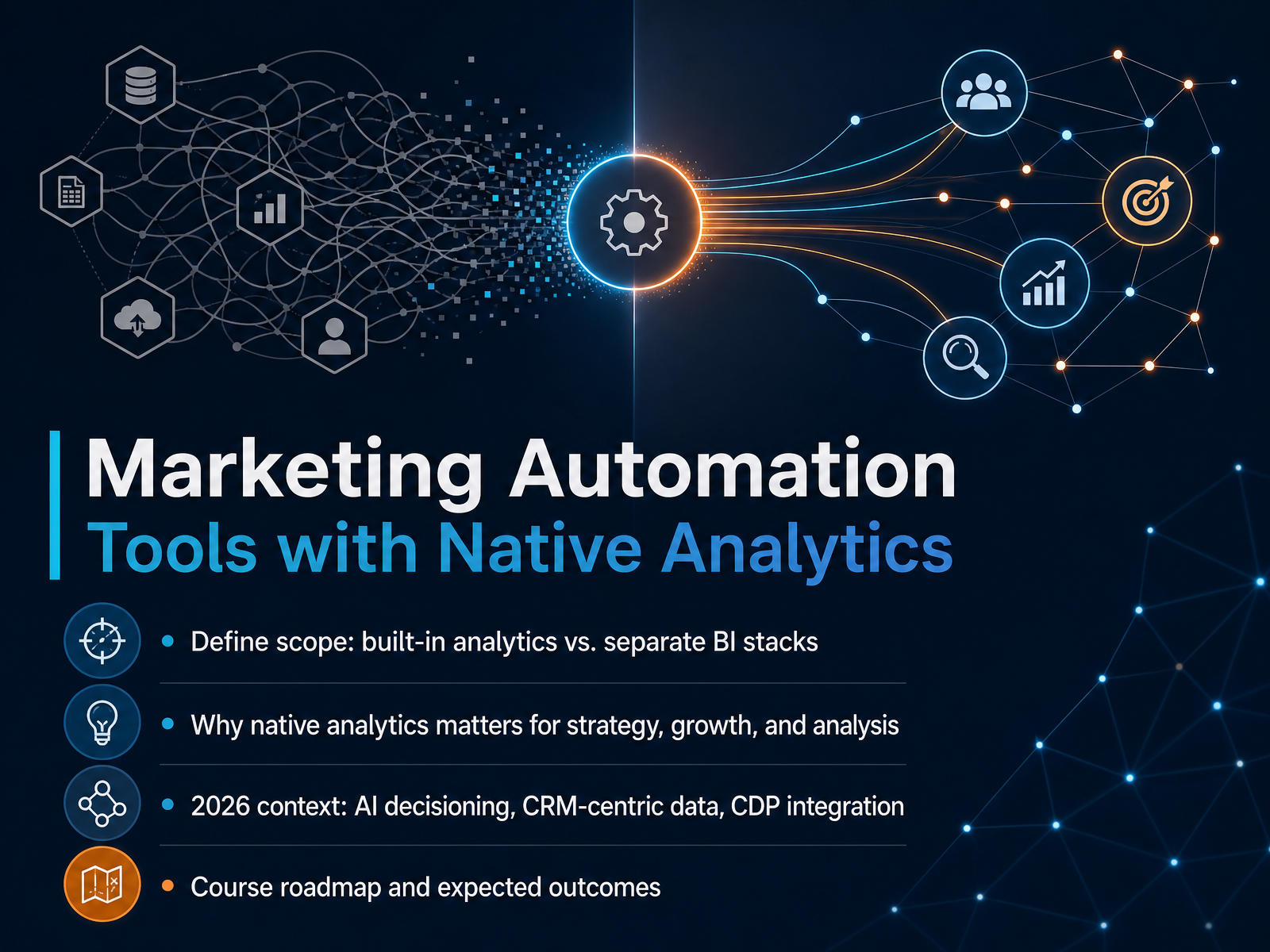
- 01Marketing Automation Tools with Native AnalyticsWelcome. This course is designed for market strategists, growth teams, and marketing analysts who need to turn automation data into measurable pipeline and ROI. Today we are focusing on marketing automation tools with native analytics, and there is a critical distinction to make from the start. Native analytics are the reporting and attribution that live inside your automation platform, versus a separate BI stack that requires you to export data before you can see it. That difference directly affects how quickly you can verify conversion paths and act on multi-touch attribution. In 2026, the context has shifted. AI decisioning is now embedded in scoring and send-time optimization. CRM-centric data has become the default architecture. And CDP integration now determines whether your native analytics can see a complete customer profile. What matters for you is whether the numbers in your dashboard ladder directly to revenue and sales handoff. By the end of this course, you will be able to evaluate platform analytics against pipeline impact, not just feature lists. Let's start with the 2026 landscape of platforms and categories.tested.mediaviewpointanalysis.comtechvendorindex.com+21 min
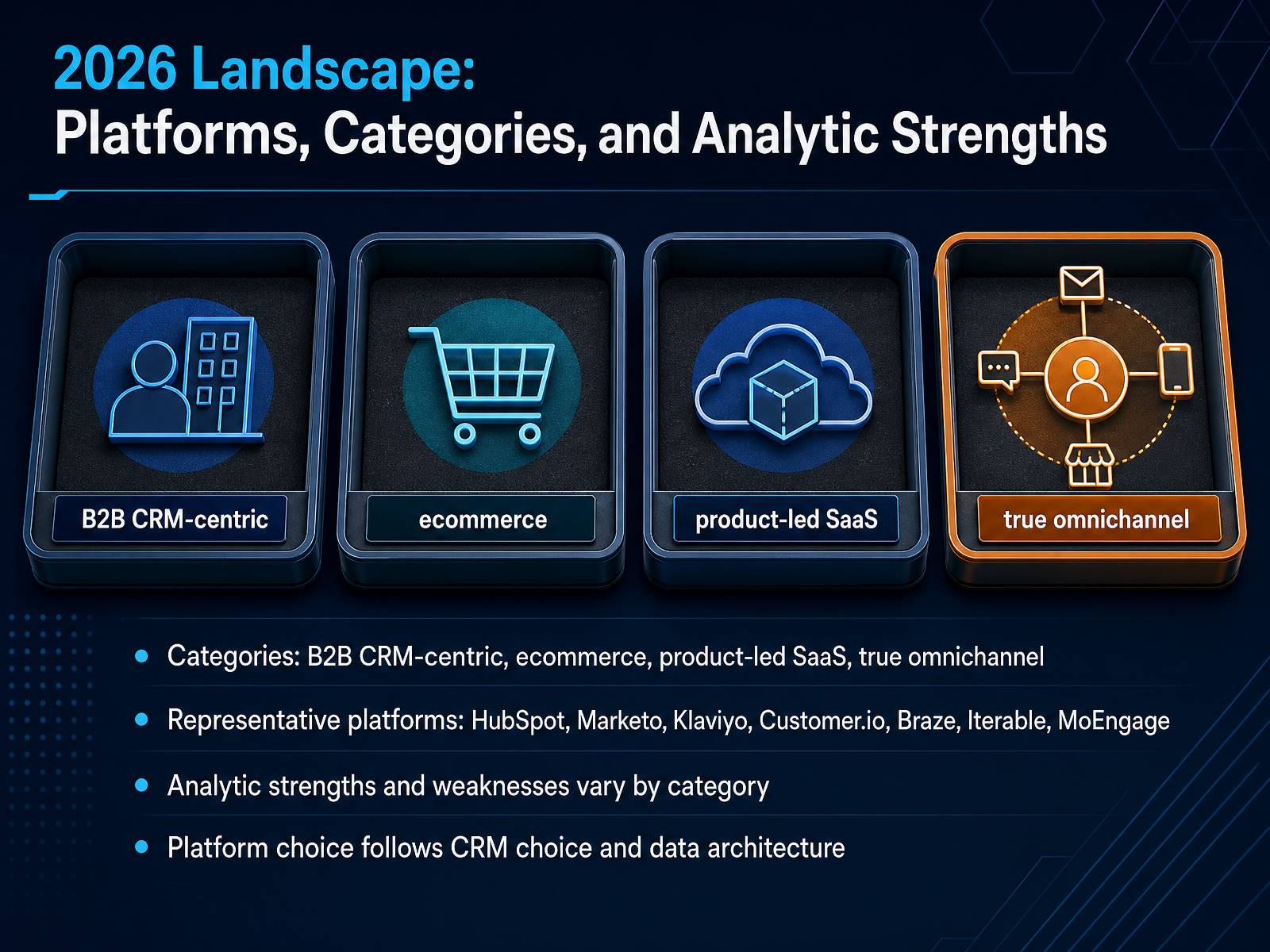
- 022026 Landscape: Platforms, Categories, and Analytic StrengthsLet's map the current platform landscape and what it means for your analytics. The market has split into four broad categories, each with a different analytic center of gravity. B2B CRM-centric platforms like HubSpot and Marketo are built around pipeline visibility and lead attribution. Ecommerce tools like Klaviyo focus on revenue per recipient and purchase behavior. Product-led SaaS platforms like Customer.io emphasize lifecycle events and activation metrics. True omnichannel systems like Braze, Iterable, and MoEngage prioritize cross-channel engagement and journey performance. Each category has clear analytic strengths and also notable blind spots. That is why platform choice should not be made in isolation. It follows your CRM choice and your underlying data architecture. When you select a platform, you are also selecting which metrics get measured first and which reports are easiest to access. Next, we will look at the strategic trade-offs between native analytics and external analytics.
 2 min
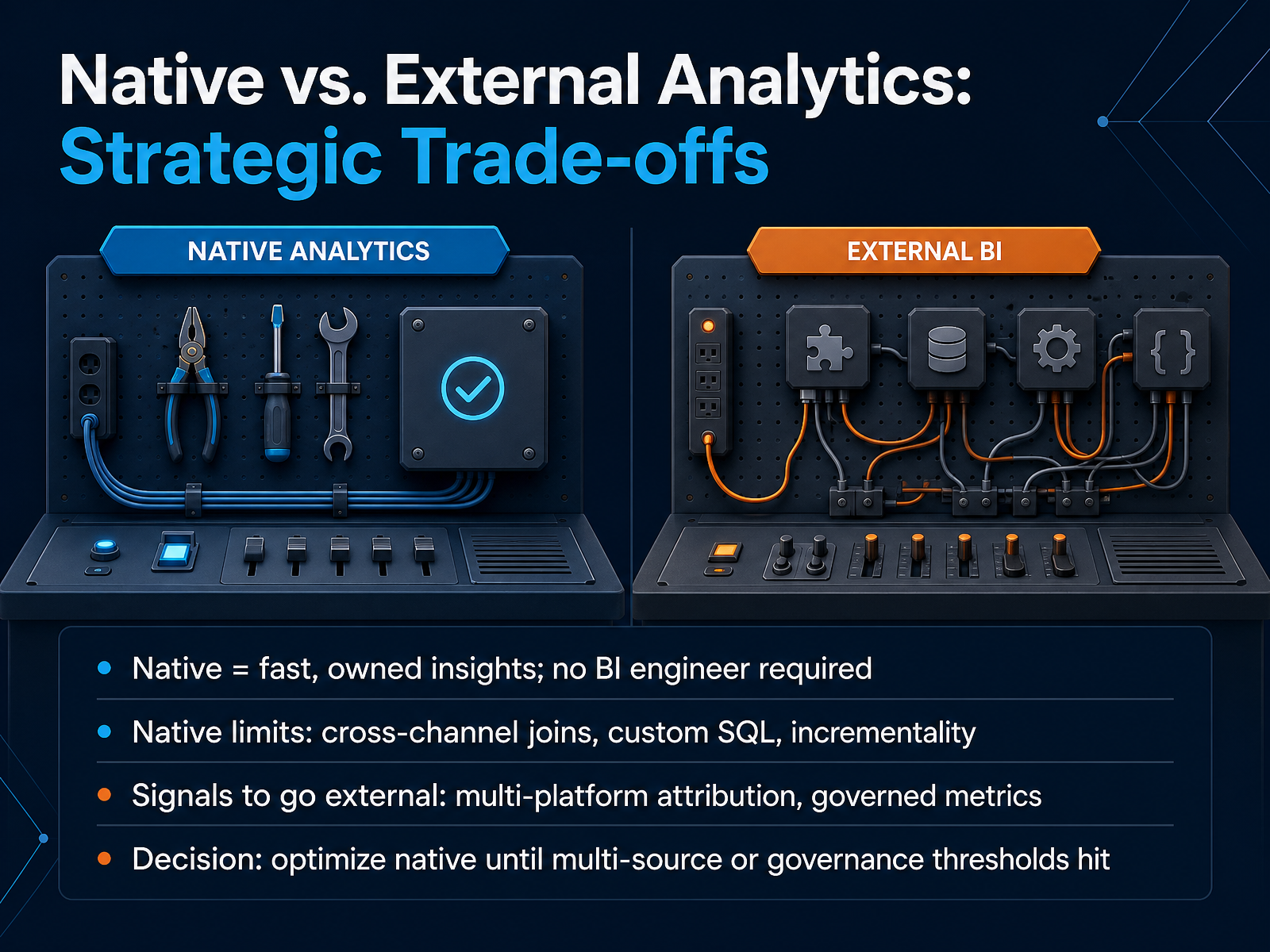
2 min - 03Native vs. External Analytics: Strategic Trade-offsLet's get concrete about a decision you'll face repeatedly: native analytics versus pushing data into an external system. Native is fast. It gives you owned, immediate insights without waiting on a BI engineer. That speed matters when you're optimizing a nurture sequence or checking conversion paths mid-campaign. But the limit is real. Native tools struggle with cross-channel joins, custom SQL, and incrementality testing. What the numbers tell you is that a platform can show email clicks, but it often cannot tell you whether a win-back campaign created revenue that would not have happened anyway. The signal to go external is clear: multi-platform attribution, or a need for governed, shared metrics across your organization. Until you hit those thresholds, the smart move is to optimize what native analytics already gives you. Think of it as knowing exactly when the architecture, not the configuration, is the constraint. That brings us to the next question: what those core native capabilities actually look like in practice.
 datawhistl.comimprovado.iodefinite.app+21 min
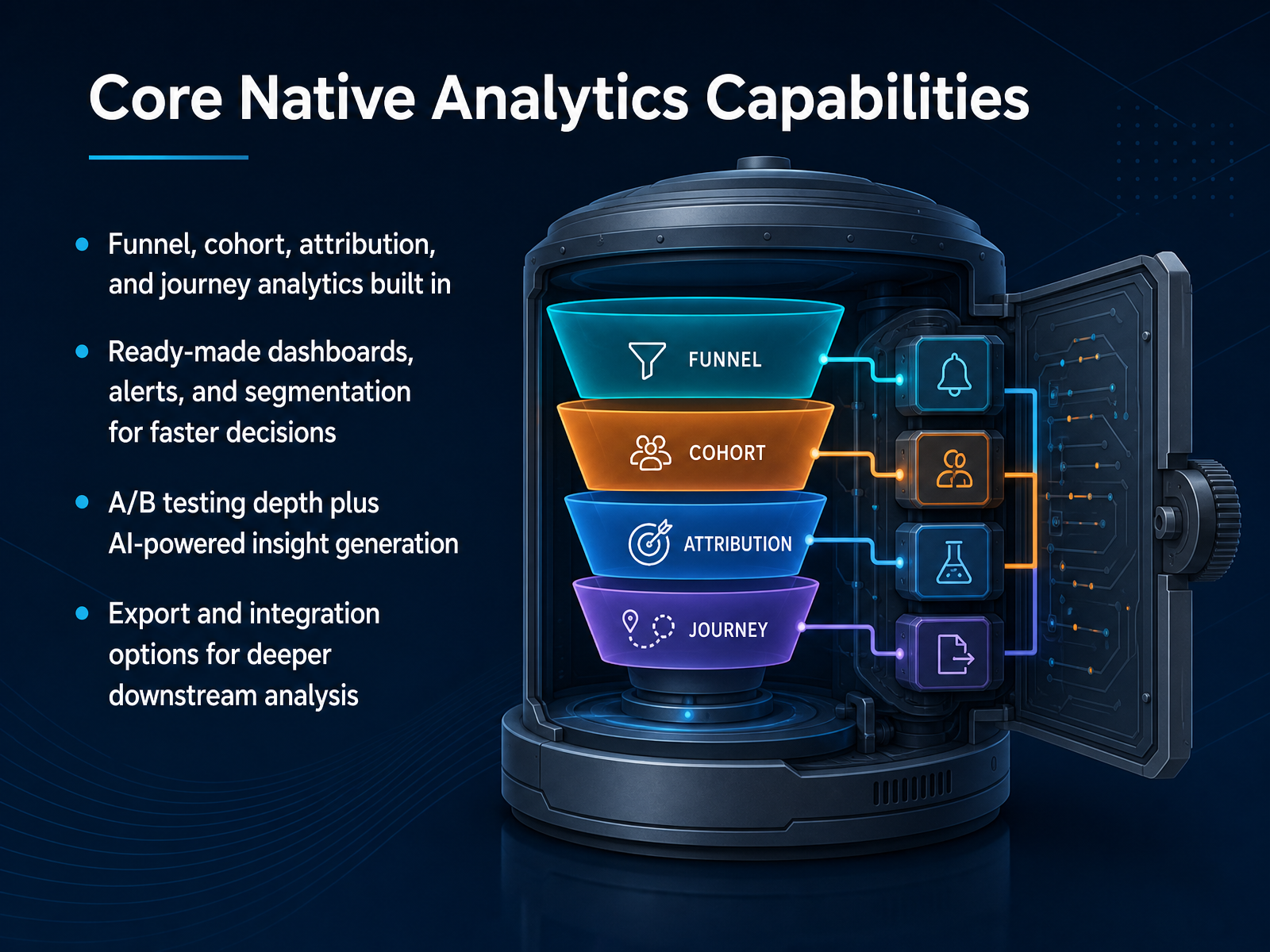
 - 04Core Native Analytics CapabilitiesNow, let's look at the core native analytics you should expect from a serious marketing automation platform. These aren't add-ons. They're built directly into the system. First, you get funnel, cohort, attribution, and journey analytics without stitching together separate tools. That means you can see your conversion paths and multi-touch attribution in one place. Second, ready-made dashboards, alerts, and segmentation let your team act faster. Instead of waiting on a data pull, you see what the numbers tell you in a dashboard view. Third, A and B testing depth goes beyond simple subject lines. You can test entire journeys, and AI-powered insight generation surfaces performance shifts before they become problems. Finally, export and integration options are important. You can move clean data into your downstream systems for deeper statistical work or reporting. Keep these capabilities in mind. They set the foundation for how you'll verify performance. Next, we'll translate these capabilities into the five dimensions of performance measurement.
 1 min
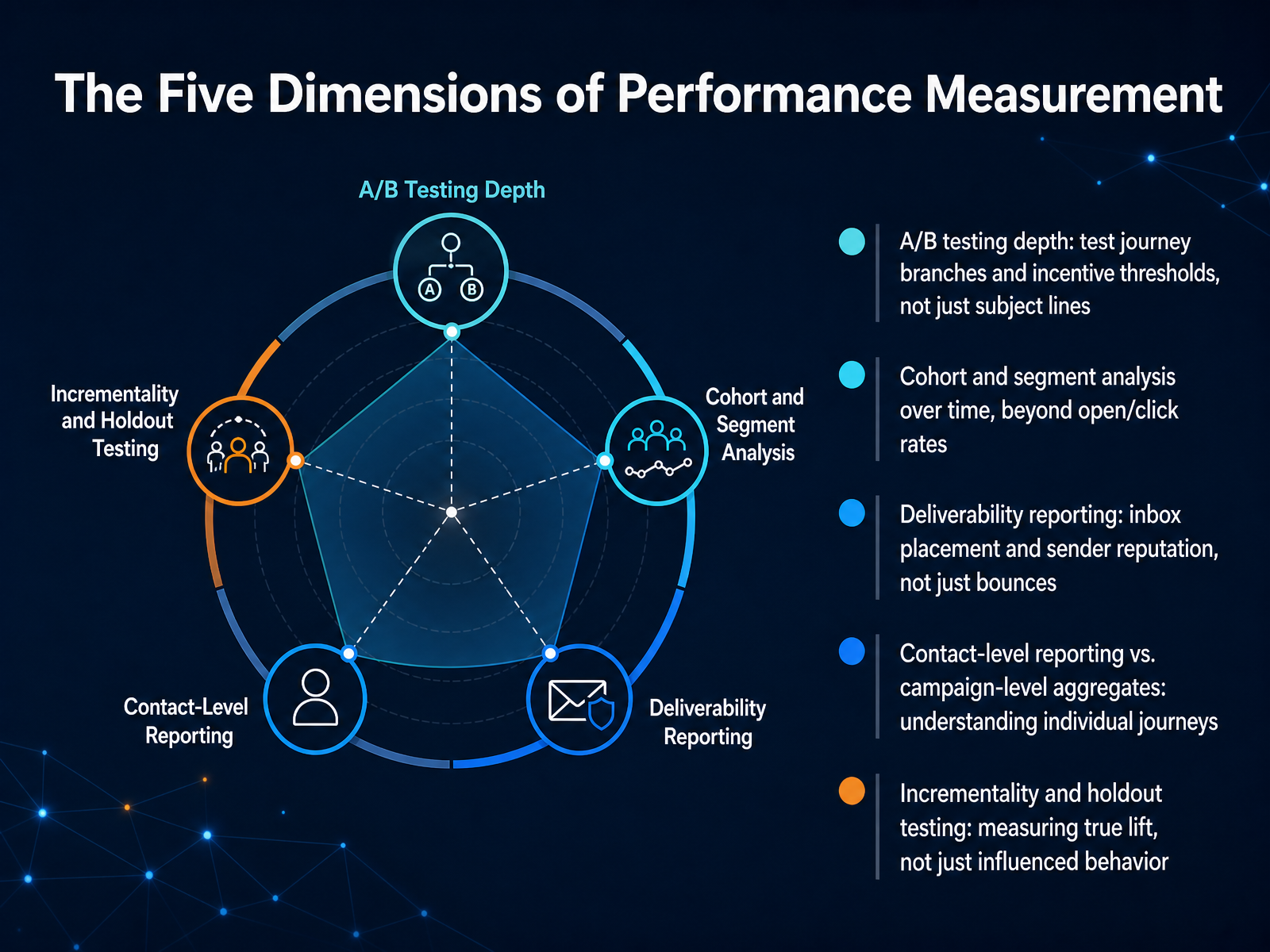
1 min - 05The Five Dimensions of Performance MeasurementSo let's move from the data layer to the performance layer. Here are five dimensions you should use to evaluate how well your platform actually measures what matters. First, A/B testing depth. You need to test journey branches and incentive thresholds, not just subject lines. Second, cohort and segment analysis over time. If you cannot compare the revenue behavior of customers who went through an automation versus those who did not, you are flying blind. Third, deliverability reporting. Look for inbox placement and sender reputation, not just bounce rates. By the time a problem shows up in open rates, the damage is already done. Fourth, contact-level reporting. Campaign-level aggregates are useful for benchmarking, but individual journeys tell you how automations are actually working. And fifth, incrementality and holdout testing. This measures true lift, not just influenced behavior. A win-back campaign that re-engages two hundred customers sounds great, but if most would have purchased anyway, the incremental value is much smaller. Next, we'll look at a practical framework for applying these dimensions to your automation programs.
 datawhistl.comimprovado.iodefinite.app+22 min
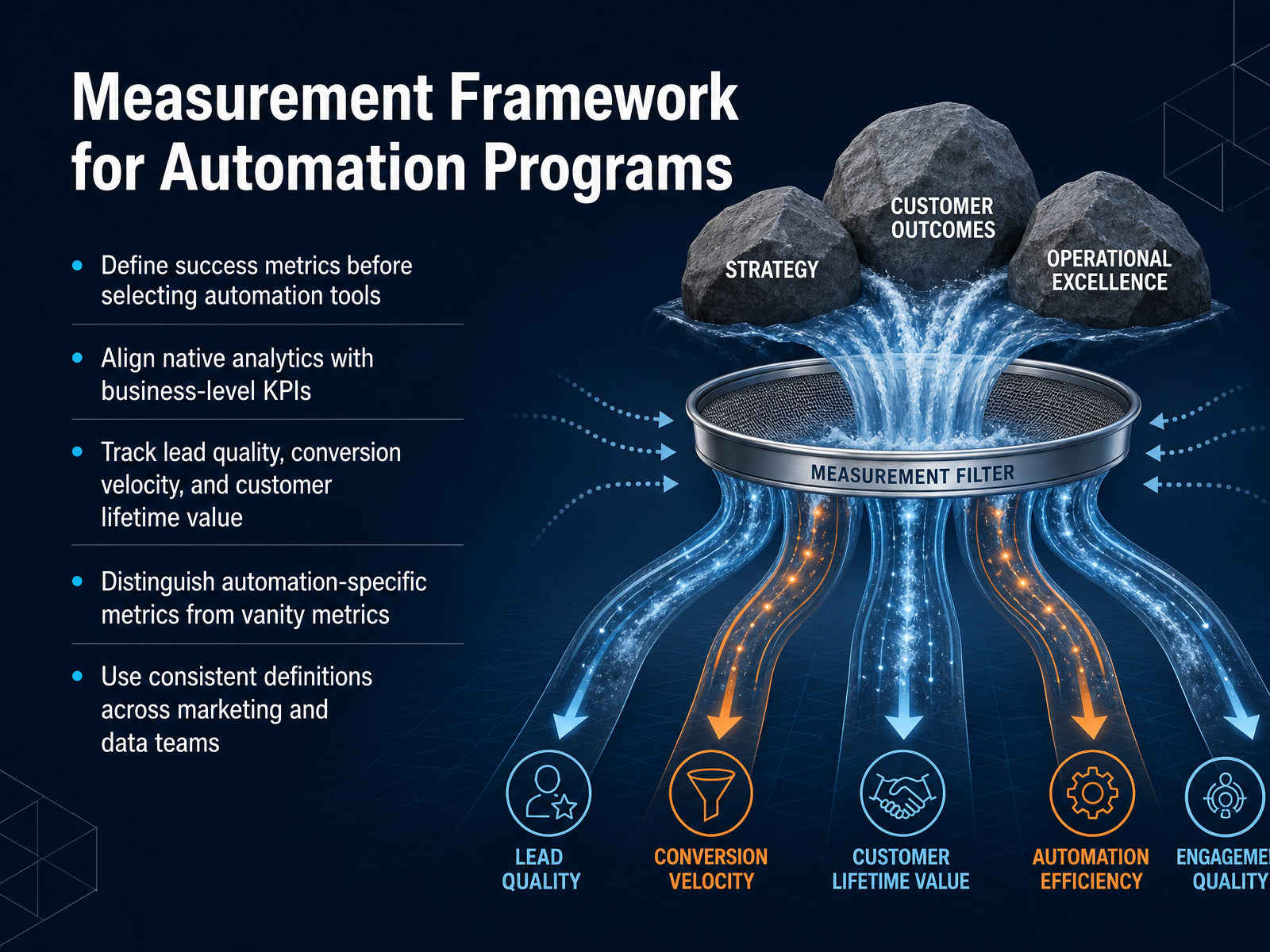
 - 06Measurement Framework for Automation ProgramsLet's move into the measurement framework. Before you evaluate any automation platform, lock down how you'll measure success. Start by defining the metrics that matter to revenue, not just to marketing activity. Then check whether the platform's native analytics can report against those same definitions. You want alignment between tool-level reporting and your business level KPIs. Focus on lead quality, conversion velocity, and customer lifetime value. Lead quality tells you whether automation is bringing in the right accounts. Conversion velocity shows whether nurtured audiences are moving faster through the pipeline. Customer lifetime value connects automation directly to long term return. Be careful to separate automation-specific metrics from vanity metrics. Email opens and form views feel productive, but they don't prove pipeline impact. Instead, look at metrics like qualified meetings per campaign, or stage conversion rates by source. And make sure marketing and data teams use the same definitions. If marketing counts a marketing qualified lead one way and data counts it another way, your native analytics will never align with the CRM. That consistency is what makes attribution believable. Next, we'll look at data governance and attribution trust.
 2 min
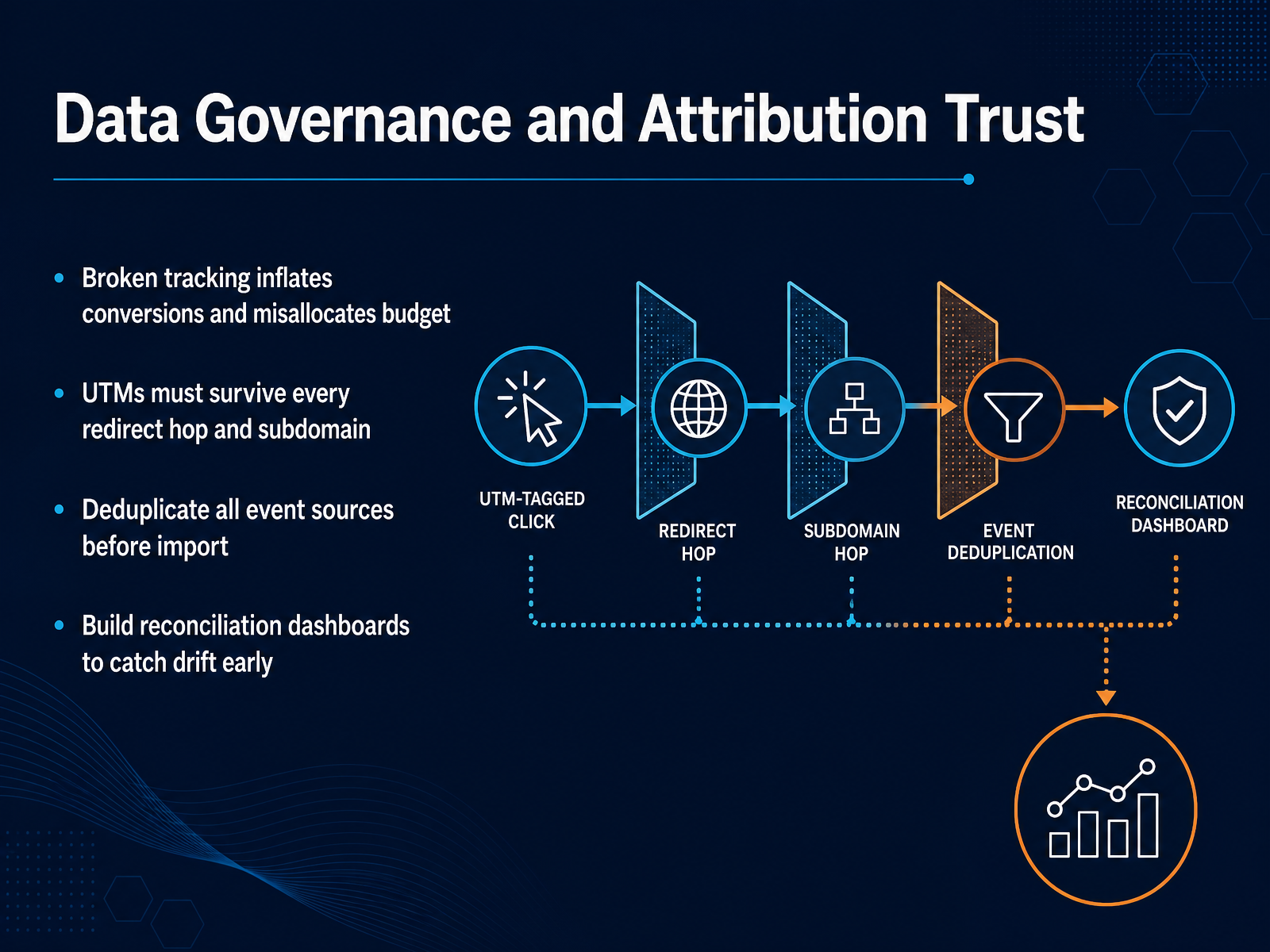
2 min - 07Data Governance and Attribution TrustNext, let's address a hidden threat to your growth strategy: data you cannot trust. When your tracking infrastructure is flawed, every downstream decision is fundamentally broken. Consider a scenario we see often: broken redirects silently strip your UTM parameters. The result is that paid traffic looks like direct traffic, and conversions appear to be coming from nowhere. You must ensure your UTMs survive every single redirect hop and subdomain transition. One missing rule can erase a channel's performance entirely. Simultaneously, you need to deduplicate all event sources before they enter your system. If your analytics tag and marketing automation platform both fire a signup event, you will count a single user twice, inflating your pipeline artificially. To protect yourself, you should build reconciliation dashboards. By comparing platform-reported revenue against your CRM data on a weekly basis, you catch drift early rather than discovering a massive misallocation at the end of the quarter. Remember, accurate attribution is not an IT project; it is your license to allocate budget with confidence. With that foundation secured, we can now focus on the individual: Identity Resolution and Consent in Native Analytics.
 moengage.come-cens.comb2b-software.net+21 min
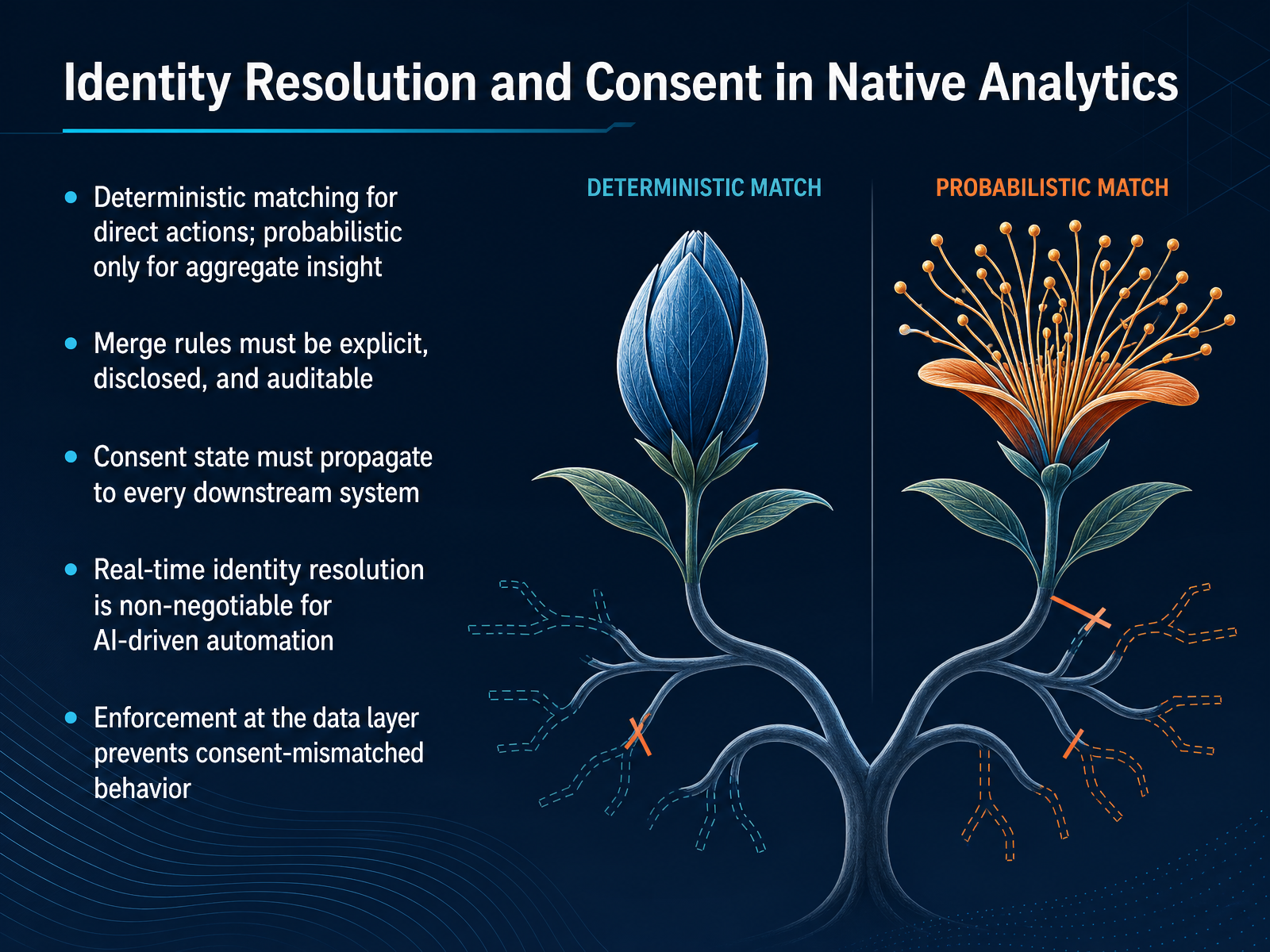
 - 08Identity Resolution and Consent in Native AnalyticsNow let's talk about identity resolution inside your native analytics, because this is where governance becomes either a real operating advantage or a growing liability. Deterministic matching, meaning confirmed identifiers like a hashed email or a login ID, should be your default for any direct action. Probabilistic matching has a role, but only for aggregate insight, never for triggering a one-to-one message. Every merge rule you build needs to be explicit, disclosed to the customer, and auditable later. When you merge an anonymous visit with an authenticated profile, the consent state from that anonymous session must travel with the data. It cannot be silently overridden by the more permissive account-level consent. And that consent state has to propagate to every downstream system, your CRM, your ad platforms, your AI agents. If activation tools read their own join logic, you will get consent-mismatched behavior, regardless of how clean your source system looks. Real-time resolution is non-negotiable here. AI-driven automation makes decisions in milliseconds, and a nightly batch profile means today's decisions are built on yesterday's identity. Enforcement at the data layer, before data enters a processing pipeline, is what prevents the wrong profile from ever being created. Next, we'll look at how to integrate these native insights directly into your growth workflows.
 martechcookbook.comrn-digital.comtreasure.ai+22 min
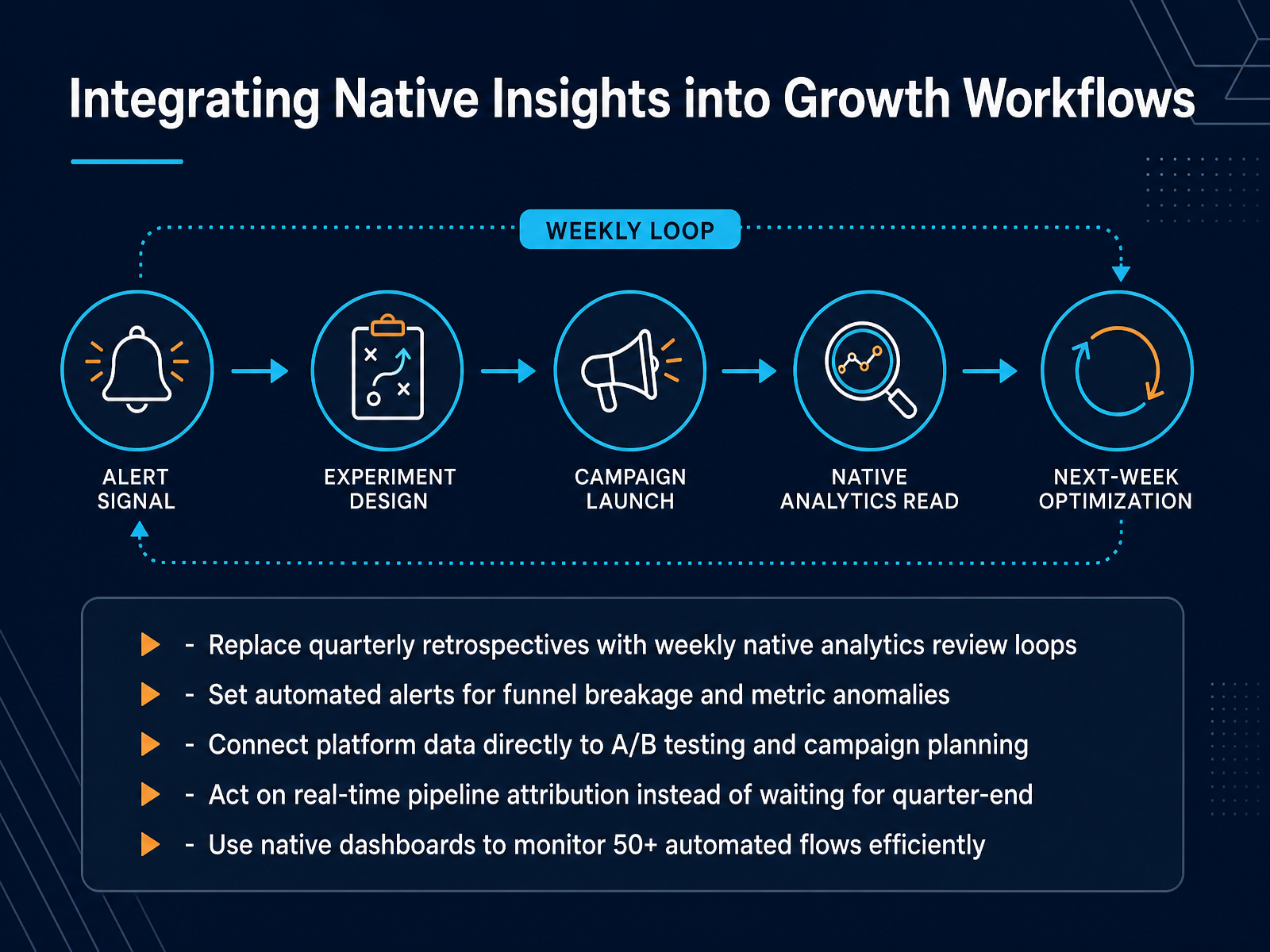
 - 09Integrating Native Insights into Growth WorkflowsNow let's talk about operationalizing these insights. The goal is to shift from periodic reporting to continuous optimization. First, replace quarterly retrospectives with weekly review loops. You want your team looking at native dashboards every week, not discovering breakage months later. Second, set automated alerts for funnel breakage and metric anomalies. This is how you catch a tracking drift or a broken flow before it burns budget. Third, connect platform data directly to your A/B testing and campaign planning. Use real-time pipeline attribution to make decisions now, instead of waiting for quarter-end data. A real-time approach is what enabled one company to cut its cost per opportunity by 30 percent in a single quarter. Finally, use those native dashboards to monitor your automated flows. One brand manages over fifty flows with precision by watching key events for performance dips. This is about installing a system of continuous checks. Next, we will look at some concrete case studies, including the successes and the hidden failures.
 moengage.come-cens.comb2b-software.net+22 min
 - 10Case Studies: Successes and Hidden FailuresLet's look at what good data actually unlocks, and what happens when the numbers lie. Wakefit saw a sixty four percent click through rate uplift when they shifted from static campaigns to behavioral automation, using product level signals and AI to optimize send time and creative. That is pipeline impact. AskNicely cut cost per opportunity by thirty percent in one quarter, simply by unifying CRM and marketing data so the CMO and CRO were finally looking at the same pipeline. And M6 Audio proved scale doesn't have to mean dependency. They migrated over forty six million contacts and hit ninety nine point seven percent deliverability, while giving CRM teams the autonomy to build scenarios in under an hour. But here is the trade off. One SaaS company spent sixty thousand dollars chasing dashboard numbers that showed two point six times more conversions than actually existed. Misconfigured redirects stripped their UTM data, and triple counted events made losing campaigns look profitable. That is the hidden cost of weak measurement. These are not platform features. They are operating decisions. Next, when to supplement native analytics.
 moengage.come-cens.comb2b-software.net+22 min
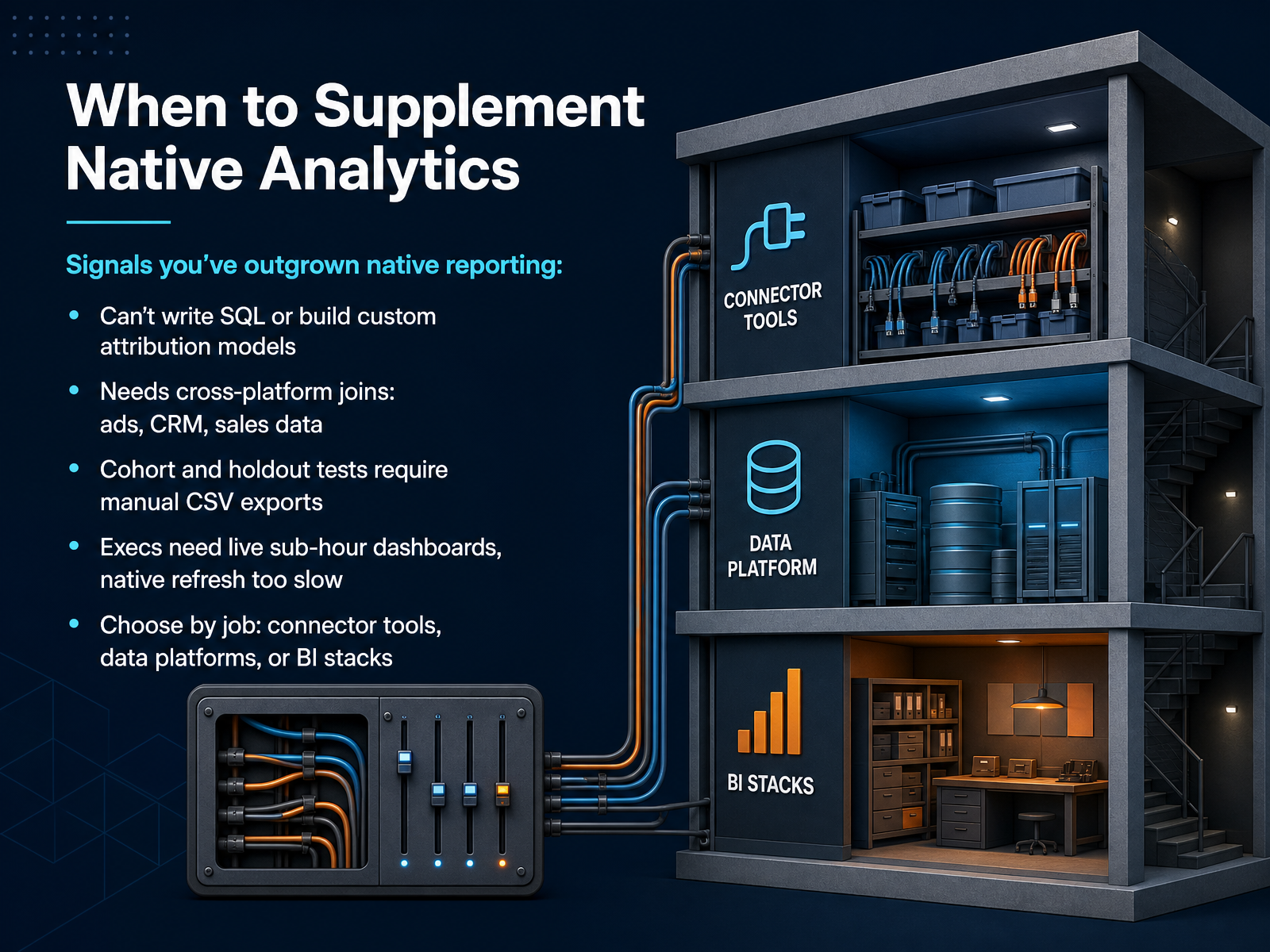
 - 11When to Supplement Native AnalyticsLet's talk about when native analytics stop being enough and how to recognize the breaking point. You know you've hit the limit when you can't write SQL against the platform, or when you need custom attribution models that go beyond the pre-built options. A second signal is cross-platform joins. If you're manually exporting from your marketing automation tool, your CRM, and your ad platforms just to see one unified picture, you've outgrown the native layer. Cohort analysis and holdout tests are another trigger. When measuring incrementality requires exporting CSVs and stitching them together, your insights are delayed and your analyst time is leaking. Pay attention to refresh speed too. If your executives need live dashboards updating every fifteen minutes, but native reports refresh hourly at best, that latency has a cost. Now, the tool you choose depends on the job. A connector tool solves the export problem. A data platform gives you governed metrics across sources. A BI stack gives you deep visualization control. Match the job to the tool, not the other way around. Next, we'll move into the vendor evaluation checklist.
 datawhistl.comimprovado.iodefinite.app+22 min
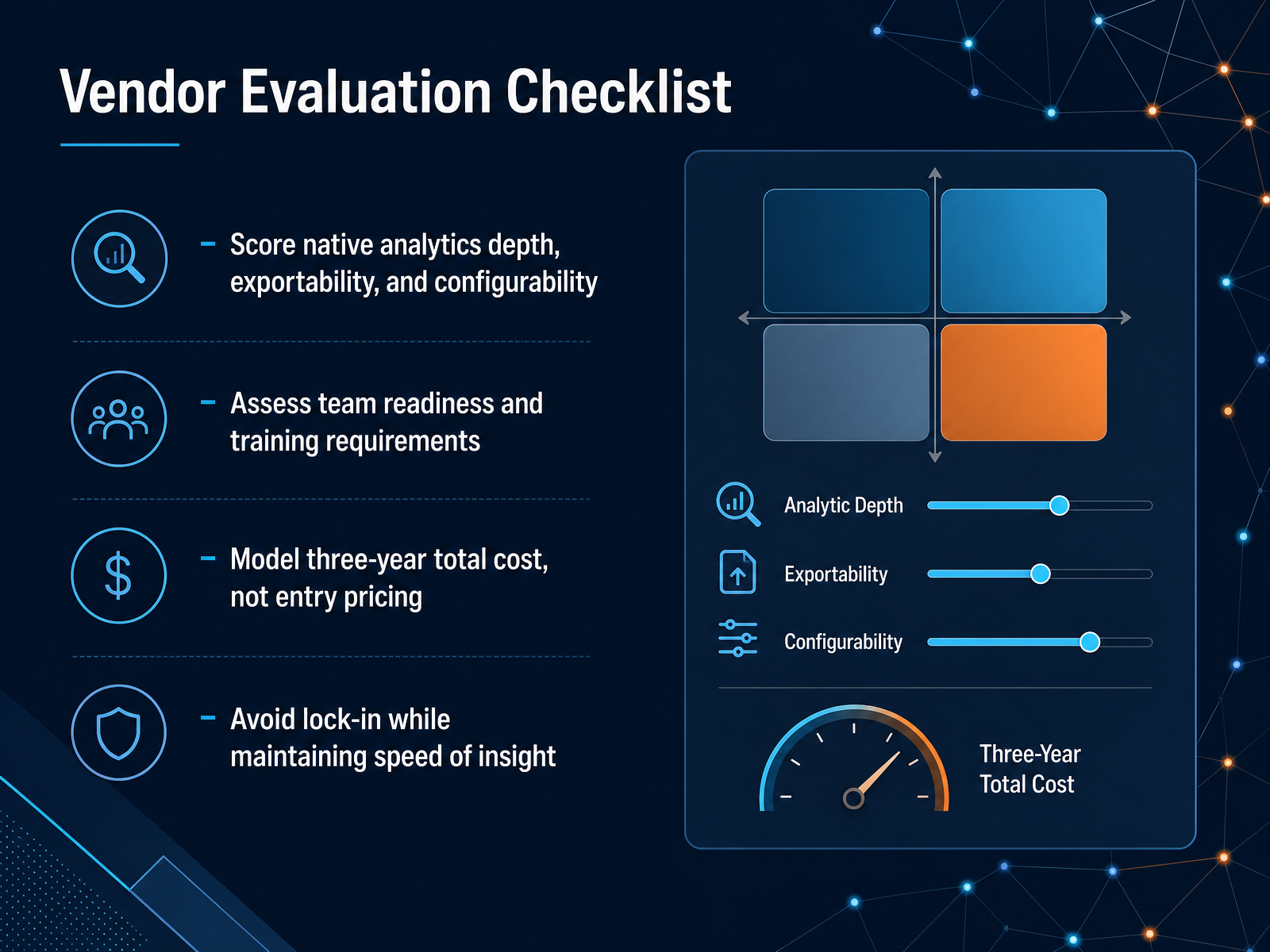
 - 12Vendor Evaluation ChecklistMoving into vendor evaluation, the checklist keeps this practical. First, score native analytics depth, exportability, and configurability. Ask how easily you can segment reports, export raw data, and adjust dashboards without waiting on vendor support. Second, assess team readiness and training requirements. You may find that two platforms are functionally close, but one requires weeks more onboarding to reach the same level of insight. Third, model three year total cost, not entry pricing. Include data volume, active seats, implementation, and support fees, because undercounting here shows up later as budget pressure or reduced adoption. Fourth, avoid lock in while maintaining speed of insight. Prefer tools with clean data export and API access, but do not sacrifice fast dashboard access for the sake of flexibility. The goal is not maximum portability, it is portable enough to protect your leverage while still giving the growth team answers this quarter. This checklist helps you move from feature comparisons to a defensible business decision. Next, we will look at the governance and adoption roadmap, because the strongest analytics stack still depends on consistent rollout and operating discipline.
 1 min
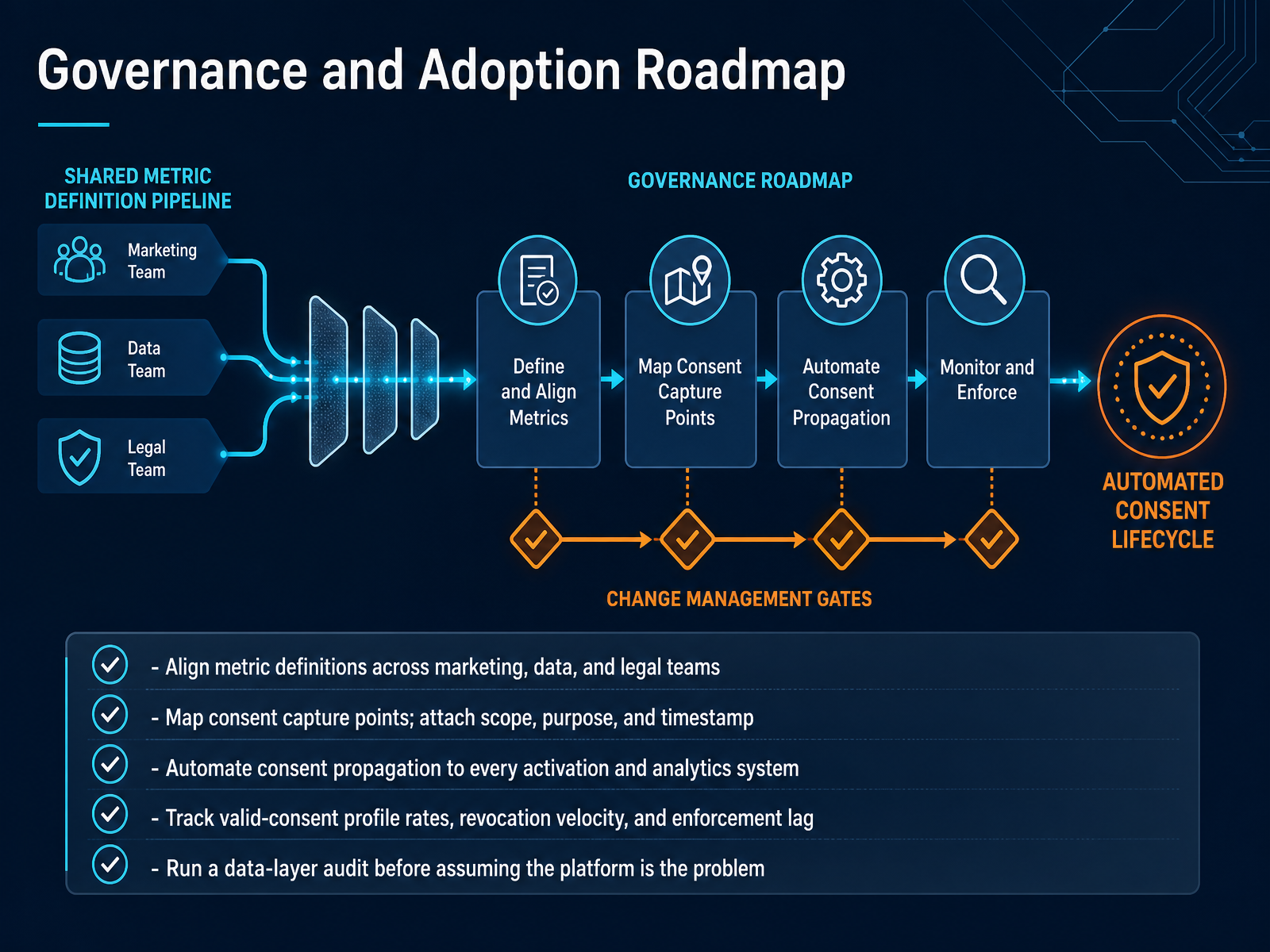
1 min - 13Governance and Adoption RoadmapLet's talk about governance and adoption, because this is where a capable platform either becomes an operating advantage or a source of quiet risk. Start by aligning metric definitions across marketing, data, and legal before you build anything. Conversion paths, attribution windows, and valid consent all have to mean the same thing to every team. Then audit your consent capture points. For each one, document scope, purpose, and timestamp, and attach that metadata to the identity record. Propagation is the real test. A revocation captured at the form must update your activation systems, analytics, and warehouse without a manual step. What you should watch are three numbers: the share of profiles with valid consent by channel, how fast revocations move through the stack, and enforcement lag. That gap, between when consent changes and when systems actually stop using the data, is where exposure lives. And one practical discipline before this slide ends. If your reports look wrong, audit the data layer first. Check tracking, consent flags, and identity joins before assuming the analytics module is broken. Most measurement problems start upstream. That mindset takes us into the final piece: action planning and next steps.
 martechcookbook.comrn-digital.comtreasure.ai+22 min
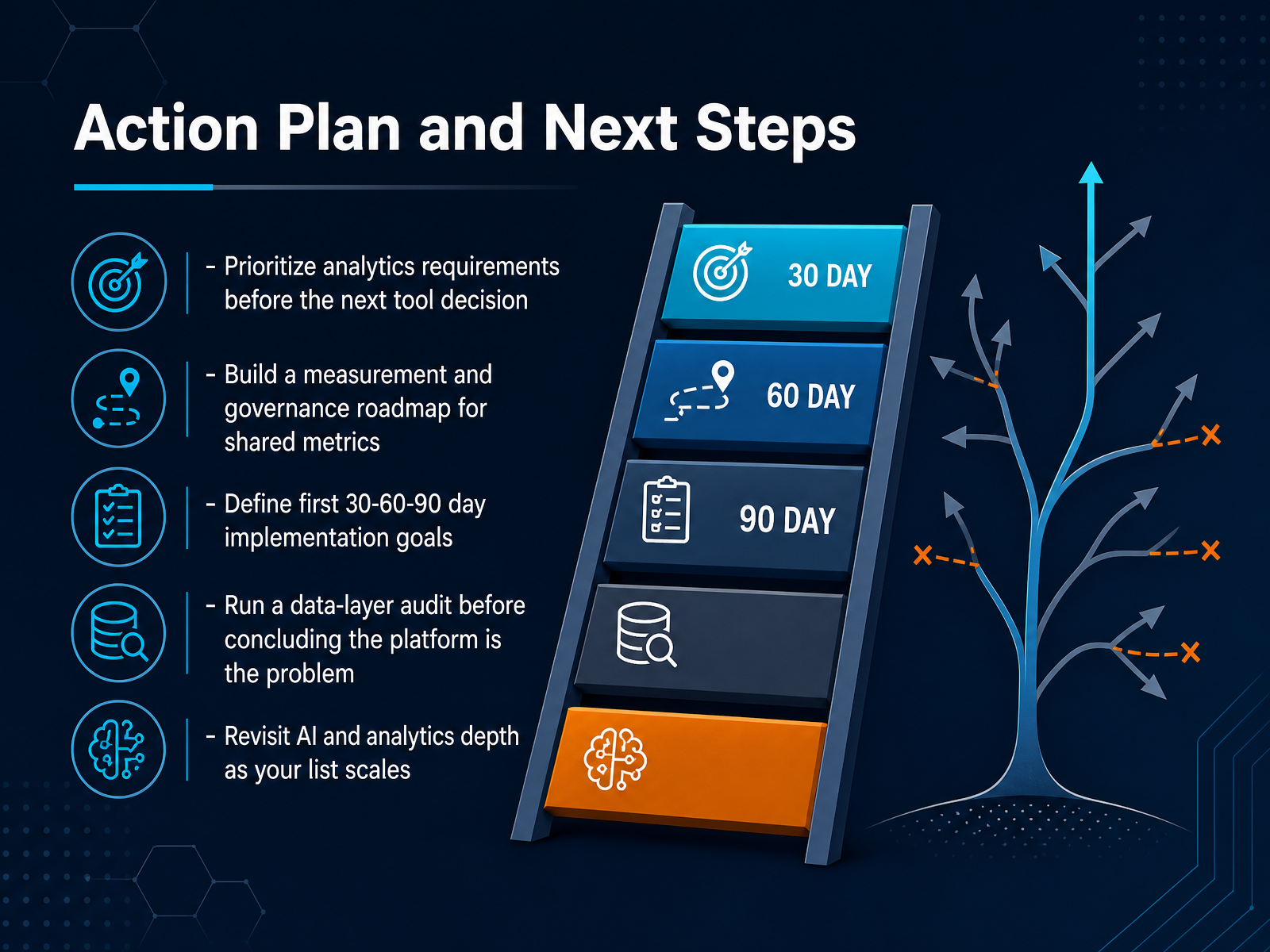
 - 14Action Plan and Next StepsLet's turn this into a concrete plan. Before your next tool decision, make analytics requirements a weighted criterion, not an afterthought. The evidence shows reporting depth tends to matter more in months twelve to twenty-four than in the first six. Build a measurement roadmap now. Define shared metric definitions, so revenue means the same thing to marketing, sales, and finance. Then set your first thirty, sixty, and ninety day goals. In the first month, do not replace the platform. Run a data layer audit instead. Check whether transactional data, behavioral events, and deliverability signals are actually connected. Often, the reporting gap is a configuration problem, not a platform failure. Finally, keep your expectations for AI insights realistic. Predictive features need scale. If your list is small today, plan to revisit those capabilities as your audience grows. Start with the data layer. Define shared metrics. Then measure what your automations actually change. Thank you for joining this session.
 datawhistl.comimprovado.iodefinite.app+21 min
Take the deck with you
Download this course as a file — free, no sign-up needed.
- PDF handoutEvery slide page, ready to print or share.15 pages · 3.8 MBDownload
- Narrated PowerPointThe deck that presents itself — every slide carries the digital human's narration video.15 pages · 16.3 MBDownload
- PowerPoint slidesThe full deck as a .pptx — open it in PowerPoint, Keynote, or Google Slides.15 pages · 3.7 MBDownload
Free to use in your own training — please keep the PersonWise credit page at the end.
Have your own deck? Turn it into a course
Sources consulted
Web sources consulted while building this course.
- Marketing Automation Software 2026: Buyer’s Guide and Comparison — tested.media
- Best Marketing Automation Software 2026: Independent Buyer Guide — viewpointanalysis.com
- Best Marketing Automation 2026 — TechVendorIndex — techvendorindex.com
- Marketing Automation Platform Comparison Guide 2026 — digitalapplied.com
- Best B2B Marketing Automation Platforms Reviews 2026 — gartner.com
- The Performance Layer: What Your Marketing Automation Platform Should Actually Be Able to Measure - Datawhistl — datawhistl.com
- HubSpot Analytics Guide 2026: Setup, Reports & Limits — improvado.io
- HubSpot Custom Reporting: Optimize, Connect, or Replace? | Definite — definite.app
- Marketo Analytics Guide 2026: Tools & Best Practices — improvado.io
- Wakefit Accelerates Campaign Go‑Live from 4 Days to Hours Using Automation | MoEngage — moengage.com
- GMG Marketing Operations & Conversion Optimization | E-CENS — e-cens.com
- How We Tested 4 Marketing Automation Platforms: A 7-Person Team's 90-Day Diary — Software Guide — b2b-software.net
- Batch | M6 Audio's CRM Migration: 46M Contacts in 3 Months — batch.com
- How a Broken Tracking Stack Wasted $60K Across Platforms for a SaaS Company — And the Full-Stack Fix That Restored 4x ROAS — redclawey.com
- Identity resolution across consent boundaries · martech cookbook — martechcookbook.com
- How to Create a Privacy-first Single Customer View with Consent-driven Data Flows - RN Digital — rn-digital.com
- What Is Identity Resolution? API-First, Real-Time, AI-Ready [2026] — treasure.ai
- Automate Consent Lifecycle Management Across Every Data System | Ethyca — ethyca.com
- Martech Playbook for Cookieless Identity Resolution — martech360.com