Social Media Marketing Strategy: Goals and Tradeoffs
Begin
14 pages · ~28 min
Social Media Marketing Strategy: Goals and Tradeoffs
Learn to build a social media marketing strategy by defining goals, making strategic choices, and managing tradeoffs for measurable success.
What you’ll learn
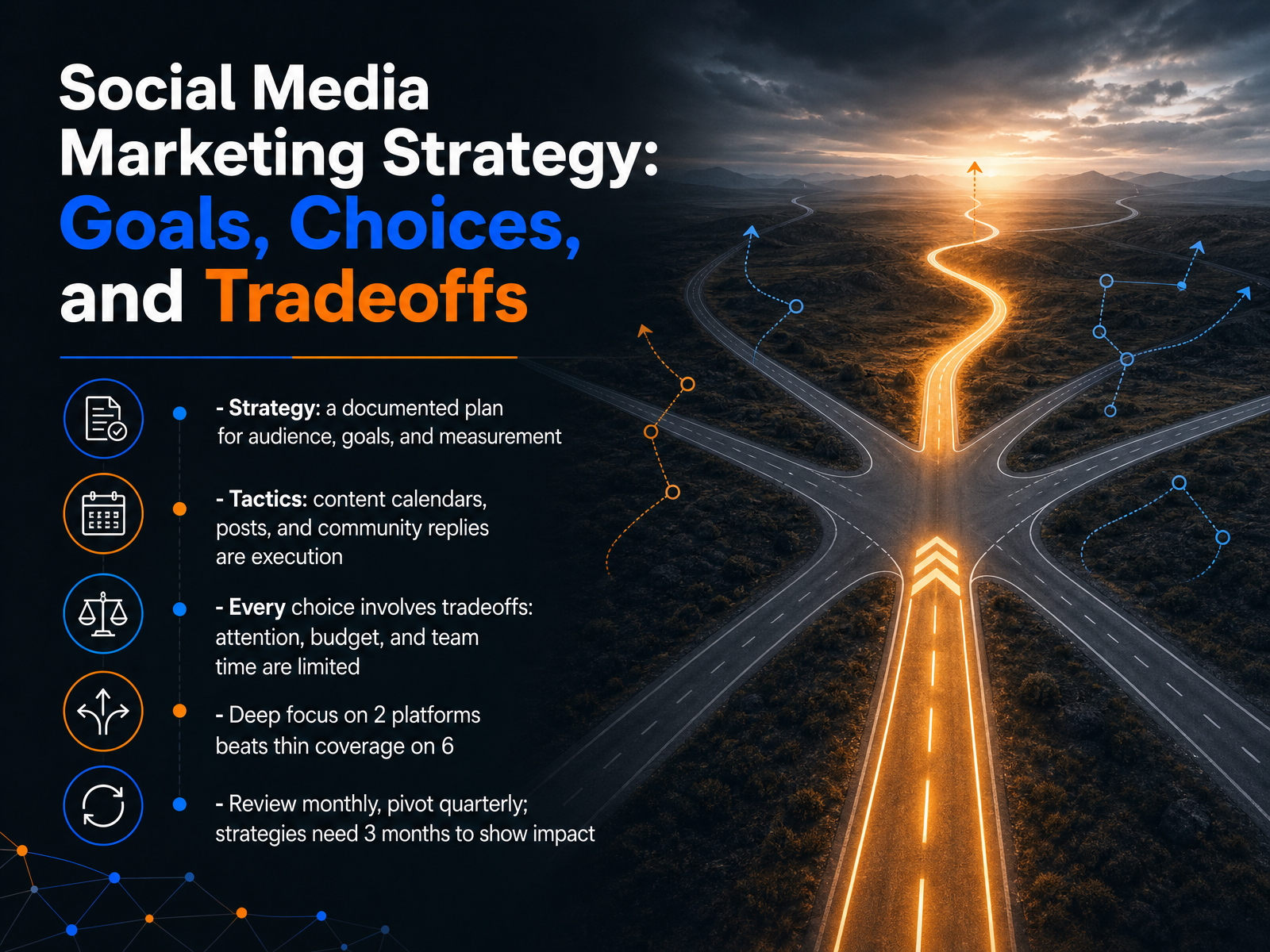
- 01Social Media Marketing Strategy: Goals, Choices, and TradeoffsWelcome. If you're here, you already know the basics of posting on social media. This session is about the hard part: turning those posts into a strategy that actually moves your business forward. We'll talk about setting goals that matter, making deliberate platform choices, and—most importantly—the tradeoffs behind every decision. Because attention, budget, and team time are limited. Every choice costs something. The good news? You don't need to be everywhere. In fact, deep focus on two platforms almost always beats thin coverage on six. And when you do commit, give it time. Review monthly, pivot quarterly—strategies need at least three months to show real impact. By the end of this session, you'll have a framework to make those calls with confidence. Now, let's start with a distinction that trips up many teams: strategy versus tactics, and why confusing the two keeps you stuck.buffer.comsynthesio.comsocialinsider.io+21 min
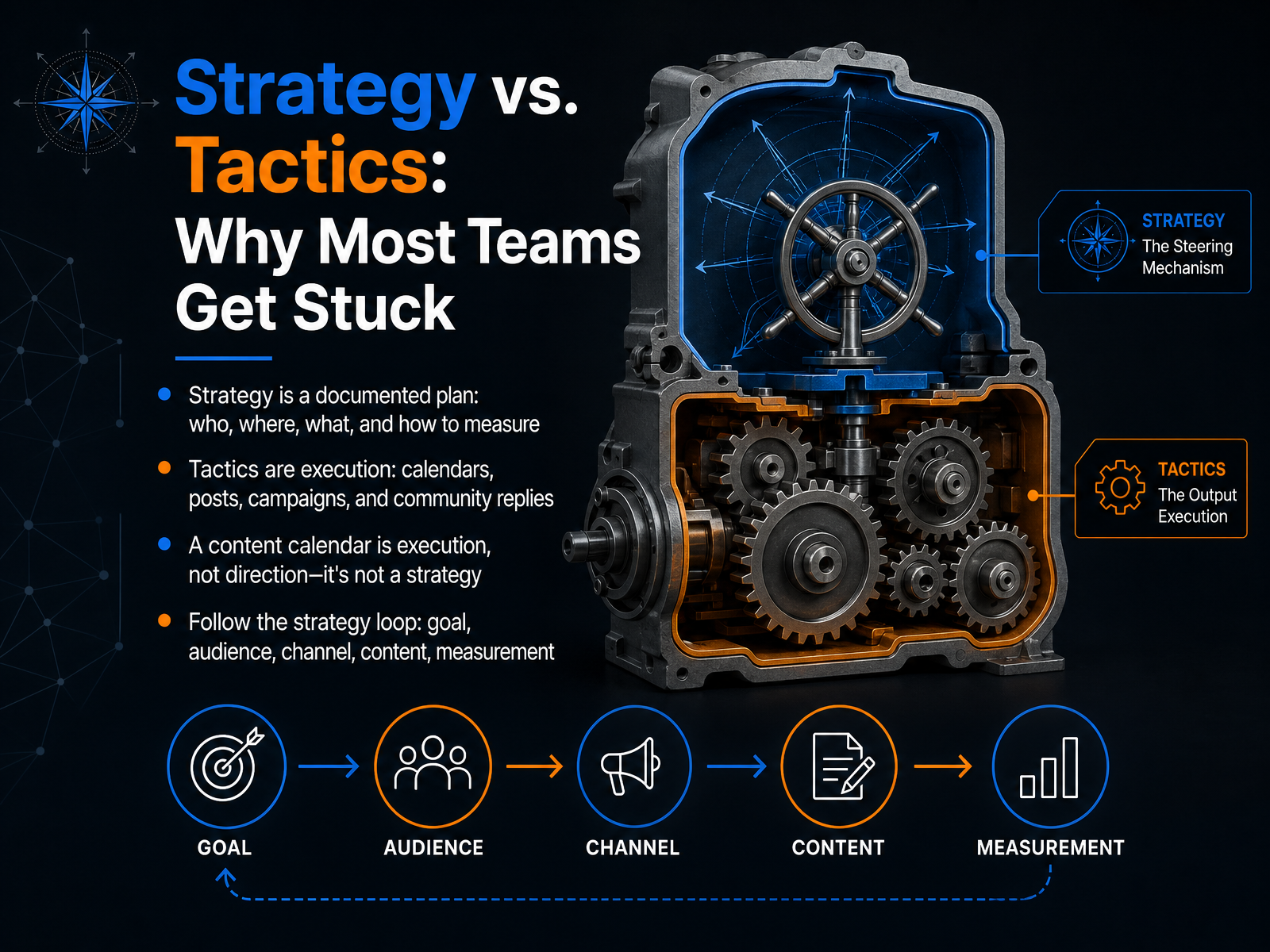
- 02Strategy vs. Tactics: Why Most Teams Get StuckLet's start by clearing up a common confusion: strategy versus tactics. This is where most teams get stuck, and it's usually because they believe a content calendar is a strategy. It is not. A content calendar is execution. It tells you what to post and when, but it doesn't tell you who you're trying to reach or why. Strategy is the documented plan that answers those questions: who you're targeting, which platforms matter, what content you'll create, and how you'll measure success. Tactics are how you execute that plan. Think of it this way: strategy is the destination, tactics are the vehicle. You can have the fastest car, but if you're heading in the wrong direction, you'll never arrive. So, follow the strategy loop. Start with a goal tied to a specific outcome and a measurable KPI. Then, define your audience and pick the one or two platforms where they actually spend time. From there, build your content pillars and measurement framework. Everything else is just tactics. Keep this loop in mind, because it frames the hardest part of your job: making the right choices and accepting the tradeoffs. That's our next topic. It's where the real strategy happens.
 buffer.comsynthesio.comsocialinsider.io+22 min
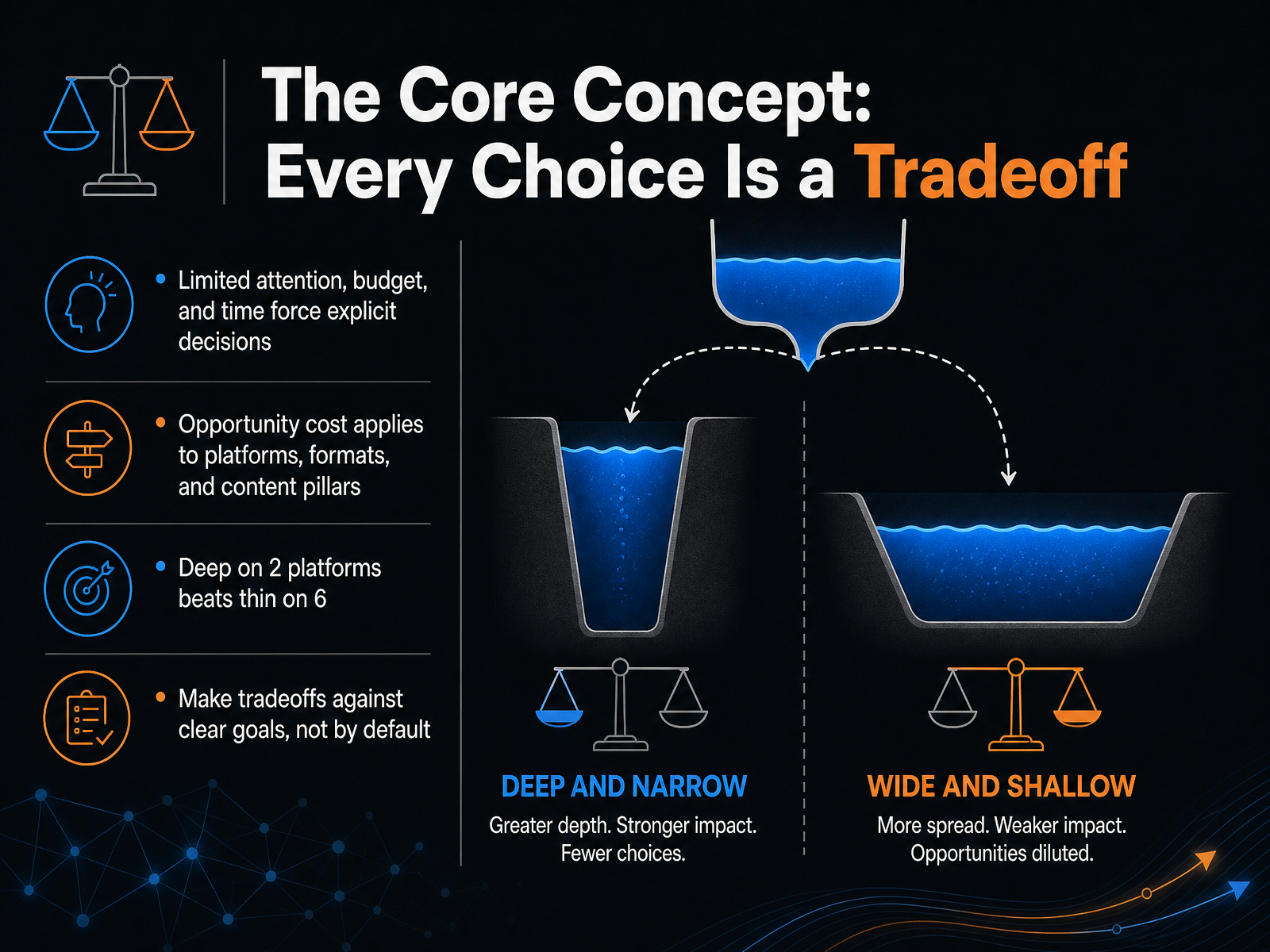
 - 03The Core Concept: Every Choice Is a TradeoffLet’s get one thing straight from the start: every choice you make in social media is a tradeoff. You have limited attention, limited budget, and limited time. That means deciding what to do is also deciding what not to do. This is opportunity cost, and it applies to platforms, formats, and content pillars alike. Being on six platforms with thin, inconsistent content will almost always lose to being excellent on two. So, the question isn’t “where can we show up?” It’s “where do we need to show up to hit our goals?” Make those tradeoffs deliberately, against clear objectives. Don’t let them happen by default. If you don’t choose, the algorithm and your habits will choose for you. The cost of the road not taken is real—count it before you move forward. Now, the first decision has to start with your business goals, not the platforms you’re tempted by.
 buffer.comsynthesio.comsocialinsider.io+21 min
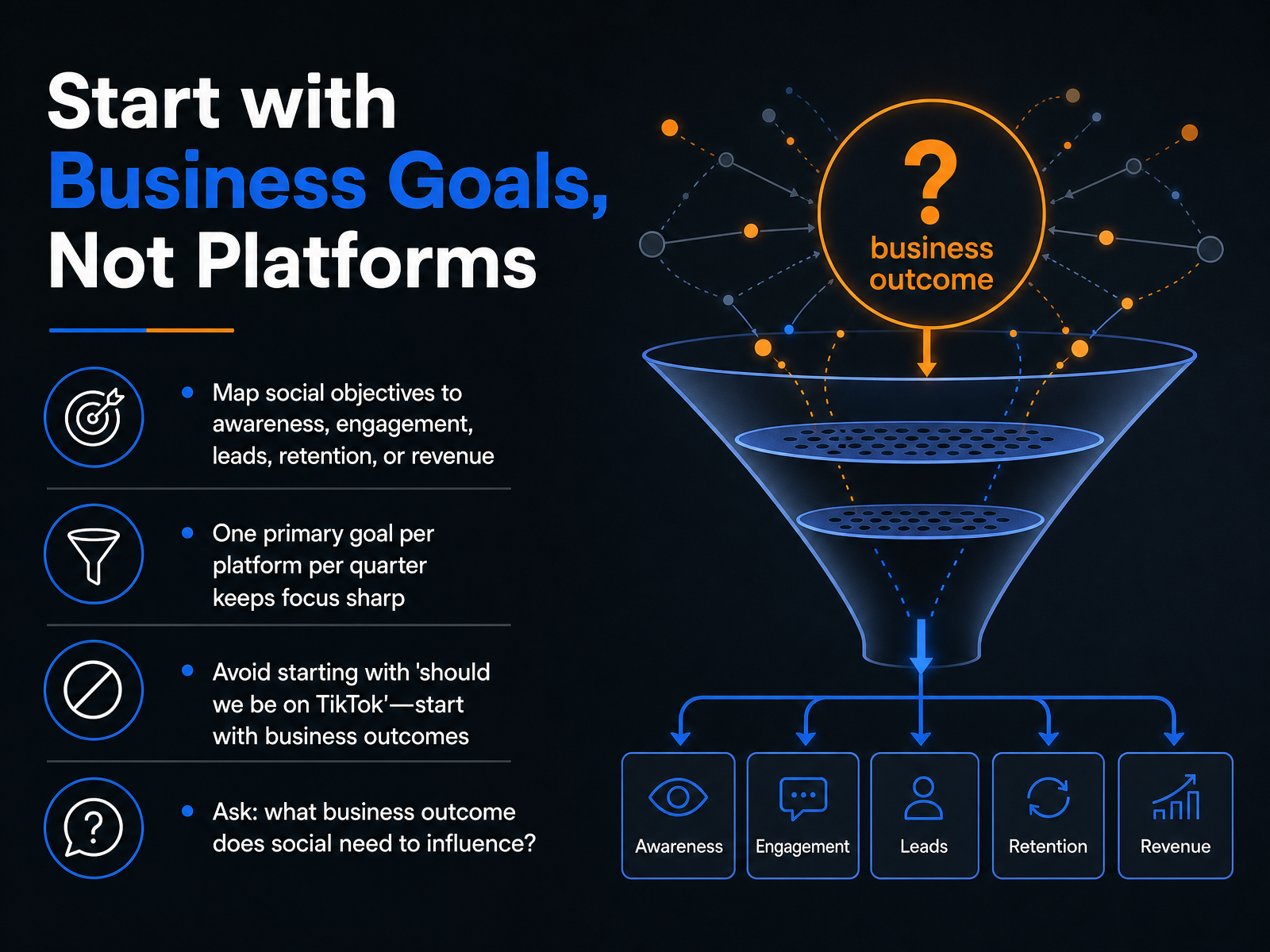
 - 04Start with Business Goals, Not PlatformsLet's be honest: most social media strategies fail before a single post goes live, because they start with the wrong question. The question isn't 'should we be on TikTok?' It's 'what business outcome does social need to influence?' Map your social objectives to awareness, engagement, leads, retention, or revenue. Pick one primary goal per platform per quarter. Just one. If you're chasing two or three, you're working from a wishlist, not a strategy. That focus is what turns activity into outcomes. So, before you pick a platform or write a single caption, ask yourself: what does the business need social to actually move? Now, once you have that clarity, let's talk about how you'll know you're winning. That's where choosing the right KPIs comes in.
 buffer.comsynthesio.comsocialinsider.io+21 min
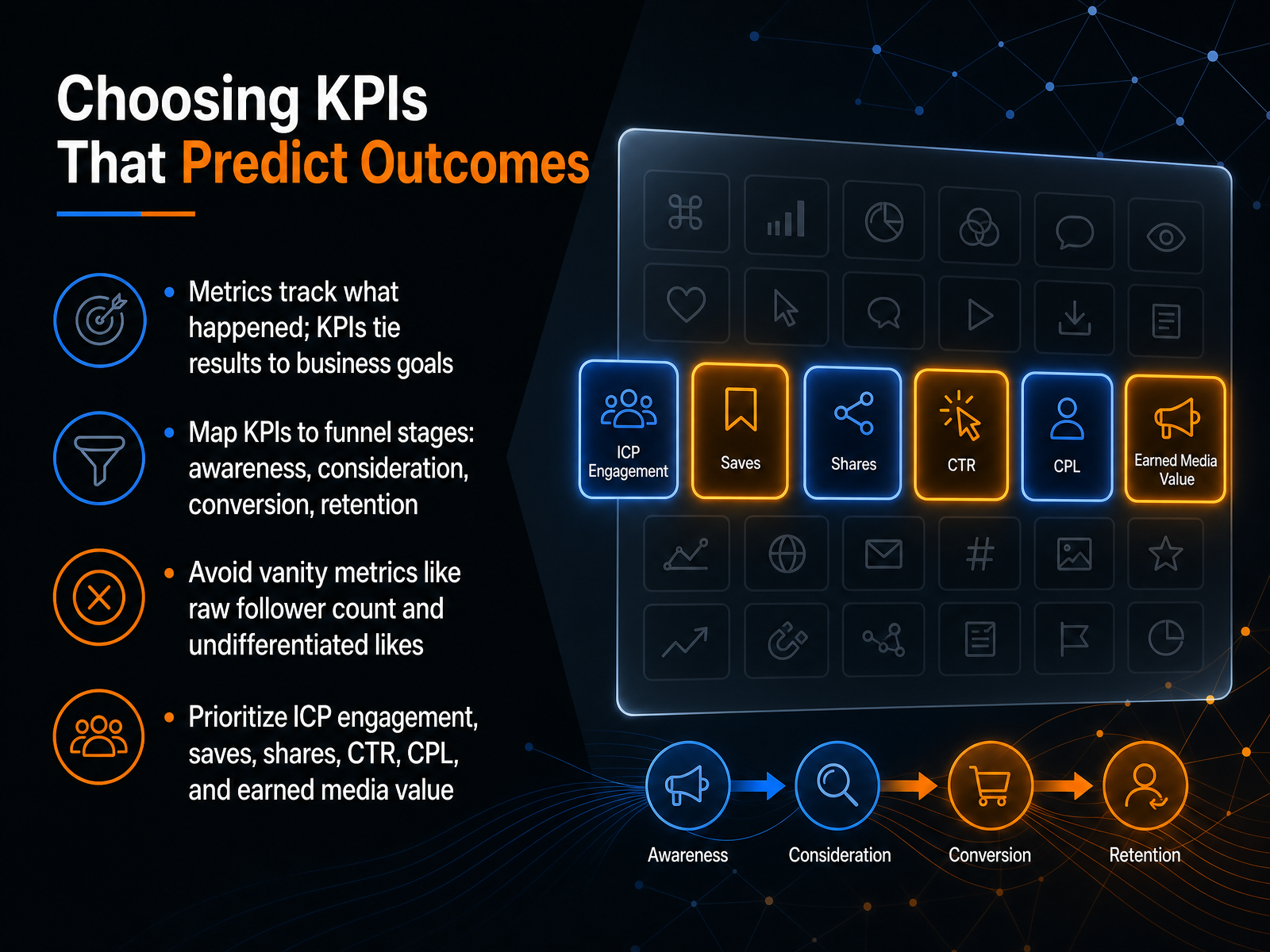
 - 05Choosing KPIs That Predict OutcomesLet's talk about choosing KPIs that actually predict outcomes. Metrics track what happened; KPIs tie results to business goals. That's the core distinction. So map your KPIs to the funnel. Top of funnel, look at reach and share of voice. Consideration, focus on saves, shares, and CTR. Conversion, you want cost per lead and conversion rate. Retention, repeat engagement and customer lifetime value. And the critical move here: avoid vanity metrics like raw follower count and undifferentiated likes. They feel like progress but predict little about pipeline. Instead, prioritize ICP engagement. Save shares and CTR signal real interest. Cost per lead closes the gap between social and sales. And earned media value gives finance a dollar figure they understand. The key takeaway: each KPI should predict a specific business outcome, not just describe activity. This sets up our next topic: audience, platform, and content fit.
 sproutsocial.comclickanalytic.comwscubetech.com+22 min
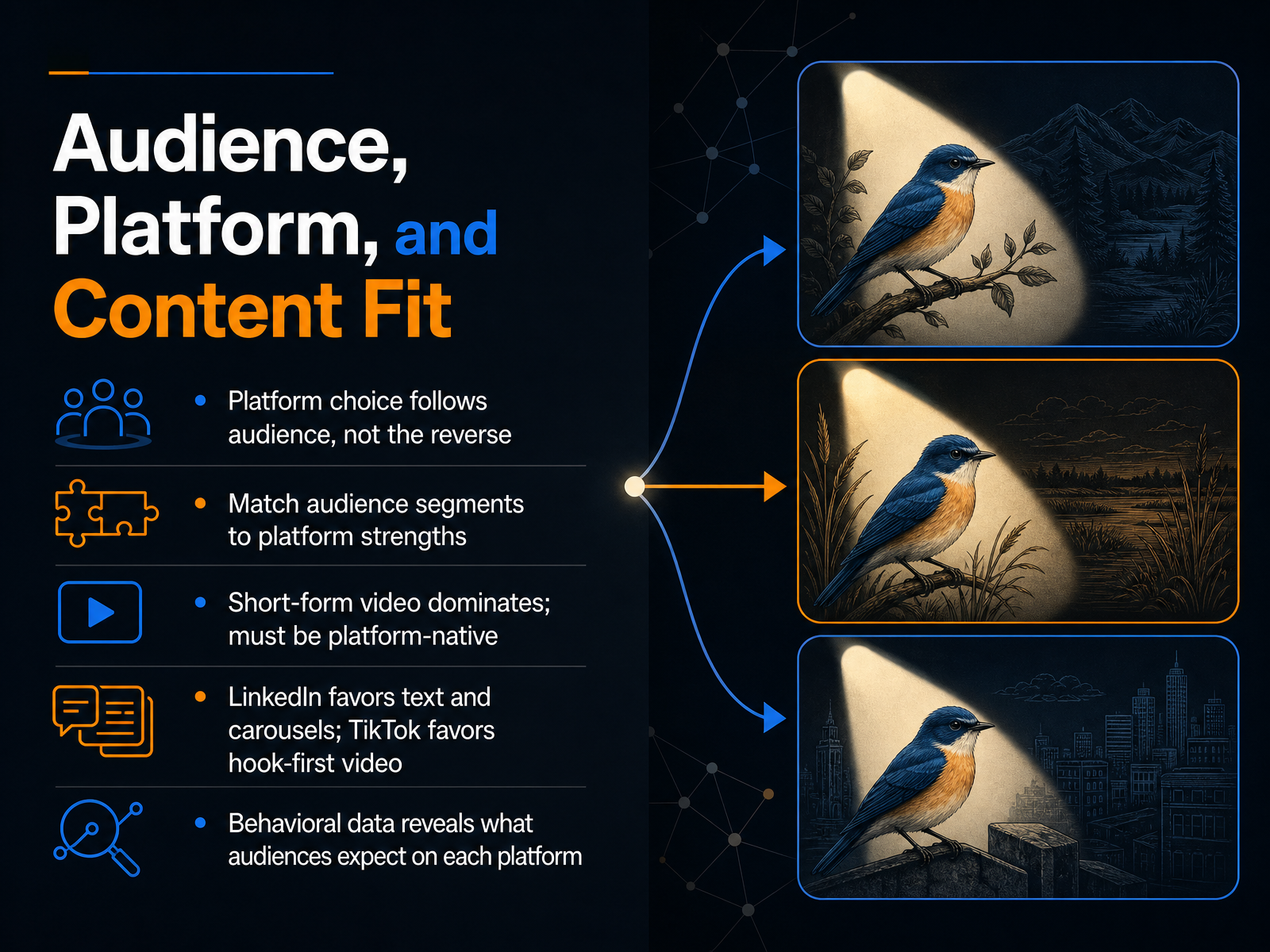
 - 06Audience, Platform, and Content FitLet’s talk about fit. Platform choice follows audience, not the other way around. You don’t pick a channel because it’s popular; you pick it because your specific customer is active there and open to your message. Start with the audience segment, then match it to the platform’s strength. Short-form video is the default now, but it has to be native. A polished brand ad won’t hold attention on TikTok. What works there is a hook in the first two seconds, something that feels creator-driven. LinkedIn is a different game entirely. It favors text posts and document carousels, not glossy video. If you’re selling a B2B solution, your thought leadership lives there. Behavioral data tells you what people expect. Gen Z uses TikTok for product discovery, nearly half of them do. Facebook’s core audience is older, and they still respond to text posts that clarify what they just watched on video. So the tradeoff is real. If you invest in a platform where your audience isn’t expecting your format, you burn budget and get nothing back. If you match both, the same content budget goes further. The key takeaway: audience tells you where, behavior tells you how. Get both right before you scale spend. Now let’s look at how you split your resources and budget across those choices.
 sproutsocial.combrandfolder.sproutsocial.comstartupbooted.com+22 min
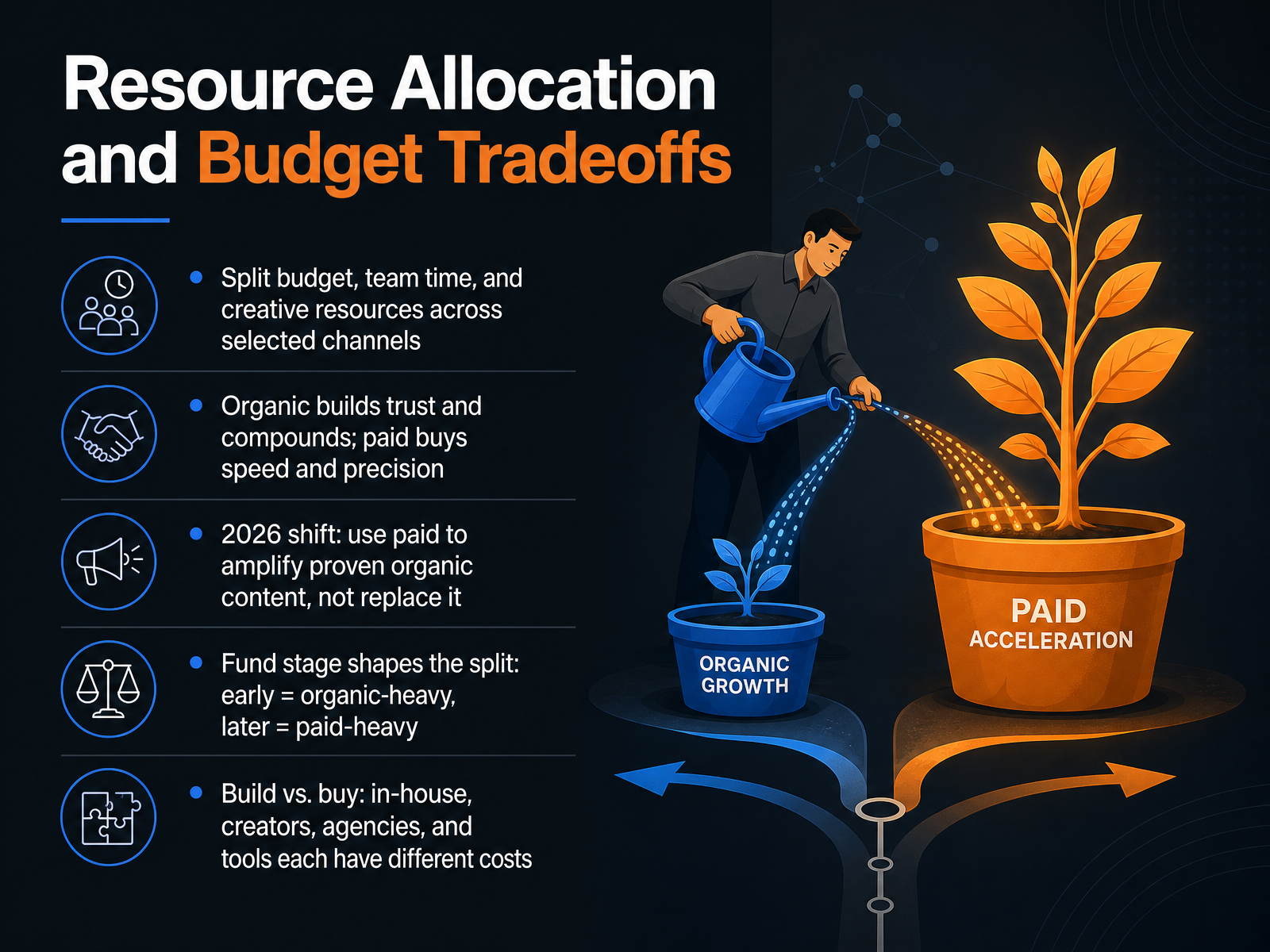
 - 07Resource Allocation and Budget TradeoffsNow let’s talk about where the money and the hours actually go. Resource allocation is a tradeoff game, not a balance-the-books exercise. Here’s the core tension: organic builds trust and compounds over time, but it is slow and reach is capped. Paid buys speed and precision, but it stops working the moment you stop spending. The 2026 shift is clear: stop treating them as separate budgets and use paid to amplify content that has already proven itself organically. Post organically, let it run for a few days, and put money behind the winners. That is your most efficient pipeline. Your funding stage should drive the split. Early stage, go organic-heavy, seventy to eighty percent, because you need to build authority on a small budget. Later stage, flip it, paid-heavy, because you need scale and you have the data to buy it efficiently. And don’t forget the build versus buy decision. In-house gives you control but eats your team’s hours. Agencies and creators give you speed but add a line item. Tools scale your output but they cost money too. Organic is never free. The fully loaded cost of a solid organic program runs two to five thousand a month in staff time. Before you lock your split, make sure you are accounting for production, not just ad spend. The takeaway: your budget split should be a deliberate bet based on your stage, your proven content, and your cost structure, not a habit. Next, let’s get into the content strategy itself: pillars, formats, and the cadence that keeps it all moving.
 rheos.appstackmatix.comsearchlab.nl+22 min
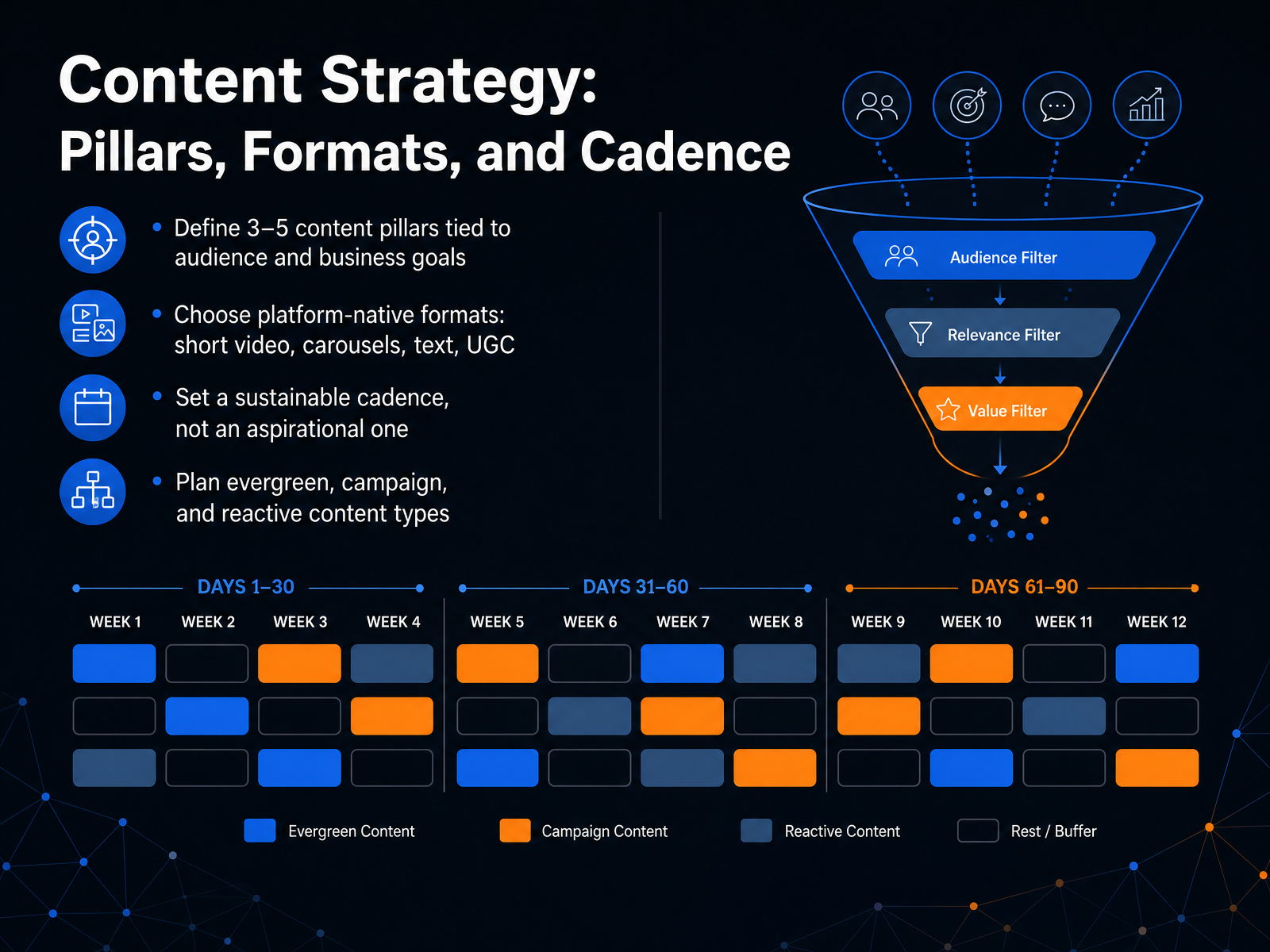
 - 08Content Strategy: Pillars, Formats, and CadenceNow let's talk about content strategy. This is where the platform choices get real. You want three to five content pillars that sit at the intersection of what your audience cares about and what your brand can credibly own. Tie each pillar to a specific business goal, so nothing goes on the calendar by accident. Next, choose platform-native formats. On LinkedIn, a text-based thought leadership post outperforms slick video. On Instagram, short-form video is the default, and carousels are your second-best bet. Don't make the mistake of producing one asset and spraying it everywhere. The algorithm rewards native behavior. Now, cadence. Set the frequency you can sustain without burning out, not the frequency you aspire to. It's better to publish three great posts a week for twelve months than to do five posts a week for six weeks and then go dark. Finally, plan your content mix deliberately. You need evergreen content that compounds, campaign content tied to launches, and reactive content for real-time moments. A simple split is twenty percent authority, fifty percent reach, and thirty percent conversion. That balance keeps you building trust, finding new audiences, and actually driving revenue. The takeaway: your content strategy is a system of tradeoffs between depth, reach, and sustainability. If you get it right, your next decision about measurement becomes much easier, which is exactly where we're headed next.
 buffer.comsynthesio.comsocialinsider.io+22 min
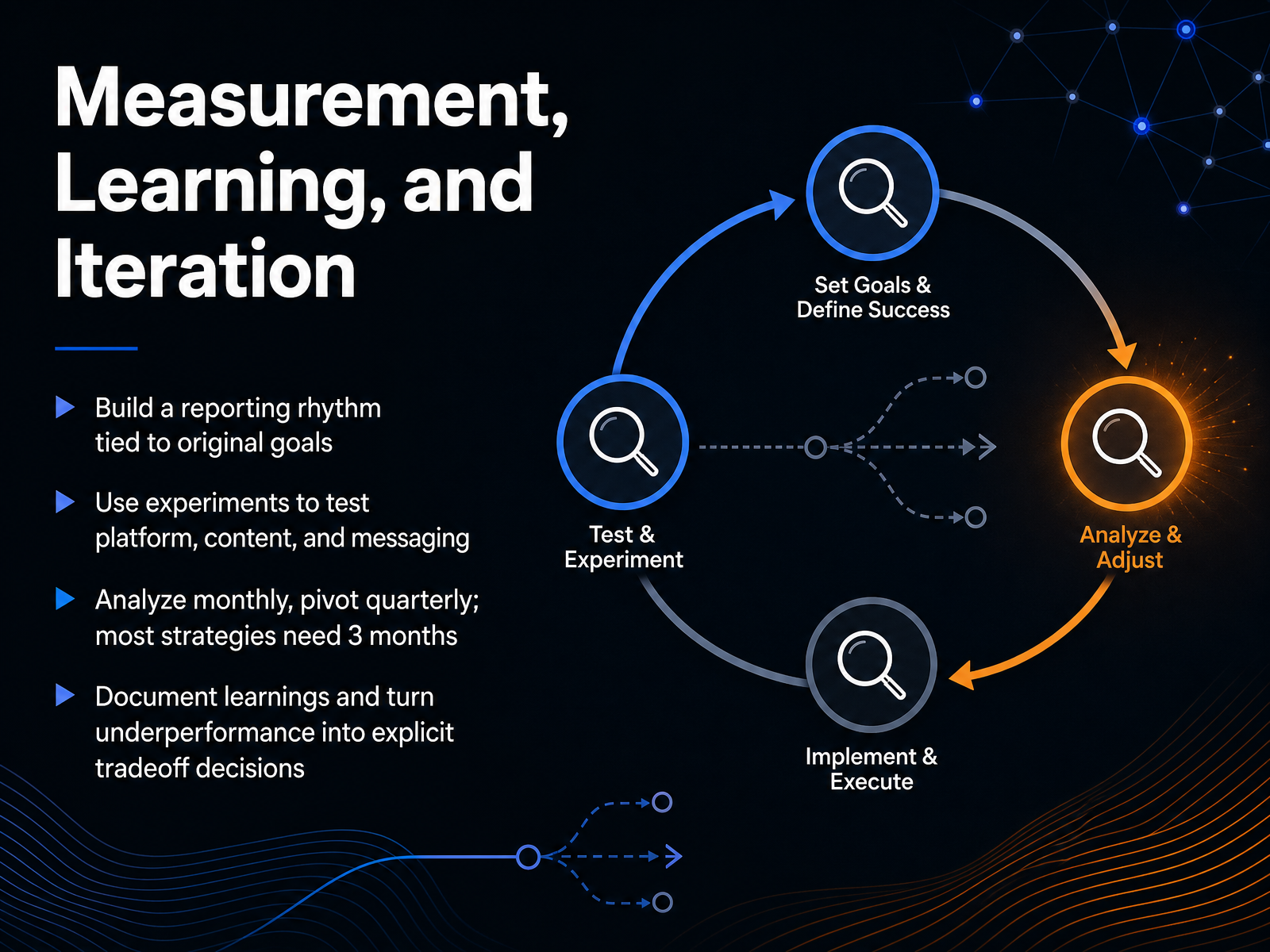
 - 09Measurement, Learning, and IterationLet's talk about the loop that keeps your strategy honest: measurement, learning, and iteration. First, build a reporting rhythm that ties directly back to the goals you set in step one. If your goal was lead generation, your monthly report leads with cost per lead and conversion rate, not likes. Second, run experiments deliberately. Test one variable at a time, whether that's a platform, a content format, or a specific message. Change one thing, hold everything else steady, and give it enough time to generate meaningful data. Here's the critical pacing: analyze monthly, pivot quarterly. Most strategies need at least three months to show real impact. If you're restructuring after two weeks based on one viral post, you're chasing noise, not signal. Finally, document your learnings. When something underperforms, turn that into an explicit tradeoff decision. If platform A isn't working, that's not a failure, it's a data point, and the budget you free up becomes a deliberate bet on platform B. The goal is to know what you've learned, what you're betting on next, and why. That documented loop is what separates a strategy from a posting schedule. From here, let's move on to the common pitfalls that derail even the best-laid plans.
 buffer.comsynthesio.comsocialinsider.io+21 min
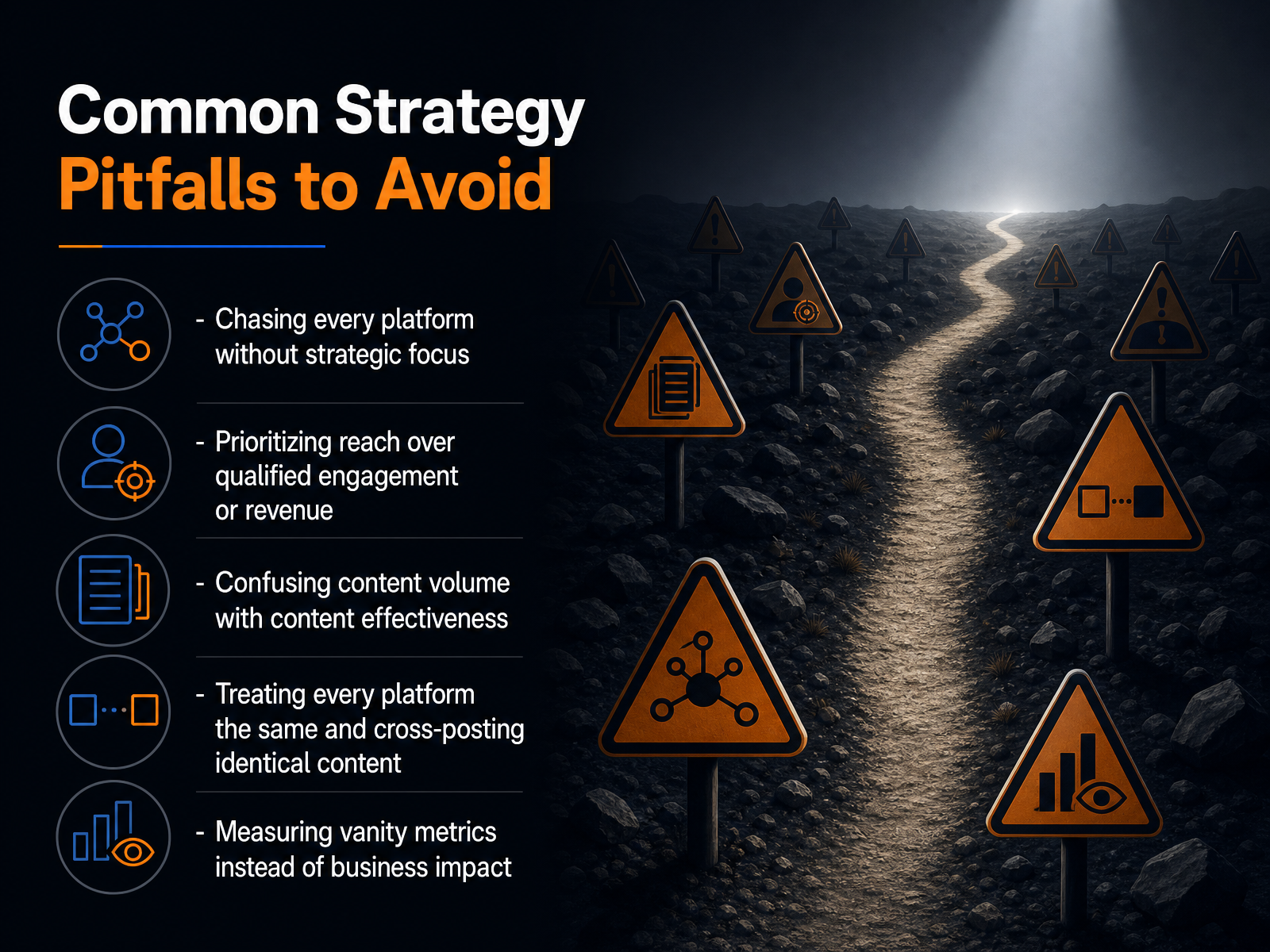
 - 10Common Strategy Pitfalls to AvoidNow let's talk about the pitfalls that quietly drain your budget and your team's energy. The first one is chasing every platform. That's not a strategy; it's a way to be average everywhere. Pick the one or two channels where your audience actually lives and go deep. Second, you're prioritizing reach over qualified engagement. A viral post that doesn't lift search, signups, or product visits is just noise. A smaller post that generates saves and meaningful comments is a better predictor of revenue. Third, don't confuse content volume with content effectiveness. Posting more won't fix a weak positioning statement. Fourth, stop cross-posting identical content everywhere. LinkedIn rewards deep insights, TikTok rewards native video. If you don't adapt the format and the hook, you're telling the algorithm you don't care. Finally, stop measuring vanity metrics. Follower count and likes feel like progress, but they don't predict pipeline. Map each content type to one primary KPI per funnel stage. If top of funnel is reach, mid funnel is saves, and bottom is cost per acquisition, you will know exactly what to cut and what to bet on. The takeaway is simple: audit your last thirty posts, and if they don't tie to a business outcome, you are burning budget on the road not taken. Now let's look at a decision checklist to put this tradeoff framework into practice.
 sproutsocial.comclickanalytic.comwscubetech.com+22 min
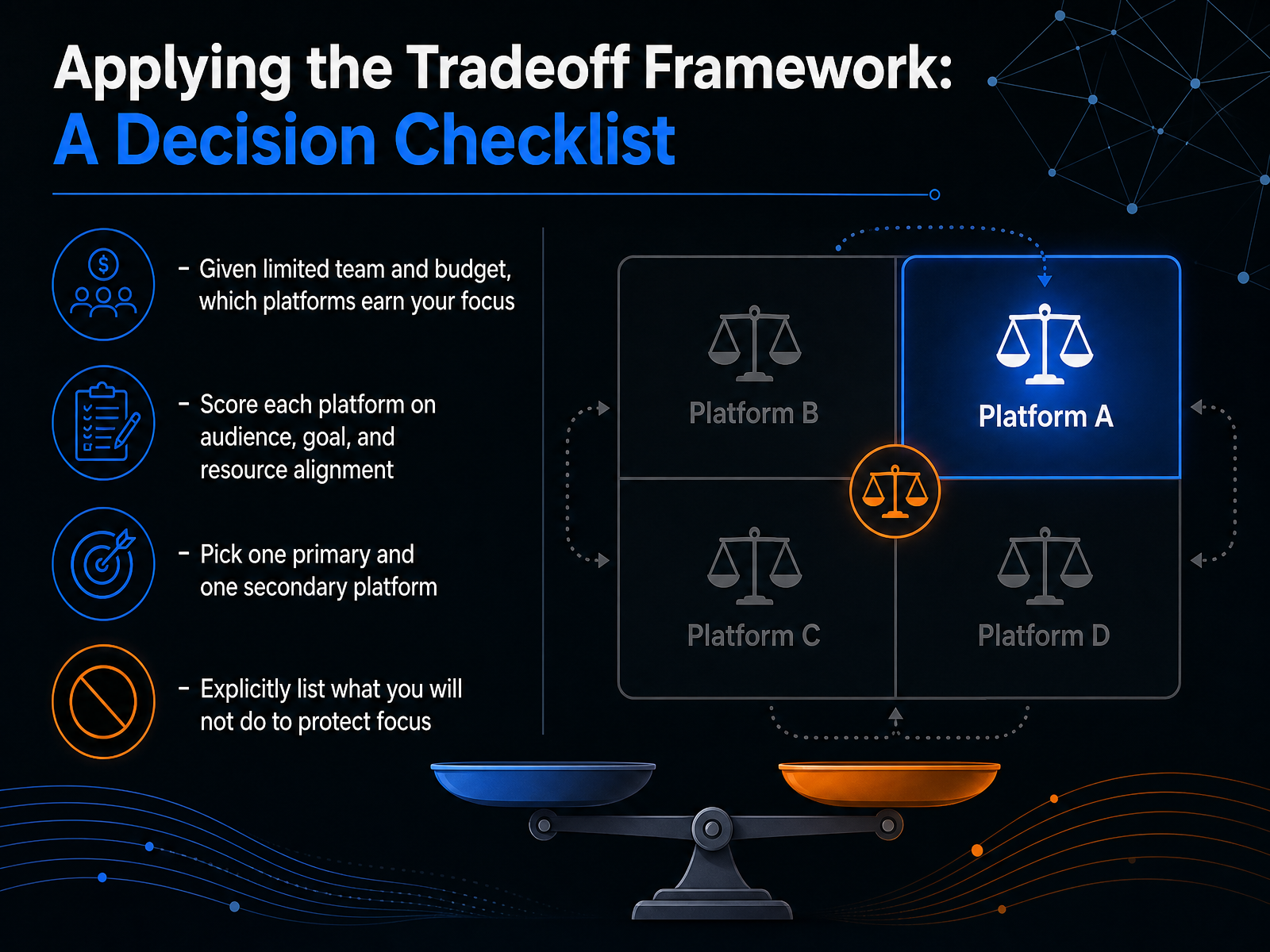
 - 11Applying the Tradeoff Framework: A Decision ChecklistLet's turn that framework into a working checklist. Start by scoring every candidate platform on three things. Audience alignment: are your ideal customers actually active there, or just registered? Goal alignment: does that platform's format support the outcome you need? And resource alignment: can your team sustain the required posting cadence without burning out? Score honestly. A platform that fails two of these doesn't belong in your mix. Then pick one primary platform and one secondary. That's it. Protect your focus by writing down what you will not do. No LinkedIn until Q3. No TikTok experiments this quarter. Decision made. The cost of the road not taken is always real, but the cost of doing everything poorly is much higher. Master two platforms before you touch a third. From here, we move into building your 90-day action plan.
 buffer.comsynthesio.comsocialinsider.io+22 min
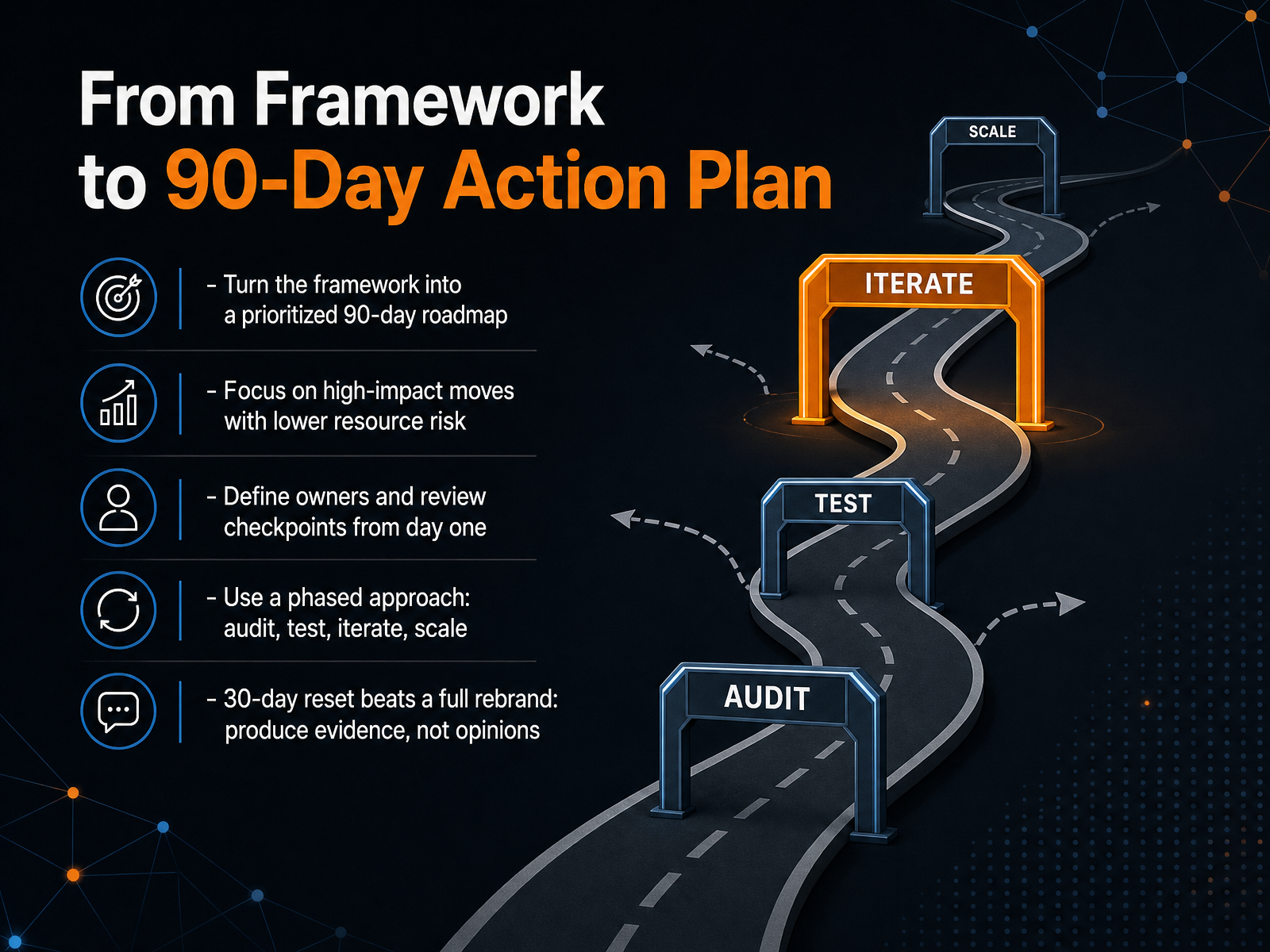
 - 12From Framework to 90-Day Action PlanSo let's turn the framework into a ninety-day action plan. Don't try to boil the ocean. Start with high-impact moves that carry low resource risk. You want early wins that build momentum without burning out your team. From day one, define who owns each initiative and set your review checkpoints. If you don't, accountability dissolves by week two. Structure your work in phases: audit, test, iterate, and scale. Spend the first thirty days just cleaning up your measurement and positioning. Week one, define your metrics and write your one-sentence promise. Week two, test two content formats with consistent hooks. Week three, double down on the top twenty percent by quality score per thousand reach. Week four, scale only the proven winners with paid support. That's how you produce evidence, not opinions. A thirty-day reset beats a full rebrand every time. You get data, you get buy-in, and you avoid the risk of a complete overhaul based on a hunch. Now let's look at how these goals, choices, and tradeoffs play out in real case scenarios.
 buffer.comsynthesio.comsocialinsider.io+22 min
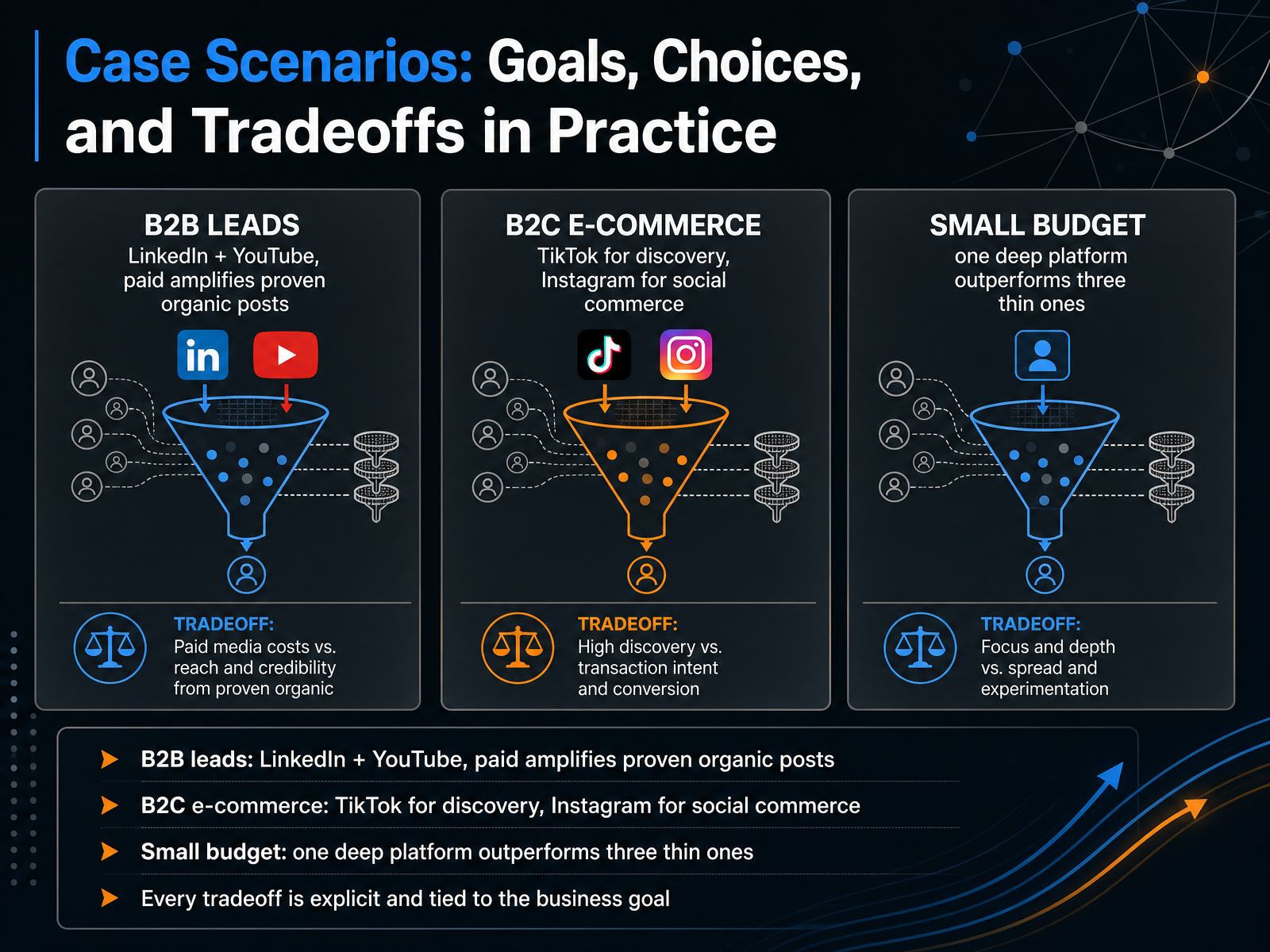
 - 13Case Scenarios: Goals, Choices, and Tradeoffs in PracticeLet's put this into practice with three common scenarios. First, B2B lead generation. Your goal is qualified pipeline, not vanity reach. So the play is LinkedIn for thought leadership, paired with YouTube for deeper product education. And here's the key move: don't start with paid. Run organic posts first, let them earn engagement, and then amplify the proven winners with paid budget. You're putting money behind content that already works, not guessing. Second, B2C e-commerce. Your goal is discovery plus conversion. That means TikTok for the top of funnel, for getting in front of new eyes, and Instagram for social commerce, where you actually close the sale. These are two different jobs, and one platform won't do both well. Third, small budget. Resist the urge to spread across three platforms. One deep platform where you can hit minimum effective frequency and build true expertise will outperform three thin presences every time. In every case, the tradeoff is explicit. You're choosing what to cut and what to bet on, and that decision always ties back to the business goal. That's how you make the choice defensible. Now let's review what we've covered and what you should do next.
 rheos.appstackmatix.comsearchlab.nl+21 min
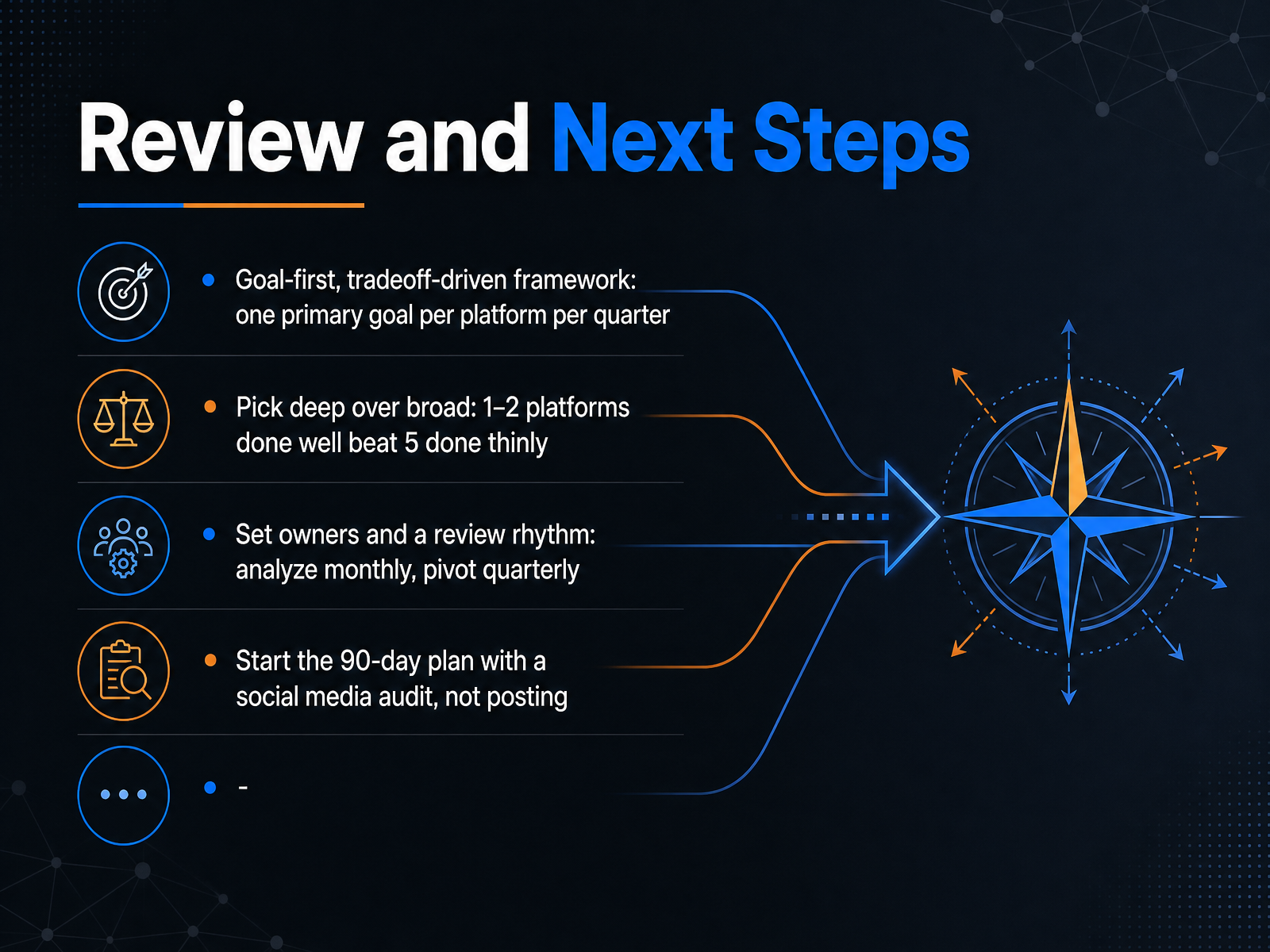
 - 14Review and Next StepsSo here's where we land. Goal-first, tradeoff-driven, one primary goal per platform per quarter. If you remember nothing else, remember that. Pick deep over broad. Two platforms done exceptionally well will beat five done thinly every single time. Set owners and a review rhythm. Analyze monthly, pivot quarterly. Don't restructure on a bad week. And start your ninety-day plan with a social media audit, not with posting. That audit is your evidence base. It tells you what to cut, what to bet on, and what the road not taken would have cost you. You now have the framework to make those calls with confidence. Thanks for your time today. Go run the audit, make the tough choices, and build something that compounds.
 buffer.comsynthesio.comsocialinsider.io+21 min
Take the deck with you
Download this course as a file — free, no sign-up needed.
- PDF handoutEvery slide page, ready to print or share.15 pages · 3.8 MBDownload
- Narrated PowerPointThe deck that presents itself — every slide carries the digital human's narration video.15 pages · 15.4 MBDownload
- PowerPoint slidesThe full deck as a .pptx — open it in PowerPoint, Keynote, or Google Slides.15 pages · 3.7 MBDownload
Free to use in your own training — please keep the PersonWise credit page at the end.
Have your own deck? Turn it into a course
Sources consulted
Web sources consulted while building this course.
- How to Create a Social Media Marketing Strategy in 2026 — 7-Step Guide — buffer.com
- How to Create a Social Media Strategy in 2026 — synthesio.com
- How to Build a Social Media Strategy in 7 Steps — socialinsider.io
- Social Media Marketing Strategy: The Complete 8-Step Guide (2026) | Arnold Street — arnoldstreet.com
- The 2026 Enterprise Guide to Agentic Social Media Strategy | Emplifi — emplifi.io
- The social media metrics to track in 2026 (and why) — sproutsocial.com
- Social Media KPIs (2026 update): 60+ Metrics & Benchmarks — clickanalytic.com
- Social Media KPIs: 28 Metrics You Should Track in 2026 — wscubetech.com
- How to Track Social Media Metrics: KPI Guide 2026 — startupeditor.com
- Social media metrics to track in 2026 (25 that matter) - Hootsuite Blog — blog.hootsuite.com
- Social Media Demographics to Inform Your 2026 Strategy — sproutsocial.com
- The 2026 Social Media Content Strategy Report — brandfolder.sproutsocial.com
- Social Media Statistics by Platform: What the Data Shows for Each Major Network in 2026 — startupbooted.com
- The Complete Social Media Demographics Guide for 2026 | Vista Social — vistasocial.com
- Social Media Statistics 2026 | 60+ Data Points & Benchmarks — searchlab.nl
- Organic vs Paid Social Media in 2026: The New Rules | Rheos Research | Rheos — rheos.app
- Organic vs Paid Social Media: How to Allocate Budget - Stackmatix — stackmatix.com
- Organic Social vs Paid Social (2026): Which Works Better? | Searchlab — searchlab.nl
- Organic Social vs Paid Social for Marketing Budget Optimization - Traffic Cove — trafficcove.com
- Organic vs Paid Social Media: The 2026 Guide to Hybrid Success — we-interactive.com