Targeted Marketing Messages
Begin
14 pages · ~28 min
Targeted Marketing Messages
Learn to tailor marketing messages for diverse audiences by understanding demographics, psychographics, and communication channels to drive engagement.
What you’ll learn
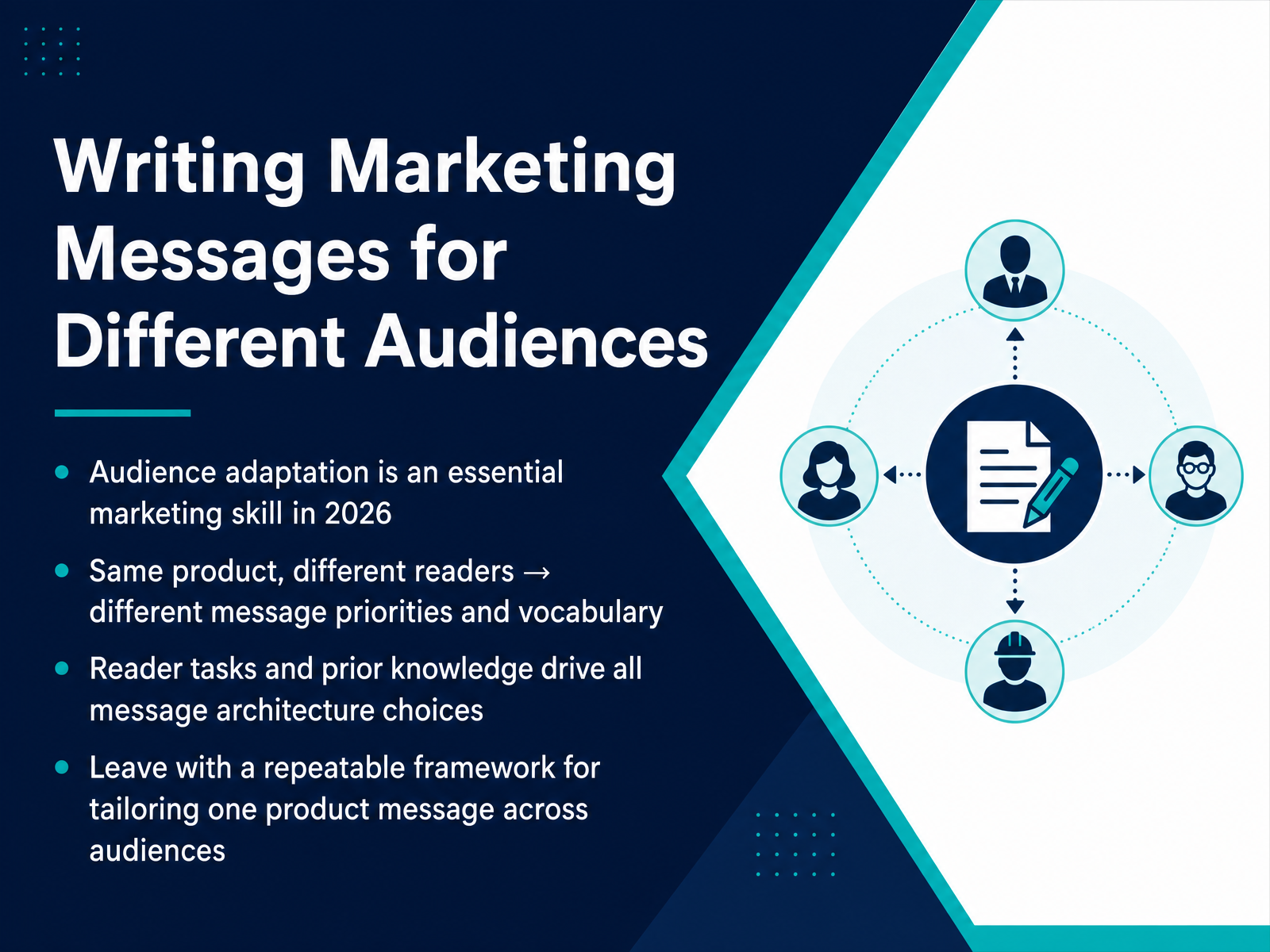
- 01Writing Marketing Messages for Different AudiencesWelcome, everyone. Today we're going to sharpen one of the most essential marketing skills right now: writing the same core message for completely different audiences. Picture this. You have a single product, but you need to communicate with a technical buyer, an executive decision-maker, and an end user. The product doesn't change, but what you emphasize and the words you choose absolutely must change. We'll base every decision on two simple drivers: what the reader needs to do, and what they already know. By the end, you'll have a repeatable framework. You'll look at one product message, identify the reader, and restructure the focus and language without starting from scratch. Let's begin by looking at why a generic, one-size-fits-all message usually falls flat.1 min
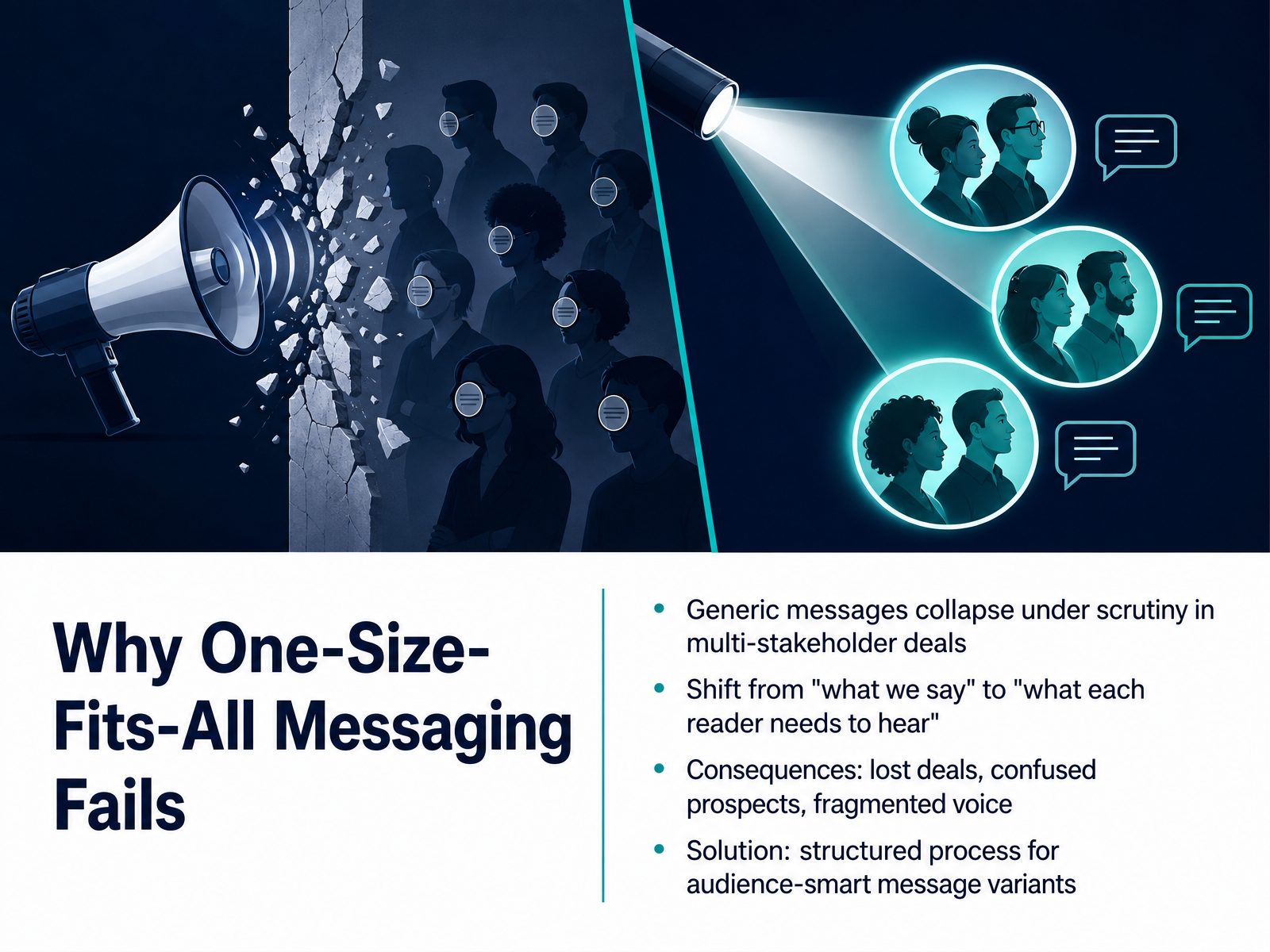
- 02Why One-Size-Fits-All Messaging FailsSo let's start with a common mistake—sending the same message to everyone. It feels efficient, but in complex sales, generic messages don't hold up. Think about it. A single deal might involve a financial buyer focused on ROI, a technical evaluator worried about integration, and an end user who just wants a simpler workflow. When your one message tries to speak to all of them at once, it actually speaks to none of them. The real shift we need to make is moving from 'what we want to say' to 'what each reader needs to hear.' If we don't, we see real consequences. Deals stall because the economic buyer never saw a clear business case. Prospects get confused when a message feels too technical, or not technical enough. And across the team, our company's voice starts to sound inconsistent and fragmented. The solution is not to write from scratch every time. It's to follow a structured process for creating audience-smart message variants. This lets us keep one core truth but adapt the focus and the language for each stakeholder. Next, let's explore that core principle: one product, many truths.
 2 min
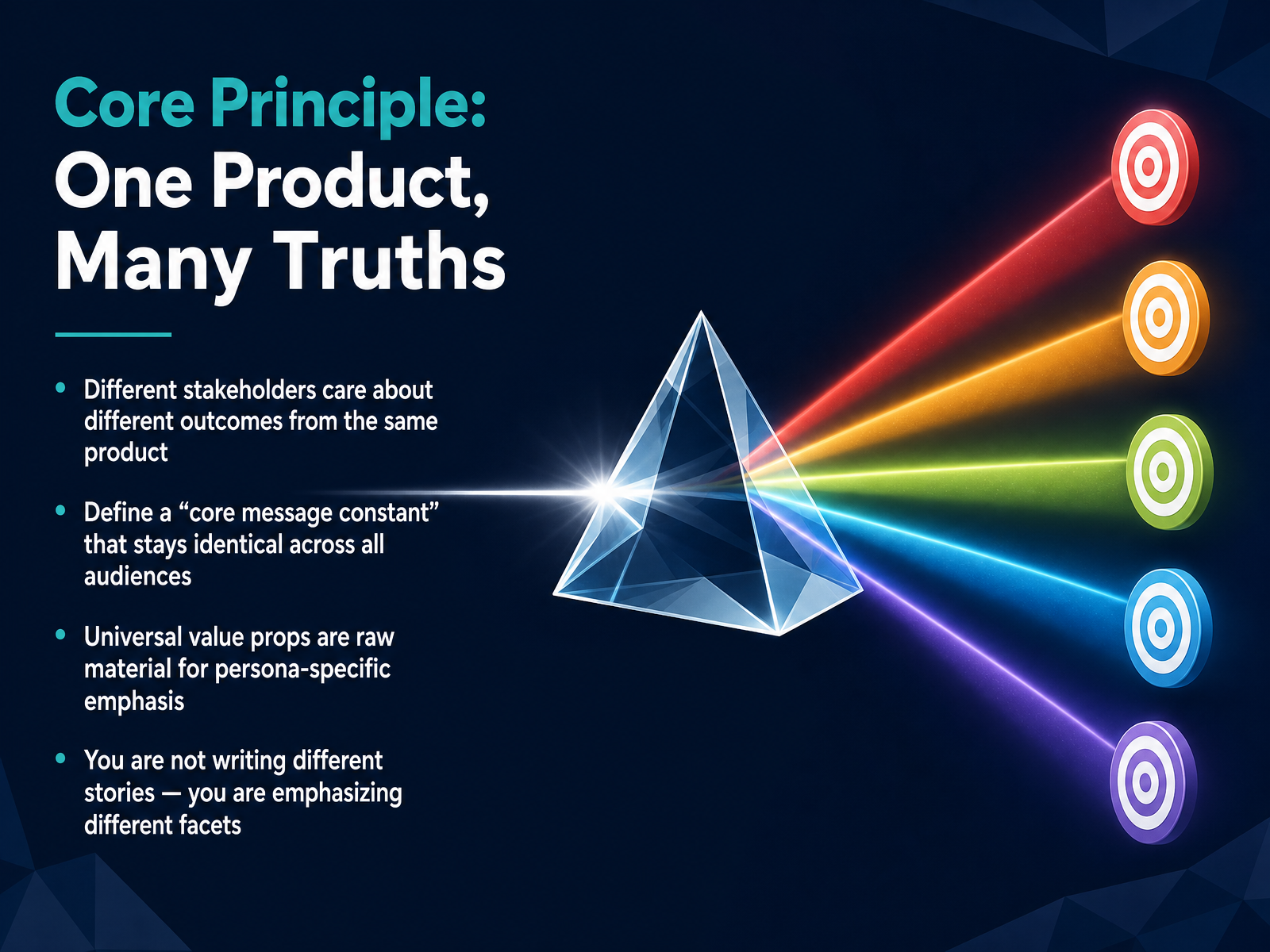
2 min - 03Core Principle: One Product, Many TruthsLet’s pull back and look at the core principle that makes this work. For any one product, there isn’t just one story. There are many truths. Different stakeholders genuinely care about different outcomes. A finance director scans for cost reduction. An IT manager looks for integration reliability. The end user just wants a task to be faster and simpler. Your first job is to define a core message constant. This is the universal value proposition that stays identical across every audience. Think of it as the raw material. You don’t change the facts. You change the emphasis. You are not writing different stories. You are highlighting different facets of the same truth. For example, a cloud software’s core truth might be centralized, real-time data. For operations, you emphasize speed of access. For compliance, you emphasize audit trails and control. Same product, same data, different facets. Now we’ll put this into practice. Up next is audience mapping, where we break down task, knowledge, and decision role.
 2 min
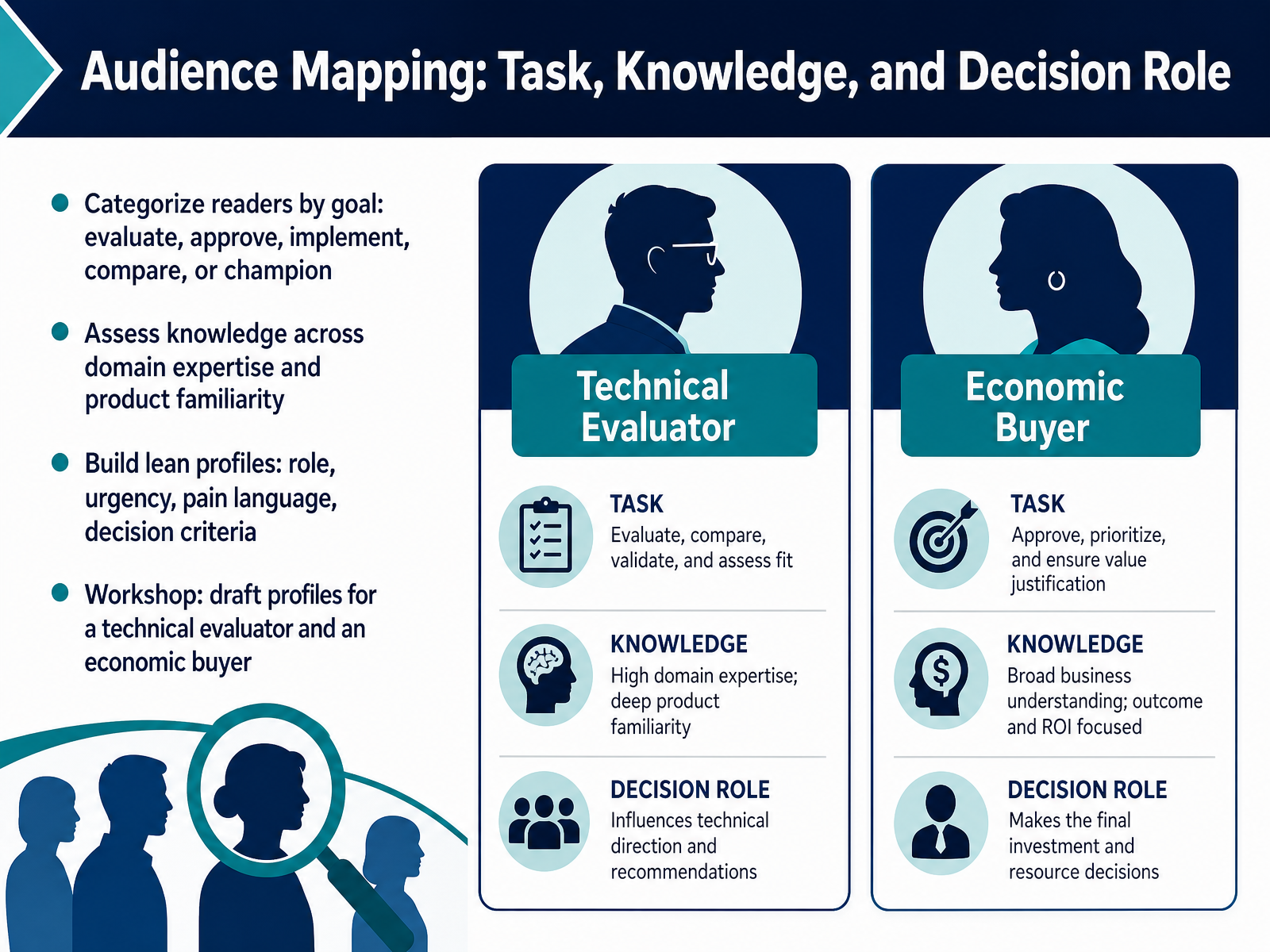
2 min - 04Audience Mapping: Task, Knowledge, and Decision RoleNow we get tactical and map our readers. We categorize them by what they need to do with the message. Are they here to evaluate technical specs, approve a budget, implement a solution, compare vendors, or champion an idea internally? Their task dictates what we lead with. Next, we assess knowledge. This has two layers: how well they understand the problem domain, and how familiar they are with our specific product. An industry veteran and a new hire read the same email very differently. From this, we build lean profiles. For each reader, capture their role, their urgency, a phrase they would use to describe the pain, and the top three criteria they use to decide. This is not a full biography, just enough to sharpen your message. Let’s put this into practice. Draft a quick profile for a technical evaluator. Then do the same for an economic buyer. Notice how the technical evaluator’s decision criteria might be integration depth and security, while the economic buyer cares about total cost of ownership and risk reduction. That shift in criteria is what we use to reframe the message. Next, we’ll dig deeper into those priorities and see exactly what each reader cares about most.
 2 min
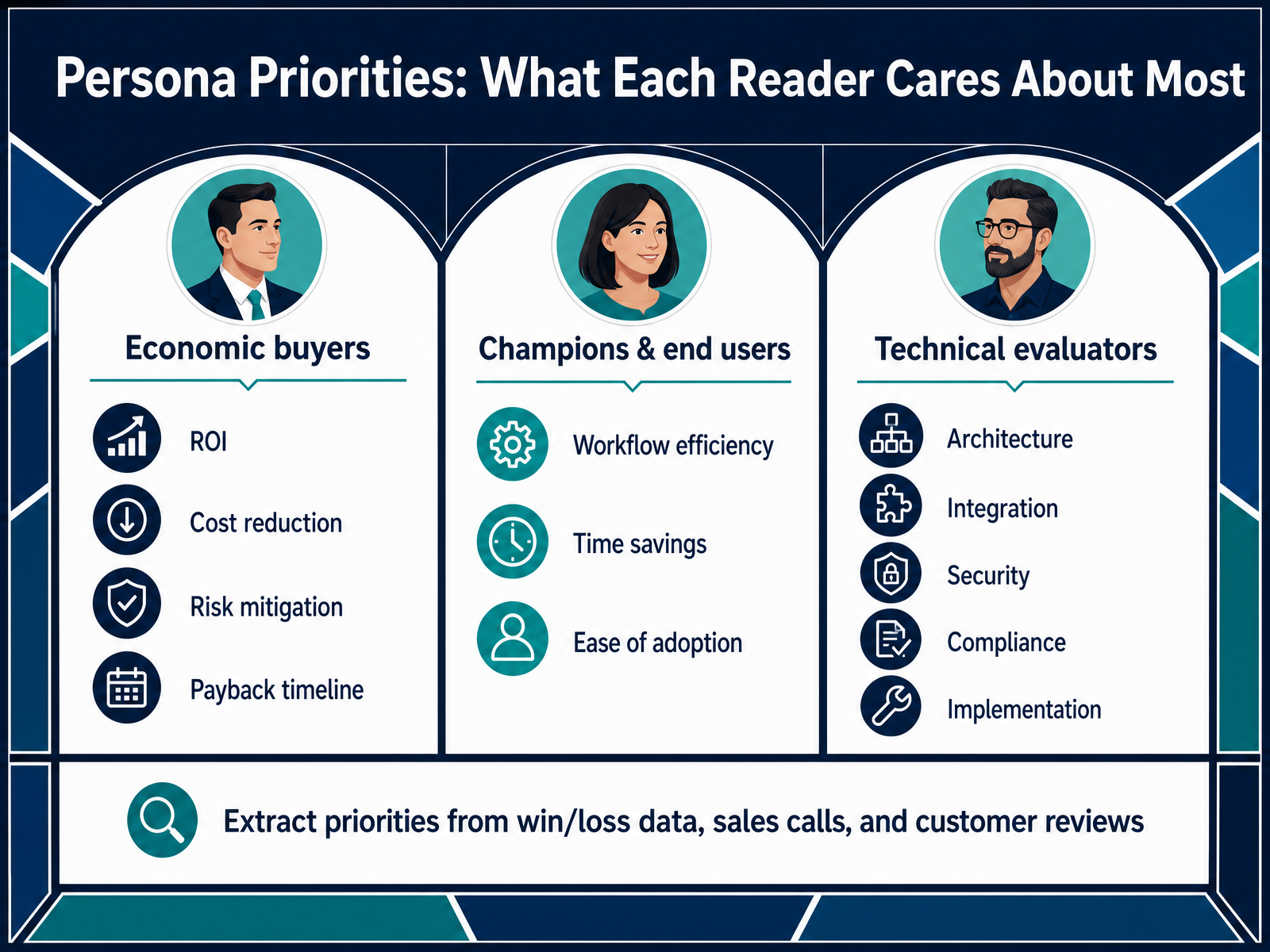
2 min - 05Persona Priorities: What Each Reader Cares About MostNow let's get inside the heads of our readers. Different people care about different things, so we have to prioritize what we say based on their role. Think about the economic buyer. This person signs the check, so they care about return on investment, cost reduction, and risk mitigation. Show them the payback timeline. Don't talk about button colors. Next, the champion and end users. They want to know how this makes their daily life easier. Lead with workflow efficiency, time savings, and ease of adoption. They are asking, will this slow me down or speed me up? Finally, the technical evaluator. This reader goes deep. They need to see the architecture, how it integrates, and proof of security and compliance. If you don't cover implementation details, you lose their trust. How do you learn these priorities? Extract them from your own data. Mine your win/loss reports, listen to sales call recordings, and read customer reviews. Look for the specific words each role uses and mirror that language. Up next, we'll organize all of this into the message map, your single source of truth.
 2 min
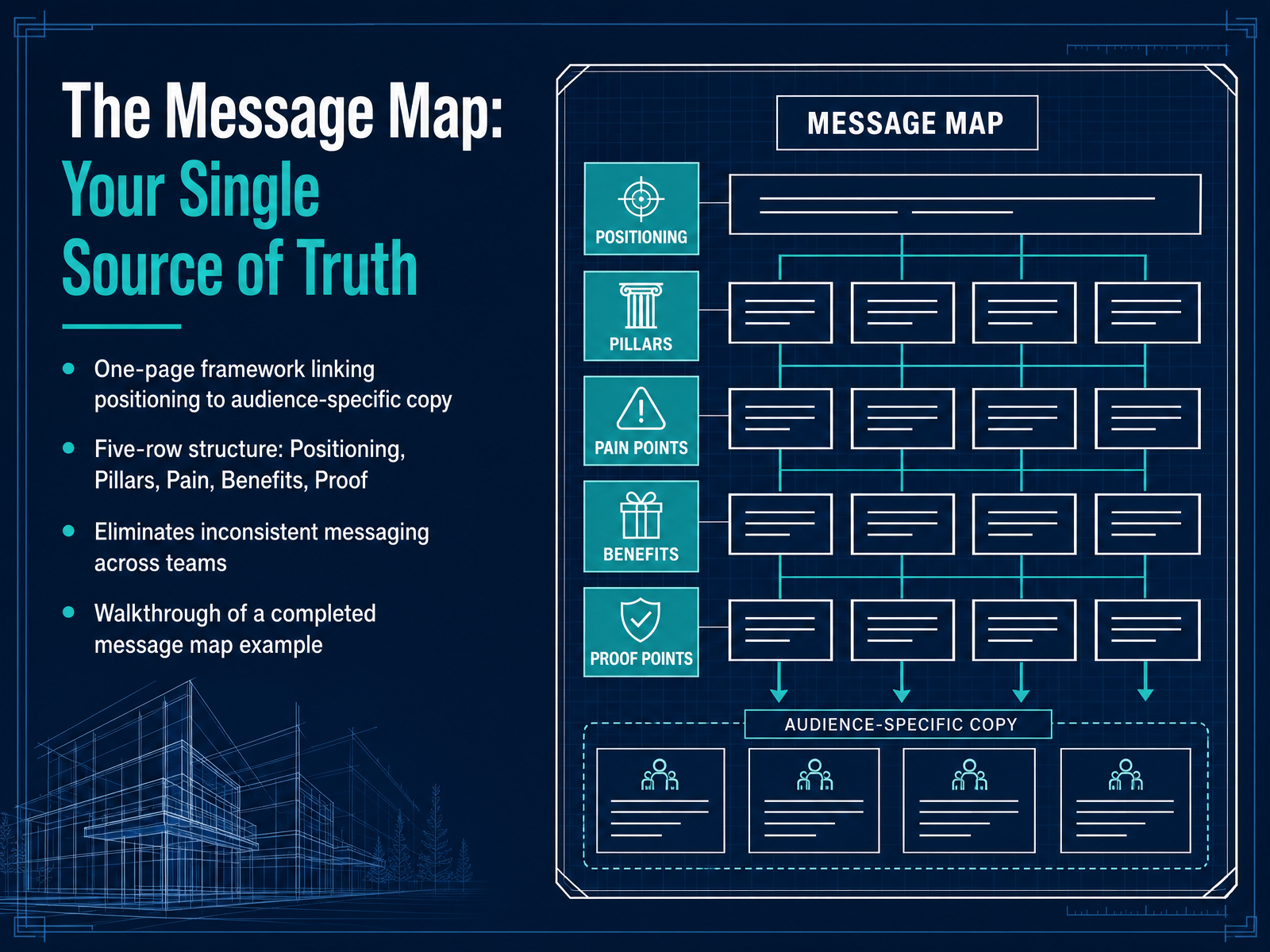
2 min - 06The Message Map: Your Single Source of TruthSo now we need a tool to keep all of this organized. Let's look at the message map. Think of this as your single source of truth. It's a simple, one-page framework that links your high-level positioning directly to audience-specific copy. The structure is clear. It has five rows. Row one is Positioning, your core promise. Row two is Pillars, the main points that support that promise. Row three is Pain, the specific problem you solve for that audience. Row four is Benefits, what the reader gains. And row five is Proof, the hard evidence that makes your claim believable. What this does is eliminate all the inconsistent messaging that happens when different teams are writing from their own notes. With a completed message map, everyone works from the same playbook. Let's walk through an example. Say our positioning is 'Streamline Your Workflow.' For a manager audience, the pain might be 'lost hours on admin tasks,' and the benefit is 'more time for strategic leadership.' The proof is a case study showing a twenty percent time saving. For an end-user, that same positioning shifts. The pain becomes 'frustrating double-data entry.' The benefit is 'a single, clean dashboard.' The proof is a user testimonial about easier daily work. Same core message, different story. The message map makes this adaptation systematic instead of random. Next, we'll build on this by showing you how to adjust message priority for different readers.
 2 min
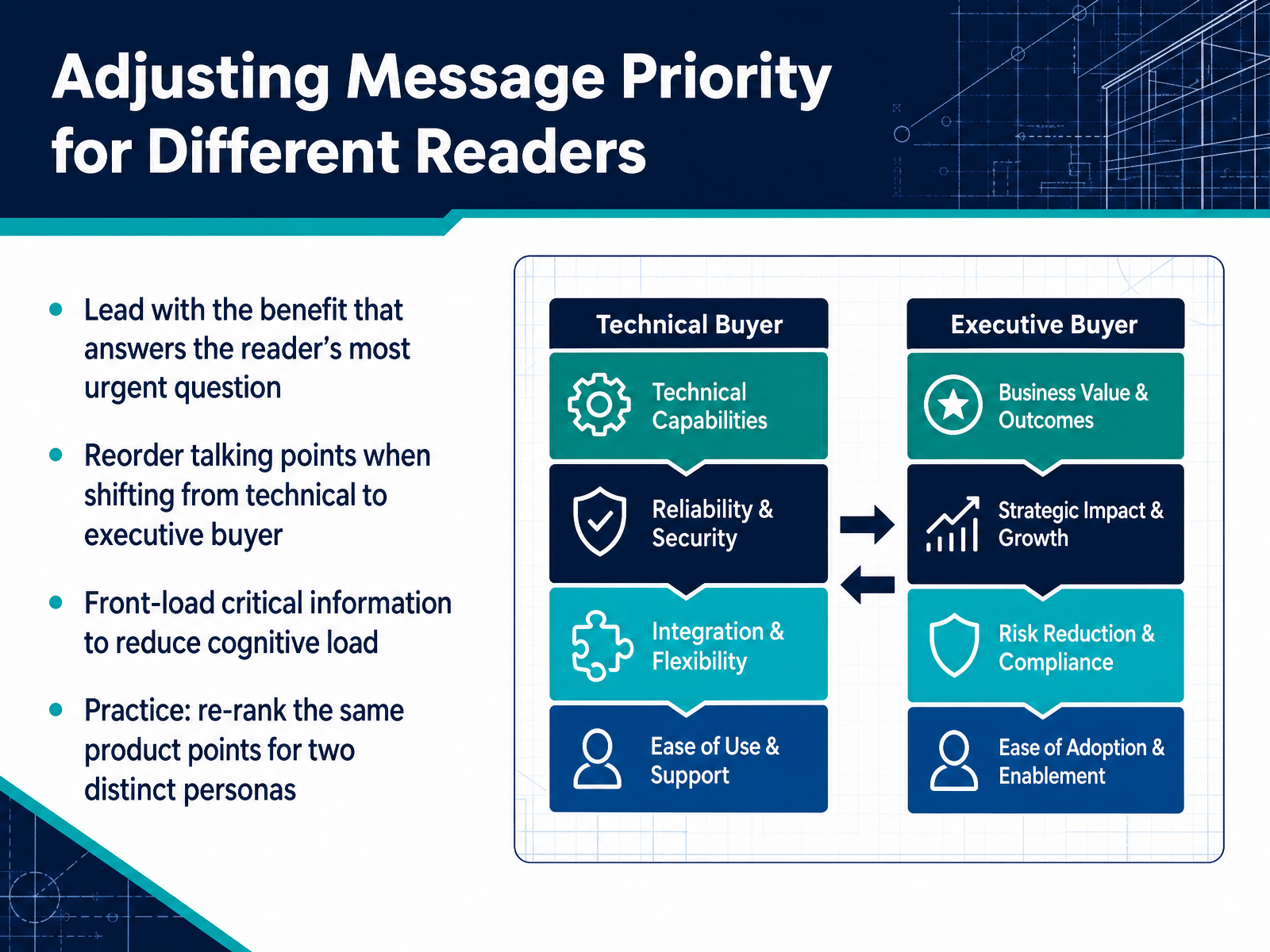
2 min - 07Adjusting Message Priority for Different ReadersNow let's talk about adjusting message priority for different readers. The most effective messages don't just change the words; they change what comes first. Always lead with the benefit that answers the reader's most urgent question. For a user, that might be ease of use. For an executive, it's return on investment or risk reduction. When you shift from a technical buyer to an executive buyer, reorder your talking points. An engineer wants proof of performance up front. A VP wants the business case summarized in the first two sentences before they'll even scroll down. Front-load the critical information. This reduces cognitive load and respects their time. Don't bury the headline. Here's your practice. Take five product points and re-rank them for two distinct personas. Put yourself in each reader's shoes and ask: what do they need to know first? That simple sorting exercise instantly sharpens your marketing message. Up next, we'll dive deeper into language tuning, covering vocabulary, tone, and how to calibrate technical depth for each audience.
 2 min
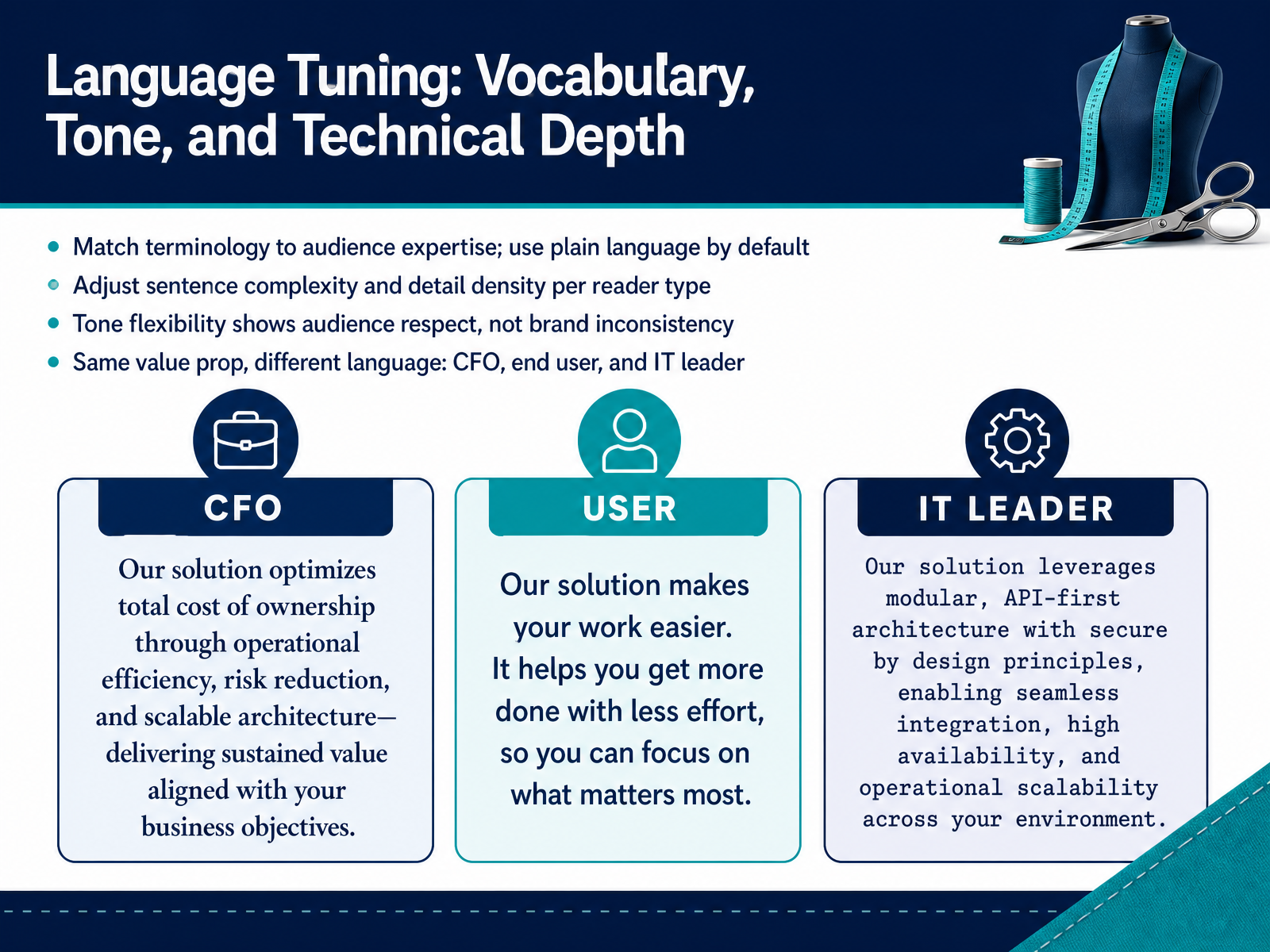
2 min - 08Language Tuning: Vocabulary, Tone, and Technical DepthLet's talk about language tuning. This is where we match vocabulary, tone, and technical depth to each specific reader. Start with plain language by default. If your audience does not share your expertise, swap out jargon for everyday terms. Then adjust sentence complexity. An executive summary needs short, high-level points. A technical guide can include layered details and longer explanations. Tone flexibility shows respect for the reader's context, not brand inconsistency. You stay true to your value proposition, but you express it through different language. For a CFO, talk about cost savings and risk reduction. For an end user, describe time saved and everyday ease. For an IT leader, highlight integration and security controls. Same core message. Completely different words. Up next, we'll look at proof points that persuade each persona.
 2 min
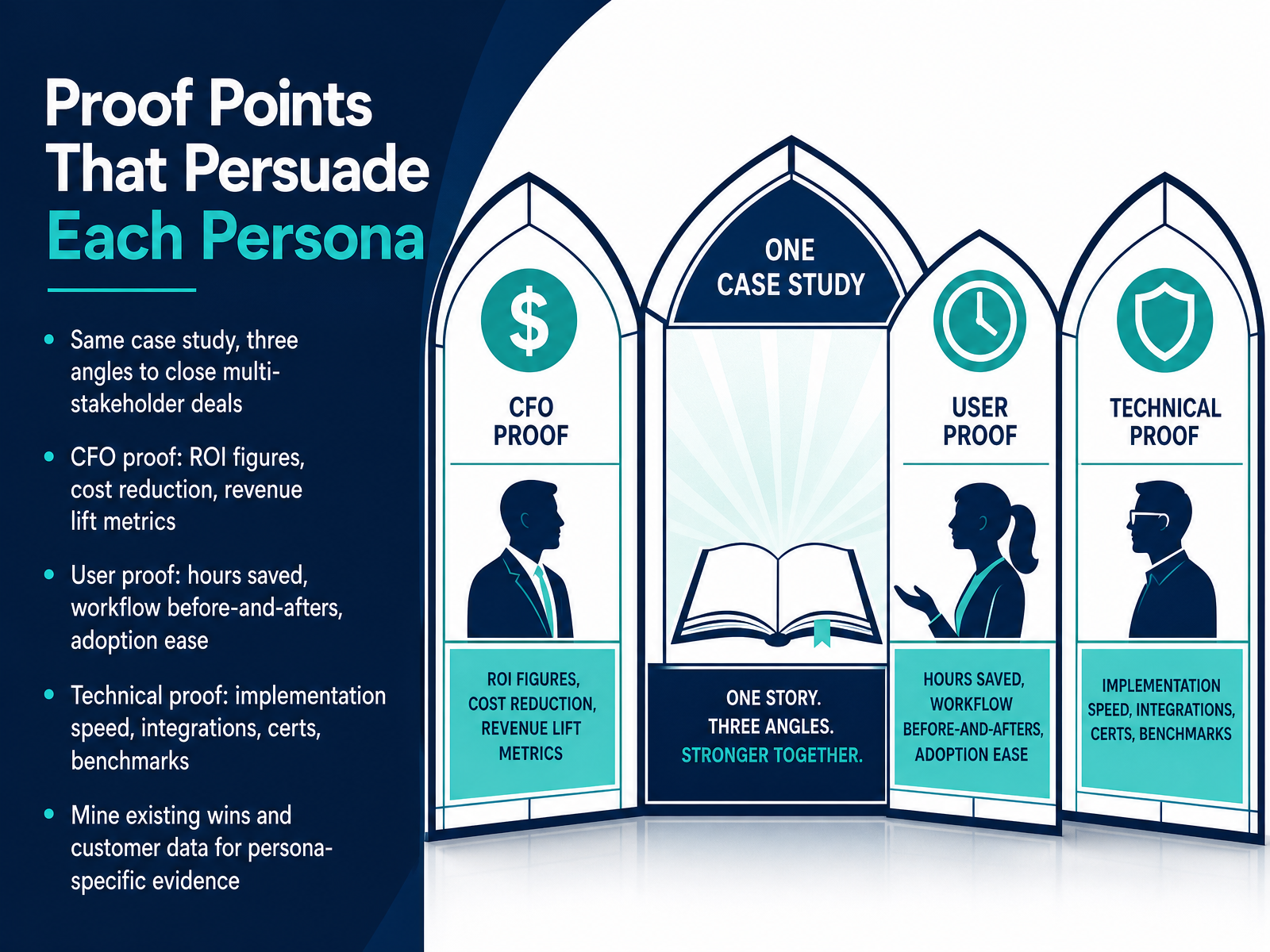
2 min - 09Proof Points That Persuade Each PersonaNow let's talk about proof. The same case study can close the deal with three different people when you surface the right evidence. For the CFO, lead with hard numbers: a clear return on investment, measured cost reduction, and revenue lift. For the end user, show them time back in their day. Paint the before-and-after picture of their workflow, and emphasize how easy adoption really is. For the technical buyer, prove you can execute. Call out implementation speed, existing integrations, security certifications, and performance benchmarks. Don't invent new data. Mine your existing wins and customer satisfaction data, then package it separately for each persona. Next, we'll move from one product to multiple messages with a concrete walkthrough.
 1 min
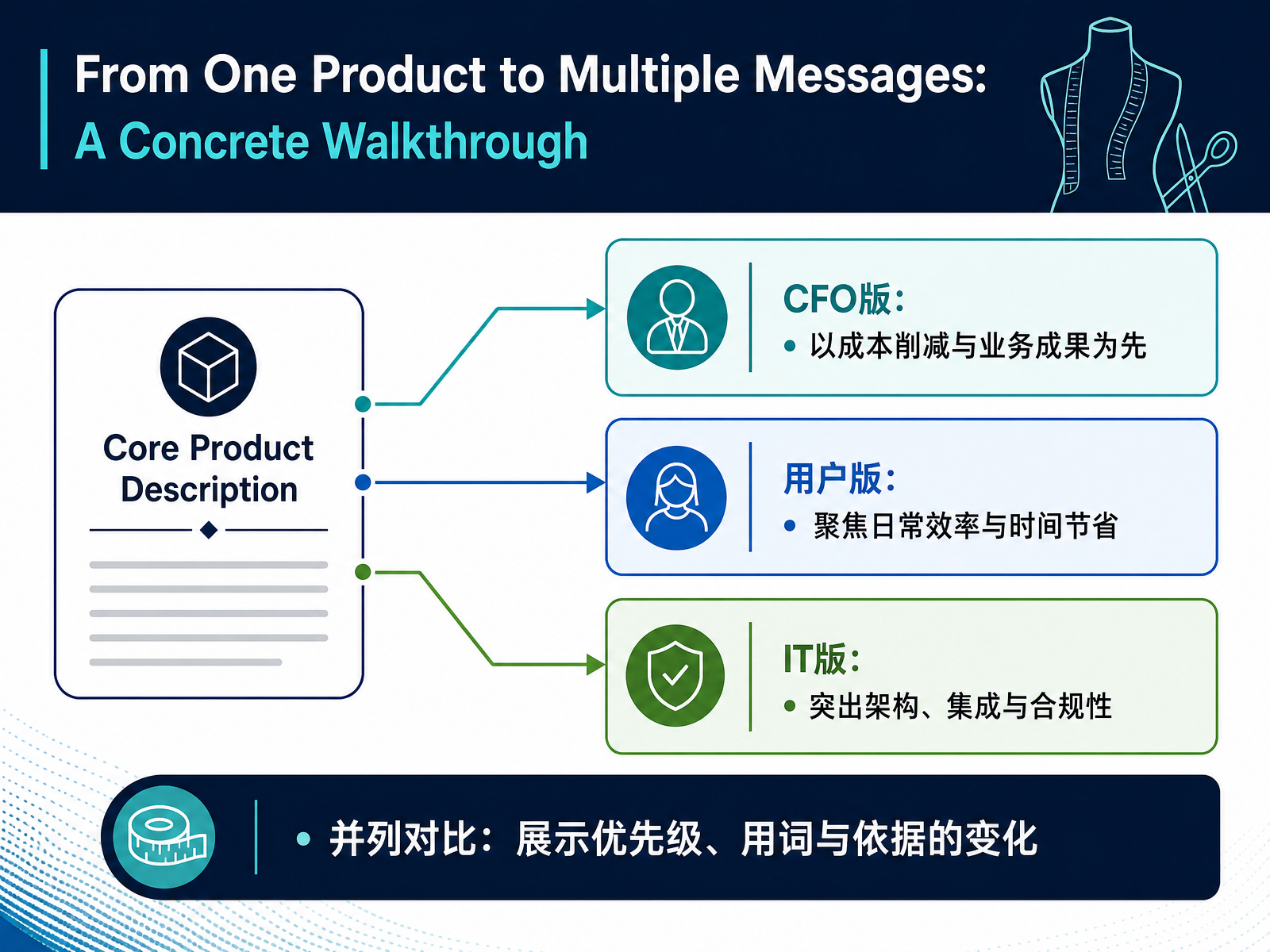
1 min - 10From One Product to Multiple Messages: A Concrete WalkthroughLet's take one core product and watch it speak to three completely different audiences. Same solution, but the message shifts dramatically. First, the Chief Financial Officer version. Here we lead with cost reduction and measurable business outcomes. We talk about ROI, budget impact, and financial risk. Next, the end-user version. For this audience, we flip the focus entirely to daily efficiency and time savings. We emphasize how the product makes their specific tasks faster and easier, using words like 'streamline' and 'simplify.' Finally, the IT version. This message prioritizes architecture, integration, and compliance. We use precise technical language about security protocols, API connectivity, and system requirements. Now, place these three messages side by side. You'll see clear differences in what we prioritize, the exact words we choose, and the business logic behind each decision. The core value doesn't change, but the door we open for each reader is completely different. Next, we'll tackle how to preserve brand consistency across all these variants.
 2 min
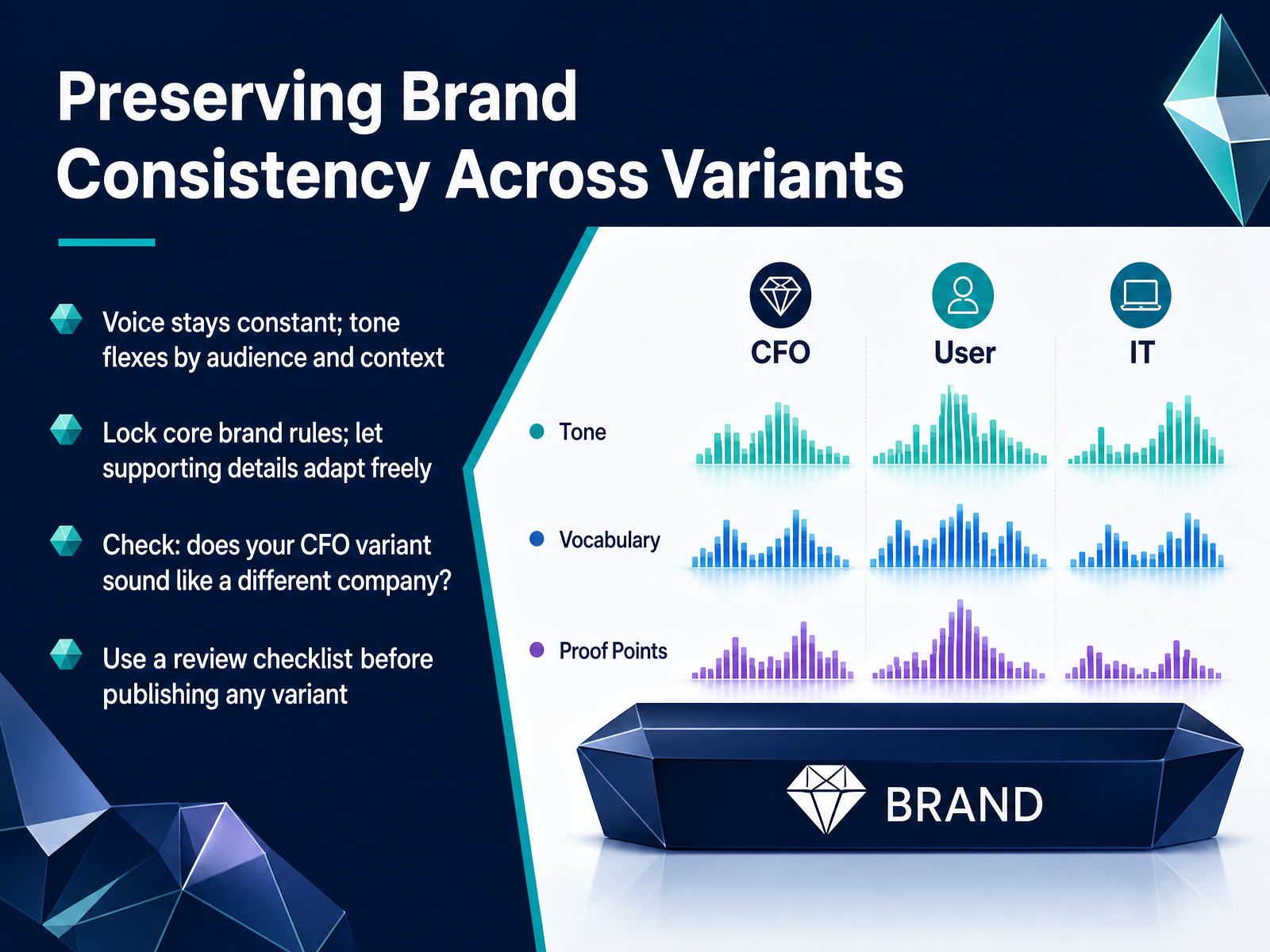
2 min - 11Preserving Brand Consistency Across VariantsLet's talk about keeping the brand consistent while we tailor the message. Your brand voice is your company's personality. That stays the same whether you're talking to a CFO or a new intern. But your tone, that's the expression of that personality. It flexes. With a CFO, your tone is concise and proof-driven. With a creative director, it can be more visionary. The practical rule is this: lock down your core brand rules, like your value proposition and your key differentiators. Let supporting details adapt freely. Here's a quick gut check. Read your CFO variant out loud. Does it sound like a completely different company? If so, pull back on the adaptation. To prevent drift, use a simple review checklist before you publish any variant. Check your logo usage, your key terms, and your brand promise. This one-page checklist can save you from a confusing customer experience. Now, even with a solid process, mistakes happen. Next, we'll look at common pitfalls when writing across audiences.
 2 min
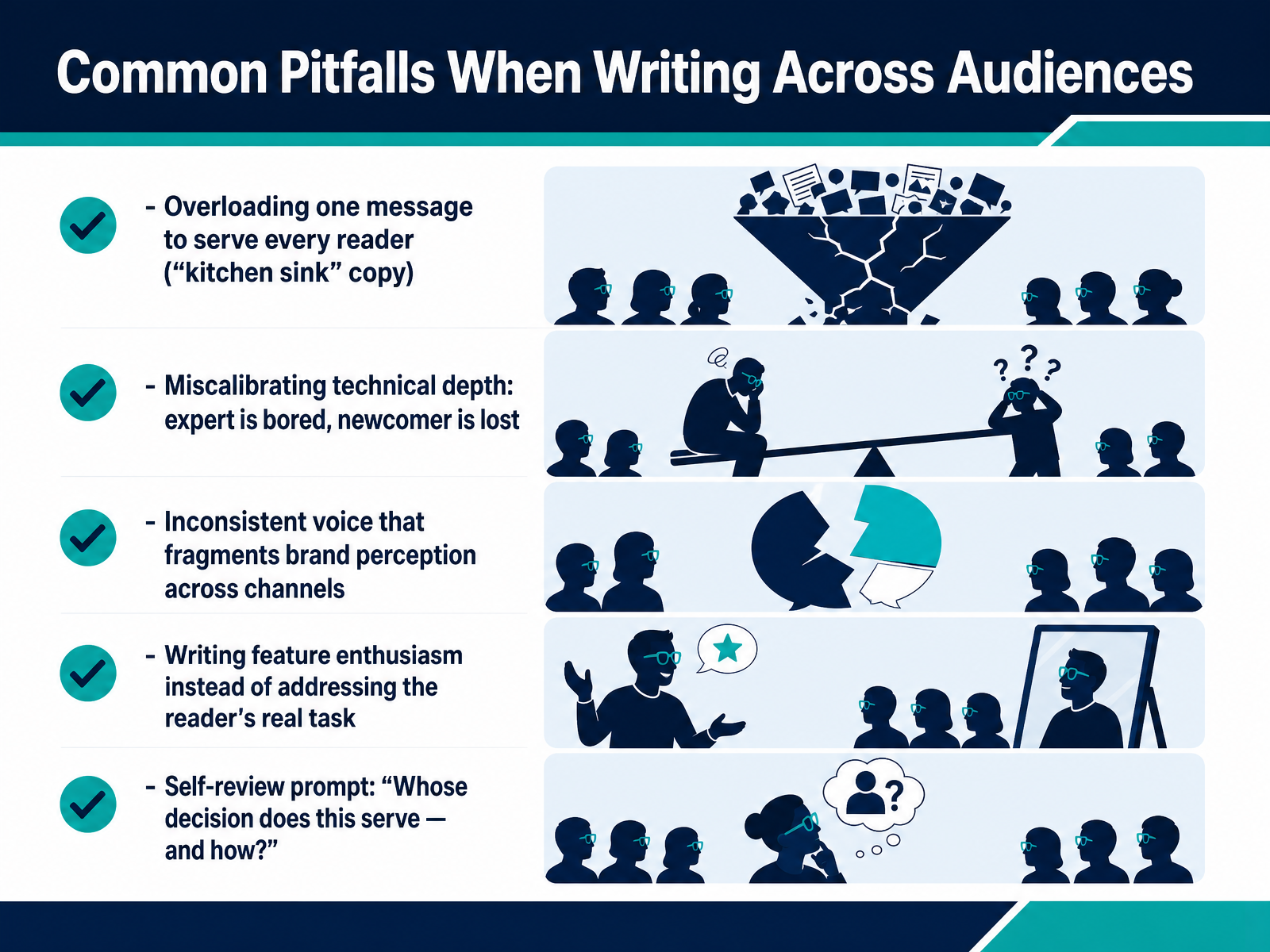
2 min - 12Common Pitfalls When Writing Across AudiencesLet's quickly scan the most common pitfalls, so you can catch them before they catch you. First, the kitchen sink message. That's when you try to serve every possible reader in one piece of copy. Instead of clarity, you get clutter; nobody finds their reason to care. Second, technical depth. Give an expert a basic definition and you'll lose their respect. Throw jargon at a newcomer and you'll lose their attention completely. Third, inconsistent voice. If your email sounds formal but your social post is full of slang, the brand feels fragmented and untrustworthy. Fourth, focusing on feature enthusiasm instead of the reader's real task. Leading with 'We're excited about our new dashboard' ignores the customer's central question: 'Will this save me time?' Finally, every time you review your draft, ask yourself this prompt: 'Whose decision does this serve, and how?' If the answer isn't clear, your message needs sharper focus. Coming up next, we'll turn these insights into action with a repeatable three-step customization process.
 2 min
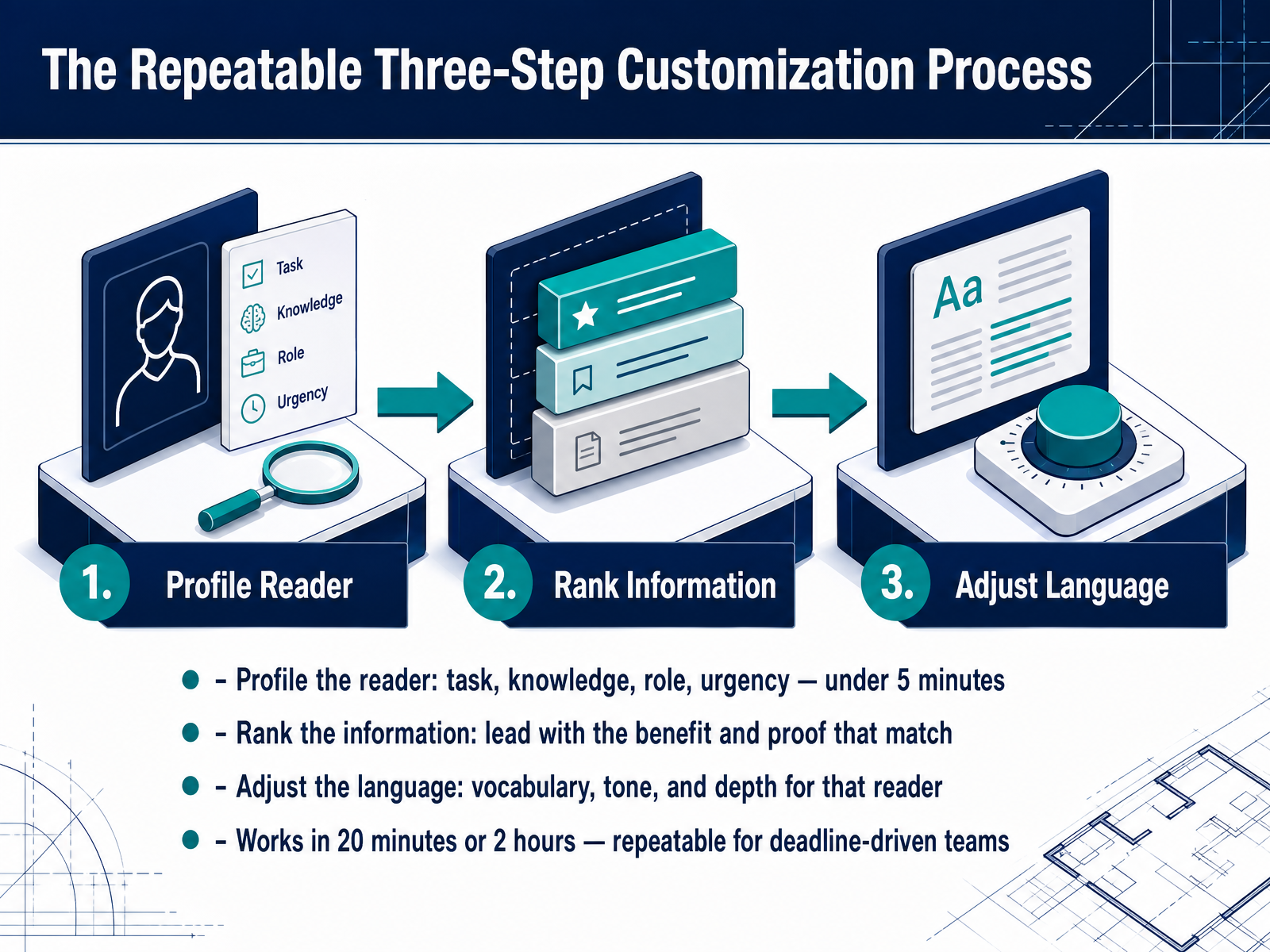
2 min - 13The Repeatable Three-Step Customization ProcessLet's lock in a repeatable process that works whether you have twenty minutes or two hours. First, profile the reader. In under five minutes, ask yourself, what is their task, what do they already know, what is their role, and how urgent is their need? For example, a busy executive scanning a subject line needs a confidence signal immediately, while an engineer reviewing documentation needs technical accuracy first. Next, rank your information. Lead with the benefit and the proof that directly match that reader's profile, not the feature list you are most proud of. Finally, adjust your language. Shift your vocabulary, your tone, and the depth of detail to meet that reader where they are. This is the repeatable customization process that keeps deadline-driven teams consistent. And next, we will put all of this together into your audience-adaptation playbook.
 2 min
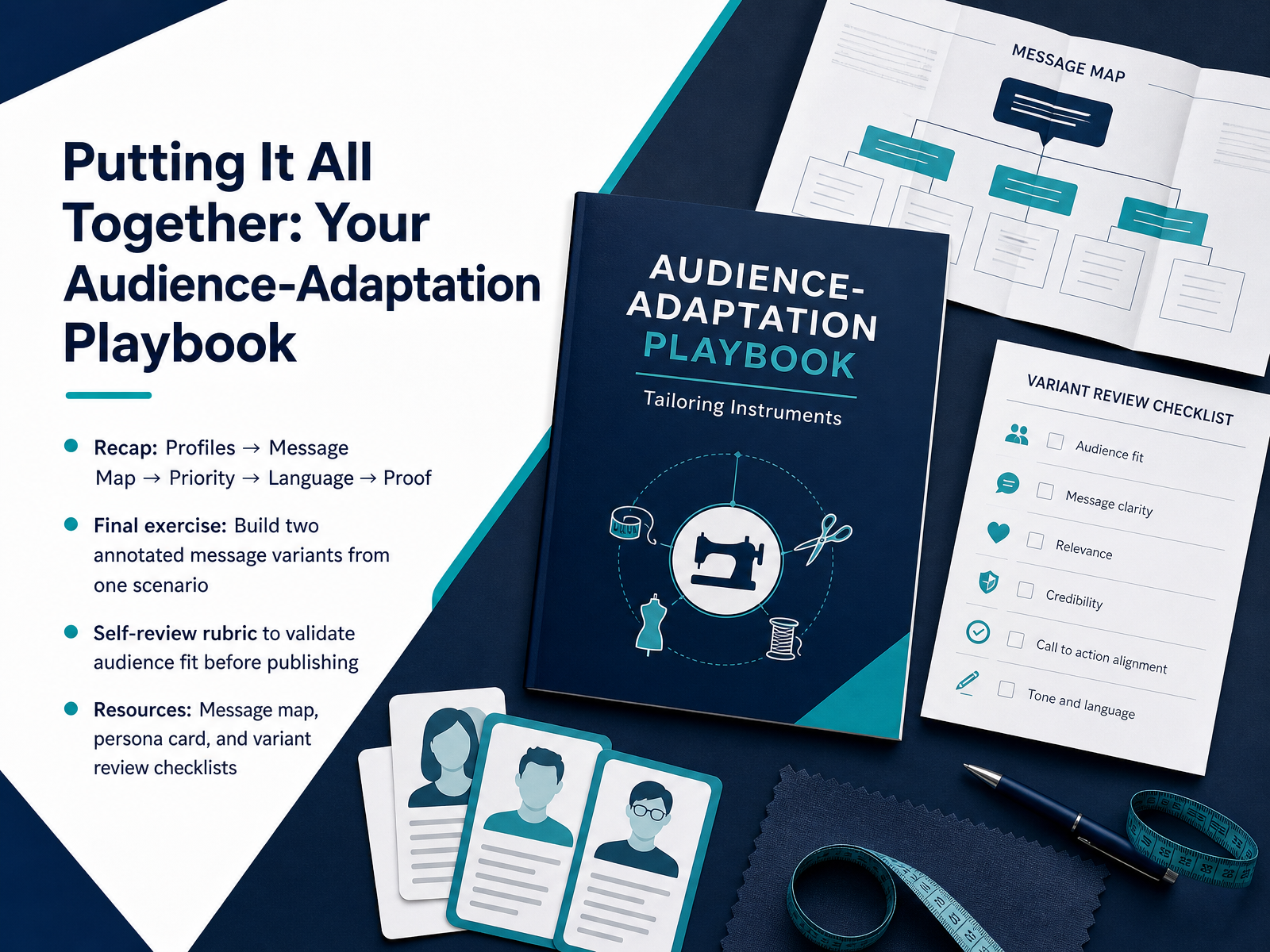
2 min - 14Putting It All Together: Your Audience-Adaptation PlaybookLet’s pull everything together into a simple playbook you can reuse. Step one: build a quick audience profile. Step two: map what matters most to that reader onto a message map. Step three: rank your points by what they need first. Step four: choose words and examples that fit their world. And step five: read it from their perspective and proof before sending. Your final exercise brings this to life. Take one scenario and write two message variants aimed at different audiences. Then run your drafts through the self-review rubric. Does the subject line speak to the right need? Does the lead sentence match what they know and care about? Are the details right for their level? Use the message map, persona card, and variant checklist to sharpen both versions before you publish. Thank you for building this skill with me. You now own a repeatable process for adapting marketing messages with clarity and confidence. Go make every message count.
 2 min
2 min
Take the deck with you
Download this course as a file — free, no sign-up needed.
- PDF handoutEvery slide page, ready to print or share.15 pages · 3.8 MBDownload
- Narrated PowerPointThe deck that presents itself — every slide carries the digital human's narration video.15 pages · 14.4 MBDownload
- PowerPoint slidesThe full deck as a .pptx — open it in PowerPoint, Keynote, or Google Slides.15 pages · 3.7 MBDownload
Free to use in your own training — please keep the PersonWise credit page at the end.
Have your own deck? Turn it into a course