Begin
14 pages · ~28 min
Social Media Platform Strategy
This training helps marketers evaluate and select social media platforms, covering architecture and tradeoffs to guide effective channel decisions.
A digital instructor presents all 14 pages. Hold “Ask” at any point and ask out loud — the answer comes from this course. No sign-up needed.
What you’ll learn
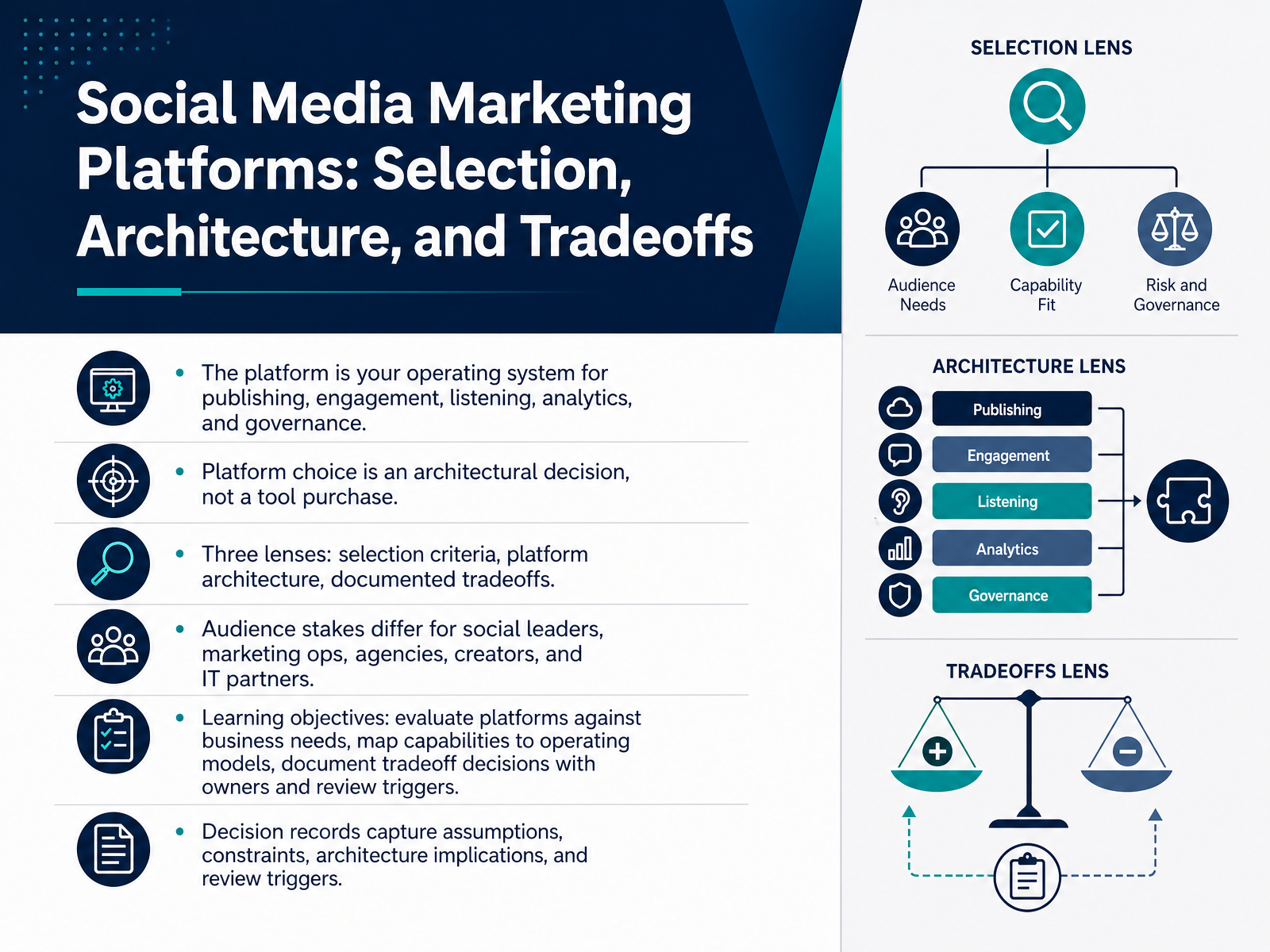
- 01Social Media Marketing Platforms: Selection, Architecture, and TradeoffsWelcome. Today we're covering social media marketing platforms, and specifically how to select them, how they're architected, and the tradeoffs you accept when you choose. Here's the core idea. Your platform is your operating system for publishing, engagement, listening, analytics, and governance. So treat platform choice as an architectural decision, not a tool purchase. We'll use three lenses. Selection criteria. Platform architecture. And documented tradeoffs. Your stakes differ by role. Social leaders care about governance and outcomes. Marketing ops cares about workflow and integrations. Agencies care about multi-client structures. Creators care about speed and cost. And IT partners care about security, permissions, and scale. By the end, you should be able to evaluate platforms against business needs, map capabilities to your operating model, and document tradeoff decisions with named owners and review triggers. That last habit matters most. A decision record captures your assumptions, constraints, architecture implications, and the conditions that would make you revisit. Let's start with why platform selection is an architecture problem.mordorintelligence.comemplifi.iopropicked.com+21 min
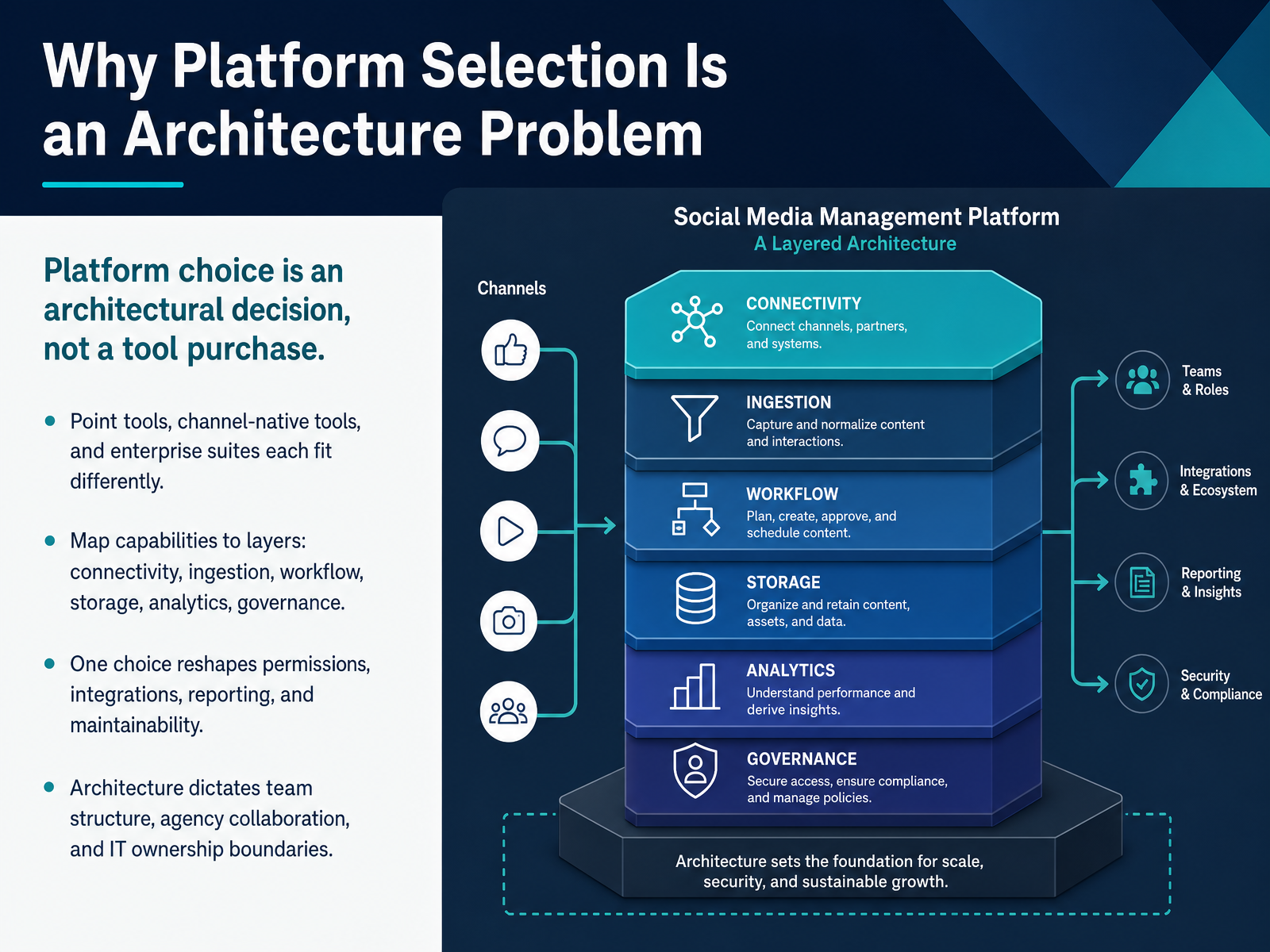
- 02Why Platform Selection Is an Architecture ProblemLet's talk about why platform selection is really an architecture problem, not just a tool purchase. Point tools, channel-native tools, and enterprise suites each fit differently. So map capabilities to layers: connectivity, ingestion, workflow, storage, analytics, and governance. One choice reshapes permissions, integrations, reporting, and long-term maintainability. Architecture also dictates team structure, agency collaboration, and where IT ownership boundaries sit. When your governance and reporting needs are simple, a lighter tool may be enough. But choose an enterprise suite when approvals, audit trails, and multi-brand control must scale. Next, we'll look at the 2026 Platform Landscape and Selection Triggers.
 codersarts.comown360.aiappexchange.salesforce.com+21 min
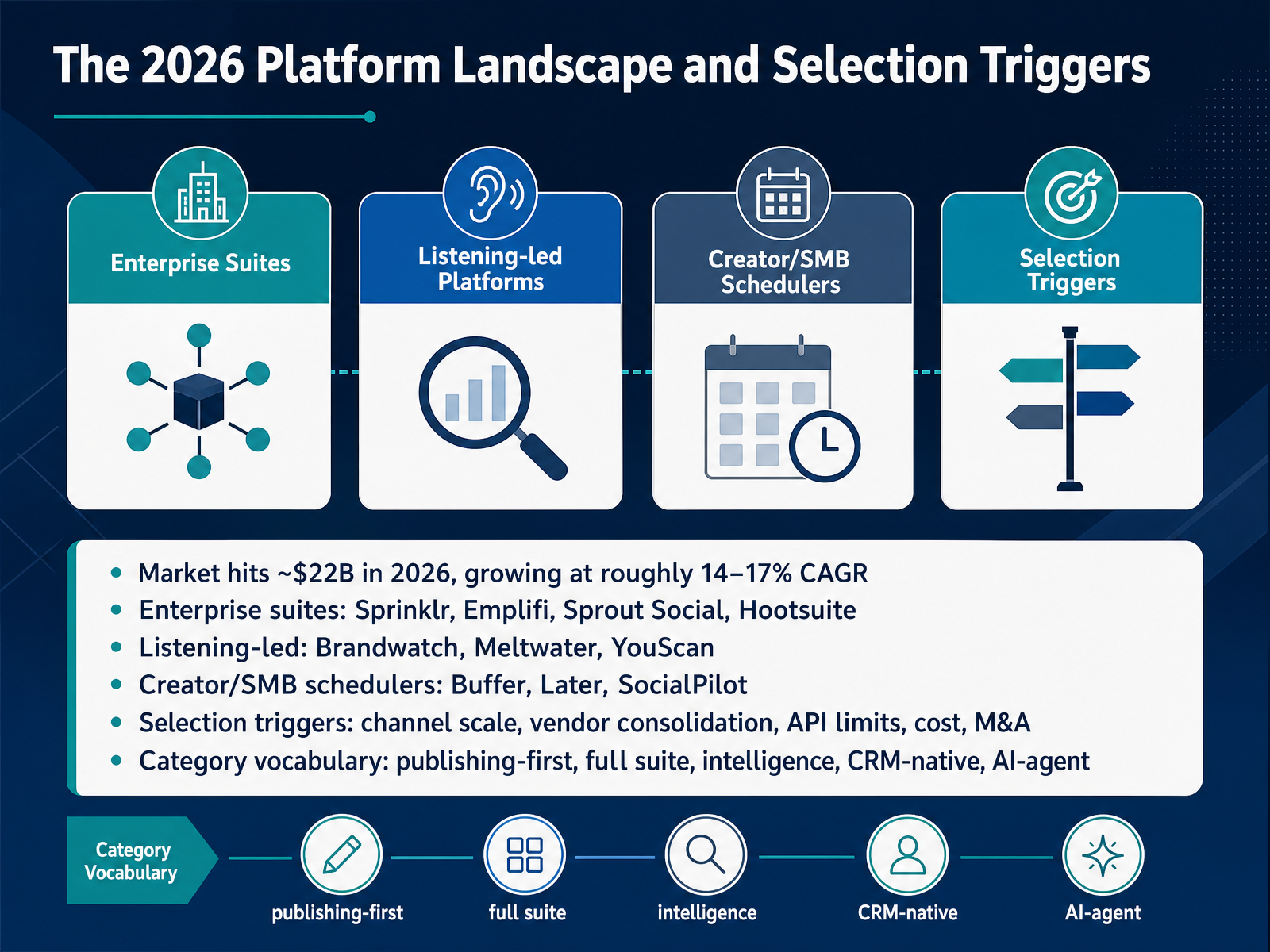
- 03The 2026 Platform Landscape and Selection TriggersLet's look at the 2026 platform landscape and the triggers that start a selection process. The market sits at roughly twenty-two billion dollars in 2026, growing at fourteen to seventeen percent a year. Three main tiers compete for your budget. Enterprise suites like Sprinklr, Emplifi, Sprout Social, and Hootsuite cover publishing, care, and governance. Listening-led tools like Brandwatch, Meltwater, and YouScan lead with intelligence rather than scheduling. And creator or small-business schedulers like Buffer, Later, and SocialPilot win on price and speed. What usually triggers a review? Channel scale, vendor consolidation, platform API limits, rising cost, and mergers or acquisitions. Learn the category vocabulary before you evaluate vendors. Teams describe themselves as publishing-first, full suite, intelligence-led, CRM-native, or AI-agent. Each label sets different expectations for integration, permissions, and reporting. So sort the market into tiers first, then define your trigger clearly. That keeps the shortlist honest. Next, we'll cover selection criteria that actually matter.
 mordorintelligence.comemplifi.iopropicked.com+22 min
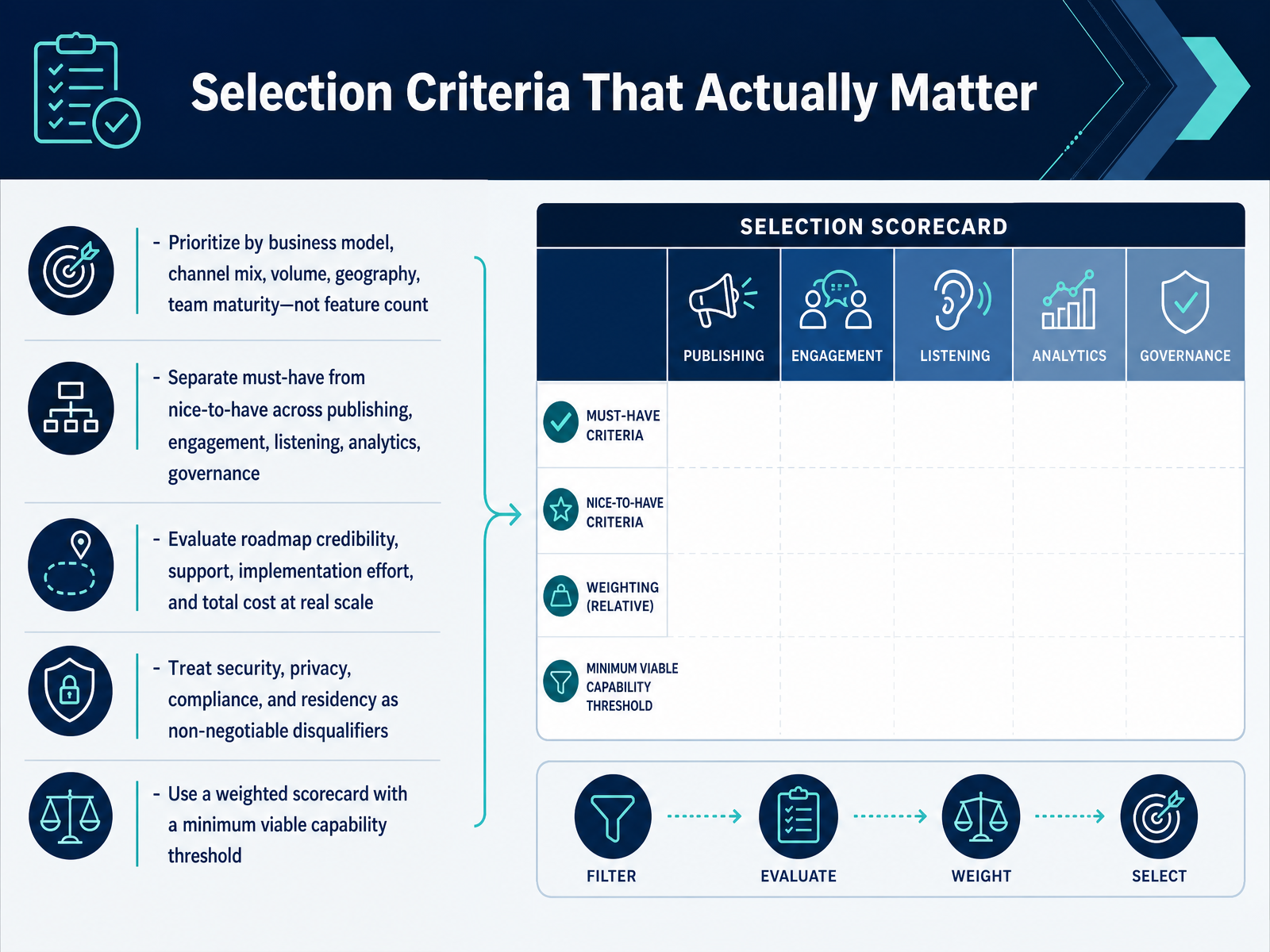
- 04Selection Criteria That Actually MatterNow let's look at selection criteria that actually matter. Start by prioritizing your business model, channel mix, content volume, geography, and team maturity. Feature count should not drive this decision. Next, separate must-haves from nice-to-haves across publishing, engagement, listening, analytics, and governance. Then evaluate roadmap credibility, support quality, implementation effort, and total cost at real scale. Remember, per-seat pricing looks small at five users and gets expensive when your entire approval chain needs access. Security, privacy, compliance, and data residency are not scored items. They are disqualifiers. If your IT team will reject a vendor later, remove that vendor early and save your committee the time. Finally, use a weighted scorecard with a minimum viable capability threshold. Set your weights before demos begin, so criteria stay fixed while vendors compete on evidence. A simple rule: any high-weight yes must be demonstrated live at your scale. Roadmap promises stay partial credit. That structure turns a debate into a decision. Next, we move to platform architecture patterns and integration surfaces.
 apaya.comapaya.comapaya.com+21 min
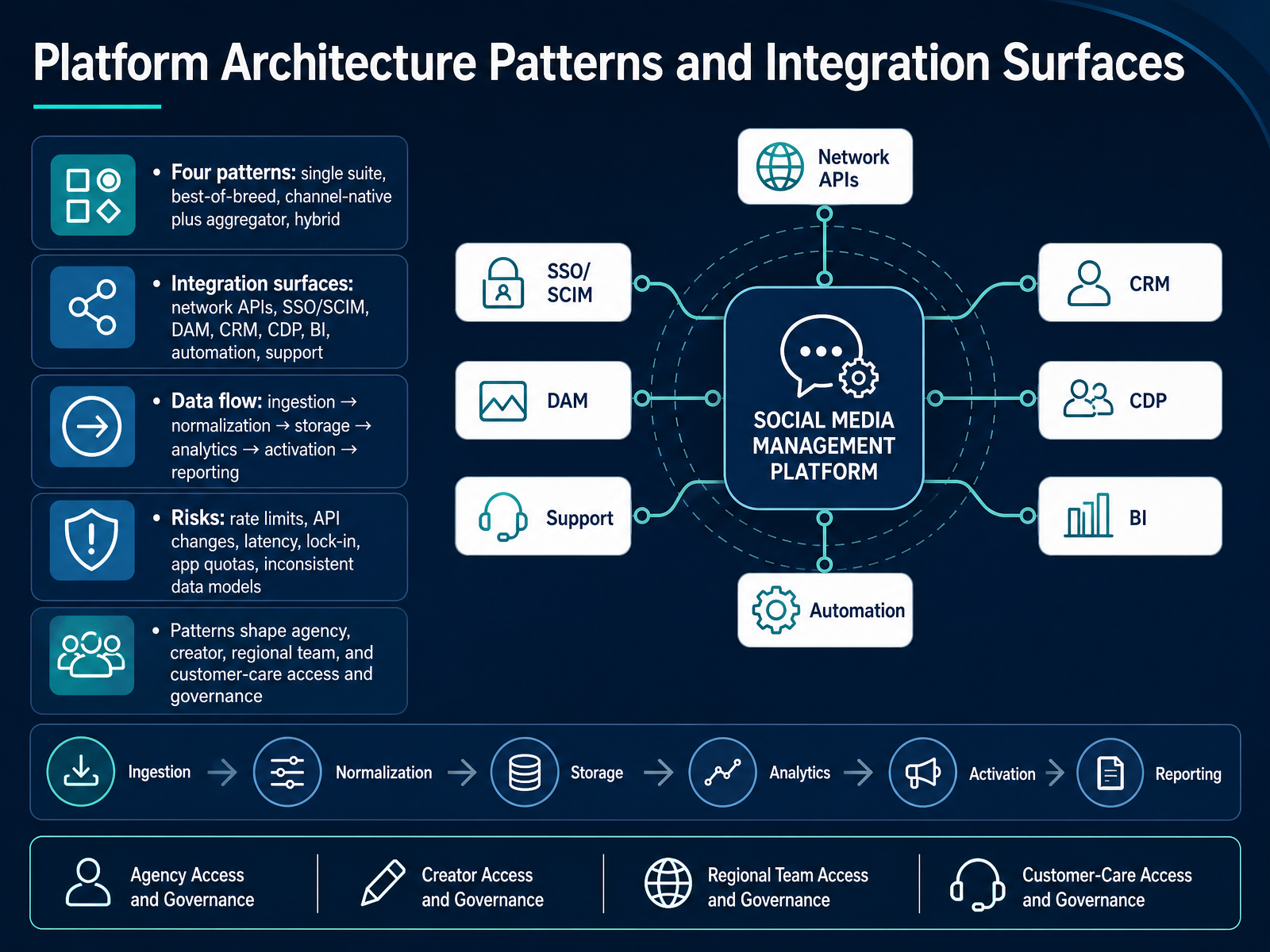
- 05Platform Architecture Patterns and Integration SurfacesNow let's look at architecture patterns and integration surfaces, because this choice drives your access model, your governance, and your cost. There are four common patterns: a single suite, best-of-breed tools, channel-native plus an aggregator, or a hybrid. Each one changes how agencies, creators, regional teams, and customer care get access to accounts and data. Think about integration surfaces next. You will connect network APIs, single sign-on with user provisioning, your digital asset manager, CRM, customer data platform, business intelligence, automation, and support tools. The data flow is consistent: ingestion, normalization, storage, analytics, activation, and reporting. Choose a single suite when governance and consolidated reporting outweigh depth. Accept best-of-breed when you can absorb more integration work. The risks are real. Rate limits, like TikTok's six posting requests per minute per token, will throttle you. Instagram allows one hundred published posts in a rolling twenty four hours. API changes, latency, application quotas, lock-in, and inconsistent data models all shape your architecture. Next, we examine rate limits, tokens, and platform constraints.
 blotato.comdevelopers.facebook.comsocial-api.ai+22 min
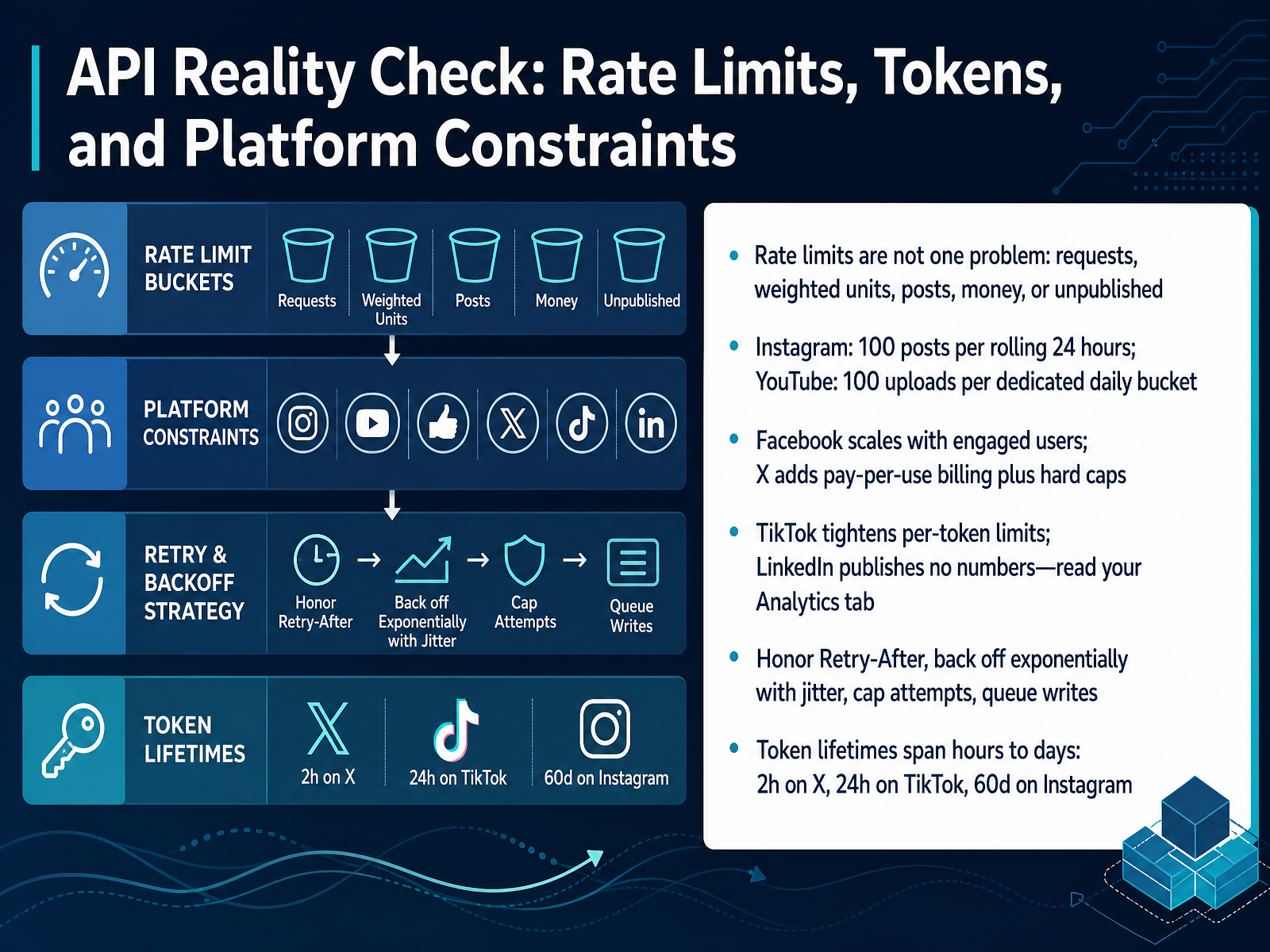
- 06API Reality Check: Rate Limits, Tokens, and Platform ConstraintsLet's talk about the API reality check that trips up most platform selections. Rate limits are not one problem. Depending on the platform, your ceiling counts requests, weighted units, posts, money, or even unpublished allowances. Instagram allows one hundred published posts per rolling twenty four hours. YouTube gives uploads a dedicated bucket of one hundred per day, separate from the shared ten thousand unit pool. Facebook scales with engaged users, so a new page is throttled hardest exactly when you are testing. X now adds pay per use billing on top of hard caps. TikTok tightens limits per token. And LinkedIn publishes no numbers at all. You have to read your own limits in the Analytics tab after making at least one request. What should you build? Honor Retry After when it appears. Back off exponentially with jitter, and cap your attempts. Queue write operations behind a rate limiter instead of firing them inline. And plan around token lifetimes that range from two hours on X, to twenty four hours on TikTok, to sixty days on Instagram. Check these constraints before you commit to a platform, because they shape your architecture, your workflows, and your support load. Next, we look at the operating model question: Build, Buy, or Blend.
 blotato.comdevelopers.facebook.comsocial-api.ai+22 min
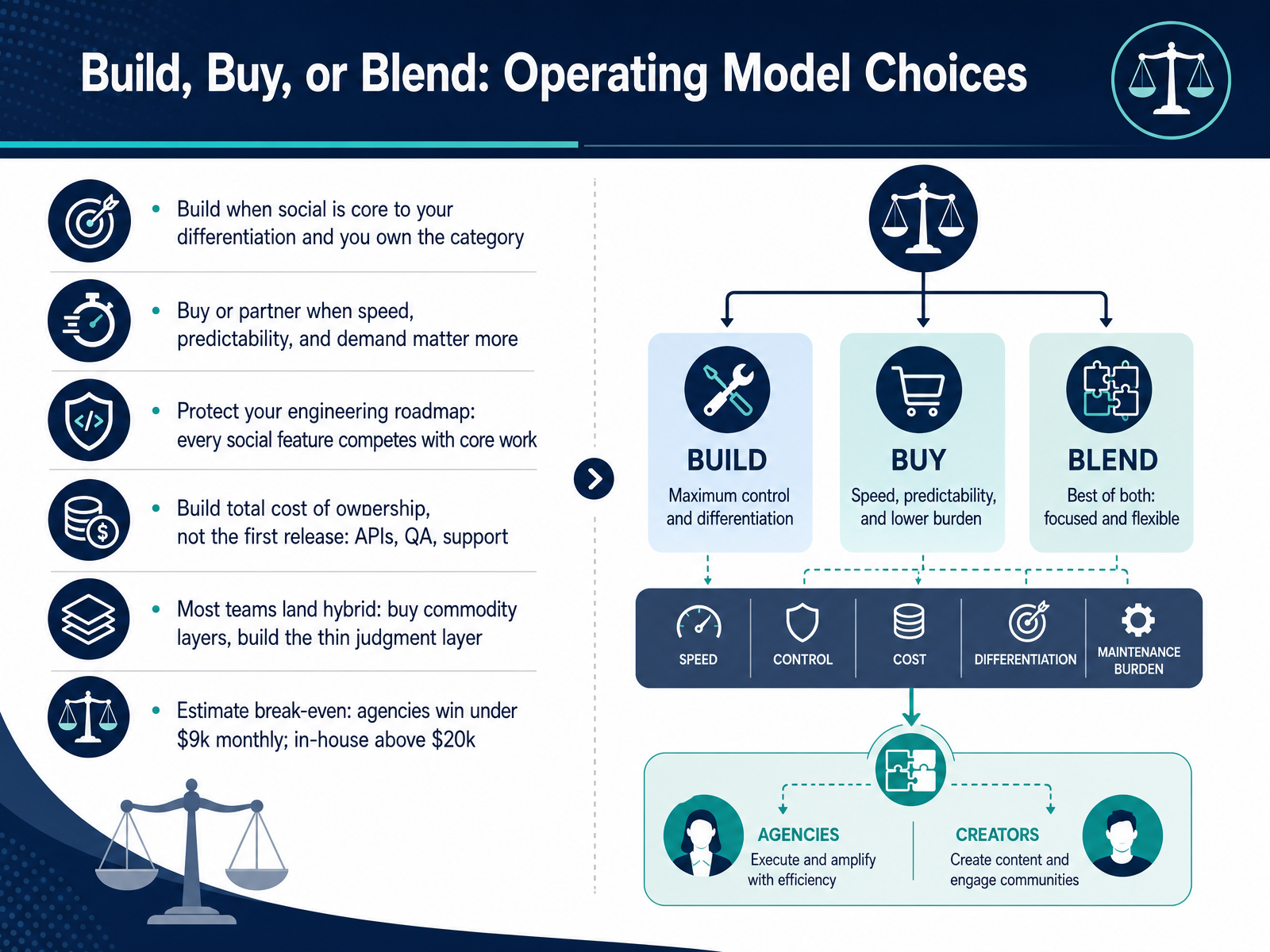
- 07Build, Buy, or Blend: Operating Model ChoicesNow let's talk about your operating model. Build, buy, or blend. Build when social is core to your differentiation and you truly own the category. Buy or partner when speed, predictability, and customer demand matter more. Remember, every social feature you build competes with your core engineering roadmap. So model total cost of ownership, not just the first release. That means APIs, QA, support, and ongoing maintenance. Most teams land hybrid. Buy the commodity layers, and build only the thin judgment layer that is yours. Use the break-even test. Agencies usually win below nine thousand dollars monthly. In-house starts winning above twenty thousand. Estimate your true monthly spend before you commit either way. Next, we will examine core tradeoffs: speed, control, cost, and risk.
 cloudcampaign.com1 min
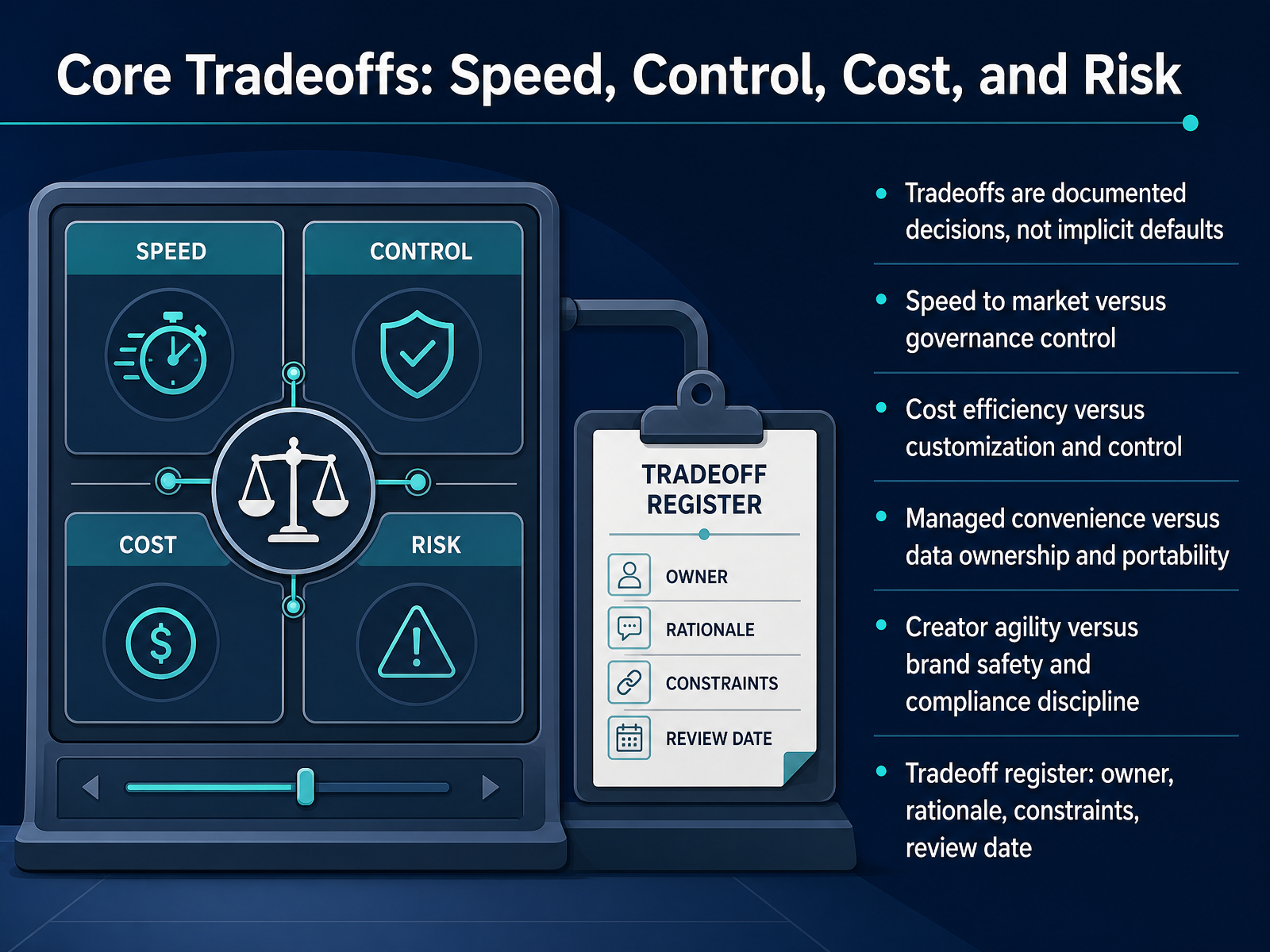
- 08Core Tradeoffs: Speed, Control, Cost, and RiskLet's talk about the core tradeoffs you'll face: speed, control, cost, and risk. The key principle here is that tradeoffs should be documented decisions, not implicit defaults. When you leave them undocumented, teams drift into conflicting assumptions. So name them upfront. First, speed to market versus governance control. Move fast, and you accept lighter review. Strengthen approval chains, and launches slow down. Second, cost efficiency versus customization. Standard pricing is predictable, but tailored workflows and integrations cost more to build and maintain. Third, managed convenience versus data ownership and portability. A vendor handles infrastructure and API changes, but you need clear export rights and exit terms before you sign. Fourth, creator agility versus brand safety and compliance discipline. Creators move quickly; regulated brands need approval gates. Both can work, but not by accident. The practical tool is a tradeoff register. For each tradeoff, record the owner, the rationale, the constraints, and a review date. That turns debate into a decision you can revisit. Next, we move into governance, compliance, and brand safety.
 cloudcampaign.comapaya.comapaya.com+22 min
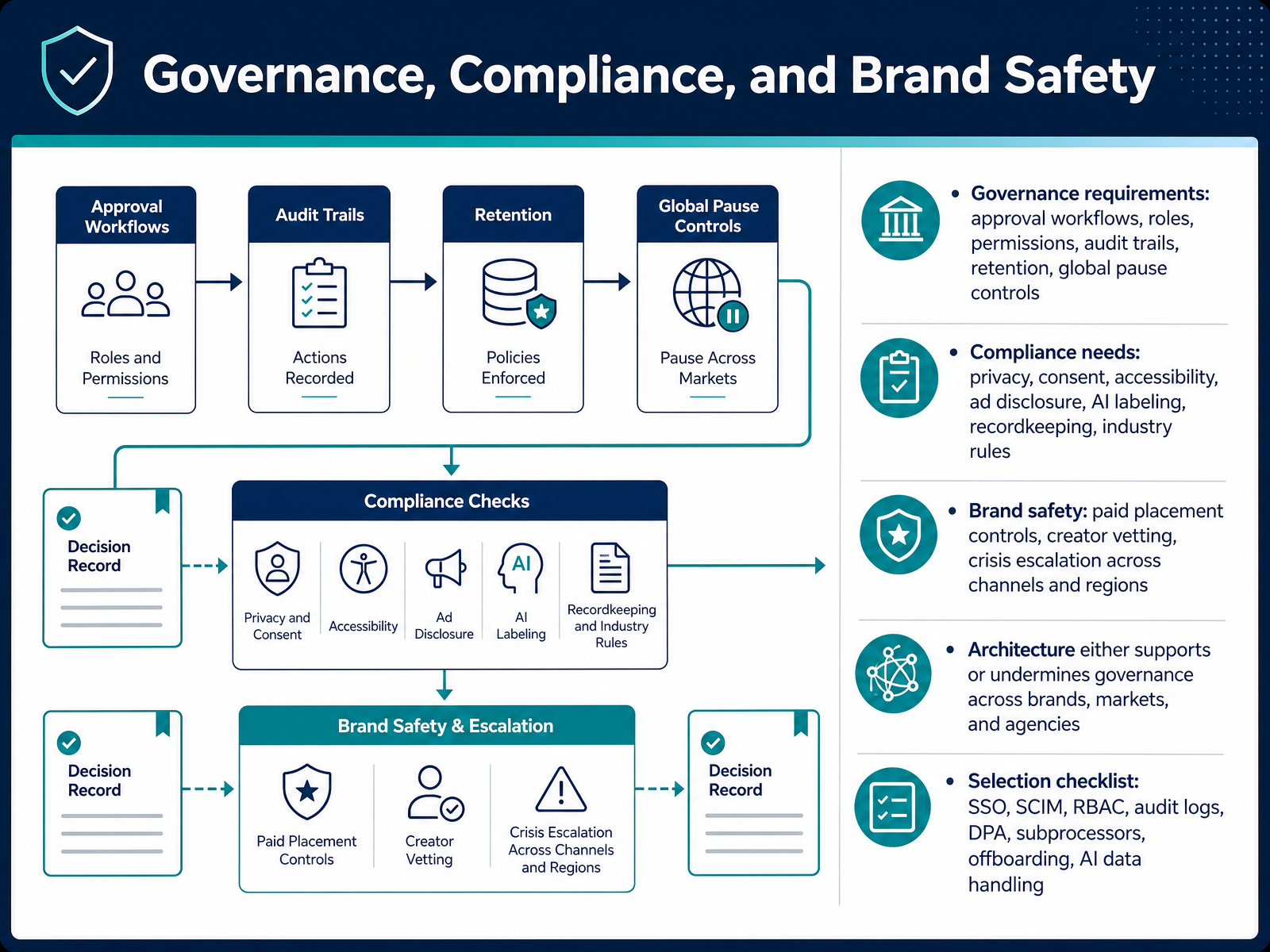
- 09Governance, Compliance, and Brand SafetyLet's talk about governance, compliance, and brand safety. These are the requirements that decide whether a platform is actually safe to operate at scale, not just pleasant to use. Start with governance. You need approval workflows, clear roles and permissions, audit trails, retention rules, and a global pause control you can trigger fast during a crisis. Compliance adds the legal layer: privacy and consent, accessibility, ad disclosure, AI labeling, recordkeeping, and any industry-specific rules. Brand safety splits into two tracks. Brand safety stops your ads appearing beside illegal or hateful content. Brand suitability is a judgment call about context. Remember, platform controls only cover the floor, and the EU's Digital Services Act makes adjacency a legal risk, not just a reputational one. So check the architecture. Can it enforce permissions and approvals consistently across brands, markets, and agencies, or does governance break at the edges? Use this selection checklist. Single sign-on, SCIM provisioning, role-based access control, audit logs, a data processing addendum, a named subprocessor list, clean offboarding, and clear answers on how AI handles your data. Choose platforms that answer all eight in writing. Accept the tradeoff of higher cost and slower setup if your brands are regulated or distributed. Next, we move into measurement, analytics, and data architecture.
 apaya.comapaya.comapaya.com+22 min
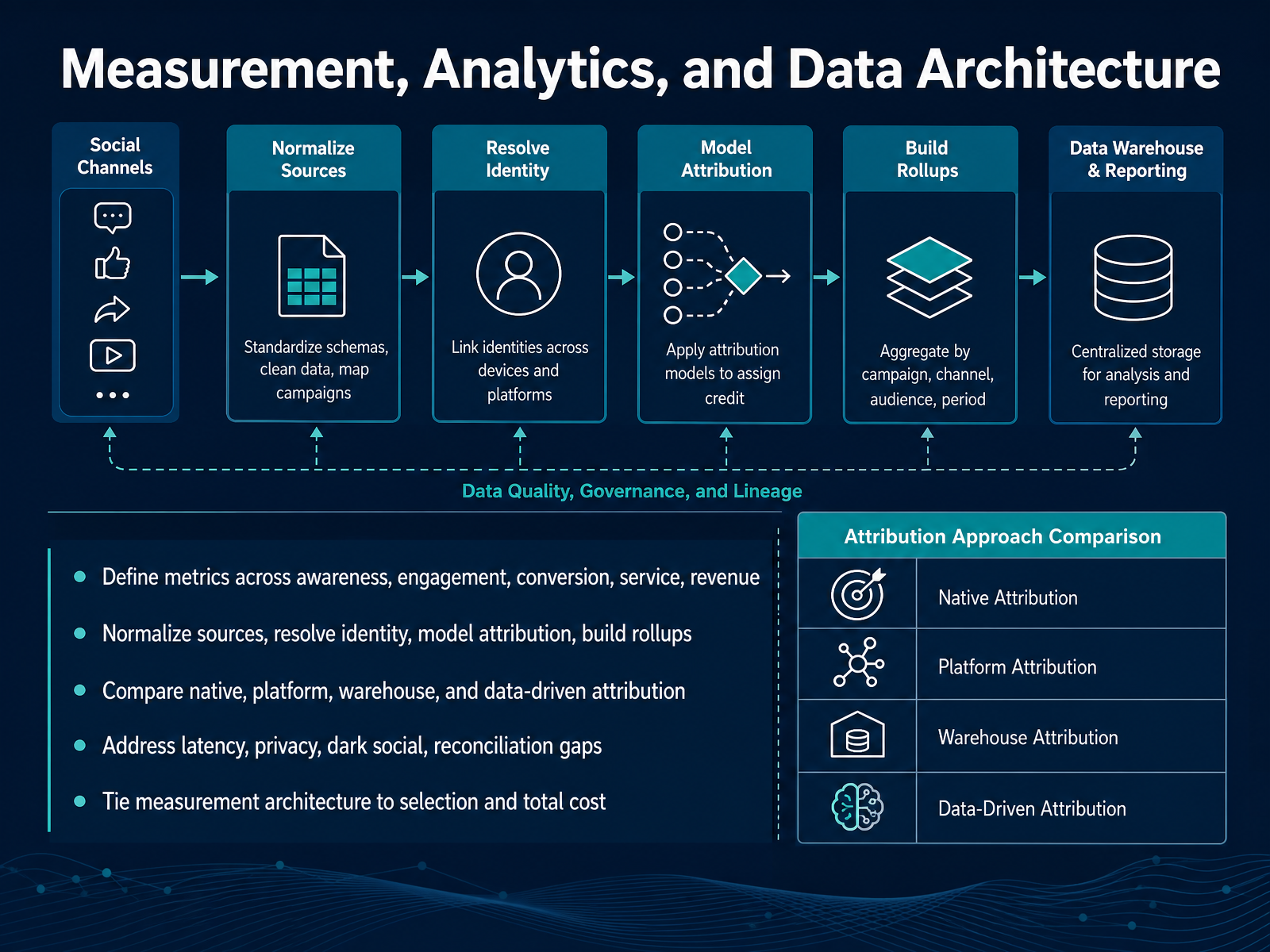
- 10Measurement, Analytics, and Data ArchitectureLet's turn to measurement, analytics, and data architecture. Start by defining metrics across five buckets: awareness, engagement, conversion, service, and revenue. Each one answers a different question, so agree on definitions before you compare vendors. Then normalize sources, resolve identity, model attribution, and build rollups. That pipeline is where most selection decisions get made or regretted. Weigh four attribution approaches: native, platform, warehouse, and data-driven. Native is fast but self-referential. Platform models use their own windows and rarely agree, so a platform count and your analytics count can both be right and still not match. Warehouse models give you control, but you own the engineering. Data-driven needs volume, often hundreds of conversions per month, to stay stable. Plan for latency, privacy limits, dark social showing up as direct traffic, and reconciliation gaps. Report ranges, not false precision. Finally, tie the measurement architecture to total cost, including pipeline maintenance, identity resolution, and change management. Choose the simplest model your decisions can tolerate, and invest the savings in data quality.
 2 min
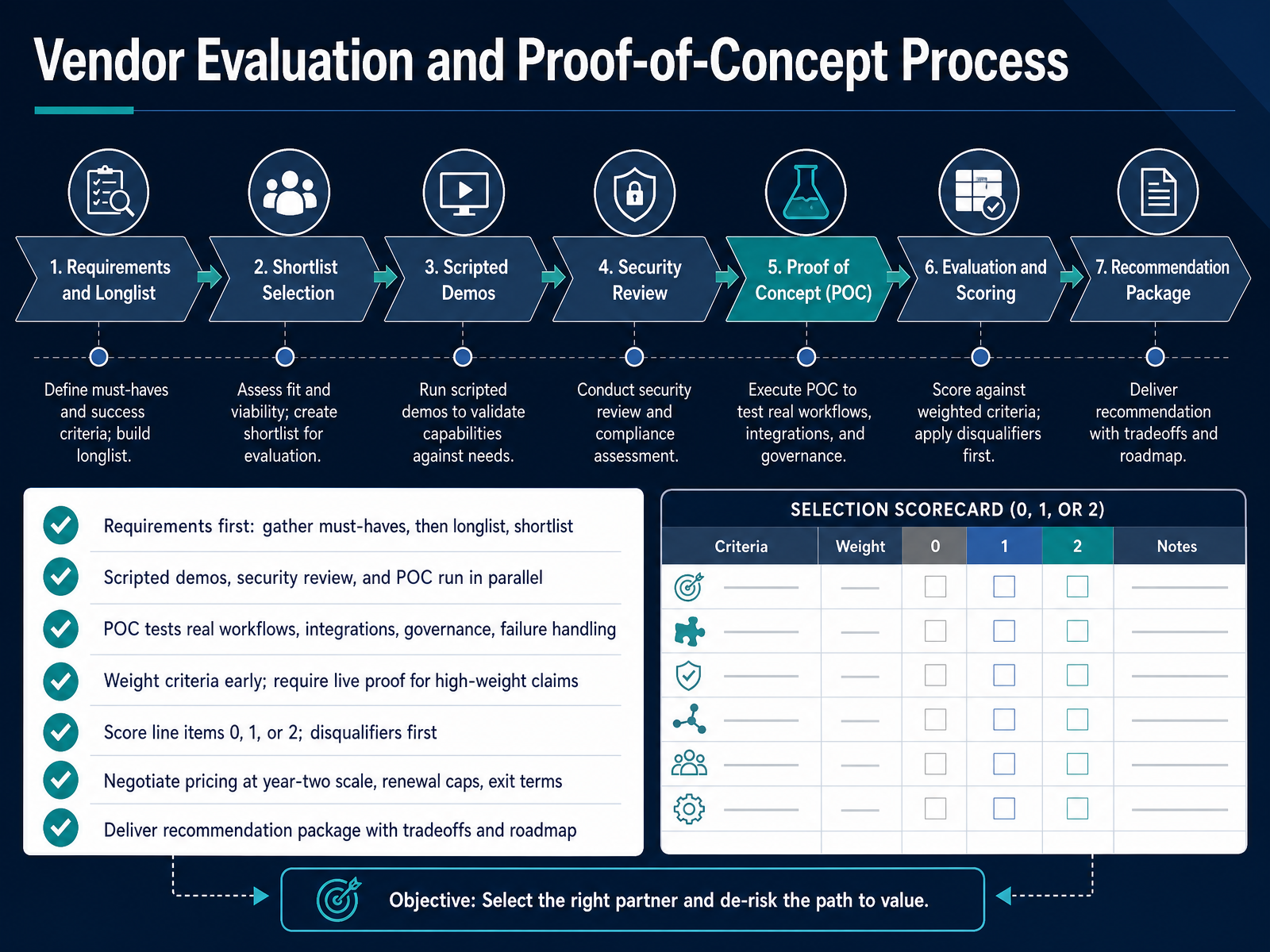
- 11Vendor Evaluation and Proof-of-Concept ProcessNow let's turn to vendor evaluation and the proof-of-concept process. Start with requirements, not vendors. Gather your must-haves first, then build a longlist, then a shortlist. Run scripted demos, the security review, and the proof of concept in parallel so you save weeks. The proof of concept should test real workflows, your integrations, governance rules, and failure handling, not just the happy path. Weight your criteria early, and require live proof for any high-weight claim. Score each line item as zero, one, or two, and apply disqualifiers first, before scoring. On pricing, negotiate at your year-two scale, ask for renewal caps, and settle exit terms. Then deliver a recommendation package that names the tradeoffs and the roadmap. Next, we'll walk through the implementation roadmap and phased rollout.
 apaya.comapaya.comapaya.com+21 min
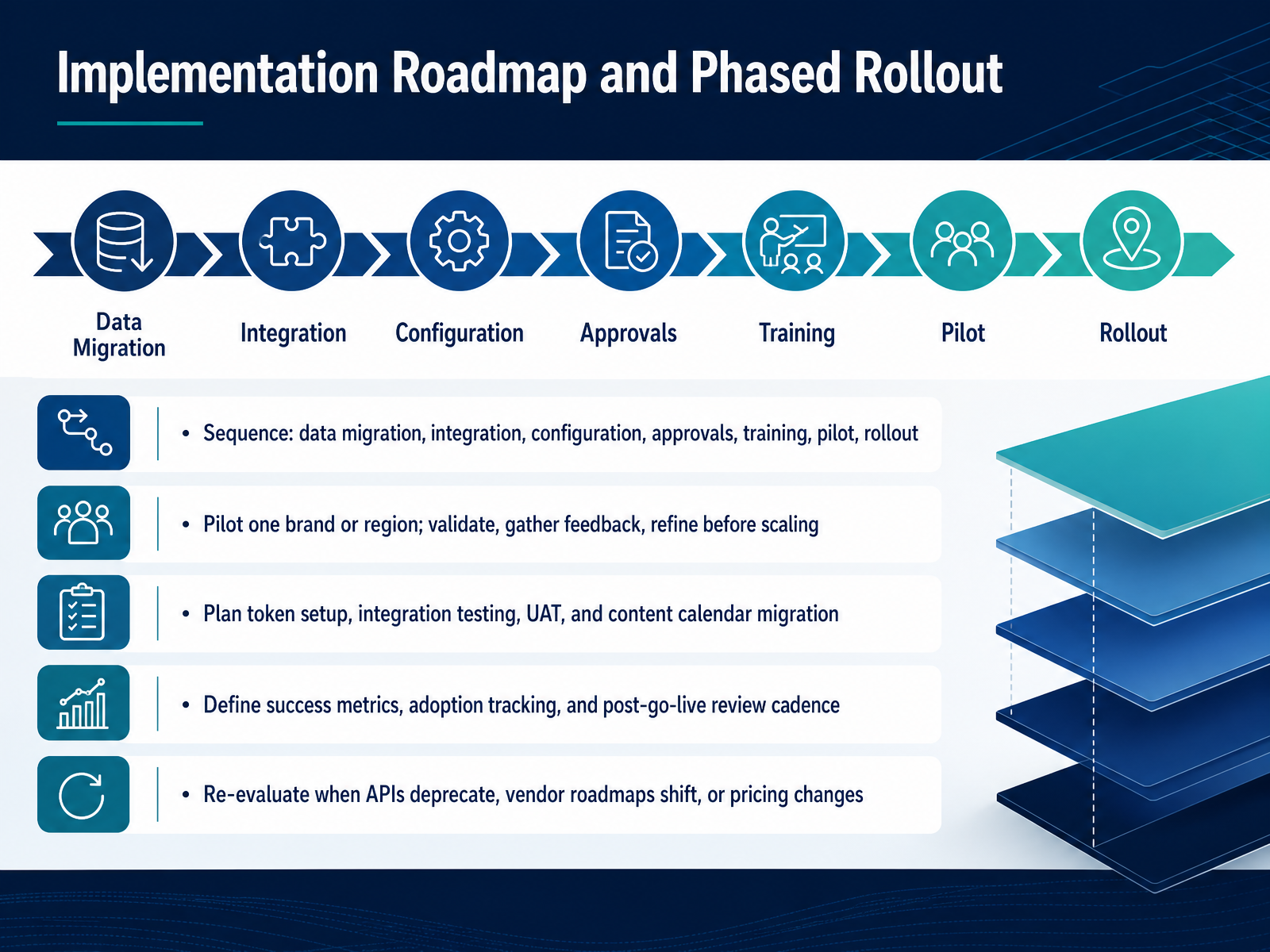
- 12Implementation Roadmap and Phased RolloutNow let's turn to the implementation roadmap and phased rollout. Sequence matters here. Start with data migration, then integration, configuration, and approvals. Training and the pilot come next, and full rollout comes last. Pilot with one brand or one region. Validate the workflow, gather feedback, and refine before you scale. At the same time, plan token setup, integration testing, user acceptance testing, and content calendar migration. Define success metrics up front, track adoption weekly, and book a post go live review. Then revisit the platform when APIs deprecate, vendor roadmaps shift, or pricing changes. Next, we look at change management across teams, agencies, and creators.
 1 min
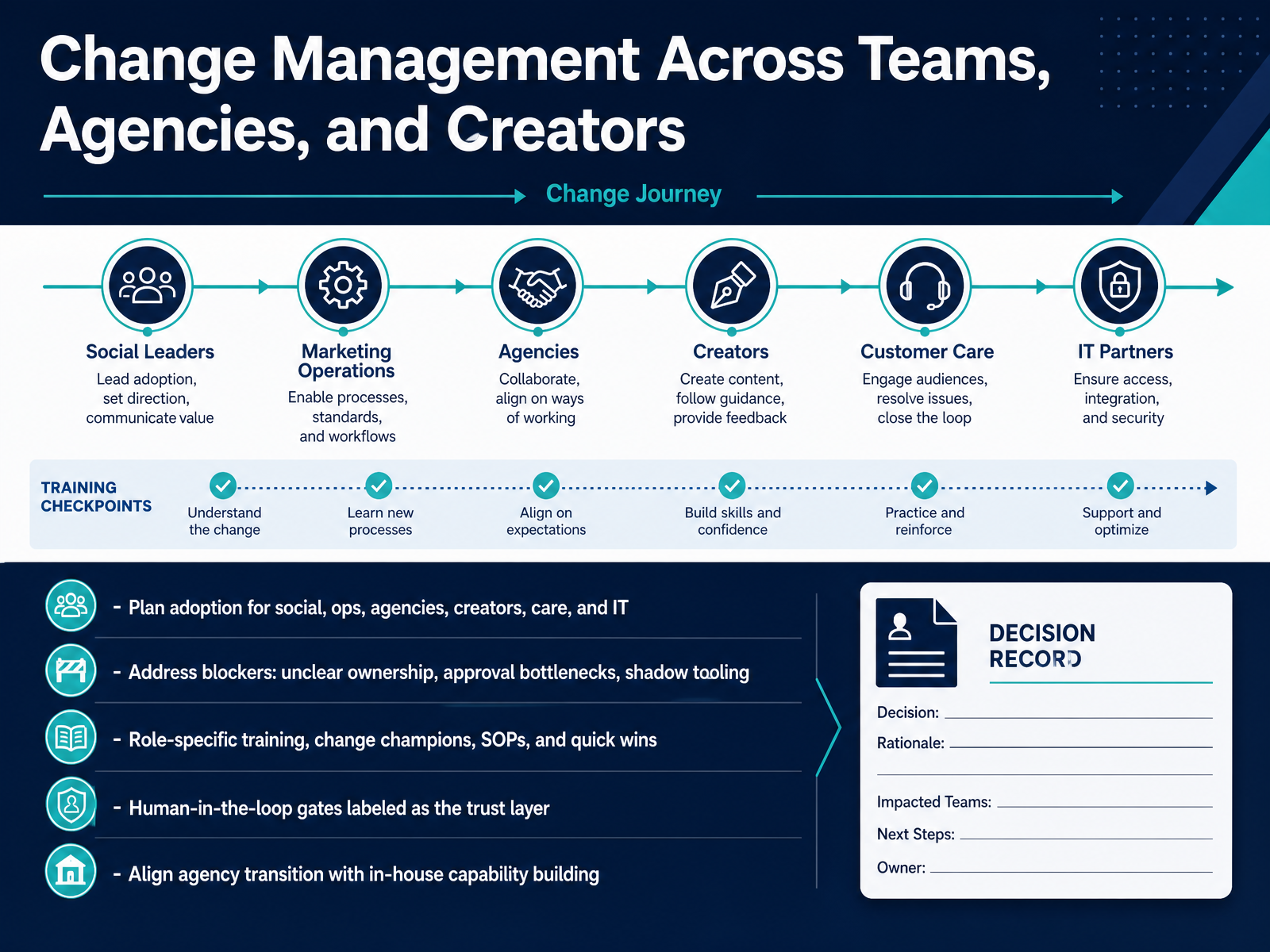
- 13Change Management Across Teams, Agencies, and CreatorsLet us talk about change management across teams, agencies, and creators. Platform adoption is a people problem before it is a technology problem. So plan it for every group that touches social: social teams, marketing operations, agencies, creators, care, and I T. Name the blockers early. Unclear ownership, slow approvals, and shadow tooling are the usual suspects. Address each with role-specific training, change champions, simple S O Ps, and a few visible quick wins. Keep human-in-the-loop gates, and label them honestly as your trust layer. They are the control that makes autonomy safe, not a bottleneck to remove. If you work with agencies, align their transition with your in-house capability building, so knowledge stays when the contract changes. Choose phased rollout when adoption risk is high, and accept slower speed in exchange for real usage. Next, we move to Decision Record, Review Triggers, and Next Steps.
 cloudcampaign.com2 min
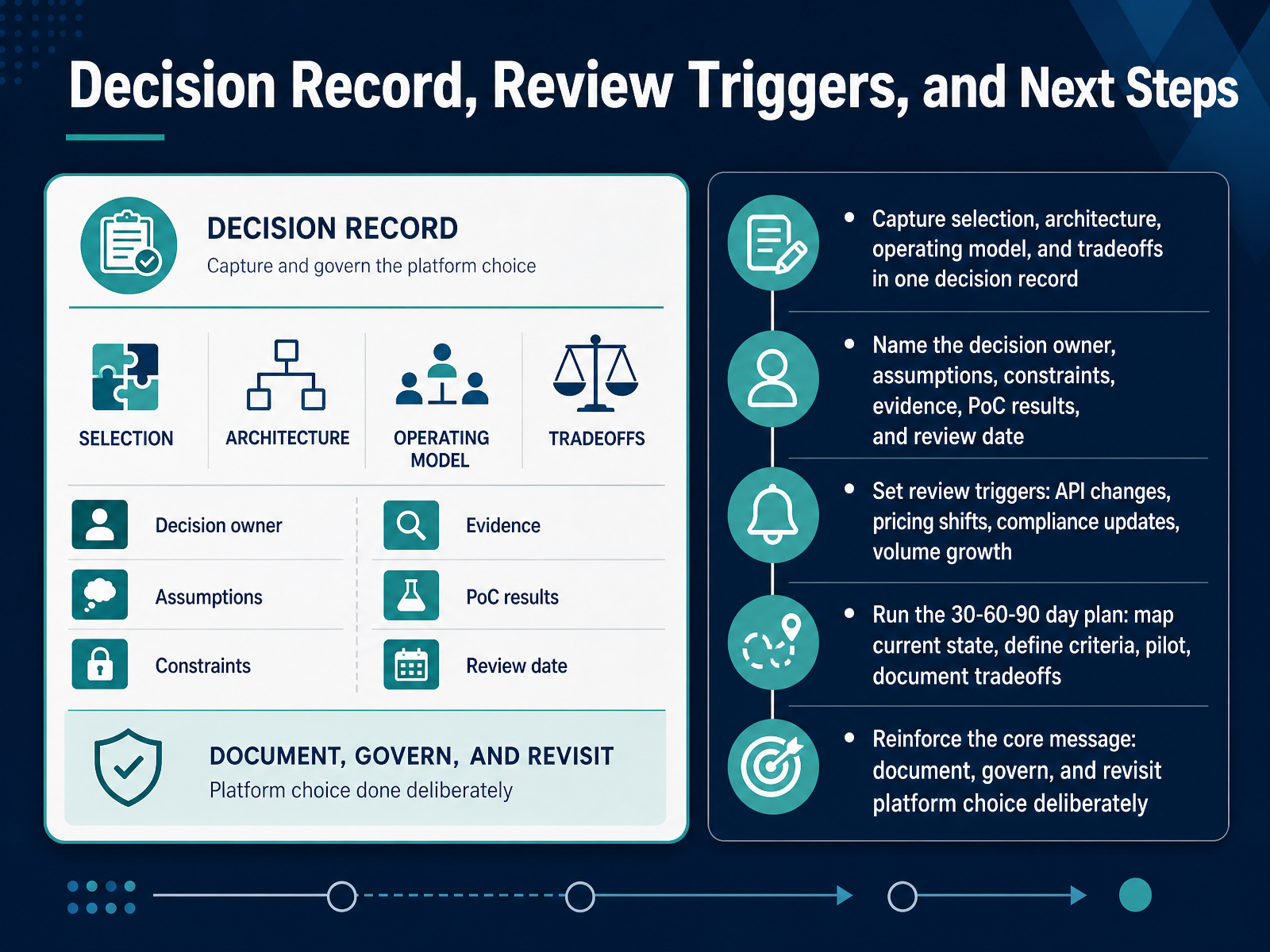
- 14Decision Record, Review Triggers, and Next StepsLet's close this out with how to make your decision stick. Capture your selection, architecture, operating model, and tradeoffs in one decision record. Name the decision owner, the assumptions, the constraints, the evidence, your proof of concept results, and a review date. Then set review triggers, so the decision gets revisited when it should. Watch for API changes, pricing shifts, compliance updates, and volume growth. Your next steps follow a thirty, sixty, ninety day plan. In the first thirty days, map the current state and define your criteria. At sixty days, run your pilot with success criteria agreed up front. At ninety days, document the tradeoffs and move to rollout. Above all, remember the core message: document, govern, and revisit your platform choice deliberately. If you keep that discipline, no single platform decision becomes permanent. Thank you for following along, and good luck with your evaluation.
 apaya.comapaya.comapaya.com+22 min
Take the deck with you
Download this course as a file — free, no sign-up needed.
- PDF handoutEvery slide page, ready to print or share.15 pages · 4.0 MBDownload
- Narrated PowerPointThe deck that presents itself — every slide carries the digital human's narration video.15 pages · 15.4 MBDownload
- PowerPoint slidesThe full deck as a .pptx — open it in PowerPoint, Keynote, or Google Slides.15 pages · 3.8 MBDownload
Free to use in your own training — please keep the PersonWise credit page at the end.
Have your own deck? Turn it into a course
Sources consulted
Web sources consulted while building this course.
- Social Media Management Software Market Size, Share & 2031 Growth Trends Report — mordorintelligence.com
- Top 10 Social Media Management Platforms Compared (2026) — emplifi.io
- Social Media Management Trends (2026) — Market Analysis | ProPicked — propicked.com
- Social Media Management Software Market Report 2026 — researchandmarkets.com
- The 10 best social media management tools in 2026 — zapier.com
- Enterprise Architecture Blueprint for an AI Social Media & Content Management Platform — codersarts.com
- OwnSocial — Publish. Engage. Listen. Convert. Measure. — Own360.ai — own360.ai
- Part 1: Application Overview — appexchange.salesforce.com
- Hootsuite: Social Media Marketing and Management Tool — hootsuite.com
- AI-Powered Social Media Management Platform — sprinklr.com
- How to Evaluate Social Media Management Platforms - Apaya — apaya.com
- Social Media Management Software RFP Template - Apaya — apaya.com
- Social Media Software Security Requirements for Enterprise Buyers - Apaya — apaya.com
- 7 Ways to Evaluate the Best Social Media Management Platform — emplifi.io
- Social Media API Rate Limits: What Breaks at Scale in 2026 - Blotato — blotato.com
- Rate Limits — developers.facebook.com
- Social Media API Rate Limits: Backoff & Jitter (2026 Guide) — social-api.ai
- Social Media API Integration Guide (2026) — bundle.social
- Social Media API Rate Limits (2026) — Aether — aetherhq.dev
- Building vs. Buying Social Media Software: What SaaS Teams Should Know Before Adding Social Media Management | Cloud Campaign — cloudcampaign.com