Begin
14 pages · ~28 min
McKinsey Change Management Practices
This course introduces McKinsey's change management practices, helping leaders and managers plan and sustain organizational change effectively.
A digital instructor presents all 14 pages. Hold “Ask” at any point and ask out loud — the answer comes from this course. No sign-up needed.
What you’ll learn
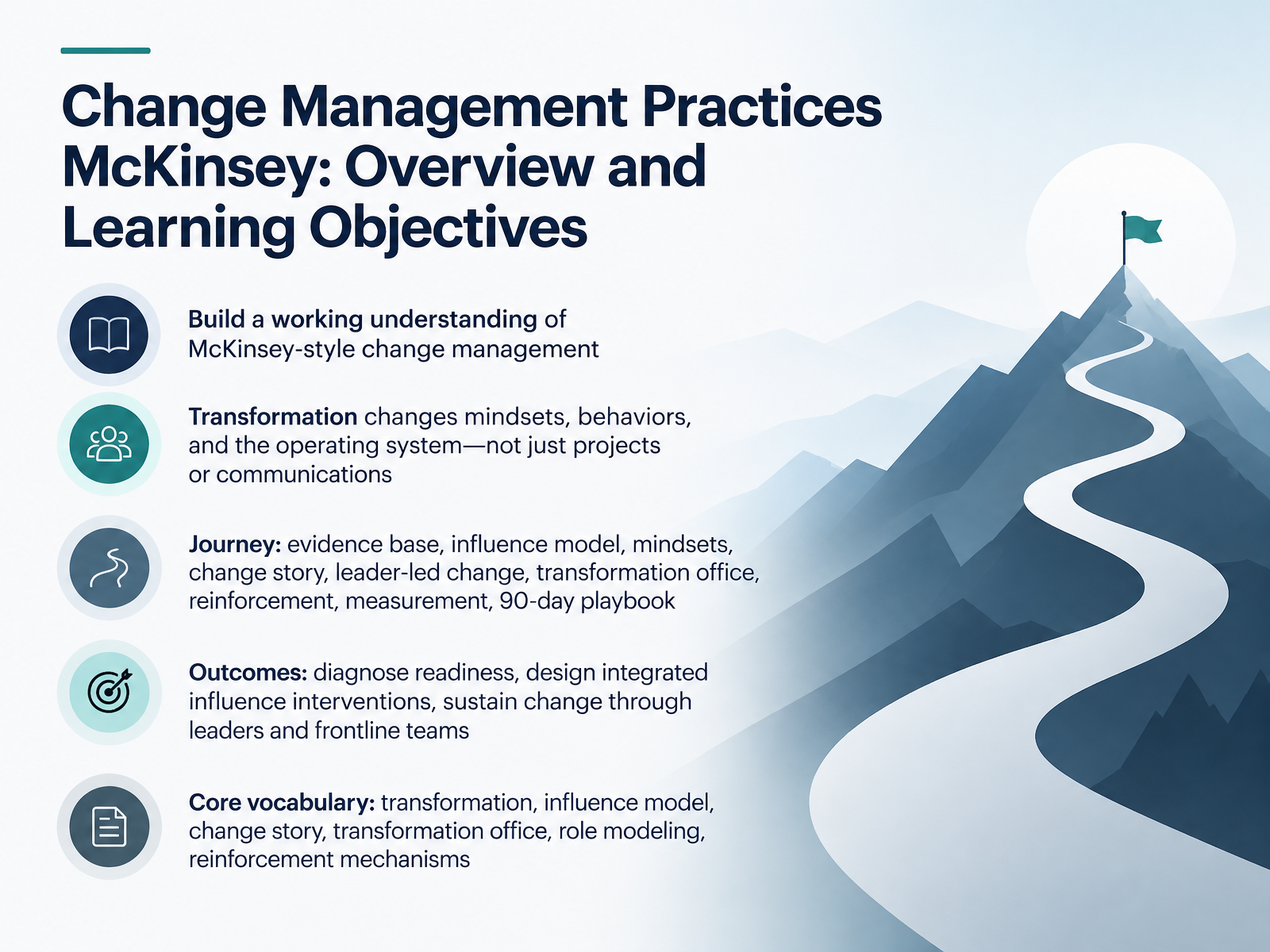
- 01Change Management Practices McKinsey: Overview and Learning ObjectivesWelcome. Over the next fourteen short slides, we will build a working understanding of McKinsey-style change management, and you will leave with practices you can use in your own transformation.
Here is the framing that matters. Transformation is not a set of projects or a communications campaign. It changes mindsets, behaviors, and the operating system of the organization. That is harder, and it is where most of the real work sits.
Our journey runs in a deliberate sequence. We start with the evidence base. Then the influence model, mindsets, and the change story. From there, leader-led change, the transformation office, reinforcement mechanisms, and measurement. We close with a ninety-day playbook.
By the end, you should be able to diagnose readiness, design influence interventions that work together rather than in isolation, and sustain change through leaders and frontline teams. Along the way, you will pick up the core vocabulary. Transformation, influence model, change story, transformation office, role modeling, and reinforcement mechanisms. Notice these are practical tools, not slogans.
Before we move on, one checkpoint for your next team meeting. Ask the room to name your transformation in one sentence. Is it projects and communications, or is it mindsets, behaviors, and the operating system? The answer tells you where to start.
Let us begin with Why Change Efforts Fail: The Evidence Base.mckinsey.commckinsey.commckinsey.com+22 min
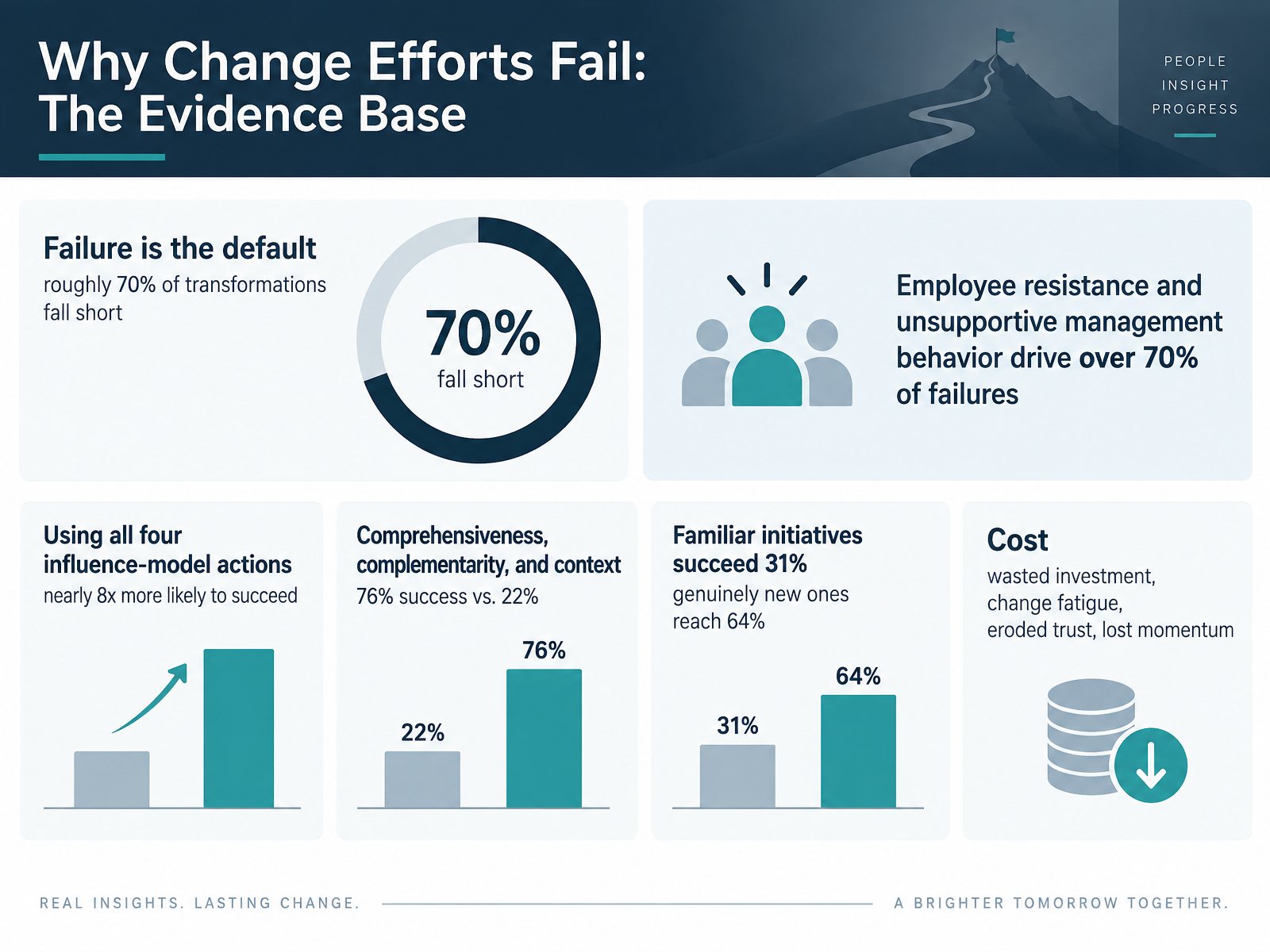
- 02Why Change Efforts Fail: The Evidence BaseLet's look at what the evidence actually tells us about failure. The base rate is sobering. Roughly seventy percent of transformations fall short. And the main drivers are not budgets or strategy. They are behavior. Employee resistance and unsupportive management behavior account for more than seventy percent of failures. So pause here and ask, where is your leadership behavior quietly working against the change? Now, the good news. When companies use all four influence model actions together, they are nearly eight times more likely to succeed than using just one. Comprehensiveness matters. When initiatives are comprehensive, complementary, and fit the context, seventy six percent succeed, versus twenty two percent when none of those elements are present. And novelty pays. Familiar initiatives succeed about thirty one percent of the time. Genuinely new ones reach sixty four percent. The cost of ignoring this is real. Wasted investment, change fatigue, eroded trust, and lost momentum. Before we move on, check one thing: are your current initiatives genuinely new, and do they draw on all four actions? Next, we will walk through the Influence Model, four building blocks that must work together.
 mckinsey.commckinsey.commckinsey.com+22 min
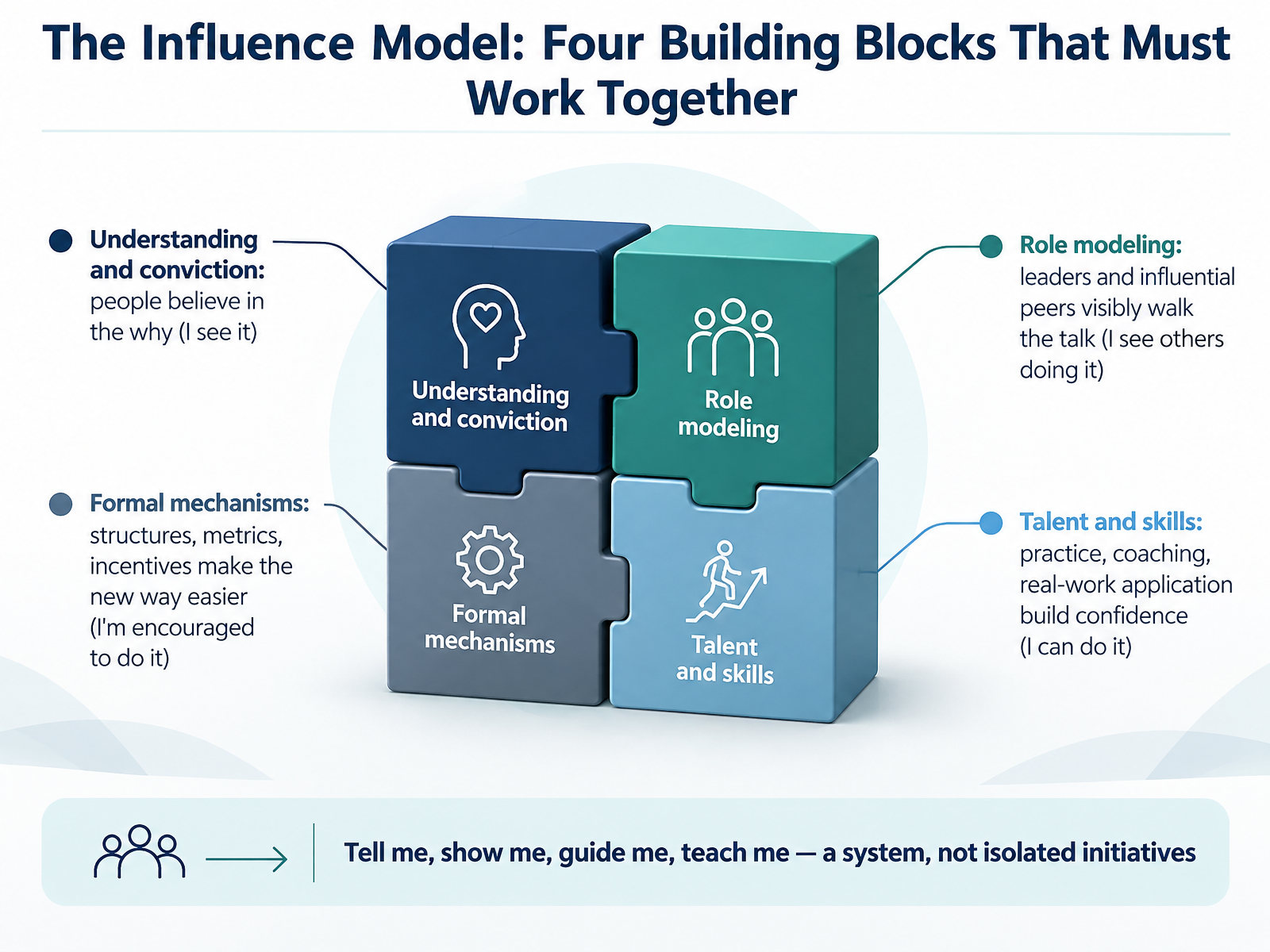
- 03The Influence Model: Four Building Blocks That Must Work TogetherLet's look at the engine behind all of this. McKinsey's Influence Model gives us four building blocks, and the critical word is together. Understanding and conviction is the first. People need to see it. In practice, that means a change story that answers why now, and why this matters for their team, not just for the company. Second, role modeling. People need to see others doing it. Leaders and influential peers visibly walk the talk, and yes, that includes people who don't hold formal authority. Third, formal mechanisms. Structures, metrics, and incentives should make the new way easier, not harder. If the scorecard rewards the old behavior, the old behavior wins. Fourth, talent and skills. Practice, coaching, and real work application build confidence, so people can honestly say, I can do it. Tell me, show me, guide me, teach me. That is one system, not four isolated initiatives. Here's your checkpoint. At your next team meeting, ask which of the four blocks is weakest in your current change, and name one action this week to strengthen it. This brings us to mindsets and behaviors, the heart of transformation.
 hbs.edumckinsey.commckinsey.com+22 min
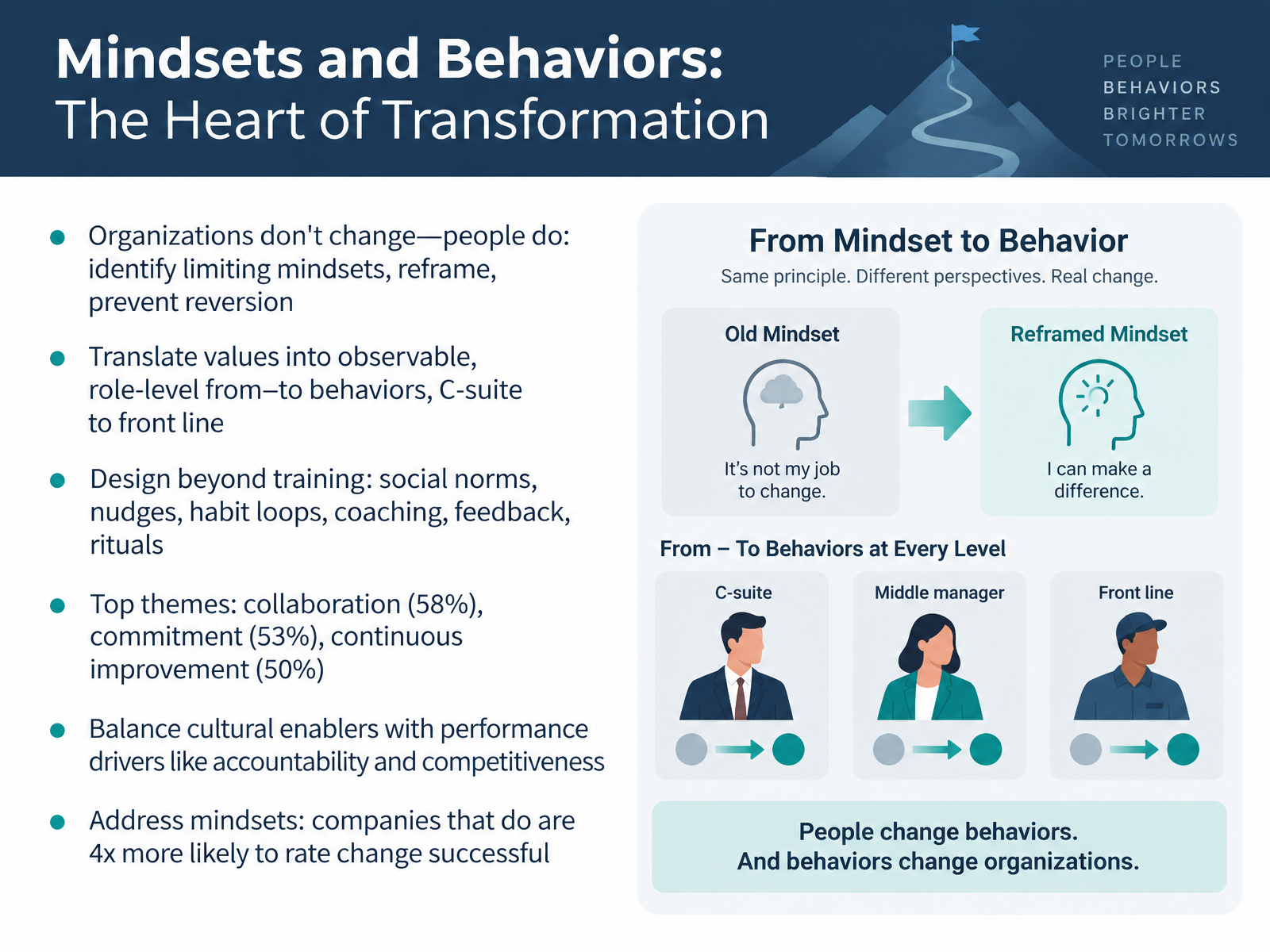
- 04Mindsets and Behaviors: The Heart of TransformationLet's turn to where transformation actually lives: mindsets and behaviors. Organizations don't change. People do. So start by naming the limiting mindsets in your team, reframe them, and build in safeguards against reversion. Then translate your values into observable from-to behaviors at every level, from the C-suite to the front line. And design beyond training. Think social norms, nudges, habit loops, coaching, feedback, and rituals. The most common themes are collaboration at fifty-eight percent, commitment at fifty-three percent, and continuous improvement at fifty percent. But balance those cultural enablers with performance drivers like accountability and competitiveness. The payoff is real. Companies that address mindsets are four times more likely to rate change successful. Your checkpoint: pick one role this week and draft its from-to behavior pair. Next, we look at crafting a change story that creates conviction.
 mckinsey.commckinsey.commckinsey.com+21 min
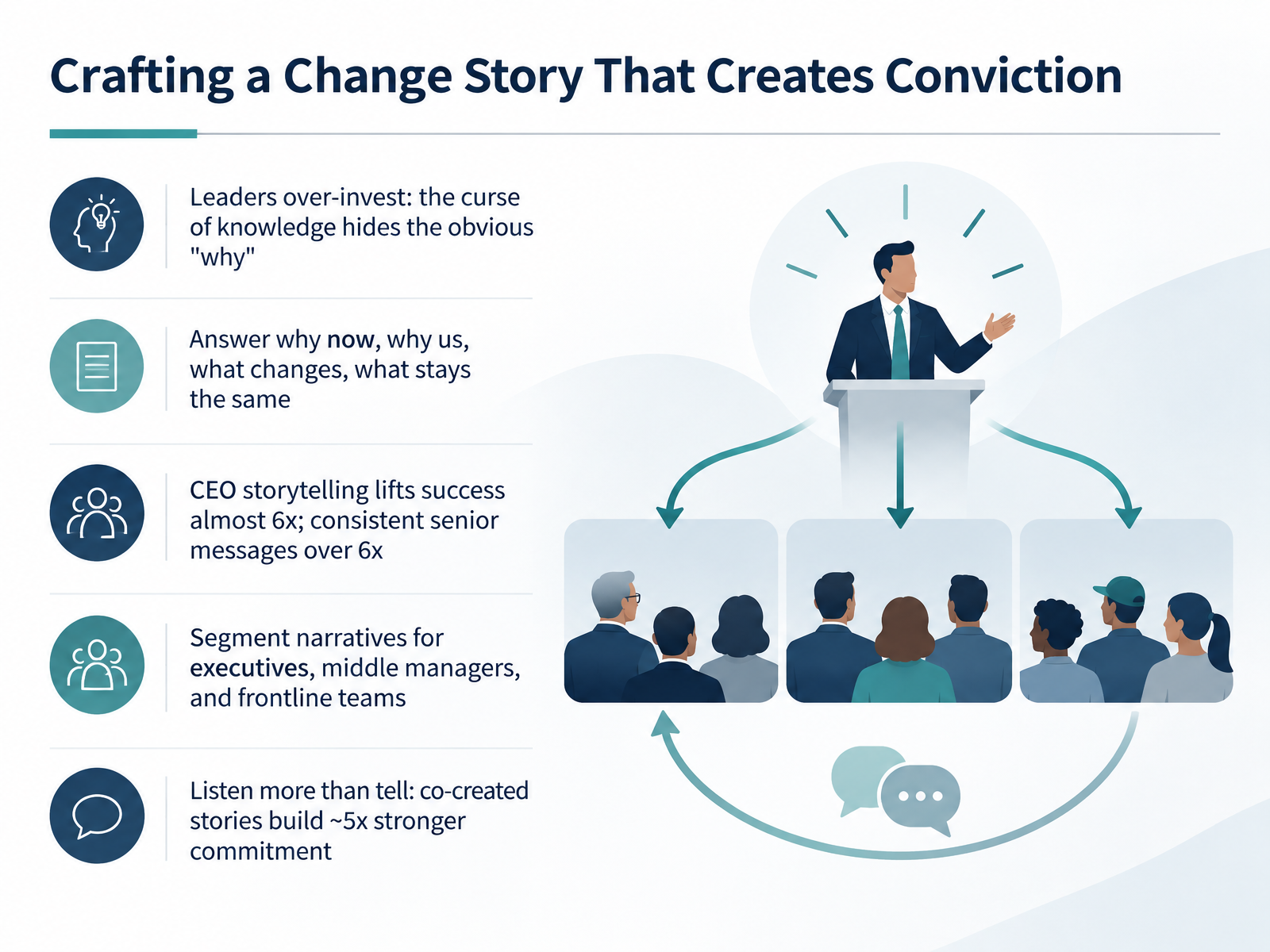
- 05Crafting a Change Story That Creates ConvictionLet's talk about the change story. And here is the trap leaders fall into. You have lived with this change for months. The reasoning feels obvious to you, so you skip the why and go straight to the slides. Your people do not have that context. They need four answers: why now, why us, what changes, and what stays the same. The data is striking. When the CEO tells a compelling change story, success odds rise almost six times. When senior leaders share consistent, complementary messages, it's more than six times. But one story does not fit everyone. Segment. Executives need the business case. Middle managers need the decisions they will own. Frontline teams need to know what changes on Monday morning. And listen more than tell. When people co-create the story, commitment runs roughly five times stronger. So here is your checkpoint for the next team meeting: ask three people in different roles to retell the why in their own words. What you hear tells you whether the story is landing. Next, we look at leader-led change and how to align the top and the middle.
 2 min
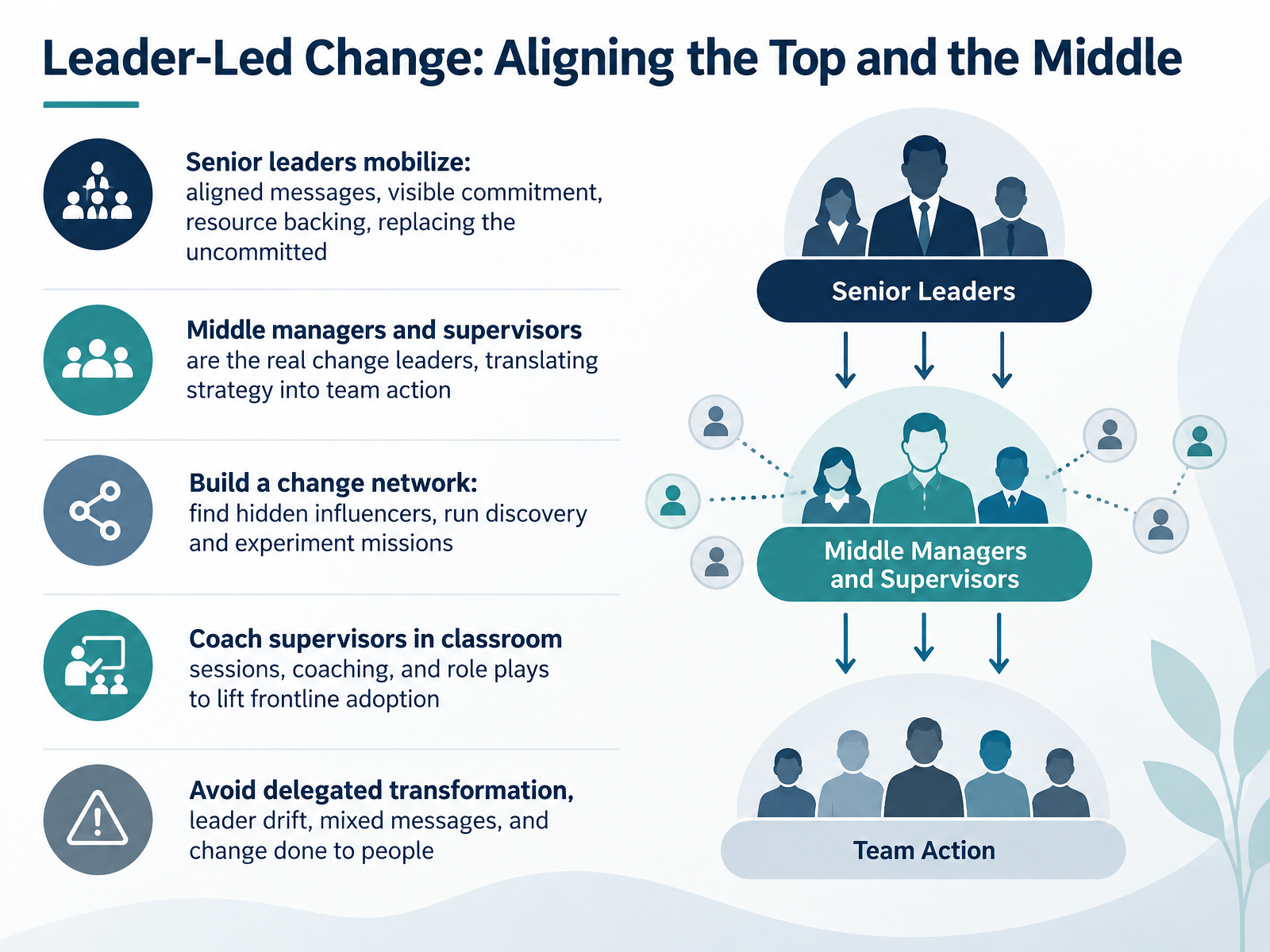
- 06Leader-Led Change: Aligning the Top and the MiddleNow let's talk about aligning the top and the middle. Senior leaders set the conditions. They send aligned messages, show visible commitment, back the change with resources, and yes, replace people on their teams who are not committed. But the real change leaders sit in the middle. Supervisors translate strategy into team action, and they carry the practical burden of shifting behavior. So build a change network. Find the hidden influencers through a short survey, then run discovery and experiment missions. At one financial services company, that approach turned skeptics into champions, and ninety-six percent agreed the new behaviors would improve performance. Then equip supervisors to lift frontline adoption. A national sales force trained its area managers in central academies, backed that with classroom sessions, coaching, and role plays, and raised lead conversion by twenty percent in a year. Three traps to name and avoid: delegated transformation, leader drift, and mixed messages. Change done to people gets rejected. Here is your checkpoint for the next team meeting. Name your pivotal middle role, the one closest to the work that must change, and confirm those people have both the tools and the will. That leads us to the Transformation Office: Governance and Execution Rhythm.
 mckinsey.com2 min
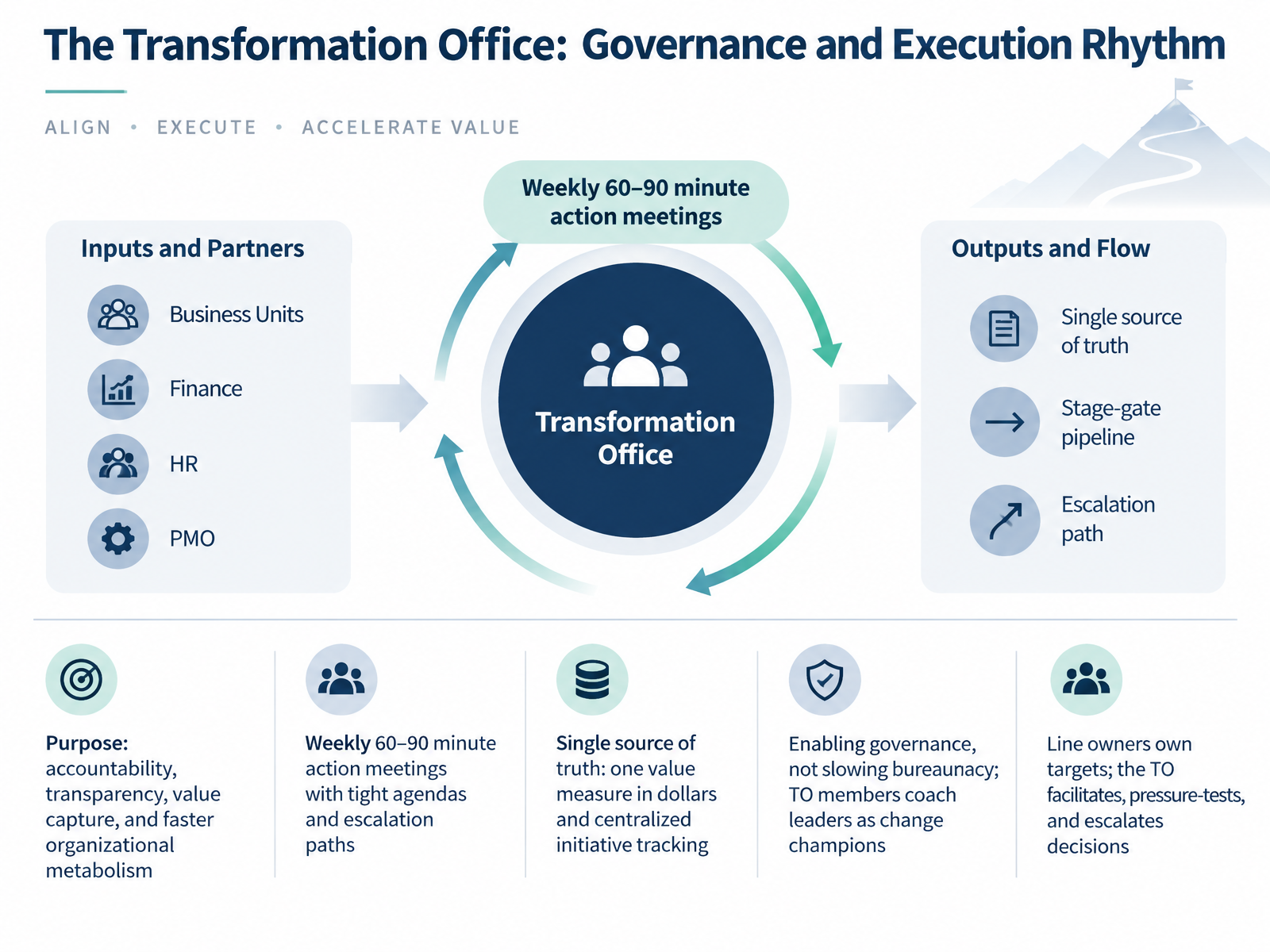
- 07The Transformation Office: Governance and Execution RhythmLet's turn to the engine room of any transformation: the Transformation Office. Its purpose is accountability, transparency, value capture, and a faster organizational metabolism. Picture a weekly action meeting, sixty to ninety minutes, with a tight agenda and a clear escalation path. One source of truth matters here: a single value measure in dollars, and one centralized tracker. Say a business unit claims savings. The TO pressure-tests that number against the single value measure. This is enabling governance, not slowing bureaucracy. TO members coach leaders as change champions, and line owners own the targets while the TO facilitates and escalates decisions. Before your next meeting, check one thing: does every initiative have a named line owner and a dollar value agreed in one place? Once that rhythm holds, the work shifts to sustaining momentum. Moving Fast and Reinforcing: Making Change Stick.
 2 min
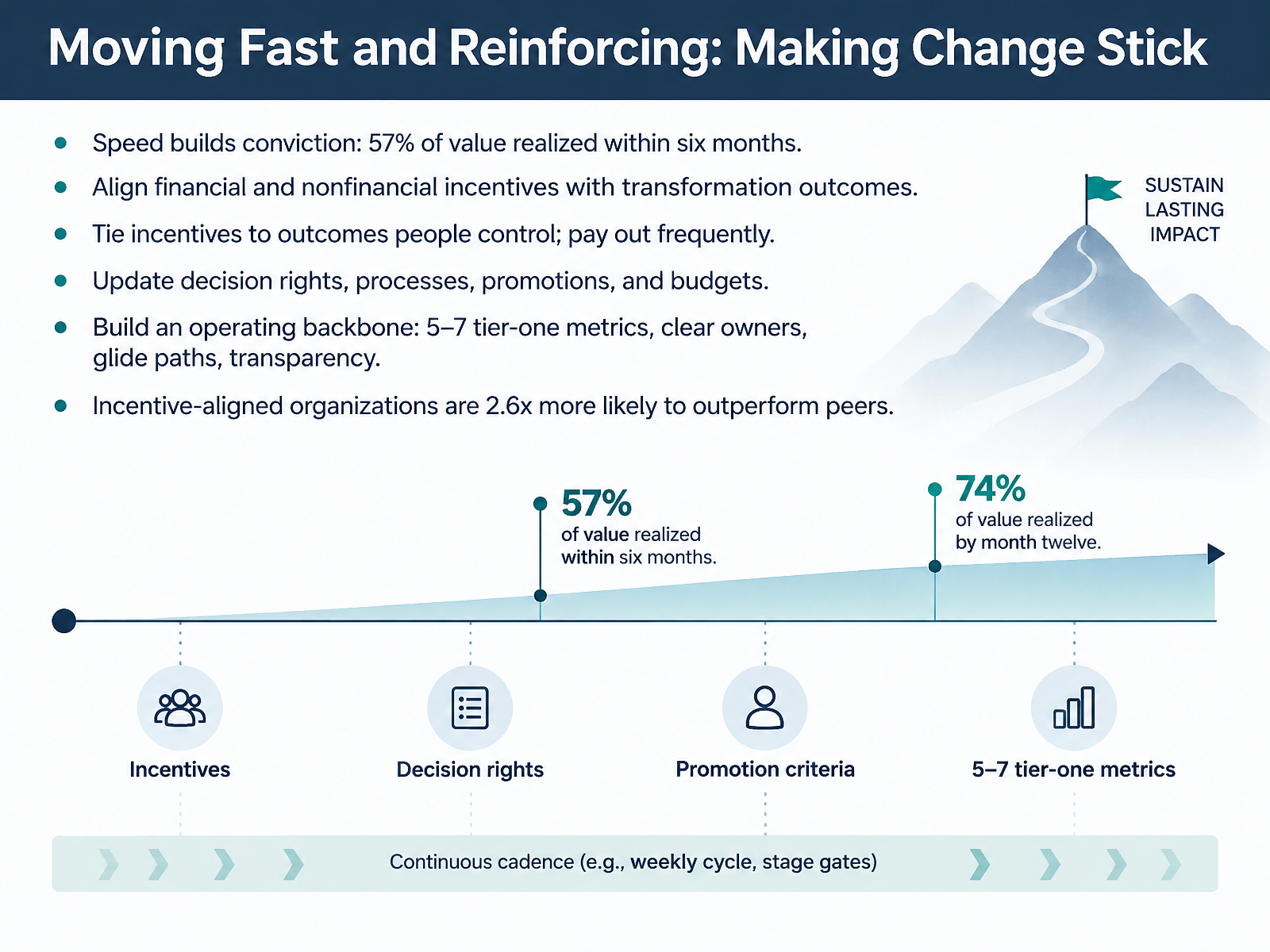
- 08Moving Fast and Reinforcing: Making Change StickLet's turn to making change stick, because momentum fades when nothing reinforces it. Speed builds conviction. McKinsey finds that fifty-seven percent of transformations realizing impact within six months improved and sustained performance. So pursue quick wins early. Reinforce with incentives, financial and nonfinancial, tied to outcomes people actually control. Pay out frequently. One transformation leader paid quarterly and wished he had paid monthly. Align decision rights, processes, promotions, and budgets, not just the bonus plan. And build an operating backbone: five to seven tier-one metrics, clear owners, glide paths, and real-time transparency. On the numbers, incentive-aligned organizations are two point six times more likely to outperform peers. Here is your checkpoint for your next leadership meeting: name your five to seven tier-one metrics, confirm one owner for each, and check whether every incentive ties to an outcome that owner controls. Then we move to measuring change and diagnosing readiness.
 mckinsey.commckinsey.com2 min
- 09Measuring Change and Diagnosing ReadinessSo let's turn to measurement. Track both leading and lagging indicators: adoption, behaviors, mindsets, organizational health, and business outcomes. Use pulse surveys and listening channels to spot resistance and fatigue early, before they harden. Establish a readiness baseline across ten categories, covering holistic performance and business reinvention. Now, a caution. Only twenty-nine percent of tracked metrics are actively used. The rest become statistical noise. So keep the set focused and tie each metric to a decision. Set a target that eighty percent of initiatives are updated weekly, and act on intervention triggers, not just produce another report. Here's your checkpoint for the next team meeting: identify one metric you track but never act on, and either retire it or assign a trigger to it. Next, we'll look at diagnosing readiness and selecting critical behaviors.
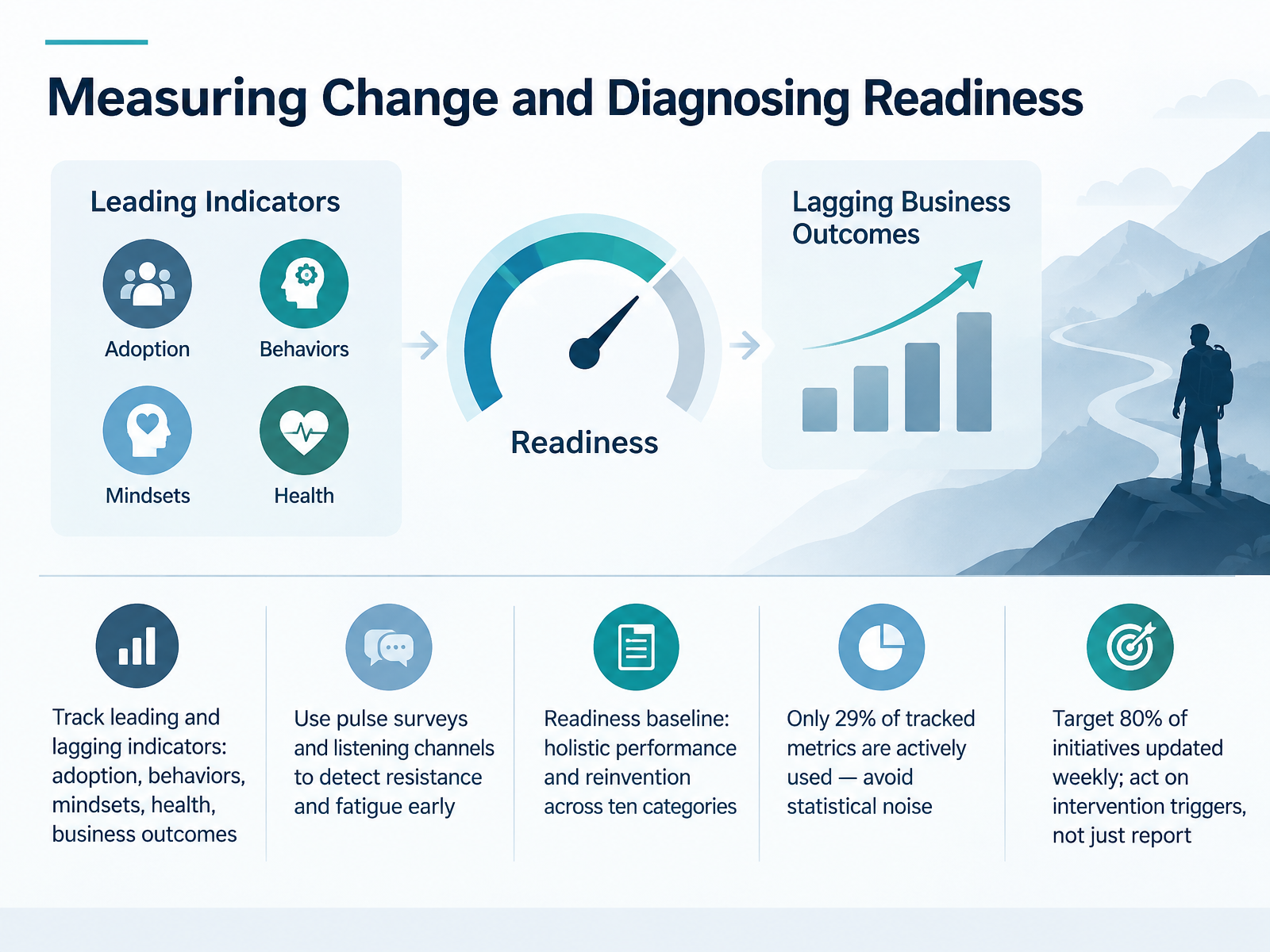 1 min
- 10Diagnosing Readiness and Selecting Critical BehaviorsLet's move into diagnosing readiness and selecting critical behaviors. Start with a baseline. Measure current performance and organizational health across your change portfolio, so you know what you are actually moving from. Next, map stakeholders. Assess impact by role, then segment by job level and function. Now here is where many teams go wrong. They build a wish list of every behavior they want improved. Don't. Identify the critical few from-to shifts, the handful that unlock the rest. Target pivotal roles and hidden influencers first. In one plant, it was a respected shift supervisor who quietly set the tone, not the director. Finally, run the checklist. Is leadership aligned? How much change fatigue exists? Where are the capability gaps? And are your mechanisms, from incentives to metrics, aligned with the new behaviors? Your checkpoint for your next team meeting: name one critical behavior and one misaligned mechanism you will fix this month. That naturally leads us to designing an integrated influence plan.
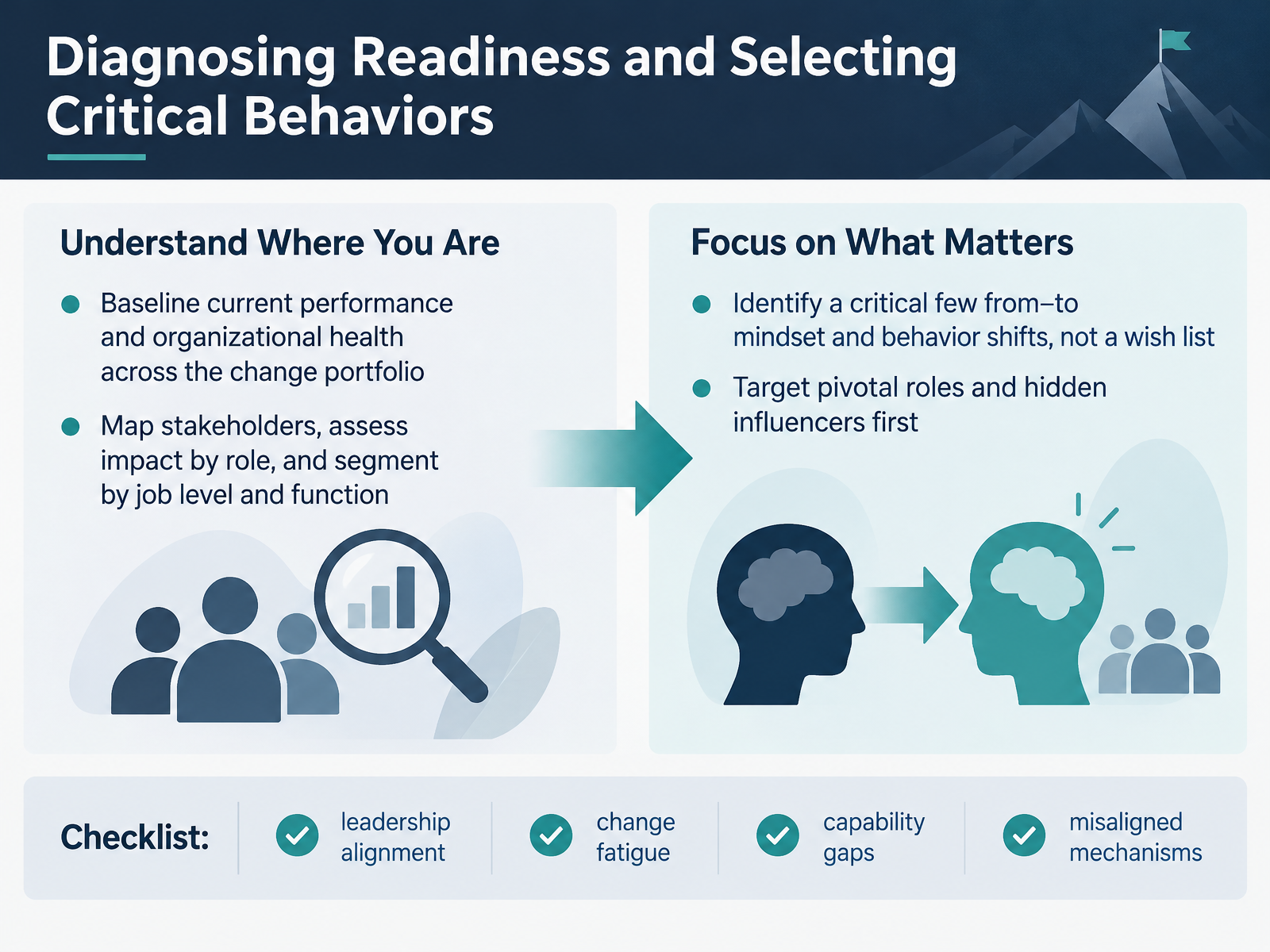 2 min
- 11Designing an Integrated Influence PlanNow let's bring the four levers together into one integrated influence plan. Start by personalizing actions across conviction, role modeling, formal mechanisms, and skills. Your finance lead may need evidence and a clear mandate, while your frontline supervisor needs practice and peer support. Anchor every action in the change story: where we are, where we are going, and how we get there. Then assign clear accountabilities and build a coalition of supported change champions. Use quick wins in the first six months to build momentum, and run sprints in parallel for the complex work. Finally, deploy nudge-based and tech-enabled actions at scale, and track progress in real time. Here is your checkpoint for the next team meeting: map one action to each lever, and name the owner for each. That simple grid exposes gaps fast. Next, we will look at standing up a lightweight transformation office and cadence.
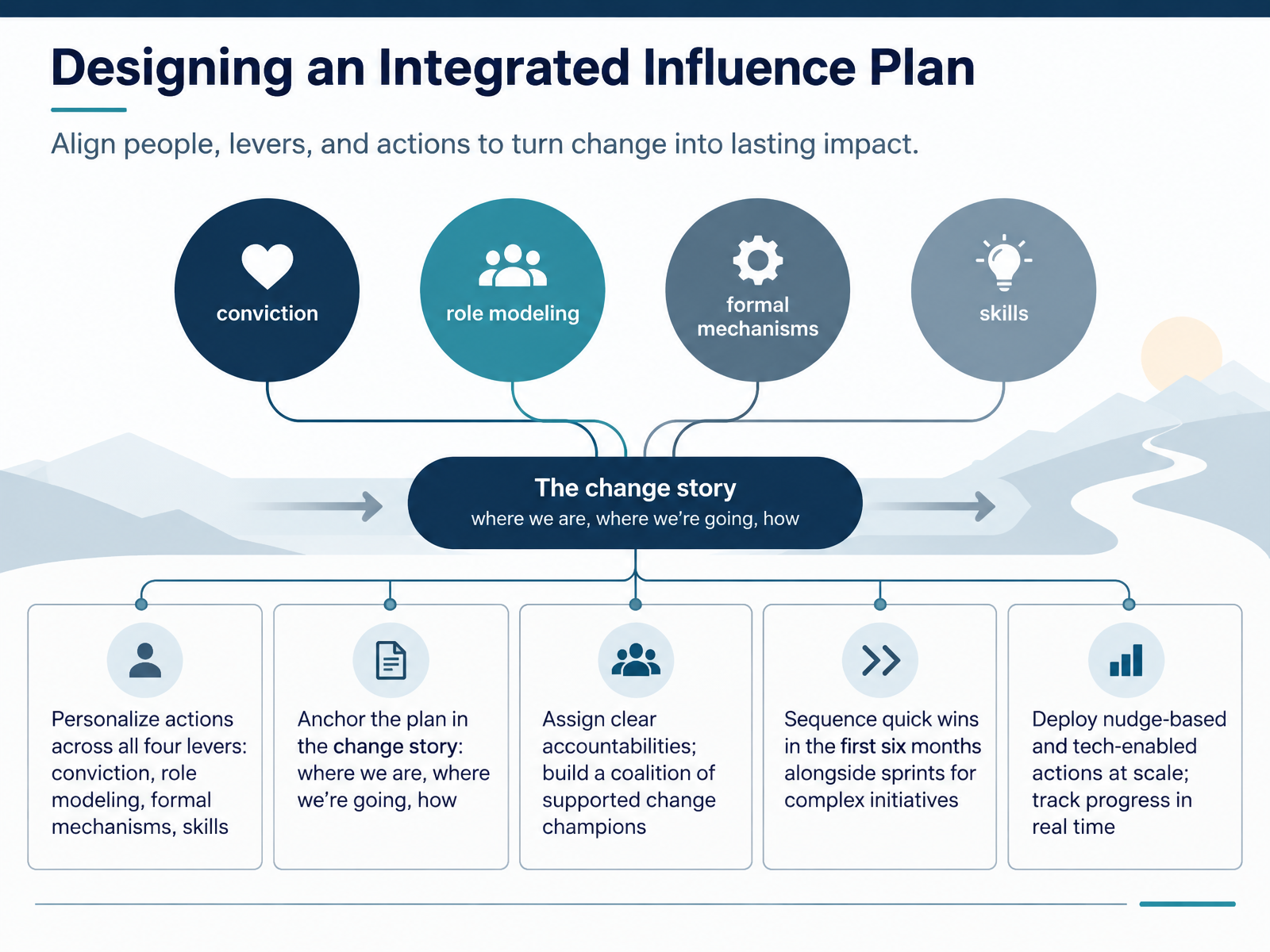 2 min
- 12Standing Up a Lightweight Transformation Office and CadenceLet's turn to the operating engine of your change effort: a lightweight transformation office and a steady cadence. You decide three things up front. Mandate: what decisions can this office make, and what does it escalate? Structure: a small core team, not a new layer of bureaucracy. Key roles: who owns initiatives, who chairs the steering forum, who tracks value. Now staff it carefully. Put strong people in the office and appoint a capable chief transformation officer with credibility on both sides of the business. Embed the office in existing structures. Use the forums you already have. Run a weekly rhythm: initiative reviews, steering forums, clear escalation, and progress tracking. Keep one source of truth, covering initiatives, owners, value, and progress. And watch the trade-off. The office succeeds by removing roadblocks, coaching owners, and driving decisions, not by producing reports. Here is your checkpoint for the next team meeting: agree your mandate, structure, and key roles in one page before you hire anyone. That clarity prevents months of drift. Next, we look at equipping managers to lead team-level change.
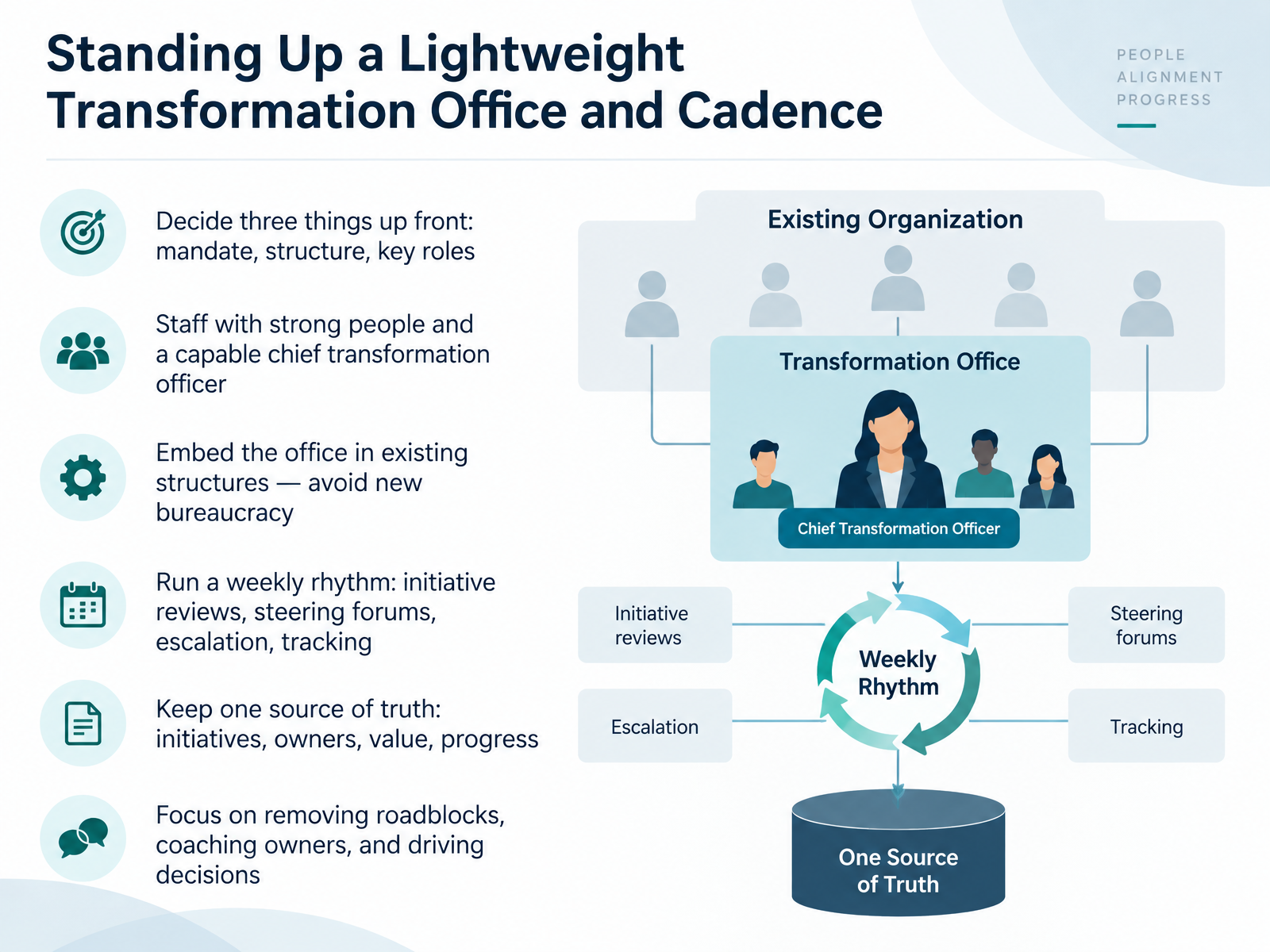 2 min
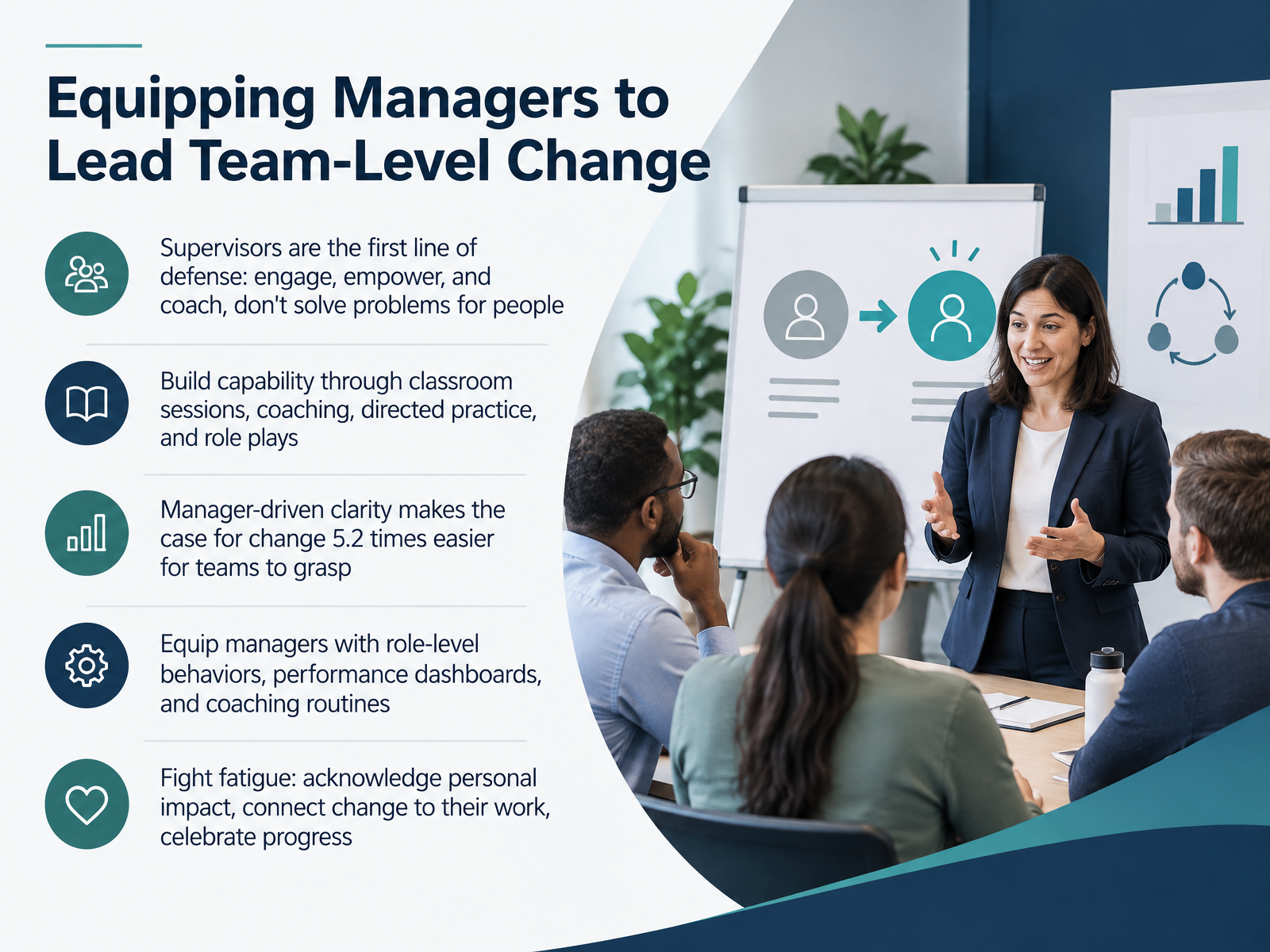
- 13Equipping Managers to Lead Team-Level ChangeNow let's focus on the people who make change real for your teams: their direct managers. Supervisors are your first line of defense. Their job is to engage, empower, and coach, not to solve problems for people. When a team member hits a snag, resist the urge to jump in. Let the silence sit. Ask questions. Let them build their own solution and their confidence along with it.
Build manager capability deliberately, through classroom sessions, coaching, directed practice, and role plays. This matters because when managers make the case for change clear, teams grasp it five point two times more easily. Equip them with role-level behaviors, performance dashboards, and simple coaching routines.
And fight fatigue. Acknowledge the personal impact. Connect the change to their daily work. Celebrate progress.
Here is your checkpoint for the next team meeting: ask each manager which one behavior they will practice this week, and how you will coach them on it.
Next, we turn to First Ninety Days: A Practical Playbook and Common Pitfalls.
 mckinsey.commckinsey.commckinsey.com+22 min
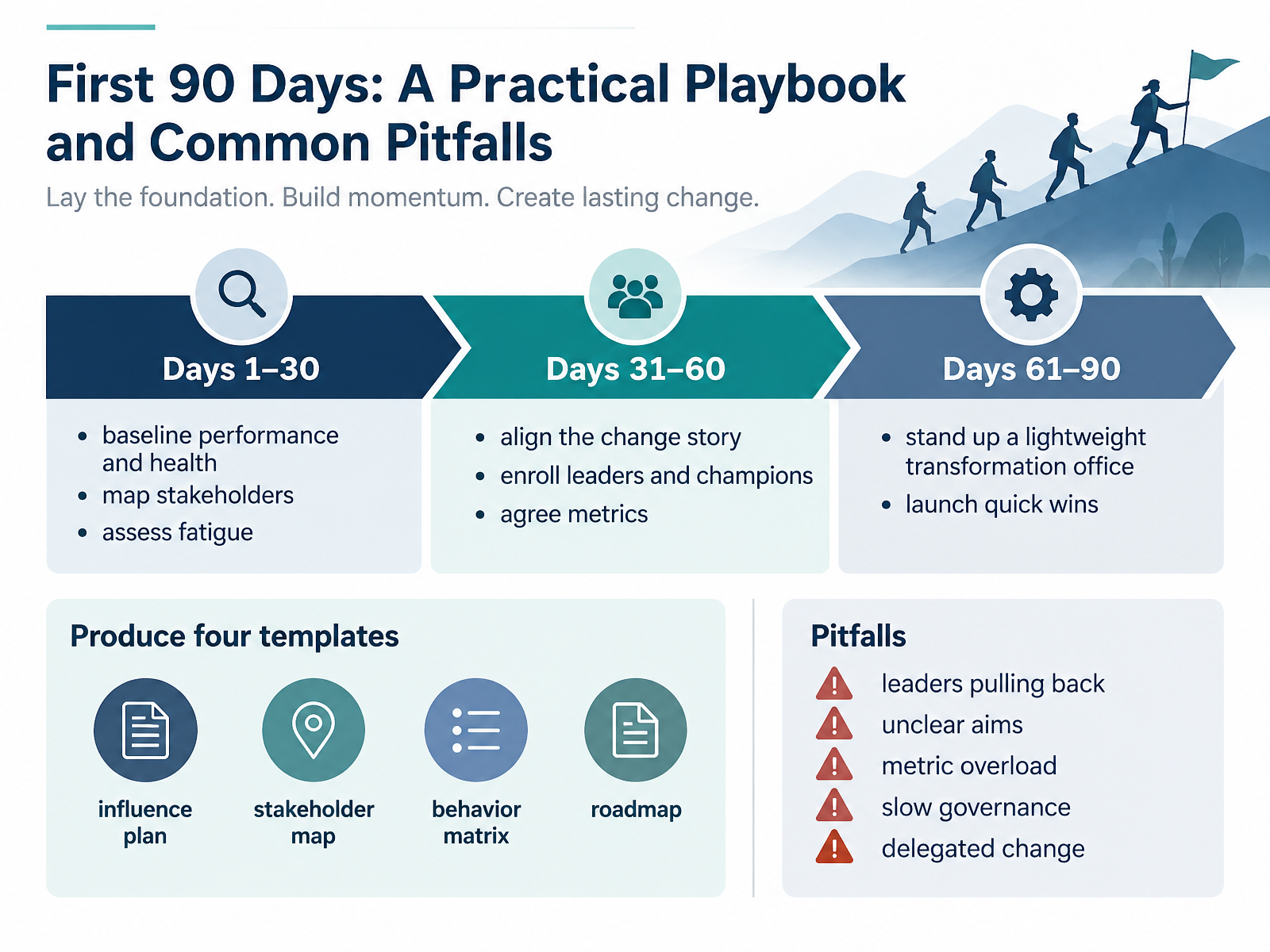
- 14First 90 Days: A Practical Playbook and Common PitfallsLet's close with the first ninety days, laid out as a practical playbook. In days one to thirty, build the baseline. Measure both performance and organizational health. Map your stakeholders, and assess how much change fatigue already exists. In days thirty-one to sixty, align the change story, enroll leaders and champions, and agree on a small set of metrics. In days sixty-one to ninety, stand up a lightweight transformation office and launch quick wins. Along the way, produce four templates: an influence plan, a stakeholder map, a behavior matrix, and a roadmap. Now watch for the common pitfalls. Leaders pulling back. Unclear aims. Metric overload. Slow governance. And change that gets delegated instead of owned. Here's your checkpoint: in your next team meeting, walk through the ninety-day calendar and name which pitfall you're most exposed to right now. That brings us to the end of the course. Thank you for your engagement. You now have a practical set of practices to work with. Pick one, apply it this week, and keep building your own playbook.
 mckinsey.commckinsey.commckinsey.com+22 min
Take the deck with you
Download this course as a file — free, no sign-up needed.
- PDF handoutEvery slide page, ready to print or share.15 pages · 3.2 MBDownload
- Narrated PowerPointThe deck that presents itself — every slide carries the digital human's narration video.15 pages · 16.3 MBDownload
- PowerPoint slidesThe full deck as a .pptx — open it in PowerPoint, Keynote, or Google Slides.15 pages · 3.2 MBDownload
Free to use in your own training — please keep the PersonWise credit page at the end.
Have your own deck? Turn it into a course
Sources consulted
Web sources consulted while building this course.
- The role of the transformation office | McKinsey — mckinsey.com
- How to gain and sustain a competitive edge through transformation — mckinsey.com
- A model for effective change management | McKinsey — mckinsey.com
- Why an agile transformation office is your ticket to real and lasting impact | McKinsey — mckinsey.com
- The science of organizational transformations | McKinsey — mckinsey.com
- The science of organizational transformations — mckinsey.com
- Organizations do not change. People change! — mckinsey.com
- How to beat the transformation odds — mckinsey.com
- What successful transformations share — mckinsey.org
- Mind-sets matter in organizational transformations | McKinsey — mckinsey.com
- McKinsey's Influence Model - Module Note - Faculty & Research - Harvard Business School — hbs.edu
- The four building blocks of change — mckinsey.com
- McKinsey Classics: Making change stick: Four key moves — mckinsey.com
- When one size doesn’t fit all: How to make change personal — mckinsey.com
- Influence Model - McKinsey's Change Management Model — managementconsulted.com
- Capability building for frontline workers: A conversation with Kevin Carmody | McKinsey — mckinsey.com
- Transforming employees mindsets and behaviors to build telesales capabilities — mckinsey.com
- How to drive successful large-scale organizational change | McKinsey — mckinsey.com
- To deliver a transformation’s full potential, put the front line first — mckinsey.com
- Transforming change leader mindsets | McKinsey — mckinsey.com