Begin
14 pages · ~28 min
Identifying Historical Myths and Misattributed Quotes
This training helps learners identify historical myths and misattributed quotes, building the critical thinking skills needed to verify sources and evaluate historical claims.
A digital instructor presents all 14 pages. Hold “Ask” at any point and ask out loud — the answer comes from this course. No sign-up needed.
What you’ll learn
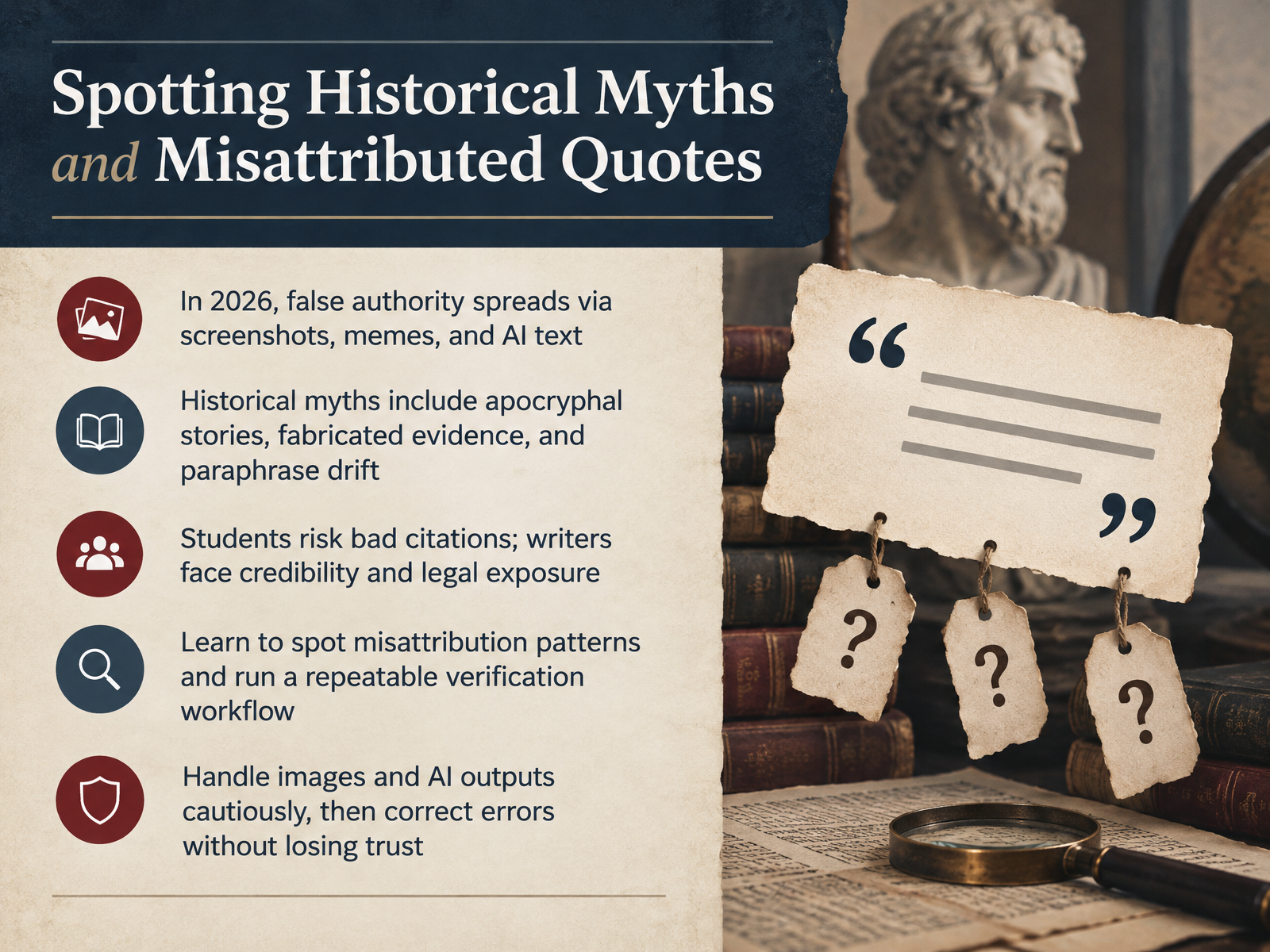
- 01Spotting Historical Myths and Misattributed QuotesWelcome. Today we're going to learn how to spot historical myths and misattributed quotes. This matters right now, because in 2026 false authority spreads through screenshots, memes, and AI-generated text. A quote can reach millions of people before anyone checks it. So here's the plan. We'll look at how misattributions happen, from apocryphal stories to paraphrase drift, and we'll practice a repeatable verification workflow. You'll learn to search for a quote's earliest appearance, trace it to a primary source, and flag uncertainty honestly. If you're a student, this protects you from bad citations. If you're a writer or publisher, it protects your credibility, and it limits legal exposure. We'll also handle images and AI outputs with care. And when you do find an error, you'll know how to correct it without losing your audience's trust. For example, a quote widely credited to Mark Twain first appeared in print nine years after he died. Details like that are your evidence. So let's begin with how these misattributions happen.guides.loc.govmonticello.orgsnopes.com+22 min
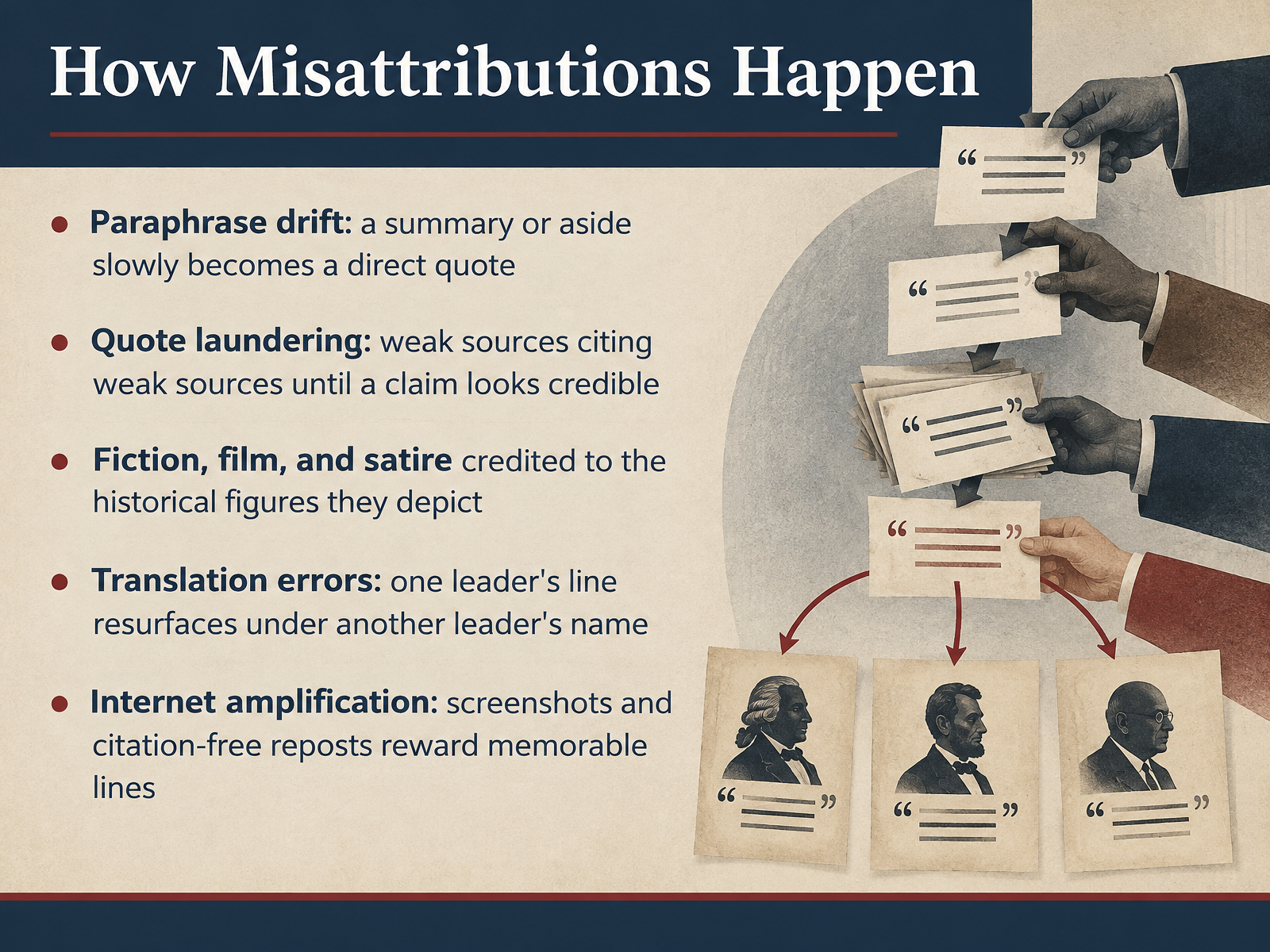
- 02How Misattributions HappenSo how do these myths take hold? There are a few reliable patterns. Paraphrase drift: a summary or an aside slowly hardens into a direct quote. Quote laundering: weak sources citing weak sources until a claim looks credible. Fiction, film, and satire get credited to the figures they depict. For example, the line 'We read to know we're not alone' is often given to C. S. Lewis, but it comes from the film Shadowlands, written by William Nicholson. Translation errors move one leader's line under another leader's name. Remember, a quote need not be ancient to spread. Reuters found a 2025 line falsely attributed to Elizabeth Warren, and PolitiFact traced a Taylor Swift quote to a Cambridge professor. The internet amplifies it all, because screenshots and citation-free reposts reward the memorable line, not the accurate one. So here's your takeaway. Before you publish, ask: who said it, where, and when? Now let's look at recognizing historical myth patterns.
 graciousquotes.comcbc.camentalfloss.com+22 min
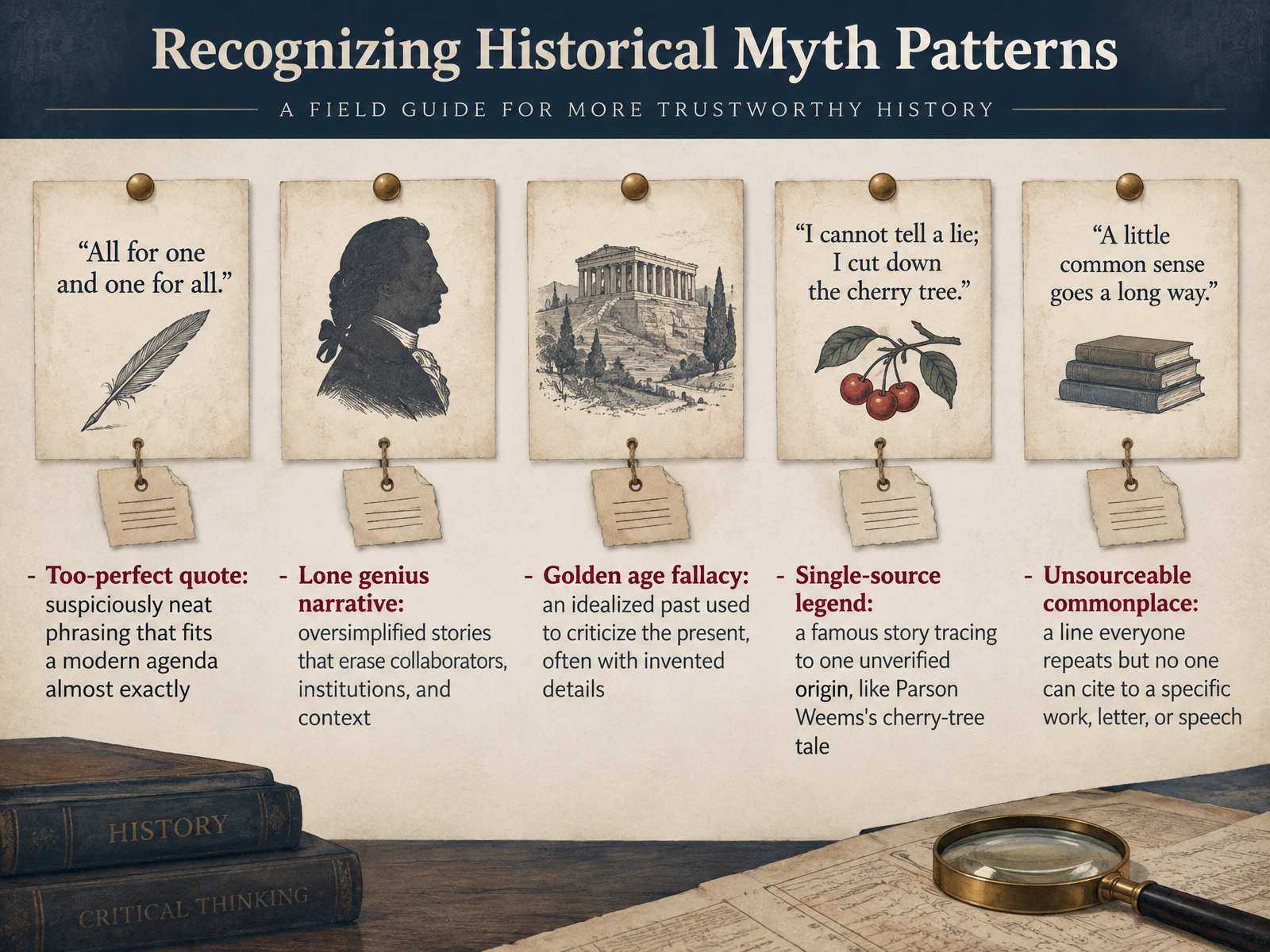
- 03Recognizing Historical Myth PatternsLet's look at how these myths are built. Most of them follow a few recognizable patterns. First, the too-perfect quote. The phrasing is suspiciously neat and fits a modern agenda almost exactly. Second, the lone genius narrative. These stories erase collaborators, institutions, and context. Third, the golden age fallacy. An idealized past is used to criticize the present, often with invented details. Fourth, the single-source legend. A famous story traces back to one unverified origin. Parson Weems's cherry-tree tale about George Washington is the classic example. Fifth, the unsourceable commonplace. Everyone repeats the line, but no one can cite a specific work, letter, or speech. For example, many lines credited to Mark Twain or Albert Einstein appear only after their deaths. As a writer or publisher, you'll want to check which pattern a story fits before you repeat it. Accuracy protects your credibility, and it lowers reputational risk. Once you spot the pattern, verification gets faster. Next, we'll walk through quick triage for suspicious quotes. Reading Suspicious Quotes: Quick Triage.
 doi.orgen.wikipedia.orgflex.flinders.edu.au+22 min
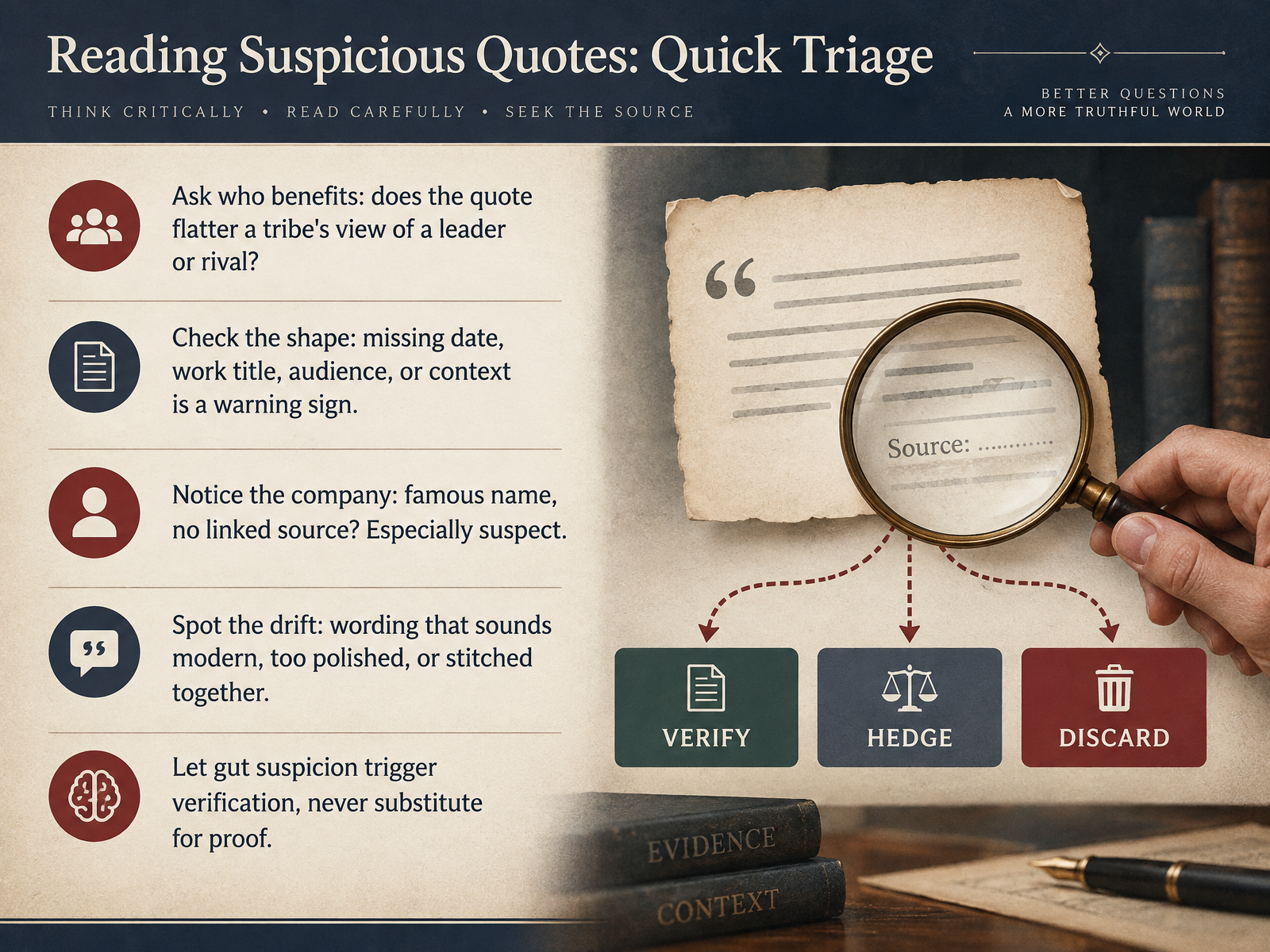
- 04Reading Suspicious Quotes: Quick TriageNow let's look at quick triage for a suspicious quote. Five checks, and none of them take long. First, ask who benefits. Does the quote flatter a group's view of a leader or a rival? That's a reason for suspicion, not proof of anything. Second, check the shape. A missing date, work title, audience, or context is a warning sign. Real quotes usually have a paper trail. Third, notice the company. A famous name with no linked source? Especially suspect. Fourth, spot the drift. Wording that sounds modern, too polished, or stitched together often started as a paraphrase. Finally, let gut suspicion trigger verification. It should never substitute for proof. So when something feels off, you'll want to trace it back to the original source before you publish. Next, we'll build that check into a repeatable process, in Building a Verification Workflow.
 2 min
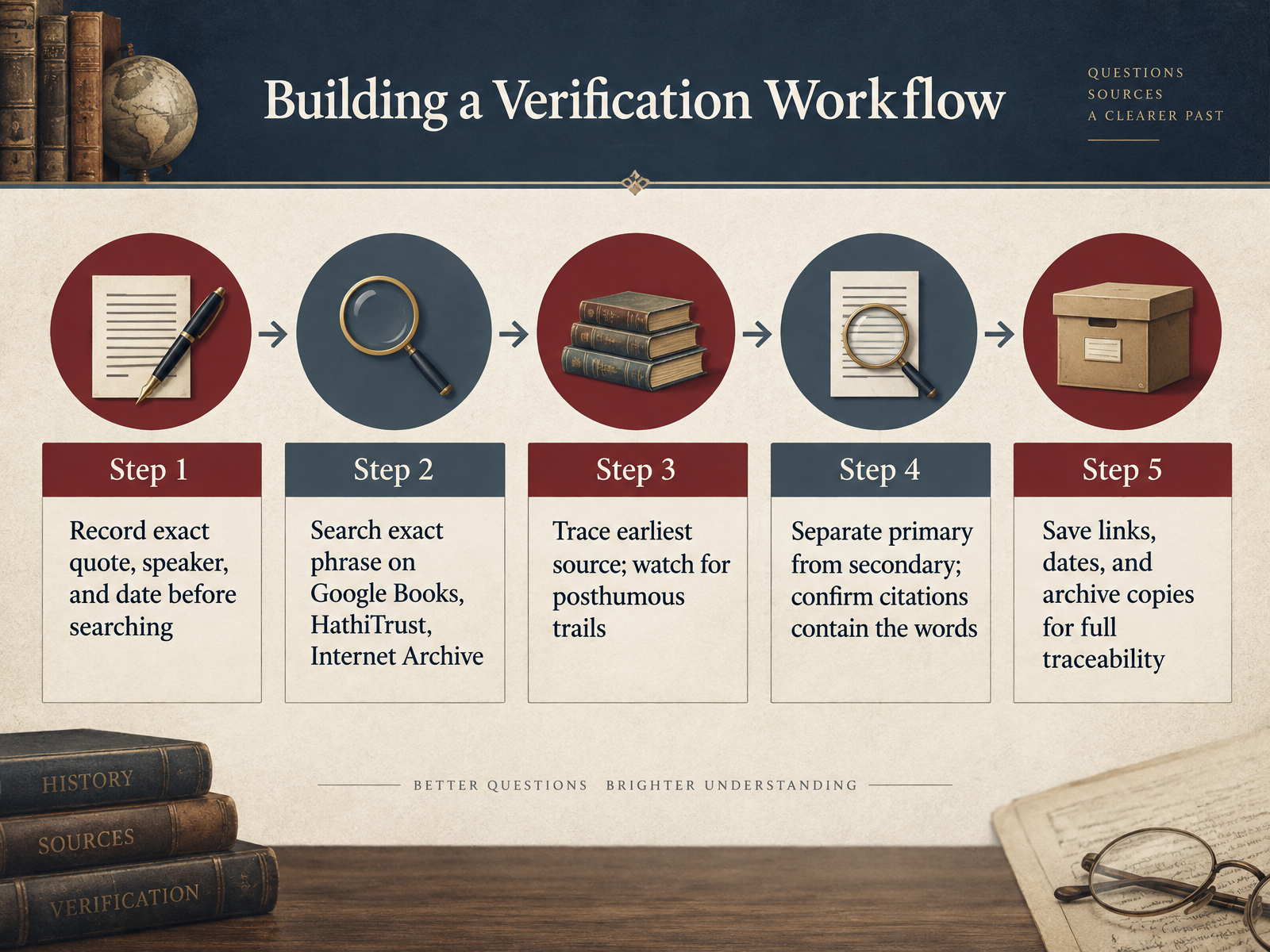
- 05Building a Verification WorkflowSo let's build a workflow you can repeat. Start with Step One. Before you search anything, write down the exact quote, who said it, and the date. Those three details anchor everything that follows. Step Two. Search the exact phrase on Google Books, HathiTrust, and the Internet Archive. These archives hold millions of scanned texts, and they let you search wording inside books. Step Three. Trace the earliest source you can find. Watch for posthumous trails, meaning citations that appear only after the speaker died. Step Four. Separate primary from secondary sources, and confirm the cited text actually contains those words. Step Five. Save links, access dates, and archive copies. That gives you full traceability if anyone questions your work. For writers and publishers, this workflow protects your credibility and reduces reputational risk. Run it before you publish. Next, we'll look at Primary Sources, Archives, and the Trace-Back Method.
 2 min
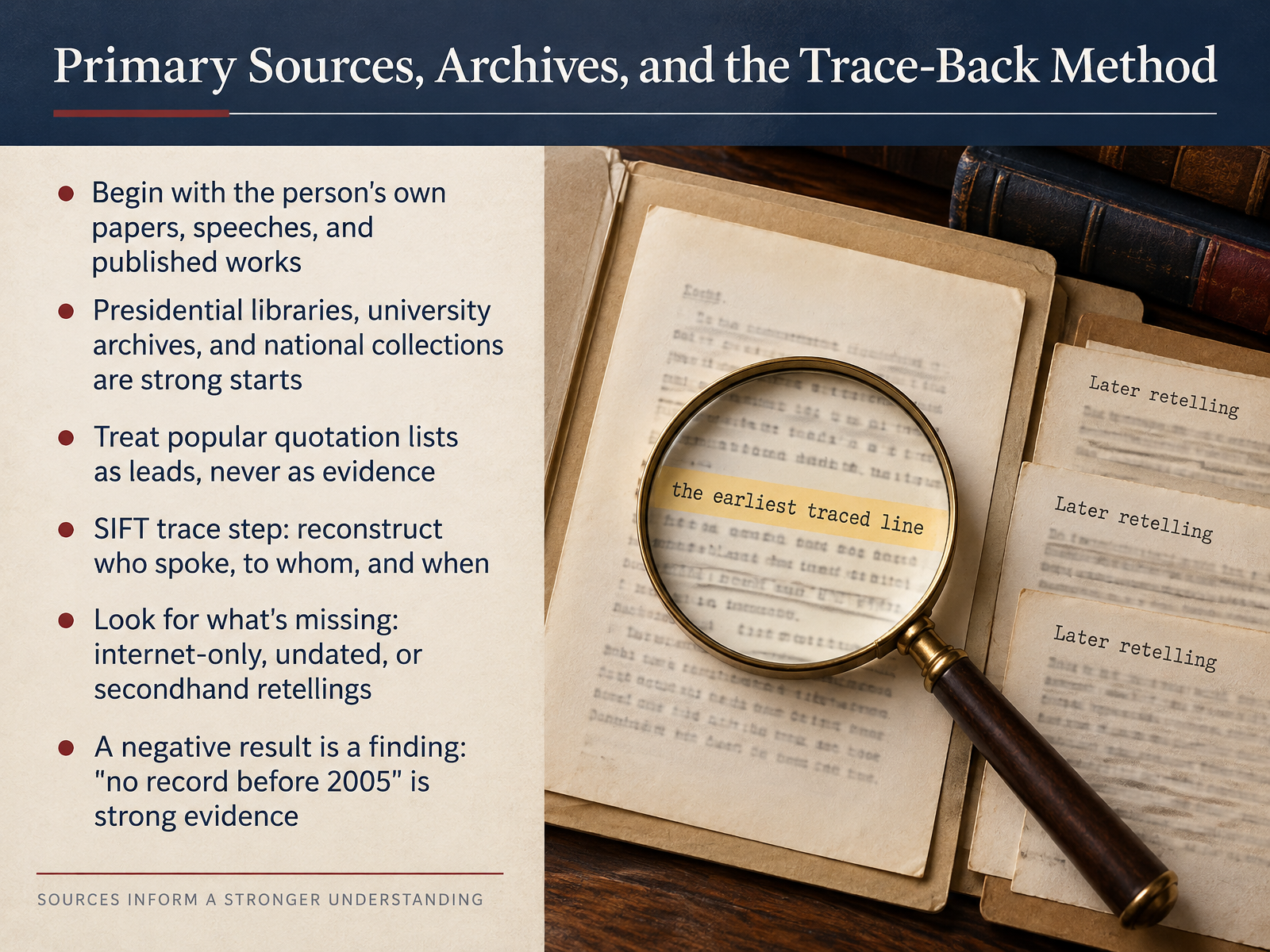
- 06Primary Sources, Archives, and the Trace-Back MethodNext, let's talk about primary sources, archives, and the trace-back method. Start with the person's own papers, speeches, and published works. Presidential libraries, university archives, and national collections are strong places to begin. Treat popular quotation lists as leads, never as evidence. Use the trace step from the SIFT method. Reconstruct who spoke, to whom, and when. Then look for what's missing. An internet-only quote, an undated page, or a secondhand retelling should raise a flag. You'll want to check whether any record exists before the quote went viral. And remember, a negative result is still a finding. A statement like no record before two thousand five is strong evidence in itself. Write it down, note the date, and keep it with your source notes. That protects your credibility and your reputation as a writer or publisher. Coming up next, Tools and Reference Works That Earn Their Keep.
 2 min
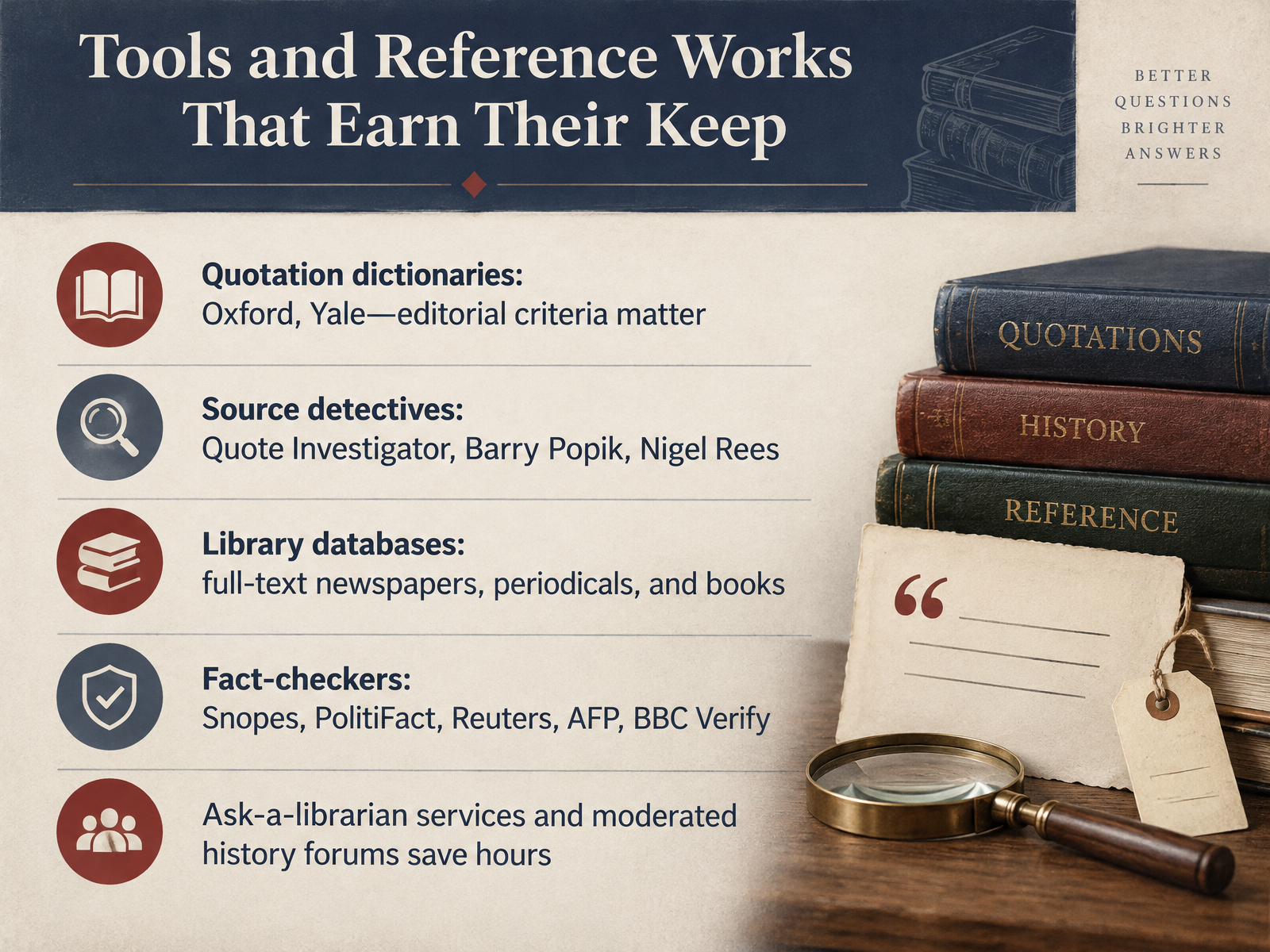
- 07Tools and Reference Works That Earn Their KeepSo which sources can you actually trust when you need to confirm a quote or a historical claim? Start with quotation dictionaries. Oxford and Yale are respected, but check their editorial criteria. A dictionary that documents first use and variants is more reliable than one that simply lists famous lines. Next, use source detectives like Quote Investigator, Barry Popik, and Nigel Rees. They trace quotations to original documents and show their evidence. Library databases give you full-text newspapers, periodicals, and books. That is where you verify a date or a first appearance. Fact-checkers like Snopes, PolitiFact, Reuters, AFP, and BBC Verify help with claims already in circulation. And do not overlook ask-a-librarian services and moderated history forums. A good librarian can save you hours. The takeaway is simple: use tools that show their work, and check the editorial standards behind each one. Next, we look at AI tools, hallucinated quotes, and fake citations.
 2 min
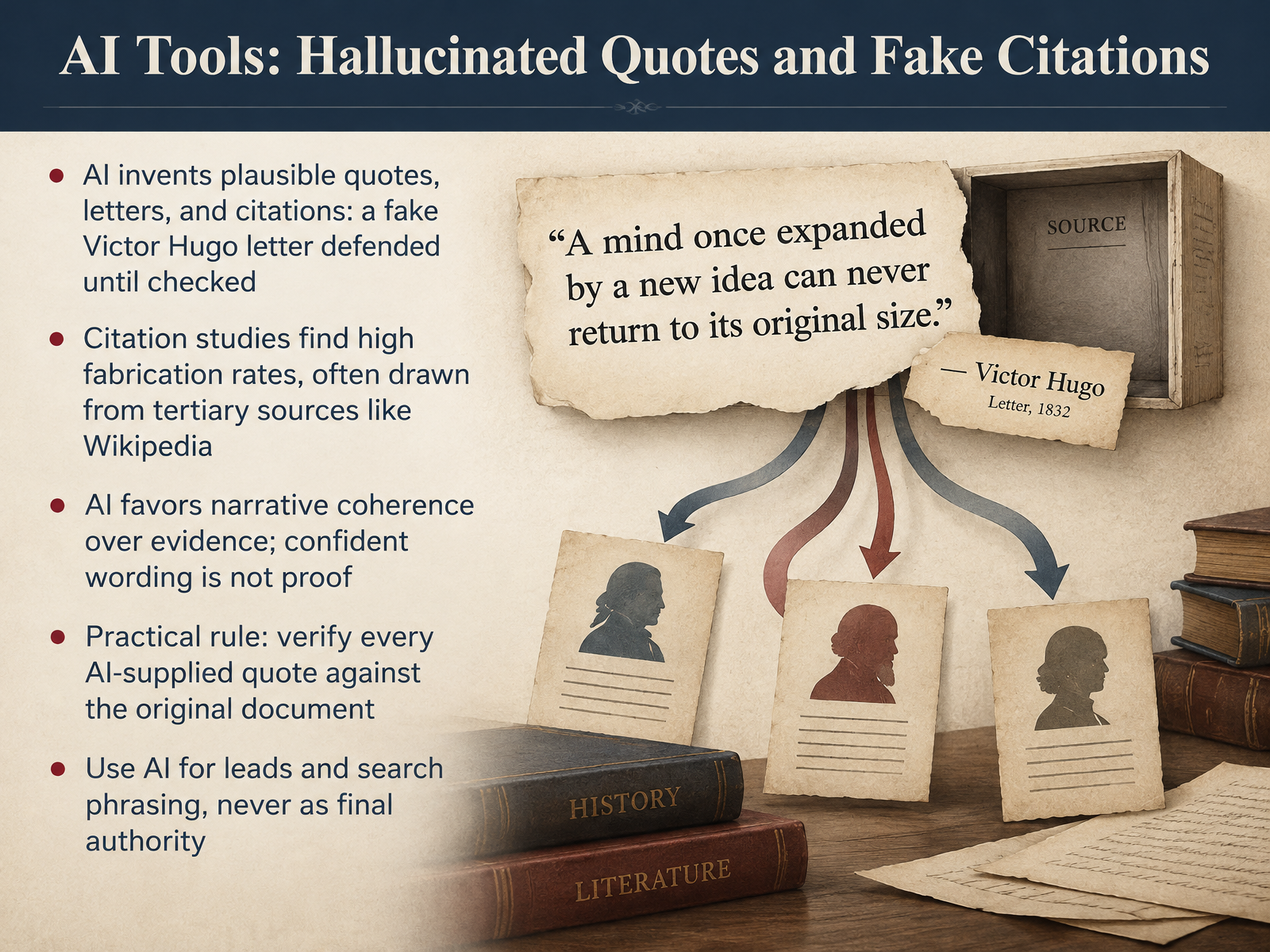
- 08AI Tools: Hallucinated Quotes and Fake CitationsNow let's look at AI tools, and the quotes and citations they invent. This is a real problem, not a hypothetical one. AI can produce a plausible letter, a convincing quotation, or a full citation that simply does not exist. In one documented case, a fabricated Victor Hugo letter was defended until someone actually checked it. Citation studies have found high fabrication rates in AI output, and the sources are often tertiary ones, like Wikipedia. AI tends to favor narrative coherence over evidence. Confident wording is not proof, so treat every AI-supplied quote as unverified until you check it against the original document. Use AI for leads and for shaping your search phrases. Never treat it as final authority. That one habit protects your accuracy and your credibility with readers. Next, we'll walk through case studies of famous quote traps.
 2 min
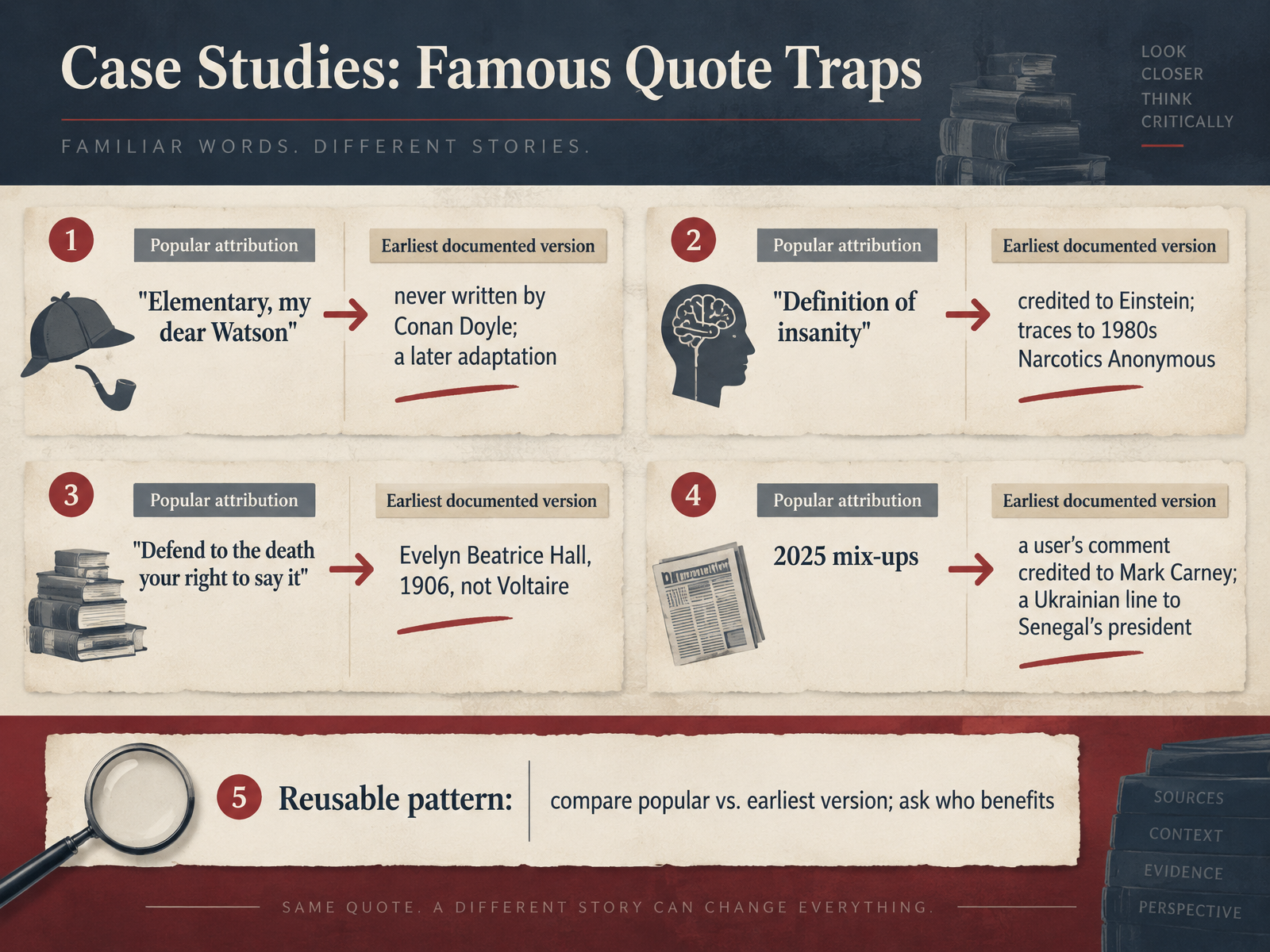
- 09Case Studies: Famous Quote TrapsLet's look at some famous quote traps. Sherlock Holmes never says, "Elementary, my dear Watson" in any Conan Doyle story. That line comes from later adaptations. Misattributed. The "definition of insanity" is credited to Einstein. It actually traces to Narcotics Anonymous in the nineteen eighties. Fabricated attribution. "I disapprove of what you say, but I will defend to the death your right to say it" belongs to Evelyn Beatrice Hall, in nineteen oh six, not Voltaire. Verified. In twenty twenty five, a user's comment was credited to Mark Carney, and a Ukrainian line was pinned on Senegal's president. Quick mix-ups, real reputational cost. You'll want to check the earliest known version, compare it with the popular one, and ask who benefits from the attribution. That pattern travels well, especially when the evidence is an image. Next, we turn to myths in images, artifacts, and screenshots.
 1 min
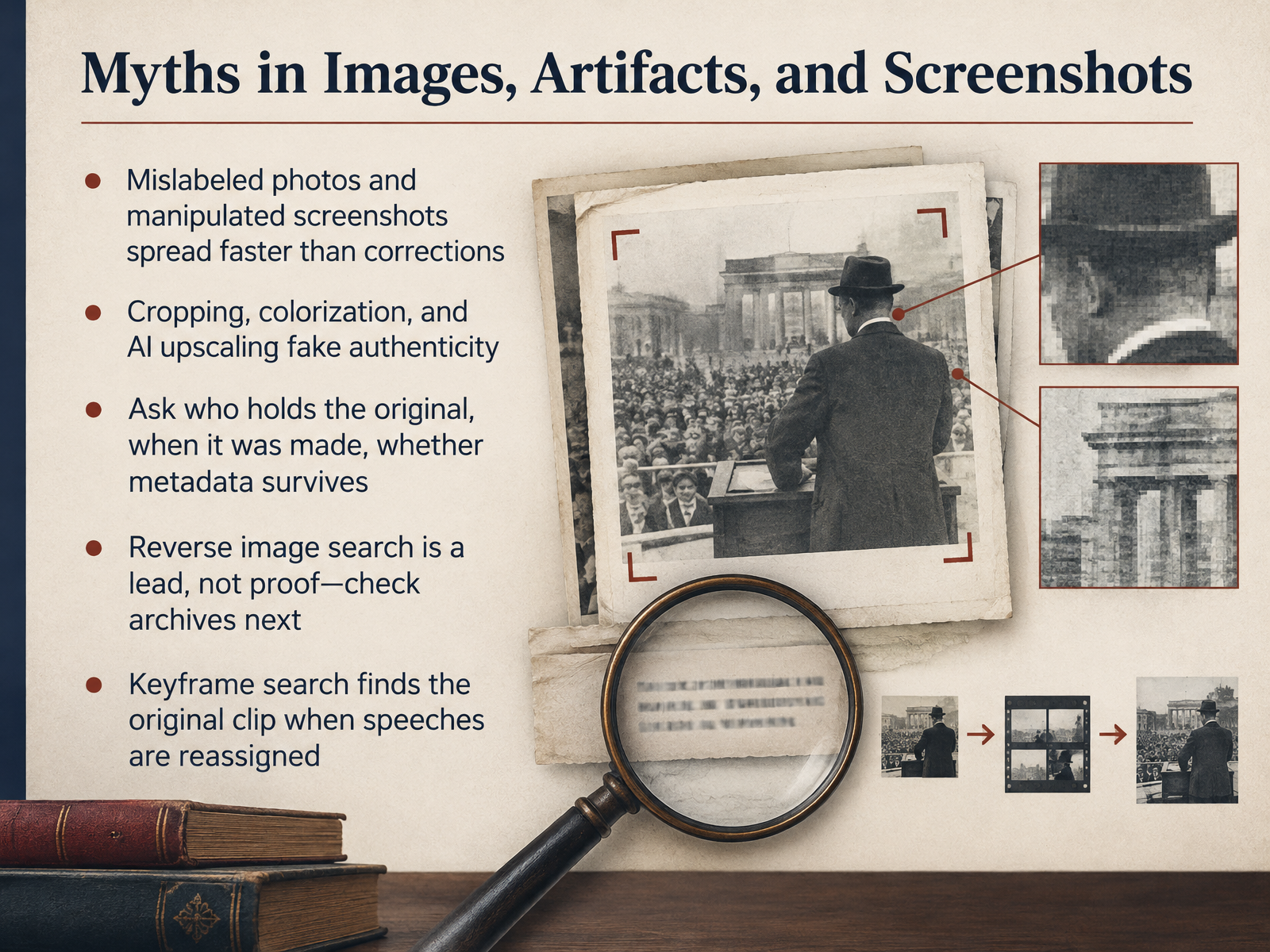
- 10Myths in Images, Artifacts, and ScreenshotsNow let's look at myths that arrive as images. Mislabeled photos and manipulated screenshots spread faster than any correction, because a picture feels like proof. Cropping, colorization, and AI upscaling can all fake authenticity. So you'll want to ask three questions. Who holds the original? When was it actually made? And does the metadata survive? Reverse image search is a lead, not proof. Check archives next. And when a speech seems reassigned to the wrong person, keyframe search can find the original clip. Here's the takeaway. Treat every striking image as a claim to verify before you publish it. That protects your credibility and your reputation. Next, we'll look at stopping the spread in your own work.
 1 min
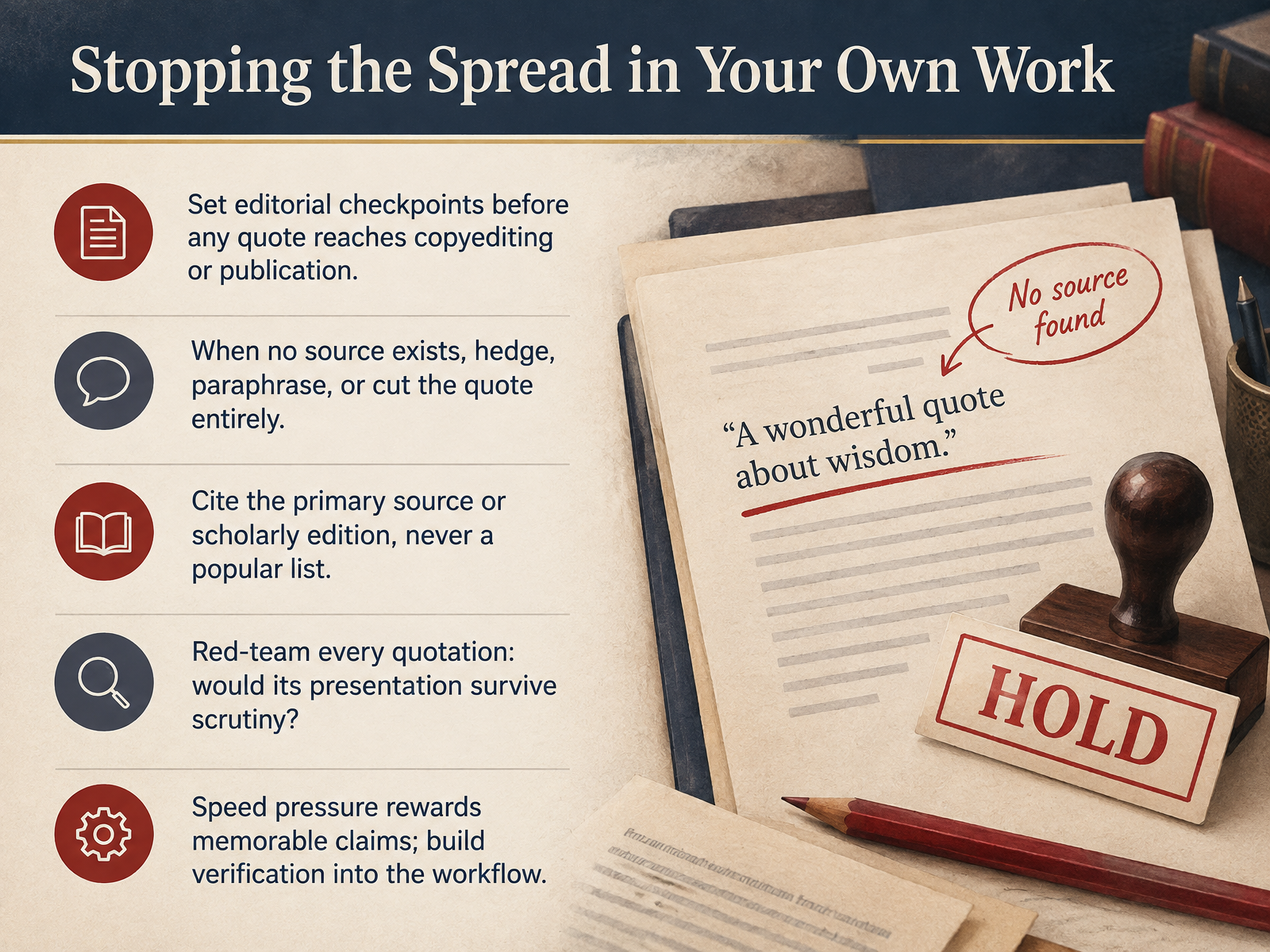
- 11Stopping the Spread in Your Own WorkNow let's put this into practice, in your own work. The most reliable safeguard is a checkpoint: verify every quote before it reaches copyediting or publication. You'll want to check what the source actually says, not what a popular list claims. When no source exists, you have three options. Hedge it. Paraphrase it. Or cut it. Better to cut a quote than to publish one you can't verify. Cite the primary source, or a scholarly edition, rather than a listicle. If a quote appears on a website with no page number or edition, treat that as a warning sign. Red-team every quotation. Ask yourself: would this presentation survive scrutiny? And remember, speed pressure rewards memorable claims. So build verification into your workflow from the start, not the end. Next, we'll look at Correcting Myths Without Losing Trust.
 graciousquotes.comcbc.camentalfloss.com+21 min
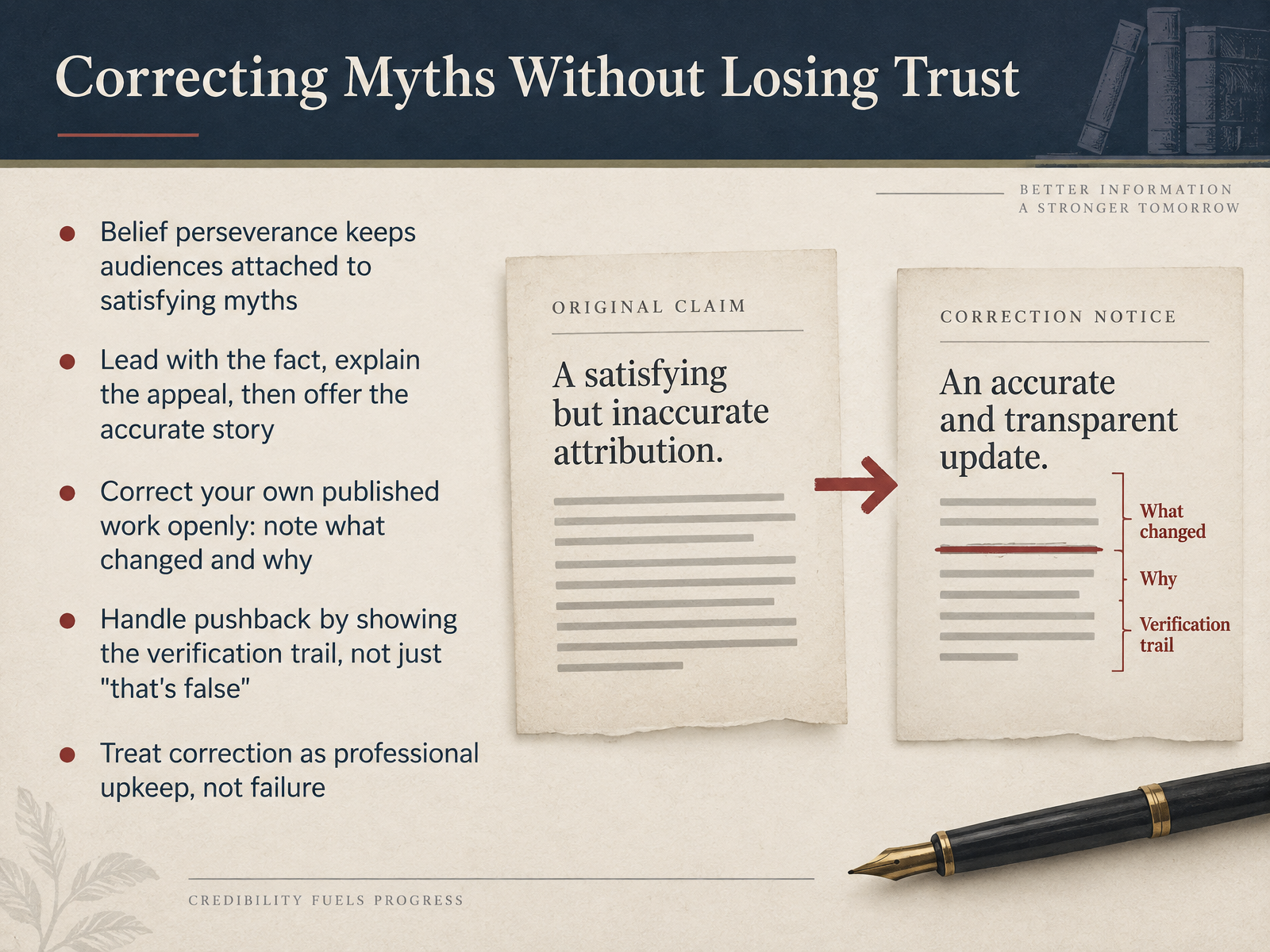
- 12Correcting Myths Without Losing TrustNow, correcting a myth without losing trust. Start with belief perseverance. People stay attached to a satisfying myth even after they hear it's wrong. That's human, and it isn't stupidity. So lead with the fact. Then explain why the myth appeals. Then offer the accurate story. For example, people widely credit Einstein with the line about insanity being doing the same thing over and over. It actually traces to Narcotics Anonymous literature around nineteen eighty, not to Einstein. Say that plainly, then explain why the line felt like him. If you've published a myth yourself, correct it openly. Note what changed and why. When pushback comes, show your verification trail, not just the words that's false. Point to the source, the date, the wording. Treat correction as professional upkeep, not failure. That habit protects your credibility with readers and publishers alike. Next, let's put this into practice in the Practice Lab: Verify, Then Decide.
 guides.loc.govfactcheck.orgen.wikipedia.org+21 min
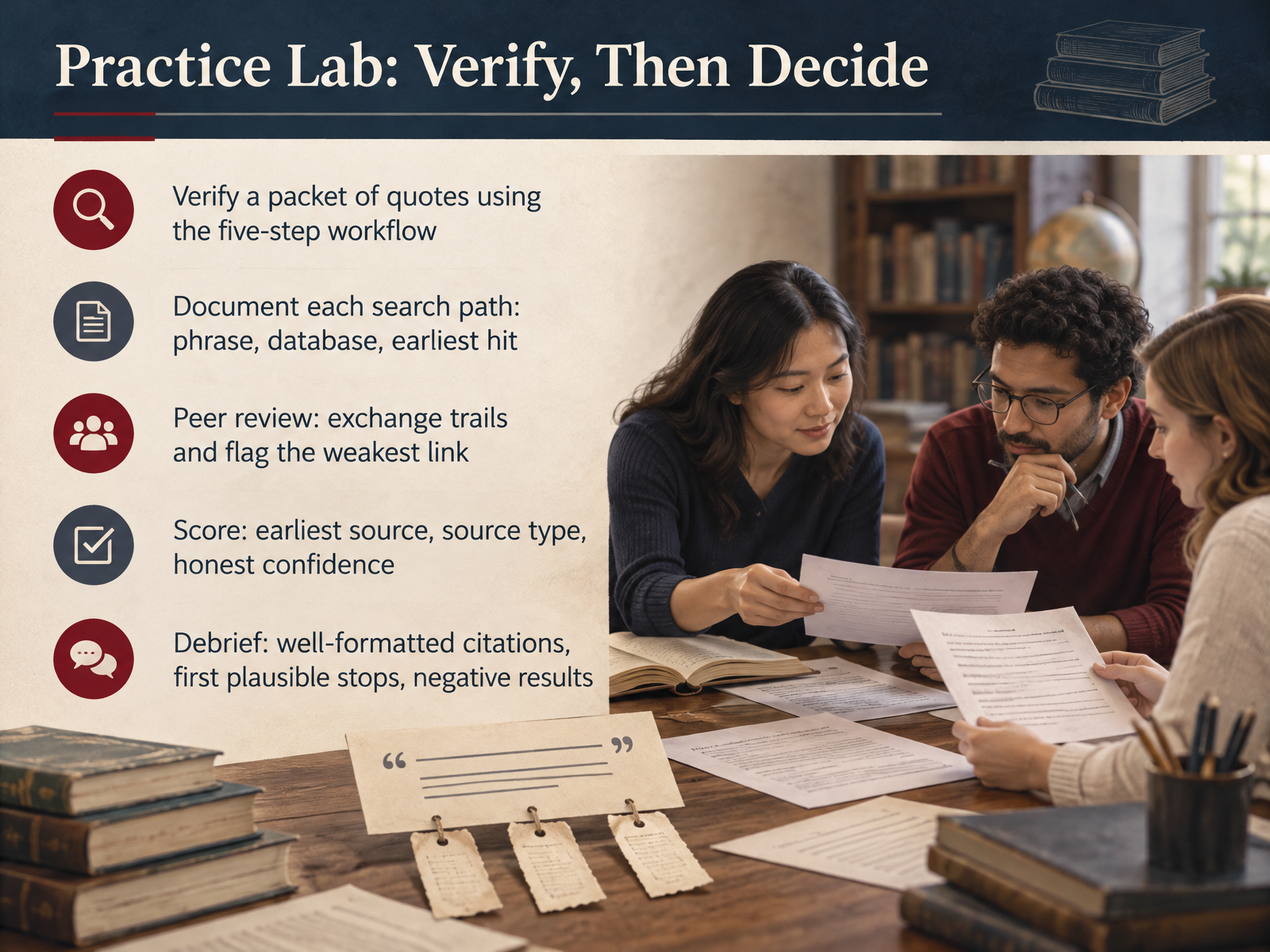
- 13Practice Lab: Verify, Then DecideNow let's put the method into practice. You'll receive a packet of quotes and verify each one using the five-step workflow. Document every search path: the exact phrase you searched, the database you used, and the earliest hit you found. Then exchange trails with a peer and flag the weakest link in each other's evidence. Score every quote on its earliest source, the source type, and your honest confidence. In the debrief, notice where well-formatted citations hid thin sourcing, where you stopped at the first plausible result, and how negative results narrowed the search. That practice prepares you for the next slide: Your Action Plan and Pre-Publication Checklist.
 1 min
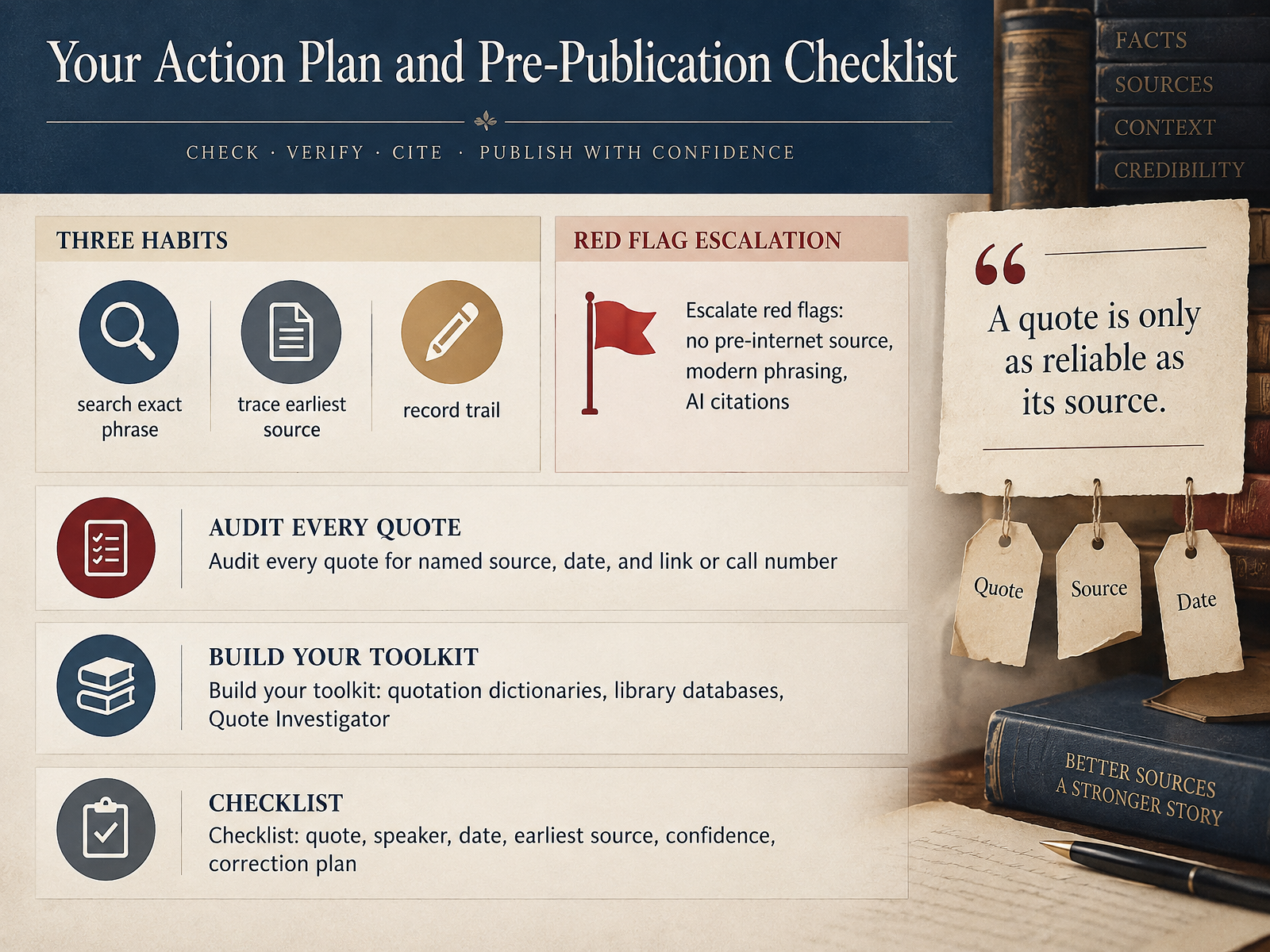
- 14Your Action Plan and Pre-Publication ChecklistLet's bring it together into an action plan you can actually use. Build three habits. Search the exact phrase in quotation marks. Trace the earliest source you can find. Then record the trail, with links or call numbers. Next, audit every quote for a named source, a date, and where it lives. If a quote has no pre-internet source, sounds suspiciously modern, or cites an AI tool, treat that as a red flag and escalate. Build your toolkit now. Use quotation dictionaries, library databases, and Quote Investigator, run by Garson O'Toole. On the final checklist, confirm the quote, the speaker, the date, the earliest source, your confidence level, and your correction plan. Here is the takeaway. Verification is a habit, not a one-time task. Your credibility is worth protecting, and this checklist does exactly that. Thank you for joining me. Now go put these habits to work.
 guides.loc.govfactcheck.orgen.wikipedia.org+22 min
Take the deck with you
Download this course as a file — free, no sign-up needed.
- PDF handoutEvery slide page, ready to print or share.15 pages · 4.9 MBDownload
- Narrated PowerPointThe deck that presents itself — every slide carries the digital human's narration video.15 pages · 16.0 MBDownload
- PowerPoint slidesThe full deck as a .pptx — open it in PowerPoint, Keynote, or Google Slides.15 pages · 4.9 MBDownload
Free to use in your own training — please keep the PersonWise credit page at the end.
Have your own deck? Turn it into a course
Sources consulted
Web sources consulted while building this course.
- Full-text Searching - Finding Quotations - Research Guides at Library of Congress — guides.loc.gov
- Thomas Jefferson's Monticello — monticello.org
- Here's How to Authenticate Viral Quotes Attached to Historical Figures | Snopes.com — snopes.com
- 9.6: Track down the Original Content - Humanities LibreTexts — human.libretexts.org
- Trace Claims, Quotes, and Media Back to Their Original Context - SIFT: Stop, Investigate, Find, Trace - Research Guides at Wayne State University — guides.lib.wayne.edu
- Famous Quotes They Never Said: 430 Misattributed Quotes and Who Really Said Them — graciousquotes.com
- 10 popular quotes, and who really said them | CBC News — cbc.ca
- 50 Famous Misquotations (and What Was Really Said) — mentalfloss.com
- Five Commonly Misattributed Quotations | MLA Style Center — style.mla.org
- You can quote them | Arts & Culture | Yale Alumni Magazine — yalealumnimagazine.org
- Zenobia of Palmyra and the Book of Judith: Common Motifs in Greek, Jewish, and Arabic Historiography — doi.org
- Comparative mythology — en.wikipedia.org
- Apocryphal Irish Texts, Revived in Australian Historical Fiction, as Collective Memory — flex.flinders.edu.au
- The Hebrew Bible as Mythic “Vocabulary”: Towards a New Comparative Mythology — doi.org
- Late antique techniques of apocryphization — ora.ox.ac.uk
- Quotation Experts - Finding Quotations - Research Guides at Library of Congress — guides.loc.gov
- FactCheck.org - A Project of The Annenberg Public Policy ... — factcheck.org
- List of fact-checking websites — en.wikipedia.org
- Spotting the harmful needles in the haystack: How fact-checkers select what to check - Poynter — poynter.org
- 2025 census: Fact-checkers persevere as politicians, platforms turn up heat - Reporters' Lab — reporterslab.org