Begin
14 pages · ~28 min
Distributing Research to a Global Audience
This training teaches researchers a practical workflow for distributing research findings to a global audience, covering the key steps and methods for effective international outreach.
A digital instructor presents all 14 pages. Hold “Ask” at any point and ask out loud — the answer comes from this course. No sign-up needed.
What you’ll learn
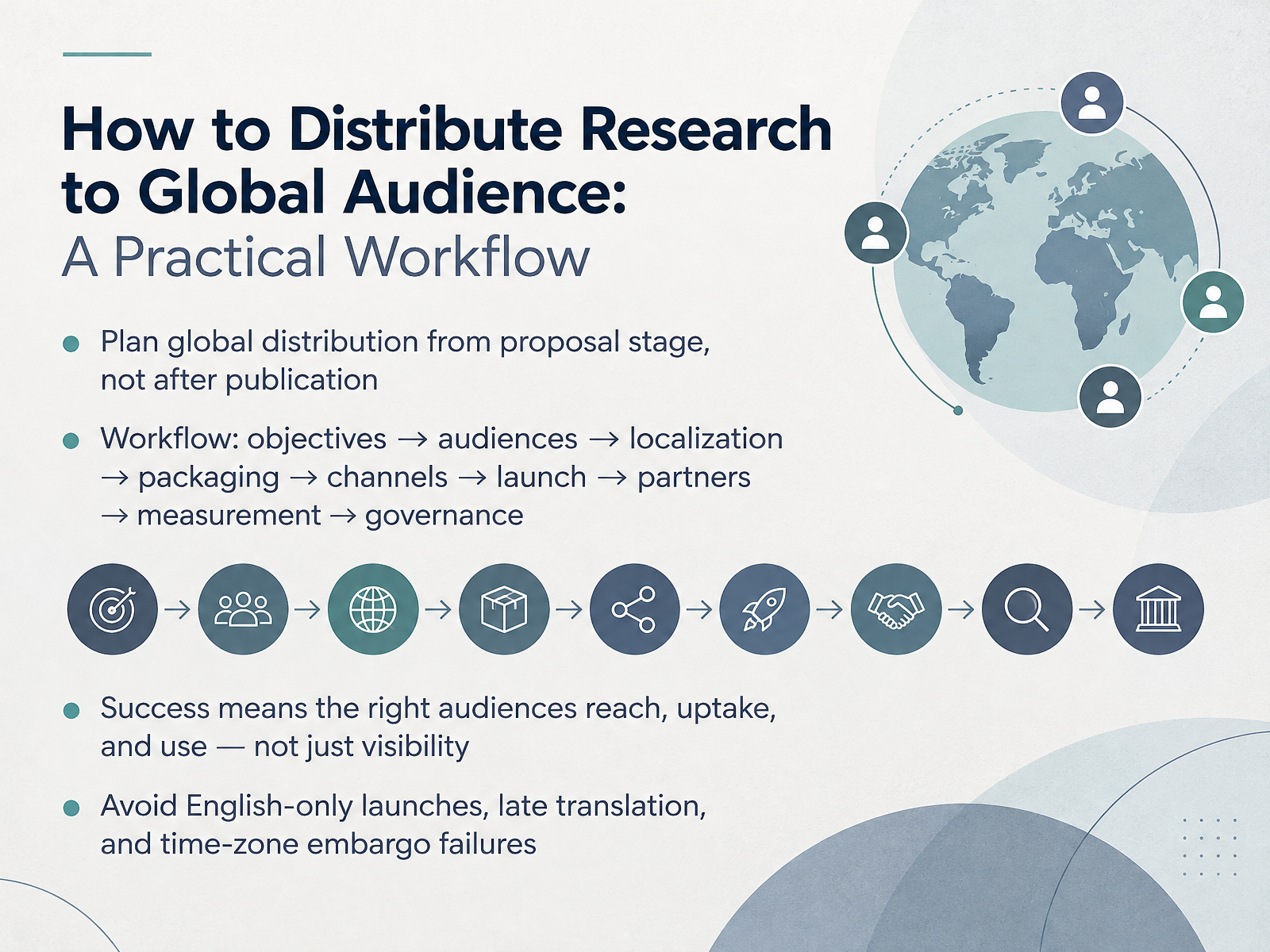
- 01How to Distribute Research to Global Audience: A Practical WorkflowWelcome. I am glad you are here. This course is about distributing research to a global audience, and the goal is simple. By the end, you will have a practical workflow you can run in your next distribution cycle, even with limited time, several markets, and approval layers to work through. First, a mindset shift. Plan global distribution from the proposal stage, not after publication. In practice, the workflow runs like this. Objectives, audiences, localization, packaging, channels, launch, partners, measurement, and governance. Treat these as one sequence your team revisits, not a checklist you finish once. Next, redefine success. Success means the right audiences reach, uptake, and use the work, not just visibility. A high-traffic English-only launch can still miss the people who need the findings most. So avoid three common failures. English-only launches, late translation, and time-zone embargo mistakes. One takeaway before we move on. At your next proposal review, name your priority audiences and their language needs in writing. That single step prevents most downstream delays. Next, we look at why global distribution matters now.scienceeurope.orgacademic.oup.competerbates.org.uk+22 min
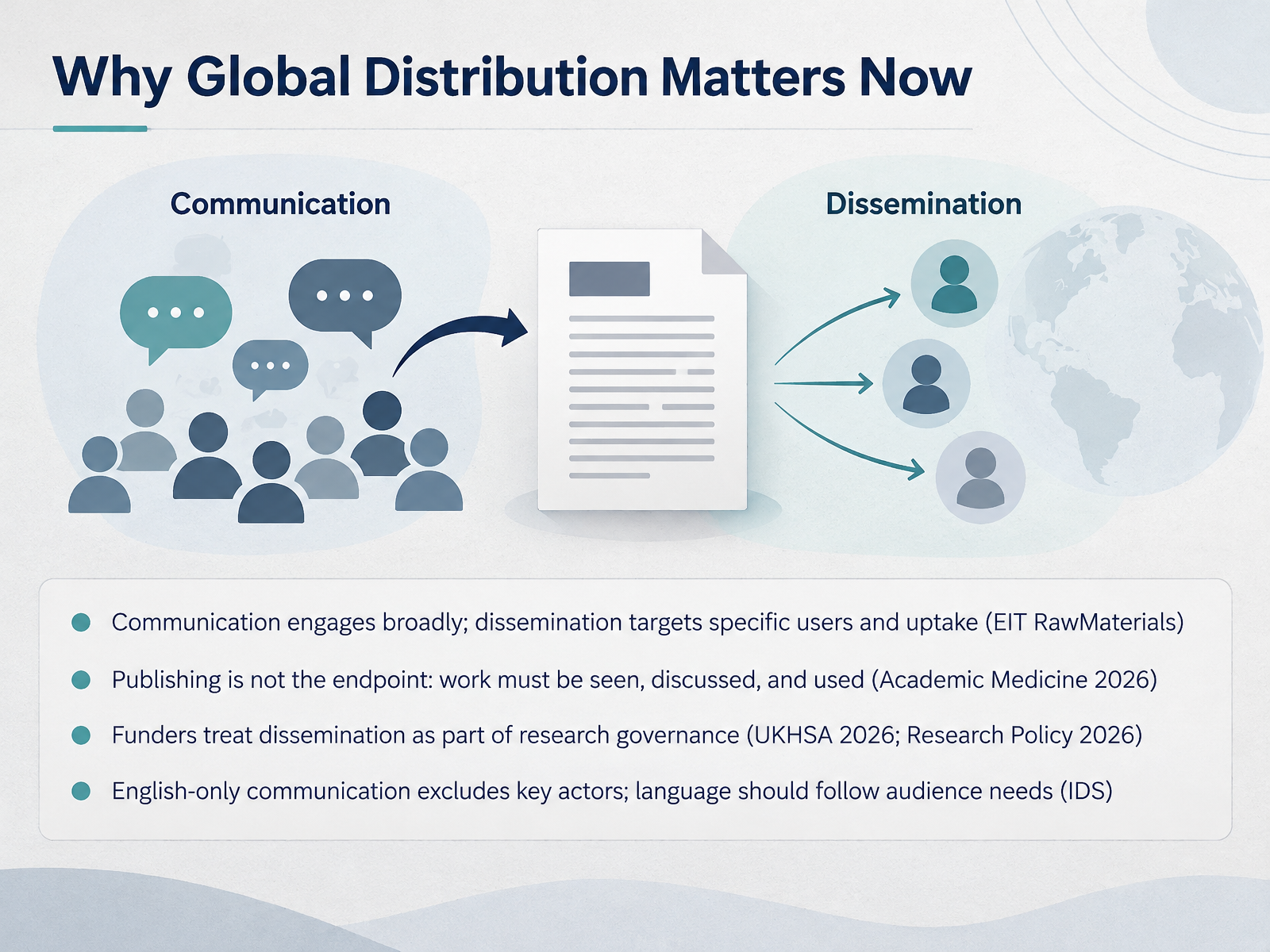
- 02Why Global Distribution Matters NowLet's look at why global distribution matters right now. First, communication and dissemination are not the same job. Communication engages broadly; dissemination targets specific users and the uptake of your findings. Next, publishing is not the endpoint. Without active sharing, important work often goes unseen, undiscussed, and unused. Funders now treat dissemination as part of research governance, so your plan may be reviewed alongside your methods. And English-only output excludes key actors. Language should follow audience needs, which means budgeting for translation early rather than scrambling later. Your takeaway for this cycle: name your priority audiences and their language needs before you draft anything. The Seven-Step Dissemination Backbone comes next.
 scienceeurope.orgacademic.oup.competerbates.org.uk+22 min
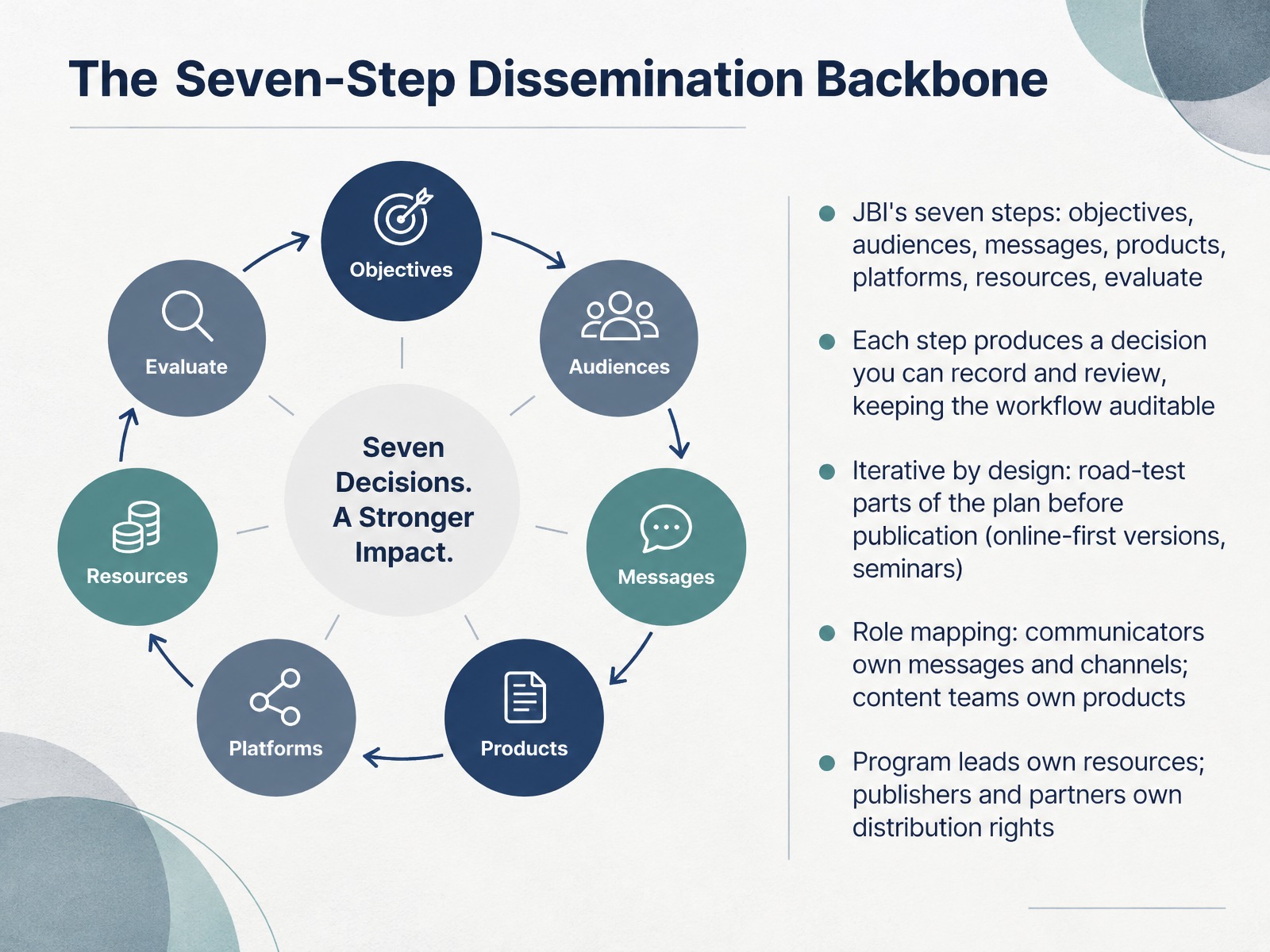
- 03The Seven-Step Dissemination BackboneHere's the backbone that keeps all of this auditable. JBI lays out seven steps: objectives, audiences, messages, products, platforms, resources, and evaluate. That's a lot, so think of it this way. Each step produces one decision you can record and review, and that record is your audit trail when a funder or partner asks what happened and why. Second, the plan is iterative by design. Road test parts of it before publication, using an online-first version or a seminar talk, and let that feedback sharpen the plan. Third, map roles clearly. Communicators own messages and channels. Content teams own products. Program leads own resources, and publishers and partners own distribution rights. Here's your takeaway: before your next distribution cycle, assign an owner to every step and note where you'll road test. Next, we'll look at audience and market prioritization.
 jbi.globalguides.library.vcu.edufddda029-0b0f-44c0-ac47-122487ebcfe1.filesusr.com+22 min
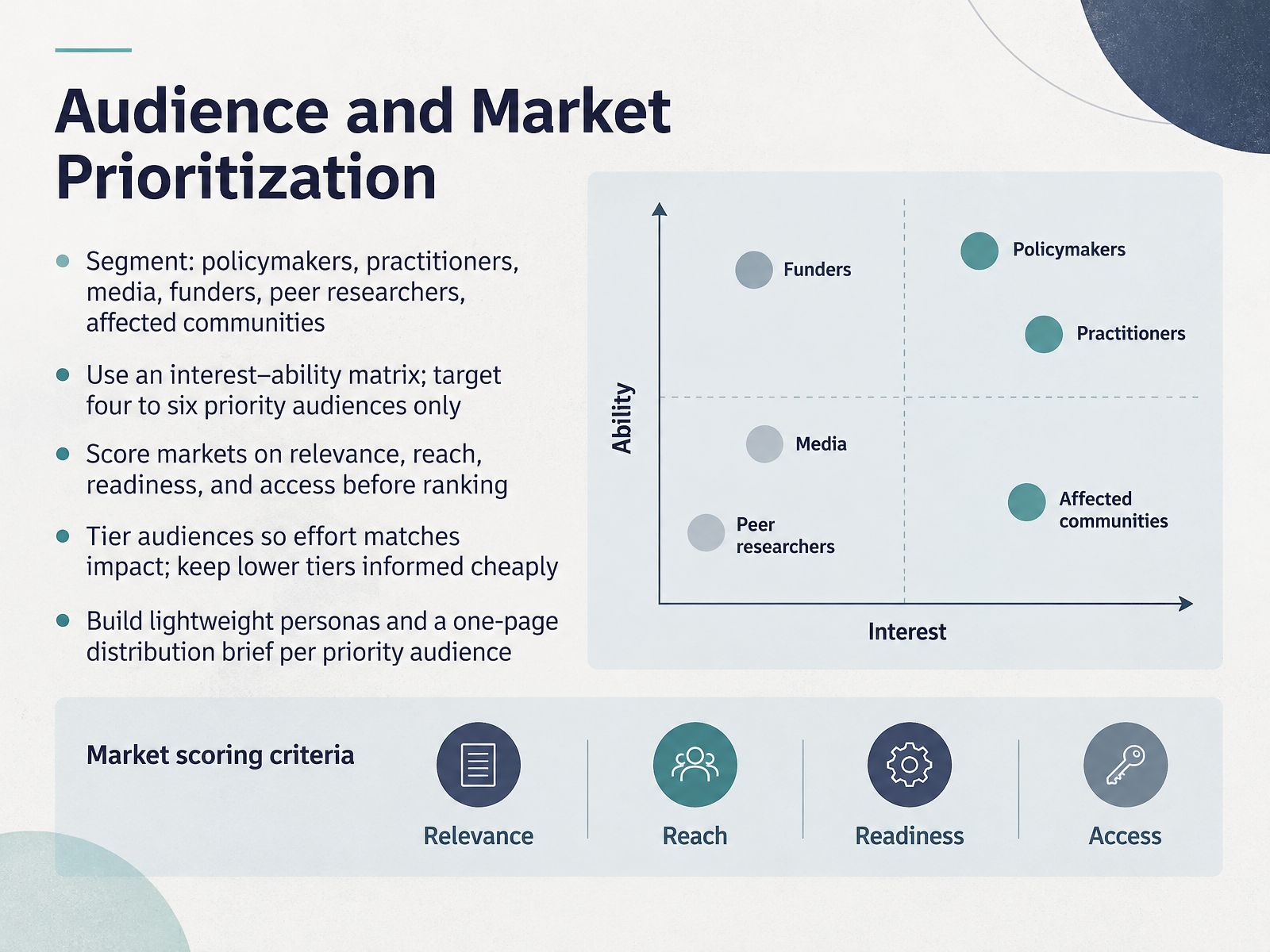
- 04Audience and Market PrioritizationSo, keeping that audience-first approach in mind, let's talk prioritization. You have limited time, multiple markets, and approval layers to navigate, so you cannot target everyone. Start by segmenting your potential audiences into rough groups: policymakers, practitioners, media, funders, peer researchers, and affected communities. Next, plot them on a simple interest-ability matrix. High interest plus high ability goes to the top of your list. Then score your markets on four things: relevance, reach, readiness, and access. Rank only after you score. Your goal is four to six priority audiences, no more. Tier them so effort matches impact. Tier one gets full, tailored attention. Lower tiers stay informed cheaply through newsletters or social updates. Build lightweight personas and a one-page distribution brief for each priority audience. That brief is your takeaway for this cycle: one page per audience, shared across the content team before anything gets published. Next, we look at localization beyond translation.
 health.org.ukmarketing-strategy.netklinko.ai+22 min
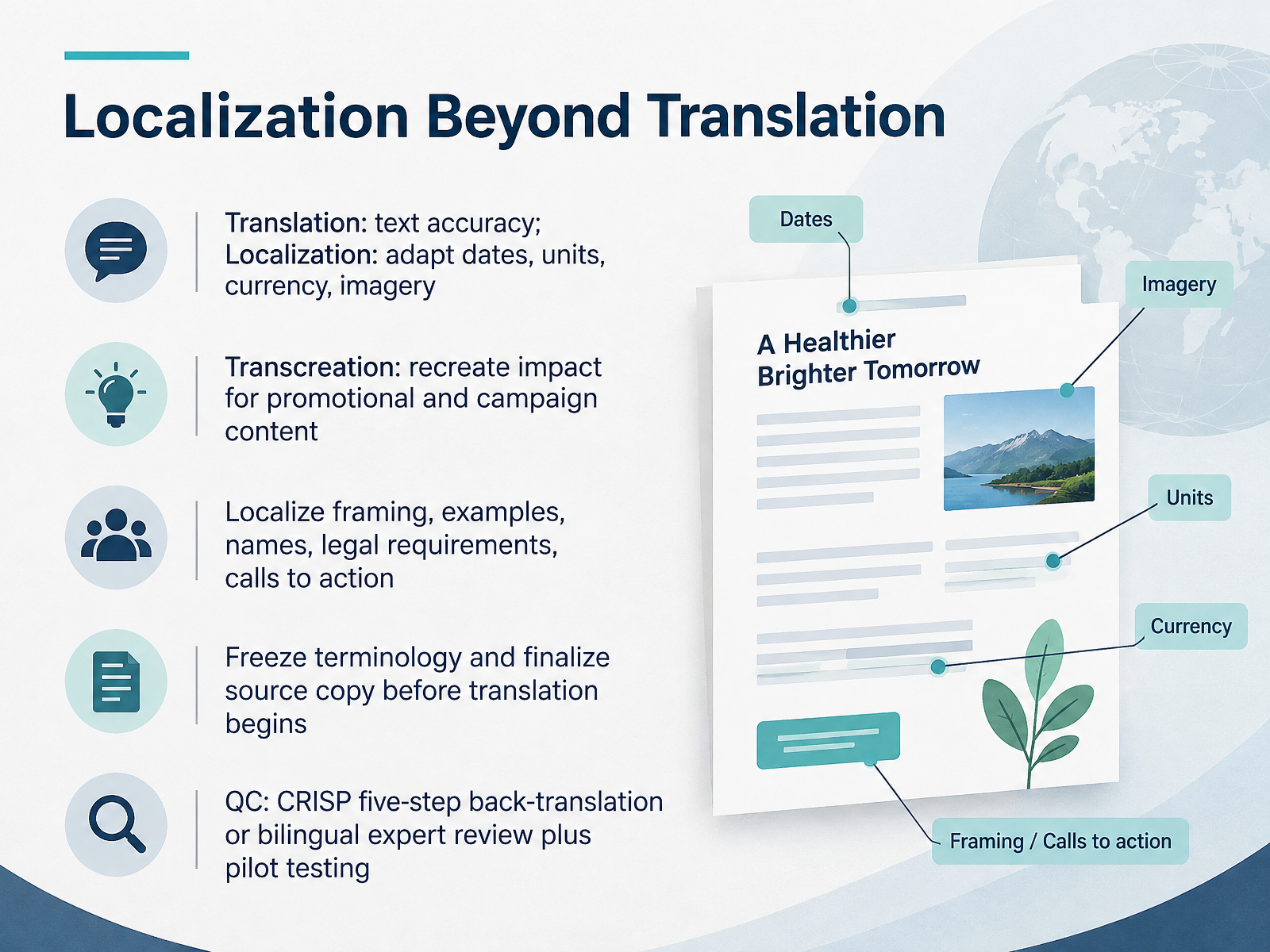
- 05Localization Beyond TranslationLet's move on to localization beyond translation. Translation gets the words right. Localization adapts everything around them: date formats, units of measurement, currency, imagery, and cultural references. For promotional content, you may go further into transcreation, where you recreate the impact rather than the wording. In practice, localize the framing, the examples, the names, the legal requirements, and the calls to action, not just the sentences. One constraint many of you face: approval layers multiply when copy keeps changing. So freeze your terminology and finalize the source copy before translation starts. Otherwise you pay twice. For quality control, use the CRISP five-step back-translation method or a bilingual expert review, then pilot test with real users. Your takeaway for this cycle: sign off on the source and glossary first, then localize the full experience, not just the text. Next, we look at packaging research into formats that travel.
 taus.nettranquality.infociol.org.uk+22 min
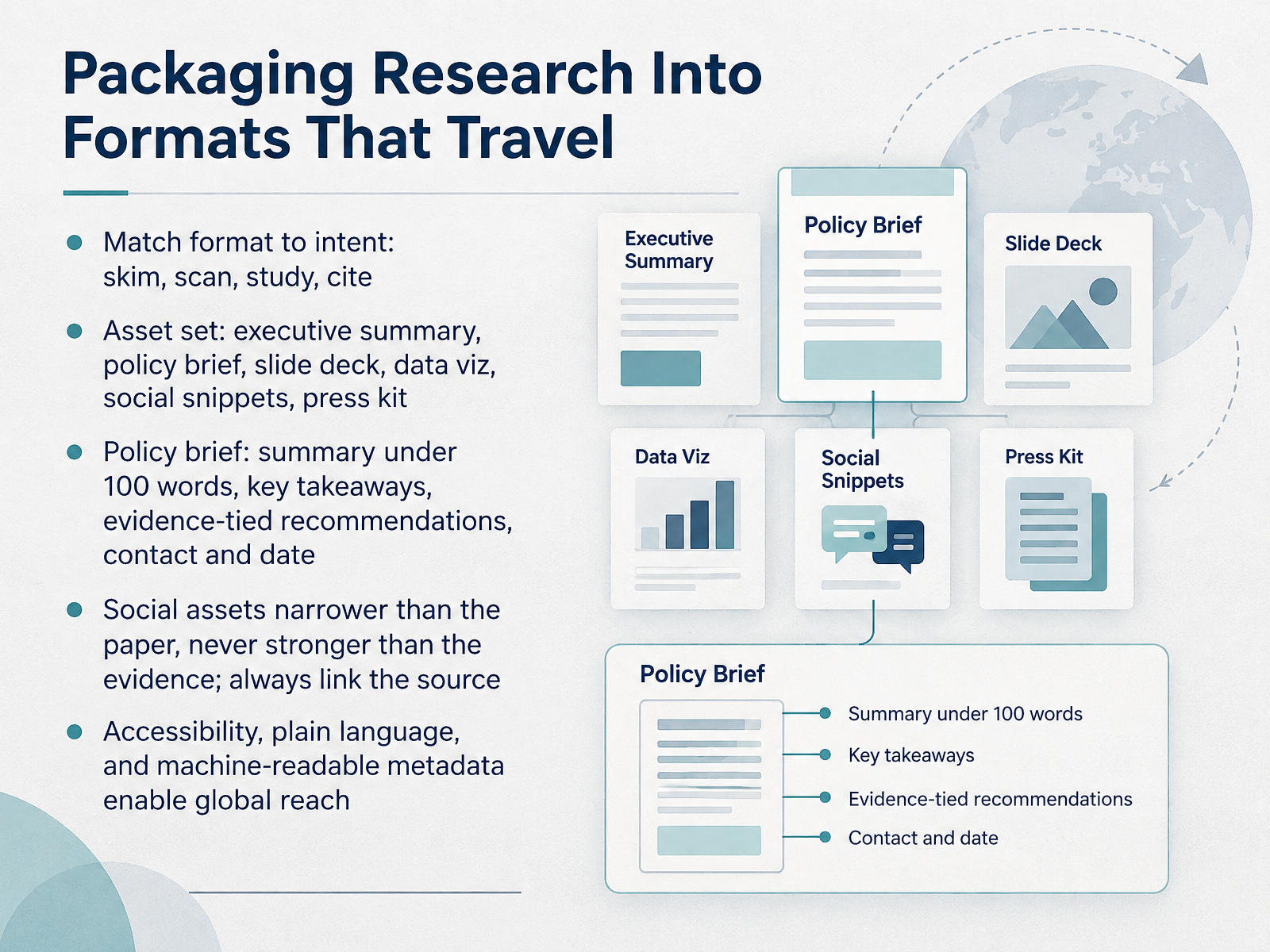
- 06Packaging Research Into Formats That TravelNow let's talk about packaging research into formats that actually travel. Start with intent. Some readers skim, some scan for detail, some study the full argument, and some need to cite it. Match the asset to that intent. In practice, that means building one asset set: an executive summary, a policy brief, a slide deck, a data visualization, social snippets, and a press kit. Your policy brief has a clear recipe. Lead with a summary under one hundred words, add key takeaways, tie every recommendation to the evidence, and include a contact and a date. For social assets, keep them narrower than the paper and never stronger than the evidence, and always link the source. Accessibility and plain language widen your reach, and machine-readable metadata makes your work findable worldwide. Here's your takeaway: inventory your asset set against those four reader intents before your next distribution cycle. Next, we'll look at channel strategy across regions.
 scienceeurope.orgacademic.oup.competerbates.org.uk+22 min
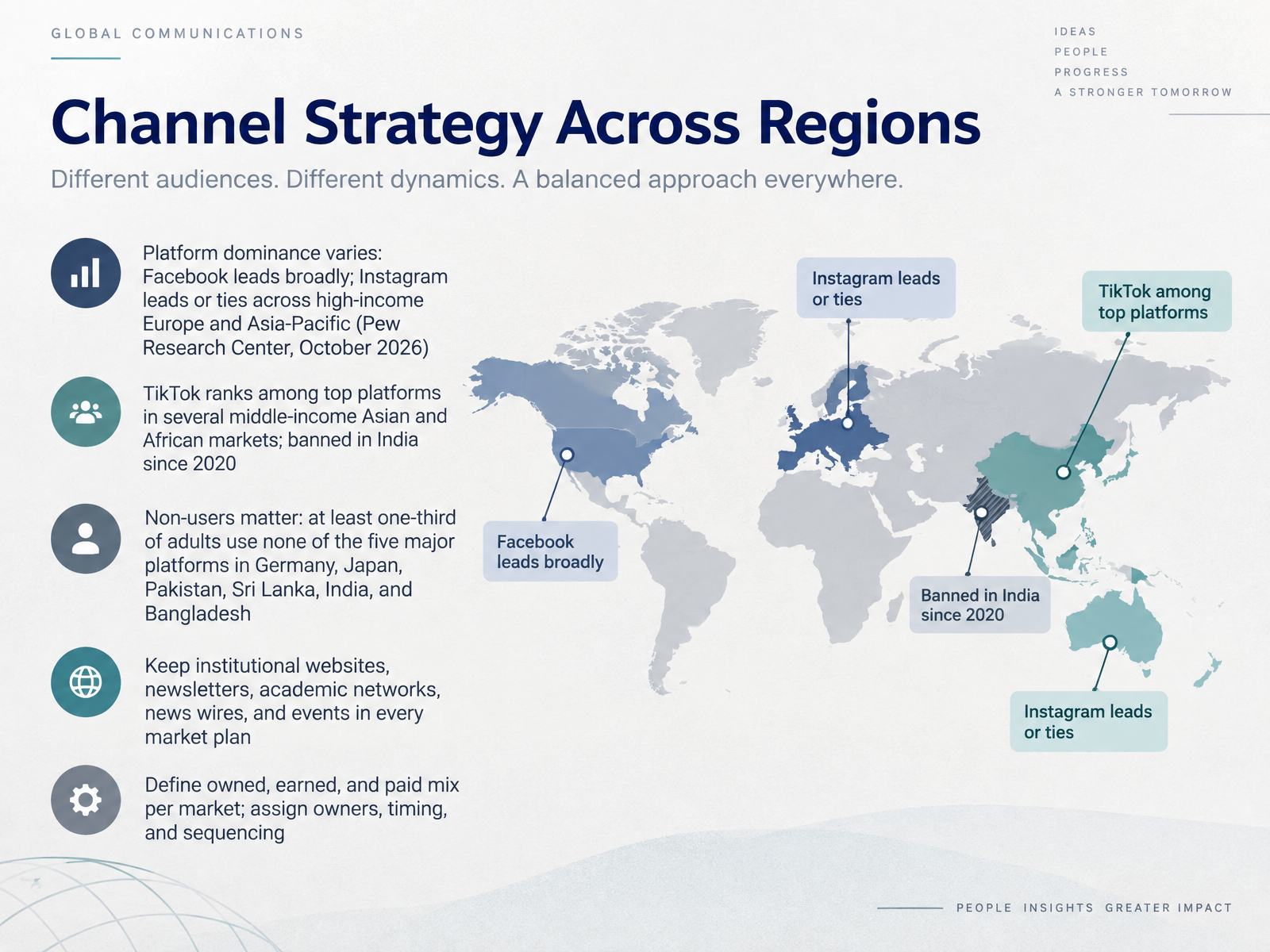
- 07Channel Strategy Across RegionsNext, let's talk channel strategy across regions. First, the platform data. Pew Research surveyed thirty-six countries in twenty twenty-six and found Facebook leads broadly, while Instagram leads or ties in high-income Europe and Asia-Pacific. TikTok ranks among the top platforms in several middle-income Asian and African markets, but it has been banned in India since twenty twenty. Here is what teams often miss. Non-users matter. At least one-third of adults use none of the five major platforms in Germany, Japan, Pakistan, Sri Lanka, India, and Bangladesh. So keep institutional websites, newsletters, academic networks, news wires, and events in every market plan. In practice, define your owned, earned, and paid mix per market, then assign owners, timing, and sequencing. That discipline keeps approval layers from stalling your launch. Your takeaway for this cycle is simple. Build one channel plan per market, not one global plan with local captions. That sets up our next topic, launch sequencing and embargo management.
 scienceeurope.orgacademic.oup.competerbates.org.uk+22 min
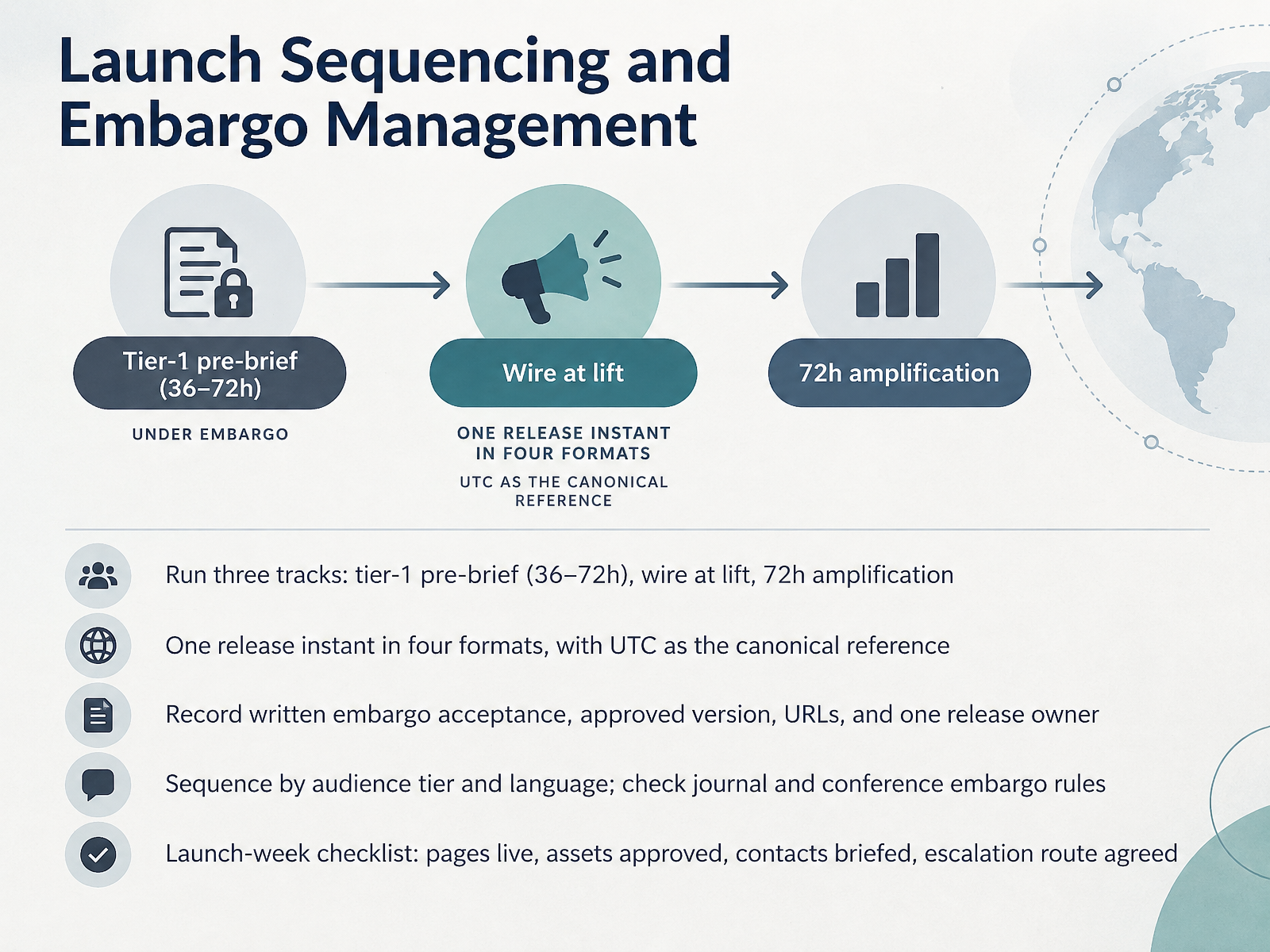
- 08Launch Sequencing and Embargo ManagementNow let's talk about sequencing the launch itself. Run three tracks: a tier-one pre-brief thirty-six to seventy-two hours ahead, the wire firing at the lift moment, then seventy-two hours of amplification. Next, pick one release instant and write it in four formats, with Coordinated Universal Time as the canonical reference, so a reporter in New York cannot mistake the hour. In practice, record written embargo acceptance, the approved version, the public URLs, and one release owner who can authorize timing changes. Sequence by audience tier and language, and check each journal and conference embargo rule, because policies change year to year and local press cultures differ. Before launch week, run the checklist: pages live, assets approved, contacts briefed, and an escalation route agreed. So your takeaway is simple: one owner, one instant, one written record. Next, we move on to Partnerships and Amplification.
 1 min
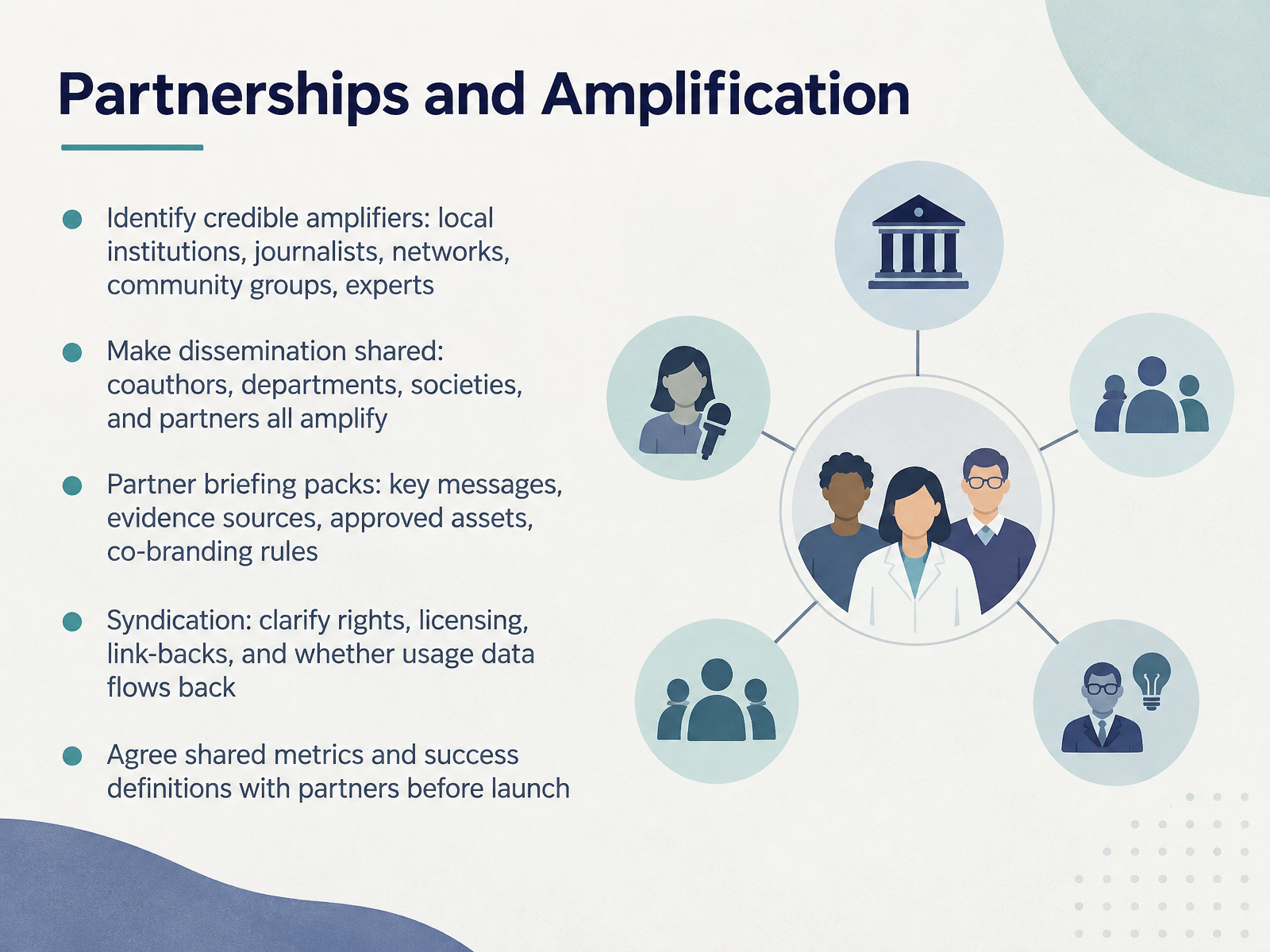
- 09Partnerships and AmplificationNow let's talk about partnerships and amplification. First, identify credible amplifiers: local institutions, journalists, networks, community groups, and subject experts who already have your audience's trust. Next, make dissemination shared. Your coauthors, departments, professional societies, and partners can all amplify, and a collective model beats one person broadcasting alone. In practice, give each partner a briefing pack with key messages, evidence sources, approved assets, and co-branding rules, so nothing gets rewritten into a stronger claim than the data supports. If you syndicate content, clarify rights and licensing, require link-backs, and settle in writing whether usage data flows back to you. Then agree shared metrics and success definitions before launch, not after. One actionable takeaway for your next cycle: sign a one-page partner agreement covering assets, rights, and metrics before anything goes live. That sets up Measurement and Feedback Loops.
 scienceeurope.orgacademic.oup.competerbates.org.uk+22 min
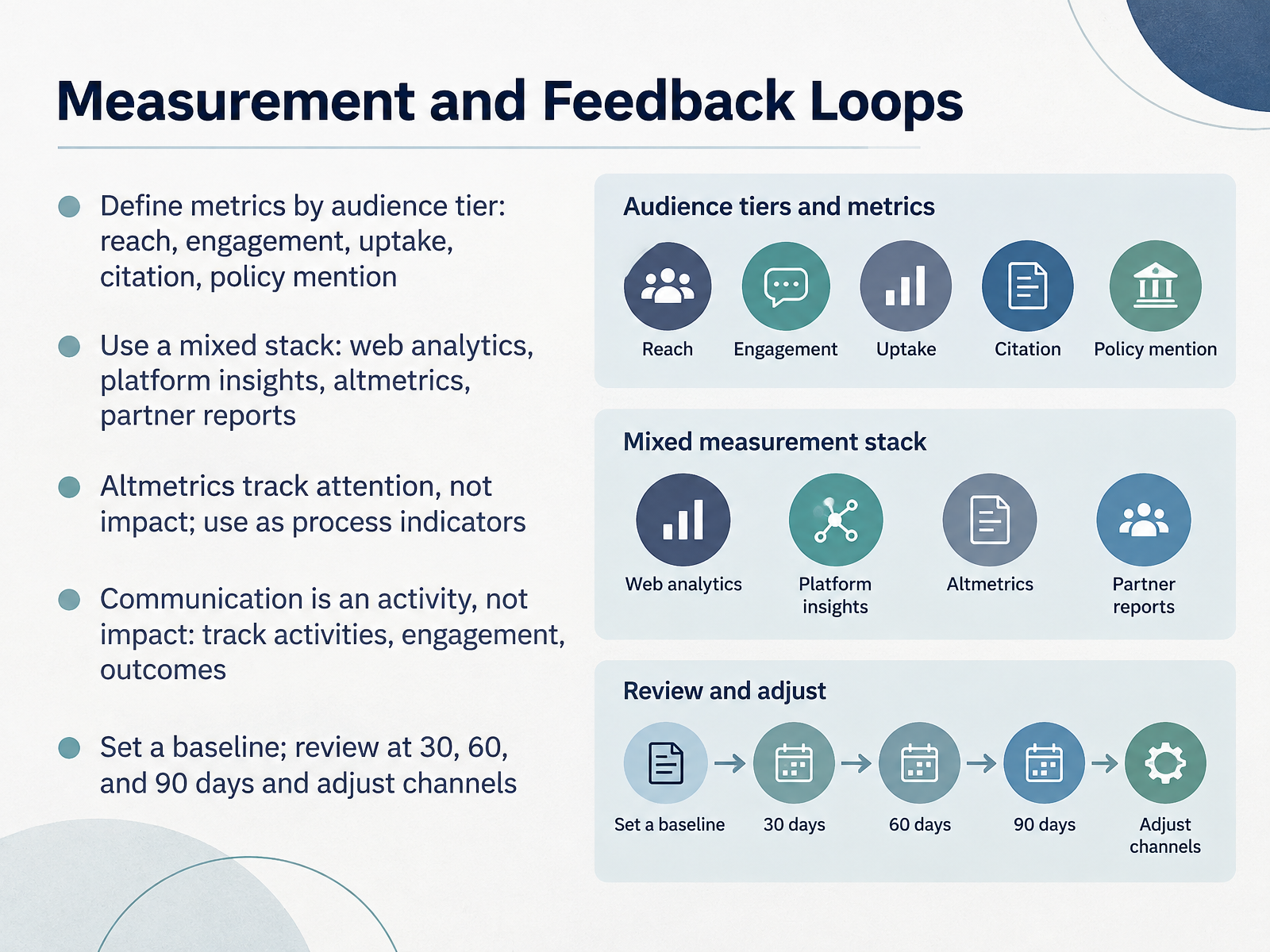
- 10Measurement and Feedback LoopsNow let's talk about measurement and feedback loops. First, define metrics by audience tier: reach, engagement, uptake, citation, and policy mention. Different tiers need different evidence, so don't judge a policy audience by impressions alone. Next, use a mixed stack: web analytics, platform insights, altmetrics, and partner reports. In practice, altmetrics track attention, not impact, so treat them as process indicators. Remember that communication is an activity, not impact. Track activities, engagement, and outcomes separately, because a press release is an activity, a download is engagement, and a policy citation is an outcome. Set a baseline first, then review at thirty, sixty, and ninety days and adjust your channels based on what moved. Your takeaway: pick one metric per audience tier, baseline it this week, and book those three reviews before your next cycle starts. Next, we'll look at governance, budget, and risk.
 scienceeurope.orgacademic.oup.competerbates.org.uk+22 min
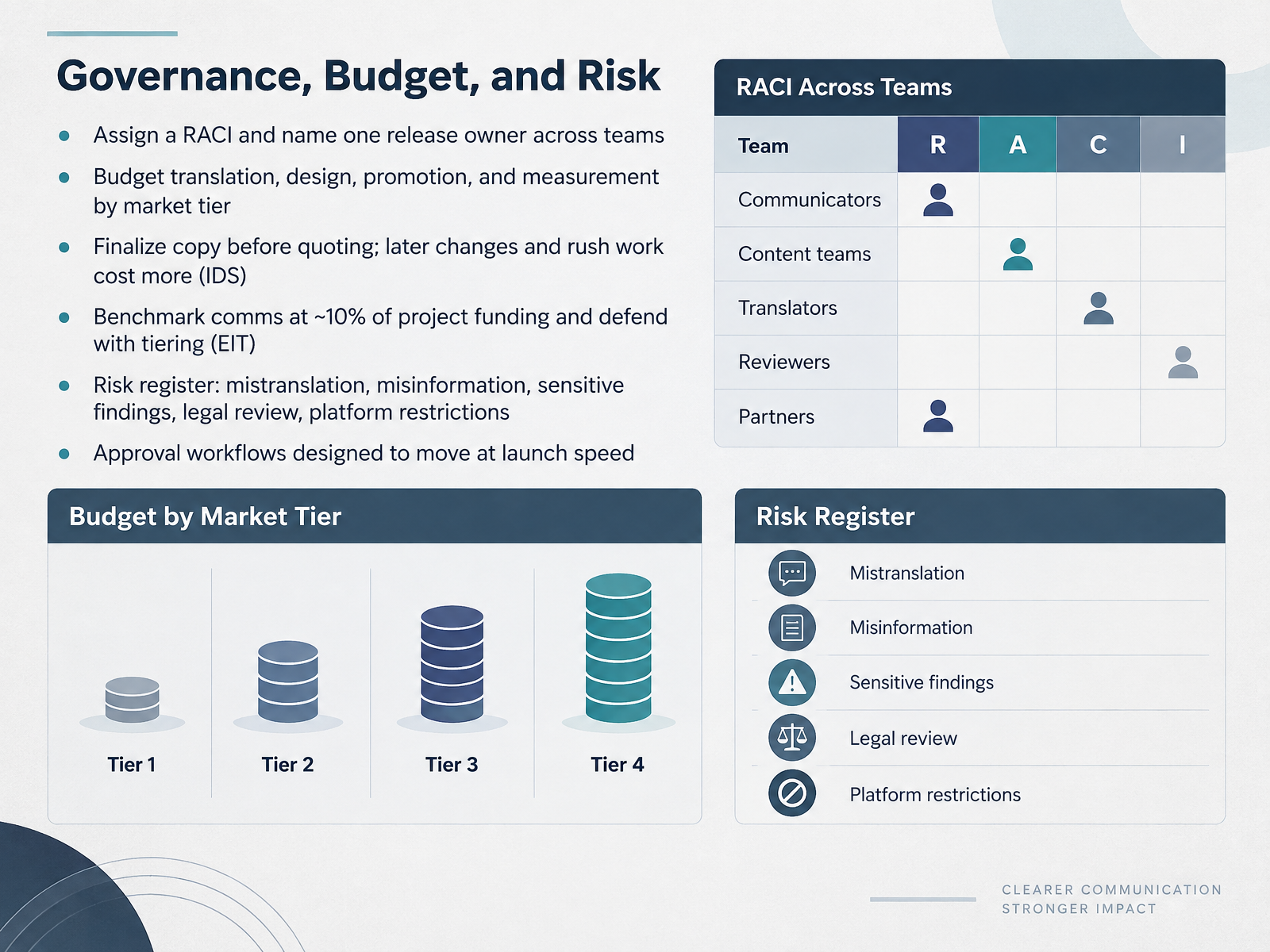
- 11Governance, Budget, and RiskNow let's talk governance, budget, and risk. First, assign a RACI and name one release owner who can authorize timing changes across teams. Next, translate your budget by market tier: design, promotion, and measurement cost more in some markets than others. In practice, finalize copy before you request quotes. Later changes and rush work cost more, so lock the text early. For benchmarking, aim for around ten percent of project funding for communications, and defend it with tiering. Then keep a risk register covering mistranslation, misinformation, sensitive findings, legal review, and platform restrictions. Finally, design approval workflows to move at launch speed, with clear decision points. Your takeaway: name one owner and tier your budget before the next cycle. Next, we will build your ninety-day distribution workflow.
 1 min
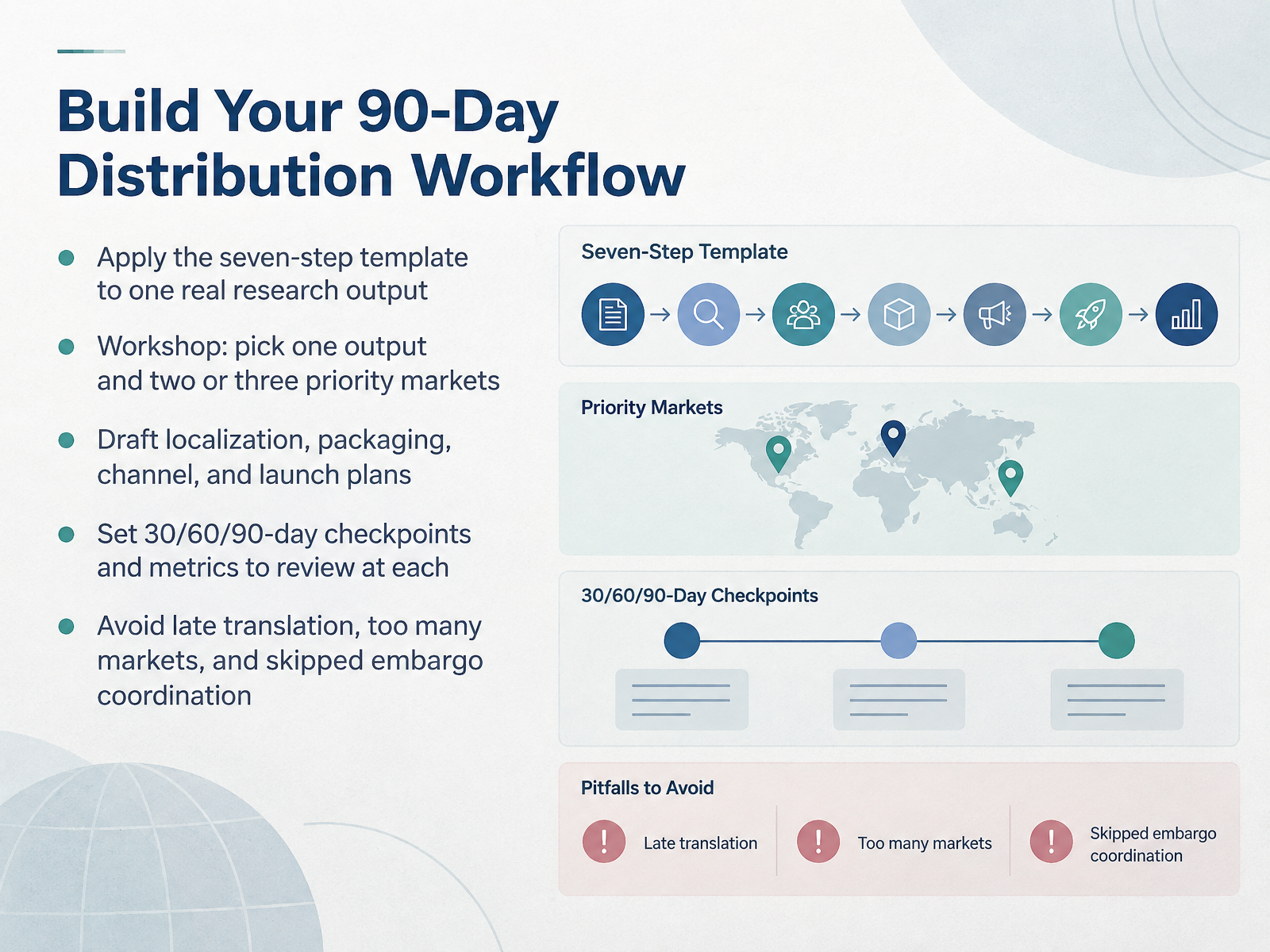
- 12Build Your 90-Day Distribution WorkflowNow let's put that into a ninety-day workflow. Apply the seven-step template to one real research output, not a whole portfolio. In your workshop, pick one output and two or three priority markets. Say you're launching a policy brief: choose the United Kingdom, Germany, and Kenya, and keep your focus there. Next, draft four plans together: localization, packaging, channels, and launch. Then set checkpoints at thirty, sixty, and ninety days, with metrics to review at each. Thirty days out, confirm translations and local approvals. At sixty, check channel readiness and embargo timing. At ninety, review reach and engagement. There are three traps to avoid: late translation, too many markets, and skipped embargo coordination. Lock translation early, cap your market list, and record one release time in every relevant timezone. Your takeaway: run one real output through this ninety-day template before scaling. Next, we'll look at templates, checklists, and resources.
 jbi.globalguides.library.vcu.edufddda029-0b0f-44c0-ac47-122487ebcfe1.filesusr.com+22 min
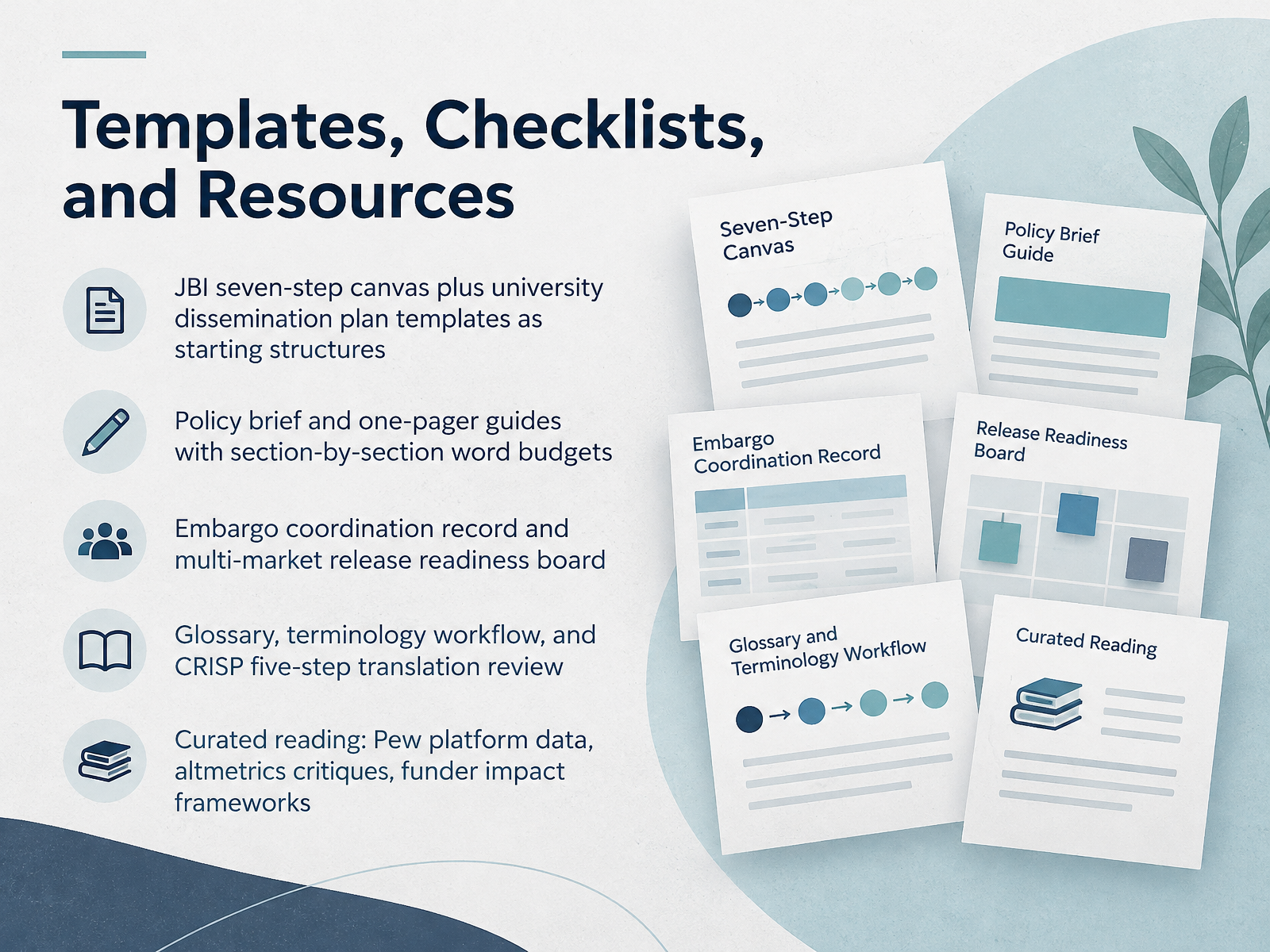
- 13Templates, Checklists, and ResourcesNow, let's look at the toolkit you can lean on. Start with proven structures rather than a blank page. The JBI seven-step canvas covers objectives, audiences, messages, products, platforms, resources, and evaluation. University dissemination plan templates work the same way, so pick one and adapt it. Next, use policy brief and one-pager guides with section-by-section word budgets. For example, a background section of roughly two hundred to two hundred fifty words keeps you disciplined and skimmable. Then add operational records. An embargo coordination record captures who accepted the embargo, the exact release time with time zone, and the approved version. A multi-market release readiness board shows each market as draft, in local review, approved, or ready, so approval layers do not stall you. For language, keep a glossary, a terminology workflow, and a five-step translation review, because machine translation is only a starting point. Finally, curate your reading. The Pew platform data helps you choose channels by market. Altmetrics critiques remind you that attention is a process indicator, not proof of impact. Funder impact frameworks help you report to the people paying for the work. Your takeaway is this. Load these templates into your next distribution cycle before kickoff, not after the draft exists. That brings us to Key Takeaways and Next Steps.
 jbi.globalguides.library.vcu.edufddda029-0b0f-44c0-ac47-122487ebcfe1.filesusr.com+22 min
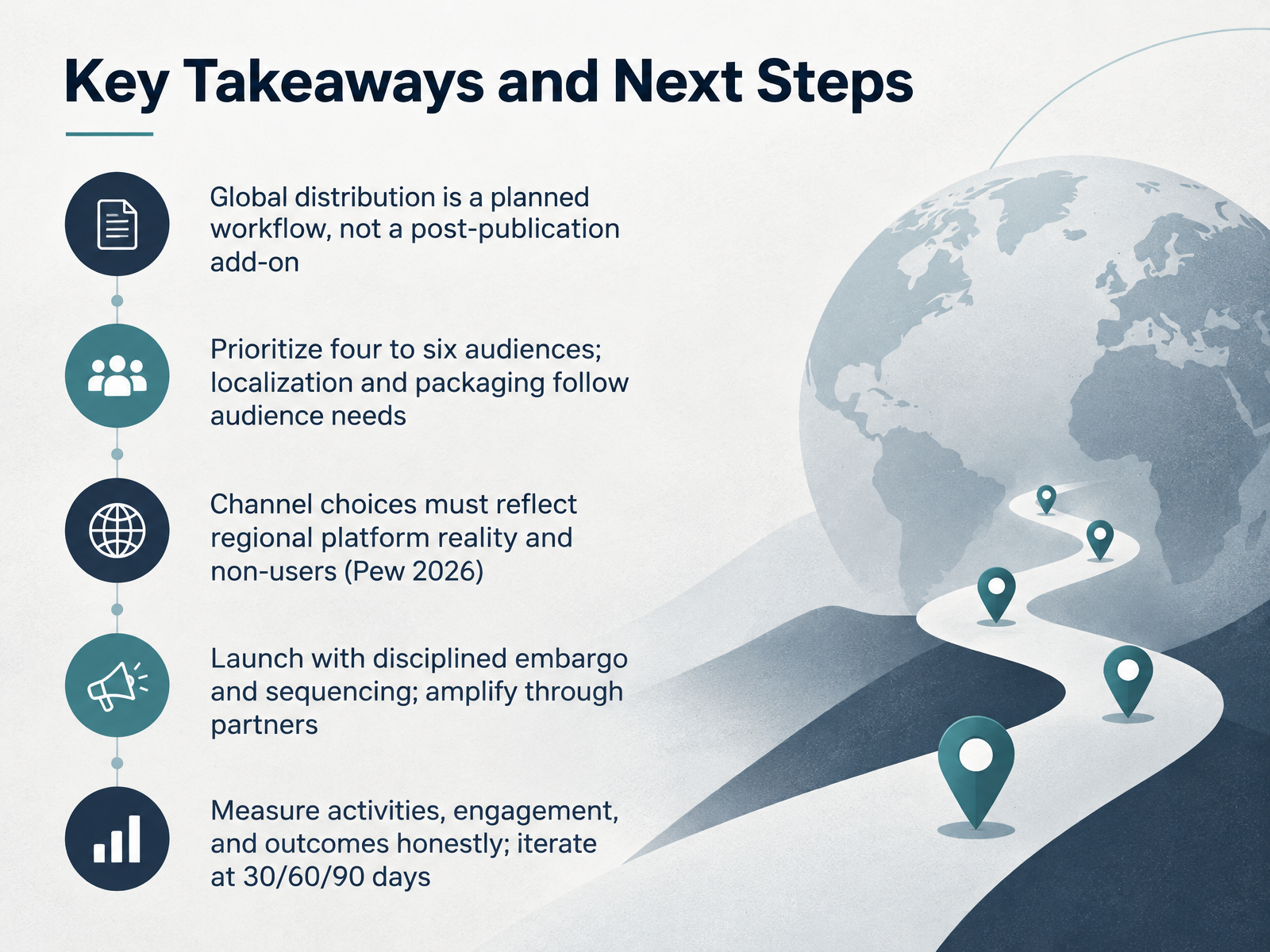
- 14Key Takeaways and Next StepsLet's bring it together. First, global distribution is a planned workflow, not something you bolt on after publication. Second, prioritize four to six audiences, then let localization and packaging follow their needs. Third, match channels to regional platform reality, and remember the non-users. Pew's twenty twenty twenty-six data shows substantial non-use even in major markets like Germany, Japan, and India. Fourth, launch with a disciplined embargo and clear sequencing, then amplify through partners. Fifth, measure activities, engagement, and outcomes honestly, keeping those categories separate, and iterate at thirty, sixty, and ninety days. Here's your next step: before your next launch, run one short review against these five points and fix the weakest one first. That single habit compounds across every cycle. Thank you for working through this course with me. You now have a workflow you can repeat, refine, and share with your team. Go run it.
 scienceeurope.orgacademic.oup.competerbates.org.uk+22 min
Take the deck with you
Download this course as a file — free, no sign-up needed.
- PDF handoutEvery slide page, ready to print or share.15 pages · 3.8 MBDownload
- Narrated PowerPointThe deck that presents itself — every slide carries the digital human's narration video.15 pages · 14.7 MBDownload
- PowerPoint slidesThe full deck as a .pptx — open it in PowerPoint, Keynote, or Google Slides.15 pages · 3.8 MBDownload
Free to use in your own training — please keep the PersonWise credit page at the end.
Have your own deck? Turn it into a course
Sources consulted
Web sources consulted while building this course.
- SCIENCE COMMUNICATION AND RESEARCH CULTURE — scienceeurope.org
- From publication to dissemination: using social media to extend scholarly reach and impact | Academic Medicine | Oxford Academic — academic.oup.com
- FINAL_GuiDiR Framework 120724 — peterbates.org.uk
- Dissemination — chibe.upenn.edu
- EXTERNAL COMMUNICATION STRATEGY 2026 - 2027 — erc.europa.eu
- https://jbi.global/sites/default/files/inline-images/JBI_Research_Dissemination/5-Research-Dissemination.pdf — jbi.global
- Dissemination Plan Template - Create a Research Dissemination Plan - Research Guides at Virginia Commonwealth University — guides.library.vcu.edu
- Communications and Dissemination Toolkit: Global Communications for International and Grassroots Projects — fddda029-0b0f-44c0-ac47-122487ebcfe1.filesusr.com
- Research dissemination: a practical guide for JBI authors — doi.org
- Make a communication plan: How-to, templates, tips — canva.com
- Identifying and prioritising audiences — health.org.uk
- Prioritising segments without turning the scoring into a verdict — marketing-strategy.net
- Audience Research & Target Audience Analysis Tool | Klinko — klinko.ai
- Communication audience research for campaigns | NMS Market Research — nms.global
- Understanding the Secrets of Persuasion | Columbia University School of Professional Studies — sps.columbia.edu
- TAUS Report - Transcreation Best Practices and Guidelines | TAUS — taus.net
- FIT Position Paper on Translation, Localisation and Transcreation — tranquality.info
- Translation, localisation or transcreation? | CIOL (Chartered Institute of Linguists) — ciol.org.uk
- Code of Practice — iti.org.uk
- When translation is not enough: Transcreation as a convention-defying practice. A practitioner's perspective — jostrans.org