Historical Timelines & Periodization
Begin
14 pages · ~28 min
Historical Timelines & Periodization
Learn to analyze historical timelines by identifying change, continuity, and periodization patterns.
What you’ll learn
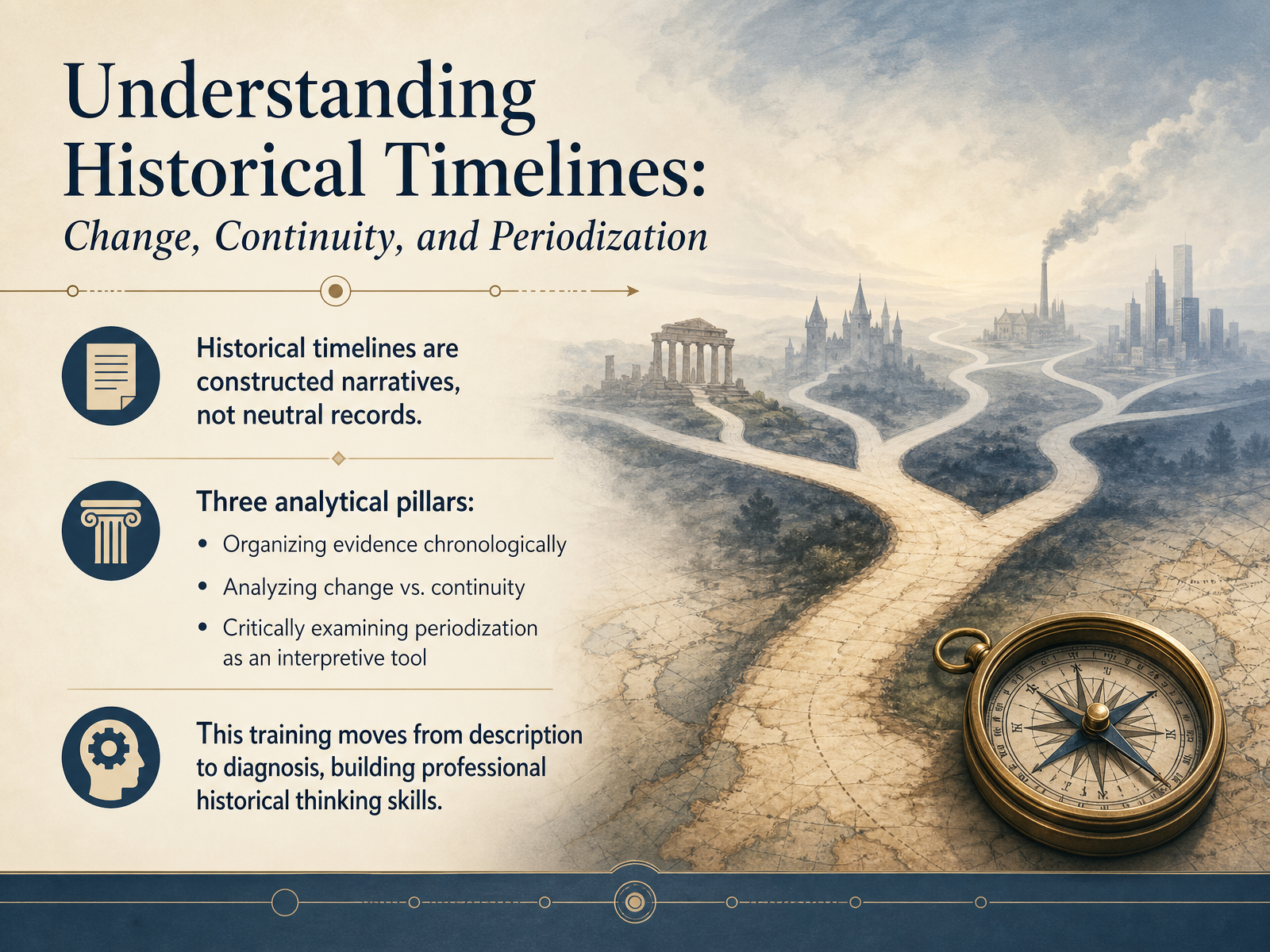
- 01Understanding Historical Timelines: Change, Continuity, and PeriodizationWelcome. In this training, we build professional historical thinking skills by working directly with timelines. Our focus is not just on what happened, but on how we organize evidence to make sense of the past. This slide introduces three analytical pillars you will apply immediately. First, arranging evidence chronologically to reveal sequence and relationships. Second, diagnosing change versus continuity, because history is not just a story of transformation; some structures persist across periods. Third, critically examining periodization. The labels we use, like the Renaissance or the Cold War, are interpretive tools historians create, not natural facts we discover. Across this session, we move from describing the past to diagnosing how historical narratives are built. You will learn to read any timeline as a constructed argument, one you can test and refine with your own evidence.eprints.worc.ac.ukessp.psu.edupmc.ncbi.nlm.nih.gov+22 min
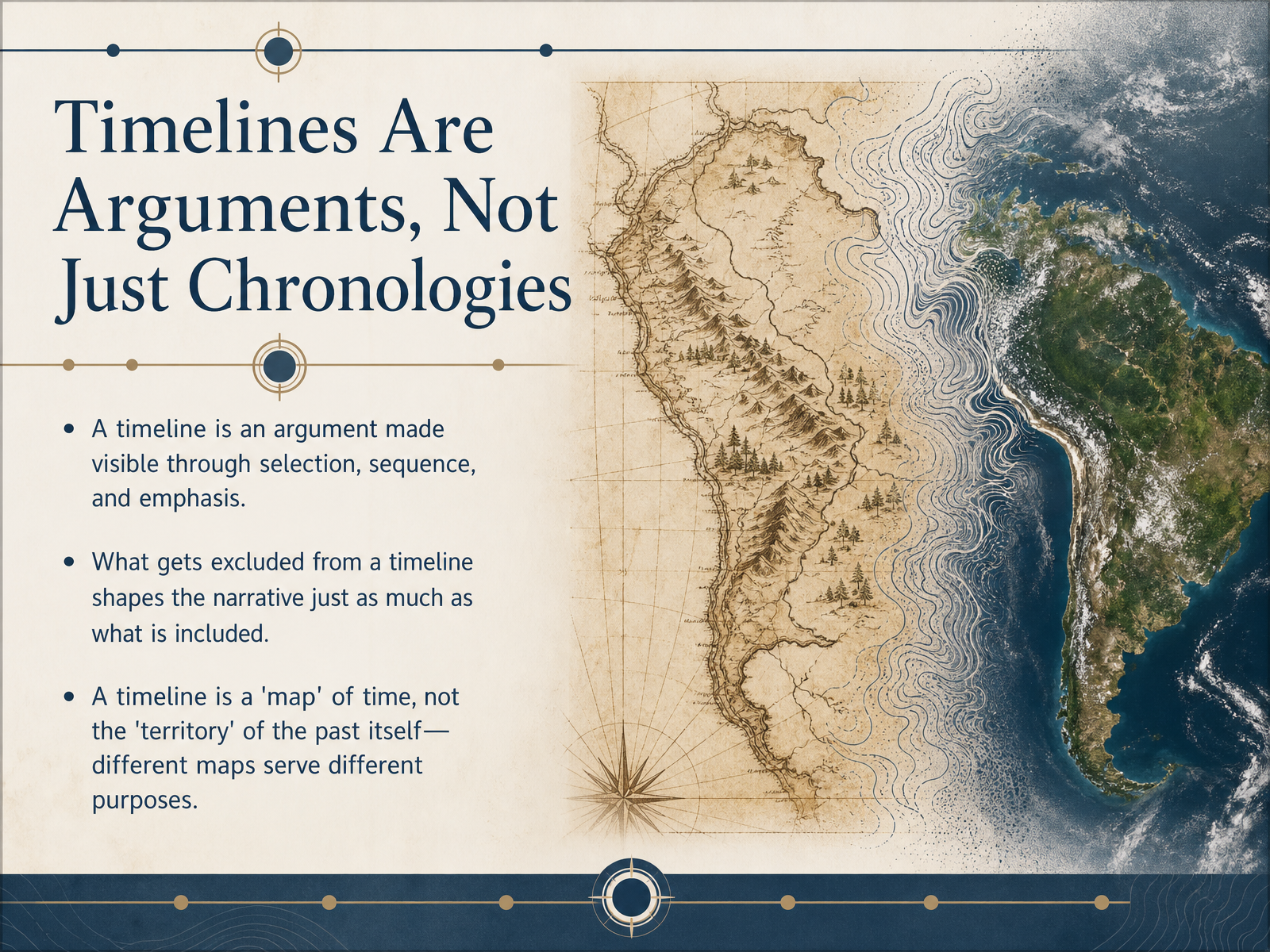
- 02Timelines Are Arguments, Not Just ChronologiesA timeline is never neutral. Every timeline you build or read is an argument made visible through your choices about what to show, what to leave out, and where you place the emphasis. Think of a timeline as a 'map' of time, not the 'territory' of the past itself. Different maps serve different purposes. A highway map and a topographic map of the same region reveal entirely different truths. The same holds for timelines. A timeline of political revolutions and a timeline of everyday life in the same century will look almost nothing alike. Equally important is what gets excluded. Silences shape the story just as powerfully as the dates you include. As you analyze evidence, start asking: whose experience is centered here, and whose is absent? Recognizing that these are constructed frameworks gives you an essential analytical tool you can use right now. Let's see what happens when we put this into practice.
 eprints.worc.ac.ukessp.psu.edupmc.ncbi.nlm.nih.gov+21 min
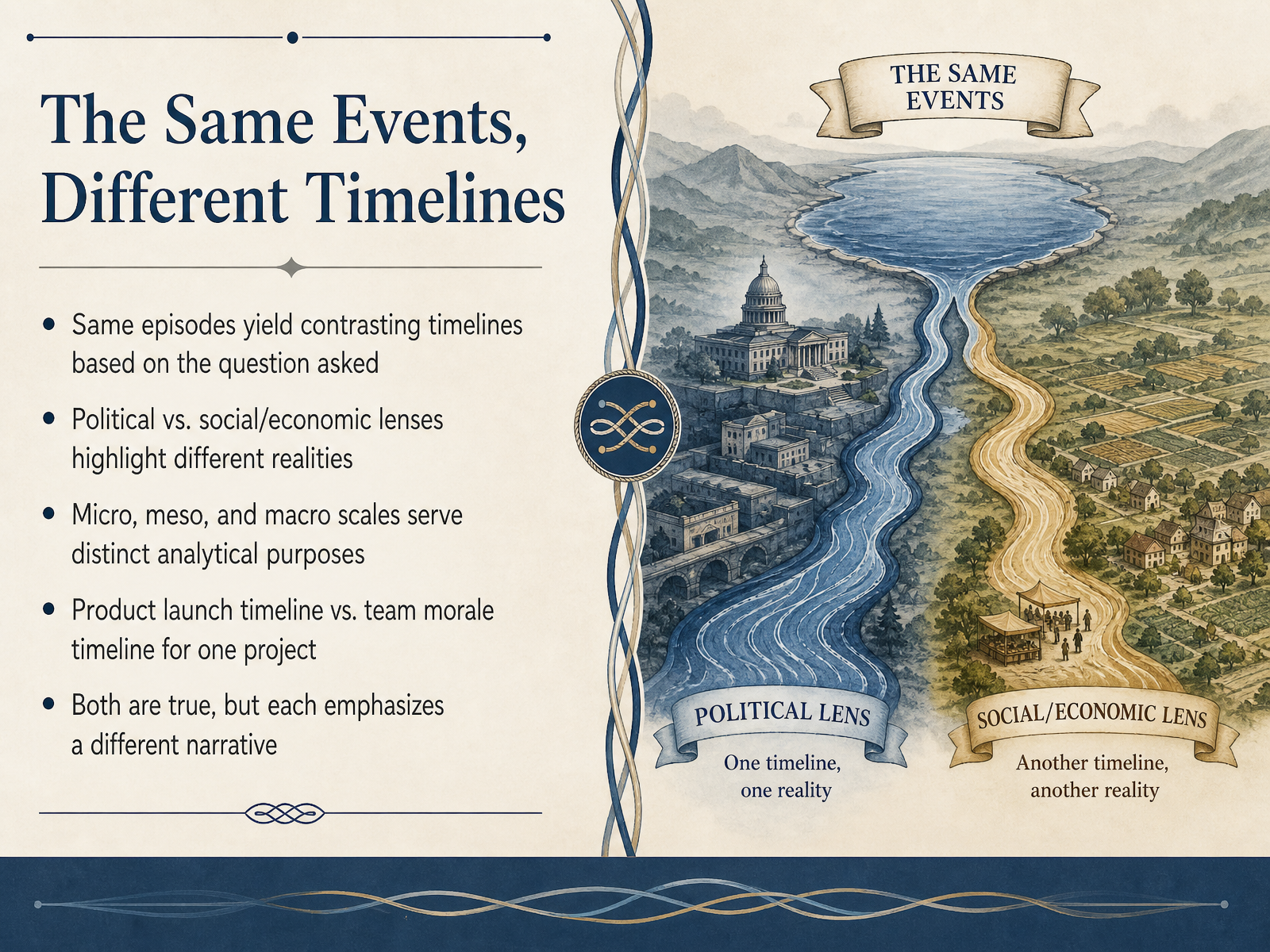
 - 03The Same Events, Different TimelinesLet’s shift to a practical idea: the same sequence of events can, and often should, produce very different timelines. The structure you build depends entirely on the question you’re asking. If you apply a political lens, your timeline highlights elections, treaties, and regime changes. Switch to a social or economic lens, and you’ll see shifts in living standards, labor practices, or demographic patterns instead. Both timelines are built from the same underlying evidence, yet each spotlights a separate reality. This is also a matter of scale. A macro timeline can map centuries of imperial rise and fall. A meso timeline might track decades of institutional reform, and a micro timeline could follow the daily experience of a single community during crisis. To make this concrete, think about a product launch inside your own organization. One timeline tracks market entry, revenue milestones, and competitive response. Another tracks team morale, turnover, and resource fatigue. Both are accurate. Neither is the whole story. What this teaches us is that timelines are not neutral records. They are arguments about what mattered most. And you, as the analyst, choose which narrative to foreground. Next, we’ll take that insight into detecting and analyzing change itself, in "Identifying and Analyzing Change."
 peterpappas.comaclanthology.orglucensoftware.com+22 min
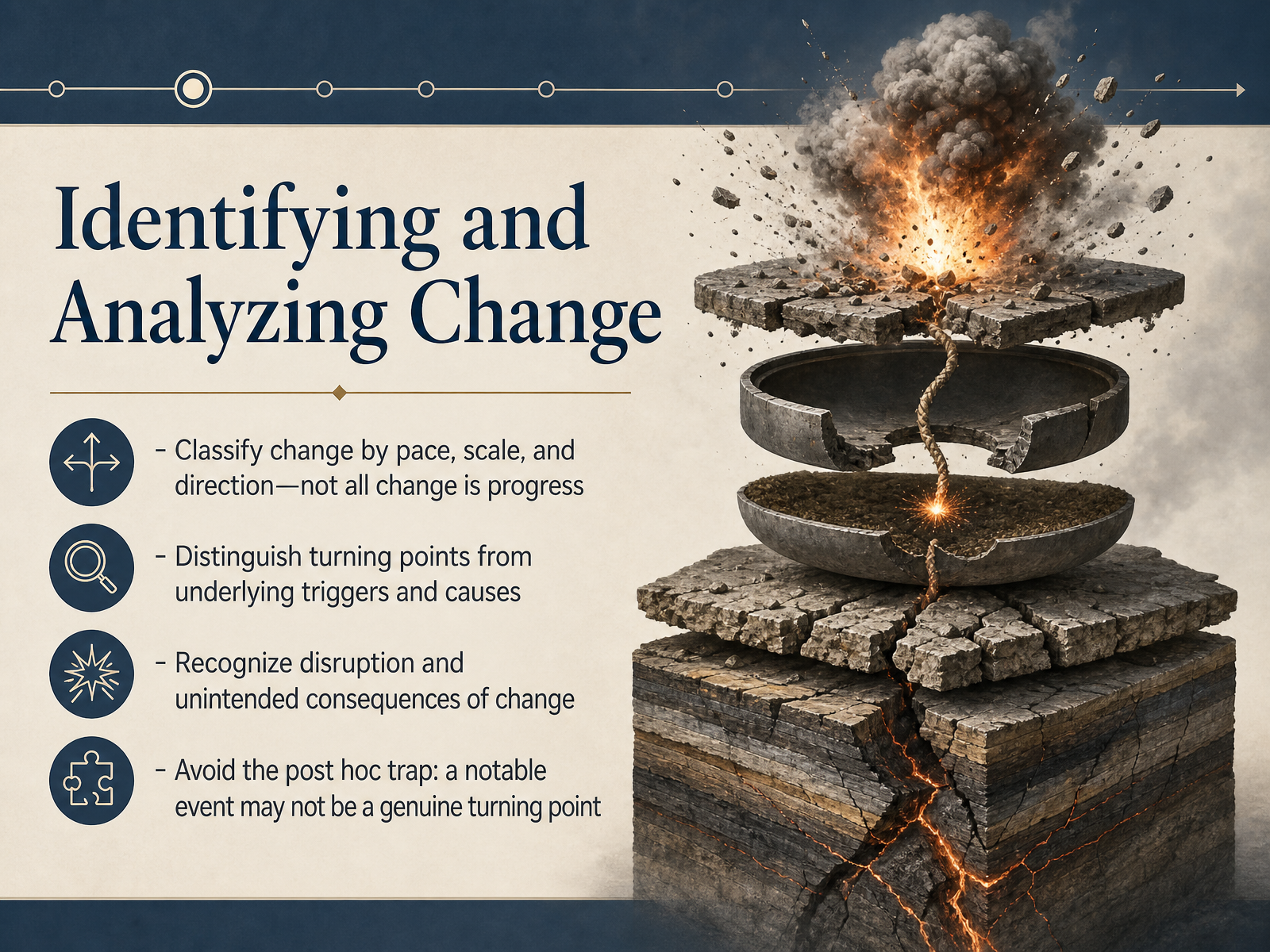
 - 04Identifying and Analyzing ChangeLet's turn now to the practical work: identifying and analyzing change itself. When you examine a change in your evidence, start by classifying it along three dimensions—its pace, its scale, and its direction. Not all change is progress. Some shifts happen slowly over generations, while others strike suddenly. Some affect a single institution, others reorganize an entire society. And direction matters. A change can mean growth, decline, or simply a new trajectory with no clear improvement at all. Next, draw a sharp line between turning points and the underlying triggers and causes that set them in motion. A dramatic event may capture everyone's attention, but the real drivers often operate quietly for decades beforehand—termites in the basement, not a single storm. Look also for disruption and unintended consequences. Many changes produce outcomes that no one planned, and those second-order effects frequently reshape the timeline more than the original event itself. Finally, resist what we can call the post hoc trap. A highly visible event might look like a genuine turning point, but when you test it against your evidence you often find that existing patterns simply continued. A notable date is not automatically a meaningful pivot. So as you organize your evidence, put each change through these tests: classify its pace, scale, and direction; separate catalysts from deep causes; trace consequences that nobody intended; and always question whether a celebrated event truly altered the direction of the story. Next, we'll examine the other half of this analytical pair: explaining continuity, which is far more than the simple absence of change.
 sciencedirect.comdoi.orgdoi.org+22 min
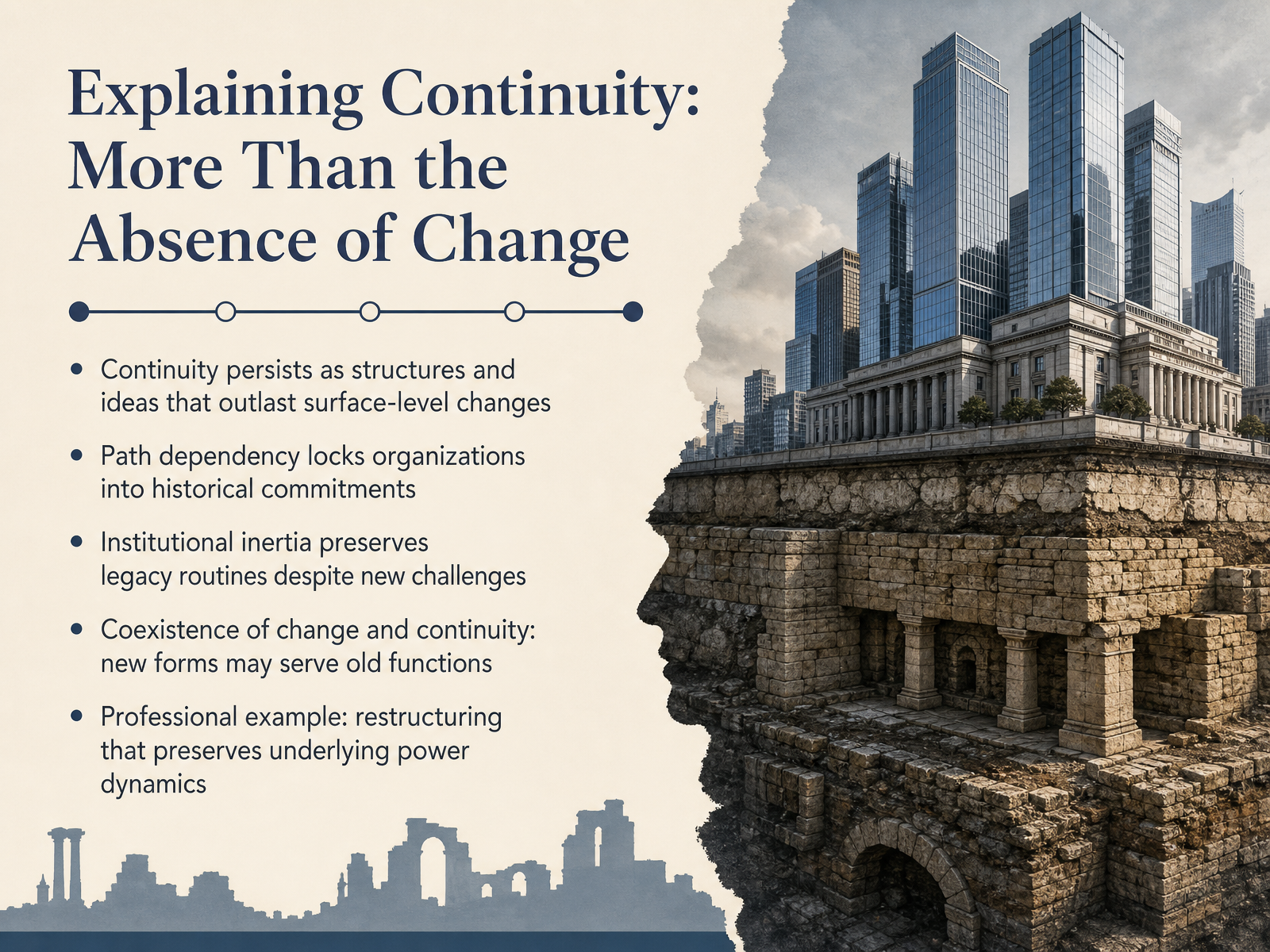
 - 05Explaining Continuity: More Than the Absence of ChangeNow let's turn to a complementary concept—continuity. It's easy to mistake continuity for the simple absence of change, but that isn't quite right. Continuity is an active persistence, where structures and ideas outlast surface-level adjustments. Think of path dependency: past commitments can lock an organization into a particular direction, making alternatives increasingly costly or unthinkable. You also see institutional inertia, where legacy routines keep operating long after their original rationale has faded. One important insight is that change and continuity often coexist. New forms can actually serve old functions. For instance, a company might announce a bold restructuring, yet preserve the same underlying power dynamics. The structure looks new, but the continuity of influence is what actually matters. So when you examine your own evidence, trace not just what changed, but what held firm beneath the surface. In the next slide, we'll put these ideas side by side with a comparative framework for change and continuity.
 wiwiss.fu-berlin.dewilfreddolfsma.netlink.springer.com+22 min
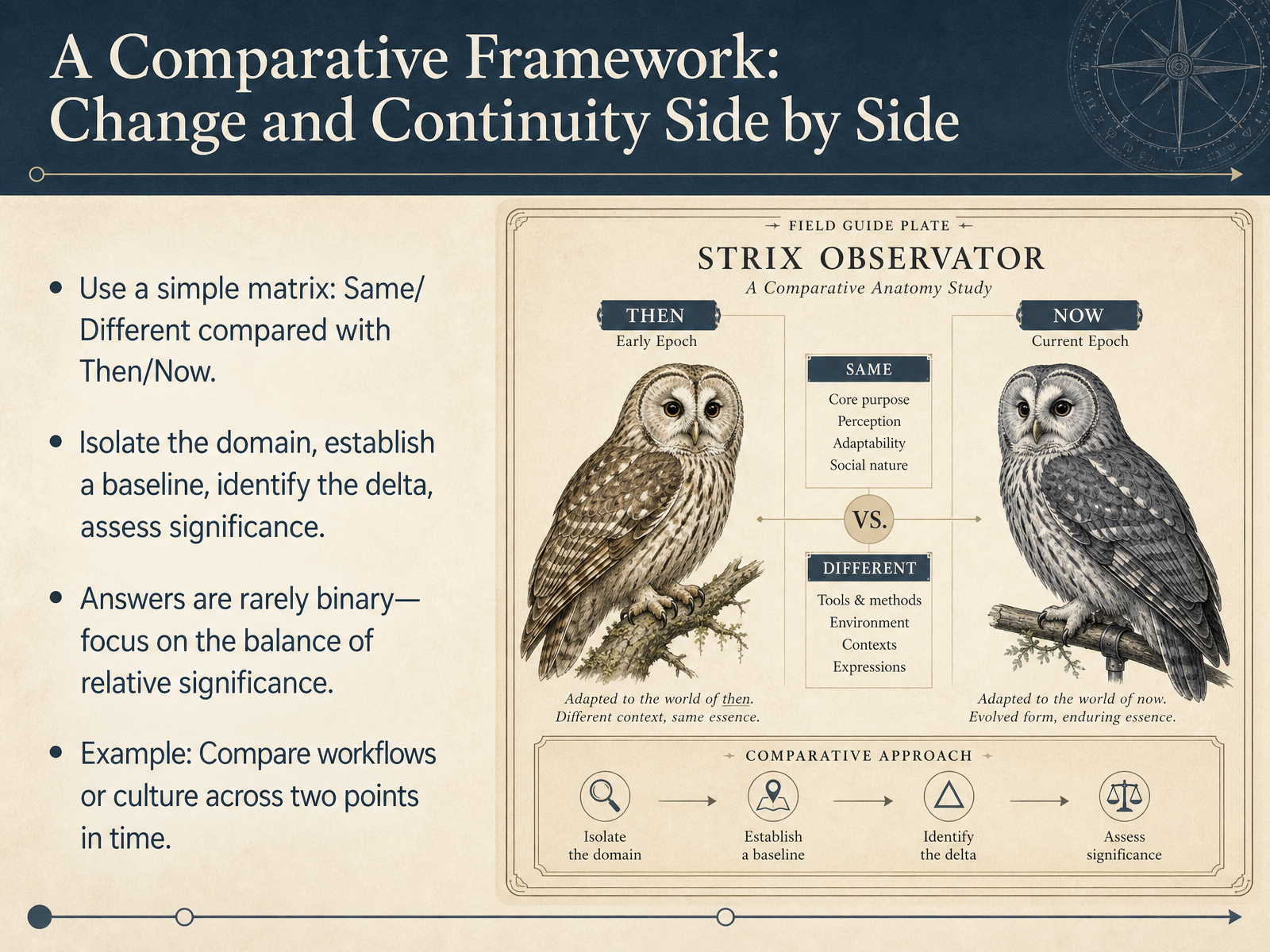
 - 06A Comparative Framework: Change and Continuity Side by SideSo far we’ve talked about change and continuity as separate ideas. Now let’s put them side by side and build a working comparative framework. The goal here is not to decide whether something changed or not, because the answer is rarely that binary. Instead, we want to assess the balance of relative significance. A practical way to start is with a simple matrix: same versus different, compared across then versus now. Pick a domain—maybe workflows, team culture, or decision rights—and establish a clear baseline at a past point in time. Then identify the delta, that is, what actually shifted, and what persisted despite pressure to change. The hardest and most important step is the last one: assess significance. Ask yourself, does the change represent a fundamental reorientation, or just an incremental adjustment within a stable path? In organizational research, this is the difference between a transformation that changes the direction of a trajectory and reproduction that reinforces the existing path. By isolating the domain, establishing the baseline, identifying the delta, and then evaluating the significance, you move from simply listing differences to making a structured analytical judgment. Next, we’ll turn to periodization and why we should treat it as an interpretive tool, not a natural fact.
 wiwiss.fu-berlin.dewilfreddolfsma.netlink.springer.com+22 min
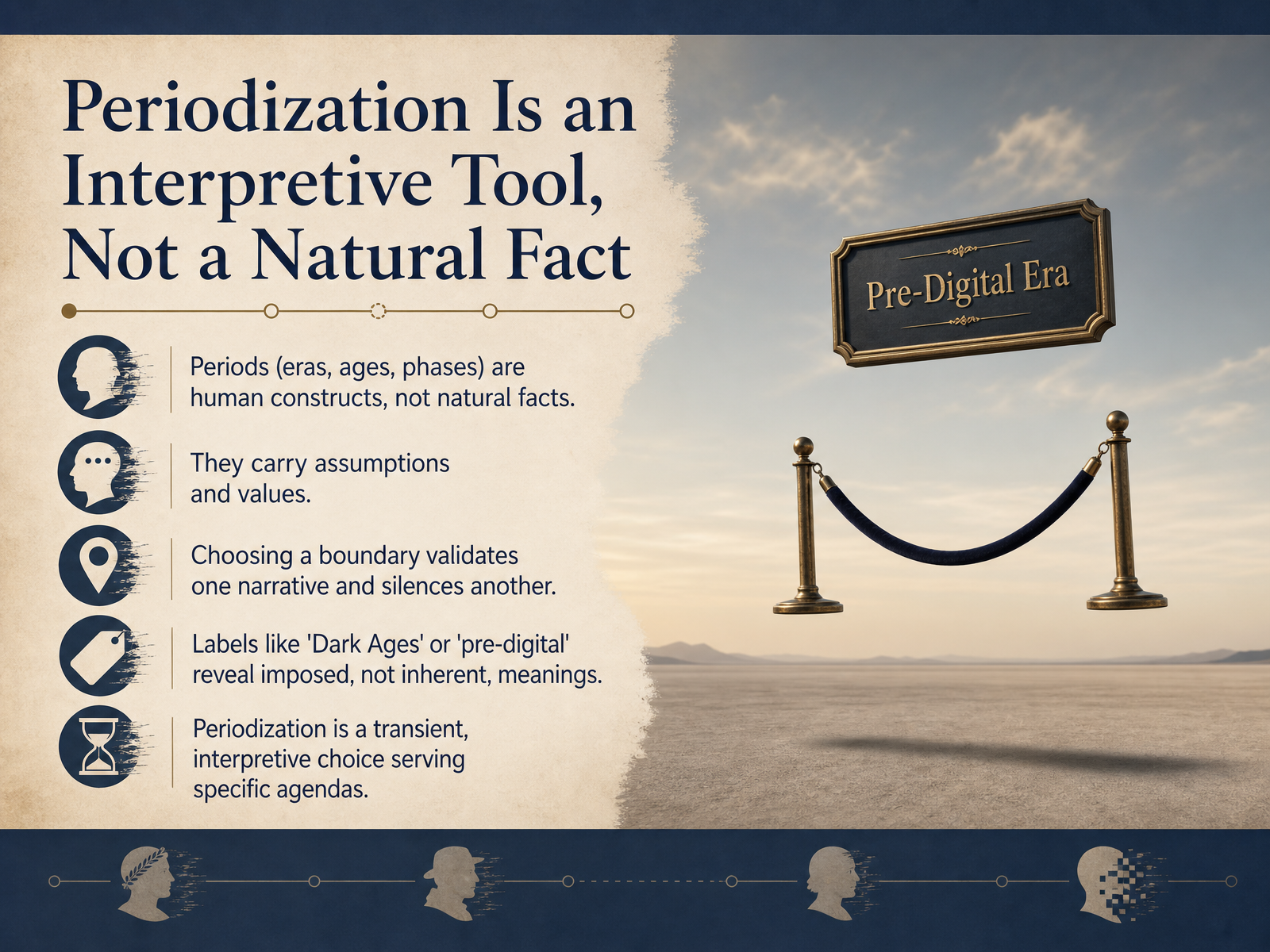
 - 07Periodization Is an Interpretive Tool, Not a Natural FactLet's shift our focus to what a period really is. When we talk about eras, ages, or phases, it's easy to think of them as natural facts built into the timeline. But in truth, these are human constructs. They are frameworks we invent to organize evidence, and every framework carries specific assumptions and values. Think about labels like the 'Dark Ages' or even 'pre-digital.' These names don't describe inherent qualities of the past. Instead, they impose a judgment from our present perspective. When you choose a boundary line between two periods, you are making an interpretive choice. You are validating one narrative and, just as powerfully, silencing another. Periodization is not a permanent truth waiting to be discovered. It is a transient tool, often serving a specific agenda. So when you build your own timelines, ask yourself: whose story does this boundary highlight, and whose story does it leave out? Now, let's apply this lens directly to our own environment with a look at 'Periodization in Your Organization.'
 2 min
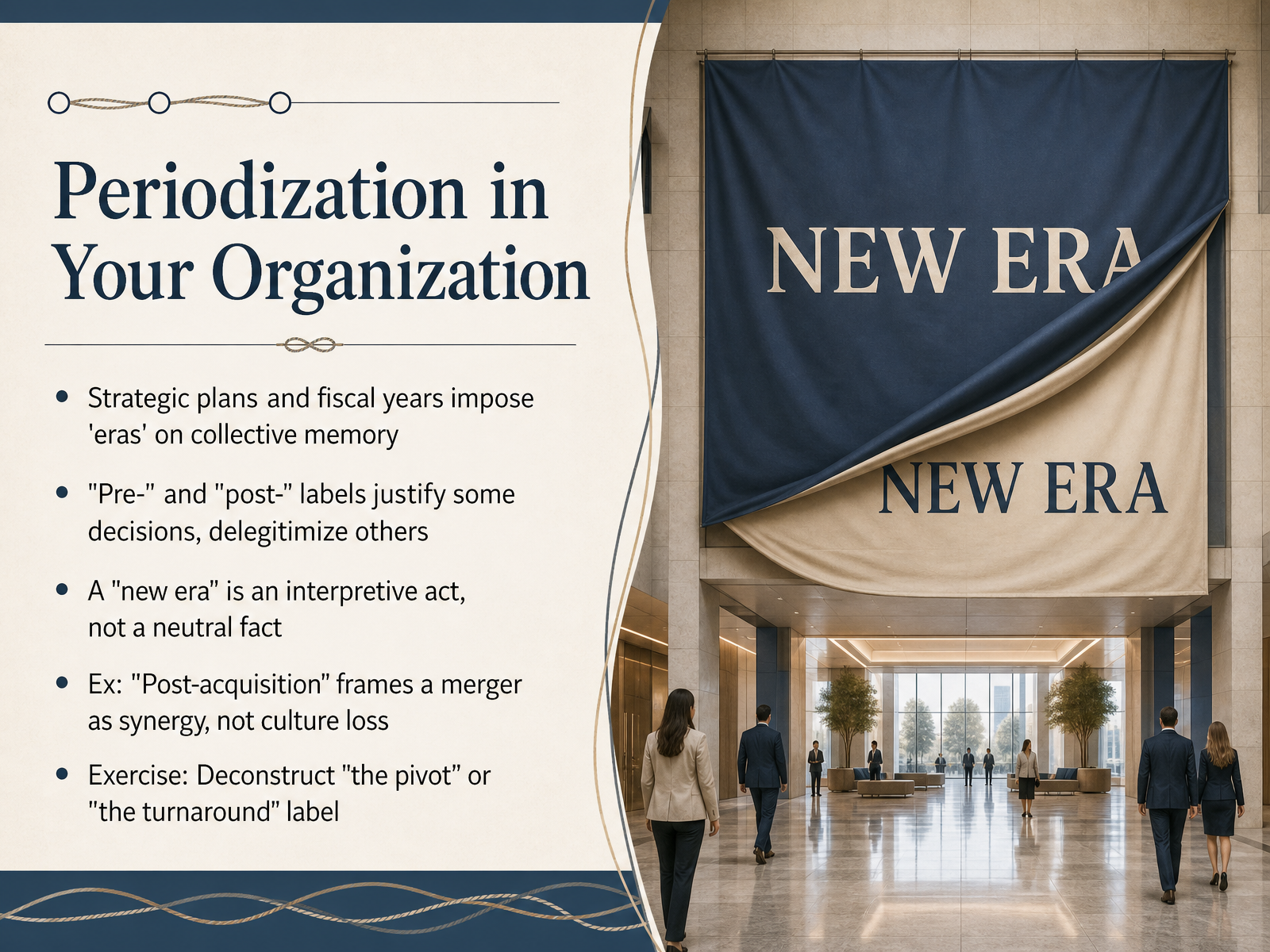
2 min - 08Periodization in Your OrganizationNow let’s bring periodization directly into your own organization. Think about how strategic plans and fiscal years impose distinct ‘eras’ on your collective memory. A three-year strategy cycle doesn’t just allocate resources—it declares that time before the cycle is fundamentally different from time after it. The same happens with labels like ‘pre-merger’ and ‘post-merger.’ These labels don’t just describe a sequence; they actively justify some decisions and delegitimize others. For example, framing something as ‘post-acquisition’ emphasizes synergy and integration, while quietly sidelining narratives about culture loss. A ‘new era’ is never a neutral fact. It is an interpretive act that centralizes some people and priorities while marginalizing others. Let’s make this concrete. Try deconstructing a label your organization uses—like ‘the pivot’ or ‘the turnaround.’ Ask yourself: who benefits from this framing, and what story does it make harder to tell? Up next, we’ll explore how these ‘new era’ declarations shape strategy and communication in practice.
 2 min
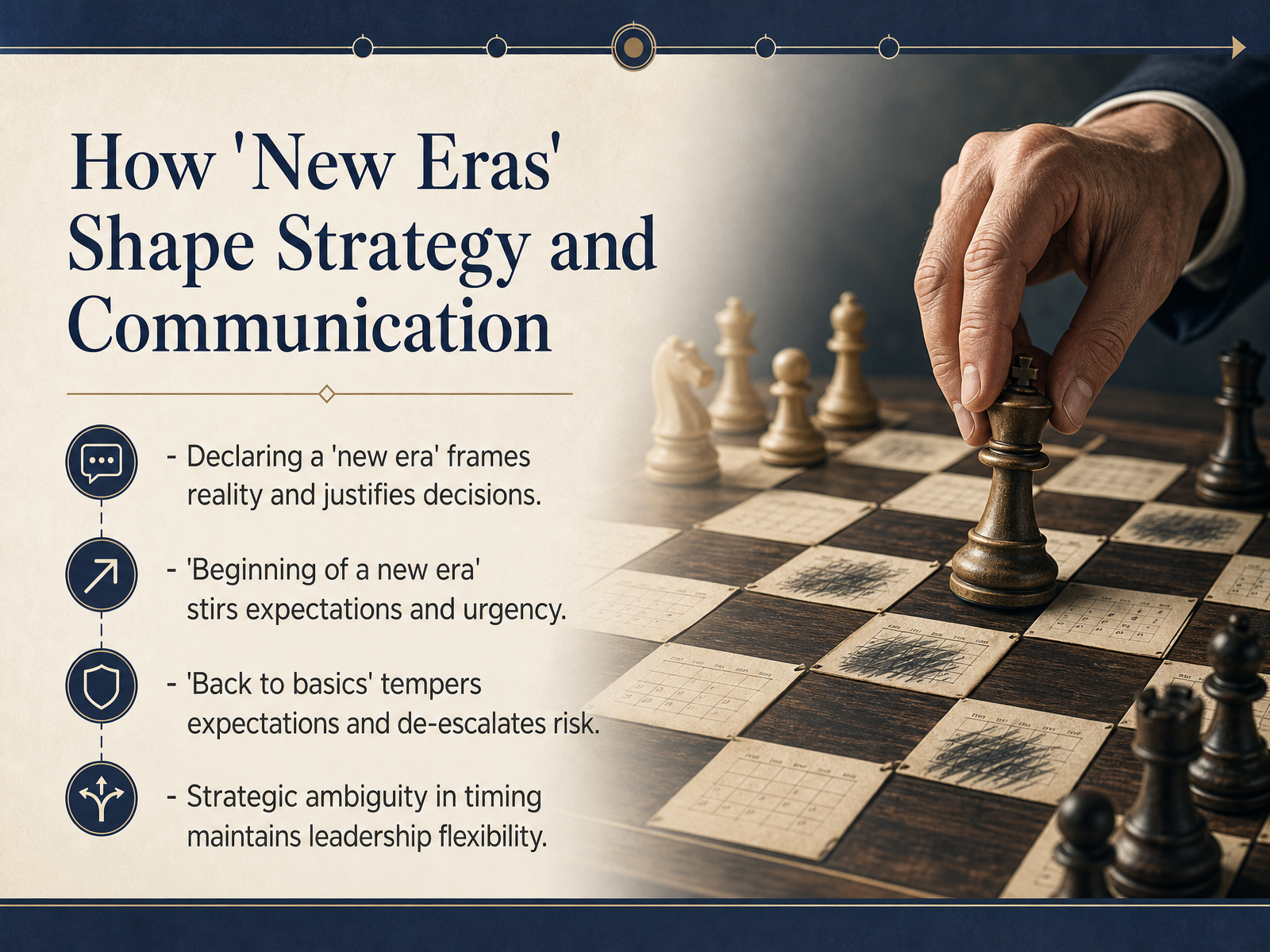
2 min - 09How 'New Eras' Shape Strategy and CommunicationNow let's turn to how declaring a 'new era' actively shapes strategy. When a leader announces the 'beginning of a new era,' they aren't just describing a timeline; they are framing reality to justify decisions and stir expectations. That phrase creates urgency and mobilizes people toward a future that feels both novel and inevitable. But framing works in more than one direction. A 'back to basics' message does the opposite: it tempers expectations and de-escalates risk by anchoring the organization in proven methods. And sometimes the most powerful move is strategic ambiguity in timing. By keeping the exact start or end of an era vague, leadership maintains flexibility while still sending a clear directional signal. Each of these choices is a periodization tool, not a neutral fact, and you can apply this lens directly to your own evidence analysis by asking what the timing claim is doing for the speaker. We'll deconstruct how these choices form full narratives next, when we look at deconstructing organizational narratives.
 2 min
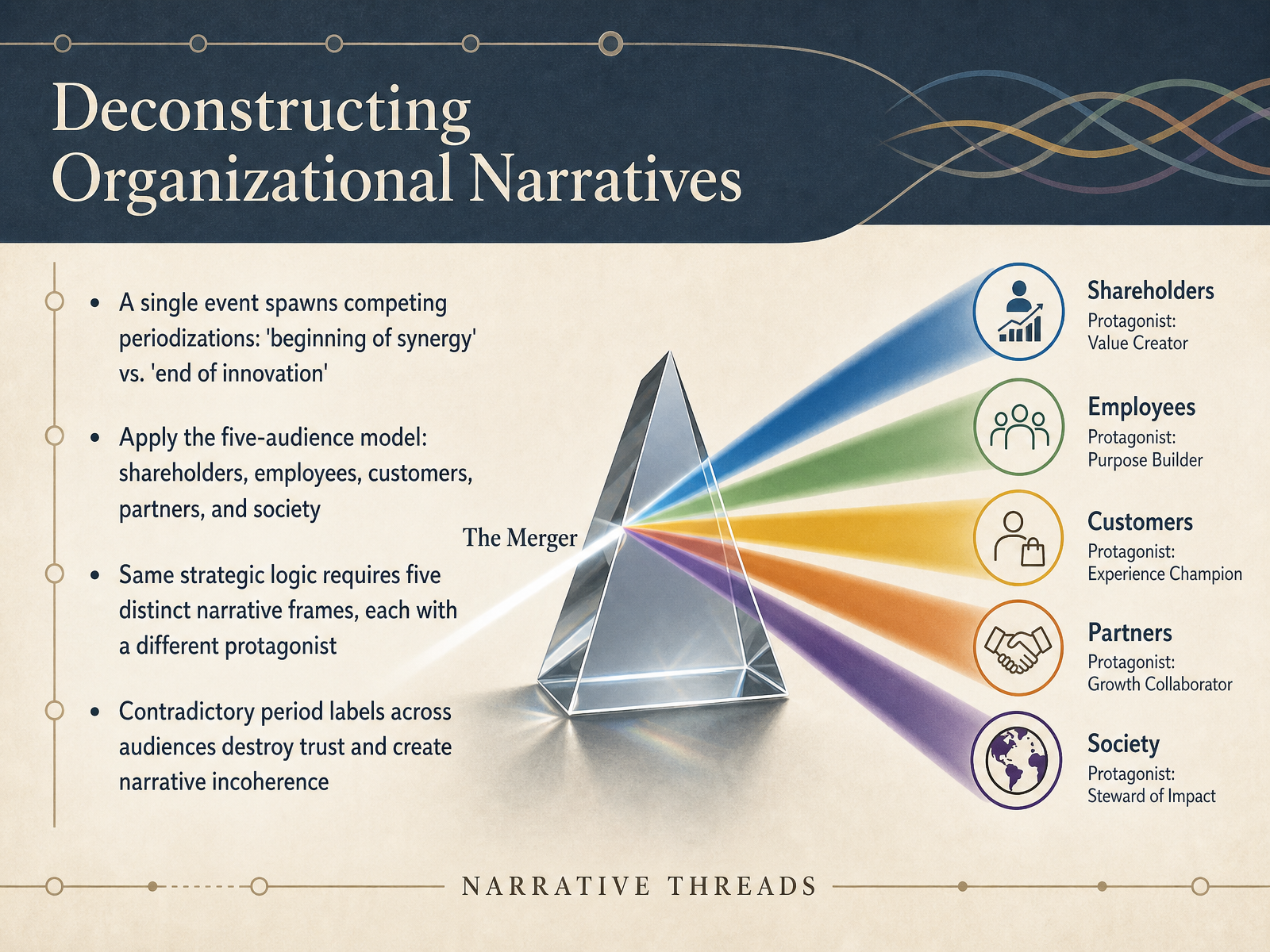
2 min - 10Deconstructing Organizational NarrativesSo let's apply this directly. Take a single strategic decision, like a company restructuring. That one event can spawn completely different periodizations depending on who's telling the story. To the leadership team it may be the 'beginning of synergy.' To the engineers, it's the 'end of innovation.' Both labels are using time to frame meaning, but neither is a fixed truth. To see this clearly, use a practical tool: the five-audience model. Analyze the same event from the view of shareholders, employees, customers, partners, and society. The strategic logic may stay constant, but each group needs its own narrative frame with a different protagonist and a different period label. The real danger comes when the labels contradict each other. If you tell shareholders a new era of efficiency has begun, while telling employees nothing is really changing, that inconsistency erodes trust across every audience. Your next step is to audit your organization's competing timelines. In the next slide, we will unpack common pitfalls that undermine historical thinking and how to spot them.
 peterpappas.comaclanthology.orglucensoftware.com+21 min
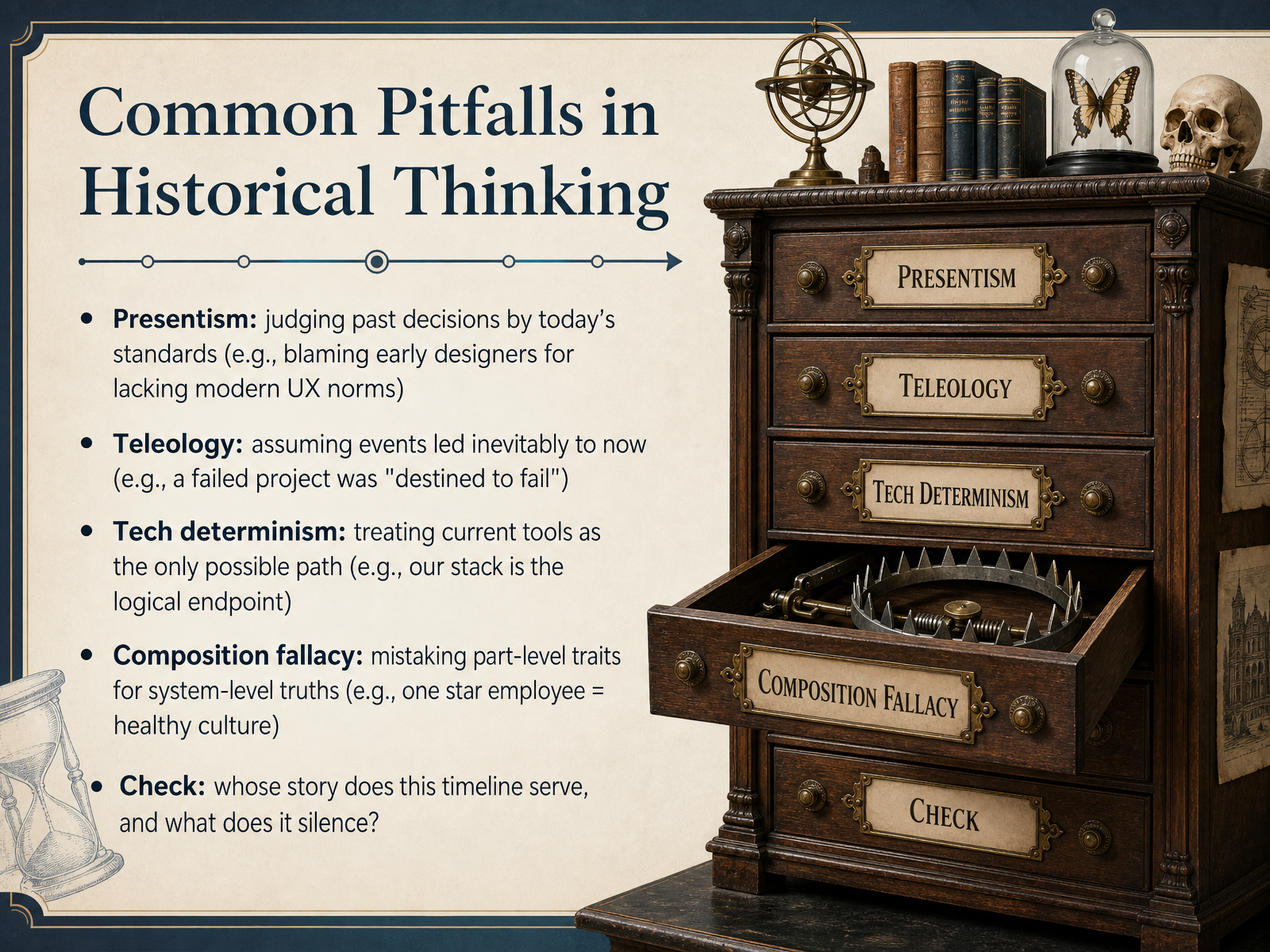
 - 11Common Pitfalls in Historical ThinkingLet's examine a few common pitfalls that can quietly shape our analysis. First is presentism: judging past decisions by today's standards. For example, criticizing early UX designers for not following modern accessibility guidelines misses the tools and norms of their time. Next, teleology assumes events were destined to happen. Saying a canceled initiative was doomed from the start ignores the real choices and turning points people faced. A related trap is tech determinism, treating our current stack as the only logical endpoint. That flattens the messy, branching paths innovation actually took. Then there's the composition fallacy: mistaking one part for the whole system. Pointing to a single star performer and declaring the culture is healthy overlooks what the rest of the team is experiencing. So, pause and ask: whose story does this timeline serve, and what does it silence? Every periodization is a choice. Now let's put these ideas to work directly. Our next slide is Applied Practice: Timelines in a Professional Context.
 2 min
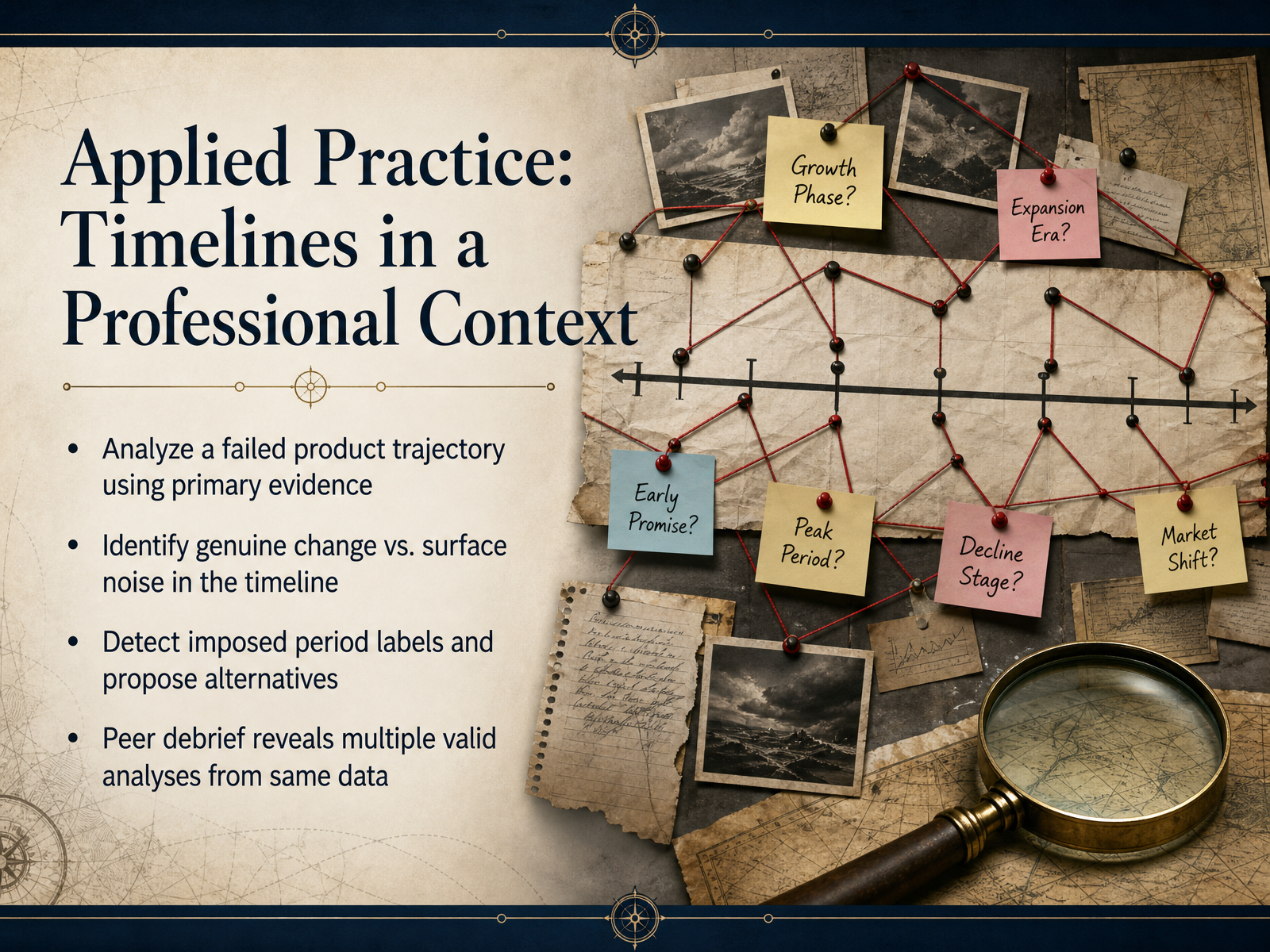
2 min - 12Applied Practice: Timelines in a Professional ContextNow let's take these skills directly into a professional setting. Imagine you've been asked to analyze a failed product trajectory using primary evidence, things like meeting minutes, early sales data, and internal memos. Your task here isn't just to list events. You need to identify genuine change versus surface noise. A sharp quarterly sales drop, for example, might look like a turning point, but the real strategic pivot may have happened months earlier when a critical feature was cut. Next, actively detect the imposed period labels, the fiscal quarters, the CEO's tenure, the 'pre-launch' and 'post-mortem' phases that others attached to the timeline. Ask yourself if these boundaries actually fit the evidence. Could an alternative periodization, maybe based on shifting customer needs rather than internal restructures, tell a more accurate story? Finally, the peer debrief is where this really comes alive. When you compare your timeline to a colleague's, you'll almost certainly find multiple valid analyses emerging from the exact same data. That's the proof: the timeline is a constructed framework, not a single fixed truth. Hold onto that insight, because up next, in 'The Analytical Toolkit,' we will build out a repeatable workflow that brings all of these techniques together.
 peterpappas.comaclanthology.orglucensoftware.com+22 min
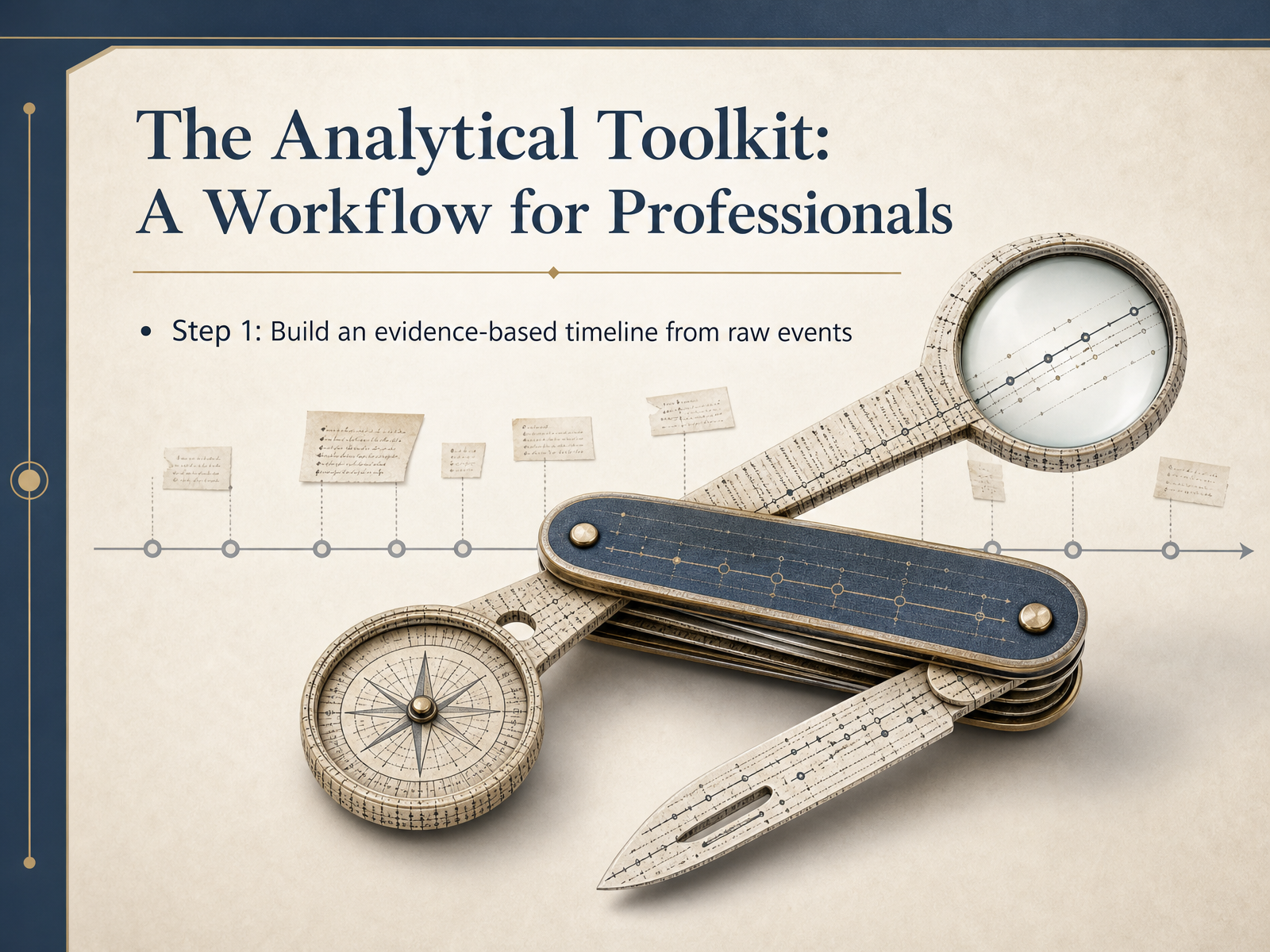
 - 13The Analytical Toolkit: A Workflow for ProfessionalsBuilding an analytical toolkit starts with something deceptively simple: constructing a timeline. But this isn't just listing dates. Step one asks you to build an evidence-based timeline directly from raw events. Think of it as laying out the data before you interpret it. A treaty signed, a market crash, a regulatory shift—you place each event in sequence using only what the sources confirm. A timeline built this way becomes your primary analytical document. It reveals gaps, clusters, and rhythms that a pre-packaged narrative would hide. Especially in professional settings, where decisions hinge on sequence and speed, this raw chronological spine keeps you honest. It separates what actually happened from the story we wish had happened, and that discipline is what turns a timeline into a tool for strategic insight. Now, let’s wrap up with key takeaways and your next steps.
 2 min
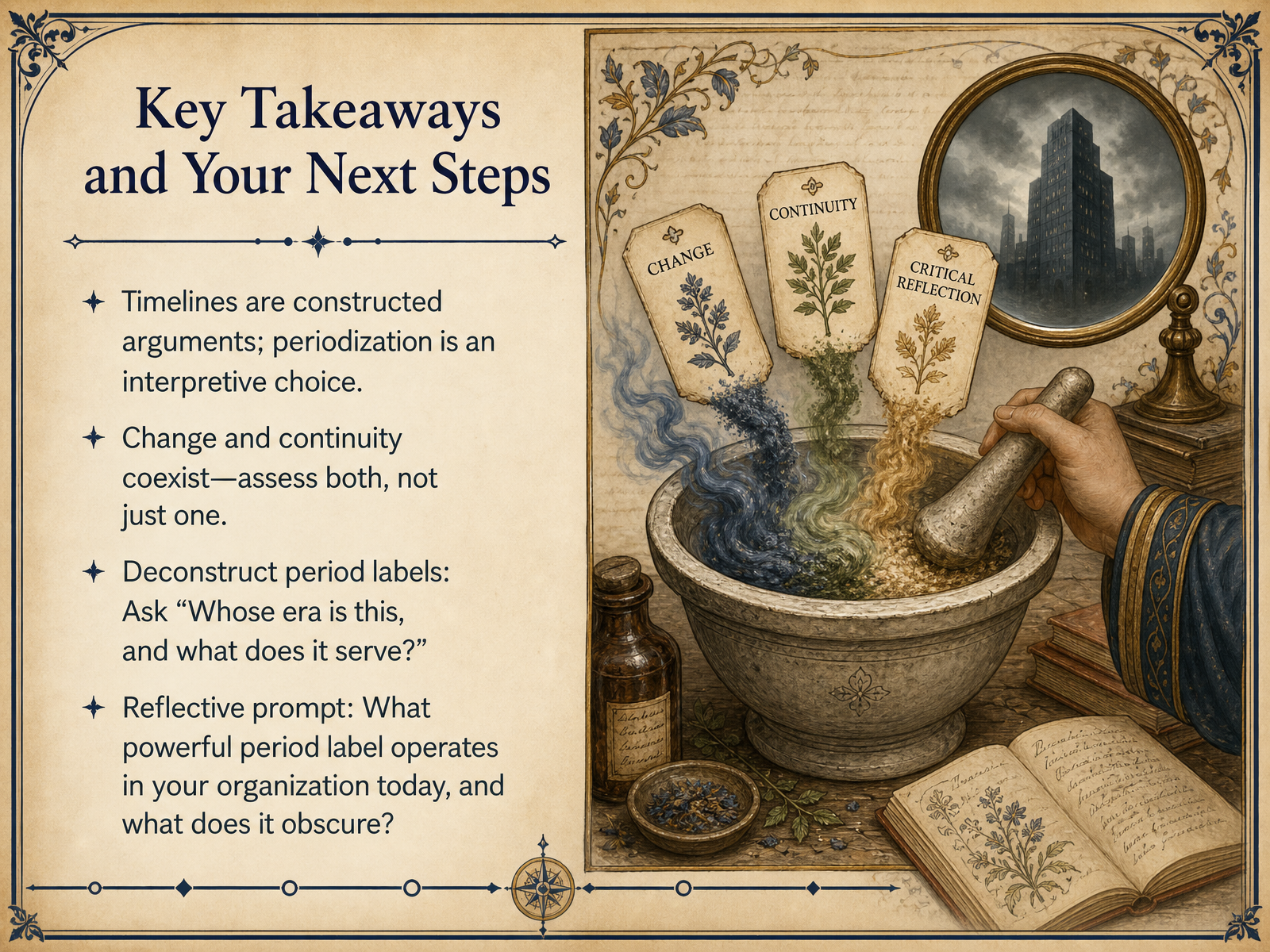
2 min - 14Key Takeaways and Your Next StepsWe have reached the final slide, so let me leave you with a concise summary and a practical next step. First, remember that every timeline you encounter is a constructed argument. The labels we use, like ancient, modern, or digital, are interpretive choices that serve someone's perspective. Second, never analyze change in isolation. Look for the continuities that persist beneath the surface of transformation. Third, deconstruct those period labels by asking two direct questions: whose era is this, and what does it serve? These questions will help you expose the assumptions behind any historical framing. Finally, I want you to carry this skill into your own organization. Your prompt is this: identify one powerful period label operating in your professional environment right now, and honestly assess what that label might be obscuring about the past or the present. Thank you for joining me in this exploration of historical timelines. The tools of change, continuity, and critical periodization are now yours to apply in your own evidence analysis. Go put them to work.
 2 min
2 min
Take the deck with you
Download this course as a file — free, no sign-up needed.
- PDF handoutEvery slide page, ready to print or share.15 pages · 5.4 MBDownload
- Narrated PowerPointThe deck that presents itself — every slide carries the digital human's narration video.15 pages · 18.7 MBDownload
- PowerPoint slidesThe full deck as a .pptx — open it in PowerPoint, Keynote, or Google Slides.15 pages · 5.4 MBDownload
Free to use in your own training — please keep the PersonWise credit page at the end.
Have your own deck? Turn it into a course
Sources consulted
Web sources consulted while building this course.
- Chronological Understanding — eprints.worc.ac.uk
- MIDDLE AND HIGH SCHOOL TEACHER MISCONCEPTIONS OF GEOLOGIC TIME — essp.psu.edu
- College Student Conceptions about Changes to Earth and Life over Time — pmc.ncbi.nlm.nih.gov
- The significance of geologic time: Cultural, educational, and economic frameworks — doi.org
- https://lnu.diva-portal.org/smash/get/diva2:840600/FULLTEXT01 — lnu.diva-portal.org
- Rewinding History with AI: A Timeline Technique that Teaches Perspective – Copy / Paste — peterpappas.com
- HistoryComparator: Interactive Across-Time Comparison in Document Archives — aclanthology.org
- Your guide to different types of graphical timelines — lucensoftware.com
- Visualizing The Cuban Missile Crisis Through The Eyes Of English Wikipedia, Russian Wikipedia & Grokipedia – The GDELT Project — blog.gdeltproject.org
- 3. Historical Analysis and Interpretation - Public History Initiative — phi.history.ucla.edu
- Dynamics in socio-technical systems: Typology of change processes and contrasting case studies — sciencedirect.com
- Typology of sociotechnical transition pathways — doi.org
- Conceptualising variations in societal transformations towards sustainability — doi.org
- Explanations of Institutional Change: Reflecting on a “Missing Diagonal” — doi.org
- Original research article Rethinking the Multi-level Perspective for energy transitions: From regime life-cycle to explanatory typology of transition pathways — sciencedirect.com
- ORGANIZATIONAL PATH DEPENDENCE: OPENING THE BLACK BOX — wiwiss.fu-berlin.de
- Path dependence, initial conditions, and routines in organizations — wilfreddolfsma.net
- Understanding Institutional and Organizational Path Dependencies — link.springer.com
- Path Dependence in Ports: The Persistence of Cooperative Forms — doi.org
- Organizational Paths: Path Dependency and Beyond — wiwiss.fu-berlin.de