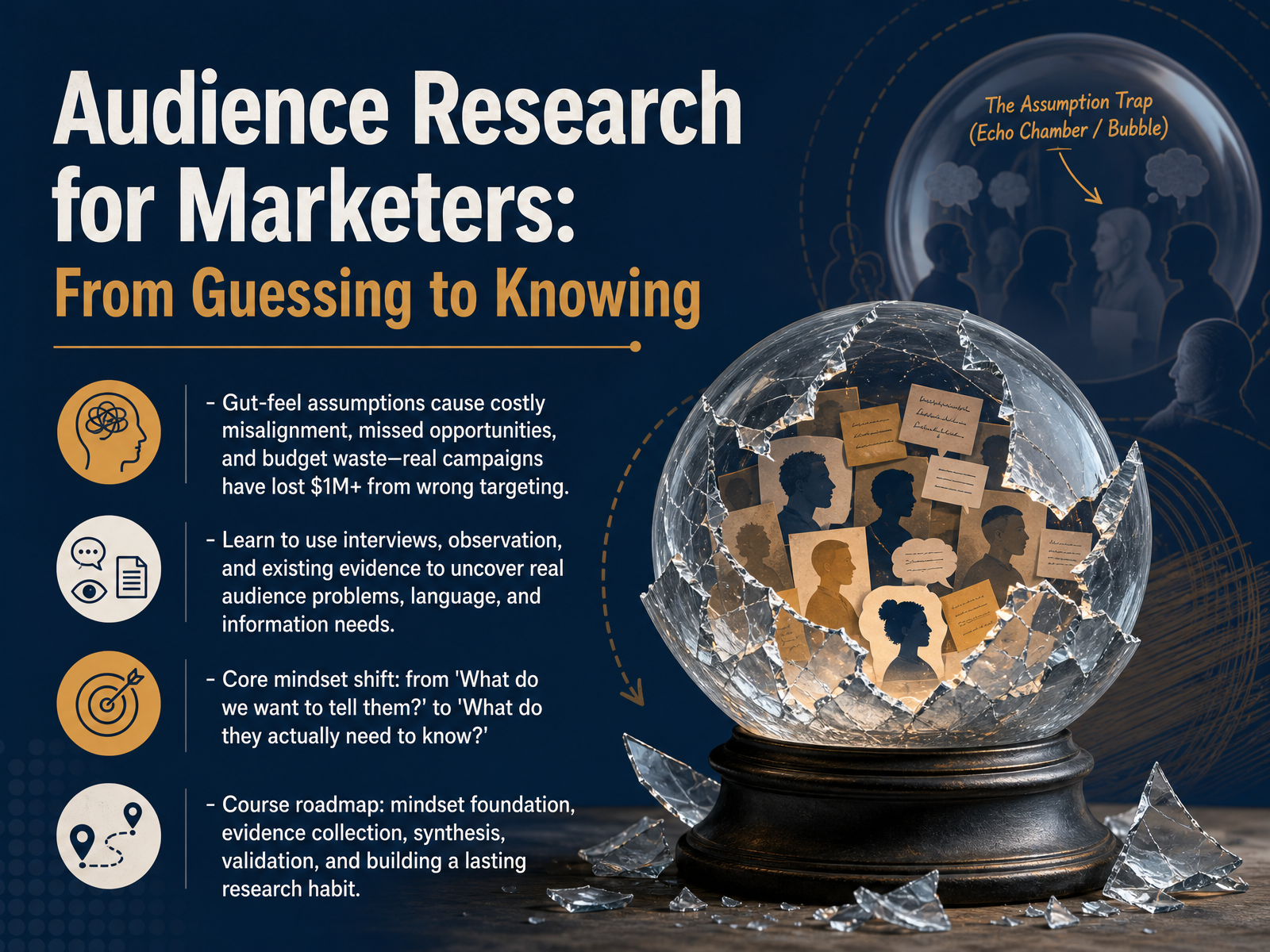
Audience Research for Marketers
Begin
13 pages · ~26 min
Audience Research for Marketers
Learn to identify and analyze target audiences to create more effective marketing campaigns.
What you’ll learn
- 01Audience Research for Marketers: From Guessing to KnowingWelcome to Audience Research for Marketers. This course moves you from guessing to knowing—replacing gut-feel assumptions with evidence-based audience understanding. Consider this: unvalidated assumptions have caused real campaigns to lose over one million dollars through misaligned targeting and messaging. We'll learn to use interviews, observation, and existing evidence to uncover real audience problems, the language they use, and their true information needs. The core mindset shift is moving from 'What do we want to tell them?' to 'What do they actually need to know?' Our roadmap starts with a mindset foundation before moving into evidence collection, synthesis, validation, and building a lasting research habit. Next, we'll examine The Cost of Assumptions: Why Guessing Fails.akshatsinghbisht.comakshatsinghbisht.comlurestudio.com.au+21 min
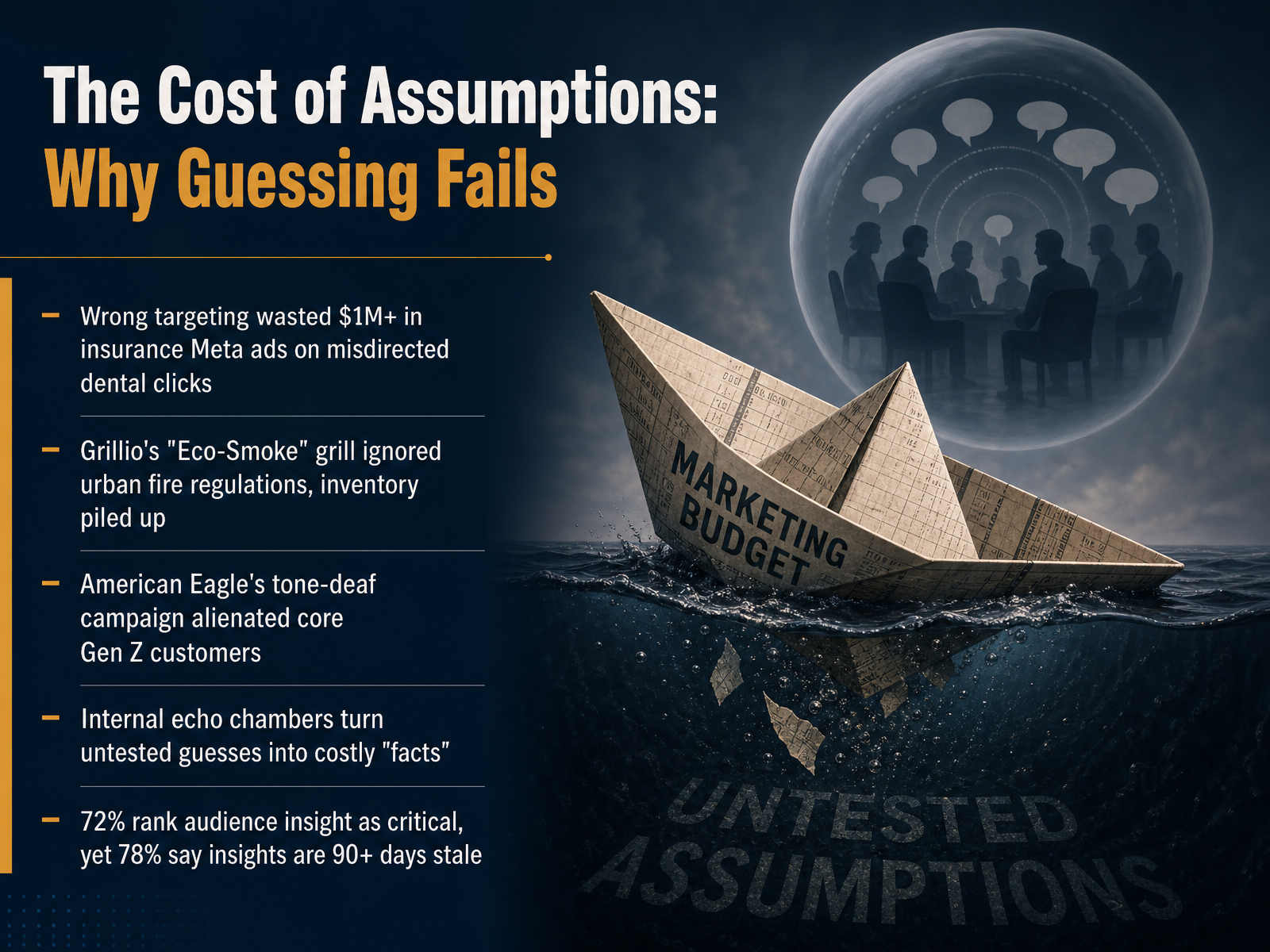
- 02The Cost of Assumptions: Why Guessing FailsNow, let's look directly at what happens when audience research is missing. We'll examine the real-world cost of operating on assumptions instead of evidence. Consider a Meta ads campaign in the insurance sector. Because the creative used stock images of dentists and vague headlines, users decoded the message as a dental clinic ad, not an insurance offer. The result? Over one million dollars wasted on misdirected clicks and a cost-per-lead that ballooned to over one hundred seventy dollars. Next, think about Grillio's Eco-Smoke grill launch. Their marketing team assumed urban customers would want a wood-chip grill, but they skipped localized research. After launch, they discovered strict fire regulations and limited outdoor space made the product practically unusable, leaving inventory to pile up. And American Eagle's high-budget campaign featuring Sydney Sweeney meant to revive sales backfired completely. An internal echo chamber approved copy that was perceived as tone-deaf, using a 'good genes' pun many associated with eugenics, which alienated their core Gen Z customers. These are not rare accidents. Research shows seventy-two percent of marketers rank deep audience insight as critical, yet seventy-eight percent say their insights are over ninety days stale. This lag time is where untested guesses harden into costly, internal facts.
 akshatsinghbisht.comakshatsinghbisht.comlurestudio.com.au+22 min
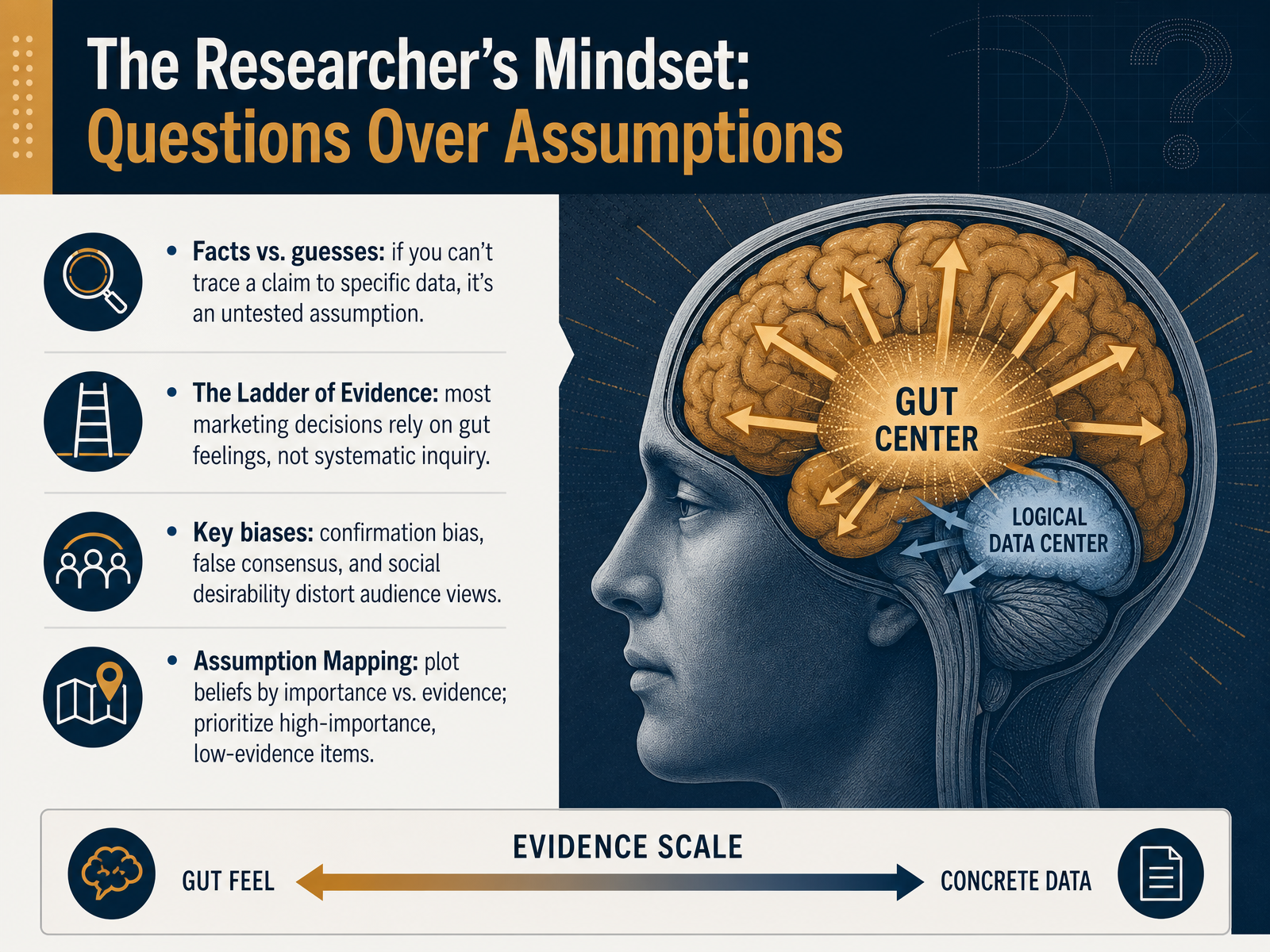
 - 03The Researcher's Mindset: Questions Over AssumptionsLet's get into the researcher's mindset—specifically, the discipline of privileging questions over assumptions. The first rule is simple: if you cannot trace a claim back to specific, observable data, then what you have is not a fact. It is an untested assumption. In marketing, we often find decisions climbing what we call the 'Ladder of Evidence.' Most organizations operate on the bottom rungs, relying on gut feelings instead of systematic inquiry. This is amplified by three key biases to watch for. Confirmation bias makes us seek out evidence that supports what we already believe. False consensus leads us to assume everyone thinks like we do. And social desirability distorts what people tell us—they give answers they think we want to hear, not the messy truth. To combat this, we use Assumption Mapping. You plot every belief about your audience on a grid. The vertical axis is importance; the horizontal axis is how much evidence you actually have. The most dangerous zone is high importance paired with low evidence. A classic example: a healthcare team assumed men ignored their content because they were apathetic. Mapping revealed this had no evidence. Real interviews proved the barrier was actually fear. That single shift from assumption to evidence transformed the campaign's impact. Your goal is to prioritize investigating those high-importance, low-evidence items first. This brings us directly to our next topic: designing interviews that uncover truth, not validation.
 mobas.comsenseandrespond.costrategyzer.com+22 min
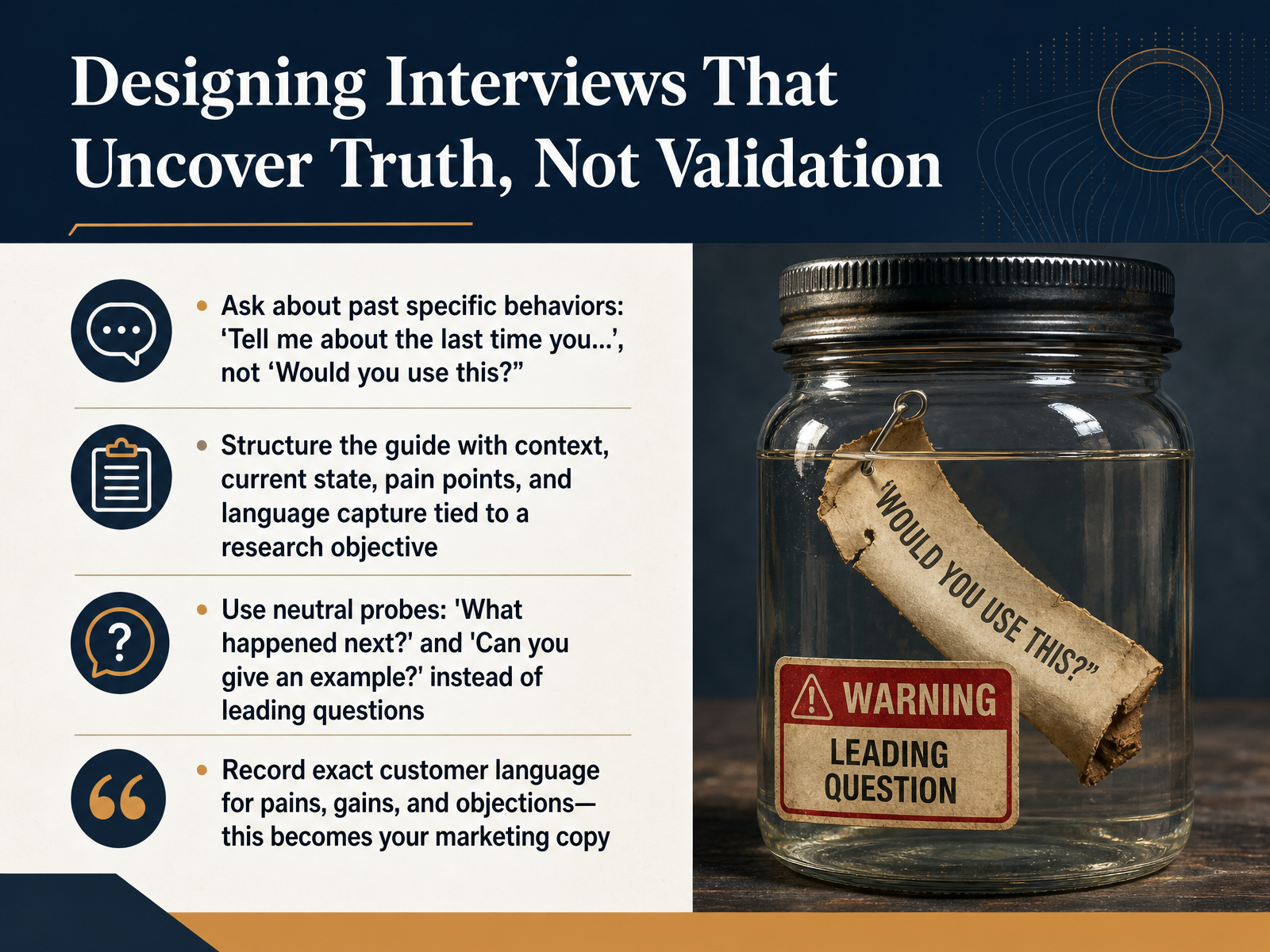
 - 04Designing Interviews That Uncover Truth, Not ValidationNext, we translate our research foundation into an interview guide designed to uncover truth, not validation. A common mistake is asking leading, hypothetical questions like "Would you use this?" That only invites speculation and politeness. Instead, anchor the conversation in real behavior. Ask about specific past instances, for example, "Tell me about the last time you tried to solve this problem." Structure your guide around key areas. Begin with context and their current state, then explore specific pain points, and finally, capture their exact language. Every question should tie back to a clear research objective. When they answer, use neutral probes to dig deeper without introducing bias. Questions like "What happened next?" or "Can you give me an example?" encourage detail without putting words in their mouth. Most critically, record the precise words they use to describe pains, desired gains, and objections. This verbatim language becomes the most powerful material for your marketing copy, resonating in a way generic terms never can. Let's move on to practicing these skills with a role-play and avoiding common pitfalls.
 maxverdic.comtheforge.mcmaster.cakoji.so+22 min
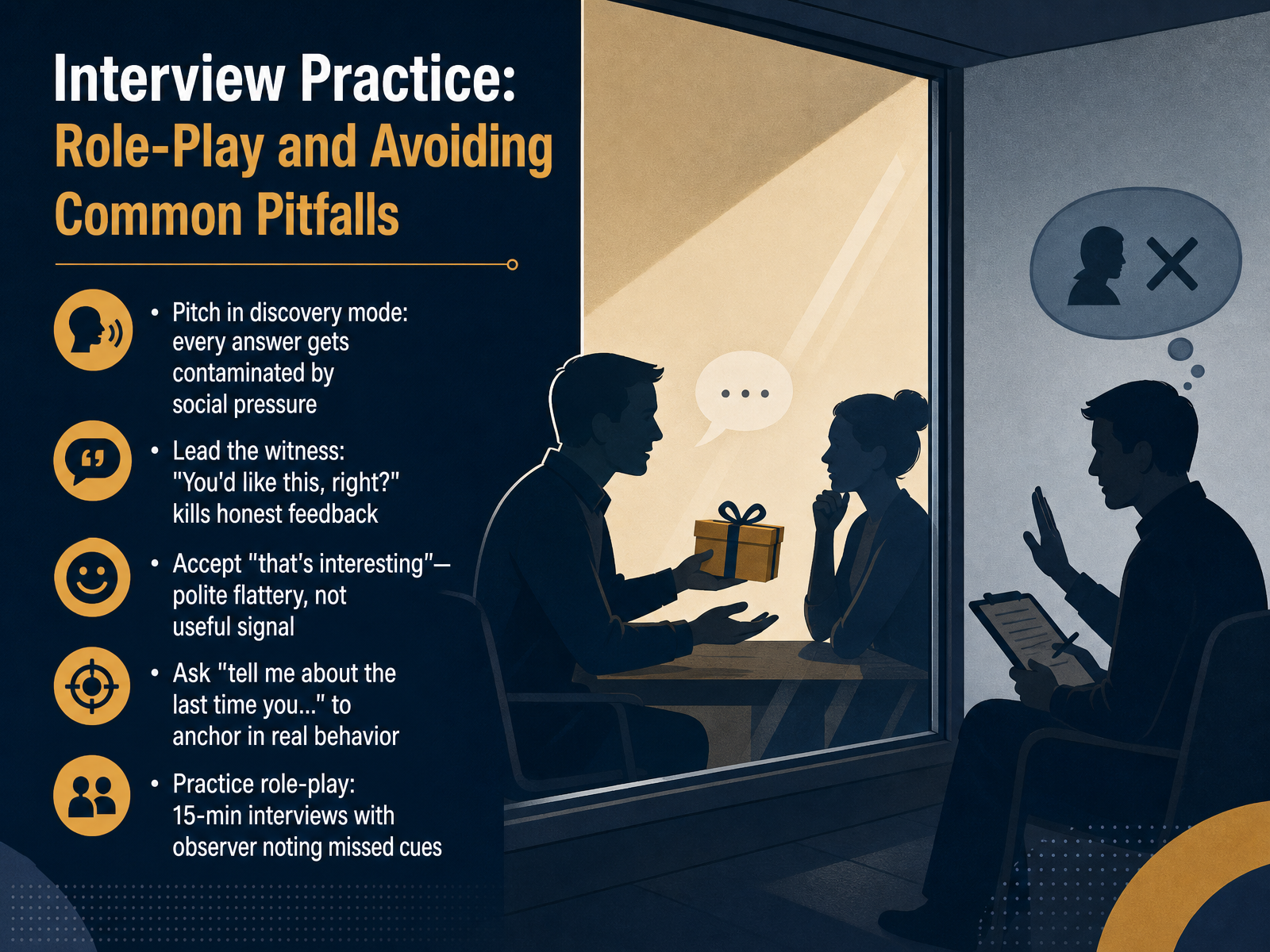
 - 05Interview Practice: Role-Play and Avoiding Common PitfallsNow, let's practice interviewing. Role-play is the fastest way to catch bad habits before they ruin real research. The slide lists five traps to watch for. First, never pitch in discovery mode. The moment you introduce your solution, social pressure contaminates every answer. Next, avoid leading the witness. A question like, You'd like this, right? kills honest feedback instantly. Third, beware of polite flattery. When someone says, That's interesting, it often means they're just being nice. It is not a useful signal. Instead, anchor the conversation in real behavior. Ask, Tell me about the last time you dealt with this problem. That forces them to describe actual actions, not hypothetical wishes. For your practice session, run a fifteen-minute interview while an observer silently notes every missed cue. Then debrief together. You will be surprised how often you accidentally pitch or lead. Let's move from interviewing talk to observing real-world action in the next slide: Observing Behavior: What Audiences Do vs. What They Say.
 maxverdic.comtheforge.mcmaster.cakoji.so+22 min
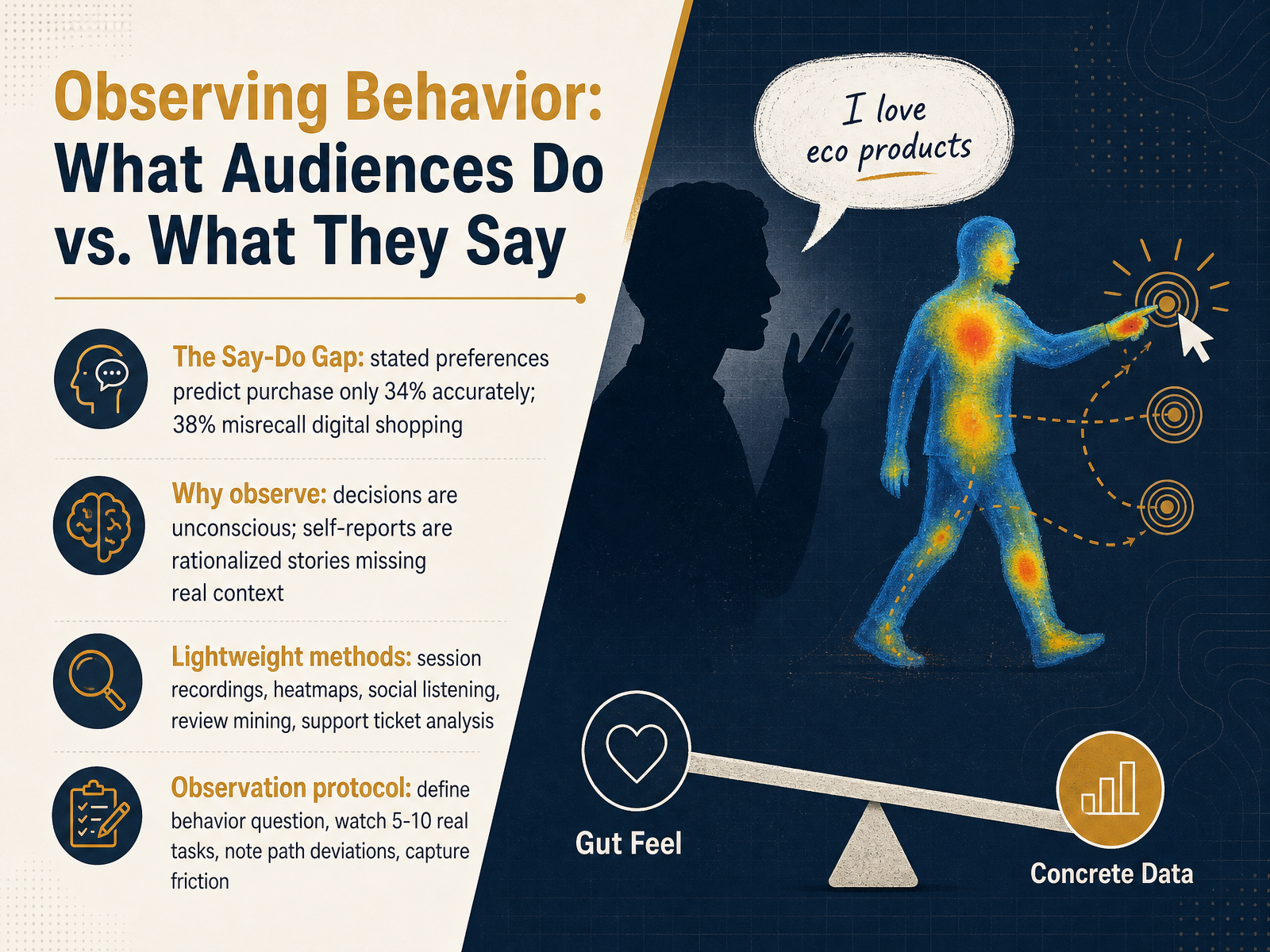
 - 06Observing Behavior: What Audiences Do vs. What They SayLet's look at the heart of audience research: what people do versus what they say. In the industry, this disconnect is called the say-do gap. Stated preferences predict actual purchase behavior only about thirty-four percent of the time. In fact, studies show that thirty-eight percent of people misrecall their digital shopping behavior. Think about that. Nearly four out of ten people don't accurately remember what they shopped for online. This isn't about dishonesty. Most decisions are unconscious and habitual. When we ask people to explain a purchase later, they give us a rationalized story that misses the real context. A customer might say they chose a product for its quality, but observation might reveal they simply grabbed the first familiar option under time pressure. So how do we bridge this gap? We use lightweight observation methods. Session recordings, heatmaps, social listening, review mining, and support ticket analysis all let you see the behavior directly without intrusive studies. To get started, I recommend a simple observation protocol. First, define a specific behavior question you want answered. Then, watch five to ten real user sessions or tasks. As you watch, note where the user's path deviates from what you expected. Finally, capture the specific moment of friction. This structured approach turns observation from a passive activity into a rigorous research method. Now, let's move on to mining a rich source of insights you likely already have: your existing evidence.
 quirks.comnielseniq.comquali-fi.com+22 min
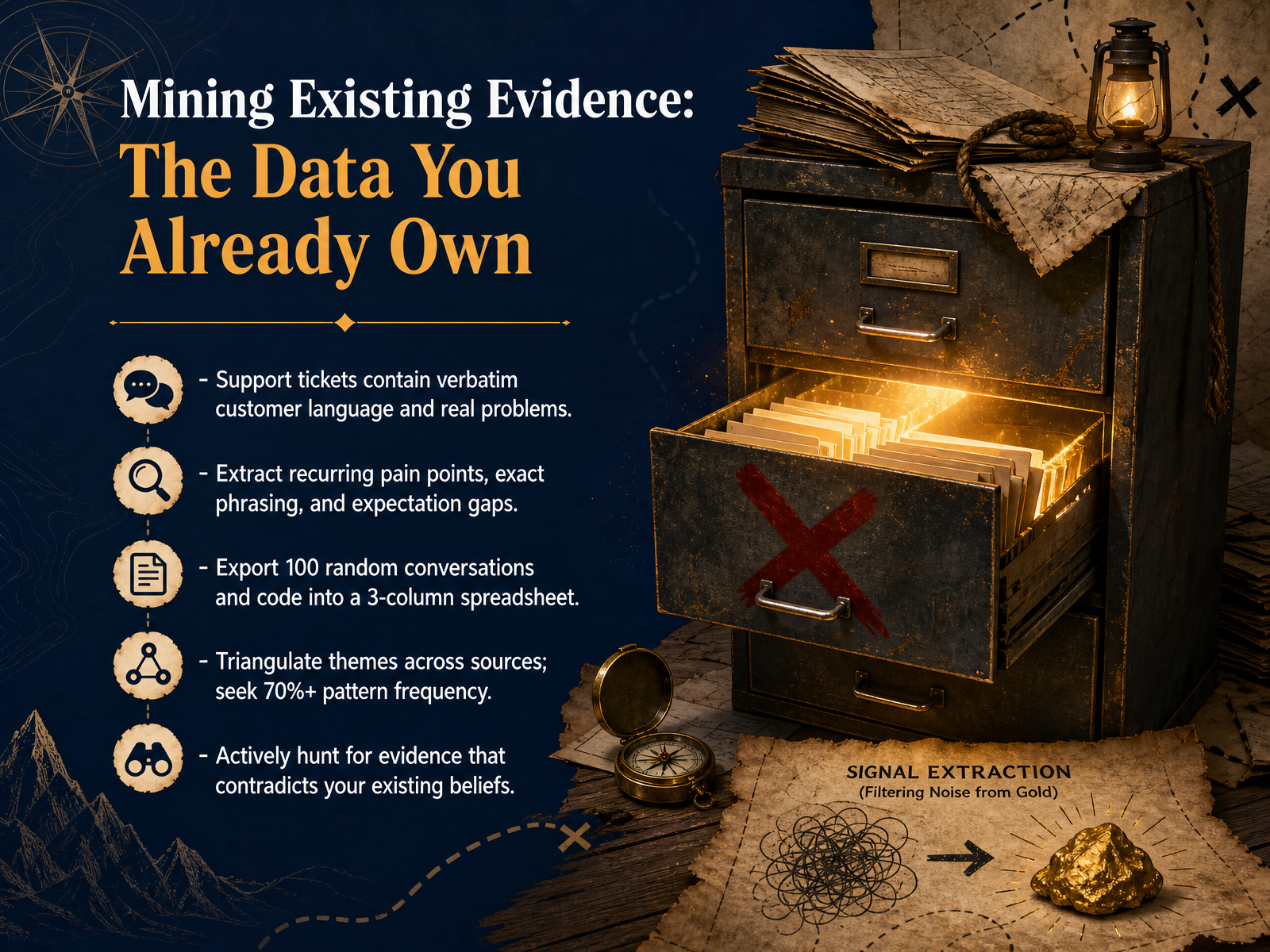
 - 07Mining Existing Evidence: The Data You Already OwnNow let's look at a goldmine you already own: your support tickets. These aren't just problem logs; they're compressed signals containing verbatim customer language and their real, unfiltered problems. To extract insights, start by exporting about one hundred random conversations and coding them into a simple three-column spreadsheet. In the first column, note the recurring pain points. In the second, capture the exact phrasing customers use. In the third, identify the gap between their expectation and the actual product experience. As you code, actively hunt for evidence that contradicts your existing marketing beliefs—this is your protection against confirmation bias. Once coded, triangulate themes across these sources and seek a pattern frequency of at least seventy percent. That threshold separates a real trend from a one-off complaint. This method turns your help desk from a cost center into a credible research function. Next, we'll connect this evidence with what you hear in interviews and see in observation, a process called triangulation.
 2 min
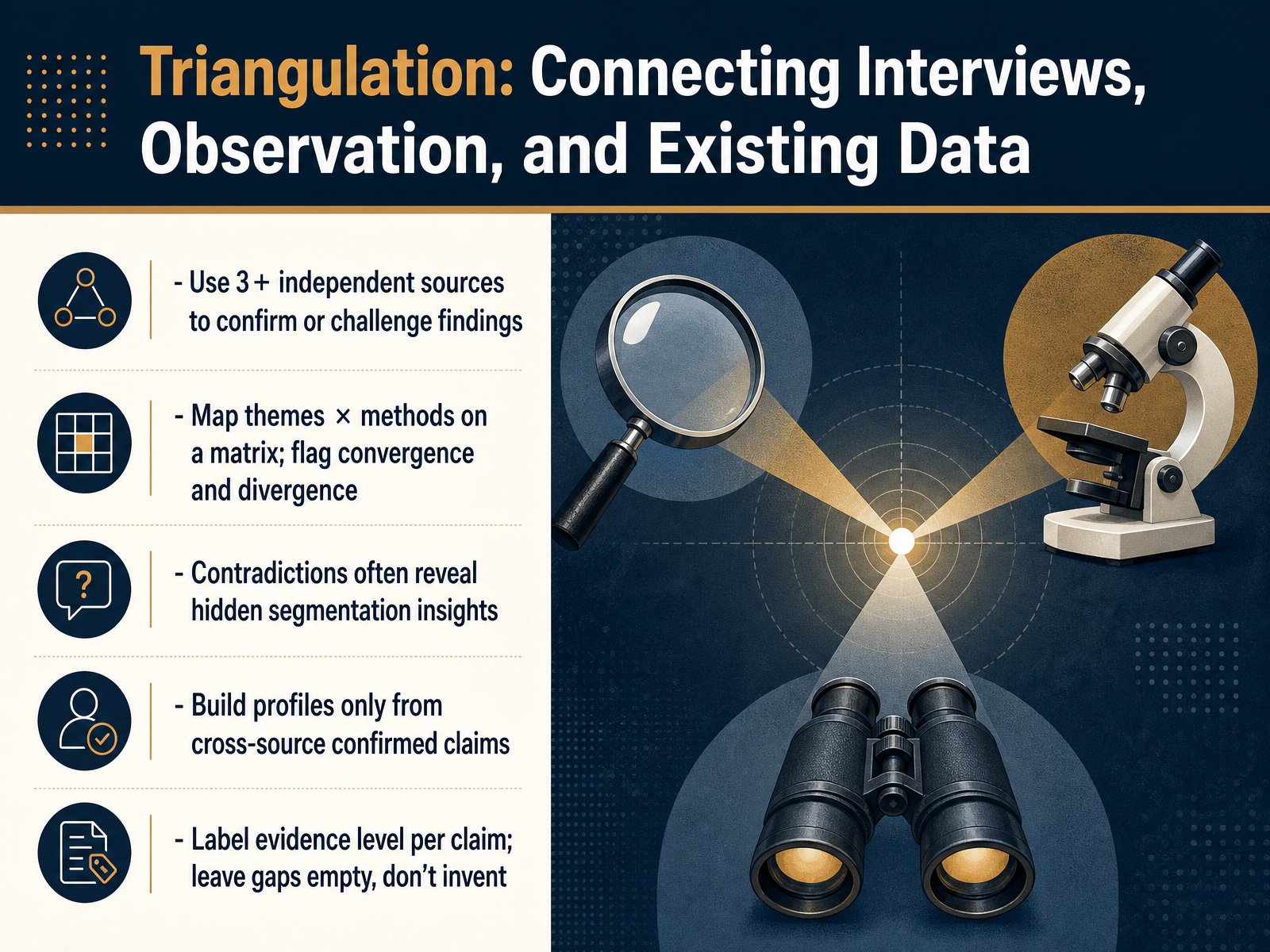
2 min - 08Triangulation: Connecting Interviews, Observation, and Existing DataIf you’ve been following the data collection steps, you now have three distinct streams of evidence: what people said in interviews, what you observed them do, and what the existing numbers or records show. The real analytical power comes when you connect them. That process is called triangulation. The rule is a minimum of three independent sources to confirm or challenge any finding. To do this, map your themes across methods on a matrix, and flag where the streams converge and where they diverge. Contradictions are not mistakes; they often reveal hidden segments, like enterprise buyers wanting simplicity while small teams keep asking for power features. Only build audience profiles from claims that are confirmed across sources. For every claim, label the evidence level—strong, moderate, or limited—and leave gaps empty instead of inventing an explanation.
 1 min
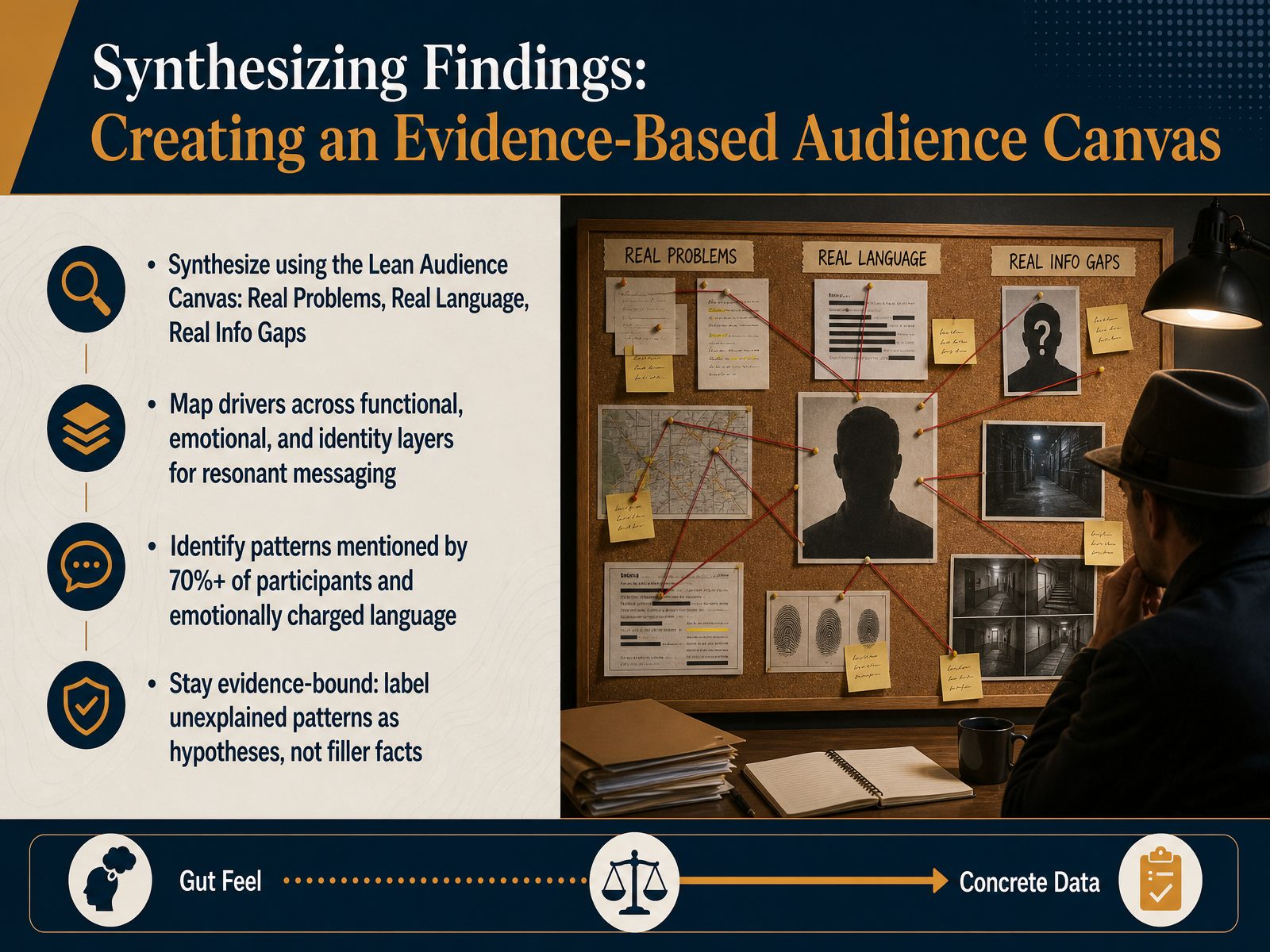
1 min - 09Synthesizing Findings: Creating an Evidence-Based Audience CanvasNow, let's synthesize everything you've gathered. The goal is to move from raw data to an evidence-based audience canvas. Think of this as your fact-checked map of the audience's world. First, we populate a Lean Audience Canvas with three columns: Real Problems, meaning their actual pain points. Real Language, using the exact words and phrases they use. And Real Info Gaps, which are the questions they still need answered. Next, map the drivers behind these needs. Look across functional layers, like getting a job done, emotional layers, like reducing anxiety, and identity layers, like wanting to be seen as a competent professional. This layering helps you build truly resonant messaging. As you scan your data, identify patterns mentioned by at least seventy percent of your participants, and pay special attention to language charged with frustration or excitement. Most importantly, stay evidence-bound. If you notice an unexplained pattern, label it clearly as a hypothesis for further testing. Do not turn a hunch into a filler fact. This discipline protects the integrity of your entire canvas. Next, we'll move into validating your conclusions before you commit.
 2 min
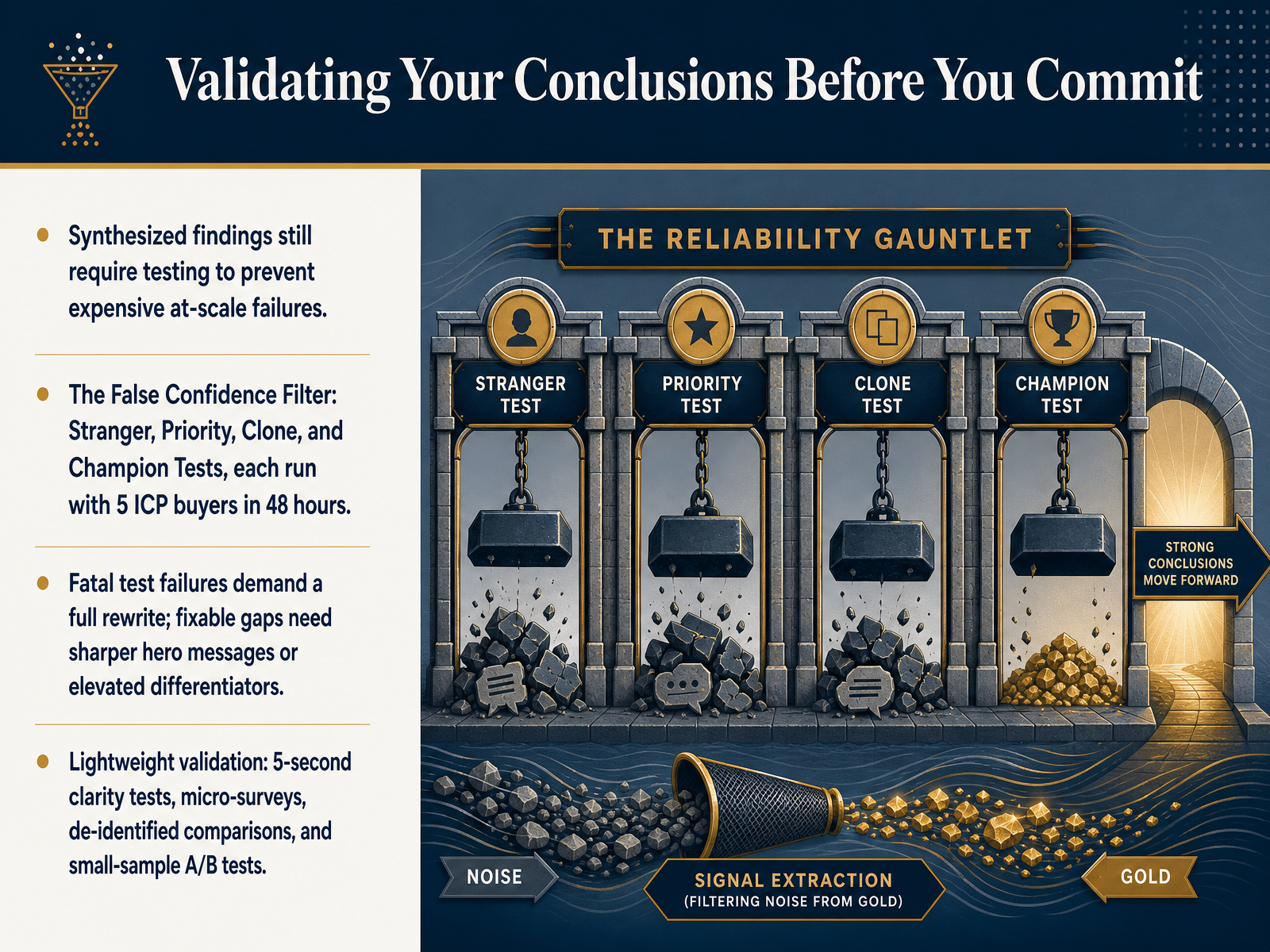
2 min - 10Validating Your Conclusions Before You CommitLet's talk about what happens right after the synthesis. You have combined your interview notes and observation data into a clear narrative, but the work is not done. Findings still require structured testing before you commit to a full launch. Skipping this step risks expensive, at-scale failures that could have been caught early. We use a protocol called the False Confidence Filter. It consists of four lightweight tests: the Stranger Test, the Priority Test, the Clone Test, and the Champion Test. Each one is run with five ICP buyers within just 48 hours. A failure on the Stranger or Priority Test is fatal, meaning the messaging needs a complete rewrite. A failure on the Clone or Champion Test is usually fixable. You often just need sharper hero messages or elevated differentiators. Lightweight validation does not require a large research study. Use five-second clarity tests to check understanding, run micro-surveys or de-identified comparisons to gauge differentiation, and conduct small-sample A/B tests. The goal is to catch fatal flaws with evidence, not to publish a research paper. Up next, we turn these audience truths into marketing action.
 2 min
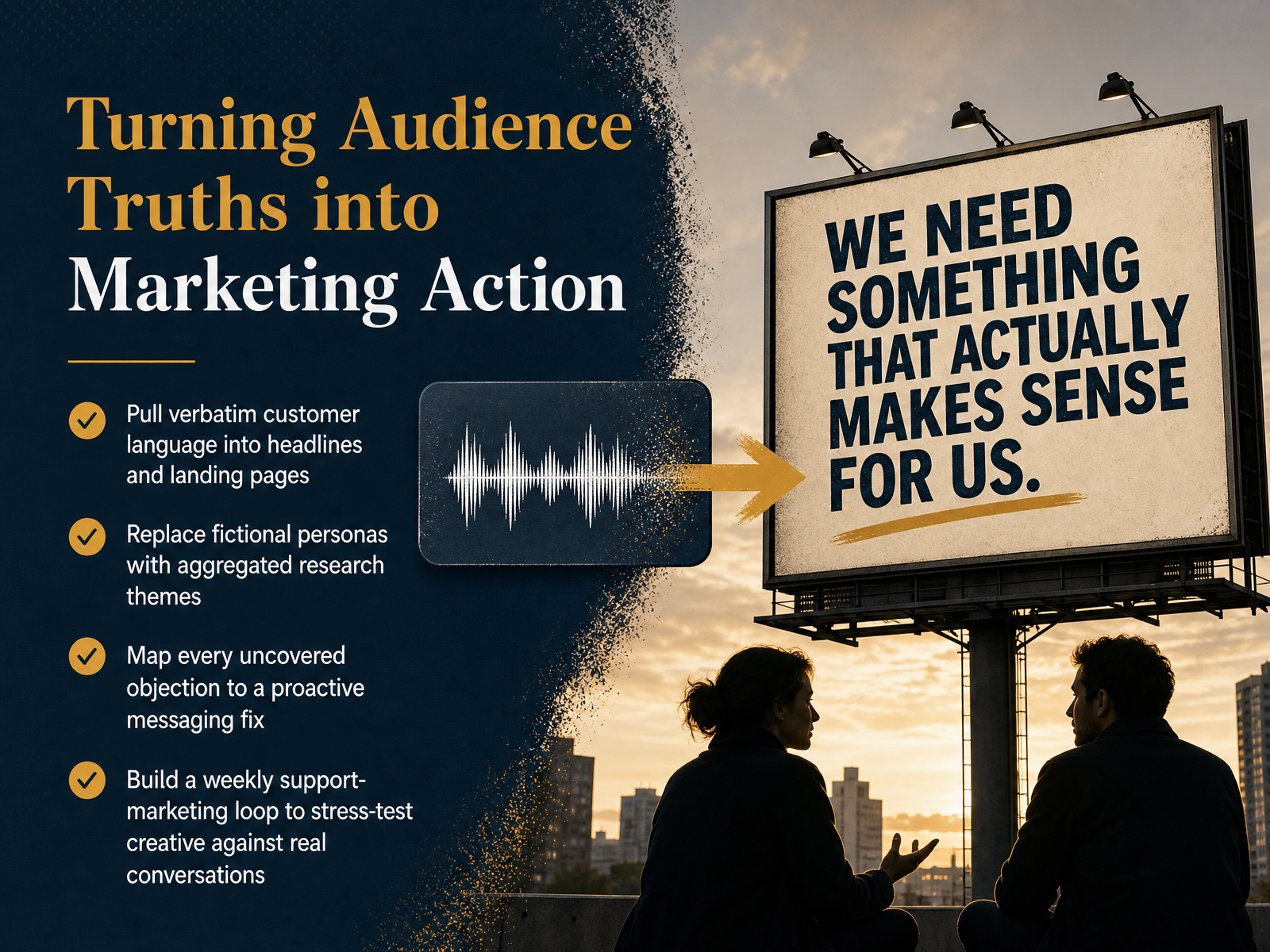
2 min - 11Turning Audience Truths into Marketing ActionNow, let's turn those audience truths into marketing action. First, pull verbatim customer language directly into your headlines and landing pages. If your support tickets show customers asking how to stop IT from seeing HR payroll tickets, that exact phrasing should lead your content, not just the vendor term data segmentation. Second, replace fictional personas with aggregated research themes. Group recurring ticket issues like feature confusion or onboarding gaps into evidence-based themes that reflect real behavior. Third, map every uncovered objection to a proactive messaging fix. When tickets reveal a mismatch between what your marketing promises and what the product delivers, adjust the creative immediately. Fourth, build a weekly support-marketing loop. A brief standing meeting to stress-test new campaigns against real ticket language and trending questions catches misconceptions before you spend media dollars. This systematic approach grounds your creative in the voice of the customer and closes the gap between what you say and what your audience actually needs. Next, let's explore building your continuous audience research habit.
 2 min
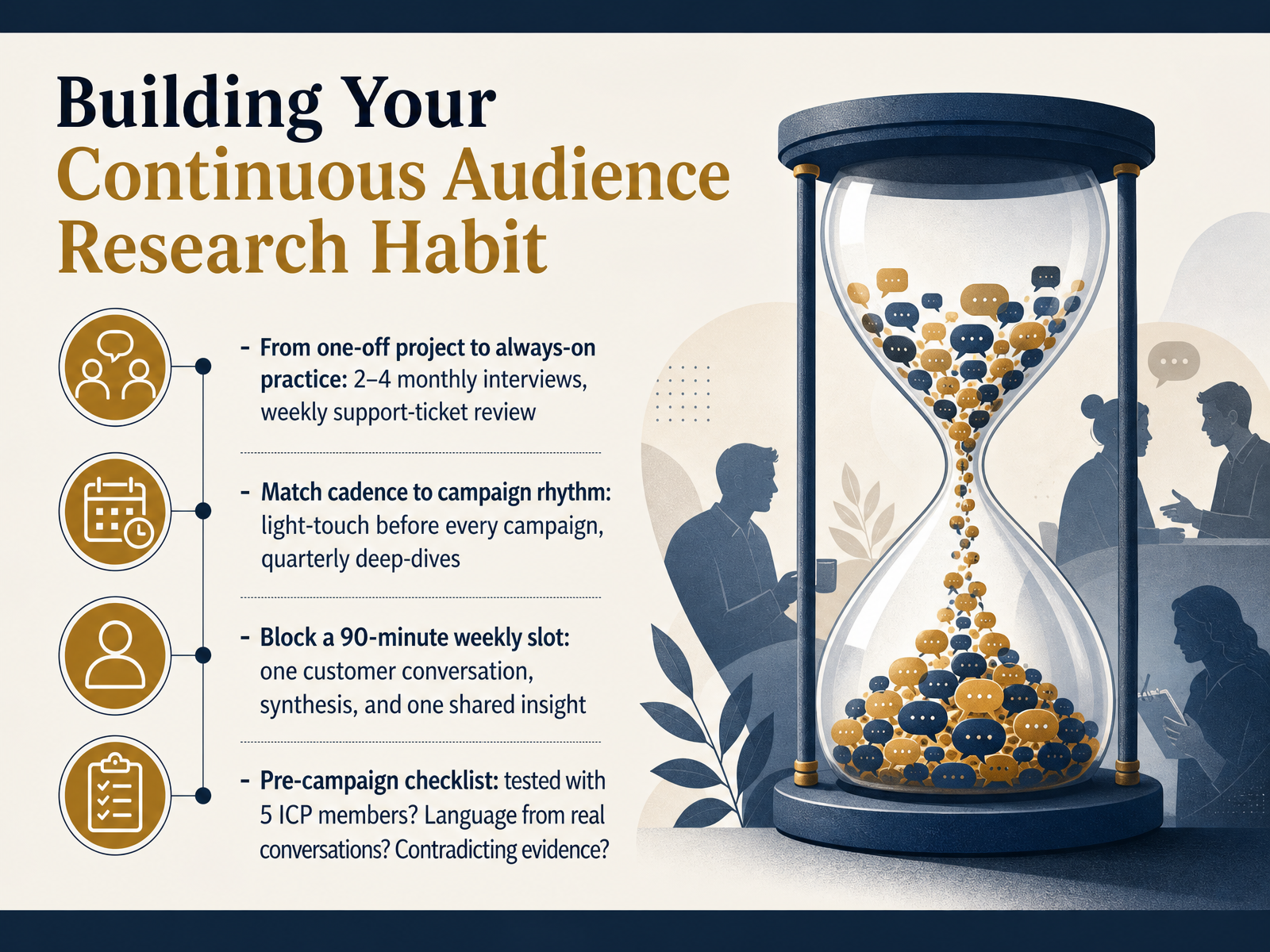
2 min - 12Building Your Continuous Audience Research HabitSo how do we turn rigorous research into a lasting professional habit? It starts with moving from a one-off project to an always-on practice. Aim for two to four interviews a month and a weekly review of support tickets. This is not about volume. It is about preventing the assumption drift that happens when you stop talking to real customers.
Match your research cadence to your campaign rhythm. Run a light touch check before every campaign and a quarterly deep dive to examine purchase criteria and positioning. This keeps your messaging connected to current market reality.
Block a non-negotiable ninety-minute slot every single week. Use it for one customer conversation, rapid synthesis of what you heard, and sharing one actionable insight with your team. The synthesis triggers the reward in the habit loop we discussed earlier.
Finally, never launch without a pre-campaign checklist. Ask yourself: has this been tested with at least five ideal customer profile members? Does the language come from real conversations? And critically, is there any contradicting evidence you are choosing to ignore? This is your firewall against guessing.
Let's put this into immediate practice inside a structured sprint. Next, we will walk through Your First Research Sprint: A 30-Day Action Plan.
 2 min
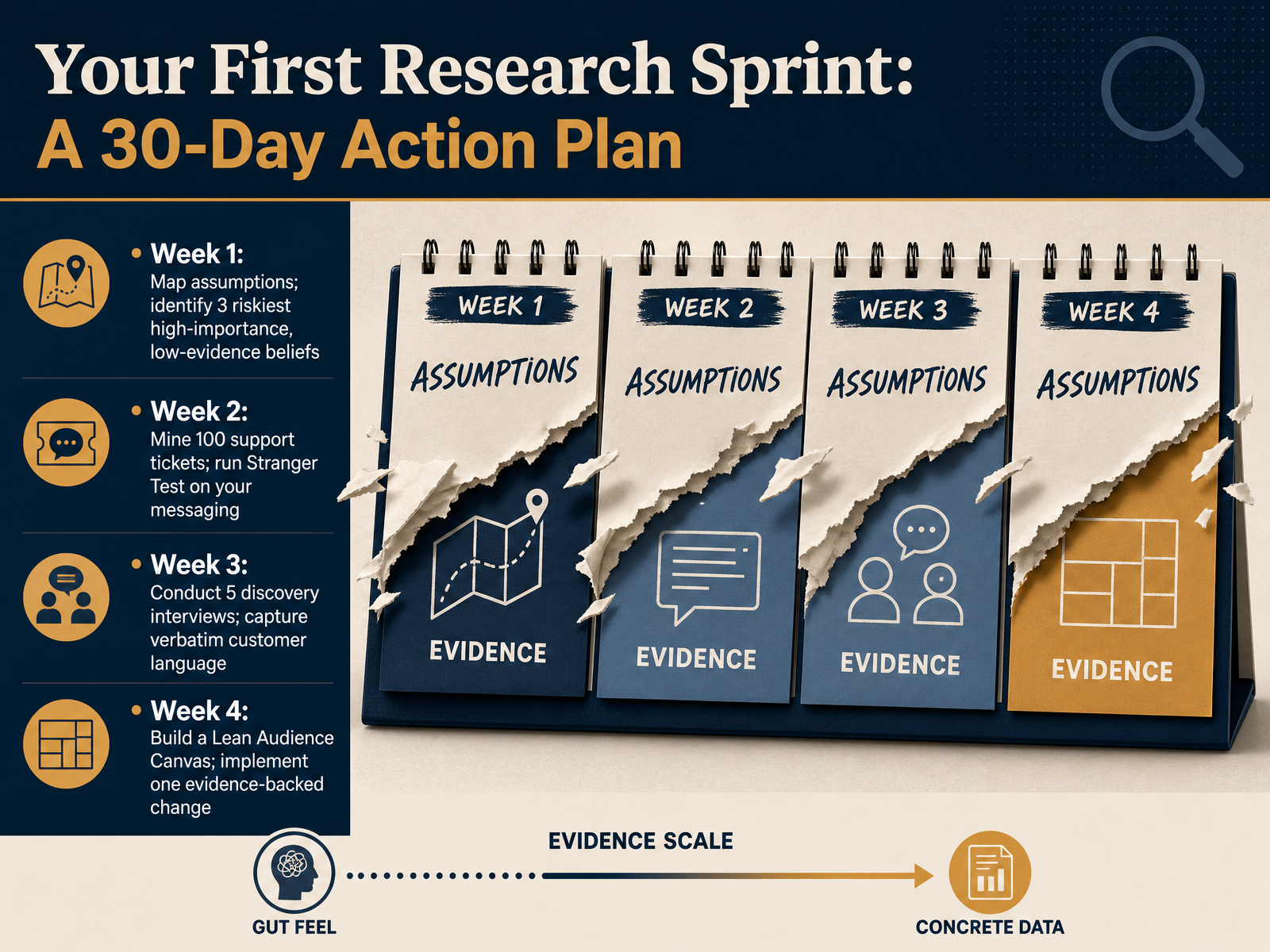
2 min - 13Your First Research Sprint: A 30-Day Action PlanWelcome to your final step: a concrete 30-day plan to make audience research a repeatable habit. Your mission is to stop guessing and start knowing. In week one, map your assumptions. Identify the three riskiest beliefs you hold about your audience—the ones that are critical to success but have the weakest evidence. In week two, mine 100 support tickets. These conversations reveal the exact words your customers use and the problems they actually face. Also run the Stranger Test on your current messaging to see if anyone outside your team even understands it. Week three is for five discovery interviews. Leave your script behind and capture their verbatim language and real struggles. Finally, in week four, build a Lean Audience Canvas to synthesize your findings. Most importantly, implement one evidence-backed change immediately. This whole-course distills into this sprint. Do the work, trust the evidence you gather, and you will build messaging that truly resonates. Thank you for taking this course. Now go start your sprint.
 mobas.comsenseandrespond.costrategyzer.com+22 min
Take the deck with you
Download this course as a file — free, no sign-up needed.
- PDF handoutEvery slide page, ready to print or share.14 pages · 4.6 MBDownload
- Narrated PowerPointThe deck that presents itself — every slide carries the digital human's narration video.14 pages · 15.8 MBDownload
- PowerPoint slidesThe full deck as a .pptx — open it in PowerPoint, Keynote, or Google Slides.14 pages · 4.6 MBDownload
Free to use in your own training — please keep the PersonWise credit page at the end.
Have your own deck? Turn it into a course
Sources consulted
Web sources consulted while building this course.
- How Wrong Interest-Based Targeting in Meta Ads Ruined a Major Healthcare Campaign in the U.S. | Digital Marketing Consultant & Expert Akshat Singh Bisht — akshatsinghbisht.com
- How Poor Message Encoding & Decoding Wasted $1 Million in Meta Ads — A Real Client Case Study | Digital Marketing Consultant & Expert Akshat Singh Bisht — akshatsinghbisht.com
- The Bumble Fumble — Lure Studio — lurestudio.com.au
- Marketing Campaign Failure Case Study | Research Mistakes Exposed — influencers-time.com
- Why Our $500K Campaign Completely Flopped - Popart Films LLC — popartfilms.tv
- How Assumption Mapping can de-risk your marketing — mobas.com
- Assumption Mapping Workshops: Getting the Whole Team Aligned Before You Build — Sense & Respond Learning — senseandrespond.co
- How Assumptions Mapping Can Focus Your Teams On ... — strategyzer.com
- Assumption Mapping: David Bland's 2×2 for Deciding What to Test First - RoadmapOne — roadmap.one
- Assumption mapping - Connected Places Catapult — cp.catapult.org.uk
- Customer Interview Questions: Framework for Better Insights | MaxVerdic | MaxVerdic — maxverdic.com
- Example of Customer Discovery Interview Guide — theforge.mcmaster.ca
- How to Conduct Market Research Interviews: Questions, Methods, and ... — koji.so
- Interview Guide Template: Customer Discovery Questions + Probing Prompts | GoTranscript — gotranscript.com
- Ultimate Guide to Customer Interviews: Lessons From 5 years+ of Field Research - Vaughan Broderick — vaughanbroderick.com
- How observational research can improve self-reported behaviors — quirks.com
- Why Consumers Say One Thing and Do Another - Say-Do Gap- NIQ — nielseniq.com
- Closing the Say-Do Gap in Market Research | Quali-Fi | Quali-Fi — quali-fi.com
- Closing the say-do gap: How real-time insights are reshaping consumer research | Articles — quirks.com
- Customer research that works: why past behaviour never lies — suebehaviouraldesign.com