Begin
14 pages · ~28 min
Historical Context: Avoiding Presentism and Anachronism
This training helps history educators and students recognize and avoid presentism and anachronism when interpreting the past.
A digital instructor presents all 14 pages. Hold “Ask” at any point and ask out loud — the answer comes from this course. No sign-up needed.
What you’ll learn
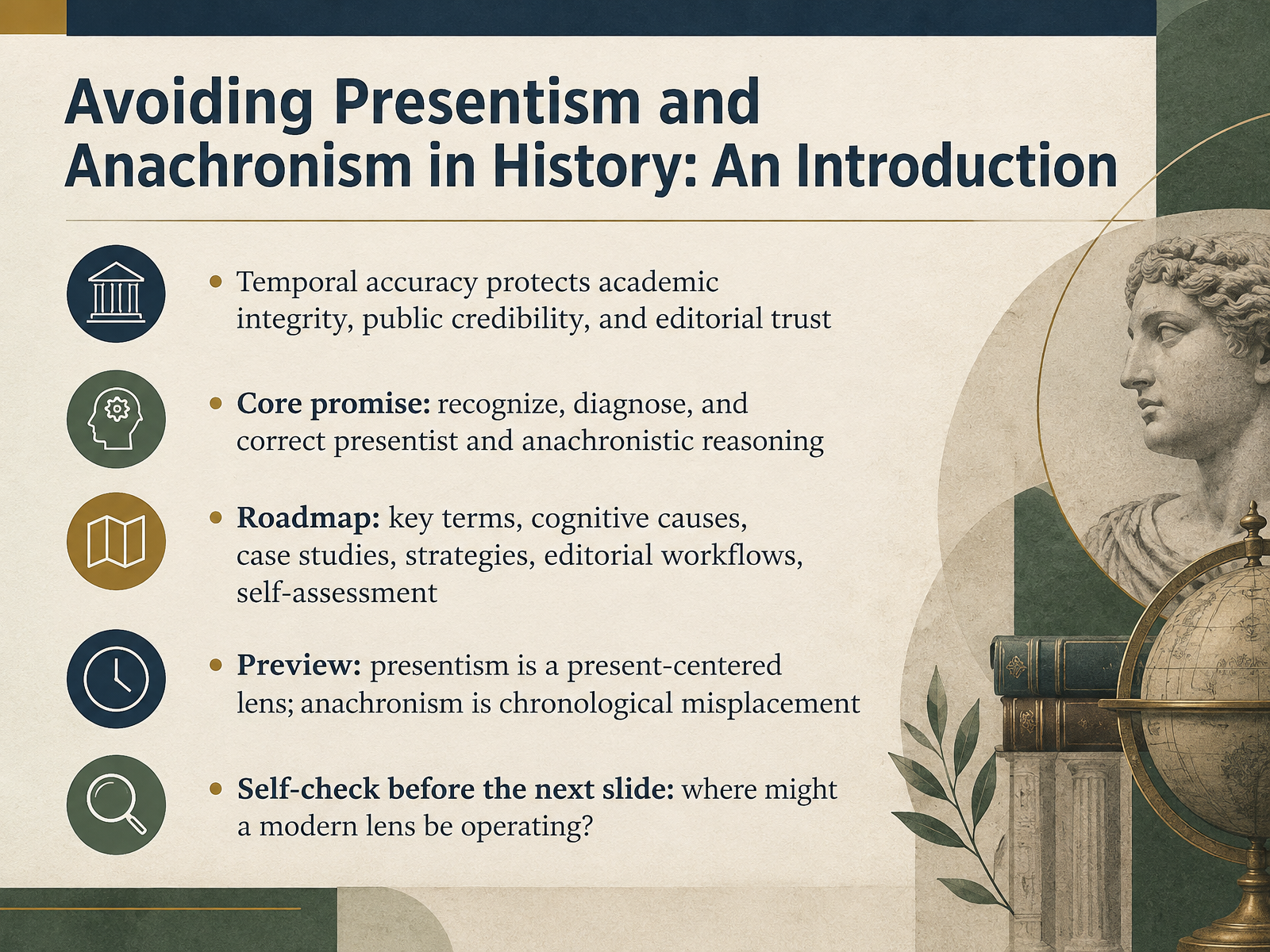
- 01Avoiding Presentism and Anachronism in History: An IntroductionWelcome. This course is about avoiding presentism and anachronism in history. If you study the past, write about it, or edit historical work, this matters to you. Getting time right protects academic integrity, public credibility, and editorial trust. Here is our core promise. By the end, you will be able to recognize, diagnose, and correct presentist and anachronistic reasoning. Our roadmap moves through key terms, cognitive causes, case studies, practical strategies, editorial workflows, and self-assessment. Before we go further, here is a preview of two central terms. Presentism is a present-centered lens. It reads the past through today's concerns and categories. Anachronism is chronological misplacement. It places an idea, word, or object outside its proper time. The two are linked, but not identical. Before the next slide, try a quick self-check. Where might a modern lens be operating in your own current project? We will build from that question as we move into defining presentism and anachronism.trepo.tuni.fijsser.orgdoi.org+22 min
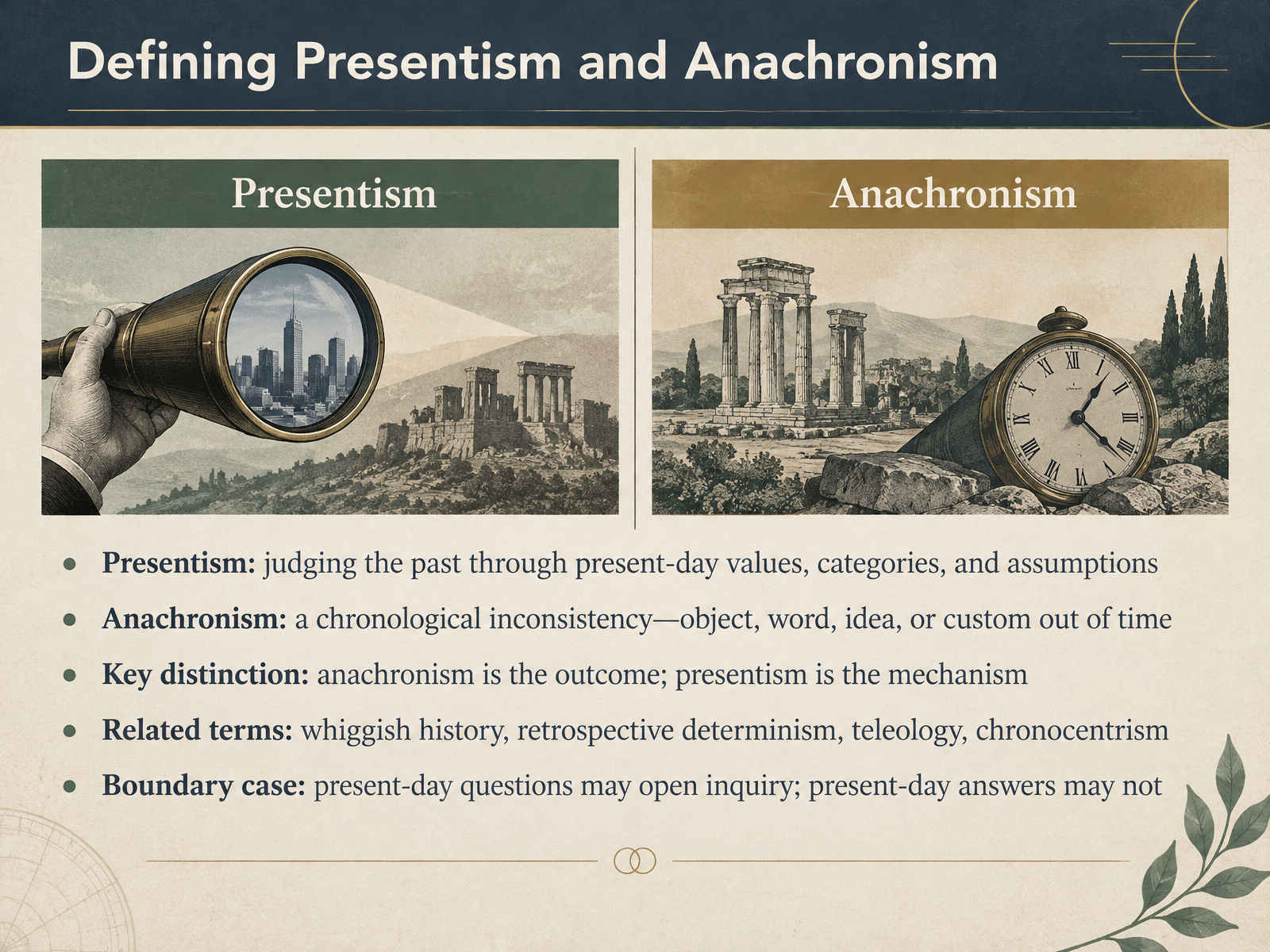
- 02Defining Presentism and AnachronismLet's draw a clear line between two terms we often mix up. Presentism means judging the past through present-day values, categories, and assumptions. Anachronism is a chronological inconsistency: an object, word, idea, or custom out of time. Here is the key distinction. Anachronism is the outcome. Presentism is the mechanism that produces it. We also hear related terms, such as whiggish history, retrospective determinism, teleology, and chronocentrism. Consider a boundary case. Present-day questions may open inquiry. Present-day answers may not. For example, asking how medieval families treated children is a fair question. Concluding that they lacked our modern concept of childhood, and judging them for it, slips into presentism. So here is your check. When a passage feels off, ask whether the problem is the misplaced detail or the present-day lens behind it. Next, we look at a typology of anachronism: facts, language, and perspective.
 trepo.tuni.fijsser.orgdoi.org+22 min
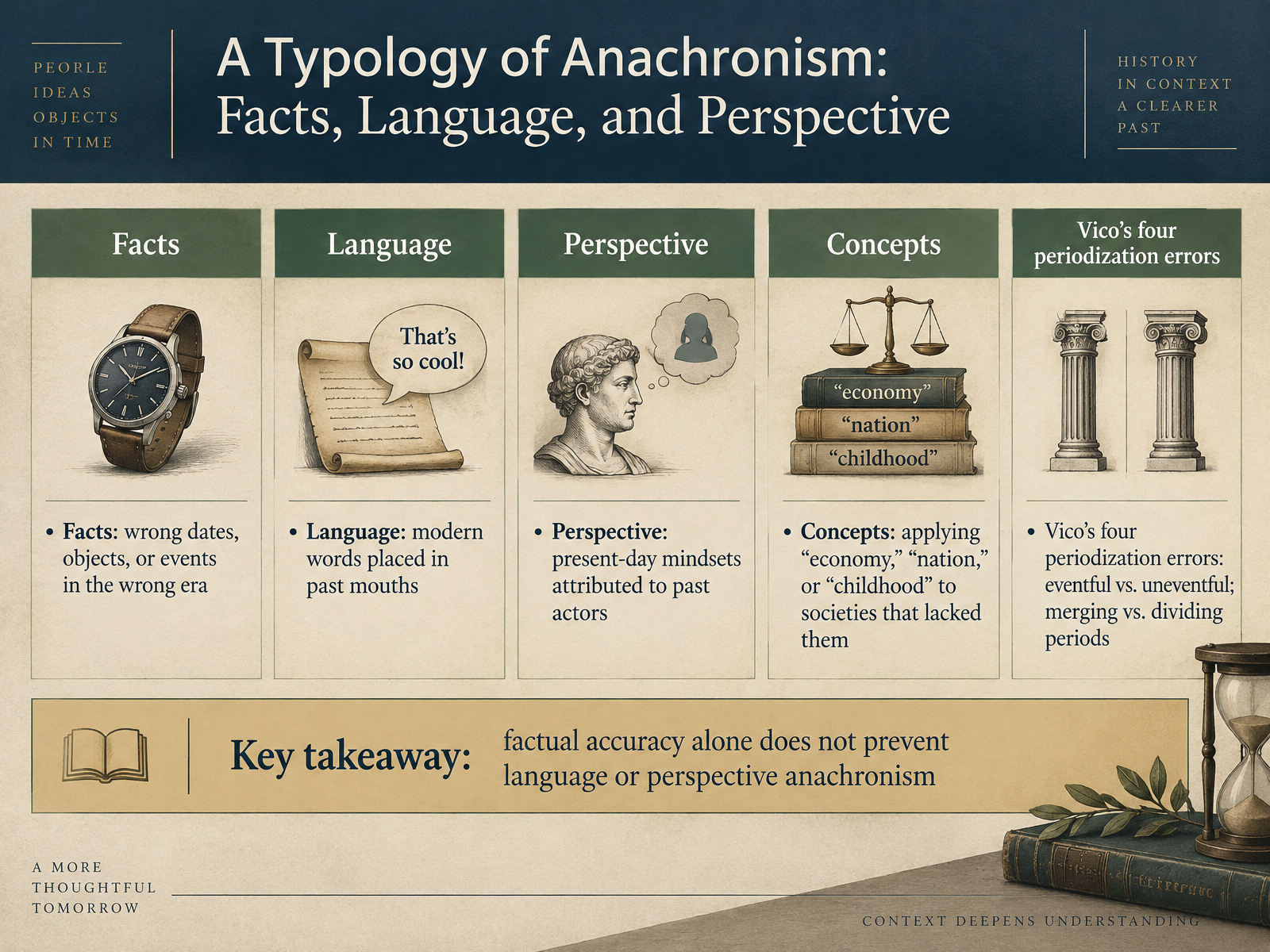
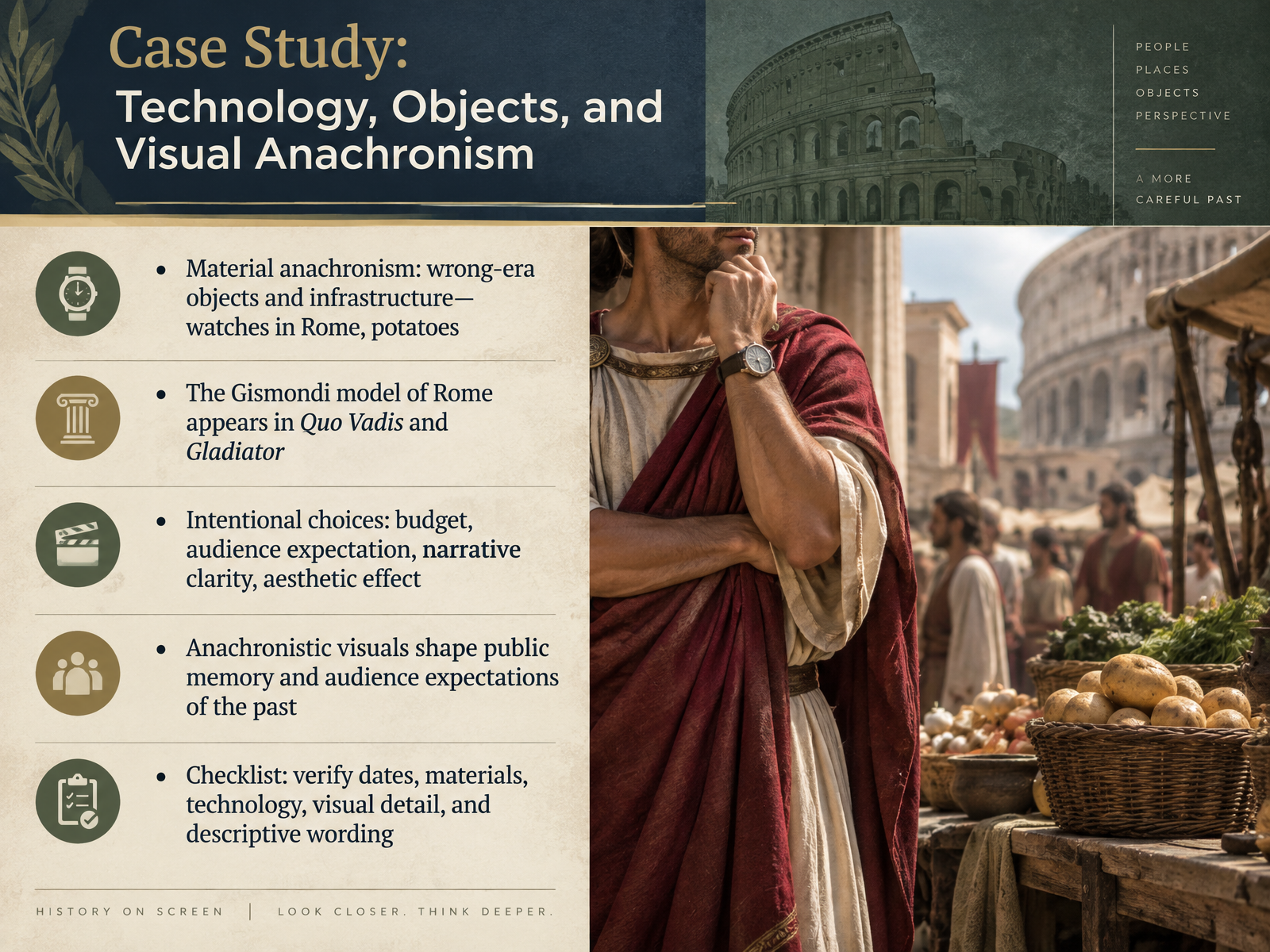
- 03A Typology of Anachronism: Facts, Language, and PerspectiveLet's now sort anachronism into clear types, so you can spot each one in your own writing. First, factual anachronism: wrong dates, objects, or events in the wrong era. For example, a Roman soldier wearing a wristwatch. After revision, he checks the sun's height and gives the signal. Second, language: modern words placed in past mouths. A medieval farmer says his harvest was stressful. Better: he says the harvest weighed on him, and worries about the tithe. Third, perspective: present-day mindsets attributed to past actors. Fourth, concepts: applying economy, nation, or childhood to societies that lacked them. Vico adds four periodization errors. Treating eventful periods as uneventful, or the reverse. Merging periods that should be divided, or dividing periods that should be united. Here is the key takeaway. Factual accuracy alone does not prevent language or perspective anachronism. Try this check on your current draft. Pick one paragraph and ask whose words and whose mindset these really are. Next, we look at why our brains default to the present. Why Our Brains Default to the Present.
 trepo.tuni.fijsser.orgdoi.org+22 min
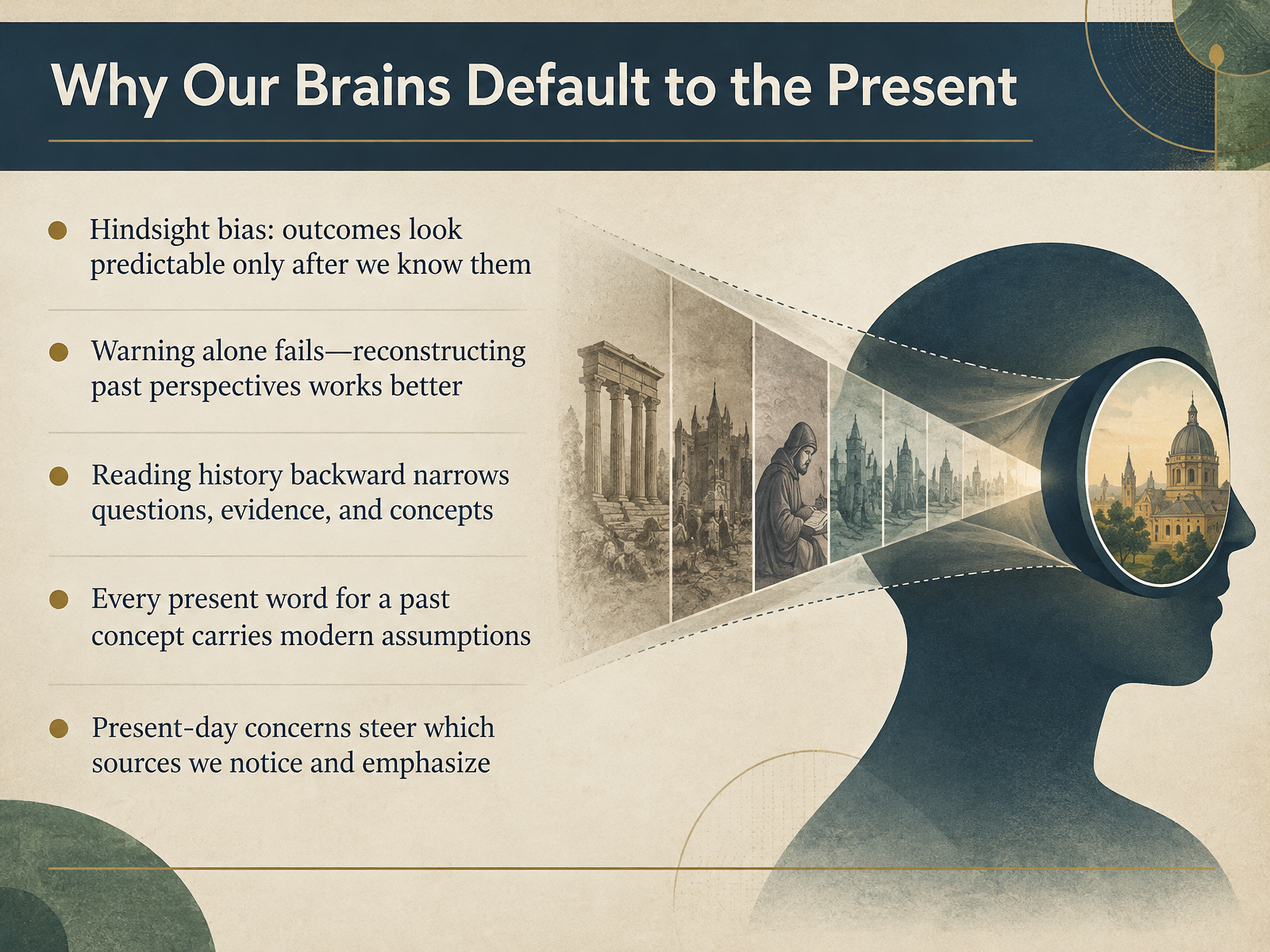
- 04Why Our Brains Default to the PresentLet's turn to the mind doing the interpreting. Our brains naturally default to the present. This is called hindsight bias. Once we know an outcome, it feels as if it was always predictable. But simply warning yourself about this bias rarely works. What does help is deliberately reconstructing how the past looked to the people living through it. When we read history backward, we quietly narrow our questions, our evidence, and our concepts. Every present-day word we use for a past idea carries modern assumptions with it. And our current concerns steer which sources we notice and emphasize. Here is a quick example. Instead of writing that the invention of the printing press made censorship inevitable, ask what people at the time actually feared. Revise that sentence so it reflects their concerns, not ours. Your check for this section: list three terms in your draft and ask whether their meaning existed in that era. Next, we'll look at contextualization as the core skill.
 pubmed.ncbi.nlm.nih.govdoi.orgdoi.org+22 min
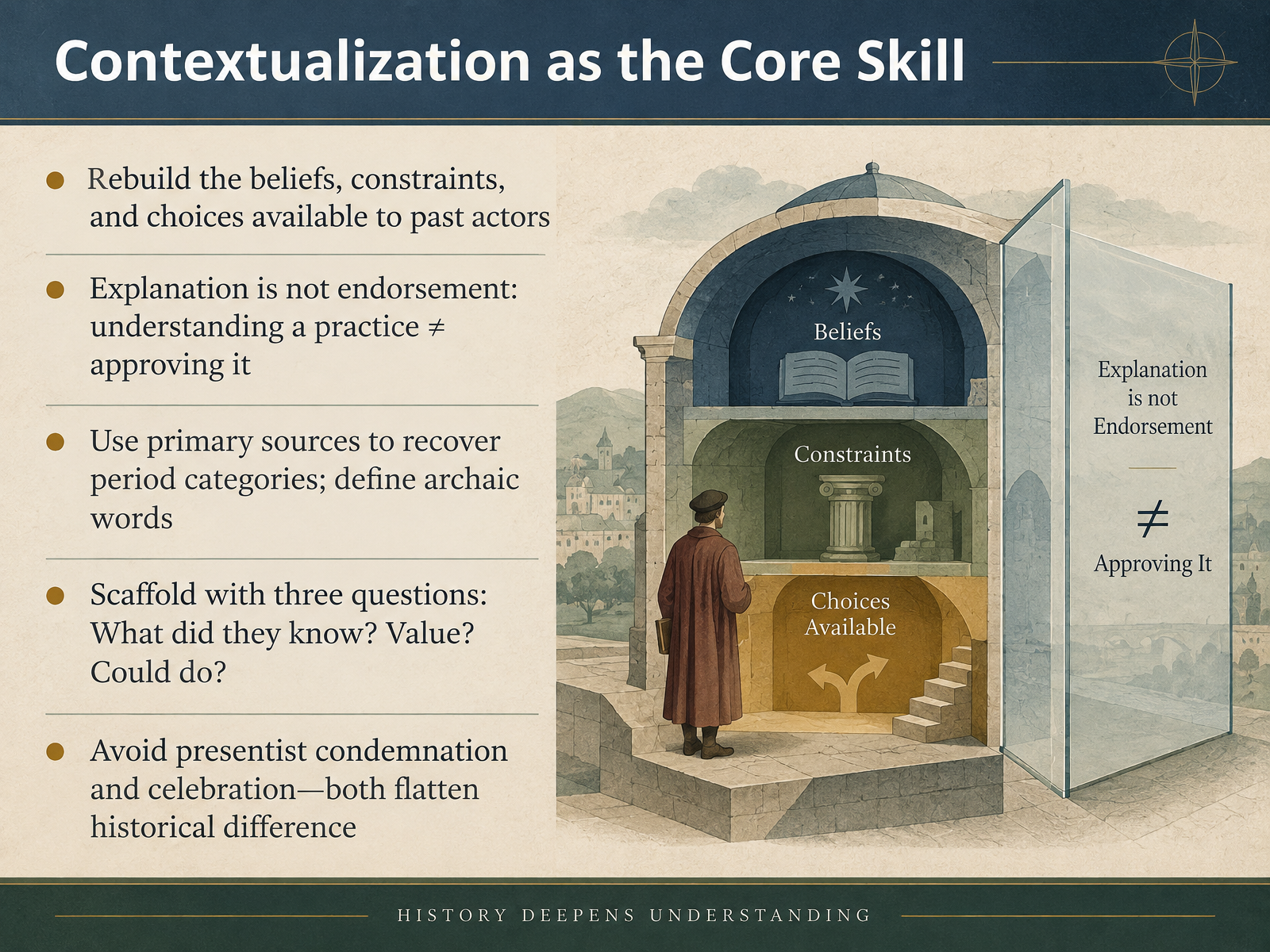
- 05Contextualization as the Core SkillNow let's turn to the skill that holds the rest together: contextualization. Contextualization means rebuilding the beliefs, constraints, and choices available to past actors. It does not mean agreeing with them. Explaining a practice is not endorsing it. Use primary sources to recover period categories, and define archaic words plainly. A three-part scaffold helps. Ask what they knew, what they valued, and what they could actually do. A quick before-and-after shows the shift. Before: a writer calls a past custom backward. After: the writer describes the pressures that made the custom seem reasonable then. Notice how the second version explains without excusing. We all slip into presentist condemnation or celebration, and both flatten historical difference. So here is your check. When you judge a past actor, ask whether your standard existed in their world. Next, we look at a case study of concepts and words that travel badly.
 loc.govteachinghistory.orgloc.gov+22 min
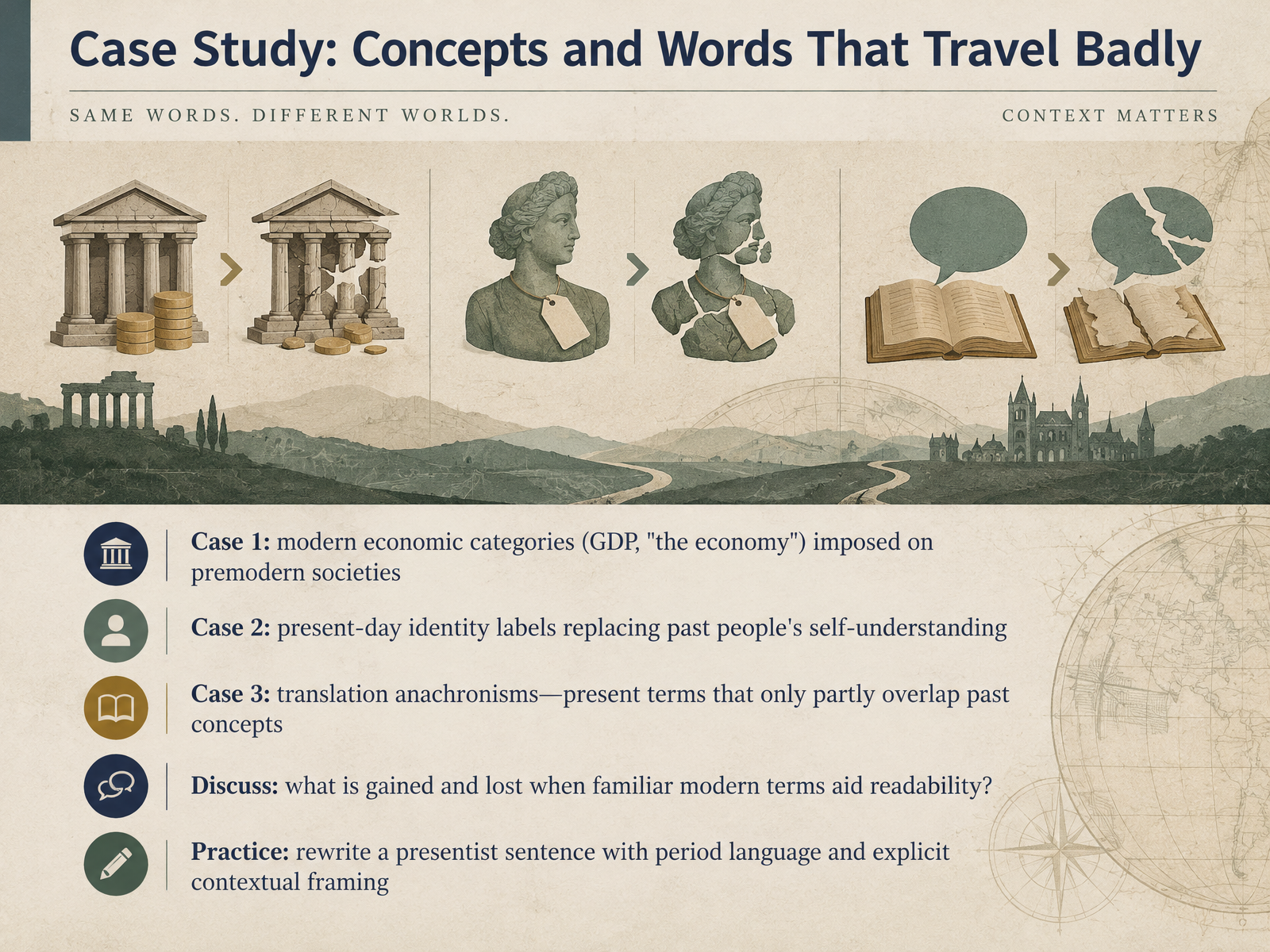
- 06Case Study: Concepts and Words That Travel BadlyNow let's look at concepts and words that travel badly across time. First, modern economic categories. Terms like GDP and the economy are recent tools. Applying them to premodern societies introduces anachronistic elements, because those societies did not organize production this way. Revise this sentence so it avoids an anachronistic detail, for example. Second, identity labels. Present-day categories can replace how past people understood themselves. Ask what words they used for themselves. Third, translation anachronisms. A present term may only partly overlap a past concept, so define both. When familiar modern terms aid readability, we gain access and lose precision. So name what the term adds and what it hides. Your practical check is this. Does each key term carry a date, a source, or an explicit note about its limits? Next, we turn to technology, objects, and visual anachronism.
 academia.edudoi.orgdoi.org+22 min
- 07Case Study: Technology, Objects, and Visual AnachronismNow let's turn to technology, objects, and visual anachronism. Material anachronism means the wrong object appears in the wrong era. A wristwatch in ancient Rome is one example. A potato in medieval Europe is another, because it only arrived after 1492. Films illustrate this well. The Gismondi model of Rome, showing the city of Constantine, appears in both Quo Vadis and Gladiator, centuries after the stories are set. Some choices are intentional: budget, audience expectation, narrative clarity, or aesthetic effect. But anachronistic visuals still shape public memory and what audiences expect the past to look like. So here's your check: verify dates, materials, technology, visual detail, and descriptive wording. Start by asking whether each object could exist in that year. Next, we look at the historian's dilemma of moral judgment.
 trepo.tuni.fijsser.orgdoi.org+22 min
- 08Case Study: Moral Judgment and the Historian's DilemmaNow let's look at moral judgment, and the historian's dilemma.
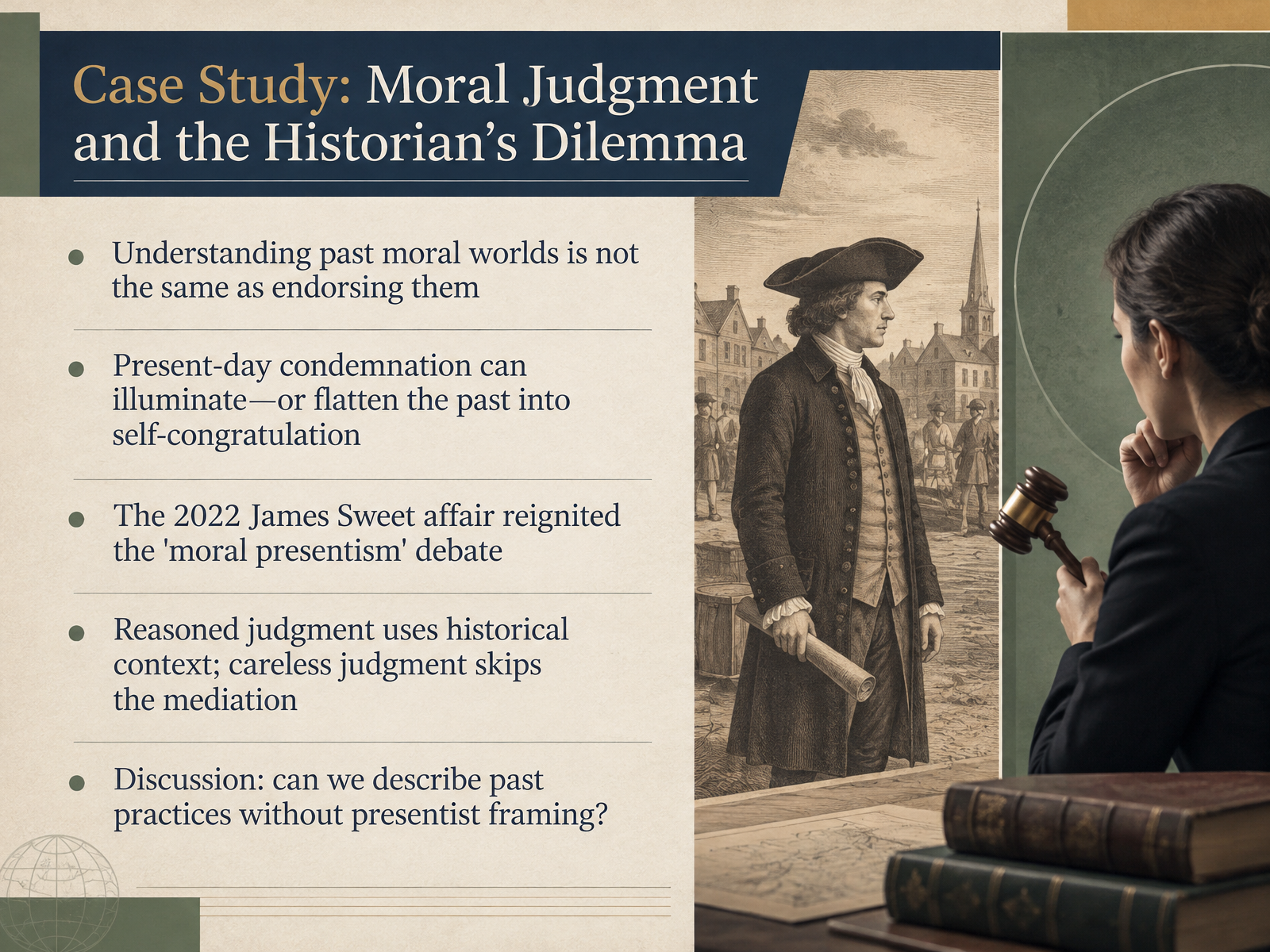
First, a key distinction. Understanding the moral world of the past is not the same as endorsing it. We can describe a practice and explain why it made sense to people then, without saying it was right.
Second, present-day condemnation can illuminate an injustice. But it can also flatten the past into self-congratulation, as if we simply know better.
In August 2022, James Sweet, then president of the American Historical Association, raised this debate about what he called teleologies of the present. Responses split sharply, and the controversy is often called the Sweet affair. A common compromise emerged: present-day concerns are a legitimate starting point, but they must be checked by respect for the evidence.
So here is the distinction that matters. Reasoned judgment uses historical context. Careless judgment skips that mediation and applies our standards directly.
A quick example. Before: colonial officials were simply cruel and hypocritical. After: colonial officials defended their conduct with arguments their contemporaries also contested. The second version explains. The first only evaluates.
Here is a question to discuss. Can we describe past practices without presentist framing? Try revising one sentence that judges, so it explains first. Ask yourself, did I show the context before I judged?
Next, we turn to practical strategies for writers and educators.
 2 min
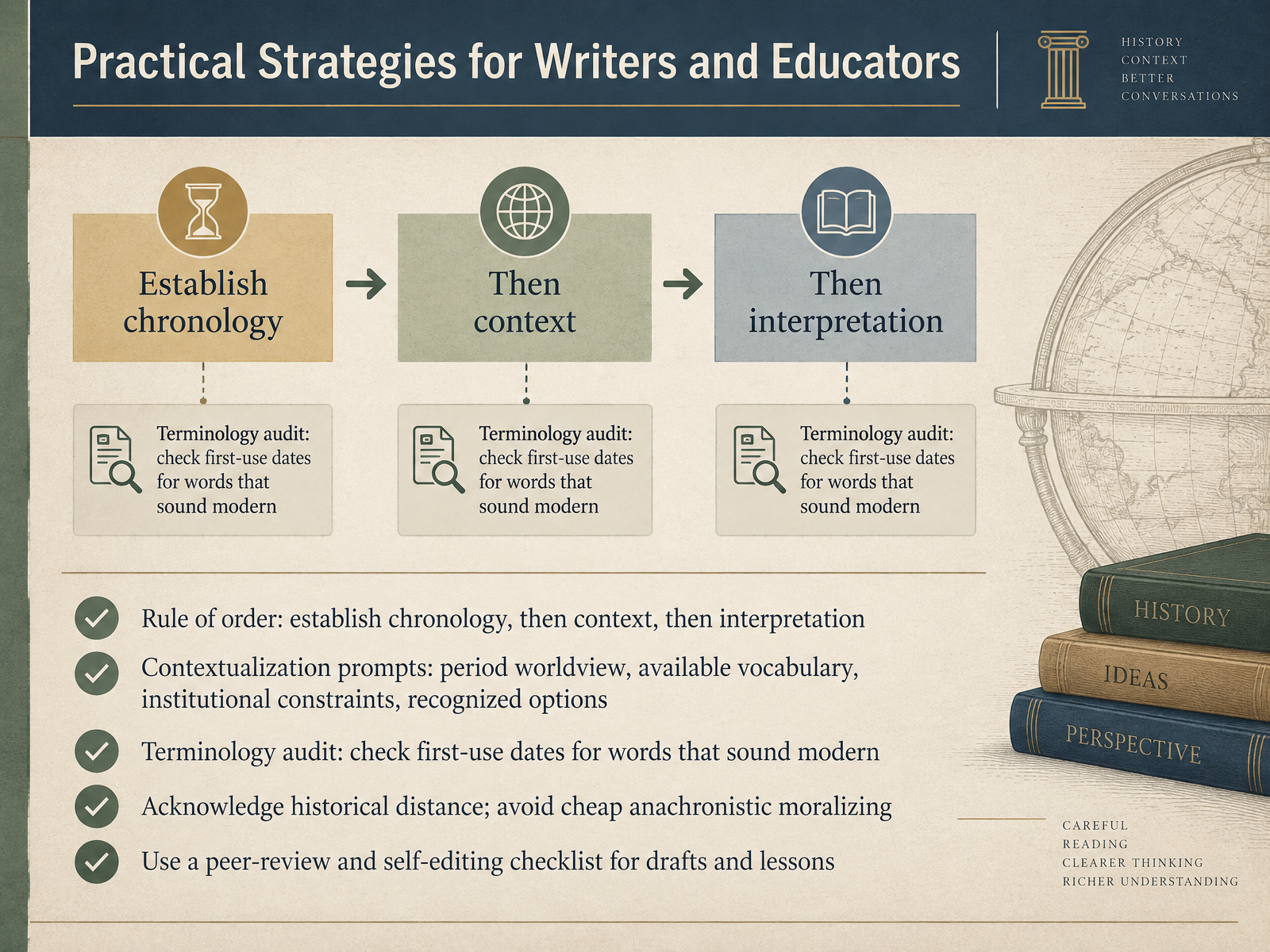
- 09Practical Strategies for Writers and EducatorsNow let's turn to practical strategies you can use in drafts and lessons. Start with a rule of order. Establish chronology first, then context, then your interpretation. For example, instead of opening with a verdict, narrate the events in past tense, then explain the period worldview, and only then offer your reading. Next, use contextualization prompts. Ask what people believed, what words existed, and what institutions constrained them. Consider this before and after. Before: a medieval merchant demanded his rights. After: the merchant petitioned the guild for a customary exemption. Then run a terminology audit. Check the first-use date of any word that sounds modern. We all catch these late; it is a normal editing step. Acknowledge historical distance, and avoid cheap moralizing. Finally, build a peer-review and self-editing checklist. As a quick check, ask: could the people described have thought this? That question keeps your prose honest. Next, we move to editorial and publishing workflows.
 loc.govteachinghistory.orgloc.gov+22 min
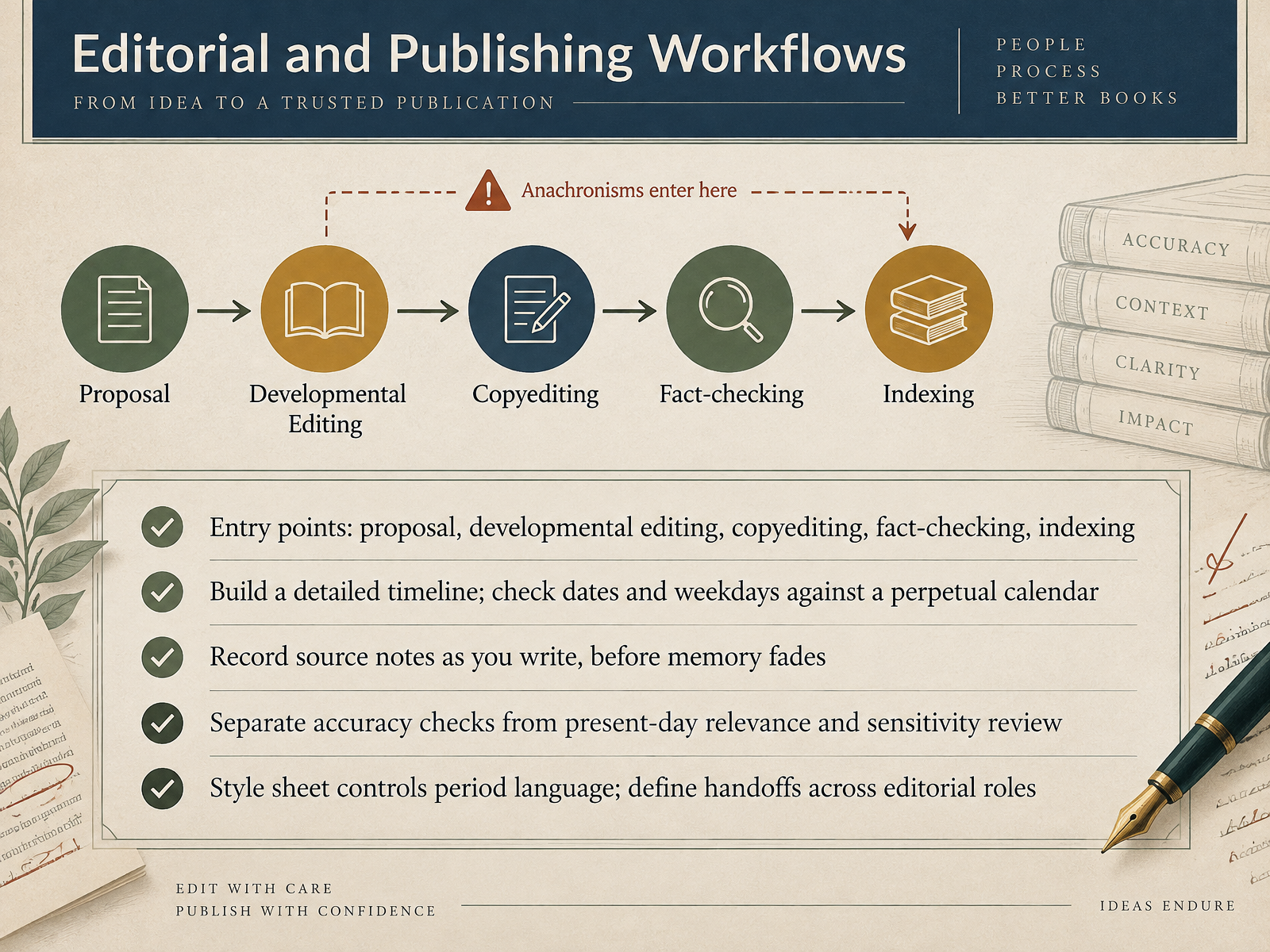
- 10Editorial and Publishing WorkflowsNow let's move from principles to practice, with editorial and publishing workflows. Accuracy gets protected by process, not memory. Start by naming your entry points. A manuscript may arrive at proposal stage, developmental editing, copyediting, fact-checking, or indexing, and each stage needs a clear owner. Then build a detailed timeline. Check every date and weekday against a perpetual calendar, because long drafts drift quietly. Record source notes as you write, before memory fades. Reconstructing sources later costs more time and gives weaker results. Keep accuracy checks separate from present-day relevance and sensitivity review, so each gets full attention. Use a style sheet to control period language, and define handoffs across editorial roles. Here is a quick before and after. Before: the editor fixes the dates during copyediting. After: fact-checking owns the chronology, copyediting owns the style sheet, and handoffs are written down. Our shared pitfall is assuming someone downstream will catch it. To check your own workflow, ask who signs off on chronology, and where that sign-off is recorded. Next, we look at publishing case files, and how anachronisms slip through.
 trepo.tuni.fijsser.orgdoi.org+22 min
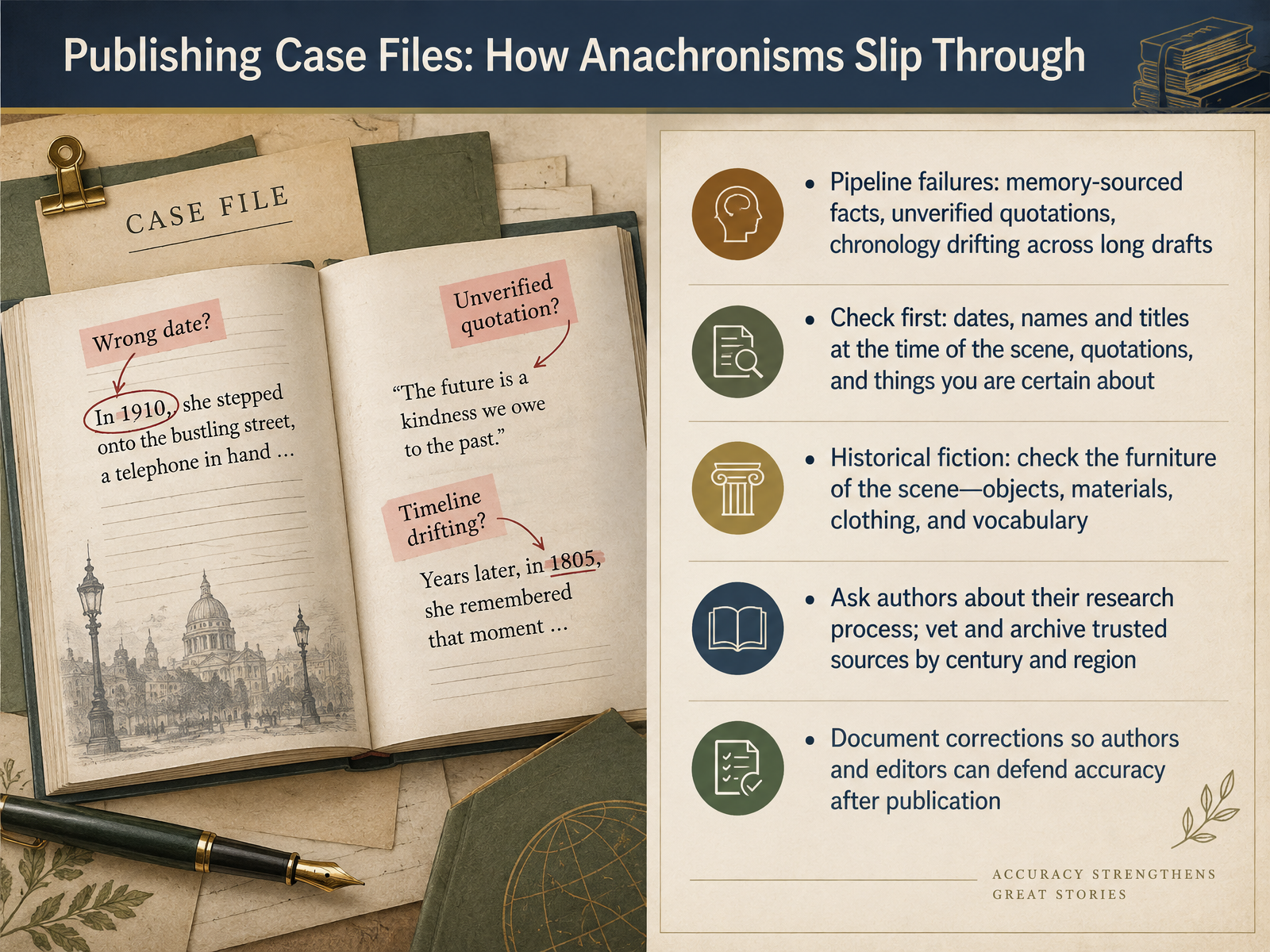
- 11Publishing Case Files: How Anachronisms Slip ThroughLet's look at how anachronisms slip through real publishing pipelines. Most failures are not dramatic. Facts come from memory, quotations go unverified, and chronology drifts across a long draft. A copy editor keeps a running timeline and notes on dates and details. Here is a before and after. Before: a character in nineteen forty checks her wristwatch. After: she checks the clock on the mantel. Check first: dates, names and titles at the time of the scene, quotations, and the things you are certain about. Certainty is what stops us looking. In historical fiction, check the furniture of the scene: objects, materials, clothing, and vocabulary. Ask authors about their research process, then vet and archive trusted sources by century and region. Document corrections, so authors and editors can defend accuracy after publication. Your practical check: open a source note for every fact you did not verify today. Next, we turn to common pitfalls: overcorrection and false neutrality.
 trepo.tuni.fijsser.orgdoi.org+22 min
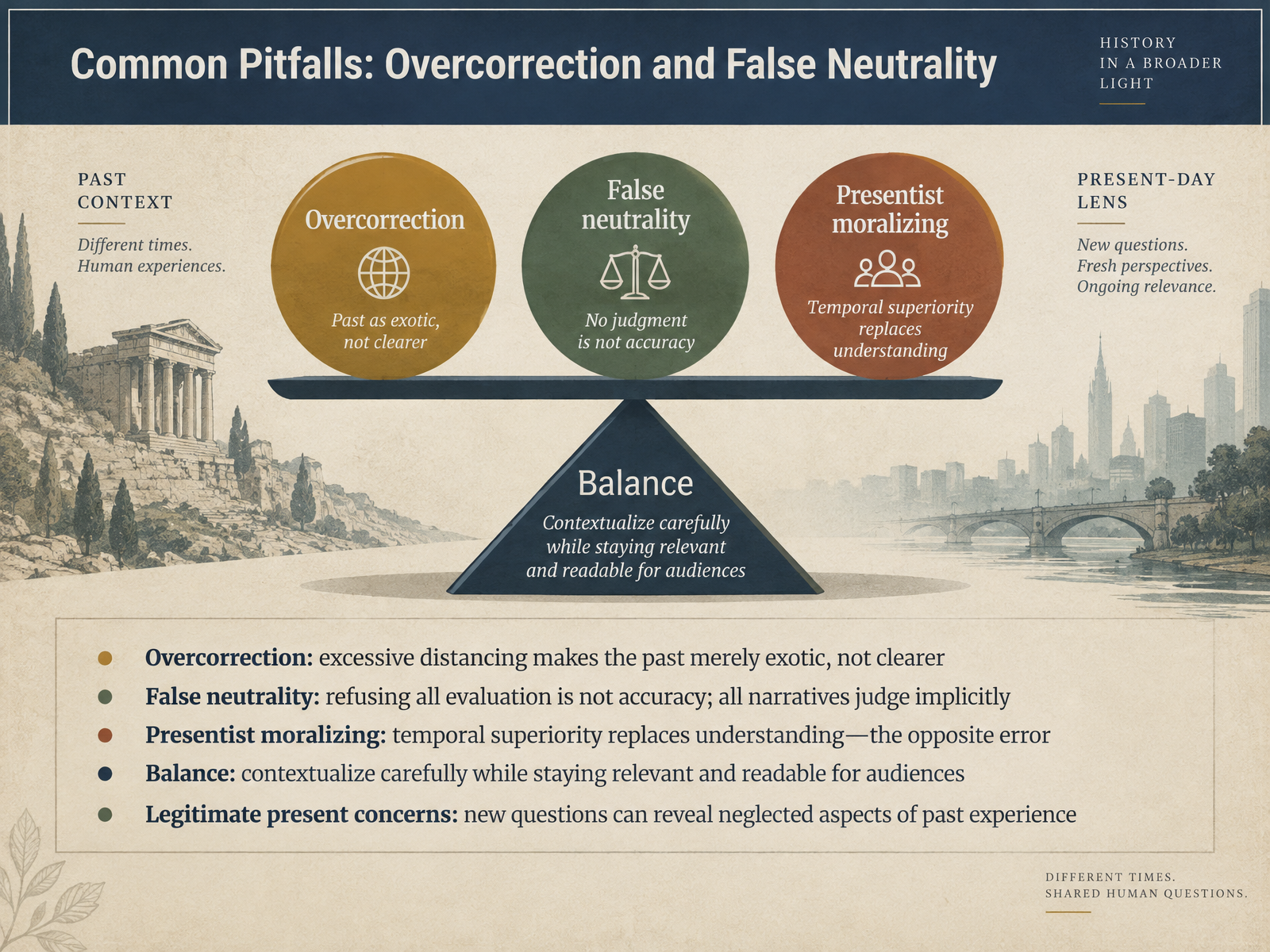
- 12Common Pitfalls: Overcorrection and False NeutralityNow let's look at common pitfalls, especially overcorrection and false neutrality. Overcorrection is the first one. Excessive distancing makes the past merely exotic, not clearer. For example, you might write, "The ritual can only be understood by the vanished mind of the age." That tells the reader nothing real. A better version says, "The ritual marked communal status, and its meaning shifted as the local economy changed." Next, false neutrality. Refusing all evaluation is not accuracy. All narratives judge implicitly through what they include and emphasize. Presentist moralizing is the opposite error. Temporal superiority replaces understanding. So aim for balance: contextualize carefully, while staying relevant and readable for your audience. Remember that legitimate present concerns can be productive. New questions can reveal neglected aspects of past experience. Here is a practical check. Read your paragraph and ask: does it explain the past on its own terms, or does it only judge it from ours? Now let's move into making it stick, applying one strategy this week.
 loc.gov2 min
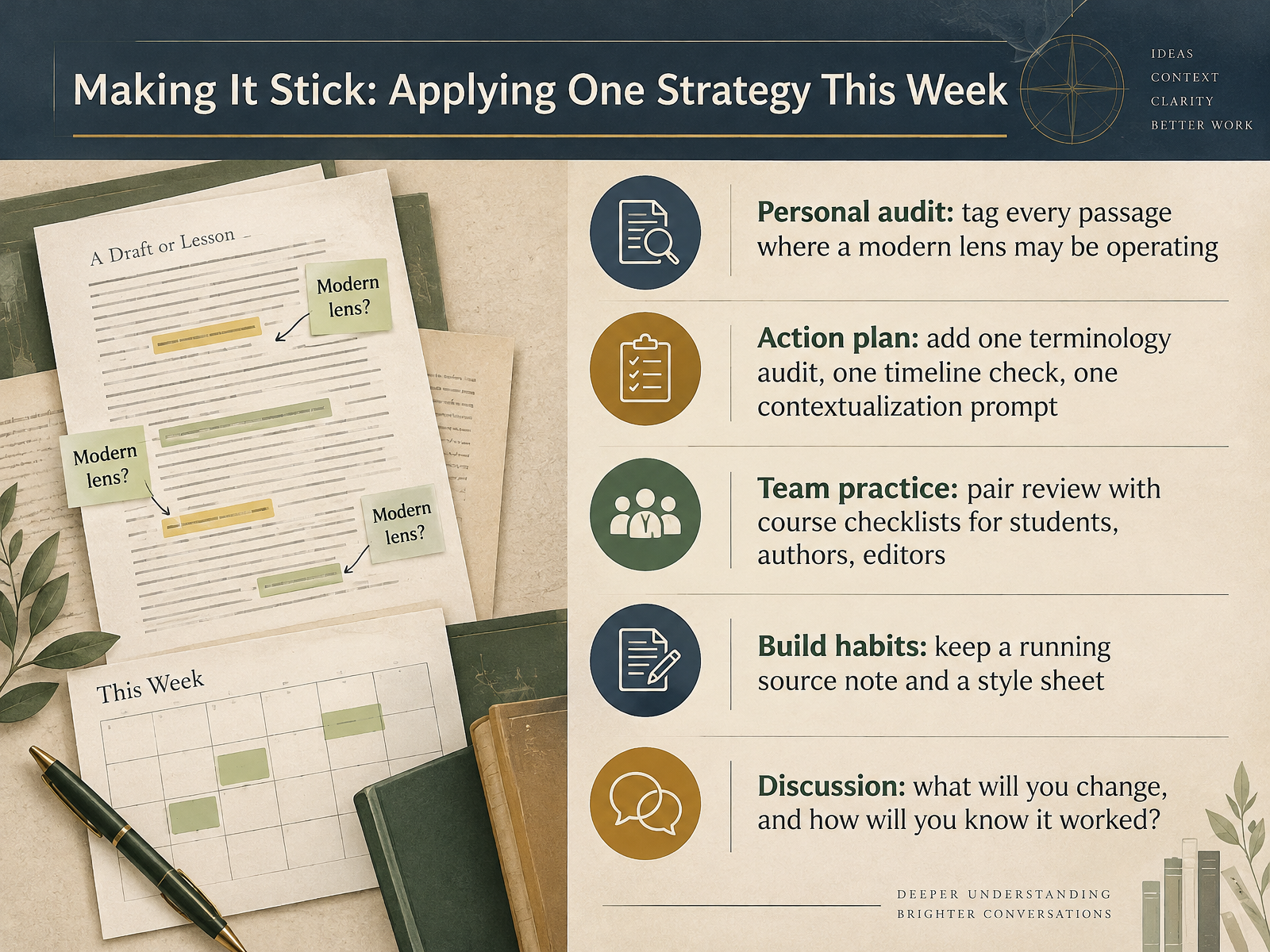
- 13Making It Stick: Applying One Strategy This WeekLet's turn these ideas into something you can actually do this week. Start with a personal audit. Tag every passage where a modern lens may be operating. Then build a small action plan. Add one terminology audit, to catch words that did not yet exist. Add one timeline check. And add one contextualization prompt, asking what else was happening at the time. If you work in a team, try pair review with a shared checklist for students, authors, and editors. To build habits, keep a running source note as you write, plus a style sheet for names, dates, and terms. Here is a quick check. Before you finish a session, ask yourself what will you change, and how will you know it worked. Next, we look at self-assessment and next steps.
 loc.govteachinghistory.orgloc.gov+22 min
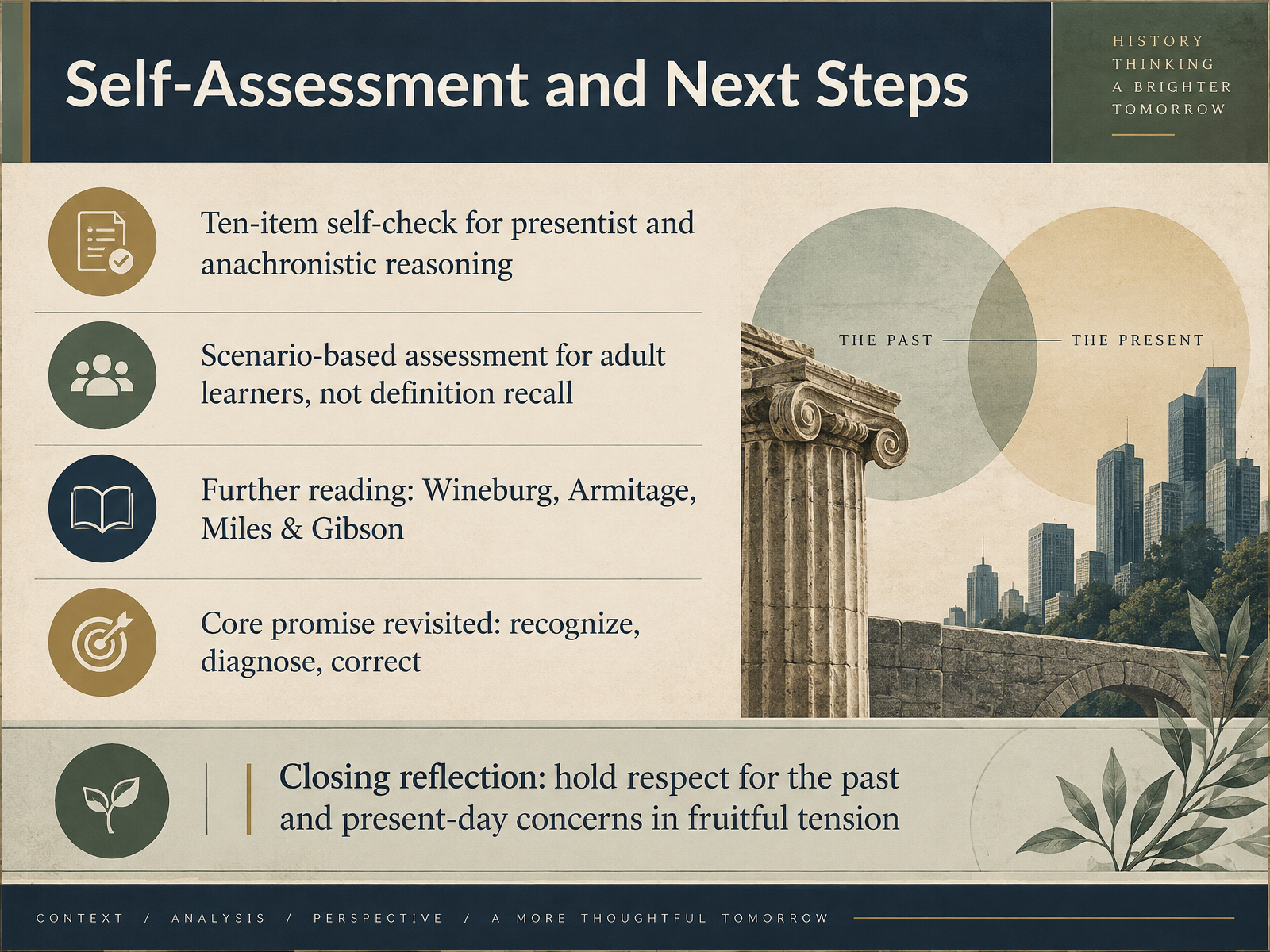
- 14Self-Assessment and Next StepsLet's close with self-assessment and next steps. Your self-check has ten items, and it is scenario based rather than definition recall. So you will not be asked to repeat a definition of presentism. Instead, you will read short passages and decide where presentist or anachronistic reasoning appears. For example, a sentence that calls a medieval writer "uneducated" because he lacked modern science is a scenario you can now diagnose and revise. For further reading, start with Wineburg on historical thinking, Armitage's defense of presentism, and Miles and Gibson on rethinking presentism in history education. Return to our core promise one last time. You can recognize the problem, diagnose its source, and correct it with evidence and context. And keep this closing reflection in view. Good history holds respect for the past and present-day concerns in fruitful tension. It does not surrender either one. So here is your final check. Take one paragraph you have written, run it through the ten items, and name exactly one change you will make. Thank you for your careful work throughout this course. You now have a practical method, and you are ready to use it confidently in your own writing.
 loc.gov2 min
Take the deck with you
Download this course as a file — free, no sign-up needed.
- PDF handoutEvery slide page, ready to print or share.15 pages · 5.4 MBDownload
- Narrated PowerPointThe deck that presents itself — every slide carries the digital human's narration video.15 pages · 15.6 MBDownload
- PowerPoint slidesThe full deck as a .pptx — open it in PowerPoint, Keynote, or Google Slides.15 pages · 5.4 MBDownload
Free to use in your own training — please keep the PersonWise credit page at the end.
Have your own deck? Turn it into a course
Sources consulted
Web sources consulted while building this course.
- Sins of a Historian. Perspectives to the problem of anachronism — trepo.tuni.fi
- Problem of anachronism in history teaching: An analysis of fictional texts in social studies and history textbooks | Ozturk | Journal of Social Studies Education Research — jsser.org
- History as translation / anachronism as synchronism — doi.org
- Chronisms : on the past and future of the relation of times — kops.uni-konstanz.de
- Project MUSE - The Return of Anachronism — muse.jhu.edu
- Fifty years of hindsight bias research-Reflection on Fischhoff (1975) - PubMed — pubmed.ncbi.nlm.nih.gov
- Looking Backward and Forward on Hindsight Bias — doi.org
- Hindsight Bias — doi.org
- Reading History Forward — doi.org
- Hindsight bias: How knowledge and heuristics affect our reconstruction of the past — doi.org
- TPS Quarterly Winter 2010 — loc.gov
- Four Reads: Learning to Read Primary Documents | TeachingHistory.org — teachinghistory.org
- Getting Started with Primary Sources | Teachers | Programs | Library of Congress — loc.gov
- Teaching Historiography | The American Historical Review | Oxford Academic — academic.oup.com
- Teaching students to think like historians | Penn GSE — gse.upenn.edu
- Sins of a Historian. Perspectives to the Problem of Anachronism. — academia.edu
- National accounts in world history: Methodological problems and possible solutions — doi.org
- Reinhart Koselleck on Translation, Anachronism and Conceptual Change — doi.org
- Composite and Loose Concepts, Historical Analogies, and the Logic of Control in Comparative Historical Analysis — doi.org
- An Historian's Worst Nightmare: Conceptual Anachronisms — milliern.com