Begin
14 pages · ~28 min
Museum Object Conservation Basics
This training introduces museum conservation basics, teaching staff and volunteers how institutions preserve, handle, and protect collection objects.
A digital instructor presents all 14 pages. Hold “Ask” at any point and ask out loud — the answer comes from this course. No sign-up needed.
What you’ll learn
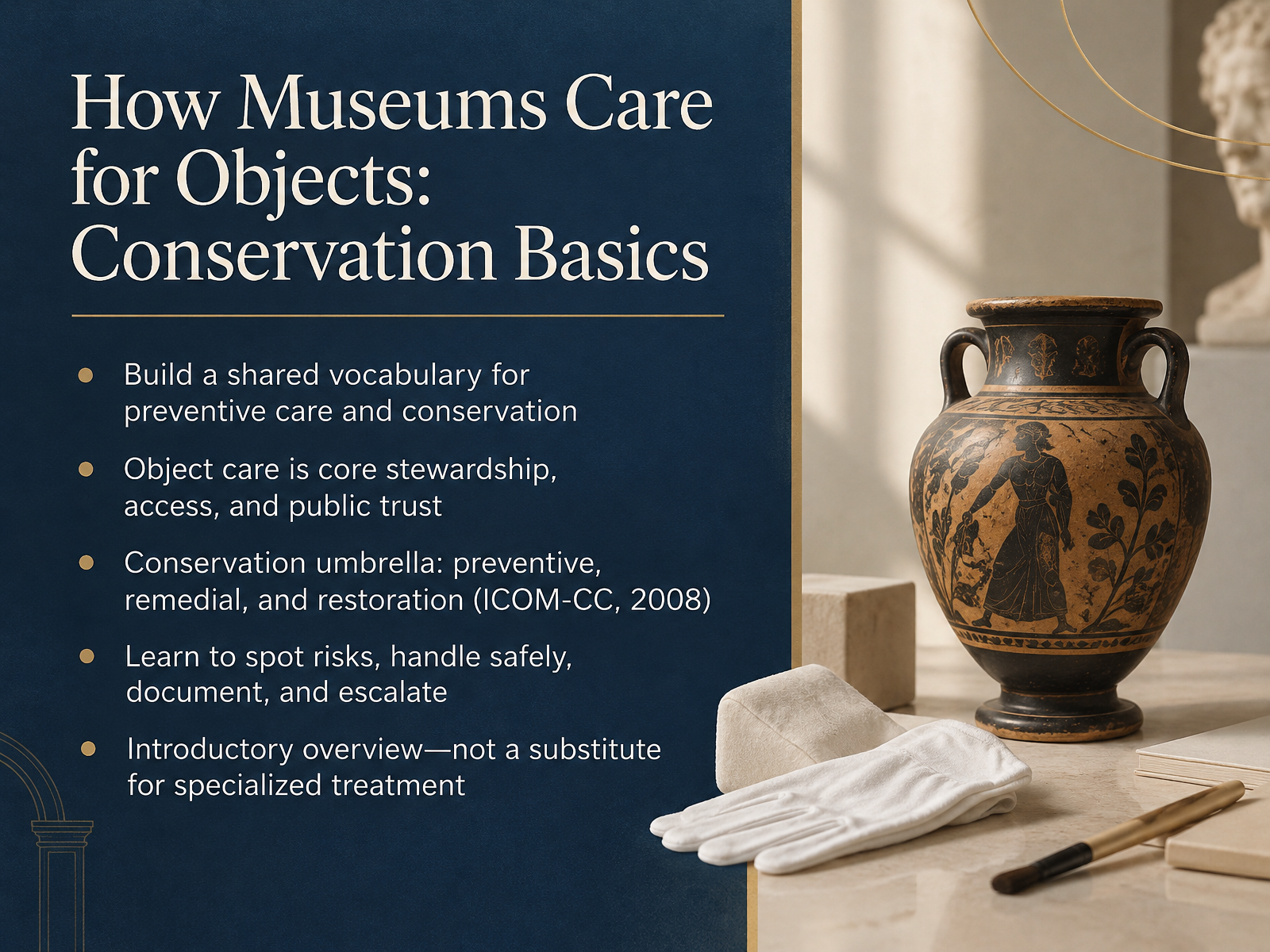
- 01How Museums Care for Objects: Conservation BasicsWelcome to How Museums Care for Objects: Conservation Basics. This course is for museum staff, volunteers, students, and collectors, and it treats you as a capable colleague working within real constraints. Our goal is to build a shared vocabulary for preventive care and conservation, so we can talk about objects clearly and act with confidence. Object care is core stewardship. It protects access for the public and builds trust in your collection. Conservation is an umbrella term, and according to the ICOM-CC terminology from 2008, it covers preventive conservation, remedial conservation, and restoration. Over the next few slides, you will learn to spot risks, handle objects safely, document what you see, and escalate concerns to a conservator when needed. This is an introductory overview, not a substitute for specialized treatment. Next, we will examine what conservation means, including key terms and their boundaries.icom-cc.orgicom-cc.orgiccrom.org+21 min
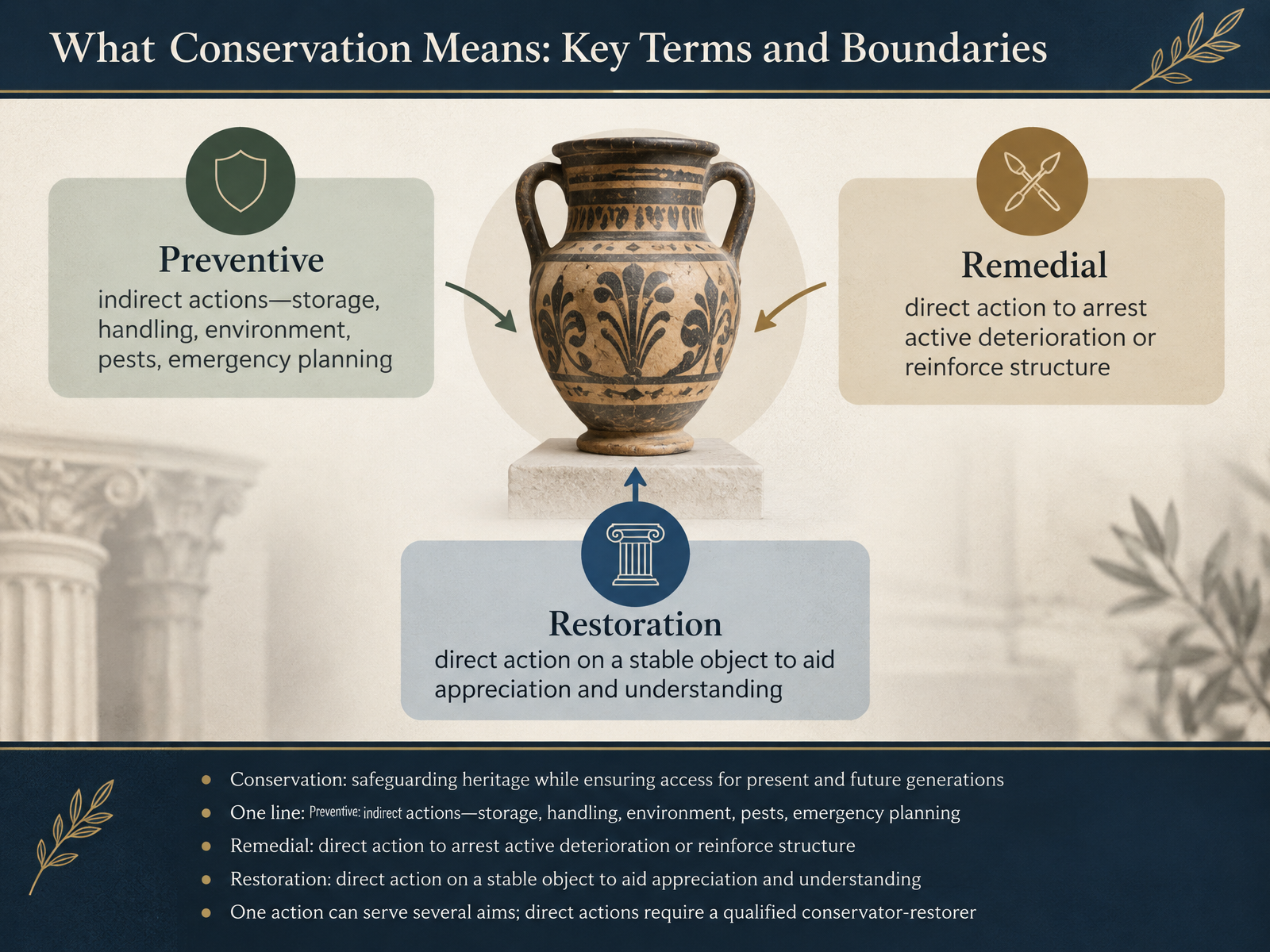
- 02What Conservation Means: Key Terms and BoundariesLet's define the terms we'll use throughout this course. Conservation is the umbrella term. It means safeguarding heritage while ensuring access for present and future generations. Underneath it sit three kinds of action, sorted by their aims. Preventive conservation is indirect. It covers storage, handling, light, humidity, pests, and emergency planning. It doesn't touch the object's materials or change how it looks. Remedial conservation is direct action. It arrests active deterioration or reinforces a fragile structure, like stabilising corroded metal. Restoration is also direct. It works on a stable object to aid appreciation and understanding, such as retouching a painting. Keep in mind that one action can serve several aims. Removing yellowed varnish, for example, can be both remedial and restoration. And because direct actions carry real risk, they require a qualified conservator-restorer. You can handle the preventive work yourself. Next, we'll look at the principle behind these decisions: doing the least harm.
 icom-cc.orgicom-cc.orgiccrom.org+22 min
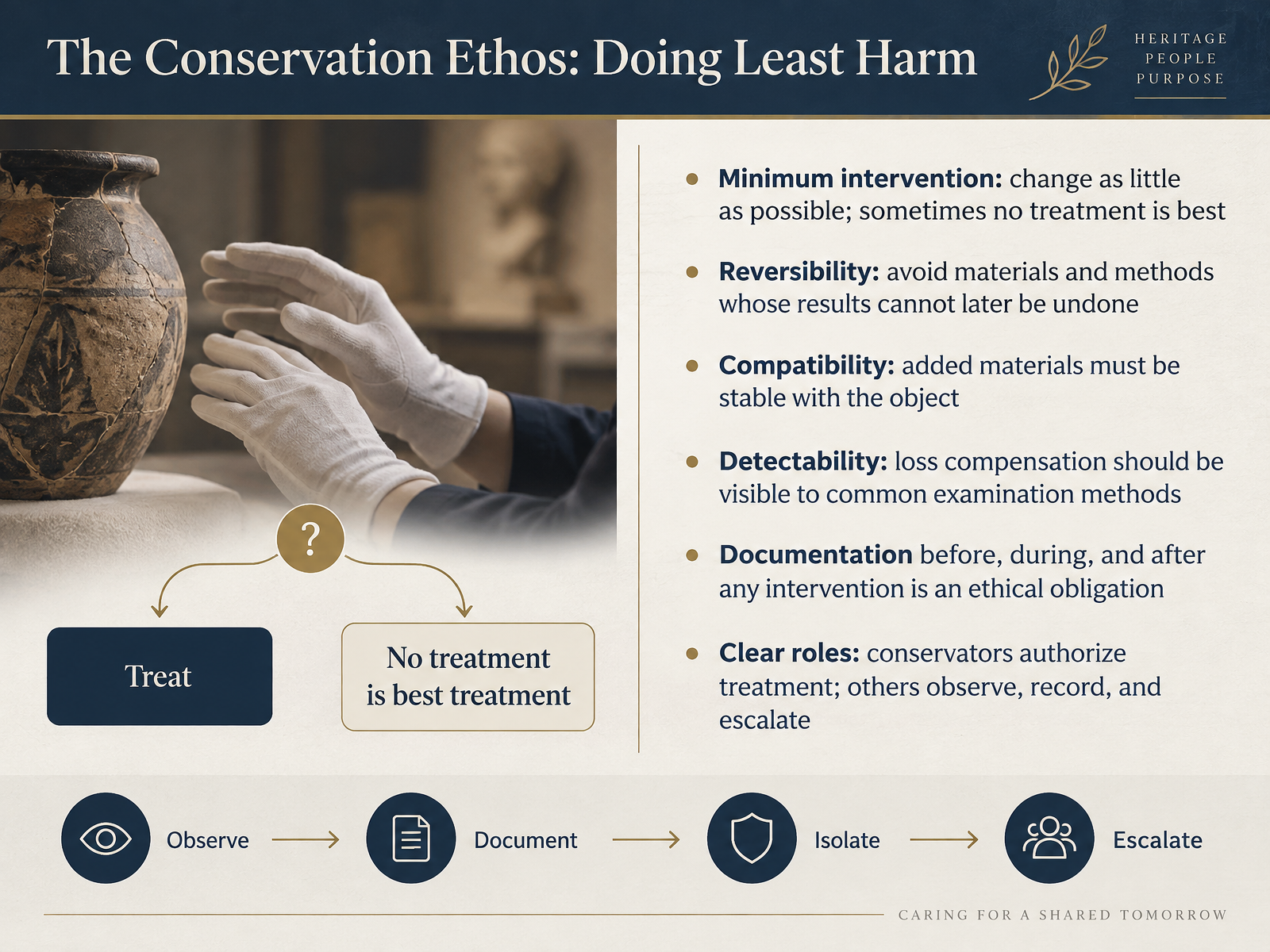
- 03The Conservation Ethos: Doing Least HarmLet's turn to the conservation ethos, which comes down to doing the least harm. Minimum intervention means changing as little as possible, and sometimes no treatment is the best treatment. Reversibility means avoiding materials and methods whose results you cannot later undo. Compatibility asks that anything you add stays stable with the object over time. Detectability means loss compensation, the fills and inpainting that disguise damage, should be visible to common examination methods, so no one mistakes it for original. Documentation before, during, and after any intervention is an ethical obligation, not paperwork. And roles stay clear. Conservators authorize treatment, while everyone else observes, records, and escalates concerns. Next, we'll look at The Ten Agents of Deterioration.
 culturalheritage.orgobs-traffic.museumblackburnconservation.com+22 min
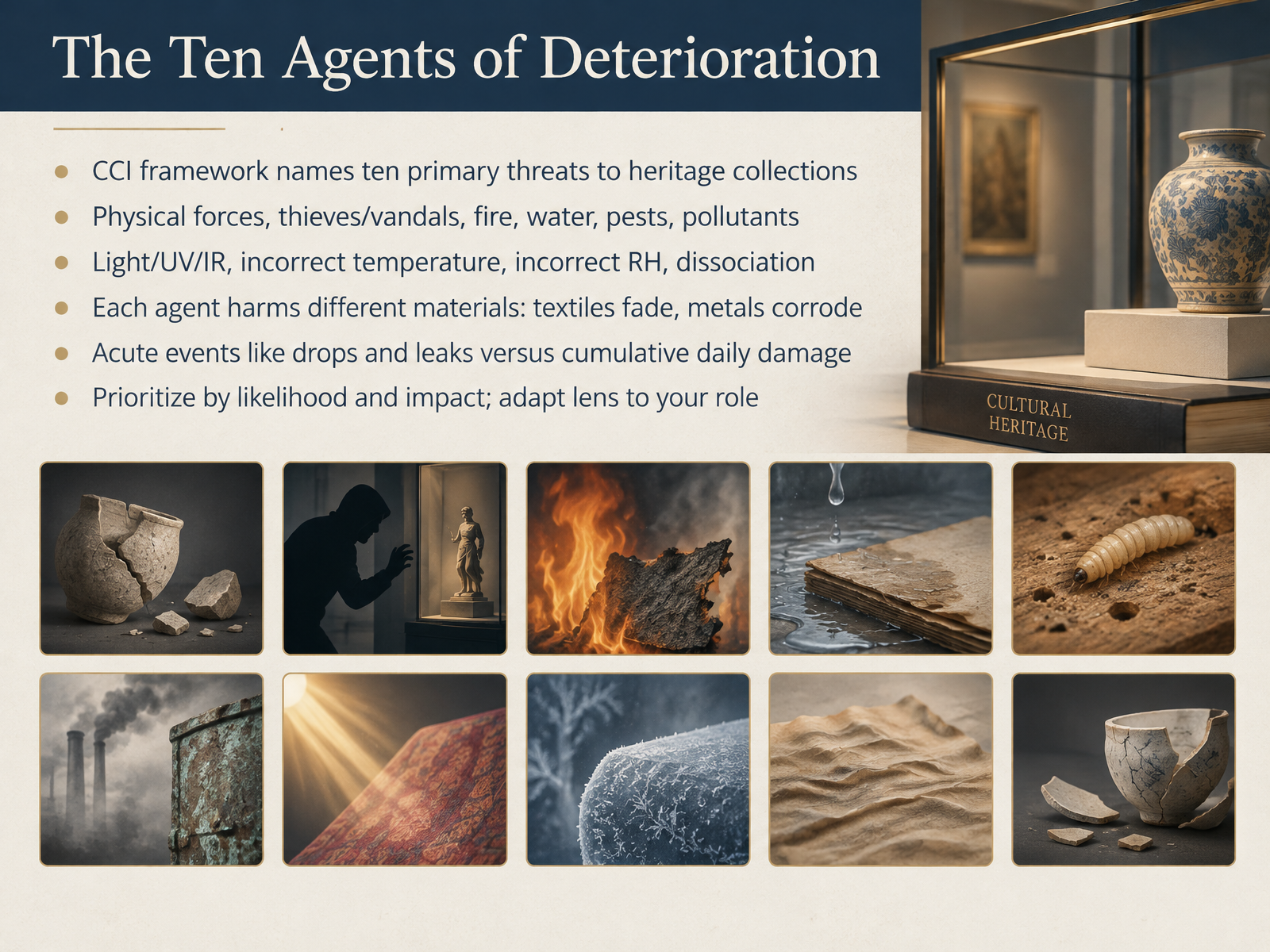
- 04The Ten Agents of DeteriorationNow that you know why preventive care matters, here is a framework that helps you organize it. The Canadian Conservation Institute names ten agents of deterioration, meaning the ten primary threats to heritage collections. Six are physical events: physical forces, thieves and vandals, fire, water, pests, and pollutants. Four are environmental or organizational: light, including ultraviolet and infrared; incorrect temperature; incorrect relative humidity; and dissociation, which is the loss of an object's records or its link to its story. Each agent harms materials differently. Light fades textiles; pollutants corrode metals. Some damage is acute, like a dropped object or a leaking pipe. Other damage accumulates quietly, day by day. So prioritize by likelihood and impact. Ask what is most likely here, and how bad it would be. Then adapt that lens to your role. A volunteer handling objects watches physical forces. A registrar watches for dissociation. Take a moment to picture your own workspace. Which agents feel most likely there? Next, we look closer at the environment: temperature, relative humidity, and light.
 canada.cacanada.capublications.gc.ca+22 min
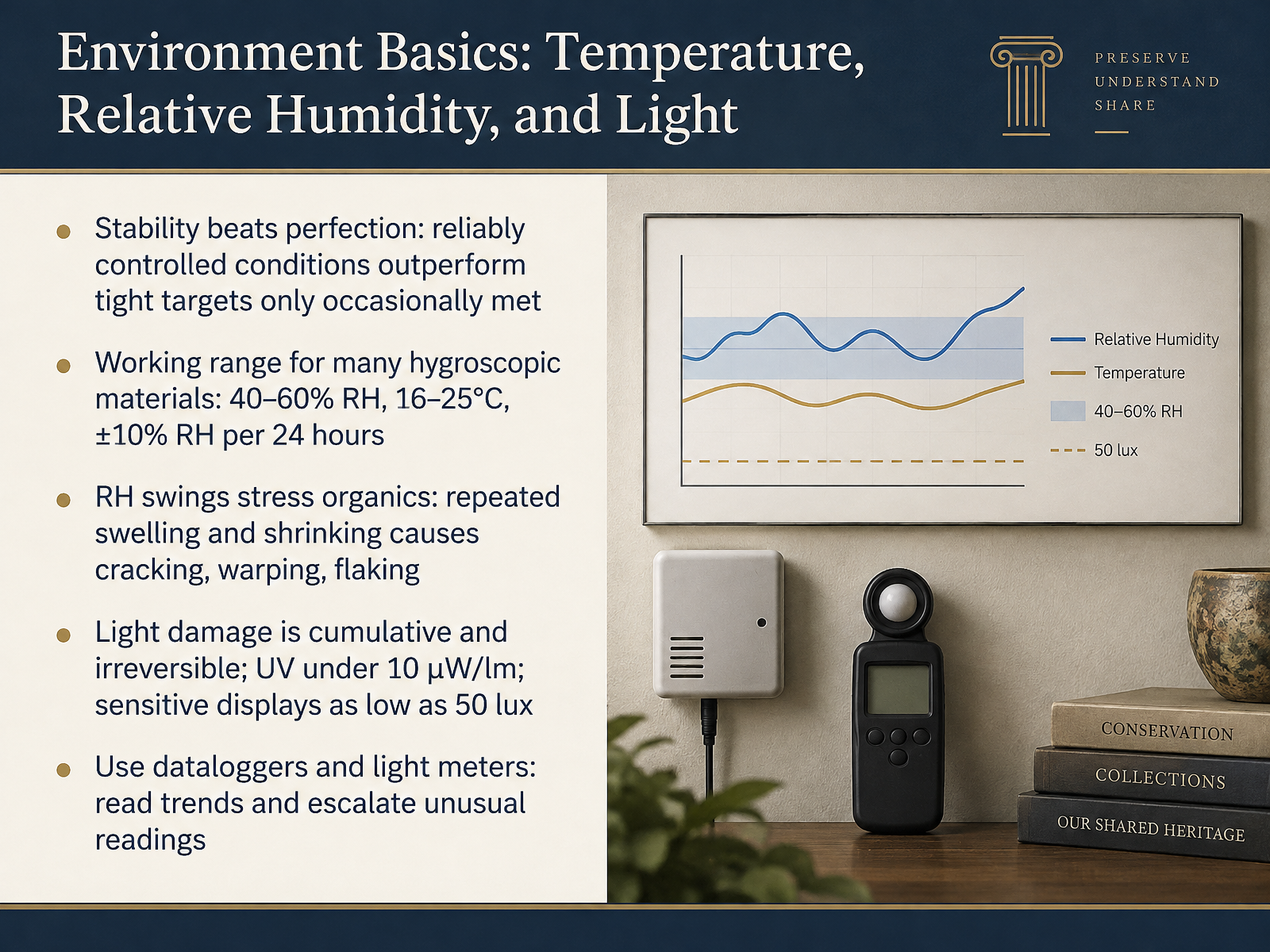
- 05Environment Basics: Temperature, Relative Humidity, and LightLet's look at the environment itself: temperature, relative humidity, and light. Here's the principle that matters most. Stability beats perfection. Conditions that are less tightly controlled but reliably maintained over time serve your collection better than exact targets met only some of the time. For many hygroscopic materials, meaning materials that absorb and release moisture, like canvas, textiles, and wood, a working range is forty to sixty percent relative humidity and sixteen to twenty-five degrees Celsius. Keep changes within plus or minus ten percent relative humidity per twenty-four hours. Why does that matter? Repeated swelling and shrinking stresses organics and causes cracking, warping, and flaking. Light damage is different. It is cumulative and irreversible, so it adds up with every exposure. Keep ultraviolet light under ten microwatts per lumen, and display sensitive pieces as low as fifty lux. Use dataloggers and light meters, watch the trends, and escalate unusual readings. Next, we turn to pollutants and material compatibility.
 publications.gc.canationalmuseums.org.ukies.org+22 min
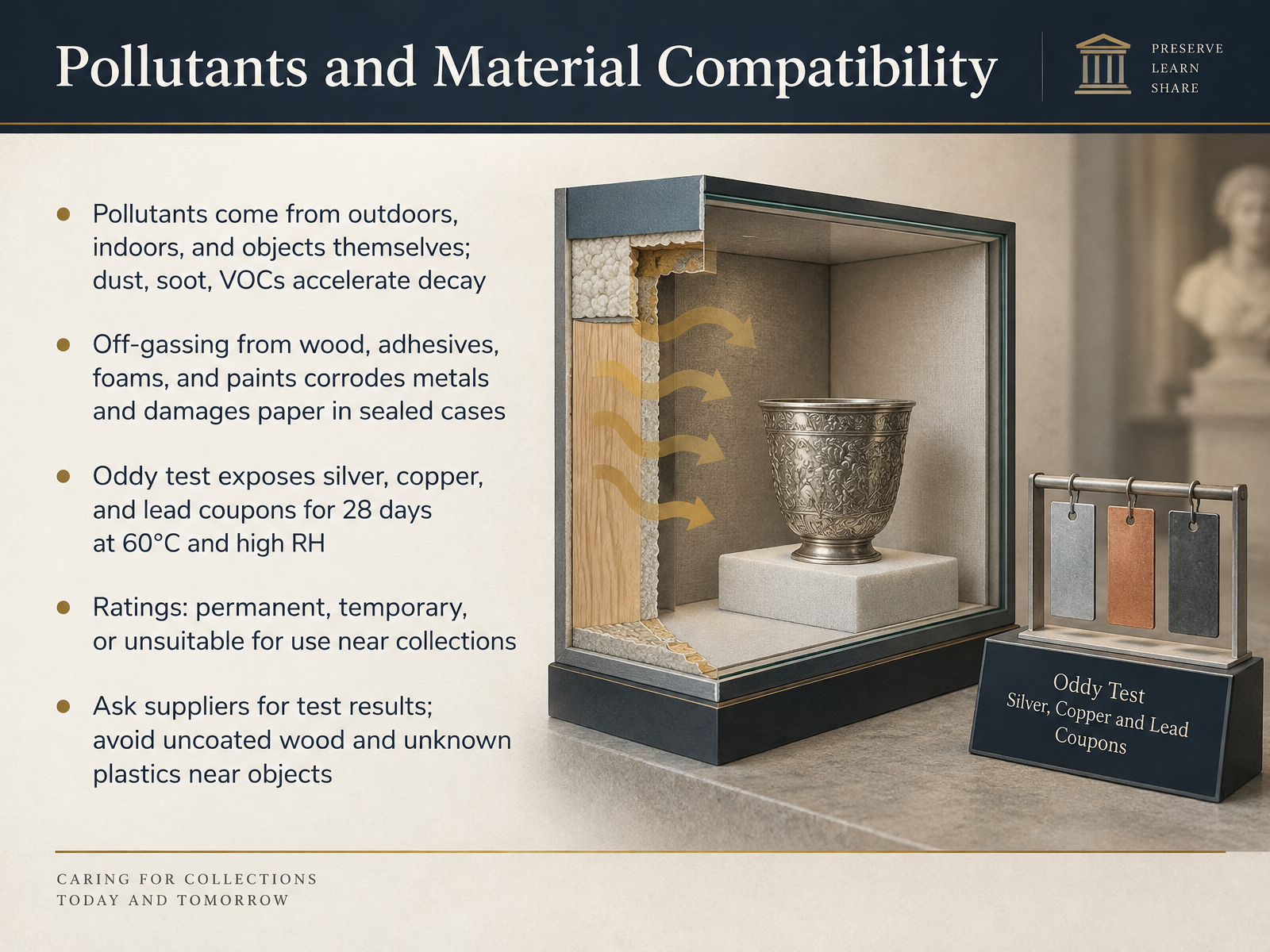
- 06Pollutants and Material CompatibilityNext, let's talk about pollutants and material compatibility. Pollutants come from outdoors, from indoors, and from the objects themselves. Dust and soot settle on surfaces, while volatile organic compounds, or VOCs, are gases that off-gas from materials and quietly accelerate decay. Wood, adhesives, foams, and paints release these gases. Inside a sealed case, they build up and can corrode metals or damage paper. So how do you check a material before it goes near your collection? The Oddy test exposes silver, copper, and lead coupons to the material for twenty-eight days at sixty degrees Celsius and high relative humidity. Results are rated permanent, temporary, or unsuitable for use near collections. Ask suppliers for test results, and keep uncoated wood and unknown plastics away from objects. Aim to control pollutants early, because prevention is far cheaper than treatment. That leads us into safe handling: planning, gloves, and supports.
 canada.cacanada.capublications.gc.ca+22 min
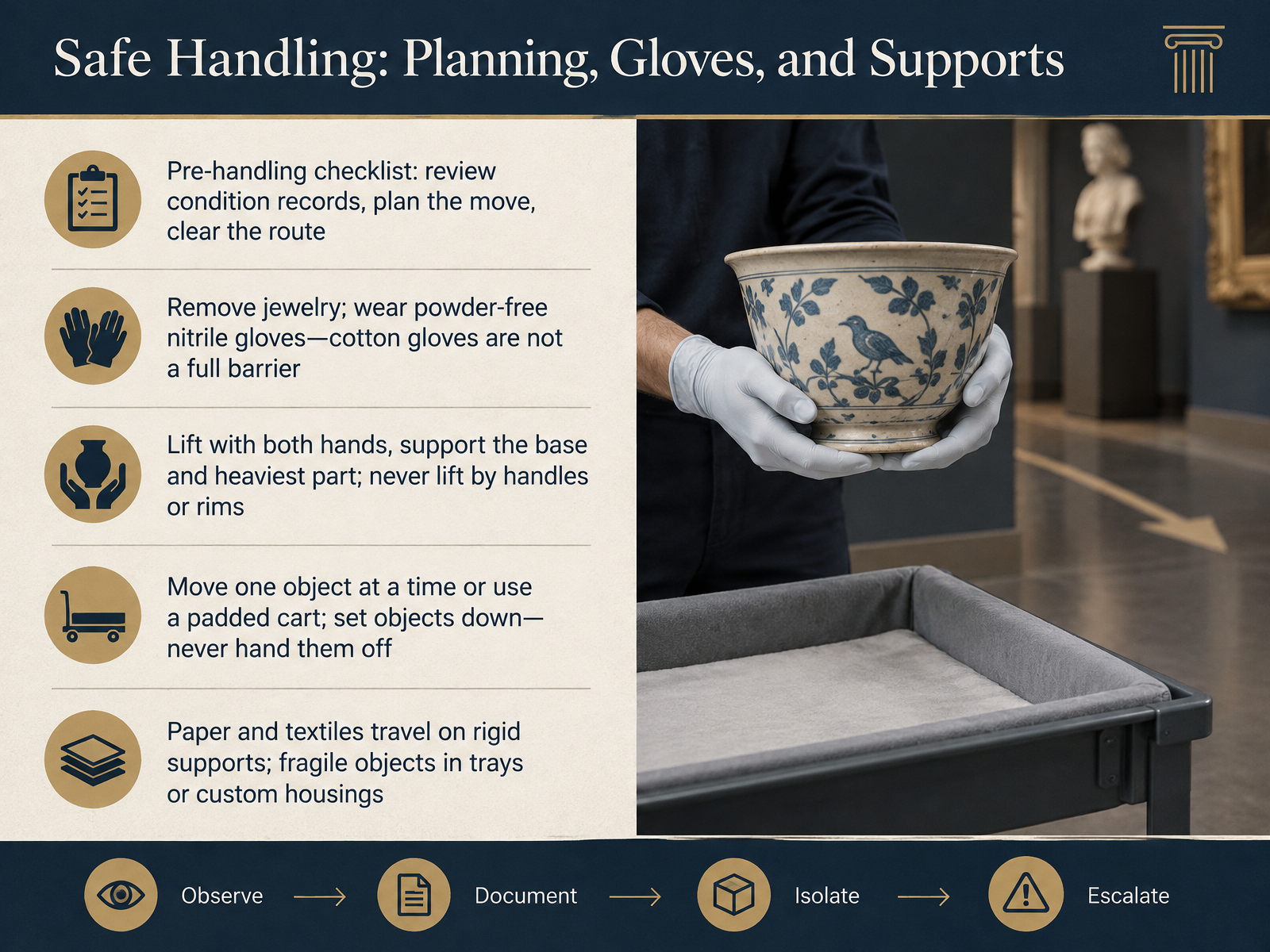
- 07Safe Handling: Planning, Gloves, and SupportsNow let's talk about safe handling, starting with planning. Before you touch an object, review its condition records, plan the move, and clear the route. Remove jewelry that could snag a surface. Wear powder-free nitrile gloves, because cotton gloves are not a full barrier against the oils on your skin. When you lift, use both hands and support the base and the heaviest part. Never lift by handles or rims, since those are often weak. Move one object at a time, or use a padded cart. Set objects down on a stable surface. Never hand an object directly to another person. Paper and textiles travel on rigid supports, and fragile objects go in trays or custom housings. Take a moment to picture each of those steps before your next move. That preparation is what protects both the object and you. Next, we look at storage and housekeeping that protect collections.
 2 min
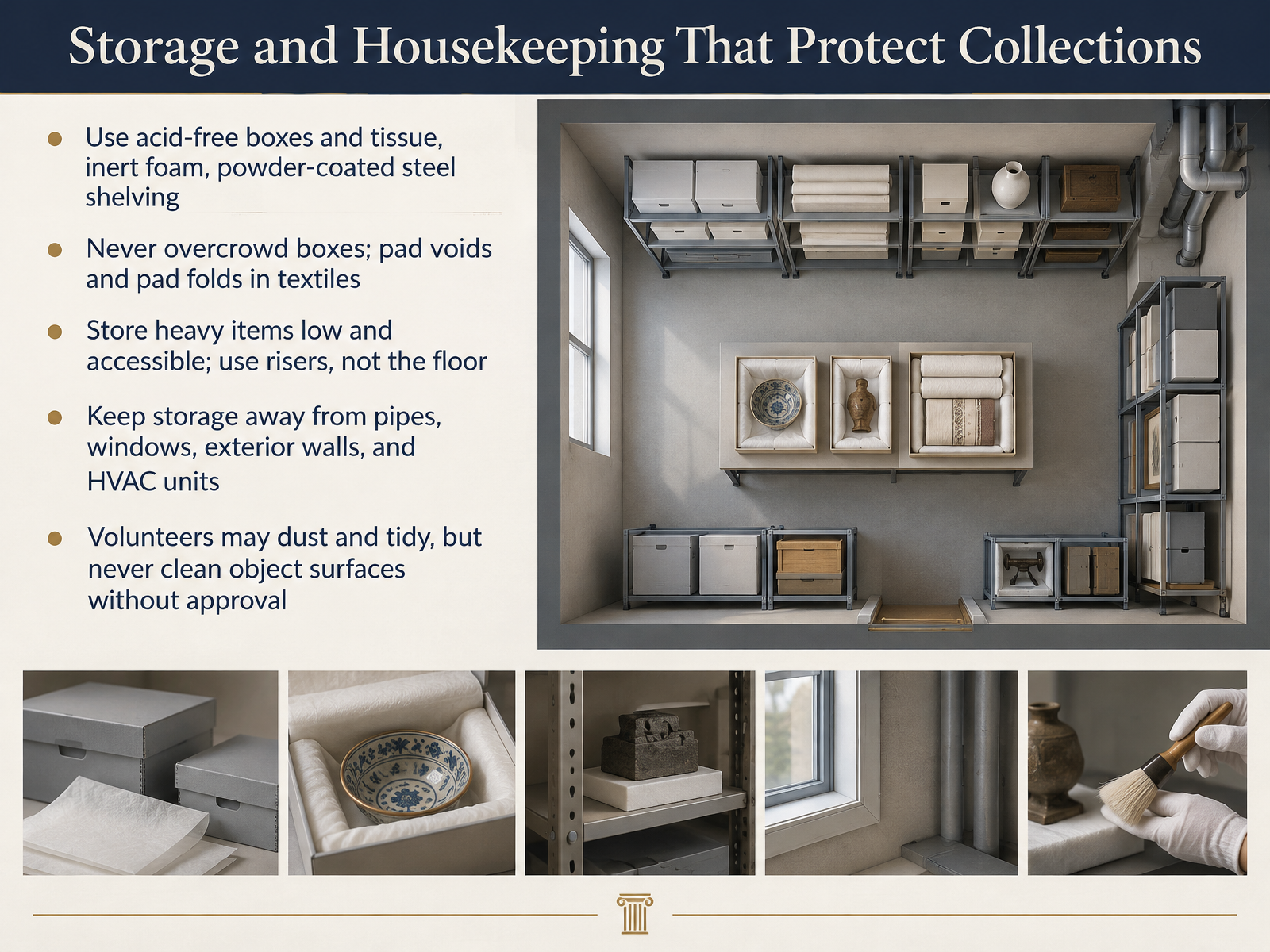
- 08Storage and Housekeeping That Protect CollectionsNext, let's look at how your storage space and housekeeping routines protect collections. Start with materials. Use acid-free boxes and tissue, materials formulated to resist the acids that yellow and embrittle paper and textiles over time. Choose inert foam, which means it won't off-gas or react with objects. And use powder-coated steel shelving rather than bare wood, which releases harmful vapors. Never overcrowd boxes. Pad empty voids with tissue so items can't shift and knock together, and pad the folds in textiles with rolled tissue to prevent creases setting in. Store heavy items low and within easy reach, ideally at waist height. Use risers instead of placing objects directly on the floor. Keep storage away from pipes, windows, exterior walls, and HVAC units, because leaks and temperature swings cause damage you may not notice for months. Volunteers can dust and tidy, but never clean an object's surface without approval, since the wrong cloth or solvent can remove original finish. Our next topic is condition reporting and documentation, where these observations become part of the object's record.
 2 min
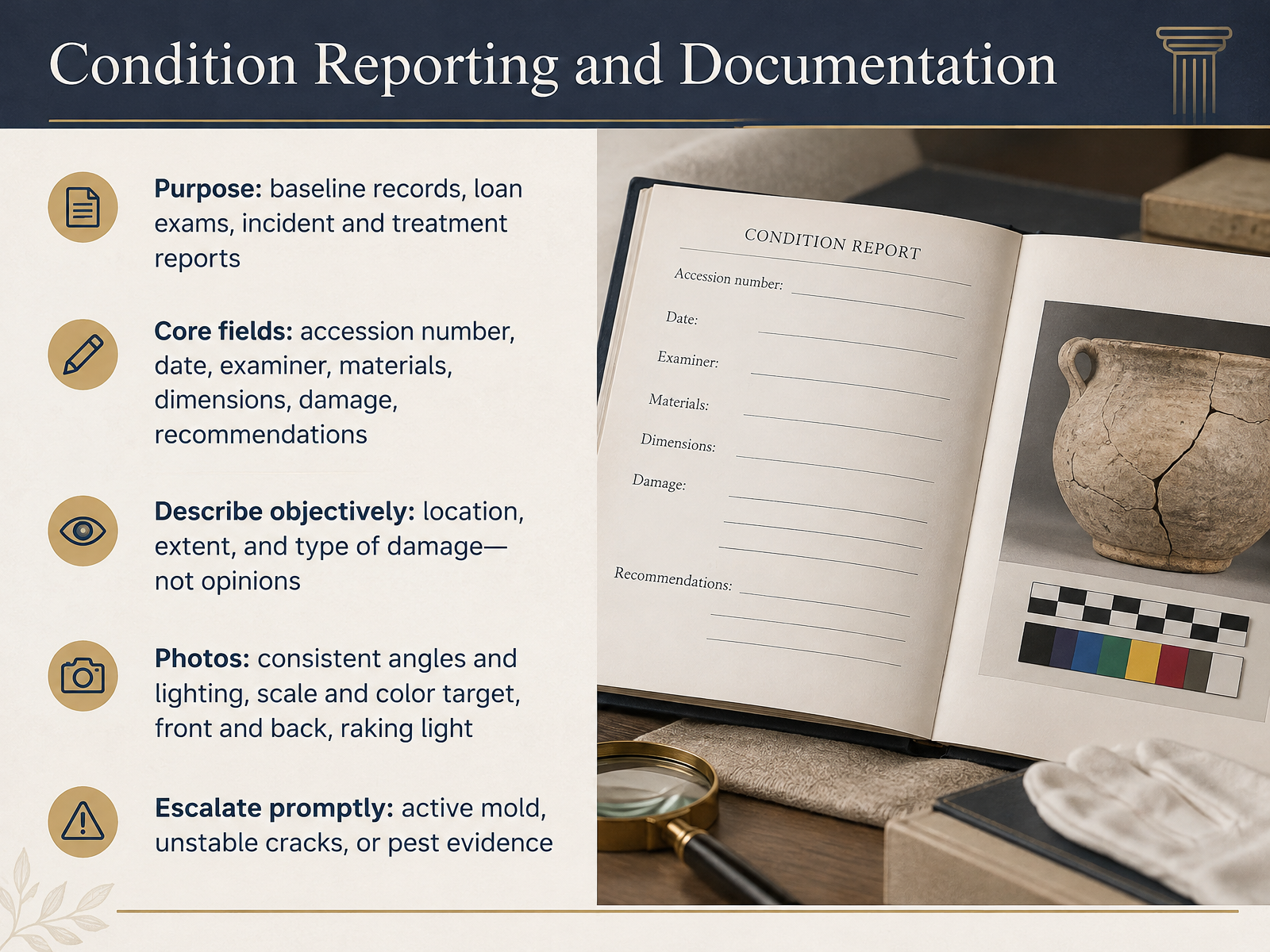
- 09Condition Reporting and DocumentationNow let's talk about condition reporting and documentation. A condition report is simply a written record of an object's state at a specific moment, so you can compare later and spot change. You need them for baseline records on new acquisitions, loan exams before and after travel, and incident or treatment reports. Every report carries the same core fields: accession number, date, examiner, materials, dimensions, damage, and recommendations. Describe what you see objectively. Name the location, extent, and type of damage, not your opinion of it. Say a three centimeter tear at the lower left corner, not that the piece looks bad. For photos, keep angles and lighting consistent, include a scale and color target, shoot front and back, and use raking light, which means light at a low angle, to reveal surface distortion. And escalate promptly if you see active mold, unstable cracks, or pest evidence. Next, we move to integrated pest management, where you prevent, monitor, and respond.
 2 min
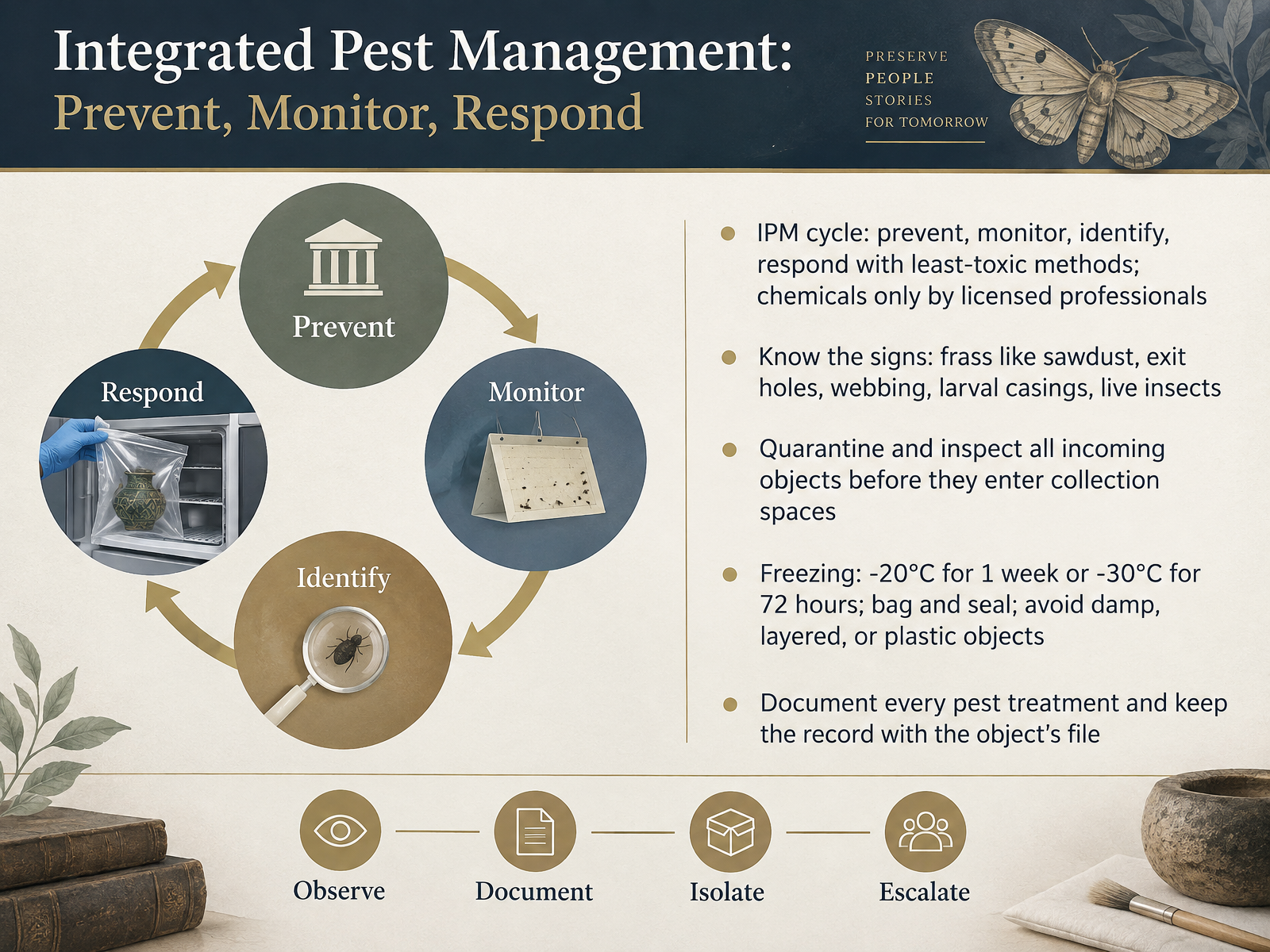
- 10Integrated Pest Management: Prevent, Monitor, RespondNext, let's look at integrated pest management, or IPM. Think of it as a cycle: prevent pests from getting in, monitor for signs, identify what you have, then respond with the least toxic method that works. Chemicals are handled only by licensed professionals.
Know the signs. Frass, which is insect excrement that looks like sawdust, exit holes, webbing, larval casings, and live insects. Quarantine and inspect every incoming object before it enters collection spaces.
Freezing is a common response. Use minus twenty degrees Celsius for one week, or minus thirty degrees Celsius for seventy two hours. Bag and seal the object first. Avoid freezing damp, layered, or plastic objects, which can crack or delaminate.
Finally, document every pest treatment and keep that record with the object's file. Next, we turn to emergency readiness: water, fire, and mold.
 2 min
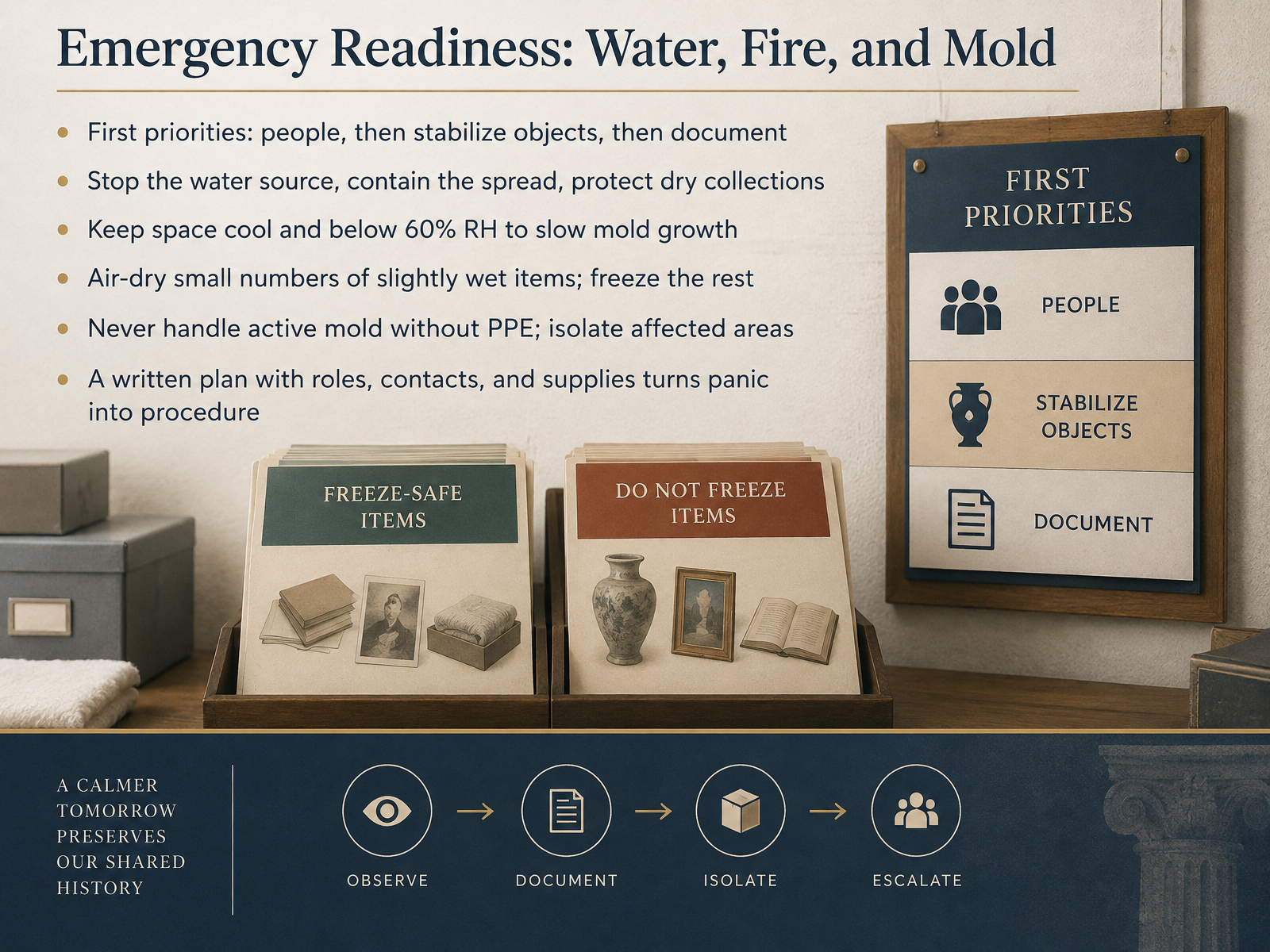
- 11Emergency Readiness: Water, Fire, and MoldNow let's talk about emergencies, because water, fire, and mold don't wait for a convenient moment. When something happens, your first priorities are people, then stabilizing objects, then documentation. Get everyone safe before you touch a single item. Next, stop the water source if you can, contain the spread with towels or flood socks, and protect collections that are still dry. Get the space cool and below sixty percent relative humidity to slow mold growth. Air-dry small numbers of slightly wet items, and freeze the rest if freezing is safe for those materials. Never handle active mold without personal protective equipment, and isolate affected areas. A written plan with roles, contacts, and supplies turns panic into procedure. That leads us to working with conservators, when to call, and how to prepare.
 1 min
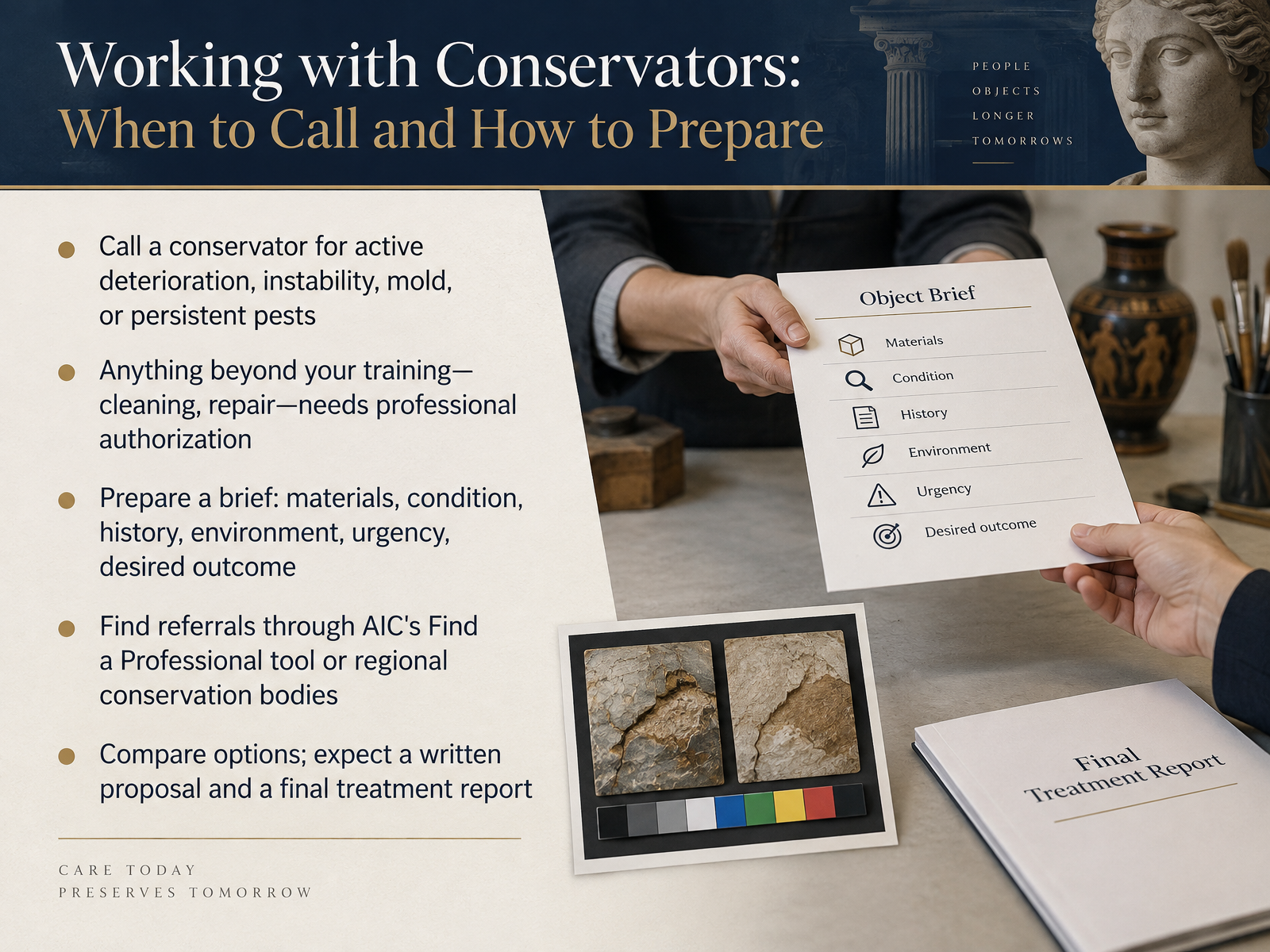
- 12Working with Conservators: When to Call and How to PrepareNow let's talk about when to call a conservator, and how to prepare. Call a conservator for active deterioration, instability, mold, or persistent pests. And anything beyond your training, such as cleaning or repair, needs professional authorization. For mold, protect yourself first, then isolate the object. To prepare, write a short brief covering materials, condition, history, environment, urgency, and your desired outcome. Find referrals through the American Institute for Conservation's Find a Professional tool, or through regional conservation bodies. Compare options. Expect a written proposal before treatment, and a final treatment report afterward. Next, we'll work through practical scenarios: putting it all together.
 culturalheritage.orgobs-traffic.museumblackburnconservation.com+22 min
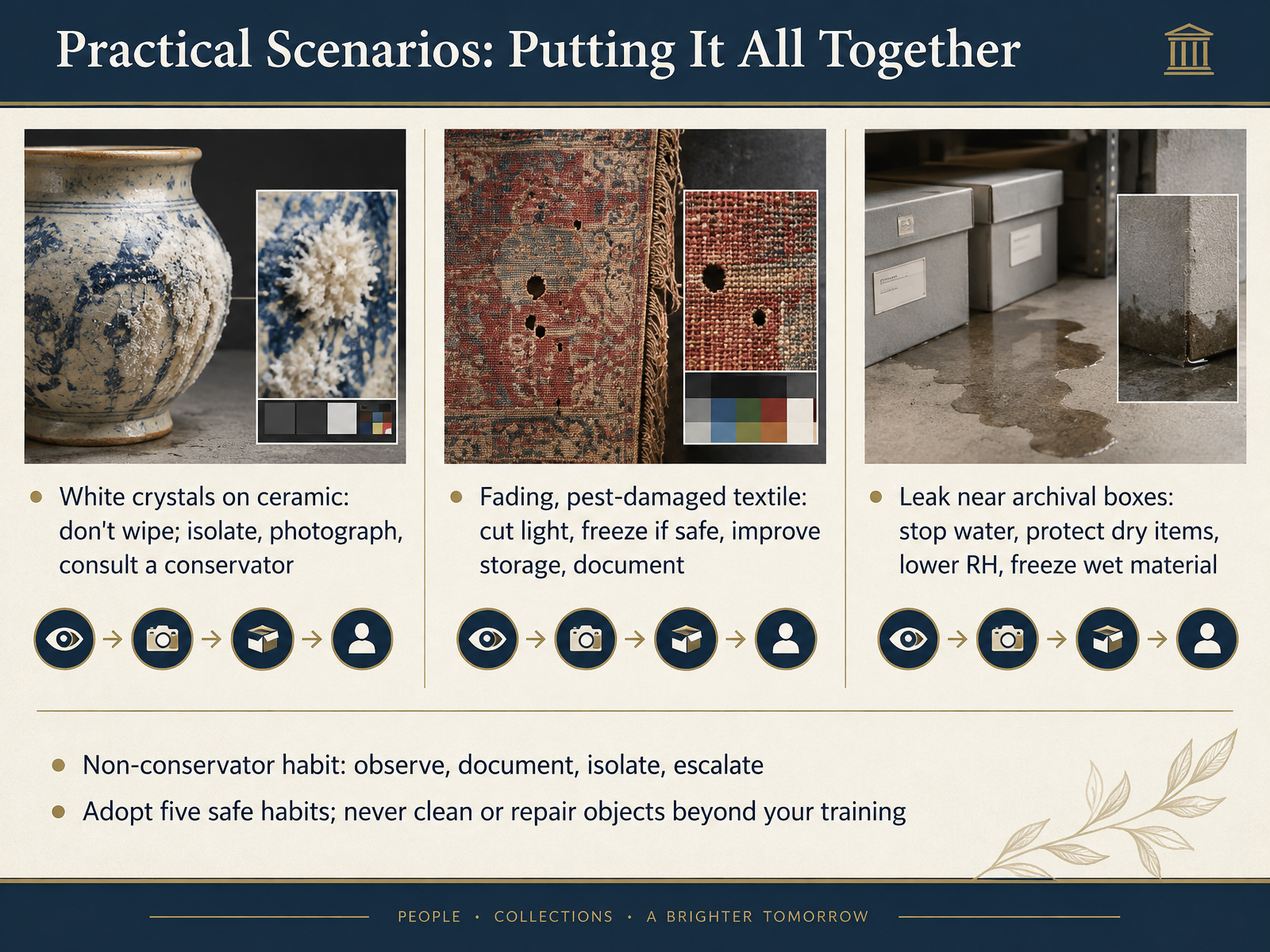
- 13Practical Scenarios: Putting It All TogetherLet's put these principles to work in real situations. Suppose you find white crystals on a ceramic. That can mean soluble salts are migrating to the surface. Do not wipe them away. Isolate the object, photograph it, and consult a conservator. For a fading, pest-damaged textile, cut the light, freeze it only if that material is safe to freeze, improve storage, and document everything. If a leak reaches your archival boxes, stop the water first, protect the dry items, lower the relative humidity, and freeze wet material where safe. If you are not a conservator, your habit is simple: observe, document, isolate, escalate. Adopt five safe habits, and never clean or repair objects beyond your training. Next, we move to Assessment and Your Next 30 Days.
 icom-cc.orgicom-cc.orgiccrom.org+22 min
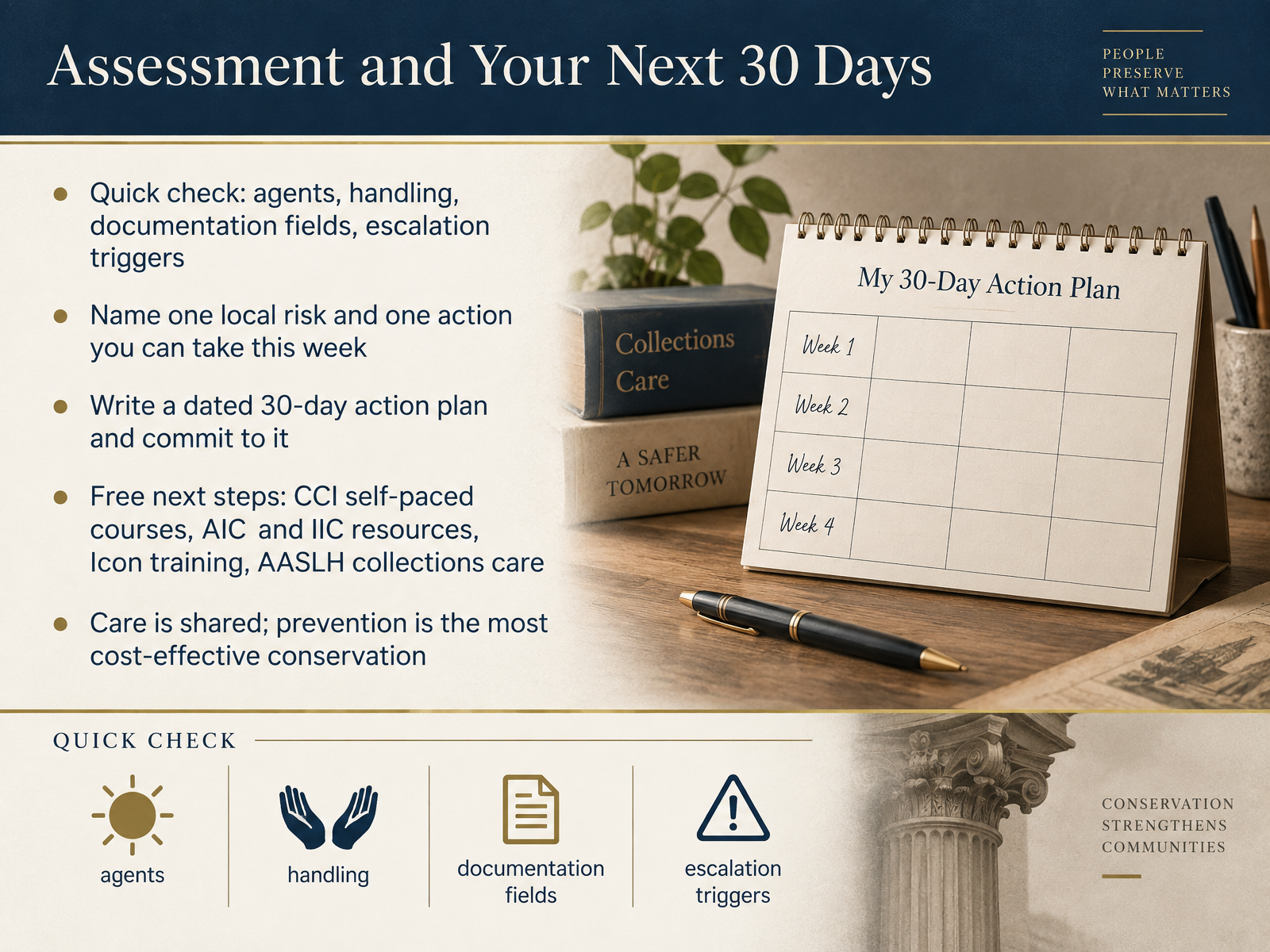
- 14Assessment and Your Next 30 DaysLet's close with a quick check and a plan you can actually keep. Ask yourself four things: which agents of deterioration affect your space, how confident is your handling, which documentation fields are missing, and when do you call in a conservator. Then name one local risk and one action you can take this week. A leaking downpipe, for example, and a scheduled roof inspection. Now write a dated thirty-day action plan, and commit to it in writing. Free next steps include the Canadian Conservation Institute's self-paced courses, resources from the American Institute for Conservation and the International Institute for Conservation, Icon training, and AASLH collections care. Care is shared, and prevention remains the most cost-effective conservation. Thank you for your attention and your good work. You now have enough to start, so pick one action today and begin.
 canada.cacanada.capublications.gc.ca+22 min
Take the deck with you
Download this course as a file — free, no sign-up needed.
- PDF handoutEvery slide page, ready to print or share.15 pages · 4.6 MBDownload
- Narrated PowerPointThe deck that presents itself — every slide carries the digital human's narration video.15 pages · 14.7 MBDownload
- PowerPoint slidesThe full deck as a .pptx — open it in PowerPoint, Keynote, or Google Slides.15 pages · 4.5 MBDownload
Free to use in your own training — please keep the PersonWise credit page at the end.
Have your own deck? Turn it into a course
Sources consulted
Web sources consulted while building this course.
- ICOM-CC | Terminology for conservation (2008) — icom-cc.org
- ICOM-CC Resolution on Terminology English — icom-cc.org
- ICOM-CC Resolution on Terminology English — iccrom.org
- ICOM-CC Resolution on Terminology Commentary — icom-cc.org
- Terminology to characterize the conservation of tangible cultural heritage — cz-museums.cz
- Code of Ethics and Guidelines for Practice - American Institute for Conservation — culturalheritage.org
- AIC CODE OF ETHICS AND GUIDELINES FOR PRACTICE — obs-traffic.museum
- OUR CODE OF ETHICS — blackburnconservation.com
- APPENDIX C: CODES OF ETHICS — doi.gov
- DEPARTMENTAL MANUAL — doi.gov
- Agents of deterioration - Canada.ca — canada.ca
- Framework for Preserving Heritage Collections: Strategies for Avoiding or Reducing Damage - Canada.ca — canada.ca
- Agents of deterioration.: CH57-4/11-2020E-PDF - Government of Canada Publications - Canada.ca — publications.gc.ca
- Preventive conservation guidelines for collections - Canada.ca — canada.ca
- Agents of deterioration — en.wikipedia.org
- Climate guidelines.: CH57-4/83-2025E-PDF - Government of Canada Publications - Canada.ca — publications.gc.ca
- Environmental Sustainability - Reducing Museums' Carbon Footprint - National Museum Directors' Council Website — nationalmuseums.org.uk
- Recommended Practice: Lighting Museums — ies.org
- Bizot Green Protocol - Handbook 1 - Adopting the Bizot Green Guidelines — nationalmuseums.org.uk
- 2.1 Temperature, Relative Humidity, Light, and Air Quality: Basic Guidelines for Preservation — NEDCC — nedcc.org