Begin
14 pages · ~28 min
Time Zones and the International Date Line
This training explains how time zones and the International Date Line work, helping global teams schedule across regions and avoid date and time confusion.
A digital instructor presents all 14 pages. Hold “Ask” at any point and ask out loud — the answer comes from this course. No sign-up needed.
What you’ll learn
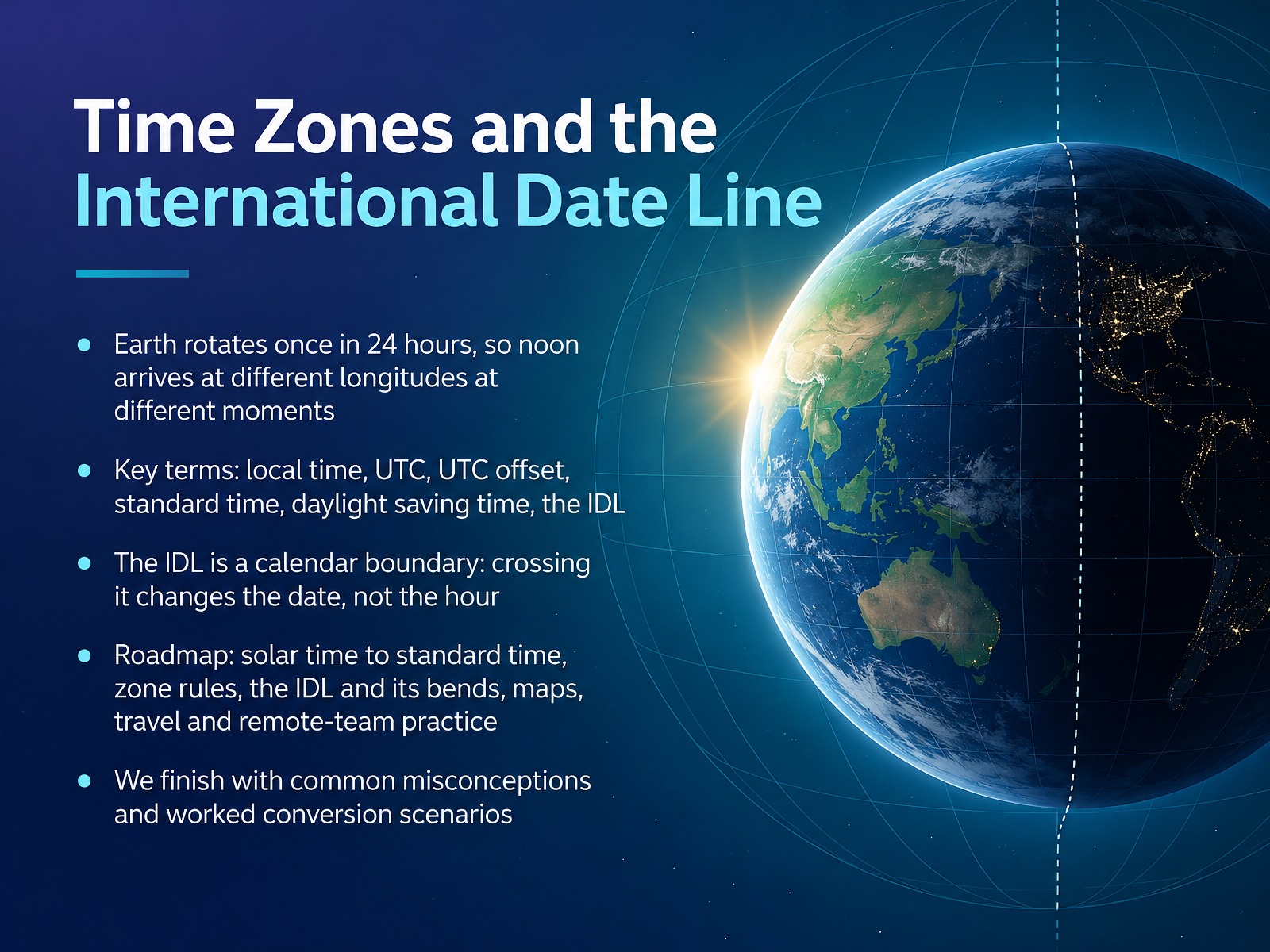
- 01Time Zones and the International Date LineWelcome. I'm glad you're here. Today we're exploring time zones and the International Date Line, a topic that matters whether you're a student, a traveler, or part of a remote team. Here's the big idea. Earth turns once every twenty four hours. So noon arrives at different longitudes at different moments. We'll define a few key terms: local time, U T C, U T C offset, standard time, daylight saving time, and the I D L, short for International Date Line. Think of the date line as a calendar boundary. Crossing it changes the date, not the hour. For example, you can cross it and stay at the same clock time, but the day shifts. Here's our roadmap. We start with solar time and how it became standard time. Then we look at zone rules, the date line and its bends, and how to read time zone maps. We finish with practical tips for travel and remote team scheduling, plus common misconceptions and worked conversion scenarios. Let's begin with how solar time became standard time.en.wikipedia.orgoceanservice.noaa.govsimplemaplab.com+22 min
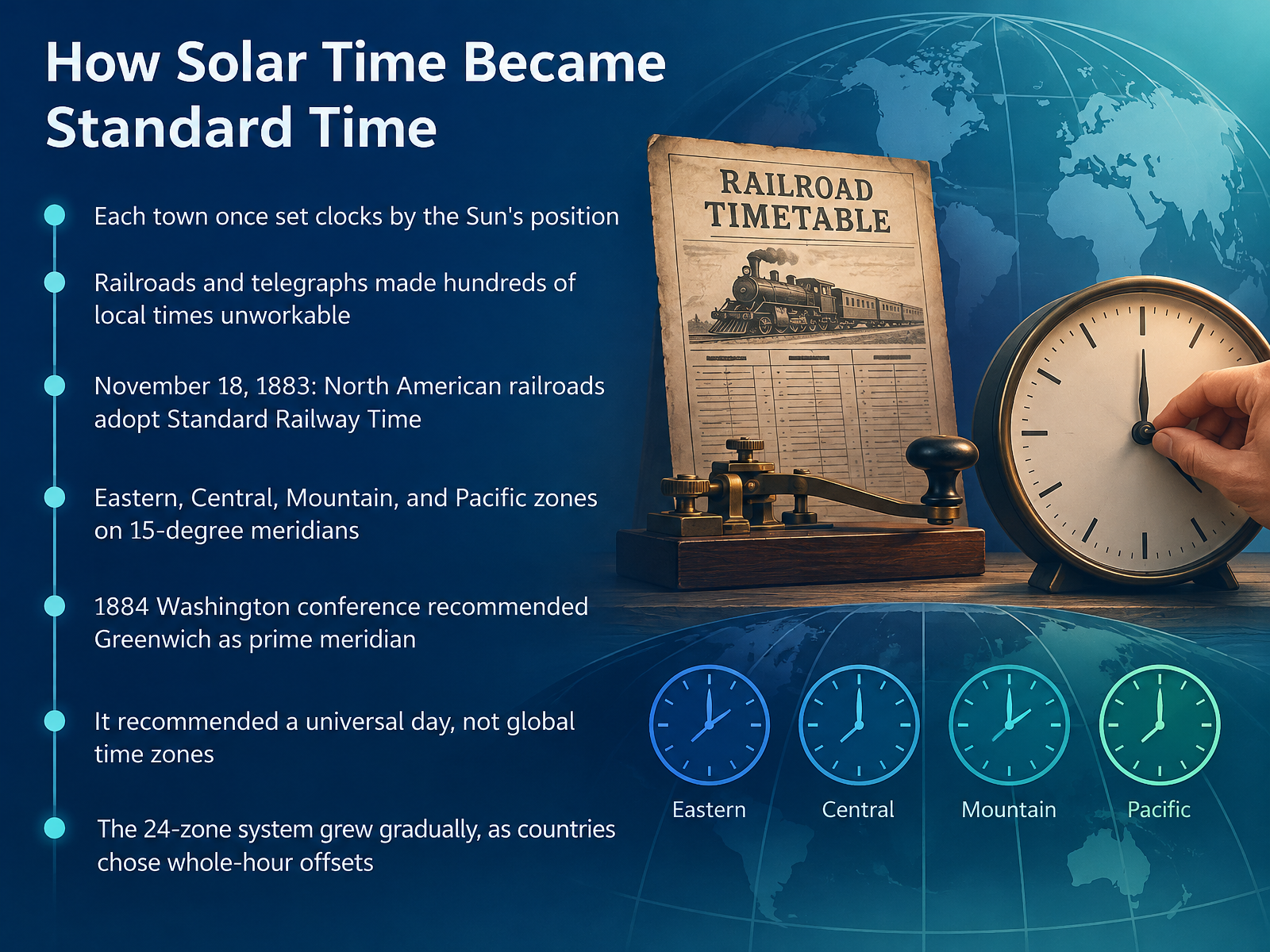
- 02How Solar Time Became Standard TimeLet's look at how solar time became standard time. Before the late eighteen hundreds, each town set its clocks by the Sun's position. Noon meant the moment the Sun was highest in that particular place. This worked locally, but it created hundreds of slightly different local times. Then railroads and telegraphs connected distant cities. A train schedule with hundreds of local times became unworkable. So on November eighteenth, eighteen eighty-three, North American railroads adopted Standard Railway Time. They created four zones, Eastern, Central, Mountain, and Pacific, spaced along fifteen-degree meridians. A fifteen-degree change in longitude equals one hour of solar time. In eighteen eighty-four, the Washington conference recommended Greenwich as the prime meridian and proposed a universal day. Importantly, it did not create global time zones. The twenty-four-zone system grew gradually, as countries chose whole-hour offsets. That gradual choice still shapes how we schedule calls and flights today. Next, we will look at reading those offsets: UTC, GMT, and unusual halves.
 gutenberg.orgen.wikipedia.orgsecjhuapl.edu+22 min
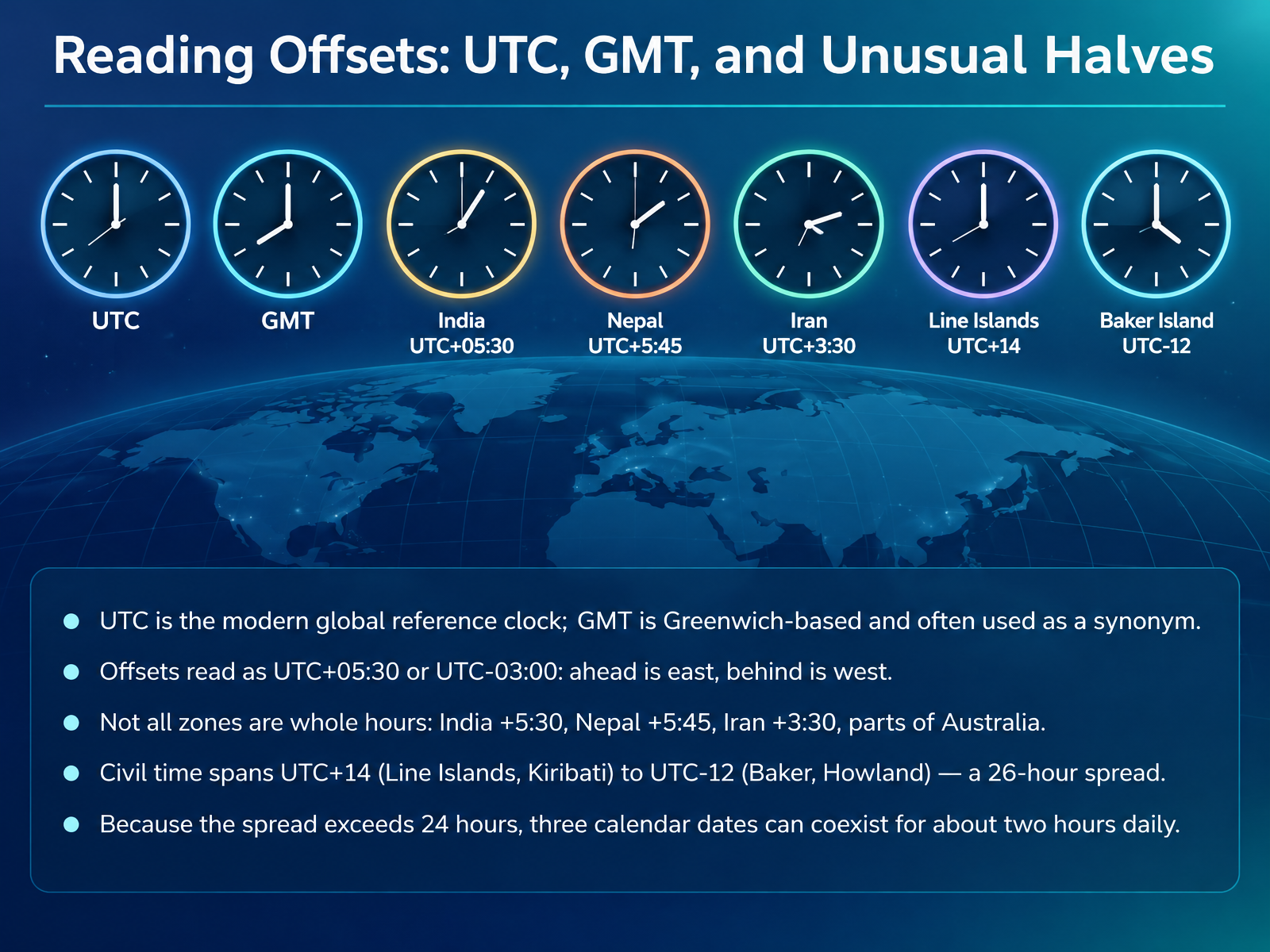
- 03Reading Offsets: UTC, GMT, and Unusual HalvesNow let's look at how we actually read those time offsets. The modern global reference clock is Coordinated Universal Time, usually written as U T C. You may also see G M T, which stands for Greenwich Mean Time. G M T is based on the prime meridian at Greenwich, and it is often used as a synonym for U T C, though U T C is the more precise standard today. Offsets are written like U T C plus five thirty, or U T C minus three. If the offset is ahead of U T C, the location is east. If it is behind, the location is west. Here is something many people find surprising. Not every time zone is a whole hour. India uses U T C plus five thirty. Nepal uses U T C plus five forty five. Iran uses U T C plus three thirty. And parts of Australia also use half-hour offsets. Now think about the full range. Civil time stretches from U T C plus fourteen in the Line Islands of Kiribati to U T C minus twelve at Baker and Howland Islands. That is a twenty-six-hour spread. Because that spread is wider than twenty-four hours, three different calendar dates can exist at the same time for about two hours each day. Next, we will see why time zones are legal choices, not just geographic ones.
 en.wikipedia.orgoceanservice.noaa.govsimplemaplab.com+22 min
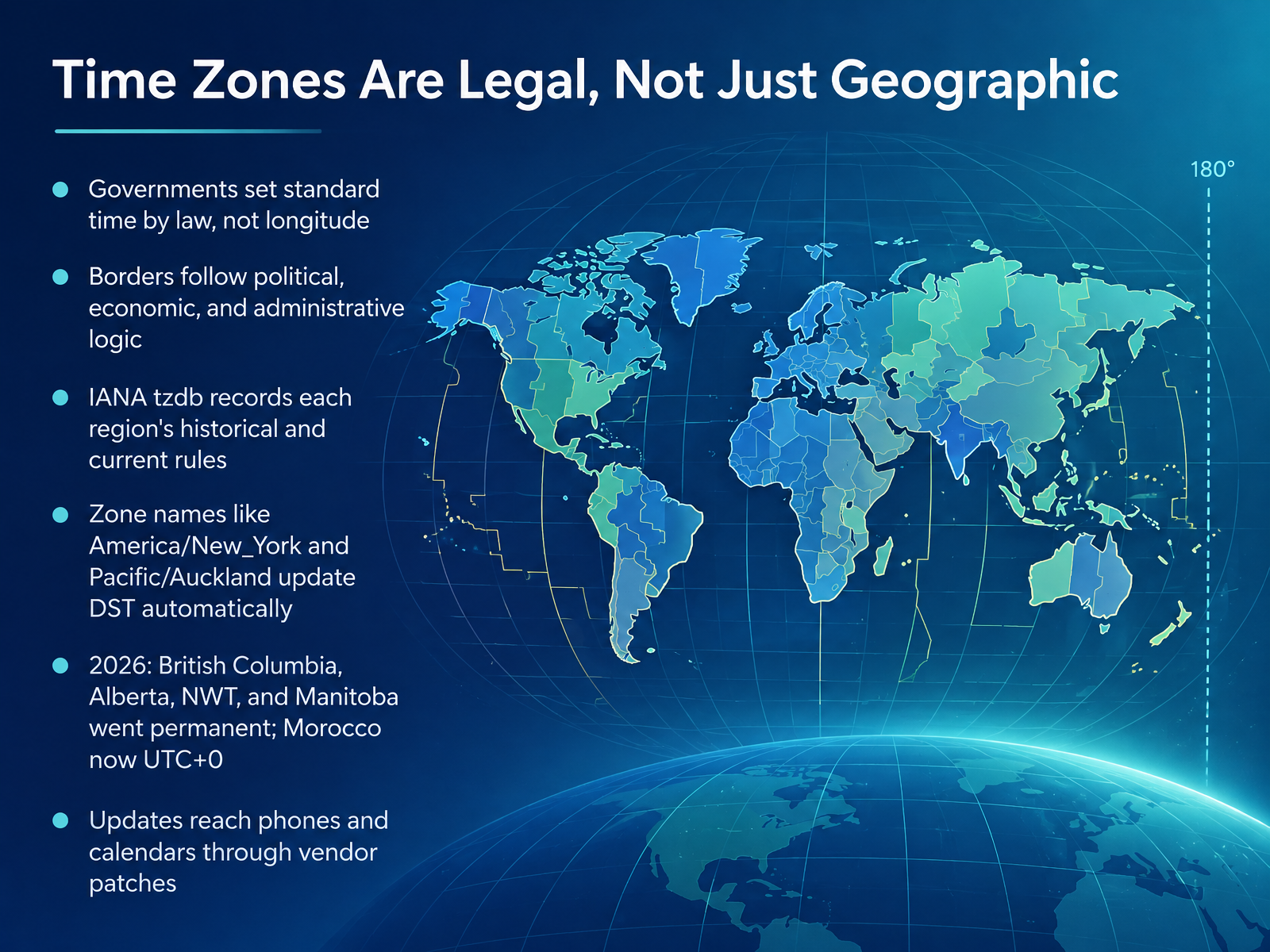
- 04Time Zones Are Legal, Not Just GeographicNow let's look at why time zones shift. Time zones are legal, not just geographic. Governments set standard time by law. So the lines on a map often follow political and economic borders, not longitude. For example, a country may choose one offset so that business hours line up with a key trading partner. One global reference records these rules. It is called the IANA time zone database. It tracks each region's historical and current rules, including daylight saving changes. Zone names keep this organized. Names like America slash New York and Pacific slash Auckland update daylight saving time automatically. In 2026, several places made permanent changes. British Columbia, Alberta, and the Northwest Territories moved to permanent offsets. Manitoba also moved to permanent time, and Morocco now uses Coordinated Universal Time plus zero. How do these updates reach you? Through vendor patches on your phone, computer, and calendar apps. Here is the practical takeaway. When you schedule a call or book a flight, check the current rules, because laws can change and your device may need an update. Next, we'll see how daylight saving time works and where it can trip us up: Daylight Saving Time and Its Traps.
 iana.orgiana.orgiana.org+22 min
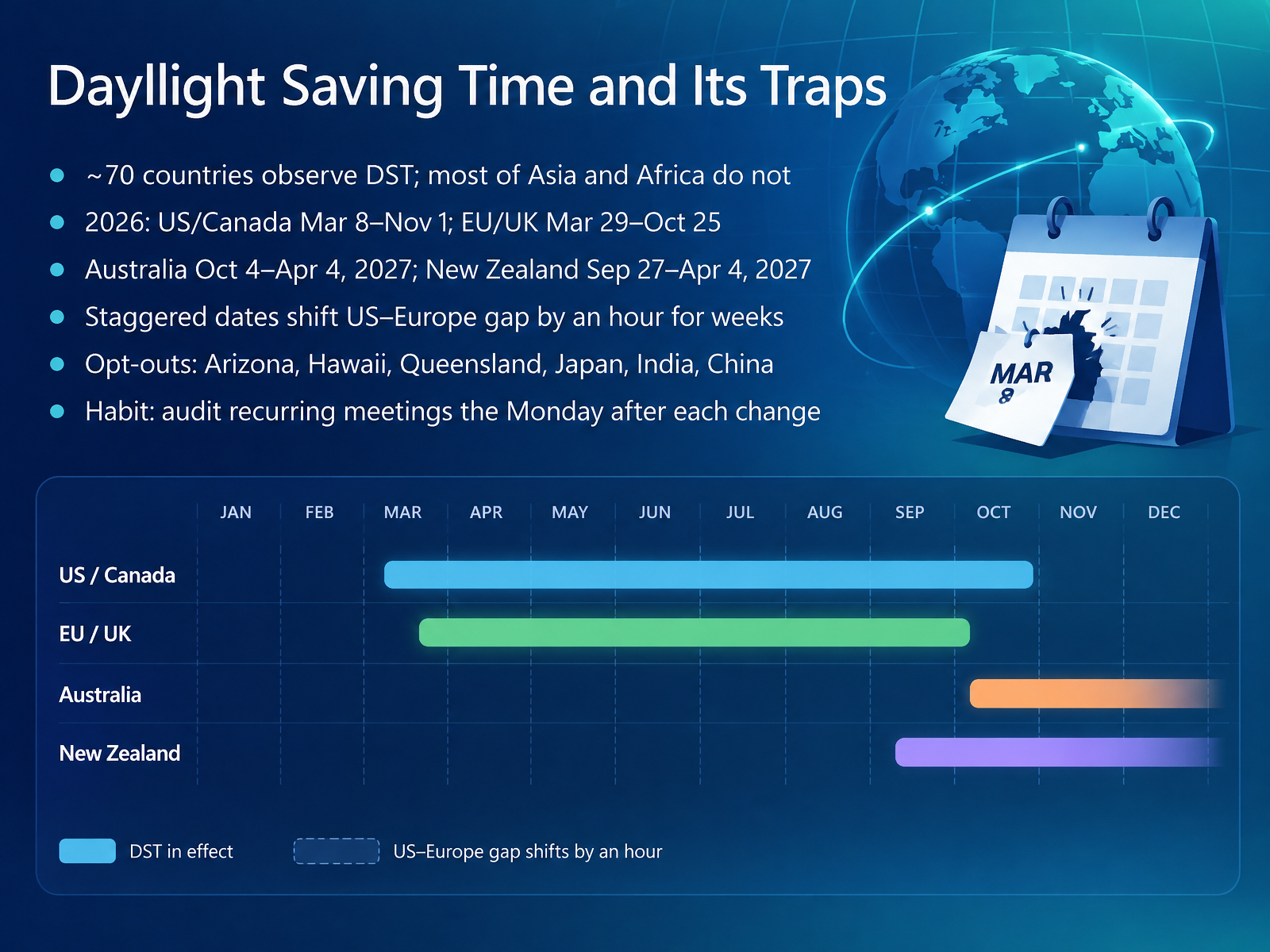
- 05Daylight Saving Time and Its TrapsNow let's look at daylight saving time, and the traps it sets. Daylight saving time, or D S T, shifts clocks forward in spring and back in autumn. About seventy countries observe it. Most of Asia and Africa do not. And here is where things get tricky. The dates are not the same everywhere. In twenty twenty-six, the United States and Canada change on March eighth and November first. The European Union and the United Kingdom change on March twenty-ninth and October twenty-fifth. Australia follows October fourth to April fourth, and New Zealand follows September twenty-seventh to April fourth, both in twenty twenty-seven. Because these dates are staggered, the gap between the United States and Europe shifts by one hour for several weeks. A nine in the morning call in New York that worked last week may land an hour differently in London today. And some places opt out entirely. Arizona, Hawaii, Queensland, Japan, India, and China stay on one time all year. So here is a simple habit. The Monday after each clock change, audit your recurring meetings. Check that every invite still shows the right local time for everyone. Up next, we look at what the International Date Line is.
 boxtool.appskdul.aiworld-clock.app+22 min
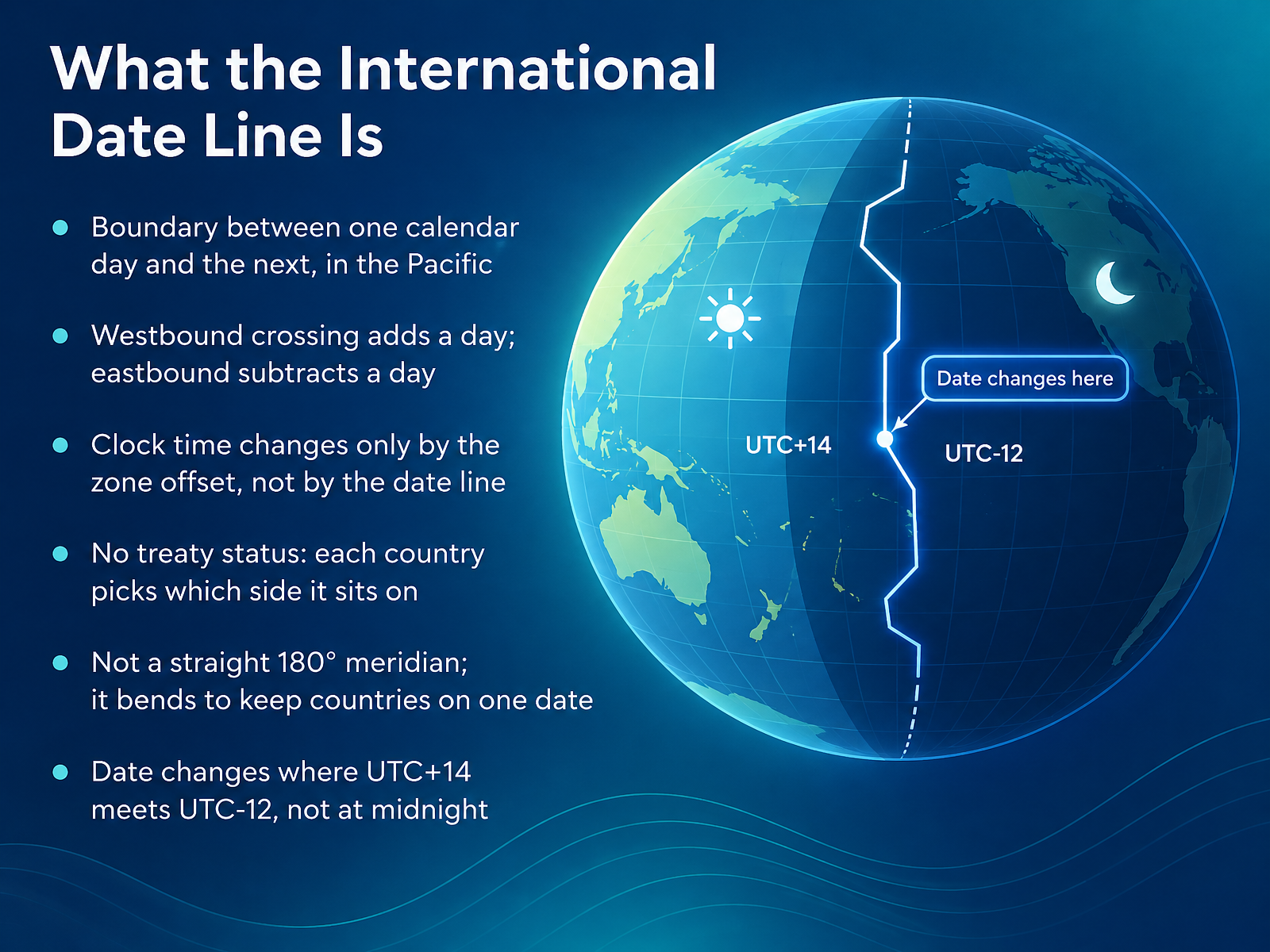
- 06What the International Date Line IsNow let's define the International Date Line itself. It is the boundary between one calendar day and the next, and it runs through the Pacific Ocean. Here is the key rule. When you cross it heading west, you add a day. When you cross it heading east, you subtract a day. For example, a flight from Los Angeles to Tokyo leaves on a Monday and lands on a Wednesday. One important detail: your clock time only changes by the time zone offset, not by the date line itself. The date line is not a treaty. There is no international law that fixes it. Each country simply chooses which side it sits on. That is why it is not a straight line at one hundred eighty degrees. It bends so that countries and island groups stay on a single date. And the date does not change at midnight. It changes where the earliest time zone, UTC plus fourteen, meets the latest, UTC minus twelve. Next, we will look at why the date line zigzags.
 en.wikipedia.orgoceanservice.noaa.govsimplemaplab.com+22 min
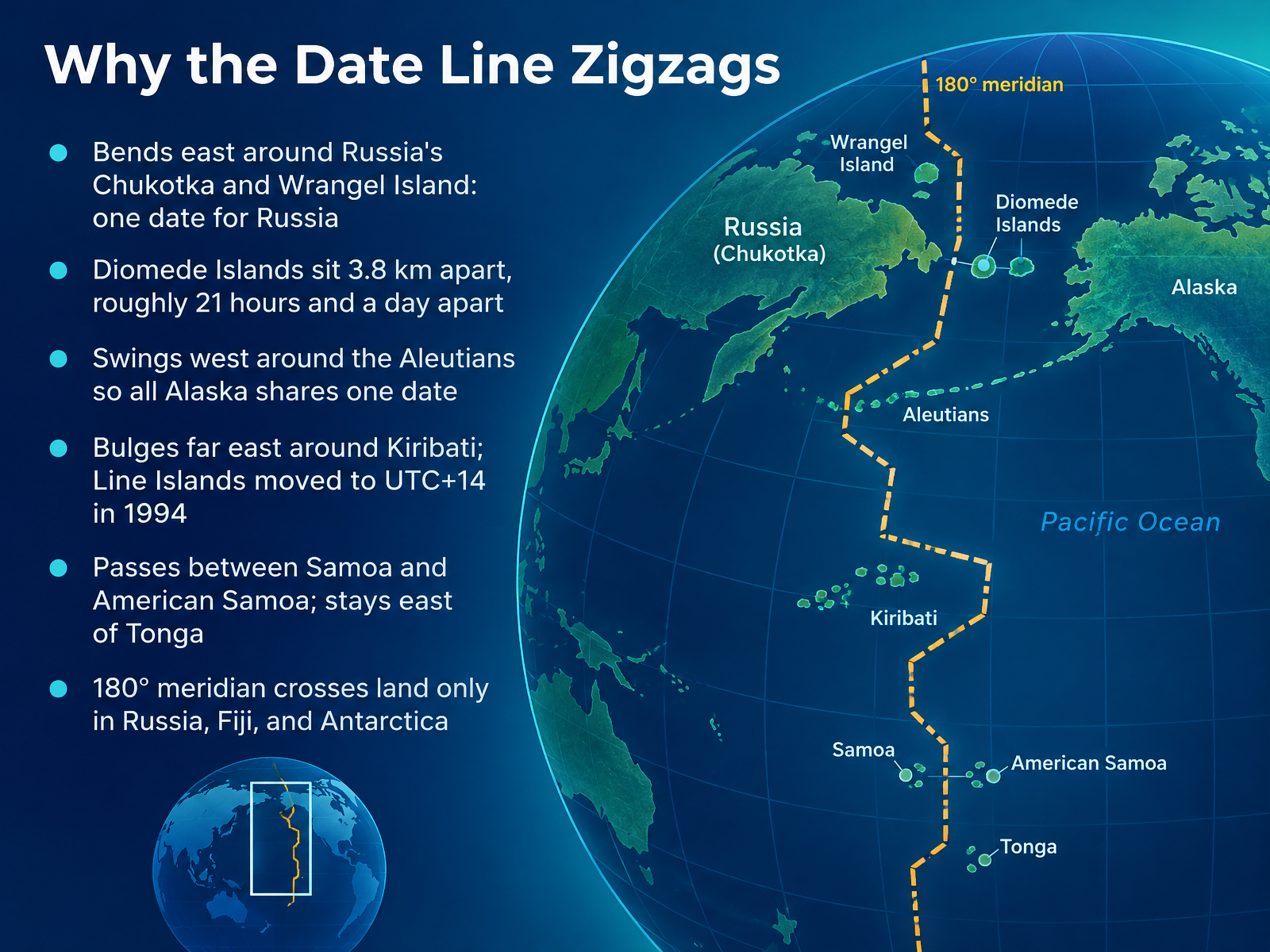
- 07Why the Date Line ZigzagsNow let's look closer at that wavy shape. Why does the date line zigzag? The short answer is that a straight line down the 180 degree meridian would split countries and island chains across two different calendar days. So the line bends to keep each place on a single date. Here is a clear example. In the Bering Strait, the line bends east around Russia's Chukotka region and Wrangel Island, so all of Russia shares one date. Right there, the Diomede Islands sit only three point eight kilometers apart, yet they are roughly twenty one hours and a full day apart. Farther south, the line swings west around the Aleutian Islands, so all of Alaska stays on the same date as the rest of the United States. Then it bulges far east around Kiribati. In 1994, the Line Islands moved to UTC plus fourteen, the earliest time zone on Earth. The line also passes between Samoa and American Samoa, and it stays east of Tonga. One more detail. The 180 degree meridian crosses land only in Russia, Fiji, and Antarctica. Every other country is reached by a bend, not by the geographic line. So the zigzag is not random. It is a practical solution that keeps neighbors on the same calendar day. Next, we will explore how and why countries redrew the line over time, in When Countries Redrew the Line.
 en.wikipedia.orgoceanservice.noaa.govsimplemaplab.com+22 min
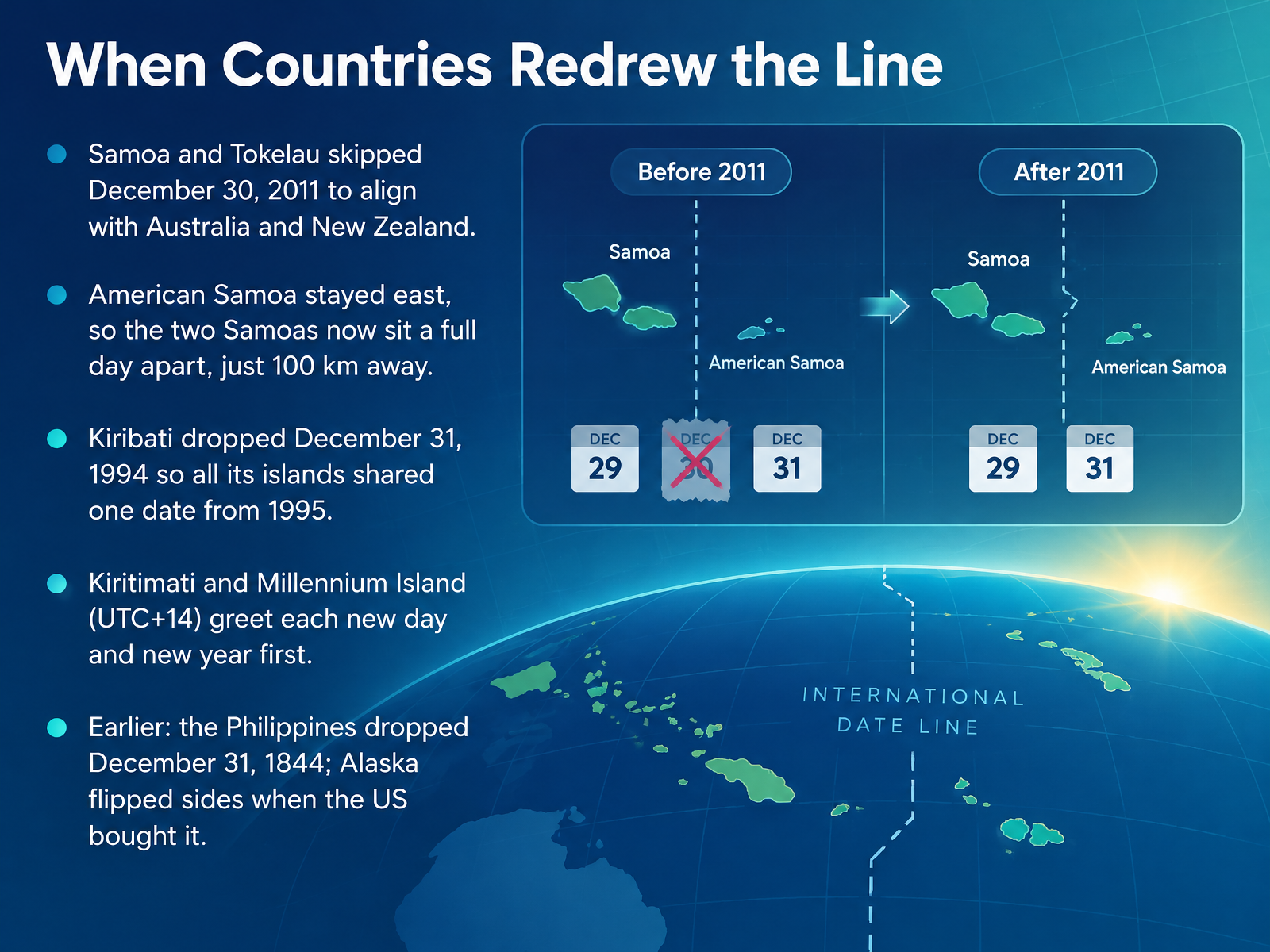
- 08When Countries Redrew the LineLet us look at how countries have redrawn the date line over time. When a straight line would split a country into two different dates, governments often move it. In 2011, Samoa and Tokelau skipped December 30 entirely, jumping from December 29 straight to December 31 to align with Australia and New Zealand. American Samoa stayed on the east side, so today the two Samoas are a full day apart, even though they are only about 100 kilometers away. Kiribati made a similar move in 1994, dropping December 31 so all its islands shared one date from 1995. Its Kiritimati and Millennium Island now sit at UTC plus 14, greeting each new day and each new year first. Earlier examples include the Philippines, which dropped December 31 in 1844, and Alaska, which flipped sides when the United States bought it. The lesson is simple: the date line bends for practical reasons, trade, family, and shared working days. Next, we will see how to read all of this on a world time zone map.
 en.wikipedia.orgoceanservice.noaa.govsimplemaplab.com+21 min
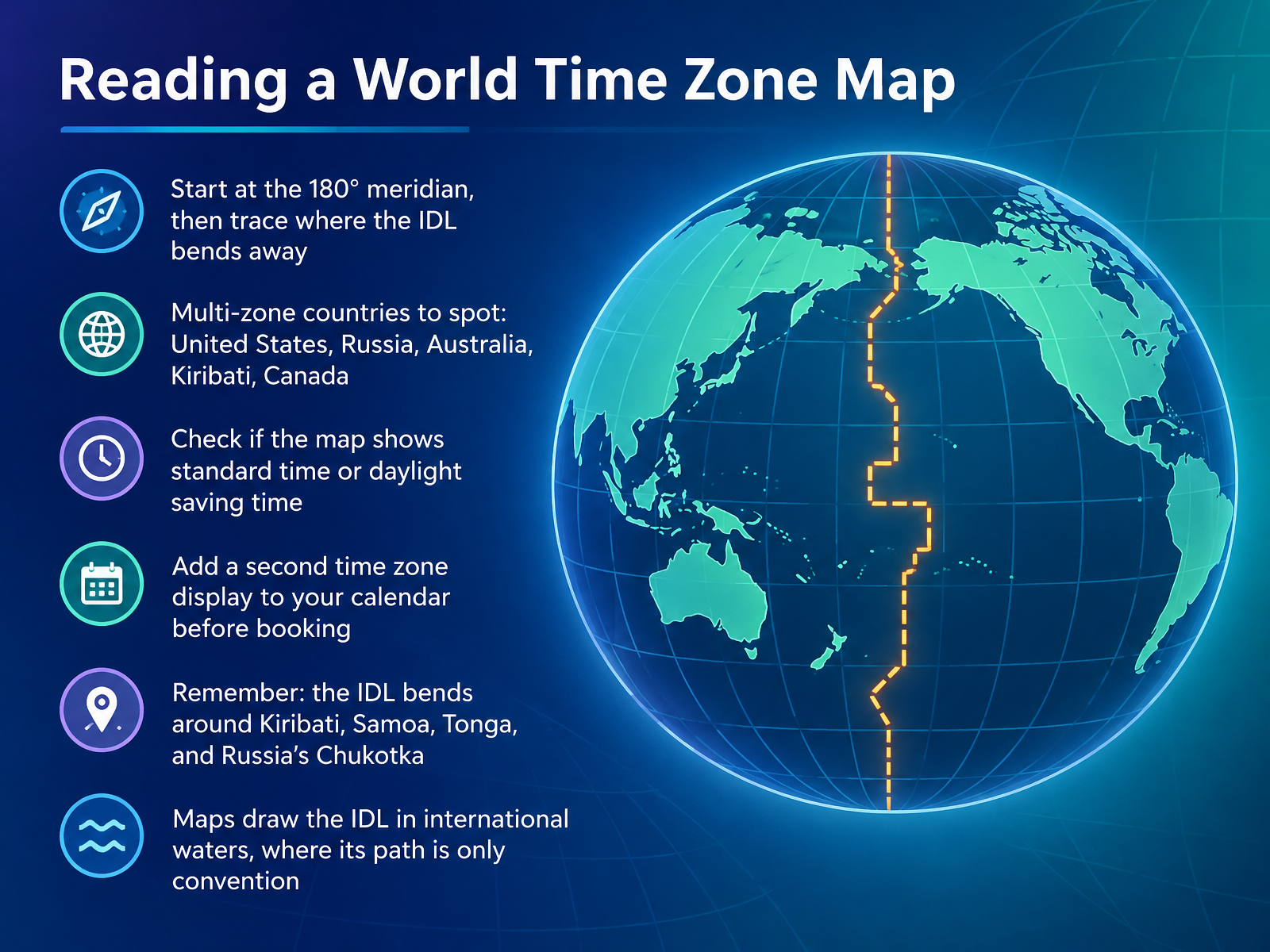
- 09Reading a World Time Zone MapNow let's look at reading a world time zone map. Start at the one hundred eighty degree meridian, then trace where the International Date Line bends away from it. That is where the map gets interesting. Look for multi-zone countries such as the United States, Russia, Australia, Kiribati, and Canada. Next, check whether the map shows standard time or daylight saving time, because the offsets can shift by an hour. Before you book anything, add a second time zone display to your calendar so the date change is obvious. And remember, the line bends around Kiribati, Samoa, Tonga, and Russia's Chukotka region. One useful detail: maps draw the Date Line through international waters, where its path is only a convention, not law. So treat the map as a practical guide, not a fixed border. Next, we will focus on travelers, crossing zones and the Date Line.
 en.wikipedia.orgoceanservice.noaa.govsimplemaplab.com+22 min
- 10Travelers: Crossing Zones and the Date LineNow let's talk about travelers crossing the date line. First, a ticket always shows departure and arrival in each airport's local time. So those two clocks belong to two different airports. If you fly westbound across the Pacific, you skip a calendar date. If you fly eastbound, you live the same date twice. For example, leave Los Angeles on Monday night and you may land in Sydney on Wednesday morning. That small plus two next to the arrival time marks the calendar-day gap, not the flight duration. So book your first hotel night on the arrival date, not your departure date. And if you have a deadline, express it in UTC, because that clock never changes when you cross the line. Next, we look at how remote teams schedule across zones: Remote Teams: Scheduling Across Zones.
 en.wikipedia.org1 min
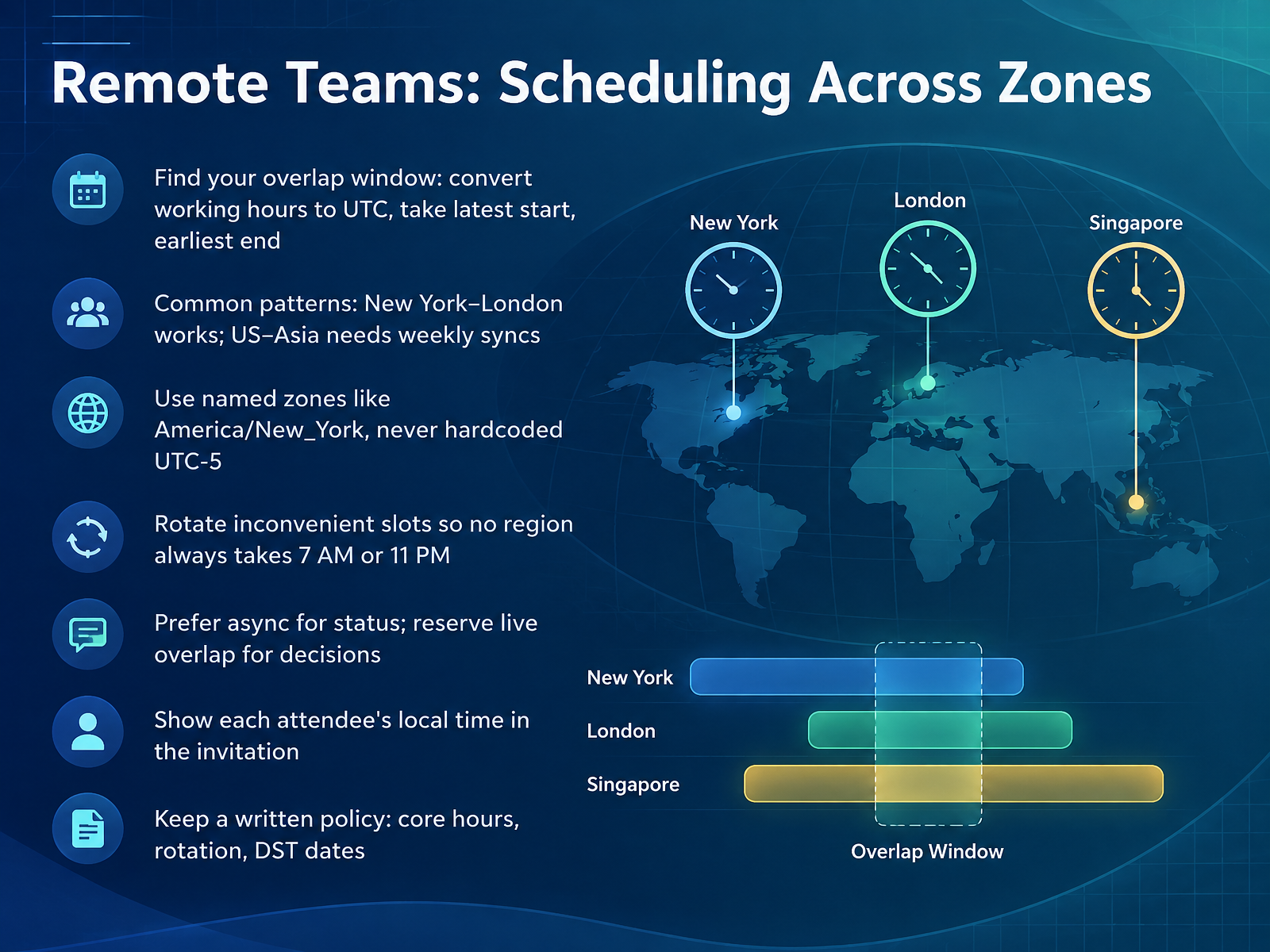
- 11Remote Teams: Scheduling Across ZonesNow let's put this into practice for remote teams. The first step is to find your overlap window. Convert everyone's working hours into UTC, then take the latest start time and the earliest end time. The space between them is your shared window. For example, New York and London usually overlap comfortably in the morning and early afternoon. But the United States and Asia may have no daily overlap at all, so weekly syncs work better than daily calls. Two rules keep this fair. First, use named zones like America slash New York, never a fixed offset like UTC minus five, because named zones adjust for daylight saving automatically. Second, rotate the inconvenient slot, so no region always takes seven in the morning or eleven at night. Prefer async updates for status, and save live time for real decisions. Always show each attendee's local time in the invitation, and keep a written policy covering core hours, rotation, and daylight saving dates. Next, let's look at common mistakes and misconceptions.
 boxtool.appskdul.aiworld-clock.app+22 min
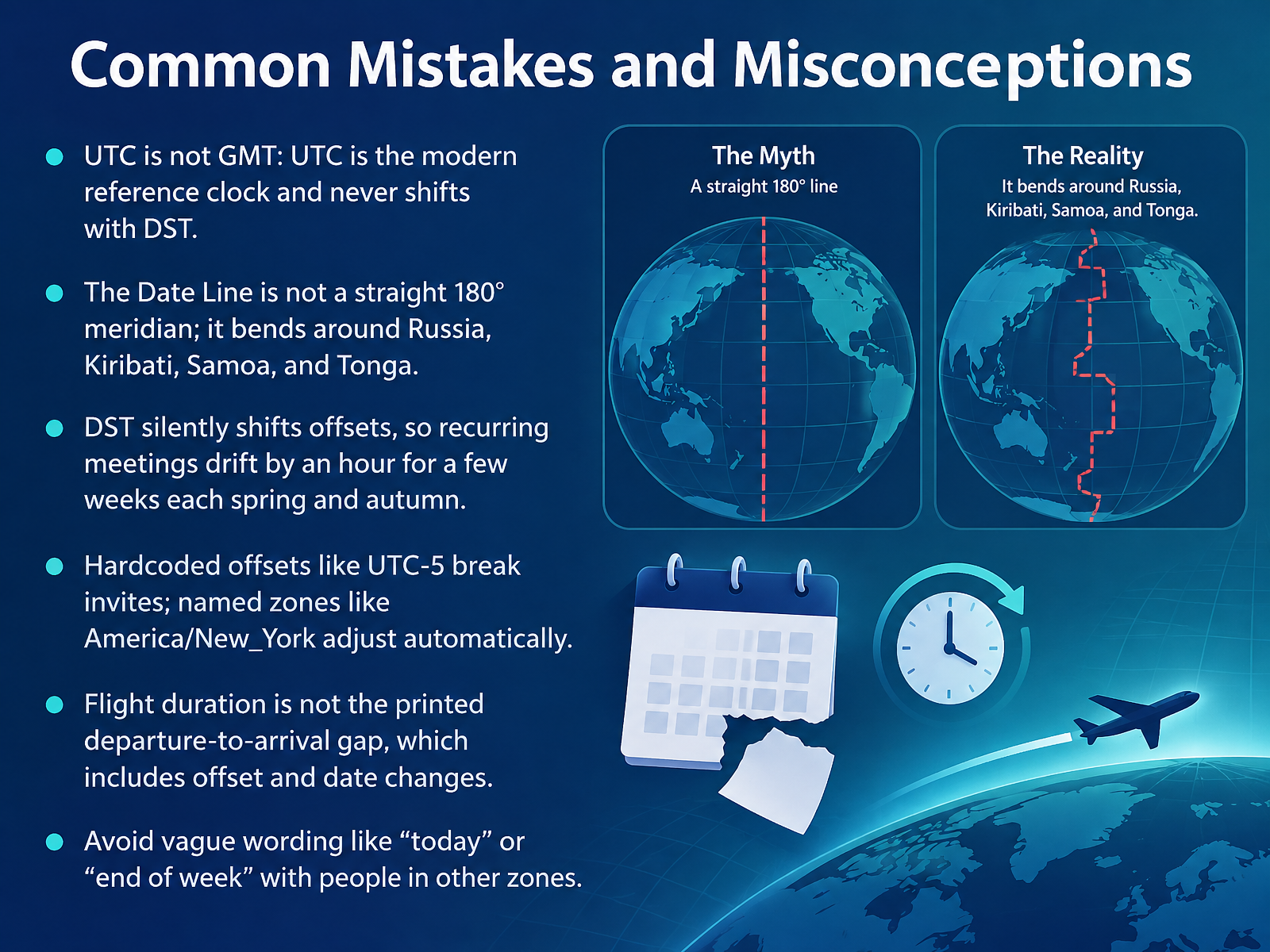
- 12Common Mistakes and MisconceptionsNow let's clear up some common mistakes. First, UTC is not the same as GMT. UTC is the modern reference clock, and it never shifts for daylight saving. Second, the International Date Line is not a straight line at one hundred eighty degrees. It bends around Russia, Kiribati, Samoa, and Tonga. Third, daylight saving silently shifts offsets. So a recurring meeting can drift by an hour for a few weeks each spring and autumn. Fourth, avoid hardcoded offsets like UTC minus five. They break invites. Use named zones like America slash New York, which adjust automatically. Fifth, flight duration is not the printed departure to arrival gap, because that gap includes offset and date changes. And sixth, avoid vague wording like today or end of week with people in other zones. Say the exact date and time with a zone, like five PM New York time. Next, let's walk through worked scenarios and quick checks.
 boxtool.appskdul.aiworld-clock.app+22 min
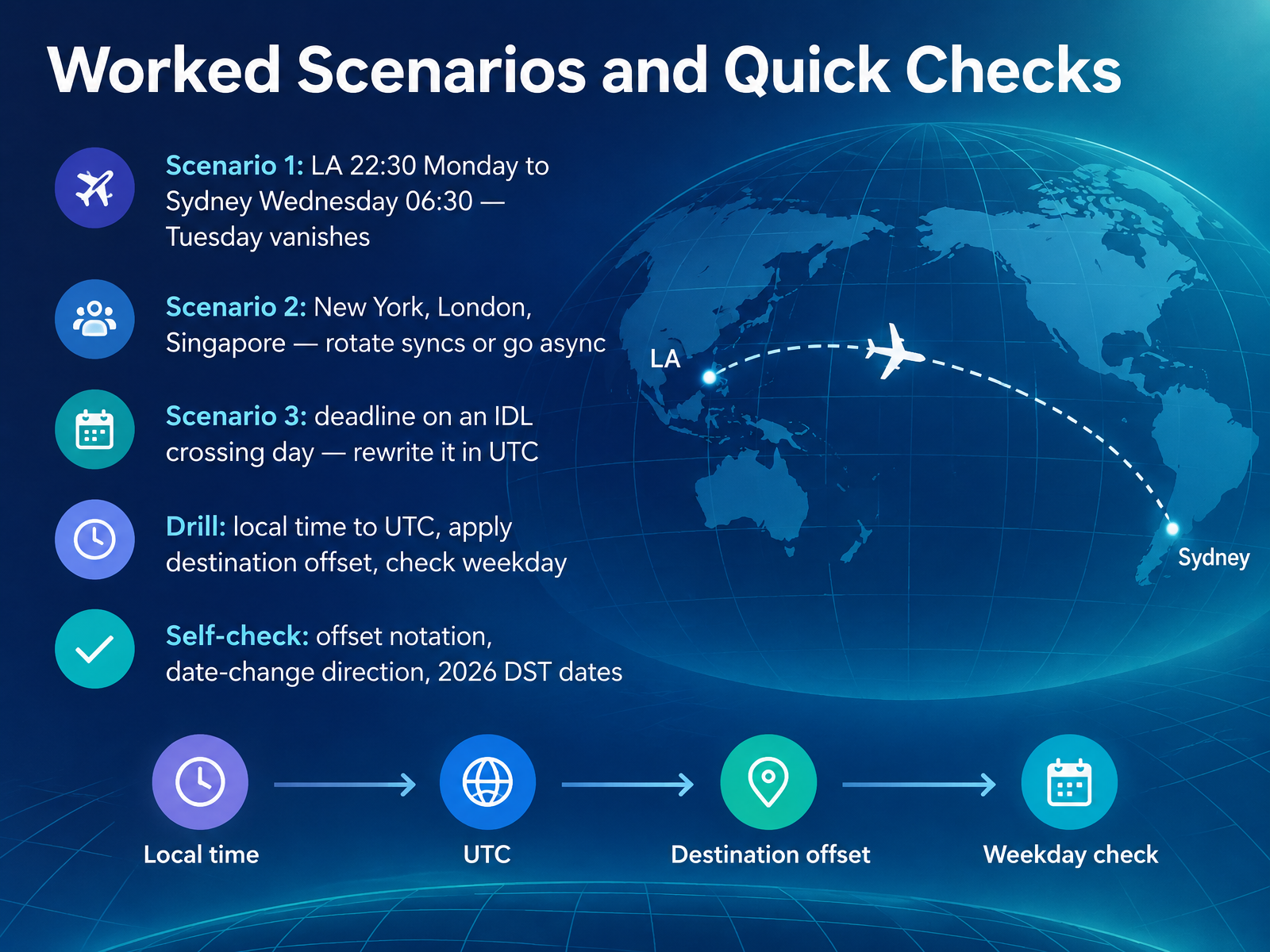
- 13Worked Scenarios and Quick ChecksLet us put all of this into practice with three quick scenarios. Scenario one: a flight leaves Los Angeles at twenty-two thirty on Monday and lands in Sydney at six thirty on Wednesday. Tuesday disappears, because the route crosses the date line heading west. Scenario two: a team in New York, London, and Singapore has no single hour that suits everyone. The practical fix is to rotate the awkward time slot, or move that work to asynchronous messages. Scenario three: a deadline falls on a day you cross the date line. Rewrite it in UTC, so the instant stays fixed. Here is a simple drill. Take a local time, convert it to UTC, apply the destination offset, then check the weekday. For your self-check, remember three things: how offsets are written, which direction the date changes, and the 2026 daylight saving dates. Let us wrap up with the key takeaways and where to verify.
 boxtool.appskdul.aiworld-clock.app+22 min
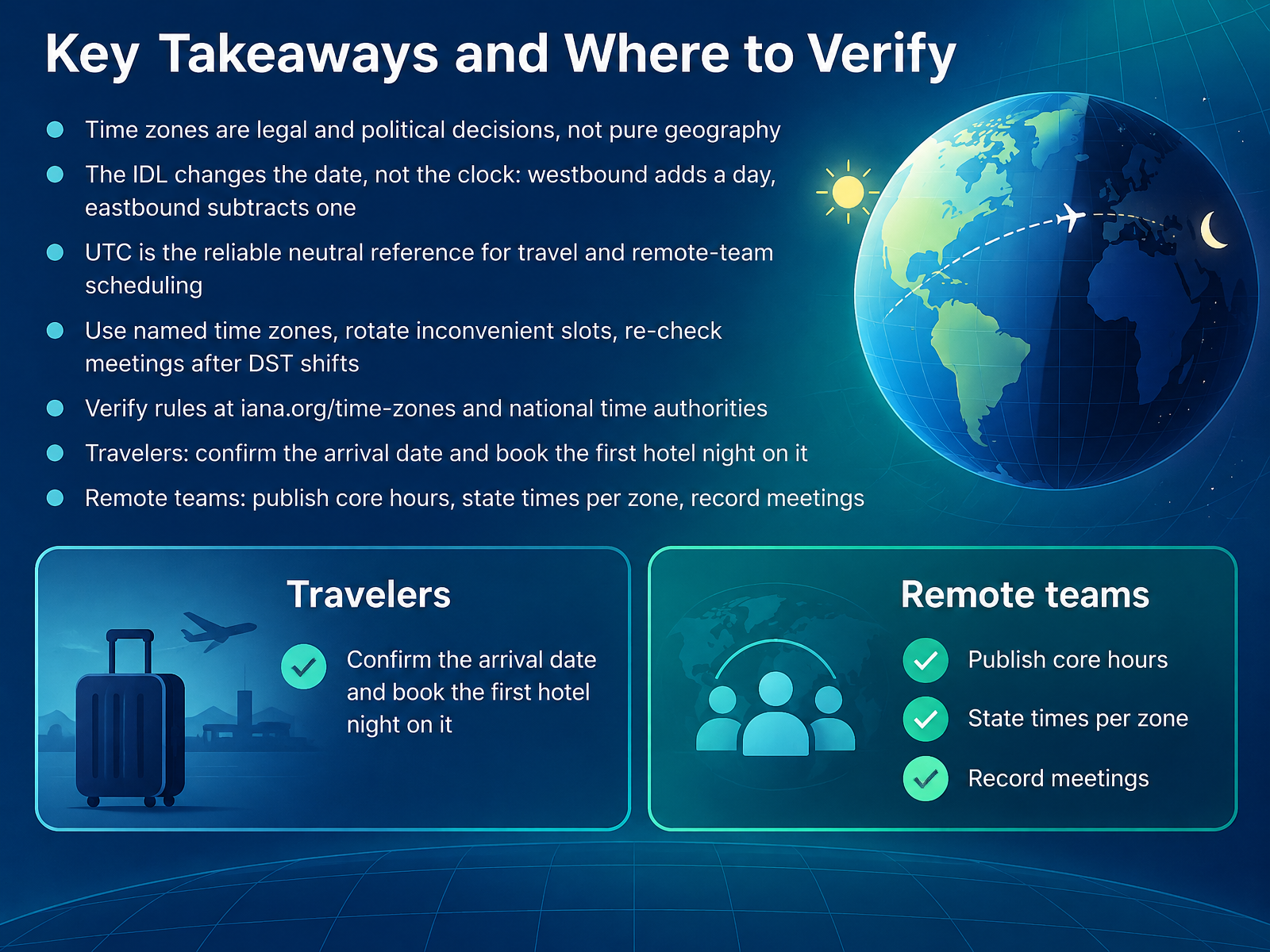
- 14Key Takeaways and Where to VerifyLet's bring it all together. Time zones are legal and political choices, not simply lines on a map. The International Date Line changes the date, not the clock. Traveling west, you add a day. Traveling east, you subtract one. For travel and remote-team scheduling, Coordinated Universal Time, or UTC, is the reliable neutral reference. In practice, use named time zones like America/New_York instead of fixed offsets, rotate inconvenient meeting slots so the burden is shared, and re-check recurring meetings after daylight saving changes. To verify the rules, go to iana.org slash time-zones, or check your national time authority. Travelers, confirm your arrival date and book your first hotel night on that date. Remote teams, publish core hours, state times for each zone, and record meetings so no one is left out. Thank you for joining this course. Keep exploring, and use these habits to stay on time, wherever you are.
 boxtool.appskdul.aiworld-clock.app+22 min
Take the deck with you
Download this course as a file — free, no sign-up needed.
- PDF handoutEvery slide page, ready to print or share.15 pages · 3.9 MBDownload
- Narrated PowerPointThe deck that presents itself — every slide carries the digital human's narration video.15 pages · 15.0 MBDownload
- PowerPoint slidesThe full deck as a .pptx — open it in PowerPoint, Keynote, or Google Slides.15 pages · 3.9 MBDownload
Free to use in your own training — please keep the PersonWise credit page at the end.
Have your own deck? Turn it into a course
Sources consulted
Web sources consulted while building this course.
- International Date Line — en.wikipedia.org
- What is the international date line? — oceanservice.noaa.gov
- International Date Line Map: Where It Is & Why It Zigzags — simplemaplab.com
- Time in Kiribati — en.wikipedia.org
- International Date Line: Definition, Location & Why It Zigzags - Anantam IAS — anantamias.com
- The Project Gutenberg eBook of International Conference Held at Washington for the Purpose of Fixing a Prime Meridian and a Universal Day. — gutenberg.org
- International Meridian Conference — en.wikipedia.org
- THE CENTENARY OF THE PRIME MERIDIAN AND OF INTERNATIONAL STANDARD TIME — secjhuapl.edu
- Why Were Time Zones Created? — timeanddate.com
- The adoption of a Prime Meridian and the International Meridian Conference of 1884 — royalobservatorygreenwich.org
- Time Zone Database Release 2026e — iana.org
- Time Zone Database Releases — iana.org
- Time Zones — iana.org
- Time Zone Database Release 2026d — iana.org
- Time Zone Database Release 2026c — iana.org
- Working Across Time Zones: A Practical Guide to Global Scheduling — BoxTool — boxtool.app
- Scheduling Across Time Zones: A Remote Team's Survival Guide | skdul blog — skdul.ai
- Remote Work Across Time Zones - Global Clock — world-clock.app
- How to Avoid Mistakes with Daylight Saving Time and International Scheduling — Clock7 Blog — clock7.com
- Time Zone Management for Remote Teams | TimeZones.now — timezones.now