Cloud Computing Fundamentals
Begin
11 pages · ~22 min
Cloud Computing Fundamentals
An introductory course on cloud computing fundamentals, teaching core concepts, service models, and deployment options for beginners.
What you’ll learn
- 01Introduction to Cloud Computing: A Vendor-Neutral Mental ModelWelcome. If you work with technology, you hear cloud terms constantly. Public cloud, hybrid cloud, cloud-native, FinOps. But what actually is cloud, beyond the marketing? This course gives you a vendor-neutral mental model, a clear way to think about cloud computing that works across providers like AWS, Azure, Google Cloud, and even private clouds. The core definition comes from the National Institute of Standards and Technology, or NIST. It describes cloud as on-demand network access to a shared pool of configurable computing resources you can provision and release quickly with minimal management effort. That is a mouthful, so we will break it down into a practical framework. We will cover the key principles, the economics, the main service models, deployment options, and security. By the end, you will be able to translate vendor pitches and ask sharper questions. Let's start by understanding the business drivers behind this shift in the next slide, titled: Why Cloud? The Pre-Cloud Reality and the Business Case.nist.govdoi.orgcsrc.nist.gov+22 min
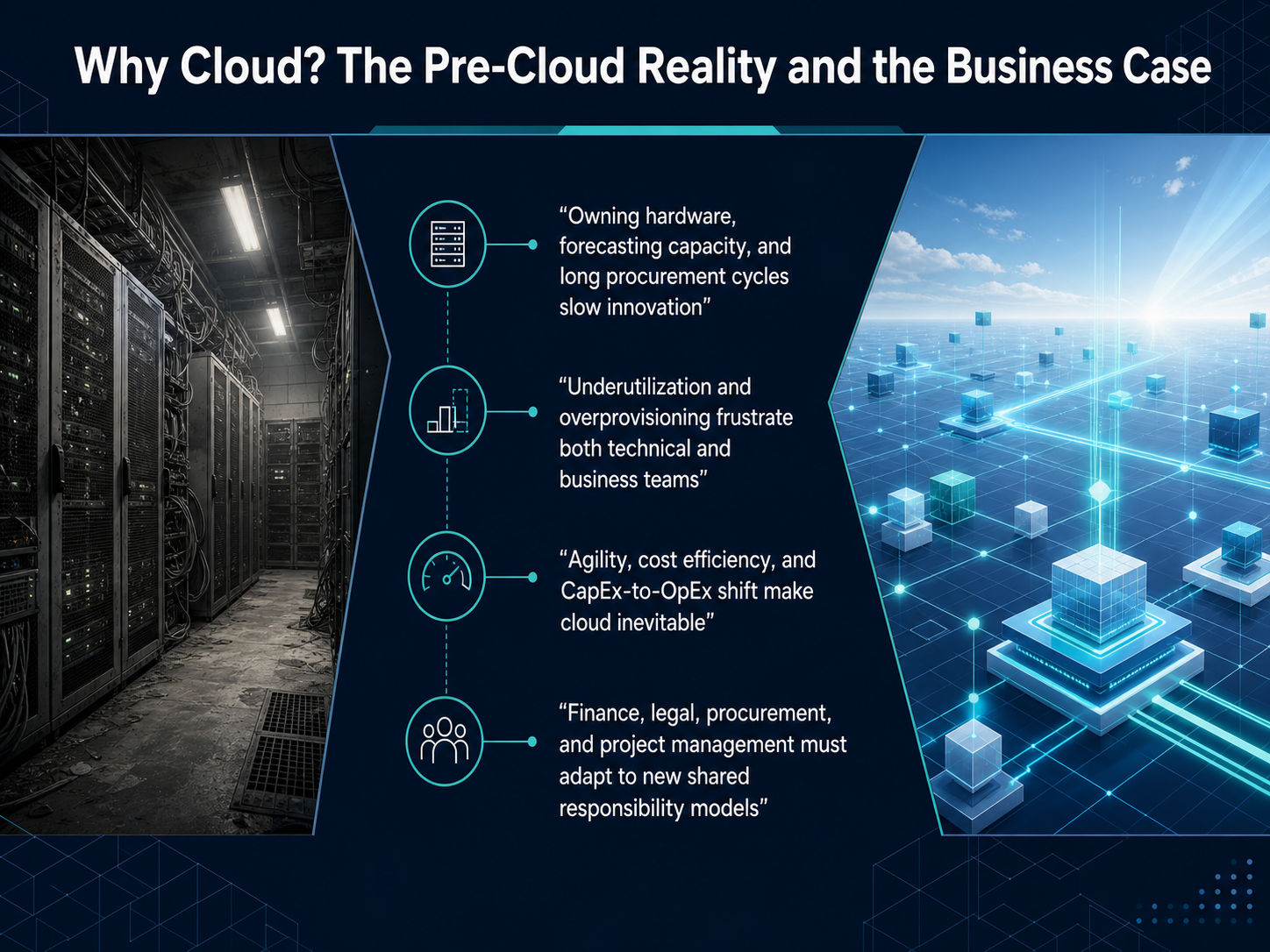
- 02Why Cloud? The Pre-Cloud Reality and the Business CaseBefore we can understand the cloud, we need to understand why it became essential. Think about the pre-cloud reality. Companies had to buy their own hardware, predict future capacity, and wait through long procurement cycles. This made innovation slow and frustrating. A common problem was overprovisioning, paying for servers that sat idle, or underprovisioning, which caused failures during peak demand. This frustrated both technical teams and business leaders alike. The cloud solves this by shifting spending from a massive upfront capital expense, or CapEx, to a flexible, pay-as-you-go operating expense, or OpEx. This improves agility and cost efficiency. But this shift also impacts more than just the IT department. It creates a new shared responsibility model. Finance, legal, procurement, and project management teams all must adapt how they budget, manage risk, and plan projects. Next, let’s build a core mental model by looking at the five essential characteristics of cloud, as defined by NIST.
 resources.flexera.comdoi.orgdoi.org+22 min
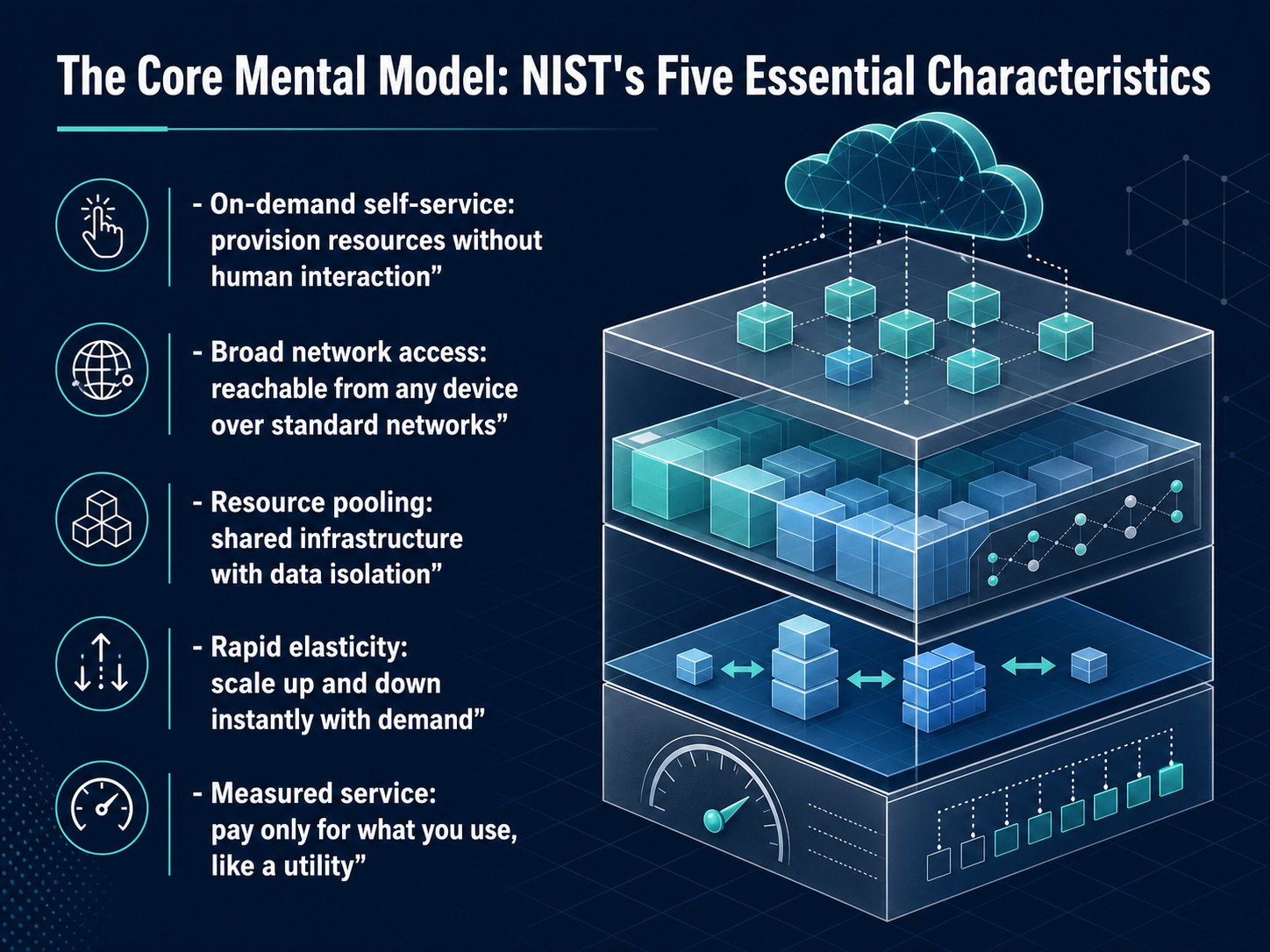
 - 03The Core Mental Model: NIST's Five Essential CharacteristicsLet's anchor our mental model of cloud computing with the most widely accepted definition. The National Institute of Standards and Technology, or NIST, identifies five essential characteristics that make a cloud a cloud. First, on-demand self-service. This means you can spin up a server or increase storage yourself, right when you need it, without filing a ticket or waiting for someone to provision it for you. Second, broad network access. Your resources are available over the internet using standard protocols, so you can reach them from your laptop, your phone, or a tablet. Third, resource pooling. The provider combines a shared pool of physical and virtual machines to serve many customers at once. Your data stays isolated, but you share the underlying infrastructure. Fourth, rapid elasticity. This is the ability to scale resources up and down almost instantly as demand changes. To you, the capacity feels unlimited. Finally, measured service. You only pay for what you actually use, whether that's compute time, storage, or bandwidth, just like a utility bill. These five traits are our core checklist for evaluating any cloud service. Next, let's build on this foundation by exploring the three common service models: IaaS, PaaS, and SaaS, and where the shared responsibility line is drawn.
 nist.govdoi.orgcsrc.nist.gov+22 min
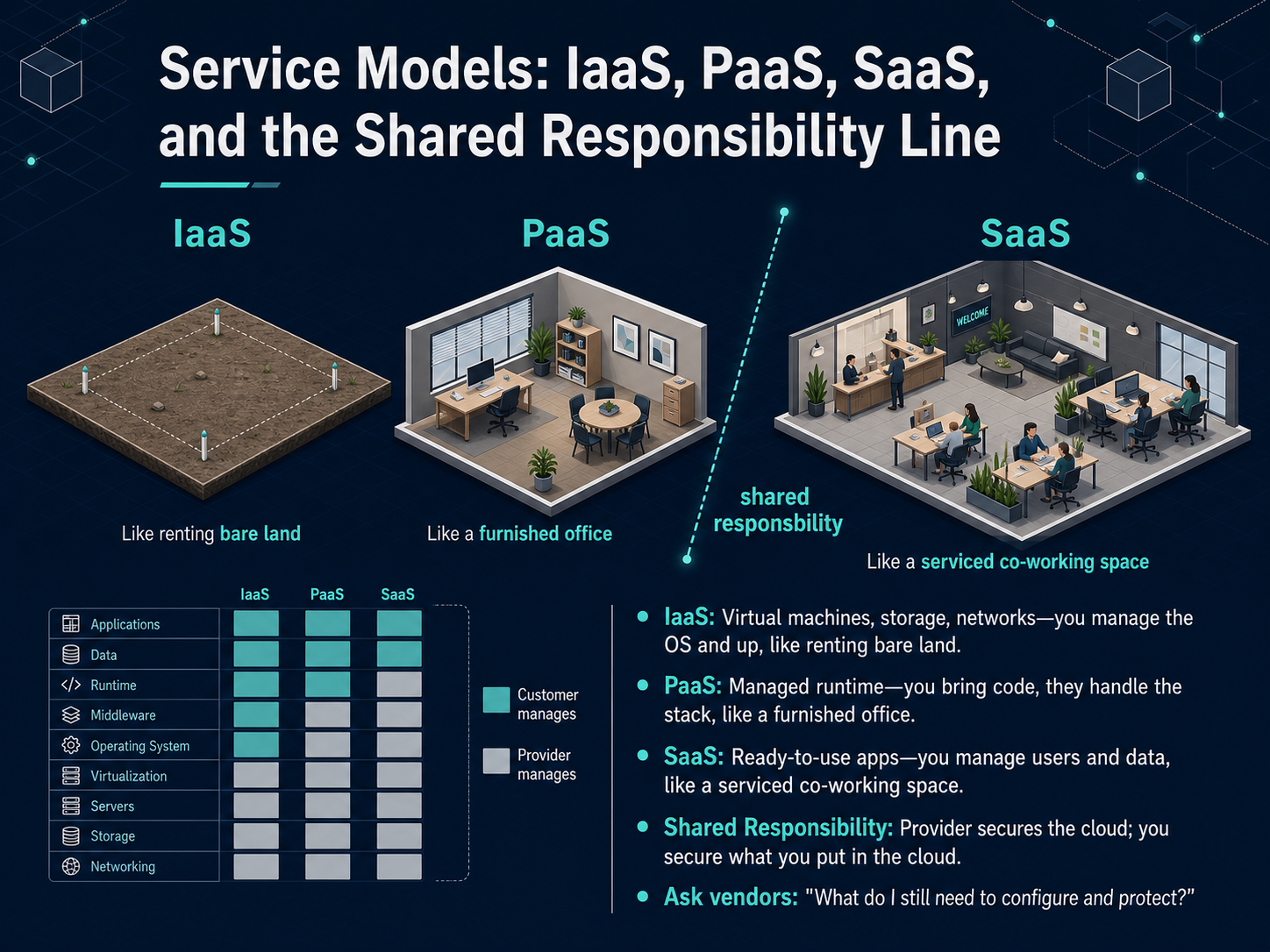
 - 04Service Models: IaaS, PaaS, SaaS, and the Shared Responsibility LineNow let's look at the three main service models and a concept called shared responsibility. First, Infrastructure as a Service, or IaaS. Think of this as renting bare land. You get virtual machines, storage, and networks, but you manage the operating system and everything above it. Next is Platform as a Service, or PaaS. This is like a furnished office. You bring your code, and the provider handles the underlying stack, the runtime, and the middleware. Finally, Software as a Service, or SaaS, is like a serviced coworking space. The application is ready to use; you just manage your users and your data. These models define the shared responsibility line. Simply put, the provider secures the cloud foundation, but you are always responsible for securing what you put inside it. So, a powerful question to ask any vendor is simply, 'What do I still need to configure and protect?' This clarity helps you avoid gaps in your security. Next, we'll explore the common deployment models: Public, Private, Hybrid, and Multi-Cloud.
 nist.govdoi.orgcsrc.nist.gov+22 min
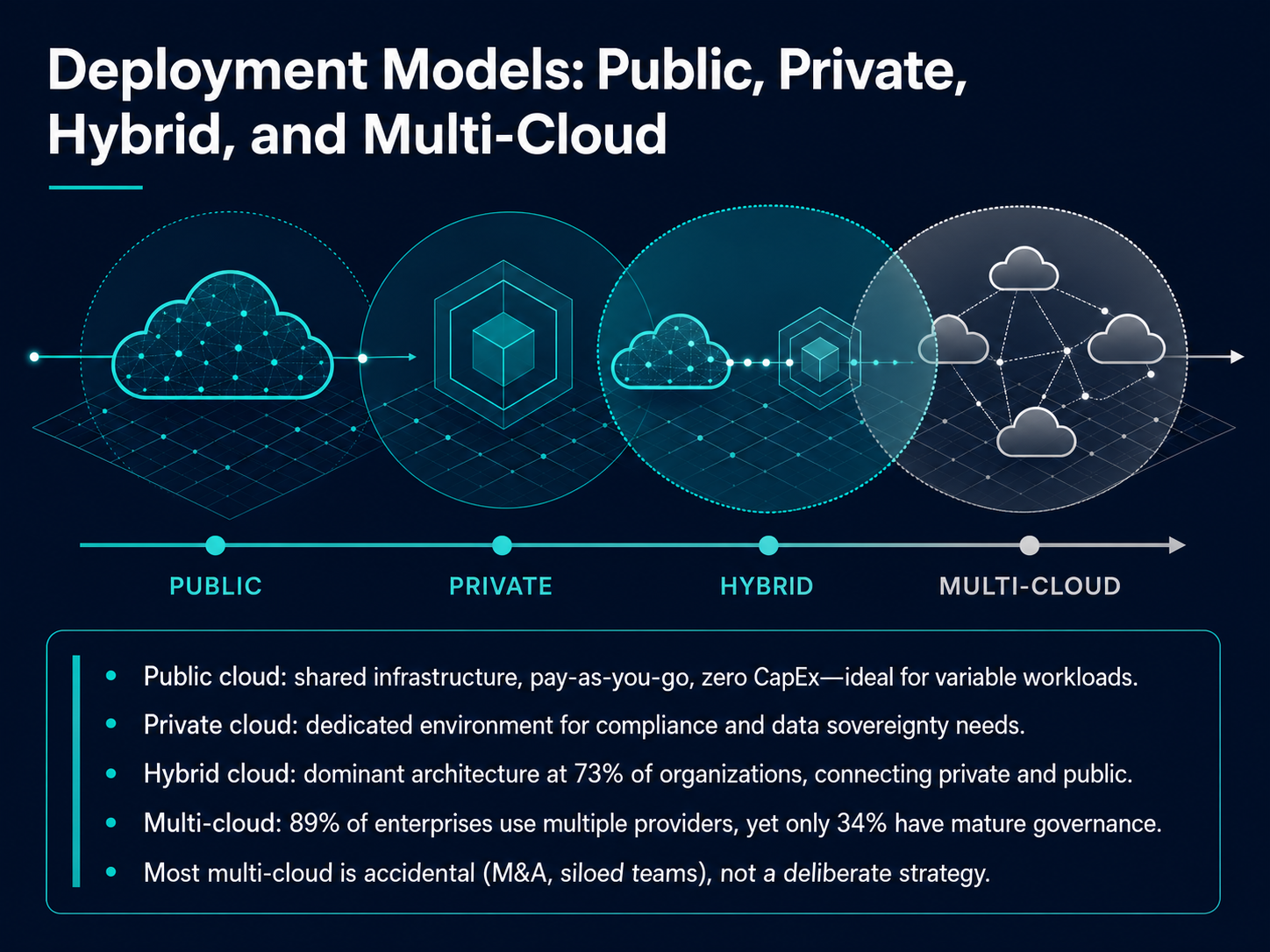
 - 05Deployment Models: Public, Private, Hybrid, and Multi-CloudSo far, we've talked about what cloud is and how you access it. Now, let's look at where it lives. Think of deployment models as the neighborhood your cloud resources move into. We’ll walk through four of them.
First, the public cloud. This is shared infrastructure, like a giant apartment building, where you pay only for what you use. There’s no big upfront cost, which makes it perfect for workloads that change a lot.
Next is the private cloud. This is a dedicated environment, like a private house, built just for your organization. It’s the go-to choice when laws or regulations require strict control over your data.
The most common choice is the hybrid cloud, connecting private and public. In fact, seventy-three percent of organizations use this model today. It lets you keep sensitive data in your private space while using the public cloud’s massive scale for everything else.
Finally, there’s multi-cloud, which means using services from multiple providers. While eighty-nine percent of enterprises do this, it’s often accidental. Mergers and different teams acting on their own create this complexity. Only a small fraction have it properly governed. The goal isn't to avoid it, but to manage it intentionally.
Now that we've mapped out where the cloud lives, let's talk about how it changes the way you pay for technology. We'll explore the economics of cloud, CapEx, OpEx, and FinOps, next.
 halkwinds.cominfo.flexera.compacewisdom.com+22 min
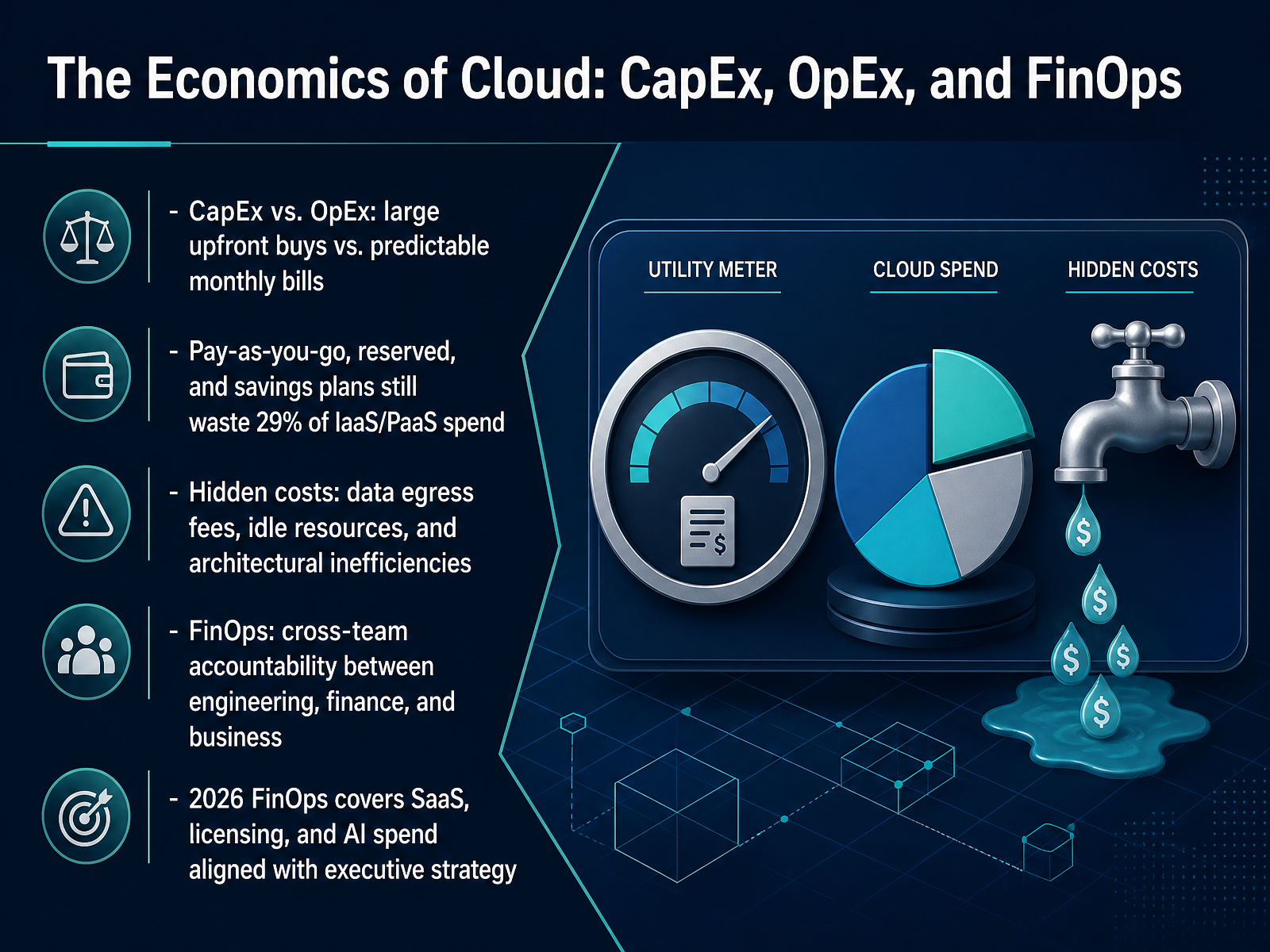
 - 06The Economics of Cloud: CapEx, OpEx, and FinOpsNow, let's talk money. Moving to the cloud fundamentally changes the economics. You shift from large, upfront capital expenses—buying hardware—to predictable, operational expenses, like a monthly utility bill. This is the core difference between CapEx and OpEx. But that pay-as-you-go model, plus reserved instances and savings plans, doesn't automatically mean you're optimizing. In fact, research shows companies still waste about twenty-nine percent of their cloud infrastructure spend. Hidden costs are the culprit. Think data egress fees, where you pay to move your own data, or simply paying for idle resources that are running but not being used. This is where FinOps comes in. It's not just a tool; it's a cultural practice that creates financial accountability through collaboration between engineering, finance, and business teams. And by twenty twenty-six, the FinOps framework is expanding. It now covers SaaS, software licensing, and even AI spend, all aligned directly with executive strategy. It's about maximizing business value, not just cutting costs. Next, let's build on this trust and responsibility by exploring security, compliance, and trust as a true partnership, not just a product.
 finops.orgfinops.orglearn.microsoft.com+22 min
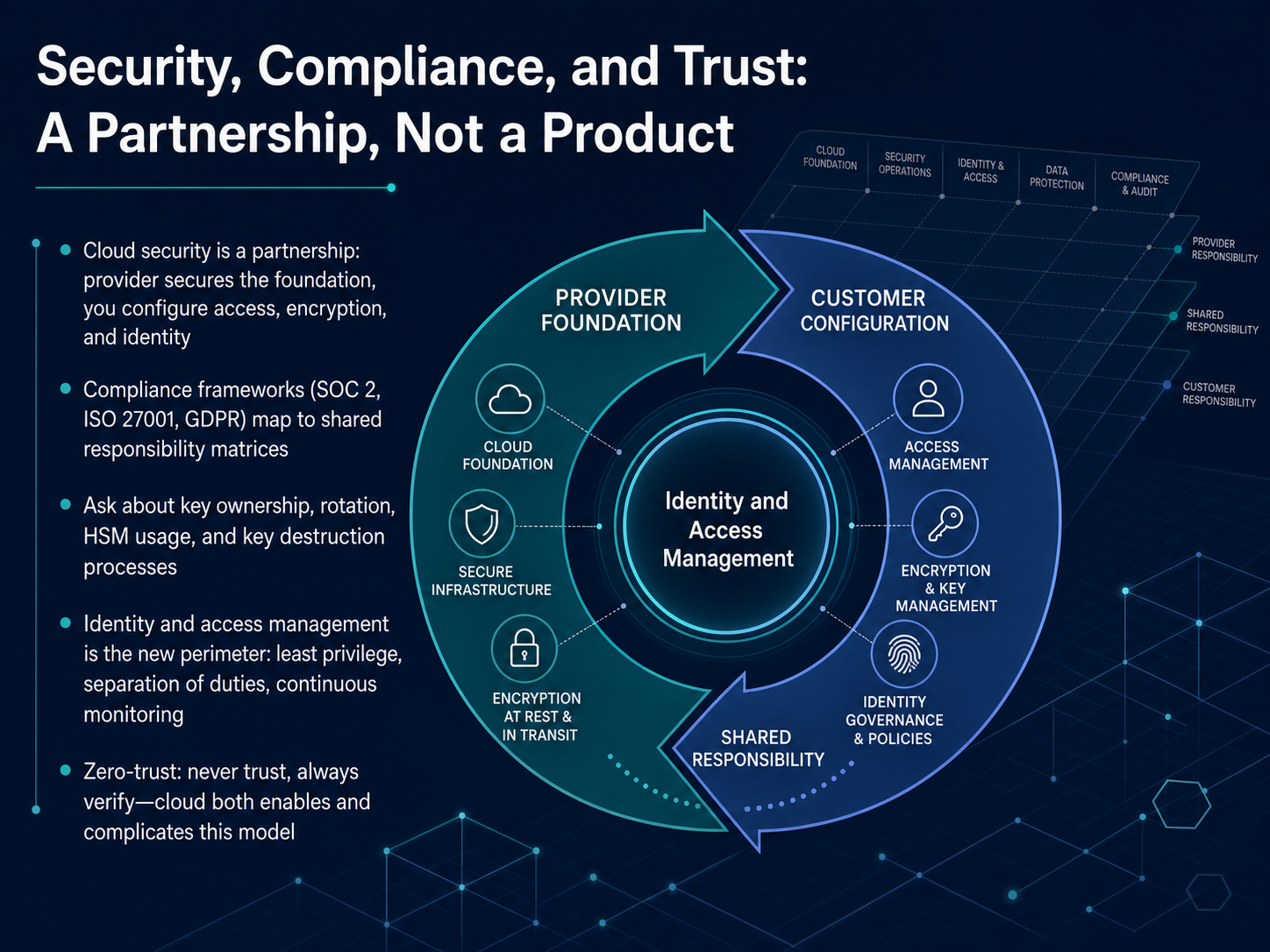
 - 07Security, Compliance, and Trust: A Partnership, Not a ProductNow let's talk about something that often surprises people: Security, Compliance, and Trust are a partnership, not a product you can simply buy. When you move to the cloud, you and the provider share the responsibility. The provider secures the foundation, the physical data centers, the network hardware. You are responsible for what you put in the cloud, like configuring access, encrypting your data, and managing user identities. Think of compliance frameworks like SOC Two, ISO 27001, or GDPR. They map to this shared responsibility. You need to ask your provider direct questions about encryption key ownership, key rotation, and especially the process for key destruction. Because if you delete a key, you want to know exactly when that data becomes unrecoverable. Also, remember that identity and access management is your new perimeter. Use the principle of least privilege. Give people only the access they absolutely need, and continuously monitor that access. Finally, you will hear the term zero-trust. It means never trust, always verify. The cloud both enables this model and makes it more complex. Up next, we will build on these ideas to explore what 'Cloud-Native' means and what it changes.
 nist.govdoi.orgcsrc.nist.gov+22 min
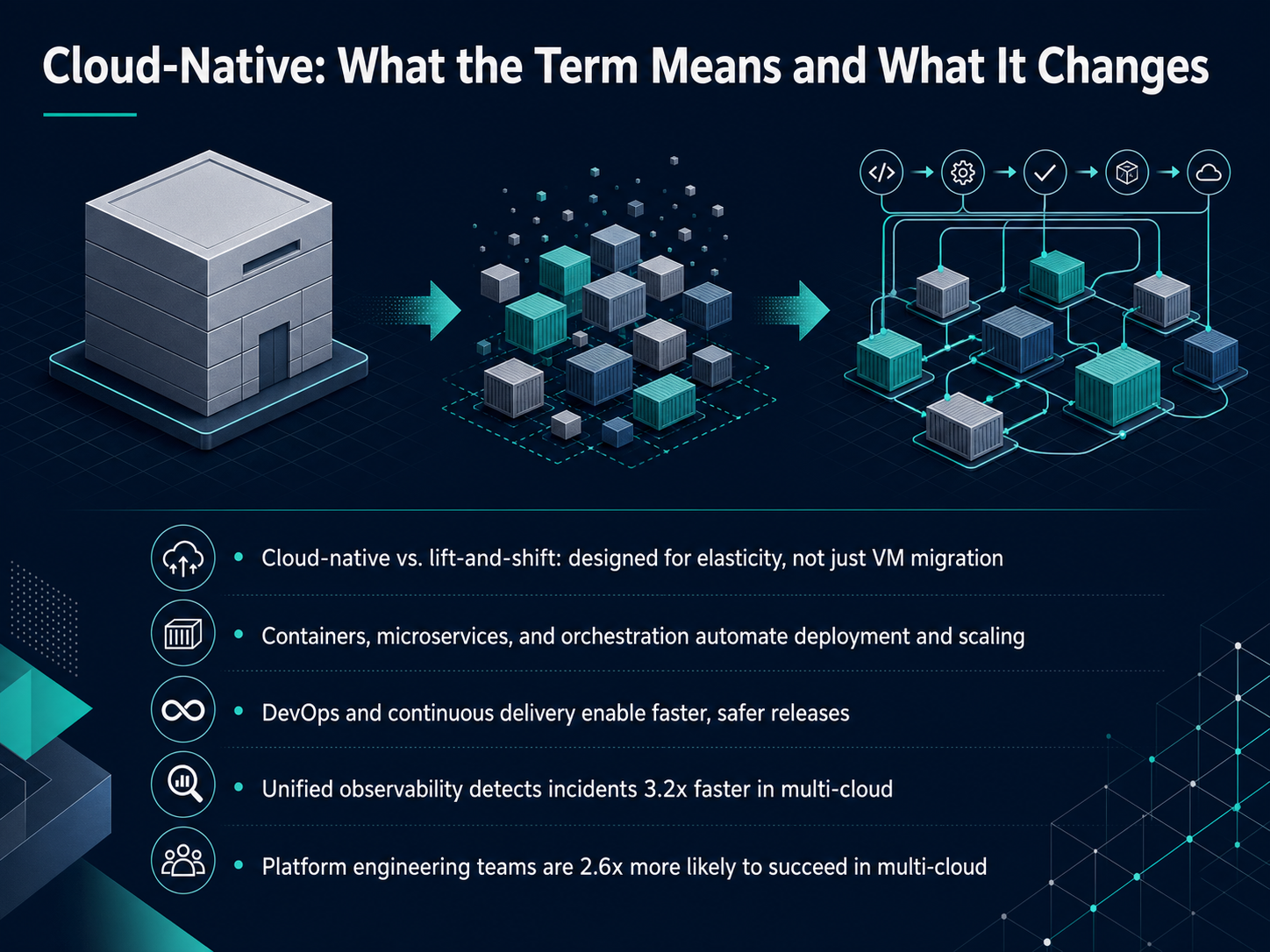
 - 08Cloud-Native: What the Term Means and What It ChangesNow let's talk about what cloud-native really means and why it's a different way of thinking. When you hear the term, picture applications designed from the start to take advantage of the cloud. This is not the same as lift-and-shift, where you simply move a virtual machine to a provider. Cloud-native systems are built for elasticity, to scale up and down automatically. We achieve this with containers, microservices, and orchestration tools like Kubernetes. These technologies automate deployment and scaling, so teams aren't doing it all by hand. This approach also enables DevOps and continuous delivery, which means you can release small, safe updates to customers much faster. Now, as you adopt this model across multiple clouds, you need unified observability to see everything in one place. That single view can help you detect incidents over three times faster. Finally, many organizations are forming platform engineering teams to manage this complexity. Research shows these teams are over two and a half times more likely to succeed in a multi-cloud world. Next, we'll explore how AI and cloud have become an inseparable duo shaping strategy in 2026.
 halkwinds.cominfo.flexera.compacewisdom.com+22 min
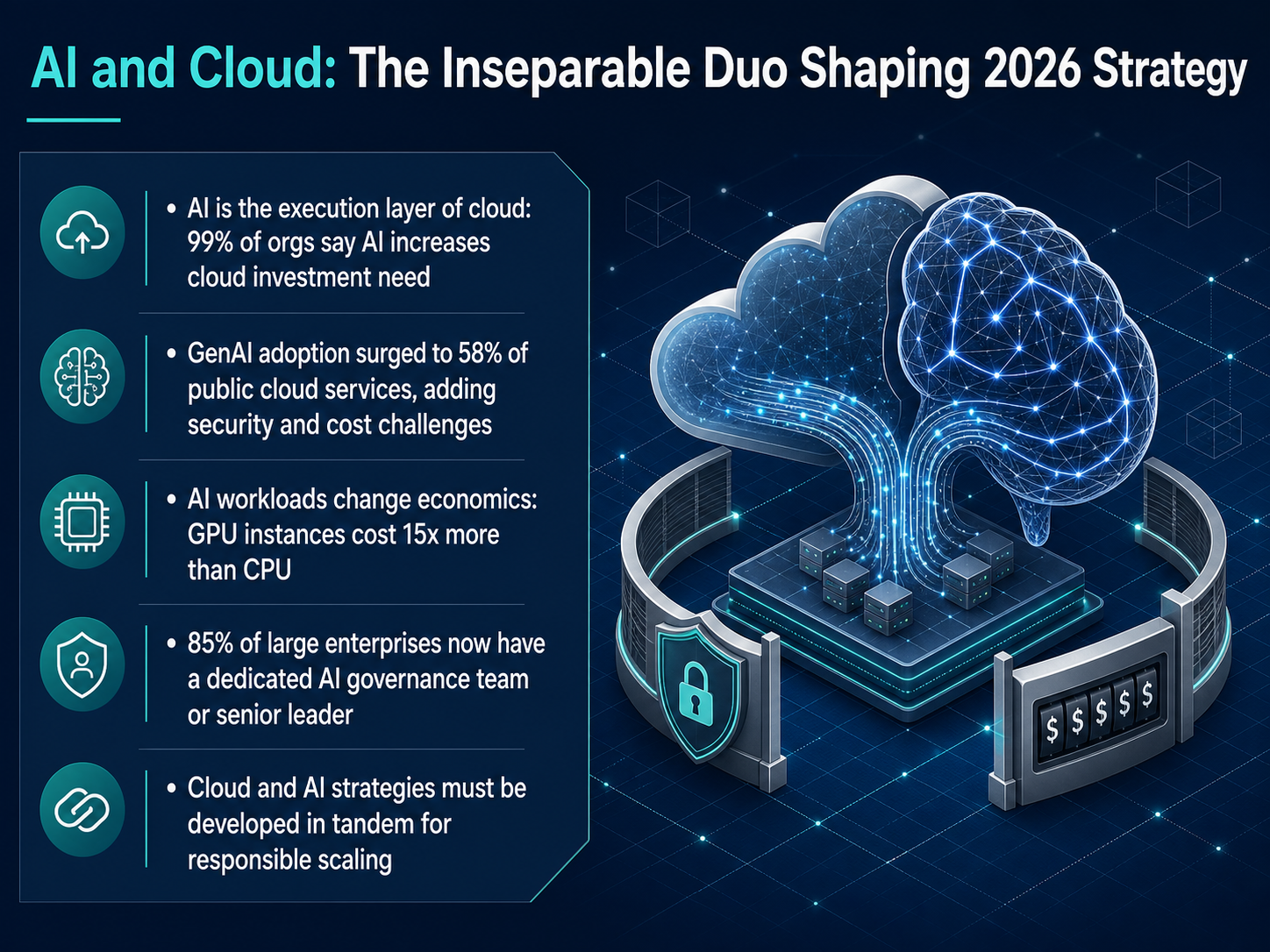
 - 09AI and Cloud: The Inseparable Duo Shaping 2026 StrategyLet's connect the dots between AI and cloud. In 2026, they are an inseparable duo. Think of cloud as the foundation, and AI as the execution layer that runs on top of it. Nearly every organization, 99 percent, says AI increases their need for cloud investment. Generative AI adoption has surged to 58 percent of public cloud services, which is great for innovation, but it also introduces new security and cost challenges. The economics are shifting because AI workloads behave differently. GPU instances, the workhorses of AI, can cost 15 times more than traditional CPU instances. This is why 85 percent of large enterprises now have a dedicated AI governance team or senior leader. They need to manage the risk and ensure responsible spending. The biggest takeaway is this: cloud and AI strategies must be developed in tandem. You can't do one without the other if you want to scale responsibly. Now, how do you actually put this into practice? Let's look at a practical framework for asking the right questions.
 resources.flexera.comdoi.orgdoi.org+22 min
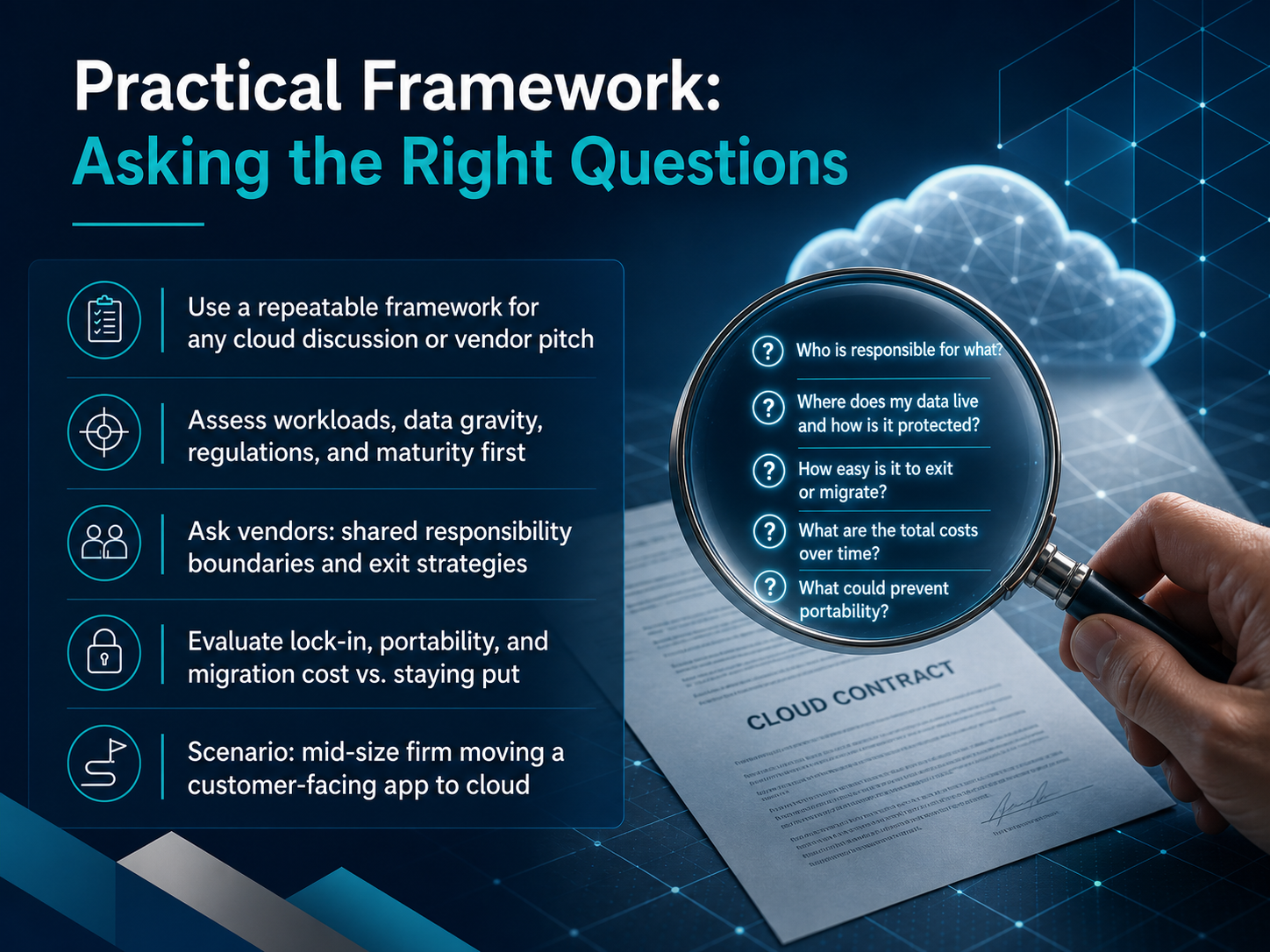
 - 10Practical Framework: Asking the Right QuestionsLet's pull everything together with a practical framework you can use in any cloud discussion. Whether you're evaluating a vendor pitch or planning a migration, start by assessing your workloads, your data gravity, your regulatory requirements, and your organizational maturity. These four factors shape almost every cloud decision. When you talk to a vendor, ask two questions directly. First, where exactly does your shared responsibility end and ours begin? Clarify who manages encryption keys, identity, and compliance. Second, what is our exit strategy? You need to understand the cost and complexity of moving your data out, not just the ease of getting in. Also evaluate lock-in, portability, and migration costs. According to industry data, eighty-nine percent of enterprises are already multi-cloud, but many arrived there by accident. A deliberate framework helps you avoid that trap. Let's apply this to a quick scenario. Imagine a mid-size firm moving a customer-facing application to the cloud. The team would first map data residency requirements, then assess if the app needs refactoring for portability, and finally compare the total cost of migration against the cost of staying put. That's the framework in action. Coming up next, we'll wrap up with concrete steps for continuing your cloud literacy journey.
 halkwinds.cominfo.flexera.compacewisdom.com+22 min
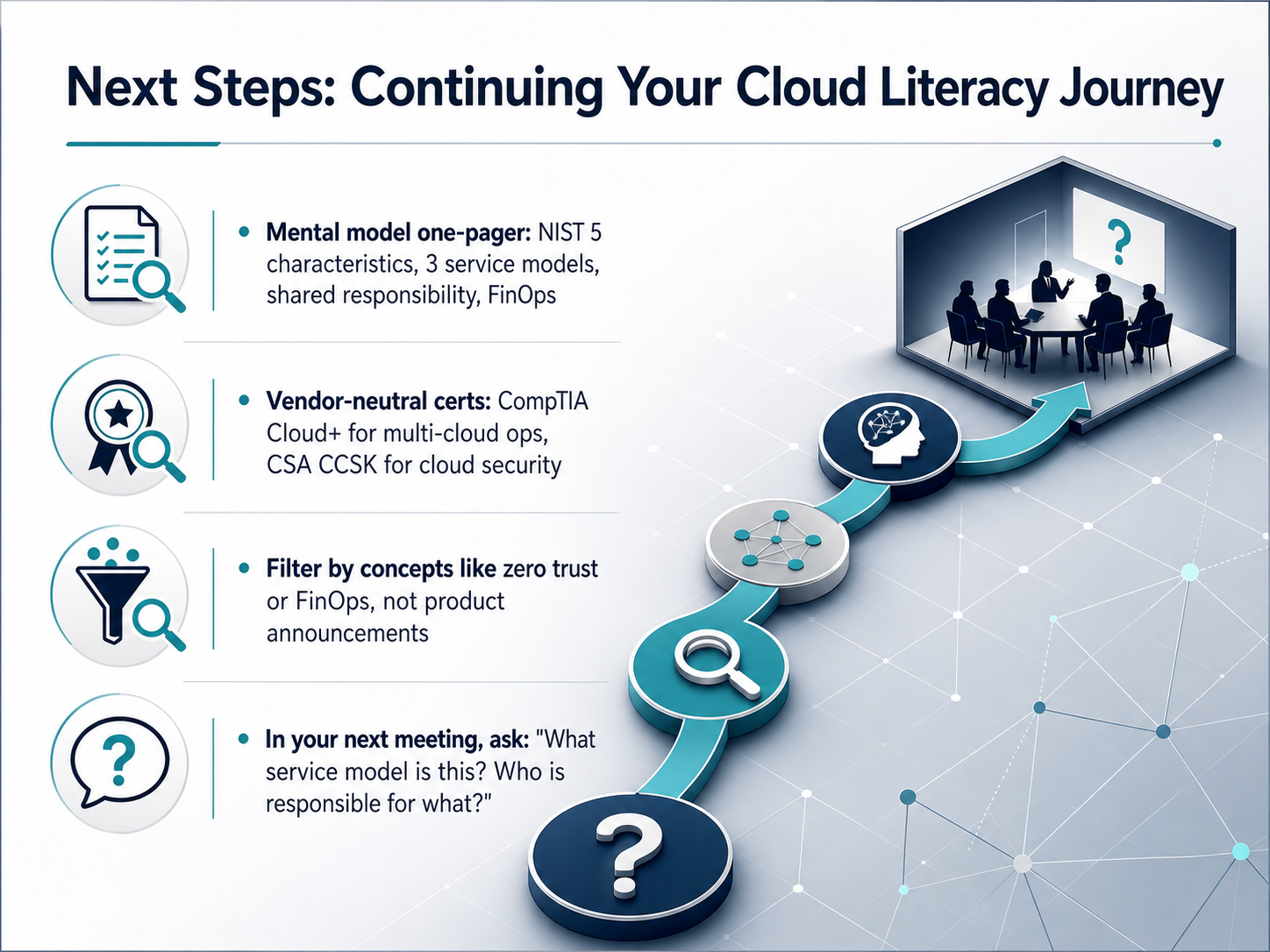
 - 11Next Steps: Continuing Your Cloud Literacy JourneyYou've built a solid mental model, and the best way to make it stick is to use it. I want to leave you with a few practical next steps. First, create a one-page reference for yourself. Jot down the five NIST characteristics, the three service models, and the idea of shared responsibility. Then add a note on FinOps, which is the practice of managing cloud costs through collaboration between engineering, finance, and business teams. Next, if you want to validate your knowledge with a certification, look at vendor-neutral options first. CompTIA Cloud Plus covers operations across Amazon Web Services, Azure, and Google Cloud Platform. The CSA Certificate of Cloud Security Knowledge, or CCSK, is the benchmark for cloud security. When you read cloud news, filter for concepts like zero trust or FinOps, not just product announcements. Finally, bring this to your very next meeting. Ask two simple questions: What service model is this? And who is responsible for what? That habit alone will accelerate your cloud literacy faster than any certification. Thank you for taking this journey. You now have a practical framework to understand and evaluate any cloud conversation.
 finops.orgfinops.orglearn.microsoft.com+22 min
Take the deck with you
Download this course as a file — free, no sign-up needed.
- PDF handoutEvery slide page, ready to print or share.12 pages · 3.2 MBDownload
- Narrated PowerPointThe deck that presents itself — every slide carries the digital human's narration video.12 pages · 11.5 MBDownload
- PowerPoint slidesThe full deck as a .pptx — open it in PowerPoint, Keynote, or Google Slides.12 pages · 3.1 MBDownload
Free to use in your own training — please keep the PersonWise credit page at the end.
Have your own deck? Turn it into a course
Sources consulted
Web sources consulted while building this course.
- The NIST Definition of Cloud Computing | NIST — nist.gov
- The NIST definition of cloud computing — doi.org
- cloud computing - Glossary | CSRC — csrc.nist.gov
- Cloud Computing | CSRC — csrc.nist.gov
- NIST SP 800-145, The NIST Definition of Cloud Computing — nvlpubs.nist.gov
- 2026 State of the Cloud Report: Cloud spend, AI & FinOps benchmarks — resources.flexera.com
- Cloud Computing for Agile and Resilient Organizations — doi.org
- Cloud-Native Systems as a Driver of Competitive Advantage in the Digital Economy — doi.org
- THE IMPACT OF CLOUD COMPUTING ON BUSINESS AGILITY — doi.org
- Cloud is now the execution layer of AI | NTT DATA Group — nttdata.com
- Multi Cloud Adoption Report 2026 | Halkwinds Research — halkwinds.com
- 2026 State of the Cloud | Insights from cloud leaders & practitioners — info.flexera.com
- Multi-Cloud Strategy in 2026: How Enterprises Build and Govern Multi-Cloud | Pace Wisdom — pacewisdom.com
- Flexera 2026 State of the Cloud Report: The convergence of cloud and value — flexera.com
- What 2026 cloud data tells us about spend, scale and strategy — flexera.com
- FinOps Framework Overview — finops.org
- FinOps Framework 2026: Executive Strategy, Technology ... — finops.org
- FinOps Framework overview - Cloud Computing — learn.microsoft.com
- FinOps Framework 2026 Update: Key Changes | Cloud Cost Room — cloudcostroom.com
- The FinOps Foundation Framework: A Practitioner's Walkthrough · rikuq — rikuq.com