Content Marketing Platform Selection
Begin
13 pages · ~26 min
Content Marketing Platform Selection
This training helps marketers and content leaders evaluate, architect, and select content marketing platforms, with a focus on key tradeoffs for informed decision-making.
What you’ll learn
- 01Content Marketing Platform: Selection, Architecture, and TradeoffsWelcome. Over the next thirteen slides, we will work through a defensible framework for choosing and structuring a content marketing platform, or C M P. We will treat this as two separate decisions. Selection is how you buy. Architecture is how the pieces fit together. And tradeoffs are what you give up with every choice you make. A C M P orchestrates content from strategy through measurement, so it touches planning, production, approval, distribution, and reporting. That means the wrong fit shows up in your workflow, not just your invoice. We will keep the conversation grounded in things you can act on: workflow fit, integration effort, governance, total cost, and the thresholds where one option clearly beats another. By the end, you will have three practical outcomes: a weighted scorecard for evaluating vendors, a reference architecture for how the stack should connect, and a shared vocabulary for discussing tradeoffs with your team. One caveat before we start. There is no universal best stack. Recommendations depend on your team size, your content volume, and the systems you already run. Let us begin with what a content marketing platform actually is.surferstack.comcontentmarketinginstitute.comnealschaffer.com+22 min
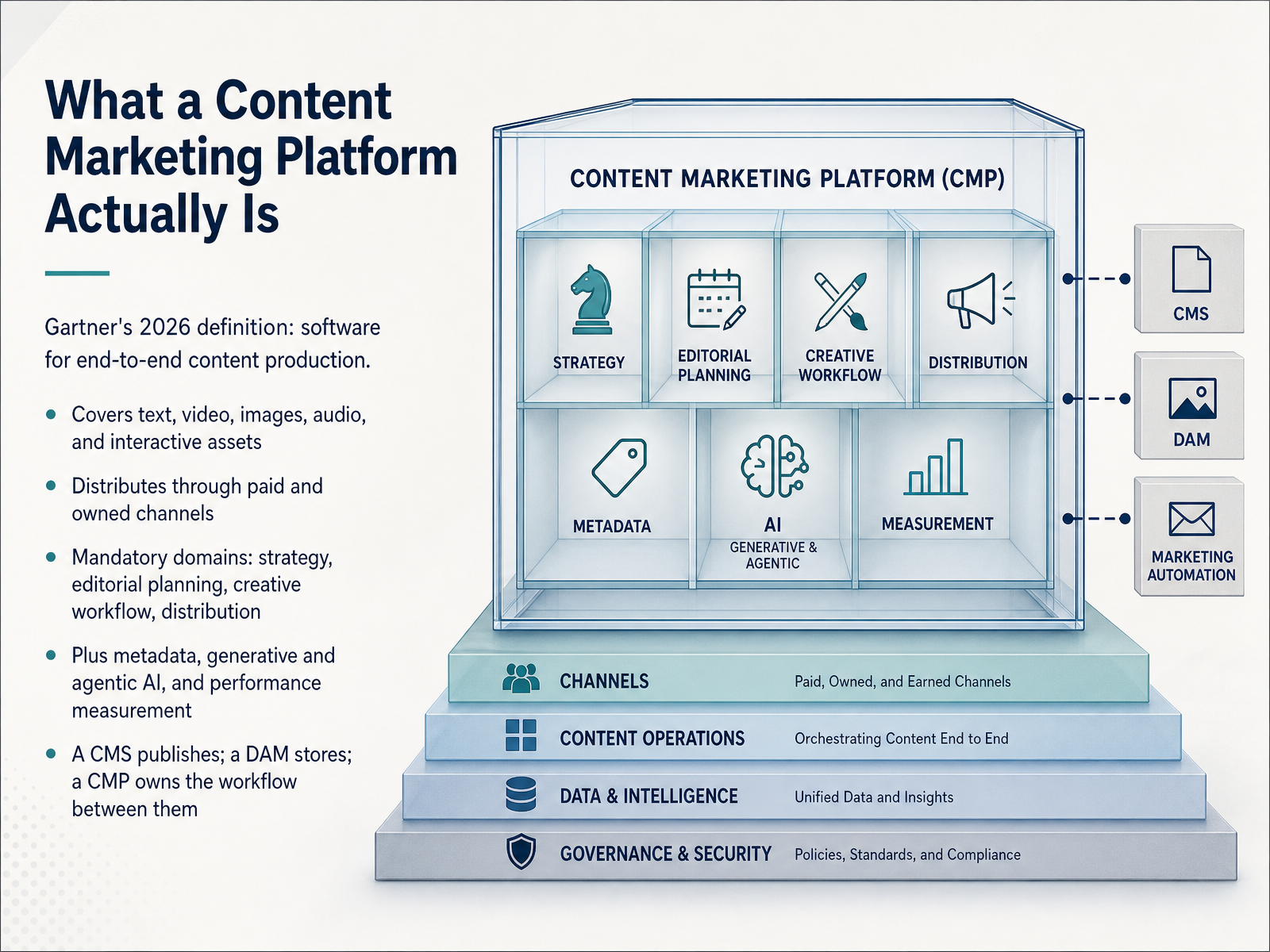
- 02What a Content Marketing Platform Actually IsLet's get precise about the category itself. Gartner's 2026 definition is a good anchor. A content marketing platform is software that supports the end-to-end content production process. That means it handles text, video, images, audio, and interactive assets, and distributes them through both paid and owned channels.
Gartner also treats several capabilities as mandatory. Content strategy. Editorial planning and calendarization. Creative workflow and approvals. Multichannel distribution. Then metadata management, generative and agentic AI, and performance measurement.
Here's the distinction that matters most in practice. A CMS publishes. A DAM stores. A CMP owns the workflow between them. It's the orchestration layer.
So when you evaluate vendors, don't just count features. Ask how one piece of content moves from brief to approval to publish to reporting. If the vendor can only show isolated screens, you may be looking at a bundle of tools, not a real platform. Next, we'll look at the pressures shaping this market in 2026.
 research.oz.spotlightar.comblog.hubspot.comcrowbert.com+22 min
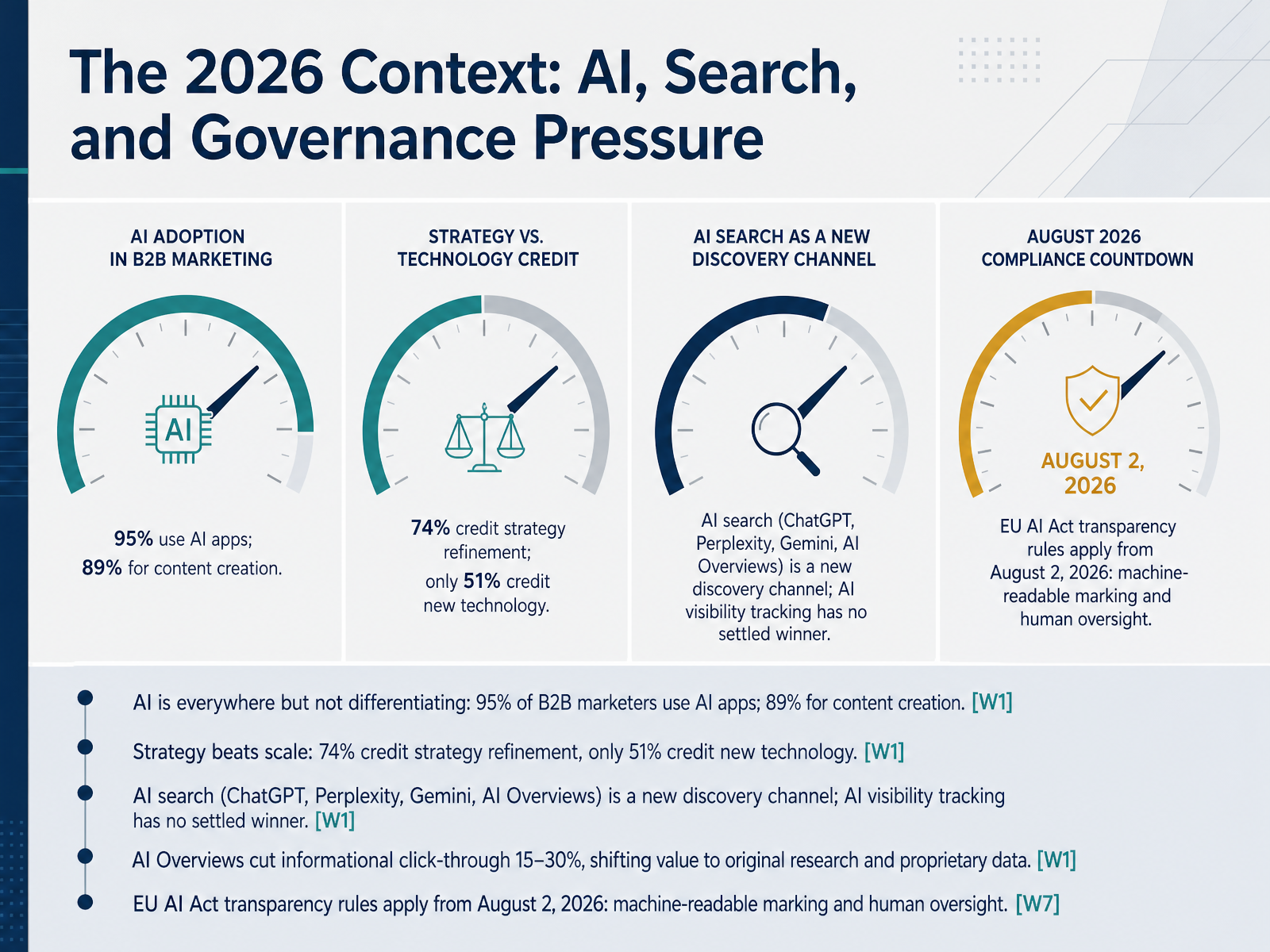
 - 03The 2026 Context: AI, Search, and Governance PressureLet's ground this in what is actually happening in 2026. Three forces shape every stack decision you make this year. First, AI. Ninety-five percent of B2B marketers now use AI applications, and eighty-nine percent use them for content creation. So AI is no longer a differentiator. It is table stakes. Second, strategy still beats scale. Among marketers whose content strategy improved, seventy-four percent credited strategy refinement, while only fifty-one percent credited new technology. Tools amplify good strategy. They do not replace it. Third, governance pressure is real. The EU AI Act's transparency rules apply from August second, 2026, requiring machine-readable marking of AI output and human oversight before publishing. Practically, that means your platform needs to track where AI touched content, enforce human approval, and keep an audit trail. Now look at discovery. AI search tools like ChatGPT, Perplexity, Gemini, and AI Overviews are becoming real channels, and AI visibility tracking has no settled winner yet. Meanwhile, AI Overviews cut informational click-through by fifteen to thirty percent. That shifts value toward original research and proprietary data, the things AI cannot synthesize. So the practical takeaway is conditional. If you produce commodity informational content at volume, the squeeze is already here. If you own unique data and expertise, you have room. Either way, governance and AI provenance belong in your requirements, not bolted on later. With that context set, let's move into Stakeholders, Requirements, and a Weighted Decision Model.
 surferstack.comcontentmarketinginstitute.comnealschaffer.com+22 min
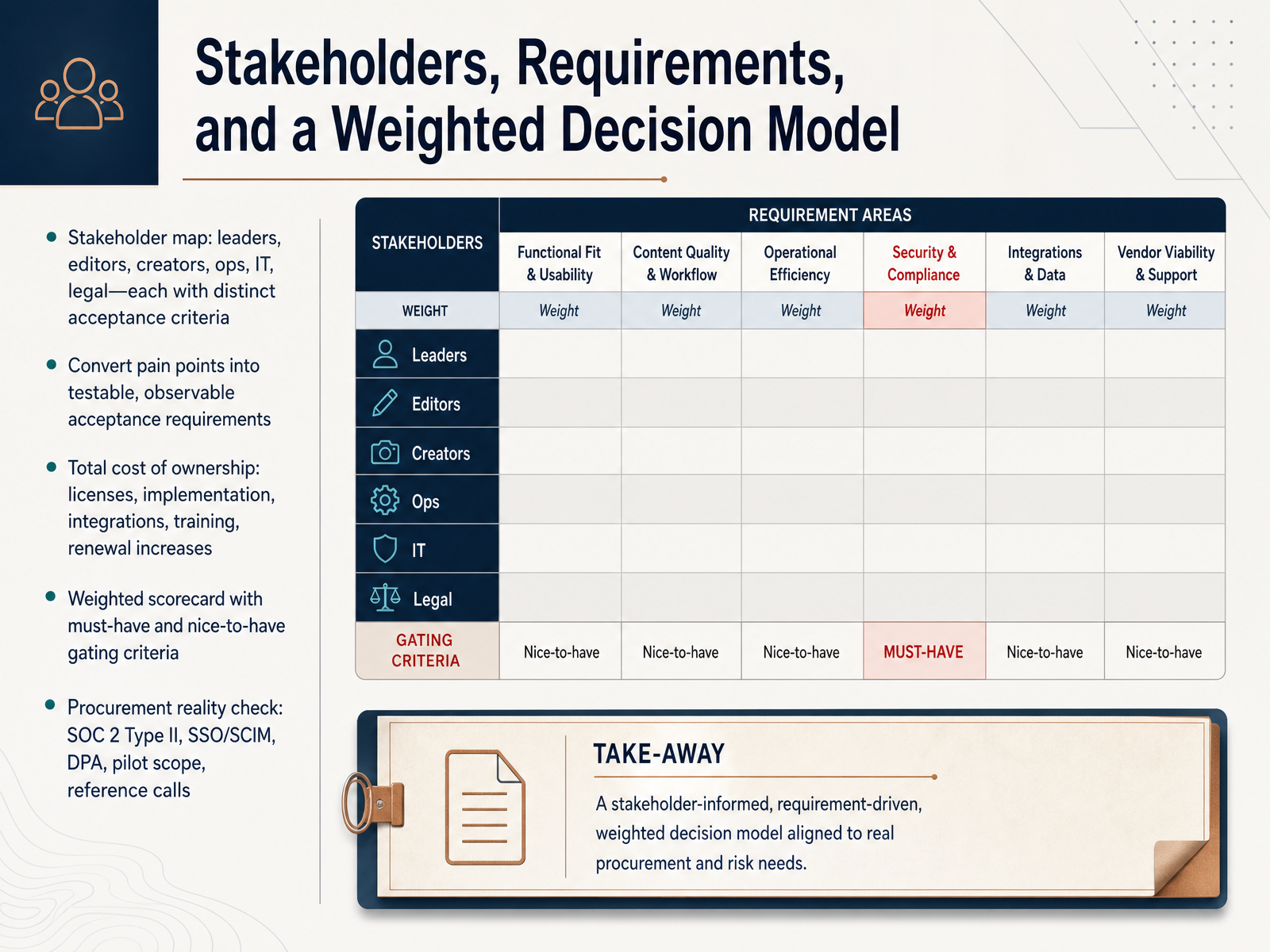
 - 04Stakeholders, Requirements, and a Weighted Decision ModelNow let's talk about who decides, and how. Start with your stakeholder map. Leaders, editors, creators, operations, IT, and legal each have different acceptance criteria. What satisfies an editor may fail your security review. So convert pain points into testable, observable requirements. Instead of saying publishing is slow, require that a brief moves from draft to approved in a defined number of steps with a full audit trail. Then model total cost of ownership honestly. Licenses, implementation, integrations, training, and renewal increases all count, not just the subscription. Build a weighted scorecard, and gate on must-haves before you score nice-to-haves. Finally, a procurement reality check. Ask for SOC 2 Type II, SSO and SCIM provisioning, a signable data processing agreement, a scoped pilot, and reference calls at your scale. If a vendor cannot pass those gates, no feature score saves them. Next, we look at the architecture choice itself. Build versus buy versus compose.
 optimizely.comfroggyads.comrfp.wiki+22 min
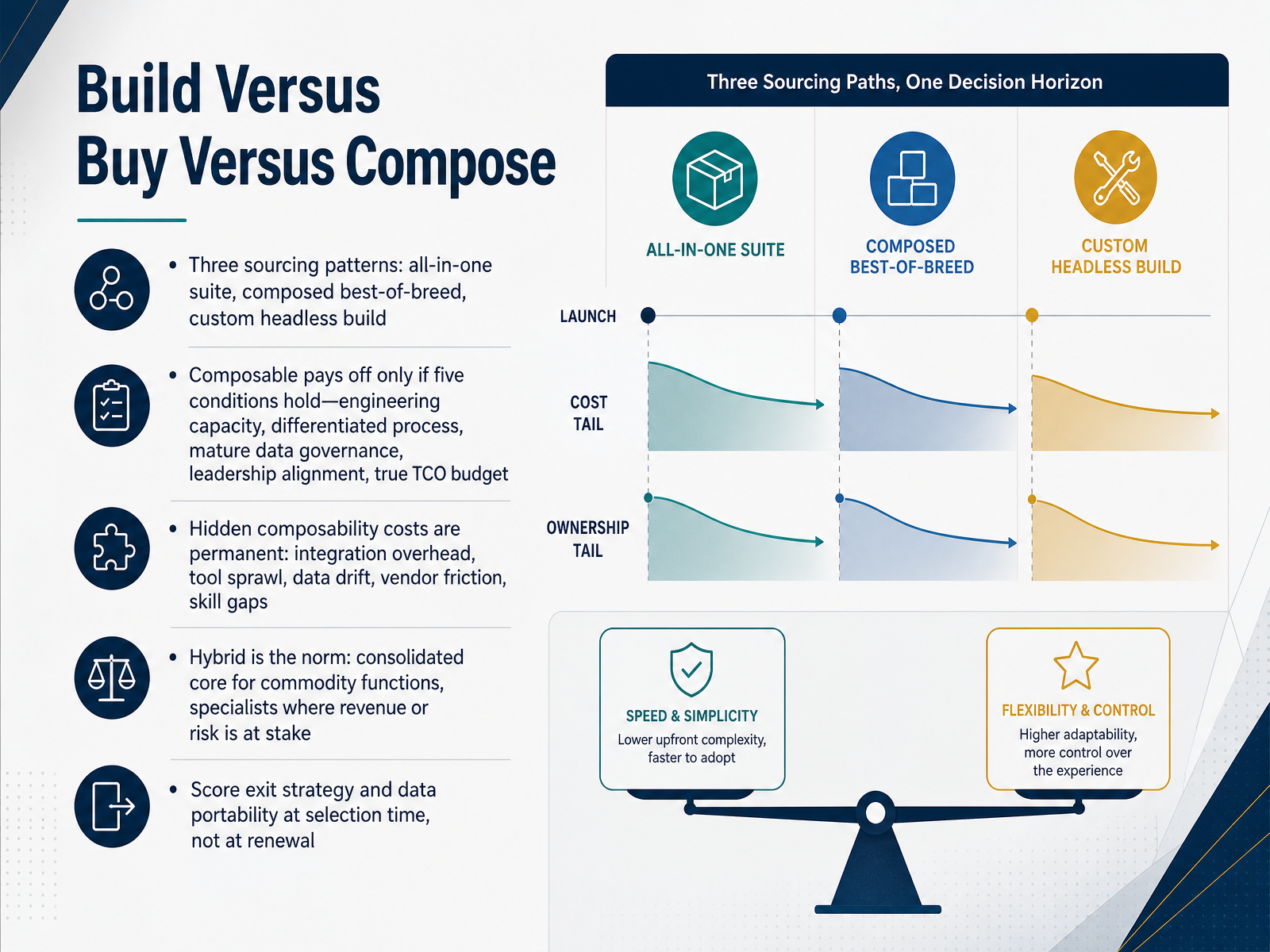
 - 05Build Versus Buy Versus ComposeNow let us talk about how you actually source the platform. There are three patterns. All-in-one suite, composed best-of-breed, and a custom headless build. Each one puts the complexity somewhere different. A suite hides it in the vendor's roadmap. A composed stack puts it on your team. Composable only pays off if five conditions hold. You have engineering capacity. Your process is genuinely differentiated. Your data governance is mature. Leadership agrees marketing tech is revenue infrastructure. And your budget covers true total cost, not just licenses. Miss two or three of those, and consolidation is the safer call. Because composability's costs are permanent, not transitional. Integration overhead, tool sprawl, data drift, vendor friction, skill gaps. That engineering tax never goes away. So hybrid is the norm. Consolidate commodity functions. Keep specialists where revenue or risk is at stake, like attribution or identity resolution. And one habit that saves you later. Score exit strategy and data portability at selection time, not at renewal. Next, we will look at a reference architecture for a content platform.
 houseofmartech.comstoryteq.comhouseofmartech.com+22 min
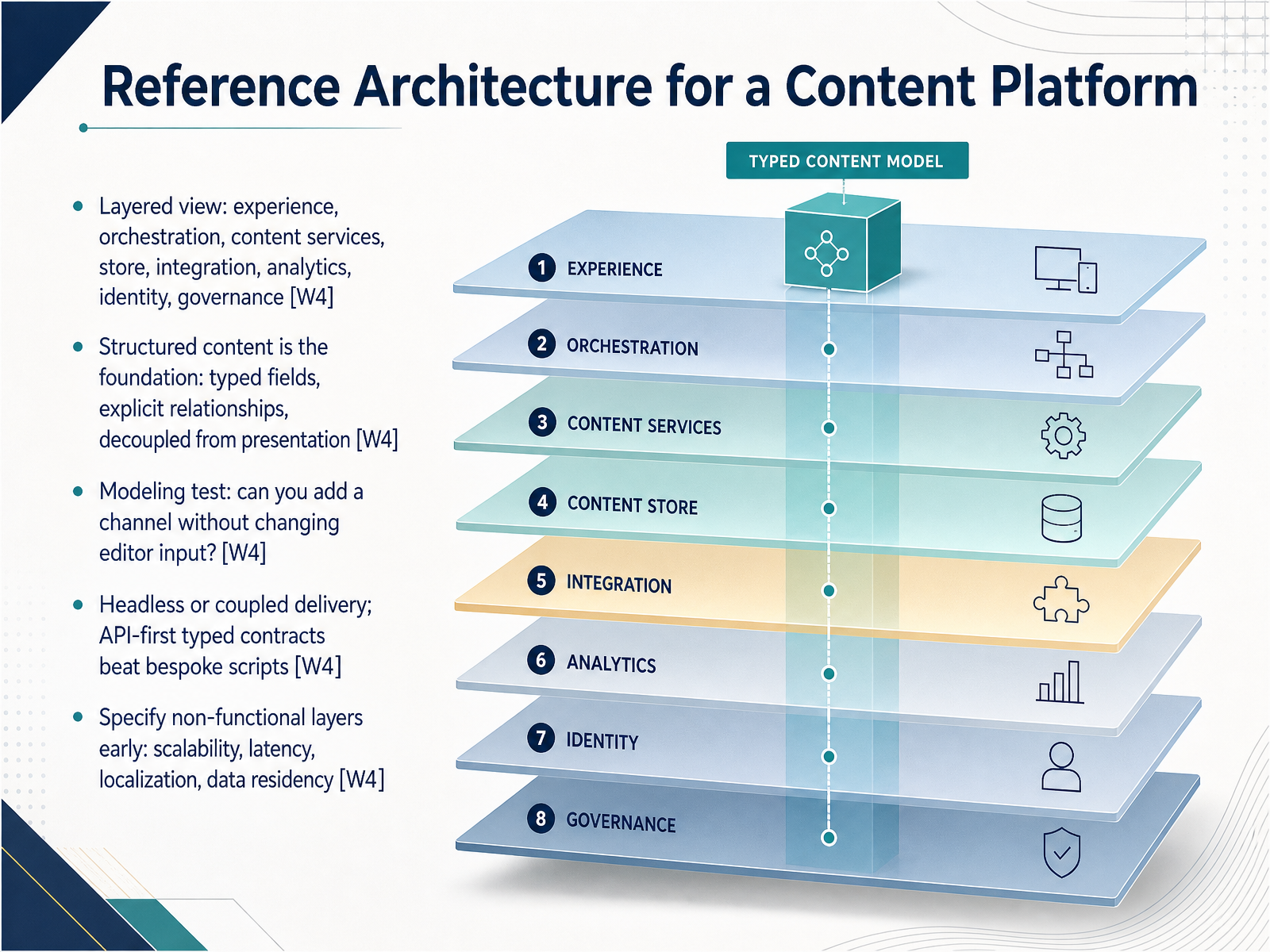
 - 06Reference Architecture for a Content PlatformLet's look at the reference architecture for a content platform. Think of it as layers: experience at the top, then orchestration, content services, the store, integration, analytics, identity, and governance. The foundation is structured content. Typed fields, explicit relationships, and no coupling to presentation. Here's a practical modeling test. Can you add a new channel, say a kiosk or a voice assistant, without changing how editors enter content? If yes, your model is genuinely decoupled. If no, you're coupled to a channel, and the composability is mostly cosmetic. On delivery, you have a choice between headless and coupled. Either way, favor API-first typed contracts over bespoke scripts. They're easier to observe, easier to replace, and they survive vendor changes. Finally, specify the non-functional layers early. Scalability, latency, localization, and data residency. These are architectural decisions, not later tuning. They shape your cost and your governance posture more than any single feature. Next, we'll move into Integrations, Data Flows, and Content Operations.
 1 min
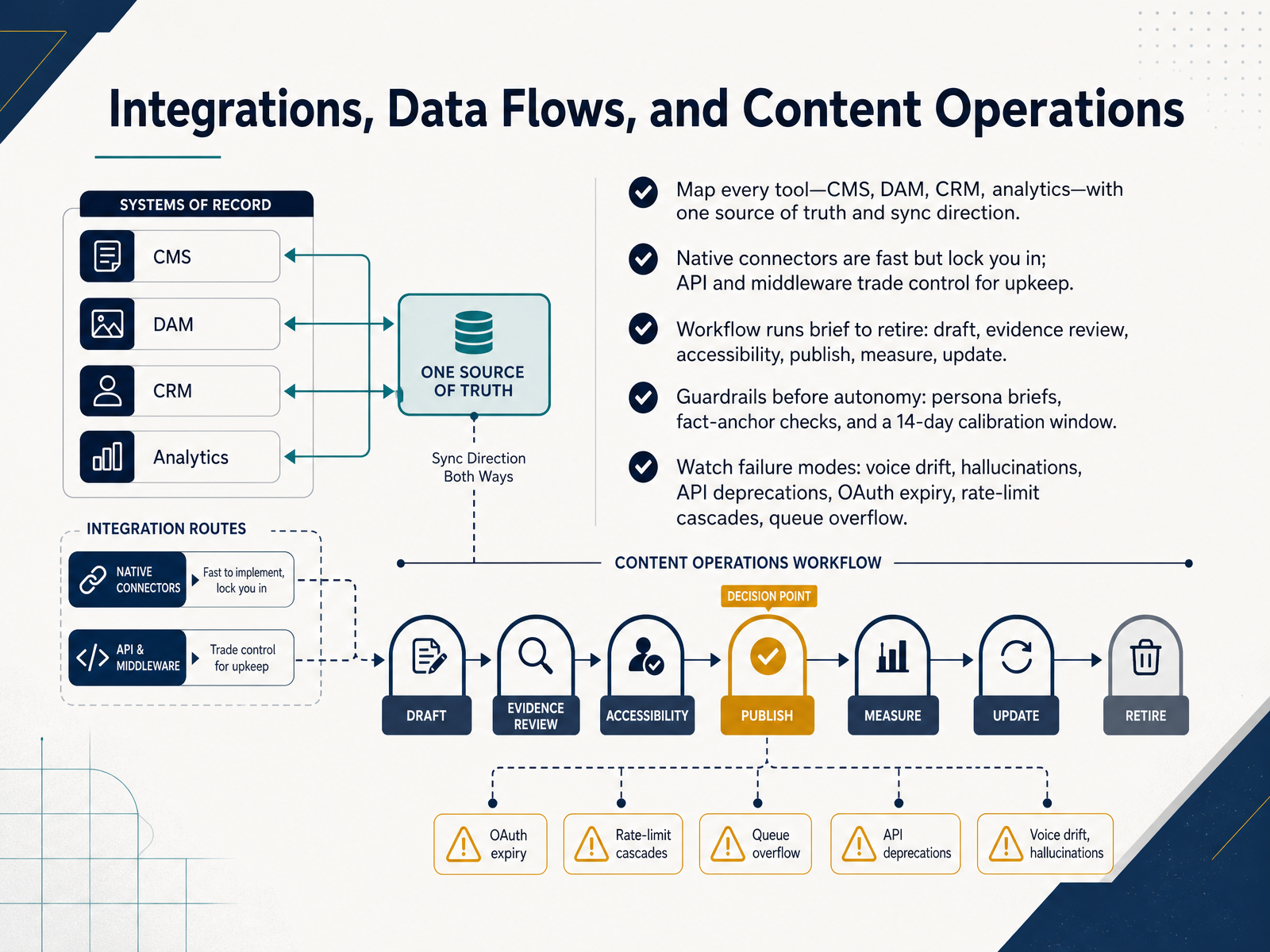
1 min - 07Integrations, Data Flows, and Content OperationsNow let's talk integrations, data flows, and content operations. Before you connect anything, map every tool in your stack: your content management system, your digital asset manager, your CRM, and your analytics. Then name one source of truth and one sync direction for each connection. Native connectors are fast, but they lock you into a vendor. API connections and middleware give you more control, but someone has to maintain them. So match the choice to your team size and volume. Next, run one workflow from brief to retire: draft, evidence review, accessibility check, publish, measure, and update. Put guardrails in place before you grant autonomy. Use persona briefs, fact-anchor checks, and a fourteen-day calibration window where you review every output. Watch for the common failure modes: voice drift, hallucinations, API deprecations, OAuth expiry, rate-limit cascades, and queue overflow. Monitor all six. The takeaway is simple. Connect fewer systems, define clear ownership, and calibrate before you automate. That leads us into the next slide, Measurement: Connecting Content to Business Outcomes.
 2 min
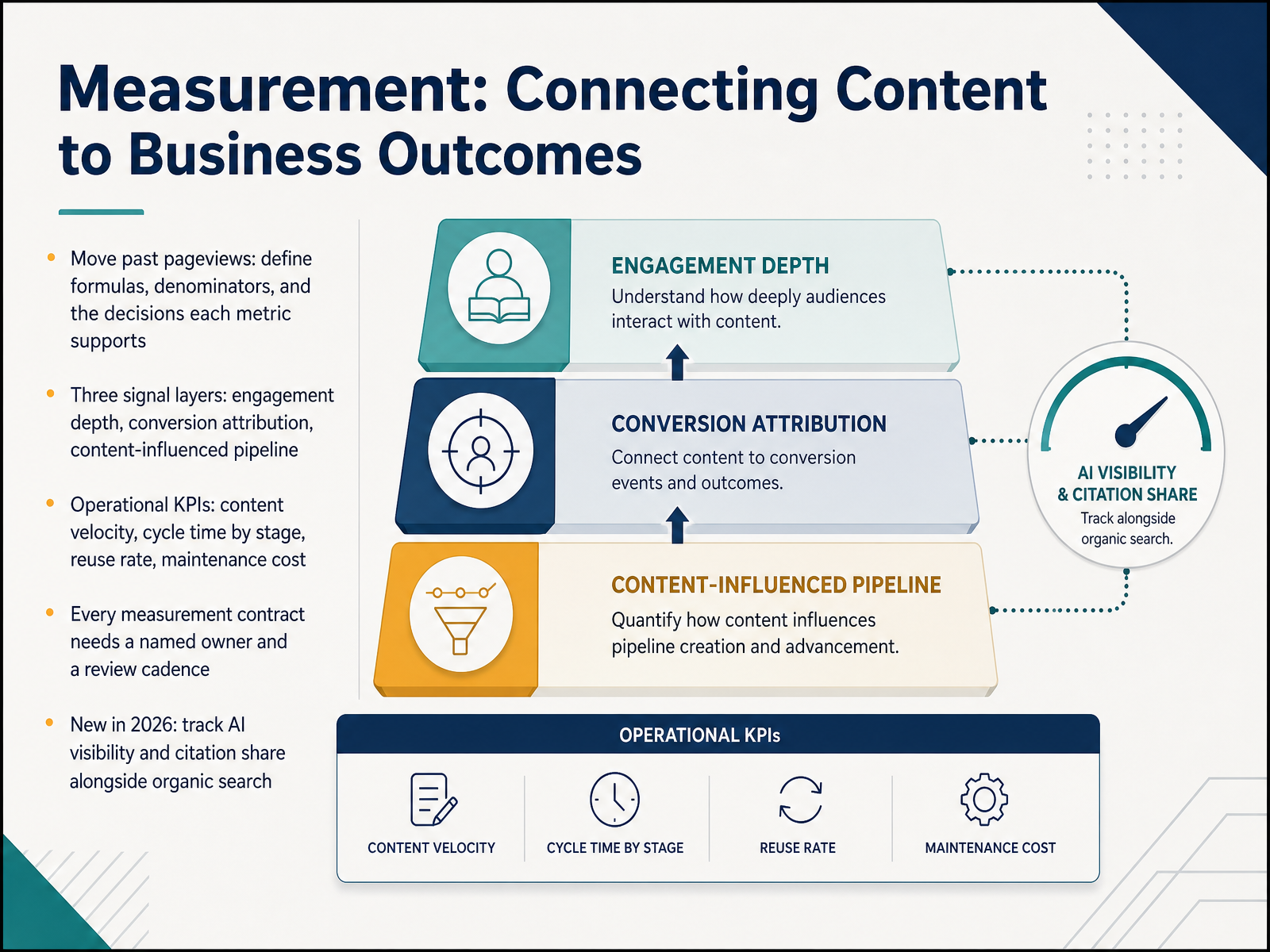
2 min - 08Measurement: Connecting Content to Business OutcomesNow let's talk about measurement, because this is where most content stacks quietly fail. Pageviews alone tell you almost nothing. Define the formula, the denominator, and the decision each metric supports before you build the dashboard. There are three signal layers. Engagement depth, conversion attribution, and content-influenced pipeline. Engagement tells you whether people read. Attribution tells you what they did next. Pipeline ties content to revenue. From there, add operational KPIs, content velocity, cycle time by stage, reuse rate, and maintenance cost. A quick example. If reuse rate is low and cycle time is rising, you are producing net-new instead of compounding existing work. Every measurement contract needs a named owner and a review cadence, or the numbers quietly drift. And new in 2026, track AI visibility and citation share alongside organic search, because ranking first in Google no longer guarantees you appear in ChatGPT or Perplexity. Pick your three signal layers, name one owner, and set a monthly review. Next, we look at governance, security, and compliance.
 surferstack.comcontentmarketinginstitute.comnealschaffer.com+22 min
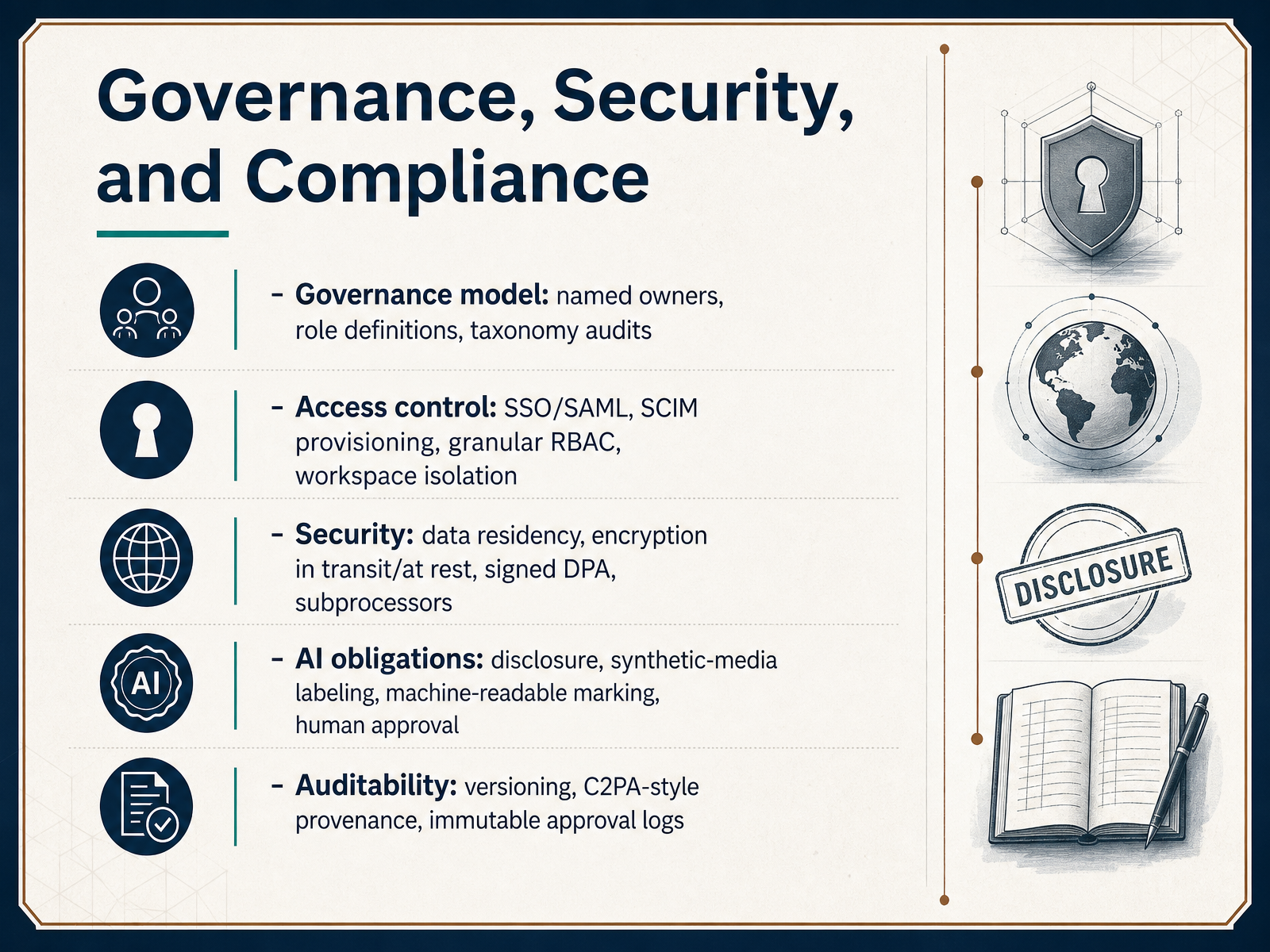
 - 09Governance, Security, and ComplianceLet's turn to governance, security, and compliance. This is where platform choices become operational. Start with the governance model. Name an owner for every content domain, define roles precisely, and schedule taxonomy audits. If nobody owns the taxonomy, it decays within a quarter. Next, access control. Require single sign on through SAML, SCIM provisioning, granular role based access, and workspace isolation. A shared login breaks your audit trail entirely. On security, verify data residency, encryption in transit and at rest, a signed data processing agreement, and a current subprocessor list. If you operate in regulated markets, residency is not optional. Then AI obligations. Disclosure when users interact with AI, labeling of synthetic media, machine readable provenance marking, and a human approval step before anything publishes. Provenance metadata must survive localization and reformatting, or the disclosure duty is missed. Finally, auditability. Versioning, C2PA style provenance, and immutable approval logs that show who edited, who approved, and when. The threshold question for your team, size, and risk exposure is whether these controls run inside the workflow or sit beside it in spreadsheets. Now let's see how to test this in practice, with scripted demos and pilots.
 2 min
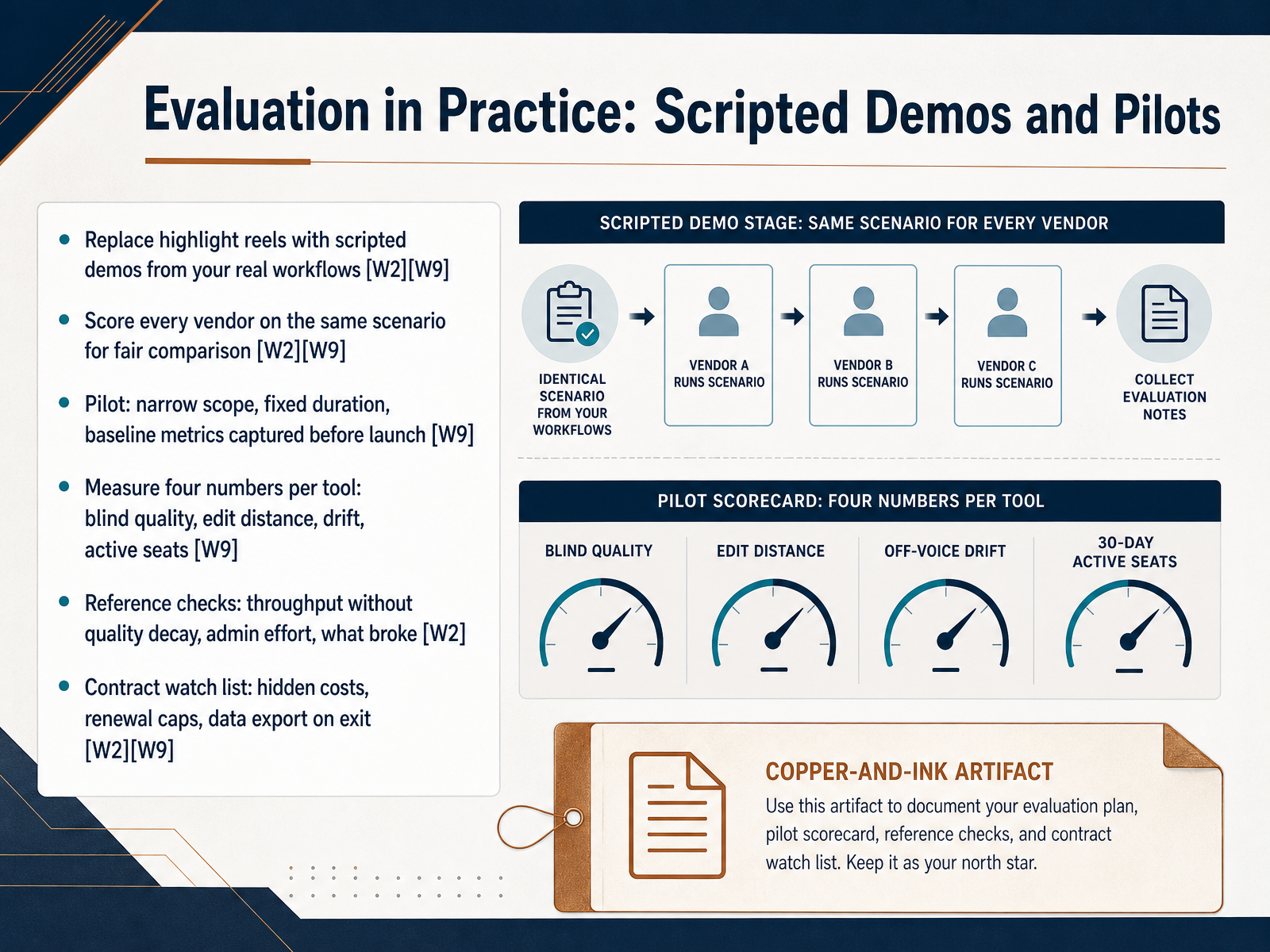
2 min - 10Evaluation in Practice: Scripted Demos and PilotsLet's move from selection criteria to how you actually evaluate vendors in practice. Two tools matter here. Scripted demos, and pilots. First, replace the highlight reel with a scripted demo built from your real workflows. Give every vendor the same scenario, then score them against the same rubric. That is the only way to compare fairly. A polished demo tells you the product can work. It does not tell you your team can work it. Next, the pilot. Keep the scope narrow and the duration fixed. Capture baseline metrics before launch, or you will have nothing to compare against. Measure four numbers per tool. Blind quality, scored without branding visible. Edit distance, from first draft to publishable. Off-voice drift. And active seats at day thirty, not logins. Then run reference checks. Ask about throughput without quality decay, admin effort, and what actually broke. Finally, the contract watch list. Hidden costs, uncapped renewals, and data export on exit. Neither a demo nor a pilot is decisive for every team. The rule is simple. Test what you will actually operate, at the scale you actually run. That brings us to tradeoffs, risks, and failure modes.
 optimizely.comfroggyads.comrfp.wiki+22 min
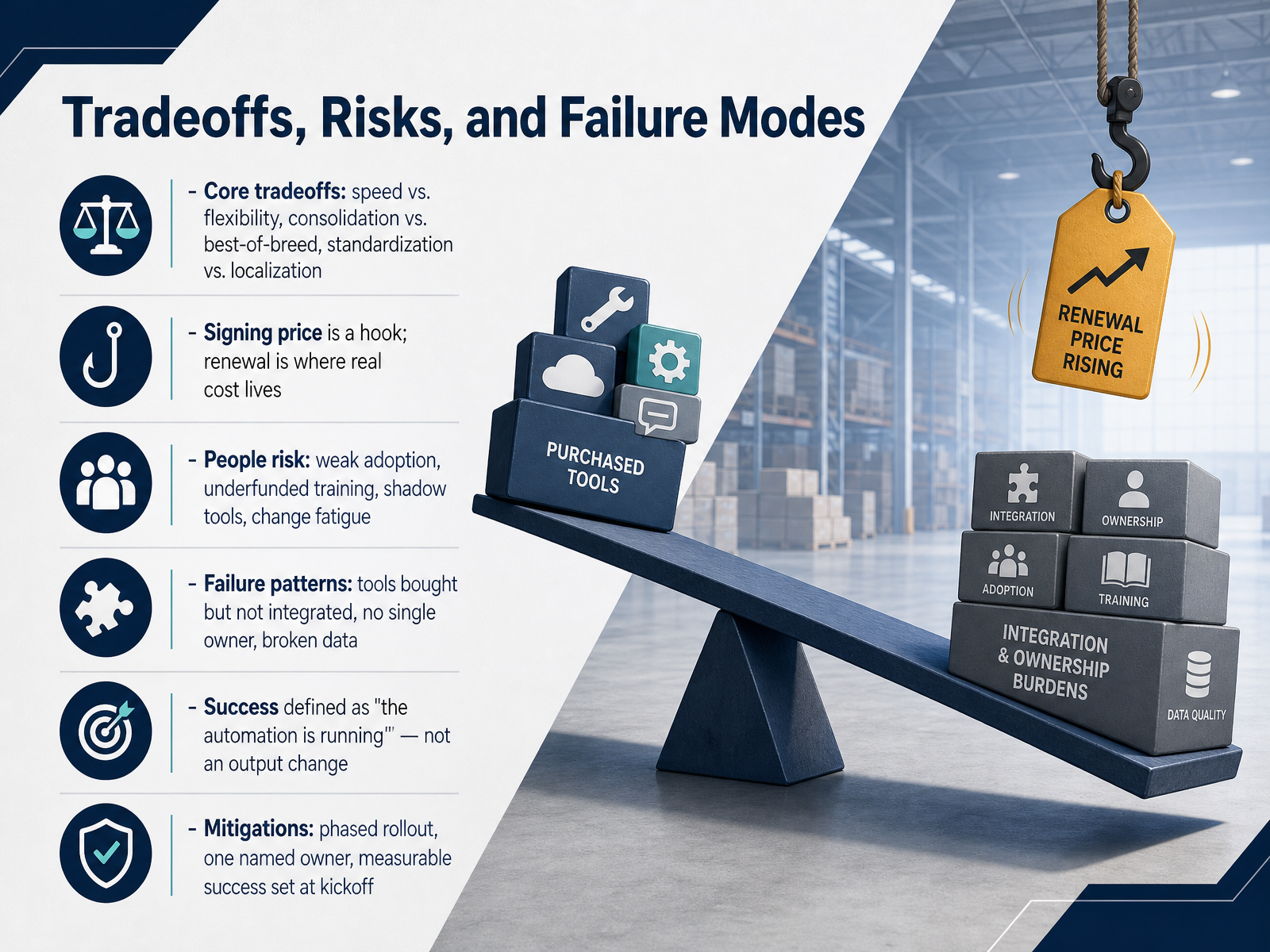
 - 11Tradeoffs, Risks, and Failure ModesNext, let's talk honestly about tradeoffs and failure modes. Every platform choice trades speed for flexibility, consolidation for best-of-breed, standardization for localization. There is no free option here. And remember, the signing price is a hook. Renewal is where the real cost lives, so negotiate renewal caps before you commit. The bigger risk is people. Weak adoption, underfunded training, shadow tools, and change fatigue kill more rollouts than bad software. 70 percent of success is people and process, not technology. Watch for the classic failure patterns: tools bought but never integrated, no single owner, and broken data producing confident garbage. Also beware defining success as the automation is running. That is not an outcome. Define success as a measurable output change, like time saved or quality scores. Mitigate with a phased rollout, one named owner, and measurable success criteria set at kickoff. Roadmap: From Decision to Rollout.
 optimizely.comfroggyads.comrfp.wiki+22 min
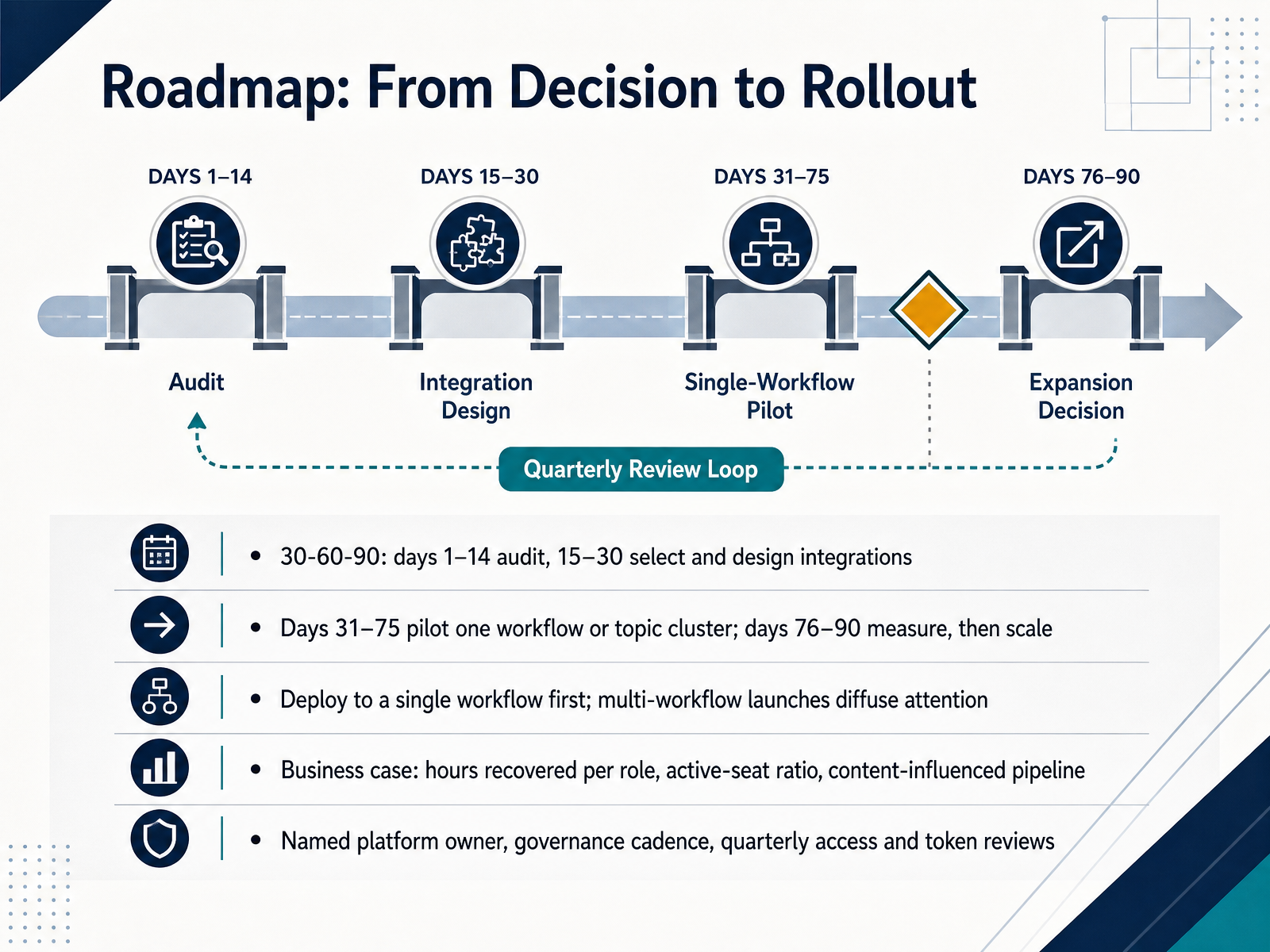
 - 12Roadmap: From Decision to RolloutLet's turn the decision into a rollout plan. Use a thirty, sixty, ninety day sequence. Days one through fourteen, audit. Days fifteen through thirty, select your platform and design the integrations. From day thirty-one to seventy-five, pilot one workflow or one topic cluster. Days seventy-six through ninety, measure, then scale. Deploy to a single workflow first. Multi-workflow launches diffuse attention and hide what is actually failing. Build the business case on hours recovered per role, active-seat ratio, and content-influenced pipeline, not pageviews. Name one platform owner, set a governance cadence, and review access and API tokens quarterly. Next, we'll pull this together in the wrap-up.
 blog.hubspot.com1 min
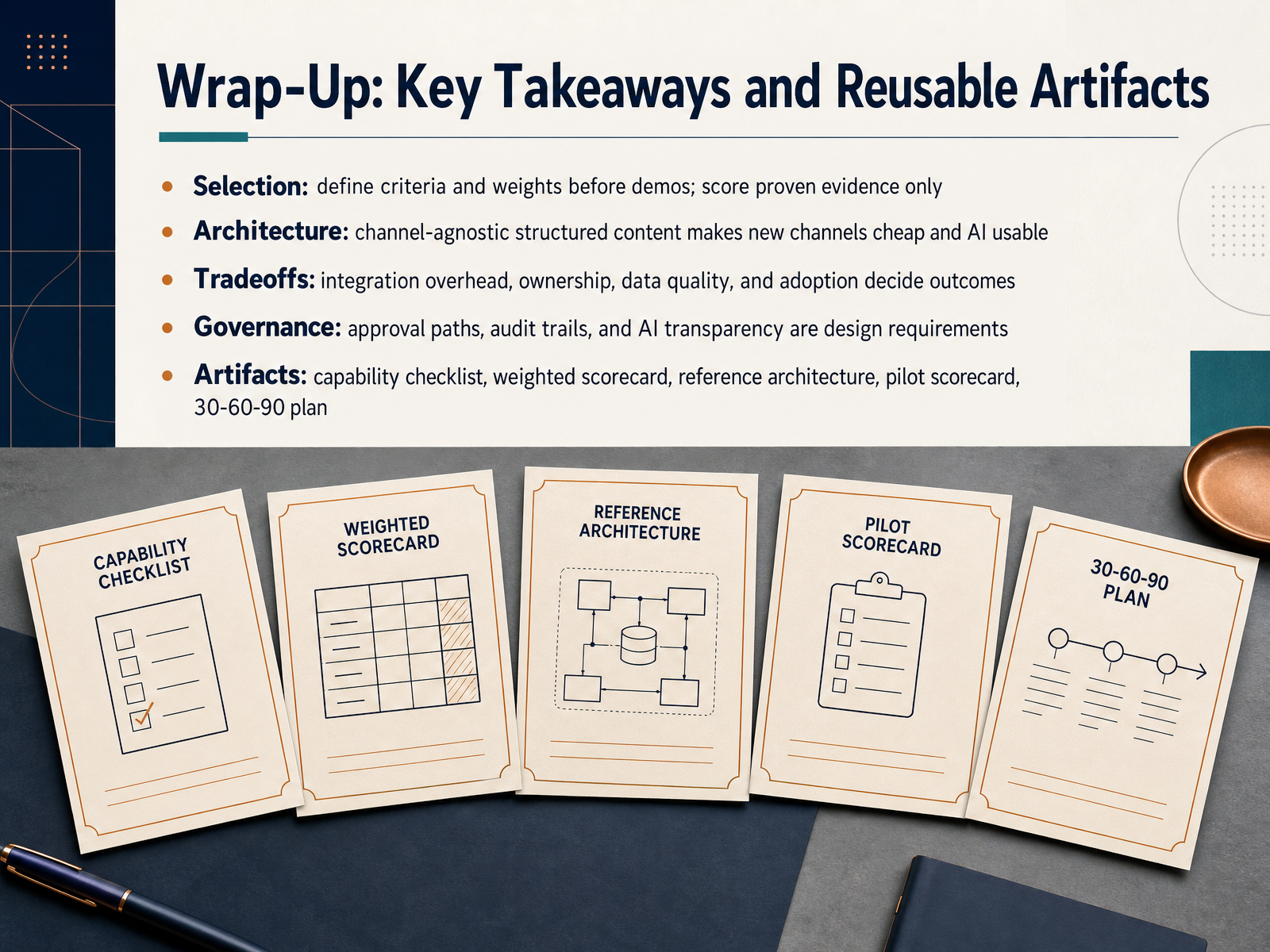
 - 13Wrap-Up: Key Takeaways and Reusable ArtifactsLet's bring this together. Five takeaways, each one a decision you can reuse.
First, selection. Define your criteria and weights before you sit through any demo. Score proven evidence only. A live walkthrough at your scale counts. A roadmap slide does not.
Second, architecture. Channel-agnostic structured content is the investment that keeps paying. Model content as data, not pages, and every new channel gets cheap, and your AI tools actually have something clean to work from.
Third, tradeoffs. Integration overhead, ownership, data quality, and adoption decide outcomes. A best-of-breed stack shifts complexity from the vendor to your team. That is a real, permanent cost.
Fourth, governance. Approval paths, audit trails, and AI transparency are design requirements, not options you add later.
And fifth, the artifacts. Keep them and reuse them. The capability checklist, the weighted scorecard, the reference architecture, the pilot scorecard, and the thirty, sixty, ninety day plan.
That is the wrap. Choose deliberately, govern early, and measure against outcomes, not activity. Thank you for working through this with me, and good luck with your evaluation.
 optimizely.comfroggyads.comrfp.wiki+22 min
Take the deck with you
Download this course as a file — free, no sign-up needed.
- PDF handoutEvery slide page, ready to print or share.14 pages · 3.7 MBDownload
- Narrated PowerPointThe deck that presents itself — every slide carries the digital human's narration video.14 pages · 14.7 MBDownload
- PowerPoint slidesThe full deck as a .pptx — open it in PowerPoint, Keynote, or Google Slides.14 pages · 3.6 MBDownload
Free to use in your own training — please keep the PersonWise credit page at the end.
Have your own deck? Turn it into a course
Sources consulted
Web sources consulted while building this course.
- How to Build a Content Marketing Tech Stack in 2026: Research, Creation, Optimization & Distribution – Surferstack — surferstack.com
- Technology Content and Marketing Trends: 2026 Insights — contentmarketinginstitute.com
- 25 Content Marketing Tools I Recommend for 2026 — nealschaffer.com
- Best Content Marketing Tools: The Top 20 for Next-Level Success in 2026 — blog.hubspot.com
- Stop Tool Chaos: Build Your Content Stack for 2026 — contentship.io
- Magic Quadrant for Content Marketing Platforms — research.oz.spotlightar.com
- Best content marketing platforms: Our 2026 picks for scaling websites — blog.hubspot.com
- What Is a Content Marketing Platform? the 2026 Guide — crowbert.com
- What is a Content Marketing Platform? | Sitecore — sitecore.com
- What Is a Content Marketing Platform? The 2025 Guide B2B Marketers Actually Need — omnibound.ai
- Free RFP template for content marketing platforms — optimizely.com
- Content Marketing Platform: Requirements, Features and Selection Guide | FroggyAds — froggyads.com
- Best Content Marketing Platforms (CMP) Suppliers 2026 — rfp.wiki
- Content Marketing & Distribution System RFP Template — demandmetric.com
- Buying Content Marketing for 500+ People? Here's What to Demand | Listicler — listicler.com
- Composable MarTech: Best-of-Breed vs All-in-One Suites — houseofmartech.com
- How To Choose Between All-In-One Vs Best-Of-Breed Content Marketing Platforms | Storyteq — storyteq.com
- Composable MarTech vs All-in-One: 2026 Decision Guide — houseofmartech.com
- Composable Marketing Stack: Best-of-Breed vs Suite — How to Choose the Right Architecture | Hashmeta — hashmeta.com
- The hidden tradeoffs in moving to a composable martech stack | Harro — harro.com