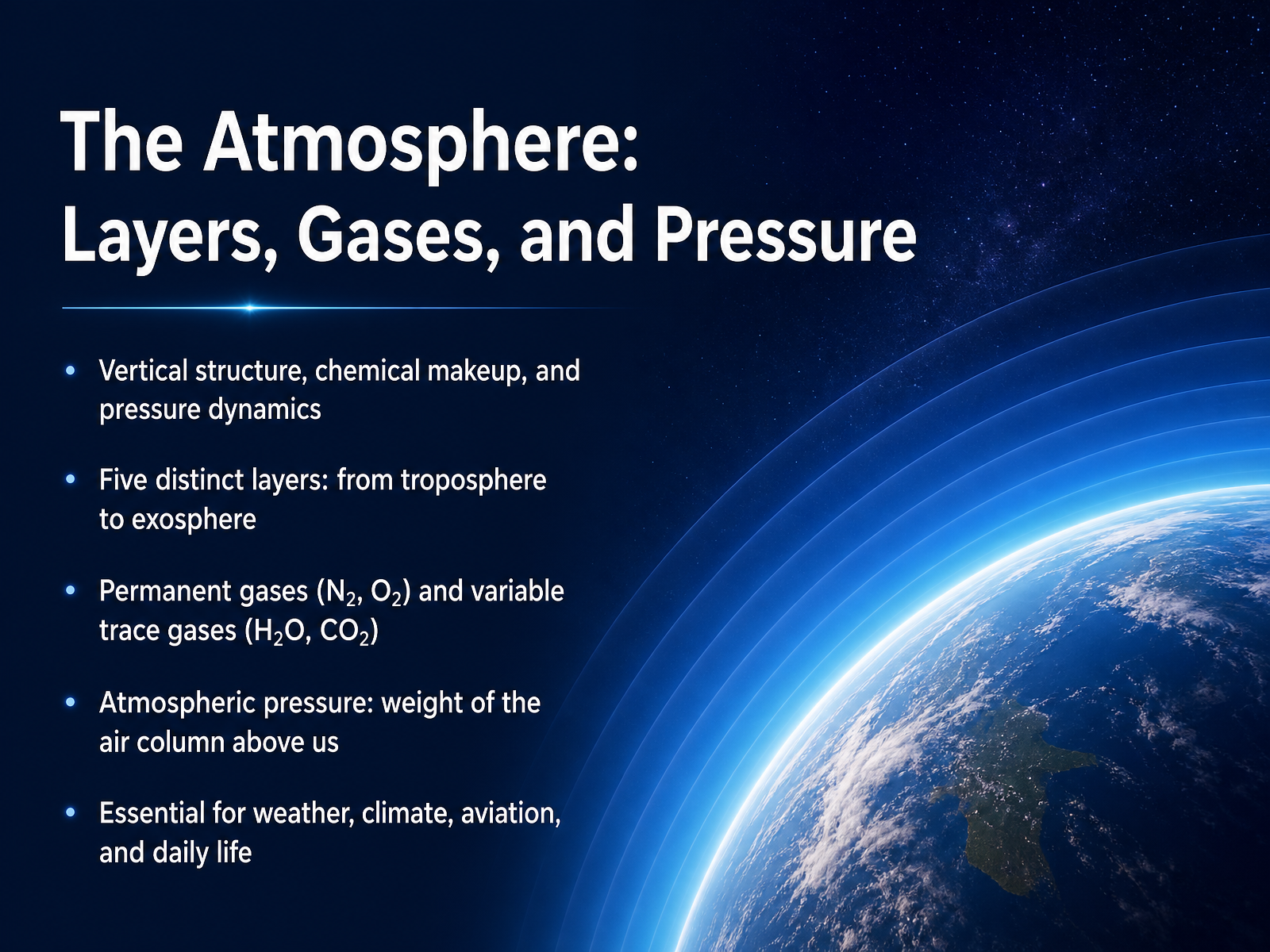
Atmosphere: Layers, Gases, and Pressure
Begin
15 pages · ~30 min
Atmosphere: Layers, Gases, and Pressure
This training provides an overview of the atmosphere's layers, composition, and pressure, designed for learners seeking foundational knowledge in atmospheric science.
What you’ll learn
- 01The Atmosphere: Layers, Gases, and PressureWelcome. In this lesson, we're going to build a clear mental model of the atmosphere: what it's made of, how it's layered, and how pressure works within it. Let's start with the big picture. Our atmosphere is a thin, protective blanket of gases held to the Earth by gravity. We'll explore its vertical structure, from the ground all the way out to space, and look at its chemical makeup—gases like nitrogen and oxygen that are always there, plus trace gases like water vapor and carbon dioxide that can vary. A key concept we'll cover is atmospheric pressure. Think of it simply as the weight of the entire column of air pushing down on a point. It's similar to how a tall stack of books feels heavier on the bottom book. Understanding this three-part model—the layers, the gases, and the pressure—is essential because it's the foundation for weather, climate, how airplanes fly, and countless aspects of daily life. Let's begin by looking at why this blanket of air is so important.2 min
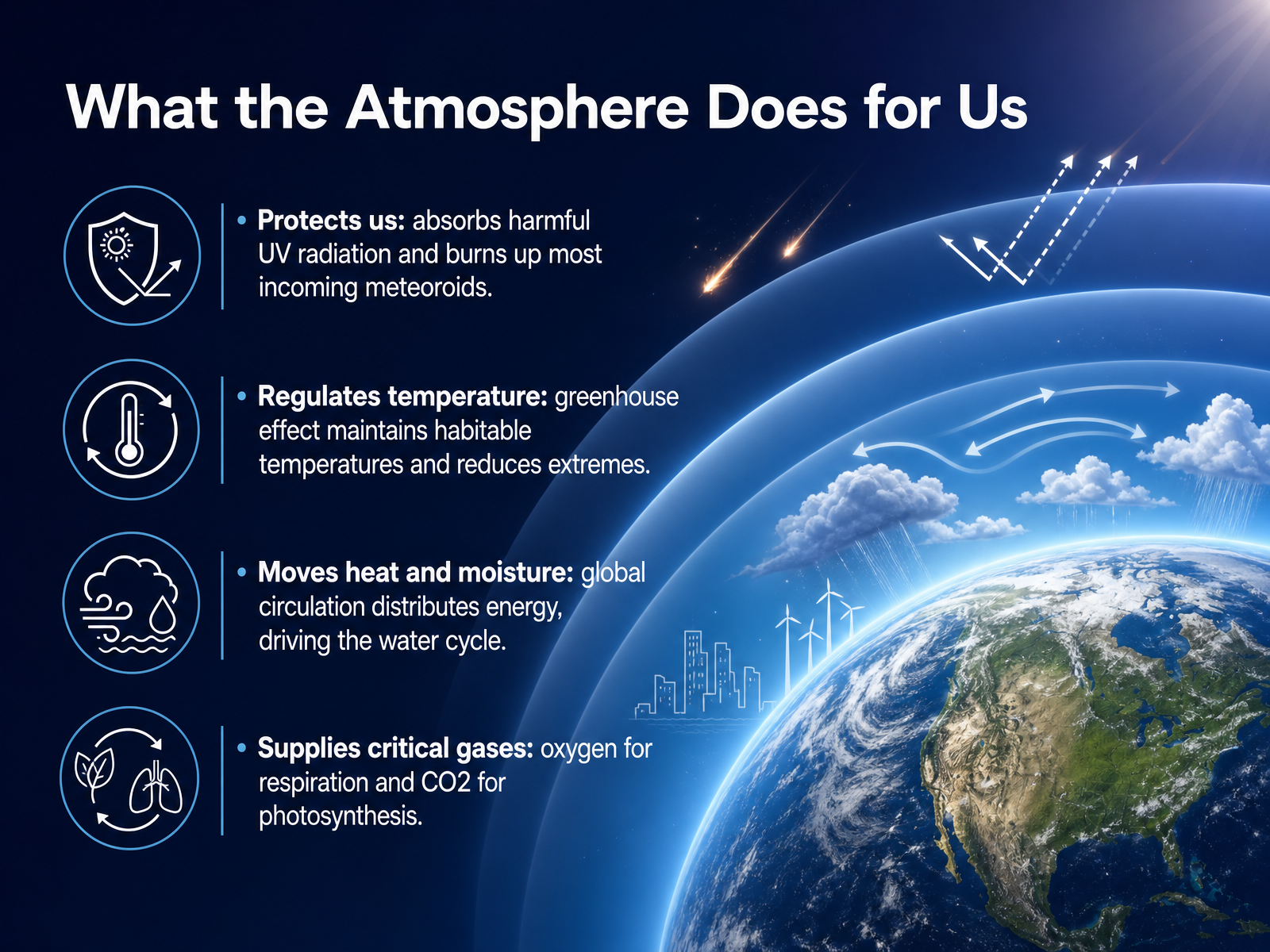
- 02What the Atmosphere Does for UsNow that we've set the stage, let's look at what the atmosphere actually does for us. First, it acts as a protective shield. It absorbs harmful ultraviolet radiation from the sun and burns up most incoming meteoroids before they can reach the ground. Second, the atmosphere regulates our planet's temperature. Through what we call the greenhouse effect, certain gases trap just enough heat to keep temperatures livable and reduce extreme swings between day and night. Third, the atmosphere is constantly moving heat and moisture around the globe. This global circulation drives our weather and powers the water cycle. Finally, it supplies the critical gases life depends on. We breathe in oxygen for respiration, and plants take in carbon dioxide for photosynthesis. In short, the atmosphere is a life-support system that protects, warms, and connects our world. Next, we'll explore the sheer scale of this invisible ocean of air by looking at its mass.
 1 min
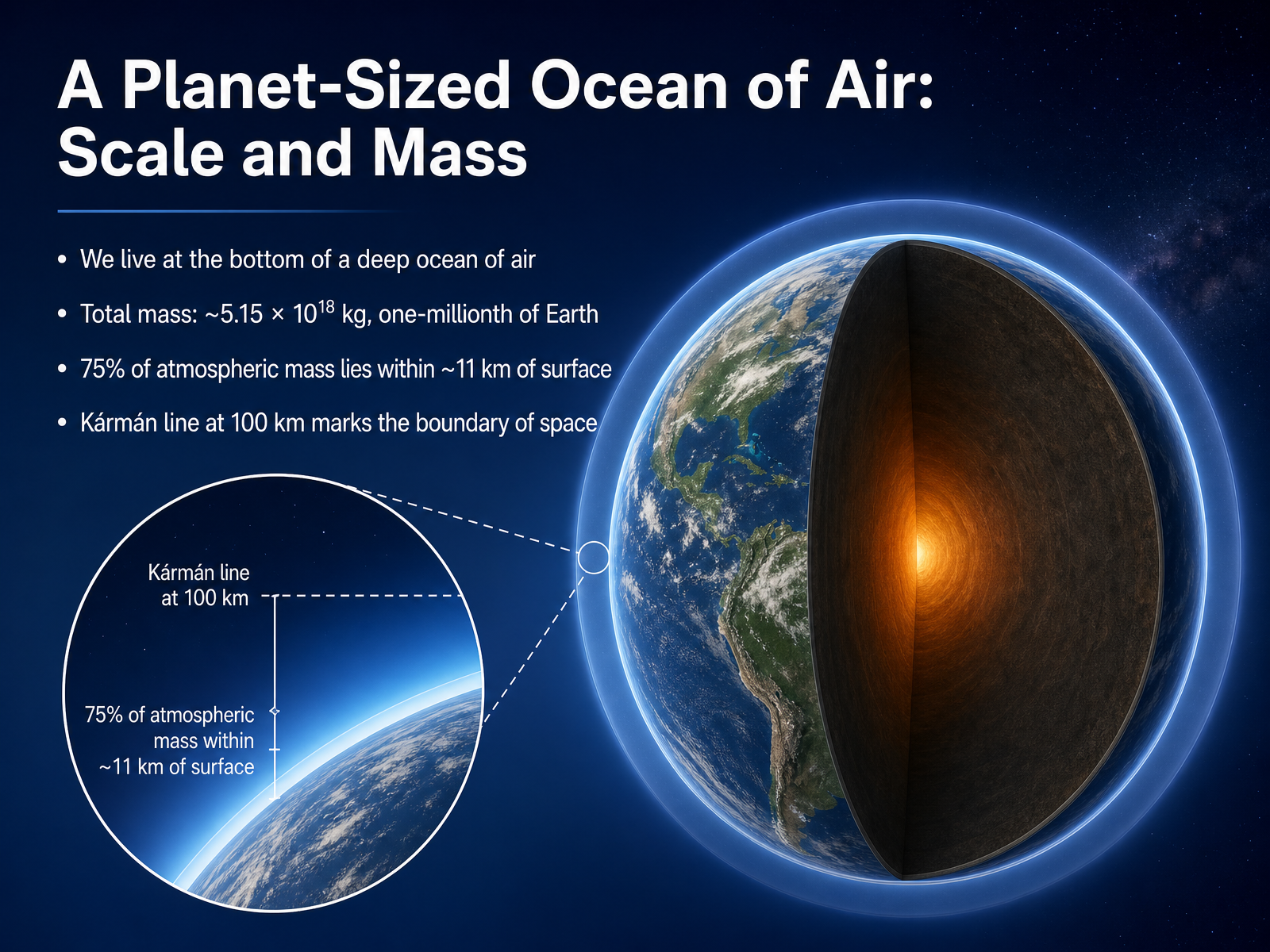
1 min - 03A Planet-Sized Ocean of Air: Scale and MassNow, let's picture the atmosphere as a planet-sized ocean of air. We live at the bottom of this deep air ocean, much like creatures on the seafloor. The total mass of all this air is about 5 point 15 times 10 to the 18th kilograms. That's only about one-millionth of Earth's total mass. Even so, air is surprisingly heavy. In fact, 75 percent of the atmosphere's mass is packed into the lowest 11 kilometers above the surface. That's the layer where all our weather happens. The atmosphere eventually thins out as you go up. Scientists define the Kármán line, at an altitude of 100 kilometers, as the official boundary where space begins. Next, we will look at how we divide this vertical structure into distinct layers.
 1 min
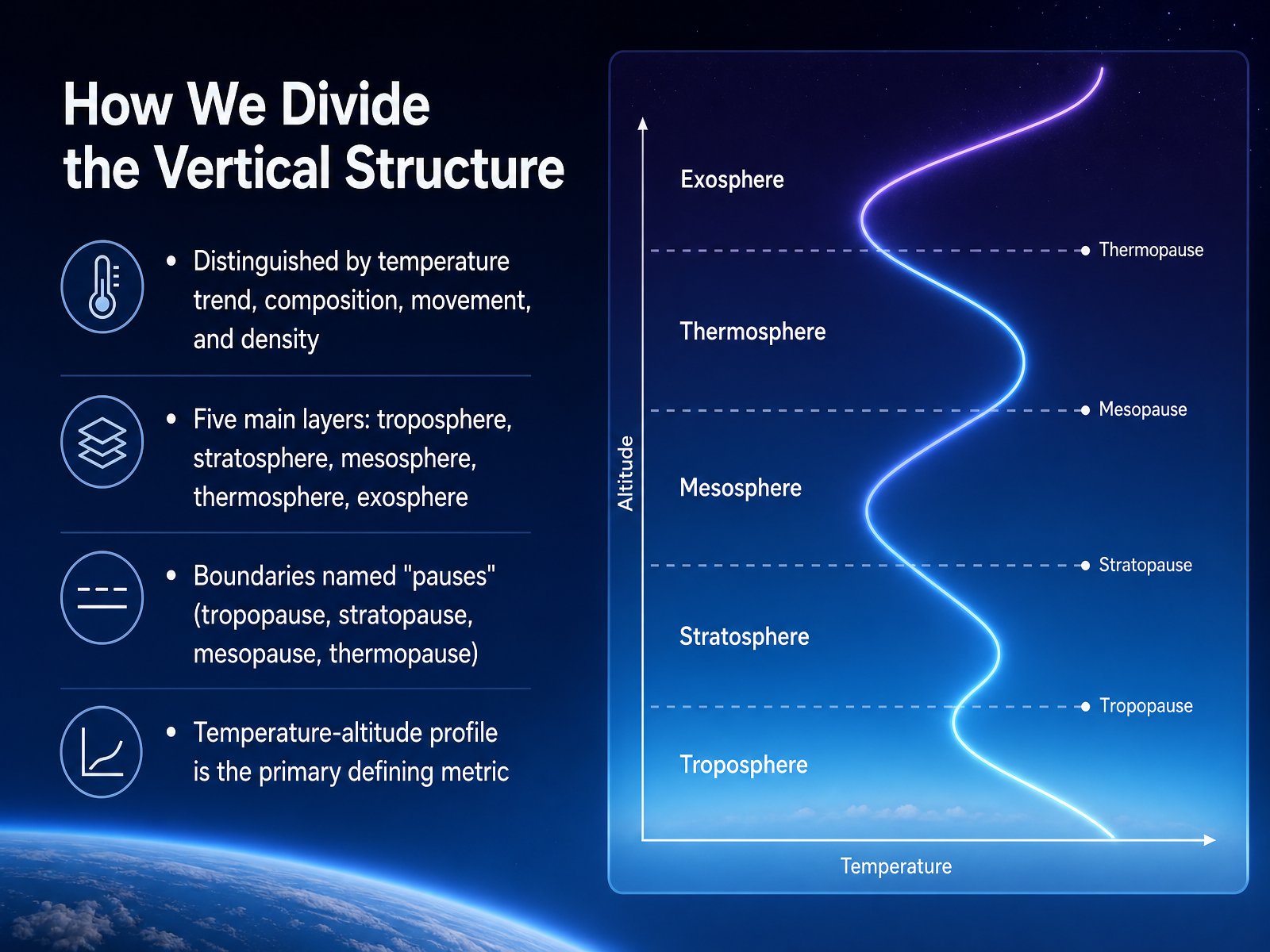
1 min - 04How We Divide the Vertical StructureLet's now talk about how scientists divide the atmosphere vertically. They use four key characteristics: how temperature changes with height, the chemical composition, how air masses move, and the overall density. Based on these factors, we identify five main layers. Starting from the ground up, they are the troposphere, stratosphere, mesosphere, thermosphere, and exosphere. The boundaries between these layers are called pauses, a term that means a stopping point. For example, the tropopause sits between the troposphere and stratosphere. We also have the stratopause, mesopause, and thermopause. The most important way to tell these layers apart is by their temperature profile, meaning how air temperature increases or decreases as you go higher. Next, we'll explore the first layer in detail: the troposphere, which is where our weather lives.
 1 min
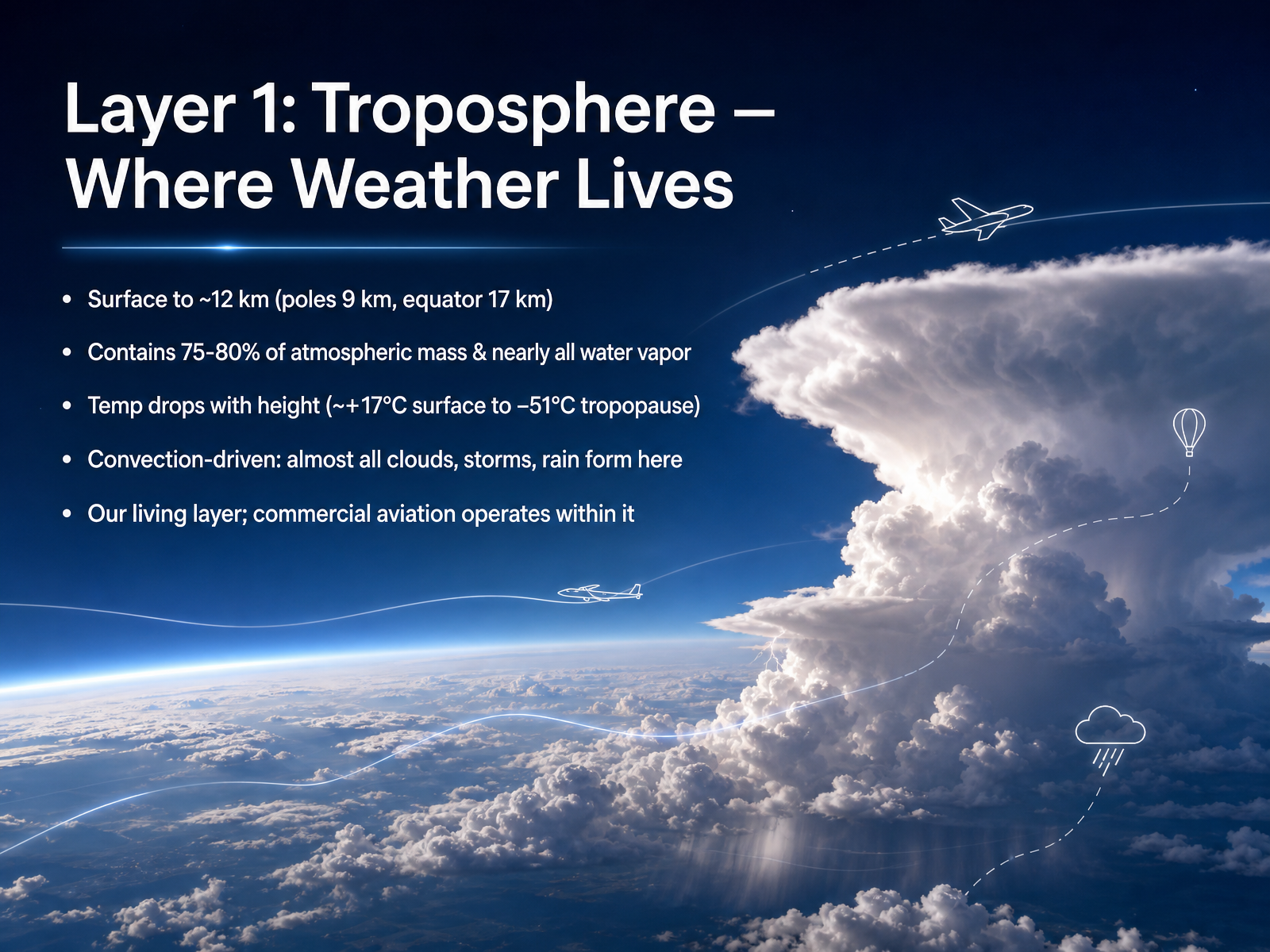
1 min - 05Layer 1: Troposphere — Where Weather LivesNow let's begin our climb through the first and most active layer, the troposphere. The word itself gives us a clue: the Greek root 'tropos' means 'turning' or 'mixing,' which describes this layer perfectly. The troposphere starts at the surface and reaches up to an average of about twelve kilometers. It's a bit thinner at the poles, around nine kilometers, and thicker at the equator, up to seventeen kilometers. Though it is the thinnest layer, do not let that fool you. It contains seventy-five to eighty percent of the entire atmosphere's mass and almost all of its water vapor. Because the sun heats the surface, not the air directly, the temperature here drops steadily as you go up. It begins at an average of plus seventeen degrees Celsius and falls to minus fifty-one degrees at the top, a boundary we call the tropopause. This temperature difference drives convection, the constant churning and mixing of air. This is why almost every cloud, thunderstorm, and raindrop forms right here. It's our living layer, where we breathe and where commercial airplanes typically fly. Next, we'll move above the weather to a calmer region: the stratosphere, home of the protective ozone layer.
 2 min
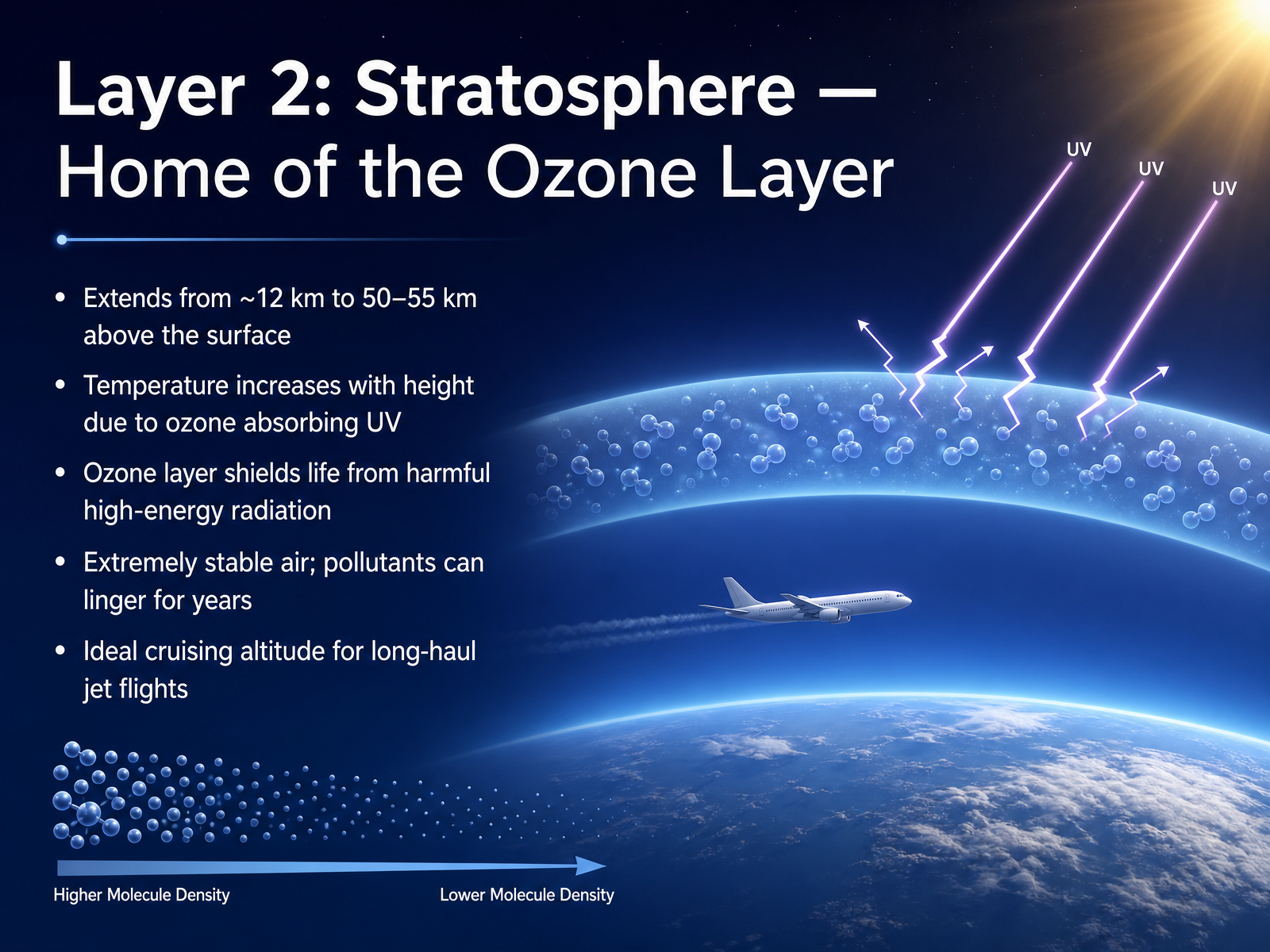
2 min - 06Layer 2: Stratosphere — Home of the Ozone LayerMoving above the troposphere, we enter the second layer: the stratosphere. This layer extends from about 12 kilometers up to around 50 or 55 kilometers above the Earth's surface. Here, something interesting happens with temperature. It actually increases as you go higher. Why? Because of the ozone layer. Ozone molecules absorb the Sun's harmful ultraviolet, or UV, radiation, and this process heats the upper stratosphere. This ozone layer acts like a protective shield, blocking most of that high-energy radiation and making life on the surface possible. Another key feature is that the stratosphere is extremely stable. The air doesn't mix much vertically, which means pollutants that reach this layer—like volcanic ash or certain chemicals—can linger for years. This stability is also why commercial long-haul jets cruise at the base of the stratosphere, where the smooth, stable air allows for a more efficient and comfortable flight. Next, we'll continue our ascent into the mesosphere, the coldest region of the atmosphere.
 2 min
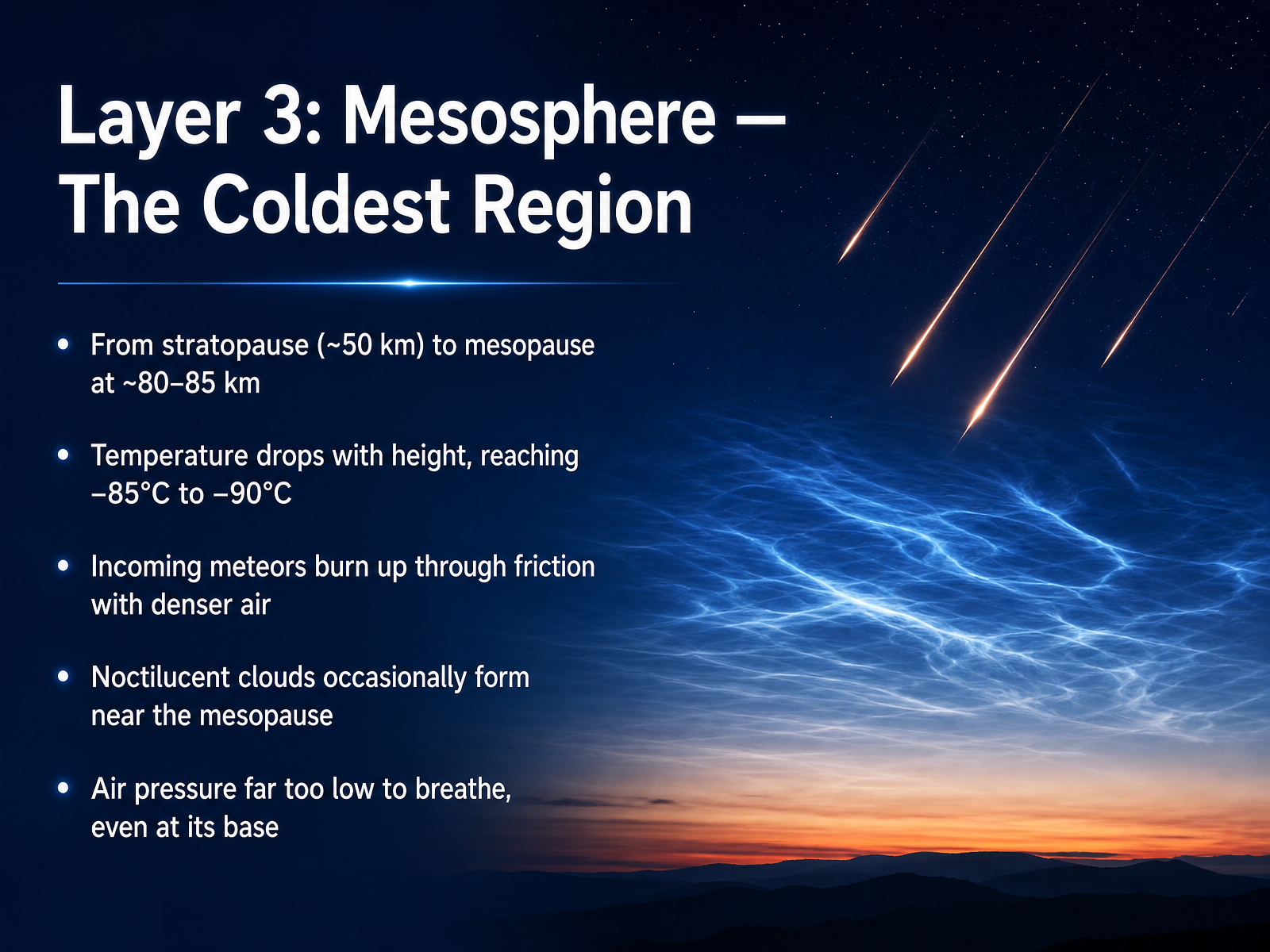
2 min - 07Layer 3: Mesosphere — The Coldest RegionMoving higher, we enter the third layer: the mesosphere. This region stretches from about fifty kilometers up, at a boundary called the stratopause, to roughly eighty or eighty-five kilometers, at the mesopause. The defining trait here is that temperature plunges with altitude. In fact, near the top, it can drop to minus eighty-five or even minus ninety degrees Celsius, making the mesosphere the coldest part of our atmosphere. Though the air is incredibly thin, there is still just enough gas to create friction. This is what burns up most meteors, creating those brilliant streaks of light we call shooting stars. On rare occasions, you might also find noctilucent, or night-shining, clouds forming as ice crystals near the frigid mesopause. Remember, even at the base of this layer, the air pressure is far too low for a human to breathe. Next, we will heat things up dramatically as we move into the thermosphere, a realm of intense energy and extremely thin air.
 2 min
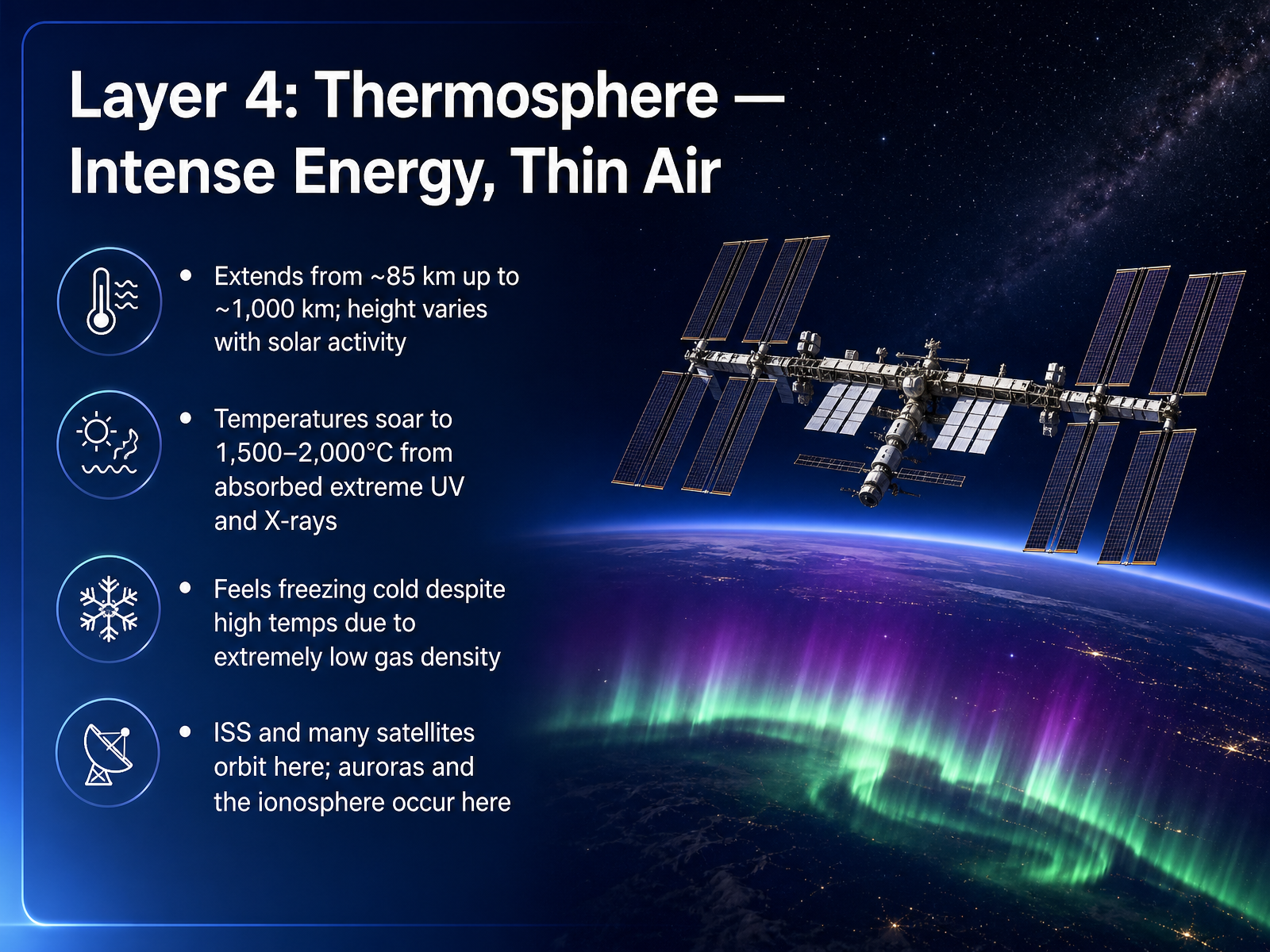
2 min - 08Layer 4: Thermosphere — Intense Energy, Thin AirNow we rise into the thermosphere, the fourth layer, stretching from about eighty-five kilometers to a thousand kilometers high. The top boundary actually expands and contracts with the sun's activity. Here, intense extreme ultraviolet and X-ray radiation from the sun is absorbed, causing temperatures to soar up to two thousand degrees Celsius. But it would feel freezing cold because the air is incredibly thin. Think of it this way: temperature measures how fast individual particles are moving, but with so few particles around, very little heat energy would transfer to your skin. This is the realm of the International Space Station and many satellites. It is also where the ionosphere lives, a region of electrically charged particles that creates the beautiful auroras. Next, we will step out to the final frontier: the exosphere.
 1 min
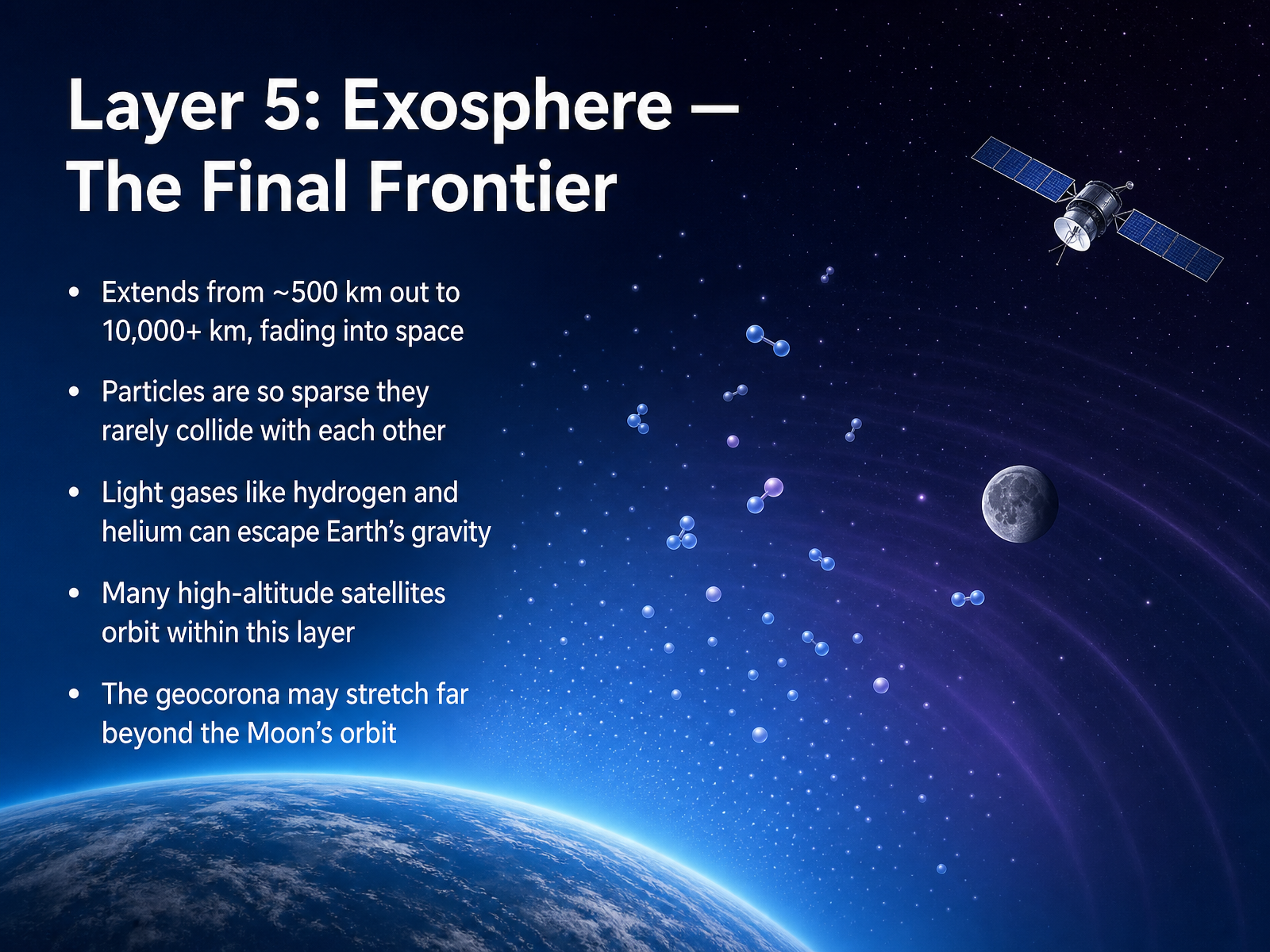
1 min - 09Layer 5: Exosphere — The Final FrontierMoving outward, we reach the atmosphere's outermost layer: the exosphere. Think of it as the final, faint boundary where our atmosphere gradually fades into the vacuum of space. This layer begins around 500 kilometers above the Earth and extends outwards for 10,000 kilometers or more. Here, air particles are so sparse that they rarely, if ever, collide. It's less like a continuous gas and more like individual atoms on solitary paths. Because the pull of gravity is so weak at this distance, very light gases like hydrogen and helium can actually escape into space. This layer is also where many high-altitude satellites comfortably orbit the Earth. And interestingly, a faint cloud of hydrogen atoms called the geocorona extends from here, stretching far beyond even the Moon's orbit. Next, we'll look at a special electrified region that overlaps with the upper layers, the ionosphere.
 1 min
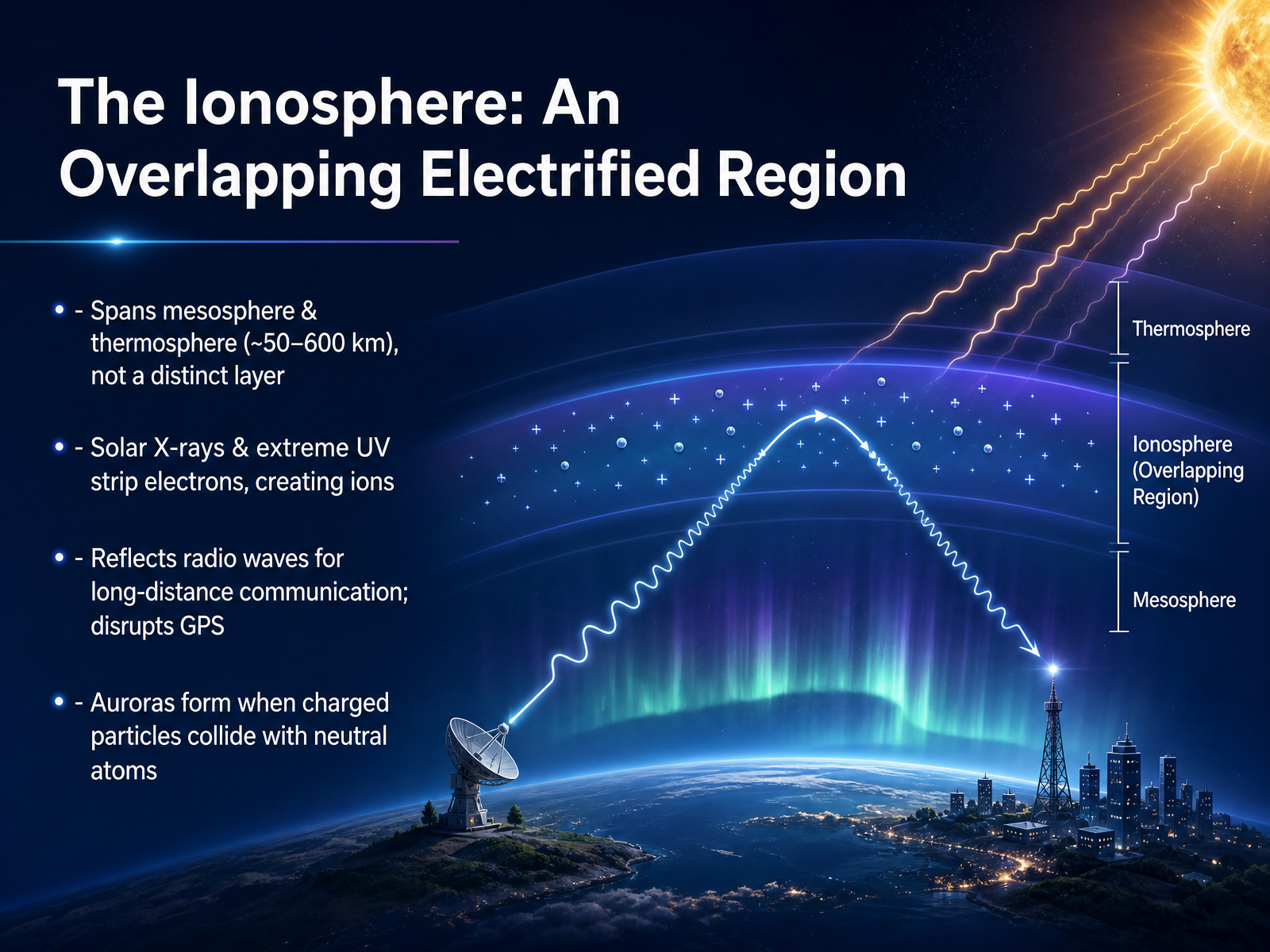
1 min - 10The Ionosphere: An Overlapping Electrified RegionNow let's explore a special region that overlaps the layers we just discussed, called the ionosphere. The ionosphere isn't a distinct, separate layer like the troposphere or stratosphere. Instead, it's an electrified zone that spans across the upper mesosphere and the entire thermosphere, from about fifty to six hundred kilometers high. Here, powerful solar X-rays and extreme ultraviolet radiation strip electrons away from atoms and molecules. This process creates electrically charged particles known as ions. This sea of ions has a fascinating practical effect. It can reflect radio waves, which allows us to send signals far beyond the horizon for long-distance communication. However, these same ionospheric changes can also disrupt GPS signals, causing navigation errors. Another spectacular effect is the aurora. When charged particles from the sun collide with neutral atoms in this region, it creates the beautiful, glowing lights near the poles. So, the ionosphere is not a single layer, but a dynamic, electrified region that shapes how we communicate and navigate. Next, we'll move inside the atmosphere's chemistry by looking at its composition, starting with the permanent gases.
 2 min
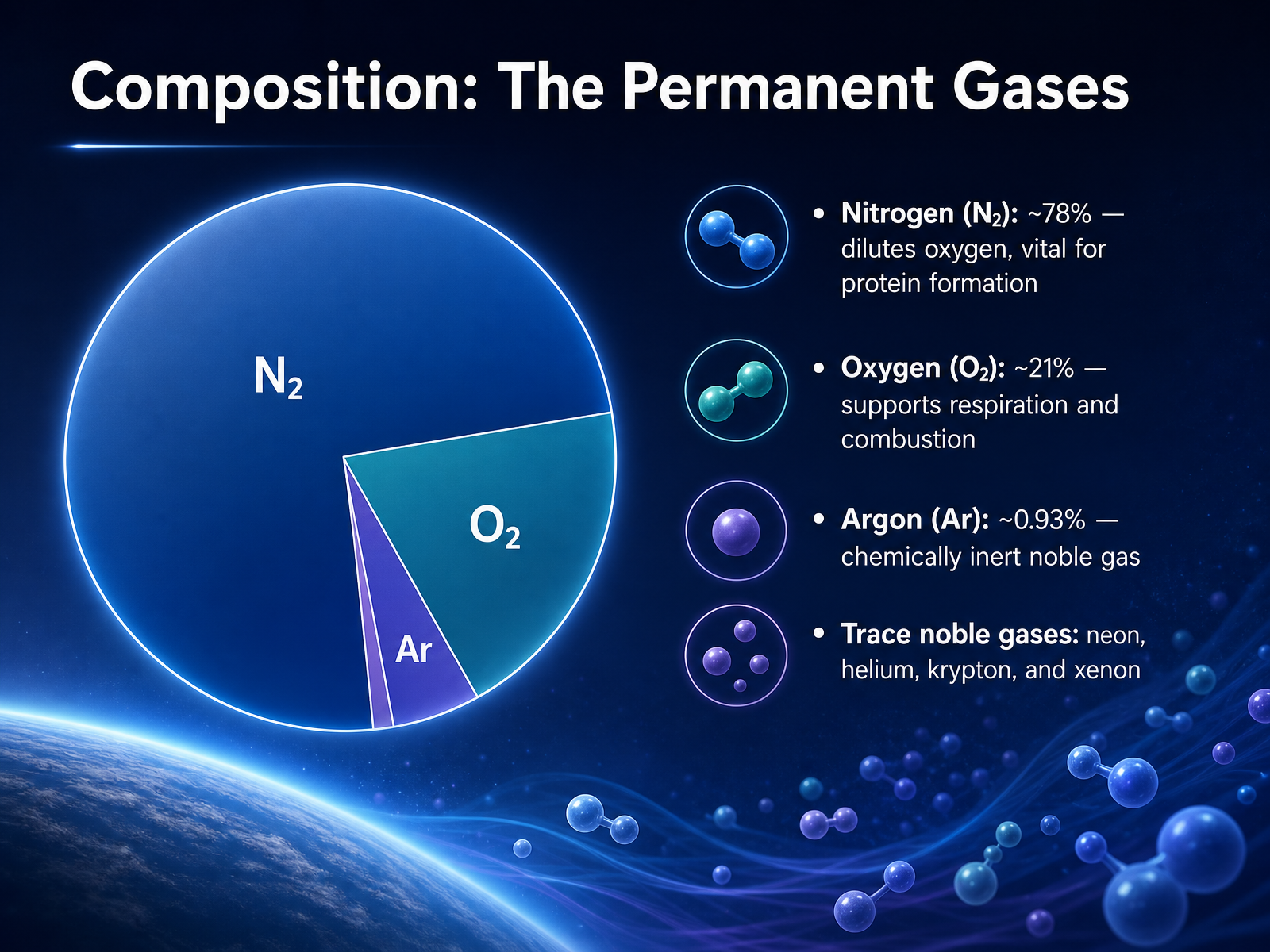
2 min - 11Composition: The Permanent GasesMoving on, let's look at the air itself — specifically, the gases that are always there. We call these the permanent gases. First, nitrogen, or N two. It makes up about seventy-eight percent of the atmosphere. Think of nitrogen as a buffer; it dilutes the oxygen and is also a critical building block for proteins in living things. Next is oxygen, O two, at about twenty-one percent. This is the gas we breathe to live, and it's also what allows fire to burn. Then we have argon, making up just under one percent. Argon is a noble gas, which means it's chemically inert — it doesn't really react with other substances. There are also tiny traces of other noble gases like neon, helium, krypton, and xenon. So, the air we breathe is a very consistent mixture, mostly nitrogen and oxygen. Next, we will explore the gases that change from place to place and over time, in the composition of variable and trace gases.
 2 min
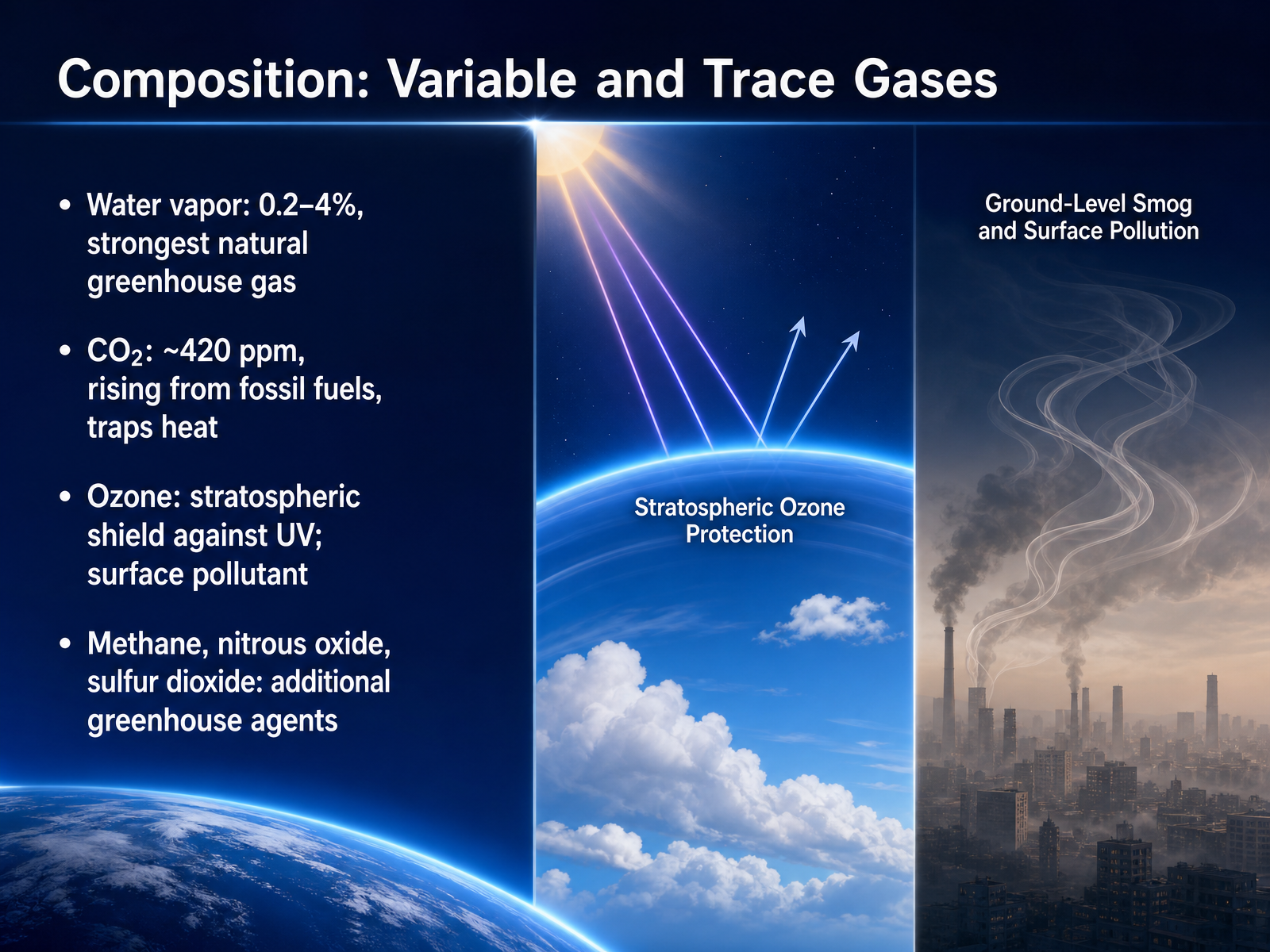
2 min - 12Composition: Variable and Trace GasesNow let's turn to the variable and trace gases in our atmosphere. These are present in very small amounts, but they play an outsized role. First, water vapor. Its concentration varies widely, from nearly zero up to about four percent. It is the most powerful natural greenhouse gas, trapping heat and keeping our planet warm. Next, carbon dioxide, or CO₂. Its current level is around four hundred twenty parts per million. This number is rising, primarily due to the burning of fossil fuels, and it directly traps heat, enhancing the greenhouse effect. Then we have ozone. High in the stratosphere, ozone forms a critical shield that absorbs harmful ultraviolet radiation from the sun. But at the surface, it becomes a pollutant that harms our health. Other trace gases, including methane, nitrous oxide, and sulfur dioxide, also act as significant greenhouse agents. Together, these tiny components are major drivers of our climate. Let's build on these concepts and explore the force they help create, with our next topic: Atmospheric Pressure: What It Is and Why It Matters.
 2 min
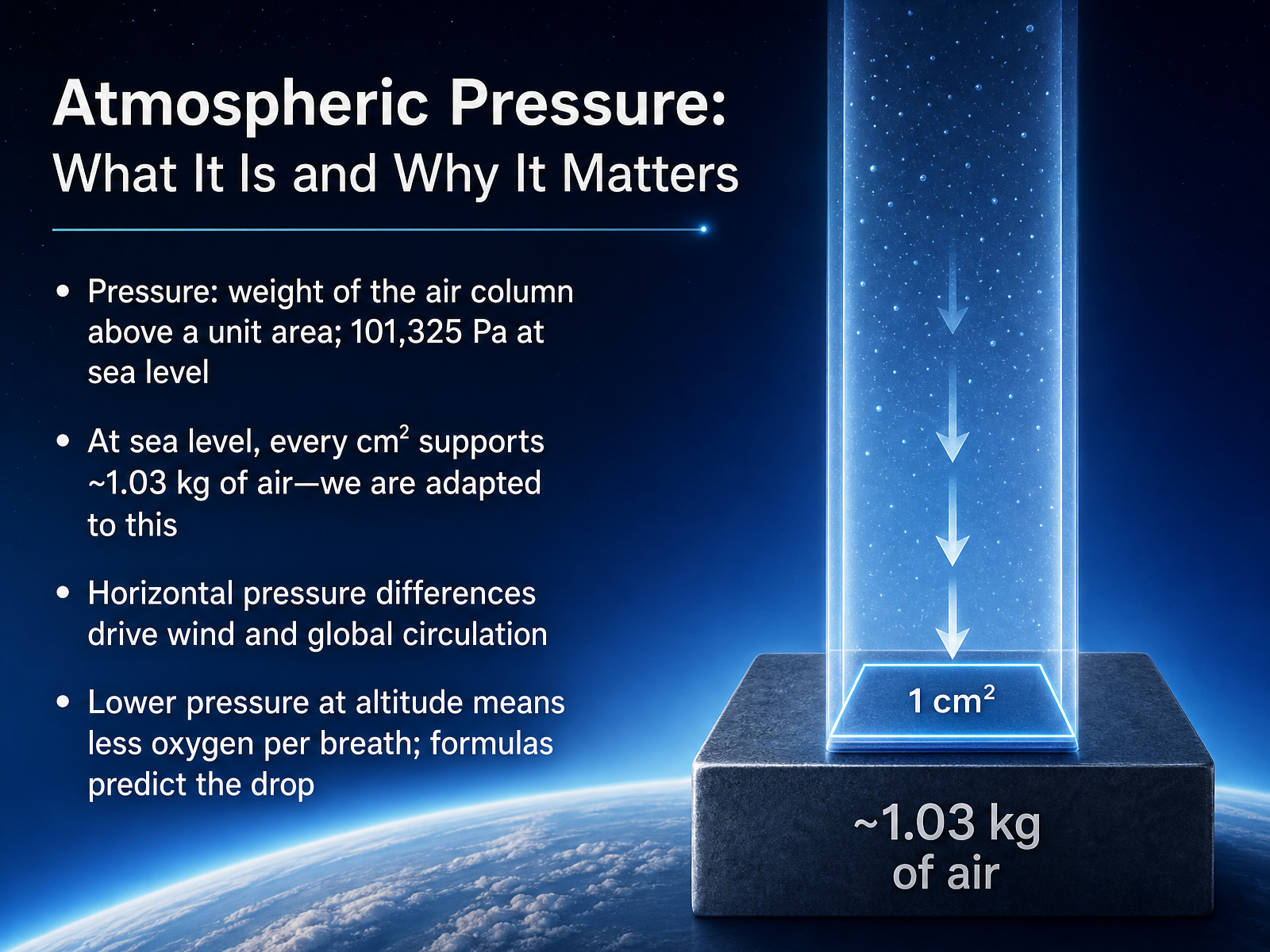
2 min - 13Atmospheric Pressure: What It Is and Why It MattersNow let's talk about atmospheric pressure and why it matters. Atmospheric pressure is simply the weight of the air column sitting above a unit area. At sea level, this weight pushes down with a standard value of about one hundred one thousand three hundred twenty five Pascals. To make that more tangible, imagine a one-centimeter square on your palm. At sea level, that tiny square supports roughly one point zero three kilograms of air. That is like a full one-liter water bottle pressing on a postage stamp. Our bodies are fully adapted to this constant pressure, so we do not feel it. But horizontal differences in pressure are what drive wind and global circulation patterns. Air naturally moves from areas of higher pressure to areas of lower pressure, creating all the winds we experience. There is also a practical breathing concern. As you go higher in altitude, pressure drops steadily. Each breath contains fewer oxygen molecules, which is why mountain climbers often carry supplemental oxygen. Next, we will explore exactly how pressure changes with altitude and learn the formulas that predict this drop.
 2 min
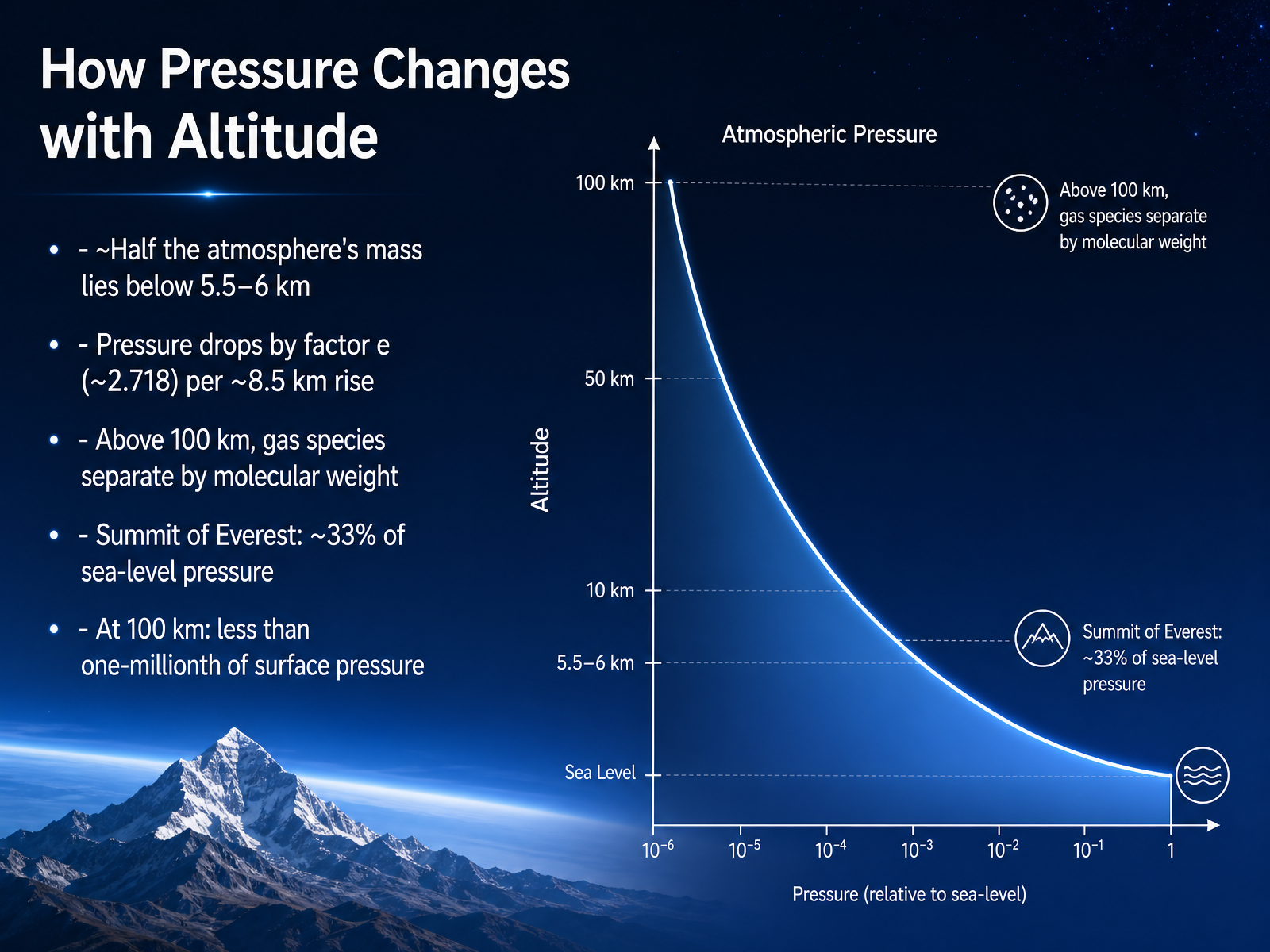
2 min - 14How Pressure Changes with AltitudeNow let's bring these ideas together and look at how pressure changes with altitude. Think of the atmosphere as a column, or a tall stack of books. The weight pressing down on you comes from all the air above. As you go higher, there is less air above, so the pressure drops. In fact, roughly half of the entire atmosphere’s mass sits below an altitude of five and a half to six kilometers. As a rule of thumb, for every eight and a half kilometers you climb, the pressure falls by a factor of about two point seven one eight. Moving up to the summit of Mount Everest, the pressure is only about thirty-three percent of what it is at sea level. Above one hundred kilometers, the air gets so thin that gases begin to separate by molecular weight, with heavier molecules staying lower. At that one hundred-kilometer height, the pressure is less than one-millionth of the surface pressure. Next, we will put all the pieces together into one system, linking layers, gases, and pressure.
 2 min
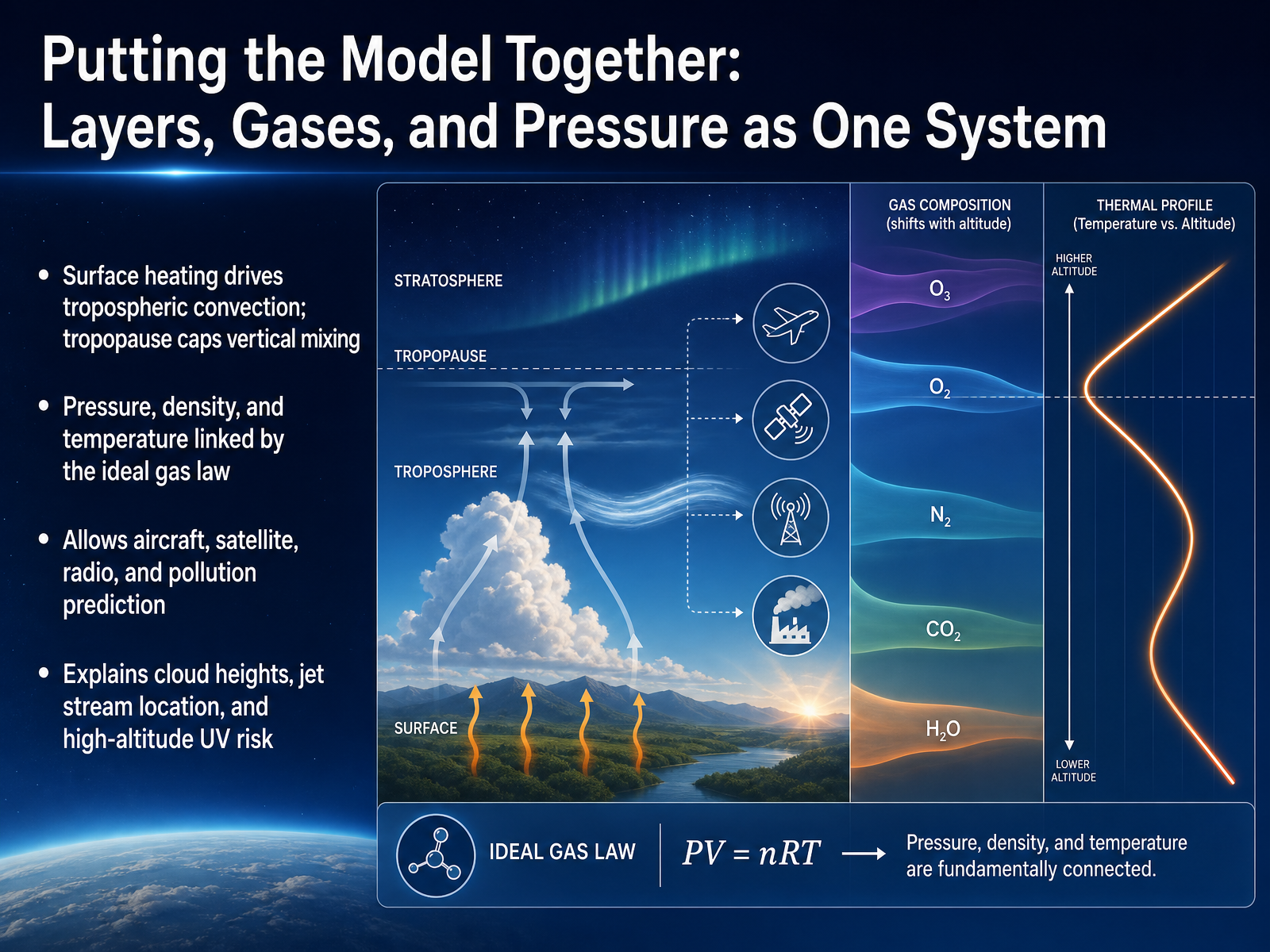
2 min - 15Putting the Model Together: Layers, Gases, and Pressure as One SystemNow let's bring everything together into one connected system. The sun heats the Earth's surface, and that warmth drives convection in the troposphere. But this vertical movement stops at the tropopause, a boundary layer that acts like a lid on our weather. Pressure, density, and temperature are all linked through a relationship called the ideal gas law. In simple terms, if you heat a parcel of air, it expands, its density drops, and its pressure changes. This one idea explains so much. It's why pilots calculate aircraft performance, why satellites orbit above the dense air, why radio waves bend, and how we predict where pollution will travel. It also explains why clouds form at specific heights, why the jet stream sits where it does, and why ultraviolet radiation risk increases sharply at high altitudes. You've now built a working mental model of our atmosphere as a single system of layers, gases, and pressure. Thank you for your focus, and well done completing this lesson.
 2 min
2 min
Take the deck with you
Download this course as a file — free, no sign-up needed.
- PDF handoutEvery slide page, ready to print or share.16 pages · 4.0 MBDownload
- Narrated PowerPointThe deck that presents itself — every slide carries the digital human's narration video.16 pages · 16.7 MBDownload
- PowerPoint slidesThe full deck as a .pptx — open it in PowerPoint, Keynote, or Google Slides.16 pages · 4.0 MBDownload
Free to use in your own training — please keep the PersonWise credit page at the end.
Have your own deck? Turn it into a course