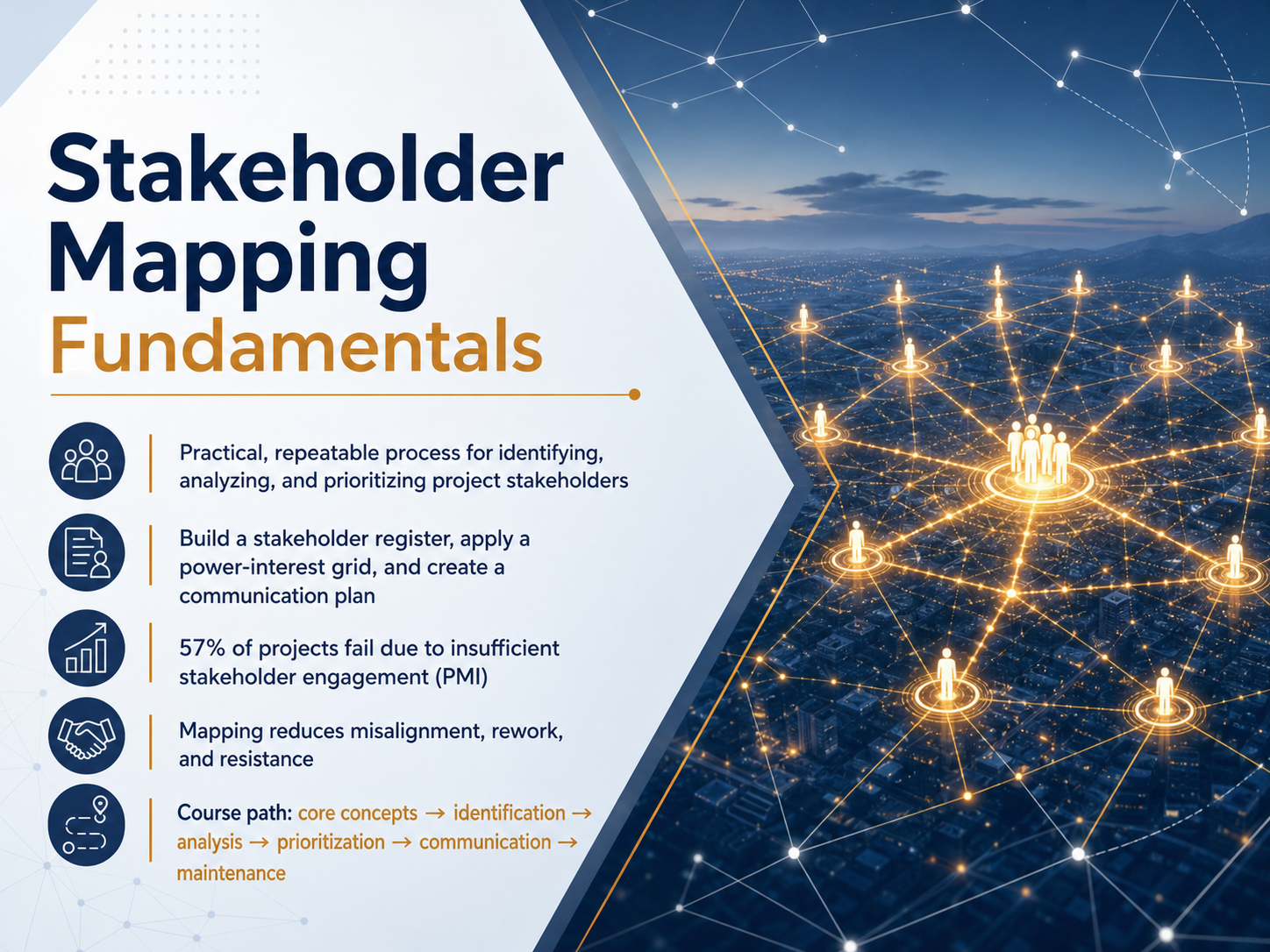
Stakeholder Mapping Fundamentals
Begin
14 pages · ~28 min
Stakeholder Mapping Fundamentals
Learn to identify, analyze, and prioritize key stakeholders to effectively manage relationships and drive project success.
What you’ll learn
- 01Stakeholder Mapping FundamentalsWelcome. I'm your digital human instructor. Today, we're going to walk through a practical, repeatable process called stakeholder mapping. It's a fundamental skill that helps us figure out who really matters on our projects, and how to bring them along with us. The reason this matters is pretty sobering. Project Management Institute research shows that 57 percent of projects fail because of insufficient stakeholder engagement. That's not just a statistic; it's a direct result of misalignment, rework, and resistance that we can actually prevent. So, our goal is to give you a direct, actionable workflow. We'll start by building a stakeholder register, then we'll apply a power-interest grid to prioritize everyone, and finally, we'll turn that analysis into a clear communication plan. Over the next few modules, we'll move from core concepts, through identification, analysis, and prioritization, all the way to communication and ongoing maintenance. Let's start by grounding ourselves in what stakeholder mapping really is.pmi.orgpmi.orgwifitalents.com+22 min
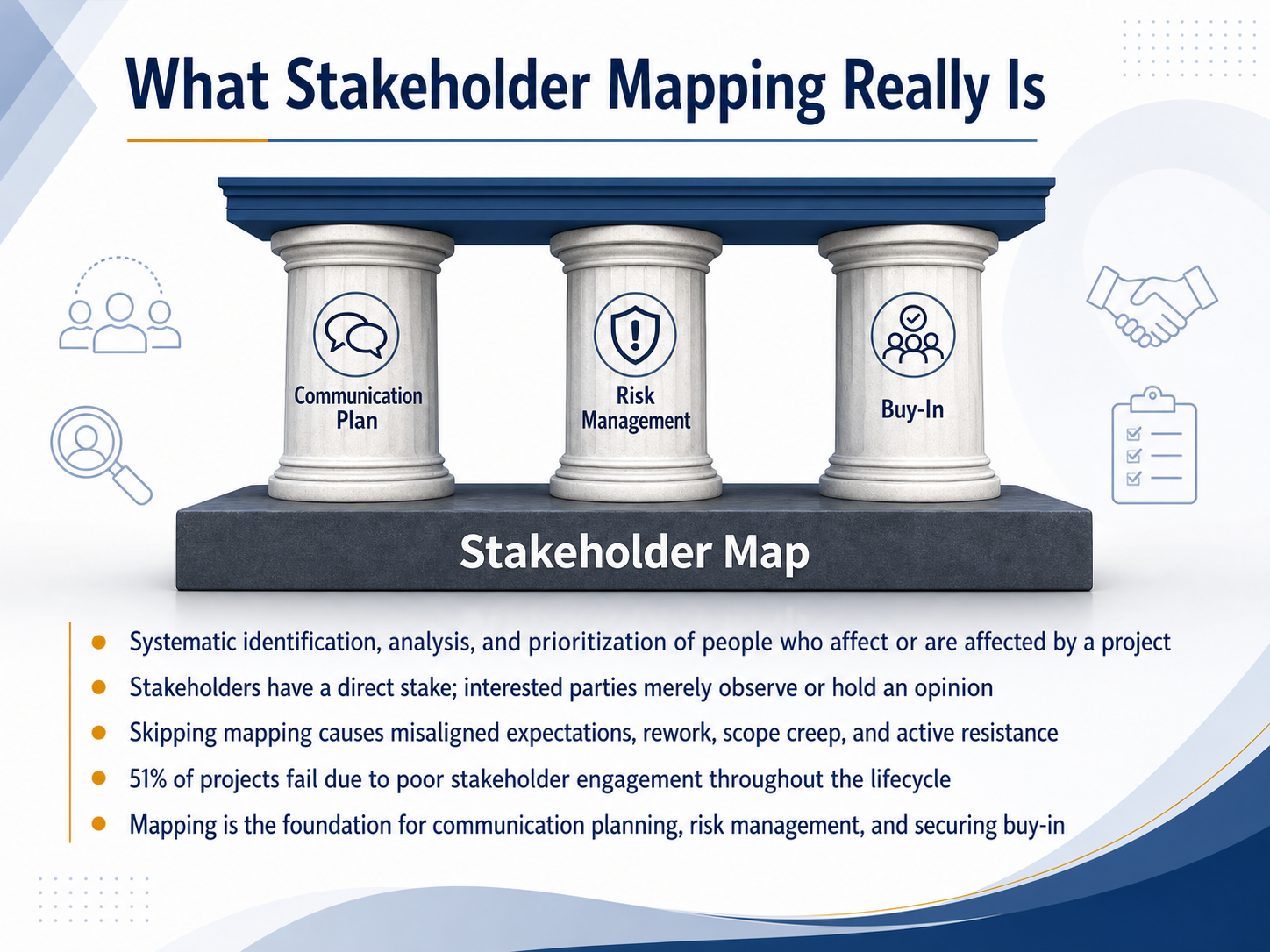
- 02What Stakeholder Mapping Really IsLet's get clear on what stakeholder mapping really is, because it's more than just listing names. It's the systematic process of identifying, analyzing, and prioritizing the people who affect or are affected by our project. And here's a distinction we need to make right away: a stakeholder has a direct stake in the outcome. An interested party might just observe or hold an opinion. That difference matters when we decide how we invest our communication time. When we skip this mapping, we see the same costly patterns. Misaligned expectations lead to rework. Unspoken concerns turn into scope creep. And when people feel unheard, they can shift from passive silence to active resistance. The research backs this up. Fifty-one percent of projects fail specifically because of poor stakeholder engagement throughout the lifecycle. That's not a small risk. That's the majority of our project's exposure. So mapping isn't a one-time admin task. It's the foundation for our communication plan, our risk management, and ultimately, securing the buy-in we need to deliver. Now that we know what it is, let's look at the business case for why this matters so much.
 pmi.orgpmi.orgwifitalents.com+22 min
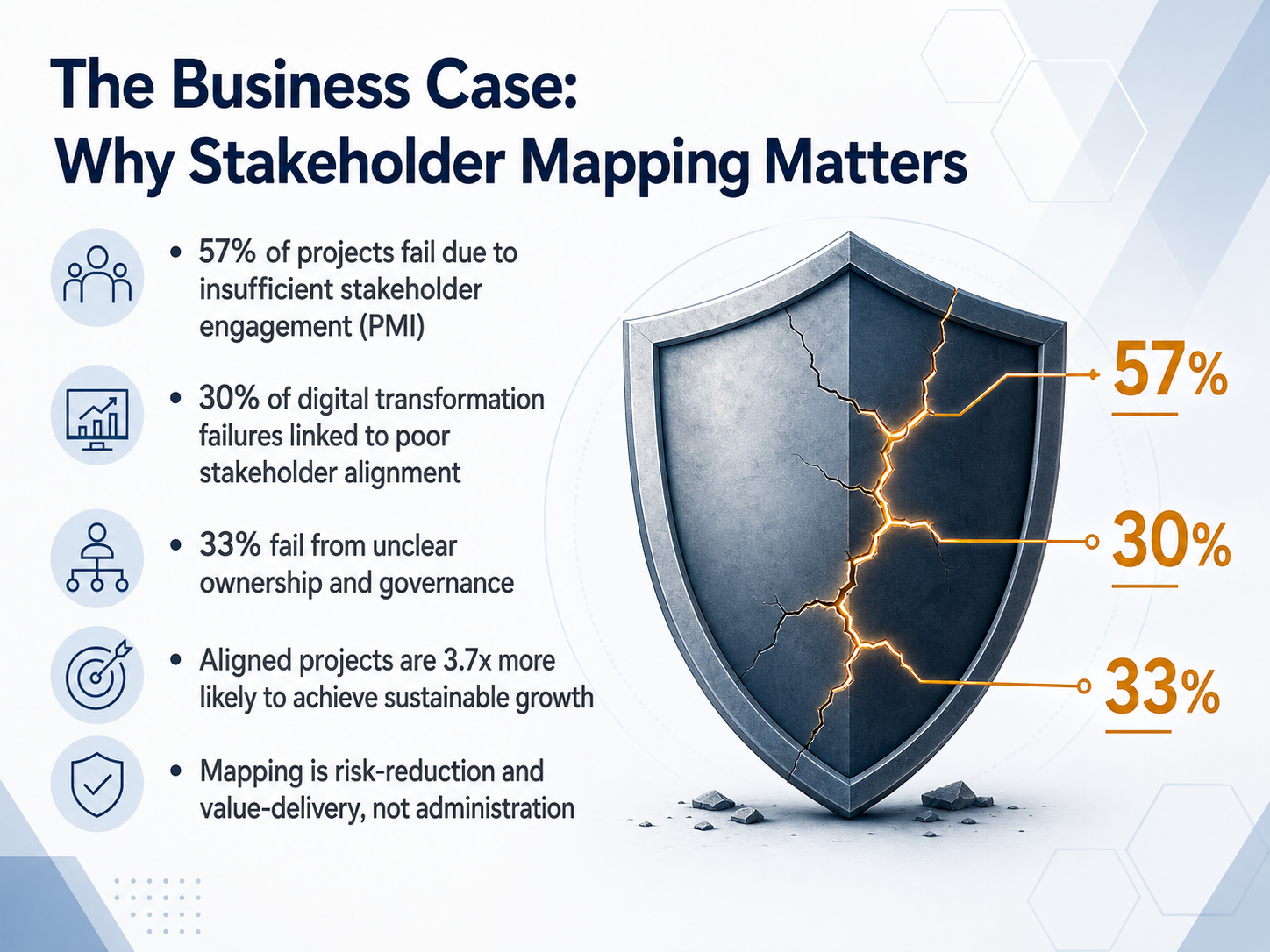
 - 03The Business Case: Why Stakeholder Mapping MattersLet's move to the business case, because if we're going to invest time in stakeholder mapping, we need to know what we're preventing. The numbers tell a clear story. PMI research shows that 57 percent of projects fail because of insufficient stakeholder engagement. That's not a typo. More than half of all failures trace back to people not being involved the right way. In digital transformation programs specifically, 30 percent of failures are linked to poor stakeholder alignment, and another 33 percent come from unclear ownership and governance. So when you add those together, the majority of transformation failures are not about technology. They're about who is informed, who is accountable, and how decisions get made. Now flip the lens. When we do get alignment right, the numbers shift dramatically. Aligned projects are nearly four times more likely to achieve sustainable growth. That means stakeholder mapping isn't administrative busywork. It's a direct risk reduction and value delivery activity. We do this because it protects the project and because it's one of the highest leverage moves we can make as a team. Let's take that mindset and apply it to the framework we use to organize everyone. Up next, the core framework, the power interest grid.
 pmi.orgpmi.orgwifitalents.com+22 min
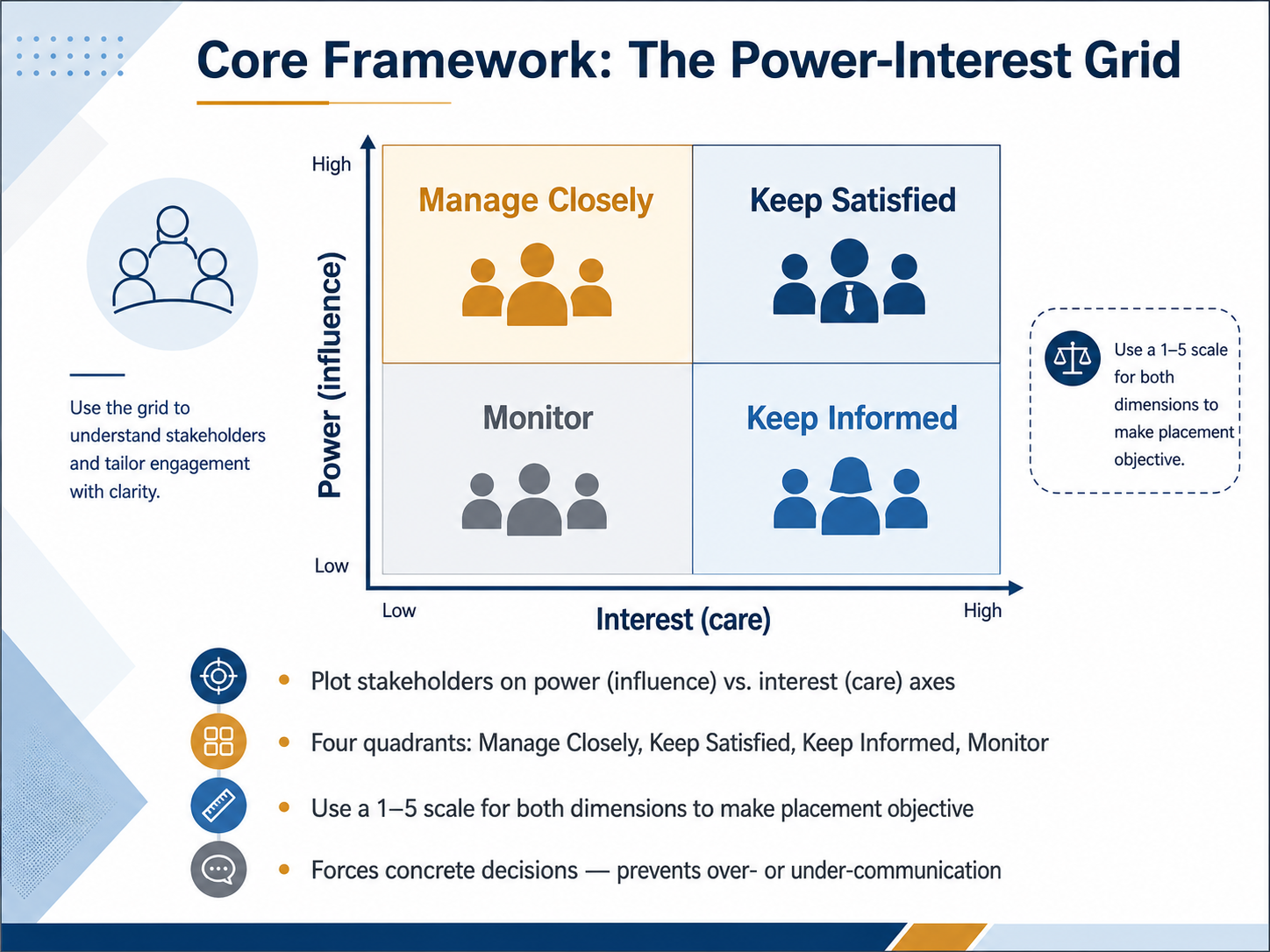
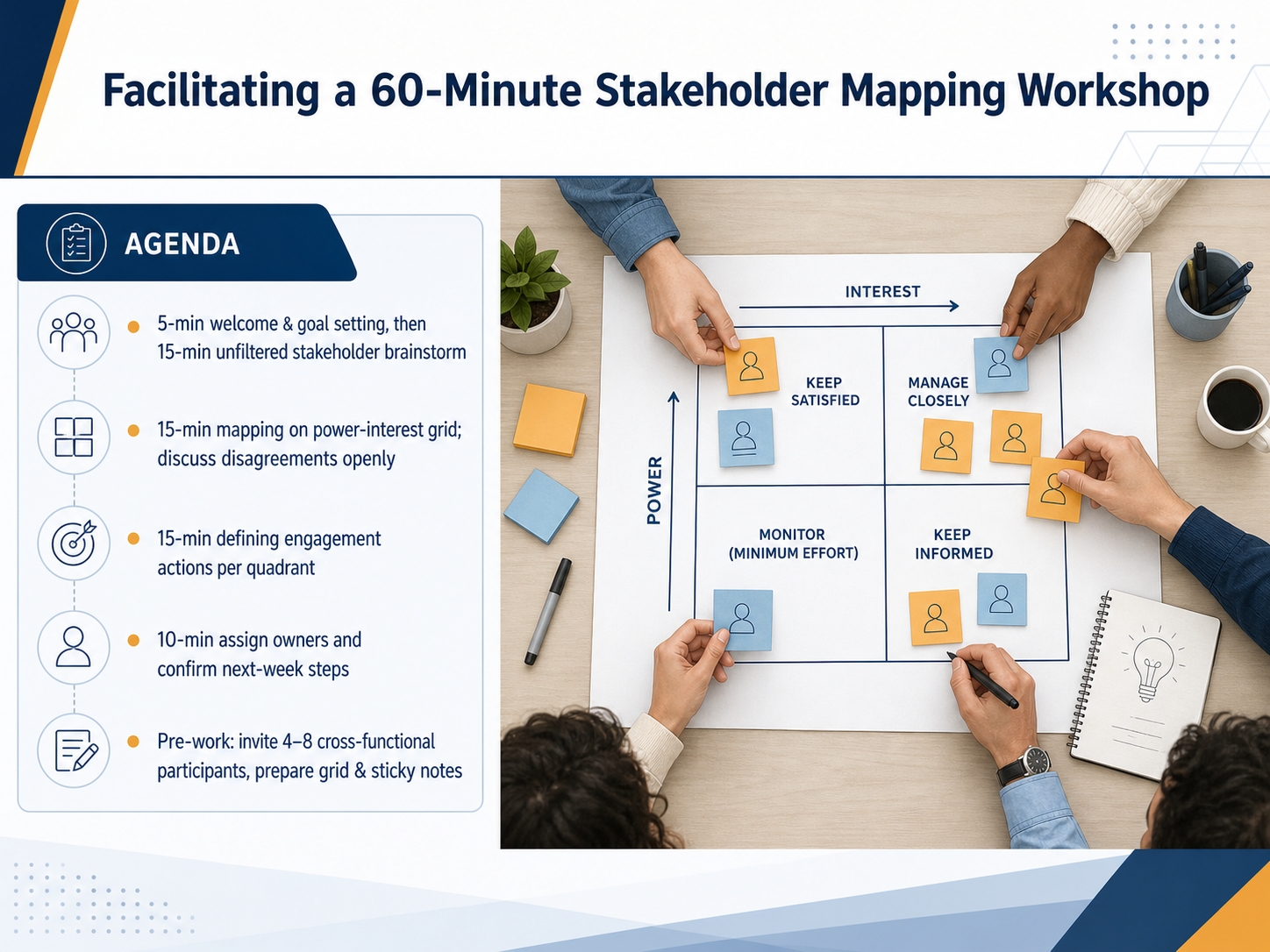
 - 04Core Framework: The Power-Interest GridNow let's look at the core framework that makes this practical: the power-interest grid. It's a simple two-by-two matrix. On the vertical axis, we plot a stakeholder's power—their ability to influence decisions, release resources, or block progress. On the horizontal axis, we plot their interest—how much they actually care about the project's outcome. By rating each stakeholder on a simple one-to-five scale for both power and interest, we can place them into one of four quadrants. The top-right quadrant is for high-power, high-interest players. We label these "Manage Closely." Think of your project sponsor or an executive champion. They need deep, frequent, two-way engagement. The top-left is high-power, low-interest. We call this "Keep Satisfied." A CFO or legal counsel often sits here. They need concise updates on decisions that affect them, but we shouldn't overwhelm them with details. The bottom-right is low-power, high-interest. This is "Keep Informed." End users and front-line staff often fall here. They need consistent updates and a clear feedback channel. The bottom-left is low-power, low-interest. We simply "Monitor" this group. The real value of this grid is that it forces concrete decisions. It prevents us from over-communicating and burning out a busy executive, and it also prevents us from under-communicating and blindsiding a key VP right before sign-off. That clarity is what we're after. Now, while this grid is a great starting point, it's not the only lens we can use. Next, let's go beyond the grid and explore some complementary lenses.
 resources.rework.comcoaching4companies.compressbooks.ulib.csuohio.edu+22 min
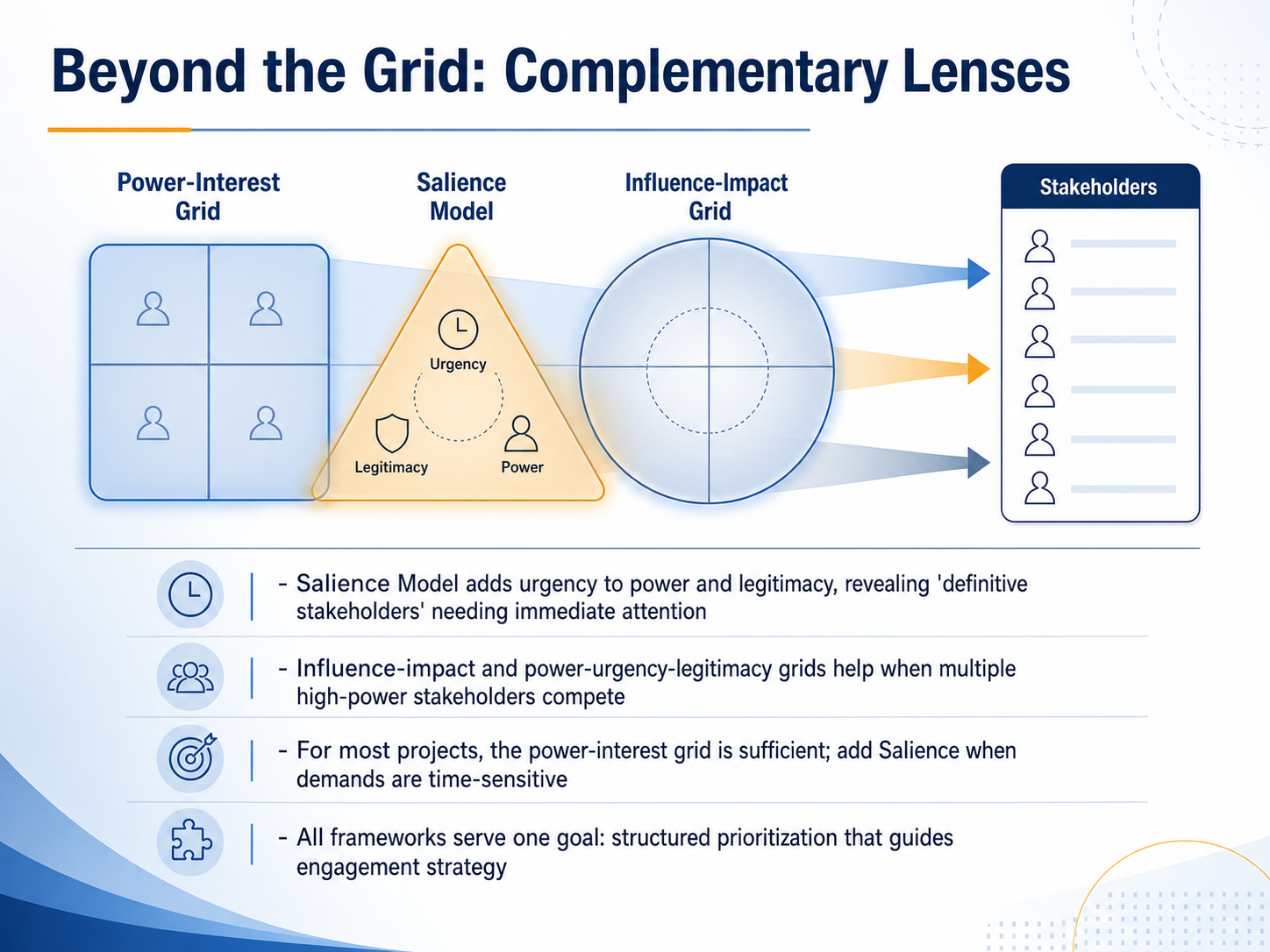
 - 05Beyond the Grid: Complementary LensesWhile the power-interest grid is our workhorse, it helps to know about a couple of complementary lenses you might reach for in specific situations. The first is the Salience Model. It adds a third dimension called urgency to power and legitimacy. This lens reveals what are called 'definitive stakeholders'—the people or groups who need your immediate attention because a demand is time-sensitive. If you are dealing with a regulatory deadline, a public relations crisis, or a sponsor who suddenly escalates a request, the Salience Model helps you see who truly cannot wait. Another tool is the influence-impact grid, which becomes useful when multiple high-power stakeholders are competing for your time. It helps you sort through overlapping priorities by focusing on who can actually affect the outcome right now. For most projects, the power-interest grid is sufficient. But when demands become time-sensitive or politically charged, layering in the Salience Model or an influence-impact view gives you sharper prioritization. The key point is that all these frameworks serve one goal: structured prioritization that guides your engagement strategy. They keep you intentional about who you talk to, when, and why. Now, with the conceptual lenses in our toolkit, let's shift to putting them into practice. Up next, we walk through the actual process with Step-by-Step Identification.
 resources.rework.comcoaching4companies.compressbooks.ulib.csuohio.edu+22 min
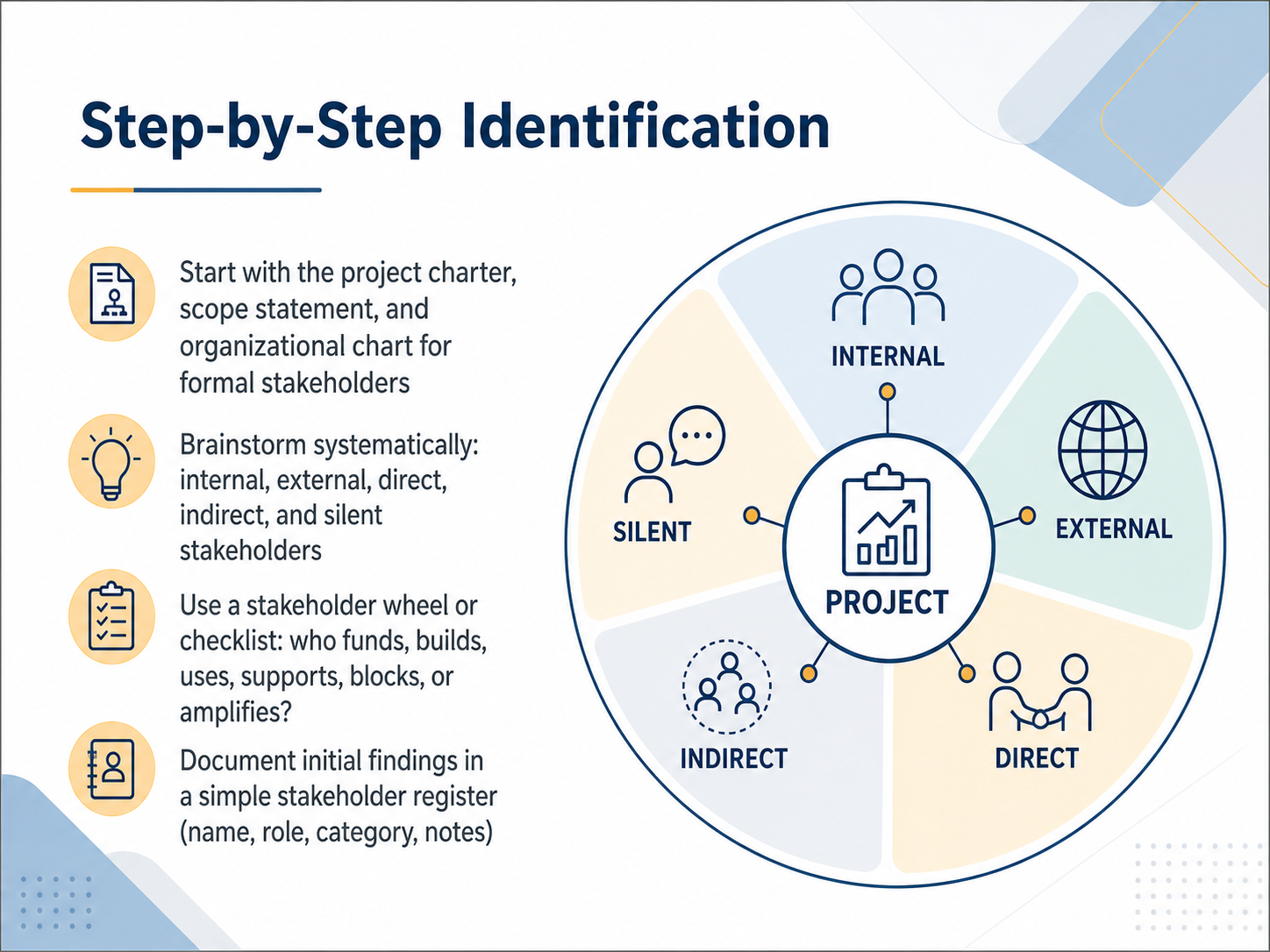
 - 06Step-by-Step IdentificationNow let's walk through a step-by-step method for identifying stakeholders. We start with the documents you already have: the project charter, the scope statement, and the organizational chart. These give us the formal roles, the sponsor, and the known approval gates. But formal docs only capture part of the picture. Next, we broaden the search with a structured brainstorm. We look at internal and external stakeholders, direct and indirect ones, and even the silent stakeholders whose work gets disrupted without anyone asking them first. A practical way to guide this is a stakeholder wheel or a simple checklist. Ask the team: who funds the work? Who builds it, who uses it, who supports it, who can block it, and who can amplify our message? Each question surfaces a different group. As you identify names, capture them immediately in a simple stakeholder register. At this stage, you just need name, role, category, and a quick note on why they matter. The goal is completeness, not perfection. You filter and prioritize later. Right now, we want to make sure no critical voice is left out. In the next slide, we'll take that list and start assessing their interests, expectations, and influence.
 fluum.aimonday.commonday.com+22 min
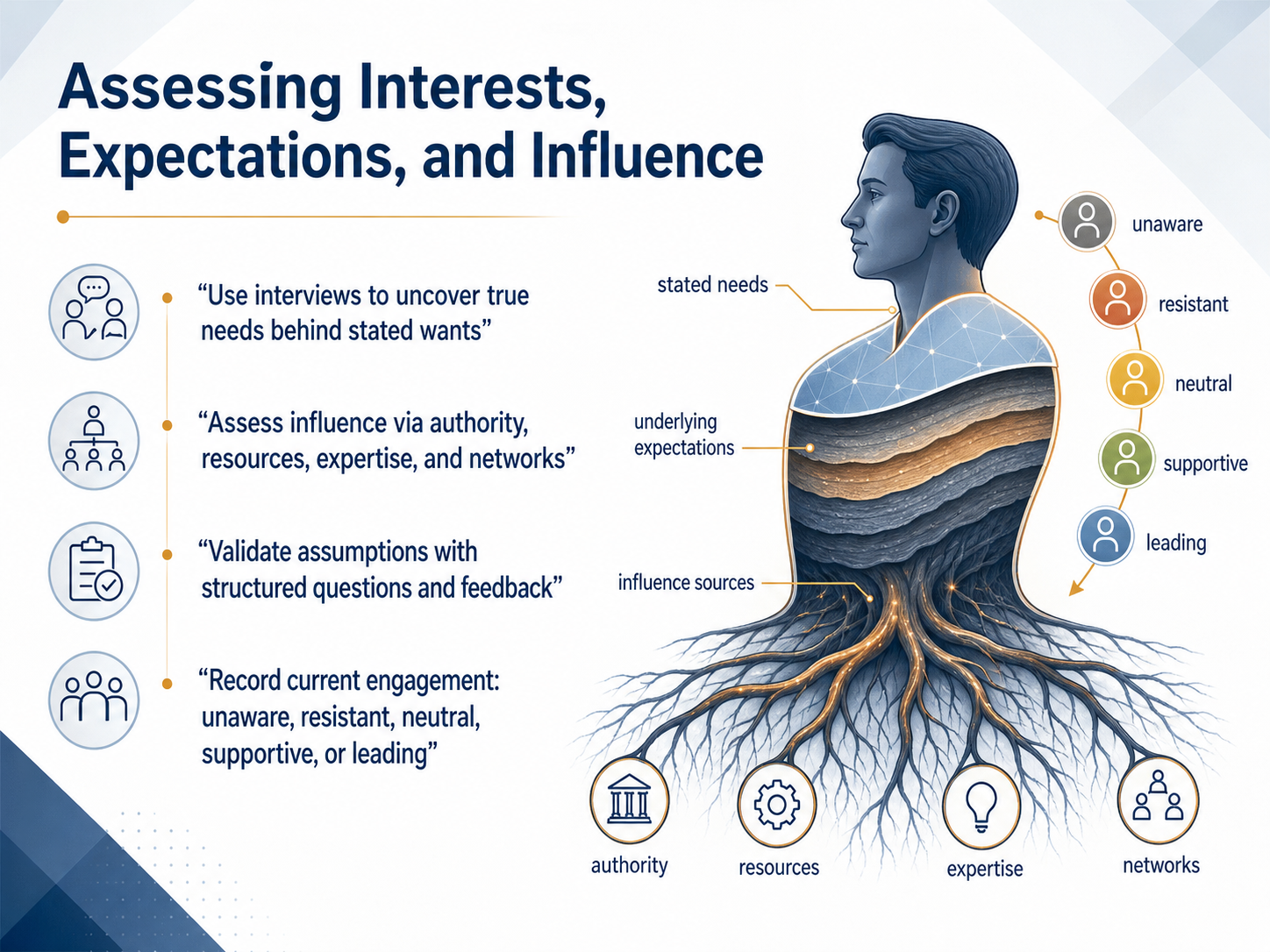
 - 07Assessing Interests, Expectations, and InfluenceNow we get into the detective work of stakeholder mapping. It's not enough to know someone wants a fast delivery. We need to uncover why. A stakeholder might say they need a feature by Friday, but the real need is avoiding a penalty clause in a contract. We uncover that by conducting short, structured interviews, asking open-ended questions like, 'What does success look like for you at the end of this phase?' Next, we assess their influence. Don't just look at the org chart. Influence comes from four places: formal authority, control over budget or resources, deep expertise, and the strength of their informal network. Someone with no direct reports but strong relationships across departments can quietly make or break your project. We then validate our assumptions. After an interview, summarize back to them: 'Based on our talk, it sounds like your main concern is resource availability in quarter three. Is that accurate?' This feedback loop is critical. Finally, record their current engagement level. Are they unaware, actively resistant, neutral, supportive, or a leading champion? This isn't a personality label; it's a snapshot of their current stance that we'll use to plan our next move. Let's take this understanding and use it to categorize our stakeholders into Prioritization and Engagement Tiers.
 2 min
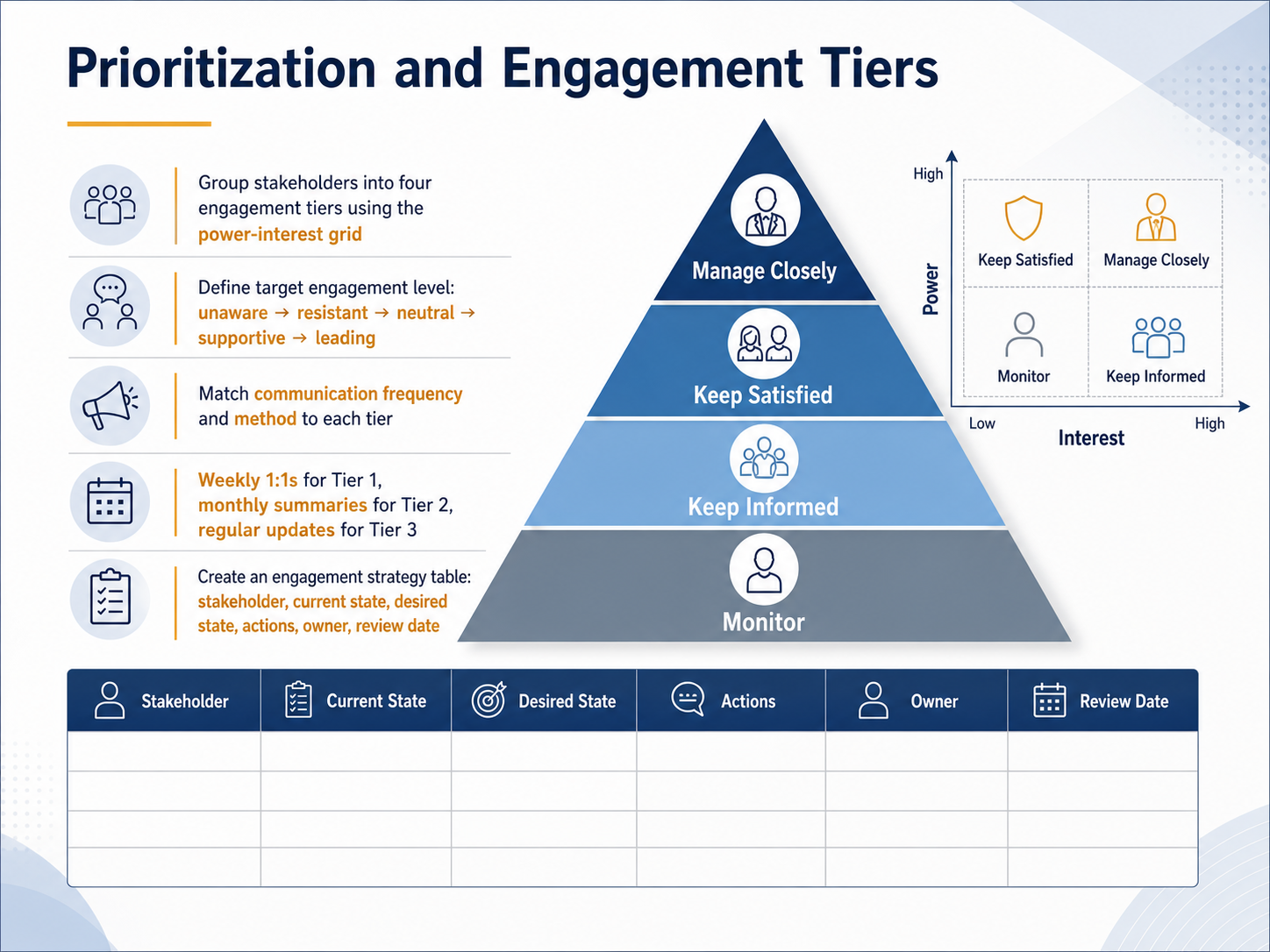
2 min - 08Prioritization and Engagement TiersNow we move from mapping to prioritization: let's turn that power-interest grid into a practical engagement playbook. We group stakeholders into four engagement tiers, and for each tier we define a target engagement level. Think of it as a spectrum: unaware, resistant, neutral, supportive, and leading. Our job is to move people toward the right end of that scale. Then we match communication frequency and method to each tier. Tier one, the high-power, high-interest group, gets the most attention—weekly one-on-ones, direct involvement in decisions. Tier two, high-power but lower interest, needs monthly executive summaries and alerts on anything that requires their sign-off. Tier three, lower power but high interest, receives regular updates and feedback channels. Tier four stays on a monitor-only rhythm with periodic check-ins. To make this actionable, we create an engagement strategy table. For each stakeholder, capture their current state, desired state, specific actions, who owns the relationship, and a review date. This table becomes your living communication plan. Next, we'll build on this with a full communication planning approach from the stakeholder map.
 resources.rework.comcoaching4companies.compressbooks.ulib.csuohio.edu+22 min
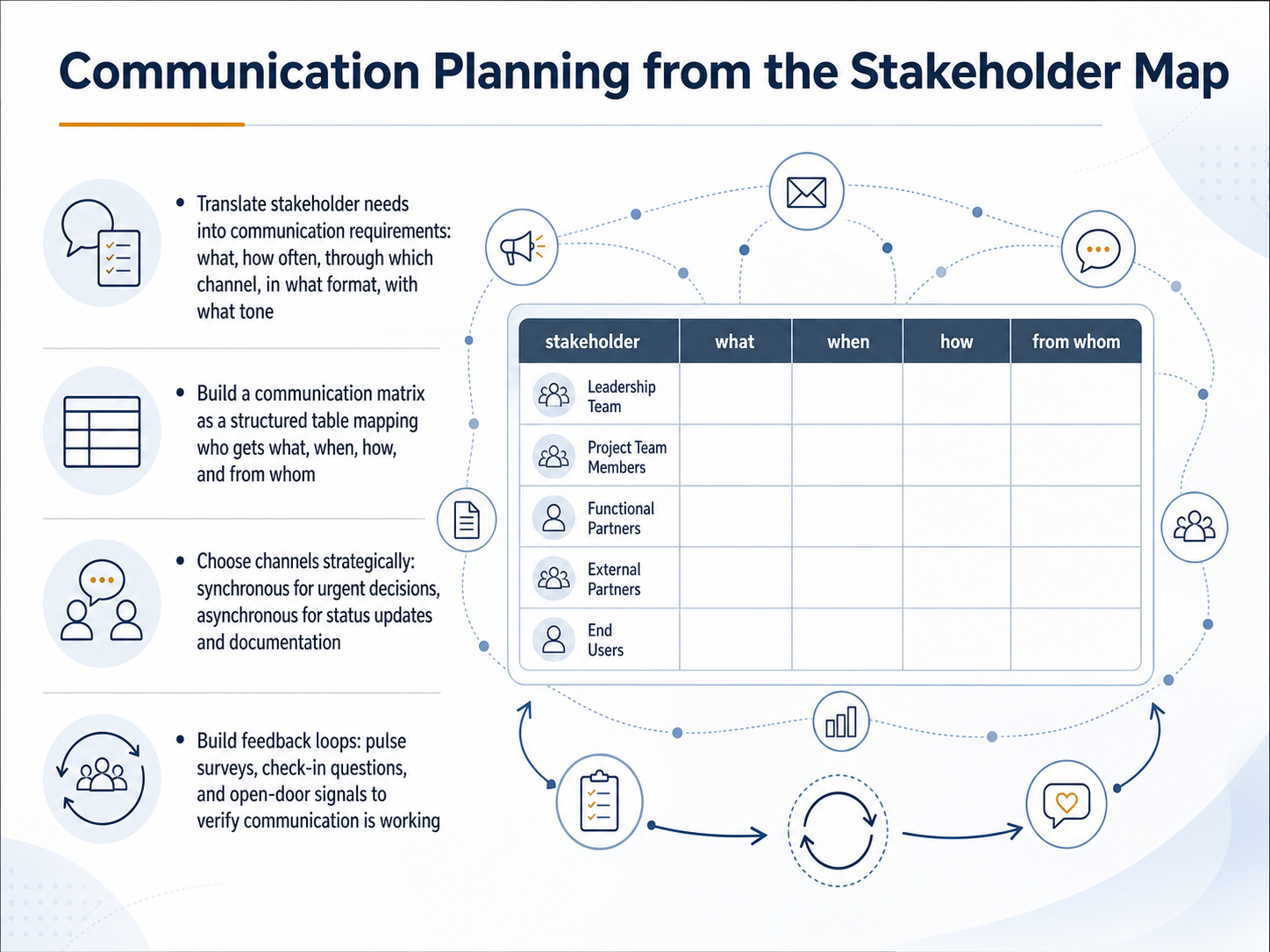
 - 09Communication Planning from the Stakeholder MapNow we translate the stakeholder map into a concrete communication plan. Start by turning each stakeholder’s needs into real communication requirements: what information they need, how often, through which channel, in what format, and with what tone. Build a communication matrix as a structured table. For each row, map who gets what, when, how, and from whom. Choose channels strategically. Synchronous channels like meetings or calls work best for urgent decisions and complex coordination. Asynchronous channels like email, dashboards, or recorded updates work best for status updates and documentation. Then build in feedback loops to verify that your communication is actually working. Use short pulse surveys, dedicated check-in questions during meetings, and visible open-door signals. These loops tell you whether stakeholders feel informed and engaged, not just whether you sent the message. A communication matrix is a living tool. Review it at each phase transition and adjust as stakeholder needs evolve.
 pmstudycircle.comsmartsheet.commiro.com+22 min
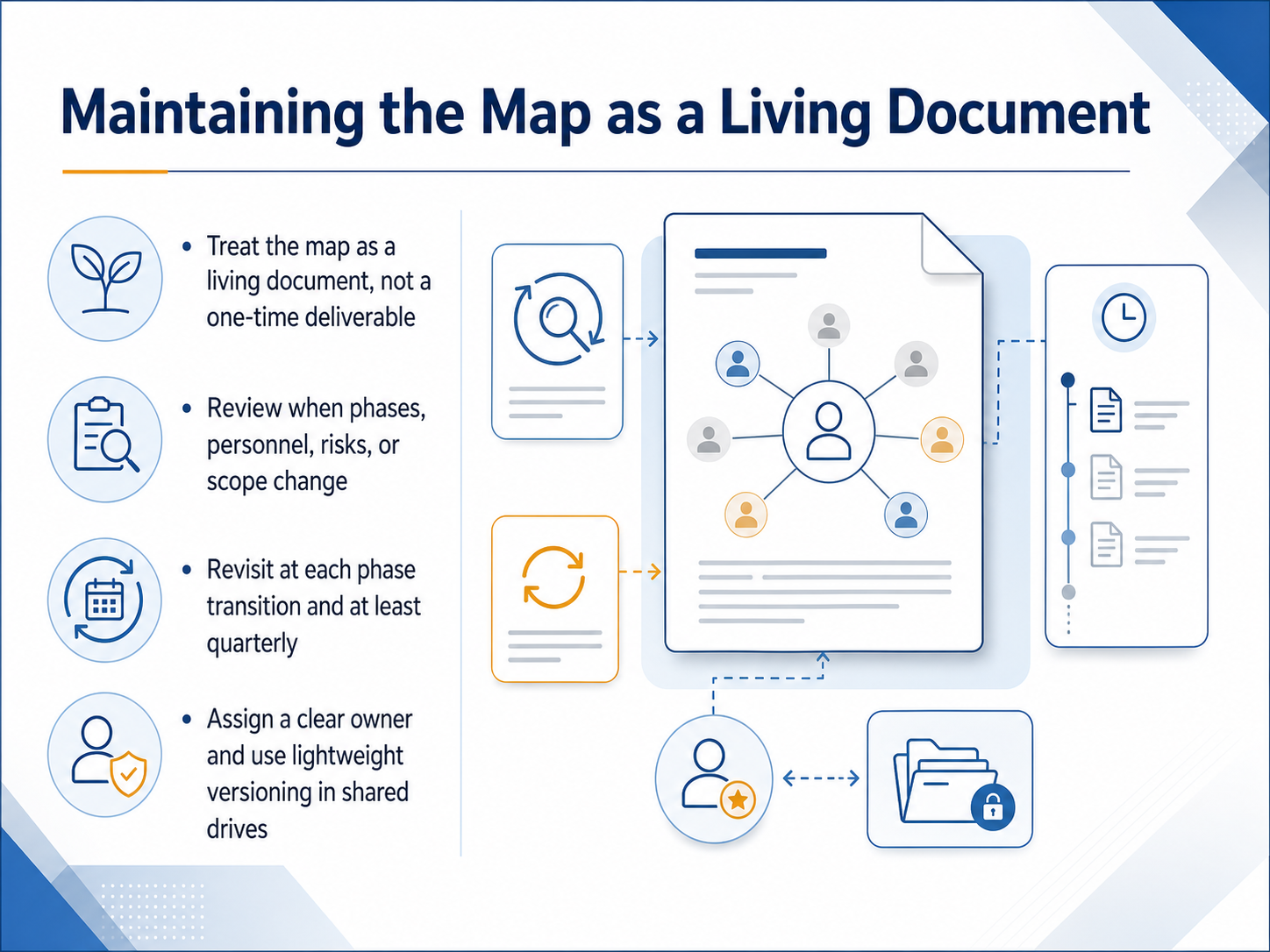
 - 10Maintaining the Map as a Living DocumentNow, let's talk about keeping the map useful beyond the first draft. The real power of stakeholder mapping comes from treating it as a living document, not a one-time deliverable you file away. We need to build the habit of revisiting it whenever something shifts in the project, like a new phase, a change in key personnel, a new risk, or a scope adjustment. At a minimum, you should plan to review the map at each phase transition and at least once per quarter. To make this stick, assign a clear owner for the map and use lightweight versioning in your shared drives so everyone can see what changed and why. Up next, we'll look at common pitfalls and how to avoid them so you can spot these issues early.
 1 min
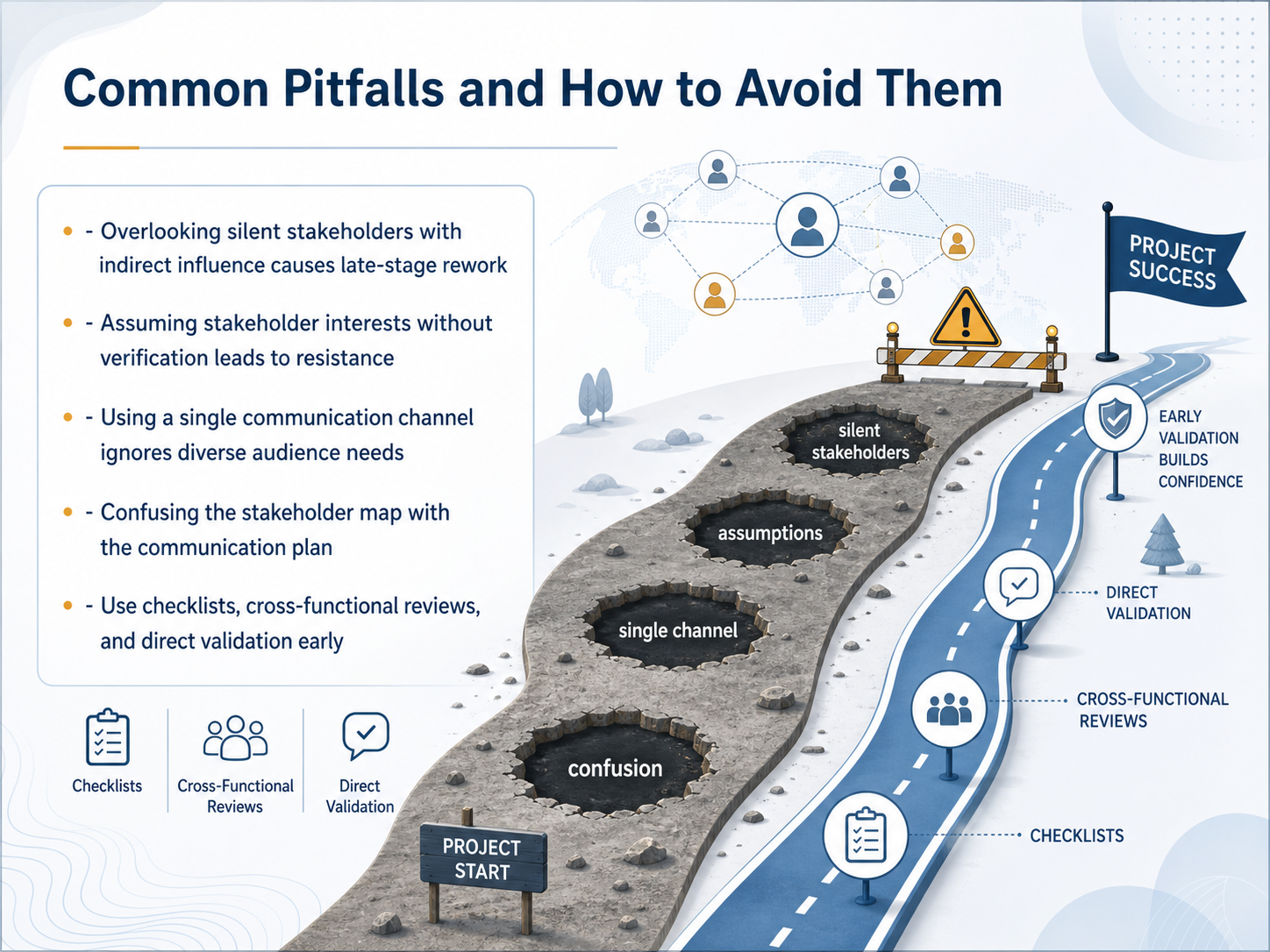
1 min - 11Common Pitfalls and How to Avoid ThemLet's walk through a few common pitfalls I've seen teams hit with stakeholder mapping, and what we can do to avoid them. One big one is overlooking silent stakeholders, people with indirect influence who don't speak up until late in the game. Suddenly they surface, and we're reworking decisions we thought were final. We can catch that early by asking who might block or quietly enable our work, not just who's at the front of the room. Another trap is assuming what stakeholders want. We've all walked into a meeting thinking we knew their goals, only to realize we'd missed the mark. The fix is direct validation, short early conversations that confirm their real interests. Then there's the habit of defaulting to one communication channel. A single email blast might work for some, but leaves others completely out of the loop. We need to match the channel to the audience, maybe a quick call for an executive, a detailed report for a technical lead. Finally, I want to separate two things that sometimes get confused: the stakeholder map itself and the communication plan. The map tells us who to engage and why. The plan tells us how, when, and what to say. Mixing them up usually means neither gets done well. We can keep them clean by using a simple checklist, holding a cross-functional review, and doing that early validation. Next, let's move from principles to practice and look at facilitating a sixty-minute stakeholder mapping workshop.
 2 min
2 min - 12Facilitating a 60-Minute Stakeholder Mapping WorkshopNow, let's walk through how to actually run a tight, sixty-minute stakeholder mapping workshop. The goal here is to move fast and come out with a clear action plan. We start with five minutes of welcome and goal setting, so everyone knows why they're in the room. Then, we jump into a quick, unfiltered brainstorm for fifteen minutes. No screening, no discussion—just get every name up on a sticky note. Next, we spend fifteen minutes mapping those stakeholders onto a power-interest grid. This is where the real conversation happens, so discuss disagreements openly; that's often where you uncover hidden risks. With the grid populated, we shift to the next fifteen minutes to define specific engagement actions for each quadrant. Finally, we use the last ten minutes to assign clear owners for each key stakeholder and confirm the concrete next steps for the next week. A quick note on pre-work: invite four to eight cross-functional participants and have your grid and sticky notes ready to go before the session starts. That way, we can hit the ground running.
 2 min
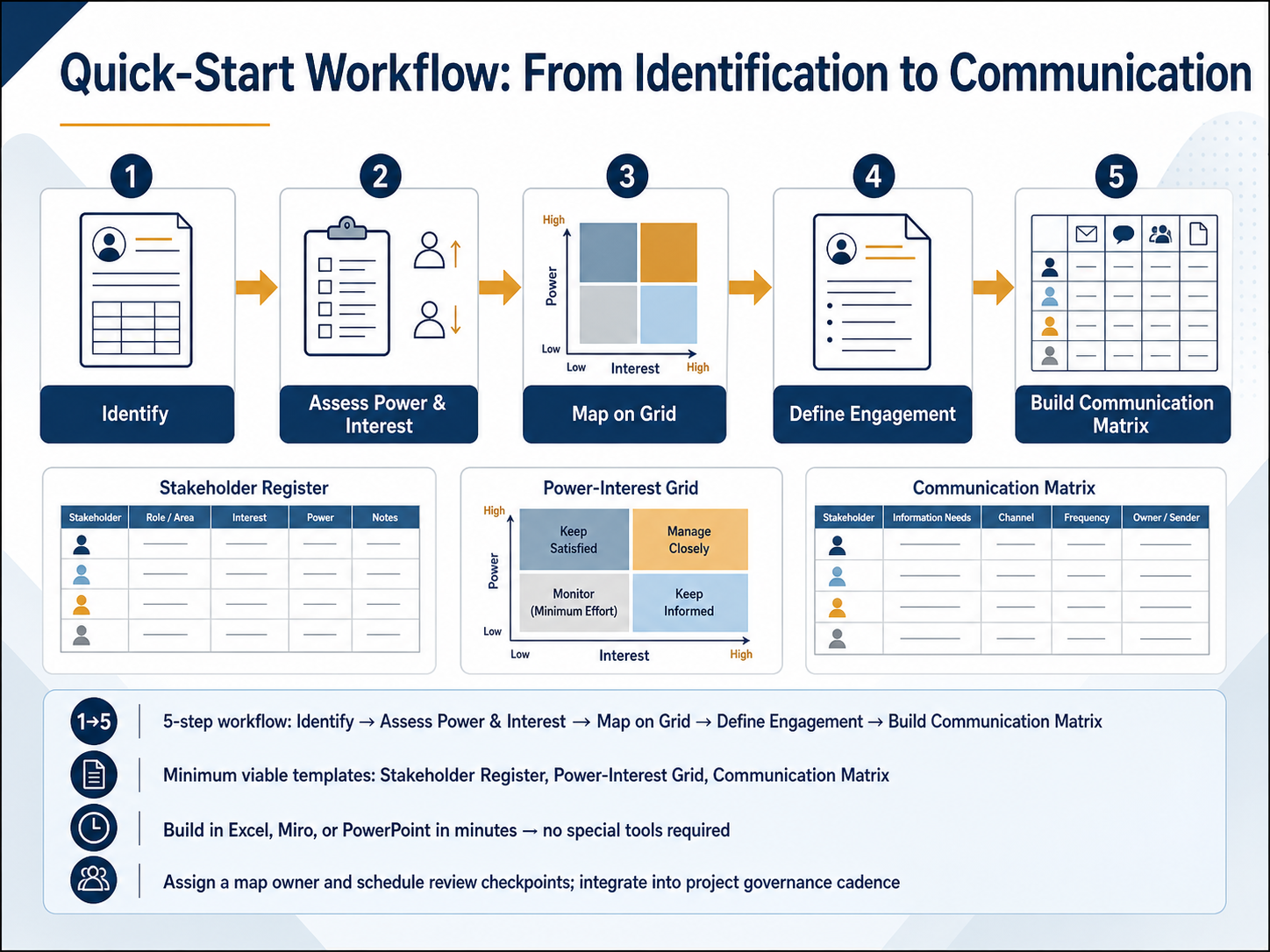
2 min - 13Quick-Start Workflow: From Identification to CommunicationNow let's pull everything together into a quick-start workflow you can run in minutes. We move through five steps: identify every stakeholder, assess their power and interest, map them onto the grid, define the engagement approach for each quadrant, and finally, build a living communication matrix that answers who needs what, when, and through which channel. You don't need any special tools to get started. A simple spreadsheet, a Miro board, or even a few PowerPoint slides will work perfectly for your first three deliverables: a stakeholder register, a power-interest grid, and the communication matrix itself. The key is to keep these documents lightweight and usable. Then, assign a map owner and schedule a quick review checkpoint at every major project phase. Build this review into your existing governance cadence so the map doesn't go stale. Stakeholder positions shift, and the communication matrix needs to reflect that reality. In our final slide, let's look at the key takeaways and your next steps.
 pmstudycircle.comsmartsheet.commiro.com+22 min
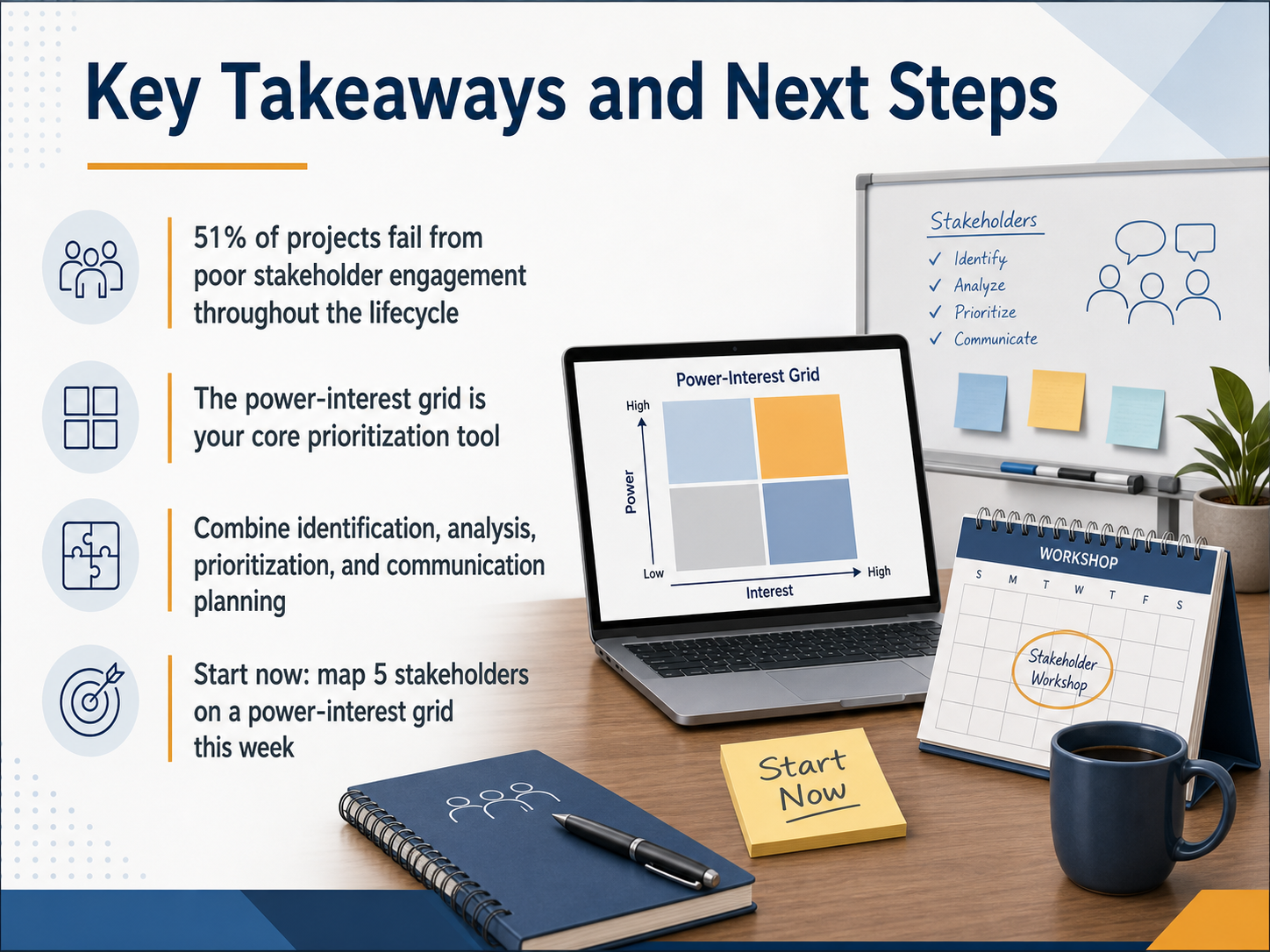
 - 14Key Takeaways and Next StepsLet's bring this together. We know that poor stakeholder engagement causes fifty-one percent of project failures, so doing this work well isn't optional. The power-interest grid is your core prioritization tool. It gives you a clear, repeatable way to decide who needs what level of attention. But the real power comes when you combine all four steps: identification, analysis, prioritization, and a practical communication plan. That's the full workflow. So here's your next step: this week, map just five stakeholders from your current project onto a power-interest grid. Start small, but start now. Thanks for joining me. Go put this to work on your project.
 pmi.orgpmi.orgwifitalents.com+21 min
Take the deck with you
Download this course as a file — free, no sign-up needed.
- PDF handoutEvery slide page, ready to print or share.15 pages · 3.7 MBDownload
- Narrated PowerPointThe deck that presents itself — every slide carries the digital human's narration video.15 pages · 14.3 MBDownload
- PowerPoint slidesThe full deck as a .pptx — open it in PowerPoint, Keynote, or Google Slides.15 pages · 3.6 MBDownload
Free to use in your own training — please keep the PersonWise credit page at the end.
Have your own deck? Turn it into a course
Sources consulted
Web sources consulted while building this course.
- Project Success — pmi.org
- https://www.pmi.org/-/media/pmi/documents/public/pdf/learning/thought-leadership/pulse/pulse_of_the_profession_2025-1.pdf?rev=2910b8cb04c04fb6a47ef24f854175c9 — pmi.org
- Project Failure Statistics | 2026 Market Report — wifitalents.com
- New PMI Research Reveals Strategy-Execution Gap Is Undermining Transformation And How to Close It — pmi.org
- Project Management Statistics 2025-26: Success Rates, Trends & KPIs PMI & Wellingtone Data | PM Study Circle — pmstudycircle.com
- "Stakeholder Analysis: The Power-Interest Grid Explained" — resources.rework.com
- Exploring Mendelow’s Power Interest Stakeholder Matrix | Coaching 4 Companies — coaching4companies.com
- 5.2 Stakeholder Analysis – Project Management — pressbooks.ulib.csuohio.edu
- Mendelow Matrix, a Stakeholder Analyis explained - Toolshero — toolshero.com
- Mendelow Stakeholder Matrix: Guide + Template (2026) - FourWeekMBA — fourweekmba.com
- Stakeholder Identification Strategies That Actually Work — fluum.ai
- Stakeholder Analysis: A Step-by-Step Guide | monday.com Blog — monday.com
- Project Stakeholders: Definition, Types, and How to Manage — monday.com
- Identify Stakeholders in PMBOK 8 — Complete Guide — projectmanagement.com.br
- Stakeholder Analysis: What Is and 3 Techniques To Approach — imd.org
- What Is a Communication Matrix? Templates, Steps and Best Practices | PM Study Circle — pmstudycircle.com
- Free Communication Matrix Templates With How-To — smartsheet.com
- FREE Communication Matrix Template | Miro 2026 — miro.com
- Communication Matrix in Project Management — planta.de
- Communication Plan Template 2026 (Free) — 5 Steps + Matrix — pathhub.ai