Begin
14 pages · ~28 min
Dating Historical Documents: Calendars & Regnal Years
This training teaches researchers how to date historical documents using calendars and regnal years, building practical skills for accurate chronological analysis of archival sources.
A digital instructor presents all 14 pages. Hold “Ask” at any point and ask out loud — the answer comes from this course. No sign-up needed.
What you’ll learn
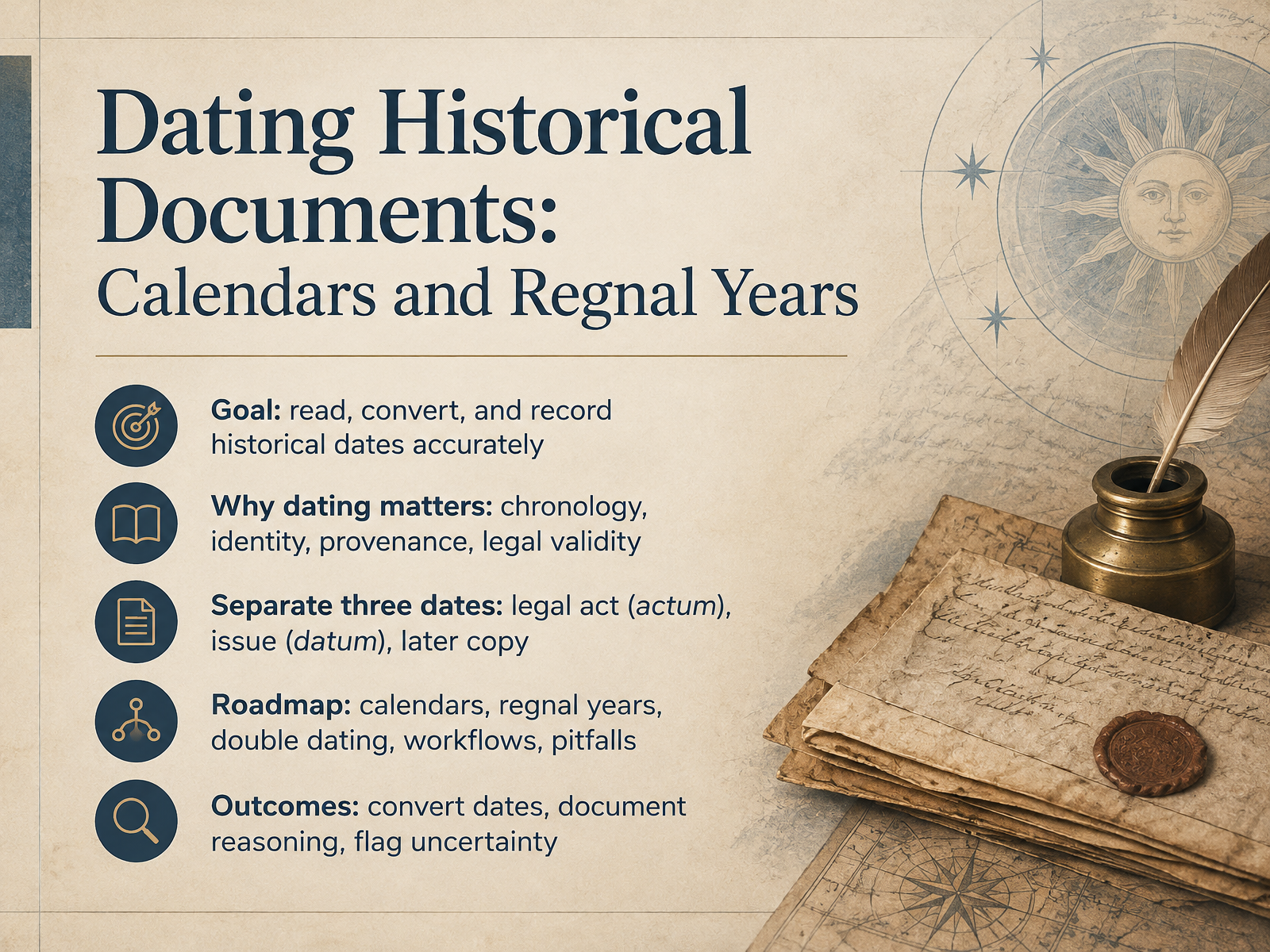
- 01Dating Historical Documents: Calendars and Regnal YearsWelcome to Dating Historical Documents: Calendars and Regnal Years. The goal of this course is practical. You will learn to read, convert, and record historical dates accurately. Why does dating matter so much? Because dates shape chronology, identity, provenance, and even legal validity. A single misread year can rewrite a family, or cast doubt on a document. Before we go further, keep one key distinction in mind. A document may contain three dates: the legal act, called actum, the issue or handing over, called datum, and the date of a later copy. Often they differ. Our roadmap covers calendars, regnal years, double dating, practical workflows, and common pitfalls. By the end, you will convert dates, document your reasoning, and flag uncertainty clearly. Take a moment now to look at one of your own documents. Ask which date it really records. Next, we look at three dates hidden in one document.interpares.orgdoi.orgdk.robinson.cam.ac.uk+22 min
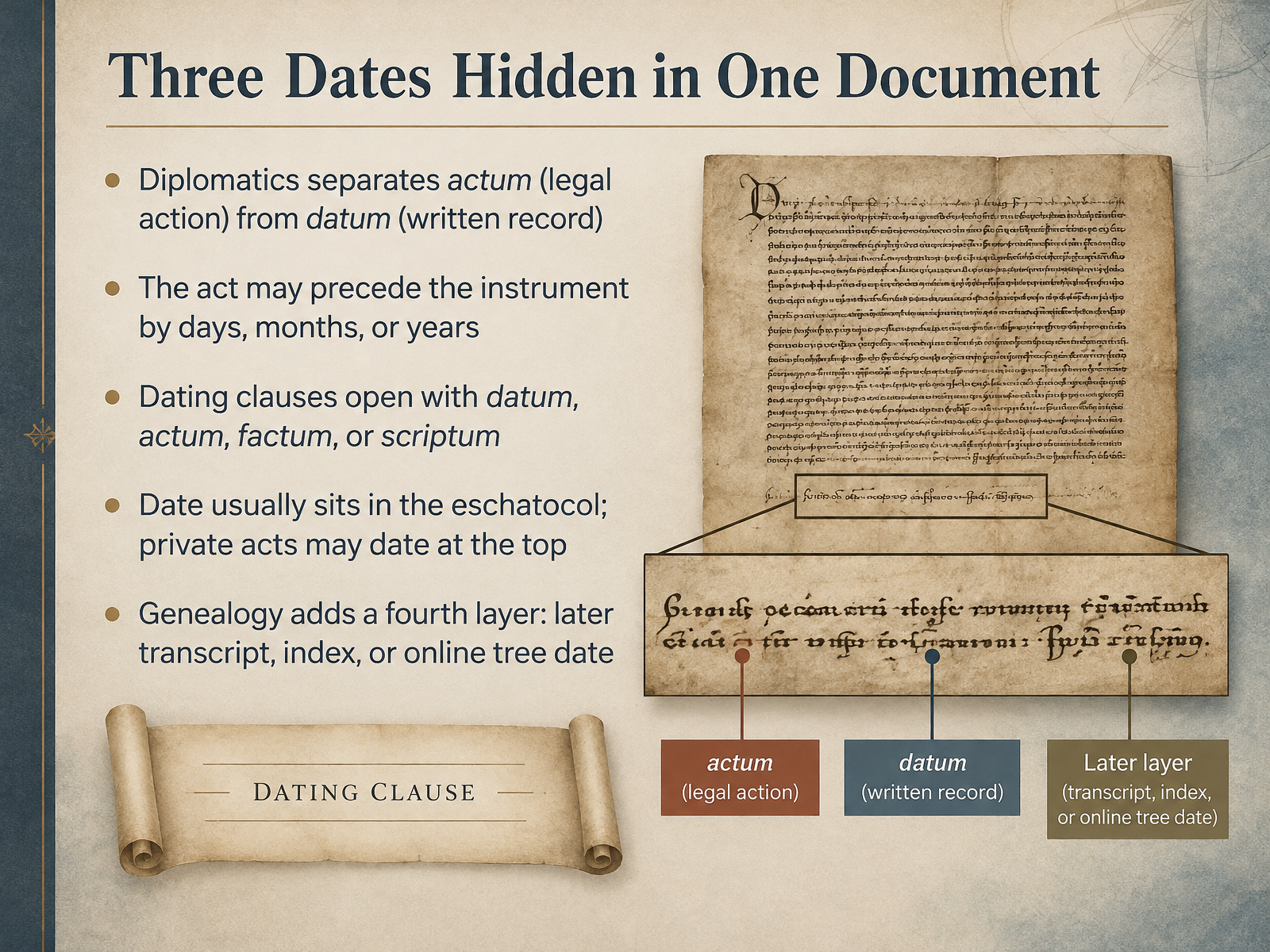
- 02Three Dates Hidden in One DocumentBefore you read a single date as a fact, look closely. One document can hide three dates, and sometimes four. Diplomatics, the study of documents, separates the actum, the legal action itself, from the datum, the point when the written record was made. The act may come days, months, or years before the instrument that records it. Dating clauses often open with words like datum, actum, factum, or scriptum, so watch for them. The date usually sits in the eschatocol, the closing section of the document, though private acts may put it at the top. And genealogy adds a fourth layer: a later transcript, an index, or an online tree may carry its own date. So when you find a date, pause and ask which of these it really is. Next, we look at Julian and Gregorian Calendars in Brief.
 interpares.orgdoi.orgdk.robinson.cam.ac.uk+22 min
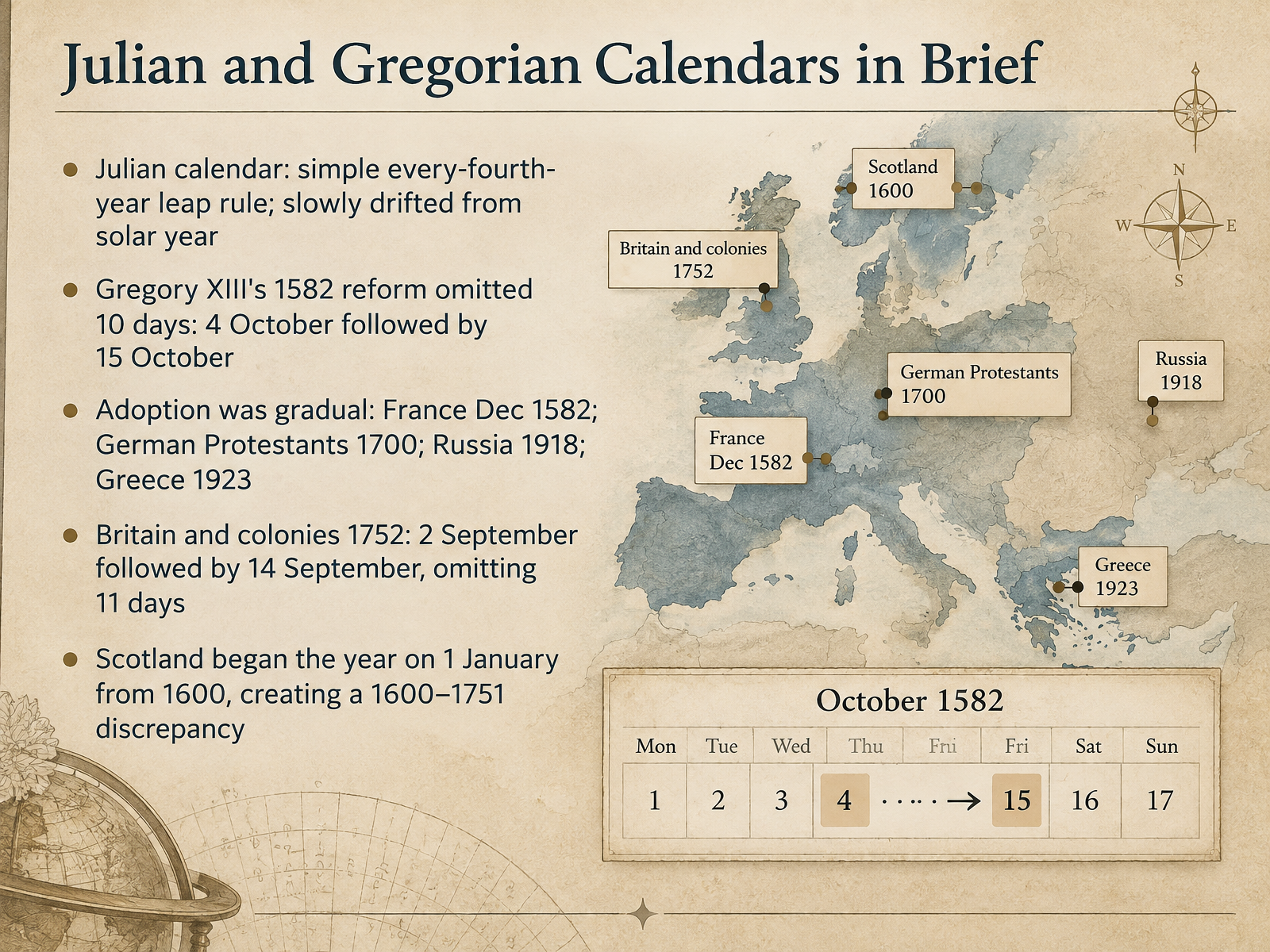
- 03Julian and Gregorian Calendars in BriefLet's begin with the two calendars themselves. The Julian calendar used a simple rule: add one leap day every fourth year. That was close, but not exact, so over centuries it slowly drifted away from the solar year. By 1582, the gap had reached ten days. Pope Gregory the Thirteenth reformed the calendar, and the fourth of October 1582 was followed directly by the fifteenth, omitting ten days. But adoption was gradual, not instant. France switched in December 1582. German Protestant states followed in 1700. Russia waited until 1918, and Greece until 1923. Britain and its colonies changed in 1752, when the second of September was followed by the fourteenth, omitting eleven days. One more detail matters for family historians. Scotland began the year on the first of January from 1600, while England still began it on the twenty-fifth of March. That created a discrepancy between the two nations from 1600 to 1751. Keep these dates in mind as you read your documents. Next, we look at Old Style, New Style, and the double date trap.
 en.wikipedia.orgcirrus.ucsd.edudata.iana.org+22 min
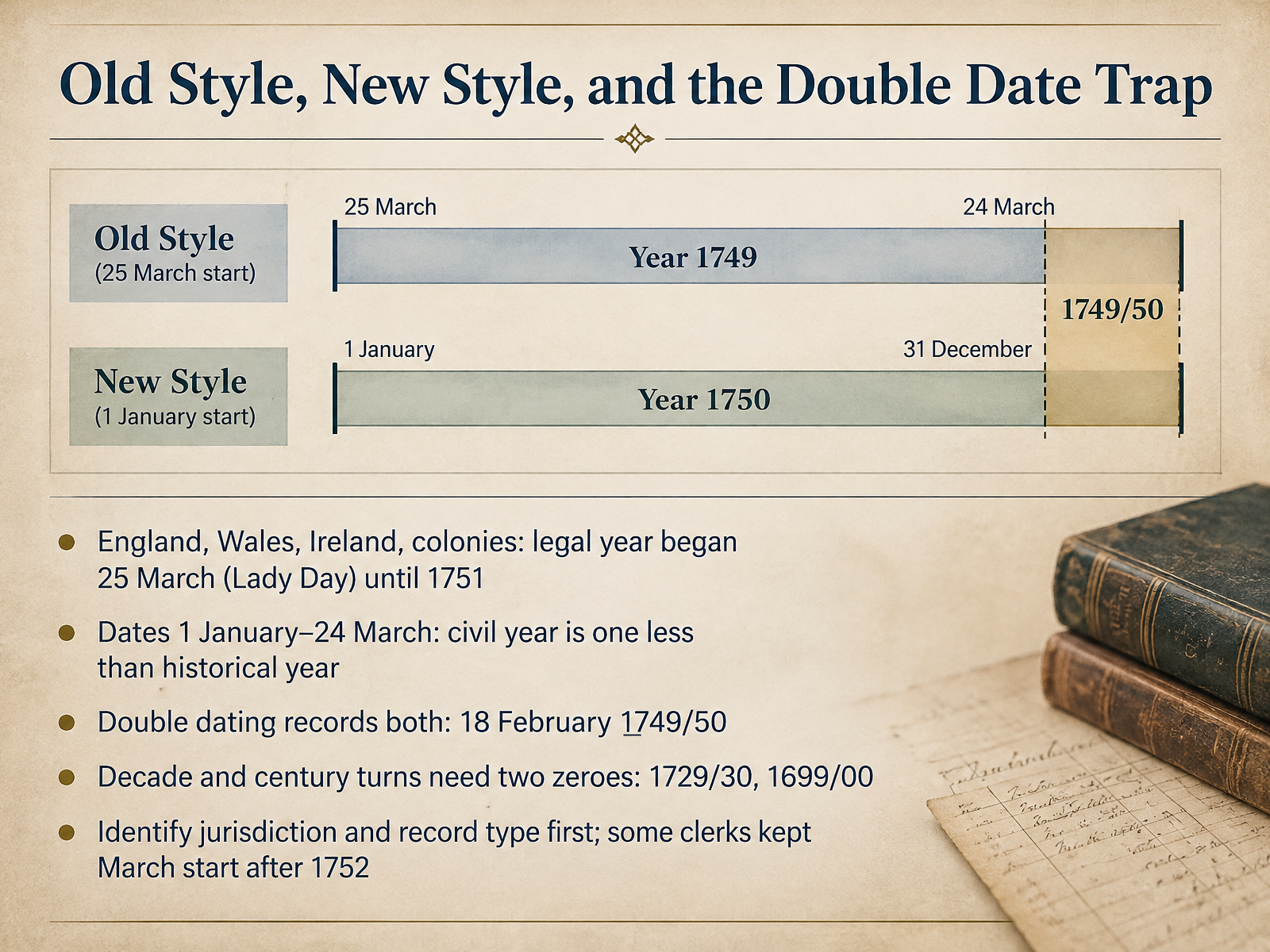
- 04Old Style, New Style, and the Double Date TrapNext, let's look at the double date trap. In England, Wales, Ireland, and the colonies, the legal year began on the twenty-fifth of March, Lady Day, until seventeen fifty-one. So for dates from January first through March twenty-fourth, the civil year is one less than the historical year. Records often show both, written with a slash. For example, eighteenth February seventeen forty-nine stroke fifty. Watch the turns of a decade or century. They need two zeroes, as in seventeen twenty-nine stroke thirty, or sixteen ninety-nine stroke double zero. Before interpreting any date, identify the jurisdiction and the record type first. Some clerks kept the March start even after seventeen fifty-two. Always check your source. Now, how were regnal years counted?
 freereg.org.ukarchives.norfolk.gov.uknottingham.ac.uk+21 min
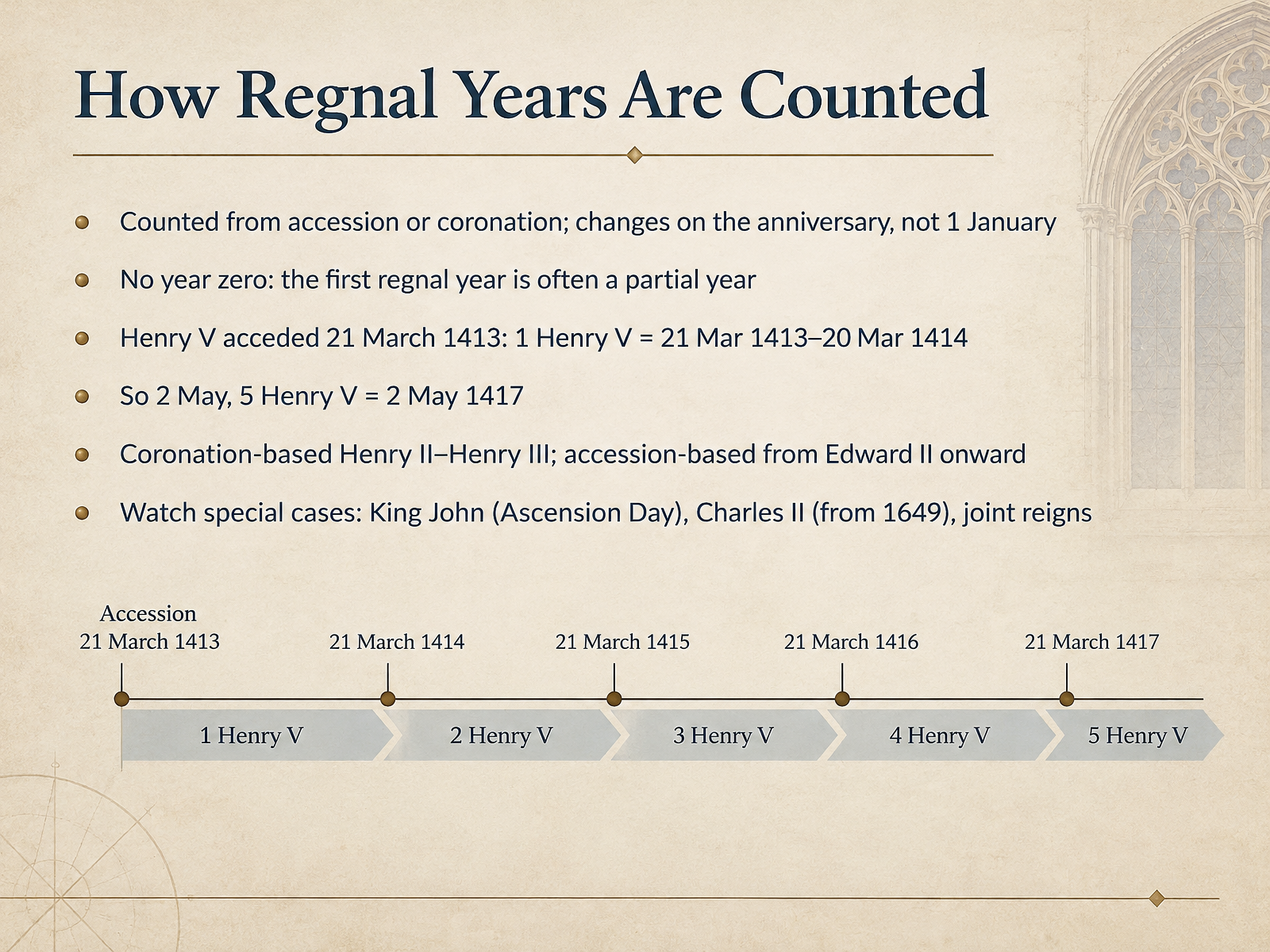
- 05How Regnal Years Are CountedNow let's look at how regnal years are actually counted. A regnal year runs from the date the monarch acceded, or was crowned, to the day before the anniversary. It does not change on the first of January. And there is no year zero. The first regnal year is often a partial year. Take Henry V, who acceded on the twenty-first of March, fourteen thirteen. His first regnal year ran from that day to the twentieth of March, fourteen fourteen. So a deed dated the second of May, five Henry V, means the second of May, fourteen seventeen. Be aware that counting from the coronation was used for Henry the Second through Henry the Third, while accession-based counting applies from Edward the Second onward. Some reigns need special care. King John counted from Ascension Day, a moveable feast. Charles the Second dated his reign from sixteen forty-nine. And joint reigns use double numbers, such as one and two Philip and Mary. Always confirm the accession date and the original wording before you convert. Next, we will work through reading and converting regnal year dates.
 nottingham.ac.ukarchives.norfolk.gov.ukrdmc.nottingham.ac.uk+22 min
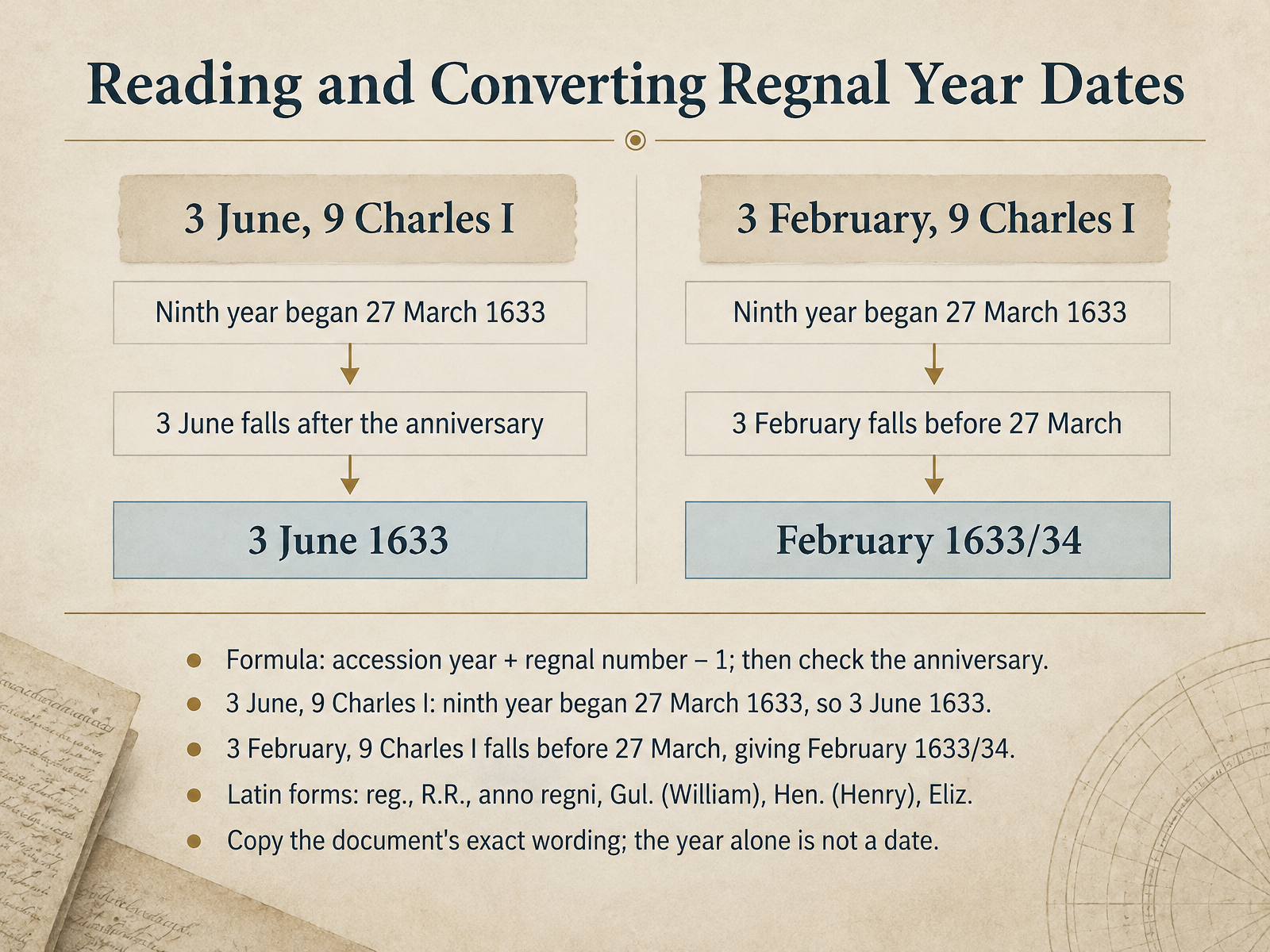
- 06Reading and Converting Regnal Year DatesNow let's put that into practice with regnal year dates. The basic formula is simple. Take the accession year, add the regnal number, subtract one, then check whether your date falls before or after the accession anniversary. Take 3 June, 9 Charles I. Charles came to the throne in 1625, so his ninth year began on 27 March 1633. June comes after that anniversary, so we read 3 June 1633. But 3 February, 9 Charles I falls before 27 March, so it lands in February 1633/34, the double date historians use for the old legal year. You will also meet Latin forms such as reg., meaning regni or year of the reign, R.R., anno regni, and abbreviations like Gul. for William, Hen. for Henry, and Eliz. Always copy the document's exact wording. The year alone is not a date. Next, we'll look at accession tables and the standard reference.
 interpares.orgdoi.orgdk.robinson.cam.ac.uk+22 min
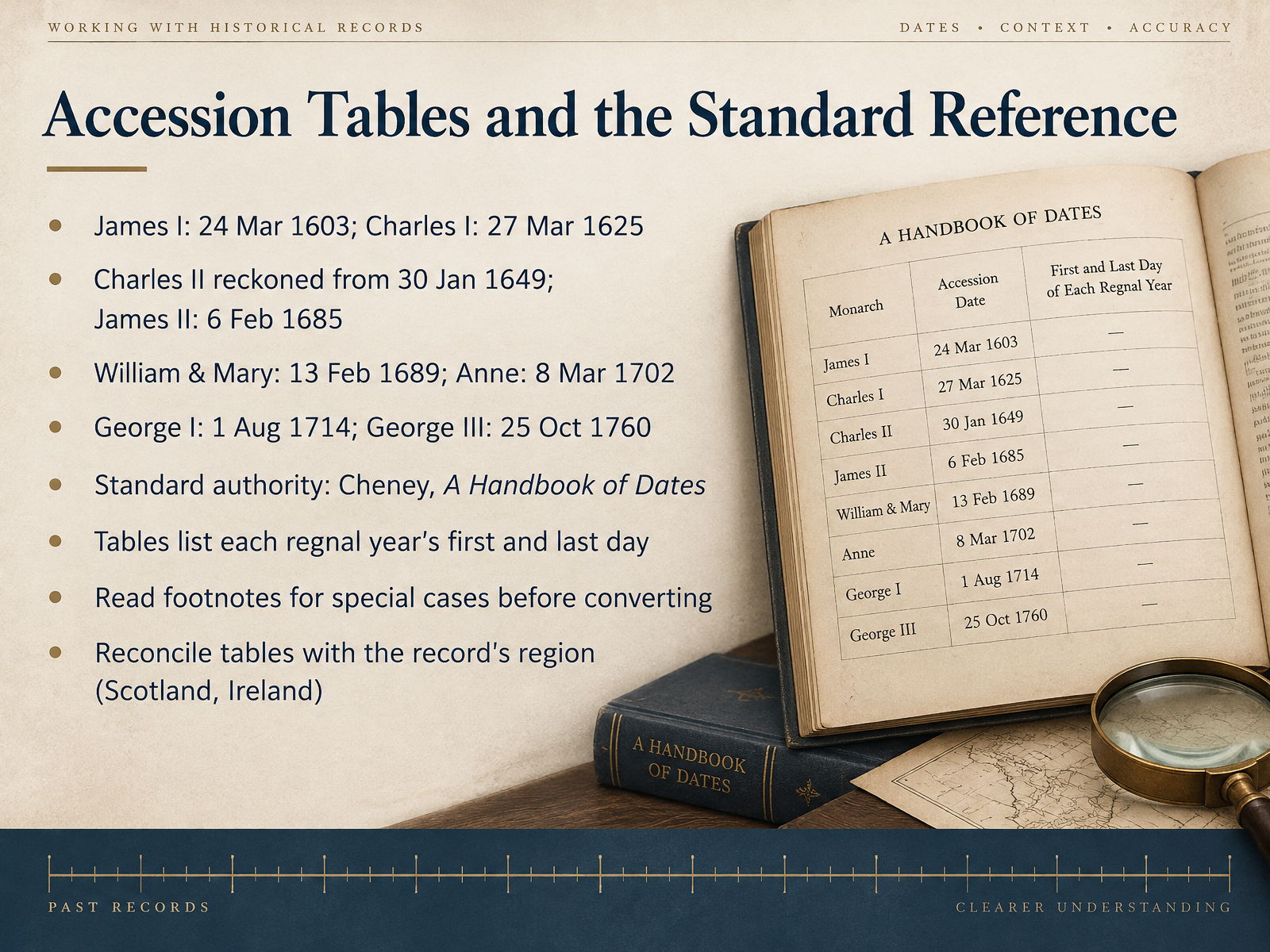
- 07Accession Tables and the Standard ReferenceNow let's look at accession tables, the standard reference you will rely on. These tables list the first and last day of each regnal year, so you don't have to calculate from memory. See the pattern. James the First acceded on twenty-four March, sixteen oh three. Charles the First on twenty-seven March, sixteen twenty-five. Charles the Second is reckoned from thirtieth January, sixteen forty-nine, the date of his father's execution, not the Restoration. William and Mary begin on thirteen February, sixteen eighty-nine, and George the Third on twenty-five October, seventeen sixty. For authority, use Cheney's A Handbook of Dates. Before converting, always read the footnotes for special cases. And check the record's region. Scottish or Irish practice may differ from the English table. So open your own document and test it against these dates.
 nottingham.ac.ukfreereg.org.ukarchives.norfolk.gov.uk+21 min
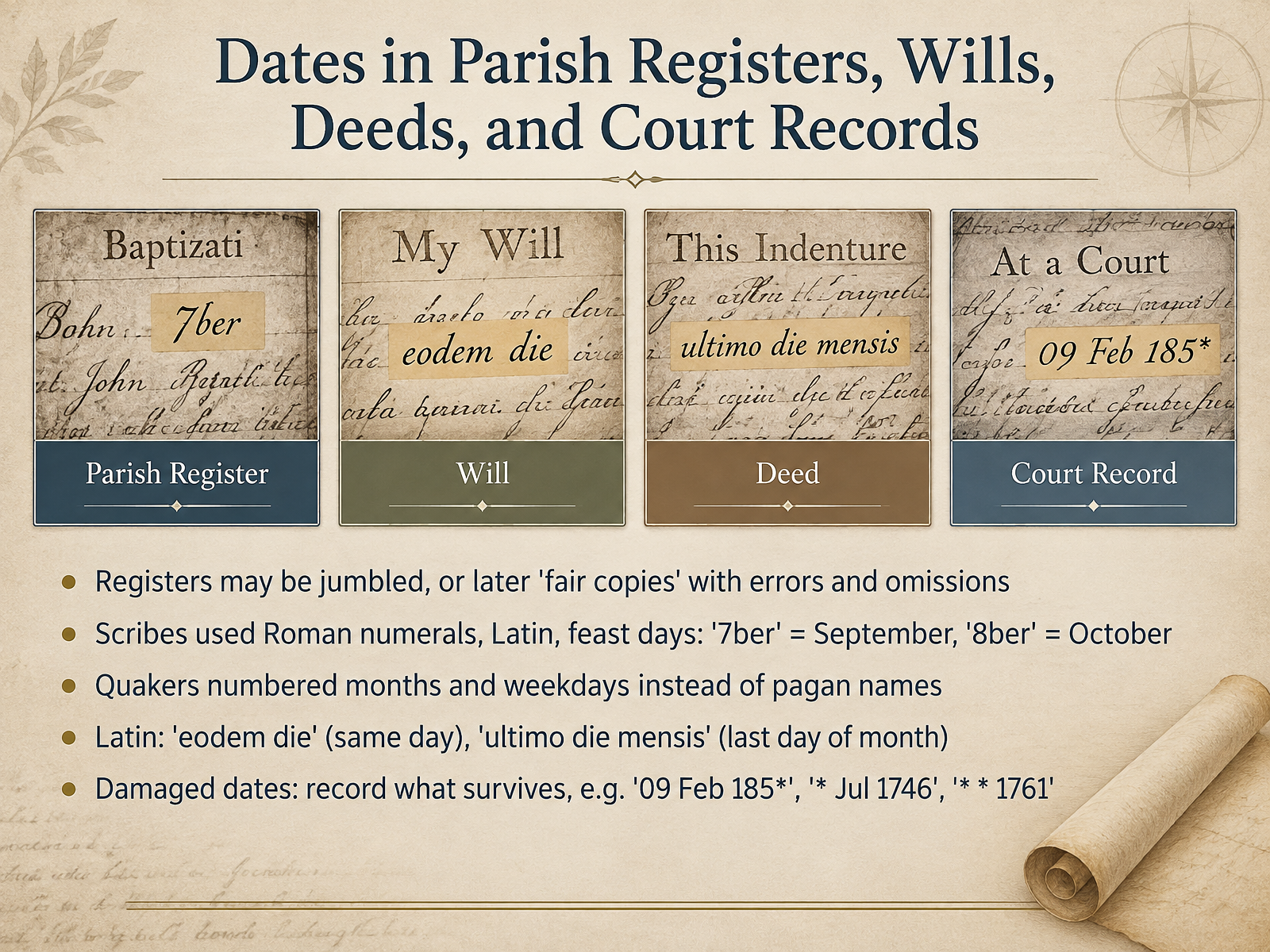
- 08Dates in Parish Registers, Wills, Deeds, and Court RecordsLet's move from principles to practice, looking at the kinds of records you will actually handle: parish registers, wills, deeds, and court records. Parish registers may be jumbled, with baptisms, marriages, and burials mixed together. Some are later fair copies, made from older volumes, and those copies can carry errors and omissions. Scribes also used Roman numerals, Latin, and feast days. A useful trap is that 7ber means September and 8ber means October, not July and August. Quakers numbered months and weekdays rather than using pagan names. And watch for Latin phrases such as eodem die, meaning the same day as the previous entry, or ultimo die mensis, the last day of the month. When a date is damaged, record only what survives, using asterisks for the gaps, for example 09 Feb 185 asterisk, or asterisk Jul 1746. Never invent the missing part. Next, we will put this into practice with the conversion workflow, step by step.
 freereg.org.ukarchives.norfolk.gov.uknottingham.ac.uk+22 min
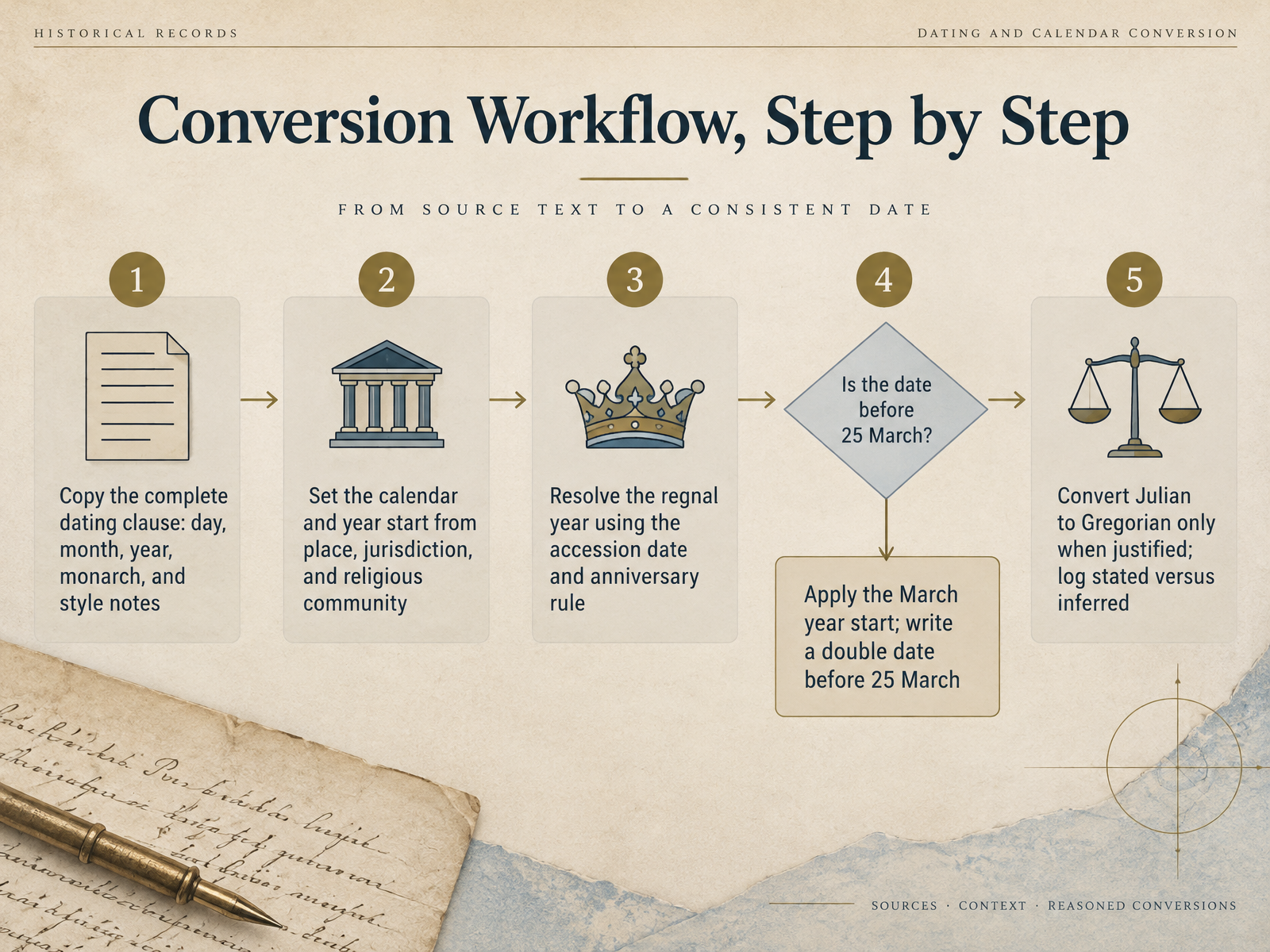
- 09Conversion Workflow, Step by StepNow let's bring the pieces together in a conversion workflow. Work through it in order, and write down each step as you go. First, copy the complete dating clause exactly: day, month, year, monarch, and any style notes such as Old Style. Second, set the calendar and the year start from the place, the jurisdiction, and the religious community, not from habit. Third, resolve the regnal year using the accession date and the anniversary rule. Remember, a regnal year begins on the accession date, not on the first of January. Fourth, apply the March year start. For a date before the twenty-fifth of March, write a double date, such as sixteen thirty-six, thirty-seven. Fifth, convert Julian to Gregorian only when the evidence justifies it, and log what the document states separately from what you inferred. That simple habit protects you from quiet errors and lets the next researcher follow your reasoning. Next, we'll look at reference tables and online calculators.
 freereg.org.ukarchives.norfolk.gov.uknottingham.ac.uk+22 min
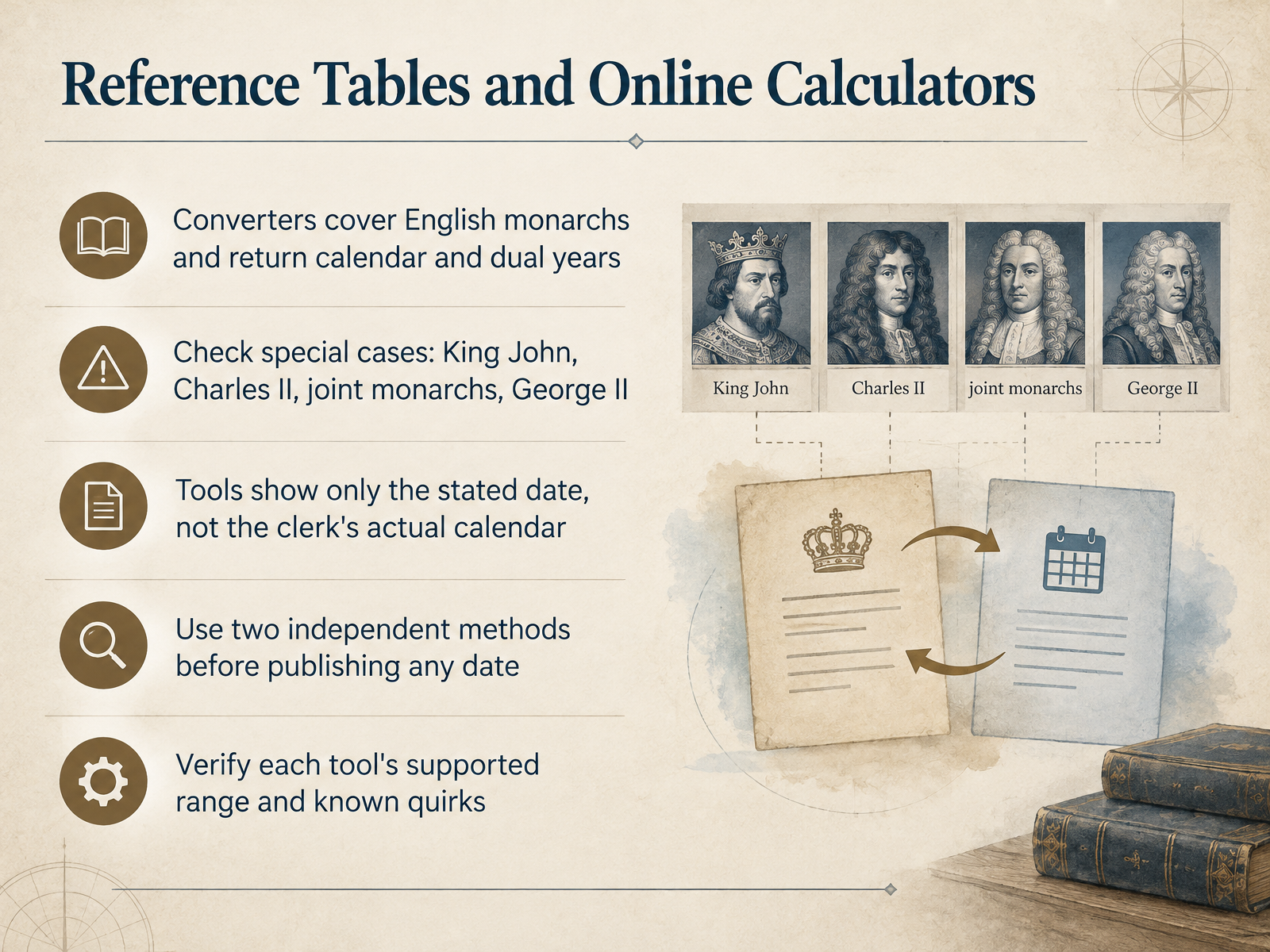
- 10Reference Tables and Online CalculatorsNow let's look at the tools themselves. Online converters for English monarchs will turn a regnal date into both a calendar year and, where relevant, a dual year such as fifteen fifty eight stroke nine. But check the special cases first. King John counted his years from Ascension Day, a moveable feast. Charles the Second dated his reign from his father's execution in sixteen forty nine, so the Restoration fell in his twelfth year. Joint monarchs such as Philip and Mary used double numbers, and take the first, Philip's year. George the Second's regnal years shifted from the eleventh of June to the twenty second of June after the calendar change of seventeen fifty two. And remember the deeper limit. A tool shows only the date as stated. It cannot know which calendar the clerk actually used. So before you publish any date, apply two independent methods, for example a converter plus a printed handbook such as Cheney's Handbook of Dates. Then verify each tool's supported range and known quirks. Treat the calculator as a helpful assistant, not as the final authority. Recording Dates: Standards and Conventions is next, where we'll put these conversions into a consistent written form.
 nottingham.ac.ukfreereg.org.ukinterpares.org+22 min
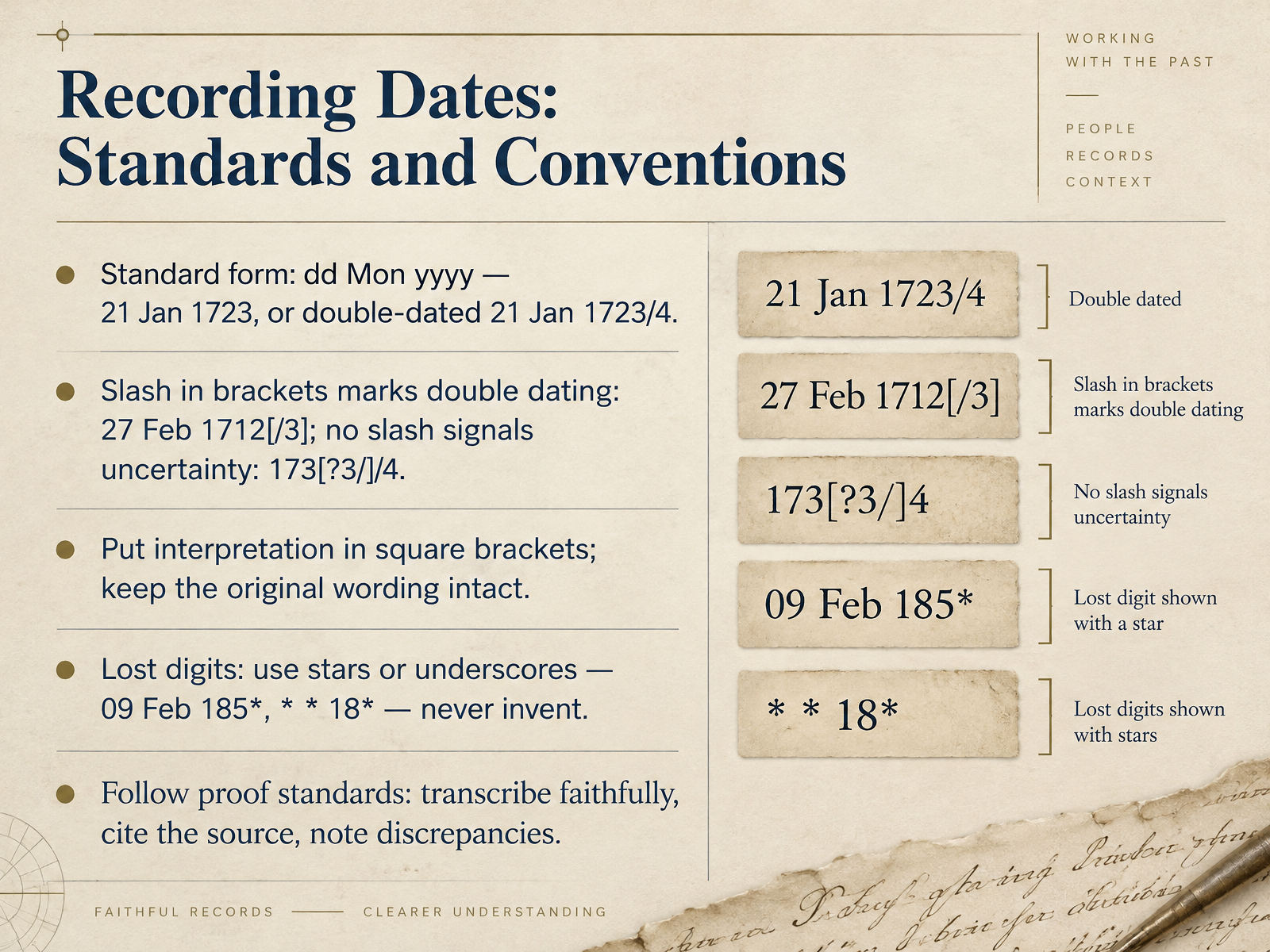
- 11Recording Dates: Standards and ConventionsNow let's put all of this into a consistent written standard. The basic form is day, three-letter month, four-digit year. So 21 January 1723 becomes 21 Jan 1723, or, double-dated, 21 Jan 1723/4. The slash in brackets marks double dating, as in 27 Feb 1712[/3]. Where there is no slash, a question mark signals uncertainty, as in 173[?3/]4. Put your interpretation in square brackets and keep the original wording intact. When digits are lost, use stars or underscores, for example 09 Feb 185*, or * * 18*. Never invent a missing digit. Finally, follow proof standards. Transcribe faithfully, cite the source, and note any discrepancies. That habit protects your readers and your own conclusions. Next, we move on to Research Logs and Documenting Uncertainty.
 freereg.org.ukarchives.norfolk.gov.uknottingham.ac.uk+21 min
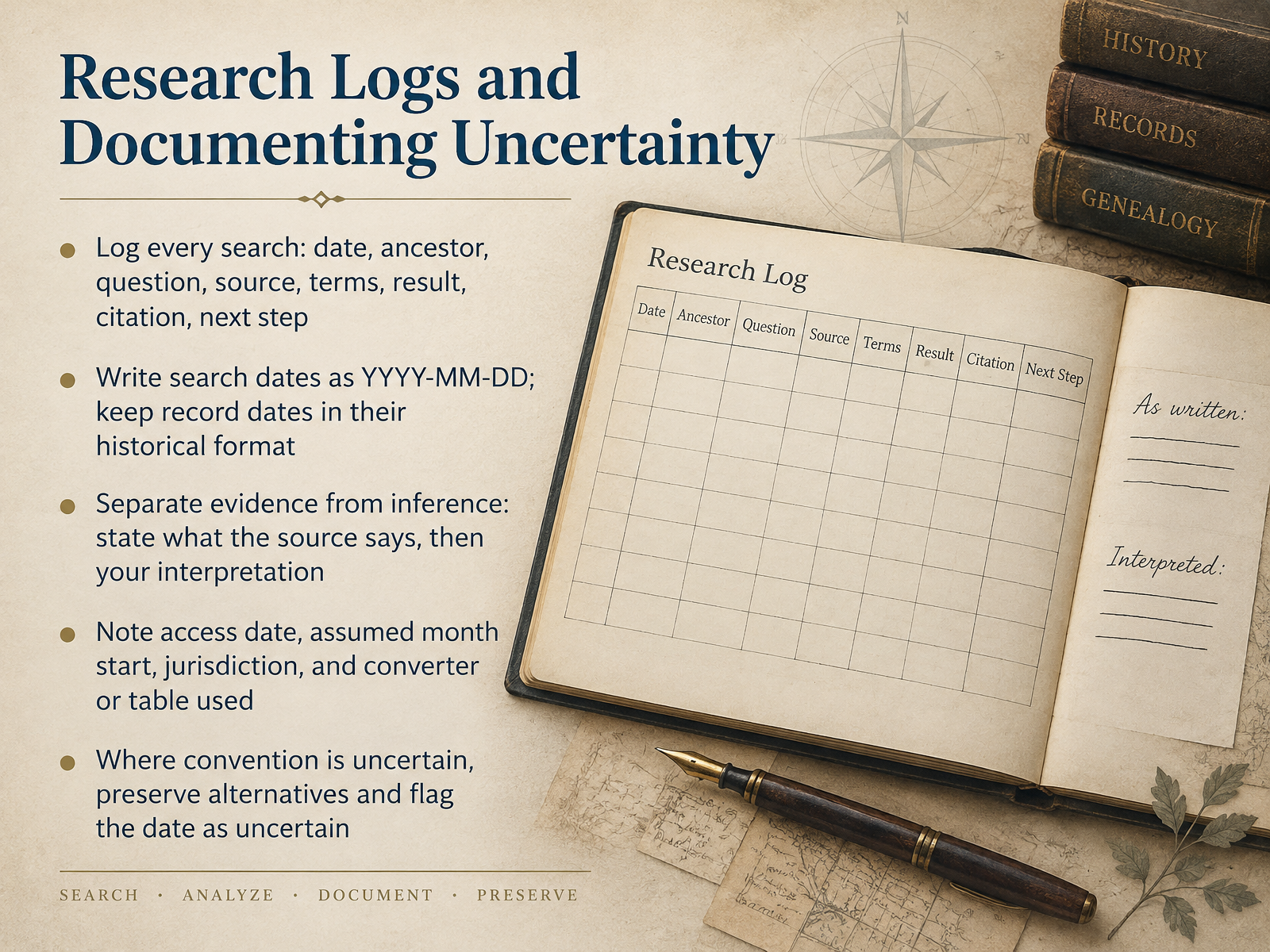
- 12Research Logs and Documenting UncertaintyNow let's turn to research logs and documenting uncertainty. A log is your safety net. For every search, record the date, the ancestor, the question you asked, the source, the search terms, the result, the citation, and the next step. Log negative results too, because knowing what you already tried saves years of repeat work. Write your search dates as year, month, day in four, two, two format, so they sort correctly. But keep the record's own dates in their historical format, such as double dates like 1749 slash 50. Then separate evidence from inference. First state what the source actually says. Then add your interpretation as a comment. Also note the access date, the assumed start of the year, the jurisdiction, and which converter or table you used. And where the convention is uncertain, preserve the alternatives and flag the date as uncertain. Your log is the breadcrumb trail back to the source. Next, we will look at common pitfalls and accuracy checks.
 2 min
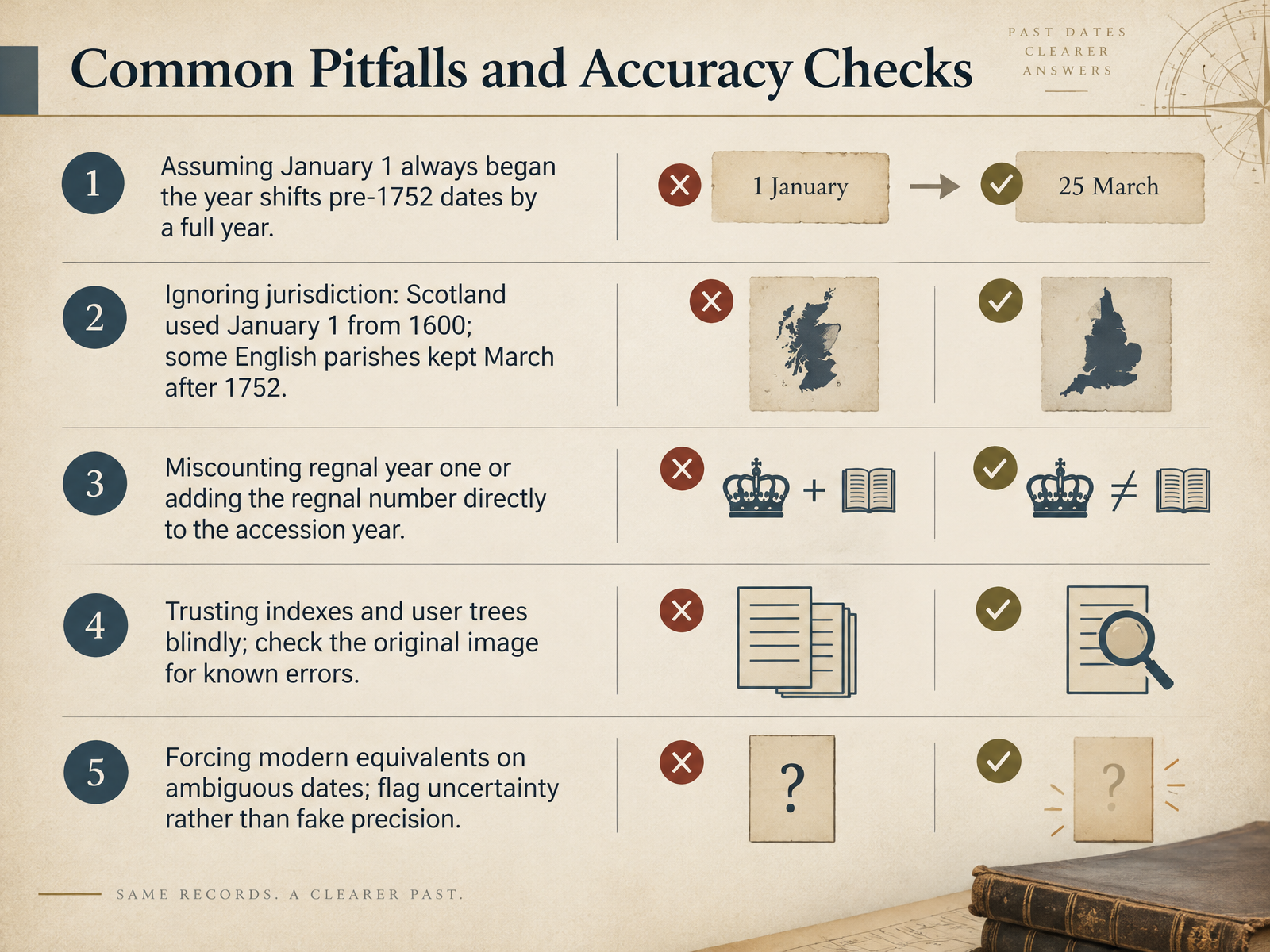
- 13Common Pitfalls and Accuracy ChecksLet us finish the method by looking at common pitfalls and accuracy checks. First, never assume January first always began the year. Before seventeen fifty-two in England and Wales, the legal year began on March twenty-fifth, so treating January as a new year can shift a date by a full year. Second, ignore jurisdiction at your peril. Scotland used January first from sixteen hundred. Some English parishes kept March well after seventeen fifty-two. Third, watch regnal years. Do not simply add the regnal number to the accession year. Start with accession year plus the regnal number, minus one, then check whether the day falls before the accession anniversary. Fourth, do not trust indexes or user trees blindly. All indexes contain errors, so view the original image and check for known problems. Finally, do not force modern equivalents on ambiguous dates. Flag uncertainty rather than fake precision. Write the date as written, and add your interpretation in square brackets. That habit keeps your reasoning honest and checkable. Next, we will bring all of this together in Putting It Into Practice.
 nottingham.ac.ukfreereg.org.ukarchives.norfolk.gov.uk+22 min
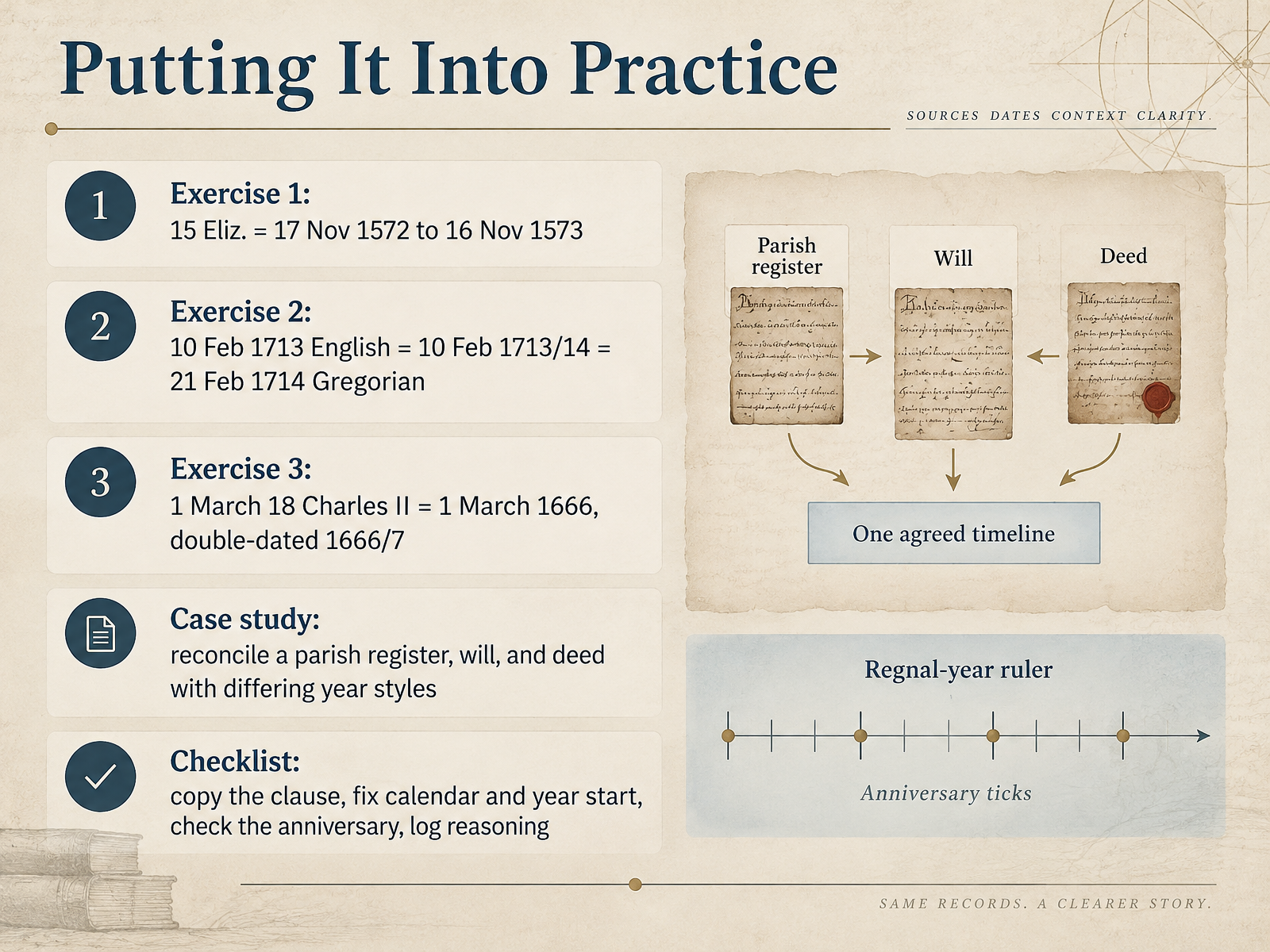
- 14Putting It Into PracticeLet's put everything into practice. Try Exercise one. Fifteen Elizabeth means the fifteenth year of Elizabeth the First. Her first year ran from the seventeenth of November, fifteen fifty eight. So her fifteenth year ran from the seventeenth of November, fifteen seventy two, to the sixteenth of November, fifteen seventy three. Exercise two. The tenth of February, seventeen thirteen English becomes seventeen thirteen slash fourteen, which is the twenty first of February, seventeen fourteen Gregorian. Exercise three. The first of March, eighteen Charles the Second, is the first of March, sixteen sixty six, double dated sixteen sixty six slash seven. Finally, a case study. Reconcile a parish register, a will, and a deed that use different year styles. Work through the checklist. Copy the dating clause exactly. Fix the calendar and the year start. Check the anniversary. Then log your reasoning. Thank you for following along. With these habits, you can read any document with confidence and accuracy. Keep going, and keep checking your own records.
 nottingham.ac.ukfreereg.org.ukarchives.norfolk.gov.uk+22 min
Take the deck with you
Download this course as a file — free, no sign-up needed.
- PDF handoutEvery slide page, ready to print or share.15 pages · 5.3 MBDownload
- Narrated PowerPointThe deck that presents itself — every slide carries the digital human's narration video.15 pages · 13.9 MBDownload
- PowerPoint slidesThe full deck as a .pptx — open it in PowerPoint, Keynote, or Google Slides.15 pages · 5.2 MBDownload
Free to use in your own training — please keep the PersonWise credit page at the end.
Have your own deck? Turn it into a course
Sources consulted
Web sources consulted while building this course.
- Authenticity Task Force Lineage of Elements Included in the Template for Analysis (pre-InterPARES): From Traditional Diplomatics to Contemporary Archival Diplomatics — interpares.org
- Diplomatics: the science of reading medieval documents. A Handbook — doi.org
- William Henry Stevenson and the continental diplomatics of his age — dk.robinson.cam.ac.uk
- Diplomatics: New Uses for an Old Science, Part I — archivaria.ca
- L’utilité des bases de données diplomatiques pour l’étude des généalogies — doi.org
- List of adoption dates of the Gregorian calendar by country — en.wikipedia.org
- Calcalcs: the calendar calculation routines — cirrus.ucsd.edu
- https://data.iana.org/time-zones/data/calendars — data.iana.org
- Old Style and New Style dates — en.wikipedia.org
- Change from the Julian Calendar to the Gregorian Calendar. Explanation of calendar change plus year when each country made the change to the Gregorian calendar at Ancestor Search — searchforancestors.com
- FreeREG | — freereg.org.uk
- Parish registers — archives.norfolk.gov.uk
- Historical Year and the Civil Year - The University of Nottingham — nottingham.ac.uk
- Change in Calendar - Dates in the Old Parish Registers - National Records of Scotland (NRS) — nrscotland.gov.uk
- FreeREG | — freereg.org.uk
- Regnal Years - The University of Nottingham — nottingham.ac.uk
- Dates and numbers in Latin and English — archives.norfolk.gov.uk
- Historical skills : dating documents — rdmc.nottingham.ac.uk
- Chronology and dating — medievalgenealogy.org.uk
- Regnal years | Courthouse Libraries BC — courthouselibrary.ca