Content Distribution Fundamentals
Begin
13 pages · ~26 min
Content Distribution Fundamentals
A foundational course covering content distribution strategies, channels, and best practices for marketing professionals.
What you’ll learn
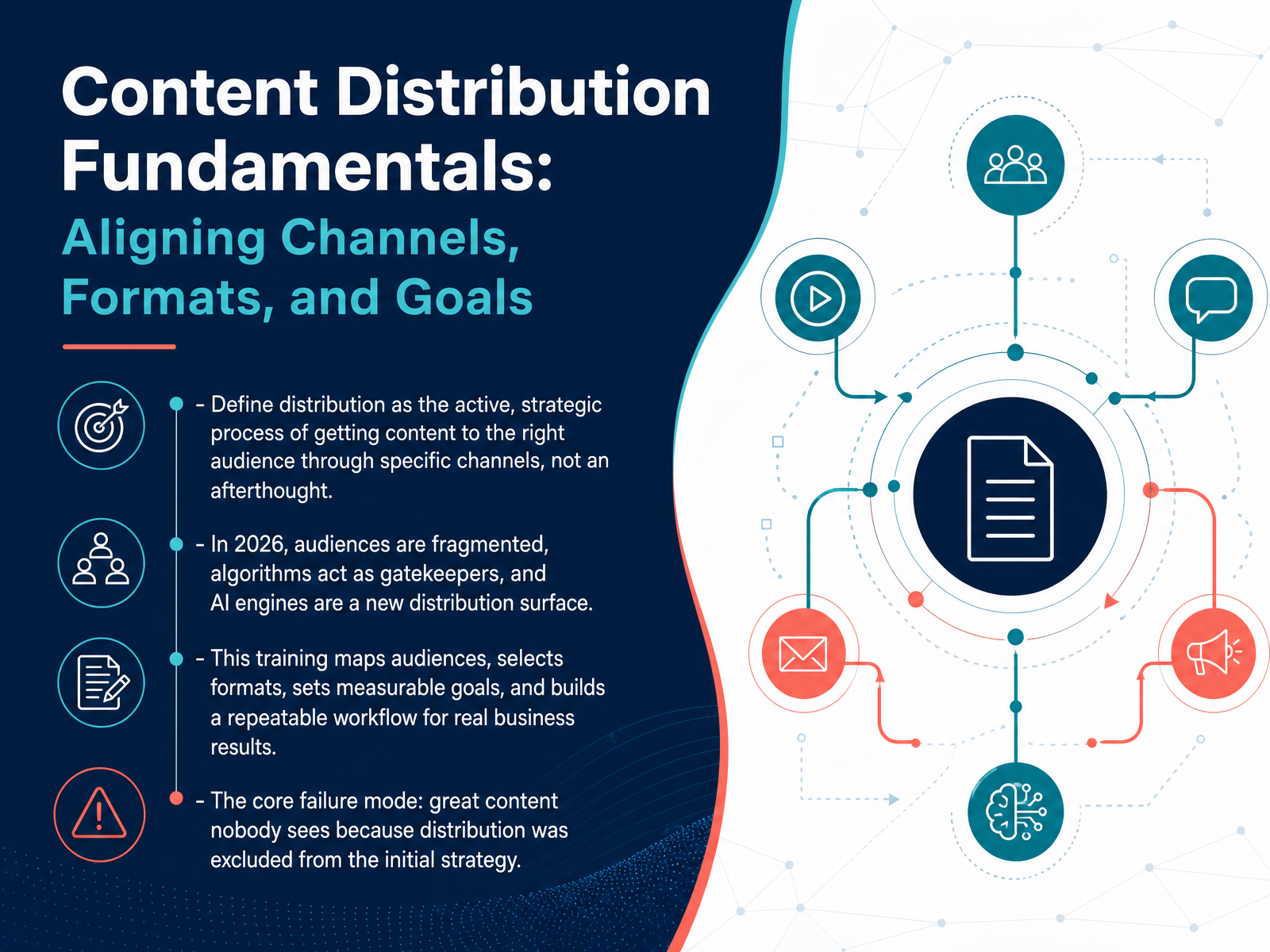
- 01Content Distribution Fundamentals: Aligning Channels, Formats, and GoalsWelcome to Content Distribution Fundamentals. In this module, we focus on how to align channels, formats, and goals to get your content seen by the right people. Too often, great content fails because distribution is treated as an afterthought. Here, we treat it as an active, strategic process from the start. In twenty twenty-six, audiences are fragmented. Algorithms act as gatekeepers, and AI engines are a new surface for discovery. This training will help you map your audience, select the right formats, set measurable goals, and build a repeatable workflow that drives real business results. Our goal is to prevent the core failure mode: creating valuable content that nobody ever sees. We'll start by examining the three plus one pillars of modern distribution.contentpen.aiflux.laupnorthmedia.co+21 min
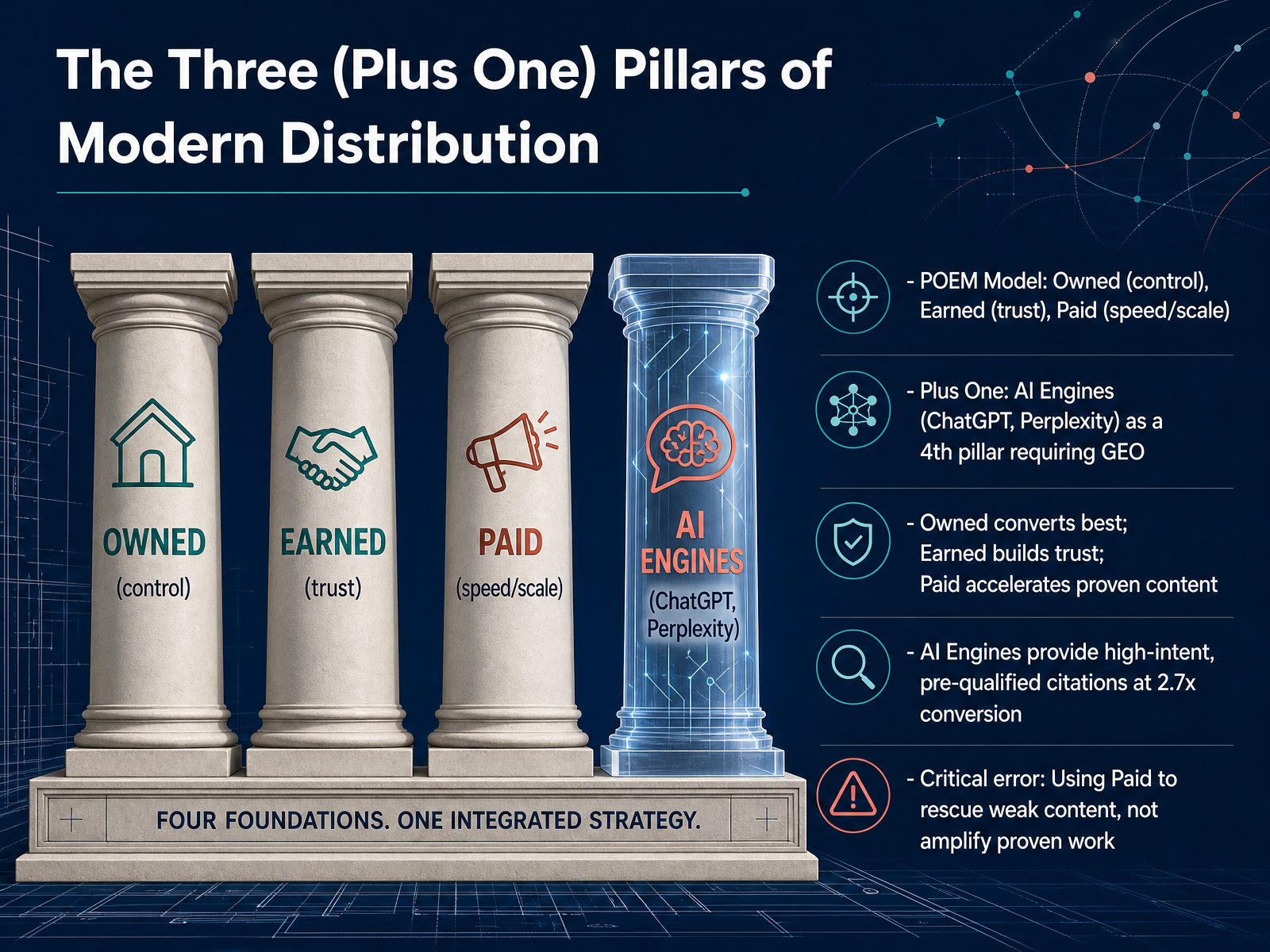
- 02The Three (Plus One) Pillars of Modern DistributionLet's move into the core distribution model that modern teams rely on. You may know the POEM framework: Paid, Owned, and Earned media. Owned channels, like your email list, give you full control. Earned channels, such as press mentions, build trust. Paid channels deliver speed and scale. But in practice, their best roles are more specific. Owned converts the best because that audience has already opted in. Earned works for long-term credibility. And paid accelerates content that has already proven itself. A critical error to avoid is using Paid to rescue weak content. It amplifies what already works; it does not save what does not. Now, there is a fourth pillar driving high-intent traffic: AI Engines. When platforms like ChatGPT or Perplexity cite your content, that visitor arrives pre-qualified. Data shows these referrals can convert at nearly three times the rate of standard organic search. And that brings us to our next essential step: mapping your audience before you choose your channels.
 flux.ladigitalapplied.comreach.cat+22 min
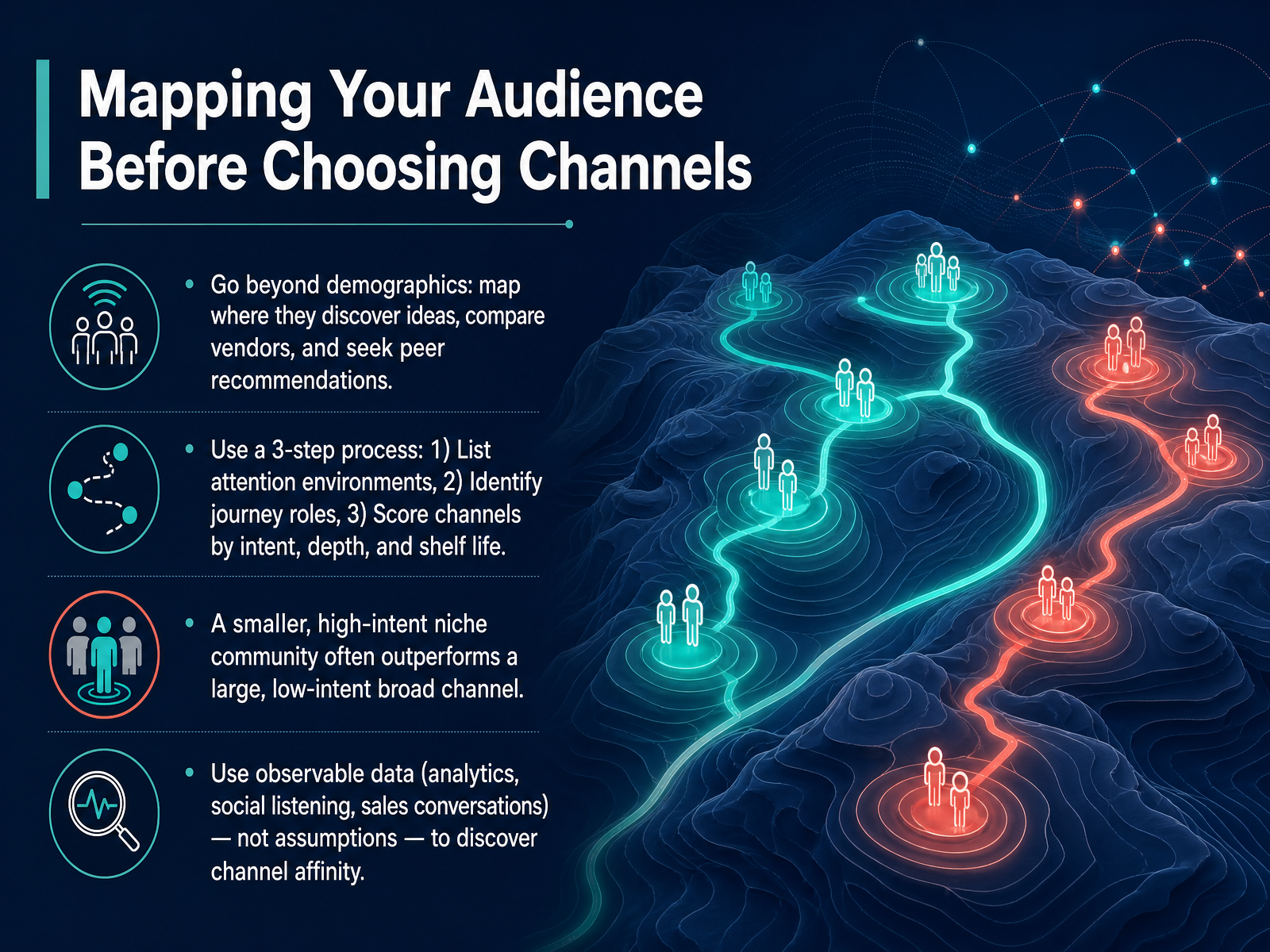
 - 03Mapping Your Audience Before Choosing ChannelsNow let's talk about how to map your audience before you choose any channels. Instead of relying only on demographics, you want to understand where your audience discovers new ideas, compares vendors, and seeks peer recommendations. You can use a simple three-step process to do this. First, list their attention environments. That means the specific places they go for information, like industry Slack communities, LinkedIn groups, or trusted newsletters. Second, identify their journey roles. Is this person a first-time researcher, an active evaluator, or a current user looking for advanced tips? Third, score your potential channels by intent, depth, and shelf life. A smaller, high-intent niche community often delivers better results than a large, low-intent broad channel because the audience is already in the right frame of mind. When you make these decisions, use observable data from your analytics, social listening, and even sales conversations. Don't let assumptions guide your channel selection. This mapping process sets you up to match your content to the right place and the right context. Next, we'll dive into matching content formats to channels and goals.
 ekaav.combloghelpline.comthemarketingjuice.com+22 min
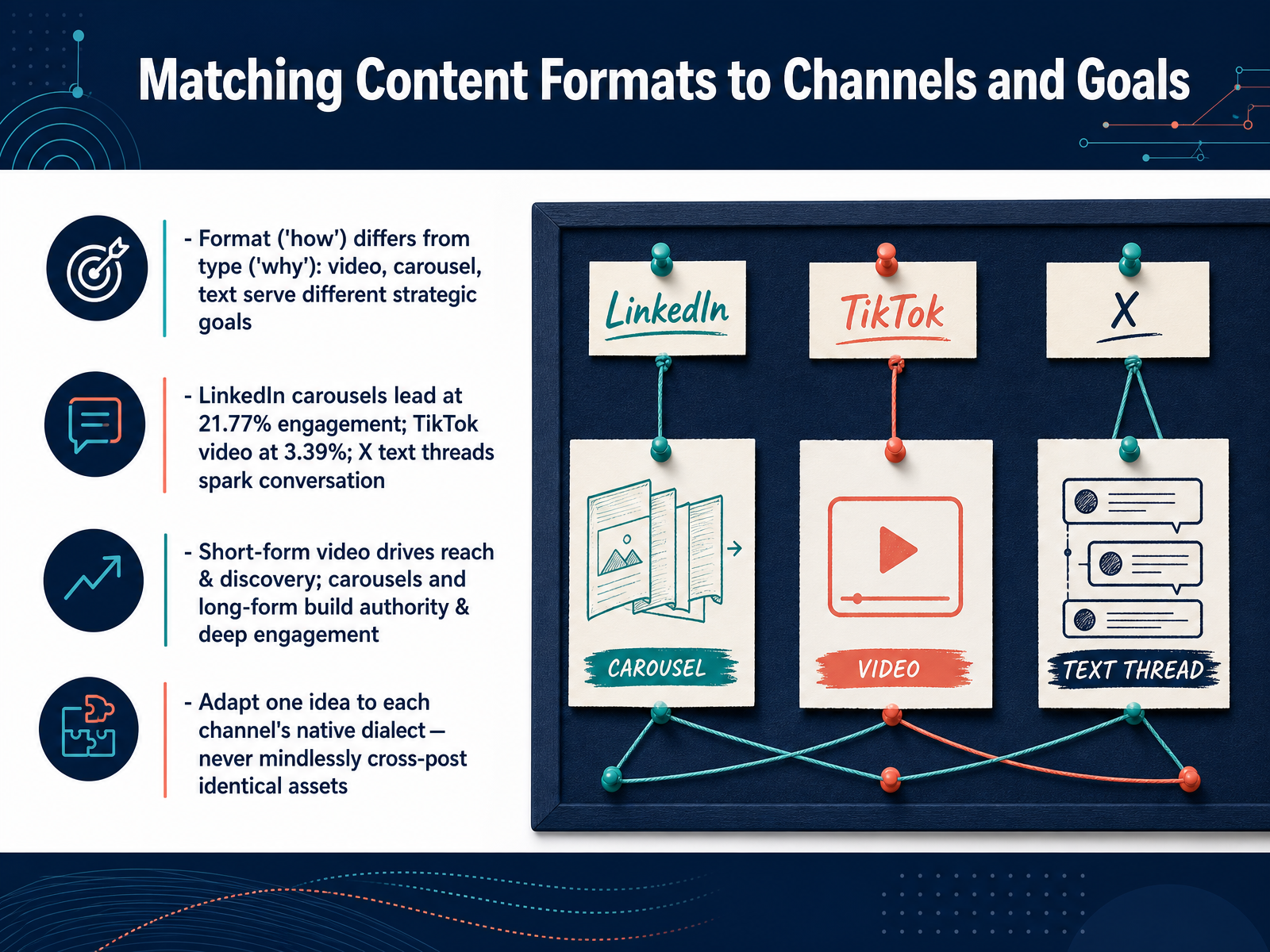
 - 04Matching Content Formats to Channels and GoalsNow let's talk about matching your format to the channel and the goal. First, keep a clear separation in mind. The format is the "how"—like a video, a carousel, or a text post. The type or goal is the "why"—are you educating, entertaining, or starting a conversation? When you match the how and the why to the right platform, the performance difference can be massive. For example, LinkedIn carousels lead engagement at over twenty-one percent, while TikTok video sits at around three point four percent. And on X, text threads spark the most conversation. Think of short-form video as your engine for reach and discovery. Formats like carousels and long-form text are better for building authority and deep engagement. The key is to adapt one core idea into each channel's native dialect, instead of mindlessly cross-posting identical assets. Next, we will build on this by setting measurable goals and a testing mindset.
 buffer.comblog.hubspot.comblog.mediaborne.co.uk+22 min
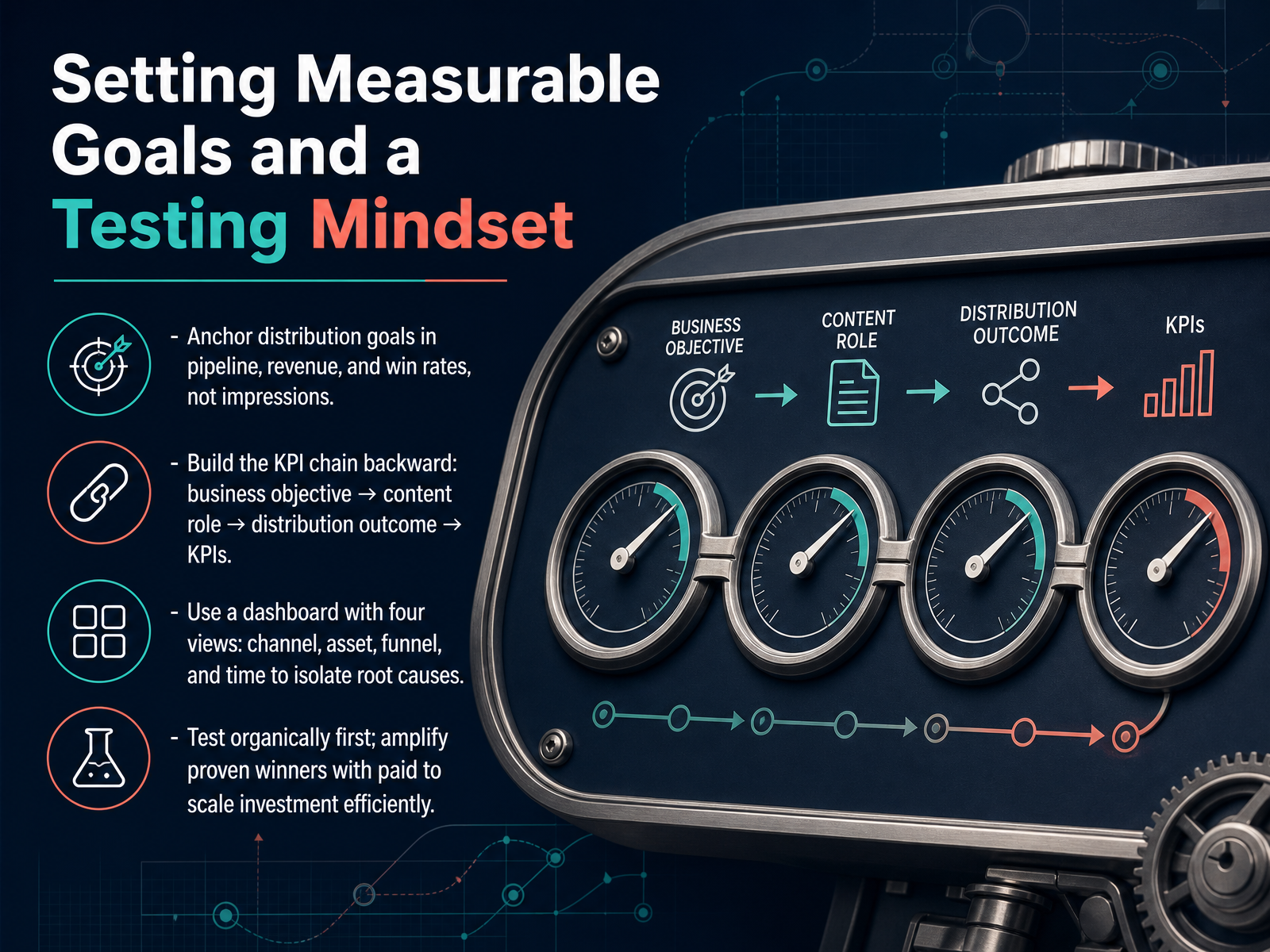
 - 05Setting Measurable Goals and a Testing MindsetNow let's talk about setting goals that actually matter and adopting a testing mindset. Many teams anchor their distribution goals on impressions, but that is a vanity metric. Instead, anchor your goals on pipeline, revenue, and win rates. These are the numbers your business truly cares about. To build your measurement chain, work backward. Start with a clear business objective, like generating more qualified opportunities. Then, define the role your content plays in that objective. From there, identify the distribution outcome you need, and finally, select the KPIs that signal that outcome. This keeps every metric tied to a real business result. Next, use a dashboard with four views to isolate problems quickly. A channel view shows which platforms perform. An asset view ranks content by impact. A funnel view tracks how assets move people through the buyer's journey. And a time view reveals performance trends. When something breaks, you can spot the root cause instantly. Finally, adopt a testing mindset. Test your content organically first. When you find messages and formats that win, amplify those proven winners with paid budget. This is a capital-efficient way to scale. It ensures you only spend money on what already works. Next, we will move from strategy to execution with The Distribution Calendar, turning your plan into an actionable schedule.
 conbersa.aidigitalapplied.comcontentpen.ai+22 min
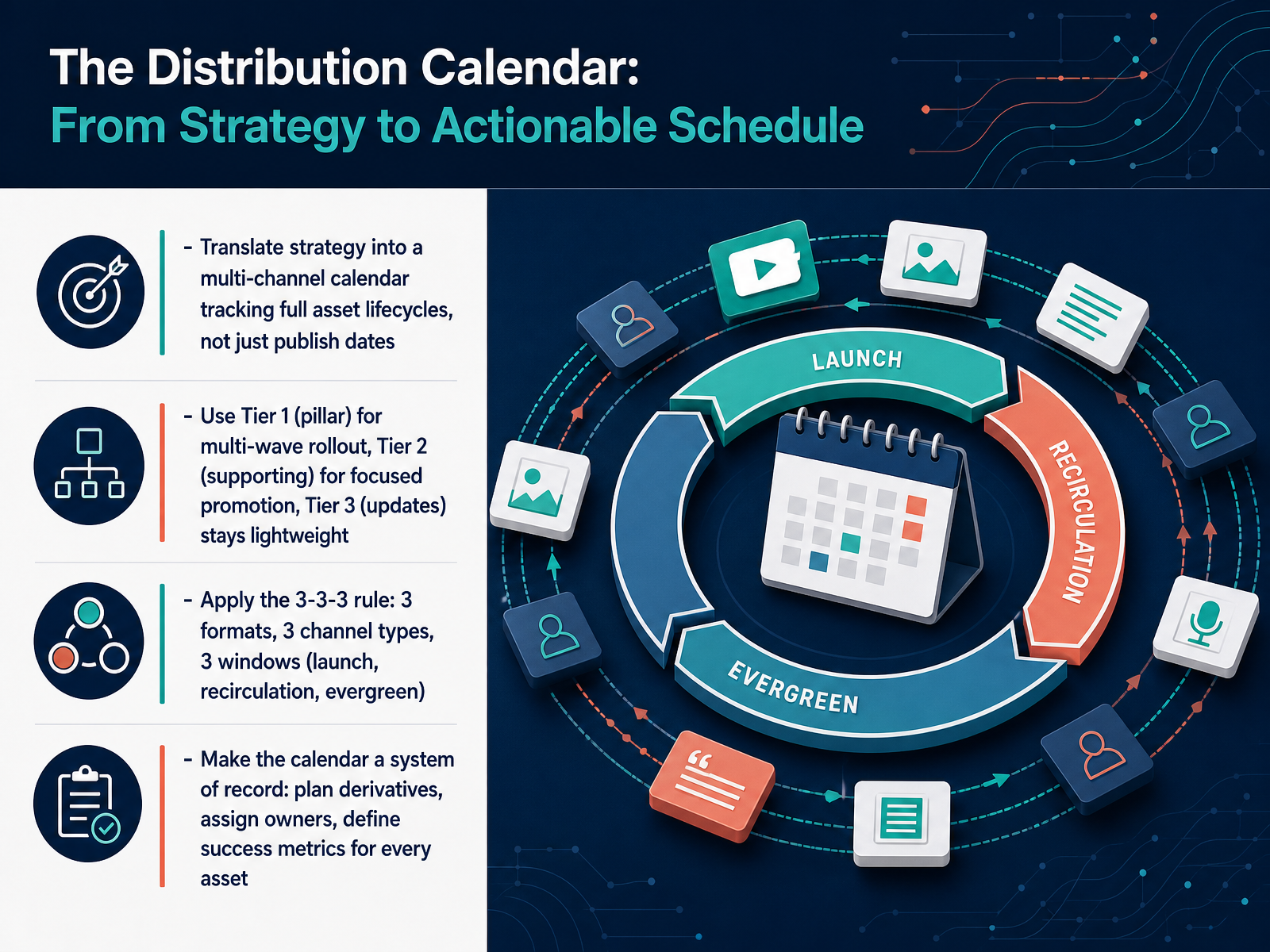
 - 06The Distribution Calendar: From Strategy to Actionable ScheduleNow we translate the distribution strategy into a living calendar. Think of this as your system of record, tracking the full lifecycle of every asset, not just the publish dates. You assign three tiers to control depth and effort. Tier one is your pillar content, built for a multi-wave rollout. Tier two is supporting content that gets a more focused push. And tier three stays lightweight, often updates or quick takes. To keep your plan balanced, apply the three-three-three rule. For each campaign, aim for three different formats, three distinct channel types, and three time windows: the launch, a recirculation window, and an evergreen window. Inside the calendar, plan all the derivatives ahead of time, assign a clear owner, and define a success metric for every single asset. This prevents the common failure of publishing a blog post and scrambling for social posts later. Next, let’s see how to operationalize this through workflows, roles, and handoffs.
 2 min
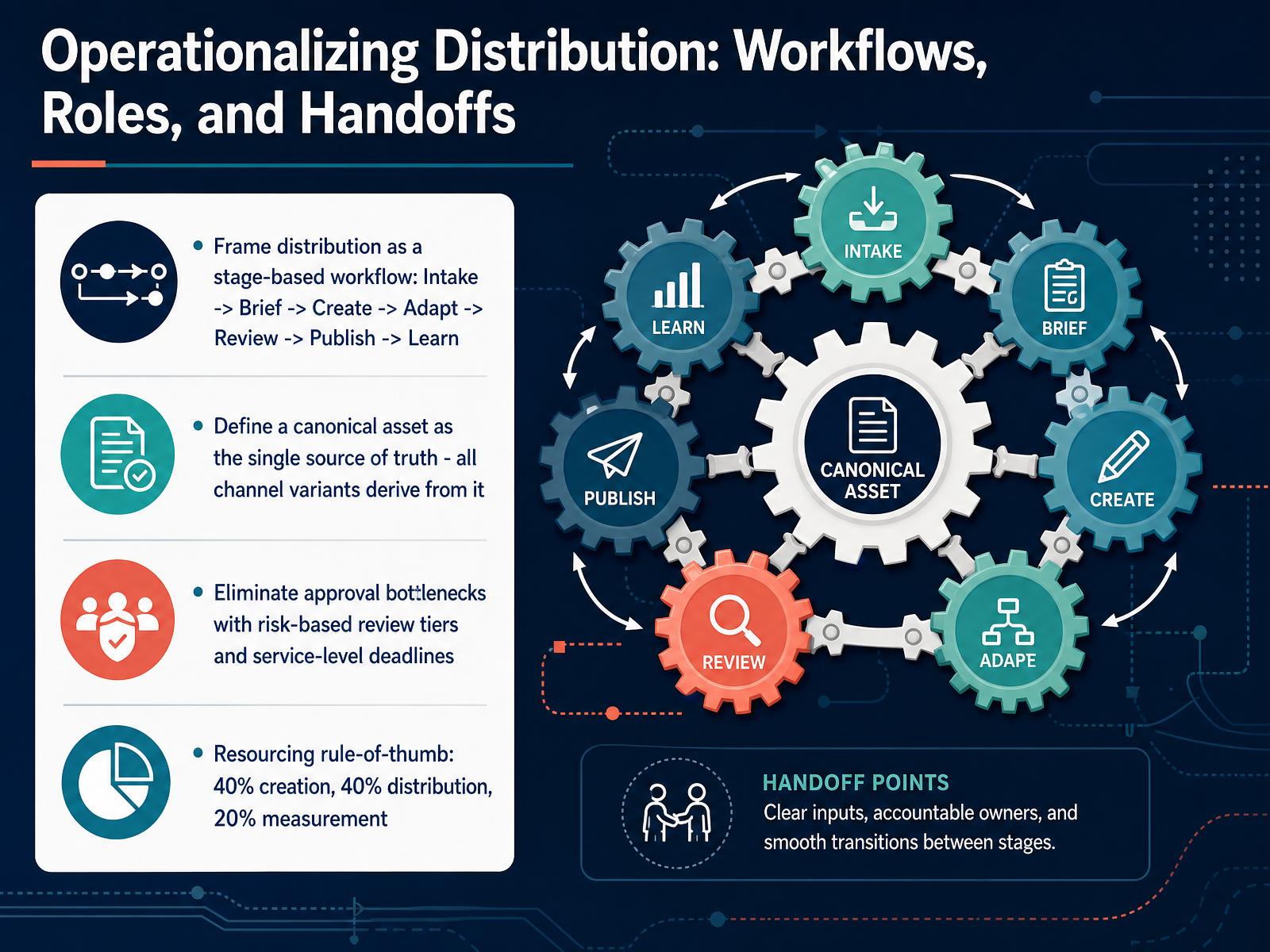
2 min - 07Operationalizing Distribution: Workflows, Roles, and HandoffsNow let's make distribution operational. Think of this as a stage-based workflow, moving from Intake to Brief, then Create, Adapt, Review, Publish, and finally Learn. This sequence makes handoffs clear and prevents bottlenecks. At the center of this workflow is the canonical asset. This is your single source of truth. All channel variants, from social posts to sales snippets, derive from it, which keeps your message consistent. To stop projects from stalling, set up risk-based review tiers and clear service-level deadlines. Not every asset needs the same heavy approval chain. And here is a practical resourcing rule to guide your team: spend forty percent of your effort on creation, another forty percent on distribution, and twenty percent on measurement. This balance ensures your content actually reaches people and performs. Next, we'll explore the Atomization Engine, a method to repurpose your canonical asset for maximum reach across channels.
 theaicmo.com1 min
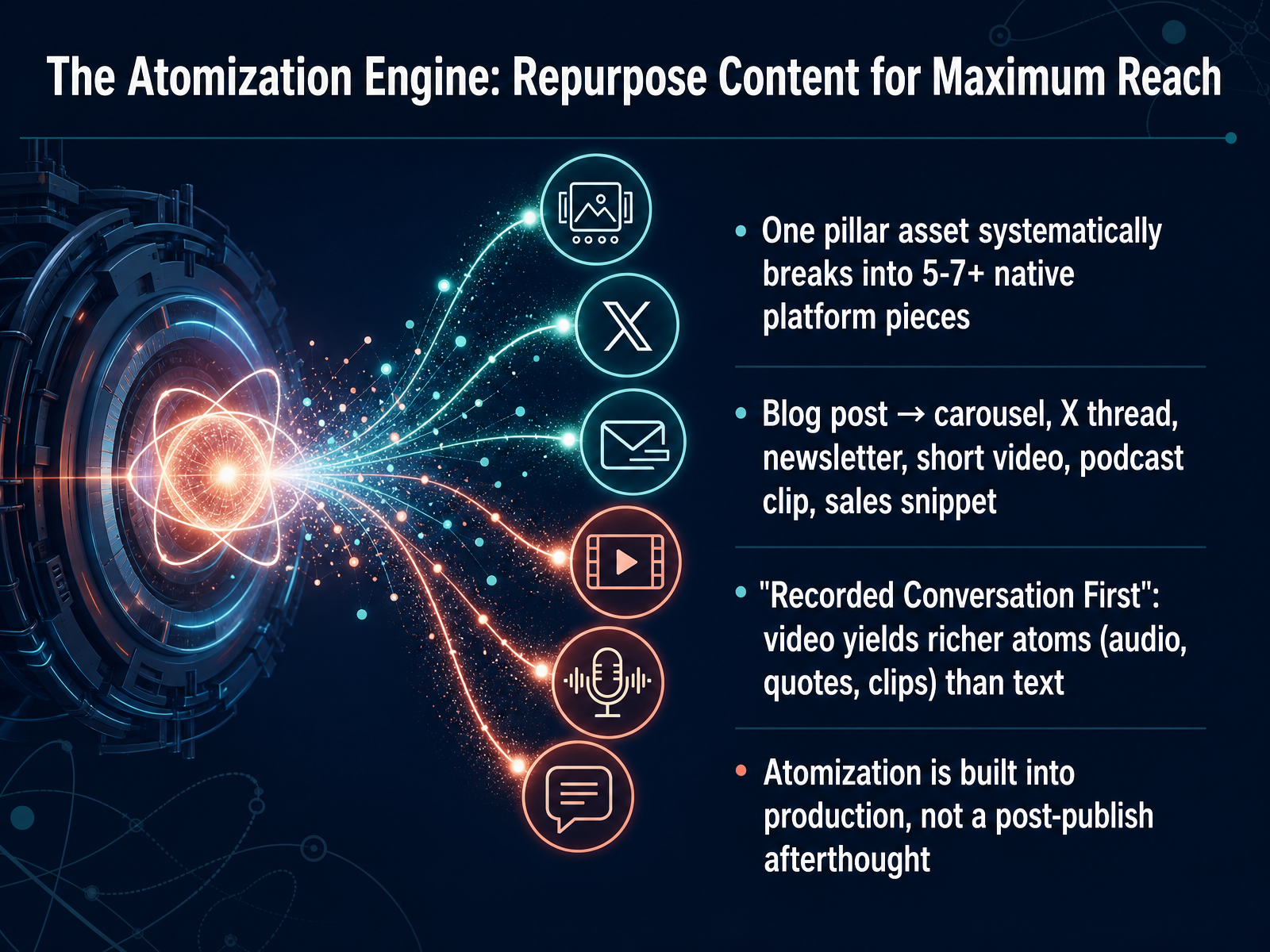
 - 08The Atomization Engine: Repurpose Content for Maximum ReachAt the heart of smart distribution is the atomization engine. This is not about randomly chopping up content. It is a deliberate system where one pillar asset—like a detailed blog post—breaks into five, seven, or more native pieces for different platforms. For example, that single blog post can become a LinkedIn carousel, a thread on X, a newsletter segment, a short video, a podcast clip, and a direct sales snippet. Here is a critical workflow shift: adopt a recorded conversation first approach. Starting with video yields richer atoms than starting with text because you can extract audio, pull quotes, and create video clips simultaneously. And remember, atomization is not a post-publish afterthought. Build it into your production process from the start so you are creating with repurposing in mind. Coming up next, we will move from repurposing to stability with owned channels and your non-negotiable foundation.
 buffer.comblog.hubspot.comblog.mediaborne.co.uk+22 min
 - 09Owned Channels: Building Your Non-Negotiable FoundationNow let's talk about the one distribution layer you genuinely control: your owned channels. These are assets like your website, your blog, your email list, your newsletter, and any resource hub you manage directly. Think of owned channels as your non-negotiable foundation. They are durable; social platforms are rented land where reach can change overnight, but your email list and your site are yours. Email in particular is your highest-ROI owned channel. On a per-visitor basis, email typically converts four to ten times better than organic search. So every external channel you use, whether it is earned or paid, should act as a feeder that drives people toward your owned subscriptions. To make that work, use clear content upgrades, internal linking across your site, and always treat your website as the canonical source for your best content. Next, we will build on this foundation and explore earned channels, where trust and authority begin to scale.
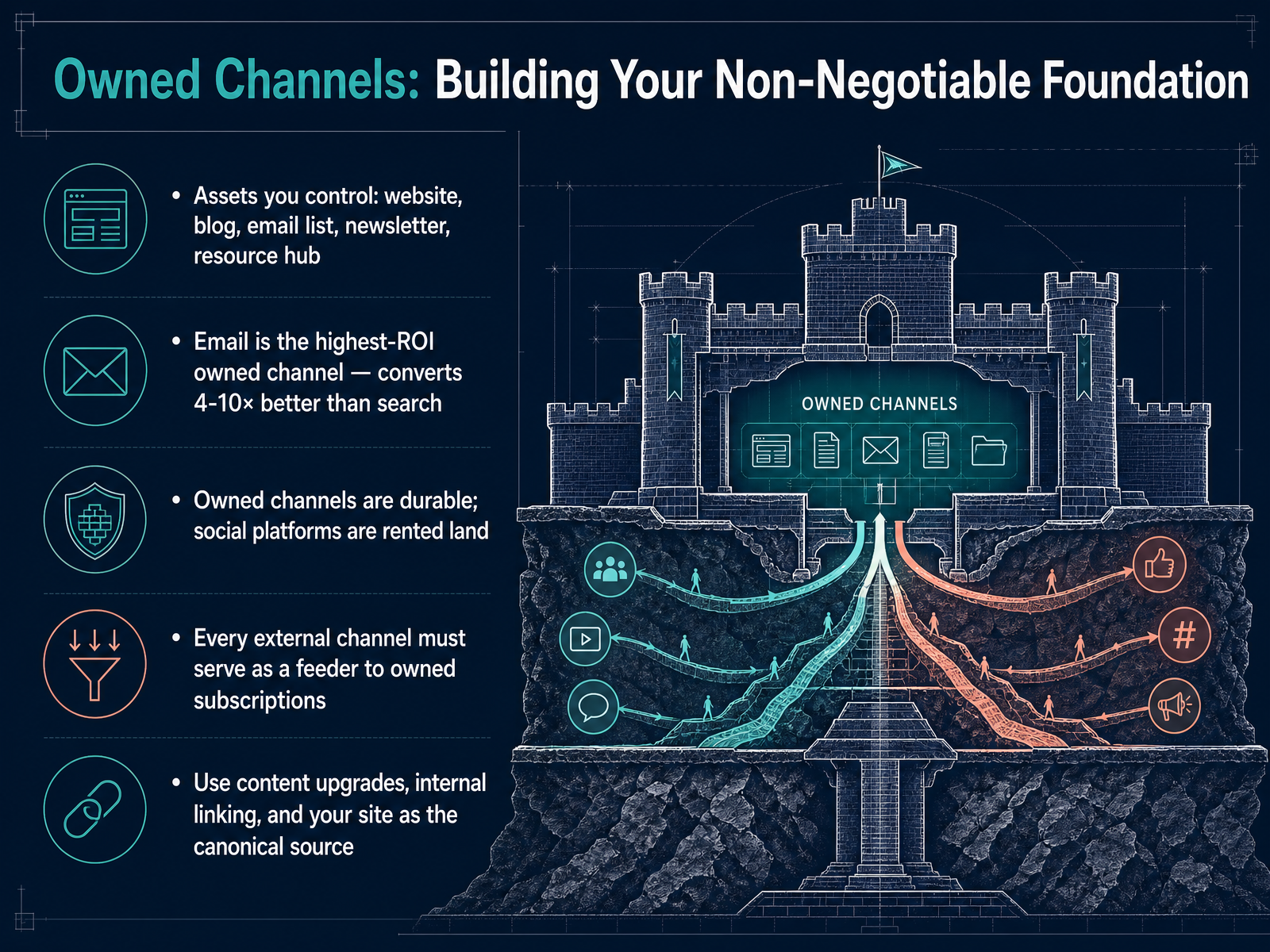 flux.ladigitalapplied.comreach.cat+21 min
 - 10Earned Channels: Building Trust and Authority at ScaleNow, let's talk about earned channels. This isn't a channel you buy. It's the channel you earn when other people voluntarily share your content, link to your site, or mention your brand in community spaces like Reddit, Slack, or Discord. These organic signals, like press coverage, backlinks, and social media shares, are the highest-trust signals you can get. For 2026, effective tactics include activating your employees as advocates, pitching your insights to popular newsletters, and genuinely contributing to community discussions. This is a system of providing real value, not dropping links. This matters even more now because major AI models heavily weight connections from sources like Reddit threads and editorial backlinks when generating their answers. Where you show up authentically, your authority grows. Next, we'll apply this earning mindset to paid and AI channels, where you strategically accelerate what's already working.
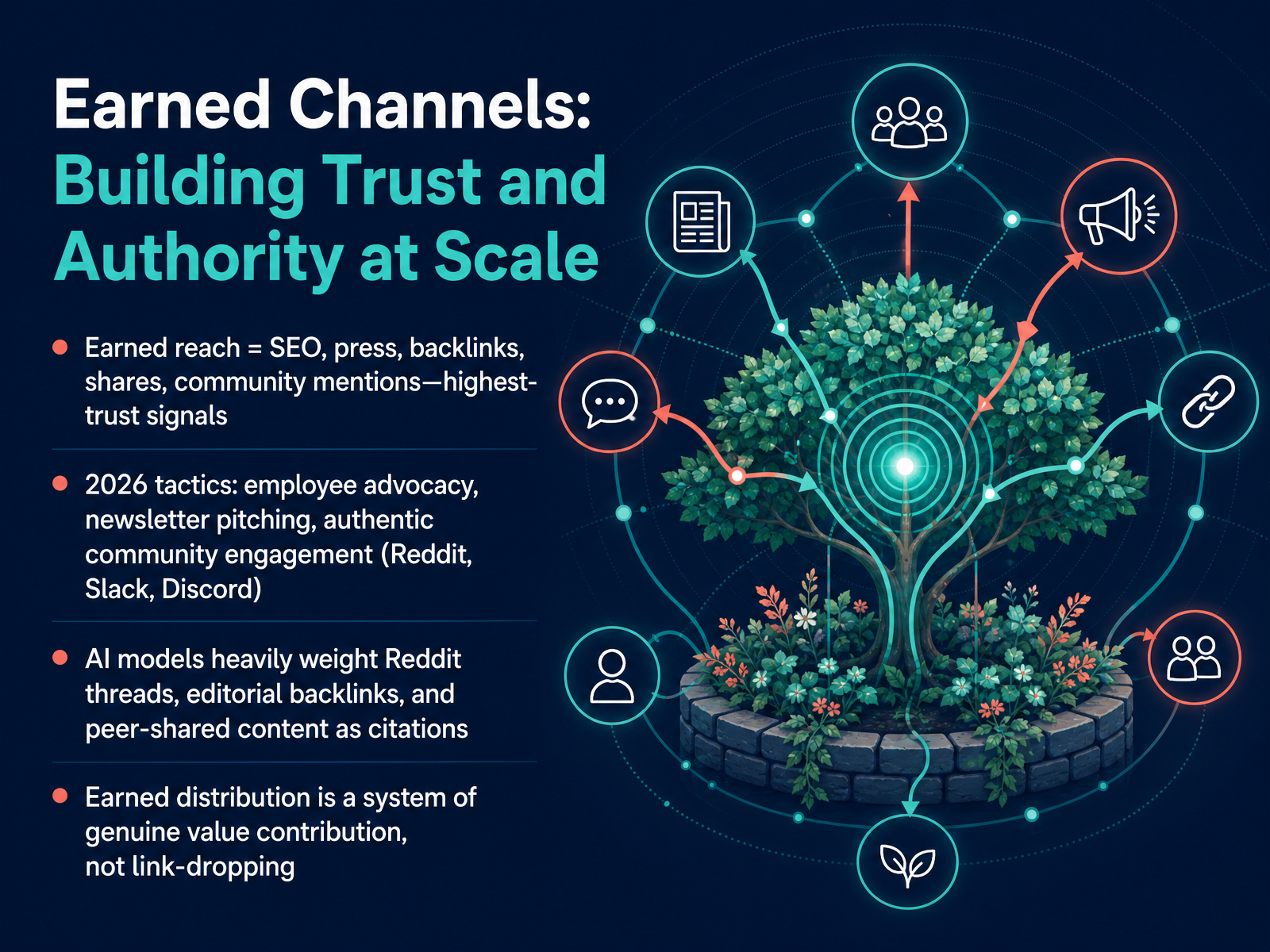 flux.ladigitalapplied.comreach.cat+22 min
 - 11Paid and AI Channels: Acceleration for Proven AssetsNow let's look at two acceleration channels that only make sense after you have proven content. Think of paid as the accelerator, not the engine. You can match it to specific jobs: amplify an organic post that is already performing, seed discovery for a new research report, or retarget visitors who already know your brand. Two practical tactics work well right now. First, you can whitelist creator content for native ads. Second, you can test newsletter sponsorships and A/B test your hooks and formats. The other fast-growing channel is AI engines. The goal here is to become the cited source in conversational answers. To earn those citations, structure your content for chunk extraction. This means building clear direct answers, bullet lists, comparison tables, FAQ schema, and language rich in named entities. The question is not whether to use paid and AI channels, but whether your content is ready to be accelerated. Next, we will move into reading the signals with performance data and iterative optimization.
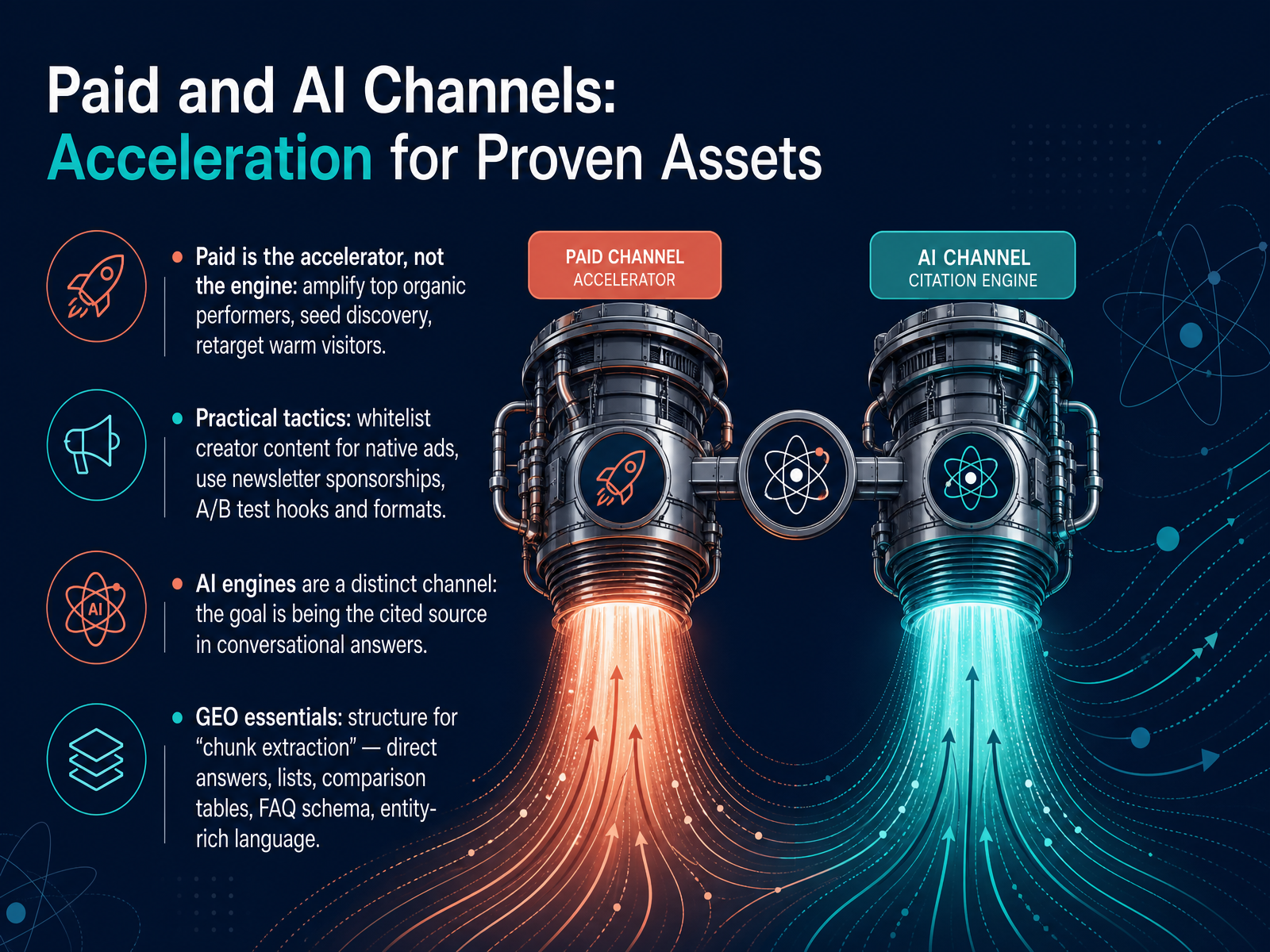 contentpen.aiflux.laupnorthmedia.co+22 min
 - 12Reading the Signals: Performance Data and Iterative OptimizationNow, let's talk about how to read the signals your performance data is sending you. Effective optimization starts with a practical review through four lenses: channel fit, format fit, conversion path, and timing. For each asset, ask if the channel truly brought the right audience, if the format was built for native consumption, if the click led to a page that matched the promise, and if the promotion hit when your audience was receptive. Don't overlook hidden demand. Monitor your server logs for four-oh-four errors from AI bots. These failed requests can map exactly what content your audience expects but cannot yet find. For scaling success, adopt the rule: test organically, then amplify with paid. This validates performance before you invest serious budget. Treat your high performers as core assets. Build second-wave derivatives, such as turning a winning blog post into a short video or an email course. And be decisive about what doesn't work. Reduce channels that consistently attract the wrong audience. These optimization habits directly inform a repeatable system. Up next, we build The Complete Distribution Workflow: From Audience to Goal.
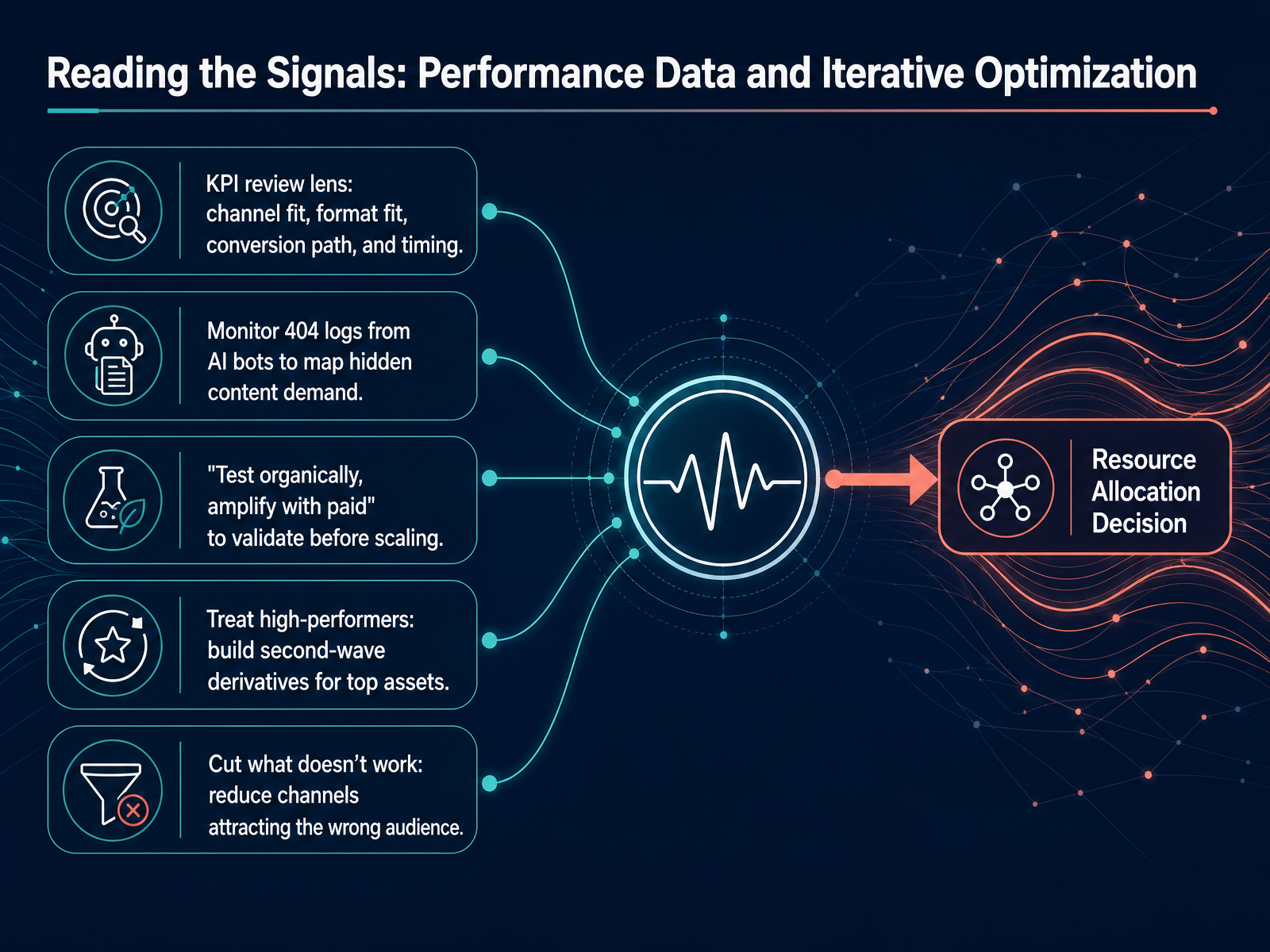 conbersa.aidigitalapplied.comcontentpen.ai+22 min
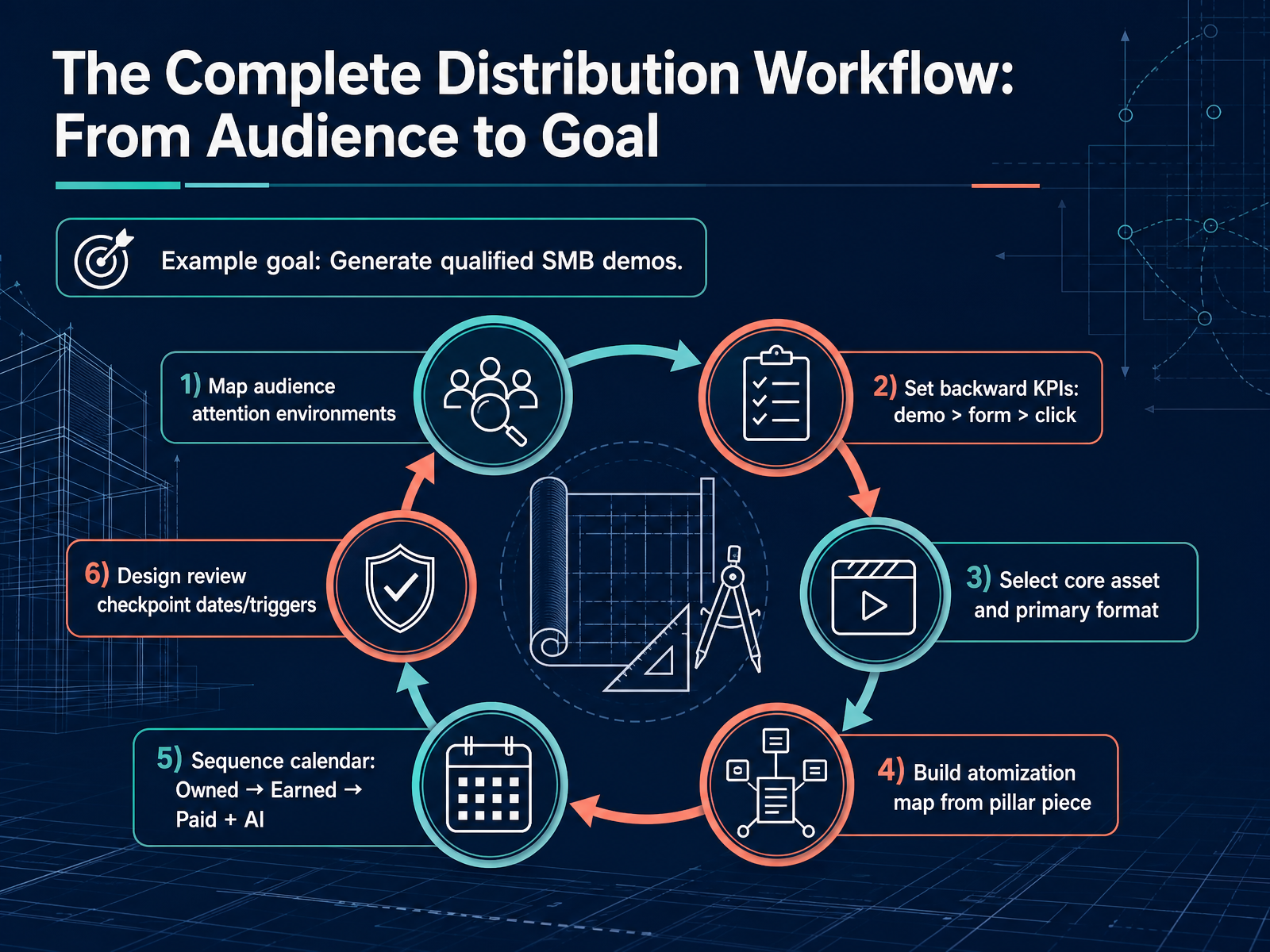
 - 13The Complete Distribution Workflow: From Audience to GoalLet's pull every piece of the framework together into one complete workflow, using an example your team can act on immediately. Suppose your goal is to generate qualified SMB demos. You start by mapping your audience's attention environments. Ask where these buyers first hear about solutions and where they compare vendors before booking a call. Next, you set backward KPIs. Working from the demo backward to the form fill and then to the click tells you which signals matter long before a lead ever reaches your calendar. From there, you select one core asset and its primary format, such as an industry benchmark report or a practical how-to guide, and build an atomization map that pulls social posts, email snippets, and video clips from that single pillar piece. Then you sequence your calendar following the Owned, Earned, Paid, plus AI model. Owned channels go first, then earned mentions, and finally paid amplification layered with AI optimizations once you see early traction. The last step is to design clear review checkpoint dates or triggers. When an asset hits a pre-agreed engagement threshold, revisit it. If it stalls, adjust the format, the CTA, or the channel. That's the complete distribution workflow: audience, backward KPIs, core asset, atomization, sequenced channels, and disciplined review. Thank you for moving through the course. Use this system on your very next campaign, start with one pillar piece, and build the habits that turn content distribution into predictable pipeline.
 contentpen.aiflux.laupnorthmedia.co+22 min
Take the deck with you
Download this course as a file — free, no sign-up needed.
- PDF handoutEvery slide page, ready to print or share.14 pages · 4.3 MBDownload
- Narrated PowerPointThe deck that presents itself — every slide carries the digital human's narration video.14 pages · 14.1 MBDownload
- PowerPoint slidesThe full deck as a .pptx — open it in PowerPoint, Keynote, or Google Slides.14 pages · 4.2 MBDownload
Free to use in your own training — please keep the PersonWise credit page at the end.
Have your own deck? Turn it into a course
Sources consulted
Web sources consulted while building this course.
- Content Distribution: Complete Strategy Guide for 2026 — contentpen.ai
- Content distribution strategy: how to get your content seen in 2026 | Flux.LA — flux.la
- Your Content Distribution Strategy: A Practical Playbook | Up North Media — upnorthmedia.co
- The Best and Worst Content Distribution Strategies in 2026 | beehiiv Blog — beehiiv.com
- Content Distribution Strategy for Businesses in 2026: The Complete Framework - ReachCat — reach.cat
- Content Distribution Strategy: Maximize Reach 2026 — digitalapplied.com
- Content amplification: How to amplify content across every marketing channel — blog.hubspot.com
- The B2B Marketer's Guide to Owned, Earned, and Paid ... — sweetfishmedia.com
- Content Distribution Mapping: A Smarter Way to Publish | Ekaav — ekaav.com
- Content Promotion Strategy: Distribution Plan, Repurposing Tactics & Paid Amplification to Boost Traffic and Leads – Blog Helpline — bloghelpline.com
- Content Distribution Strategy: Reach Further, Waste Less — themarketingjuice.com
- Optimize Content Distribution Guide 2026 | InfluenceFlow — influenceflow.io
- Best Content Format on Social Platforms in 2026: 45M+ Posts ... — buffer.com
- The most effective types of content on social media in 2026 [new data] — blog.hubspot.com
- Social media formats that drive higher engagement in 2026 — blog.mediaborne.co.uk
- 2026 Social Media Platform Format Specs: The Complete Field Guide | BriskTool — brisktool.com
- Content Strategies for Different Social Platforms |... — influenceflow.io
- How Do You Measure Content Distribution Effectiveness? | Conbersa — conbersa.ai
- Your Content Distribution Strategy Playbook for 2026 — theaicmo.com
- 5-Step Content Marketing Measurement Framework — contentmarketinginstitute.com