Begin
13 pages · ~26 min
Reading Rock Layers: Relative Dating & Superposition
This training teaches learners to interpret rock layers using relative dating and superposition principles to determine the sequence of geological events.
A digital instructor presents all 13 pages. Hold “Ask” at any point and ask out loud — the answer comes from this course. No sign-up needed.
What you’ll learn
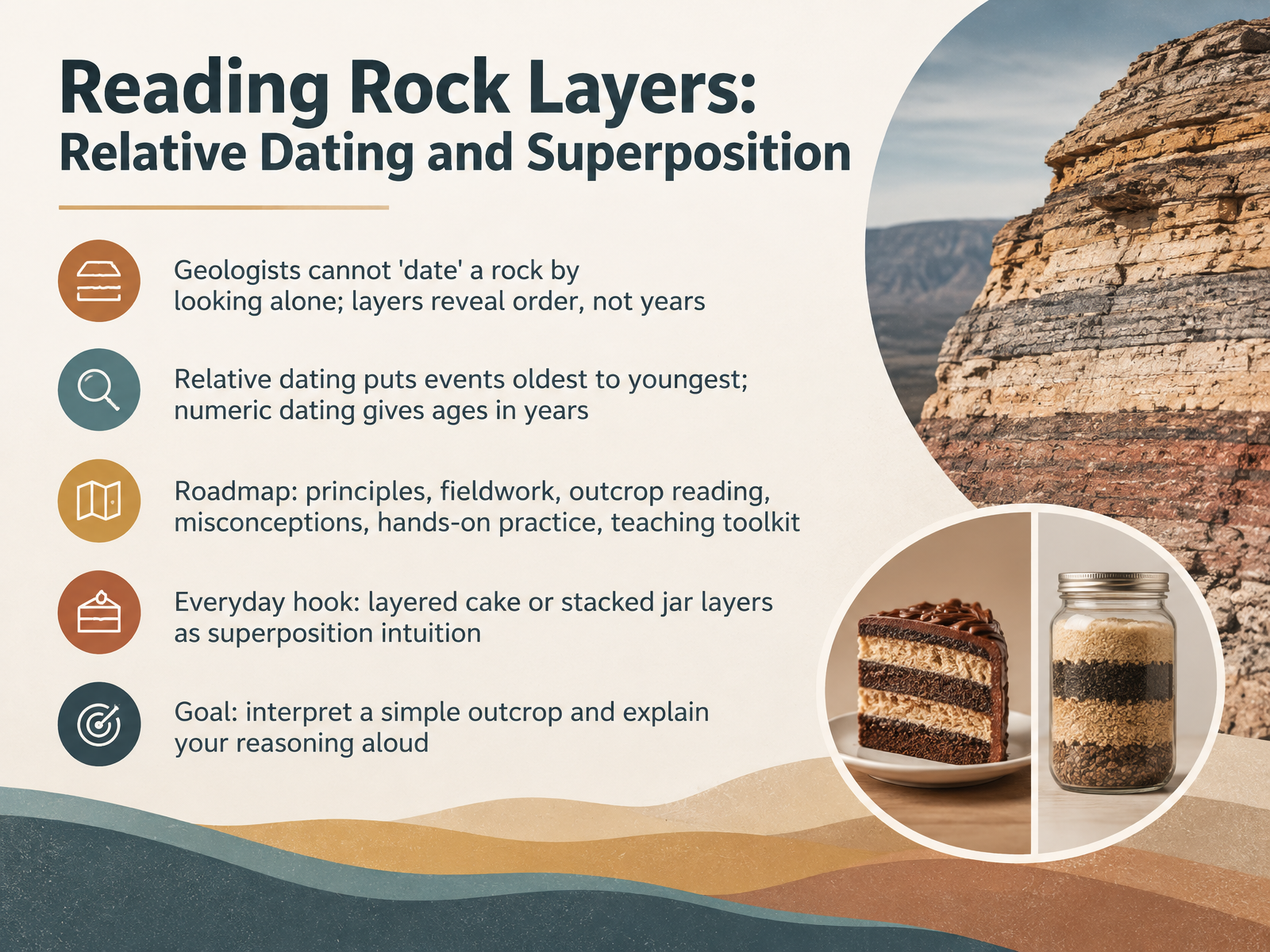
- 01Reading Rock Layers: Relative Dating and SuperpositionWelcome. Today we're going to learn how geologists read rock layers, and how they place events in order without ever knowing a single birthday. Here's the key idea. Looking at a rock does not tell you its age in years. Layers tell you order, not time. Geologists call that relative dating. It puts events from oldest to youngest. Numeric dating, by contrast, gives ages in years. Think of a layered cake or a jar of stacked sand. The bottom layers went in first. Does that match what you see? Over this course, we'll cover guiding principles, fieldwork, reading an outcrop, common misconceptions, hands-on practice, and a teaching toolkit. Our goal is simple. By the end, you'll interpret a simple outcrop and explain your reasoning aloud. Next, we'll compare relative and numeric dating, and look at what each one can and cannot tell us.apps.usgs.govnps.govusgs.gov+21 min
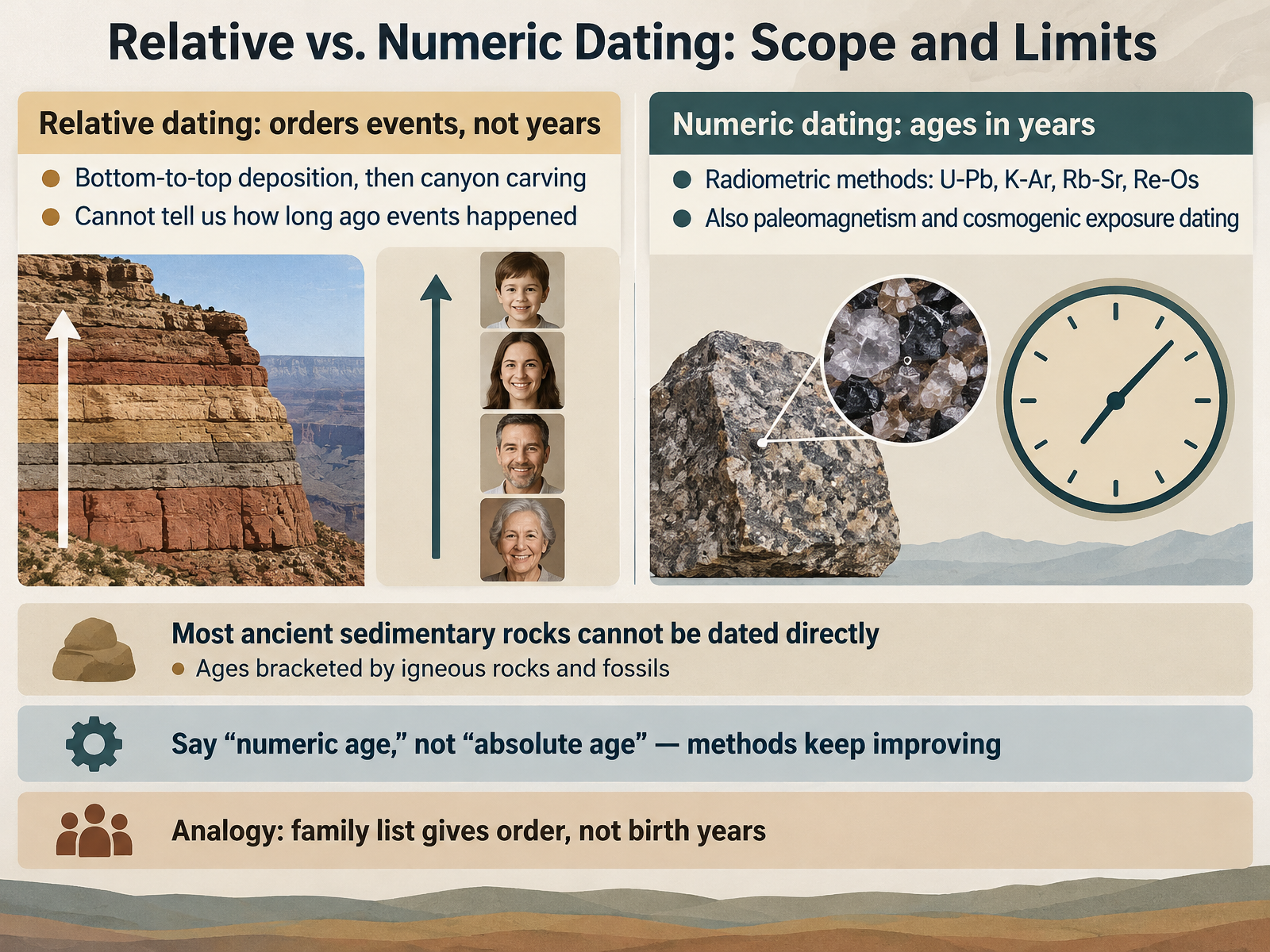
- 02Relative vs. Numeric Dating: Scope and LimitsLet's start with scope. Geologists use two kinds of dating, and they answer different questions. Relative dating puts events in order. Think of a family list of children by birth: it tells you who came first, not the birth years. In rock layers, sediment is deposited bottom to top, and later a canyon may be carved through them. That gives us sequence. But relative dating cannot tell us how long ago any of it happened. Next, numeric dating gives ages in years. Radiometric methods measure parent and daughter isotopes, using pairs like uranium-lead, potassium-argon, rubidium-strontium, and rhenium-osmium. Paleomagnetism and cosmogenic exposure dating also help. Here's an important limit: most ancient sedimentary rocks cannot be dated directly. Their ages are bracketed by igneous rocks and fossils. And say numeric age, not absolute age, because methods keep improving. Up next: Steno's Toolkit: The Principles That Make Layers Readable.
 apps.usgs.govnps.govusgs.gov+22 min
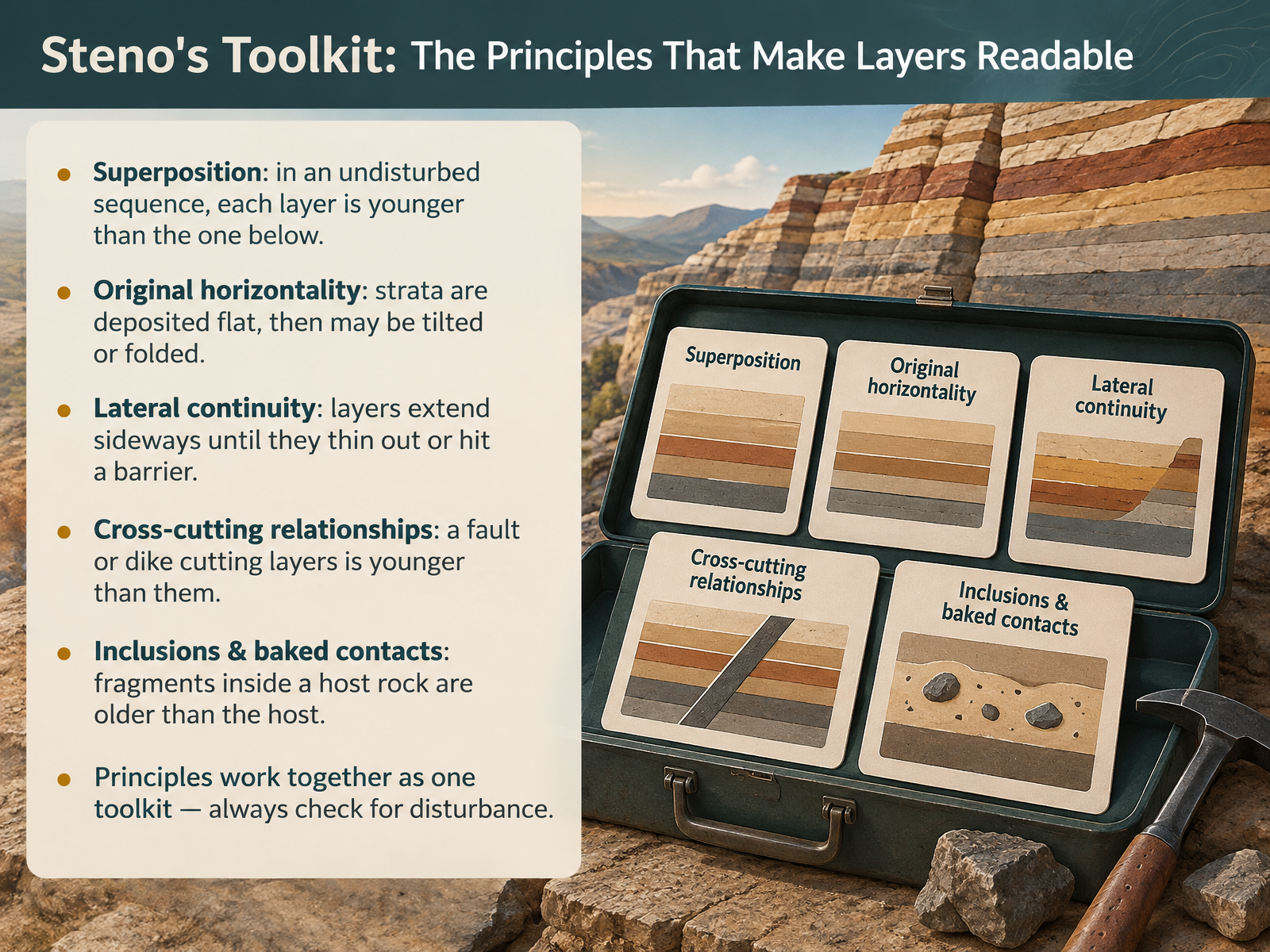
- 03Steno's Toolkit: The Principles That Make Layers ReadableHere's the toolkit that makes layers readable. These are Steno's principles, and they work best together. First, superposition. In an undisturbed sequence, each layer is younger than the one below it. Think of laundry in a basket: the newest shirt lands on top. Next, original horizontality. Strata are deposited flat, then may be tilted or folded later. Like a stack of pancakes tipped on the plate. Then, lateral continuity. Layers extend sideways until they thin out or hit a barrier. And cross-cutting relationships: a fault or a dike cutting through layers is younger than the layers it cuts. Finally, inclusions and baked contacts. Fragments inside a host rock are older than the host, and the cooling edge tells you which came first. One caution: always check for disturbance. If the sequence is overturned, superposition can mislead you, so look for way-up clues. Does that match what you see? From Sediment to Rock: What Layers Record.
 rainbow.ldeo.columbia.edueoas.ubc.caopen.maricopa.edu+22 min
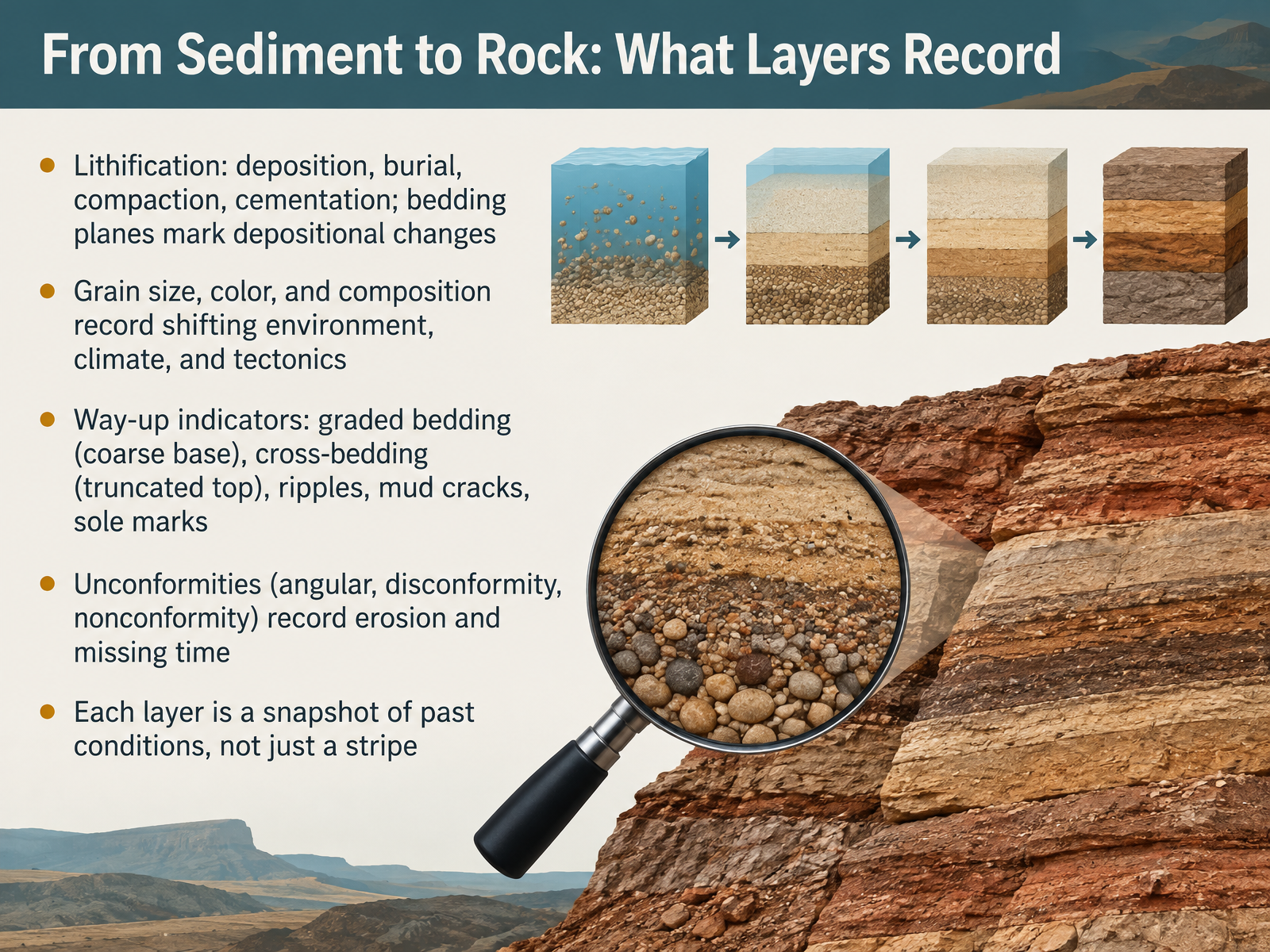
- 04From Sediment to Rock: What Layers RecordNow let's look at how loose sediment turns into solid rock, and what those layers record. The process is called lithification. Sediment is deposited, buried, compacted, and cemented. The boundaries between layers, called bedding planes, mark changes in deposition. Grain size, color, and composition record shifting environment, climate, and tectonics. Some structures also show which way was originally up. Graded bedding is coarse at the base and fine at the top. Cross-bedding has truncated tops. Ripples, mud cracks, and sole marks work too. And unconformities record erosion and missing time. There are three types: angular, disconformity, and nonconformity. Here's the takeaway. Each layer is a snapshot of past conditions, not just a stripe. Next, Ordering Events: Building a Relative History.
 opengeology.orguhlibraries.pressbooks.pubgeo.libretexts.org+22 min
- 05Ordering Events: Building a Relative HistoryNow let's build a relative history. First, identify the units and contacts, then apply the principles. List events from oldest to youngest. Here's the key rule: anything that cuts across layers is younger than what it cuts. Think of a knife cutting a cake. The cut comes after the cake was baked. So a fault that offsets layers formed after those layers. Inclusions are older than their host rock, like a chocolate chip inside a cookie. The chip formed first. Also, erosion surfaces and tilting count as events, not gaps. They mark real moments in the story. Does that match what you see? Next, we will read a real outcrop in the field to apply these ideas.
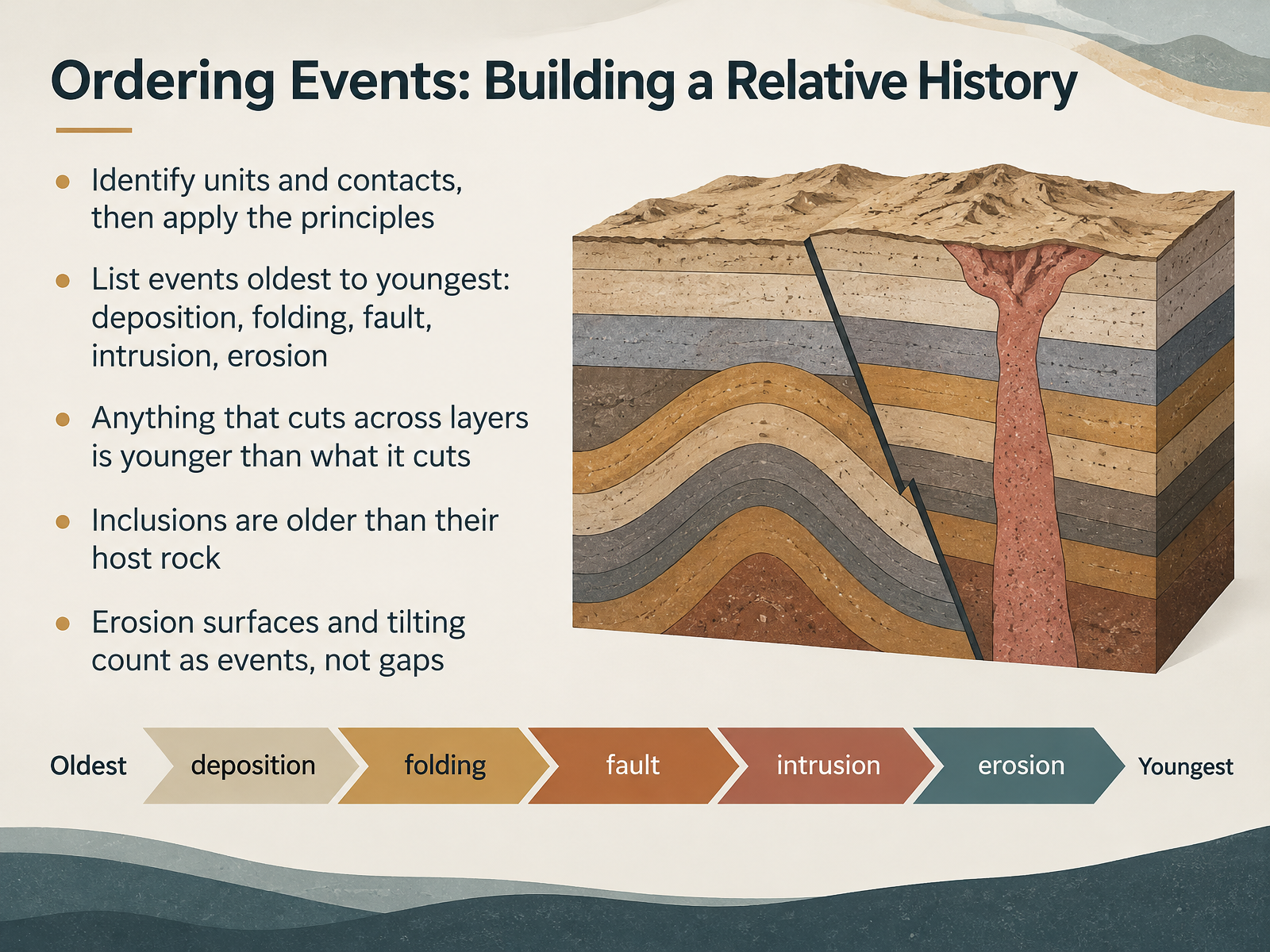 jfarmer.asu.educimss.ssec.wisc.edustudylib.net+21 min
- 06Reading a Real Outcrop: Field WorkflowNow let's put this into practice at a real outcrop. In the field, you follow a workflow: observe, sketch, measure strike and dip, record contacts, then interpret. Strike is the compass direction of a horizontal line on a tilted layer. Dip is how steeply it slopes, measured straight across that line. As you observe, note layer thickness, grain size, color, fossils, sedimentary structures, and any cross-cutting features. Think of it like packing a suitcase before a trip: check the list, or something important gets left behind. Your sketch needs a title, location, viewing direction, scale bar, and labels, with boundaries and structures emphasized. Does that match what you see? A flat-lying coastal cliff looks very different from a tilted mountain road cut. Before any student trip, plan safety: a risk assessment, permissions, and proper gear. Next, we move on to fossils, correlation, and the wider picture.
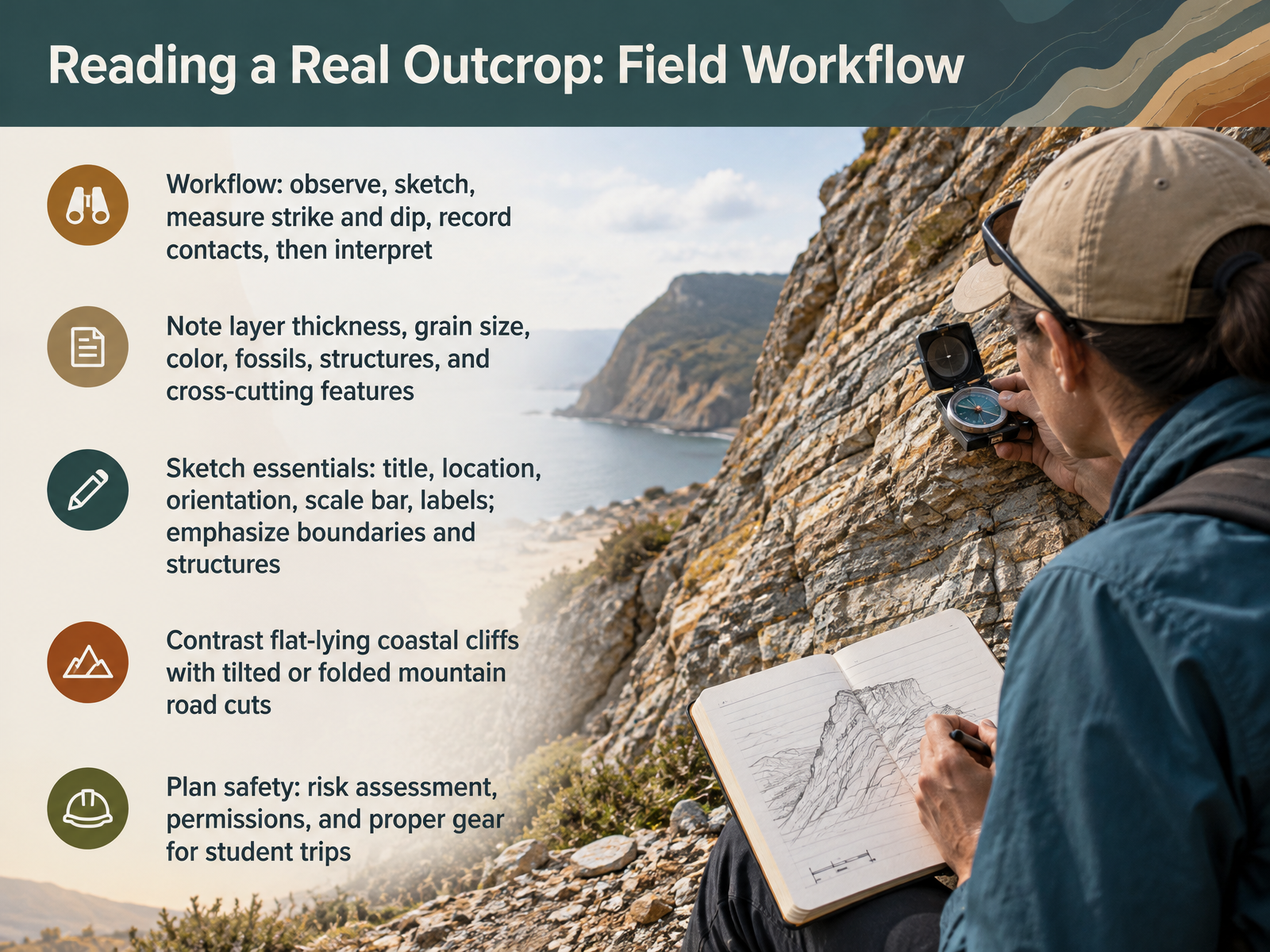 apps.usgs.govnps.govusgs.gov+22 min
- 07Fossils, Correlation, and the Wider PictureNow let's widen the view. Fossils don't just sit in layers. They change through time in a definite, recognizable order. That pattern is the law of faunal succession. Find the same kinds of fossils in rocks from two different places, and you know those rocks are about the same age. Some fossils are especially useful. We call them index fossils. They were widespread, abundant, and easy to identify, and they existed for only a short stretch of time. Think of a bus ticket with a single date stamped on it: one glance tells you when it was used. Geologists correlate rocks two ways, by rock type, called lithostratigraphy, or by fossil content, called biostratigraphy. For example, the Kaibab Formation can be traced from the South Rim of the Grand Canyon to the North Rim. Does that match what you see on the diagram? Fossils, combined with radiometric dates, build the geologic time scale. One limit: fossils aren't always present, so each correlation is a testable hypothesis. Next, let's look at common misconceptions and how to correct them.
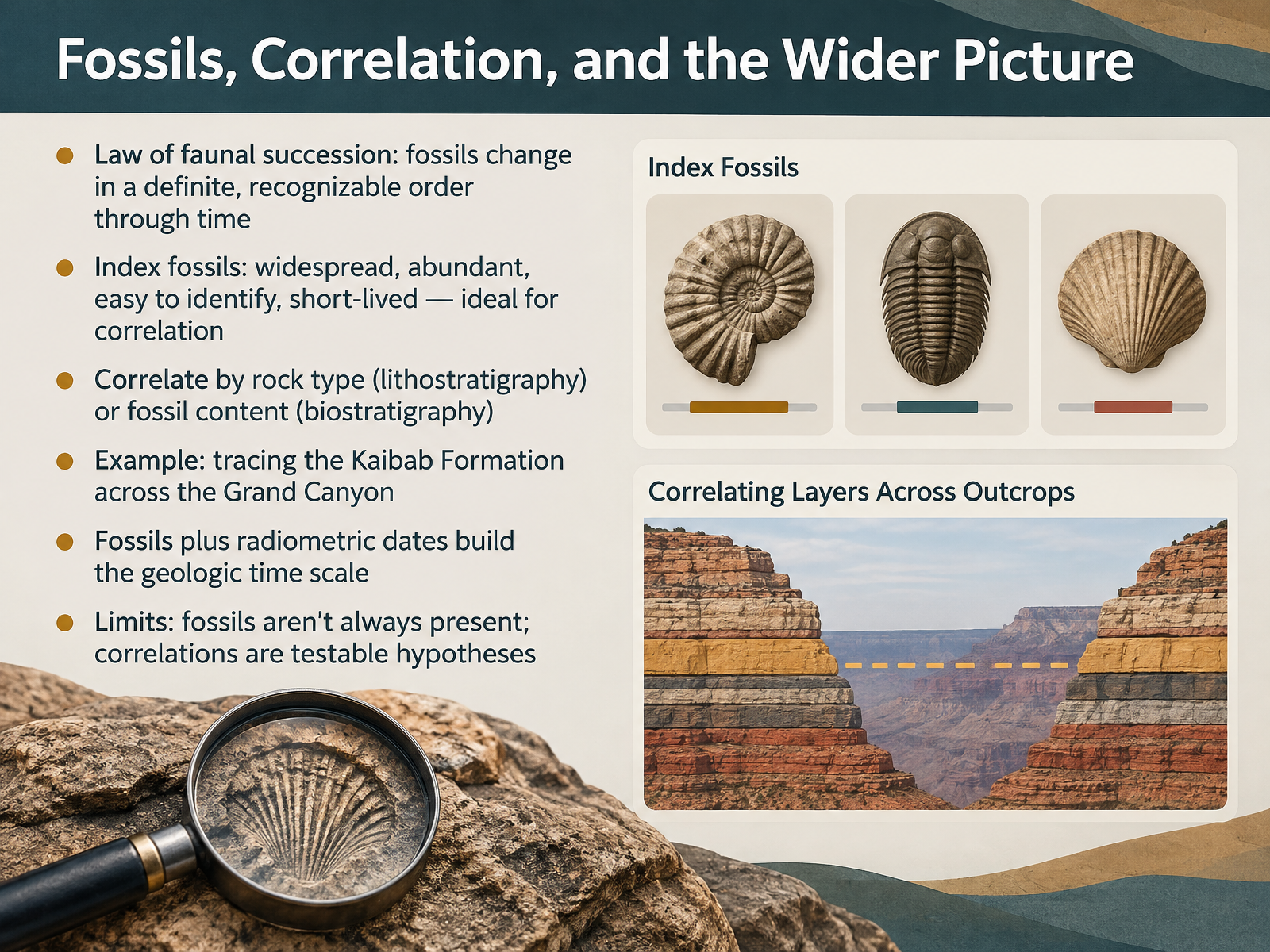 apps.usgs.govnps.govusgs.gov+22 min
- 08Common Misconceptions and How to Correct ThemNow let's tackle some common misconceptions and how to correct them. First, older does not always mean deeper. In an overturned sequence, the layers have been flipped, so check way-up indicators, like graded bedding, to see which way was originally up. Does that match what you see? Second, the same rock type does not mean the same age. Two sandstone beds far apart can be millions of years apart. Correlate them using ash layers and index fossils. Third, relative dating is not guesswork. It is structured inference from evidence, and every claim should be justified. Fourth, an unconformity records vast missing time, like pages torn from a book. For teaching, use predict-observe-explain, physical models, and ask learners to justify each claim. Next, we will put these ideas to work in a hands-on layer model.
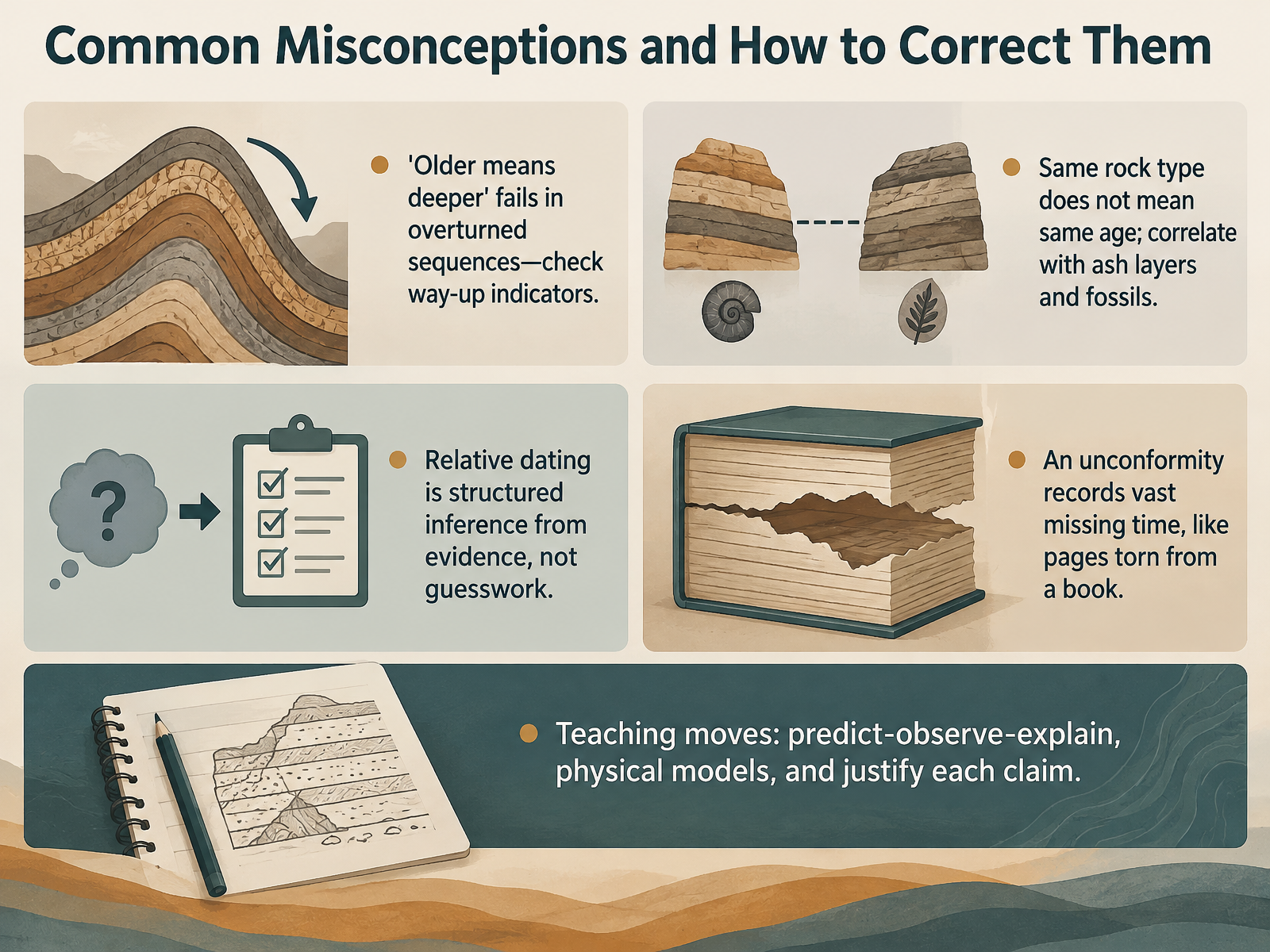 rainbow.ldeo.columbia.edueoas.ubc.caopen.maricopa.edu+21 min
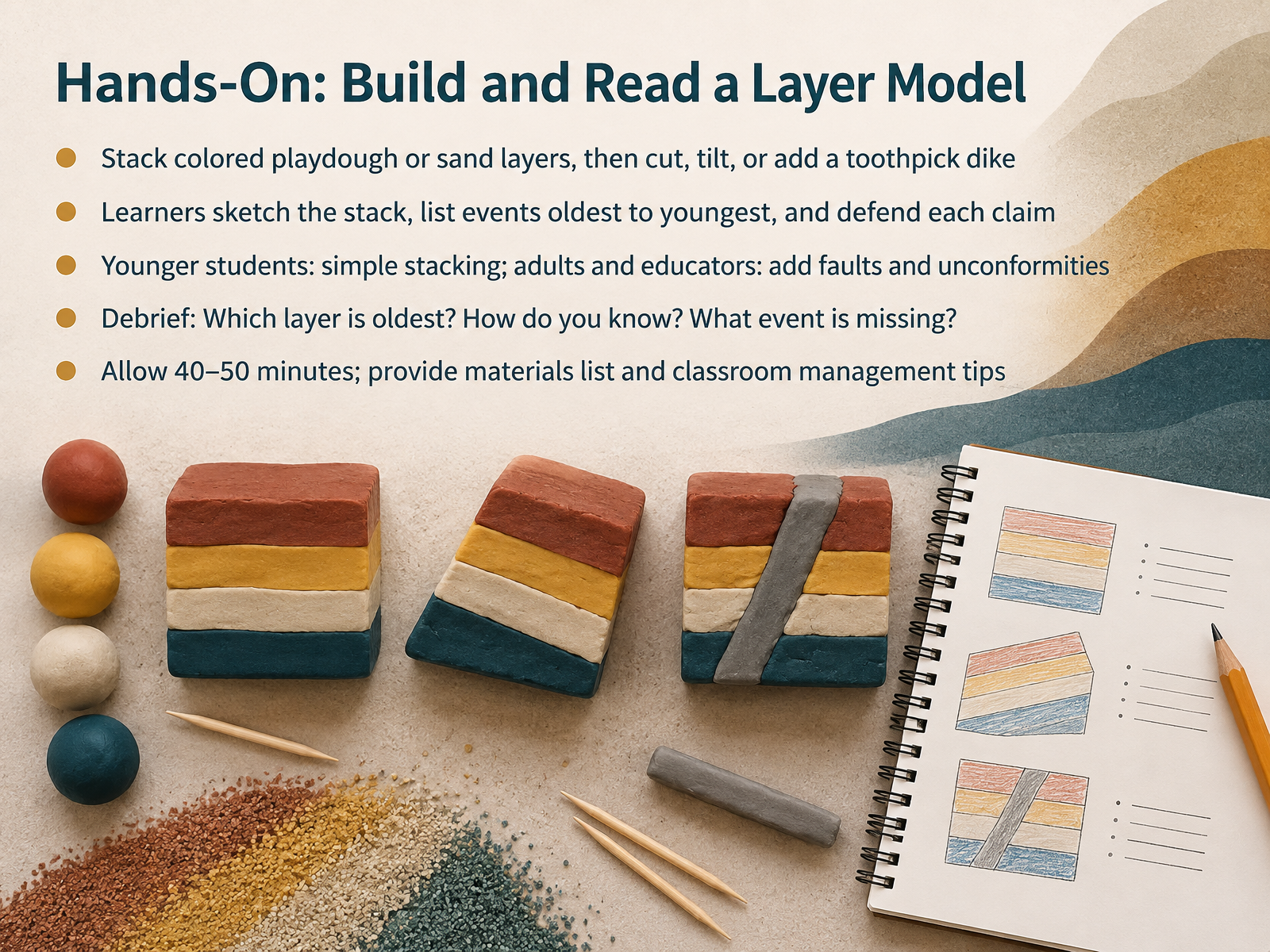
- 09Hands-On: Build and Read a Layer ModelNow let's put this into practice. In this hands-on activity, learners stack colored playdough or sand into layers, then cut, tilt, or push a toothpick dike through the stack. Think of it like building a layered sandwich by hand. Next, learners sketch the stack, list the events from oldest to youngest, and defend each claim with evidence. Younger students can keep it simple with basic stacking. Adults and educators can add faults and unconformities for more challenge. Does that match what you see? Then debrief with three questions. Which layer is oldest? How do you know? And what event is missing? Allow about forty to fifty minutes, and prepare a materials list plus classroom management tips in advance. Next, we move to the Teaching Toolkit: Question Stems, Rubric, and Resources.
 1 min
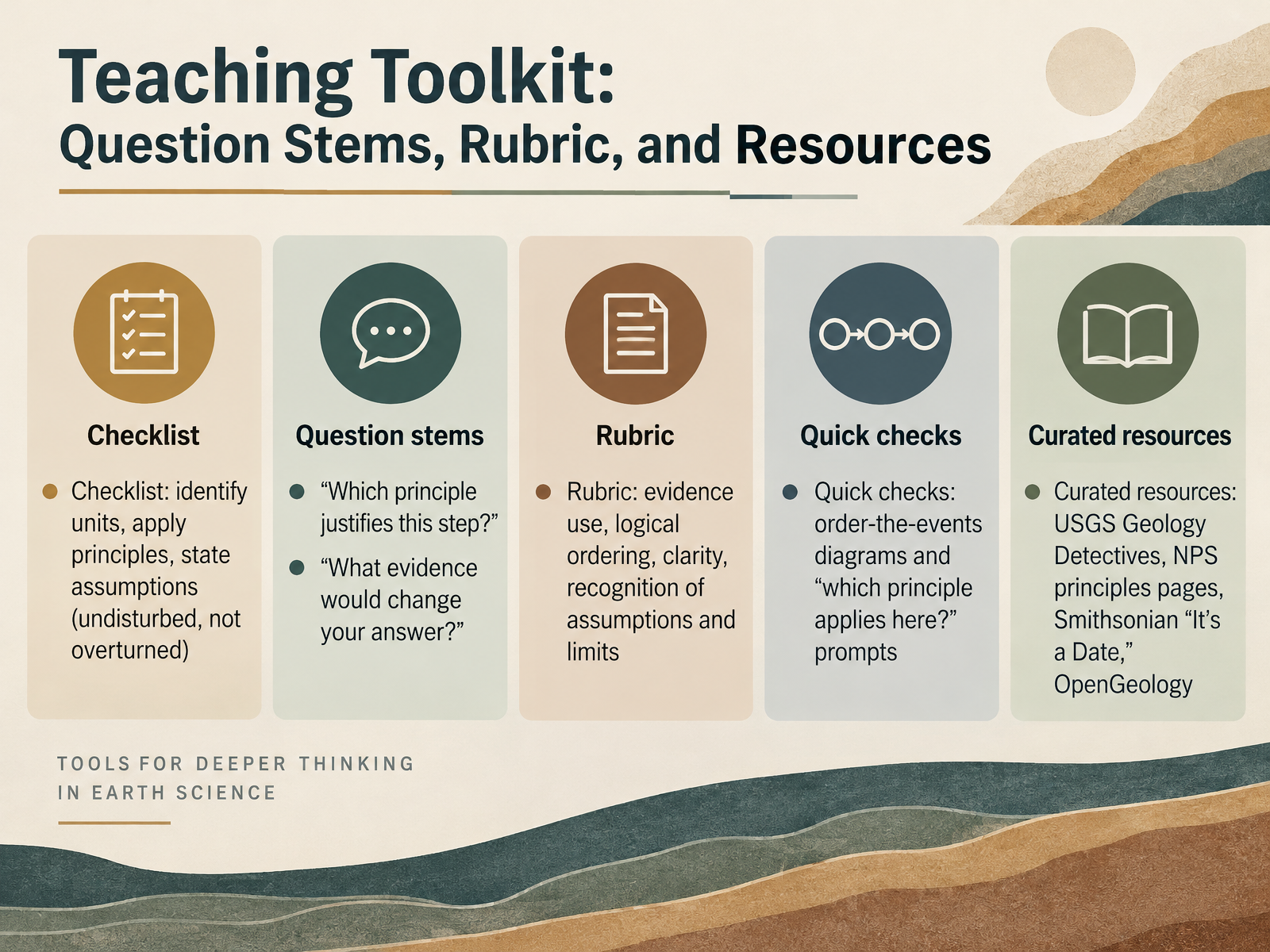
- 10Teaching Toolkit: Question Stems, Rubric, and ResourcesNow let's turn to your teaching toolkit. Start with a simple checklist. Can students identify the units, apply the right principle, and state their assumptions, such as layers left undisturbed and not overturned? Next, build questions around that reasoning. Ask, which principle justifies this step? And, what evidence would change your answer? When you grade, use a short rubric. Look for evidence use, logical ordering, clarity, and recognition of assumptions and limits. For quick checks, try order-the-events diagrams and which principle applies here prompts. Here's why this matters. Your questions should reveal reasoning, not just answers. For resources, look at the USGS Geology Detectives activity, the National Park Service pages on geologic principles, the Smithsonian's It's a Date activity, and OpenGeology's historical geology materials. Adapting for students, adult learners, and educators comes next.
 2 min
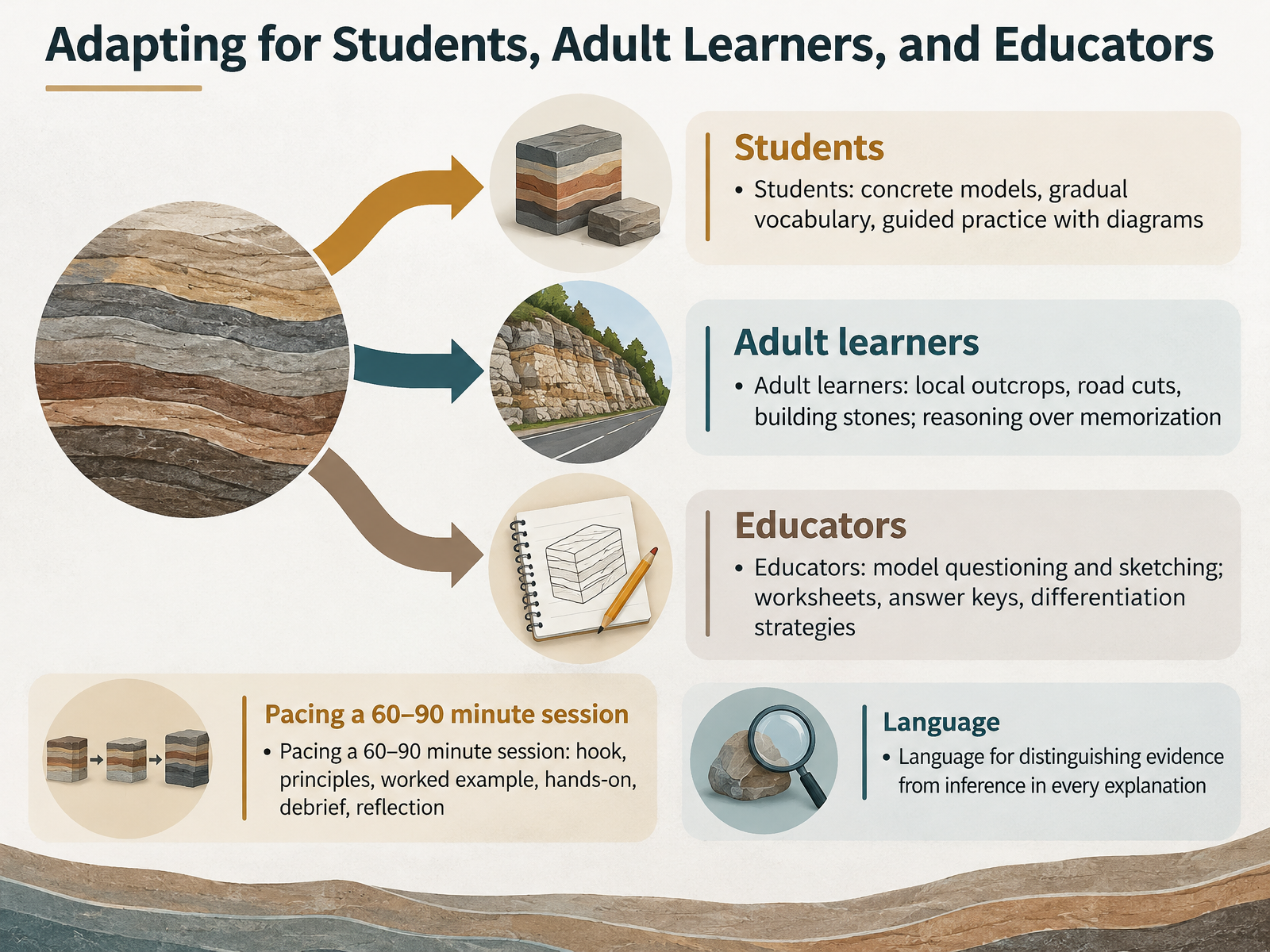
- 11Adapting for Students, Adult Learners, and EducatorsNow let's talk about adapting this for different learners. For students, use concrete models and build vocabulary gradually. Guided practice with diagrams works well. Think of it like training wheels before riding solo. For adult learners, lean on local outcrops, road cuts, and building stones. They prefer reasoning over memorization. Here's why: adults connect new ideas to what they already know. For educators, model questioning and sketching. Provide worksheets, answer keys, and differentiation strategies. Does that match what you see? For pacing a session of sixty to ninety minutes, use this sequence: a hook, the principles, a worked example, hands-on practice, a debrief, and reflection. Finally, use language that clearly separates evidence from inference in every explanation. Next, we'll look at assessment, and what mastery looks like.
 1 min
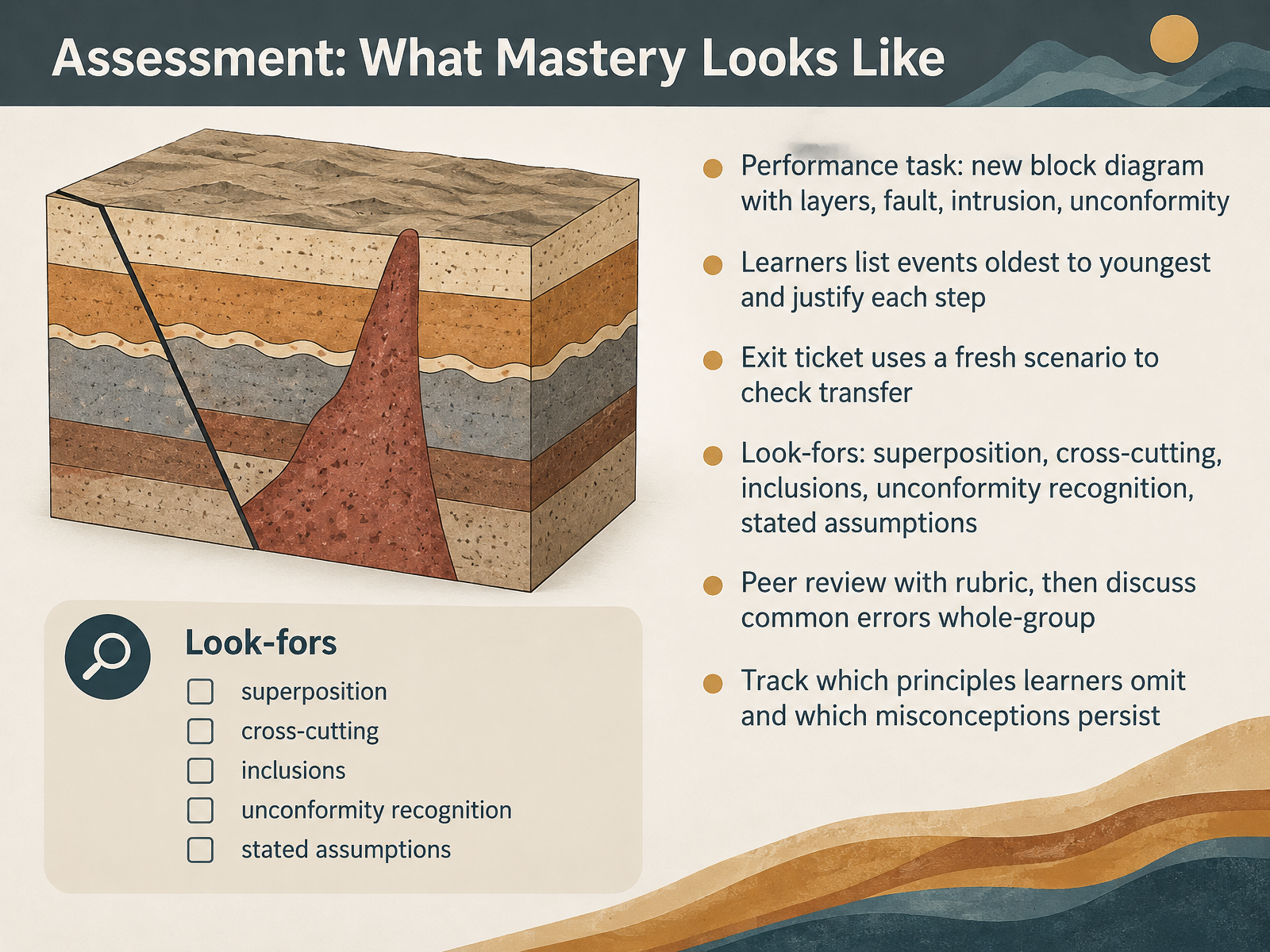
- 12Assessment: What Mastery Looks LikeNow let's look at what mastery looks like. For the performance task, learners receive a new block diagram with layered rocks, a fault, an intrusion, and an unconformity. They list the events from oldest to youngest, and they justify each step in writing. Here's why justification matters. A correct order with no reasoning tells us little, much like a stack of books arranged by height alone. So we look for five things. Superposition, cross-cutting relationships, inclusions, unconformity recognition, and stated assumptions. Next, an exit ticket uses a fresh scenario to check whether learners can transfer these principles to a diagram they have never seen. After that, peer review with a rubric, followed by a whole-group discussion of common errors. As you grade, track which principles learners omit and which misconceptions persist. Does that match what you see across the class? That record guides your next lesson. Next, we'll close with the wrap-up and key takeaways.
 jfarmer.asu.educimss.ssec.wisc.edustudylib.net+22 min
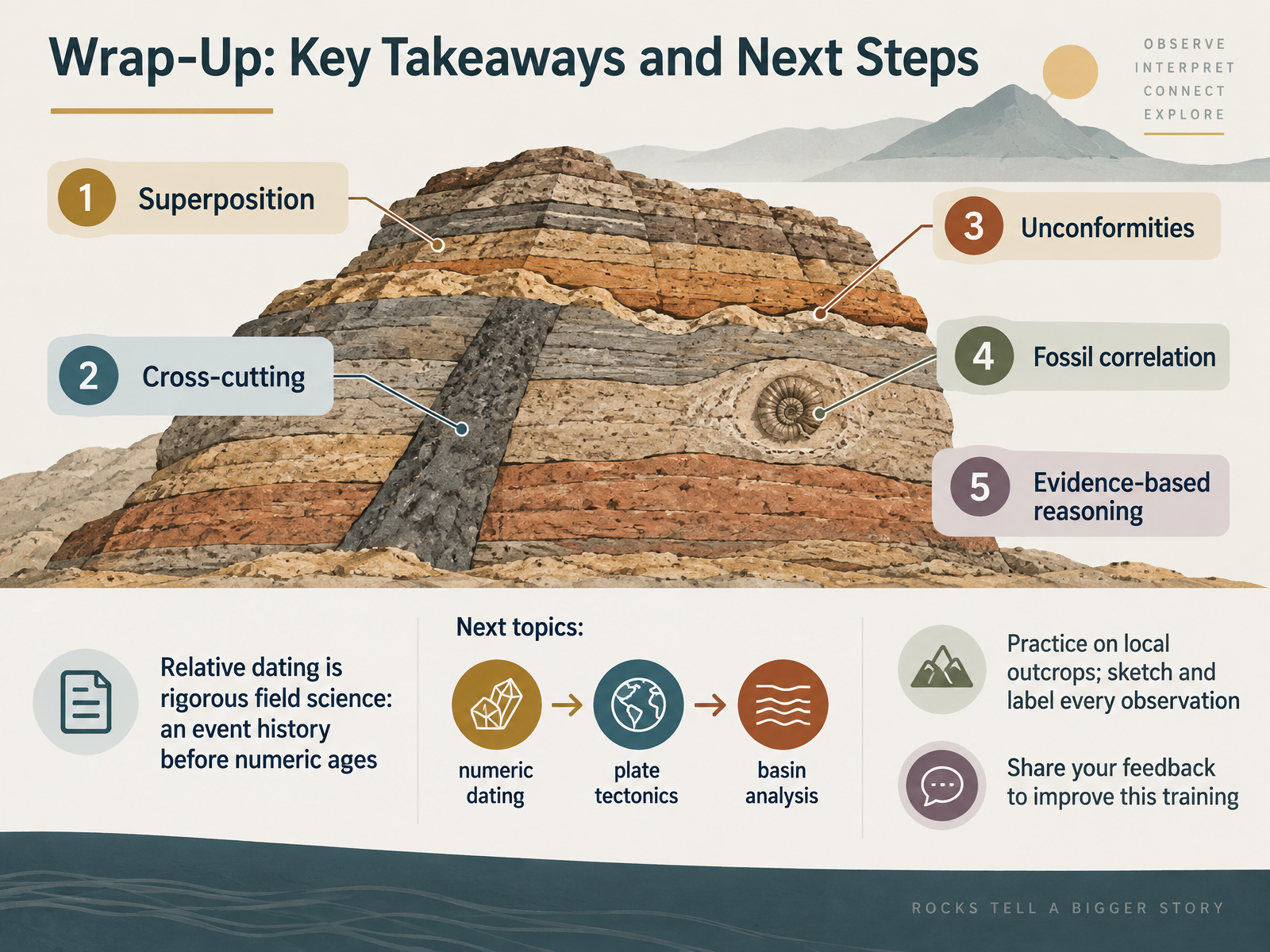
- 13Wrap-Up: Key Takeaways and Next StepsLet's bring this together. Here are five takeaways to carry with you. Superposition tells you which layer came first. Cross-cutting relationships tell you what happened later. Unconformities record missing time. Fossil correlation links rocks across distance. And evidence-based reasoning ties it all together. Here's the big idea. Relative dating is rigorous field science. It builds an event history before any numeric age is known. Next, you'll move into numeric dating, plate tectonics, and basin analysis. To practice, find a local outcrop, sketch what you see, and label every observation. Does that match what you see? That habit will sharpen your eye. Thank you for joining me. Keep observing, keep questioning, and enjoy the fieldwork ahead.
 rainbow.ldeo.columbia.edueoas.ubc.caopen.maricopa.edu+21 min
Take the deck with you
Download this course as a file — free, no sign-up needed.
- PDF handoutEvery slide page, ready to print or share.14 pages · 4.8 MBDownload
- Narrated PowerPointThe deck that presents itself — every slide carries the digital human's narration video.14 pages · 12.1 MBDownload
- PowerPoint slidesThe full deck as a .pptx — open it in PowerPoint, Keynote, or Google Slides.14 pages · 4.8 MBDownload
Free to use in your own training — please keep the PersonWise credit page at the end.
Have your own deck? Turn it into a course
Sources consulted
Web sources consulted while building this course.
- geologic dating — apps.usgs.gov
- Geologic Timescale, Geologic Dating Techniques, and Numeric Ages (U.S. National Park Service) — nps.gov
- A beginner's guide to dating (rocks) | U.S. Geological Survey — usgs.gov
- Geologic Time: Relative Time Scale — pubs.usgs.gov
- Geologic Time - Geology (U.S. National Park Service) — nps.gov
- STENO'S STRATIGRAPHY — rainbow.ldeo.columbia.edu
- Processes — eoas.ubc.ca
- 7.2 Stratigraphic Principles and Missing Time – Exploring Physical Geology Lab Online — open.maricopa.edu
- Be the Block: Working the Geologic Block Diagram as an Inquiry Tool — serc.carleton.edu
- Lab.geotime.html — rainbow.ldeo.columbia.edu
- Way-up structures – Historical Geology — opengeology.org
- Chapter 4: Sedimentary Structures – The Story of Earth: An Observational Guide — uhlibraries.pressbooks.pub
- 61.2: Sedimentary way-up structures — geo.libretexts.org
- Sedimentary Structures - Energy and Mines — gov.nl.ca
- LAB 5: SEDIMENTARY STRUCTURES & PALAEOCURRENT ANALYSIS — usuarios.geofisica.unam.mx
- Intrusions - Plutons, Dikes, and Sills — jfarmer.asu.edu
- Satellite Applications for Geoscience Education — cimss.ssec.wisc.edu
- Relative Dating Stratigraphy Exercises — studylib.net
- Stratigraphy: Timing Events in the Past — ucmp.berkeley.edu
- Relative datingexercises | PDF — slideshare.net