Begin
14 pages · ~28 min
Balancing Chemical Equations: Conservation of Mass
This training teaches learners to balance chemical equations using the law of conservation of mass, building essential stoichiometry skills for chemistry students.
A digital instructor presents all 14 pages. Hold “Ask” at any point and ask out loud — the answer comes from this course. No sign-up needed.
What you’ll learn
- 01Balancing Chemical Equations: Conservation of MassWelcome. This course is about balancing chemical equations, and our guiding idea is the conservation of mass. Here is the goal. By the end, you will be able to read an equation, verify that it is balanced, and balance one yourself in a systematic way. This skill links atomic theory to measurable chemistry. You use it whenever you calculate how much product a reaction can make. The core principle is simple. In a chemical reaction, matter is rearranged, never created or destroyed. Atoms present at the start are all present at the end, just in new combinations. Our roadmap has four parts. First, counting atoms. Second, balancing methods. Third, worked examples. Fourth, real-world evidence, including reactions in open and closed containers. If you teach, you will also practice transferring these ideas to your own learners. Expect to make mistakes along the way. That is a normal part of learning, so keep a pencil handy and be ready to check your own work. Next, we examine why equations must balance.edu.rsc.orgteachchemistry.orgopenstax.org+22 min
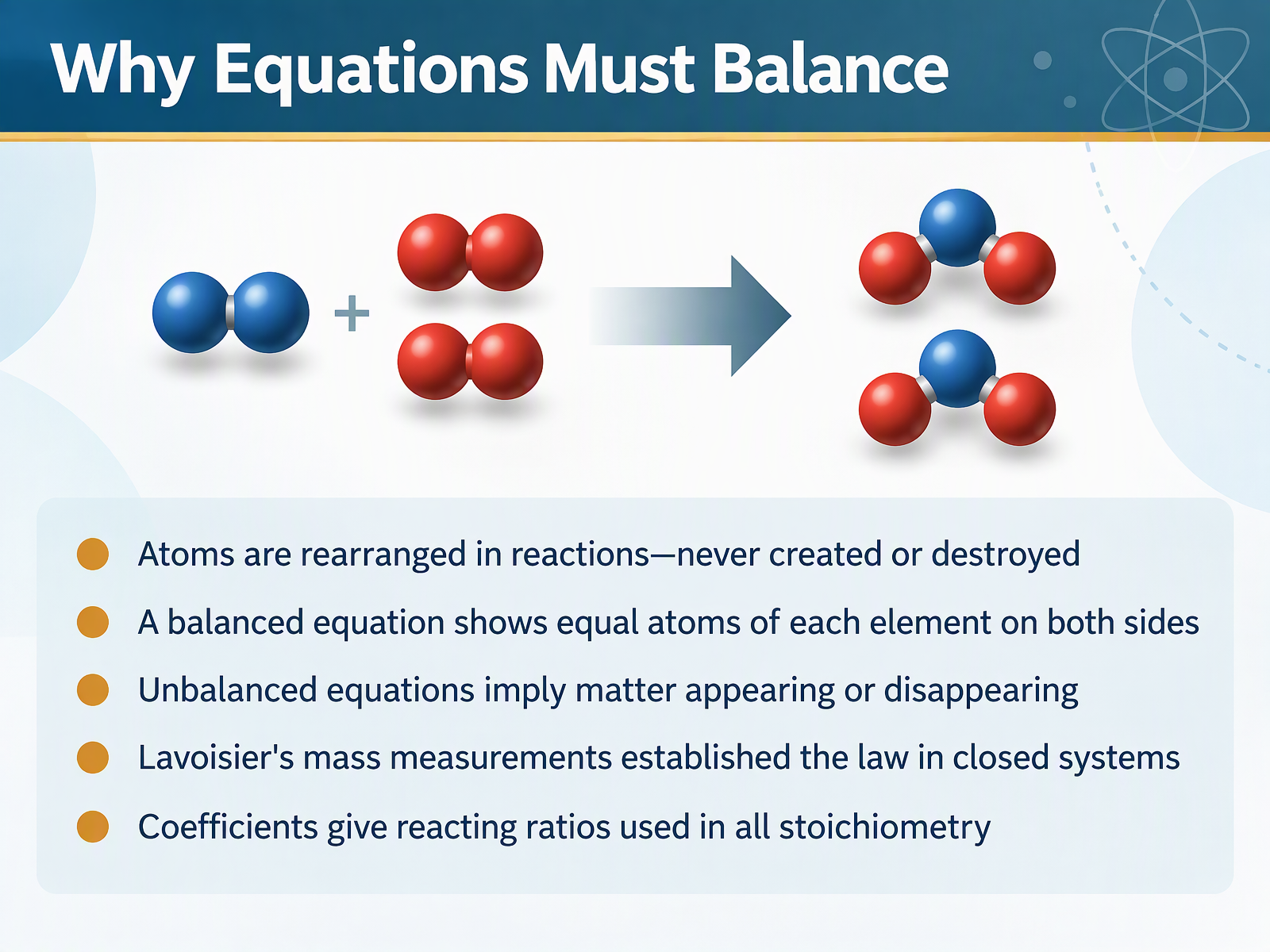
- 02Why Equations Must BalanceLet's look at why equations must balance. In a chemical reaction, atoms are rearranged but never created or destroyed. A balanced equation shows equal numbers of atoms of each element on both sides. An unbalanced equation implies matter is appearing or disappearing, which cannot happen. In the late 1700s, Lavoisier measured masses in closed systems and established the law of conservation of mass. Coefficients, the numbers placed before formulas, give the reacting ratios used in all stoichiometry. So a balanced equation is not just a formality. It is a statement that matter is conserved. Take a moment to check one of your own equations and count the atoms on each side. Next, we will examine the anatomy of a chemical equation.
 edu.rsc.orgedu.rsc.orgedu.rsc.org+21 min
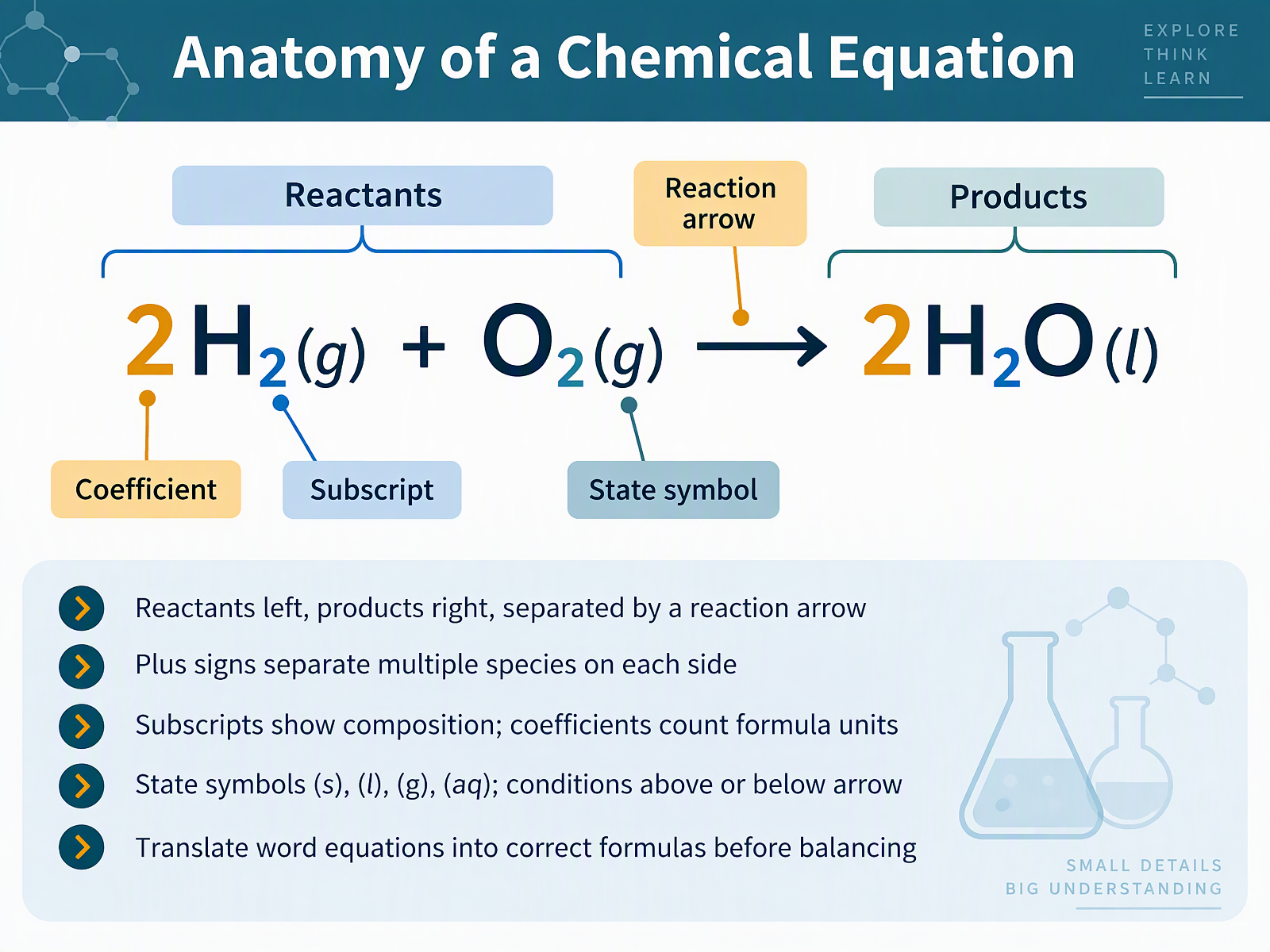
- 03Anatomy of a Chemical EquationLet's look at the anatomy of a chemical equation. Every equation has two sides. The reactants appear on the left. These are the substances you start with. The products appear on the right. These are the substances formed. A reaction arrow separates the two sides. On each side, plus signs separate multiple species. Now look closely at the formulas. Subscripts, the small numbers inside a formula, show the composition of a single unit. For example, the two in H two O means two hydrogen atoms per water molecule. Coefficients, the larger numbers in front, count how many formula units you have. A coefficient of two in front of H two O means two water molecules. State symbols tell you the physical form. S means solid, L means liquid, G means gas, and A Q means aqueous, dissolved in water. Conditions, such as heat or a catalyst, are written above or below the arrow. Before you balance anything, translate each word equation into correct chemical formulas. Changing a subscript later would change the substance itself, so get the formulas right first. In the next slide, we will practice counting atoms using subscripts, parentheses, and coefficients.
 openstax.orgprograms.clarendoncollege.educhemical-reaction.appspot.com+22 min
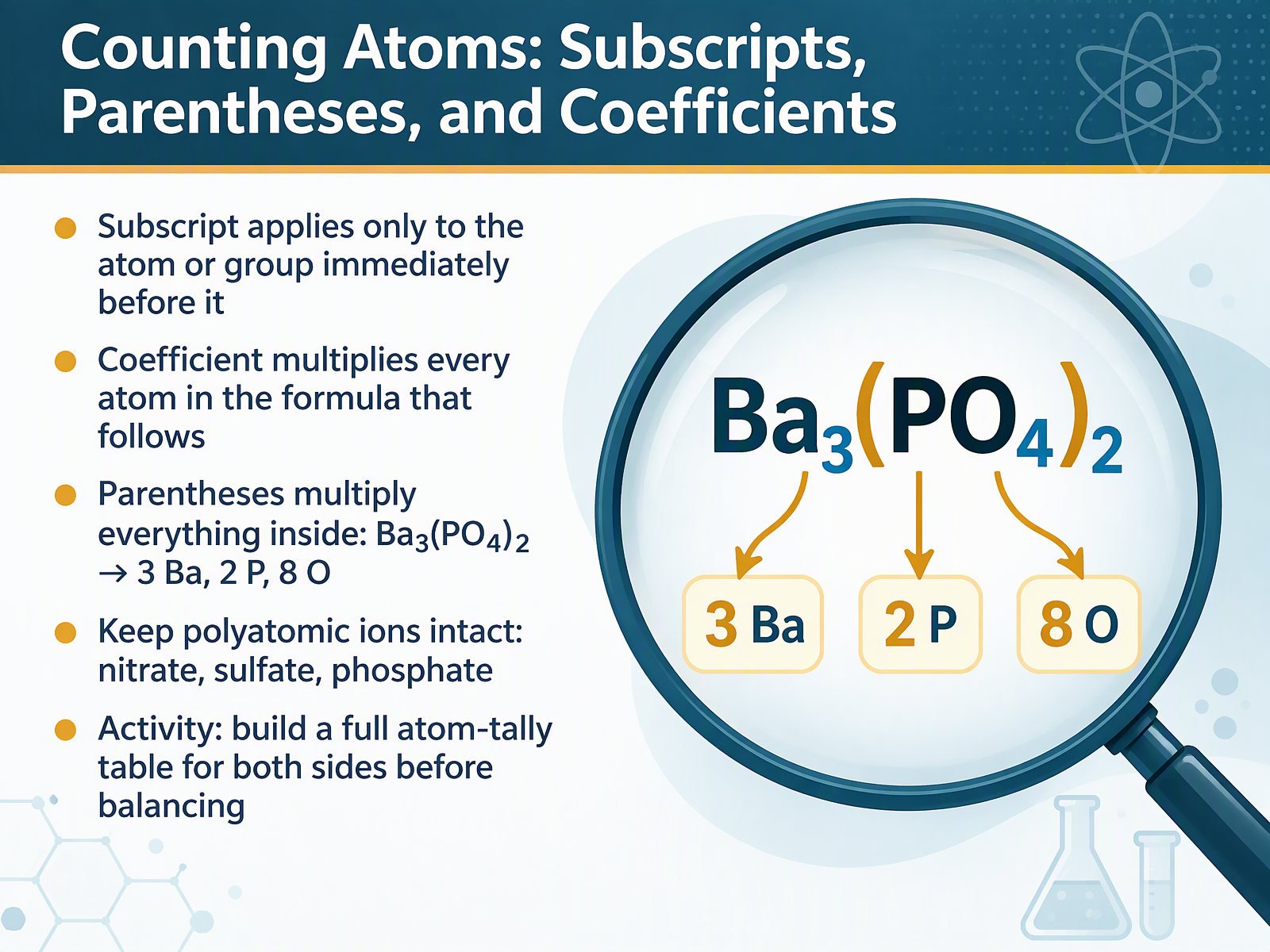
- 04Counting Atoms: Subscripts, Parentheses, and CoefficientsBefore we can balance anything, we have to count atoms correctly. There are three rules to keep in mind. First, a subscript applies only to the atom or group immediately before it. So in the formula H two O, the two belongs to hydrogen only. Second, a coefficient multiplies every atom in the formula that follows it. So two H two O means four hydrogen atoms and two oxygen atoms. Third, parentheses multiply everything inside them. For example, barium phosphate, written as B a three, open parenthesis, P O four, close parenthesis, subscript two, gives three barium atoms, two phosphorus atoms, and eight oxygen atoms. When you work with polyatomic ions such as nitrate, sulfate, or phosphate, keep them intact as a group. Do not break them into separate elements. Now try the activity. Build a full atom-tally table for both sides before you attempt to balance. Remember, mistakes in counting are normal, so check each other's tallies carefully. Next, we will look at how to verify whether an equation is balanced. This brings us to the next topic, Is It Balanced? A Systematic Check.
 edu.rsc.orgteachchemistry.orgopenstax.org+22 min
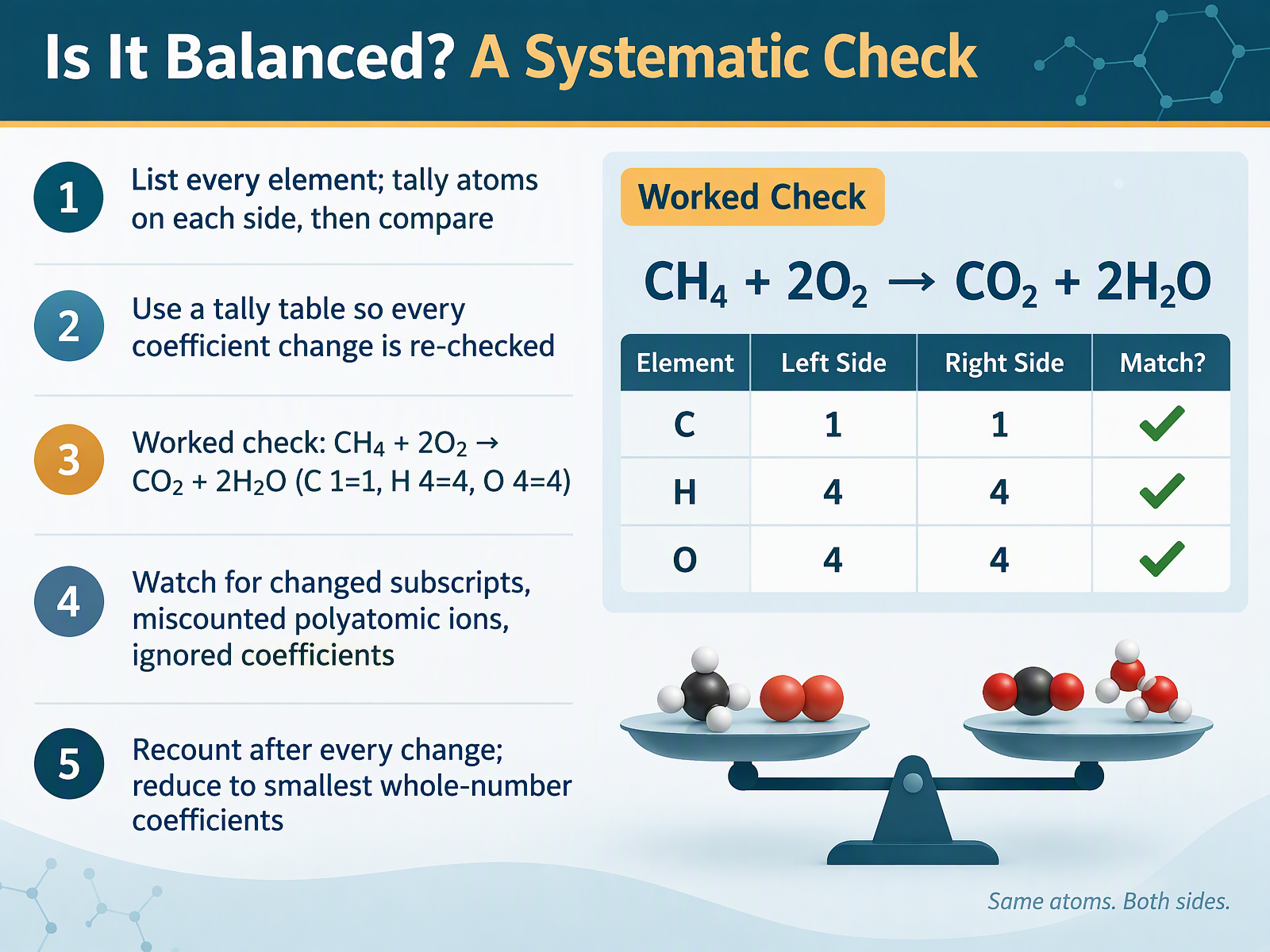
- 05Is It Balanced? A Systematic CheckLet's look at how to check whether an equation is already balanced. The method is systematic. First, list every element that appears in the equation. Then tally the atoms on each side, and compare the two totals. A tally table helps here. It lets you re-check every coefficient change, so nothing slips past you. Here is a worked check: C H four plus two O two yields C O two plus two H two O. Carbon: one equals one. Hydrogen: four equals four. Oxygen: on the left, two times two is four. On the right, one times two plus two times one is four. Balanced. As you check, watch for three common errors. Changing a subscript instead of a coefficient, miscounting a polyatomic ion such as sulfate, and ignoring a coefficient when tallying. If something looks off, recount after every change. Finally, reduce the coefficients to the smallest whole numbers. Now let's see how the inspection method builds a balanced equation step by step.
 openstax.orgprograms.clarendoncollege.educhemical-reaction.appspot.com+22 min
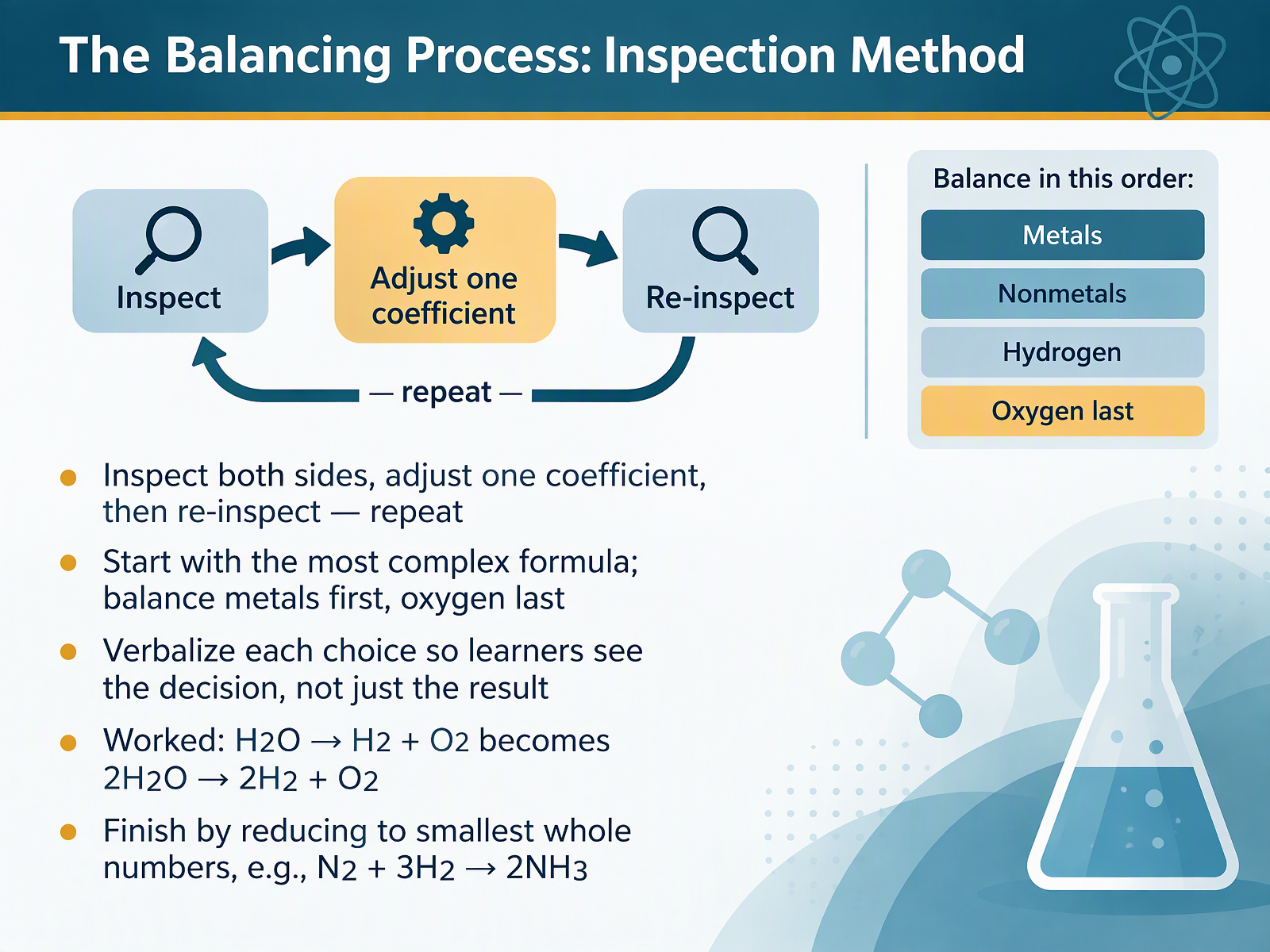
- 06The Balancing Process: Inspection MethodNow let's look at the inspection method itself. The cycle is simple. Inspect both sides, adjust one coefficient, then inspect again. Repeat until every atom count matches. Start with the most complex formula in the equation. Balance metals first, and balance oxygen last. Say each choice out loud as you make it. That way you see the decision, not just the answer. Here is the worked example. Water decomposes into hydrogen and oxygen. Hydrogen is already balanced, but oxygen is not. Place a two in front of water. Oxygen now balances, but hydrogen does not. So place a two in front of hydrogen gas. Every atom now matches. Finish by reducing coefficients to the smallest whole numbers. The ammonia equation shows why. Three N two plus nine H two gives six N H three. Divide every coefficient by three, and you get N two plus three H two gives two N H three. Pause here and check your own work before we continue. Next, we will look at fractions as scaffolds and the algebraic method.
 openstax.orgprograms.clarendoncollege.educhemical-reaction.appspot.com+22 min
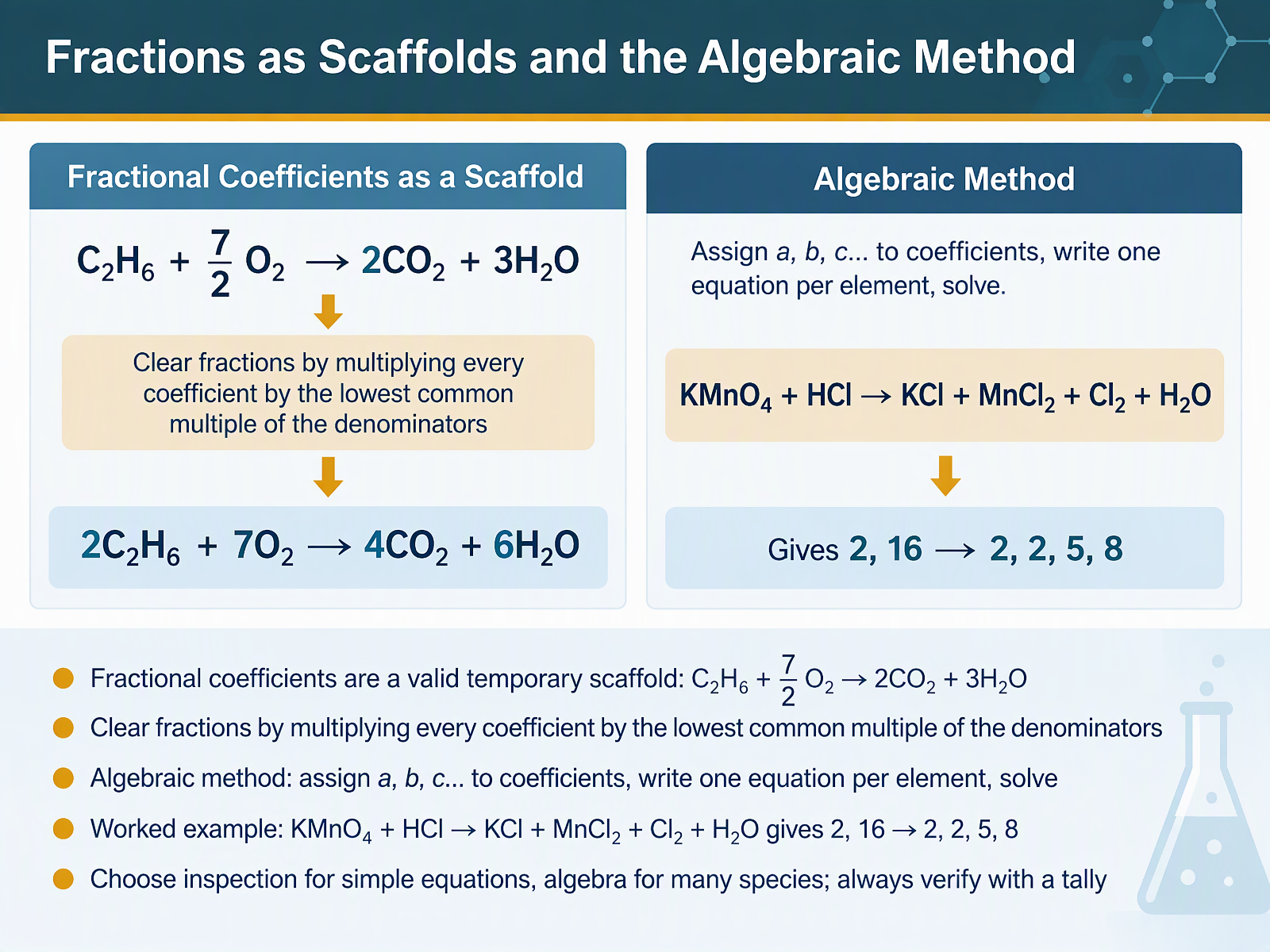
- 07Fractions as Scaffolds and the Algebraic MethodNow let's look at two more systematic tools. First, fractions as scaffolds. A fractional coefficient is a valid temporary step. For example, ethane reacting with seven halves of O two gives two C O two and three H two O. That equation is balanced, but fractions are not the final form. To clear them, find the lowest common multiple of the denominators, then multiply every coefficient by that number. Here, multiply everything by two.
Second, the algebraic method. Assign a variable, such as a, b, c, to each coefficient. Write one equation per element, setting reactant atoms equal to product atoms. Then solve the system. For potassium permanganate reacting with hydrochloric acid, the solution is two, sixteen, yielding two, two, five, and eight. Verify every result with an atom tally. Use inspection for simple equations and algebra when many species are involved.
Next, we'll work through examples step by step.
 openstax.orgprograms.clarendoncollege.educhemical-reaction.appspot.com+22 min
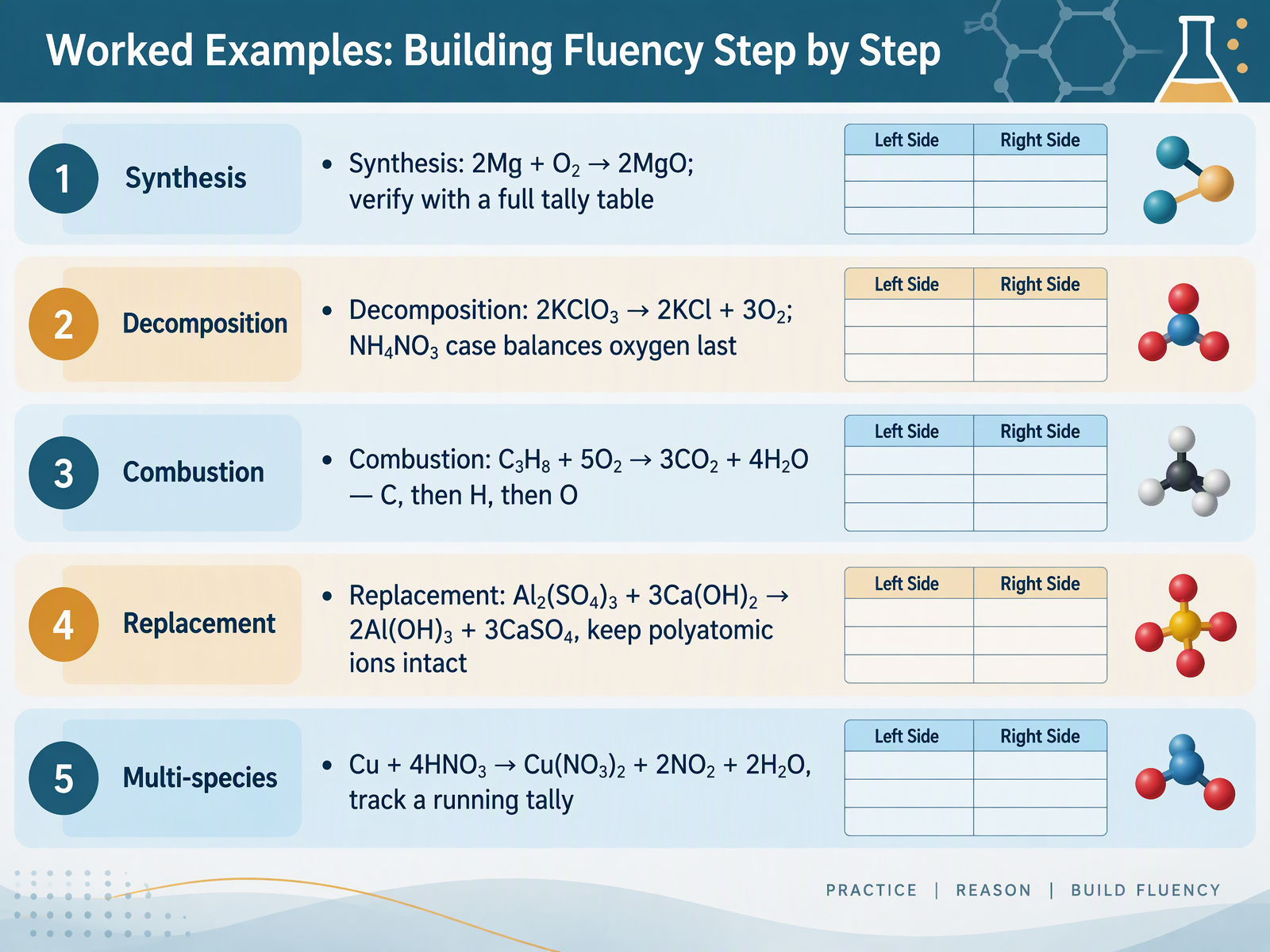
- 08Worked Examples: Building Fluency Step by StepLet's work through five examples, one reaction type at a time. First, synthesis: two magnesium plus O two gives two magnesium oxide. Confirm it with a full tally table. Two magnesium atoms on each side. Two oxygen atoms on each side. Balanced. Second, decomposition: two K C L O three gives two K C L plus three O two. Potassium and chlorine balance together, then oxygen last. The ammonium nitrate case follows the same rule: balance oxygen last. Third, combustion of propane: C three H eight plus five O two gives three C O two plus four H two O. Balance carbon, then hydrogen, then oxygen. Pause here and check that tally yourself. Fourth, replacement: aluminum sulfate plus three calcium hydroxide gives two aluminum hydroxide plus three calcium sulfate. Treat the sulfate and hydroxide groups as intact units. They carry through unchanged. Fifth, multi species: copper plus four nitric acid gives copper nitrate plus two nitrogen dioxide plus two water. Here, keep a running tally and update it each time you change a coefficient. Mistakes along the way are normal. When a change unbalances an earlier element, just return to the table. Next, we look at common mistakes and how to avoid them.
 openstax.orgprograms.clarendoncollege.educhemical-reaction.appspot.com+22 min
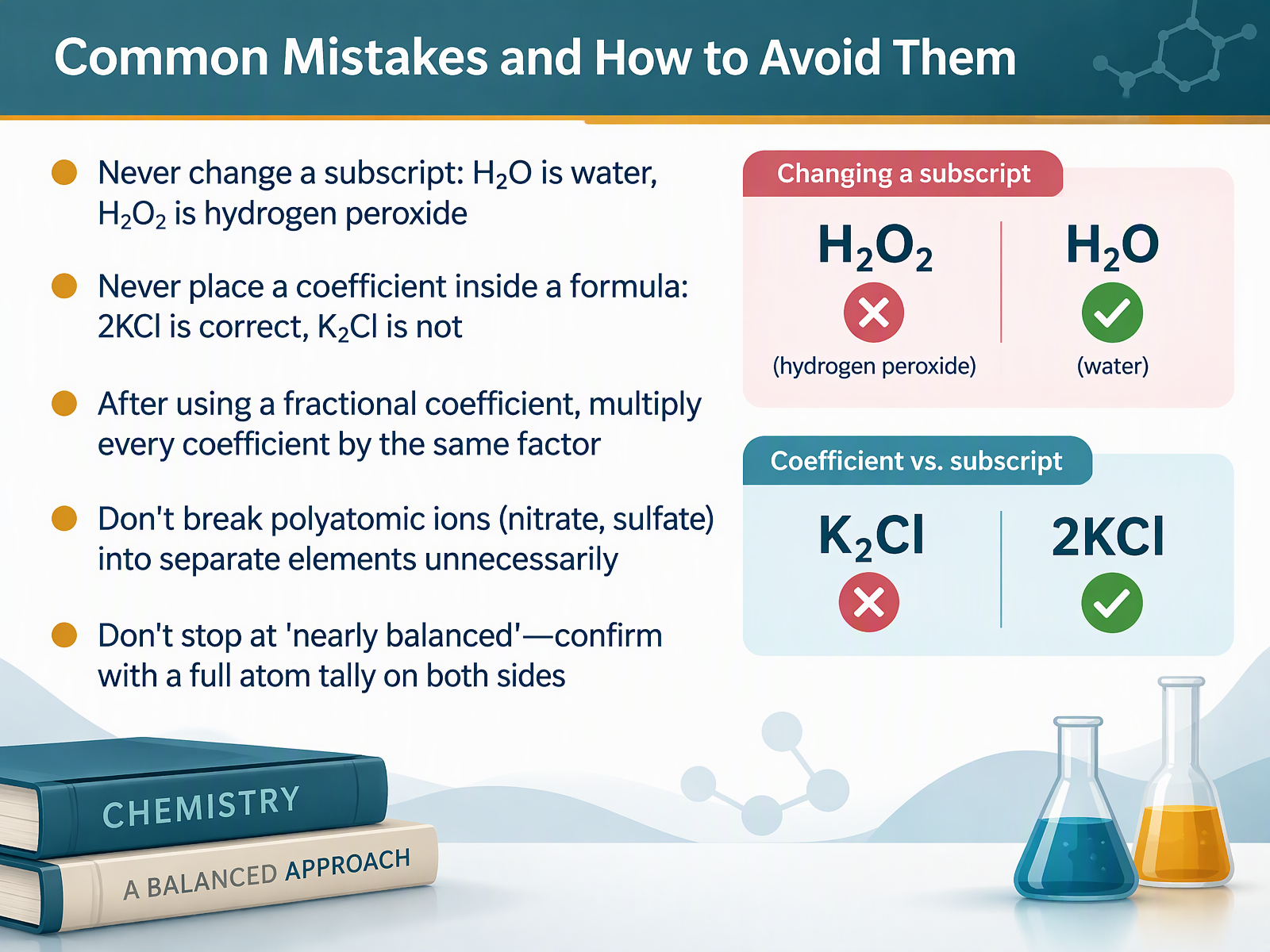
- 09Common Mistakes and How to Avoid ThemLet's look at common mistakes and how to avoid them. First, never change a subscript to make an equation balance. A subscript is the small number inside a formula. H two O is water, but H two O two is hydrogen peroxide, a different substance. Second, never place a coefficient inside a formula. A coefficient is the large number in front. Two K Cl is correct. K two Cl is not. Third, if you use a fractional coefficient along the way, multiply every coefficient by the same factor to clear the fraction. Fourth, treat polyatomic ions, such as nitrate and sulfate, as intact units instead of splitting them into separate elements. Finally, don't stop at nearly balanced. Pause here and confirm with a full atom tally on both sides. Mistakes are a normal part of the process, and checking your work catches them. Next, we'll look at teaching strategies that prevent errors.
 edu.rsc.orgteachchemistry.orgopenstax.org+22 min
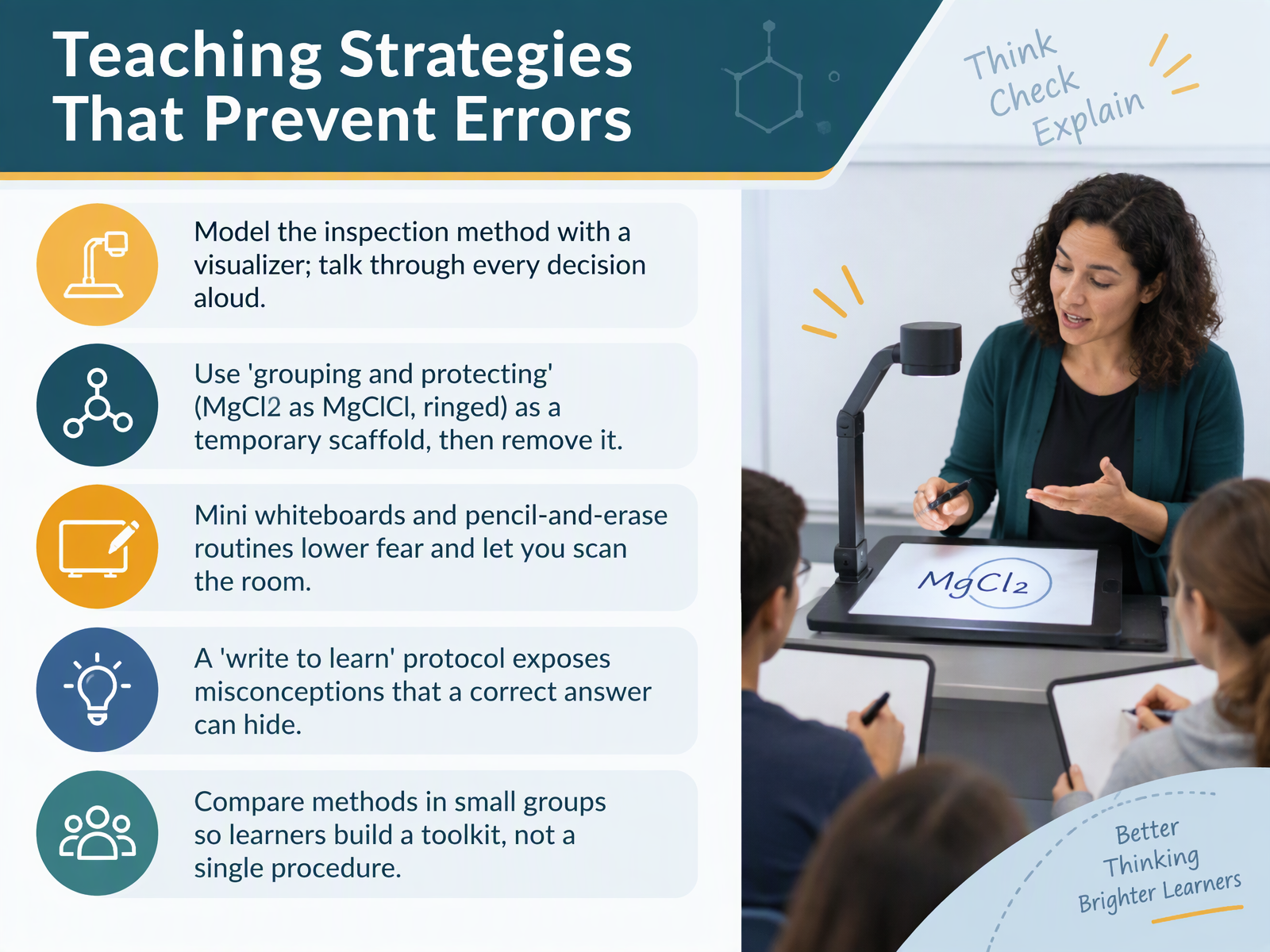
- 10Teaching Strategies That Prevent ErrorsLet's look at teaching strategies that prevent errors before they take hold. First, model the inspection method under a visualizer and talk through every decision aloud. Name each atom count and explain why you choose a coefficient, so learners hear the reasoning, not just the result. Second, use grouping and protecting as a temporary scaffold. For example, write magnesium chloride as M g C l C l and ring the whole formula, which signals that the formula stays fixed while only coefficients change. Remove the scaffold once learners are steady, since relying on it alone can constrain them when problems change. Mini whiteboards with pencil-and-erase routines lower the fear of being wrong and let you scan the room quickly. And a write to learn protocol, where learners record each decision, exposes misconceptions that a correct answer can hide. Finally, compare methods in small groups so learners build a toolkit, not a single procedure. Now let's see conservation of mass in the real world.
 edu.rsc.orgteachchemistry.orgopenstax.org+22 min
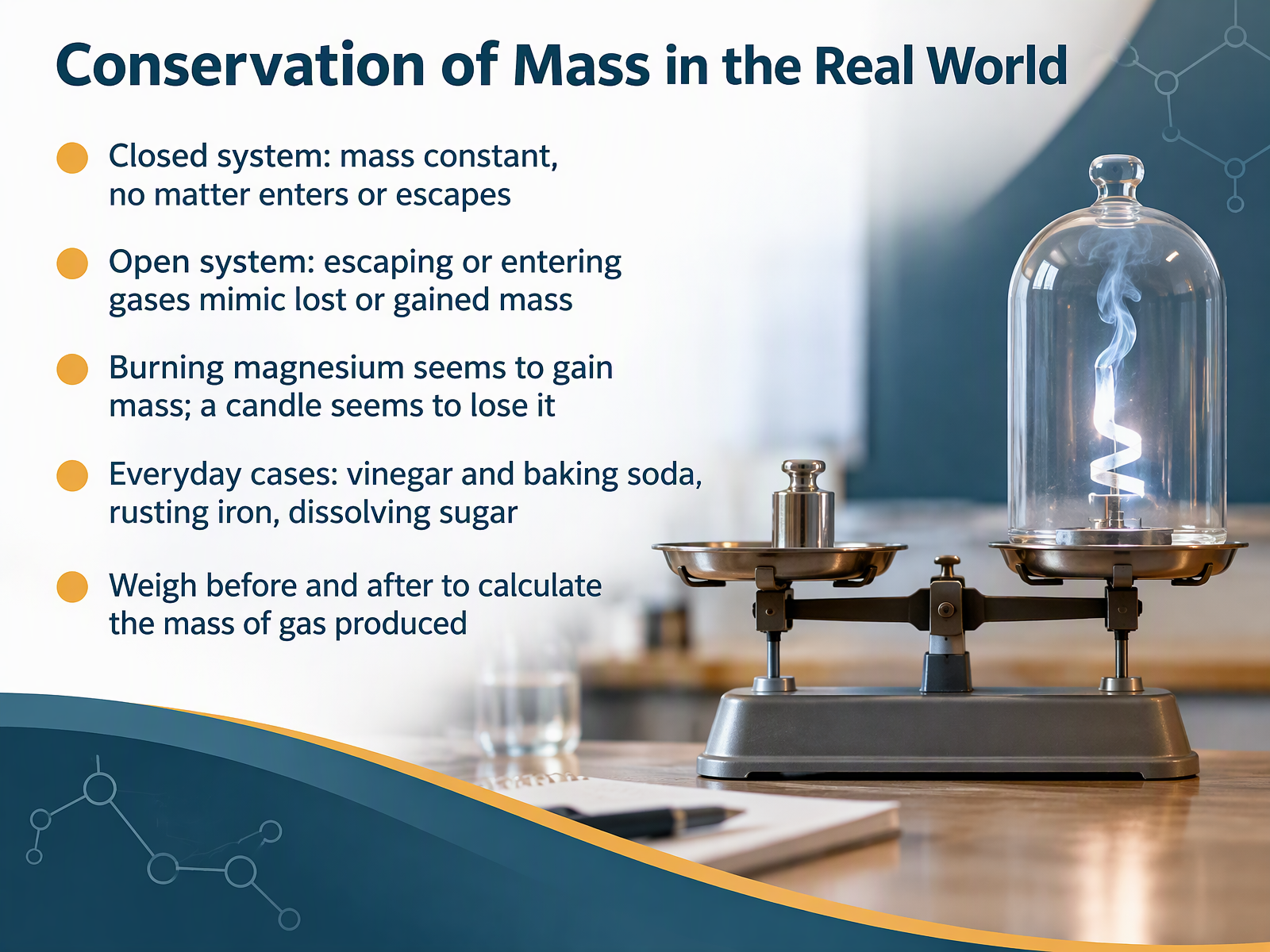
- 11Conservation of Mass in the Real WorldLet's connect conservation of mass to the real world. A closed system is one where no matter enters or escapes. In a closed system, the total mass stays constant. An open system allows matter to enter or leave. There, escaping or entering gases can make it look like mass was lost or gained. Two classic cases show this. Burning magnesium seems to gain mass because oxygen from the air joins the solid. A burning candle seems to lose mass because carbon dioxide and water vapor escape as gases. You will see the same effect with vinegar and baking soda, with rusting iron, and even with sugar dissolving in water. Here is a practical method. Weigh the system before and after the reaction. In an open system, the difference in mass equals the mass of gas produced or consumed. Take a moment to predict what a sealed bag would show. Then continue to interactive practice with simulations and games.
 edu.rsc.orgedu.rsc.orgedu.rsc.org+22 min
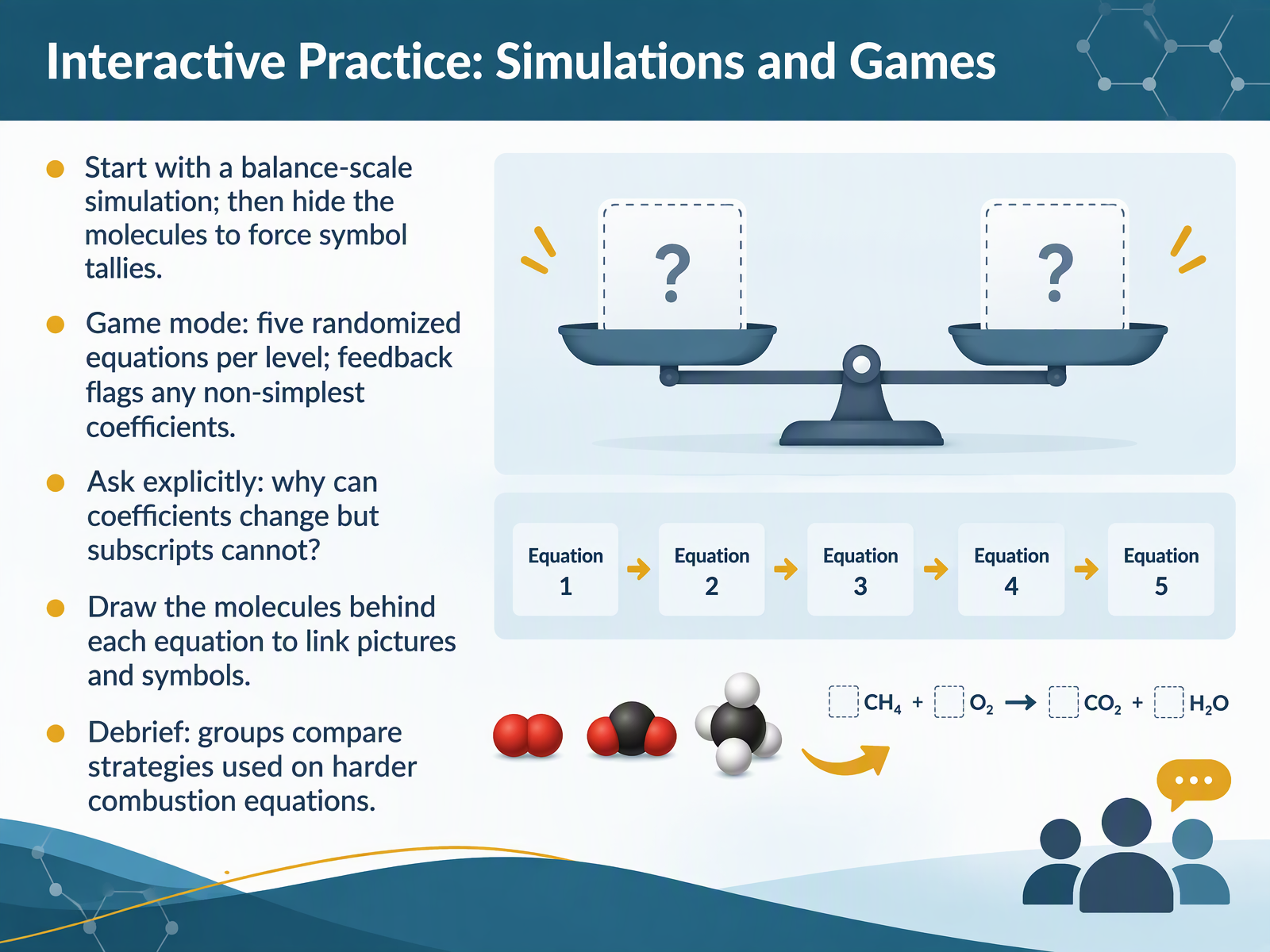
- 12Interactive Practice: Simulations and GamesNow let's put balancing into practice with simulations and games. Start with a balance scale simulation. Adjust coefficients until the scale levels. Then hide the molecules and balance again using only symbol tallies. That step matters, because the scale alone will not build the skill you need at a desk or on an exam. In game mode, you face five randomized equations per level. The feedback flags any answer that is balanced but not in simplest form. So if you see all even coefficients, divide them. Pause here and ask yourself directly: why can coefficients change but subscripts cannot? A coefficient counts how many molecules you have, so changing it changes only the amount. A subscript is part of the formula, so changing it creates a different substance. Water becomes hydrogen peroxide. Next, draw the molecules behind each equation, so pictures and symbols connect. Finish with a group debrief comparing strategies on the harder combustion equations. Now we turn to graduated practice and self-assessment.
 openstax.orgprograms.clarendoncollege.educhemical-reaction.appspot.com+22 min
- 13Graduated Practice and Self-AssessmentLet's move into graduated practice and self-assessment. Work through these in order, and pause to check your own work at each stage. In Set A, balance these warm-ups: hydrogen plus oxygen, sodium plus chlorine, magnesium plus oxygen, and iron plus sulfur. Then try Set B, the core set: methane plus two oxygen yields carbon dioxide plus two water, and four aluminum plus three oxygen yields two aluminum oxide. For Set C, the challenge: iron three oxide plus three carbon monoxide yields two iron plus three carbon dioxide, and four ammonia plus five oxygen yields four nitrogen monoxide plus six water. Here is your self-check. Formulas stay untouched. Your atom tally must be full on both sides. Coefficients must be the smallest whole numbers. And no coefficient may sit inside a formula. The answer key includes reasoning traces, so you can see exactly where a miscount occurred. That is the useful part, so treat errors as information. Next, we'll look at assessment, teaching transfer, and next steps.
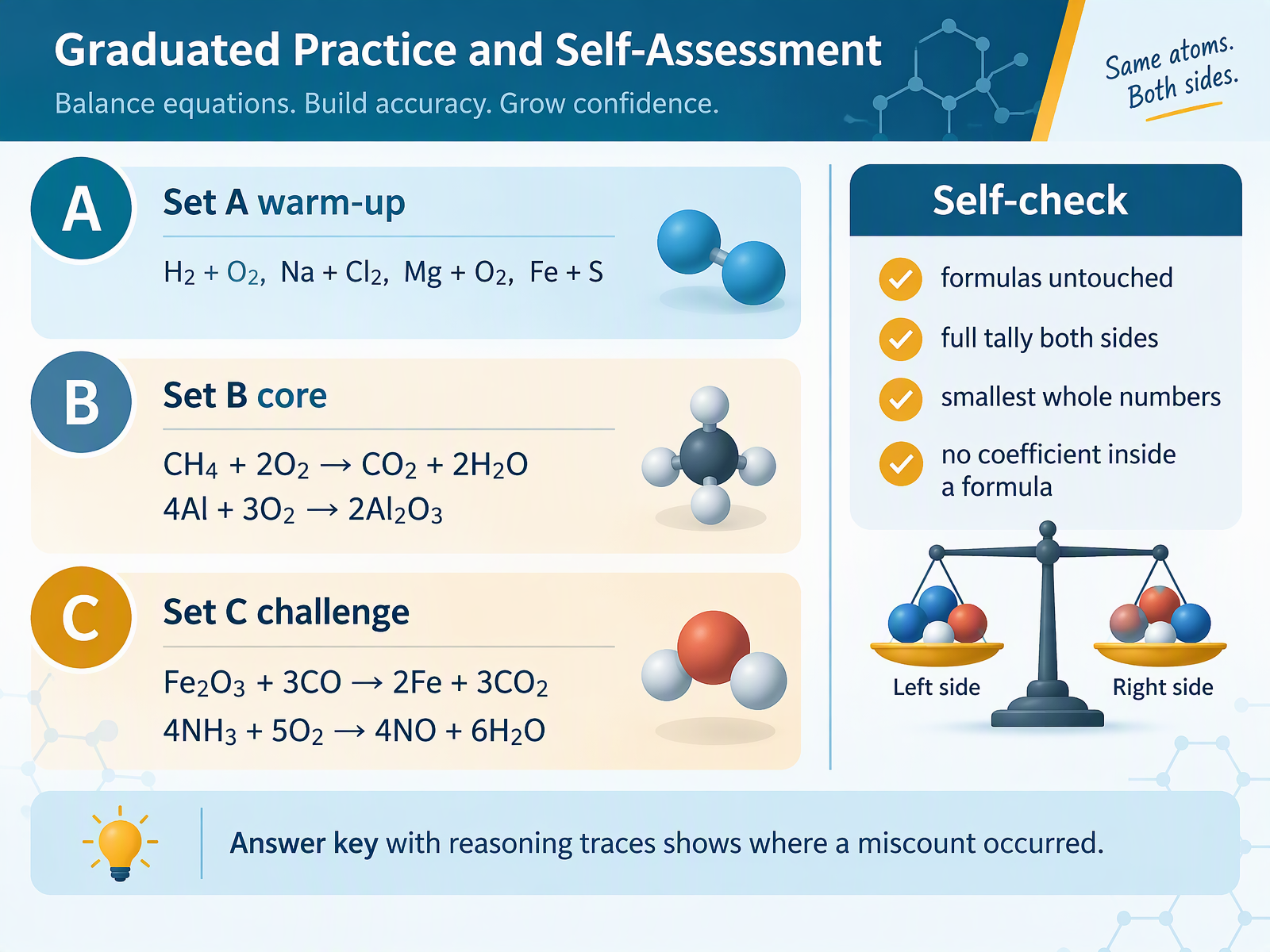 teachsimple.comtes.commashupmath.com+22 min
- 14Assessment, Teaching Transfer, and Next StepsLet's close by turning all of this toward assessment and next steps. For a quick formative check, give a one-equation exit ticket. Ask learners to submit the balanced equation plus a tally table. Scanned side by side, those two pieces show you exactly where a learner is stuck. For differentiation, provide scaffolded prompts and word banks alongside an unscaffolded version, then have pairs explain their reasoning to each other. Watch for three sticky points. First, subscript versus coefficient confusion; only coefficients change during balancing. Second, polyatomic ions such as sulfate should be carried as units, not split into separate atoms. Third, oxygen is balanced last, because it appears in the most compounds. Then discuss why burned magnesium appears to gain mass. Ask what they would actually measure: the magnesium, the oxygen consumed, or the whole closed system? This sets up the next step, stoichiometry. Molar mass and reacting-mass calculations all rest on balanced equations. So keep practicing, and thank you for your careful work today.
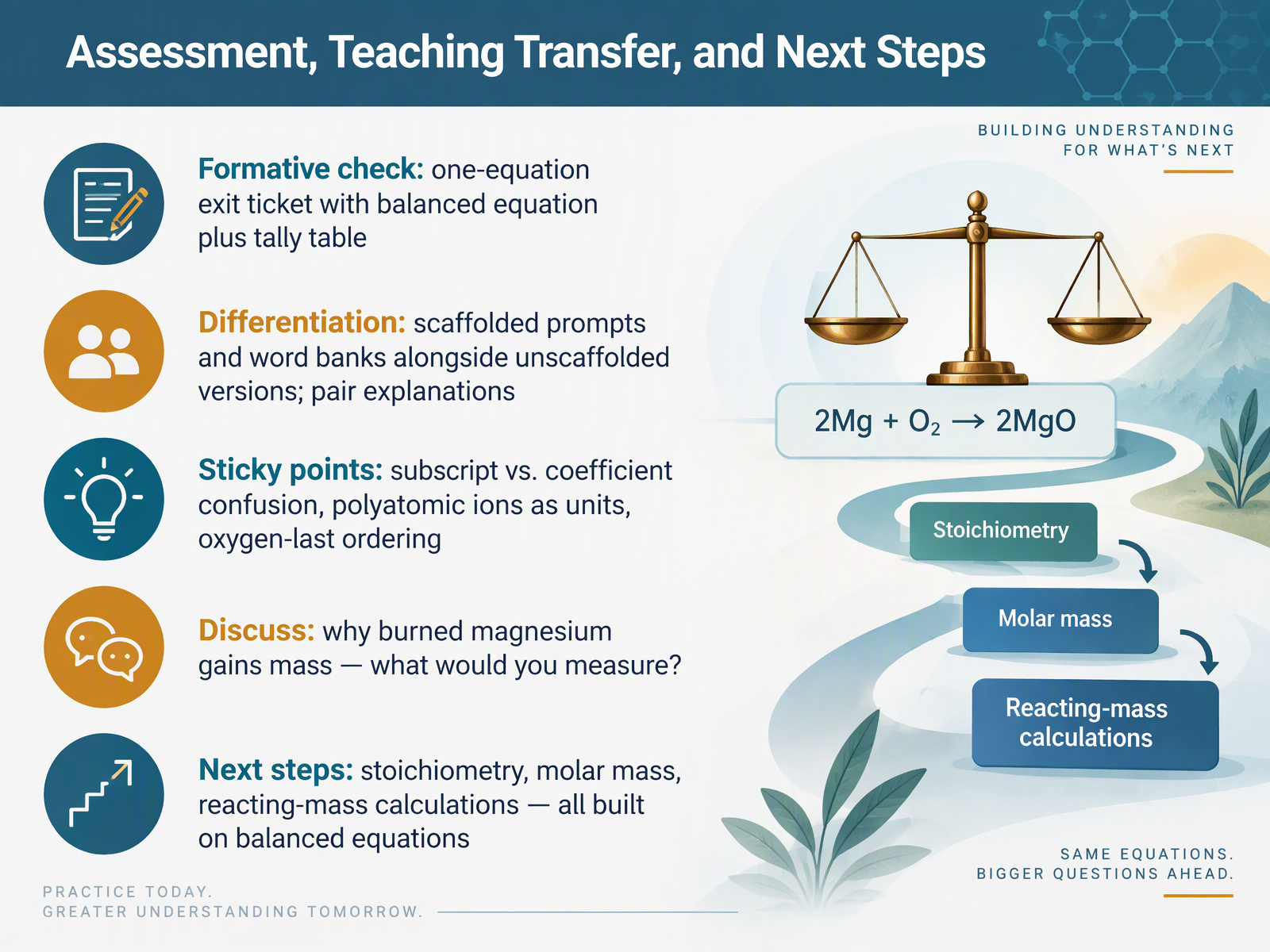 teachsimple.comtes.commashupmath.com+22 min
Take the deck with you
Download this course as a file — free, no sign-up needed.
- PDF handoutEvery slide page, ready to print or share.15 pages · 3.4 MBDownload
- Narrated PowerPointThe deck that presents itself — every slide carries the digital human's narration video.15 pages · 13.4 MBDownload
- PowerPoint slidesThe full deck as a .pptx — open it in PowerPoint, Keynote, or Google Slides.15 pages · 3.3 MBDownload
Free to use in your own training — please keep the PersonWise credit page at the end.
Have your own deck? Turn it into a course
Sources consulted
Web sources consulted while building this course.
- 5 effective ways to teach balancing equations | Ideas | RSC Education — edu.rsc.org
- Classroom Resources | Counting Atoms & Balancing Equations | AACT — teachchemistry.org
- 4.1 Writing and Balancing Chemical Equations - Chemistry 2e | OpenStax — openstax.org
- Chemical Reactions & Equations Chapter 1 — cbse.gov.in
- Teaching Methods for Balancing Chemical Equations: An Inspection versus an Algebraic Approach — doi.org
- How to teach conservation of mass | CPD article | RSC Education — edu.rsc.org
- 4 ways to teach the law of conservation of mass | Ideas — edu.rsc.org
- Teaching conservation of mass at 14–16 | CPD article | RSC Education — edu.rsc.org
- Lesson 6.2: Controlling the Amount of Products in a Chemical Reaction - American Chemical Society — acs.org
- Decomposition reactions | 11–14 years | Resource | RSC Education — edu.rsc.org
- WORKED EXAMPLE 6.1 Balancing a Chemical Equation — programs.clarendoncollege.edu
- Balance Chemical Reactions — chemical-reaction.appspot.com
- How To Balance Equations — chemicalaid.com
- Balancing Chemical Equations by Inspection, Counting Atoms ... — youtube.com
- Balancing Equation Practice for Chemistry Classes — teachsimple.com
- Balancing Chemical Equations (Hard) Worksheet GCSE | Teaching Resources — tes.com
- Balancing Equations Worksheet Library — Mashup Math — mashupmath.com
- Science, Balancing Chemical Equations — livephysics.com
- Department of Chemical Engineering Review Sheet ‐ Chemical Reactions — eng.auburn.edu