States of Matter: Solids, Liquids, Gases
Begin
12 pages · ~24 min
States of Matter: Solids, Liquids, Gases
This training explores the three states of matter—solids, liquids, and gases—and is designed for learners to understand their properties and differences.
What you’ll learn
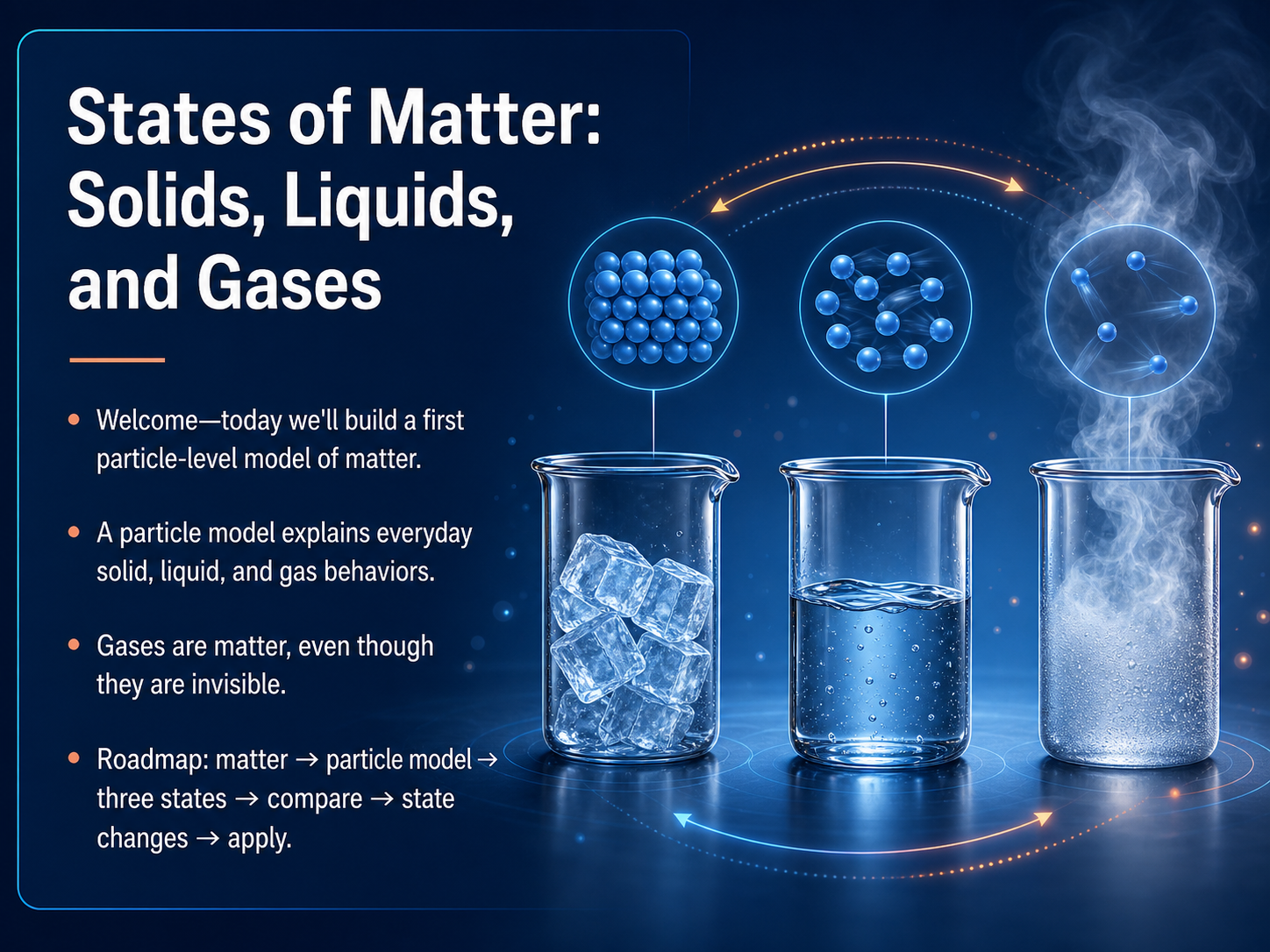
- 01States of Matter: Solids, Liquids, and GasesWelcome. I’m glad you’re here, because today we’re starting something really cool. We’re going to build our very first particle-level model of matter. By the time we’re done, you’ll have a new way to explain why a rock keeps its shape, why water pours, and why a balloon stays puffed up even when we can’t see what’s inside. Here’s a secret many people miss: gases are matter, too. Even when you can’t see them, they take up space and have mass. Our roadmap is simple. We’ll start with what matter is. Then we’ll build a particle model, explore the three main states—solid, liquid, and gas—compare them, look at how matter changes from one state to another, and finally apply our model to real examples. I’ll walk with you step by step, and we’ll treat this like a detective story where we figure out what’s really happening at a tiny scale. Let’s go ahead and begin with the big question: What is matter?doi.orgwaps.cfa.harvard.eduedu.rsc.org+22 min
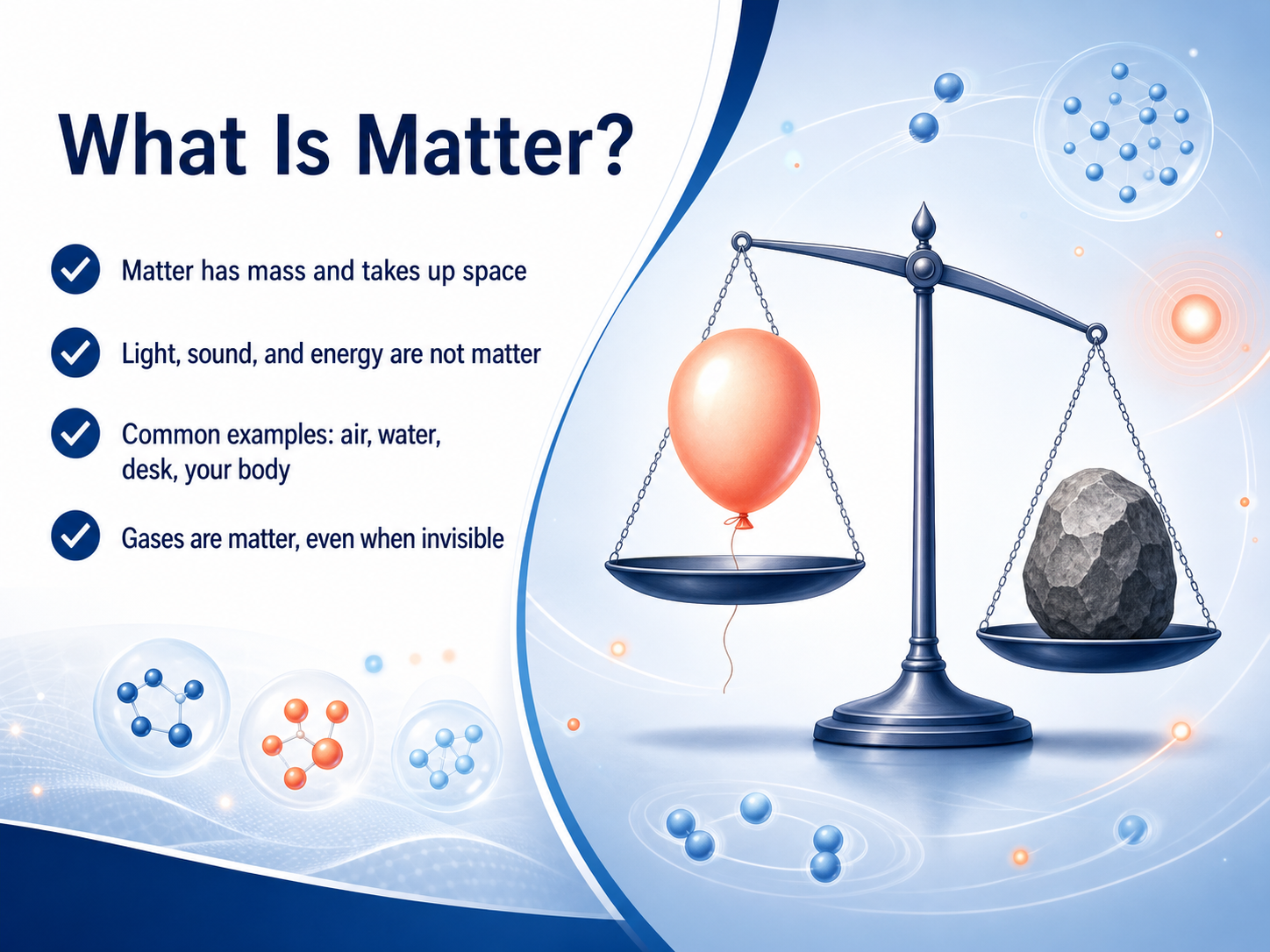
- 02What Is Matter?Now let's get a clear picture of what matter actually is. Matter is anything that has mass and takes up space. Think of it like this: if you can put it in a box, even a very large box, and it makes the box heavier, it's matter. The air around you, the water you drink, the desk in front of you, and your own body are all examples of matter. Even gases, which we often can't see, are matter. Air is a perfect example. It's invisible, but it takes up space, like when it fills a balloon, and it has mass. Things like light from a lamp, the sound of a voice, and pure energy are not matter. They are very real, but they don't have mass and they don't take up space. So, our simple rule is: matter has mass and takes up space. To understand why a solid, a liquid, and a gas behave so differently, we need to zoom way in and meet the tiny particles that make them up. Let's do that next, as we introduce the particle model.
 1 min
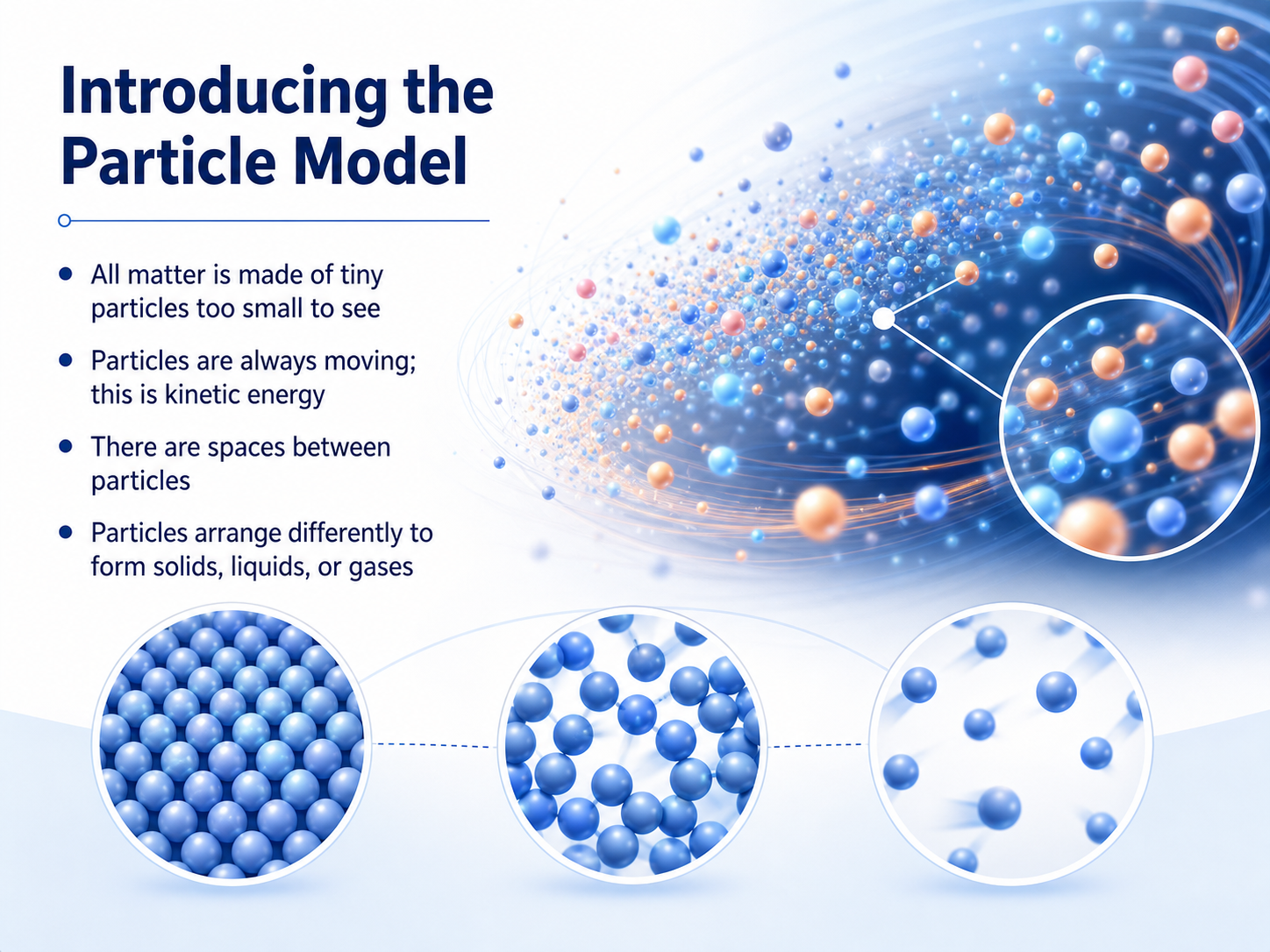
1 min - 03Introducing the Particle ModelNow, let's build a mental picture of what all this stuff around us is really made of. This picture is called the particle model. Imagine every single thing you can touch, from your water bottle to the air you're breathing, is actually made of countless tiny particles, far too small for our eyes to see. And here's a key idea: these particles are never still. They are always moving, always vibrating or zipping around. This constant motion is a form of energy, what we call kinetic energy. There are also spaces between these particles, like little gaps in a crowd. The way these particles arrange themselves—and how much they move—is what decides if something is a solid, a liquid, or a gas. With this simple model in mind, let's zoom in first on solids and see how their particles behave.
 1 min
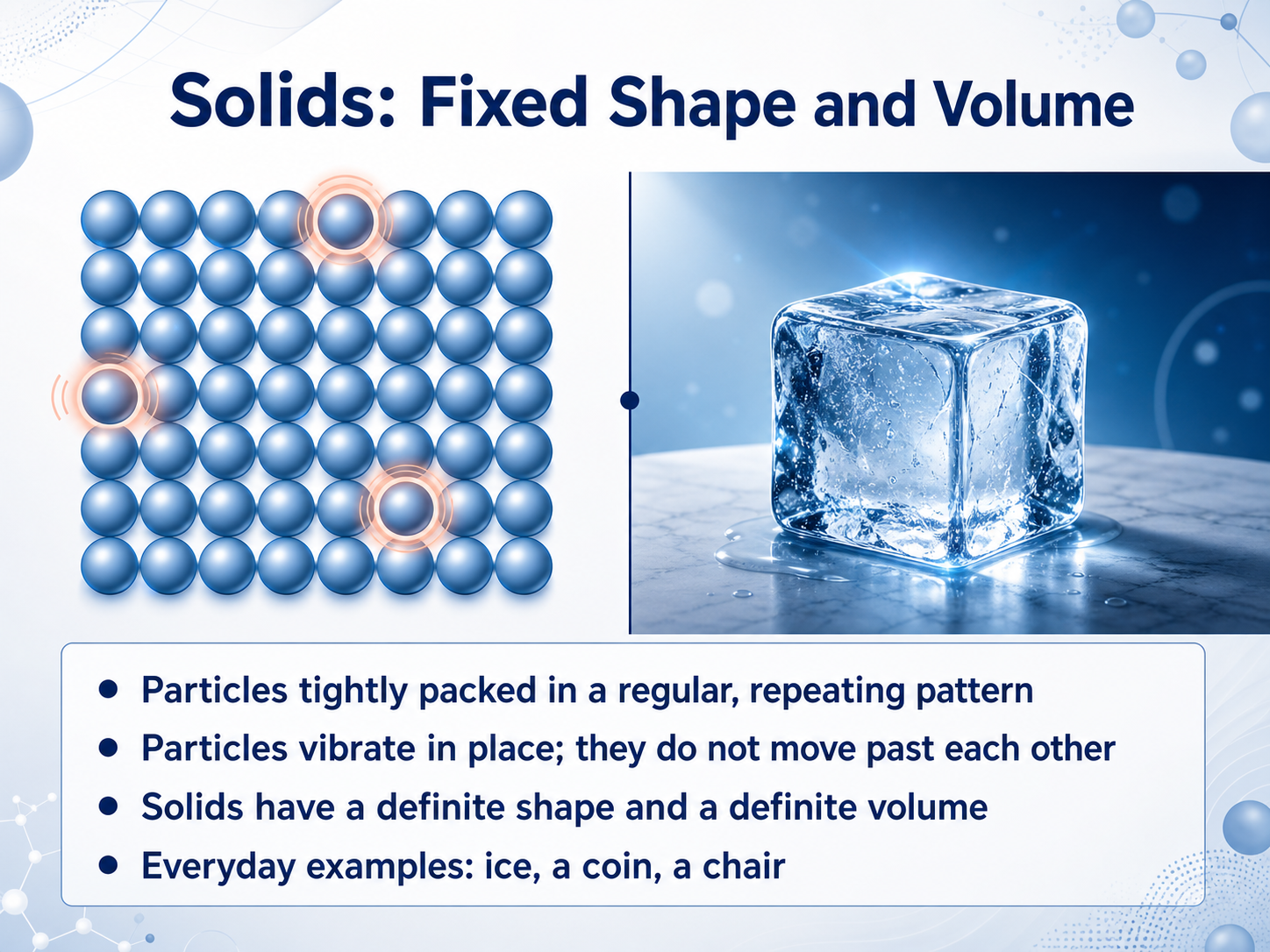
1 min - 04Solids: Fixed Shape and VolumeNow let's zoom in on a solid. Picture a marching band standing perfectly still in formation. Each person is tightly packed, shoulder to shoulder, in a regular, repeating pattern. In a solid, the particles do the same thing. They are locked in a fixed arrangement. They are not free to wander around. Instead, they vibrate slightly in place, a bit like someone shivering while keeping their feet firmly planted. Because the particles are held so tightly together, a solid has a definite shape. It does not flow to take the shape of a container. It also has a definite volume. The amount of space it takes up does not change easily. Think of an ice cube, a metal coin, or a wooden chair. Each one keeps its own shape and size, no matter where you put it. Next, we will explore what happens when particles have a little more freedom, changing from a fixed shape to something that can flow, as we look at liquids and their fixed volume.
 1 min
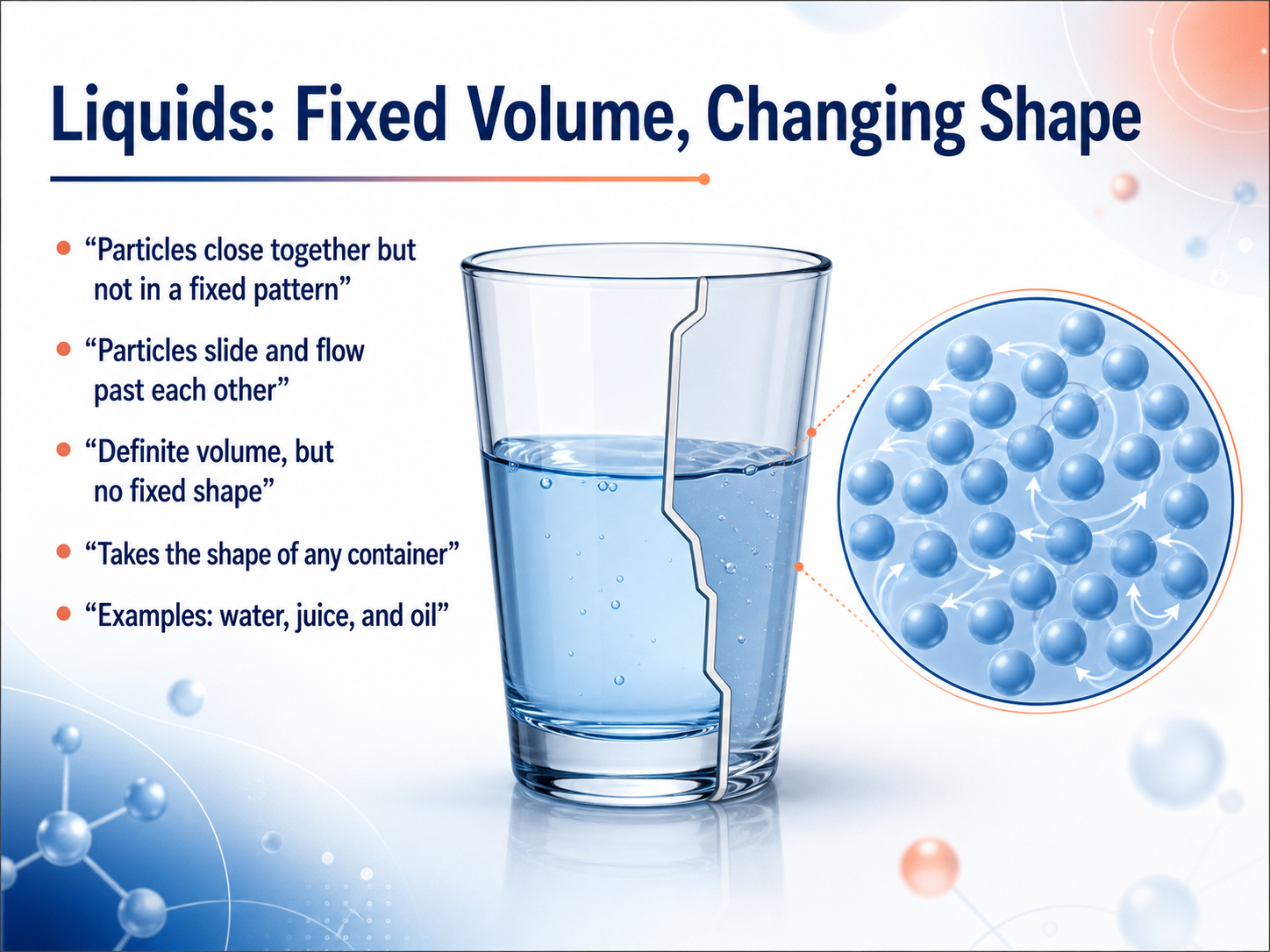
1 min - 05Liquids: Fixed Volume, Changing ShapeNow, let's picture a liquid, like a glass of water. If solids are like dancers frozen in place, then liquid particles are like dancers on a crowded dance floor. They are still packed closely together, so the volume stays the same, but they're not stuck in a rigid pattern. Instead, they slide and glide past each other, constantly changing neighbors. This is what gives a liquid a definite volume, but no fixed shape. It's why water, juice, and oil all take the shape of whatever container you pour them into. So, a liquid keeps its amount but changes its form. This flowing movement is a big clue for our next state, where the particles don't even stay close together. Let's look at gases, with no fixed shape or volume.
 1 min
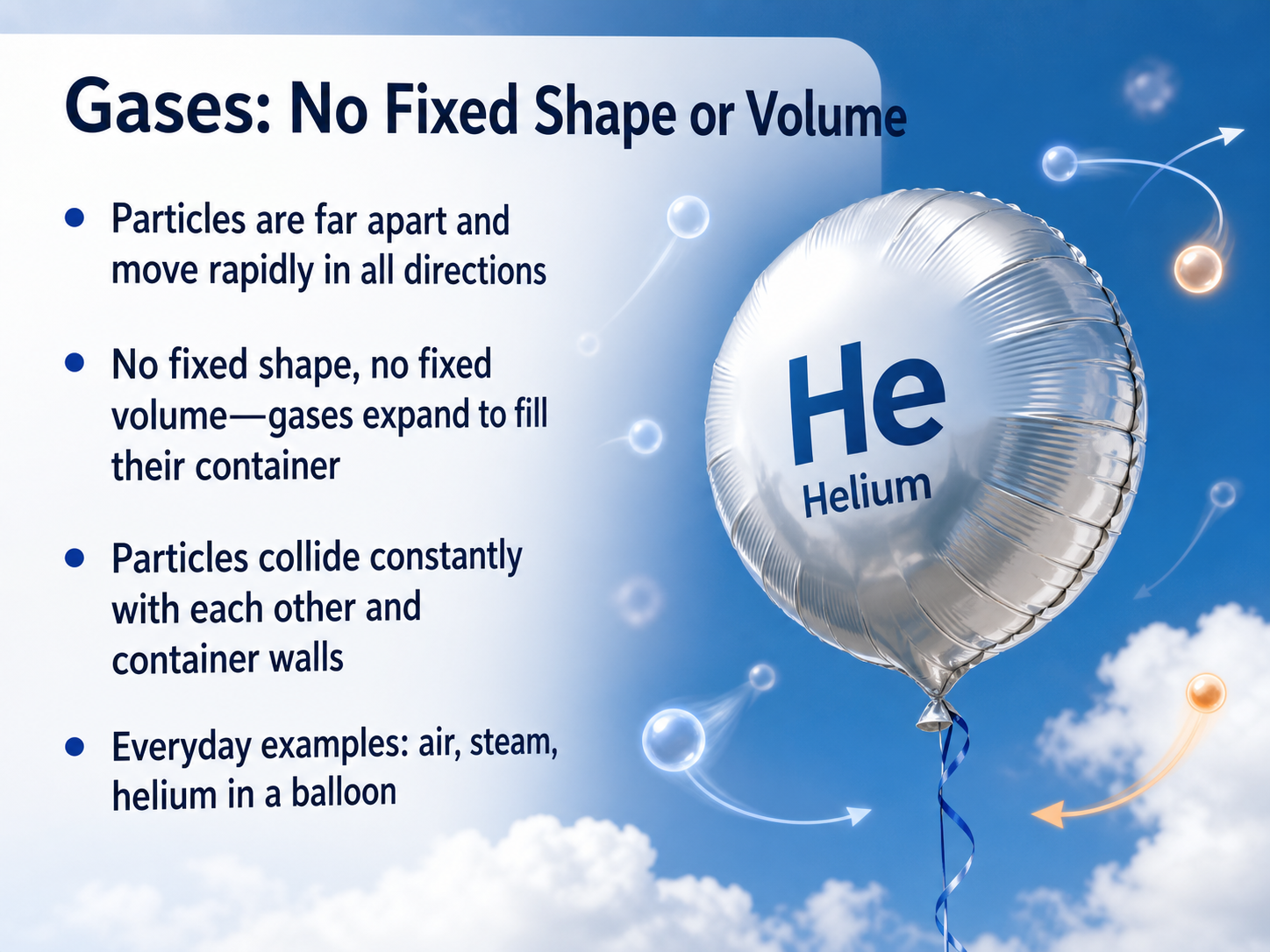
1 min - 06Gases: No Fixed Shape or VolumeNow, let's turn our attention to the wildest dancers of the bunch: gases. Think of the particles in a gas as tiny, energetic dancers spread out across a huge, empty dance floor. They are far apart from each other, and they move rapidly in all directions. Because they have so much space, a gas has no fixed shape and no fixed volume. Instead, it expands to fill whatever container it is in. If you open a bottle of perfume in one corner of a room, the scent particles spread out until they fill the entire space. These particles are constantly colliding with each other and bouncing off the walls of their container. Every time a gas particle hits a wall, it gives a tiny push, and the sum of all those pushes is what we call pressure. You can see this in everyday examples like the air we breathe, the steam rising from a hot cup of tea, or the helium that keeps a party balloon inflated. Next, we will pull all these ideas together by comparing the three states side-by-side.
 2 min
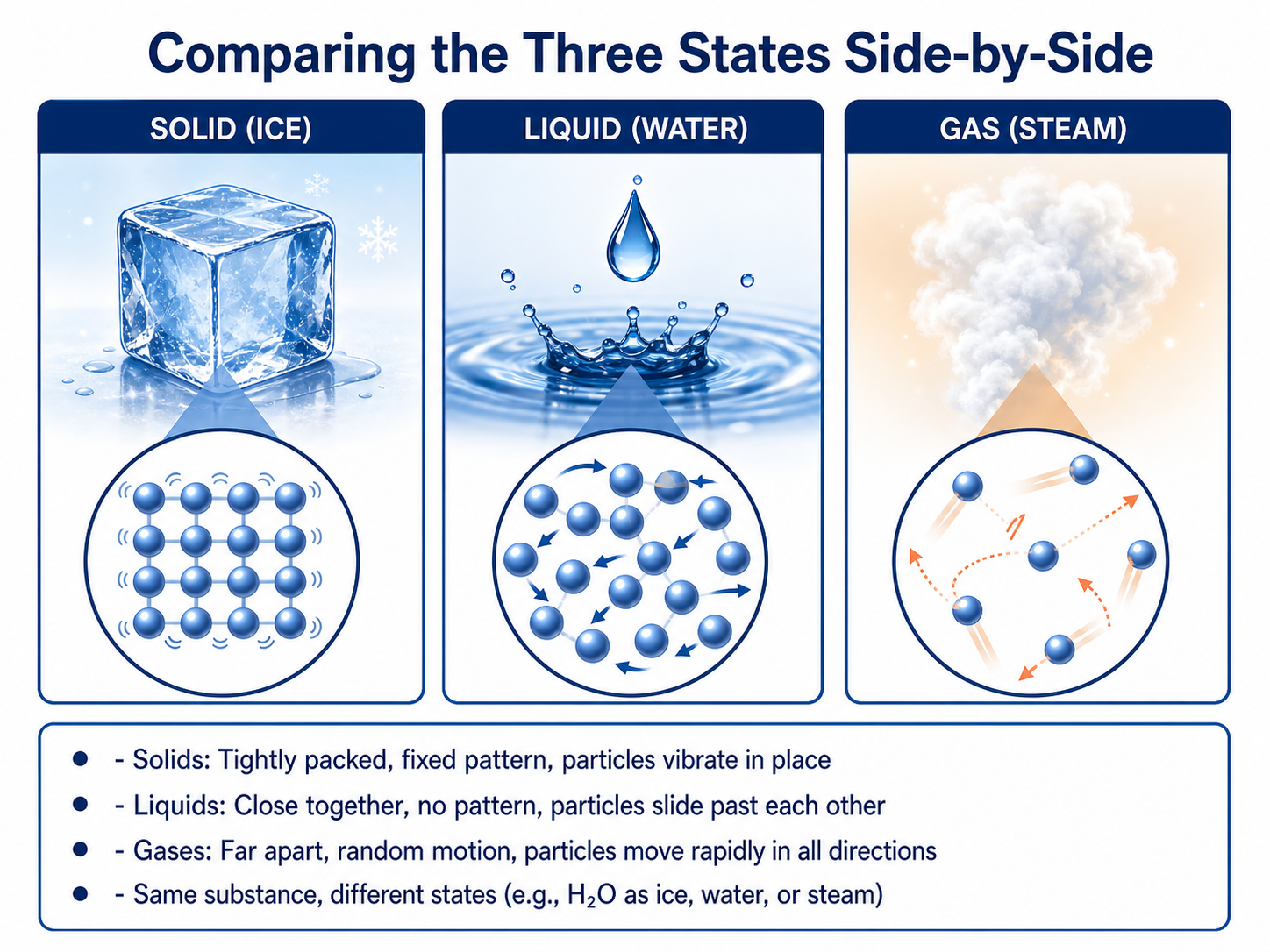
2 min - 07Comparing the Three States Side-by-SideNow let's bring all three states together side by side, so we can really see the difference. Imagine the exact same substance — like water — in three different forms. Same little particles, just arranged and moving in completely different ways. In a solid, like ice, the particles are packed tightly in a fixed pattern. They can’t move around. They just vibrate gently in place, like people standing close together, shivering slightly. In a liquid, like water, the particles are still close, but they’ve lost that fixed pattern. They slide and glide past each other, like a crowd of dancers flowing across a dance floor. In a gas, like steam, the particles are far apart. They zoom around rapidly in all directions with no pattern at all, like kids running wild in a big open field. So the same substance tells a very different story just by changing how its particles move and connect. Next, we’ll explore what makes one state shift into another, as we look at changing state by adding or removing energy.
 2 min
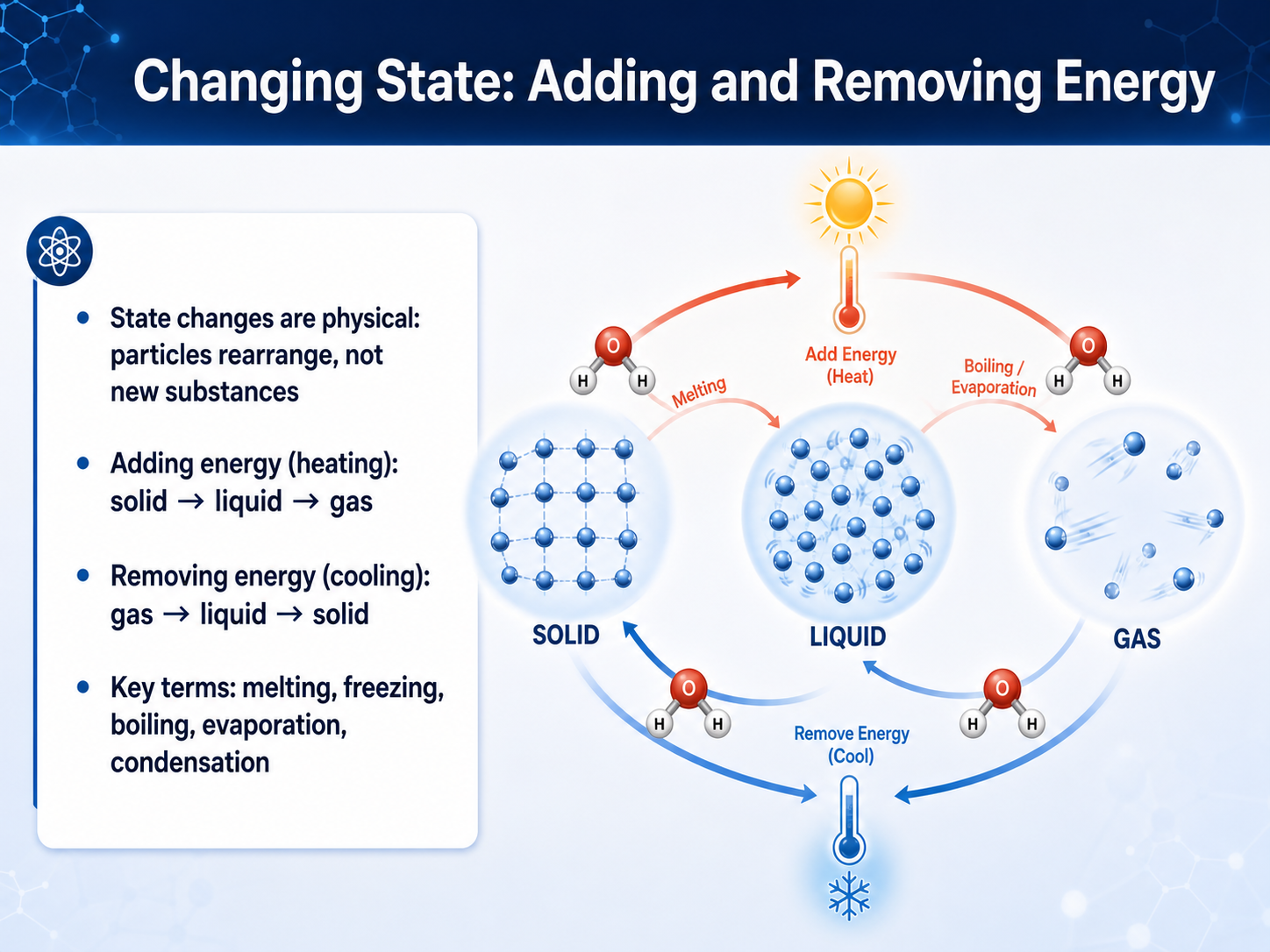
2 min - 08Changing State: Adding and Removing EnergyNow, let's talk about what actually happens when a substance changes from one state to another. It's important to know that these changes are physical, not chemical. The particles themselves don't turn into something new; they just rearrange how they are packed and how they move. Think of it like a group of dancers changing their formation without changing who they are. When we add energy, like heat, our dancers get more excited. They move faster and spread out, going from a solid to a liquid, and then to a gas. We call these changes melting and then boiling or evaporation. When we remove energy, or cool things down, the dancers slow down and come closer together. A gas condenses into a liquid, and a liquid freezes into a solid. The key idea here is that matter is conserved. When water boils, it doesn't disappear; it changes into an invisible gas called water vapor. The same H2O molecules are there, just moving differently. Now, let's look closer at two special ways a liquid turns into a gas, boiling and evaporation, and see what makes them different.
 doi.orgcpp.eduedu.rsc.org+22 min
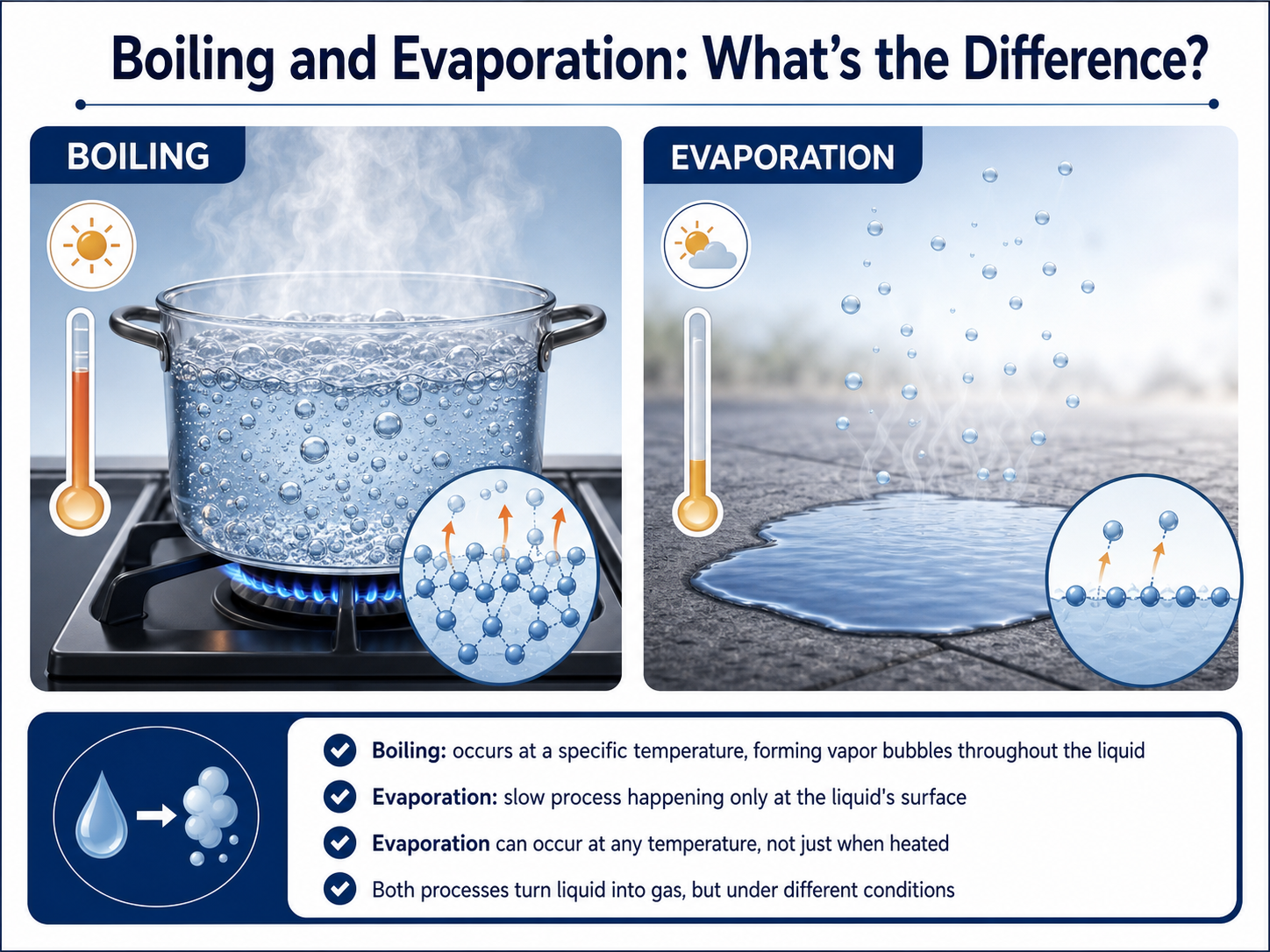
 - 09Boiling and Evaporation: What's the Difference?Let's take a closer look at two ways liquids turn into gas. Boiling and evaporation might sound like the same thing, but they happen quite differently. Imagine a pot of water on a hot stove. Boiling is a fast, dramatic change. It happens at one specific temperature, which for water is two hundred twelve degrees Fahrenheit. You see vapor bubbles forming not just at the top, but rushing up from all through the liquid. Now, think about a small puddle on the sidewalk after a rain shower. It slowly disappears, even on a cool day. That's evaporation. It's a gentle, quiet process that only happens at the liquid's surface, where the most energetic particles escape. Evaporation can occur at any temperature, not just when the liquid is hot. So both boiling and evaporation turn a liquid into a gas, but boiling is a full-body event, while evaporation is like a slow, surface-level dance. Now, let's look at the journey in the opposite direction, with condensation, where a gas turns back into a liquid.
 1 min
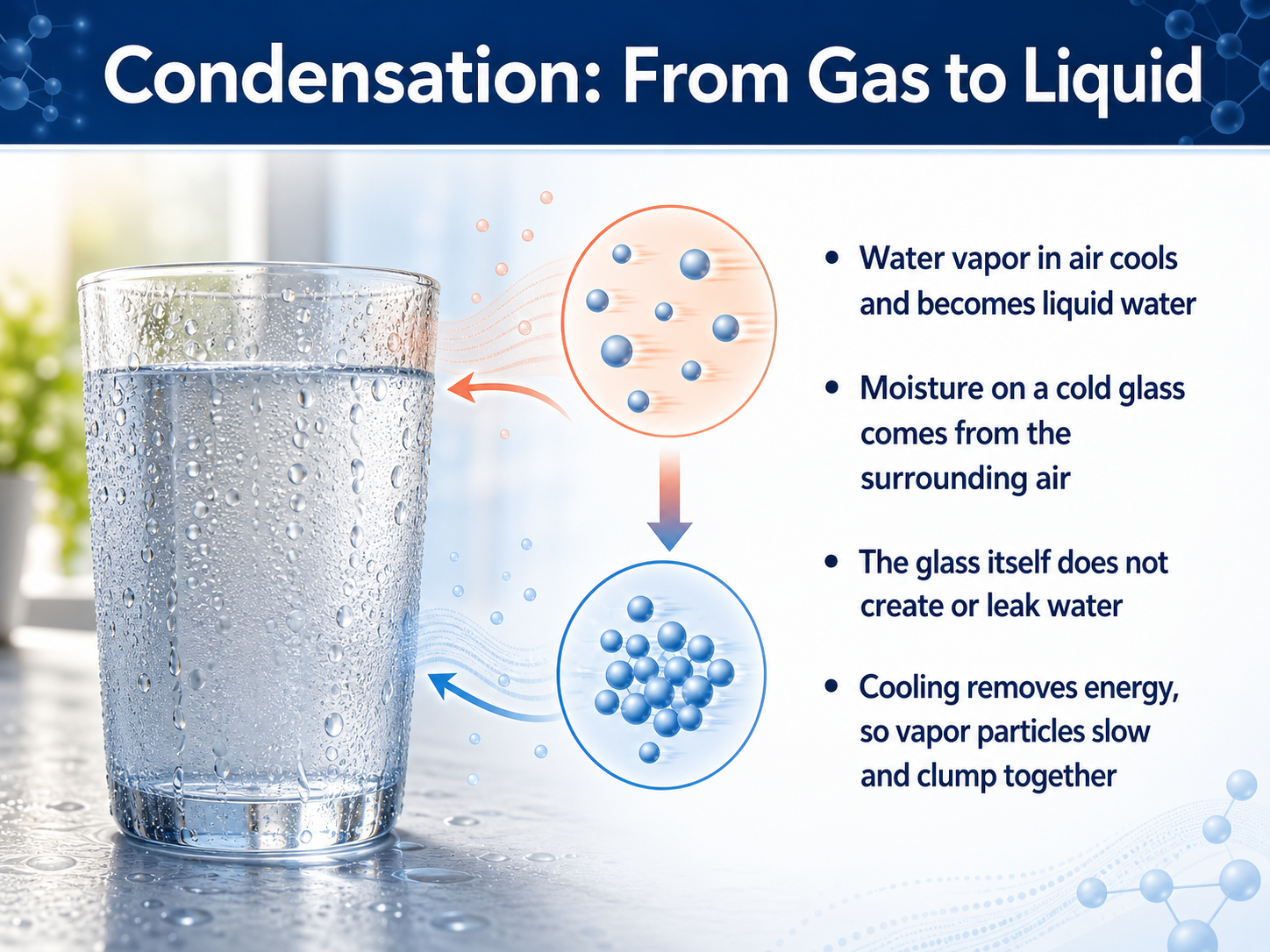
1 min - 10Condensation: From Gas to LiquidNow let's turn our attention to condensation, which is a gas turning into a liquid. Imagine a cold glass of water on a warm day. You see little droplets form on the outside of the glass. Where did that water come from? It might seem like the glass is sweating, but the glass itself doesn't create or leak any water. The moisture actually comes from the surrounding air. The air is full of invisible water vapor particles, zipping around quickly with lots of energy. When these fast-moving vapor particles bump into the cold surface of the glass, they cool down. Cooling removes energy, so the particles slow down. As they lose energy, they start to clump together, just like our dancers slowing down and linking arms. They change from a spread-out gas into a close-together liquid. Next, we'll put these ideas into action in an activity where you'll explain state changes using particles.
 1 min
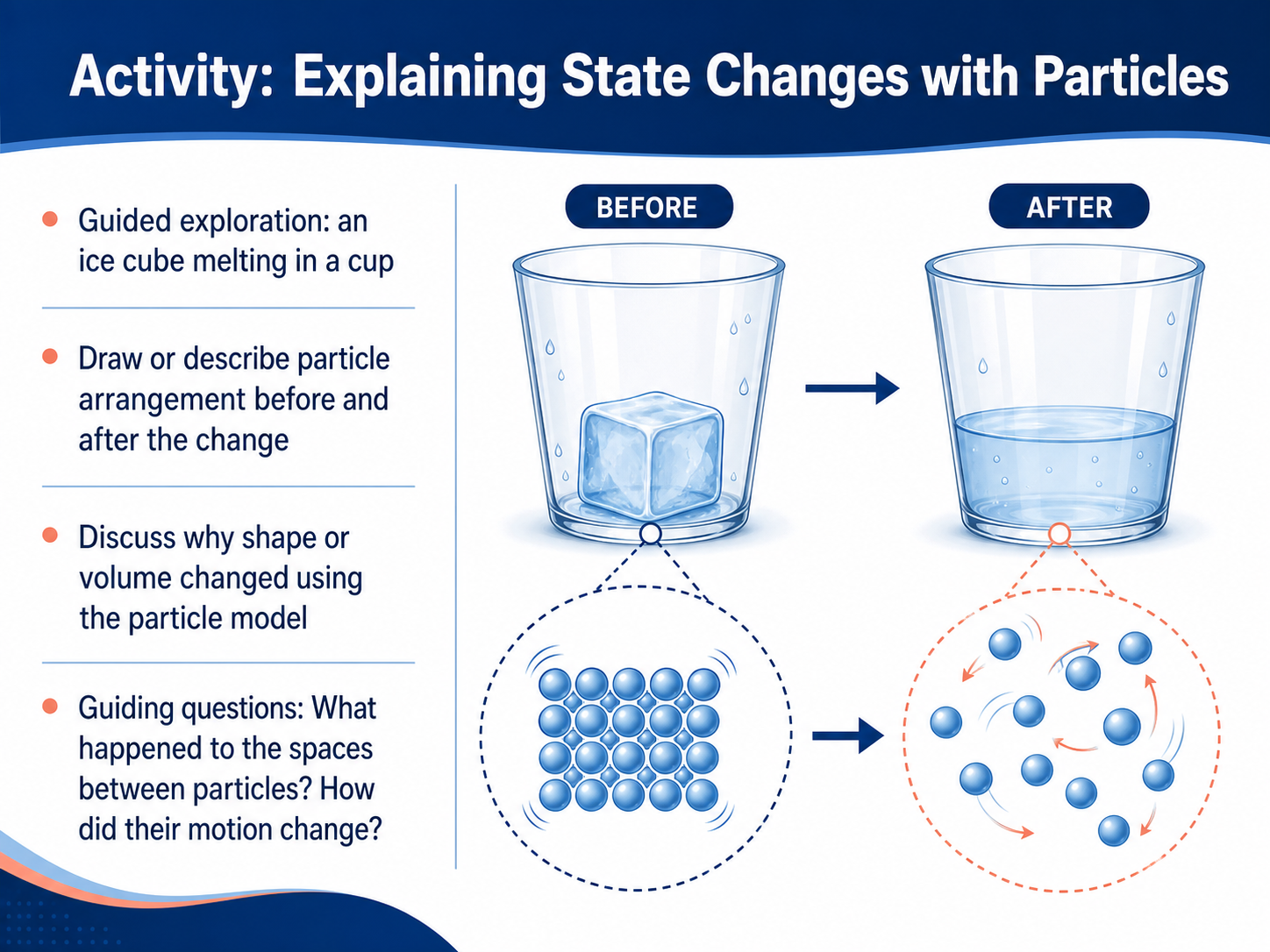
1 min - 11Activity: Explaining State Changes with ParticlesNow, let's put the particle model to work. Imagine an ice cube sitting in a cup on a warm day. Your job is to describe what happens to the particles as the solid ice turns into liquid water. Picture the ice cube at the start: the particles are packed tightly together in a neat pattern, mostly just wiggling in place. They hold their shape, which is why the cube looks solid and keeps its own space. Now draw or describe what happens as it melts. When heat flows in, the particles start to vibrate more and more. They shake free from those fixed positions and begin to slide past each other. The tight arrangement loosens, and the spaces between them grow just a little. That is why the water takes the shape of the cup and settles into a level surface. The volume stays almost the same, but the shape changes completely. As you think about this, ask yourself: what happened to the spaces between the particles? How did their motion change? Notice how faster movement and slightly bigger gaps let the particles flow while still staying close together. That is the power of the particle model. Next, we will wrap everything up in our summary and key takeaways.
 2 min
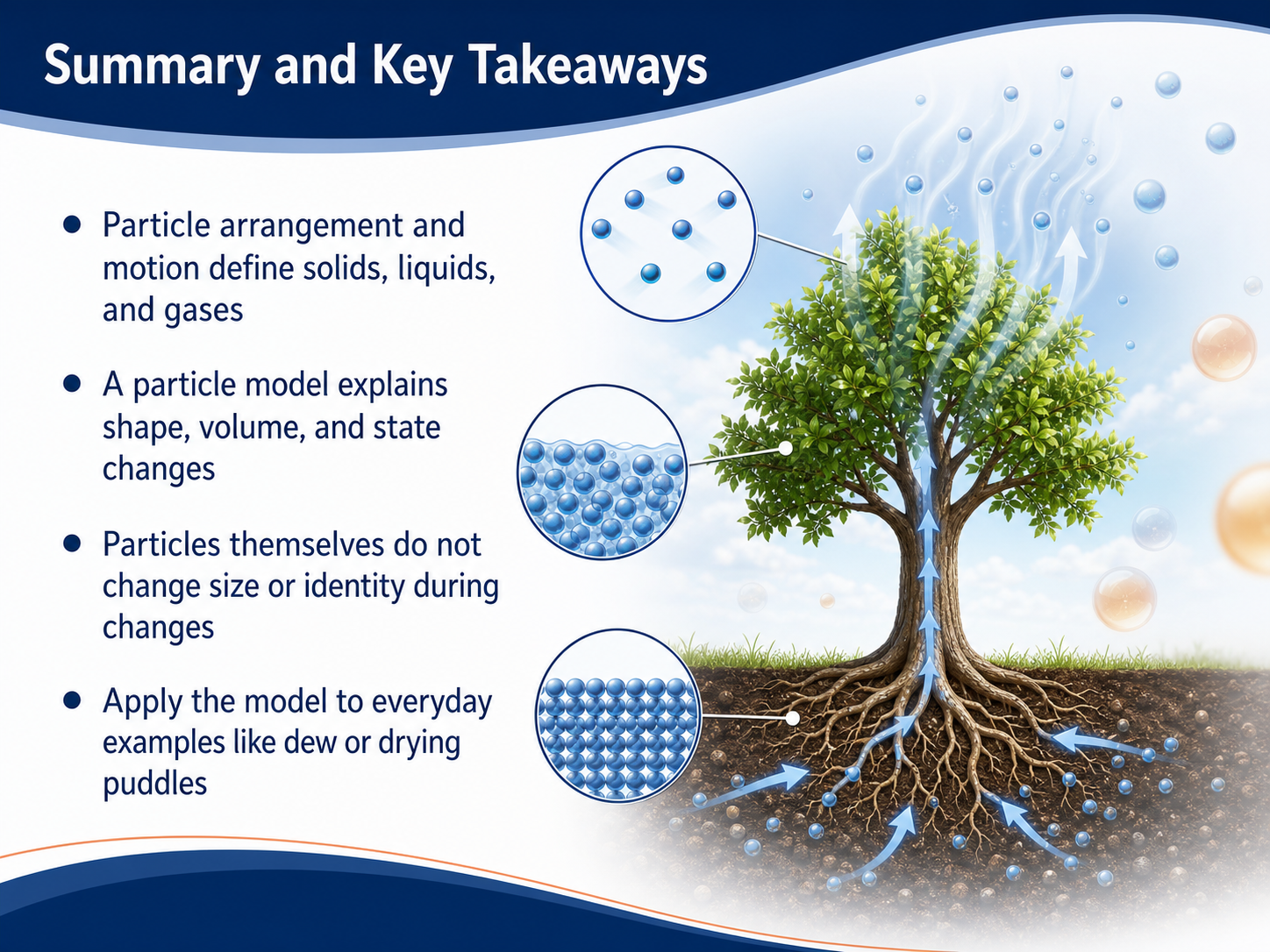
2 min - 12Summary and Key TakeawaysWe've reached the end of our journey, and I'm so glad you came along. Let's take a moment to look back at the big ideas we've built together. First, particle arrangement and motion are what truly define whether something is a solid, a liquid, or a gas. Think of our dancer analogy: locked in a grid, slipping past each other, or zipping freely around the room. That simple particle model is your key to explaining why things hold their shape, pour, or spread out to fill a balloon. It also unlocks the mystery of state changes like melting or boiling. Here's a crucial point to remember: during those changes, the particles themselves don't change size or identity. They just move differently. So, when you see morning dew on grass or a puddle drying up on a sunny day, you now have a powerful way to picture what's happening at a tiny scale. Thank you for your curiosity and hard work today. Keep looking at the world with those particle eyes, and you'll see amazing science everywhere. You've done a wonderful job.
 2 min
2 min
Take the deck with you
Download this course as a file — free, no sign-up needed.
- PDF handoutEvery slide page, ready to print or share.13 pages · 3.3 MBDownload
- Narrated PowerPointThe deck that presents itself — every slide carries the digital human's narration video.13 pages · 11.4 MBDownload
- PowerPoint slidesThe full deck as a .pptx — open it in PowerPoint, Keynote, or Google Slides.13 pages · 3.2 MBDownload
Free to use in your own training — please keep the PersonWise credit page at the end.
Have your own deck? Turn it into a course
Sources consulted
Web sources consulted while building this course.
- Seventh Grade Students’ Qualitative Understanding of the Concept of Mass Influenced By Real Experiments and Virtual Experiments — doi.org
- Misconceptions - MOSART — waps.cfa.harvard.edu
- Students’ ideas about the particulate nature of matter | Beyond appearances | Misconceptions | RSC Education — edu.rsc.org
- Misconceptions among Middle School Students Regarding the Conservation of Mass during Combustion - Eurasia Journal of Mathematics, Science and Technology Education — ejmste.com
- Students’ Ideas About Changes in Mass Associated With Melting — files.eric.ed.gov
- Children's conceptions of the changes of state of water — doi.org
- Common Student Ideas about Matter, Molecules, and the Water Cycle — cpp.edu
- Students' ideas about changes of state — edu.rsc.org
- Common Misconceptions About States and Changes of Matter and the Water Cycle - Beyond Penguins and Polar BearsWater, Ice, and Snow — Beyond Penguins and Polar Bears — beyondpenguins.ehe.osu.edu
- An investigation of tertiary students' understanding of evaporation, condensation and vapour pressure — doi.org