Begin
14 pages · ~28 min
Molecular Shape and Polarity
Explore how molecular geometry determines polarity, including VSEPR theory and bond dipoles. Ideal for chemistry students seeking to predict molecular properties.
A digital instructor presents all 14 pages. Hold “Ask” at any point and ask out loud — the answer comes from this course. No sign-up needed.
What you’ll learn
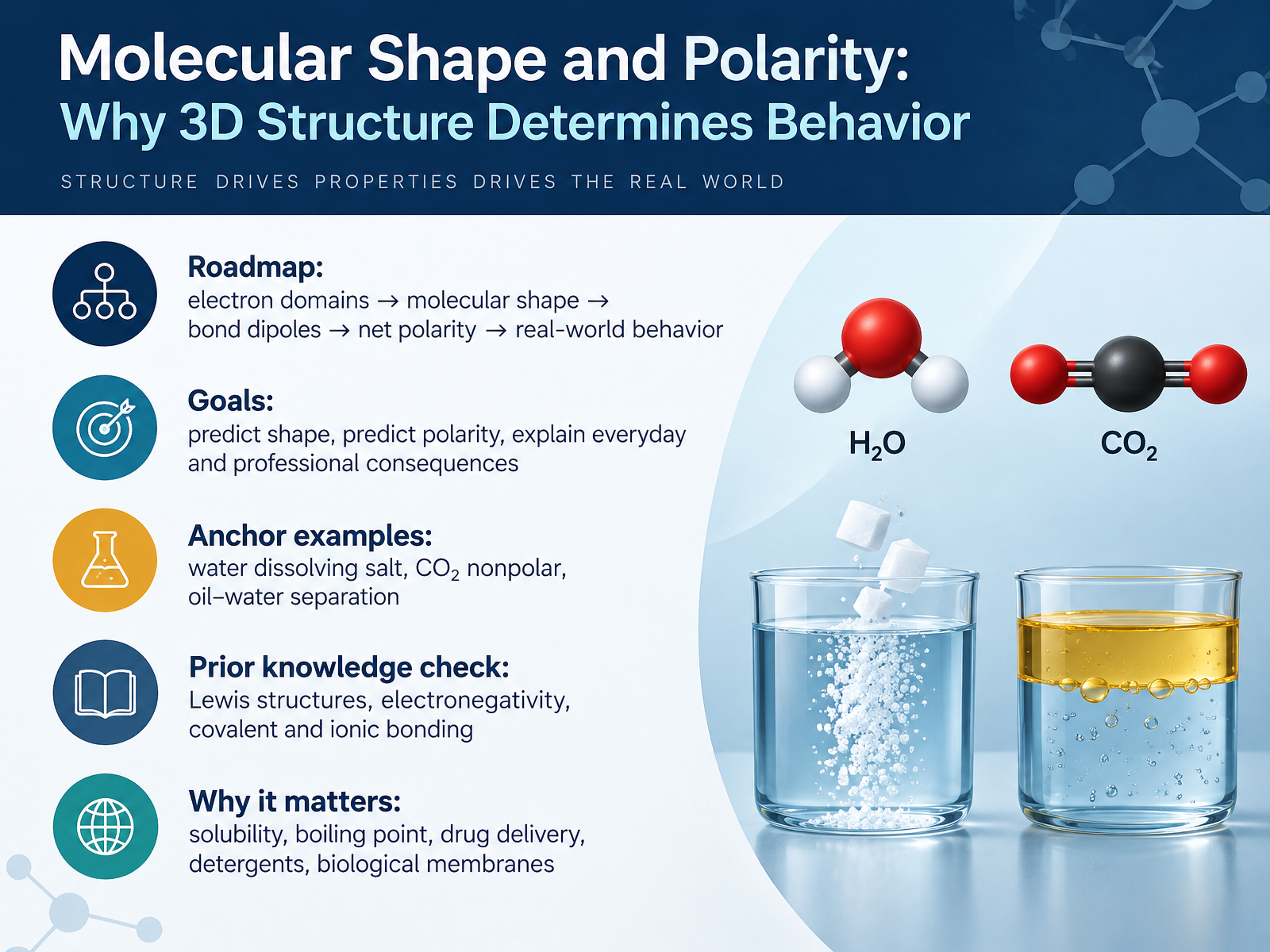
- 01Molecular Shape and Polarity: Why 3D Structure Determines BehaviorWelcome. I'm glad you're here, because today's topic quietly runs the world around you. It's molecular shape and polarity, and here's our big question. Why does the three-dimensional structure of a molecule determine how it behaves? Think about water dissolving salt, carbon dioxide staying nonpolar even though its bonds are polar, and oil refusing to mix with water. Same universe, same atoms, very different outcomes. Over this course, we'll follow one roadmap. First, electron domains. Then, molecular shape. Then, bond dipoles, and finally the net dipole, which tells us whether a molecule is polar overall. From there, we connect polarity to real behavior, like solubility, boiling point, drug delivery, detergents, and biological membranes. Our goals are practical. You'll predict shapes, predict polarity, and explain everyday and professional consequences with confidence. Before we start, quickly check your prior knowledge. You should be comfortable with Lewis structures, electronegativity, and covalent versus ionic bonding. If any of those feel shaky, that's completely fine. Just keep them nearby. So, if you can see 3D structure, you can predict polarity, and once you can predict polarity, you can explain behavior. Let's begin with the foundation of shape. Electron domains and the VSEPR model.pharmaexcipients.comnature.compubs.acs.org+22 min
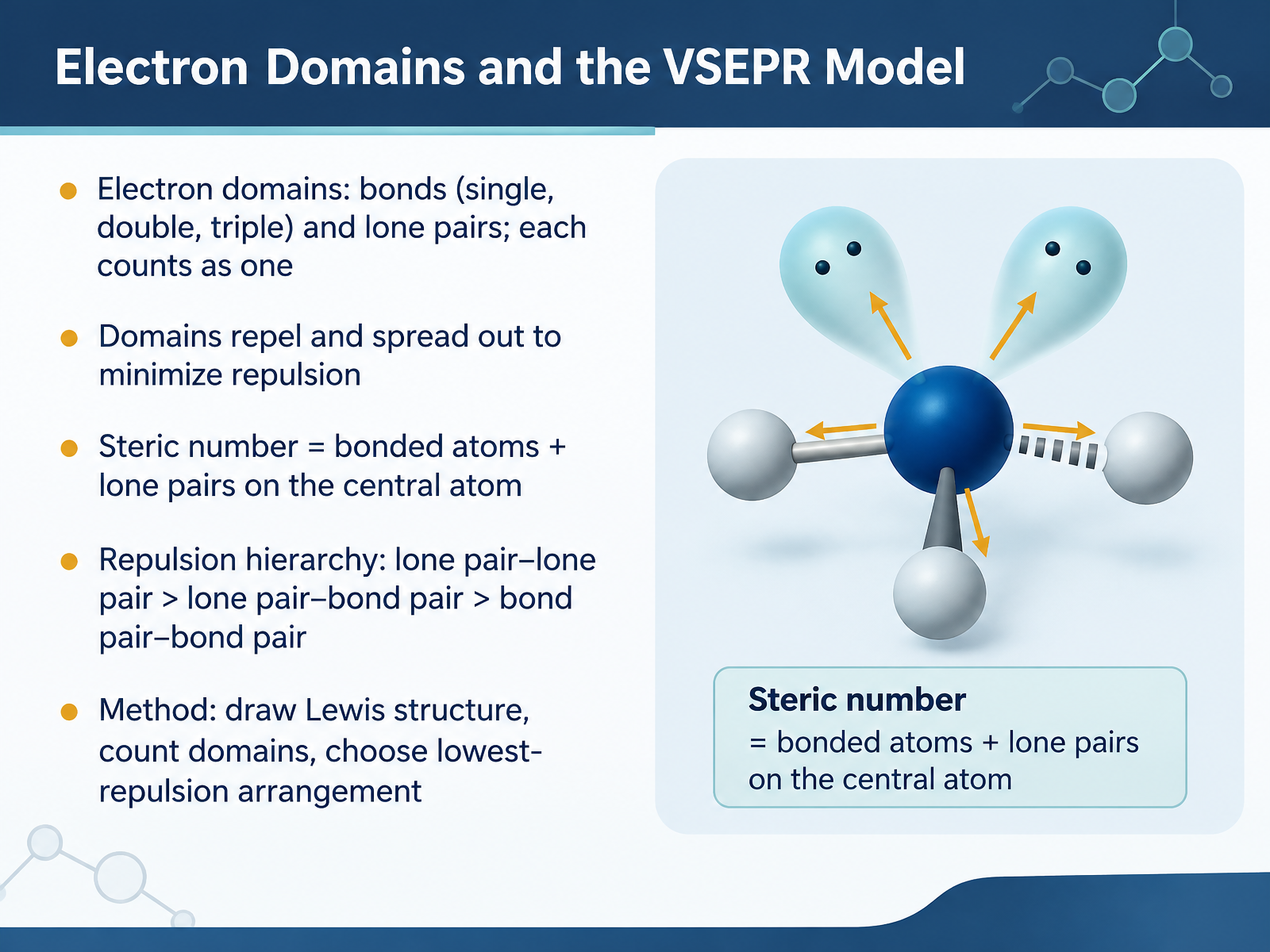
- 02Electron Domains and the VSEPR ModelNow let's build the model that turns a Lewis structure into a three-dimensional shape: V S E P R, valence shell electron pair repulsion. Around a central atom, we count electron domains. A domain is any region of electron density: a single bond, a double bond, a triple bond, or a lone pair. Each one counts as just one domain, because the electrons in a multiple bond all point in the same direction. Now here is the core idea. Electron domains repel each other. So they spread out and arrange themselves as far apart as possible to minimize that repulsion. The number of domains is called the steric number. Simply put, steric number equals bonded atoms plus lone pairs on the central atom. When domains compete for space, the repulsion hierarchy matters. Lone pair to lone pair repulsion is strongest. Lone pair to bond pair comes next. Bond pair to bond pair is weakest. So lone pairs squeeze bond angles a little tighter. Practically, the method is this. Draw the Lewis structure, count the domains around the central atom, then choose the arrangement that gives the lowest repulsion. Next, we'll name those arrangements and their ideal angles.
 chem.libretexts.orgchem.libretexts.orgmoldraw.com+22 min
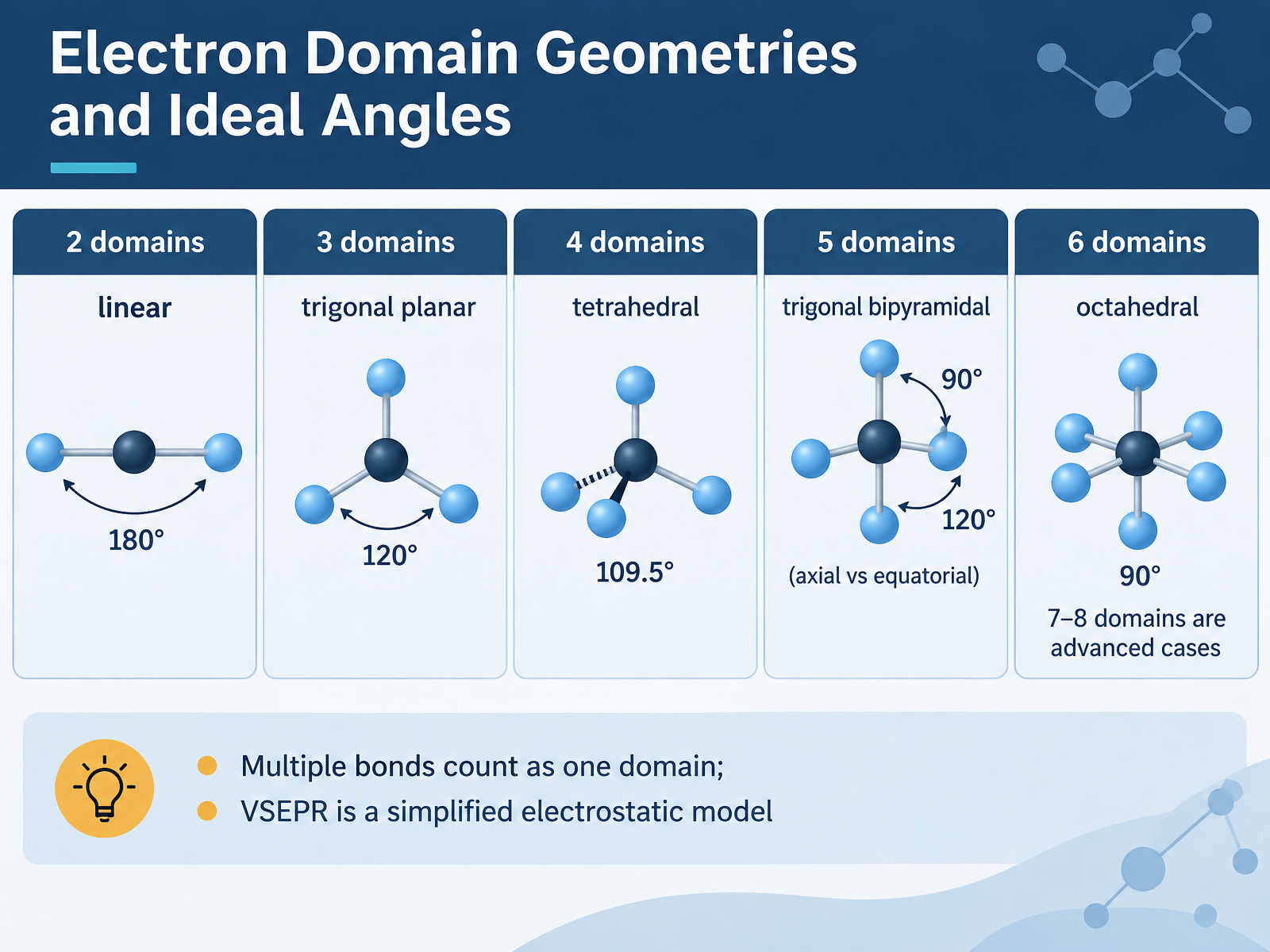
- 03Electron Domain Geometries and Ideal AnglesNow let's build the core reference table for electron domain geometry, the arrangement of all the electron groups around a central atom. The number of domains sets the geometry and the ideal angles. Two domains give you a linear geometry, with an angle of one hundred eighty degrees. Three domains give a trigonal planar geometry, with one hundred twenty degree angles. Four domains point to the corners of a tetrahedron, at one hundred nine point five degrees. Five domains form a trigonal bipyramidal geometry. Here you get two different angles, ninety degrees between axial and equatorial positions, and one hundred twenty degrees between adjacent equatorial positions. Before we move on, picture that trigonal bipyramid for a moment. Notice that the two axial positions have three neighbors at ninety degrees each, while the three equatorial positions have two neighbors at one hundred twenty degrees. That extra room is why lone pairs prefer equatorial spots, which we will see later. Six domains give an octahedral geometry, with all angles at ninety degrees. Seven and eight domains exist as advanced cases like pentagonal bipyramidal and square antiprismatic, but we will focus on two through six. Two quick ground rules. First, a double or triple bond still counts as one domain, because those electrons occupy the same region of space. So carbon dioxide, with two double bonds, is linear, not bent. Second, keep in mind that VSEPR is a simplified electrostatic model. It treats electron pairs as clouds that repel and spread out, and it predicts most main group molecules very well, though it does not capture every subtlety of orbital interactions. Think of it as a reliable first map of molecular shape. From electron domain geometry to molecular geometry.
 chem.libretexts.orgchem.libretexts.orgmoldraw.com+22 min
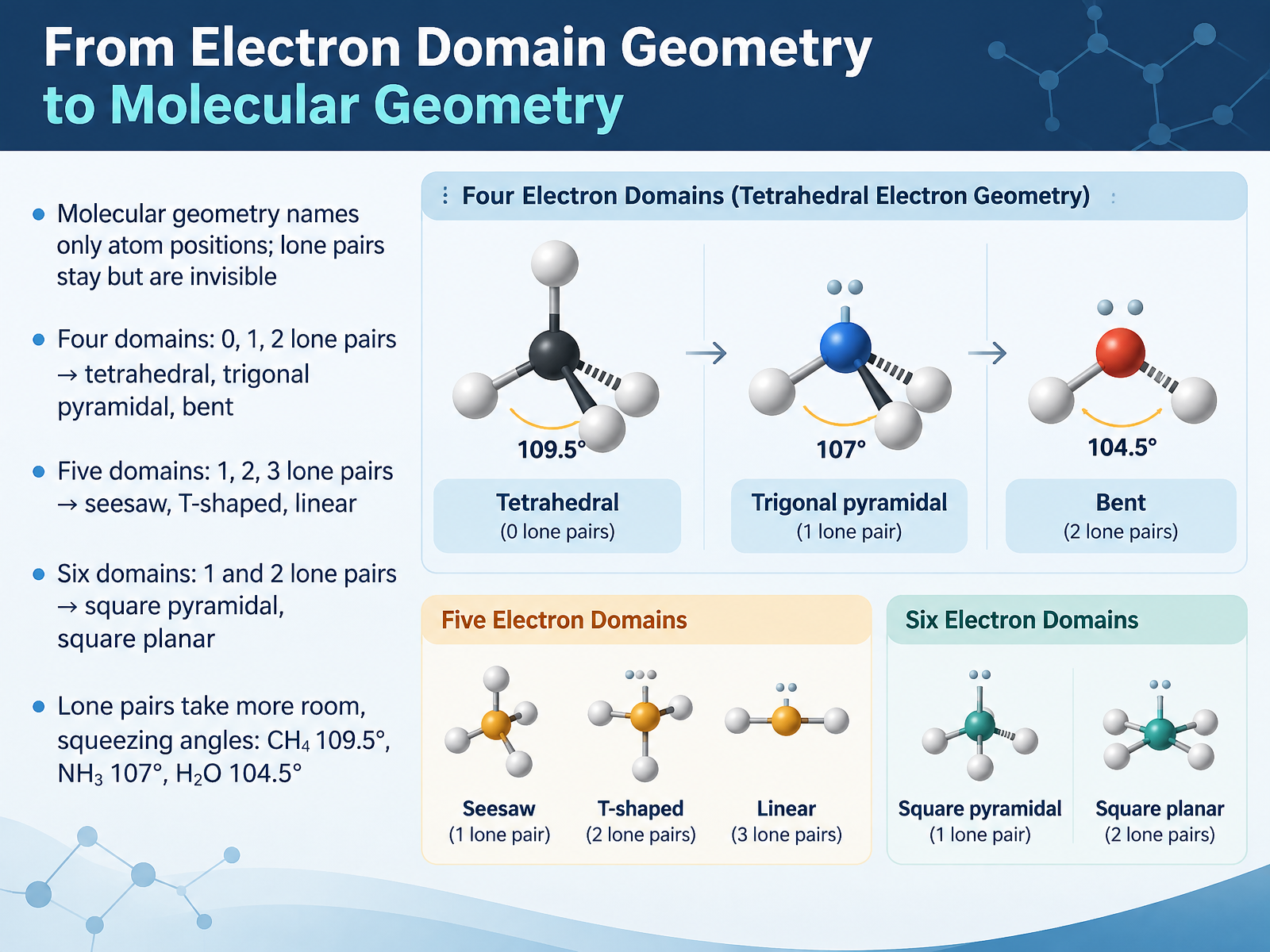
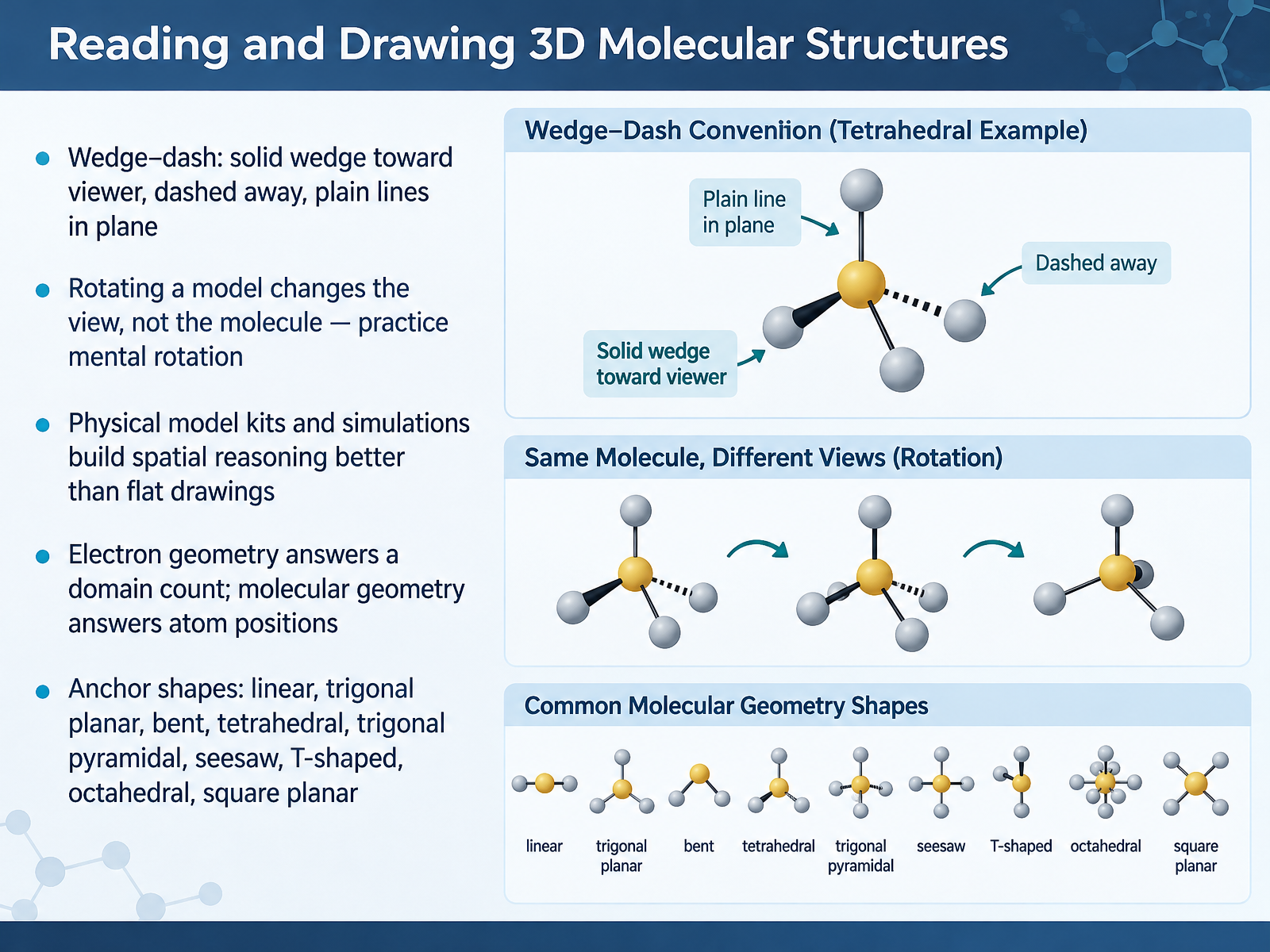
- 04From Electron Domain Geometry to Molecular GeometryLet's build on electron domain geometry and see how it becomes molecular geometry. Here is the key idea. Electron geometry counts every domain, including lone pairs. Molecular geometry names only the positions of the atoms. Lone pairs are still there, and they still push, but they are invisible in the name. Take four domains. Zero lone pairs gives tetrahedral, like methane. One lone pair gives trigonal pyramidal, like ammonia. Two lone pairs gives bent, like water. Now five domains. One lone pair is seesaw, two is T shaped, and three is linear. Six domains work the same way. One lone pair gives square pyramidal, two gives square planar. Why do the angles change? Lone pairs take up more room than bonding pairs, so they squeeze the bonds closer together. Methane sits at one hundred nine point five degrees, ammonia drops to about one hundred seven, and water drops further to about one hundred four point five. That is the pattern to keep in mind. Next, we will look at how to actually read and draw these shapes in three dimensions, so let's move on to reading and drawing three D molecular structures.
 chem.libretexts.orgchem.libretexts.orgmoldraw.com+22 min
- 05Reading and Drawing 3D Molecular StructuresNow let's talk about how we actually read and draw three-dimensional molecular structures. Start with wedge and dash notation. A solid wedge points toward you, a dashed line points away from you, and a plain line stays in the plane of the page. Before I show you an answer, pause and picture it. If you rotate a model, the view changes, but the molecule itself does not. That is why we practice mental rotation. Physical model kits and simulations build that spatial reasoning far better than flat drawings alone. Here is the key distinction. Electron geometry answers a domain count. Molecular geometry answers where the atoms actually sit. So when you count domains, you are not yet naming the molecular shape. Keep these anchor shapes in mind: linear, trigonal planar, bent, tetrahedral, trigonal pyramidal, seesaw, T-shaped, octahedral, and square planar. Next, we connect this to electronegativity and bond polarity.
 pubs.acs.orgpubs.acs.orgteachchemistry.org+22 min
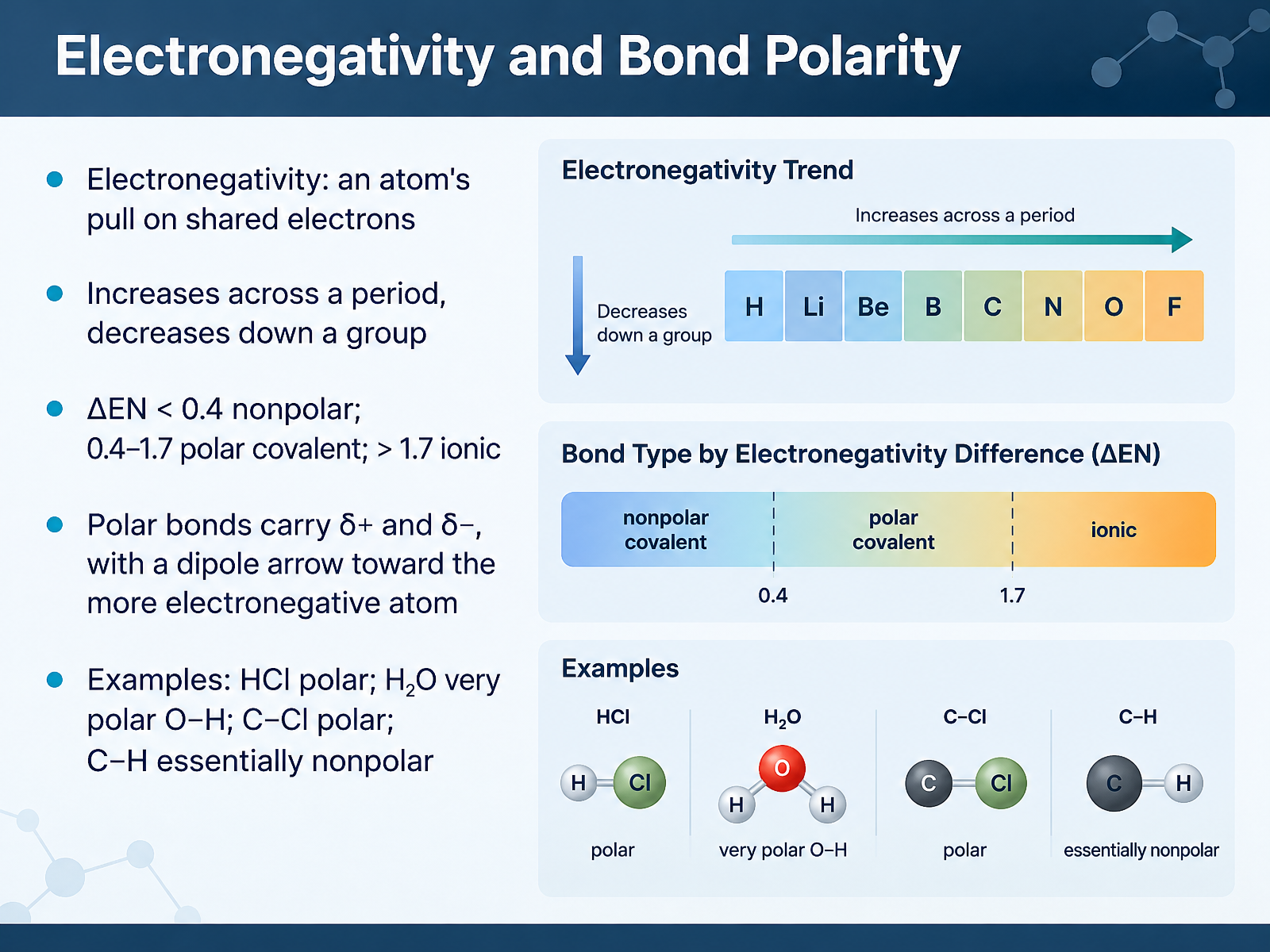
- 06Electronegativity and Bond PolarityNow let's look at what actually creates a polar bond in the first place: electronegativity. Electronegativity is simply an atom's pull on the shared electrons in a bond. That pull follows a pattern on the periodic table. It increases as you move across a period, left to right, and it decreases as you go down a group. Now here's a useful shortcut. We compare the two atoms using the difference in electronegativity, written as delta E N. If that difference is less than zero point four, the bond is essentially nonpolar. Between zero point four and one point seven, it's polar covalent. And above one point seven, we treat it as ionic. So in a polar bond, the shared electrons sit closer to the more electronegative atom. That side becomes partially negative, written delta minus, while the other side becomes partially positive, written delta plus. We show this with a dipole arrow pointing toward the more electronegative atom. Try to picture it before I say it: in hydrogen chloride, chlorine wins the tug of war, so the arrow points to chlorine. In water's oxygen hydrogen bond, oxygen pulls hard, so that bond is very polar. In a carbon chlorine bond, chlorine still pulls harder, so it's polar. But in a carbon hydrogen bond, the pull is nearly even, so we treat it as essentially nonpolar. Quick takeaway: bond polarity comes down to two things, the electronegativity difference and the direction it points. Next, we'll take those bond dipoles and ask what happens when we add them all up in three dimensions, in Molecular Polarity and Net Dipole Moments.
 pubs.acs.orgpubs.acs.orgteachchemistry.org+22 min
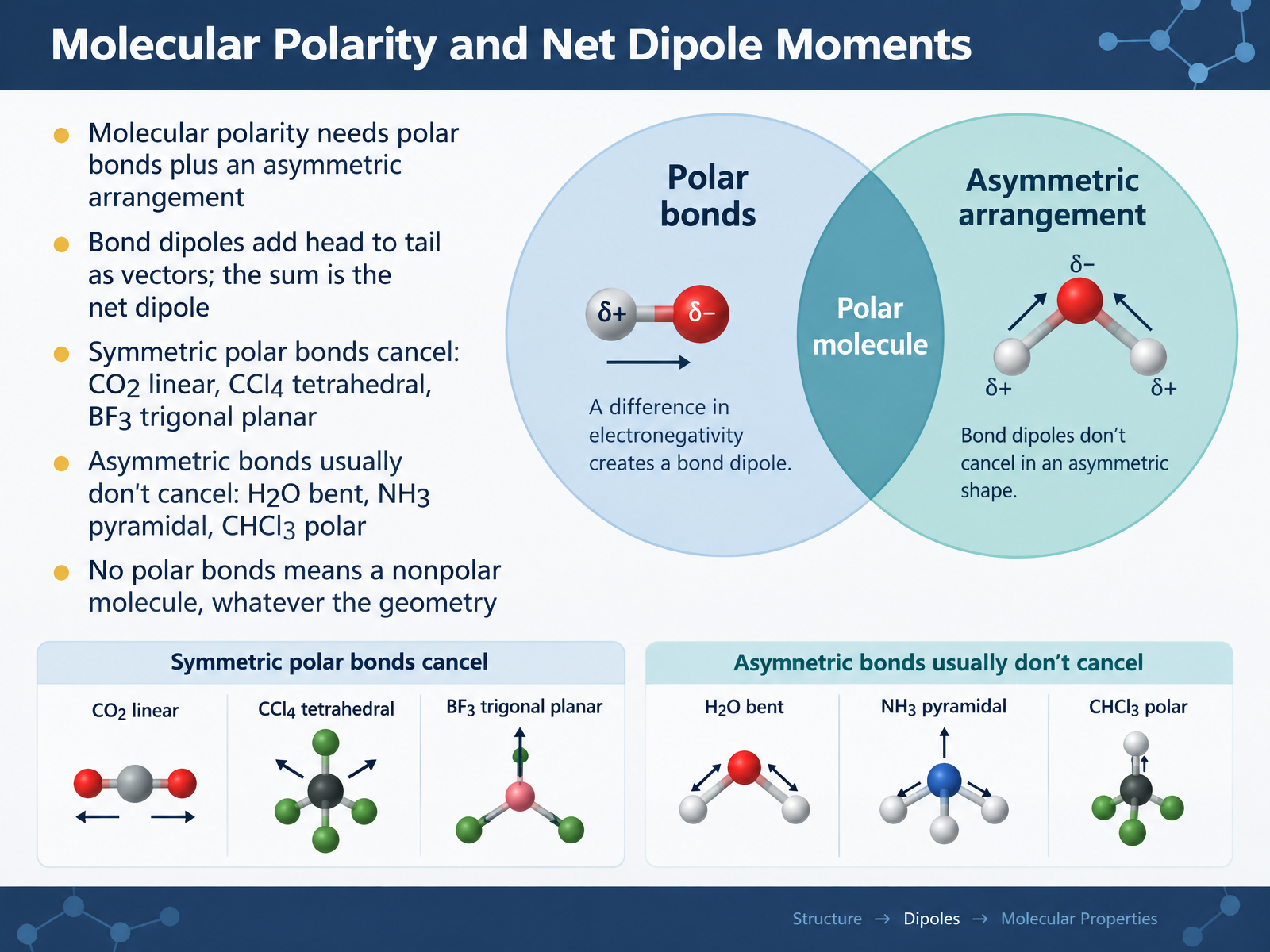
- 07Molecular Polarity and Net Dipole MomentsNow, let's bring the pieces together and talk about molecular polarity. Here's the key idea. Molecular polarity requires two things: polar bonds, plus an asymmetric arrangement of those bonds. Think of each polar bond as a little vector, a bond dipole. Bond dipole. We add these head to tail, and the sum is the net dipole. Net dipole. If that sum is zero, the molecule is nonpolar. Let's test that. Picture carbon dioxide. It's linear, with two polar carbon oxygen bonds pointing in opposite directions. They cancel, so the net dipole is zero, and carbon dioxide is nonpolar. The same logic applies to carbon tetrachloride, which is tetrahedral, and boron trifluoride, which is trigonal planar. Symmetry lets those polar bonds cancel out. Now try the opposite case. Water is bent, ammonia is pyramidal, and chloroform has three different groups. In each one, the bond dipoles point in directions that don't cancel, so the net dipole survives. And one last check. If a molecule has no polar bonds, it is nonpolar no matter what its geometry is. So remember, polar bonds alone aren't enough. You also need the wrong shape for cancellation. Up next, we'll look at symmetry, lone pairs, and some harder cases.
 pubs.acs.orgpubs.acs.orgteachchemistry.org+22 min
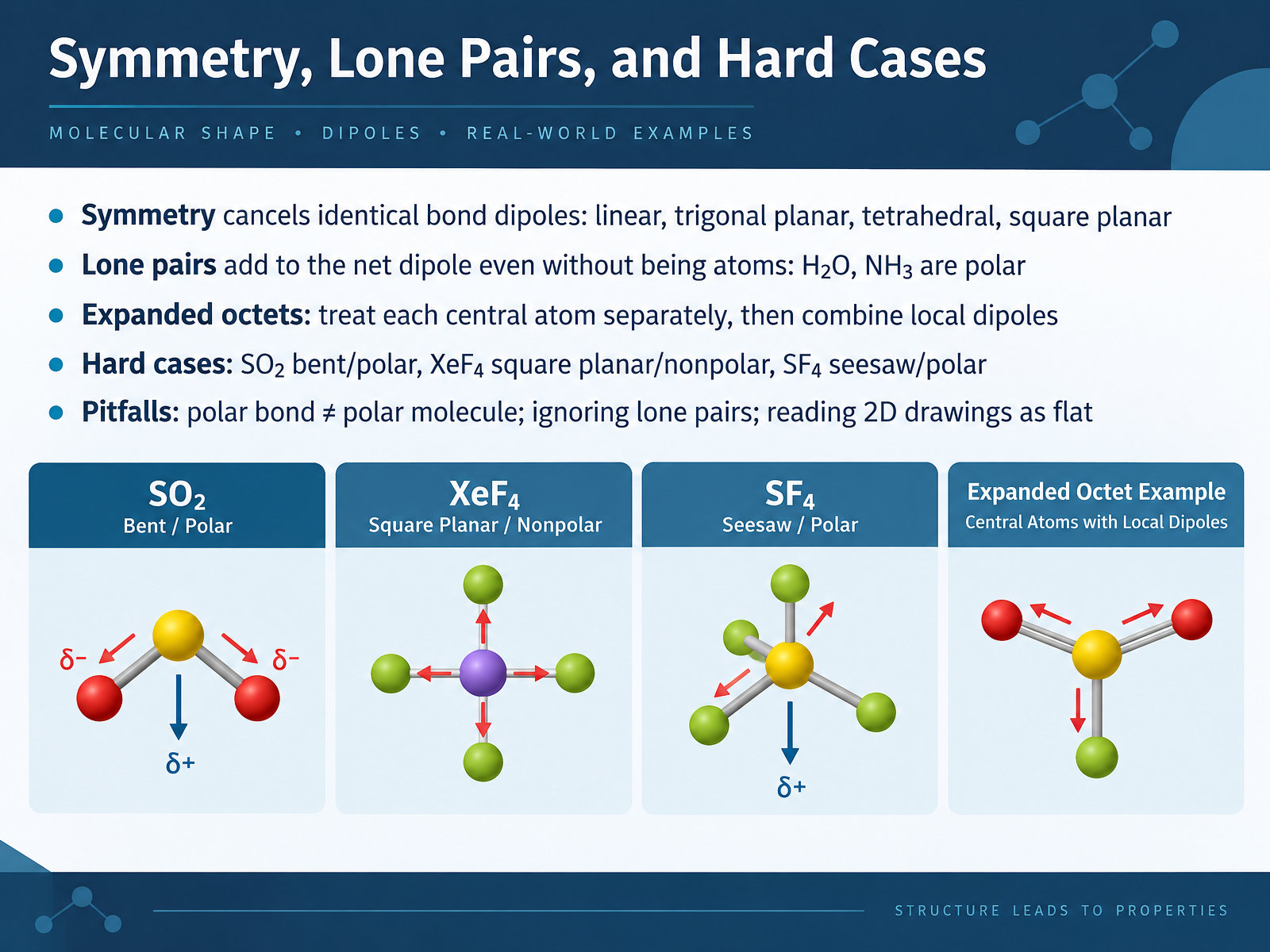
- 08Symmetry, Lone Pairs, and Hard CasesNow let's pull together the harder cases, where geometry and polarity get interesting. Start with symmetry. Identical bond dipoles arranged symmetrically cancel each other out. In a linear, trigonal planar, tetrahedral, or square planar shape, the pulls point in opposite or balanced directions, so the net dipole is zero and the molecule is nonpolar. But lone pairs change the picture. A lone pair is a region of electron density, so it adds to the net dipole even though it is not an atom. That is why water, with two lone pairs, and ammonia, with one, are both polar. For molecules with expanded octets, treat each central atom separately, then combine the local dipoles. Let's test three hard cases. Sulfur dioxide is bent, so its bond dipoles add rather than cancel, making it polar. Xenon tetrafluoride is square planar and symmetric, so it is nonpolar despite polar bonds. Sulfur tetrafluoride is seesaw shaped, and that asymmetry makes it polar. And watch for three common pitfalls: a polar bond does not automatically mean a polar molecule, never ignore lone pairs, and remember that two dimensional drawings are not flat in real space. Next, let's walk through the decision flowchart: polar or nonpolar?
 pubs.acs.orgpubs.acs.orgteachchemistry.org+22 min
- 09Decision Flowchart: Polar or Nonpolar?Now let's pull everything together with a decision flowchart you can reuse for any molecule. Think of it as five steps that take you from a formula to a verdict. Step one, draw the correct Lewis structure. This gives you the connectivity and all the lone pairs, so it is the foundation for everything else. Step two, count the electron domains around the central atom and name the geometry. For example, four domains gives you a tetrahedral arrangement. Step three, check bond polarity using electronegativity differences. A large difference means a polar bond, which we call a bond dipole. Step four, look for symmetry. If identical polar bonds point in opposite directions, their dipoles cancel. But if lone pairs or different atoms break that symmetry, the dipoles reinforce each other. Step five, state your verdict and sketch the net dipole arrow. The arrow points toward the more electronegative side, and if no arrow is needed, the molecule is nonpolar. So run the five steps in order, and the geometry will tell you whether the bond dipoles cancel or add up. That same dipole story explains why molecules stick together the way they do, which brings us to intermolecular forces and physical properties.
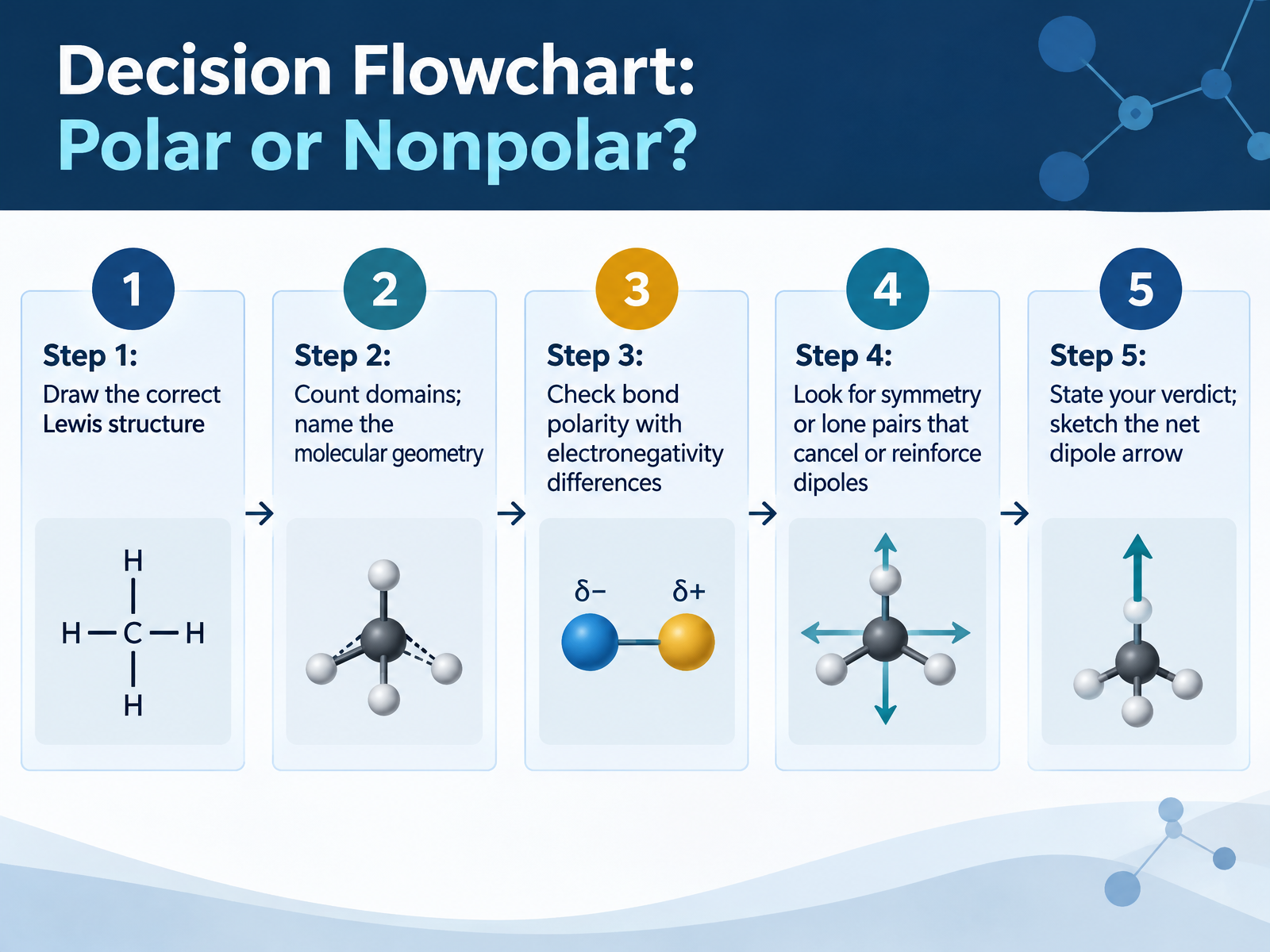 pubs.acs.orgpubs.acs.orgteachchemistry.org+22 min
- 10Intermolecular Forces and Physical PropertiesNow let's connect molecular shape and polarity to something you can actually observe: physical properties. Intermolecular forces follow a clear hierarchy: hydrogen bonding is strongest, then dipole-dipole, then London dispersion. Stronger forces mean higher melting and boiling points, and lower vapor pressure. Why? Because more energy is needed to pull the molecules apart. Hydrogen bonding requires hydrogen attached to nitrogen, oxygen, or fluorine. That's why water, ammonia, and hydrogen fluoride boil much higher than expected for their size. Now here's a quick prediction. Two molecules have the same formula, C five H twelve. One is a straight chain, one is branched. Which boils higher? The straight chain, because it has more surface area for dispersion forces. Branching lowers boiling point. Shape also matters for melting, since tight packing raises melting point. Coming up next: Like Dissolves Like: Solubility in Action.
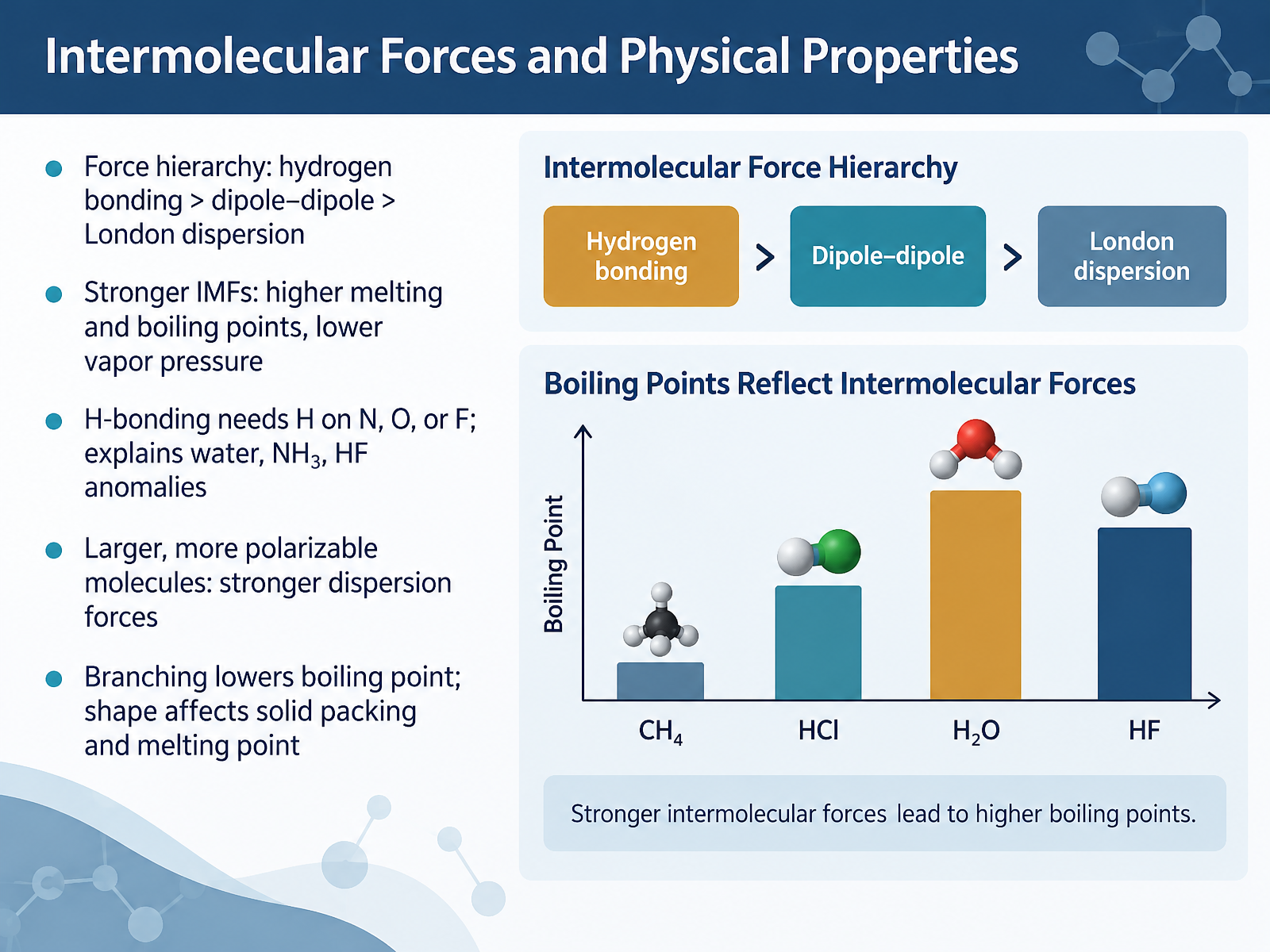 chem.libretexts.orgchem.libretexts.orgchem.libretexts.org+22 min
- 11Like Dissolves Like: Solubility in ActionNow let's see polarity in action through a simple rule you can use right away: like dissolves like. A polar solute dissolves in a polar solvent, and a nonpolar solute dissolves in a nonpolar solvent. Think of sugar in water compared with oil in water. Water is polar and forms hydrogen bonds, so it welcomes polar partners, while oil is nonpolar and simply will not mix in. The alcohol series shows this nicely. Small alcohols like methanol and ethanol mix with water because their hydroxyl group hydrogen bonds with water. But as the carbon tail grows, past butanol, the nonpolar part takes over, and the alcohol separates into its own layer. Now consider sodium chloride. Water's ion dipole interactions pull the ions apart and stabilize them, but hexane has no dipole to do that, so salt stays put. Here is a fascinating exception. Carbon dioxide is nonpolar, yet it dissolves in water because it reacts to form carbonic acid, a process that helps remove carbon dioxide from the air into our oceans. So remember, like dissolves like is a powerful guide, not a strict law. Everyday examples are all around you: water and oil separate in a glass, ethanol mixes with water but not with hexane, and soap removes grease because one end grabs water and the other grabs oil. Next, we'll explore applications in biology, medicine, and materials.
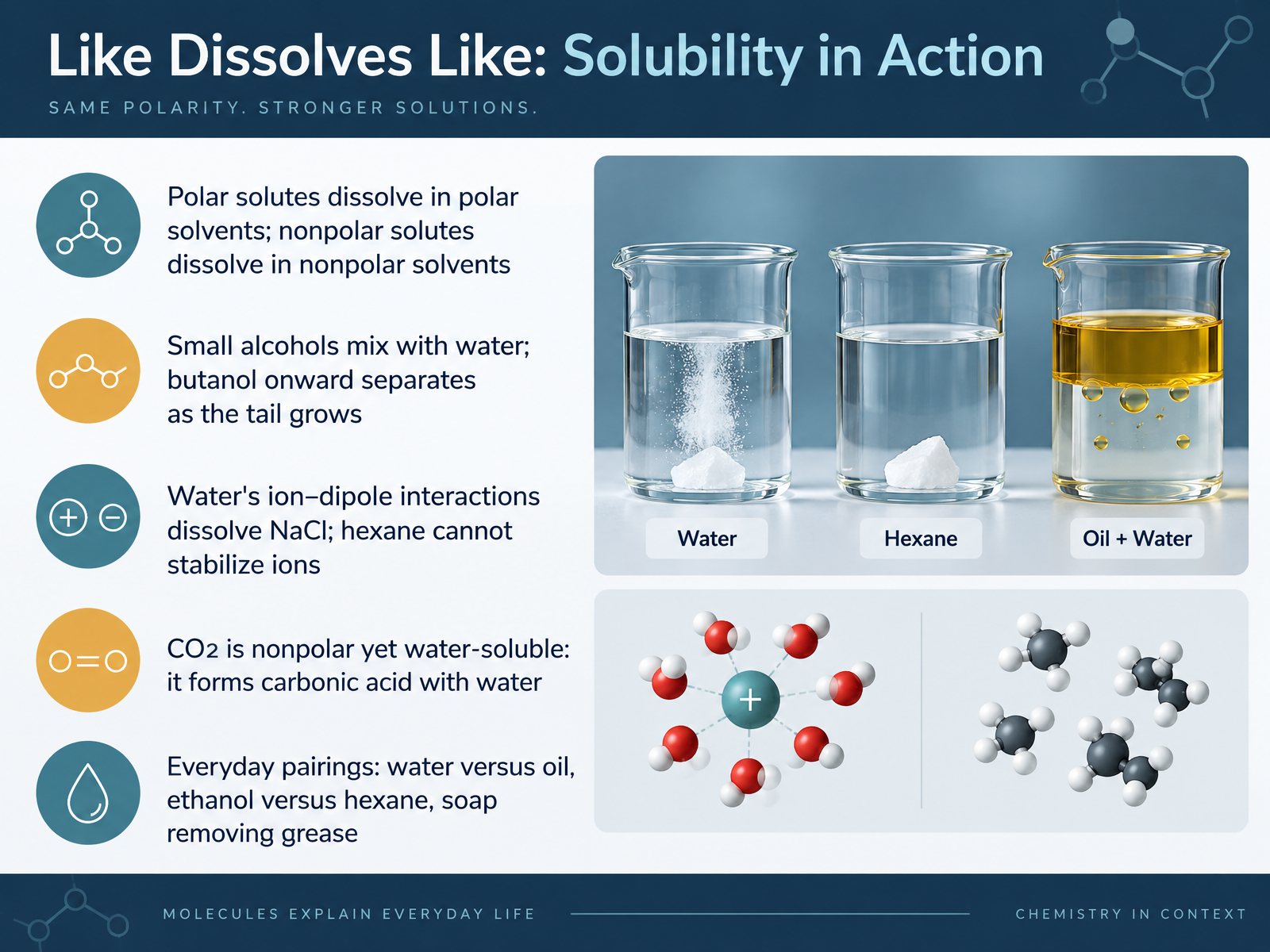 chem.libretexts.orgchem.libretexts.orgchem.libretexts.org+22 min
- 12Applications in Biology, Medicine, and MaterialsNow let's see polarity at work in biology, medicine, and materials. In DNA, hydrogen bonding holds base pairs together, and the same force drives protein folding. Water, a polar molecule, is life's solvent. In drug design, lipophilicity, measured as log P, governs membrane permeability and delivery route. A hydrophilic drug with low log P stays in the aqueous domains, while a lipophilic drug partitions into oil. API polarity also decides where a drug sits in a nanoemulsion and how well it permeates skin. Molecular chameleons and polarity-switching prodrugs make polarity tunable, hiding polar groups to cross membranes, then revealing them inside the target. Finally, surfactants pair a polar head with a nonpolar tail, and chromatography separates molecules by polarity. So remember, polarity is not just a label. It steers biology, drug delivery, and everyday materials. Next, we'll look at teaching strategies, demonstrations, and misconceptions.
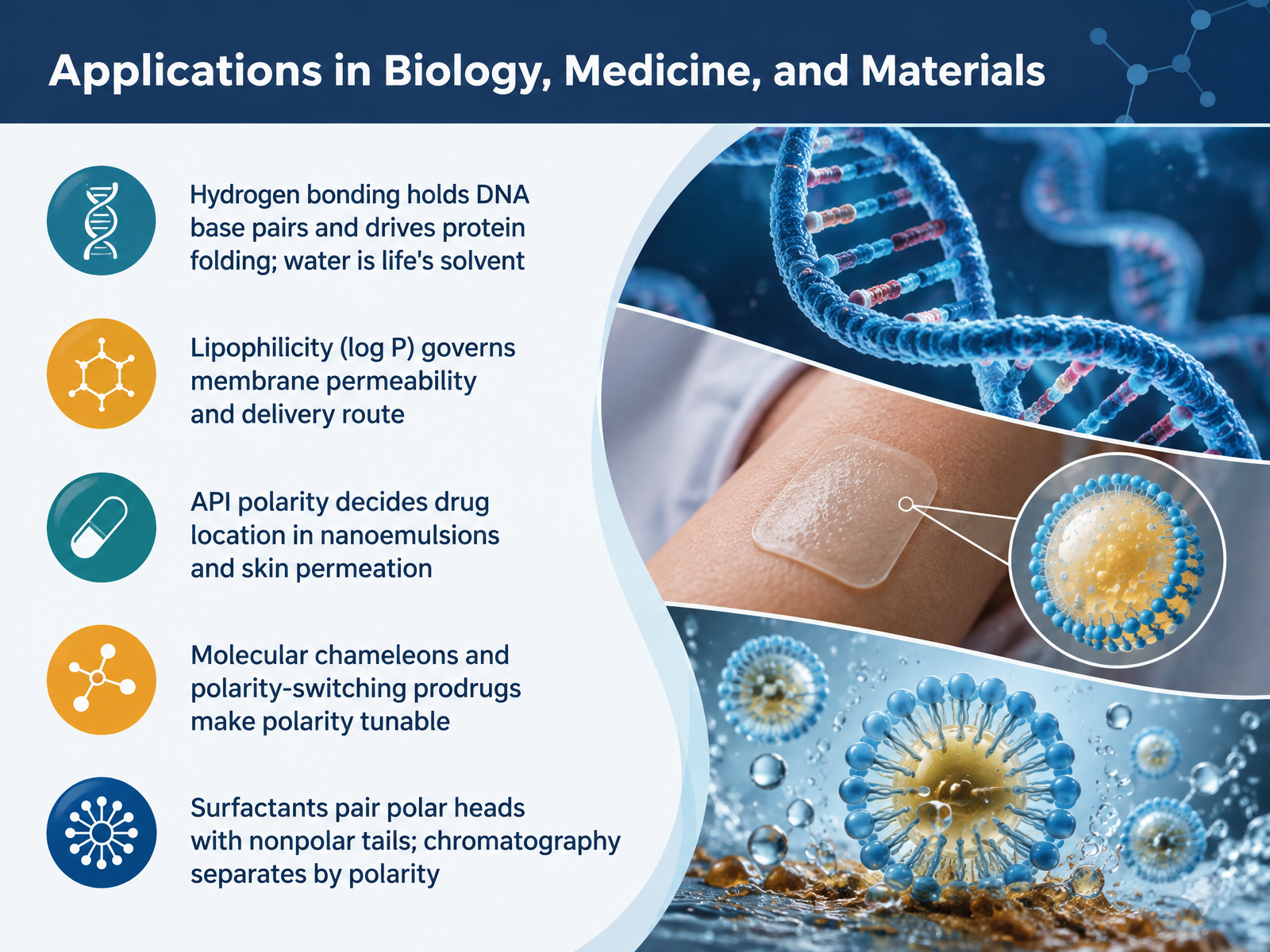 pharmaexcipients.comnature.compubs.acs.org+22 min
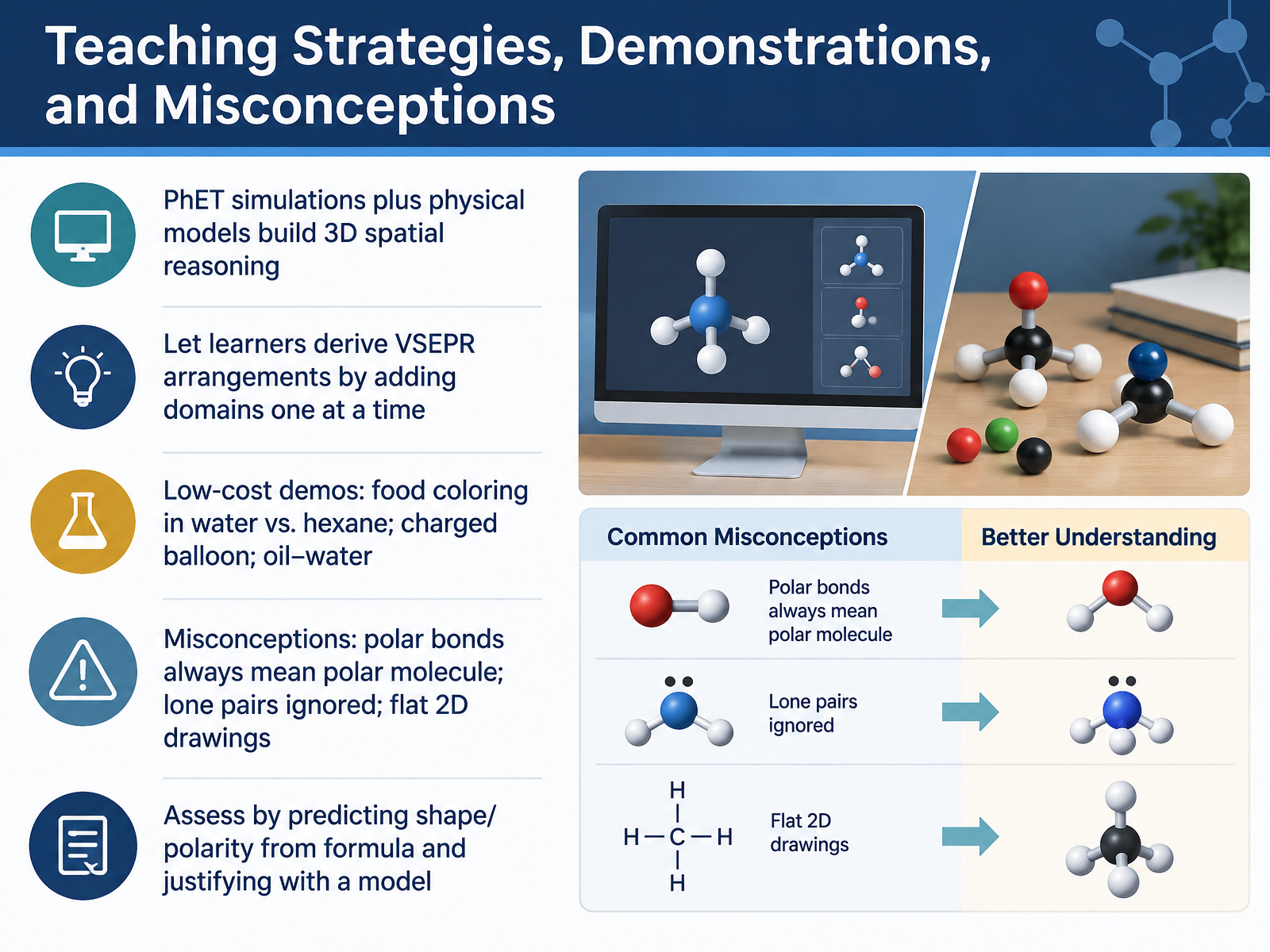
- 13Teaching Strategies, Demonstrations, and MisconceptionsLet's turn to teaching strategies, demonstrations, and misconceptions. First, help learners build three-dimensional thinking. PhET simulations like Molecule Shapes and Molecule Polarity, paired with physical models, let students rotate structures and see geometry, bond dipoles, and the net dipole instead of just reading about them. Second, instead of telling students the VSEPR arrangements, let them derive each one. Start with one electron domain, add a second, then a third, then a fourth, and ask them to predict how the shape shifts each time. They remember what they build. Low-cost demos work well too: food coloring in water versus hexane, a charged balloon bending a water stream, and oil and water separating. Now, the misconceptions to target. Polar bonds do not always mean a polar molecule, because symmetry can cancel the bond dipoles. Lone pairs are often ignored, even though they change both shape and polarity. And flat two-dimensional drawings hide the real geometry. So assess by giving a formula, asking students to predict shape and polarity, and requiring them to justify the answer with a model. Next, we'll move into guided practice, self-check, and summary.
 pubs.acs.orgpubs.acs.orgteachchemistry.org+22 min
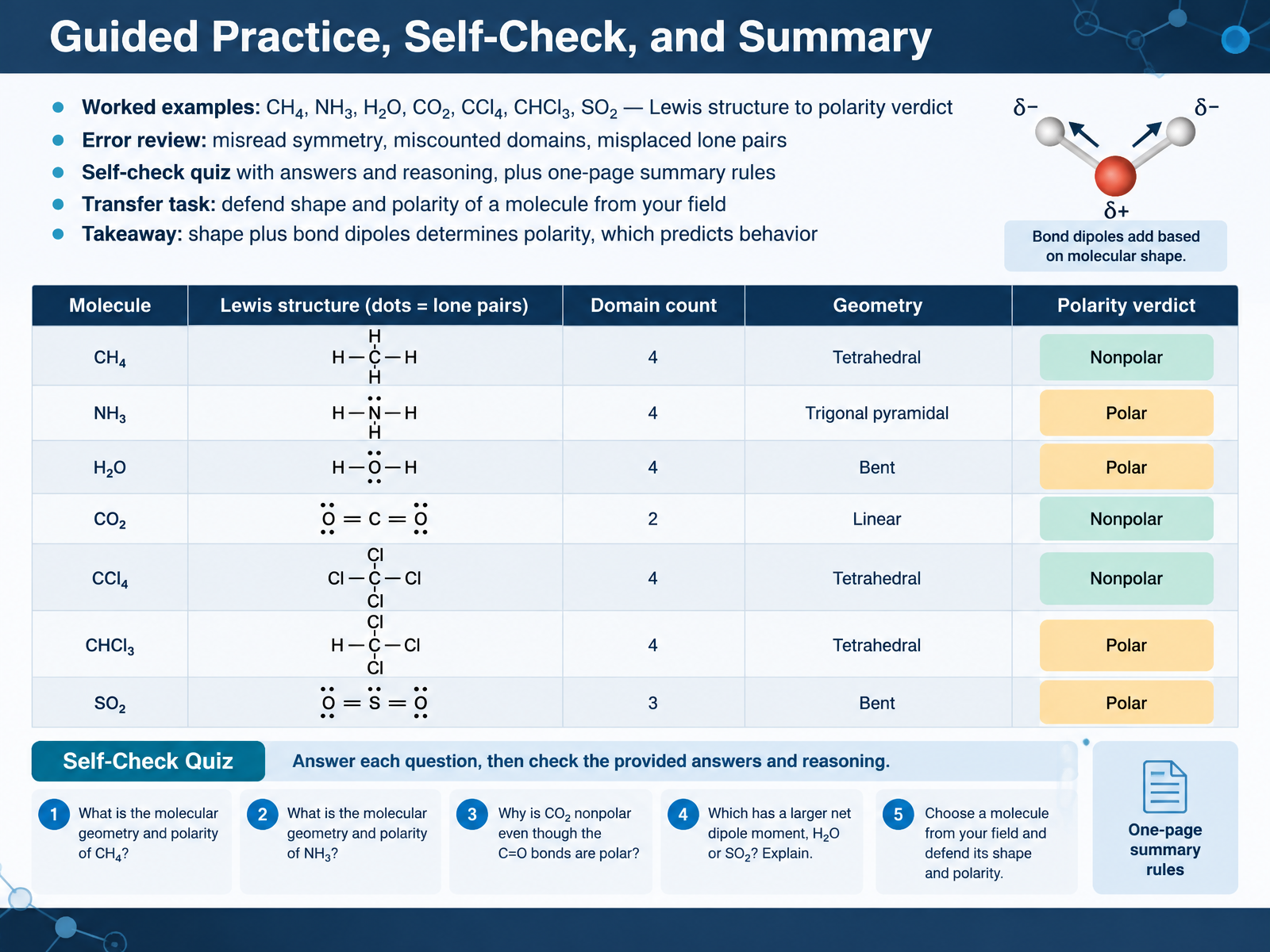
- 14Guided Practice, Self-Check, and SummaryLet's bring everything together. We worked through methane, ammonia, water, carbon dioxide, carbon tetrachloride, chloroform, and sulfur dioxide, going from Lewis structure all the way to a polarity verdict. As you review, watch for three common errors: misreading symmetry, miscounting electron domains, and placing lone pairs incorrectly. So pause here and try the self-check quiz, then compare your reasoning with the answers. Remember the one-page summary rules, and use them on a molecule from your own field. Shape plus bond dipoles determines polarity, and polarity predicts behavior, from boiling point to solubility. Thank you for working through this with me. Keep practicing, and trust your reasoning.
 chem.libretexts.orgchem.libretexts.orgchem.libretexts.org+21 min
Take the deck with you
Download this course as a file — free, no sign-up needed.
- PDF handoutEvery slide page, ready to print or share.15 pages · 3.6 MBDownload
- Narrated PowerPointThe deck that presents itself — every slide carries the digital human's narration video.15 pages · 15.3 MBDownload
- PowerPoint slidesThe full deck as a .pptx — open it in PowerPoint, Keynote, or Google Slides.15 pages · 3.4 MBDownload
Free to use in your own training — please keep the PersonWise credit page at the end.
Have your own deck? Turn it into a course
Sources consulted
Web sources consulted while building this course.
- Impact of Drug Hydrophilicity on Transdermal Delivery by Nanoemulsions - Pharma Excipients — pharmaexcipients.com
- Physics-informed design of drug-excipient nanoparticles via free energy calculation and yoked deep learning | npj Computational Materials — nature.com
- Graph-to-Graph Inverse Design of Surfactants under Multiobjective and Structural Constraints | Journal of Chemical Information and Modeling | ACS Publications — pubs.acs.org
- DynlogPA Novel High-Throughput LC−MS Assay Quantifying Dynamic Lipophilicity and Chameleonicity of bRo5 Macrocyclic Peptides | Molecular Pharmaceutics | ACS Publications — pubs.acs.org
- Strategic Charge Manipulation in Contemporary Drug Design — pharmafeatures.com
- 3.2: Valence Shell Electron-Pair Repulsion - Chemistry LibreTexts — chem.libretexts.org
- 9.1: Molecular shapes –Valence shell electron pair repulsion (VSEPR) theory - Chemistry LibreTexts — chem.libretexts.org
- VSEPR Chart & Molecular Geometry Calculator (3D) | MolDraw — moldraw.com
- 6.3: Molecular shapes –Valence shell electron pair repulsion (VSEPR) theory - Chemistry LibreTexts — chem.libretexts.org
- 5.1.1: The Shapes of Molecules (VSEPR Theory) and Orbital Hybridization - Chemistry LibreTexts — chem.libretexts.org
- ABSTRACT: Molecular geometry and molecular polarity are foundational topics in general chemistry, yet students often struggle with three-dimensional — pubs.acs.org
- Difficulties with the Geometry and Polarity of Molecules — pubs.acs.org
- Classroom Resources | Making Connections between Electronegativity, Molecular Shape, and Polarity | AACT — teachchemistry.org
- Introducing Students to Polar and Non-Polar Interactions through Inquiry — exa.ai
- Predicting Polarity of a Molecule - SAS — pdesas.org
- 2.4: Intermolecular Forces and Relative Boiling Points (bp) - Chemistry LibreTexts — chem.libretexts.org
- 4.4 Solubility - Chemistry LibreTexts — chem.libretexts.org
- 5.2: Application of Intermolecular Forces: Melting and Boiling Points - Chemistry LibreTexts — chem.libretexts.org
- Chemistry Tutorial - Solutions - A Model of Solutions - Solubility and Structure — physicsclassroom.com
- 17.3: Properties of Alcohols and Phenols - Chemistry LibreTexts — chem.libretexts.org