Begin
14 pages · ~28 min
Reading Historical Newspapers as Evidence
This training teaches researchers how to analyze historical newspapers as primary evidence, building skills to evaluate bias, context, and reliability in period sources.
A digital instructor presents all 14 pages. Hold “Ask” at any point and ask out loud — the answer comes from this course. No sign-up needed.
What you’ll learn
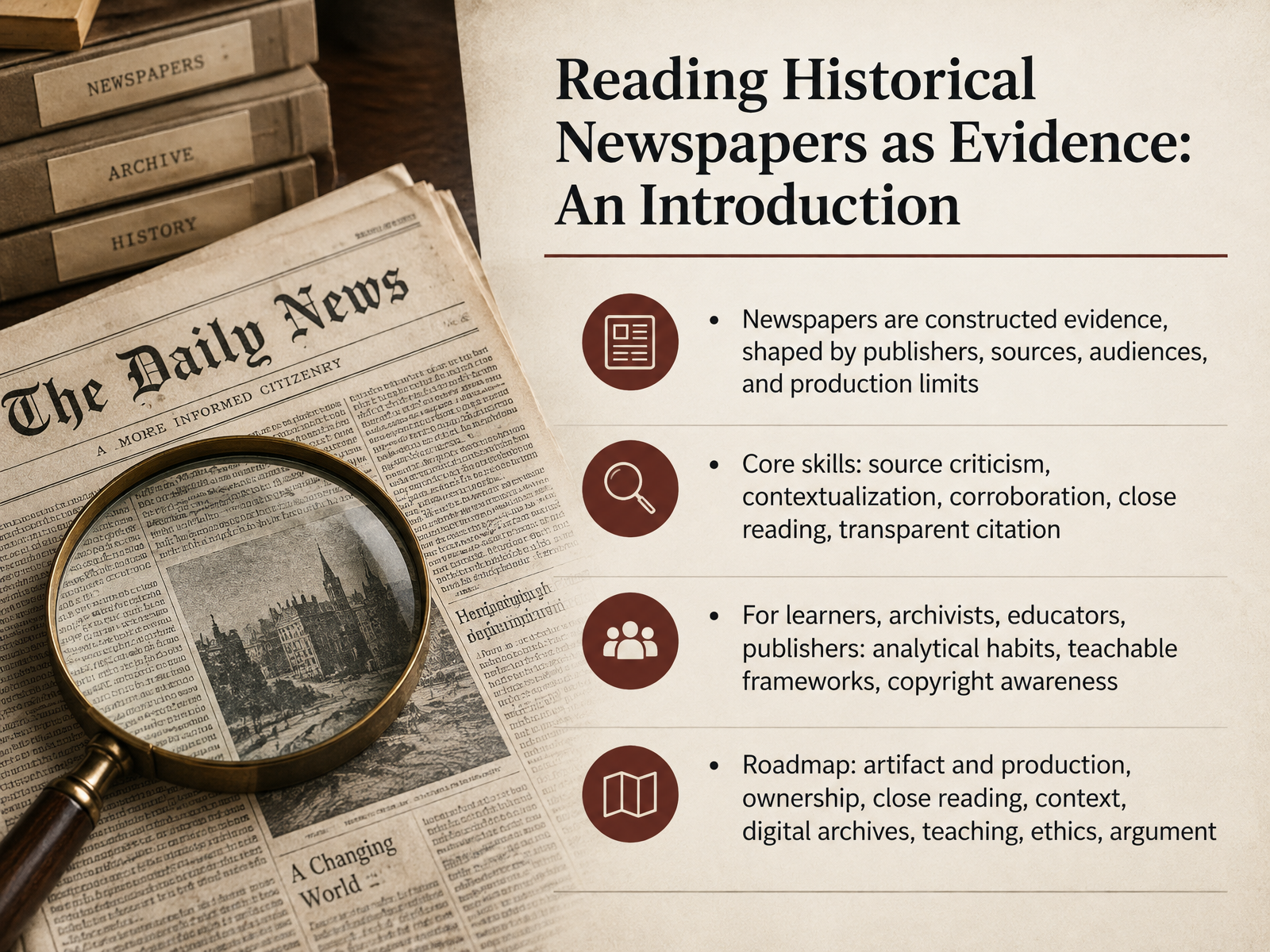
- 01Reading Historical Newspapers as Evidence: An IntroductionWelcome. This course is about reading historical newspapers as evidence, and our goal is a practical one. By the end, you will have a repeatable way to ask what a newspaper page can and cannot tell you. Here is the core idea. Newspapers are constructed evidence. Publishers, sources, audiences, and production limits all shape what appears on the page. So we build five habits: source criticism, contextualization, corroboration, close reading, and transparent citation. These habits serve different listeners. Students and history learners gain a defensible method. Archivists and educators gain a teachable framework. Publishers gain a sharper sense of copyright and editorial responsibility. Our roadmap moves from the artifact and its production, to ownership, close reading, context, digital archives, teaching, ethics, and finally building an argument. Take a moment now to note one newspaper source you plan to examine during this course. Next, we look more closely at the newspaper as a historical artifact.guides.library.illinois.eduwarwick.libguides.comlibguides.uncw.edu+22 min
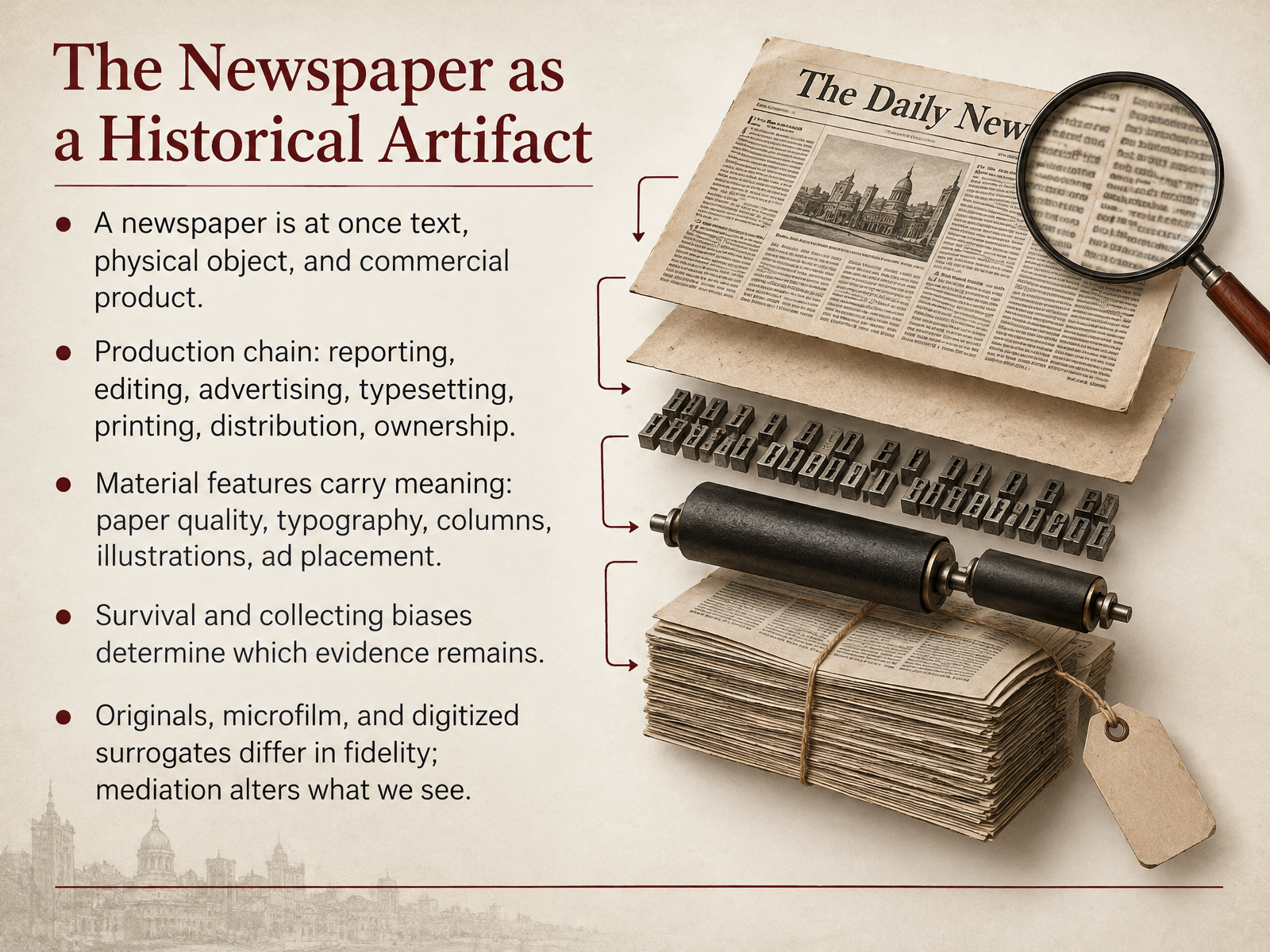
- 02The Newspaper as a Historical ArtifactLet's look at the newspaper itself. A newspaper is at once text, a physical object, and a commercial product. Before you read it as a source, picture the production chain: reporting, editing, advertising, typesetting, printing, distribution, and ownership. Each step leaves traces. Think of material features. Paper quality, typography, columns, illustrations, and ad placement all carry meaning. A short paper or dense type can reflect cost, technology, or audience. Survival also matters. What remains in archives reflects collecting and preservation choices, not just what was published. And the copy in front of you may be an original, microfilm, or a digitized surrogate. Each differs in fidelity, and mediation alters what we see. So when you examine a page, first ask what kind of object you are holding and how it reached you. Now, let's ask who actually made the news. We turn to publishers, editors, sources, and wire services.
 blogs.loc.govprepressure.compages.gseis.ucla.edu+22 min
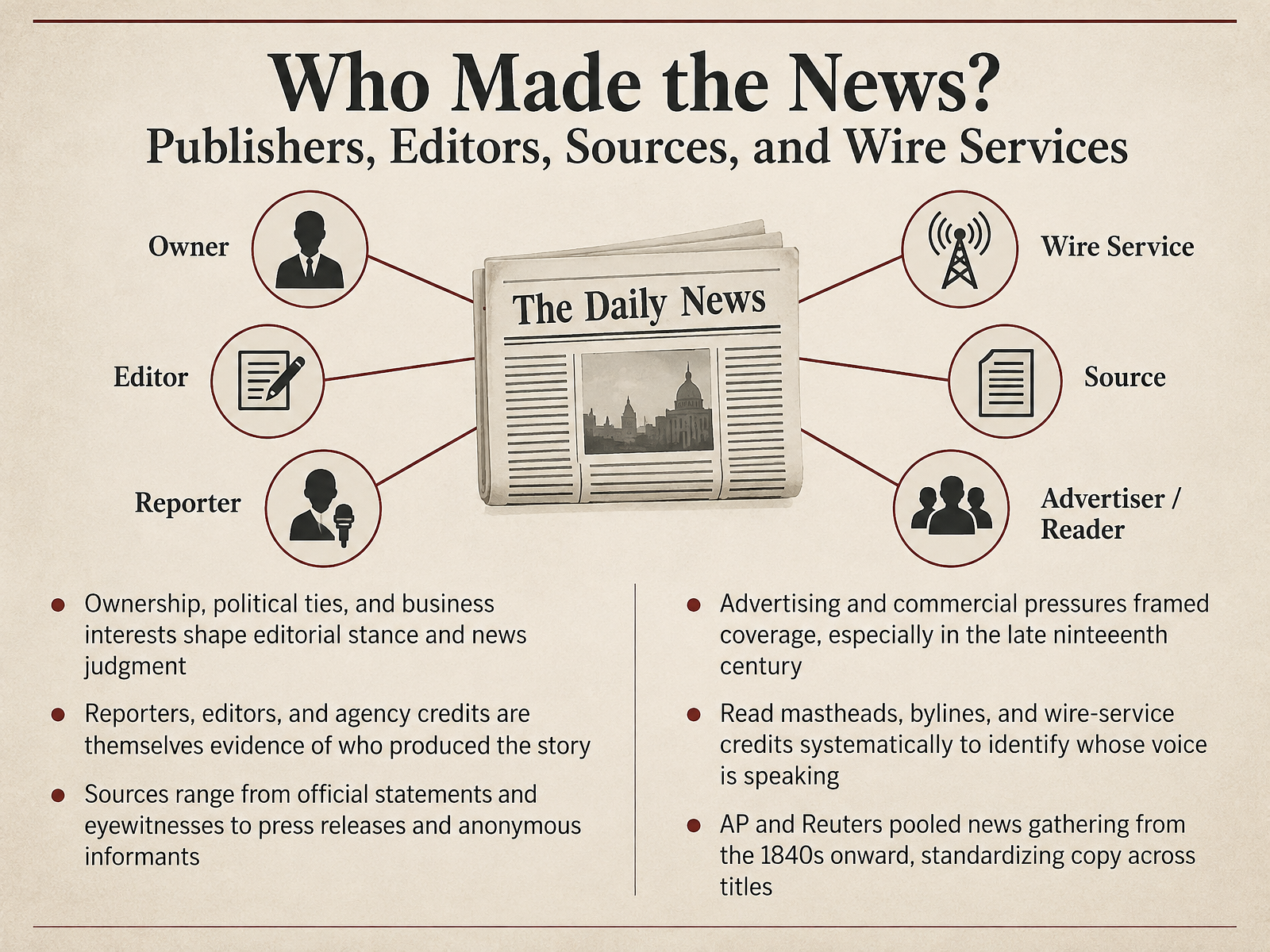
- 03Who Made the News? Publishers, Editors, Sources, and Wire ServicesNext, let's ask a basic question of every newspaper page. Who made this news? Start with ownership. Owners, political ties, and business interests shape editorial stance and news judgment. Then look at the credits. Reporters, editors, and agency lines are themselves evidence of who produced the story. Consider sources too. They range from official statements and eyewitnesses to press releases and anonymous informants. Advertising and commercial pressure framed coverage, especially in the late nineteenth century. So read mastheads, bylines, and wire-service credits systematically, and ask whose voice is speaking. Wire services matter here. The Associated Press and Reuters pooled news gathering from the eighteen forties onward, standardizing copy across many titles. For now, make one habit. On your next page, note the owner, the byline, and any agency credit before you analyze the text. That record will help you read layout, language, and visual rhetoric, which we turn to next.
 web.stanford.educambridge.orgrobswells.com+22 min
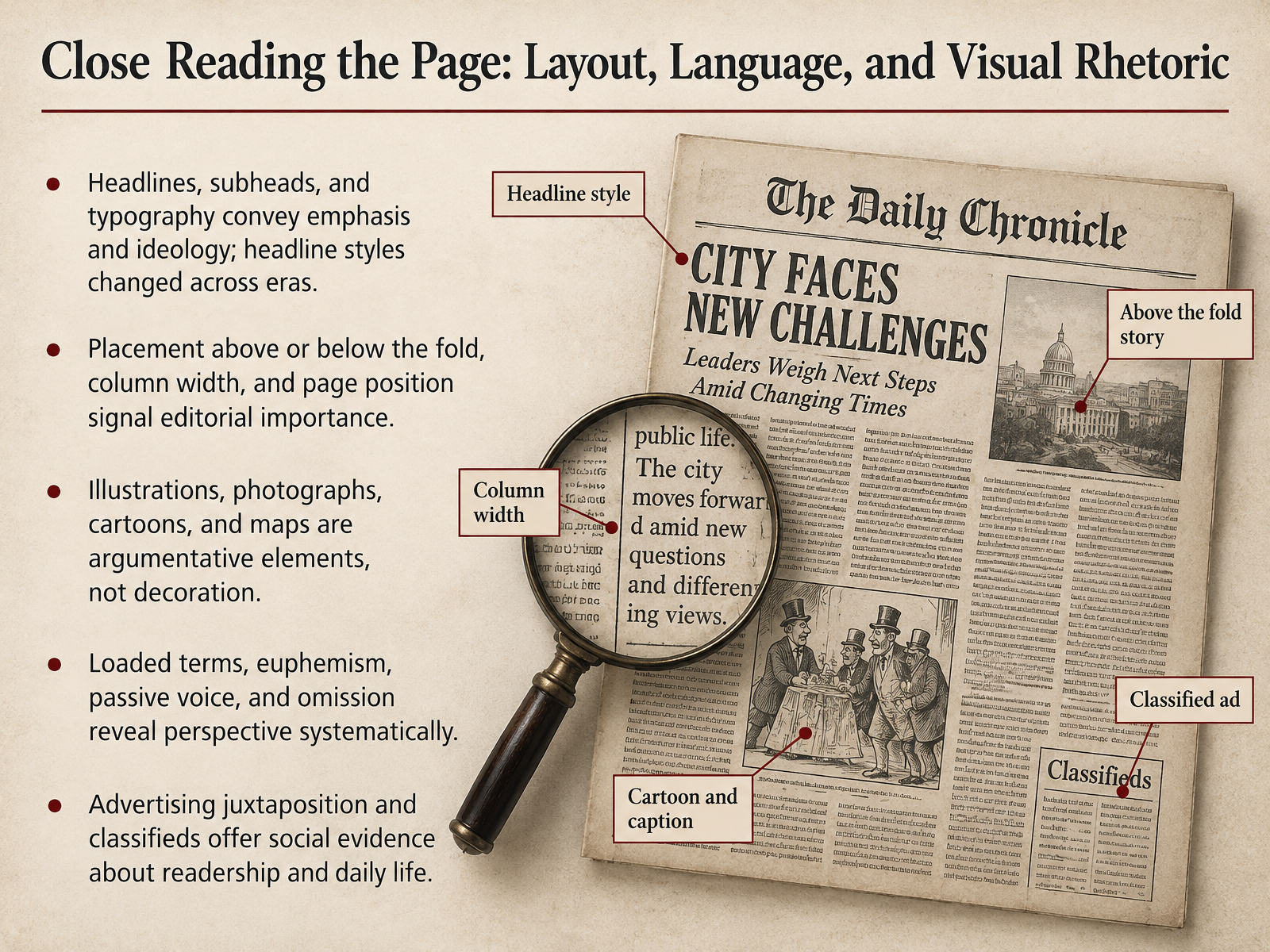
- 04Close Reading the Page: Layout, Language, and Visual RhetoricLet's move from the page as a whole to a close reading of what sits on it. Start with the headline and typography. Their size, weight, and style tell you what editors wanted you to notice, and headline conventions shifted across eras, so compare like with like. Next, look at placement. A story above the fold, given wide columns or a prominent page position, is being signalled as important. Now examine the visuals. Illustrations, photographs, cartoons, and maps are arguments, not decoration. Ask what they show and what they leave out. Then read the language. Loaded terms, euphemism, passive voice, and deliberate omission reveal perspective, and they tend to do so systematically rather than by accident. Finally, notice what sits beside the article. Advertising and classifieds are social evidence about readers and daily life. Your task for this slide is simple: choose one page and annotate these five layers directly on a copy. That prepares us for the next slide, Contextualizing the News: Date, Place, Edition, and Medium.
 journals.uc.eduepub.ub.uni-muenchen.dehdl.handle.net+22 min
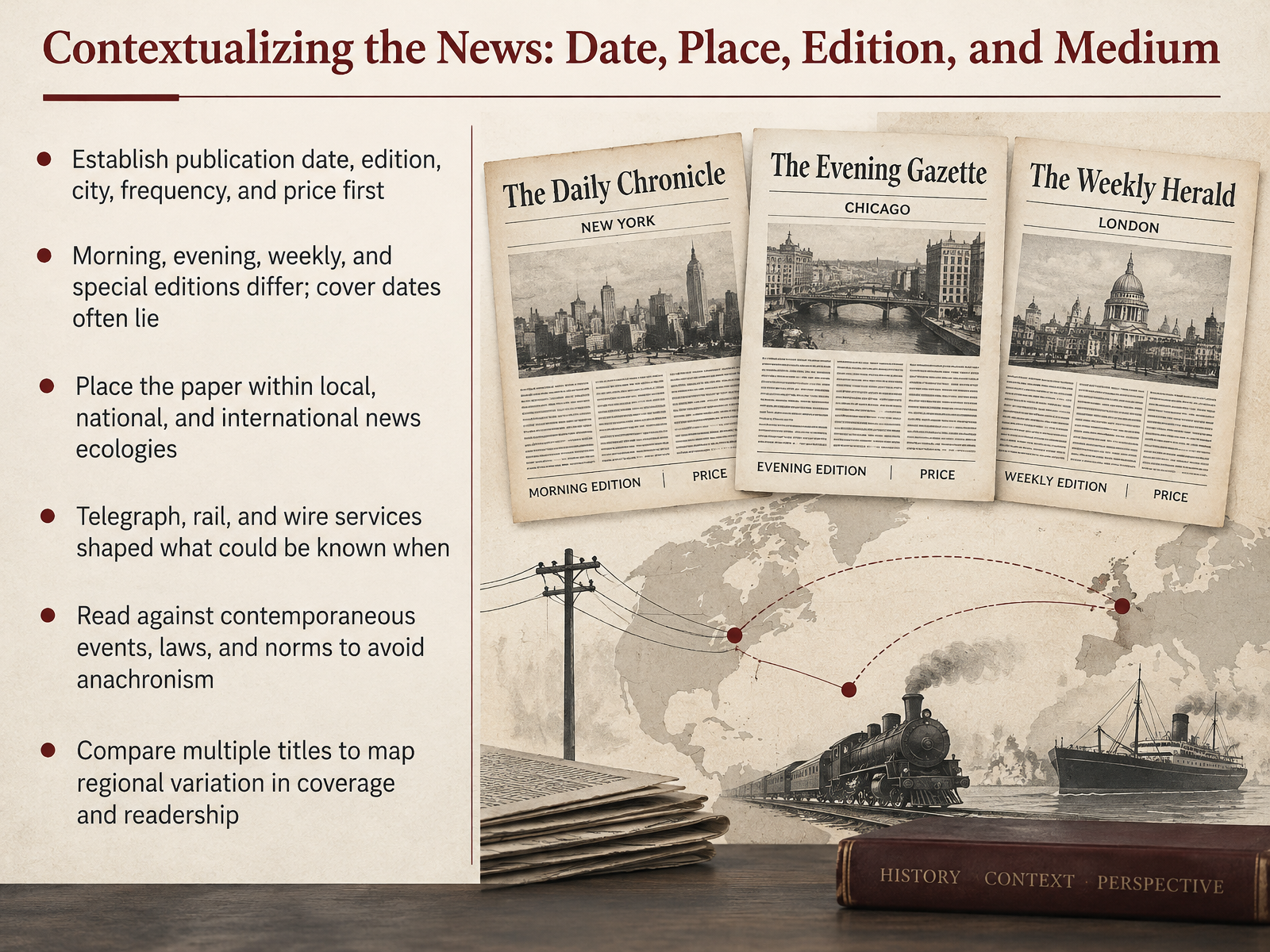
- 05Contextualizing the News: Date, Place, Edition, and MediumNext, let's situate the paper itself. Before you read a single article, establish the basics: the publication date, the edition, the city, how often it appeared, and its price. Frequency matters. Morning, evening, weekly, and special editions were different products, often with different editors and readers. And cover dates can mislead you. Many morning papers were printed the night before, so the printed date is not the publication date. Then place the paper within its news ecology, local, national, and international. Ask what telegraph lines, railways, and wire services made available, and when. Read against contemporaneous events, laws, and norms, so you avoid anachronism. Finally, compare several titles to map regional variation in coverage and readership. Your task now is to record these five facts for each source before you analyze its content. That groundwork will support the next step, verifying claims through corroboration, comparison, and triangulation.
 1 min
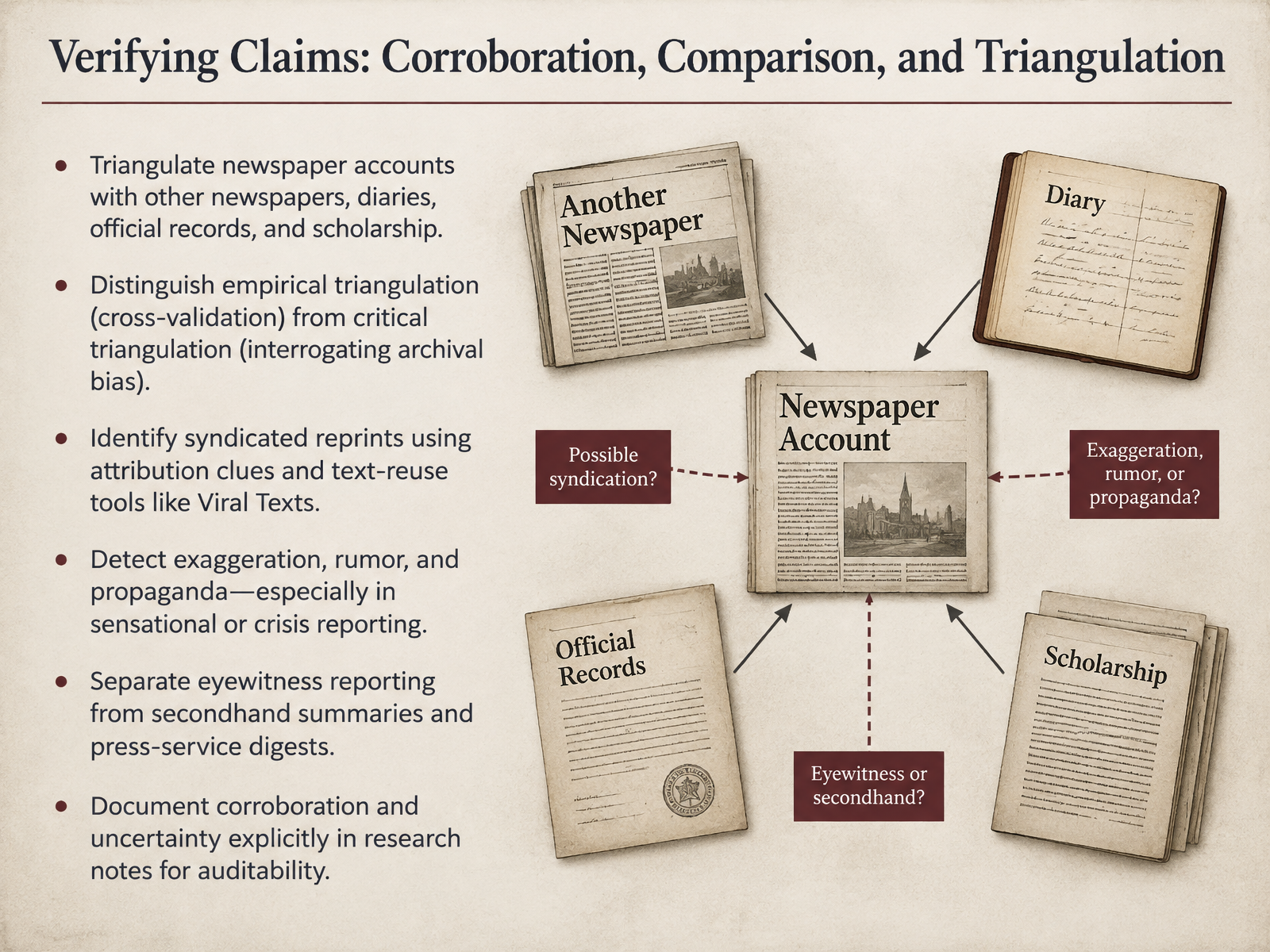
- 06Verifying Claims: Corroboration, Comparison, and TriangulationNow let's look at how to verify a claim once you have found it. Verification means checking a statement against independent evidence before you rely on it. Triangulate newspaper accounts with other newspapers, diaries, official records, and scholarship. Think of triangulation in two ways. Empirical triangulation is cross-validation, where several sources support the same fact. Critical triangulation asks who created the archive, what was left out, and why. Both matter. Next, identify syndicated reprints, meaning the same text printed in many papers. Look for attribution clues, and use text-reuse tools such as Viral Texts. Then watch for exaggeration, rumor, and propaganda, especially in sensational or crisis reporting. Separate eyewitness reporting from secondhand summaries and press-service digests, and record both corroboration and uncertainty in your notes so your work is auditable. For now, take one current claim and write down two independent sources you will check. Next, we turn to navigating digital archives and databases.
 guides.library.illinois.eduwarwick.libguides.comlibguides.uncw.edu+22 min
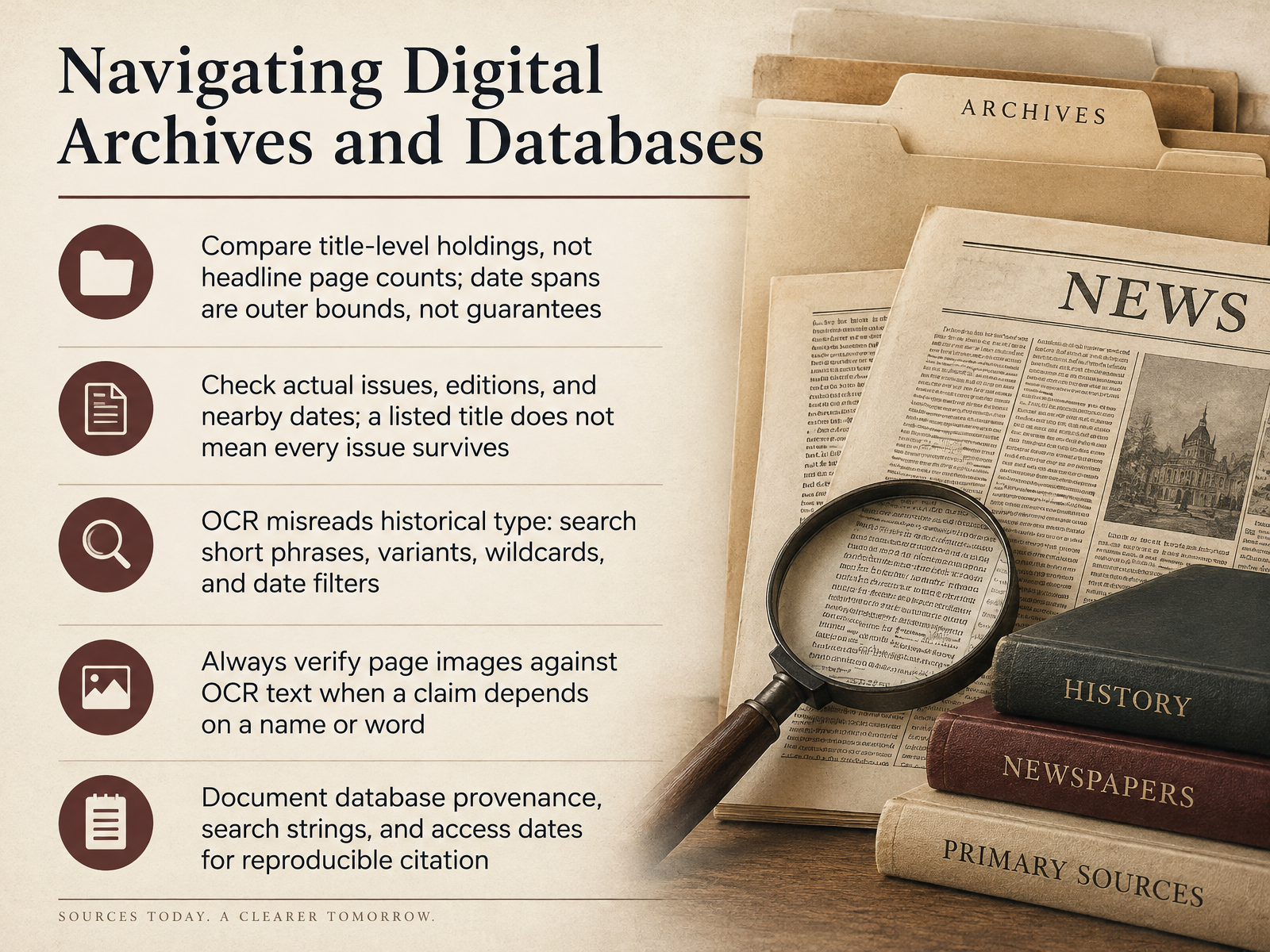
- 07Navigating Digital Archives and DatabasesNow let's talk about navigating digital archives and databases. The key habit is to compare title-level holdings, not headline page counts. A stated date span is an outer bound, not a guarantee. So open the title itself and check actual issues, editions, and nearby dates. A listed title does not mean every issue survives. Next, remember that optical character recognition, or OCR, often misreads historical type. If you are a student or researcher, search short phrases, spelling variants, wildcards, and date filters rather than long strings. When a claim depends on a name or a specific word, always verify the page image against the OCR text. For archivists and publishers, document the database provenance, your exact search strings, and the access date, so citations are reproducible. As a takeaway, before you rely on any search result, confirm the issue exists and the text matches the image.
 2 min
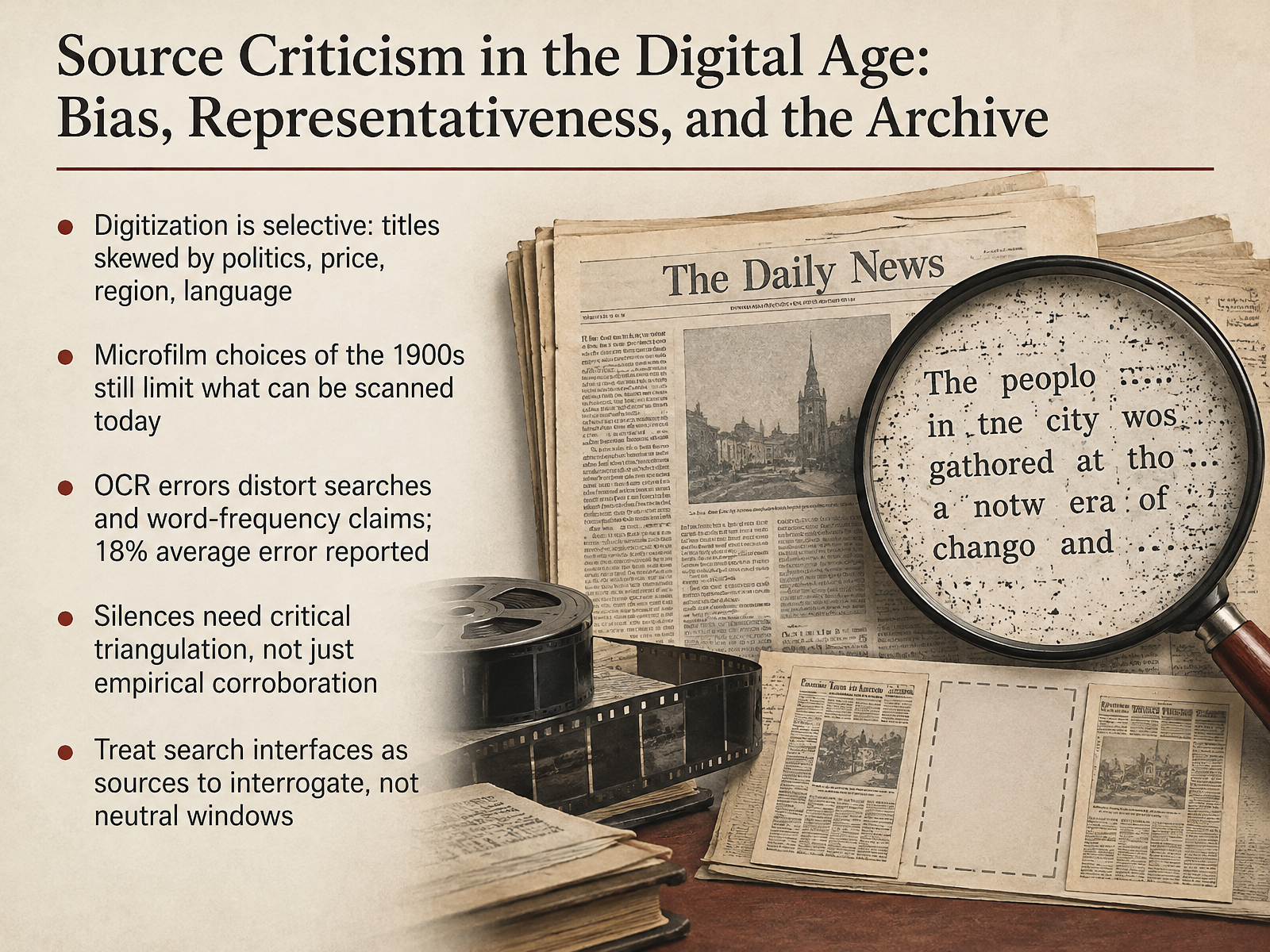
- 08Source Criticism in the Digital Age: Bias, Representativeness, and the ArchiveNow let's turn to source criticism in the digital age. Start with one practical question. How representative is this archive of what was actually printed? Digitization is selective. Titles skew by politics, price, region, and language. One study of a major British collection found conservative papers over-represented and cheaper mass-market titles under-sampled. And many choices were made decades ago. Microfilm decisions from the nineteen hundreds still limit what can be scanned today. Some reels are incomplete or degraded. Next, optical character recognition, or OCR, turns page images into searchable text. It is useful, but imperfect. Reported error averages around eighteen percent for single words. So treat search results as a sample, not a census. And be careful with word-frequency claims. Finally, gaps and silences need critical triangulation, not just empirical corroboration. Ask who was never collected, and why. And treat search interfaces as sources to interrogate, not neutral windows. Your next step is to open one archive you use and check its stated selection policy. Next, we look at teaching with newspapers in classroom and archive settings.
 2 min
- 09Teaching with Newspapers: Classroom and Archive StrategiesNow let's turn to teaching. Begin with a single newspaper page. Ask learners to observe, question, and describe before they interpret anything. For example, what do you notice first? What text appears besides articles? What details show when and where it was published? Then scaffold the work in stages, from observation, to interpretation, to corroboration. Corroboration means checking a claim against other sources. Next, move outward. Compare coverage across different titles and dates. The Library of Congress suggests comparing the same topic in two newspapers, then asking what is different, what is the same, and why. Connect that past framing to present media literacy habits. Ask learners how they would verify the same claim today. For controversial content, curate thoughtfully, and assess with explicit rubrics, so expectations are clear. Choose one page and write your observation prompts now. We'll turn next to ethics, copyright, and publishing use.
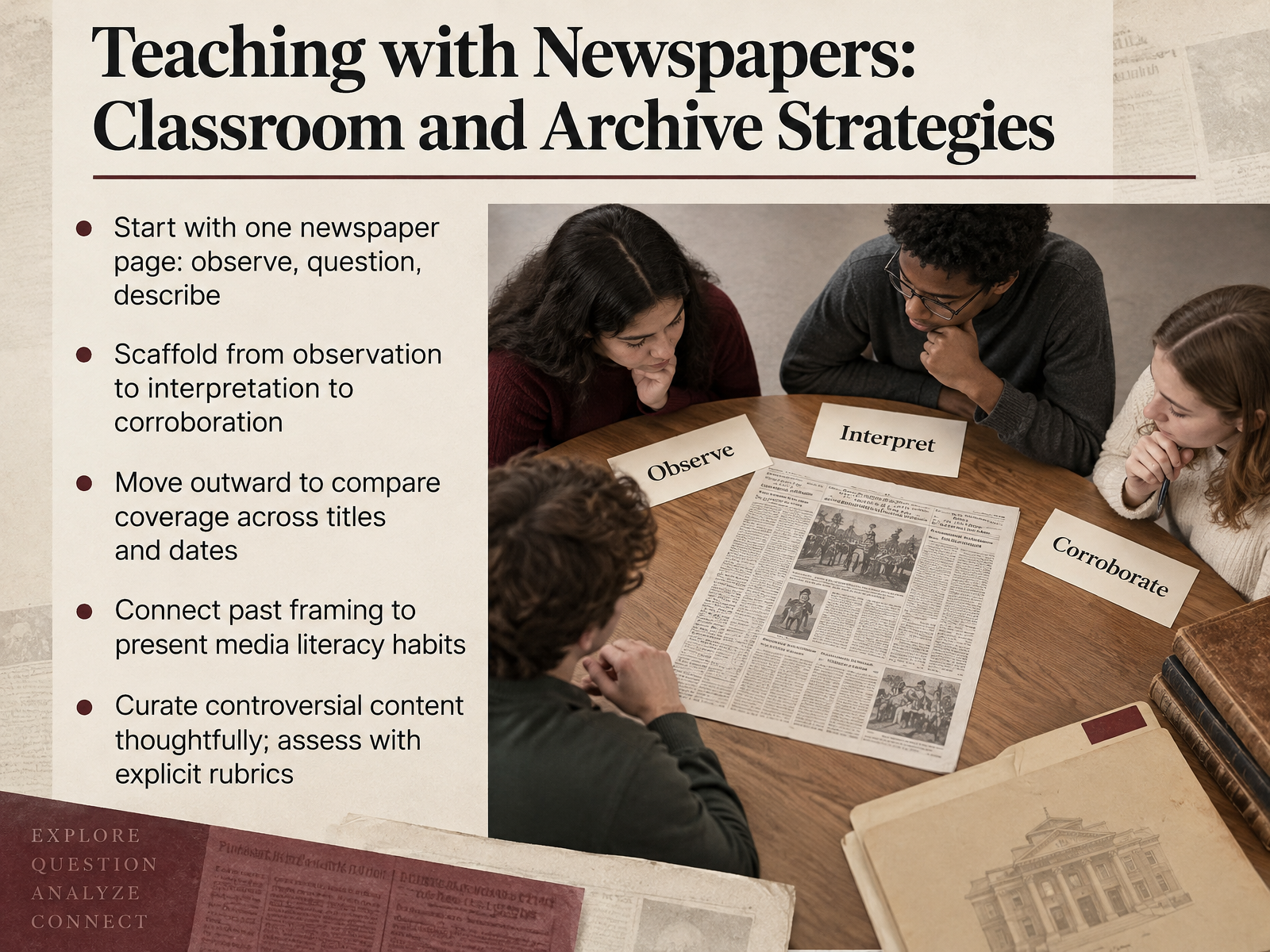 loc.gov2 min
- 10Ethics, Copyright, and Publishing UseNow let's look at ethics, copyright, and publishing use. Copyright depends on the date, the country, and the digitization agreement. So check the jurisdiction that applies. A rough rule of thumb in the United States is that issues published before nineteen thirty are in the public domain. Later issues need research into registration and renewal. When you cite, include the title, the archive or database, the URL, and your access date. If you plan to republish, either get permission from the rights holder or make a fair use or fair dealing assessment. And handle sensitive content like crime reports, obituaries, and personal data with editorial care. Before moving on, take one item you plan to use and note its copyright status and citation details. Next, we turn to From Evidence to Argument: Framing Questions and Selecting Items.
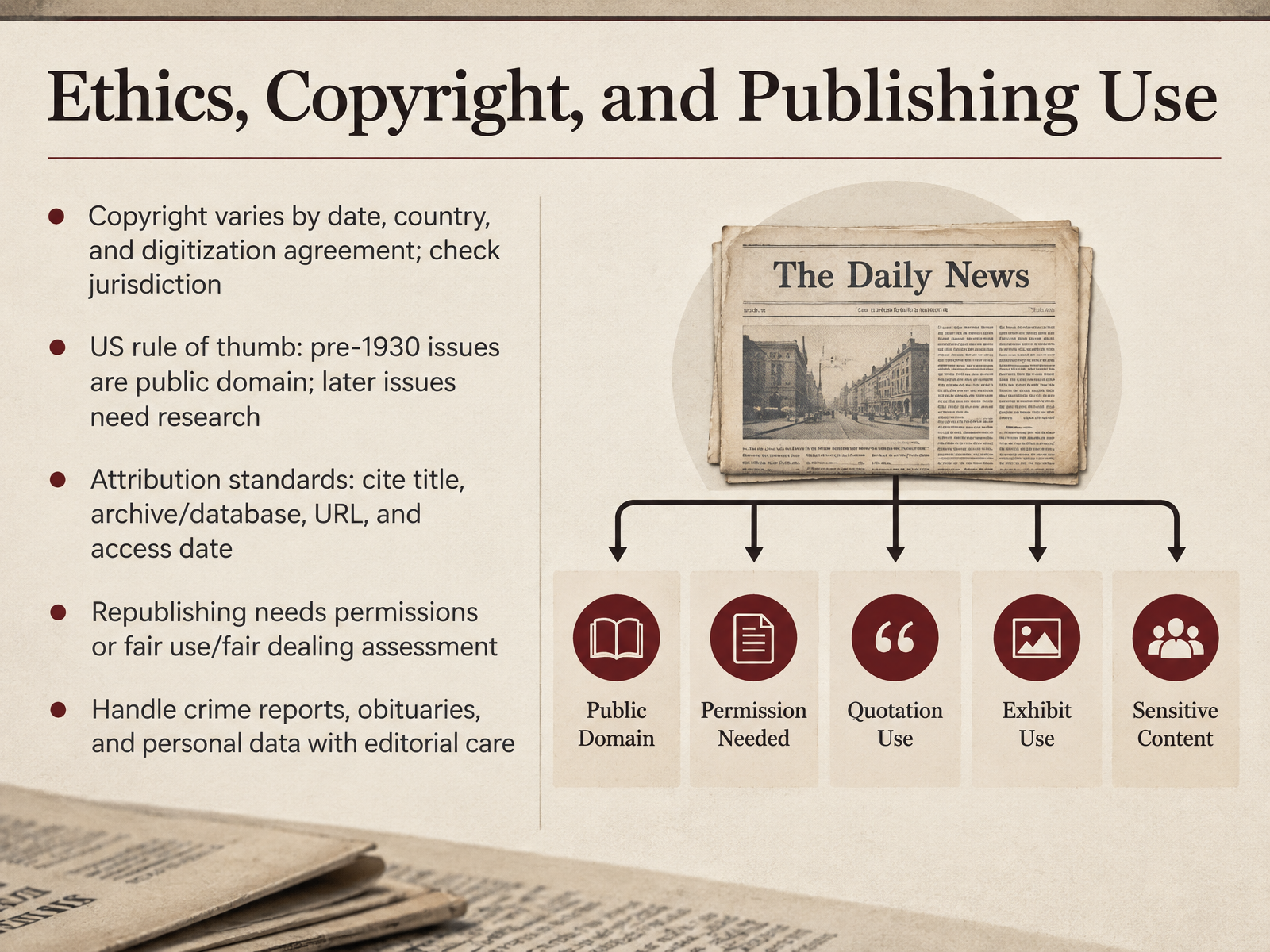 2 min
- 11From Evidence to Argument: Framing Questions and Selecting ItemsNow let's move from evidence to argument. Start by framing questions your newspapers can actually answer, within their coverage and survival limits. Then choose representative and contrasting items, not just the vivid ones. A striking headline may not represent the whole run of a paper. Next, synthesize your evidence into an argument, with citations and caveats. Distinguish facts from interpretation, and remember that both are built from sources. Watch for three common problems: overgeneralization, quotes pulled out of context, and cherry-picking. Before you draft, write one sentence stating your claim, then list which items support it and which complicate it. Presenting Findings to Academic, Public, and Professional Audiences.
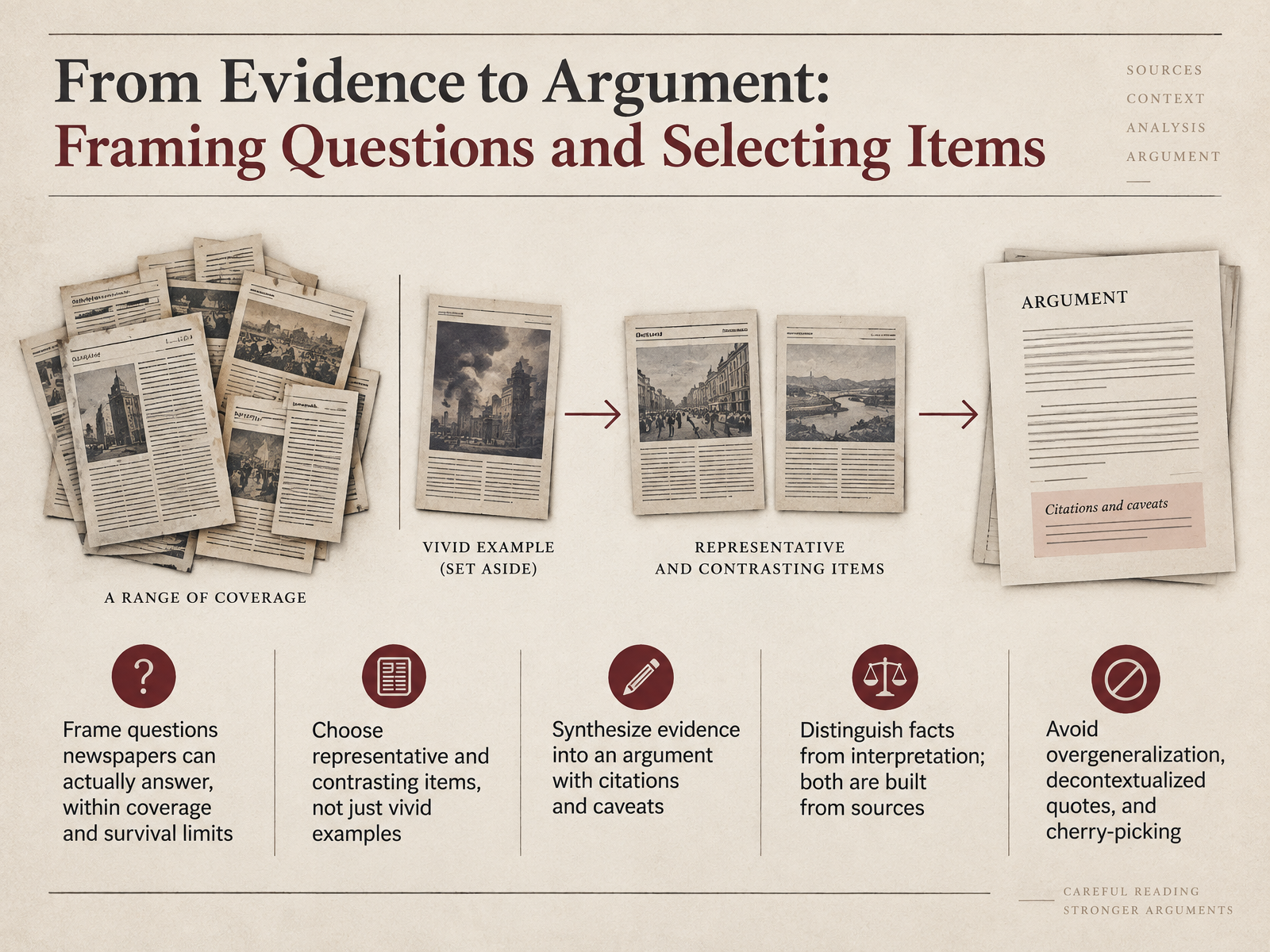 guides.library.illinois.eduwarwick.libguides.comlibguides.uncw.edu+21 min
- 12Presenting Findings to Academic, Public, and Professional AudiencesNow let's talk about how you present what you found. Your format should match your audience. An academic paper, a public history talk, and a publishing or editorial brief each need a different shape. Whichever form you use, quote from your sources and show a page facsimile. That gives listeners a personal echo of the people in the record. Then cite completely. Share a stable link and a readable reproduction, not a blurry screenshot. Assume your material will be remixed or distorted, and document provenance carefully so others can trace it back. One question to test every presentation: does it convey the evidence and its limits? Make a short audience-fit checklist for your next talk or article. Putting It Into Practice: Guided Analysis and Discussion.
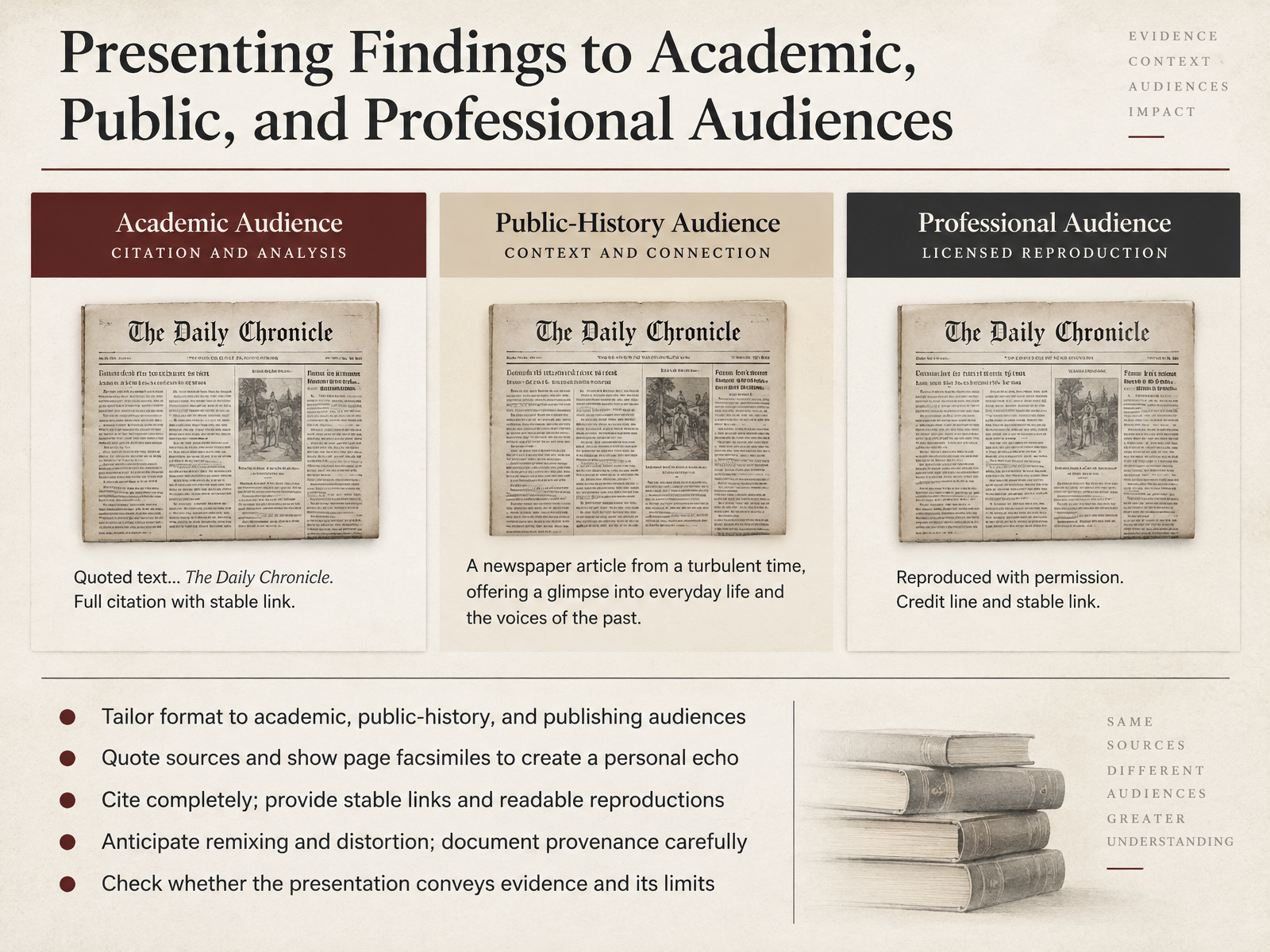 1 min
- 13Putting It Into Practice: Guided Analysis and DiscussionNow let's put these skills into practice. Start with one page and walk it through five steps: describe, source, contextualize, corroborate, and interpret. That means noting what you see, then asking who made it and why, placing it in time and place, checking it against another source, and finally stating what you think it shows. Next, take one event and compare it across two or three titles with different ownership. Ask how word choice, included facts, and omitted details differ. Then draft a short evidence paragraph that cites the item, the database you found it in, and one corroborating source. Also name one archival silence or one OCR error, and describe its effect on your reading. Finally, reflect on which of these skills transfer to students, to archive and library work, and to publishing. Choose one item this week and complete the full sequence.
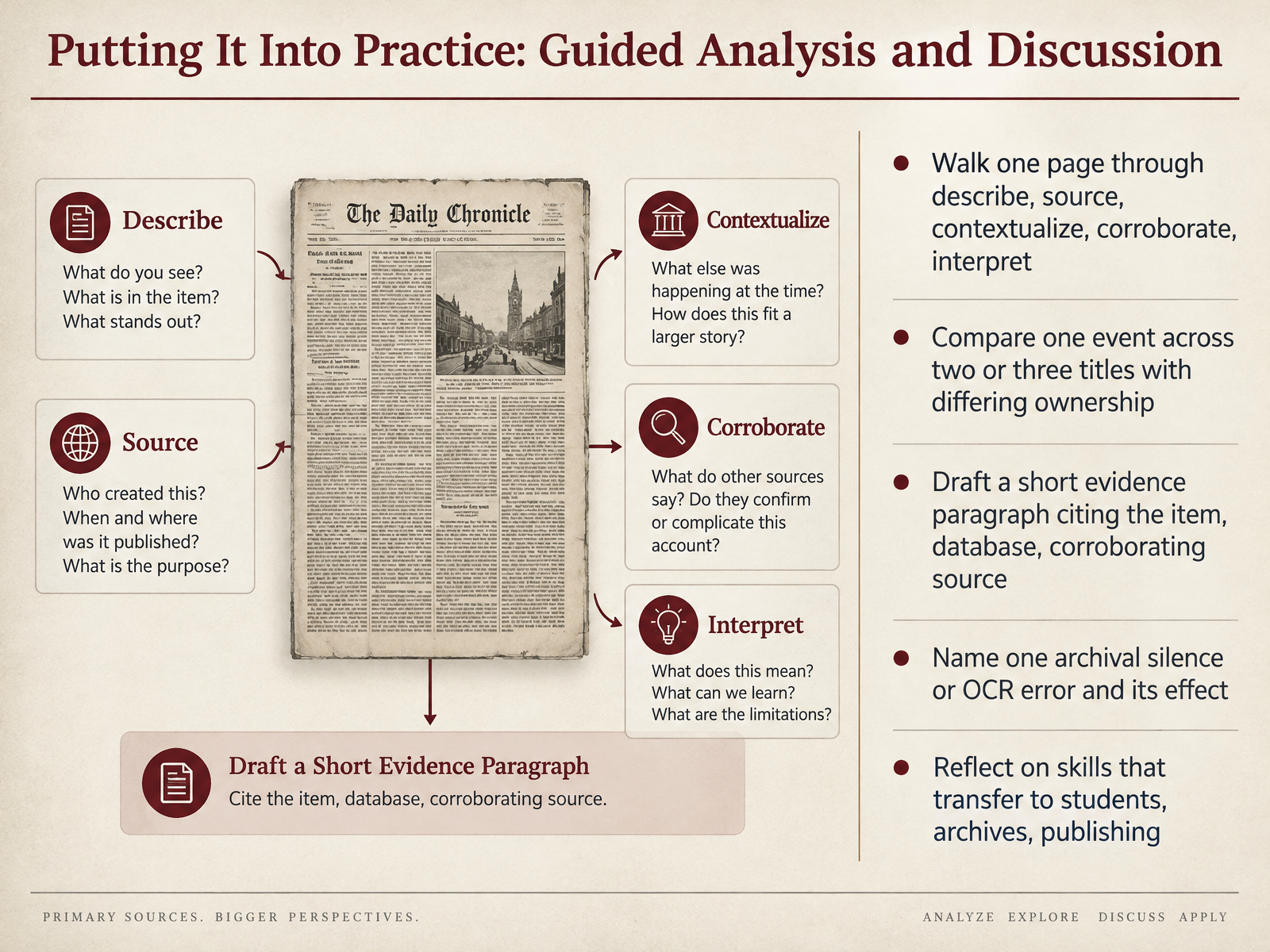 loc.gov2 min
- 14Key Takeaways, Toolkit, and Next StepsLet's close by drawing the threads together. First, newspapers are constructed evidence. Read each one through its production, its ownership, its intended audience, and its physical form, because those choices shape what gets reported and how. Second, corroborate across multiple sources, and record your uncertainty openly in your research notes. Third, remember that digital archives are selective. They reflect preservation history and the limits of optical character recognition, which is the automated text conversion that can miss misspelled names or faint type. Fourth, respect copyright and ethics when you teach, exhibit, or publish newspaper evidence. Check the rights status of each item and credit the holding institution. For your next steps, build a short personal checklist, practice on a local collection, and adapt your explanations to your audience, whether students, patrons, or readers. Thank you for working through this course with me. You now have a practical method, so take it to your next newspaper source and read it with confidence.
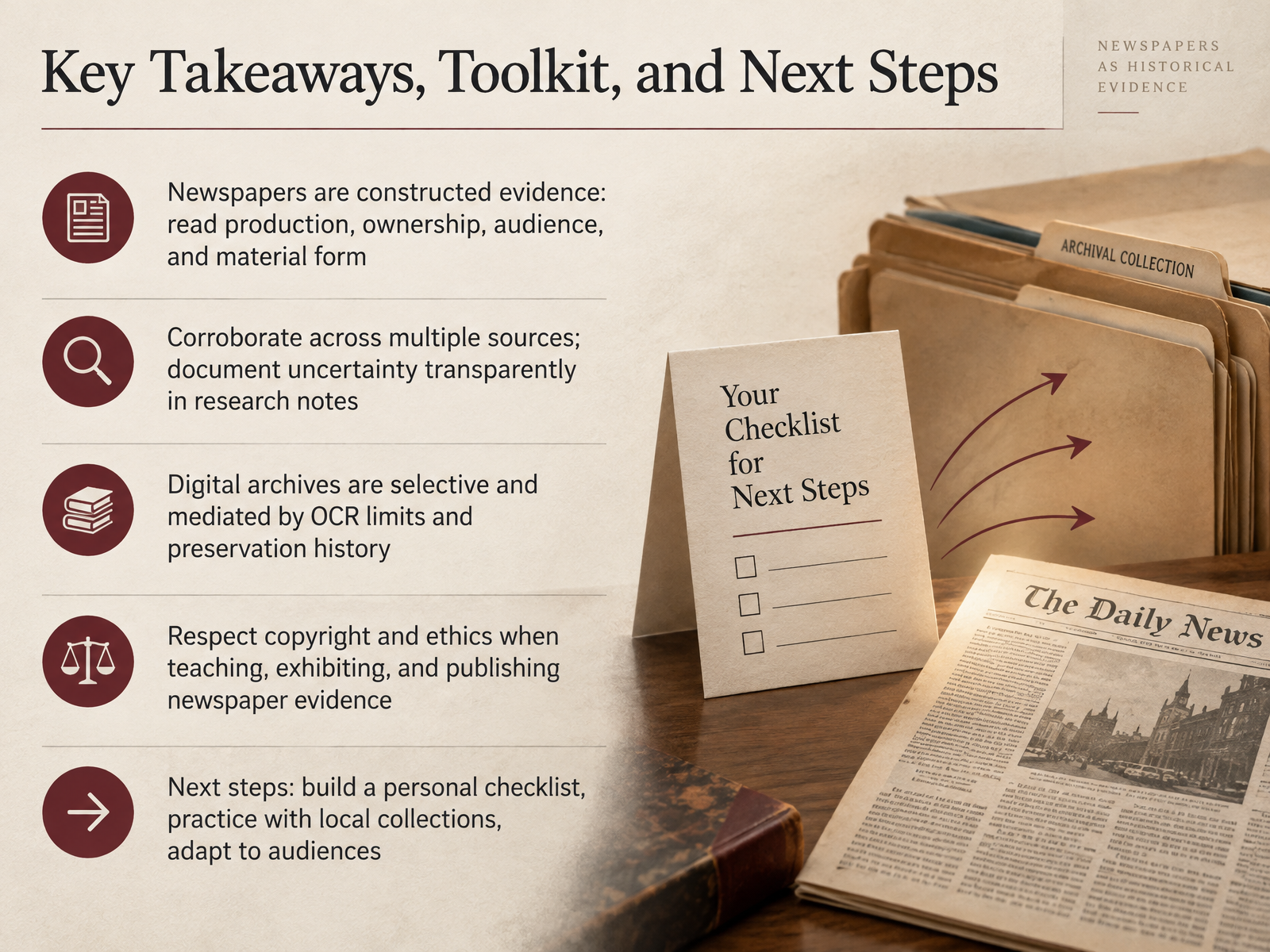 guides.library.illinois.eduwarwick.libguides.comlibguides.uncw.edu+22 min
Take the deck with you
Download this course as a file — free, no sign-up needed.
- PDF handoutEvery slide page, ready to print or share.15 pages · 5.6 MBDownload
- Narrated PowerPointThe deck that presents itself — every slide carries the digital human's narration video.15 pages · 26.2 MBDownload
- PowerPoint slidesThe full deck as a .pptx — open it in PowerPoint, Keynote, or Google Slides.15 pages · 5.5 MBDownload
Free to use in your own training — please keep the PersonWise credit page at the end.
Have your own deck? Turn it into a course
Sources consulted
Web sources consulted while building this course.
- Home - Newspapers and Magazines as Primary Sources - LibGuides at University of Illinois at Urbana-Champaign — guides.library.illinois.edu
- Using newspapers in your research - Newspapers - Subject Guides at University of Warwick — warwick.libguides.com
- Analyzing Newspapers - Using and Understanding Primary Sources - LibGuides at University of North Carolina Wilmington — libguides.uncw.edu
- Analyzing Newspapers — loc.gov
- Historical Newspaper Data: A Researcher’s Guide — walkerhanlon.com
- Printing Newspapers 1400-1900: A Brief Survey of the Evolution of the Newspaper Printing Press | Headlines & Heroes — blogs.loc.gov
- 1850-1899 | The history of printing during the 19th century — prepressure.com
- Chapter 9. Industrialization of Print — pages.gseis.ucla.edu
- Production — doi.org
- Nicprint-50: being some account of the history of the printing, packaging and newspaper industry of South Africa, and of the National Industrial Council for Printing, prepared to mark the Jubilee of the Council, 1919-1969. — open.uct.ac.za
- DO NEWSPAPERS SERVE THE STATE? INCUMBENT PARTY INFLUENCE ON THE US PRESS, 1869–1928 — web.stanford.edu
- Measuring the Partisan Behavior of U.S. Newspapers, ... — cambridge.org
- Newspaper Chains, Ownership of — robswells.com
- Journalism's partisan origins: What we can learn from the past of a critical American institution | George W. Bush Presidential Center — bushcenter.org
- Ownership and editorial stance - Newspapers — bbc.co.uk
- Sensational Design: Layout and Typography in the Visual Rhetoric of Information Disorder | Visible Language — journals.uc.edu
- Design follows politics? The visualization of political orientation in newspaper page layout — epub.ub.uni-muenchen.de
- Beginnings of the Modern Newspaper — hdl.handle.net
- Design Trends in U.S. Front Pages, 1885–1985 — doi.org
- VISUAL STRATEGIES — rug.nl