Begin
14 pages · ~28 min
Avoiding Common Content Marketing Mistakes
A concise training that helps marketers identify common content marketing mistakes and apply practical strategies to avoid them, improving content quality, consistency, and results.
A digital instructor presents all 14 pages. Hold “Ask” at any point and ask out loud — the answer comes from this course. No sign-up needed.
What you’ll learn
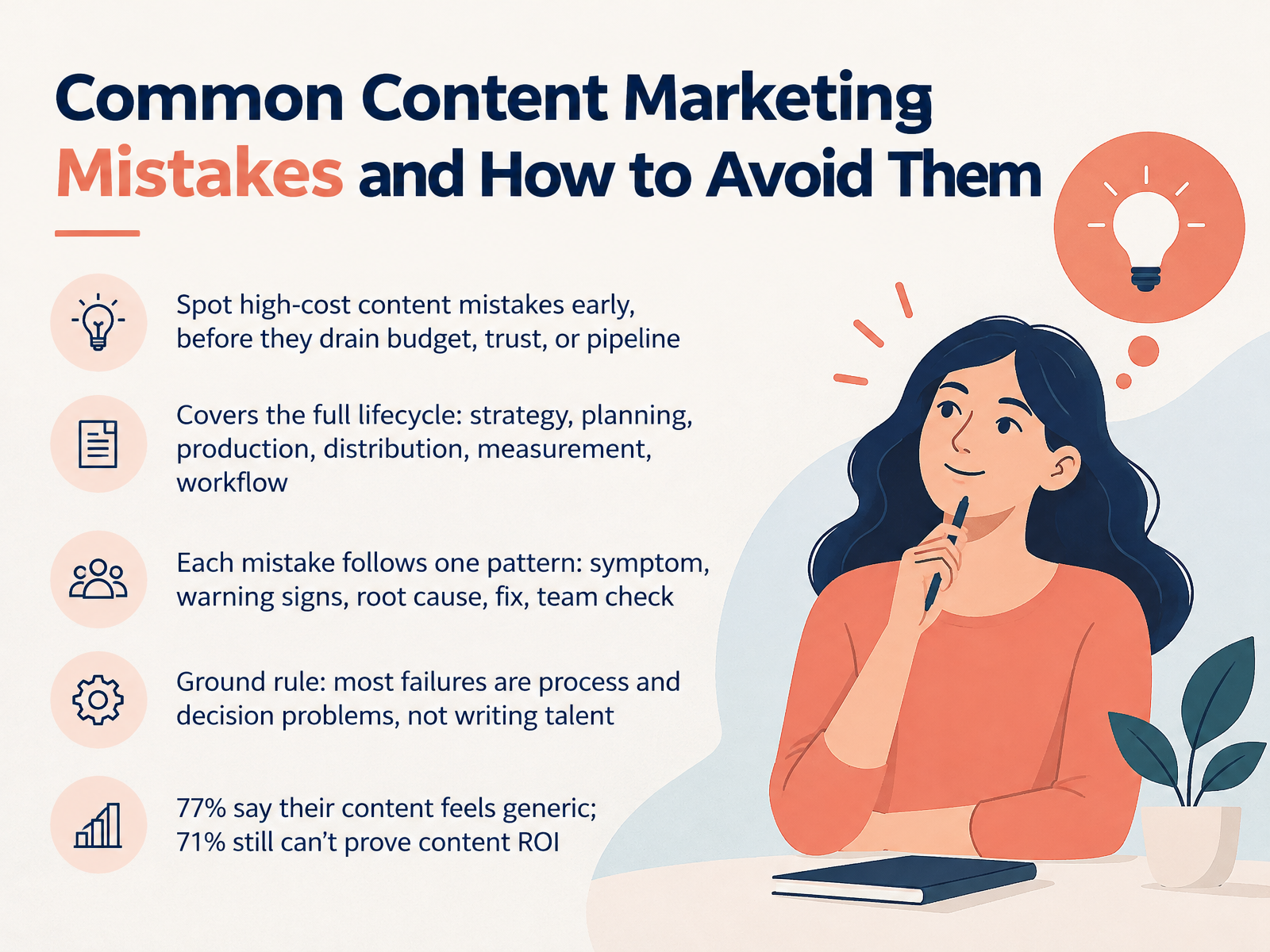
- 01Common Content Marketing Mistakes and How to Avoid ThemWelcome. I'm glad you're here. Over the next fourteen slides, we're going to walk through the content marketing mistakes that quietly drain budget, trust, and pipeline, and how to catch them early. This isn't about writing talent. Most failures are process and decision problems, and those are fixable. We'll cover the full lifecycle, from strategy and planning through production, distribution, measurement, and workflow. Every mistake follows the same pattern: symptom, warning signs, root cause, fix, and a quick team check you can run. Here's why this matters. Seventy-seven percent of marketers say their content now feels generic, and seventy-one percent still can't prove content ROI. A small example: two blog posts on the same topic, written by different writers, without a shared brief. That's not a talent gap. That's a planning gap. So listen for the check you can run with your own team, and note the ones that hit close to home. Next, let's map the mistakes that cost the most: a field map.contentmarketinginstitute.comcontentful.bynder.comzmistandcopy.com+21 min
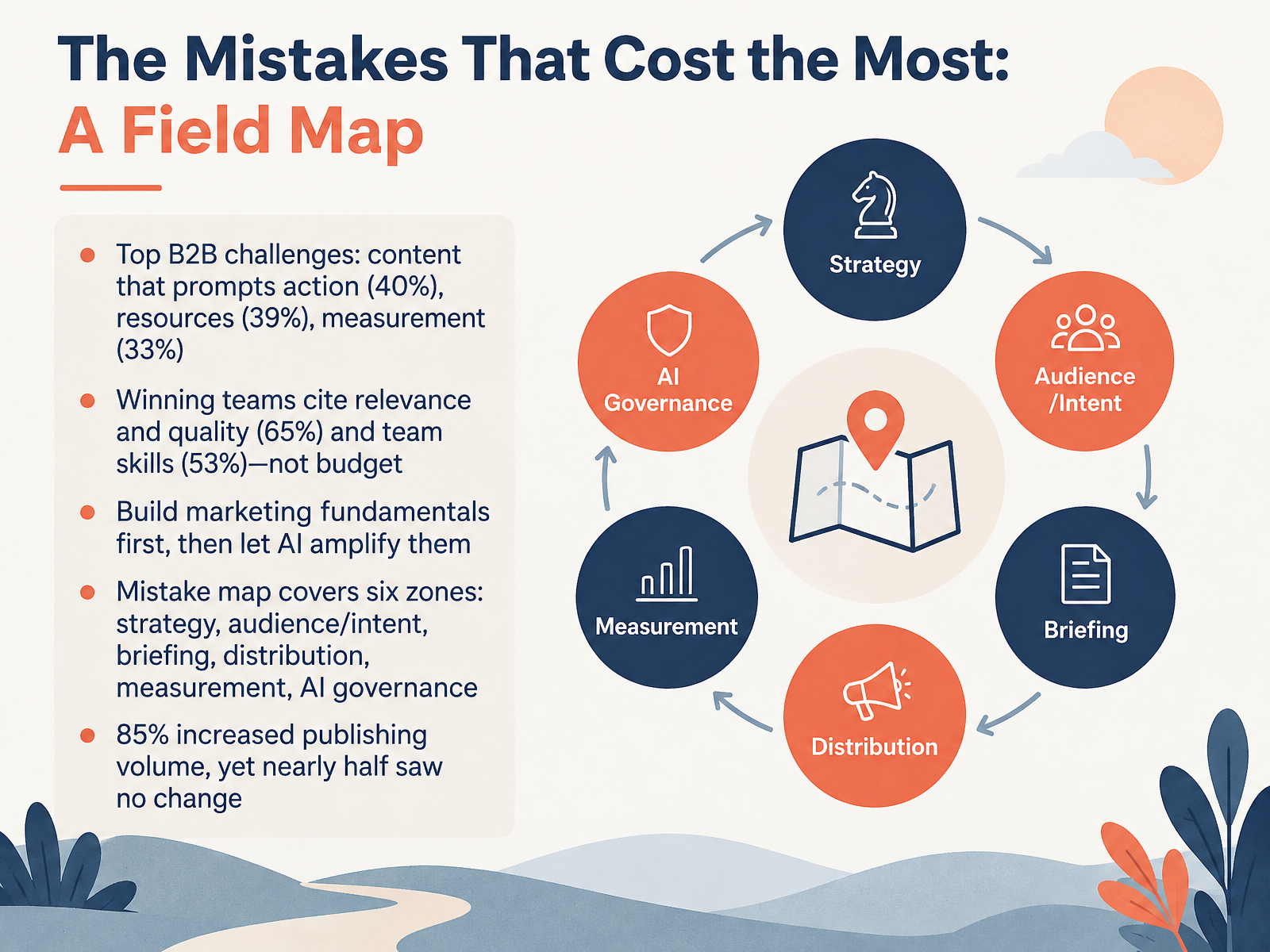
- 02The Mistakes That Cost the Most: A Field MapHere's the field map. Before we fix anything, let's see where the real costs sit.
In B2B survey data, the top challenges are familiar. Forty percent say content that prompts action, thirty nine percent say resources, and thirty three percent say measurement. Notice that budget doesn't top the list.
And when winning teams name what moved the needle, sixty five percent point to relevance and quality, and fifty three percent to team skills. Not budget. The takeaway: build marketing fundamentals first, then let AI amplify them.
Meanwhile, eighty five percent of teams increased publishing volume, yet nearly half saw no change in results. More output isn't the fix.
So we'll organize the next six zones as our mistake map: strategy, audience and intent, briefing, distribution, measurement, and AI governance. Think of them as places to run a quick check before your next piece ships.
Let's start with the first one. Mistake 1: Publishing Without a Strategy.
 contentmarketinginstitute.comcontentful.bynder.comzmistandcopy.com+22 min
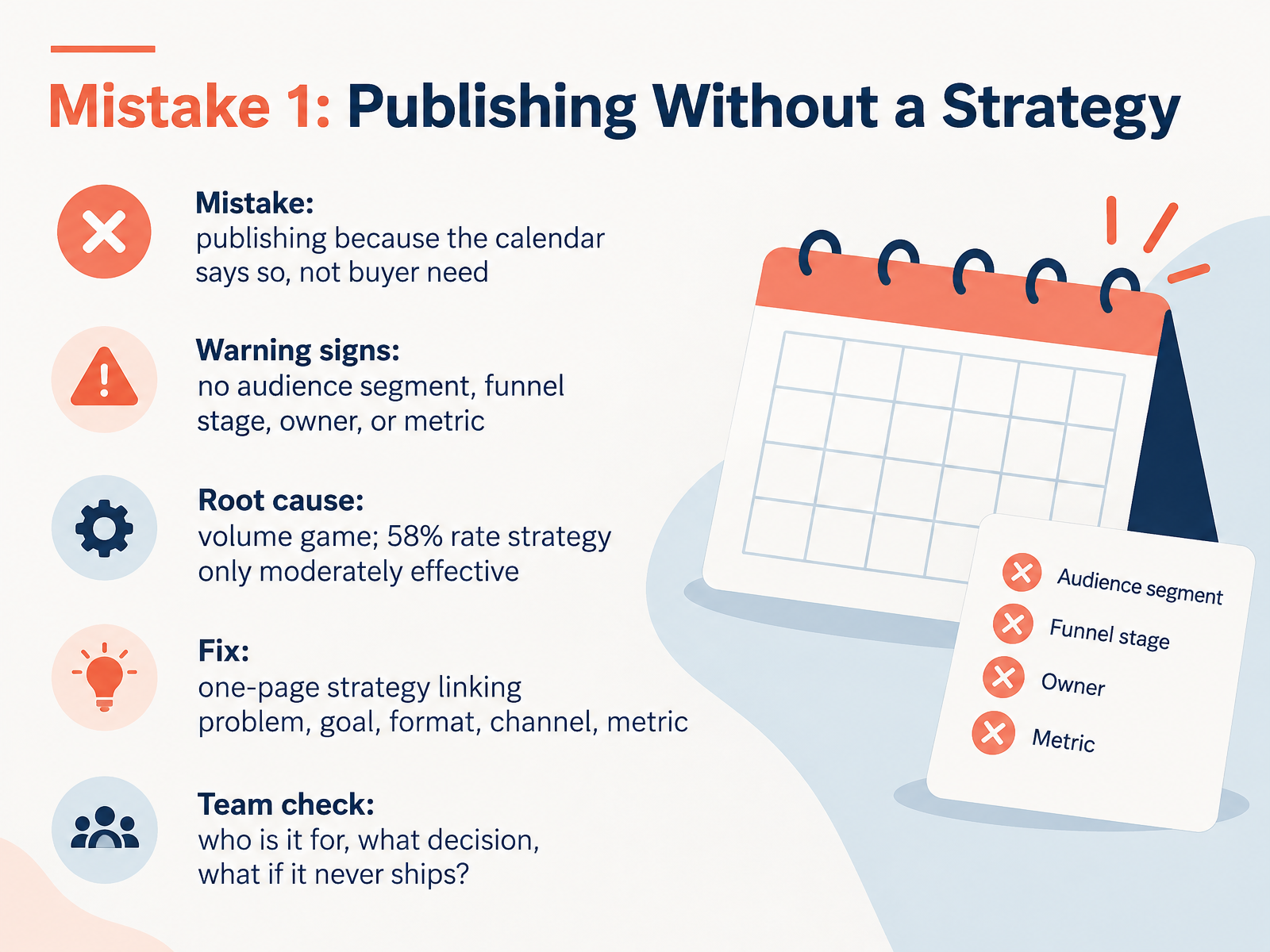
- 03Mistake 1: Publishing Without a StrategyLet's start with the most common problem: publishing without a strategy. Here's what tends to happen. The calendar says Tuesday, so something ships. Nobody can say which buyer segment it serves, which funnel stage it targets, who owns it, or which metric it should move. The root cause is usually a volume game. And the data backs that up: fifty-eight percent of B2B marketers rate their content strategy as only moderately effective. So having a strategy document isn't the finish line. The fix is small. Write a one-page strategy for each piece that links the buyer problem, the goal, the format, the channel, and the one metric you'll watch. Then run a quick team check before anyone drafts. Who is it for? What decision should it help them make? And what happens if it never ships? If nobody can answer those three questions, pause the piece. That check takes five minutes and saves weeks. Next, we look at mistake two: writing for assumptions, not for buyers.
 relato.comthemarketingjuice.comsearchenginejournal.com+22 min
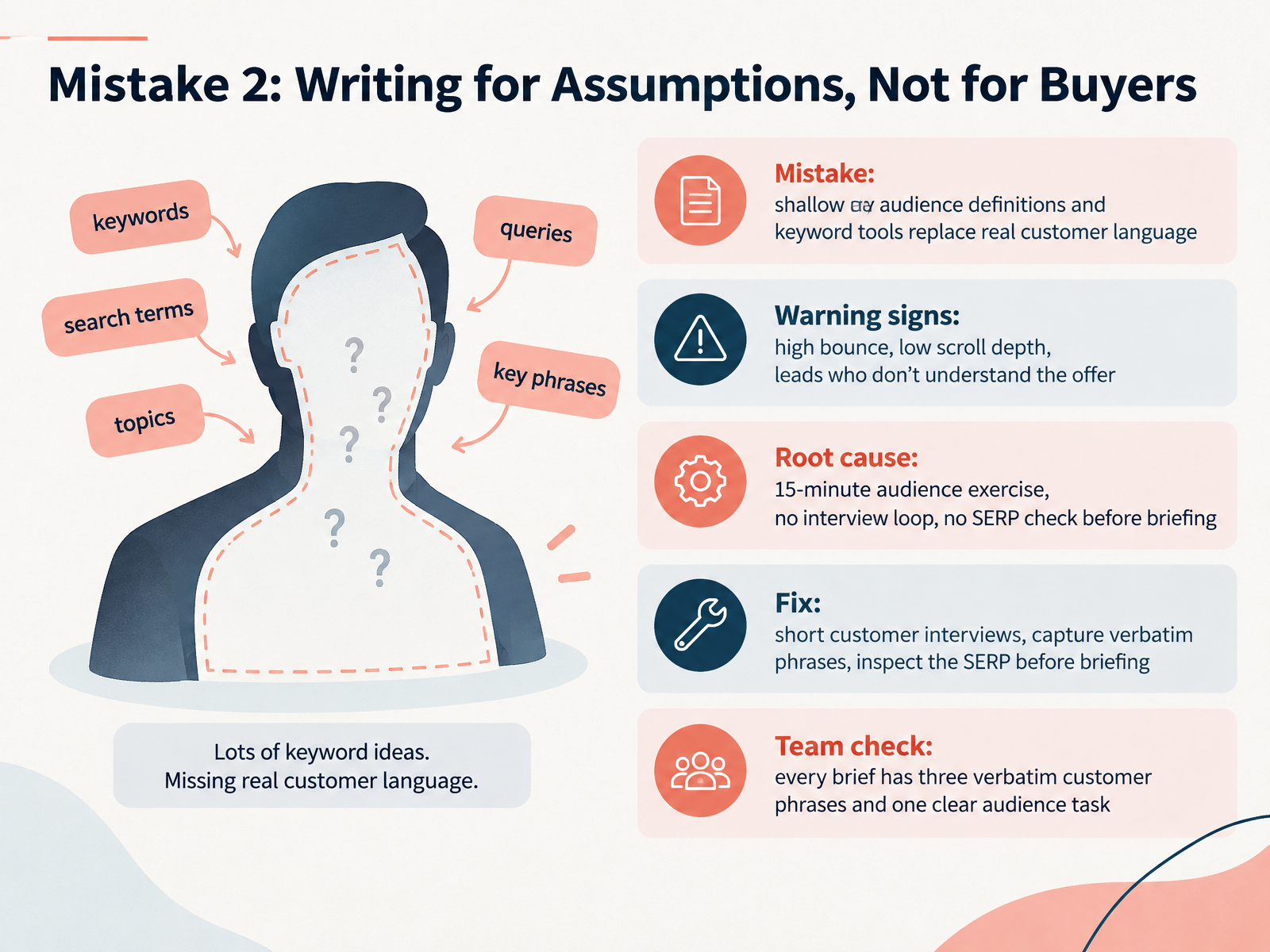
- 04Mistake 2: Writing for Assumptions, Not for BuyersNow let's look at mistake two: writing for assumptions, not for buyers. Here's what tends to happen. A brief gets an audience section filled out in about fifteen minutes. Job titles, company size, a few guessed pain points. A keyword tool fills in the rest. Then that loose definition drives six months of content. The warning signs show up in your data: high bounce, low scroll depth, and leads who don't understand the offer. The root cause is simple. No interview loop, no look at the search results before the brief. So here's the fix. Run a few short customer interviews. Capture verbatim phrases, the exact words people use. Then open the search results before you brief, and match the format searchers expect. A quick check you can run: every brief should carry three verbatim customer phrases and one clear audience task. If it doesn't, the brief isn't ready. Next, mistake three: mismatching search intent and format.
 relato.comthemarketingjuice.comsearchenginejournal.com+22 min
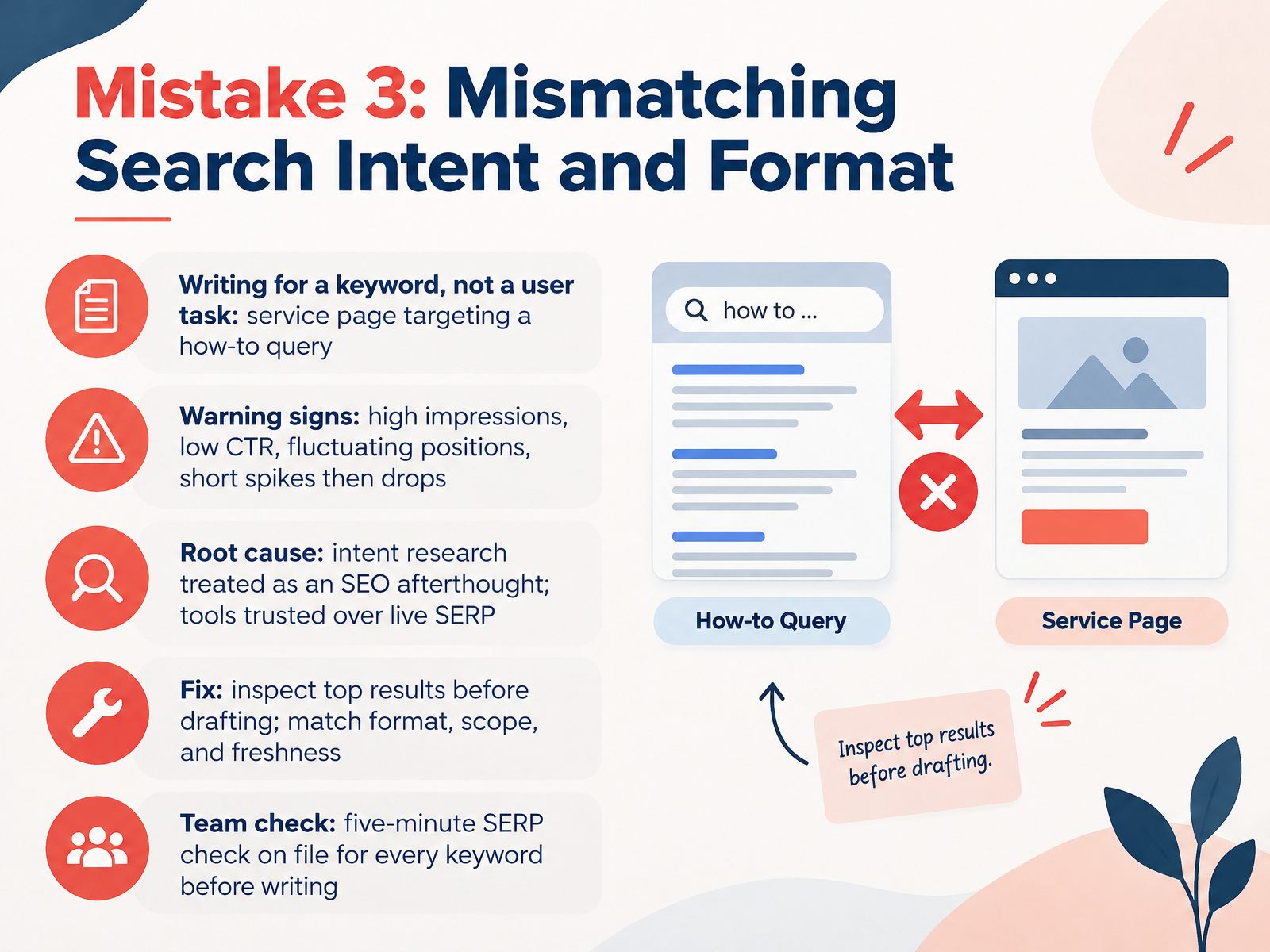
- 05Mistake 3: Mismatching Search Intent and FormatNext, let's look at mistake three, mismatching search intent and format. This is where you write for a keyword instead of a user task. Here's what tends to happen. A service page ends up targeting a how-to query, and it just will not rank, no matter how well it is written. The warning signs are clear in Search Console. High impressions, low click-through rate, positions that bounce around, and short spikes followed by drops. The root cause is usually that intent research got treated as an SEO afterthought, and a tool's label got trusted over the live results page. Here is the fix. Before drafting, search the query and inspect the top five results. Match the format, the scope, and the freshness. A quick check you can run with the team is a five-minute results page check on file for every keyword before writing starts. Now, let's move on to mistake four, confusing volume with value.
 seos.coarticles.backlinkworks.comcontentraptor.com+21 min
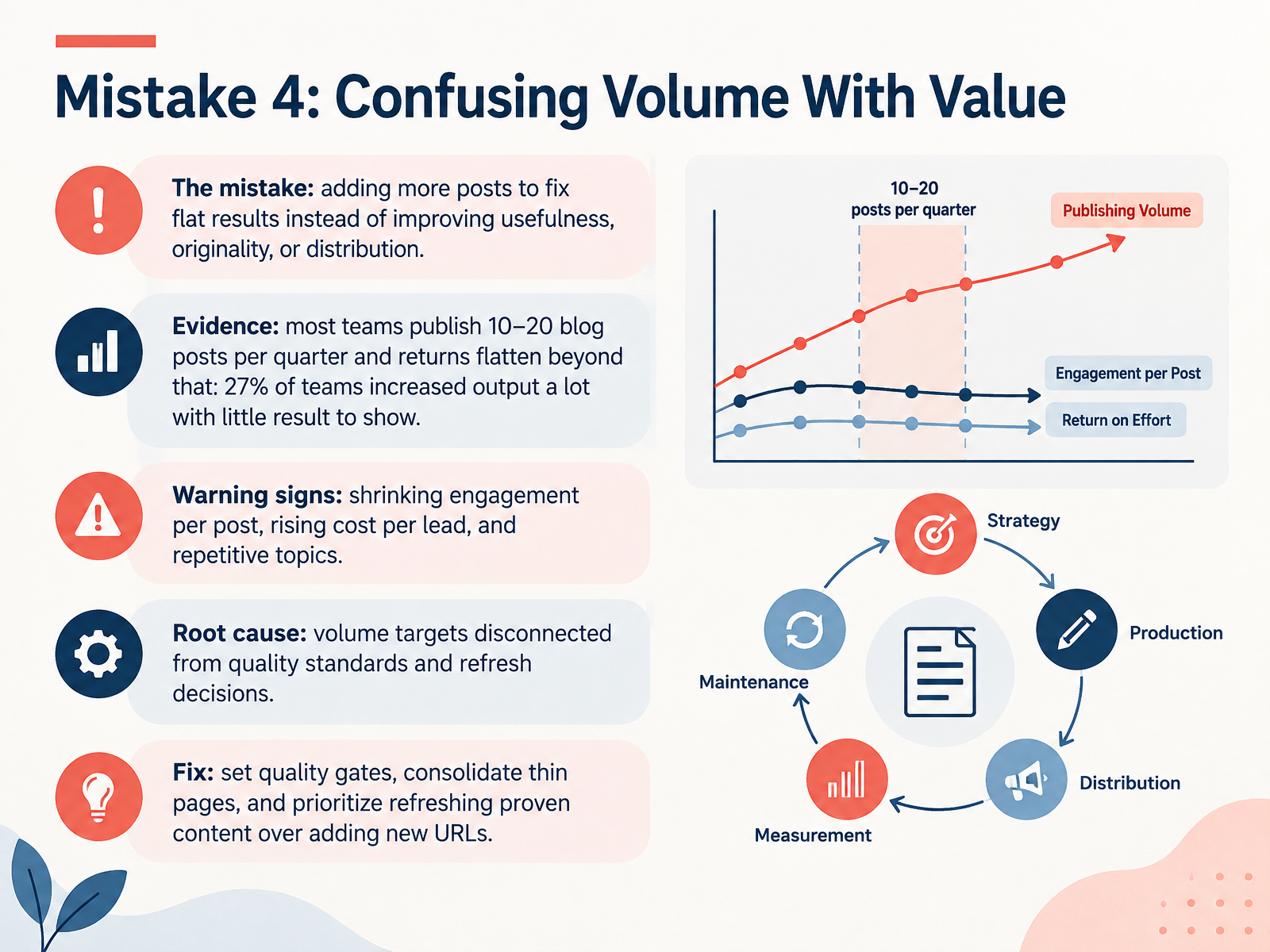
- 06Mistake 4: Confusing Volume With ValueNow let's look at mistake four, confusing volume with value. Here's what tends to happen. Results go flat, so the team adds more posts. Most teams publish ten to twenty blog posts per quarter, and returns flatten beyond that. Yet twenty-seven percent of teams ramped up output a lot with little to show for it. Watch for the warning signs. Engagement per post shrinks, cost per lead climbs, and topics start repeating. The root cause is usually a volume target disconnected from quality standards and refresh decisions. So here's the fix. Set quality gates before anything publishes. Consolidate thin pages into stronger ones. And prioritize refreshing proven content over adding new URLs. A quick check you can run this week: pick your five best-performing posts and ask whether a refresh would beat your next new draft. That's the shift from volume to value. Next, we turn to Mistake 5: Weak Briefs and Approvals That Stall.
 contentmarketinginstitute.comcontentful.bynder.comzmistandcopy.com+22 min
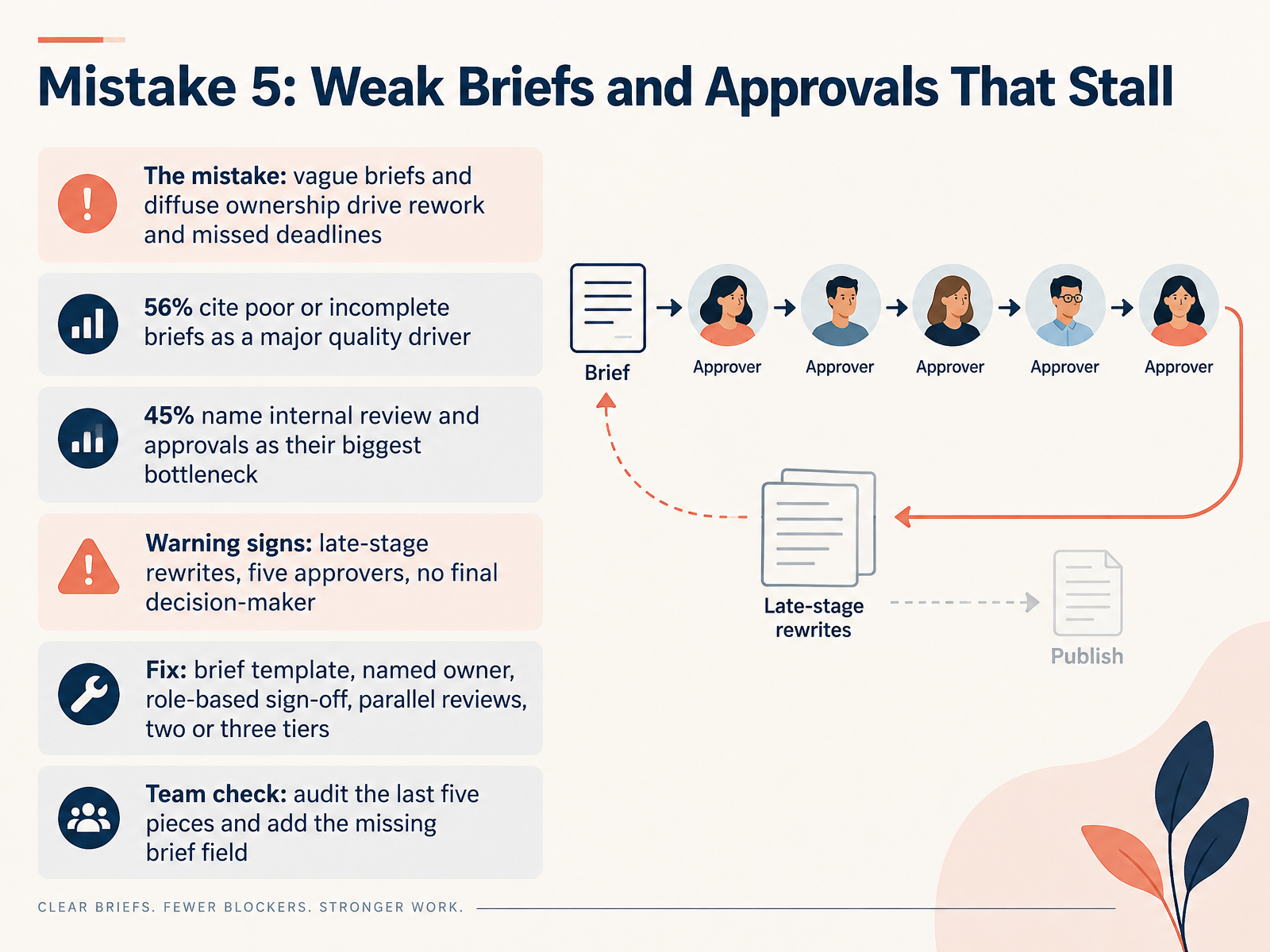
- 07Mistake 5: Weak Briefs and Approvals That StallNow let's talk about weak briefs and approvals that stall. Here's what tends to happen. A writer gets a title, a keyword, and a deadline, and the real decisions get made during review instead of before drafting. That drives rework. Fifty-six percent of content teams cite poor or incomplete briefs as a major reason quality drops, and forty-five percent name internal review and approvals as their biggest bottleneck. So watch for the warning signs. Late-stage rewrites. Five approvers. No single final decision-maker. Here's the fix. Use a brief template that covers audience, angle, keyword intent, outline, sources, length, reviewers, and deadline. Name one owner per stage. Separate reviewers from the approver. Run specialist reviews in parallel. And create two or three review tiers so small updates don't queue behind launch pages. A quick check you can run: audit your last five pieces and add the missing brief field. Next, Mistake 6: Publishing Without Distribution or Repurposing.
 narranta.comgrowth-rocket.comteambench.ai+22 min
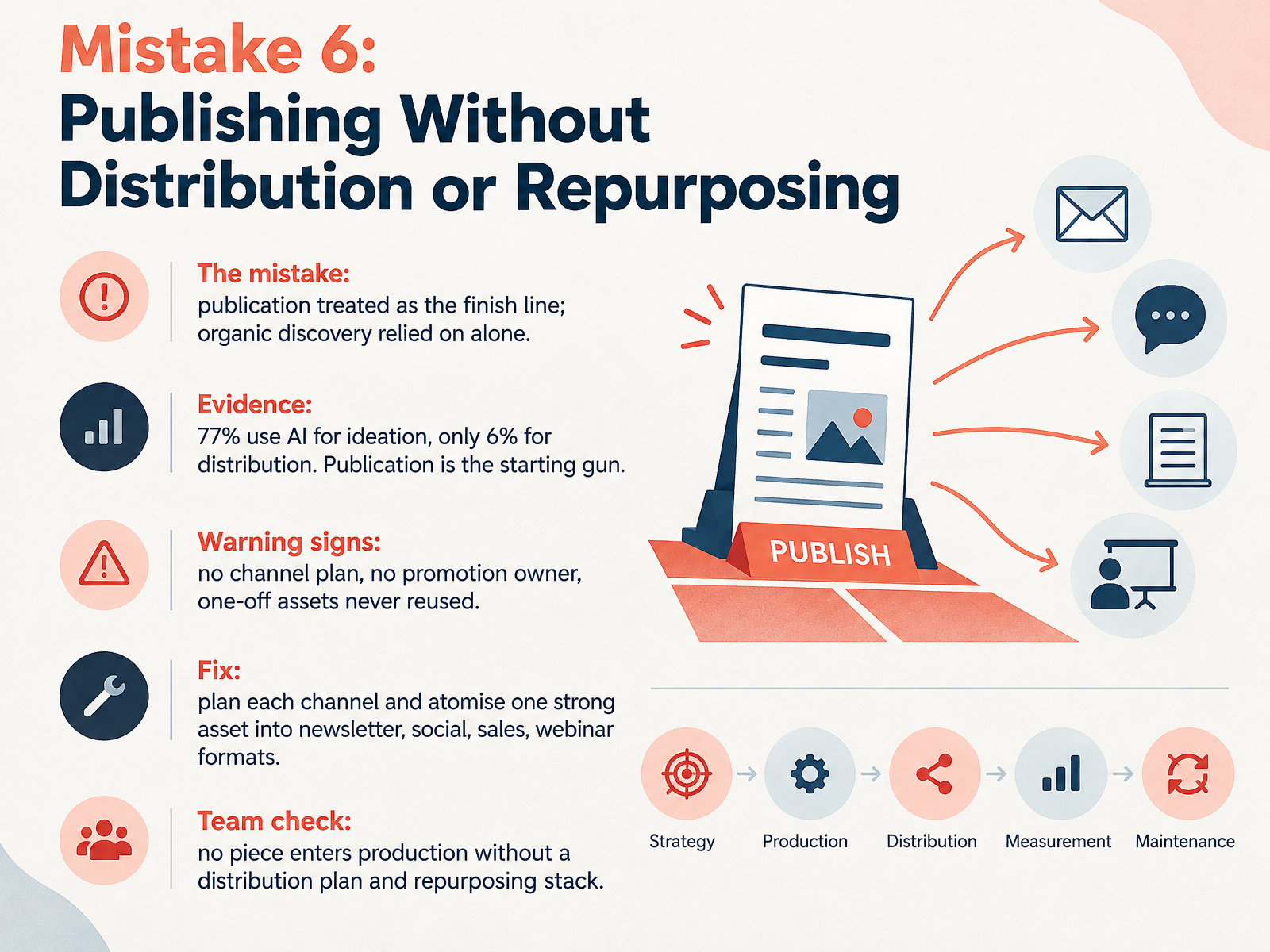
- 08Mistake 6: Publishing Without Distribution or RepurposingHere's mistake six. Treating publication as the finish line. You hit publish, share the link once, and then wait for organic discovery to do the rest. But publishing is the starting gun, not the ribbon at the end. And the numbers show it. Seventy-seven percent of teams use AI heavily for ideation, yet only six percent use it for distribution. Warning signs are easy to spot. There's no channel plan. Nobody owns promotion. And your best assets sit unused after launch. Here's the fix. Plan each channel and atomise one strong asset. That means one solid webinar or report becomes a newsletter section, three social posts, a sales one-pager, and a webinar clip. Here's a quick check you can run. No piece enters production without a distribution plan and a repurposing stack. Next, Mistake 7: Measuring Vanity Metrics Instead of Outcomes.
 contentmarketinginstitute.comcontentful.bynder.comzmistandcopy.com+21 min
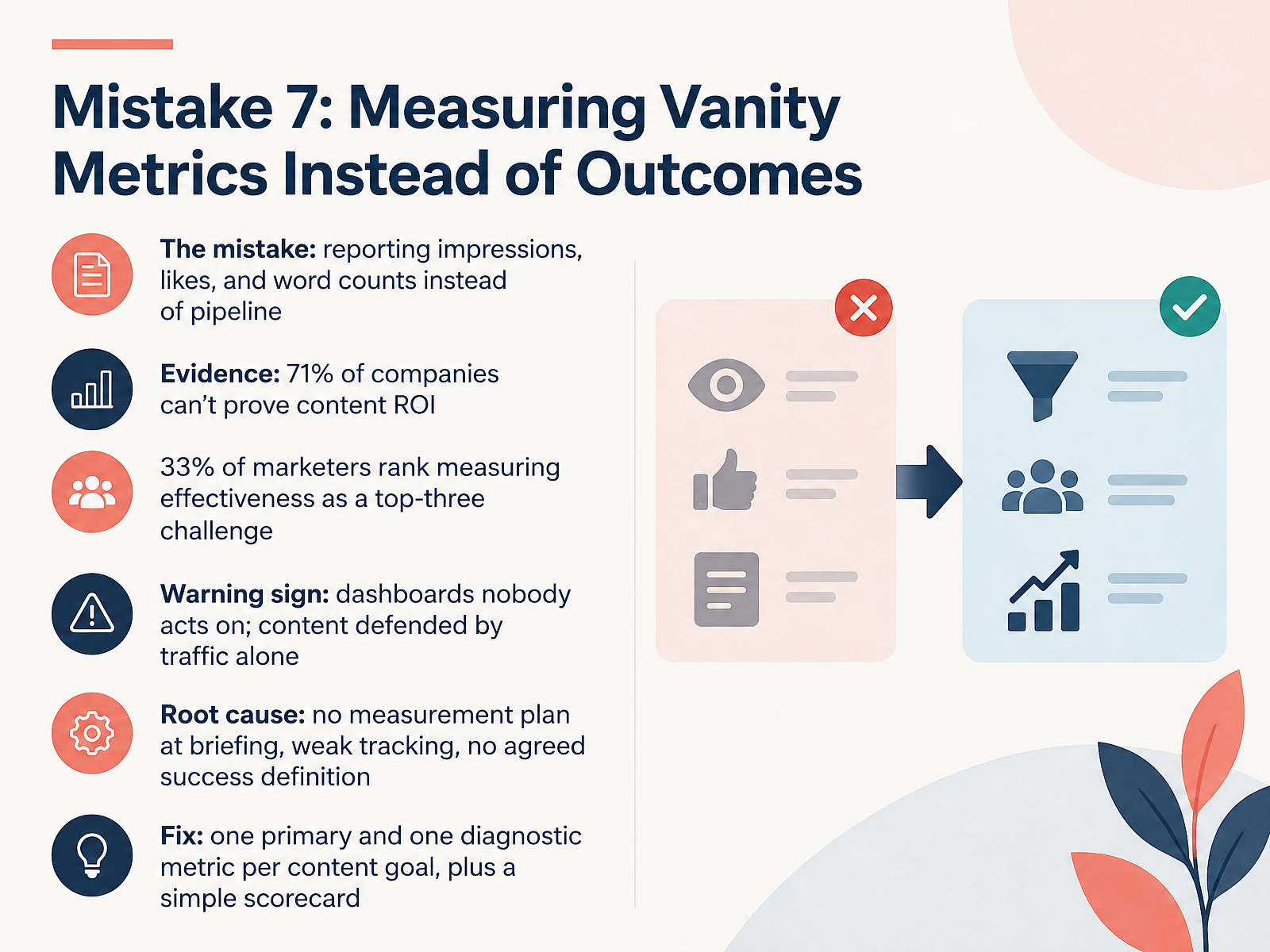
- 09Mistake 7: Measuring Vanity Metrics Instead of OutcomesNow let's talk about mistake seven: measuring vanity metrics instead of outcomes. Here's what tends to happen. A report goes out with impressions, likes, and word counts. Everyone nods. Nobody changes a decision. And when budget season arrives, the content gets defended on traffic alone. The numbers back this up. Seventy-one percent of companies can't prove content's return on investment. And thirty-three percent of marketers rank measuring effectiveness as a top-three challenge. A quick check you can run: does your dashboard have a decision attached to it? If not, it's decoration. The root cause is usually upstream. There's no measurement plan at the briefing, tracking is thin, and no one agreed on what success means. So fix it early. Define one primary metric and one diagnostic metric for each content goal, then put them on a simple scorecard. That's what turns a report into an argument you can defend. Next, mistake eight: treating AI visibility as a victory.
 contentmarketinginstitute.comcontentful.bynder.comzmistandcopy.com+22 min
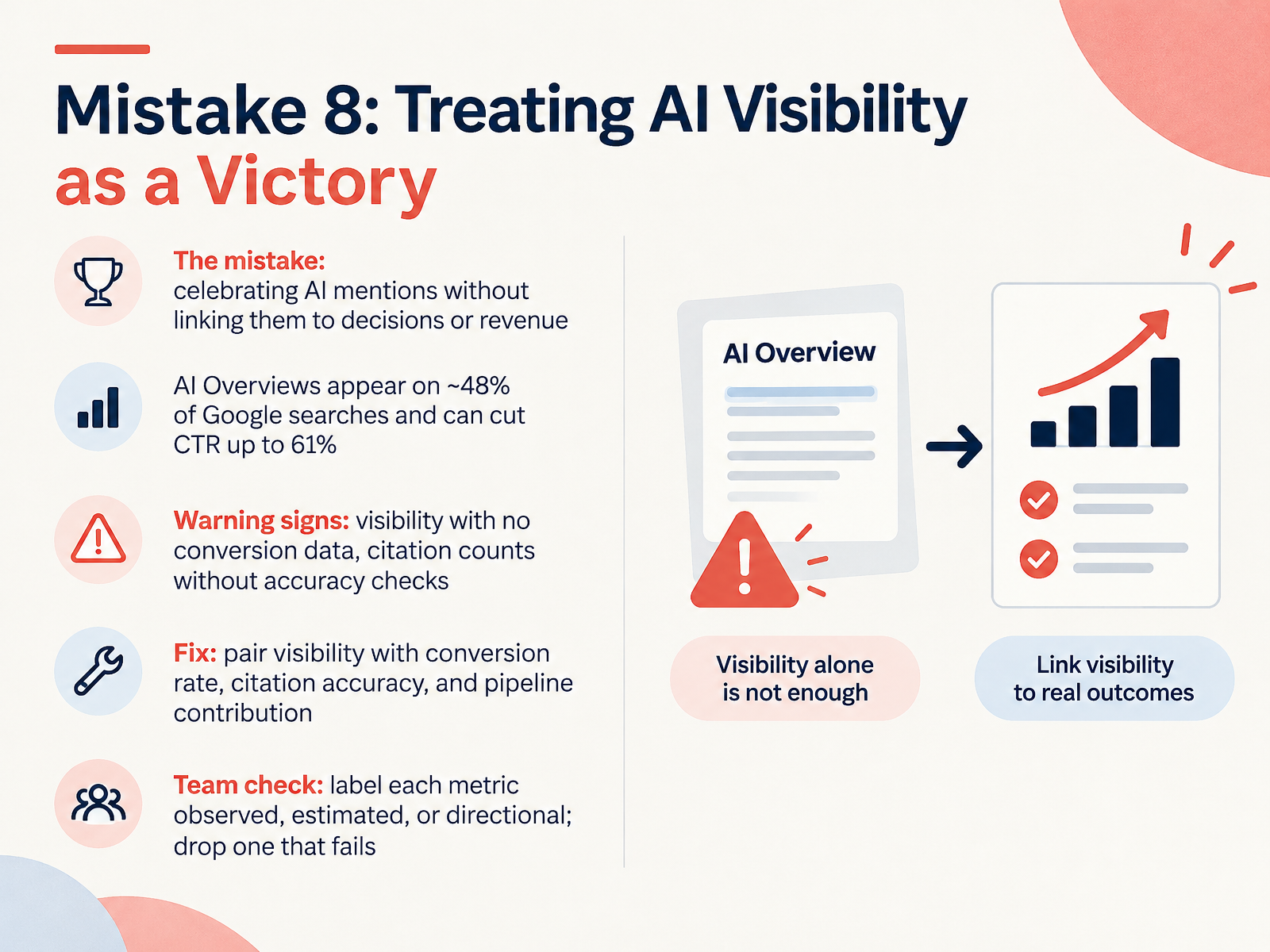
- 10Mistake 8: Treating AI Visibility as a VictoryNow here's Mistake Eight, treating AI visibility as a victory. This is where a lot of small teams get stuck. A brand shows up in AI answers, the number climbs, and the room feels good. But if nobody connects that mention to a decision or a dollar, you're celebrating a screenshot, not a result.
Here's what tends to happen. AI Overviews now appear on roughly forty eight percent of Google searches, and they can cut click through rates by as much as sixty one percent. So visibility rose while traffic fell, and the dashboard still looked great.
A quick check you can run for warning signs. Do you have visibility numbers with no conversion data next to them? Do you have citation counts and no accuracy check? If so, pause there.
The fix is to pair visibility with three things: conversion rate, citation accuracy, and pipeline contribution. Then label every metric as observed, estimated, or directional. And drop one metric that fails the test. Just one.
Next, Mistake Nine: Scaling AI Without Editorial Control.
 contentmarketinginstitute.comcontentful.bynder.comzmistandcopy.com+22 min
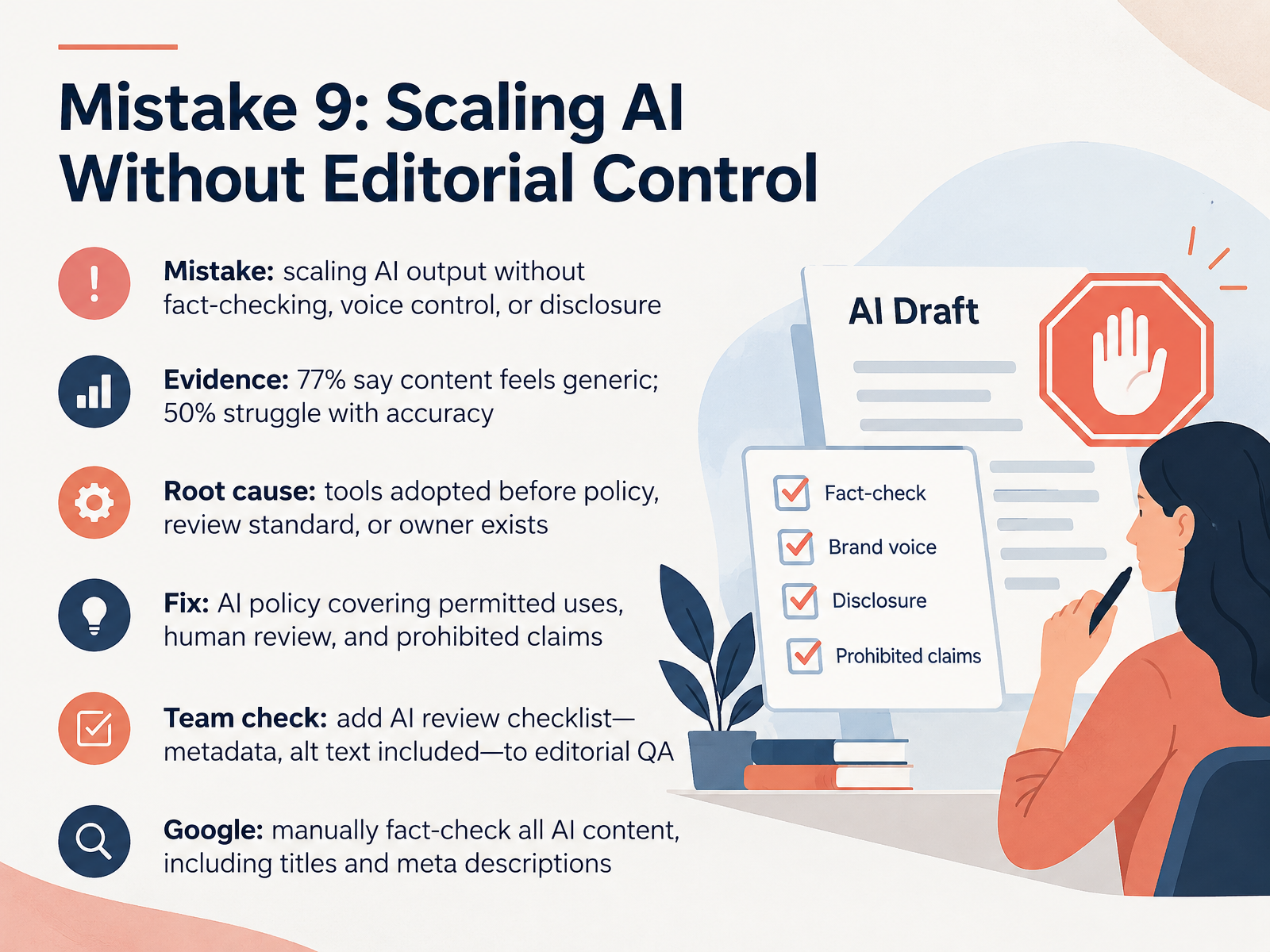
- 11Mistake 9: Scaling AI Without Editorial ControlNext, let's look at mistake nine. Scaling AI output without editorial control. Here's what tends to happen. A team finds a tool that drafts fast, output volume climbs, and nobody owns the review. Fact-checking, voice, and disclosure all get skipped. The cost is real. Seventy-seven percent of people say content feels generic, and half struggle with accuracy. The root cause is almost always sequencing. Tools got adopted before a policy, a review standard, or an owner existed. So the fix is a short AI policy. Spell out permitted uses, require human review, and list prohibited claims. Then run a quick check. Add an AI review checklist to your existing editorial QA, and include metadata and alt text, not just body copy. Google's guidance is plain here. Manually fact-check all AI content, including titles and meta descriptions. Pause there. One checklist, one owner, and you keep the speed without losing control. What Google now expects from AI-assisted content comes next.
 seos.coarticles.backlinkworks.comcontentraptor.com+22 min
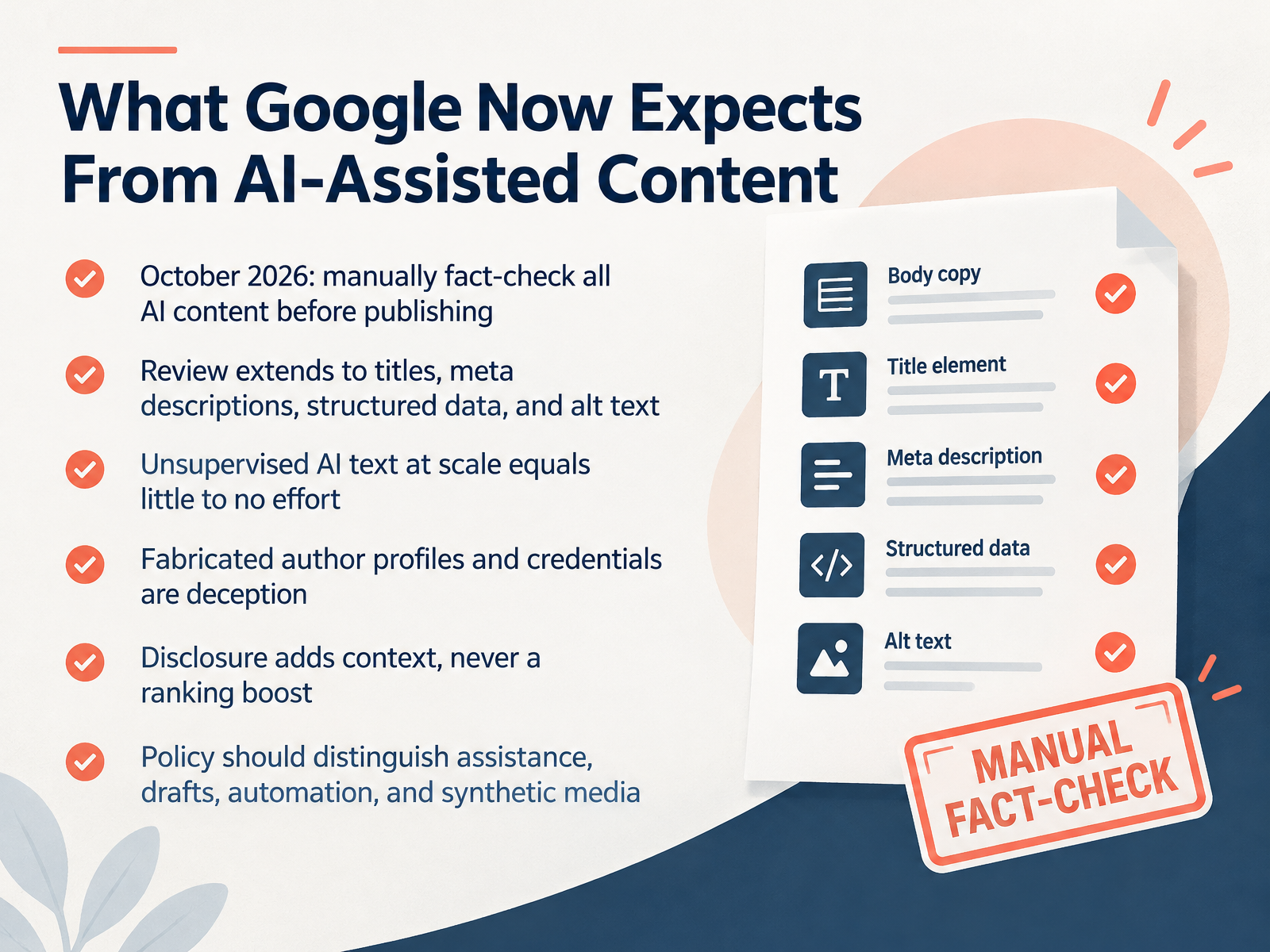
- 12What Google Now Expects From AI-Assisted ContentNow let's cover what Google expects from AI-assisted content. As of October 2026, Google says it's critical to manually fact-check and review all AI-generated content before publishing. Here's the part small teams miss. That review extends to titles, meta descriptions, structured data, and alt text, because those fields reach Search results directly. A wrong price in your schema, or a made-up claim in a meta description, sits outside the guidance even if the article itself is solid. A quick check you can run: pull a recent batch and verify every metadata field by hand, not just the body copy. And note the flip side. Unsupervised AI text at scale counts as little to no effort, so volume alone won't help you. Fabricated author profiles, AI headshots, made-up names, false credentials, those are deception, and deception makes a page untrustworthy. Disclosure adds context about how content was made. It never gives you a ranking boost, so keep the two separate in your policy. One more thing: your policy should clearly distinguish assistance, drafts, automation, and synthetic media. Next, Mistake 10: Letting Content Debt Accumulate.
 2 min
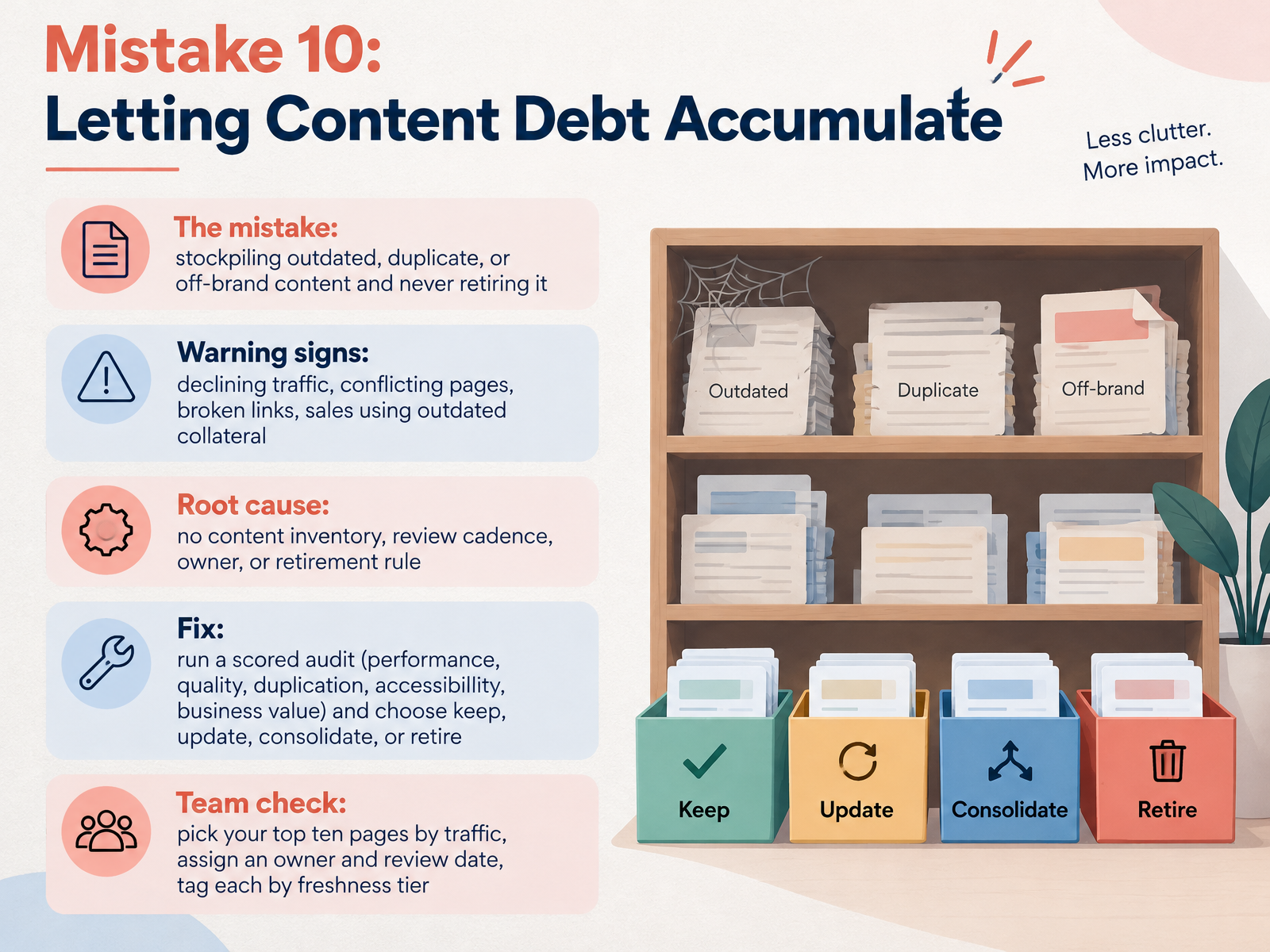
- 13Mistake 10: Letting Content Debt AccumulateLet's talk about mistake ten, letting content debt accumulate. That's when you stockpile outdated, duplicate, or off-brand content and never retire it. Here's what tends to happen. Old pages start competing with new ones, links break, traffic slips, and sales ends up sharing collateral that no longer matches your product. The root cause is usually simple: no content inventory, no review cadence, no owner, and no retirement rule. The fix is a scored audit. Rate each page on performance, quality, duplication, accessibility, and business value. Then choose one of four actions: keep, update, consolidate, or retire. A quick check you can run this week: pull your top ten pages by traffic, assign an owner and a review date to each, and tag them by freshness tier. That small step starts clearing the debt.
Next, let's build your 30-day prevention playbook.
 2 min
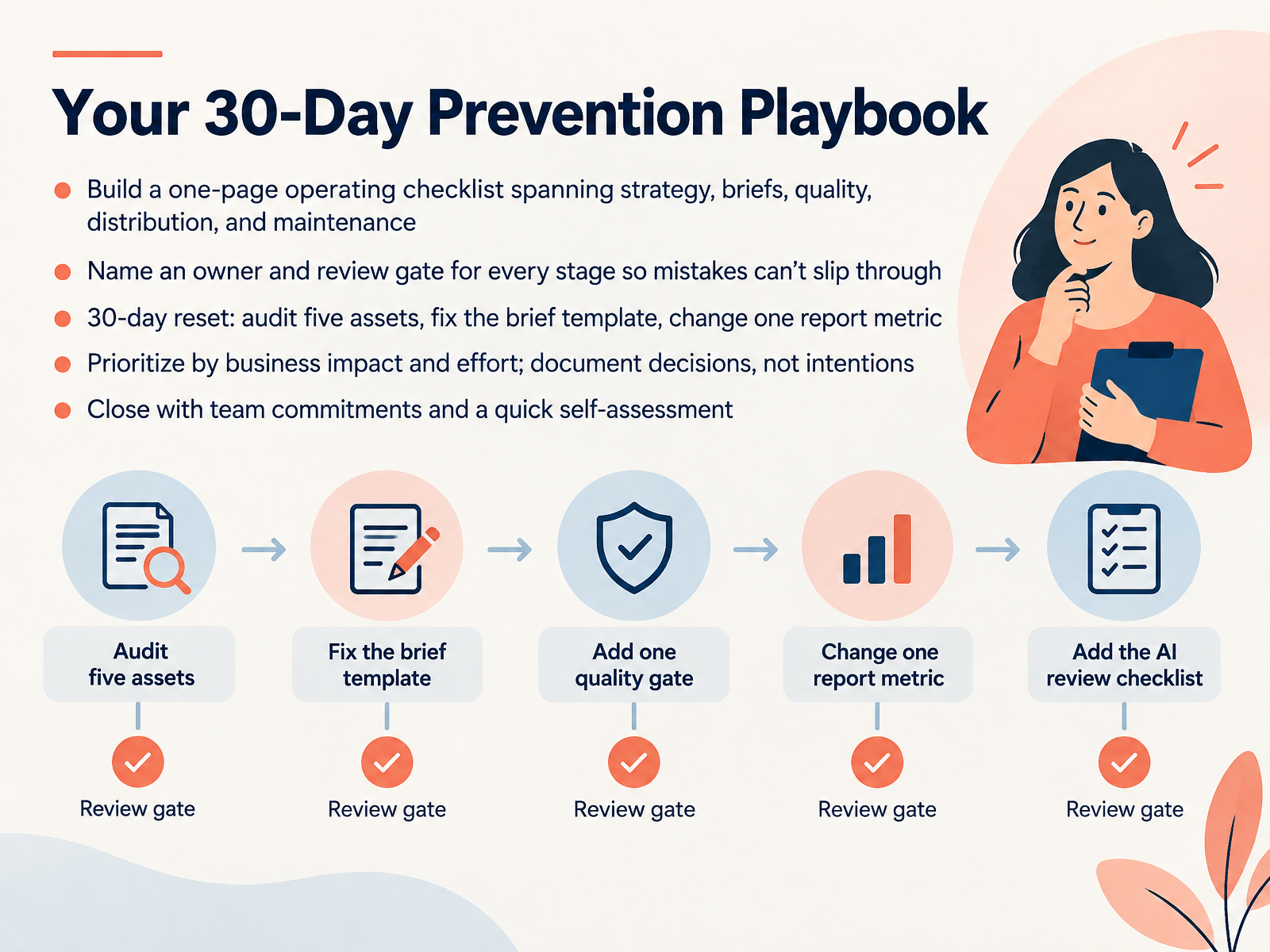
- 14Your 30-Day Prevention PlaybookLet's close with something you can actually run. Build a one-page operating checklist that covers strategy, briefs, quality, distribution, and maintenance. Then name an owner and a review gate for every stage, so a weak brief or a skipped quality check can't slip through unnoticed. Here's what tends to happen on small teams: sixty-five percent have a documented workflow, yet many still ship work they know isn't good enough. So make the checklist decide, not the loudest voice in the room. For your thirty-day reset, audit five assets, fix the brief template, and change one report metric. Prioritize by business impact and effort, and document decisions, not intentions. One quick self-assessment: can you point to the owner and gate for every stage? If yes, you're ready. Thank you for walking through this with me. You now have a practical playbook, so pick your first fix this week, and keep going. You've got this.
 contentmarketinginstitute.comcontentful.bynder.comzmistandcopy.com+22 min
Take the deck with you
Download this course as a file — free, no sign-up needed.
- PDF handoutEvery slide page, ready to print or share.15 pages · 3.5 MBDownload
- Narrated PowerPointThe deck that presents itself — every slide carries the digital human's narration video.15 pages · 13.7 MBDownload
- PowerPoint slidesThe full deck as a .pptx — open it in PowerPoint, Keynote, or Google Slides.15 pages · 3.4 MBDownload
Free to use in your own training — please keep the PersonWise credit page at the end.
Have your own deck? Turn it into a course
Sources consulted
Web sources consulted while building this course.
- B2B Content and Marketing Trends: Insights for 2026 — contentmarketinginstitute.com
- 202 B2B SaaS Content and Website Performance Benchmarks — contentful.bynder.com
- The 2026 B2B Content Report: Everyone Publishes More. Few Have Something to Say — zmistandcopy.com
- 10 B2B Content Marketing Stats from Contentoo's Report — contentoo.com
- 2026 B2B Content Marketing Survey Report - Surveyz — surveyz.io
- https://www.relato.com/blog/why-content-strategies-fail — relato.com
- Content Strategy Mistakes That Waste Budget — themarketingjuice.com
- When Does a Content Strategy Fail? 11 Factors to Blame — searchenginejournal.com
- How to Do Better Content Marketing: Understanding Your Target Audience — 24337018.fs1.hubspotusercontent-na1.net
- How to Build a Content Marketing Strategy in 10 Steps — content-managers.com
- Content SEO Mistakes to Avoid in 2026 — seos.co
- Common Search Intent Marketing Mistakes That Hurt Conversions - SEO Insights — articles.backlinkworks.com
- How to Fix Search Intent Mismatch When Your Content Will Not Rank | Content Raptor — contentraptor.com
- User Intent | The 4 Search Intent Types in SEO | Egochi — egochi.com
- Keyword intent: What it is and how to use it for SEO in 2026 — contentpen.ai
- Editorial Workflow Mistakes: 10 Problems That Slow Down Content Teams | Narranta — narranta.com
- How to Audit Your Content Briefs Before It Becomes a Problem - Growth Rocket — growth-rocket.com
- How to Reduce Content Revision Cycles Without Sacrificing Quality | TeamBench — teambench.ai
- The Agency Playbook for Sustainable Content Briefs - Growth Rocket — growth-rocket.com
- The Briefing Process That Halved Our Content Production Time — nicodigital.com