Content Brief Creation Guide
Begin
13 pages · ~26 min
Content Brief Creation Guide
Learn to create effective content briefs that align stakeholders and streamline content production for marketing teams.
What you’ll learn
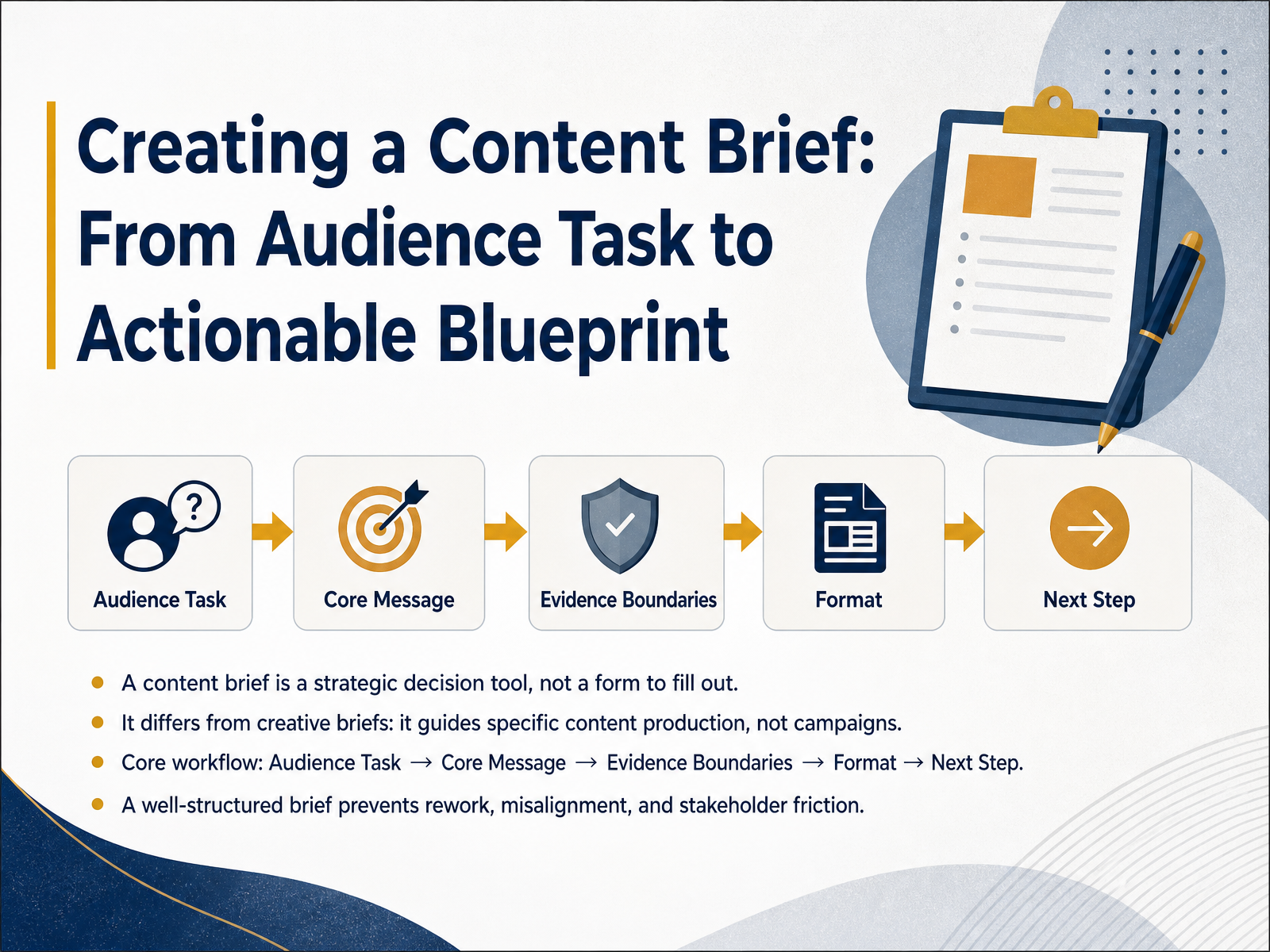
- 01Creating a Content Brief: From Audience Task to Actionable BlueprintWelcome. Today we're going to learn how to build a content brief that turns a messy idea into an actionable blueprint. Think of a content brief as a strategic decision tool. It is not a form you just fill out. You want to avoid confusion here: a content brief differs from a creative brief. Creative briefs guide campaigns, visuals, and big ideas. A content brief guides the production of a single piece of content. Our core workflow moves from the Audience Task directly to the Core Message, then sets clear Evidence Boundaries, locks in the Format, and finally defines the Next Step. When you structure your brief this way, you prevent rework, stop misalignment before it starts, and eliminate friction with stakeholders. The writer gets exactly what they need, and your review cycles drop dramatically. Let's move on and break down how this tool functions as a true strategic decision-maker.easycontent.ioblog.hubspot.comclickup.com+22 min
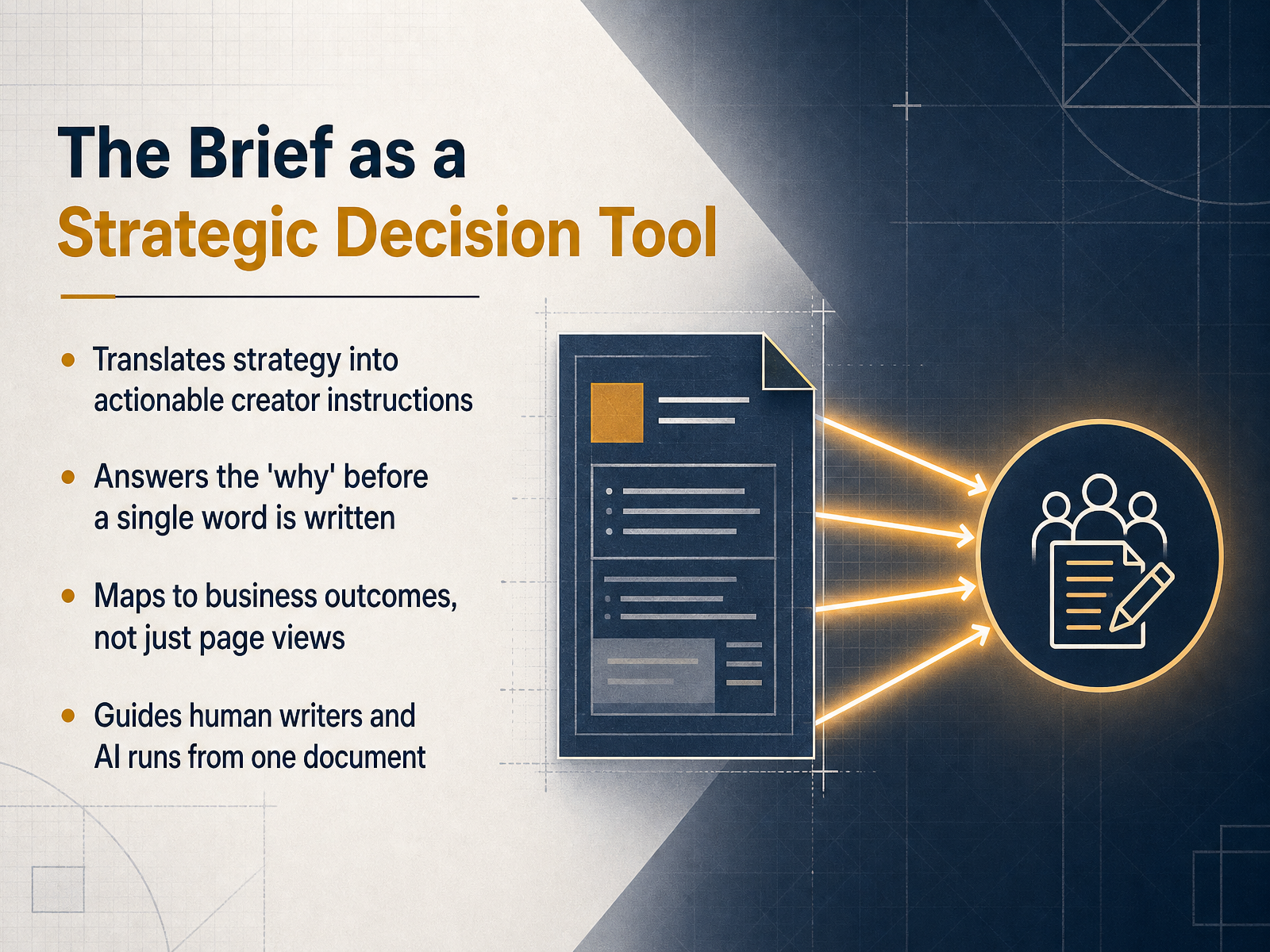
- 02The Brief as a Strategic Decision ToolNow, let's talk about the brief itself. It is not a form to fill out. It is your primary strategic decision tool. Think of it as the document that translates a high-level marketing idea into concrete, actionable instructions for whoever is creating the content. Whether that is a human writer or an AI model, the brief answers the critical 'why' questions before a single word of copy is written. This means it maps directly to business outcomes, like qualified leads or trial sign-ups, not just empty page views. Critically, in a modern workflow, we design one brief to govern both our human team and our AI generation runs from a single source of truth. This symmetry is what prevents chaos. Moving forward, we will break down exactly how to build this contract, starting with the very first field: defining the audience task and what job they are hiring this content to do.
 digitalapplied.comslatehq.comfokal.com+21 min
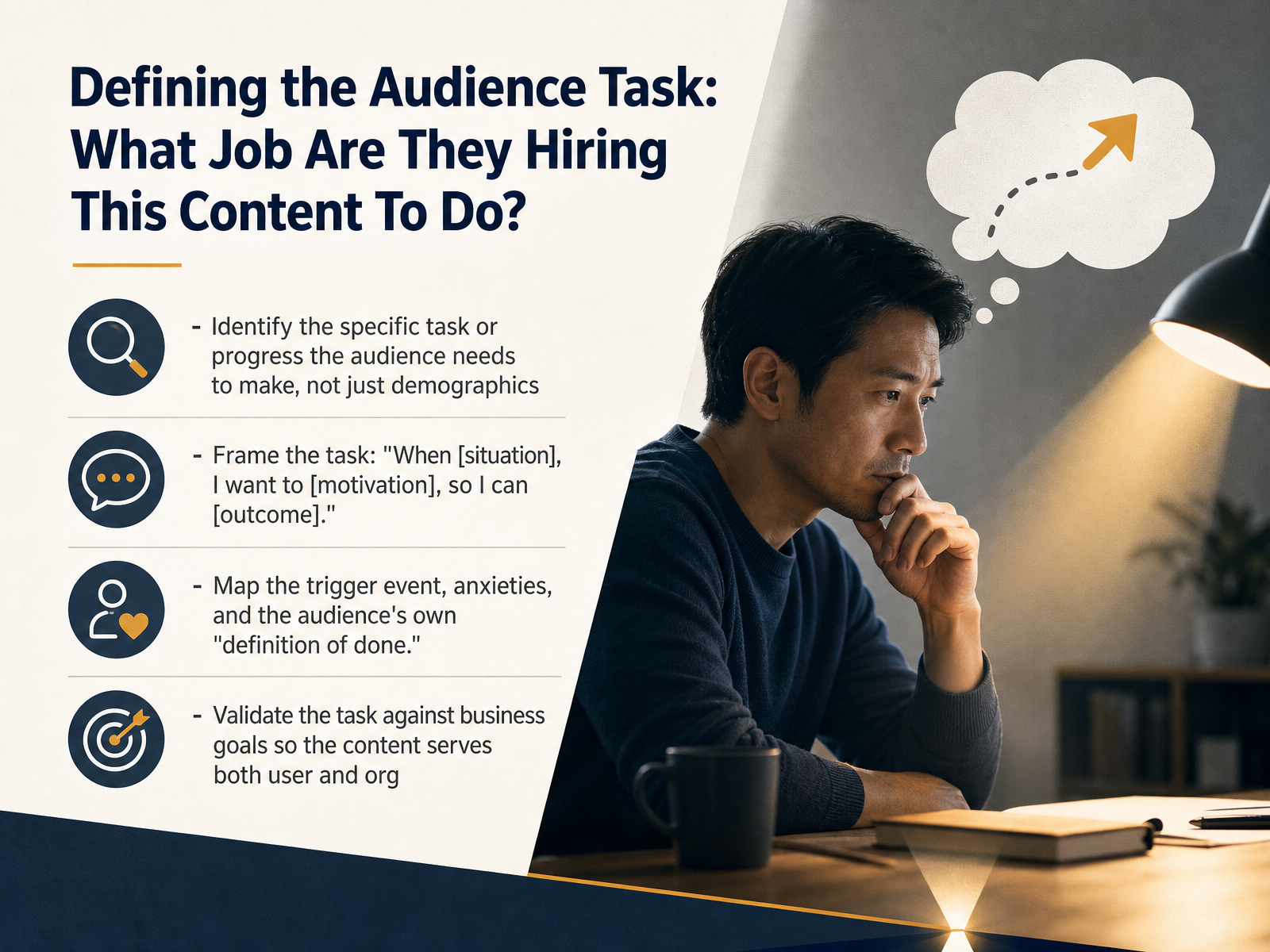
 - 03Defining the Audience Task: What Job Are They Hiring This Content To Do?Now we get to the engine of your brief: defining the audience task. Forget demographics for a moment. We need to identify the specific job your audience is hiring this content to do. I want you to frame every task using a simple prompt: When I'm in a certain situation, I want a specific motivation, so I can reach a desired outcome. That single sentence forces clarity. For example, not just 'they need a guide,' but 'When I've just missed a third supplier payment deadline, I want a single dashboard of all my invoices, so I can stop apologizing.' That statement tells you exactly what to write. You'll map the trigger event that created this urgency, the anxieties stopping them from acting, and their personal definition of done. Finally, validate that task against your business goals. The content must serve the user's progress and the organization's objectives. If it does both, you have a task worth briefing. Next, let's turn that task into a memorable takeaway with 'Crafting the Core Message: One Big Idea to Remember.'
 lilachbullock.combroadplace.comcorzamarketing.com+21 min
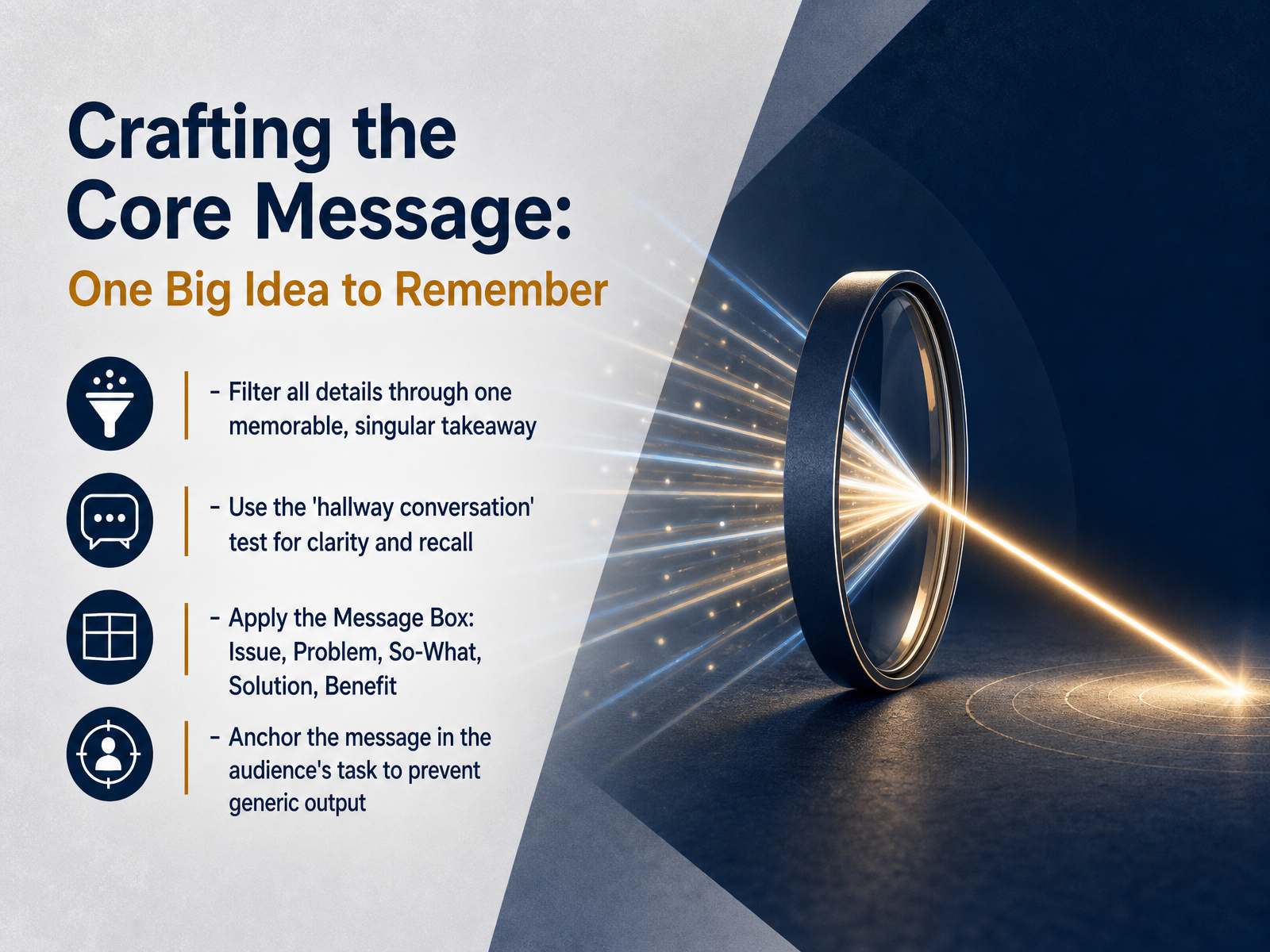
 - 04Crafting the Core Message: One Big Idea to RememberNow, let's give that core idea real shape. The goal here is to distill everything you know into one single, memorable takeaway. A good test is what I call the hallway conversation. If you rode the elevator with your audience after the meeting, could you state your main point before the doors opened? If not, your message isn't sharp enough yet. A practical tool to get there is the Message Box. This framework forces you to sort through the noise by answering five prompts. You start with the broad Issue, then define the specific Problem you're solving. The most critical part is the 'So What?' — why should your audience care right now? Then you list your Solution, and finish with the Benefit of taking that action. To prevent a generic output, always anchor your message in the audience's task. For example, if your audience builds software, your 'So What' must connect directly to their speed or their code quality, not to abstract theory. Over the next few slides, we'll build out the structure around this core idea, starting with how to set your evidence boundaries.
 compassscicomm.orgcompassscicomm.orgiodigital.com+22 min
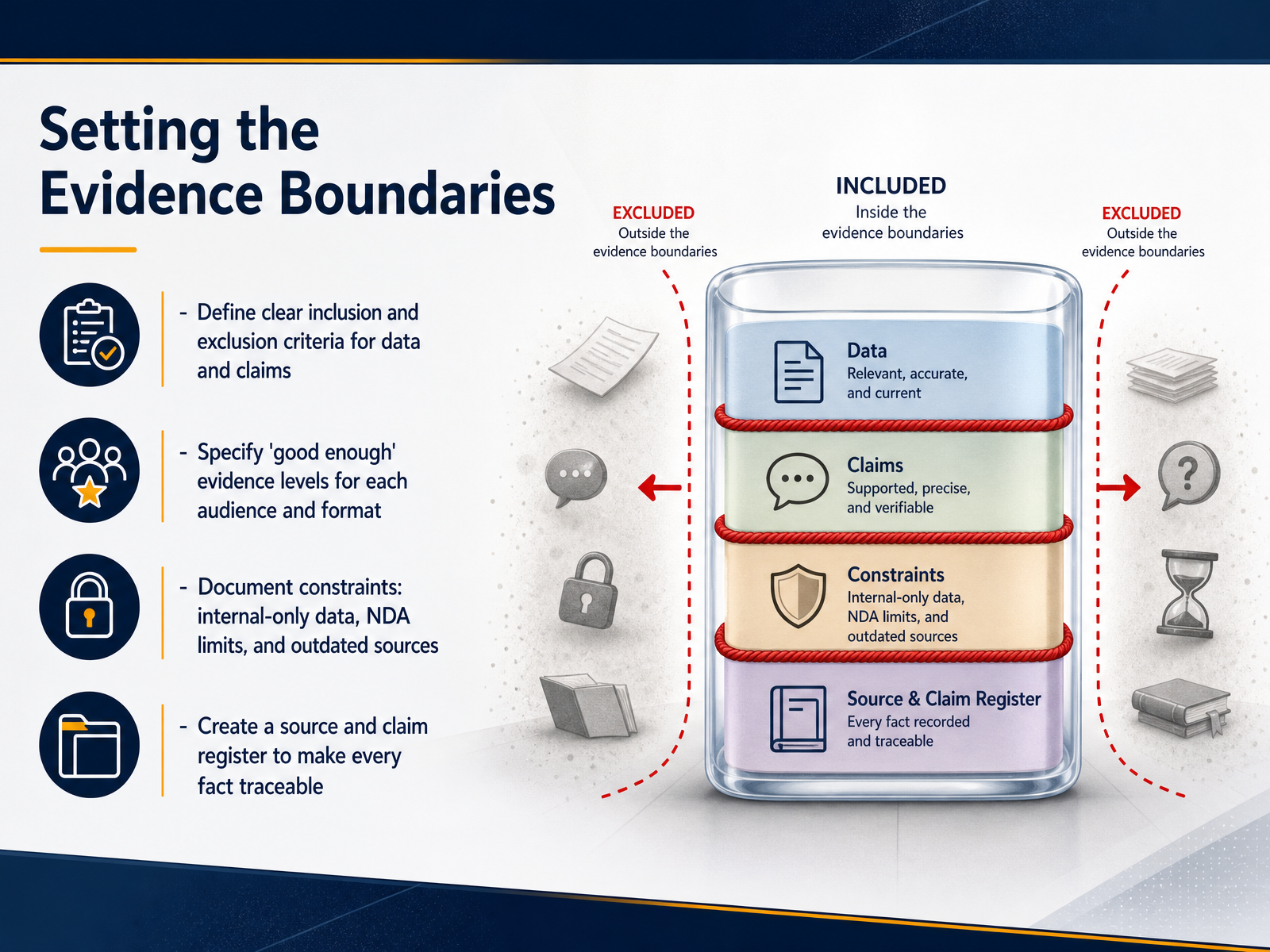
 - 05Setting the Evidence BoundariesLet's talk about setting the evidence boundaries. This is where you protect the piece from weak claims. First, define clear rules for what information is allowed in and what is out. For example, you might decide to use only studies published after 2022. Then, specify what counts as good enough evidence for each audience. An engineer reading a technical white paper needs primary research. A busy executive scanning a summary might only need a single, well-sourced industry stat. Next, document your constraints. If your NDA prohibits sharing certain internal data, or if a source is outdated, state that explicitly so the writer doesn't reach for it. Finally, create a living source and claim register. This makes every fact traceable by linking each key statement back to its original document or data set. It transforms the draft from a collection of opinions into a defensible asset. Now, once you've defined your evidence boundaries, the next step is figuring out how to present it all by choosing the right format.
 digitalapplied.comslatehq.comfokal.com+21 min
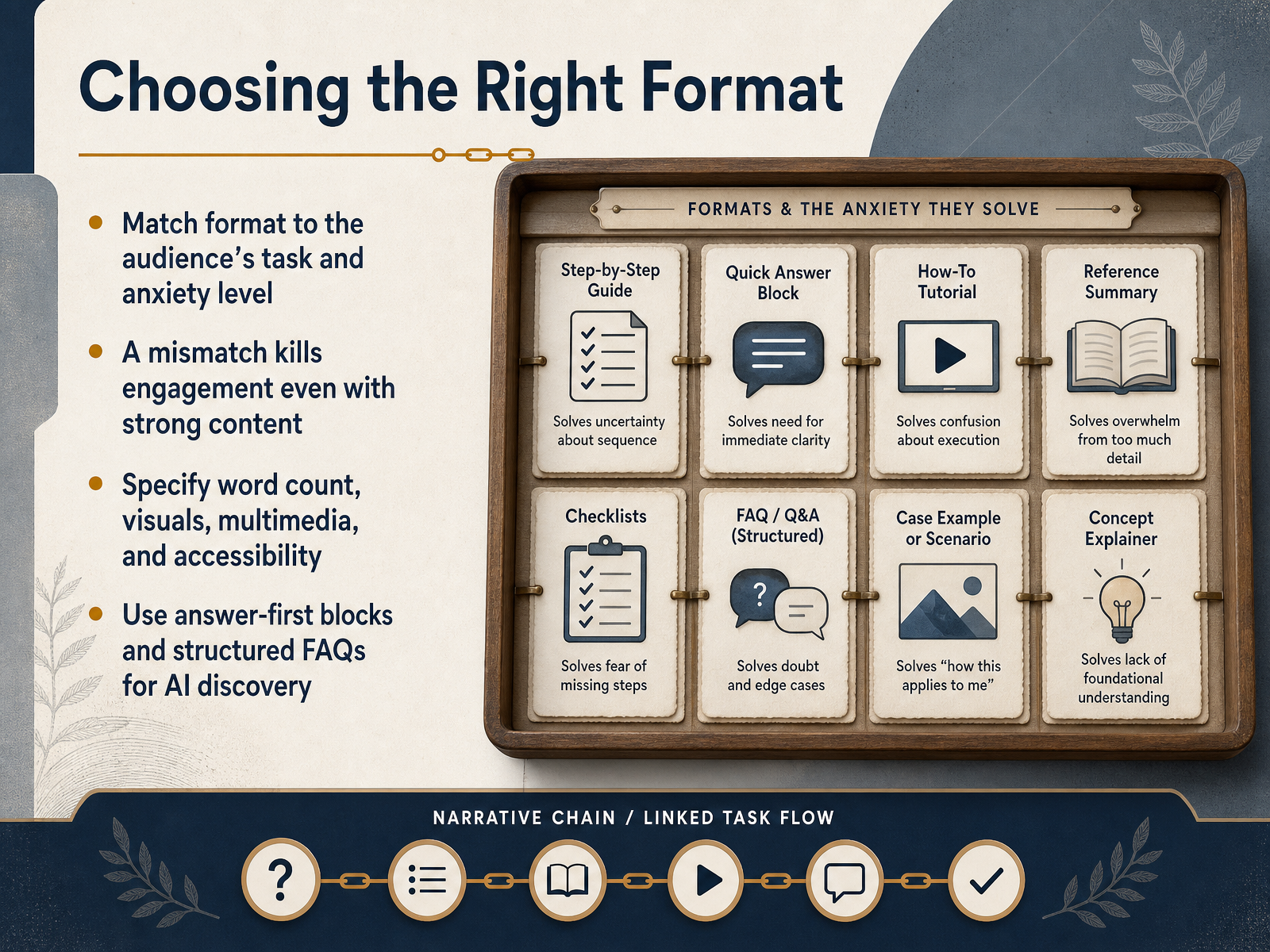
 - 06Choosing the Right FormatFormat is not just a container. It is a solution to the audience's anxiety level. A mismatch here kills engagement, even with the best evidence. We match the format to the task. When someone is panicking because they just missed a supplier payment deadline, they are not hiring a 2000-word think piece. They are hiring a scannable checklist or a short video that gives them control in sixty seconds. On the other hand, a slow-burn comparison job, where they are evaluating options over weeks, requires a detailed guide with proof points. Specify your word count, multimedia, and accessibility requirements upfront. And to win in AI-powered discovery, we use answer-first blocks. Put the definition or the direct answer right at the top, paired with structured FAQ sections. This helps a search engine cite you instantly. Let's move on to designing the specific action that follows this content in 'Articulating the Next Step: Designing for Action'.
 lilachbullock.combroadplace.comcorzamarketing.com+22 min
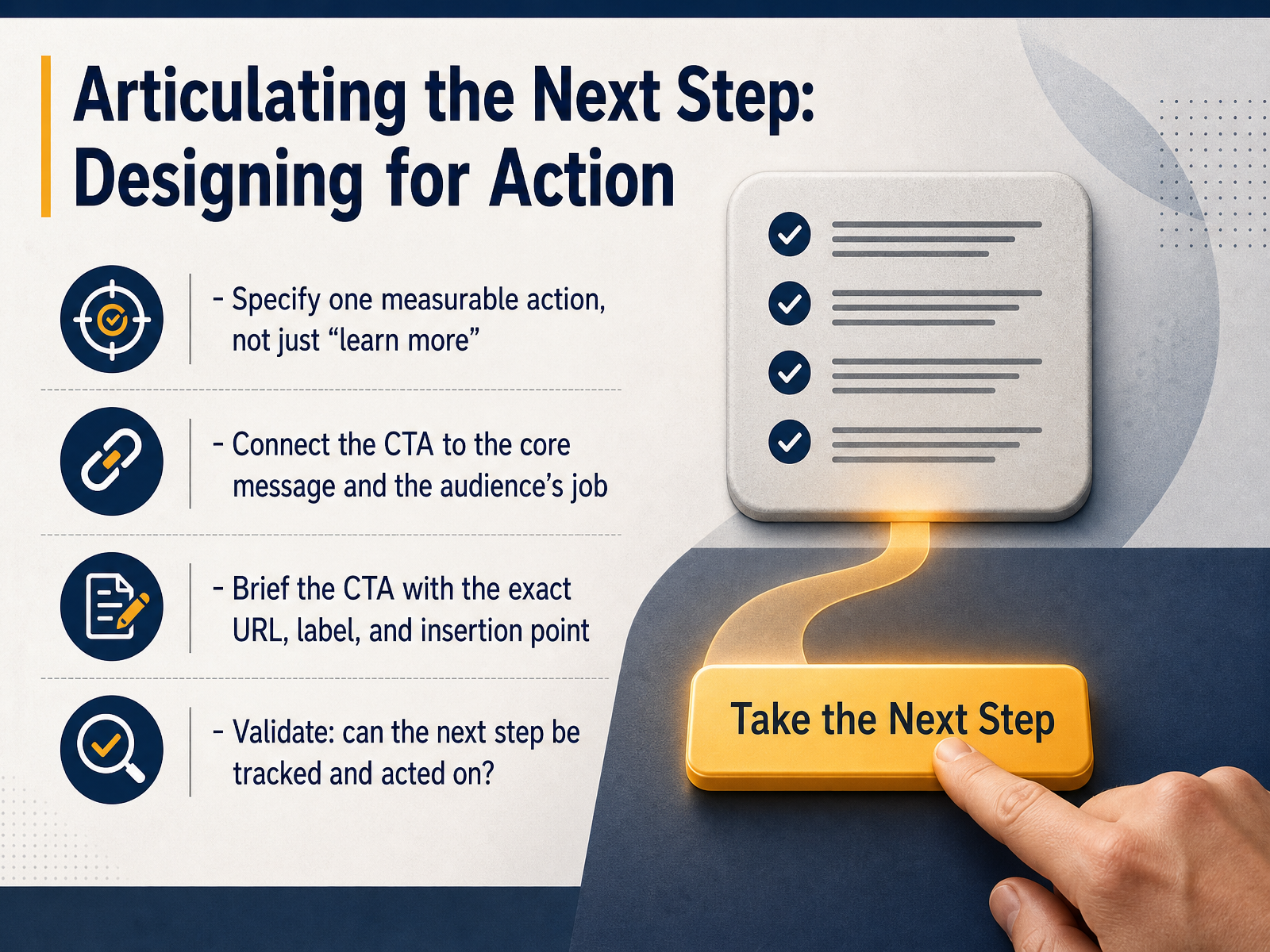
 - 07Articulating the Next Step: Designing for ActionNow let's get practical about the call to action, which I'll call the "next step." The biggest mistake is telling someone to "learn more." That's not an action. You need one specific, measurable action. For example, "Download the ROI calculator" or "Start your free trial." It must be trackable. Next, connect this action directly to your audience's job and your core message. If the reader's job is to justify budget to their boss, the next step shouldn't be a generic demo. It should be a one-page PDF they can forward, with a button that says "Send to my CFO." In your brief, spell this out exactly. You require the precise URL, the exact button label, and the exact spot in the article where the button sits—maybe right after the pricing comparison section. Then, validate it. Ask yourself, can you track this in your analytics? Can the reader act on it right now? If the answer is no, rewrite the brief. That's how you turn a passive reader into a qualified lead. Next, let's look at the structural anatomy of an executable brief.
 lilachbullock.combroadplace.comcorzamarketing.com+22 min
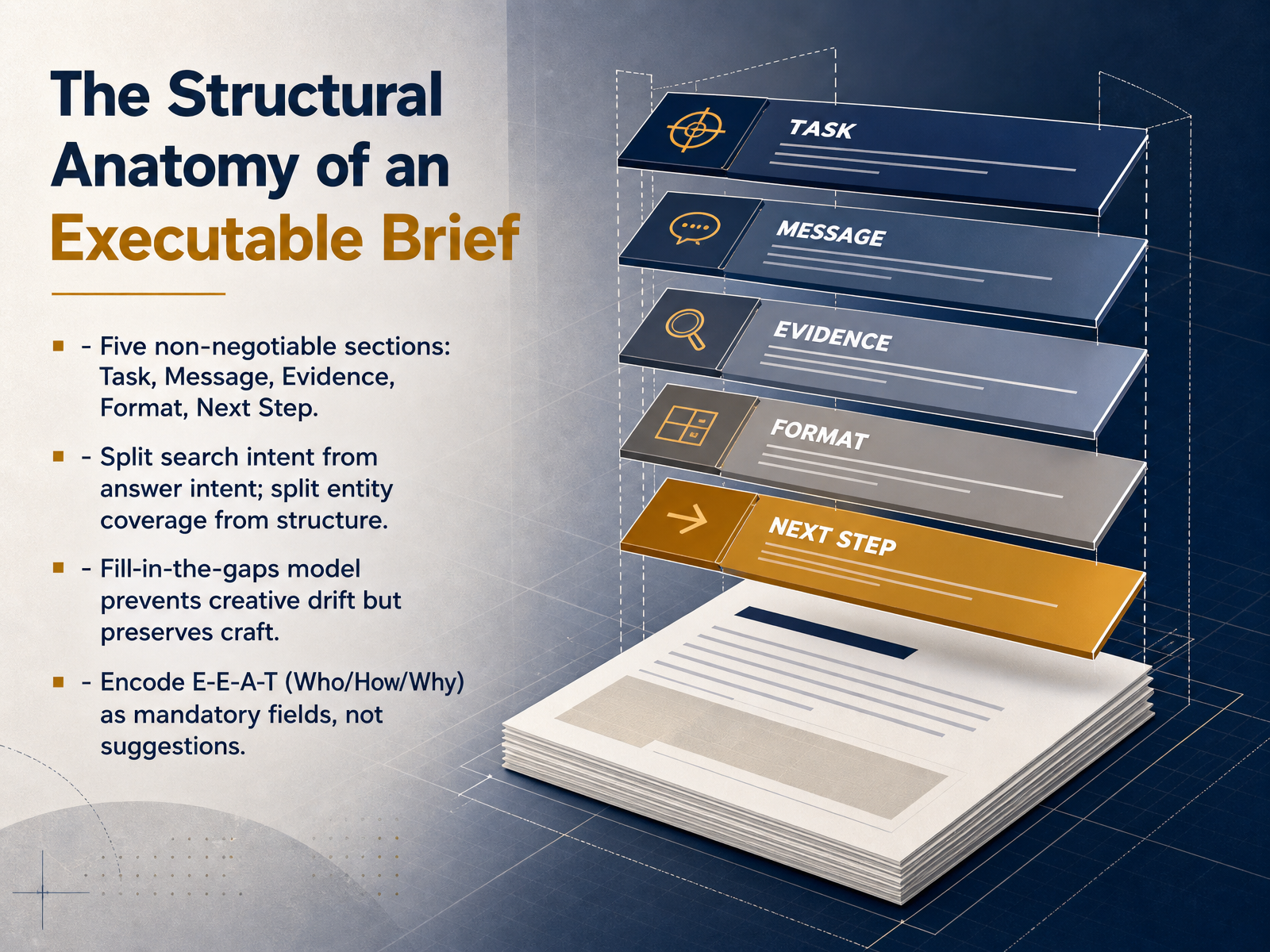
 - 08The Structural Anatomy of an Executable BriefLet’s look at the structural anatomy of a brief that actually builds a draft. I rely on five non-negotiable sections: Task, Message, Evidence, Format, and Next Step. If any one of these is missing, the writer fills the gap with guesswork—and that’s where revision cycles come from. Now, two specific splits stop creative drift. First, split search intent from answer intent. Search intent gets you into the SERP; answer intent wins the featured snippet and AI citation. Second, split entity coverage from structure targets. If you merge them, writers optimize for the countable thing—word count and heading count—and skip the harder job of achieving real topical depth. This fill-in-the-gaps model prevents drift but still protects your writer’s craft. Finally, encode E-E-A-T directly. Who, How, and Why are not style suggestions. They are mandatory fields: a named author with credentials, a disclosed production method, and a clear reader payoff. When those are blank, the brief is not done. Next, we will apply this anatomy by writing brief fields that actually drive execution.
 digitalapplied.comslatehq.comfokal.com+22 min
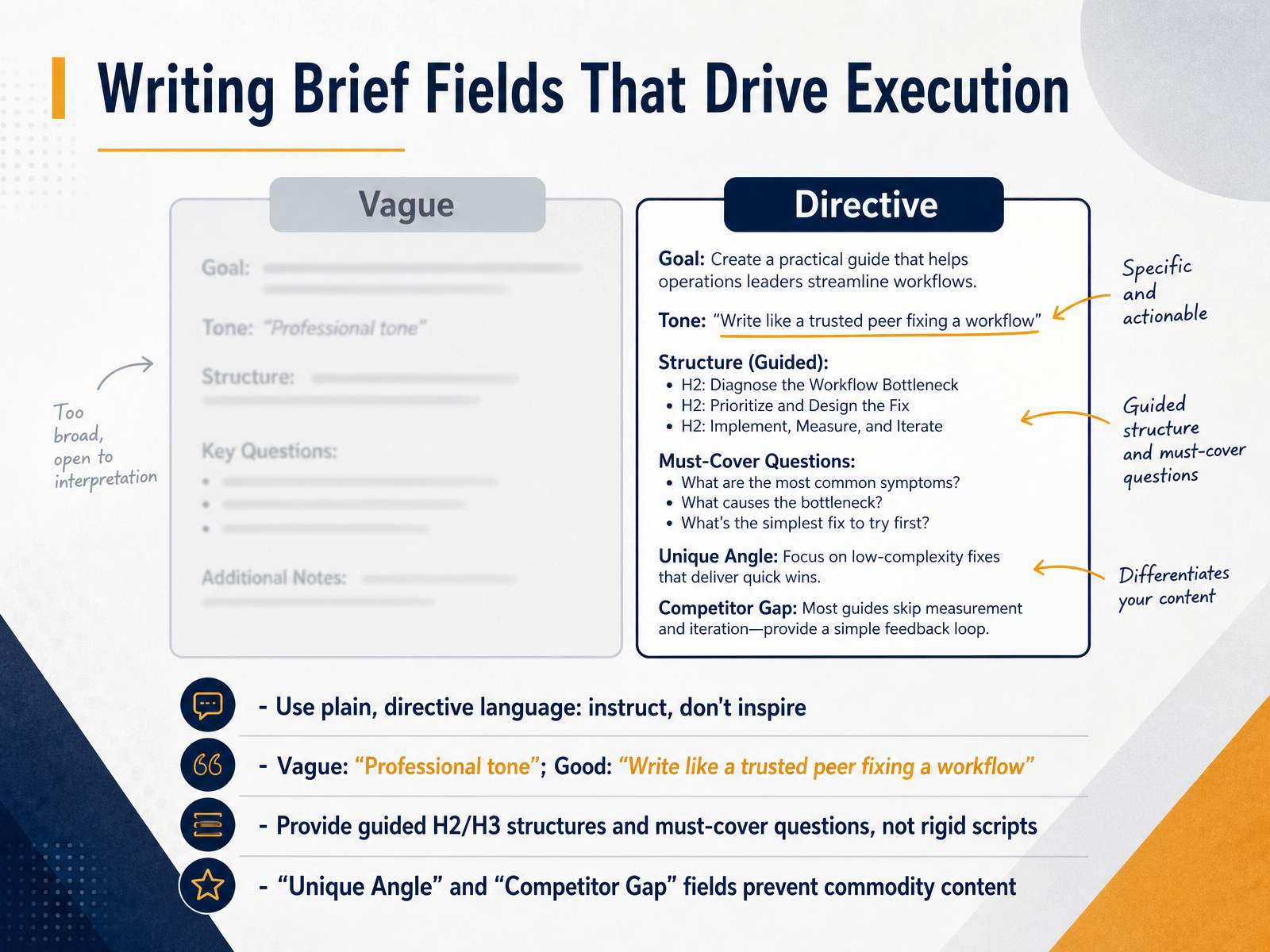
 - 09Writing Brief Fields That Drive ExecutionSo how do we actually fill in the brief fields so that a writer can execute without guesswork? The rule is simple: instruct, don't inspire. Your language needs to be plain and directive. Instead of writing a vague note like 'use a professional tone,' you give a concrete instruction like 'write like a trusted peer fixing a workflow.' That's clear. That's actionable. Next, provide guided structures instead of rigid scripts. Give your writer a set of must-cover questions and a recommended H2 and H3 skeleton, but don't dictate the final prose. This creates a logical path without stifling their expertise. Finally, to prevent commodity content, assign specific fields for the 'Unique Angle' and the 'Competitor Gap.' These two fields force the writer to articulate what's different about this piece. They must state what the competition missed and how we'll fill that void, which stops the draft from being just another generic article. Let's move on to the handoff and talk about creating a contract for quality.
 digitalapplied.comslatehq.comfokal.com+21 min
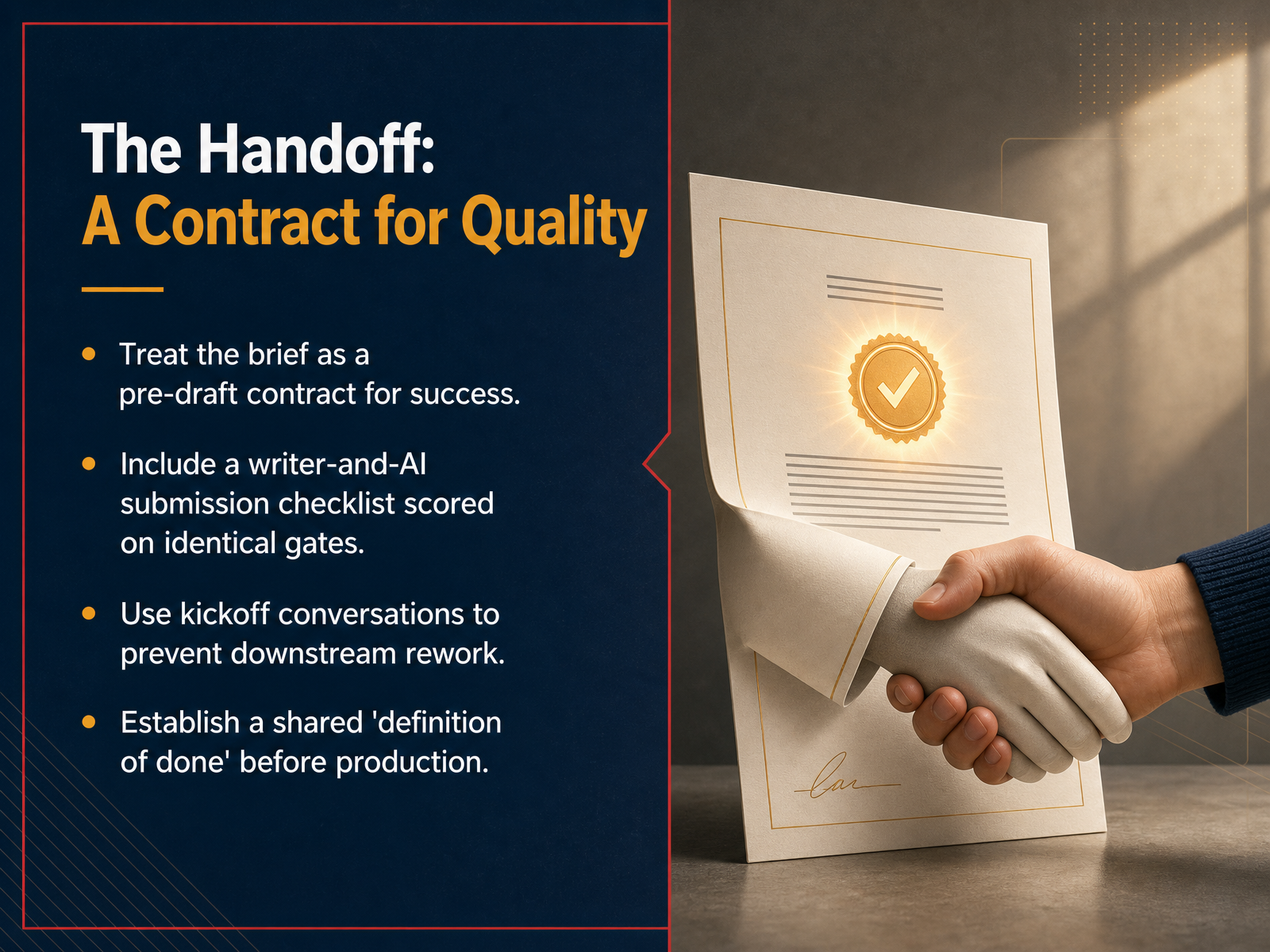
 - 10The Handoff: A Contract for QualityNow let's lock in quality before a single word is drafted. Think of your brief as a pre-draft contract. It sets shared expectations so you avoid painful revision loops later. Include a submission checklist that scores a writer and an AI-generated draft on the exact same gates. This symmetry keeps quality standards consistent, whether the first draft comes from a person or a model. Use the kickoff conversation to prevent downstream rework. Walk through the checklist, answer questions early, and clarify what each gate means before production begins. Most importantly, establish a shared definition of done. Agree on what good looks like for structure, source use, and E-E-A-T signals. When everyone signs off on the same finish line, you stop rediscovering quality standards fresh in every review. Next, let's harden that brief with a three-pass review model.
 digitalapplied.comslatehq.comfokal.com+21 min
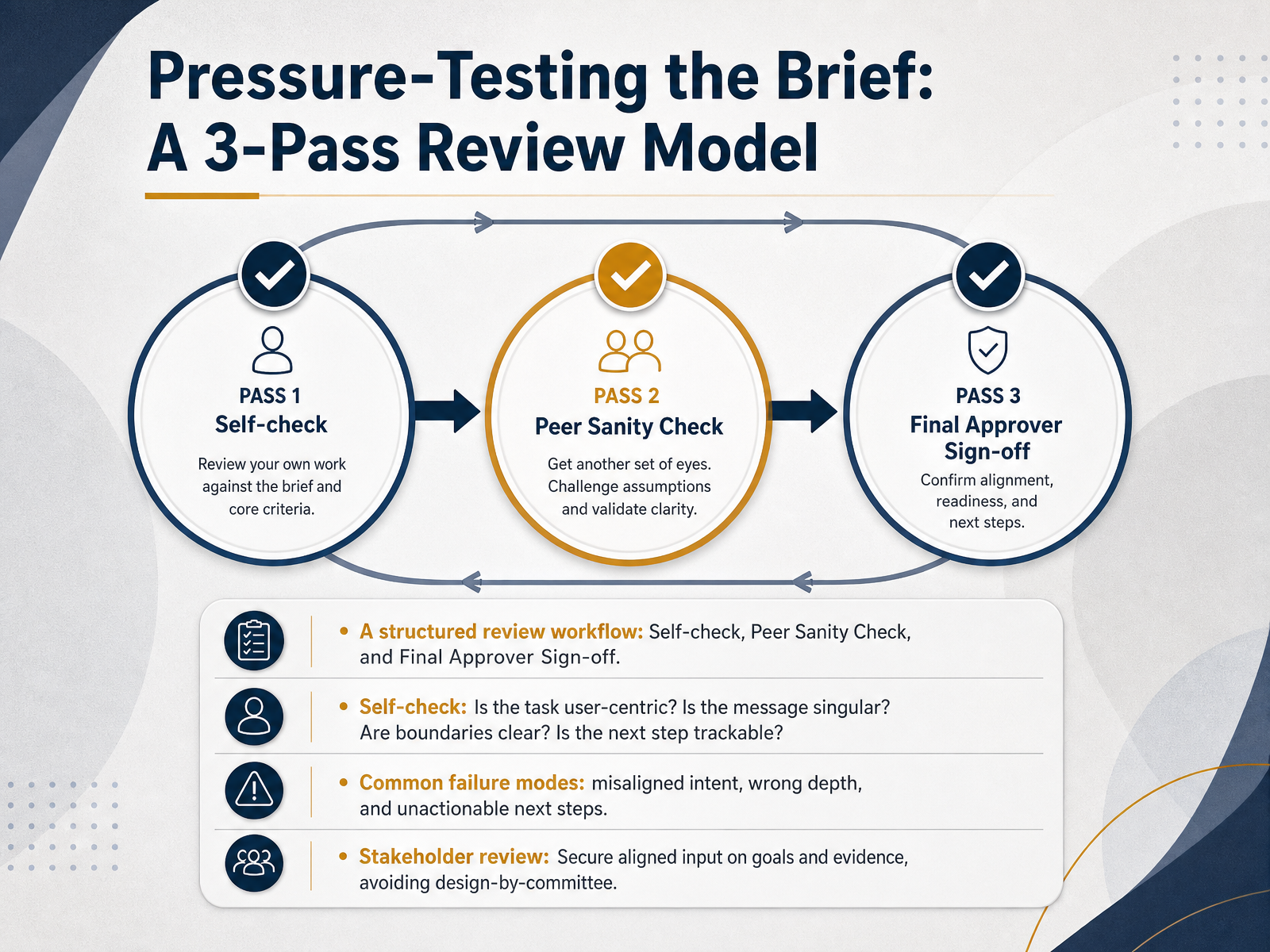
 - 11Pressure-Testing the Brief: A 3-Pass Review ModelBefore you hand off the brief, run a quick pressure test. Think of it as a three-pass review model. First, do a self-check. Ask yourself: is the task centered on the user? Is the core message singular? Are the boundaries clear, and is the next step trackable? If your brief says 'write about automation,' you've already failed. It has to say 'automate invoice reconciliation for small business owners.' Next, pass it to a peer for a sanity check. This is not design-by-committee. You want one colleague to confirm the goals and the evidence make sense to an outsider. Finally, the approver signs off. The most common failures I see here are misaligned intent, where the brief asks for a transactional page but the writer delivers an informational guide, wrong depth for the SERP, and unactionable next steps. If the CTA is 'learn more,' trash it. Make it 'book a demo' or 'download the checklist.' A brief that passes these three checks is a contract, not a suggestion. Now, let's take all of this theory and put it into practice. Next up: putting it into practice, from brief to finished content.
 easycontent.ioblog.hubspot.comclickup.com+22 min
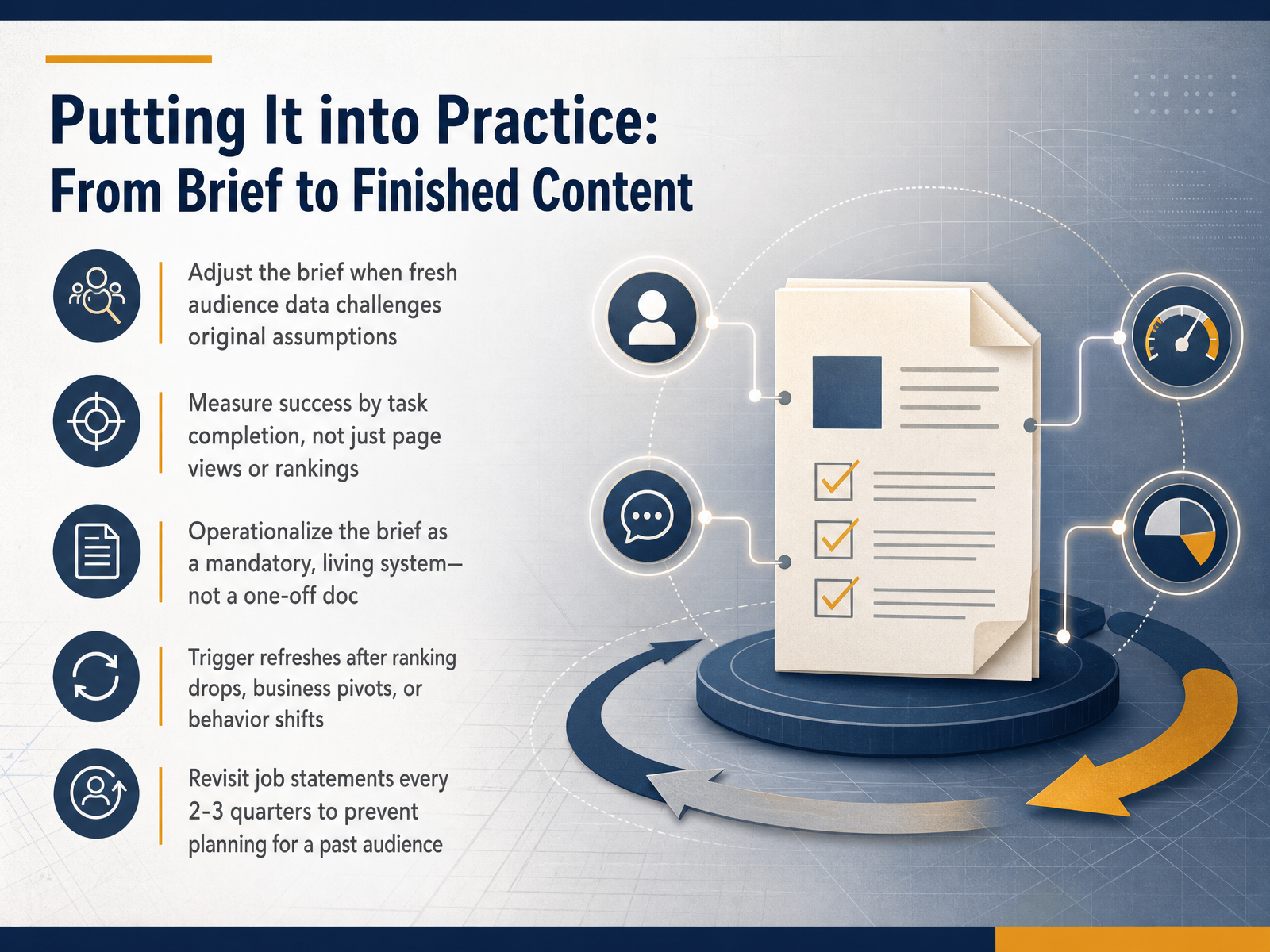
 - 12Putting It into Practice: From Brief to Finished ContentMoving into the operational side, this is where the brief stops being a document and starts driving the content engine. Your brief is never truly finished. When fresh audience data from support calls or sales interviews challenges your original assumptions, adjust the brief immediately. Do not wait for the next quarterly planning cycle. Measure success by task completion, not just page views or rankings. Did the reader actually get the job done? Track whether they moved to the next logical step, like a demo request or an implementation guide. To make this stick, operationalize the brief as a mandatory, living system. It should be the required starting point for every assignment, not a one-off doc created during a workshop. Trigger a full refresh after ranking drops, a business pivot, or a significant shift in user behavior. If your buyers have changed, your content must change with them. Finally, treat your job statements as perishable. Revisit them every two to three quarters to prevent planning content for a past audience. Let's wrap this up with our final exercise and key takeaways.
 lilachbullock.combroadplace.comcorzamarketing.com+22 min
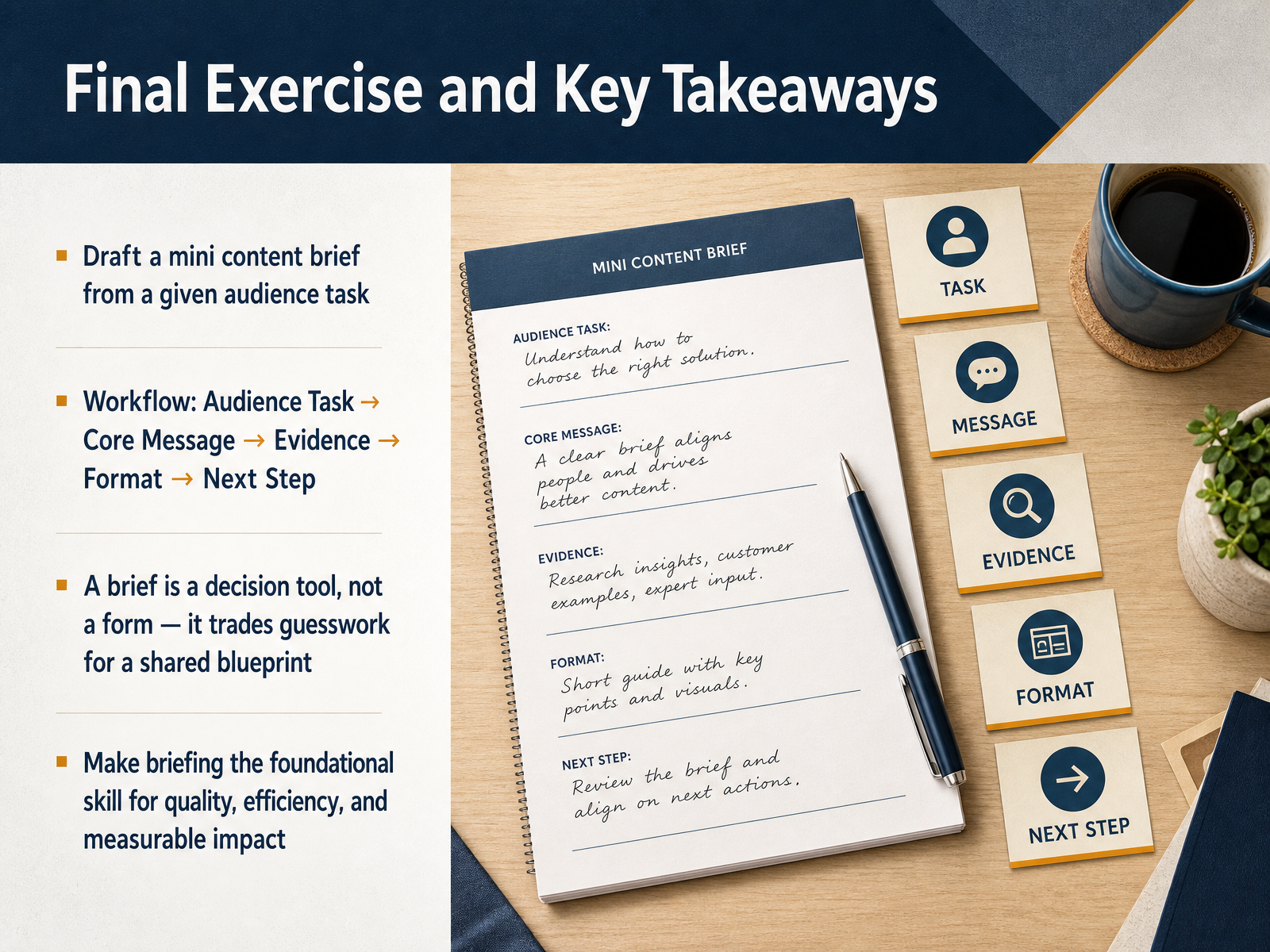
 - 13Final Exercise and Key TakeawaysNow, let's put the whole workflow into practice. We will take a real audience task and walk it through all five steps: from that task to the core message, the evidence boundary, the format, and the next step. Remember why we do this. A brief is a decision tool. It is not a form to fill out. It trades guesswork for a shared blueprint. When you master briefing, you build quality into the process before drafting starts. You stop revision loops before they happen. That is the foundational skill for efficiency and measurable impact. Thank you for investing this time. Go make your next brief the sharpest one you have ever written.
 easycontent.ioblog.hubspot.comclickup.com+21 min
Take the deck with you
Download this course as a file — free, no sign-up needed.
- PDF handoutEvery slide page, ready to print or share.14 pages · 4.1 MBDownload
- Narrated PowerPointThe deck that presents itself — every slide carries the digital human's narration video.14 pages · 12.4 MBDownload
- PowerPoint slidesThe full deck as a .pptx — open it in PowerPoint, Keynote, or Google Slides.14 pages · 4.1 MBDownload
Free to use in your own training — please keep the PersonWise credit page at the end.
Have your own deck? Turn it into a course
Sources consulted
Web sources consulted while building this course.
- Content Brief vs Creative Brief: Key Differences — easycontent.io
- How to Write a Content Brief [Template + Examples] — blog.hubspot.com
- How to Create a Content Brief (Template + Examples) — clickup.com
- What Is a Content Brief? The Complete Guide for Marketers and Writers - BriefIQ Blog — briefiq.io
- Writing an Effective Content Brief | WG Content — wgcontent.com
- The 2026 SEO Content Brief Template & Handoff Framework — digitalapplied.com
- Content Brief Template: Free Example and Walkthrough — slatehq.com
- Content Brief Template for 2026 | Fokal Guides — fokal.com
- Content Brief Template + JSON & CSV | Playcode Blog — playcode.io
- Content Brief Template for SEO: 13 Fields That Actually Matter | Pagecontent.io — pagecontent.io
- The Jobs to Be Done Template Marketing Teams Use to Plan Content - Lilach Bullock | AI Implementation Consultant — lilachbullock.com
- Creating a JTBD Framework for Your SaaS Content Strategy [With Template] - Broadplace — broadplace.com
- Content Marketing With JTBD Theory — Corza Marketing — corzamarketing.com
- https://hackernoon.com/practical-guide-to-jobs-to-be-done-framework-for-building-a-b2b-content-strategy — hackernoon.com
- Jobs to Be Done and the Problem of Audience Need: Understanding What Readers Are Trying to Accomplish - Sustainable Catalyst | Open Knowledge Lab for Ethical Strategy and Systems Intelligence — sustainablecatalyst.com
- The Message Box Workbook - COMPASS Science Communication — compassscicomm.org
- The Message Box - COMPASS Science Communication — compassscicomm.org
- Message house: the foundation of a strong and consistent content strategy — iodigital.com
- The Message Box - University Communications and Marketing — comms.msu.edu
- The Power of the “Message Box” — suzannehawkes.com