Begin
14 pages · ~28 min
ADKAR Change Management Framework
This course teaches the ADKAR change management framework so managers and change leaders can guide teams through successful organizational change.
A digital instructor presents all 14 pages. Hold “Ask” at any point and ask out loud — the answer comes from this course. No sign-up needed.
What you’ll learn
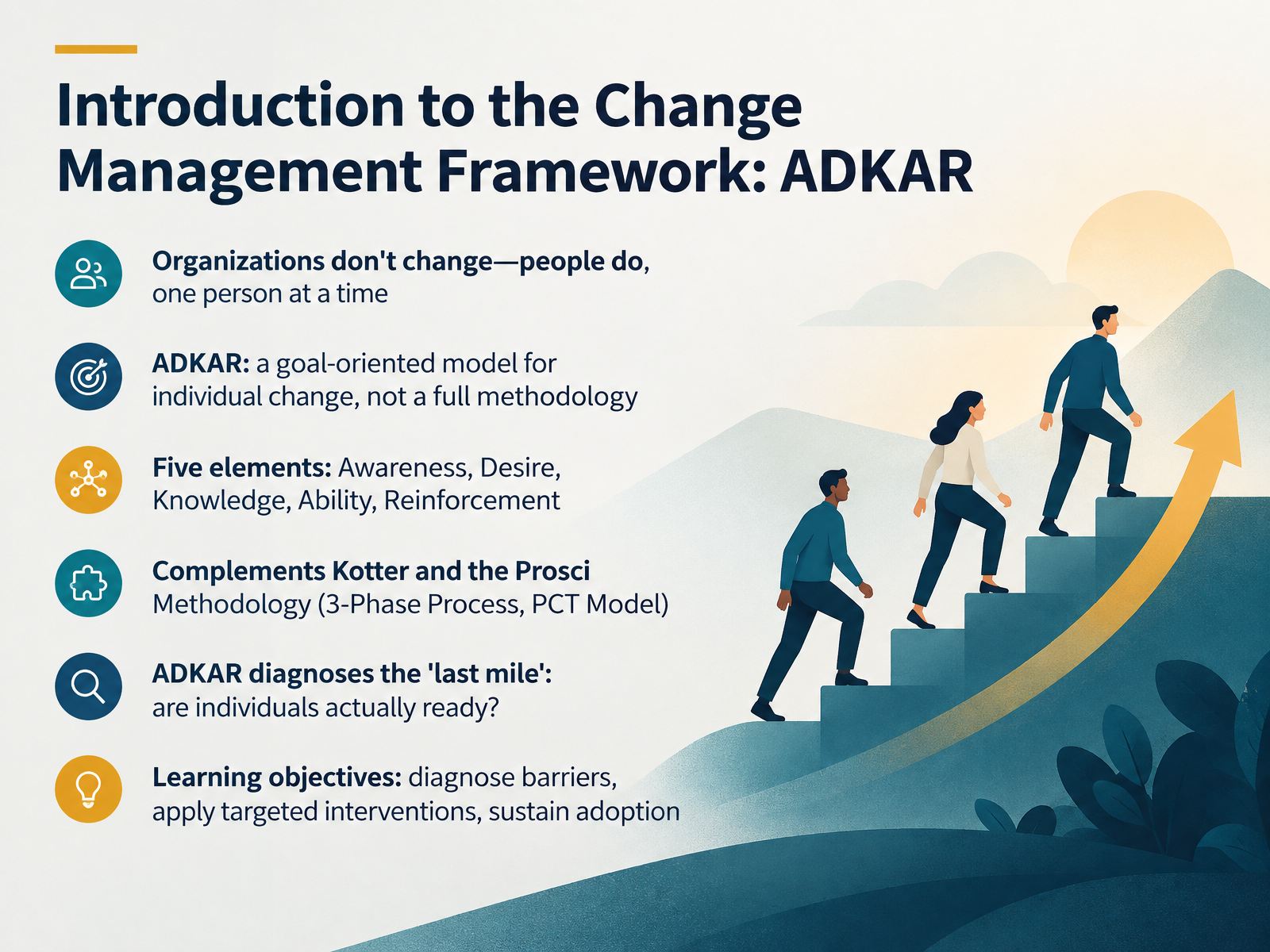
- 01Introduction to the Change Management Framework: ADKARWelcome. Over the next fourteen slides, we're going to work through one of the most practical models you'll ever use with a change initiative: a d k a r. This first slide sets the frame. Here's the core premise. Organizations don't change. People do, one person at a time. A d k a r is a goal-oriented model for individual change, not a full methodology. It defines five sequential elements an individual must achieve: Awareness, Desire, Knowledge, Ability, and Reinforcement. It complements what you already use, like Kotter and the Prosci Methodology, including the three-phase process and the P C T model. Where it earns its keep is the last mile. It diagnoses whether individuals are actually ready, or stuck at a resistance point, so you can target the intervention instead of defaulting to another town hall or another training session. By the end of this course, you'll be able to diagnose barriers, apply targeted interventions, and sustain adoption. And you don't need perfect readiness to start. Pick one impacted group this week and ask which of the five elements they're missing. That's your first move. Next, let's look at where ADKAR came from, and the individual change principle underneath it.prosci.comprosci.comprosci.com+22 min
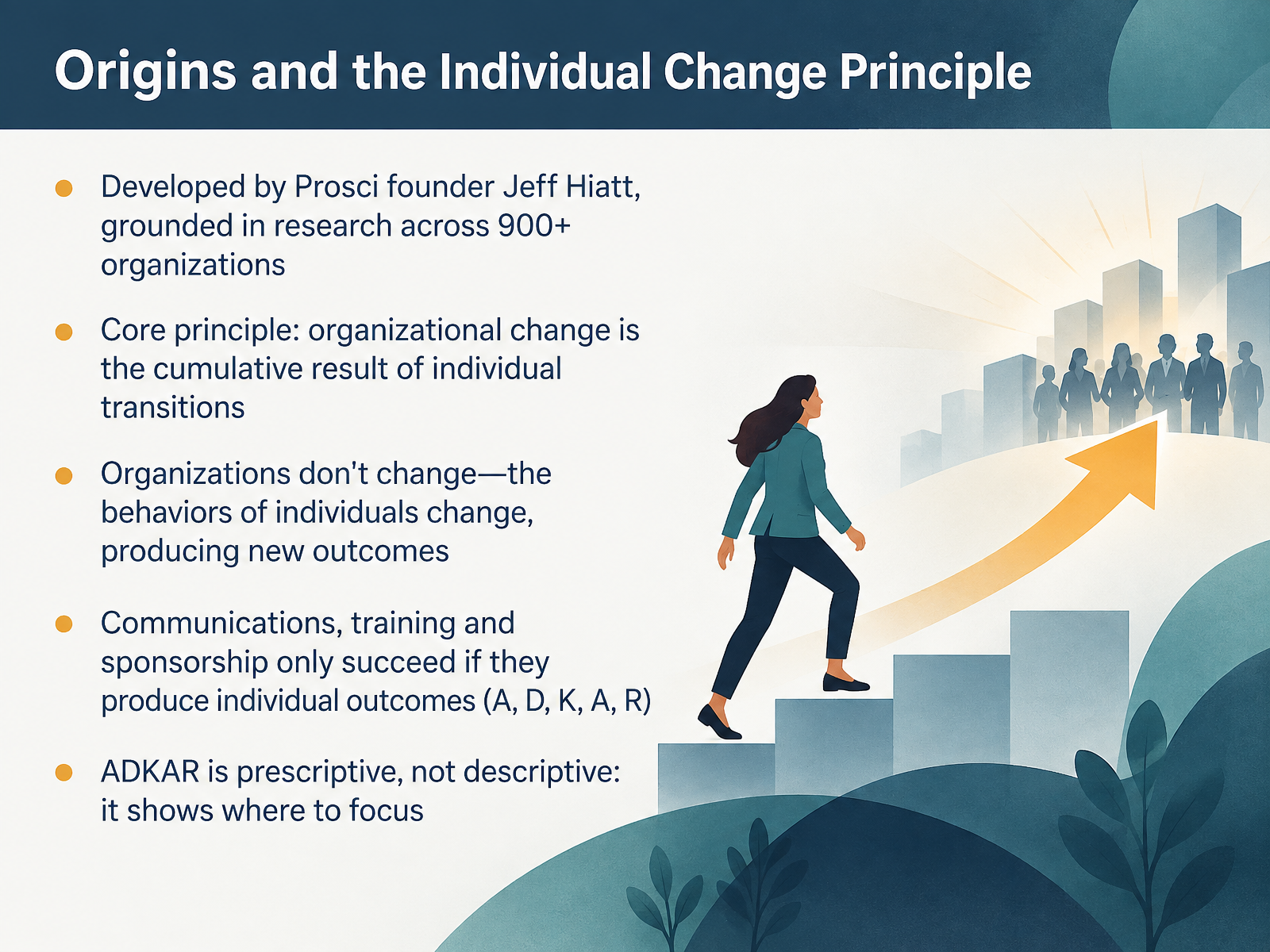
- 02Origins and the Individual Change PrincipleLet's start with where ADKAR comes from, and why it is built at the individual level. The model was developed by Prosci founder Jeff Hiatt, grounded in research across more than nine hundred organizations. The core principle is simple. Organizational change is the cumulative result of individual transitions. Organizations don't change. The behaviors of individuals change, and that produces new outcomes. This is why your communications, training, and sponsor coalition can all look strong on paper and still fail. They only succeed if they produce individual outcomes. Awareness, Desire, Knowledge, Ability, and Reinforcement. One more thing to hold onto. ADKAR is prescriptive, not descriptive. It does not just describe how people move through change. It shows you where to focus. So when you hit a resistance point, you stop asking whether the plan is good and start asking which individual outcome is missing. That question tells you your next move. The five building blocks of ADKAR.
 prosci.comprosci.comprosci.com+22 min
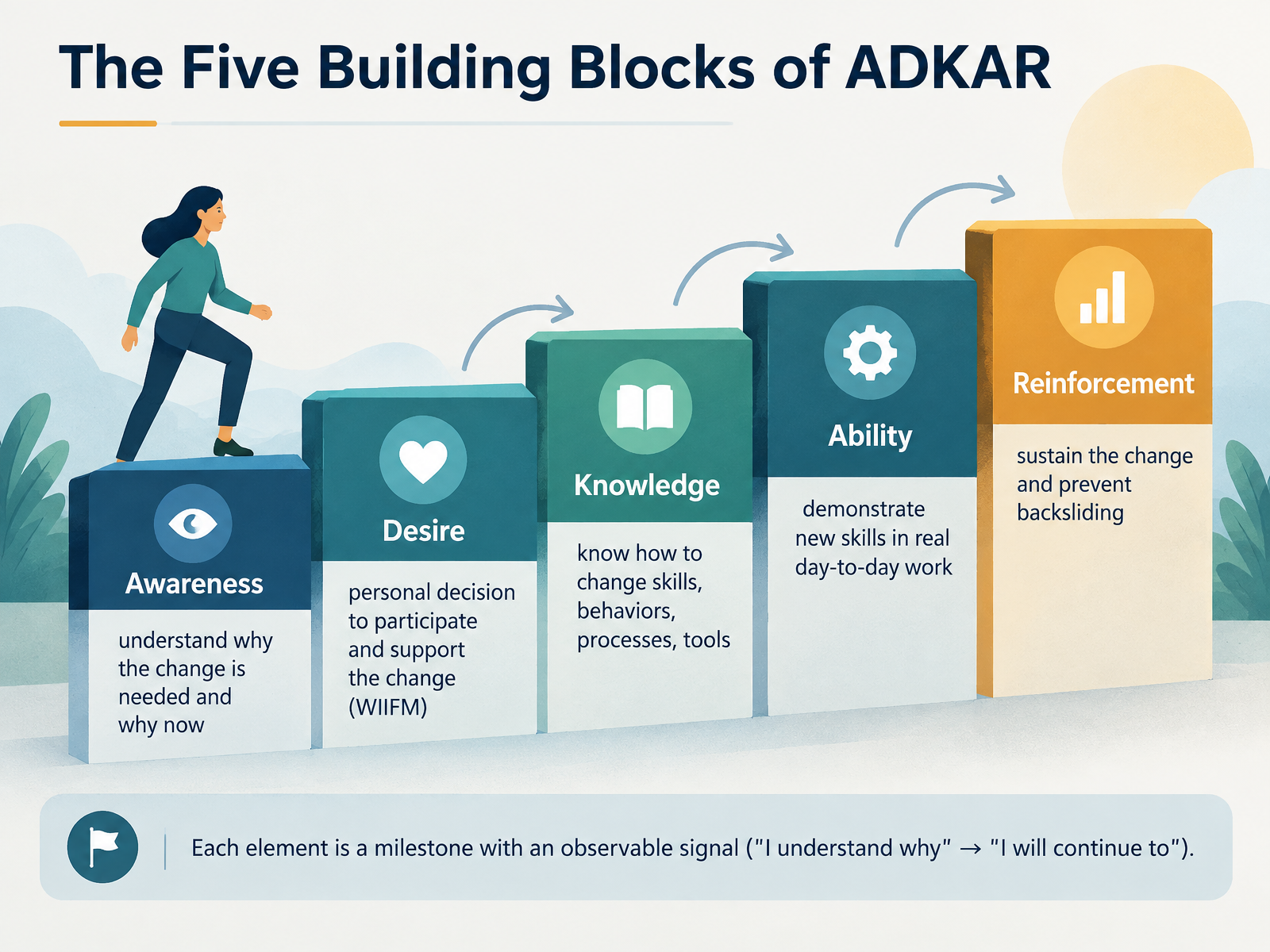
 - 03The Five Building Blocks of ADKARLet's walk through the five building blocks of ADKAR. Awareness is about understanding why the change is needed and why now. Desire is the personal decision to participate and support it, your W I I F M. Knowledge is knowing how to change the skills, behaviors, processes and tools. Ability is demonstrating those new skills in real day-to-day work. And Reinforcement is sustaining the change and preventing backsliding. Notice each element is a milestone with an observable signal, moving from I understand why to I will continue to. For each person on your team, ask which signal you're actually hearing. That one question tells you where to focus next. Now let's look at why sequence matters, cumulative and not strictly linear.
 prosci.comprosci.comprosci.com+21 min
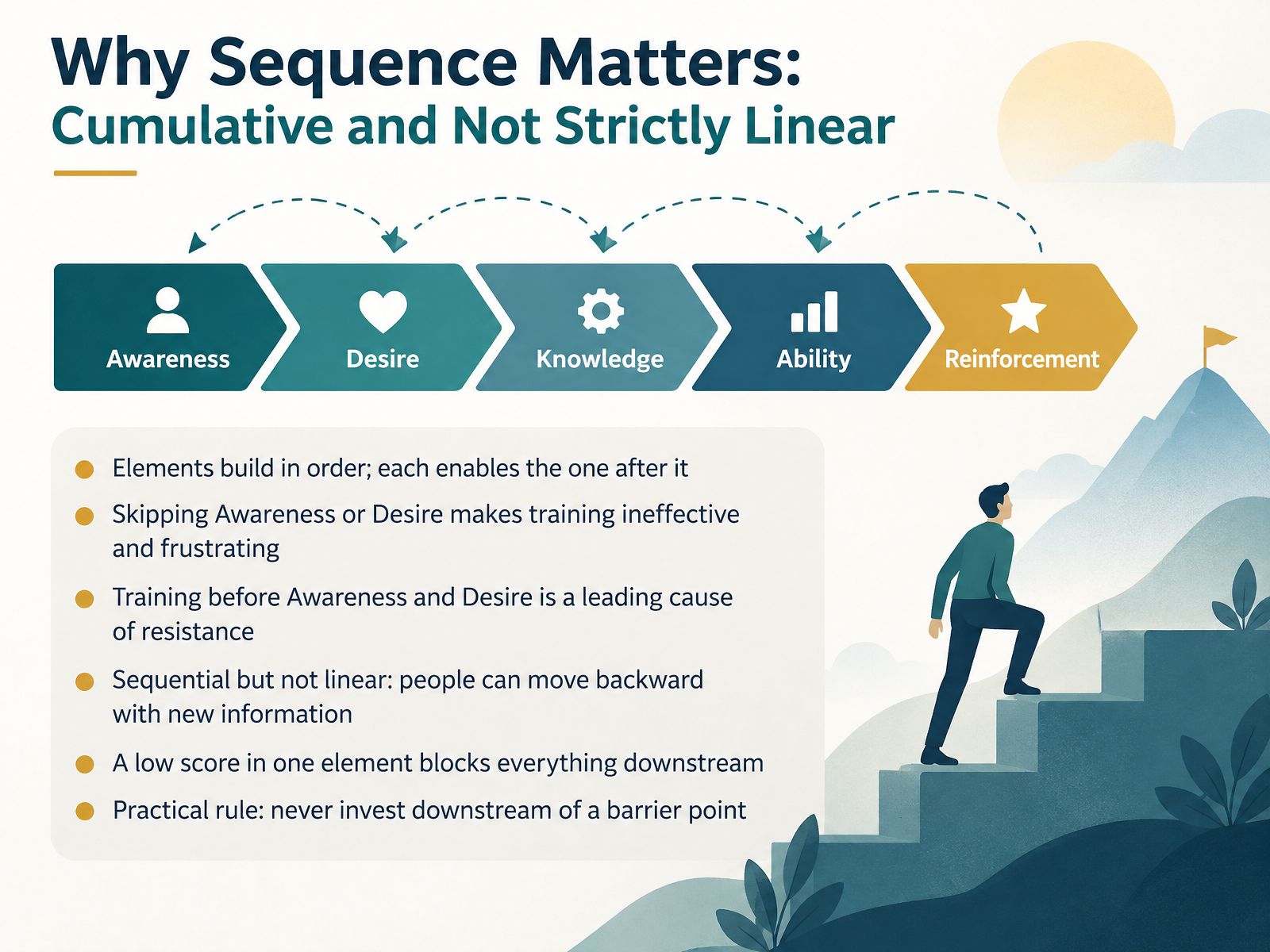
 - 04Why Sequence Matters: Cumulative and Not Strictly LinearLet's talk about why sequence matters. The ADKAR elements build in order, and each one enables the one after it. Awareness feeds Desire. Desire feeds Knowledge. Skip Awareness or Desire, and training becomes ineffective and frustrating. In fact, training before Awareness and Desire is a leading cause of resistance. But here's the nuance. It's sequential, not strictly linear. People can move backward with new information. A low score in one element blocks everything downstream. So the practical rule is simple. Never invest downstream of a barrier point. If Desire is low, don't buy more training. Work the barrier itself. Now let's look at how to read the signals for each element.
 leansixsigmaexperts.comresources.rework.comprofessionals.wrha.mb.ca+21 min
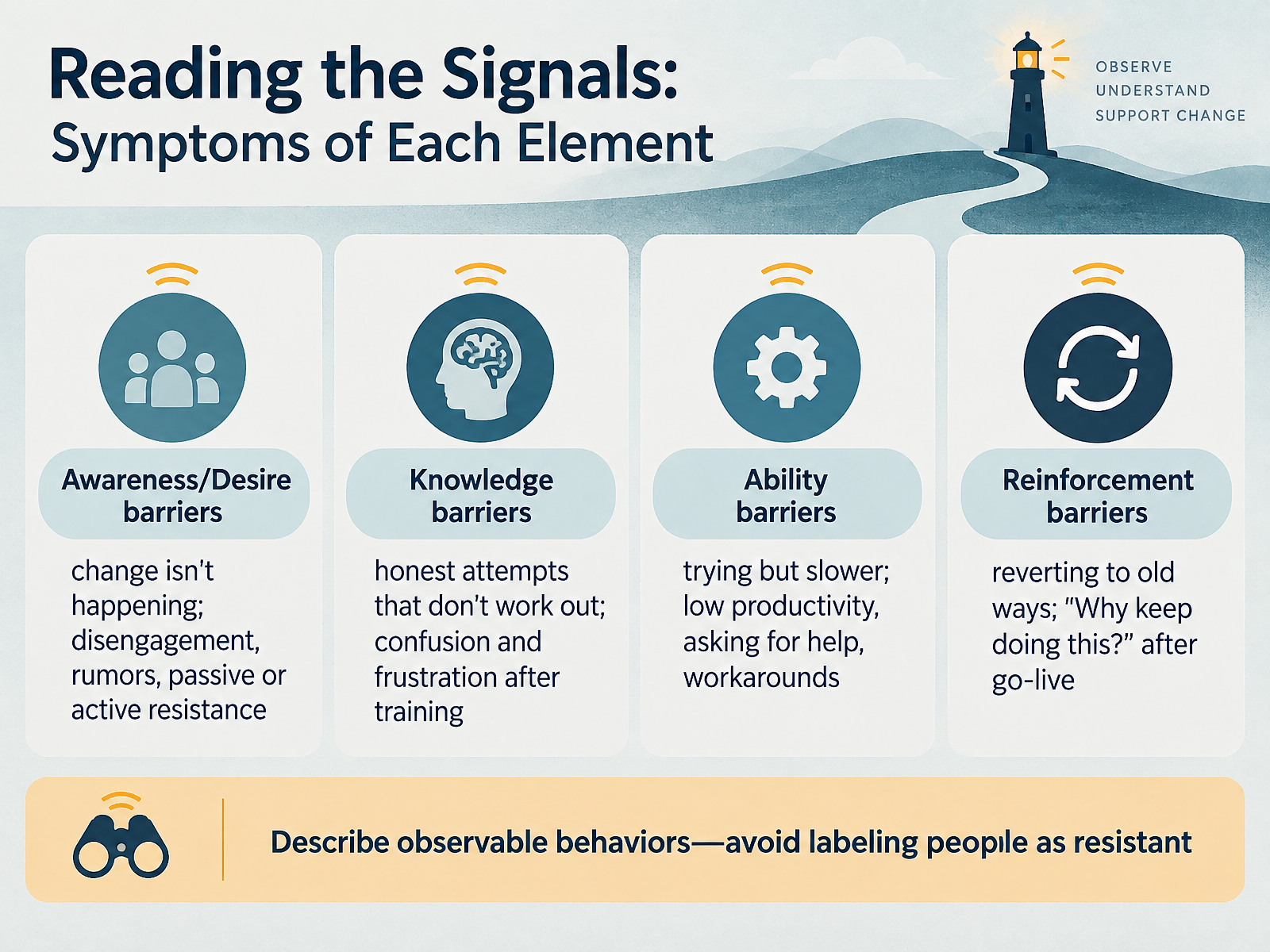
 - 05Reading the Signals: Symptoms of Each ElementLet's talk about reading the signals. ADKAR gives you a diagnostic lens, so you focus on observable behaviors rather than labeling people as resistant. Start with Awareness and Desire barriers. Here, the change simply isn't happening. Watch for disengagement, rumors, and passive or active resistance. A team that quietly keeps old habits while nodding in meetings is a classic Awareness or Desire signal. Next, Knowledge barriers. People are making honest attempts, but they don't work out. The tell is confusion and frustration right after training. They want to do it, they just don't know how yet. Ability barriers look different. People are trying, but they're slower, productivity dips, they ask for help, and they build workarounds to get through the day. That's not defiance. That's a capability gap. Finally, Reinforcement barriers show up after go-live. People revert to old ways, and you hear, why keep doing this? Now, here's your next action. Pick one team and note which of these four patterns you actually see this week. Describe the behavior, not the person. That gets you ready for the next step, diagnosing barrier points with the ADKAR Assessment.
 prosci.comprosci.comproscieurope.com+22 min
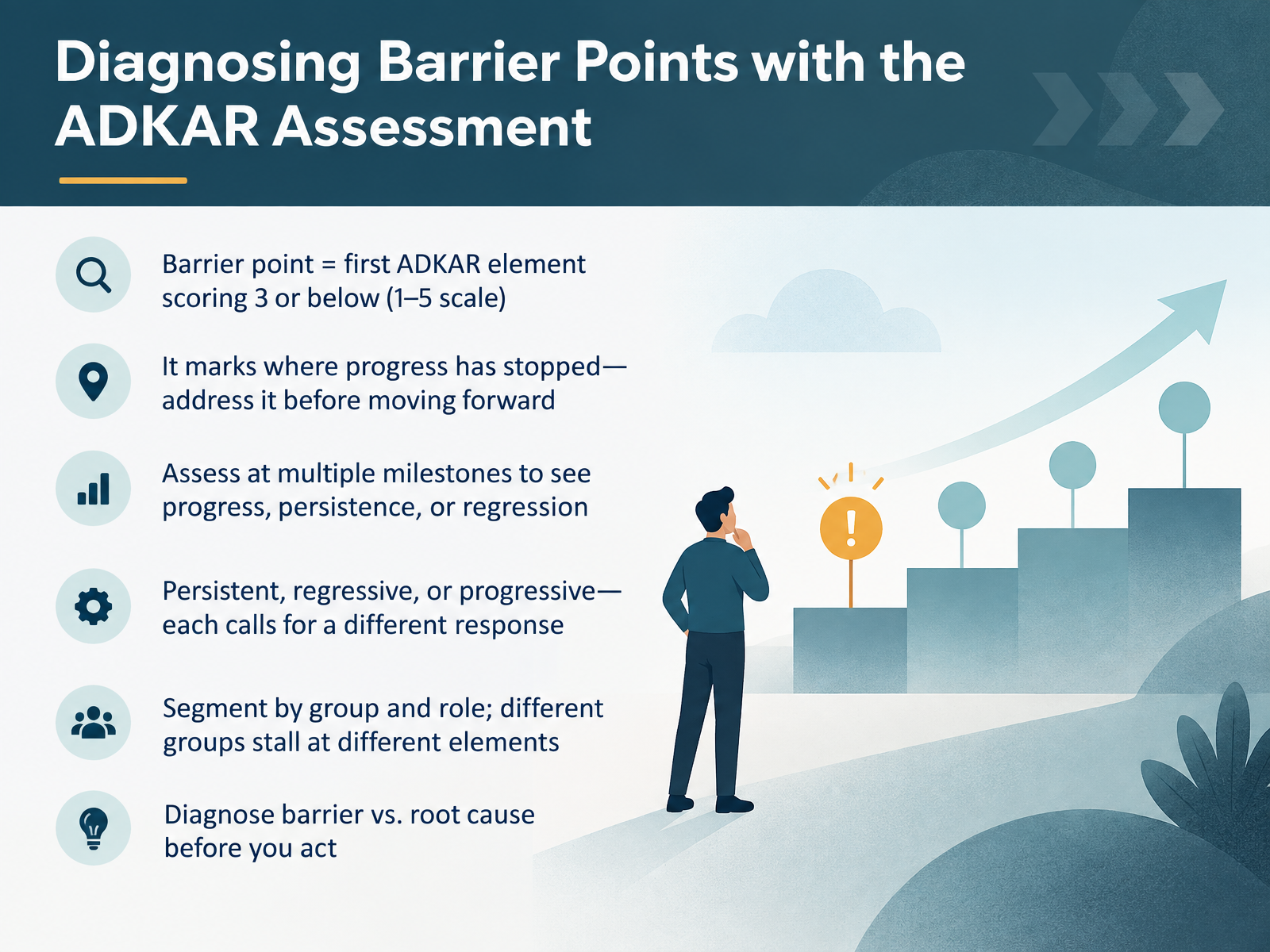
 - 06Diagnosing Barrier Points with the ADKAR AssessmentNow let's turn to diagnosing barrier points with the ADKAR Assessment. A barrier point is the first ADKAR element scoring three or below on a one to five scale. It marks where progress has stopped. Address it before moving forward. If Knowledge is your barrier, sending people to training only helps once Awareness and Desire are solid. Assess at multiple milestones to see whether the barrier is progressive, persistent, or regressive, because each calls for a different response. Segment by group and role, since different groups stall at different elements. And diagnose barrier versus root cause before you act. Here's your next action: pull your latest scores, find each group's first element at three or below, and confirm whether that barrier has moved. That sets up what comes next: targeted interventions aligned to each element.
 prosci.comprosci.comproscieurope.com+21 min
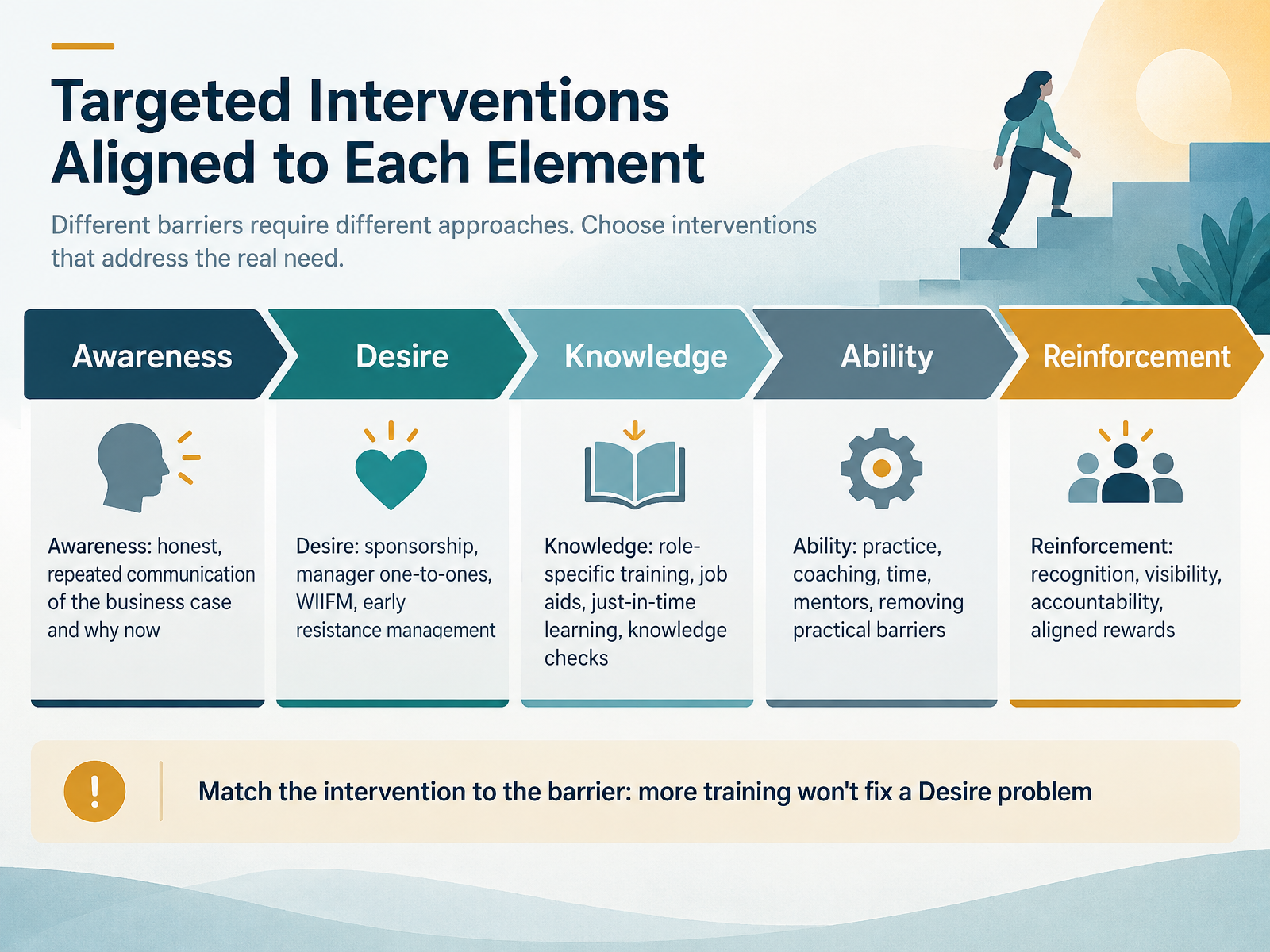
 - 07Targeted Interventions Aligned to Each ElementSo now let's get practical. Once you have a barrier point, your job is to match the intervention to the element. Awareness calls for honest, repeated communication of the business case, and why now. Desire needs sponsorship, manager one-to-ones, a clear answer to what's in it for me, and early resistance management. Knowledge means role-specific training, job aids, just-in-time learning, and knowledge checks. Ability requires practice, coaching, real time, mentors, and removing practical barriers. Reinforcement comes through recognition, visibility, accountability, and aligned rewards. Here's the rule that matters most. Match the intervention to the barrier. More training will not fix a Desire problem. If someone doesn't want the change, another course just burns goodwill. So name the barrier point first, pick the one intervention that moves it, and act. Next, building Desire, the most challenging element.
 leansixsigmaexperts.comresources.rework.comprofessionals.wrha.mb.ca+22 min
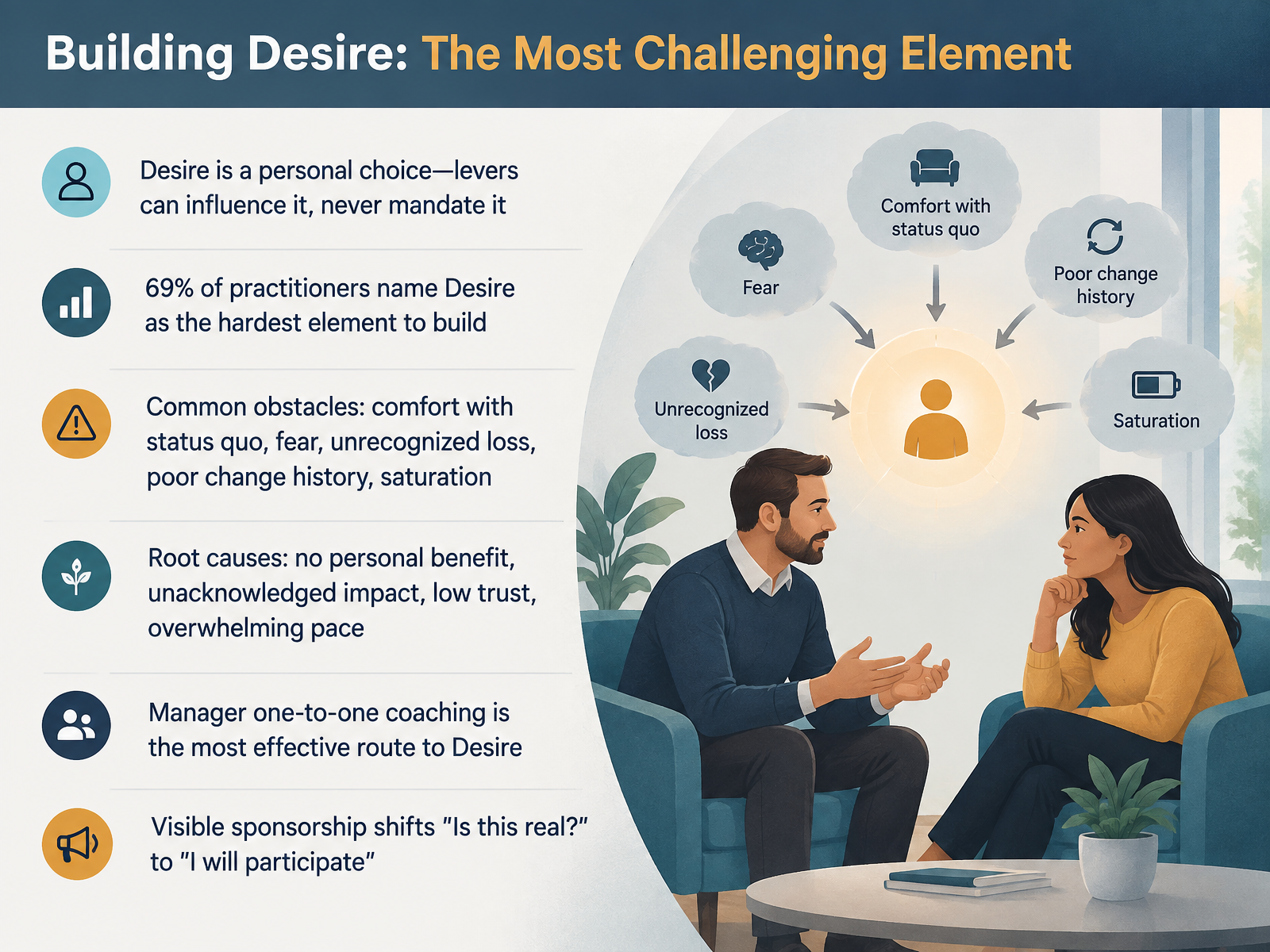
 - 08Building Desire: The Most Challenging ElementLet's move to Desire, and here's the uncomfortable truth. Desire is a personal choice. You can influence it with levers, but you can never mandate it. In Prosci's research, sixty-nine percent of practitioners name Desire as the hardest element to build. So what stands in the way? Comfort with the status quo, fear, unrecognized loss, a poor change history, and saturation. Those are symptoms. The root causes run deeper: no personal benefit, unacknowledged impact, low trust, and an overwhelming pace. Your most effective route is a manager one-to-one. Not a policy briefing, a personal conversation. And visible sponsorship is what shifts the question from is this real to I will participate. So here's your next action. Before your next sponsor touchpoint, pick one resistance point on your map and equip that person's manager to hold the conversation. Now let's look at preventing resistance before it hardens. That brings us to Overcoming Resistance: Prevention First, Response When Needed.
 prosci.comprosci.comprosci.com+22 min
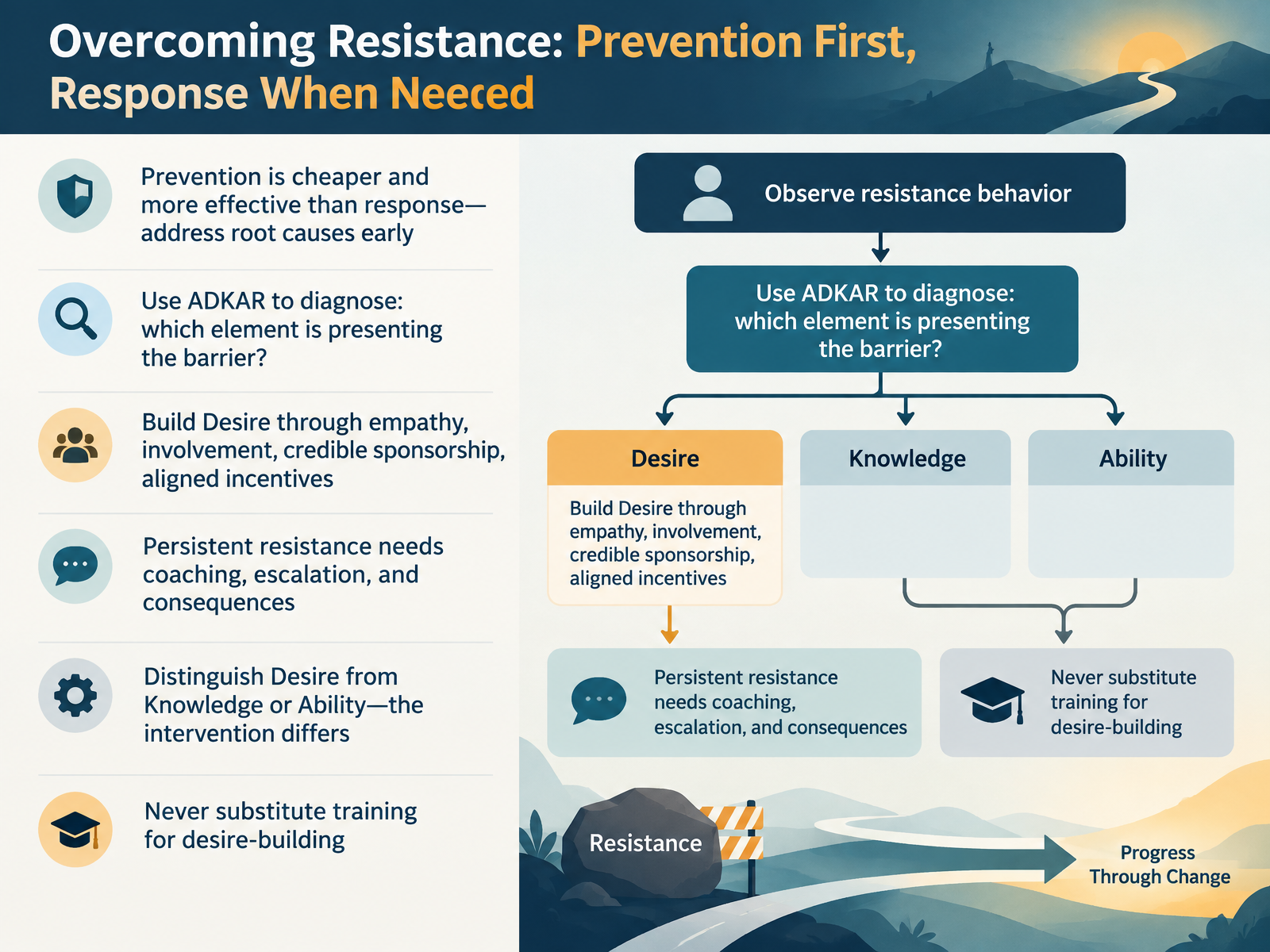
 - 09Overcoming Resistance: Prevention First, Response When NeededLet's talk about resistance. The first rule is simple. Prevention is cheaper and more effective than response, so address root causes early. When you see hesitation, resist the urge to label people. Instead, use ADKAR to diagnose. Which element is presenting the barrier? If awareness is missing, they need clearer messaging. If desire is the barrier, more training will not help. They need empathy, involvement, credible sponsorship, and aligned incentives. Build desire through honest one-on-one conversations that answer the WIIFM question. Persistent resistance, though, needs more than empathy. It needs coaching, escalation, and real consequences. And here is the trap: never substitute training for desire-building. If someone does not want to change, knowledge will not fix it. Your next action: pick one resistant group and identify their barrier point before your next sponsor meeting. That diagnosis changes your intervention. Now let's look at what comes after adoption: reinforcement. Reinforcement: Designing for Sustainment from Day One.
 prosci.comprosci.comprosci.com+21 min
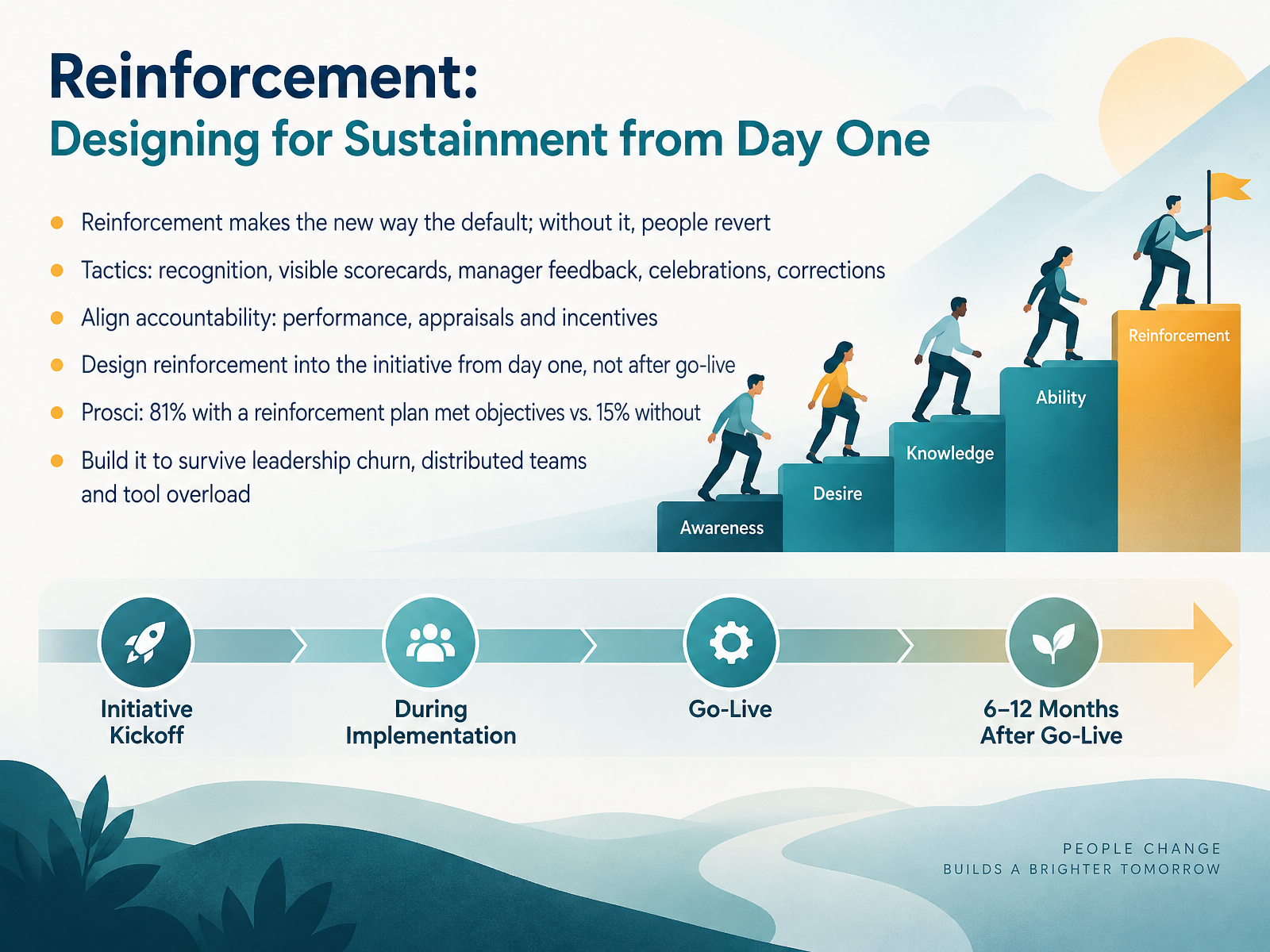
 - 10Reinforcement: Designing for Sustainment from Day OneNow to the fifth element. Reinforcement. This is what makes the new way the default and stops people reverting. And it has to be designed from day one, not bolted on after go-live. Without it, adoption decays and value realization slips. So what actually works? Recognition tied to real progress. Visible scorecards. Specific manager feedback. Celebrations beyond launch. And direct corrective action when people slip back. The biggest lever is accountability. Align performance, appraisals and incentives with the change so sustained adoption is an expectation, not an option. Here is why that matters. Prosci research shows eighty one percent of participants who planned for reinforcement met or exceeded objectives, compared to just fifteen percent without a plan. And remember, fewer than half actually allocated resources to it. That is the gap most of you will feel. Reinforcement also has to survive leadership churn, distributed teams and tool overload. So build mechanisms that do not depend on one sponsor. Name a reinforcement owner per impacted group, usually the people manager. Start early, and keep it visible for at least six months. Your next action: pull up your plan and confirm who owns reinforcement after go-live. Next, we look at Measuring Adoption and Sustaining Change.
 prosci.comprofessionals.wrha.mb.caprosci.com2 min
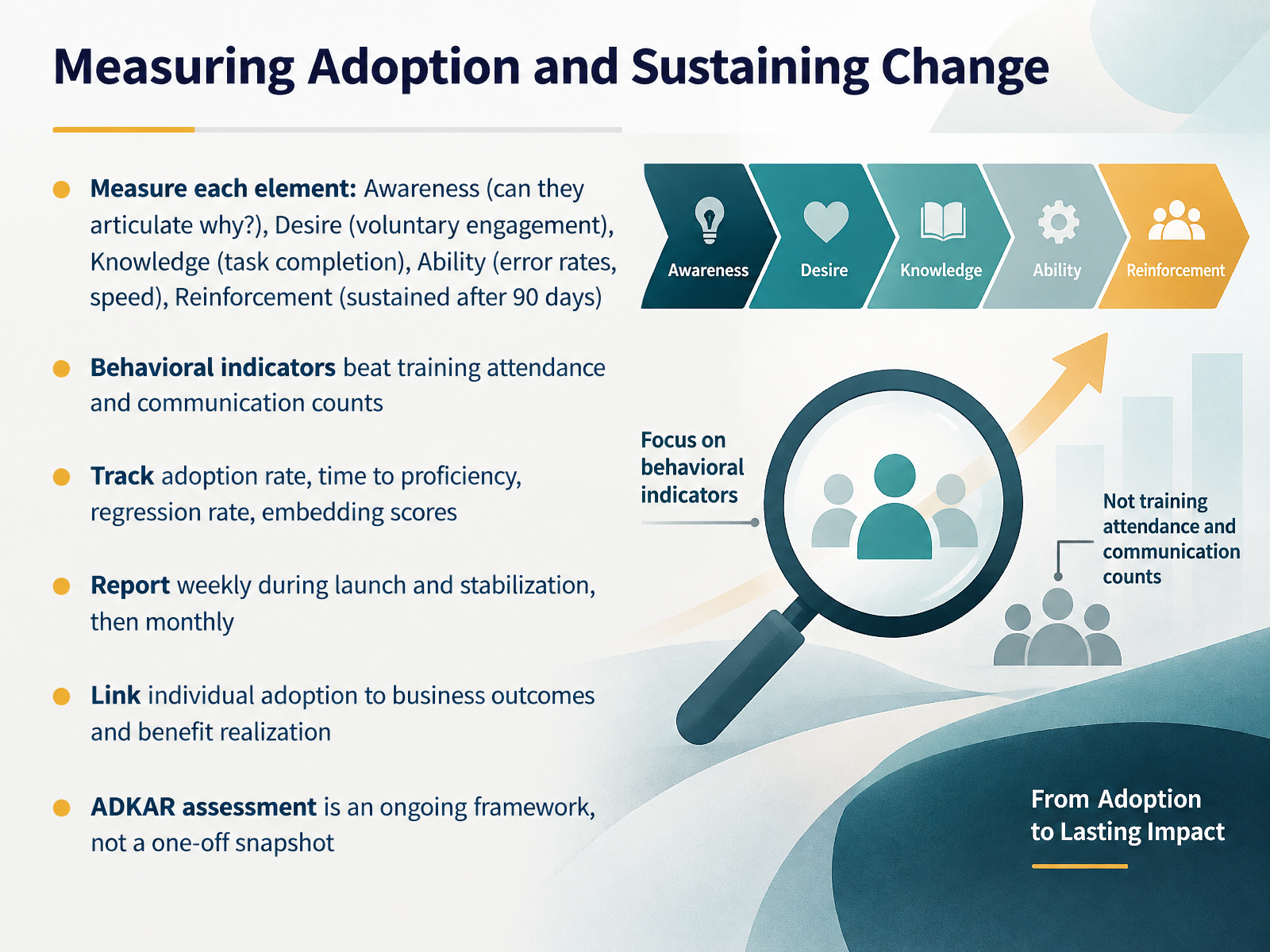
 - 11Measuring Adoption and Sustaining ChangeLet's talk about measuring adoption and sustaining change. Measurement is where ADKAR earns its keep, because you're measuring each element, not just activity. Can people articulate why? That's Awareness. Is engagement voluntary? That's Desire. Can they complete the task? Knowledge. What are the error rates and speed? That's Ability. And is it still holding after ninety days? That's Reinforcement.
The key shift, behavioral indicators beat training attendance and communication counts every time. So track adoption rate, time to proficiency, regression rate, and embedding scores. Report weekly during launch and stabilization, then monthly once adoption holds.
And tie individual adoption to business outcomes and benefit realization, so leaders see the connection. Important: the ADKAR assessment is ongoing, not a one-off snapshot. One concrete next action: pick your three to five metrics, define a threshold for each, and review them weekly. Now, let's look at scaling individual change to teams, programmes and agile.
 prosci.comprosci.comprofessionals.wrha.mb.ca2 min
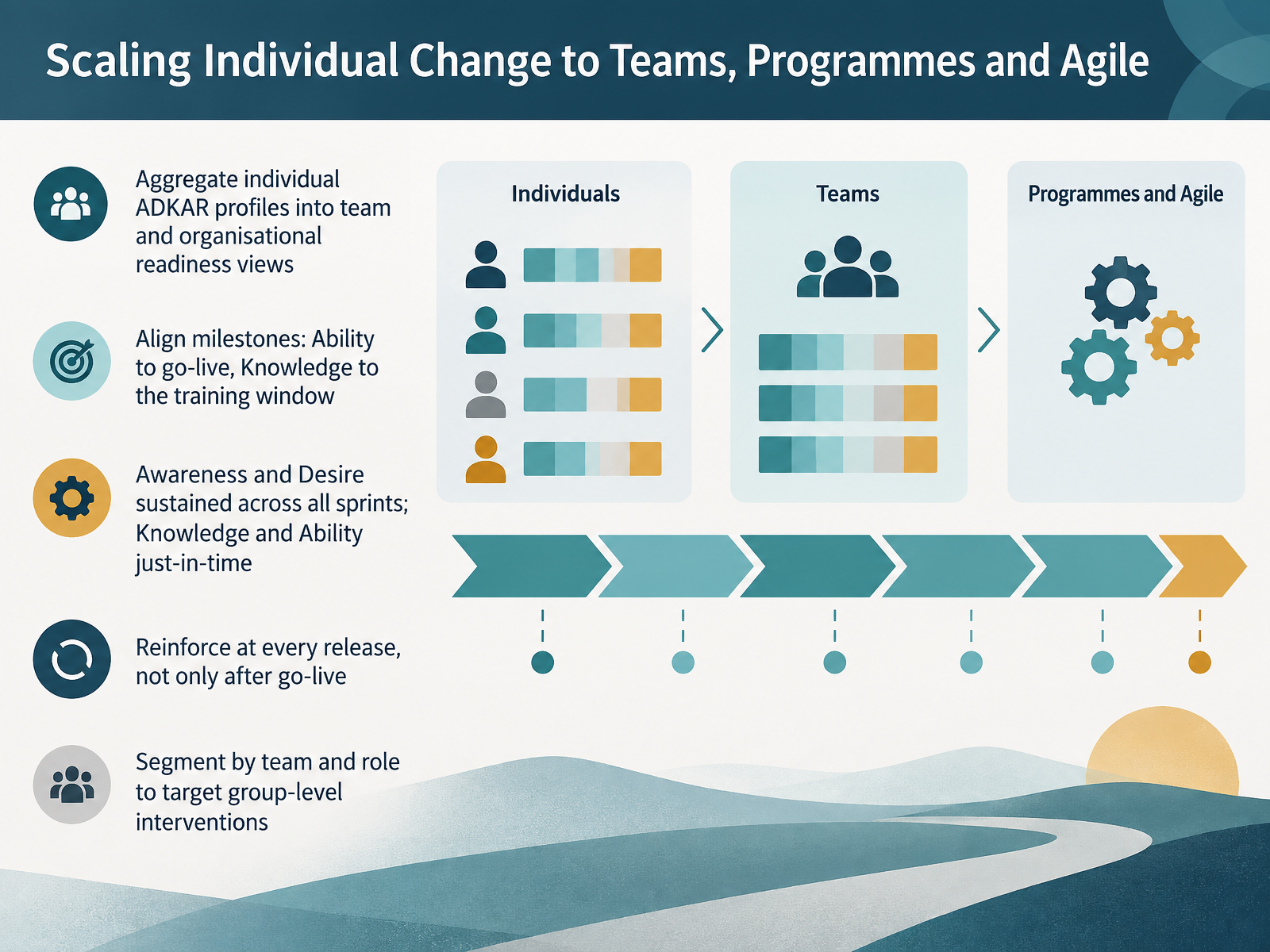
 - 12Scaling Individual Change to Teams, Programmes and AgileLet's move from the individual to the system. ADKAR was built for one person, but your programme has hundreds. So first, aggregate individual ADKAR profiles into team and organisational readiness views. That is your heat map of resistance points and sponsor coalition strength by group. Next, align your milestones. Anchor Ability to the go-live date, and Knowledge to the training window. Then hold Awareness and Desire as sustained functions across every sprint, while Knowledge and Ability land just-in-time, just enough. Reinforce at every release, not only after go-live, because each release is a micro go-live. Finally, segment by team and role so group-level interventions hit the right people. One concrete next action: build a single readiness view by team, then pick your top three resistance points to address this sprint. Next, we'll look at case studies and practical scenarios.
 prosci.comsi-labs.comprosci.com+21 min
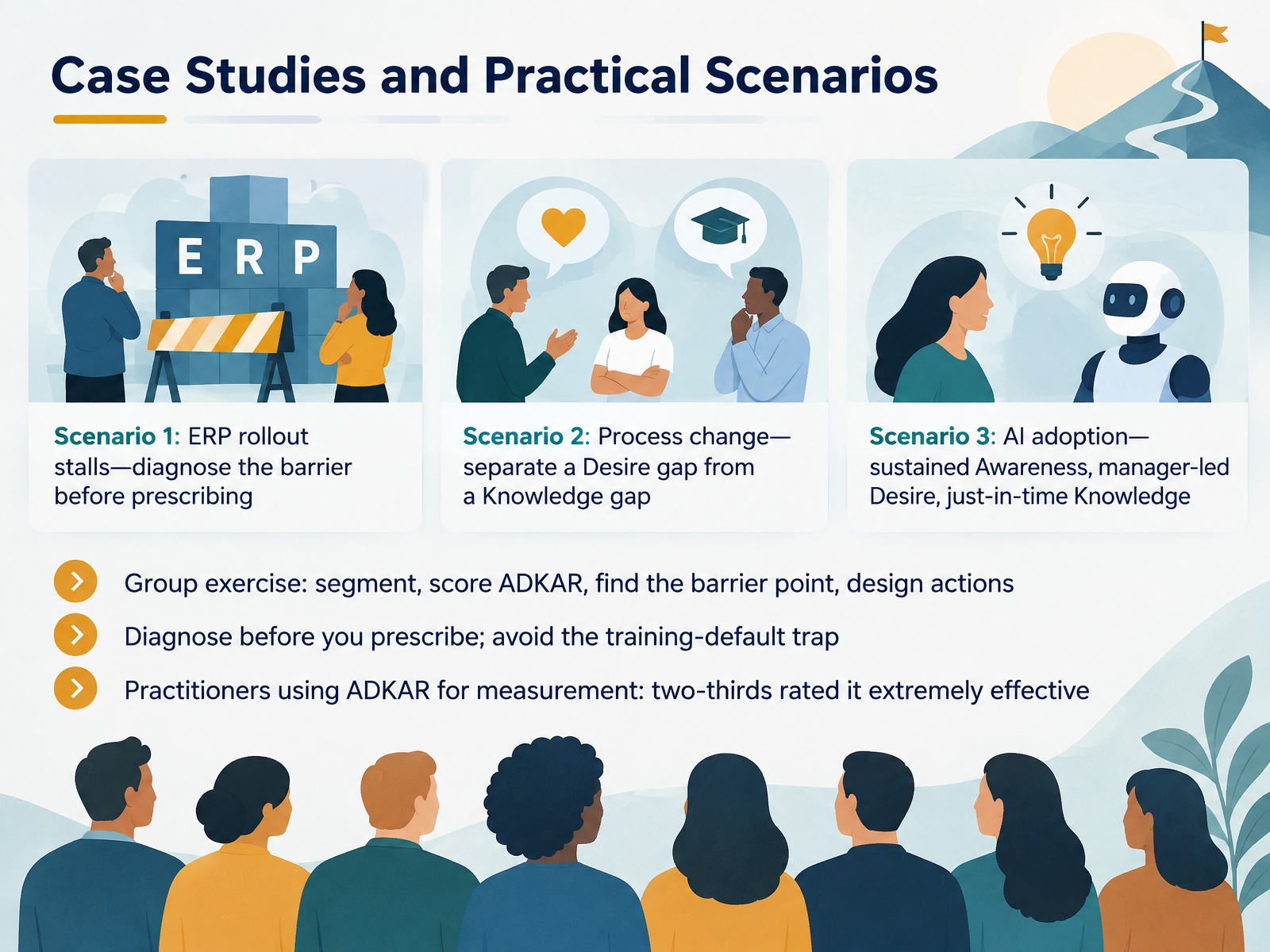
 - 13Case Studies and Practical ScenariosLet's put ADKAR to work on real scenarios. Scenario one: an ERP rollout stalls. Your instinct may be to order more training. Stop. Diagnose the barrier point first, then prescribe. Maybe Awareness is fine and Desire is the gap. Scenario two: a process change shows a Desire gap dressed up as a Knowledge gap. If people reject training, they haven't chosen the change yet. Scenario three: AI adoption. You need sustained Awareness, manager-led Desire, and just-in-time Knowledge, with hands-on coaching. For your group exercise, segment your audience, score each ADKAR element, find the first element scoring three or below, and design actions against that barrier point. Diagnose before you prescribe, and avoid the training-default trap. Practitioners who use ADKAR for measurement: two-thirds rated it extremely effective. Next, we move from diagnosis to design, in Action Planning: Applying ADKAR to Your Initiative.
 prosci.com2 min
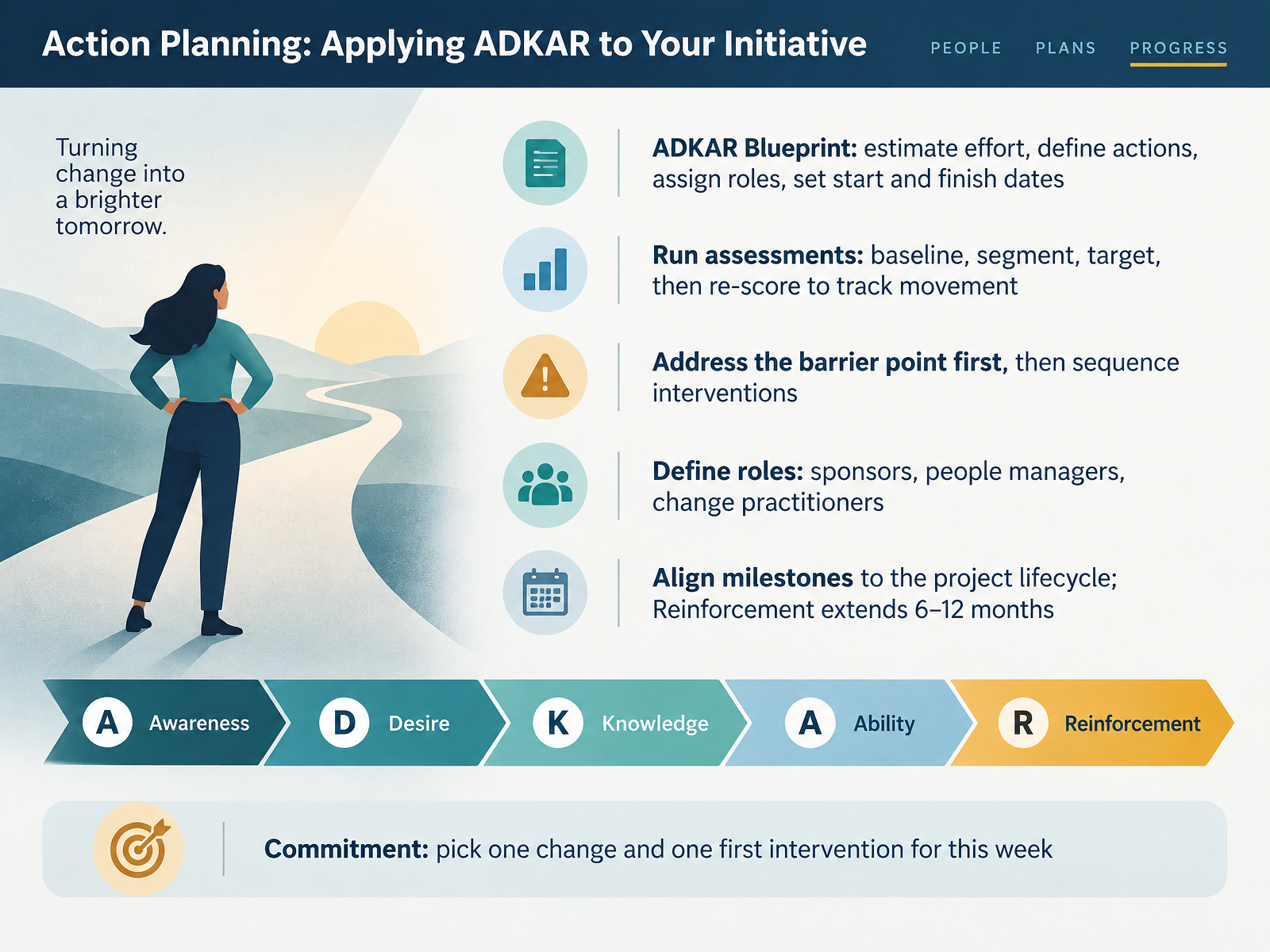
 - 14Action Planning: Applying ADKAR to Your InitiativeLet's bring ADKAR home. Start with the Blueprint: for each element, estimate effort, define the actions, assign roles, and set start and finish dates. Next, run assessments. Baseline first, then segment by group, target the earliest barrier point, and re-score to track movement. Address that barrier before you sequence anything else. More training will not fix a desire problem. Then define roles: sponsors active and visible, people managers carrying CLARC, practitioners coordinating the plan. Align your milestones to the project lifecycle, and remember Reinforcement extends six to twelve months past go-live. I know manager time is tight and readiness is mixed, so keep it small. Pick one change, and one first intervention for this week. Write it down, name the owner, and book the re-score. That is your plan. Your ADKAR journey starts with a single step. Thank you for your attention, and good luck applying ADKAR to your initiative.
 nd.govprosci.comleansixsigmaexperts.com+22 min
Take the deck with you
Download this course as a file — free, no sign-up needed.
- PDF handoutEvery slide page, ready to print or share.15 pages · 3.6 MBDownload
- Narrated PowerPointThe deck that presents itself — every slide carries the digital human's narration video.15 pages · 13.9 MBDownload
- PowerPoint slidesThe full deck as a .pptx — open it in PowerPoint, Keynote, or Google Slides.15 pages · 3.6 MBDownload
Free to use in your own training — please keep the PersonWise credit page at the end.
Have your own deck? Turn it into a course
Sources consulted
Web sources consulted while building this course.
- Prosci ADKAR Model | Change Management Model — prosci.com
- The Prosci ADKAR Model: Why it Works — prosci.com
- ADKAR — prosci.com
- ADKAR: Core to the People Side of Change — prosci.com
- Use the ADKAR Model for Change Success — prosci.com
- Prosci ADKAR Model: A Step-By-Step Guide To Change Success - Lean Six Sigma Experts — leansixsigmaexperts.com
- "ADKAR Model: Prosci's 5-Step Change Framework" — resources.rework.com
- Using ADKAR to Implement Change — professionals.wrha.mb.ca
- ADKAR Model: Guide, Practical Example and Comparison with Kotter | SI Labs — si-labs.com
- ADKAR Model - Guide, Assessment and Worked Example — mutomorro.com
- ADKAR Assessments — prosci.com
- Individual Barriers to Change and What to Do About Them — prosci.com
- https://www.proscieurope.com/sites/default/files/handouts/nexum_adkar-assessment_en_01.pdf — proscieurope.com
- https://www.prosci.com/blog/creating-successful-coaching-with-the-adkar-model — prosci.com
- ADKAR Assessment — nd.gov
- Desire in The Prosci ADKAR® Model: Definition, Examples and Best Practices — prosci.com
- Preventing and Managing Resistance to Organizational Change — prosci.com
- The ADKAR Model: Building Desire for Change With One-on-One Coaching — prosci.com
- https://www.prosci.com/blog/challenges-you-may-encounter-in-building-adkar — prosci.com
- Reinforcement in The Prosci ADKAR® Model: Definition, Examples and Best Practices — prosci.com