Managing Change in Projects
Begin
12 pages · ~24 min
Managing Change in Projects
This training teaches project managers to plan, implement, and sustain organizational change by focusing on the human side of projects.
What you’ll learn
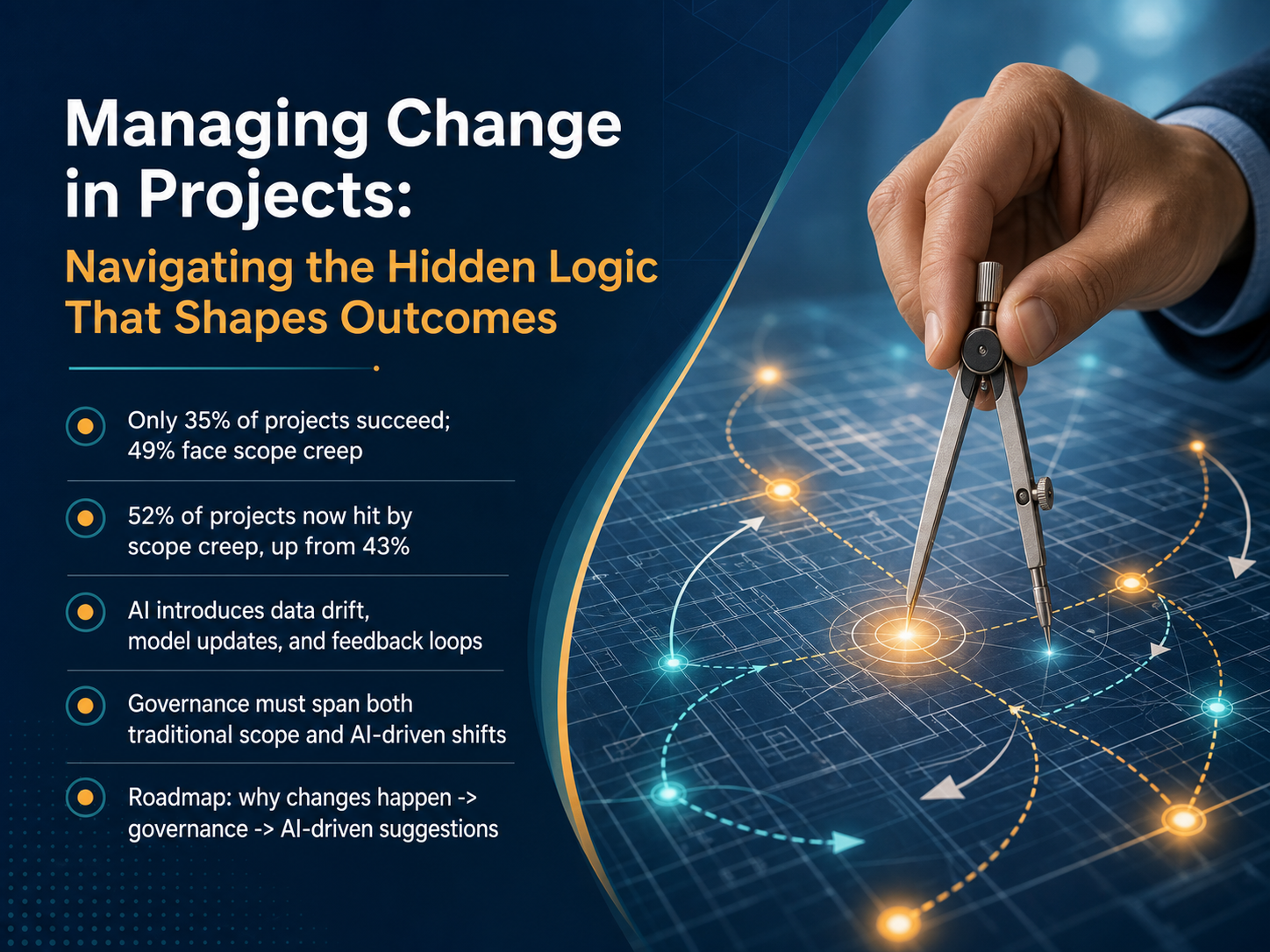
- 01Managing Change in Projects: Navigating the Hidden Logic That Shapes OutcomesWelcome. If you've ever watched a project shift direction and wondered, 'Why did that suggestion even come up?' you're in the right place. This course is about managing change in projects, but more specifically, it's about navigating the hidden logic behind those shifts. Let's start with a quick reality check. Right now, only about thirty-five percent of projects fully succeed. And scope creep, where new work quietly slips in, now affects fifty-two percent of projects, up from forty-three percent just a few years ago. That's a big jump. Now we're also adding AI into the mix, which brings its own kind of change, like data drift, unexpected model updates, and feedback loops that can quietly reshape a project's direction. So the old rules for managing scope aren't enough anymore. Our roadmap here is to first understand why changes happen, then build a stronger kind of governance that handles both traditional scope shifts and these new AI-driven evolutions. Let's explore what's really going on beneath the surface. Up next, we'll look at the dual nature of change and why both projects and algorithms effectively 'change their mind'.pmworldjournal.comagiled.apppmworldlibrary.net+22 min
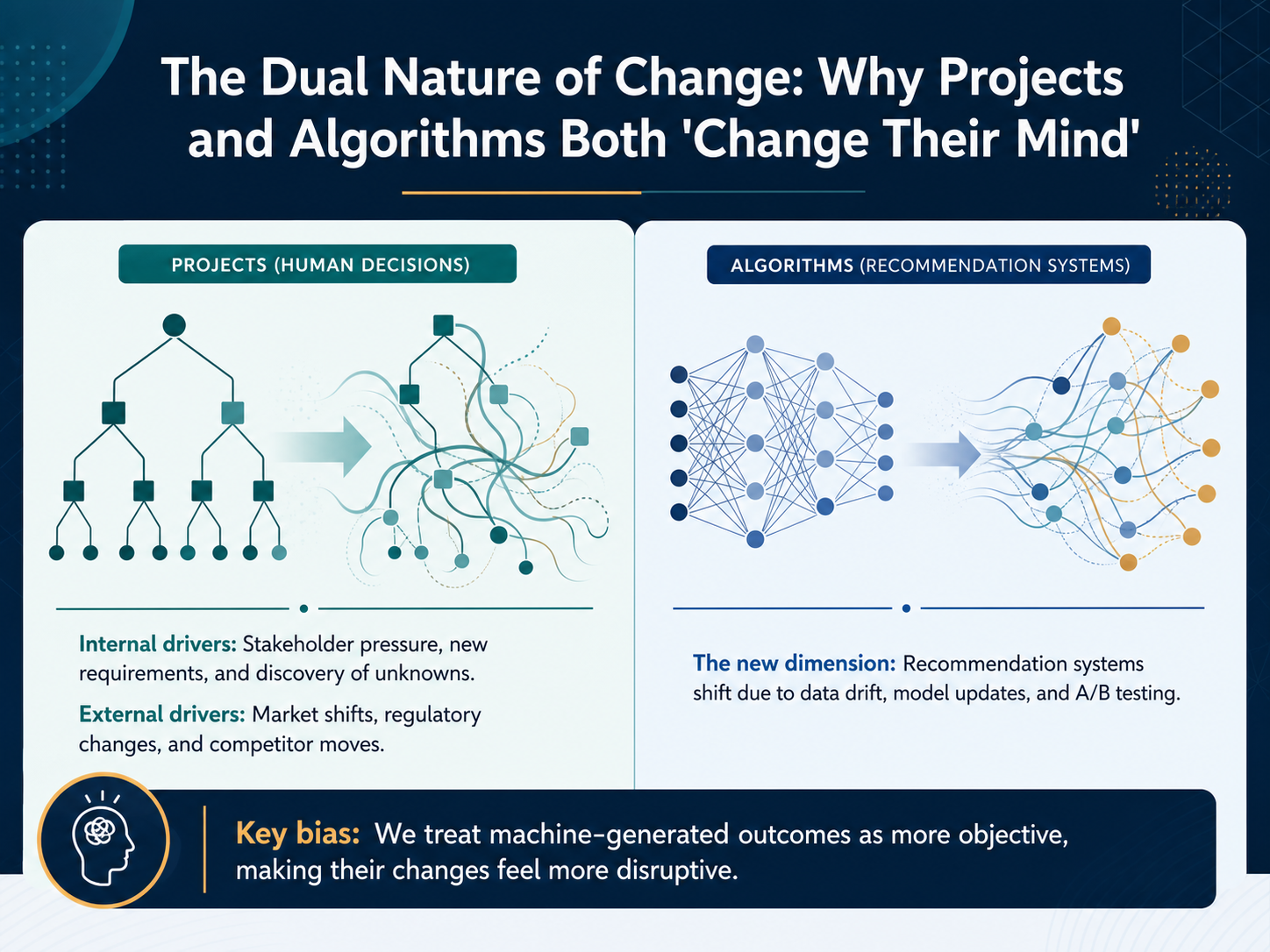
- 02The Dual Nature of Change: Why Projects and Algorithms Both 'Change Their Mind'So, why do projects and algorithms 'change their mind'? It turns out, they both face pressure from two sides. On one side, there are internal drivers. Things like stakeholder pressure, new requirements popping up, or the team discovering something they didn't know at the start. On the other side, there are external drivers. These are the big shifts outside your control, like market changes, new regulations, or a surprise move by a competitor. For human-led projects, that's often the full picture. But for AI systems, there's a new dimension. Their recommendations shift because of things like data drift. Imagine a GPS that's just a couple of degrees off. For the first mile, you don't notice. But after a hundred miles, you're in the wrong city. AI systems experience a similar, gradual shift. They also change due to model updates or A and B testing. Now, here's a key bias we need to watch. We often treat a machine's output as more objective than a human's. So when an algorithm changes its mind, it can feel especially disruptive or even like a betrayal of trust. It's not. It's just a different kind of change trigger. Next, let's decode that specific type of change. We'll explore what 'drift' really looks like inside an AI system.
 heyclarity.devkarls.iomedium.com+22 min
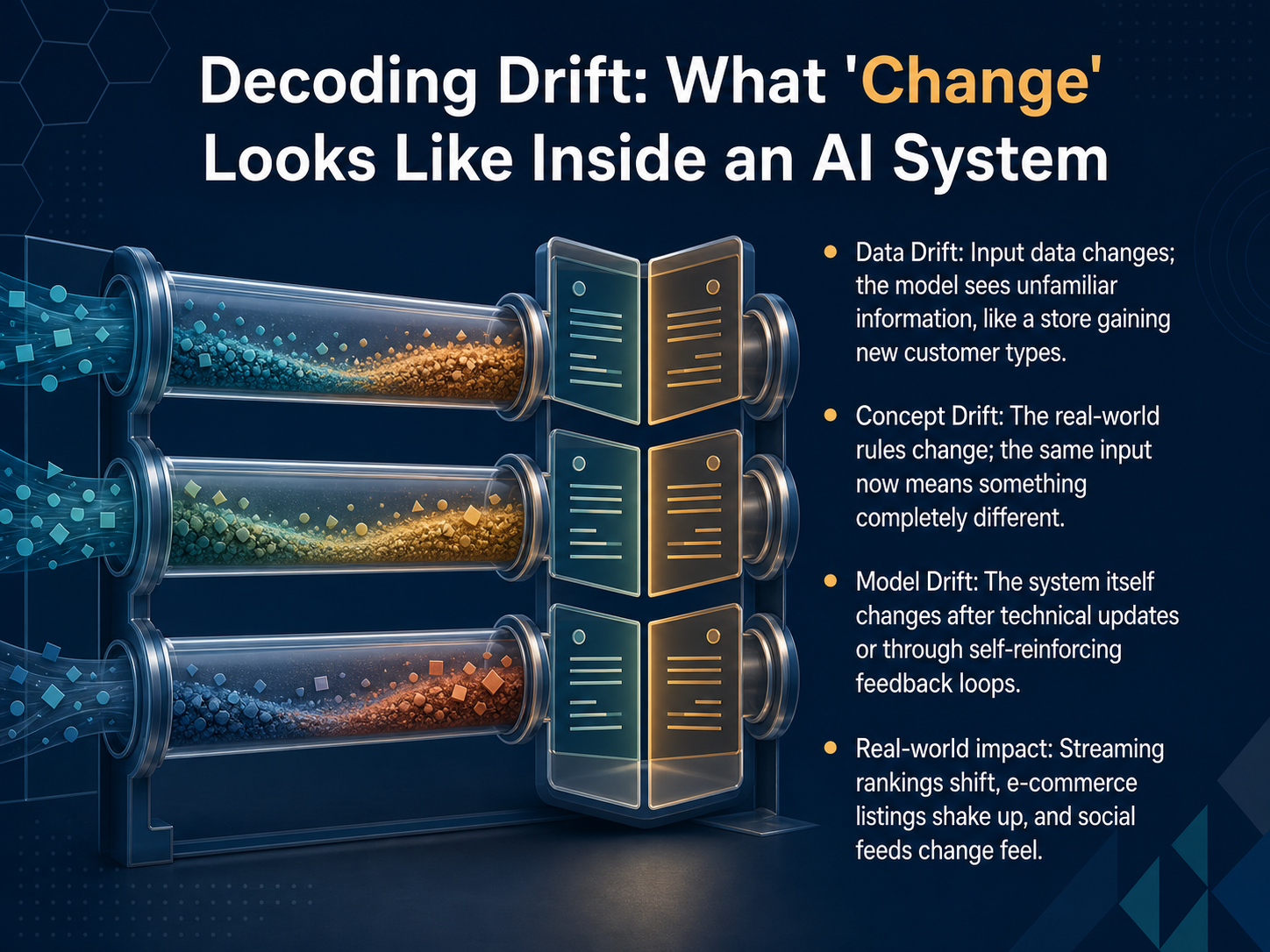
 - 03Decoding Drift: What 'Change' Looks Like Inside an AI SystemNow, let's decode what change actually looks like inside an AI system. When we talk about an AI "drifting," it's not just one thing. Think of it as three distinct patterns. First, there's data drift. This is when the information coming into the system changes. Imagine your store suddenly gets a wave of new, younger customers. The model is still seeing purchase data, but it's a type of customer it wasn't trained on. The world it understands has shifted, even if the old rules still technically apply. Second, and a bit trickier, is concept drift. Here, the real-world rules themselves have changed. Take the word "spam." What it meant for email filters ten years ago is completely different today. The same input now has a totally new meaning. Finally, we have model drift, where the system itself changes after technical updates or through a feedback loop, subtly altering its own outputs over time. The real-world impact? You feel it. Streaming rankings shift, your e-commerce listings get shaken up, and your social feeds start to feel... different. It's that unsettling sense that a product used to be better, but you can't quite explain how. This understanding of change sets the stage for our next topic: traditional guardrails and formal change control in project management.
 heyclarity.devkarls.iomedium.com+22 min
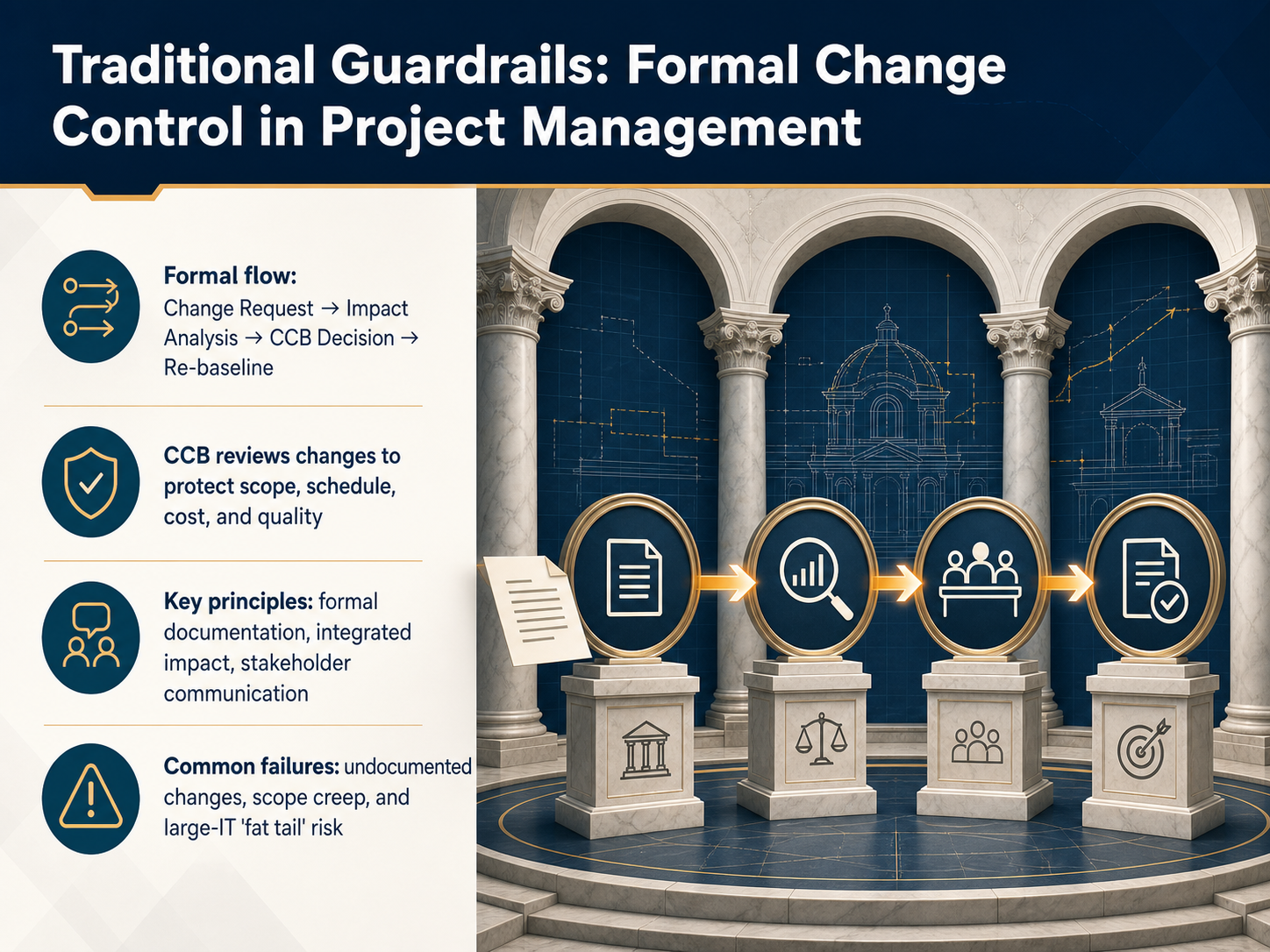
 - 04Traditional Guardrails: Formal Change Control in Project ManagementSo far, we have explored why change happens and why managing it matters. Now, let us look at the traditional guardrails that project managers have used for decades: the formal change control process. Think of this as a structured safety check before you alter the baseline of your project. The workflow is simple in theory, but powerful in practice. First, someone raises a formal Change Request. This is not just a quick chat; it is a written proposal to modify the scope, schedule, or budget. Next, the team performs an Impact Analysis. You are asking, if we make this switch, what else breaks or gets better? The analysis goes to a Change Control Board, often called the CCB. This group reviews the request to protect the project’s key constraints: scope, schedule, cost, and quality. If they approve it, you update the project plan, or re-baseline, to match the new reality. The key principles here are keeping formal documentation, considering the integrated impact across the whole project, and communicating those decisions to stakeholders. But where does this model fail? The common pitfalls are undocumented changes sneaking in or scope creep, where tiny, unapproved additions slowly blow up the budget and timeline. Large IT projects also face what is called the fat-tail risk, where oversized, unvetted changes cascade into major failure. So, the takeaway is that this guardrail only works if you actually use it. But what happens when we are not just managing documents, but managing an AI model? That brings us to a fascinating comparison titled A Tale of Two Boards: The CCB Meets the Model Review Board.
 learnpmanyware.comtrustedinstitute.comprojectmanagement.com+22 min
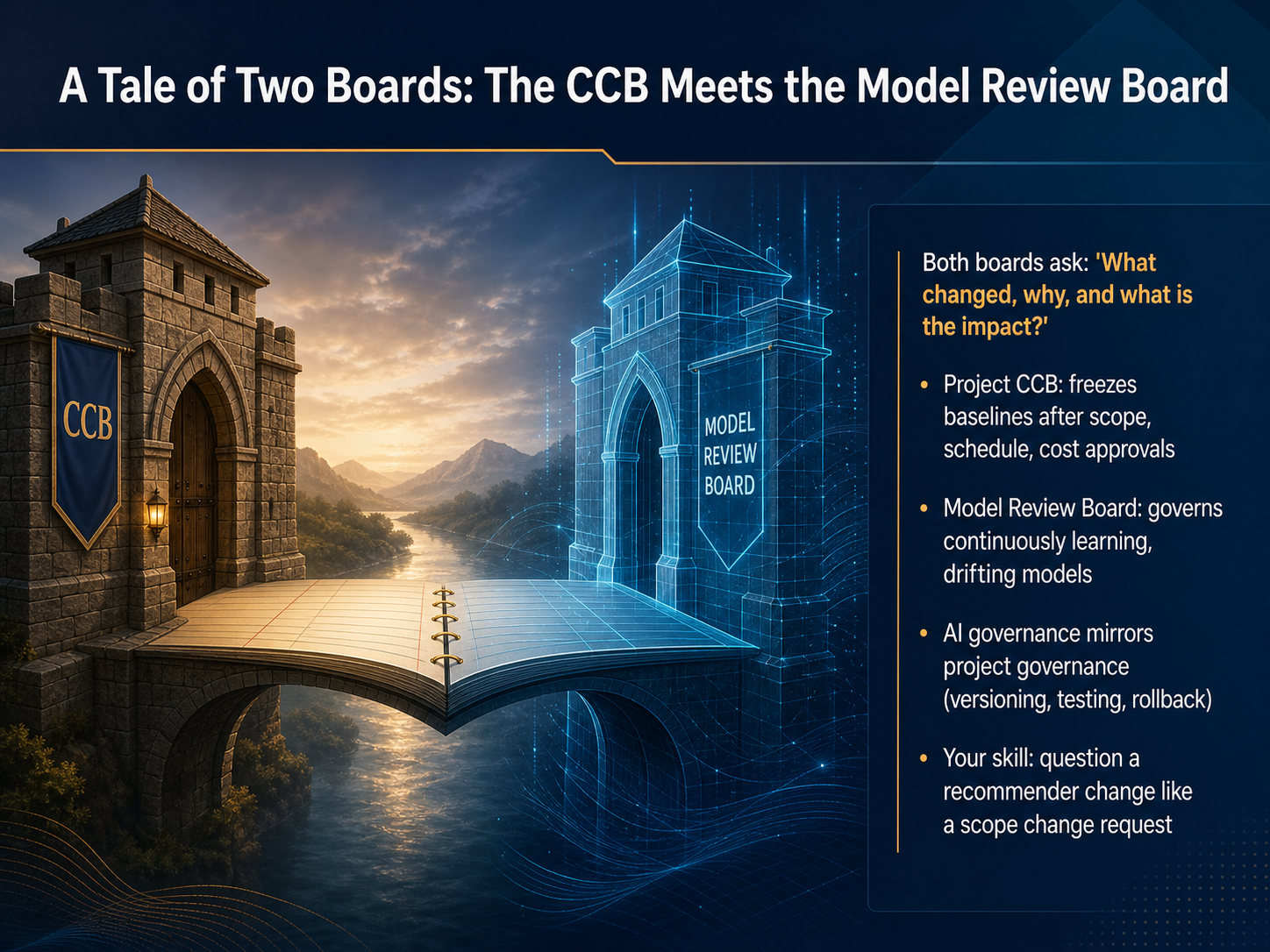
 - 05A Tale of Two Boards: The CCB Meets the Model Review BoardSo, let's make this tangible by looking at two different types of review boards. You already know the Project Change Control Board, or CCB. When someone proposes a scope change, the CCB asks three core questions: What changed, why, and what is the impact on our schedule and budget? Their job is to protect the agreed baseline. Now, a Model Review Board does something surprisingly similar, but for a living system that learns and drifts over time. In AI governance, when a recommender system gets an update or its behavior shifts, we ask those same three questions. What changed inside the model? Why did its accuracy or fairness shift? And what is the impact on users? As an AI-curious learner, your skill is to use the same critical lens. Question a model change just like a scope change request. It turns the mystery of governance into a familiar, practical conversation. Next, we'll apply this directly in a tool we call the 'Thinking Like an AI-Curious Analyst' four-quadrant 'Why' model.
 bakkah.comagility-at-scale.comcacm.acm.org+21 min
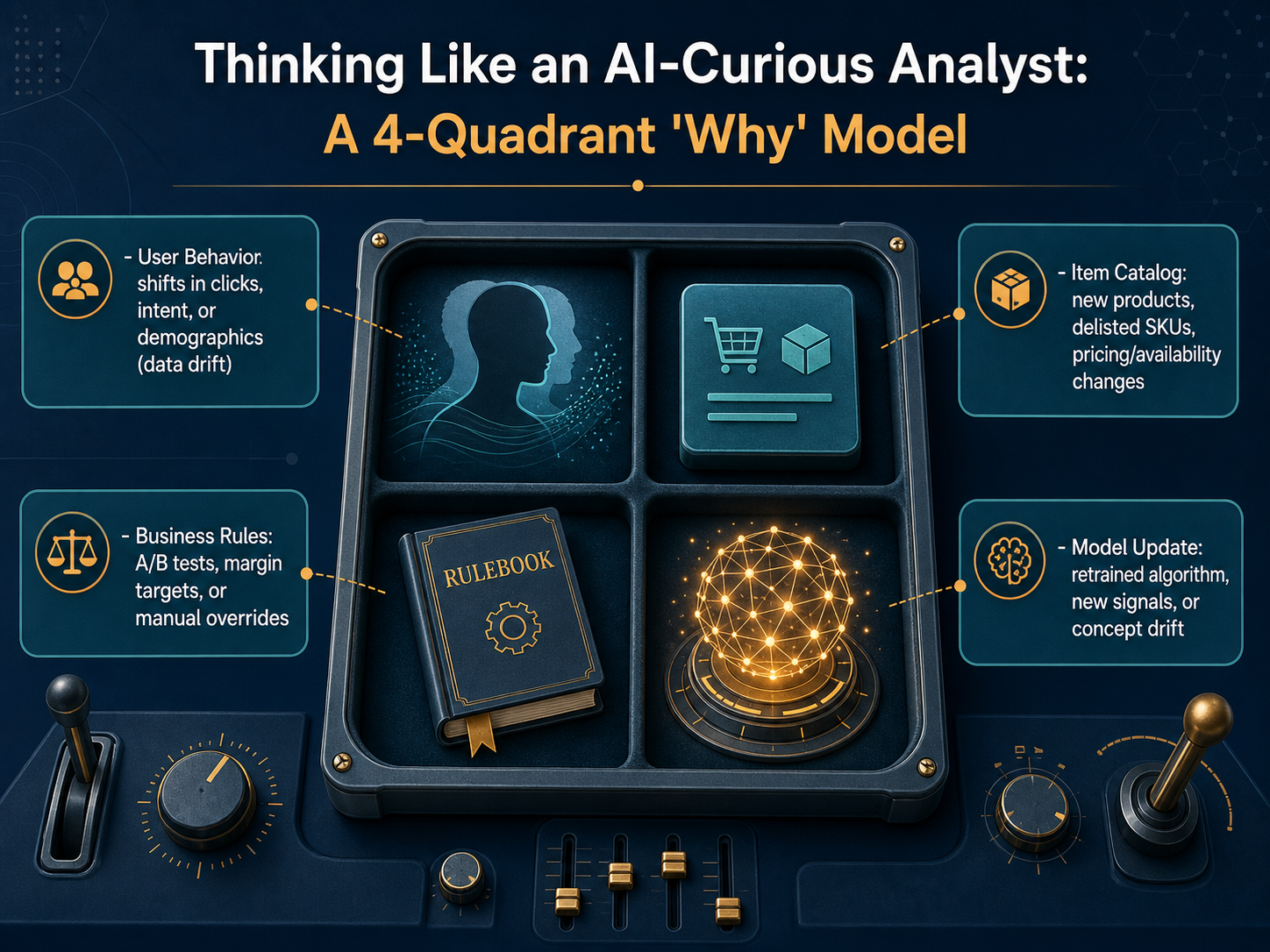
 - 06Thinking Like an AI-Curious Analyst: A 4-Quadrant 'Why' ModelNow let's put on our analyst hats. When recommendations shift, your curiosity is the best tool you have. I want to share a simple four-quadrant model to help you think like an AI-curious analyst, all organized around one word: why. First, look at User Behavior. This is about shifts in clicks, intent, or demographics. Sometimes, the data itself drifts. Your customers might simply be in a new season of life. Second, check your Item Catalog. New products get added, old ones disappear, and prices change all the time. The system can't recommend what isn't there. Third, consider Business Rules. Your own team might be running an A/B test, pushing a higher margin target, or setting a manual override. These conscious choices directly shape outcomes. And fourth, the Model Update itself. The algorithm may have been retrained, a new signal added, or it might be experiencing concept drift, where the patterns it learned no longer apply. When you see a change, just run it through these four lenses. It turns a mystery into a map. Next, let's explore where these outputs actually live, in 'The Invisible Engine: How Feedback Loops and Bias Shape What You See'.
 2 min
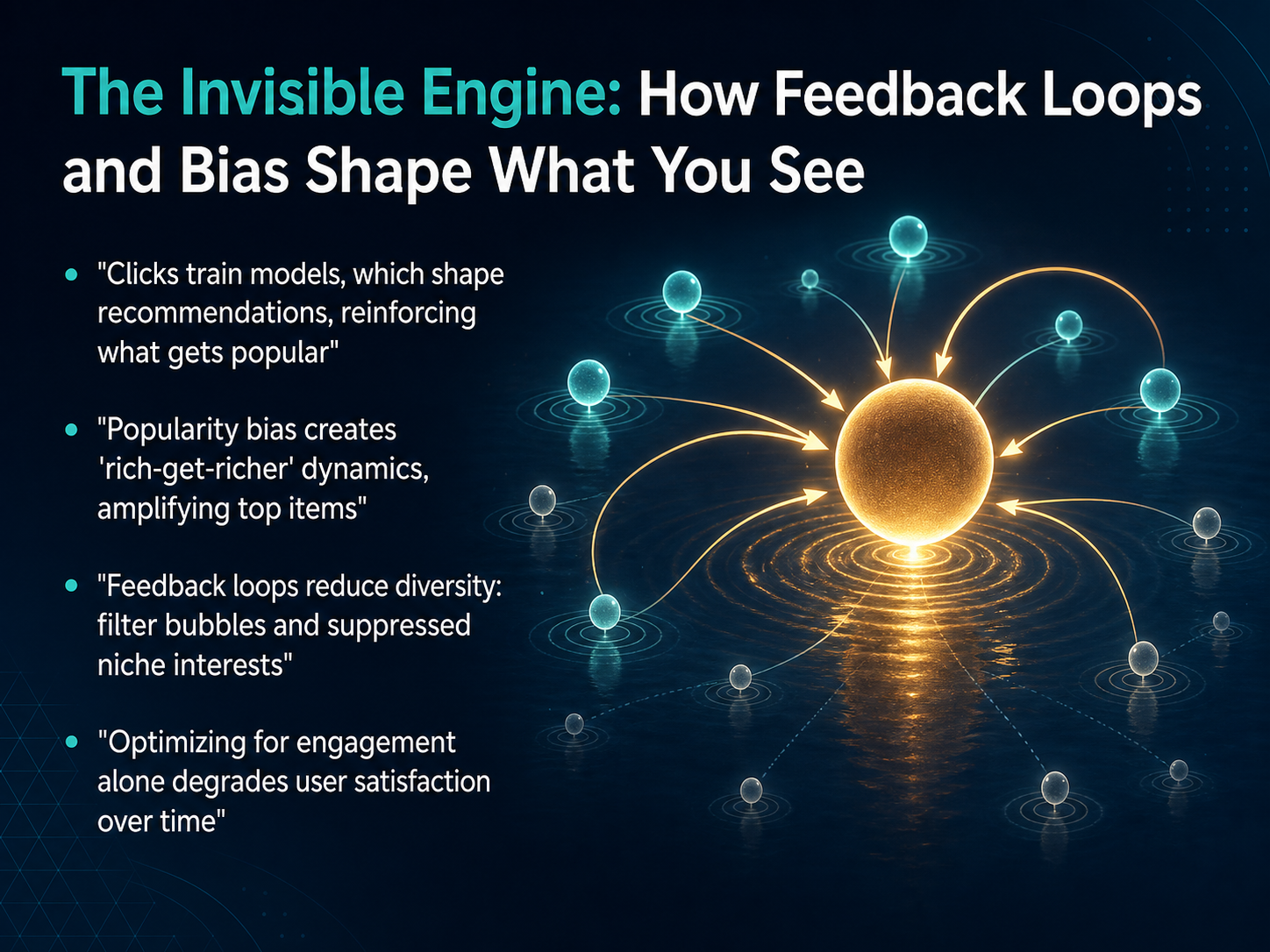
2 min - 07The Invisible Engine: How Feedback Loops and Bias Shape What You SeeSo, what actually happens when you click? It’s not just a one-time choice; it’s fuel for an invisible engine. Your clicks, and the clicks of millions of others, train the models that decide what gets popular next. This creates a feedback loop that can quickly become a 'rich-get-richer' dynamic, where already-popular items are amplified and dominate the recommendations you see. Over time, this loop reduces diversity. It can quietly suppress niche interests and pull everyone into what we call a filter bubble. The tricky part is that optimizing purely for engagement, for feeding you what you’re most likely to click on right now, can actually degrade your satisfaction over time. It leaves you asking, 'Why am I only seeing the same kind of thing?' Understanding this invisible engine is the first step to governing it. Next, we’ll explore how to anticipate and govern these unexpected outcomes, looking at the roles of risk, observability, and AI.
 1 min
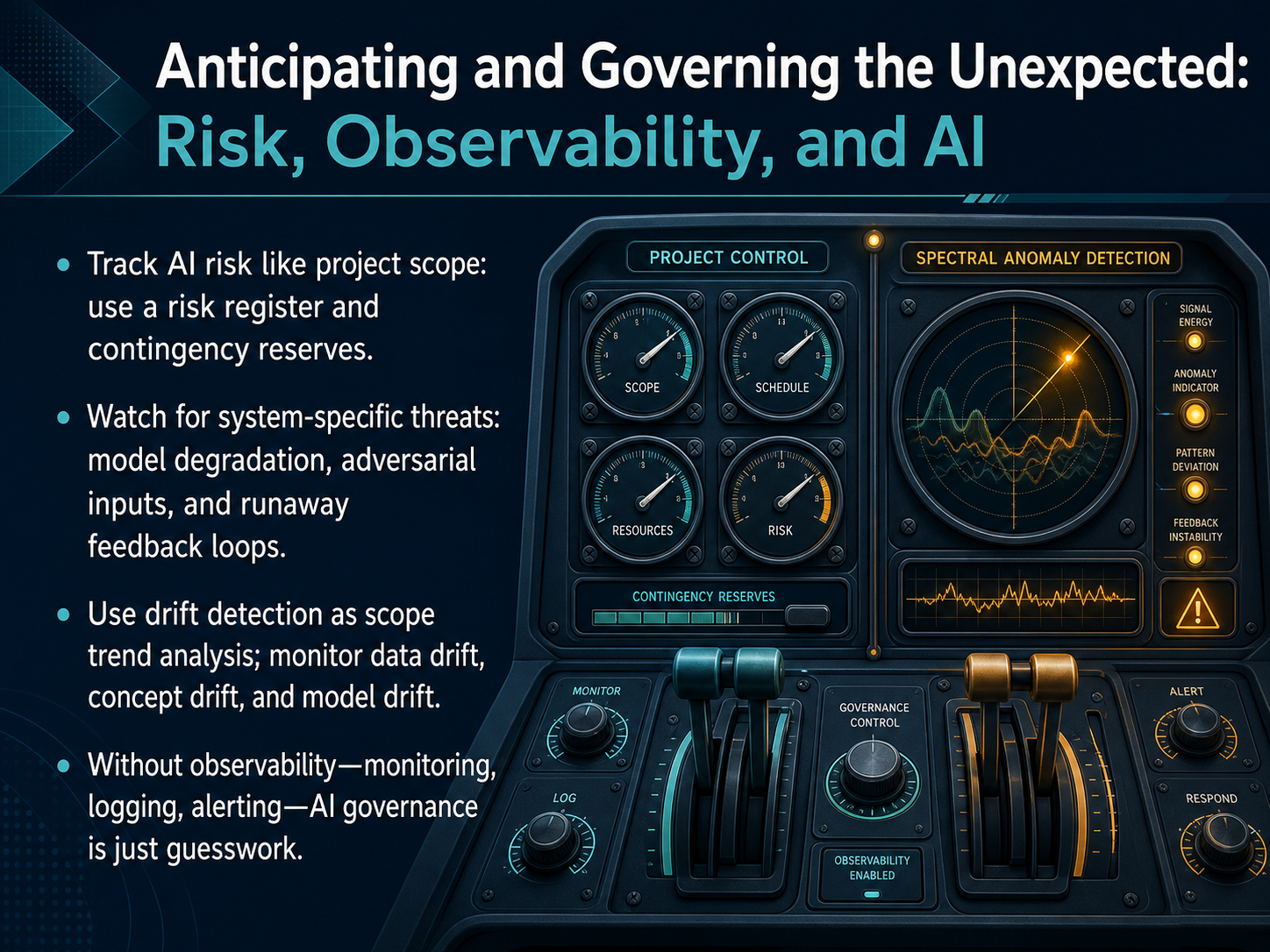
1 min - 08Anticipating and Governing the Unexpected: Risk, Observability, and AINow, let's talk about how we can anticipate and govern the unexpected when AI is part of your project. Think of it like tracking your project scope. You'd use a risk register and contingency reserves for that, right? We need a similar discipline for AI. So, create an AI risk register to log specific threats, like model degradation, adversarial inputs, or even runaway feedback loops. To spot these early, we use something called drift detection, which is a bit like trend analysis for your model. We monitor for data drift, concept drift, and model drift. But here's the core idea: without true observability—that means solid monitoring, logging, and alerting—any AI governance is really just guesswork. You can't manage a risk you can't see. Next, let's explore the human side of this, moving from change resistance to building real change literacy.
 2 min
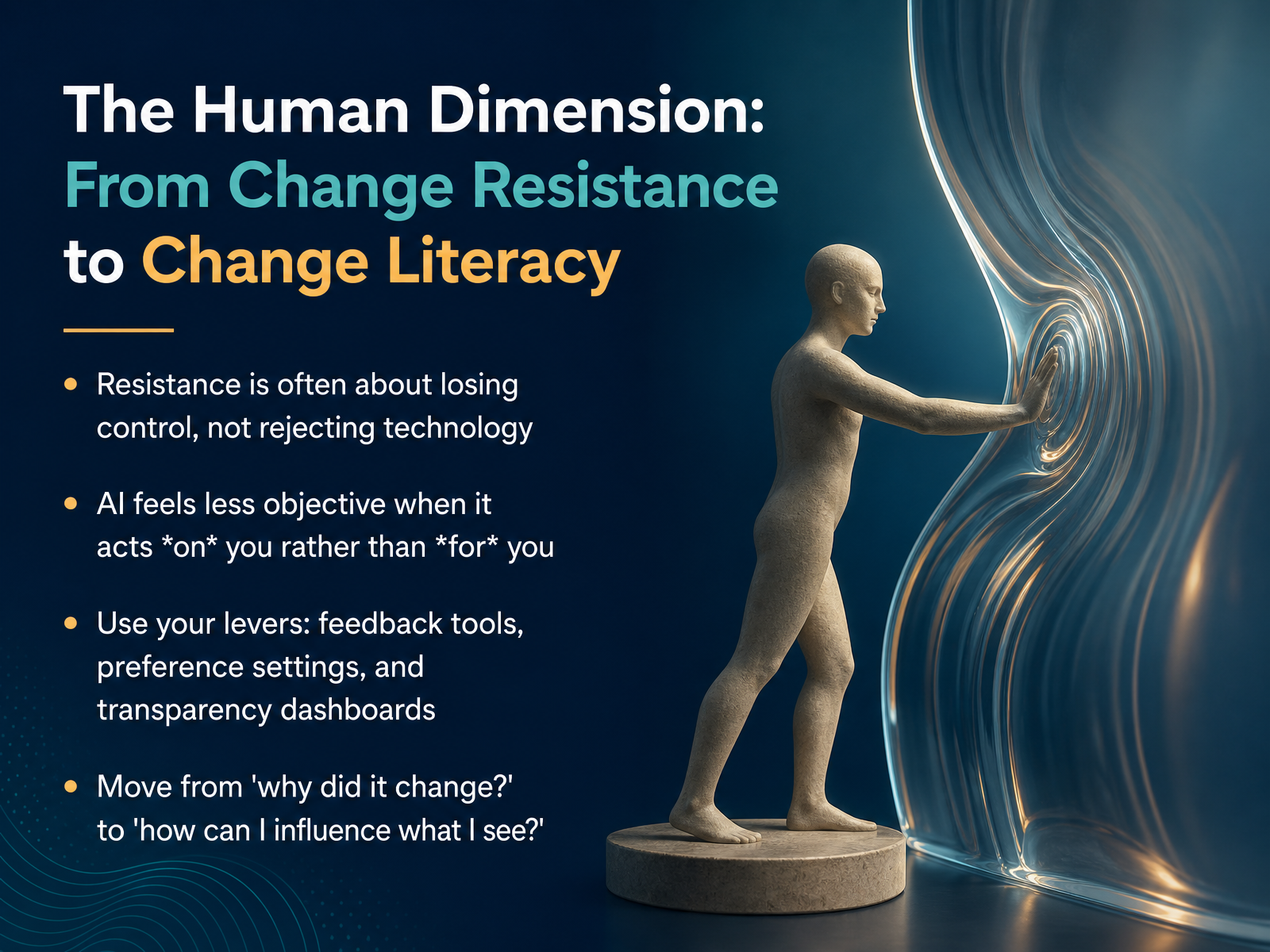
2 min - 09The Human Dimension: From Change Resistance to Change LiteracyWhen an AI-driven platform rolls out a change, the first question people ask is often, "Why did this happen?" But what they're really feeling is a loss of control. Resistance to change in projects isn't usually about rejecting the technology itself. It's about the discomfort of having something act on you, rather than for you. Think about it: an algorithm that quietly adjusts your personalized feed feels a lot less objective than one that asks for your input first. Research consistently shows that perceived autonomy is central to user satisfaction. So, your job as a change manager is to move your team from asking "Why did it change?" to "How can I influence what I see?" You have concrete levers you can use. First, point them to preference settings and feedback tools. Letting a user adjust sliders for content accuracy or exploration restores their sense of agency. Second, advocate for transparency. A simple dashboard that shows why a recommendation appeared can transform a mysterious black box into a useful, understandable tool. The goal here is to build something we might call change literacy. This isn't about one-time training. It's about giving your team the permanent ability to see, shape, and own their digital experience. When people move from being passive recipients of change to active co-creators, the whole dynamic shifts. Now, let's take a closer look at these ideas in practice. Our next slide is a case study deep dive on what happened when a model update completely changed a product experience.
 2 min
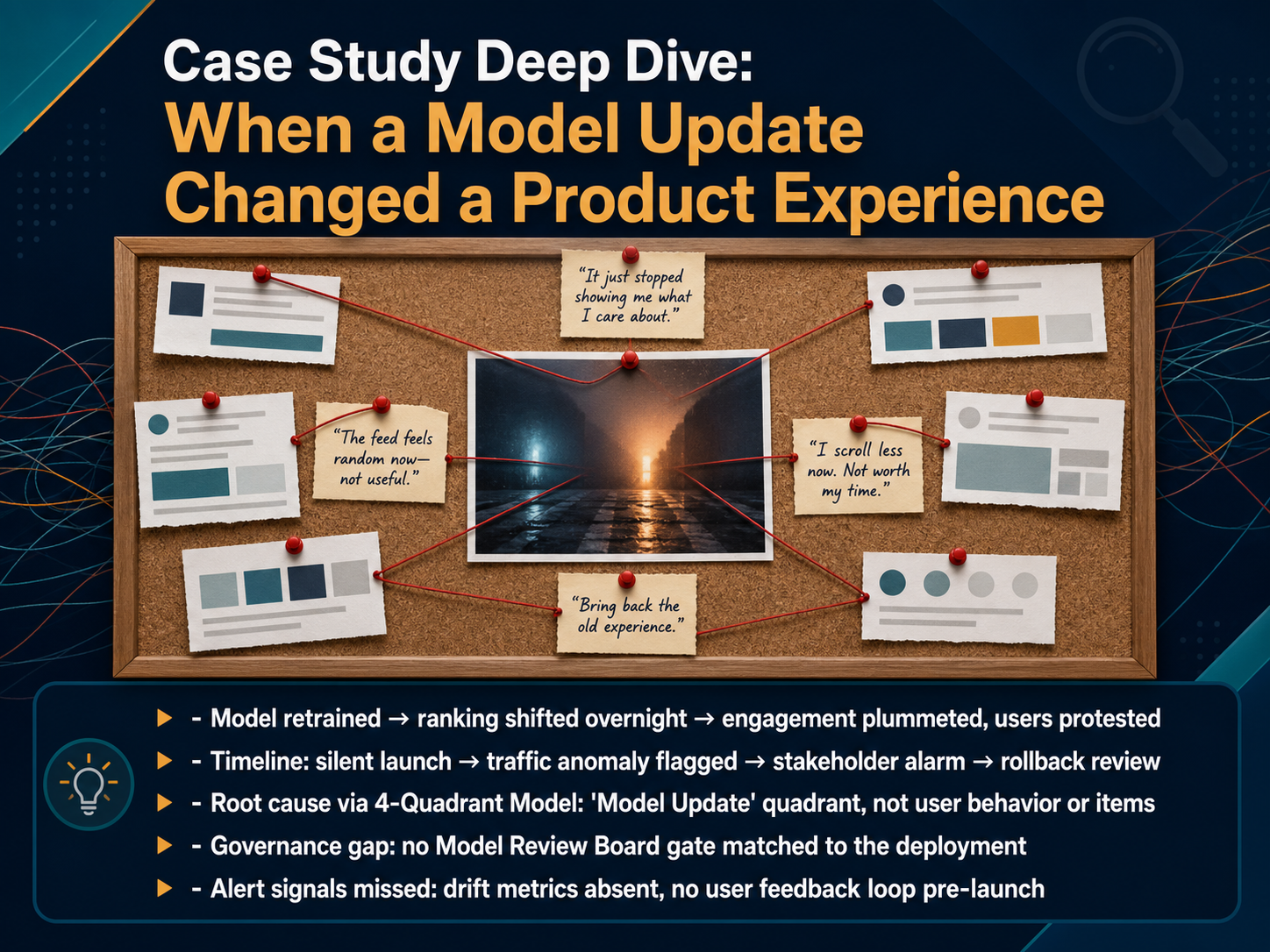
2 min - 10Case Study Deep Dive: When a Model Update Changed a Product ExperienceNow let's walk through a real case where a model update changed the entire product experience. Imagine a recommendation algorithm gets retrained overnight. The ranking shifts immediately, and suddenly user engagement plummets. People notice, and they start protesting. Here's the timeline: the team did a silent launch without a user feedback loop. An anomaly in the traffic data flagged the issue before stakeholders raised the alarm, triggering an emergency rollback review. When we used the Four-Quadrant Model to find the root cause, it landed squarely in the 'Model Update' quadrant. It wasn't a sudden change in user behavior, and it wasn't a problem with the items themselves. The core issue was a governance gap. There was no Model Review Board gate attached to this deployment. That meant critical alert signals were missed entirely. Drift metrics were absent, and no one had set up a feedback loop to catch the user reaction before the full launch. This single case shows why change control is essential: silent changes without guardrails can break the very experience you're trying to improve. Coming up, we'll translate these lessons into practical strategies for leading and tracking change in hybrid environments where humans and AI work together.
 2 min
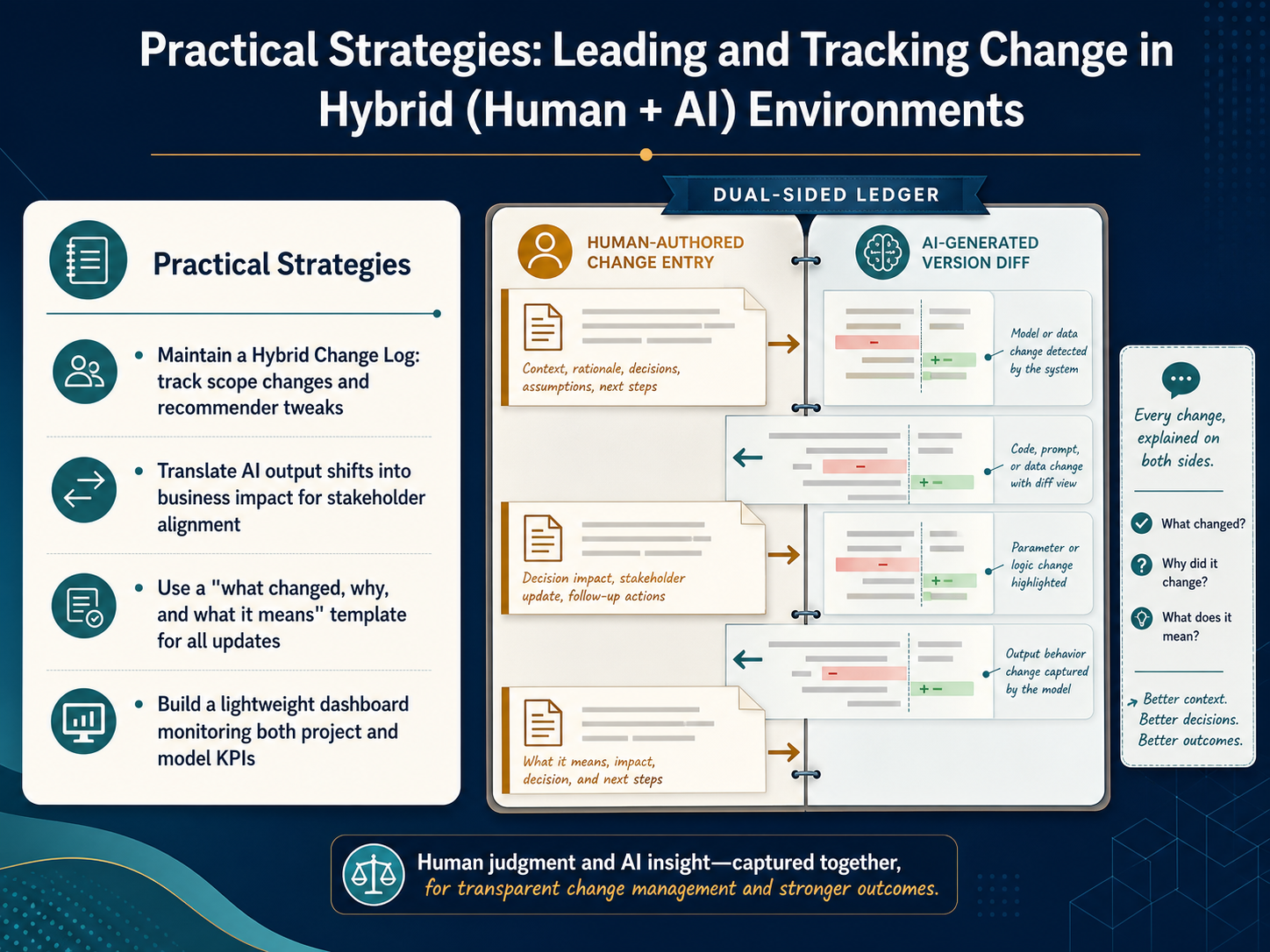
2 min - 11Practical Strategies: Leading and Tracking Change in Hybrid (Human + AI) EnvironmentsLet’s get practical. When you’re leading change in a hybrid environment—where your team and your AI tools both keep evolving—you need lightweight ways to stay aligned. Here are four strategies to try. First, keep a hybrid change log. This is a single, shared place to track scope changes and any tweaks the team makes to how a recommender or AI model works. Second, whenever the AI’s output shifts—say recommended items suddenly change—translate that into business impact for your stakeholders. Don’t just say the model updated; explain what it means for customers or revenue. Third, adopt a simple update template: what changed, why it changed, and what it means for us. Use that for every team or stakeholder update. And finally, build a lightweight dashboard that watches both your project KPIs and your model KPIs side by side. That way, you’re never monitoring technology in a vacuum. These four habits turn AI governance from a scary idea into a repeatable rhythm. Now let’s pull everything together in your final toolkit—your unified approach to change and influence.
 2 min
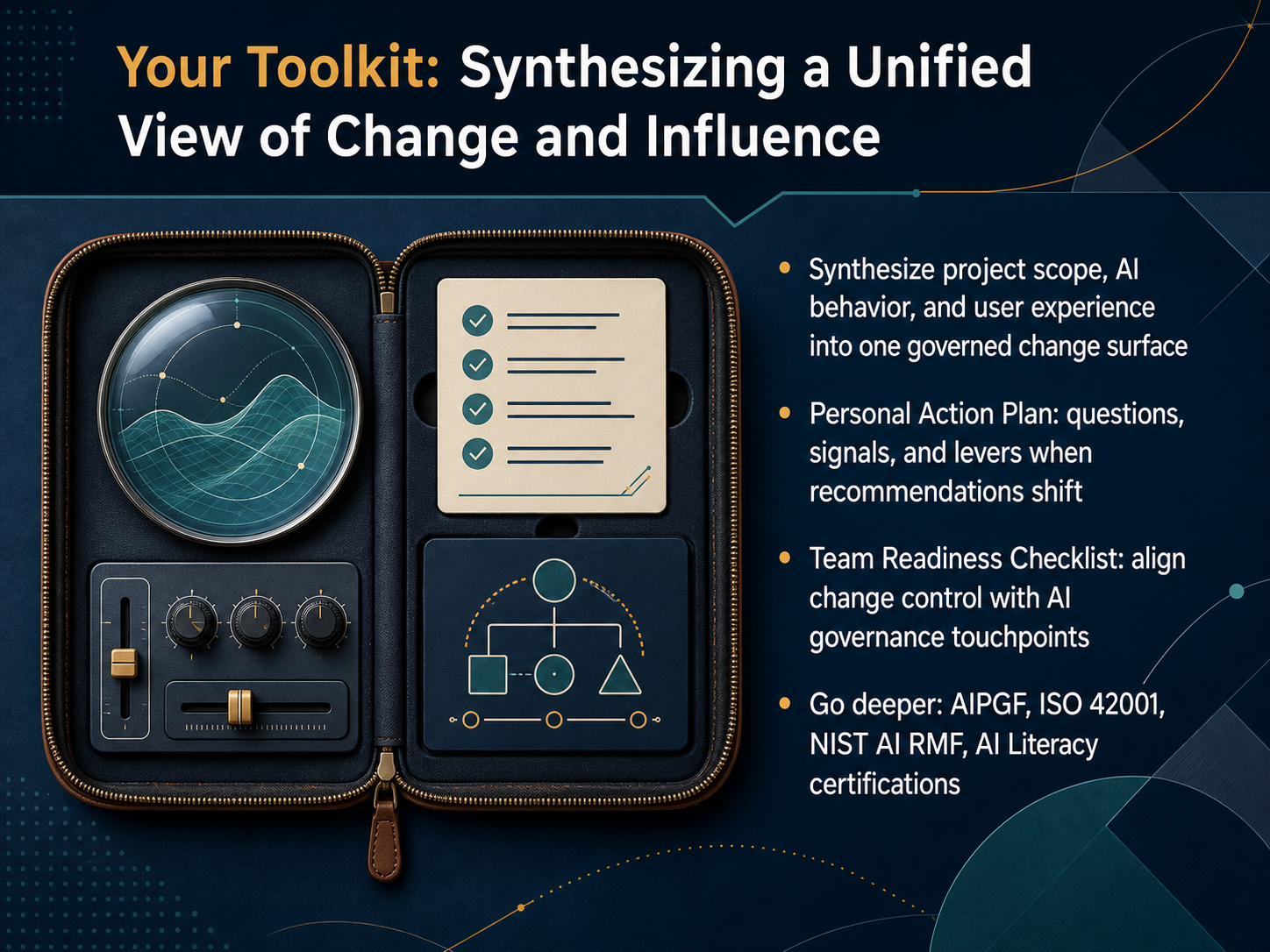
2 min - 12Your Toolkit: Synthesizing a Unified View of Change and InfluenceSo we have covered a lot of ground. Let us bring it all together into a toolkit you can use right away. Think of this as a single governed change surface. You are weaving together three threads: your project scope, how the AI behaves, and the actual user experience. When those three stay aligned, change feels manageable instead of chaotic. When an AI recommendation shifts, use your Personal Action Plan. Ask three simple questions. What signal triggered this shift? Is it a data drift, a new rule, or something else? And what lever can we pull to stay in control? For your team, the Readiness Checklist helps you align change control with AI governance touchpoints, so no one is caught off guard. If you want to go deeper, explore frameworks like the A I P G F, the ISO four two zero zero one standard, or the NIST A I Risk Management Framework. And consider an A I Literacy certification, designed for non-technical professionals like you, to build practical confidence. You now have a complete system to manage change, not just react to it. Thank you for joining me today. Stay curious, and stay in control.
 2 min
2 min
Take the deck with you
Download this course as a file — free, no sign-up needed.
- PDF handoutEvery slide page, ready to print or share.13 pages · 3.8 MBDownload
- Narrated PowerPointThe deck that presents itself — every slide carries the digital human's narration video.13 pages · 14.9 MBDownload
- PowerPoint slidesThe full deck as a .pptx — open it in PowerPoint, Keynote, or Google Slides.13 pages · 3.7 MBDownload
Free to use in your own training — please keep the PersonWise credit page at the end.
Have your own deck? Turn it into a course
Sources consulted
Web sources consulted while building this course.
- Comparative research on IT project failure rates: A 2025 ... — pmworldjournal.com
- Project Management Statistics (2026): 40+ Data Points | Agiled — agiled.app
- Comparative research on IT project failure rates: A 2025 longitudinal update — pmworldlibrary.net
- 2026 Project Management Statistics | 130+ Verified Facts — gitnux.org
- Project failure statistics you need to know (2026) • Breeze — breeze.pm
- Explaining AI Drift to Non-Technical Stakeholders | Clarity — heyclarity.dev
- Data and concept drift in simple words — karls.io
- Concept Drift vs Data Drift: The Hidden Reason Your AI Loses Accuracy | by Its Shoryabisht | CodeToDeploy | Feb, 2026 | Medium — medium.com
- Model Drift: Data Drift vs Concept Drift Explained | Sama — sama.com
- Explain the difference between concept drift, data drift, and label drift. How would AI systems detect each in real time? | by Byot Tech | Medium — medium.com
- PMP Blue V6.1 Cover for ebook 061020 — learnpmanyware.com
- Integrated Change Control test - PMBOK 7th edition — trustedinstitute.com
- Perform Integrated change control — projectmanagement.com
- Master PMP PMBOK Change Requests flow in 5 Minutes — youtube.com
- Change Management Process Complete Overview — 4pmti.com
- Change Control Boards (CCB) In Project Management And ... — bakkah.com
- AI Model Governance and Lifecycle Management — agility-at-scale.com
- The Dawn of AI Change-Control — cacm.acm.org
- Project Governance Frameworks Every PM Should Know — knowledgehut.com
- Human-Centered Responsible AI Product Development Lifecycles Merging Participatory Design, Stakeholder Alignment, and Risk Modeling for Equitable Digital Financial Service Delivery — doi.org