Primary Sources for World History
Begin
14 pages · ~28 min
Primary Sources for World History
Learn how to analyze and interpret primary sources to build historical thinking skills, designed for educators and students of world history.
What you’ll learn
- 01Using Primary Sources in World HistoryWelcome. Whether you are a student, a teacher, a researcher, or an independent learner, I am glad you are here. This course is about building a shared toolkit for working with primary sources in world history. Primary sources are original records created at the time we are studying—think of a treaty, a merchant's ledger, a diary, or a photograph. Secondary sources interpret those materials later, and tertiary sources compile summaries. But our focus is on the originals, because that is where historical thinking begins. Together, we will develop three core skills: sourcing, which asks who created a document and why; contextualization, which situates it in its time and place; and corroboration, which compares it against other evidence. These are not secret expert methods. They are ways of asking better questions. Let's start with a simple but powerful question: what counts as a primary source in world history? We will explore that next.worldhistorycommons.orghistory.genie.stanford.eduworldhistory.pitt.edu+22 min
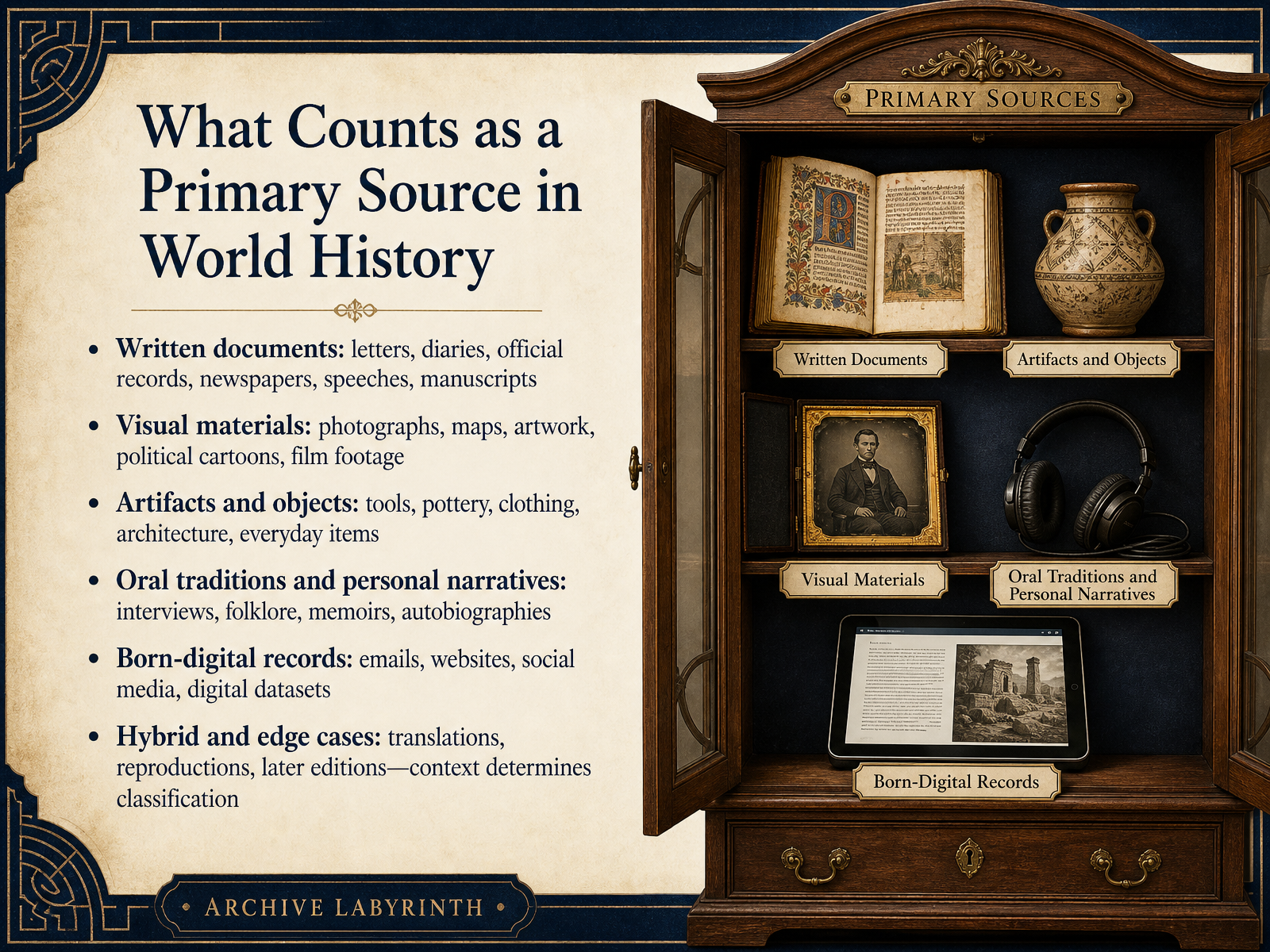
- 02What Counts as a Primary Source in World HistoryNow, let's broaden our idea of what a primary source actually is. When we say the term in world history, we're talking about raw materials created during the time we're studying, or by people who directly experienced it. You've likely encountered the classics: written documents like letters, diaries, official records, newspapers, and speeches. But our toolkit needs to be much larger. We also have visual materials, such as photographs, maps, political cartoons, and film footage. Then there are physical artifacts and objects, like tools, pottery, clothing, or even entire buildings. In many cultures, oral traditions, personal narratives, and interviews are a vital record of the past. And today, historians also analyze born-digital records like emails, websites, and social media data. A key thing to remember is that context is everything. A translation or a later edition can still function as a primary source, depending on the questions we ask. Let's keep these categories in mind as we move next to searching and accessing global primary sources.
 chnm.gmu.eduworldhistorycommons.orgchnm.gmu.edu+22 min
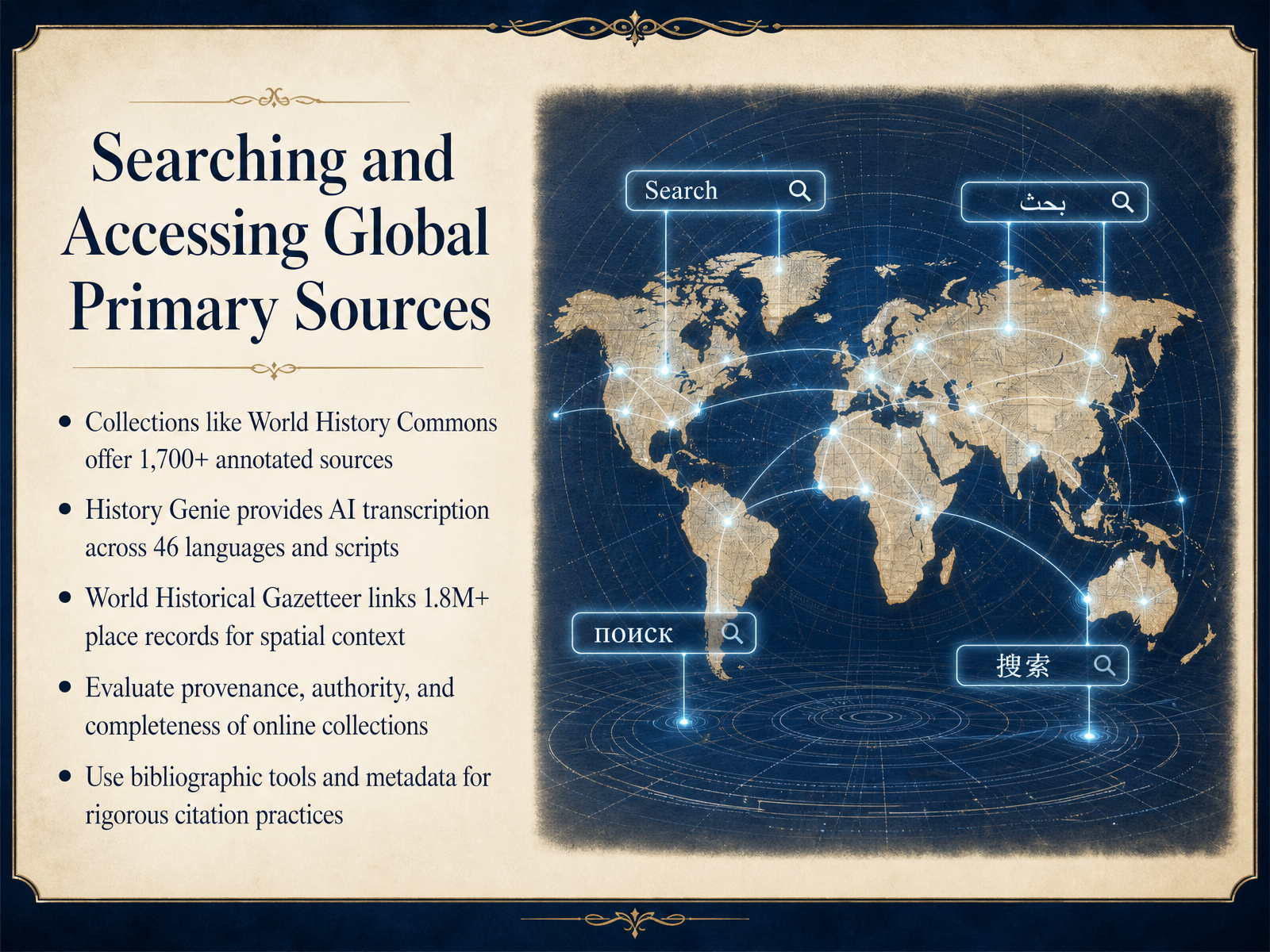
 - 03Searching and Accessing Global Primary SourcesNow we turn to the question of where we actually find these documents. Our field has a growing set of digital tools that open up the global past in remarkable ways. Take World History Commons, for instance. It offers over seventeen hundred annotated primary sources, each one peer-reviewed and paired with teaching guides to help us get started. Then there is History Genie from Stanford, which uses AI to transcribe documents across forty-six languages and scripts, letting us work with texts that would otherwise stay locked behind unfamiliar handwriting or language barriers. And to ground our sources in space, we have the World Historical Gazetteer, which links more than one point eight million place records, so we can map historical movements and connections. But here is the core practice we cannot skip: we must evaluate every online collection for its provenance, its authority, and its completeness. Just because something is digitized does not mean it tells the full story. Finally, as we gather these sources, let us use the bibliographic tools and metadata that modern platforms provide. Rigorous citation is not just an academic formality; it is how we invite others to trace our interpretive path. With our toolkit expanding, we are ready to slow down and examine the documents themselves using a structured critical reading method, which brings us to the Four-Move Critical Reading Framework.
 worldhistorycommons.orghistory.genie.stanford.eduworldhistory.pitt.edu+22 min
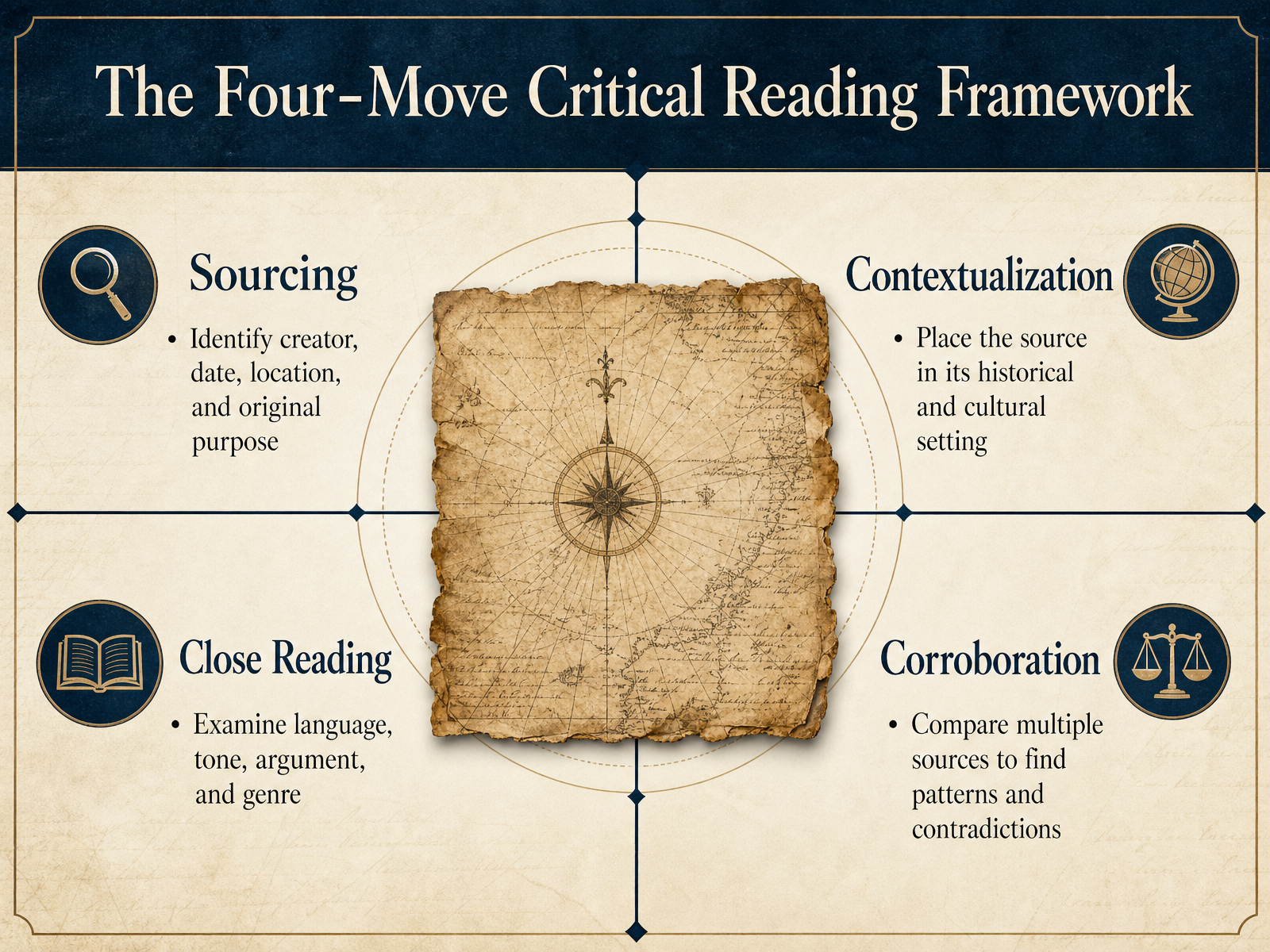
 - 04The Four-Move Critical Reading FrameworkLet's walk through a four-move framework that many historians use when they approach a new source. Think of these moves as a toolkit we can share, not a rigid checklist. The first move is sourcing. We identify the creator, the date, the location, and the original purpose. Asking who made this and why begins to reveal the perspective behind the page. Our second move is contextualization. We place the source in its historical and cultural setting. We ask, what else was happening at that moment that shapes its meaning? The third move is close reading. We slow down and examine the language, the tone, the central argument, and the genre. We ask what the words do, not just what they say. Finally, we use corroboration. We compare multiple sources to find patterns and contradictions. No single source tells the whole story, so we weigh different accounts against each other. Together, these four moves turn reading into active inquiry. Up next, we'll explore how to teach and scaffold these moves so learners can practice them safely and successfully.
 openjournals.bsu.educhnm.gmu.eduloc.gov+22 min
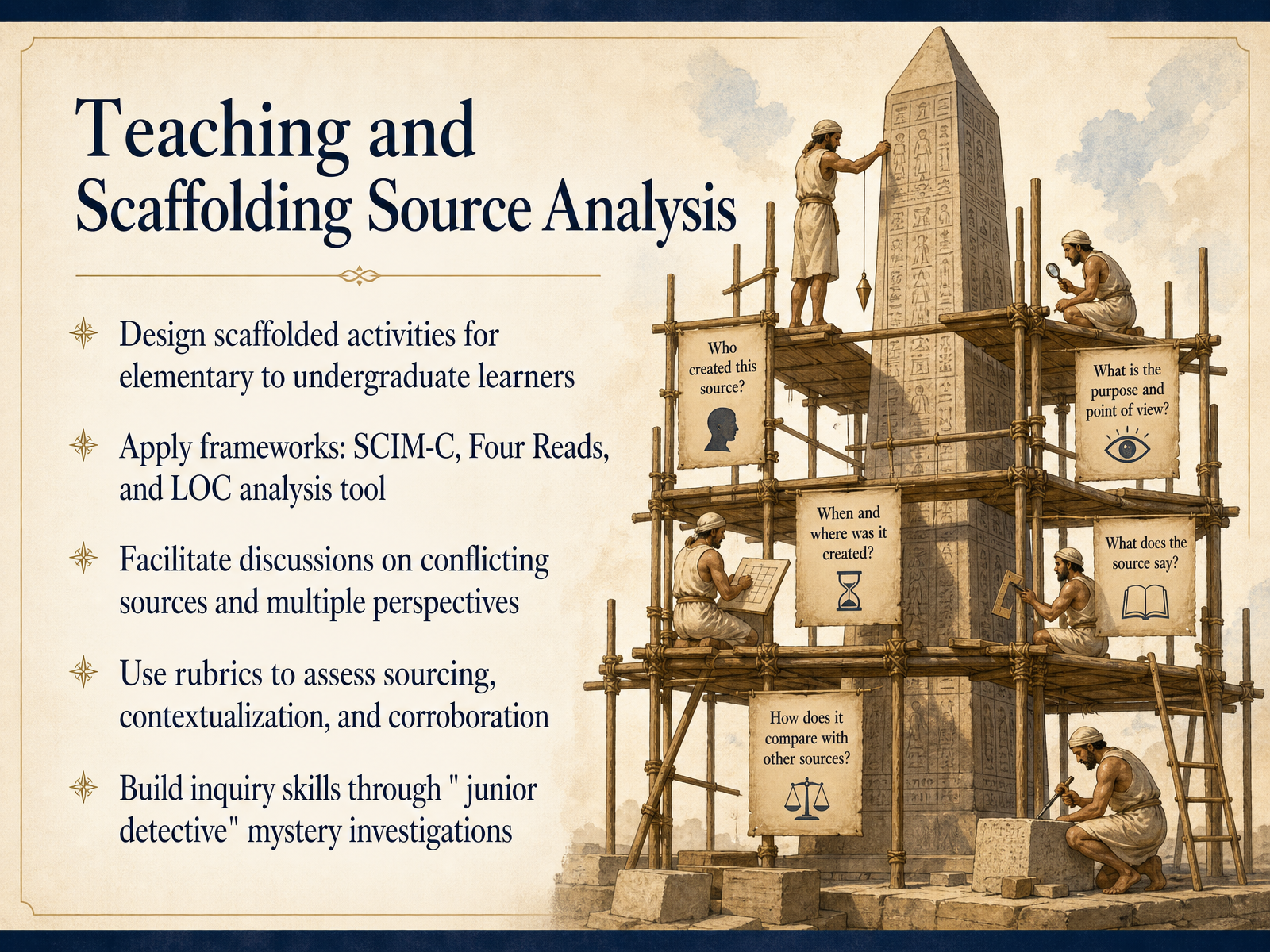
 - 05Teaching and Scaffolding Source AnalysisNow let's turn to the practical side: how do we actually teach these skills step by step? We call this scaffolding. It means designing activities that build confidence from elementary school right up to the undergraduate level, moving learners from simple observation toward full, evidence-based interpretation. We have several proven frameworks to share. You might use the SCIM-C strategy, which has students summarize, contextualize, infer, monitor, and finally corroborate across sources. Or the Four Reads approach, where each reading of a document has a different purpose, from sourcing the creator to interrogating the argument. The Library of Congress also offers a flexible Observe-Reflect-Question tool that works with any format. A powerful way to bring all this together is to frame an inquiry as a junior detective mystery. Give students a compelling question, a limited set of clues, and a detective's notebook. Their mission is to figure out what happened using the sources as evidence. When sources conflict, and they will, that's not a problem, it's the heart of the lesson. We can use structured rubrics to assess how well students source, contextualize, and corroborate, rather than just checking for a single right answer. Let's carry this detective mindset into our next topic, analyzing visual and material sources.
 openjournals.bsu.educhnm.gmu.eduloc.gov+22 min
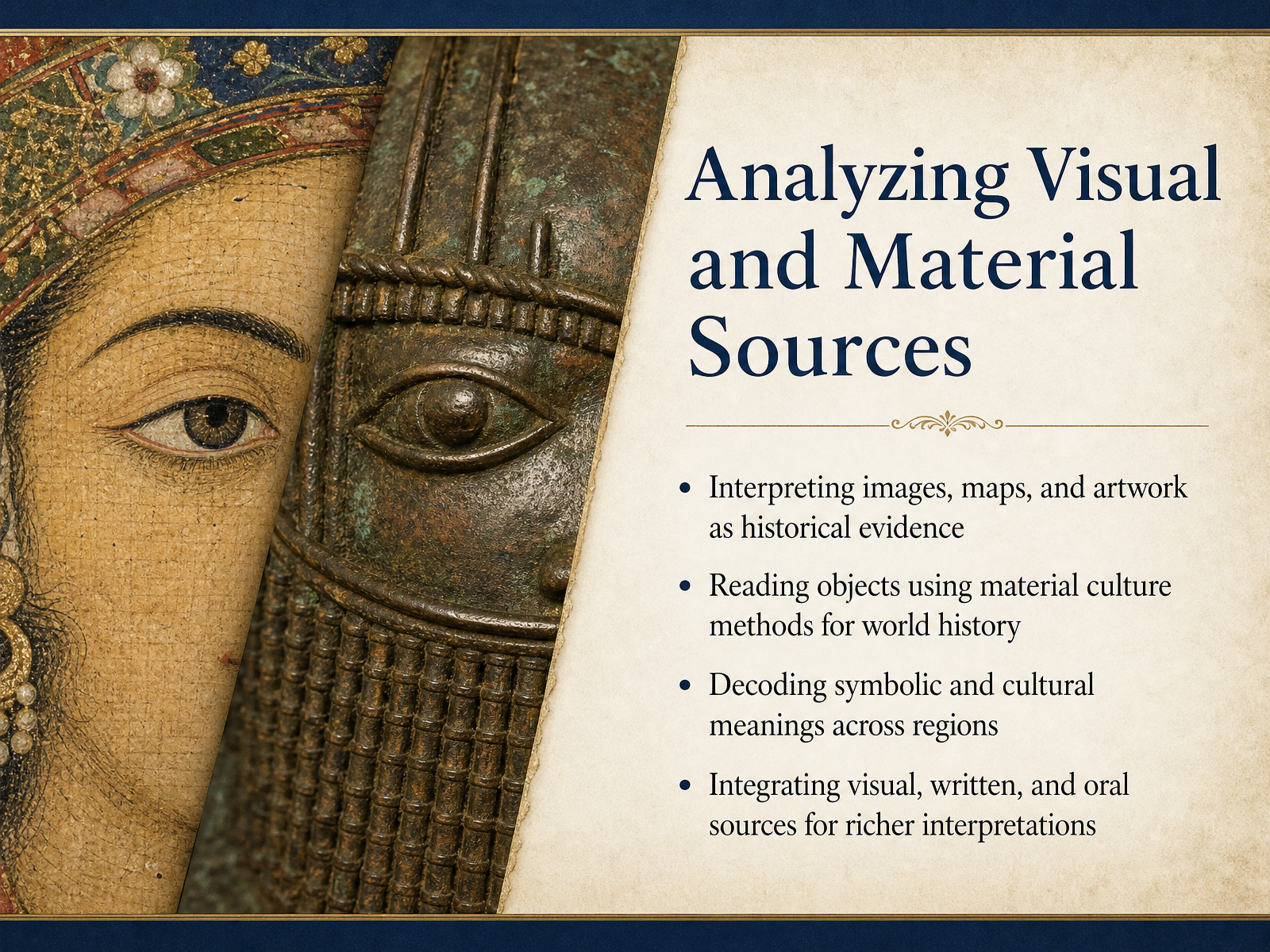
 - 06Analyzing Visual and Material SourcesNow let's turn our attention to a different kind of source, one that often speaks without written words. We're moving into the world of visual and material evidence. Think of images, maps, and objects not just as illustrations, but as primary texts in their own right. When we look at a political cartoon from 1899, a Smith's map of Virginia from 1624, or a steelworks photograph, we ask: what was the creator choosing to show, and just as importantly, what were they leaving out? We can read objects using material culture methods, exploring how a piece of pottery was made and used, which tells us about daily life and trade in ways a written document might miss. These sources are packed with symbolic and cultural meanings that can vary widely across regions, so we have to decode them carefully. The richest interpretations often happen when we don't keep these sources separate. We can integrate a photograph with a personal letter, or a map with an official document, to build a fuller, more layered story. Let's continue this line of thinking with our next topic.
 chnm.gmu.eduworldhistorycommons.orgchnm.gmu.edu+22 min
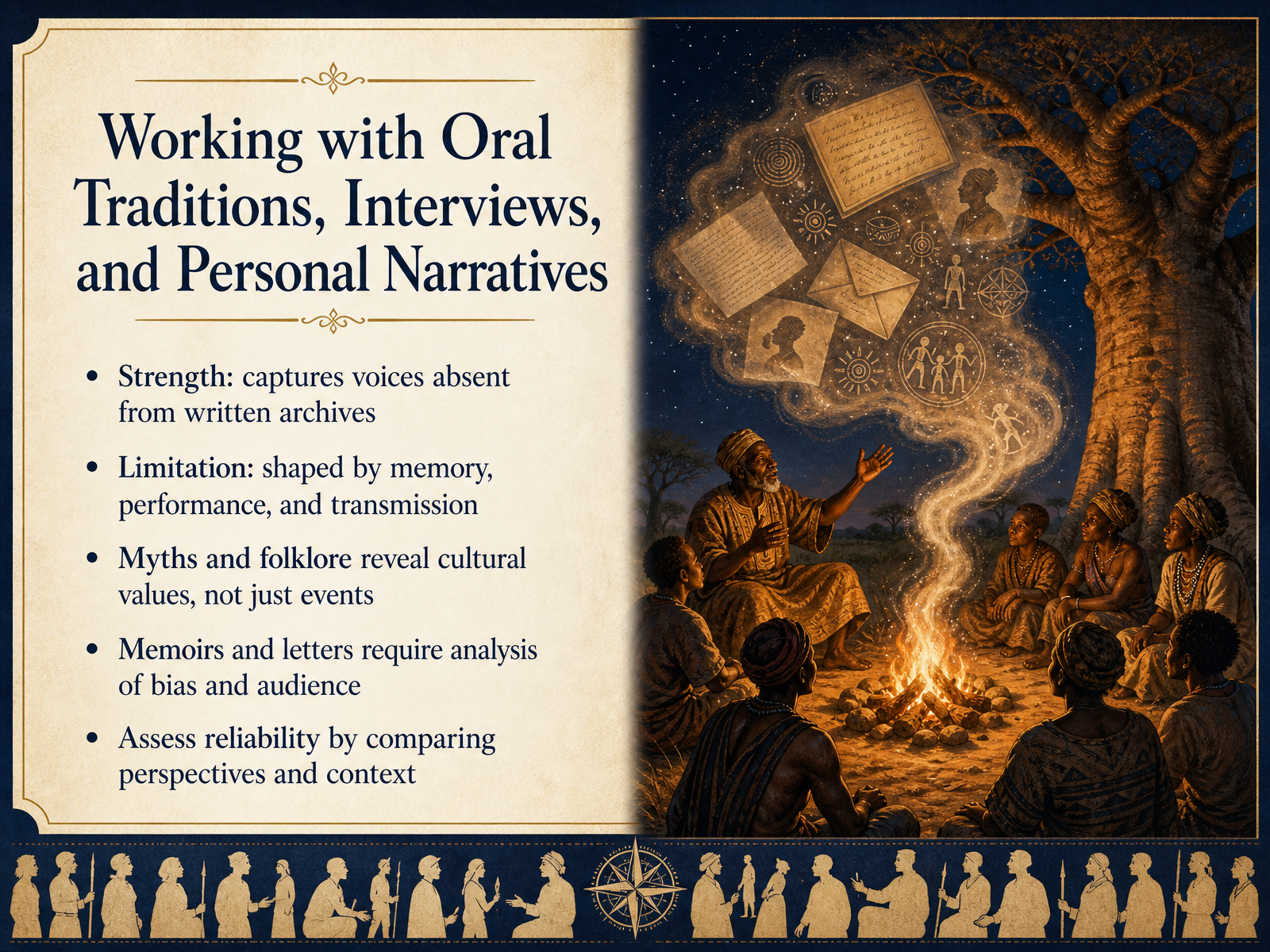
 - 07Working with Oral Traditions, Interviews, and Personal NarrativesNow let's shift our attention to sources that speak in a different way: oral traditions, interviews, and personal narratives. These can be incredibly powerful because they capture voices that are often completely absent from written archives. Think about stories passed down through generations, or the firsthand account of someone who lived through a moment historians might otherwise overlook. But we also need to handle these sources with care. A person's memory can shift over time, the way a story is performed might change its meaning, and the very act of retelling can reshape details. So, we're not just asking 'what happened.' We're also asking, 'what does this story mean to the teller, and why?' This is especially true when we look at myths and folklore. They might not give us a reliable sequence of events, but they are incredible windows into a society's deepest values and fears. Similarly, when we read a memoir or a private letter, we have to ask: who was the intended audience, and what bias might shape the narrative? Our main task is to assess reliability by comparing different perspectives and placing each story firmly in its context. Next, we'll expand our inquiry even further and explore the unique challenges and opportunities that arise when we use sources across borders, focusing on translation and multilingualism.
 2 min
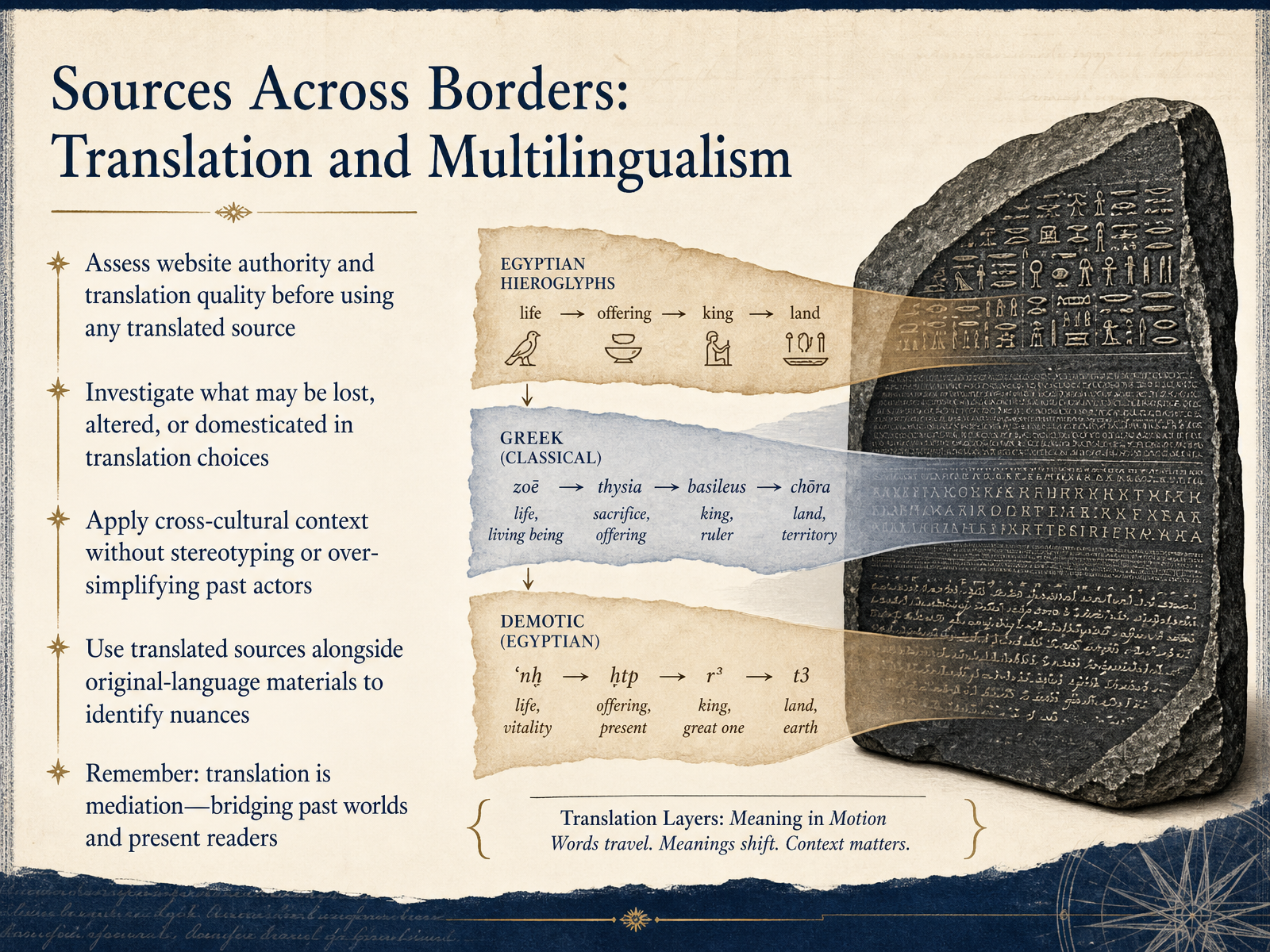
2 min - 08Sources Across Borders: Translation and MultilingualismNow let's turn to sources that cross borders, where translation and multilingualism become central to our work. When we use a translated source, the first step is to evaluate its authority and the quality of the translation itself. We need to ask: who translated it, and what choices did they make? A translator is never just a neutral conduit. They make decisions about tone, about which words to emphasize, and even about what to leave out. This means translation is a form of mediation, a bridge between a past world and us as present readers. Because of this mediation, we should actively investigate what might be lost, altered, or domesticated in the process. For example, a translator might replace an unfamiliar foreign term with a more comfortable one, smoothing over a cultural difference we actually need to see. To catch these nuances, let's pair a translated source with the original language material whenever possible. Even if we don't read the original language, side-by-side comparison can help us spot places where a closer look is required. As we do this, we must apply a cross-cultural context carefully, striving to understand past actors without falling into stereotypes or over-simplification. We're not just fact-checking words; we're interrogating the bridge itself. Next, we'll pivot to cutting-edge tools that help us do this, as we explore digital methods and computational approaches.
 chnm.gmu.edulib.murraystate.educambridge.org+22 min
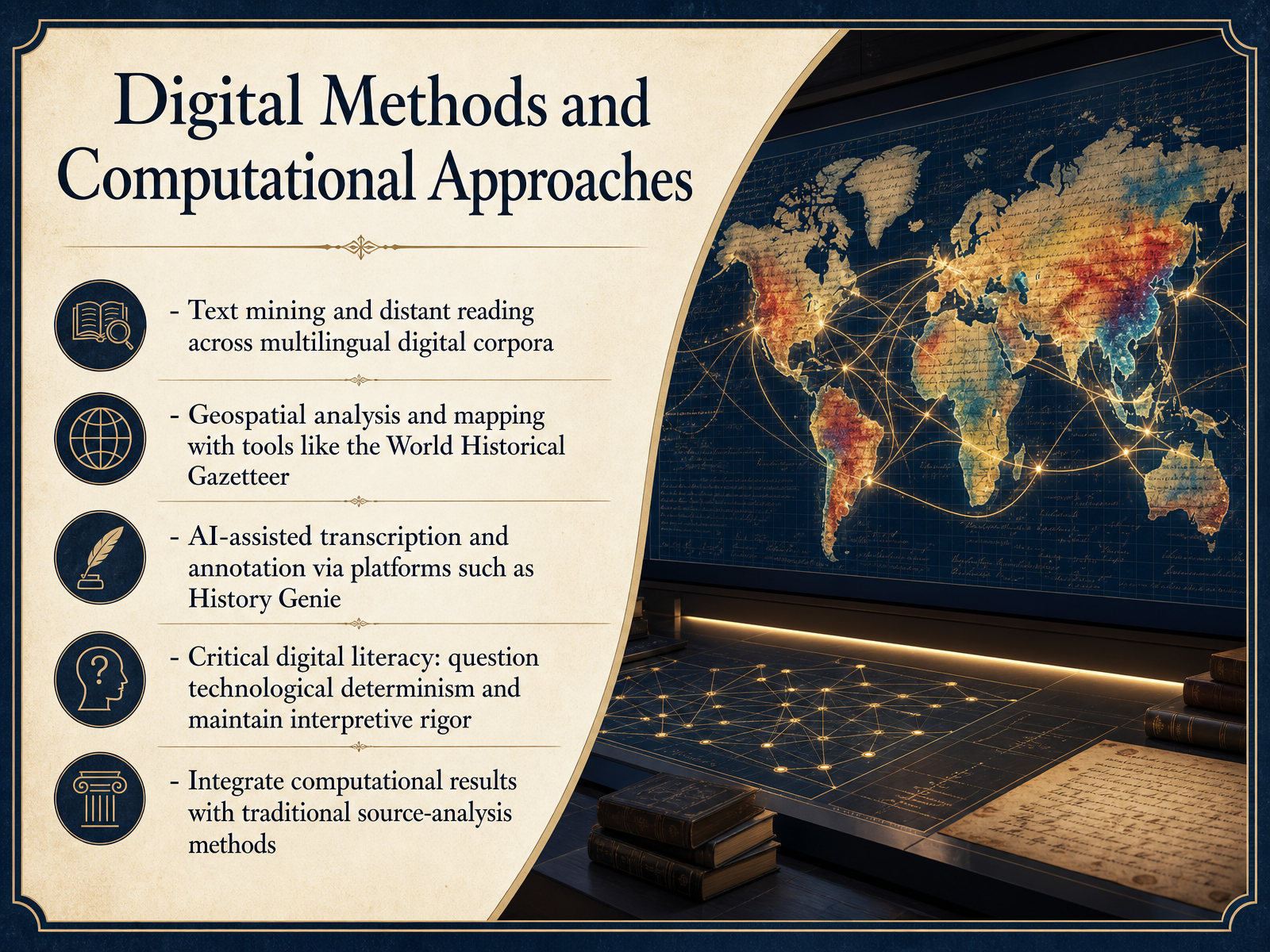
 - 09Digital Methods and Computational ApproachesSo far we have looked closely at individual sources. Now let's step back and consider what becomes possible when we work at a much larger scale. This is where digital methods and computational approaches enter our toolkit. Think about text mining and distant reading. Instead of reading a handful of documents line by line, we can analyze patterns across thousands of multilingual texts and notice trends that would be impossible to spot otherwise. Geospatial analysis lets us ask new questions about place and movement. Tools like the World Historical Gazetteer let us map historical locations and track connections across time and language. We can also enlist help from platforms like History Genie, which uses AI to transcribe and annotate documents in dozens of languages, dramatically opening up access to previously hard-to-use sources. But here is the crucial habit we must build. We need critical digital literacy. When we lean on algorithms and platforms, we must keep questioning technological determinism. Just because a tool visualizes a pattern does not make that pattern meaningful. Our interpretive rigor must remain human. The most productive historians integrate computational results with traditional close reading and source analysis. The map and the spreadsheet are starting points for new questions, not final answers. Next, we will extend this critical lens to a deeper conversation about ethics, silences, and power in the archive.
 worldhistorycommons.orghistory.genie.stanford.eduworldhistory.pitt.edu+22 min
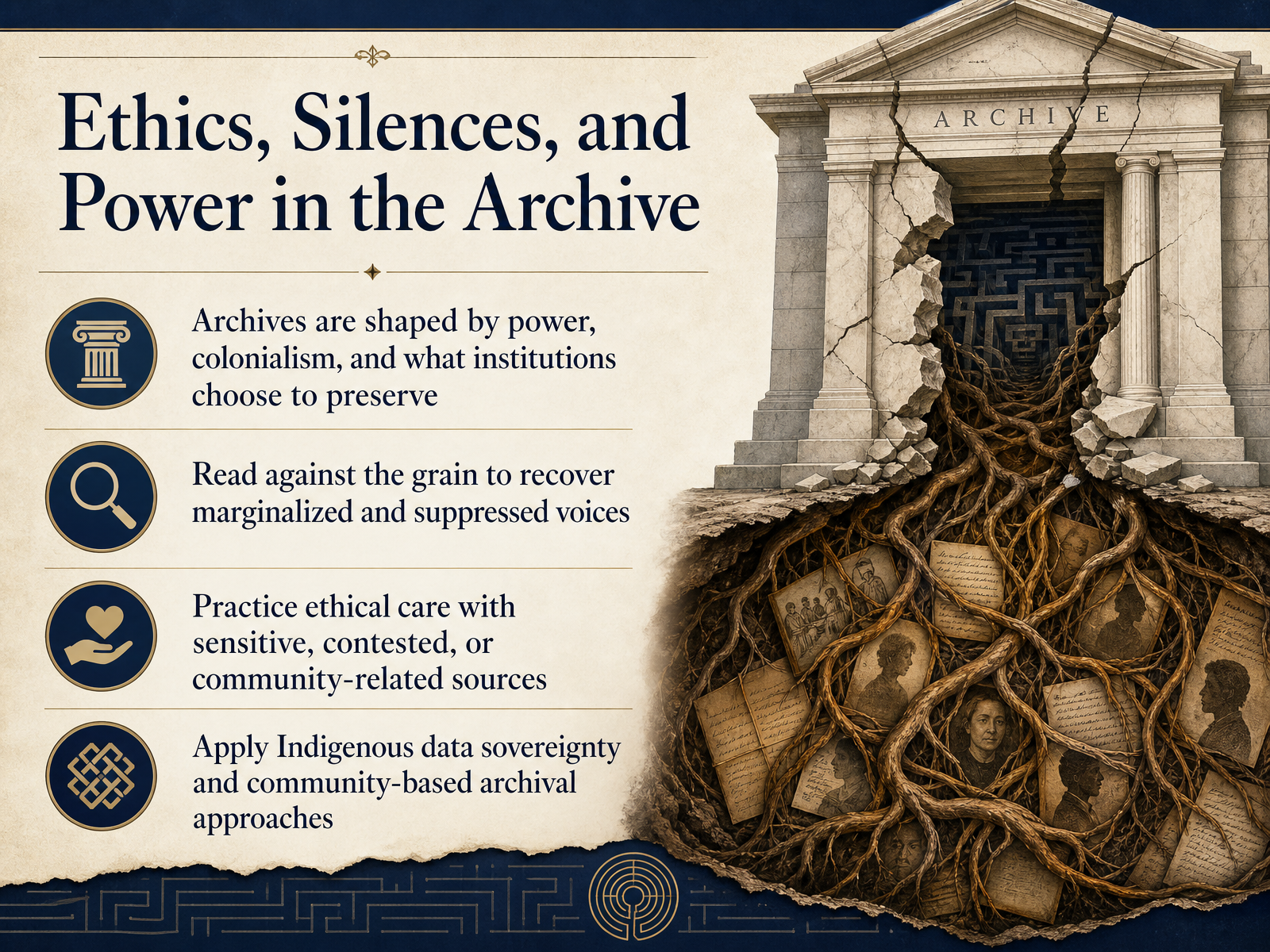
 - 10Ethics, Silences, and Power in the ArchiveNow let's turn to a more complex challenge. Archives are not neutral. They're shaped by power, by colonialism, and by deliberate choices about what to preserve and what to silence. So we have to ask, whose voices are missing from the records we use? To recover those marginalized perspectives, historians practice something called reading against the grain. This means reading a document not just for what it says, but for the experiences and voices it might suppress or distort. We also practice ethical care when working with sensitive or community-related sources. What stories should we tell, and what boundaries should we respect? This connects closely to Indigenous data sovereignty and community-based archival approaches. These frameworks recognize that communities have the right to control, interpret, and share their own histories. Let's carry these principles into action now, as we explore our next case study, Translating the Qing Empire.
 2 min
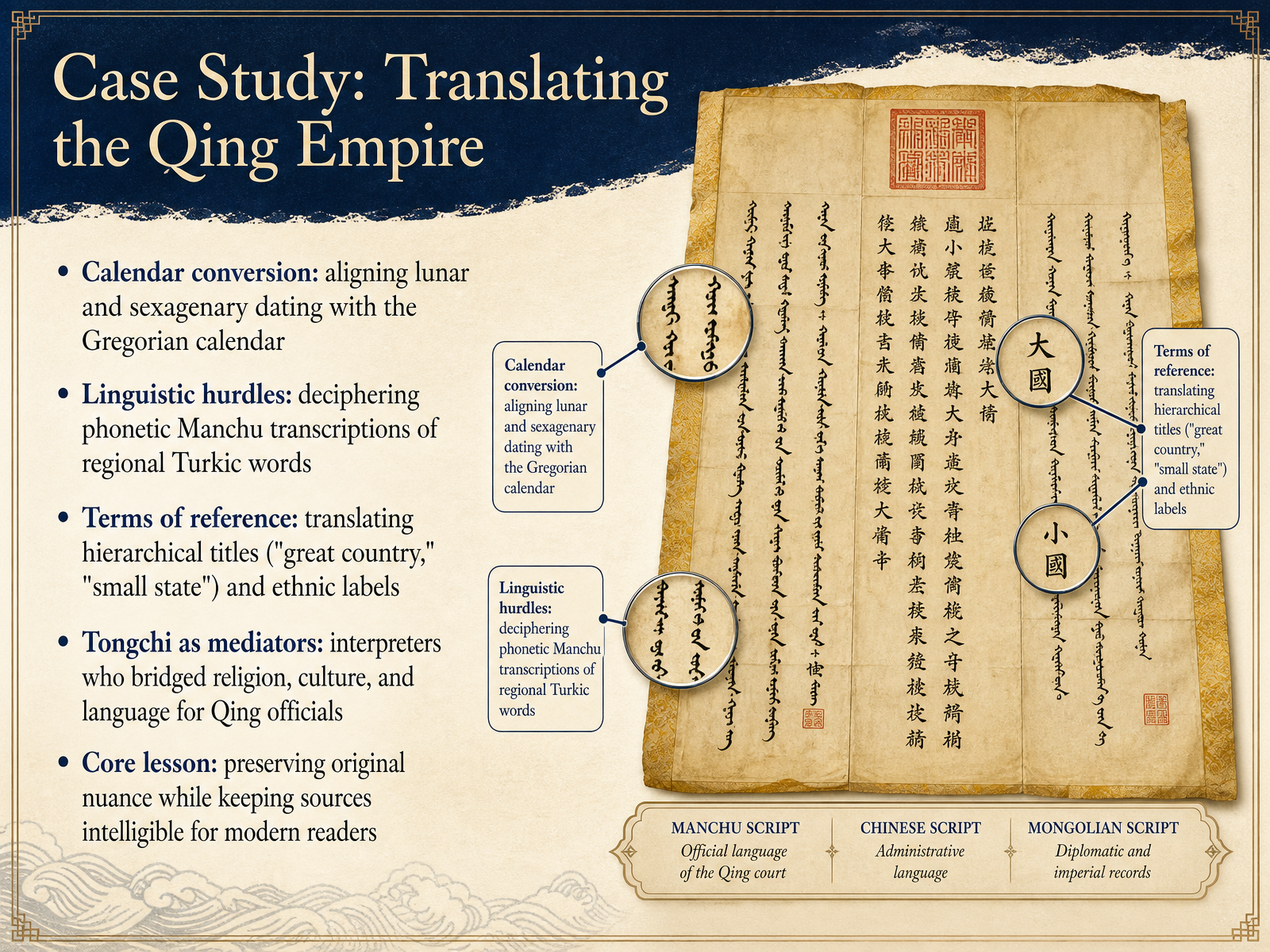
2 min - 11Case Study: Translating the Qing EmpireLet's step into the practical work of translation by examining how historians approach sources from the Qing Empire. This work happens on three main fronts. First is calendar conversion. The Qing court used a lunar calendar based on a sixty-day cycle, so a date like "Qianlong year two, fourth month" must be aligned with the Gregorian calendar we use today. In one example, scholars matched that date to May fifteenth, seventeen thirty-seven. Second, we wrestle with linguistic hurdles. Qing documents often used Manchu, the empire's administrative language, to phonetically record Turkic words. One archival entry mentioned an envoy gift written as "pisde" in Manchu. Because it appeared alongside dried fruits, researchers identified it as pistachio. Third, and perhaps most challenging, are the terms of reference. Hierarchical titles like "great country" and "small state" reveal a world of tributary relationships, not modern equality. The Chosŏn court alone used multiple labels for Qing subjects, including "Tang person" and "northern barbarian." Navigating these gaps fell to the tongchi, the interpreters who moved between religions, cultures, and languages. They didn't just translate words; they mediated entire realities for Qing officials. The core lesson here is that our job is to preserve the original nuance of these sources while still making them intelligible for modern readers. Next, we'll apply similar source-analysis questions to a different kind of global evidence in our case study on commodities, trade, and global exchange.
 chnm.gmu.edulib.murraystate.educambridge.org+22 min
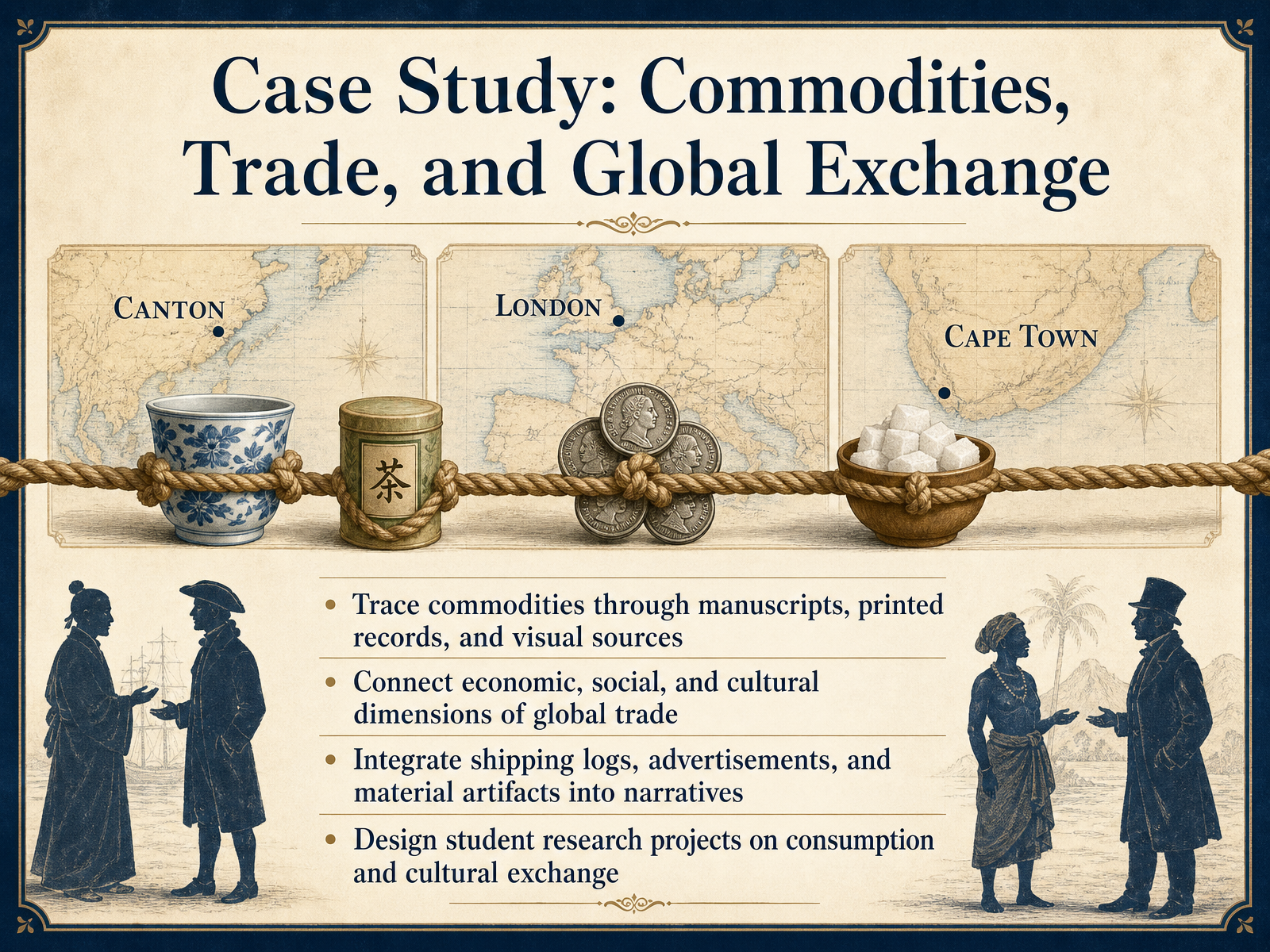
 - 12Case Study: Commodities, Trade, and Global ExchangeLet's turn now to a case study that puts all of this into practice: using commodities, trade, and global exchange as our lens. When we trace a commodity—say, tea, porcelain, or sugar—we follow it through manuscripts, printed records, and visual sources. Each type of document reveals a different angle: a shipping log might tell us about quantities and routes, while an advertisement shows us how the product was marketed and who desired it. By connecting these pieces, we can bridge the economic, social, and cultural dimensions of global trade. We start to ask richer questions. How did material artifacts—a teacup, a receipt, a merchant's letter—shape everyday life and cultural exchange across continents? When you design research projects for your students, invite them to pick a single commodity and trace its journey through diverse sources. Let them experience history not as a fixed story, but as an active investigation of consumption and connection. In a moment, we'll build on this by designing primary-source-based inquiries and assessments.
 worldhistorycommons.orghistory.genie.stanford.eduworldhistory.pitt.edu+22 min
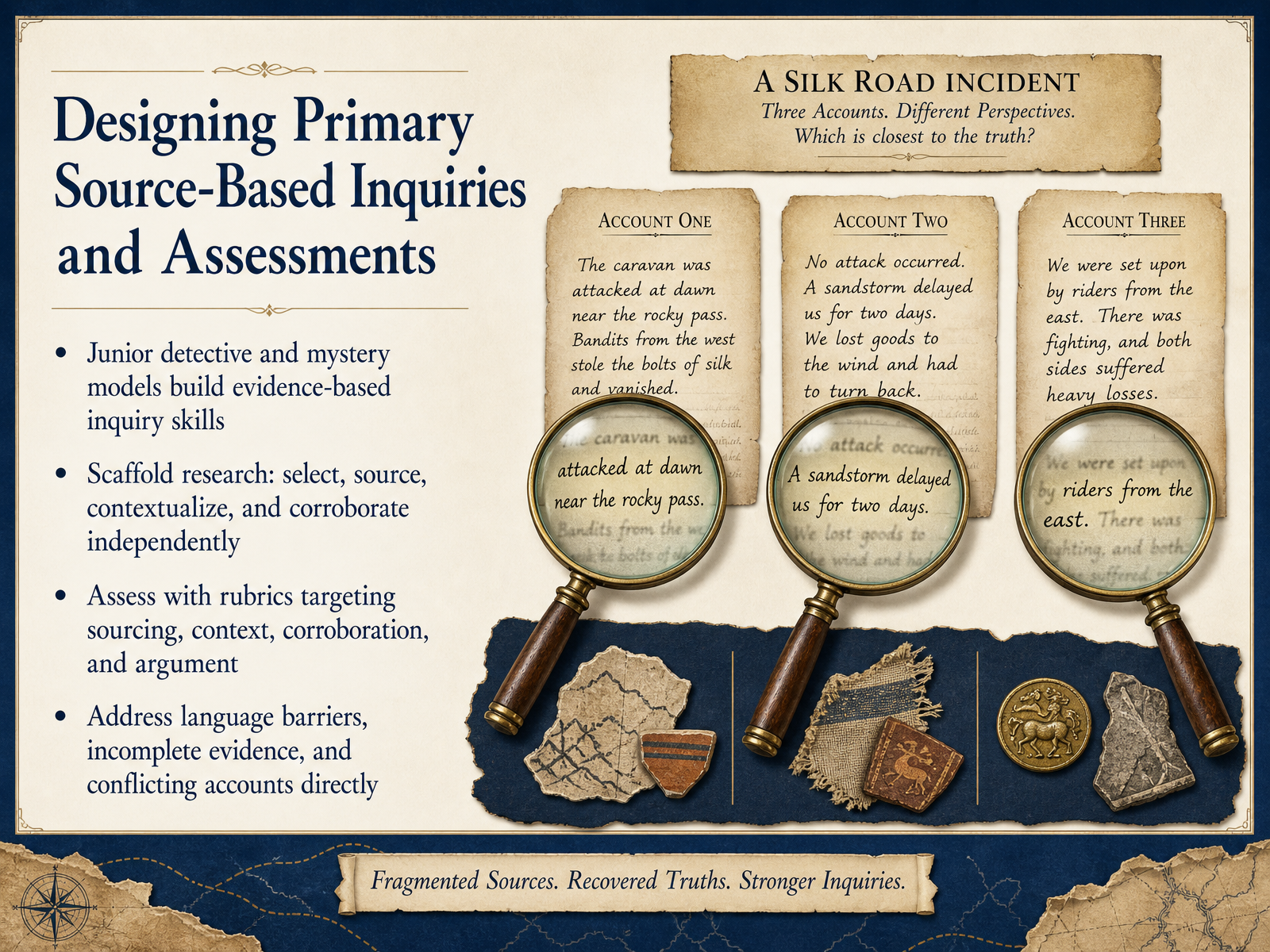
 - 13Designing Primary Source-Based Inquiries and AssessmentsLet's bring all these analytic skills together by designing inquiries that feel like investigations. Many of you have seen the junior detective or mystery models. We pose a compelling question, hand students a small set of primary sources, and deputize them as detectives. That framing immediately shifts their posture from passive reading to active evidence-building. We then scaffold the research process step by step: first selecting sources, then sourcing them by examining the creator, date, and intended audience. Next, we ask students to contextualize the material within its larger historical moment, and finally to corroborate claims across multiple pieces of evidence. This sequence helps learners gradually internalize the habits of a thoughtful historian.
When we design assessments, we can target these very moves. A rubric focused on sourcing, context, corroboration, and argument makes our expectations transparent and rewards the process of analysis, not just a correct answer. And here is a challenge we should embrace directly: the sources we give students may contain language barriers, incomplete evidence, or conflicting accounts. Instead of avoiding those rough edges, let's treat them as authentic problems to solve. When learners confront a gap or a contradiction, they experience history as a living, interpretive discipline. In our next slide, we'll explore how to build a sustainable practice with primary sources that lasts beyond a single lesson.
 openjournals.bsu.educhnm.gmu.eduloc.gov+22 min
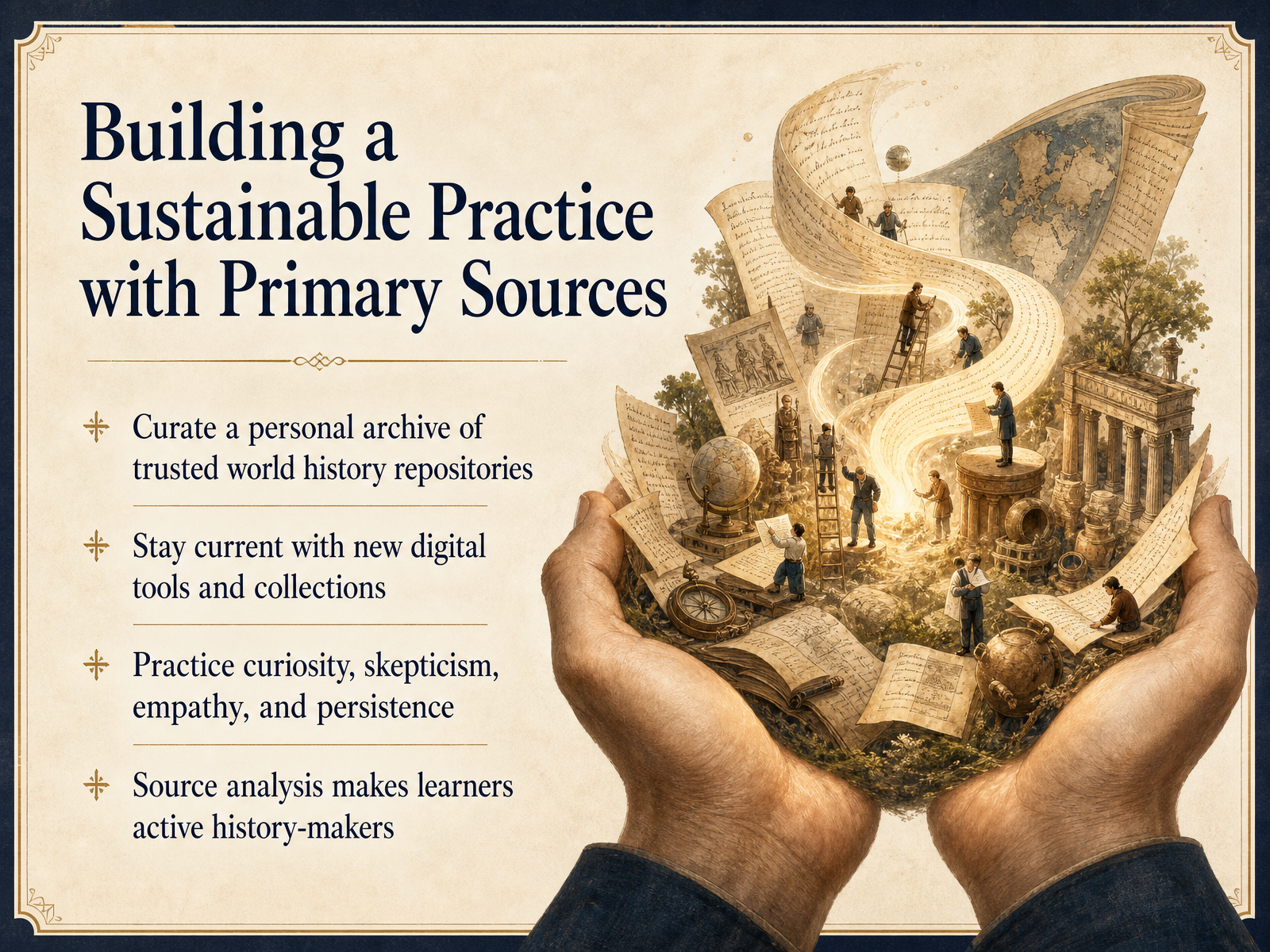
 - 14Building a Sustainable Practice with Primary SourcesLet's bring together the threads we've explored. Building a sustainable practice with primary sources starts with where we look. Curate your own personal archive of trusted world history repositories, so you always have a reliable starting point. Stay curious about new digital tools and collections as they emerge. The toolkit is always growing. But beyond tools, cultivate a historian's mindset. Practice curiosity to wonder about what you don't yet know. Skepticism to gently question every source. Empathy to understand the people behind the words. And persistence, because meaning often lies beneath the surface. When you analyze a source, you are not just studying what happened. You are actively making meaning. You become an active history-maker. Thank you for joining this inquiry. Carry this shared toolkit with you, explore deeply, and enjoy the discovery.
 2 min
2 min
Take the deck with you
Download this course as a file — free, no sign-up needed.
- PDF handoutEvery slide page, ready to print or share.15 pages · 6.6 MBDownload
- Narrated PowerPointThe deck that presents itself — every slide carries the digital human's narration video.15 pages · 18.1 MBDownload
- PowerPoint slidesThe full deck as a .pptx — open it in PowerPoint, Keynote, or Google Slides.15 pages · 6.5 MBDownload
Free to use in your own training — please keep the PersonWise credit page at the end.
Have your own deck? Turn it into a course
Sources consulted
Web sources consulted while building this course.
- World History Commons — worldhistorycommons.org
- History Genie — history.genie.stanford.edu
- World Historical Gazetteer | World History Center | University of Pittsburgh — worldhistory.pitt.edu
- Browse Teaching | World History Commons — worldhistorycommons.org
- Oxford First Source: World/Western History - Oxford Learning Link — learninglink.oup.com
- WORLD HISTORY SOURCES — chnm.gmu.edu
- Browse Primary Sources | World History Commons — worldhistorycommons.org
- WORLD HISTORY SOURCES: UNPACKING EVIDENCE — chnm.gmu.edu
- Primary Sources - World History & Civilizations - Research Guides — libguides.nvcc.edu
- History (Countries and Regions of the World): Primary Sources — fordham.libguides.com
- Historical Practice and Authentic Assessment in an Introductory World History Course | Teaching History: A Journal of Methods — openjournals.bsu.edu
- Teacher's Guide: Analyzing Primary Sources | Teacher Resources - Library of Congress — loc.gov
- Teaching Now: Scaffolding Primary Source Learning — primarysourcenexus.org
- Junior Detectives: Teaching with Primary Sources as a Bridge to Disciplinary Literacy — socialstudies.org
- World History Sources Framing Essay — chnm.gmu.edu
- History Research Guide: Translated Materials — lib.murraystate.edu
- Translations as Sources for African History * — cambridge.org
- History in Translation – AHA — historians.org
- How to use Historical Sources | Faculty of History University of Cambridge — hist.cam.ac.uk