Content Marketing Plan Execution
Begin
14 pages · ~28 min
Content Marketing Plan Execution
Learn to build a results-driven content marketing plan from goal-setting to execution. Ideal for marketers seeking a practical framework to align content with business objectives.
What you’ll learn
- 01Content Marketing Plan: From Goals to ExecutionWelcome. If you are publishing content without a clear plan, this course is for you. Here is the reality for 2026. Content marketing is no longer about volume. It is about building a system that actually connects to pipeline and revenue. In this course, we will walk through the core structure of a documented plan. We will cover goals, audience research, strategy, day-to-day operations, measurement, and how to iterate. This is built for the people doing the work. That includes content marketers, creators, small teams, and marketing managers. The core promise is simple. You will leave with a repeatable system that connects every piece of content to a real business outcome. We are moving you from ad-hoc publishing to a strategic engine. Let us start by talking about why a plan beats publishing volume.seriesxmarketing.comblog.hubspot.comblockclub.co+21 min
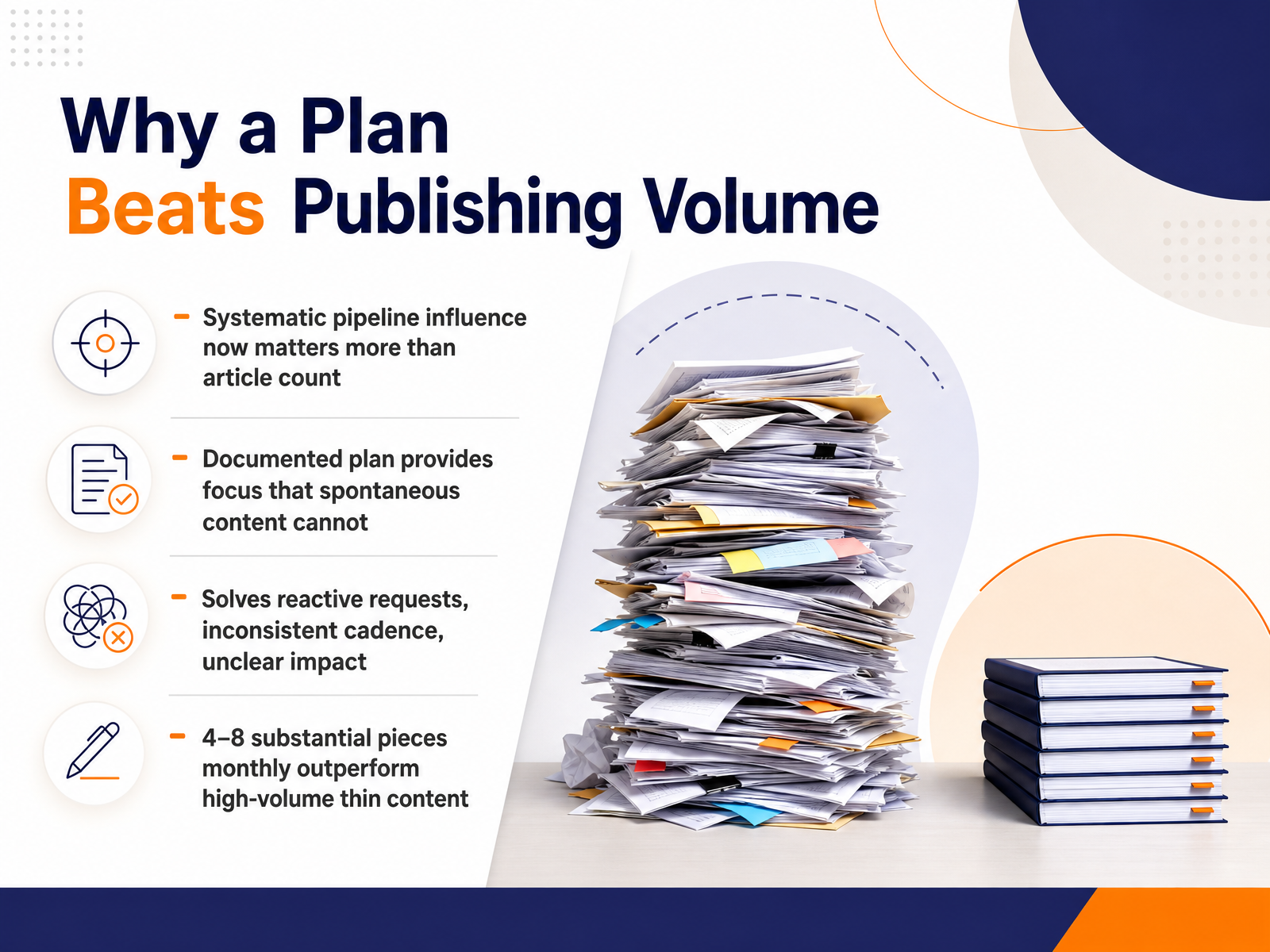
- 02Why a Plan Beats Publishing VolumeLet's get into why having a documented plan beats just trying to publish more. When volume is the only goal, it is easy to lose sight of what actually moves the needle. A clear plan creates a systematic pipeline, so every piece of content has a job and an intended audience. That focus solves three very common problems. It stops the flood of reactive requests for random one off assets. It fixes an inconsistent publishing cadence that confuses your audience. And it gives you a clear way to see the real impact of your work. You do not need thirty articles a month. Four to eight substantial, well researched pieces that answer real customer questions will almost always outperform a high volume of thin content. Because each piece works harder for you. Think of it as building leverage instead of building clutter. So as we move forward, keep that mindset. Quality, purpose, and consistency are your new benchmarks. Next, let's talk about setting goals that connect to business outcomes.
 1 min
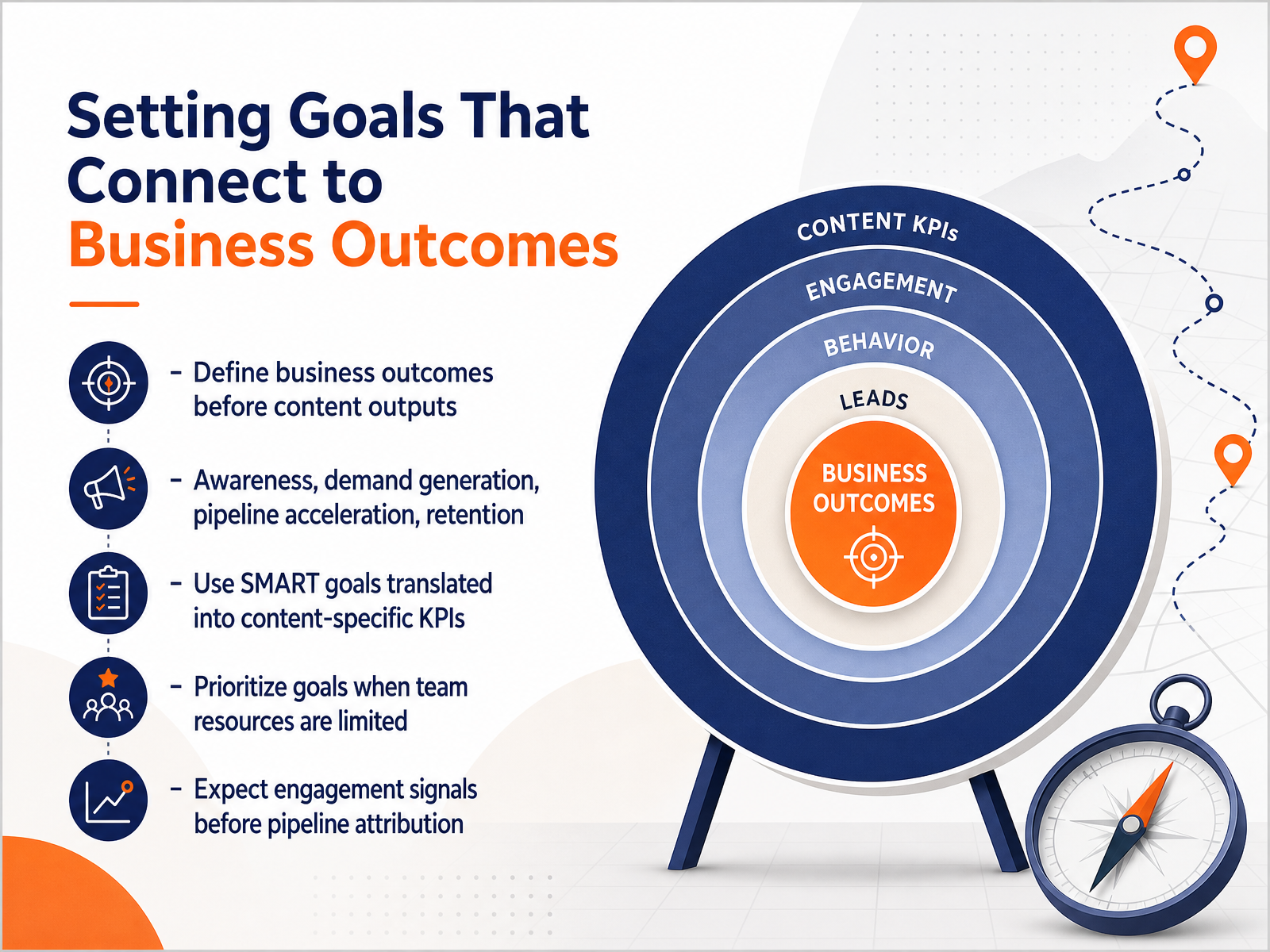
1 min - 03Setting Goals That Connect to Business OutcomesBefore we decide what to publish, we need to agree on why we're publishing at all. Start with the business outcome, not the content output. That could mean building awareness with a new audience, generating real demand, helping sales accelerate a pipeline that already exists, or keeping current customers engaged. Turn those outcomes into SMART goals, and then translate each goal into a content-specific KPI. For example, awareness might map to unique visitors or social reach, while demand generation maps to qualified leads or demo requests. If your team is small, you will not win by chasing every goal at once. Pick the one or two outcomes that matter most right now, and align the calendar against those. Also, keep expectations realistic. Early on you'll see engagement signals like time on page, shares, or return visits before you see clean pipeline attribution. That is normal. So, define the outcome, set the KPI, prioritize the few goals that matter, and let engagement lead the measurement story early on. Next, let's look at who actually makes the buying decision, and how to shape content for the people in the room.
 1 min
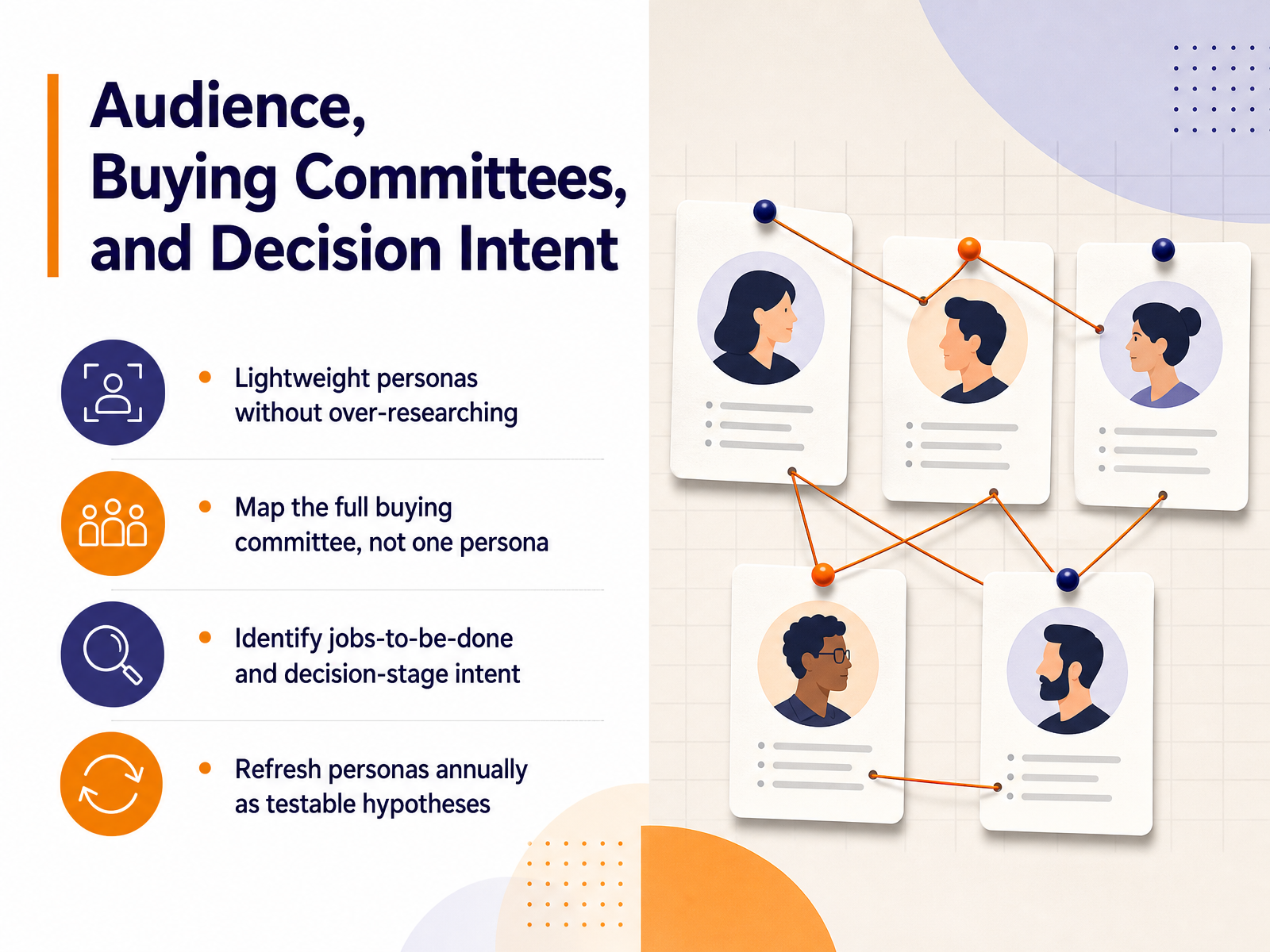
1 min - 04Audience, Buying Committees, and Decision IntentNow let's talk about who you're actually creating content for. Most teams start by building detailed personas, and that's useful, but it's easy to overdo the research. You don't need fifty-page profiles. Start with lightweight personas that capture the basics. What is this person trying to achieve? What's standing in their way? Where do they look for answers? Keep it simple enough that your team can actually use it when planning content. Next, remember that buying decisions are rarely made by one person. Map the full buying committee. You might have a champion who loves your product, a finance lead checking the budget, and an end user who has to live with the decision. If your content only speaks to one persona, you'll miss the conversations happening around the table. Then focus on jobs to be done and decision stage intent. Ask what the buyer is trying to accomplish right now. Are they just learning about the problem, comparing options, or ready to choose a vendor? The same person needs different content at each stage, so build your plan around that shift in intent. Finally, treat personas as testable hypotheses, not permanent facts. Refresh them about once a year based on real sales calls, support tickets, and analytics. If a persona stops matching what you hear from customers, update it. Next, we'll turn these audience insights into messaging, positioning, and brand voice.
 2 min
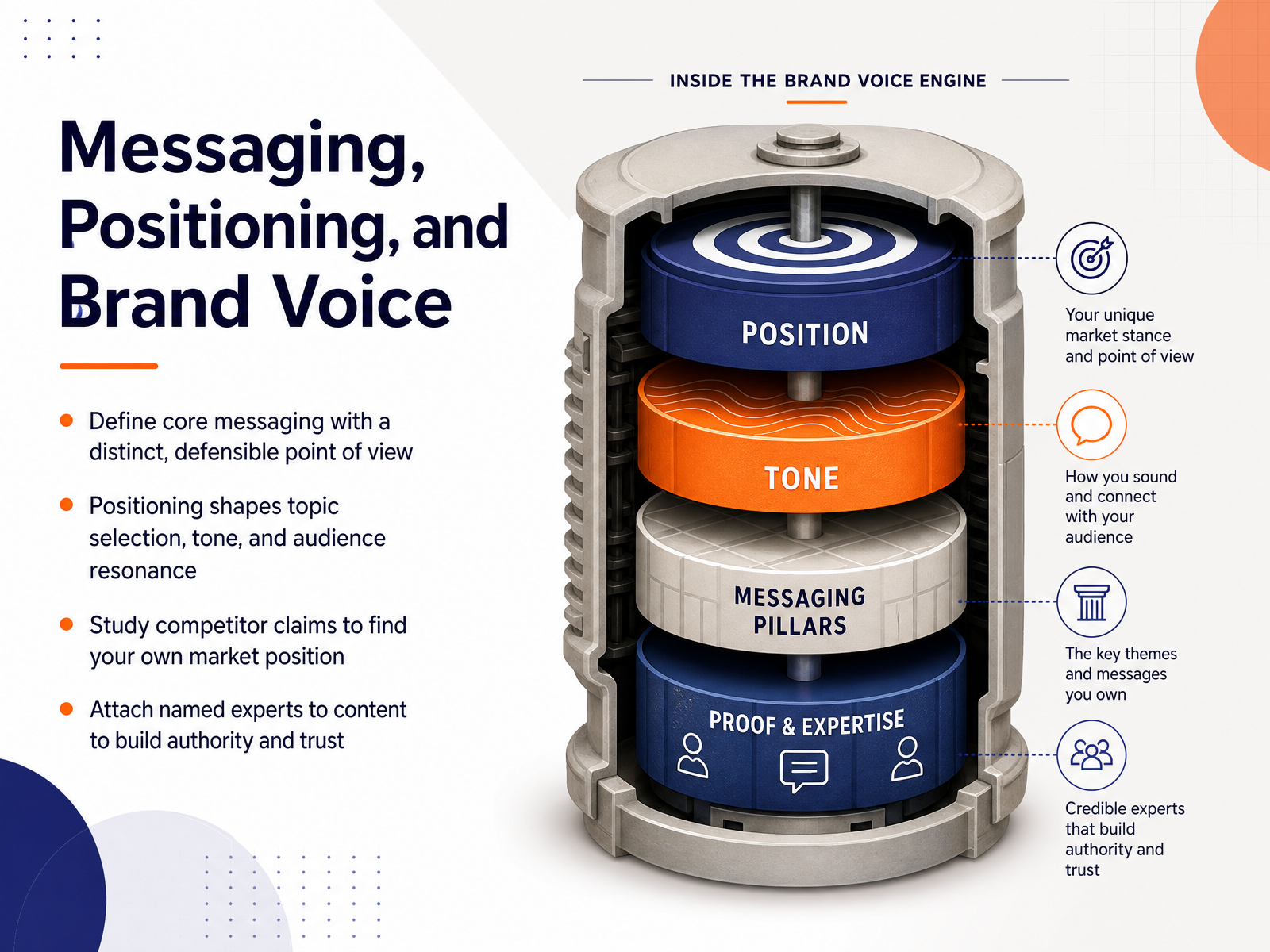
2 min - 05Messaging, Positioning, and Brand VoiceNow let's talk about messaging, positioning, and brand voice. Start with your core message. It has to be distinct and defensible. That means you can back it up, and a competitor can't just copy it tomorrow. Your positioning then shapes what you publish, how you sound, and who actually pays attention. So before you write anything, study the claims your competitors are making. Look for what they keep repeating, and find the space they've left open. That's where your market position lives. One practical way to build authority fast is to attach named experts to your content. A real name, a real face, and real experience create trust that anonymous brand content simply can't match. So the takeaway here is simple. A clear point of view, a distinct market position, and visible expertise work together to make your content feel credible from the first sentence. Next, we'll turn that messaging into a working structure with editorial pillars and topic architecture.
 1 min
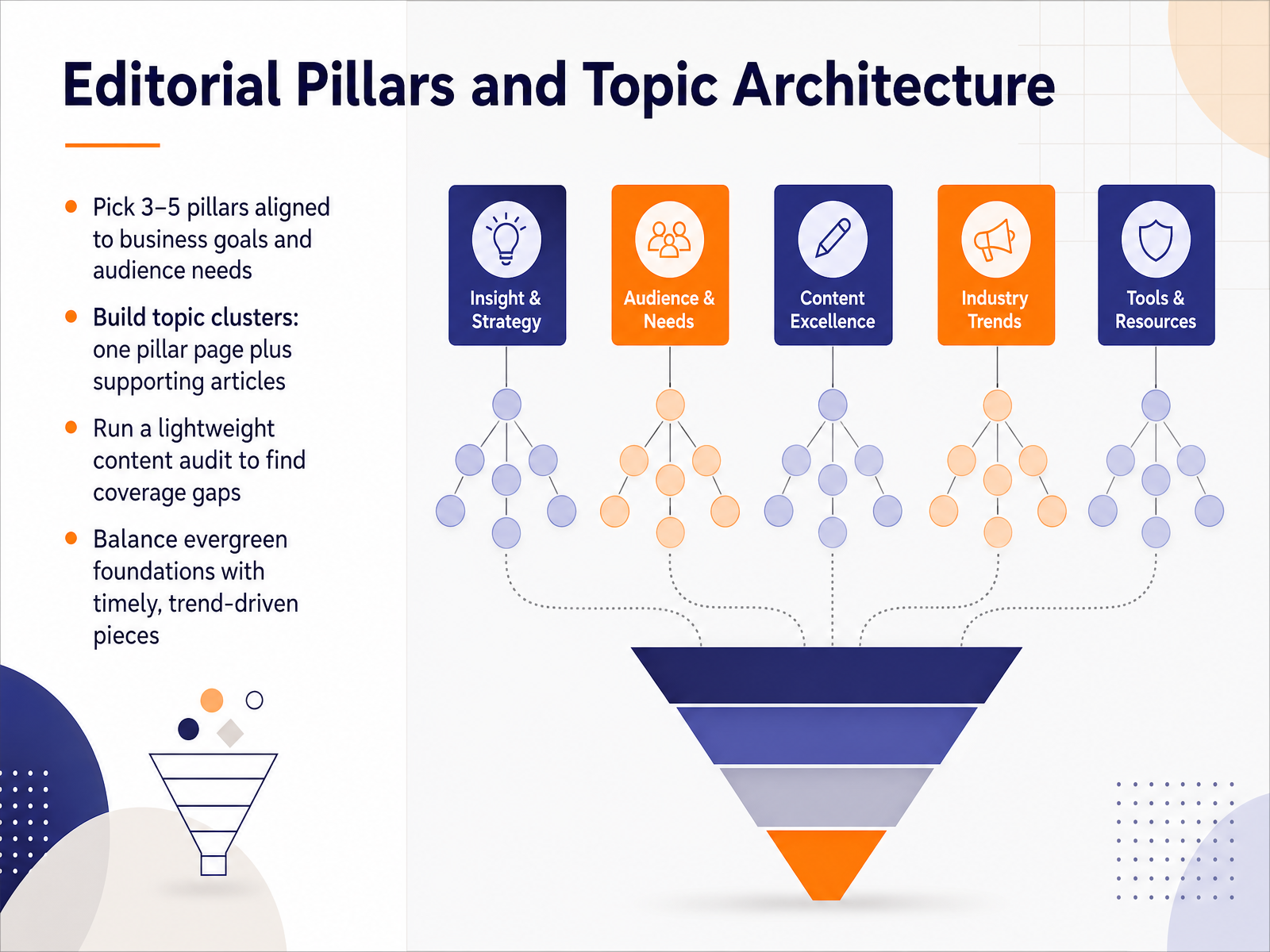
1 min - 06Editorial Pillars and Topic ArchitectureNow let's build the actual topic structure behind the plan. Start by picking three to five editorial pillars. These should sit right where your business goals and your audience's real questions overlap. If you sell project management software, a pillar could be team productivity, not just software features. Then build topic clusters around each pillar. That means one strong pillar page that covers the core topic, supported by shorter articles that answer specific questions and link back to it. This helps search engines see your expertise, and it helps readers find a clear path through your content. Next, run a lightweight content audit. Go through what you already have, mark what still fits, and flag the gaps worth filling. This is not a full website rebuild, just a working map of your current coverage. Finally, balance your mix. Keep a base of evergreen pieces that stay useful month after month, and leave room for timely pieces tied to trends, seasons, or product launches. That balance keeps your library useful without forcing you to chase every news cycle. In the next part, we will look at formats, channels, and funnel coverage, so you know where each piece fits and what job it is doing.
 2 min
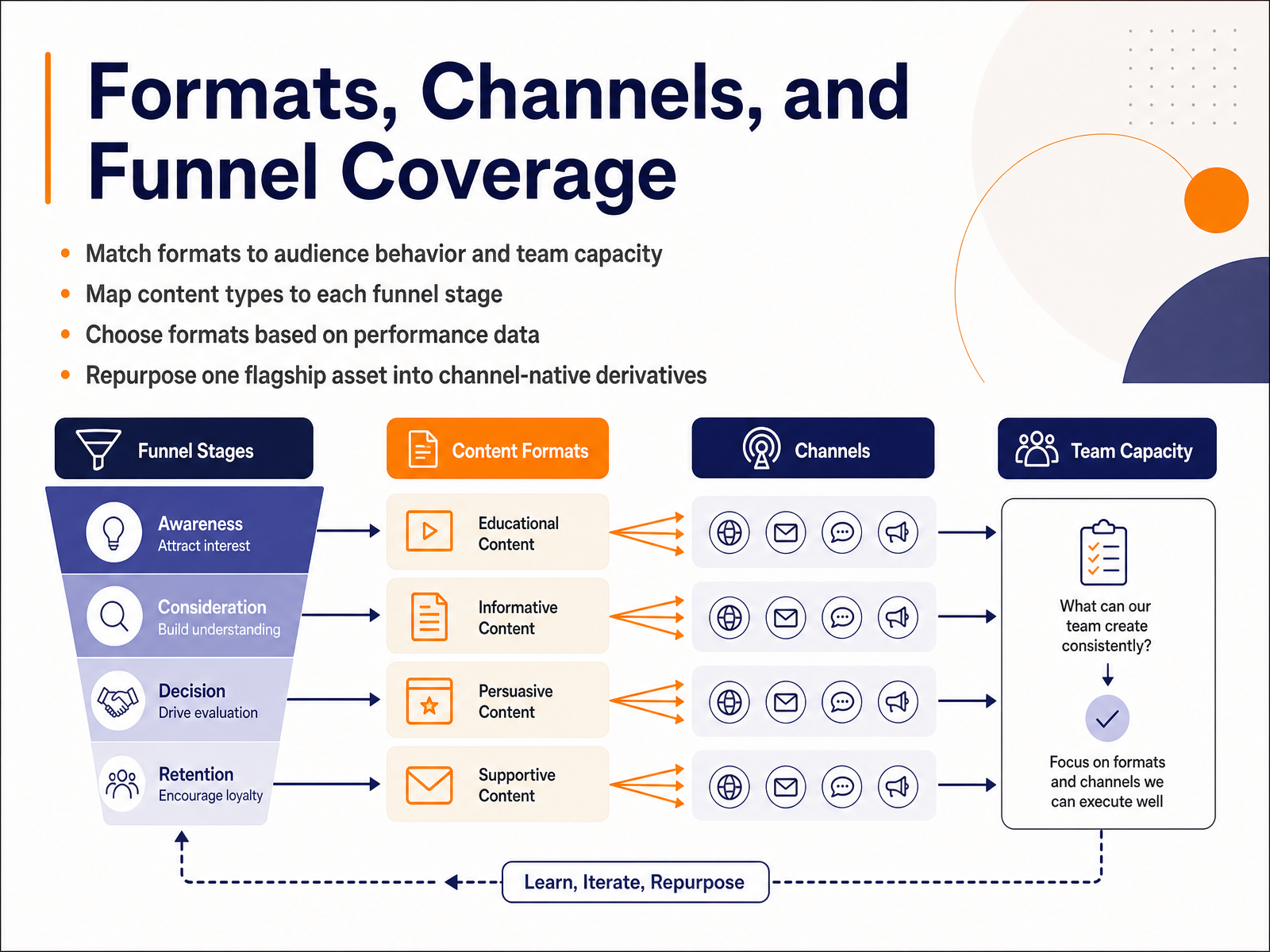
2 min - 07Formats, Channels, and Funnel CoverageLet’s turn those goals into concrete format and channel choices. Start with behavior and capacity. If your audience listens on the go, a short audio tip may beat a long PDF, but only if your team can produce it consistently. If not, a well-written email or carousel may be the smarter move. Next, map content types to each funnel stage. For awareness, think short videos, checklists, or podcast clips. For consideration, use comparison guides, webinars, or case studies. For decision, focus on product demos, trials, or proof focused pages. Third, let performance data guide you. If a past video drove high engagement but low signups, keep the format, but adjust the topic or offer. If a how-to article converts well, produce more of that style. Finally, repurpose one flagship asset into channel-native derivatives. A single interview can become a blog post, three short clips, five quote graphics, and a newsletter section. That keeps output steady without overloading the team. Next, let’s look at distribution-first planning, so your best formats actually reach the right people.
 2 min
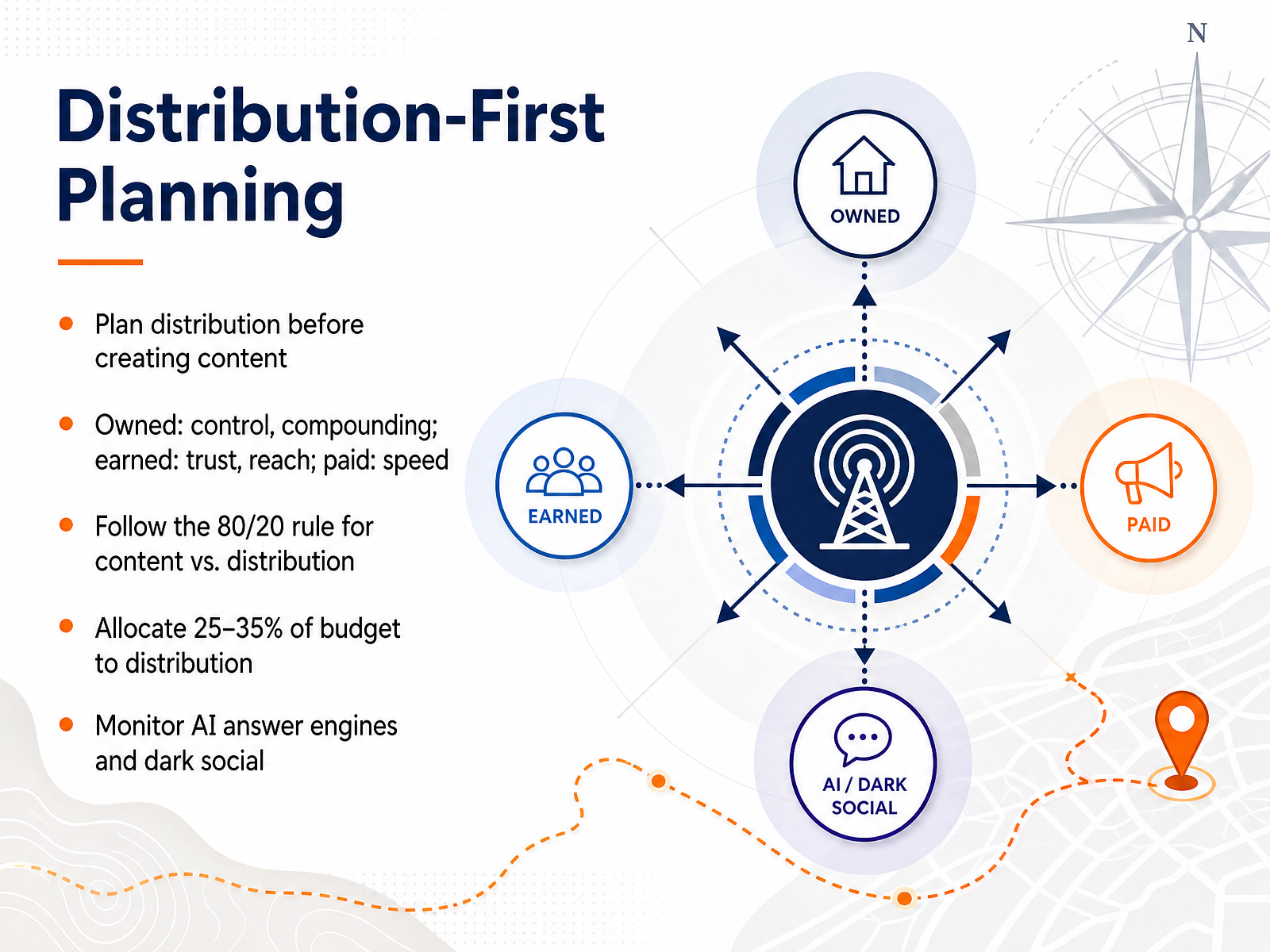
2 min - 08Distribution-First PlanningLet's flip the usual workflow on its head. Plan your distribution before you create the content, not after. That way you build for the channel from day one. The three channel types each play a different role. Owned channels give you control and compounding value over time. Earned channels build trust and extend your reach through other people. Paid channels buy you speed. A common rule of thumb is the eighty twenty rule, which means spending twenty percent of your time on creation and eighty percent on getting it seen. Budget wise, set aside twenty five to thirty five percent of your content budget for distribution, especially to amplify pieces that are already performing. And keep an eye on two quieter front doors, AI answer engines like ChatGPT or Perplexity, and dark social, things like Slack groups, DMs, and private communities that never show up in your analytics. Next, let's turn this plan into something real with a production calendar you can actually keep.
 backlinko.comdistribution.aiblog.hubspot.com+22 min
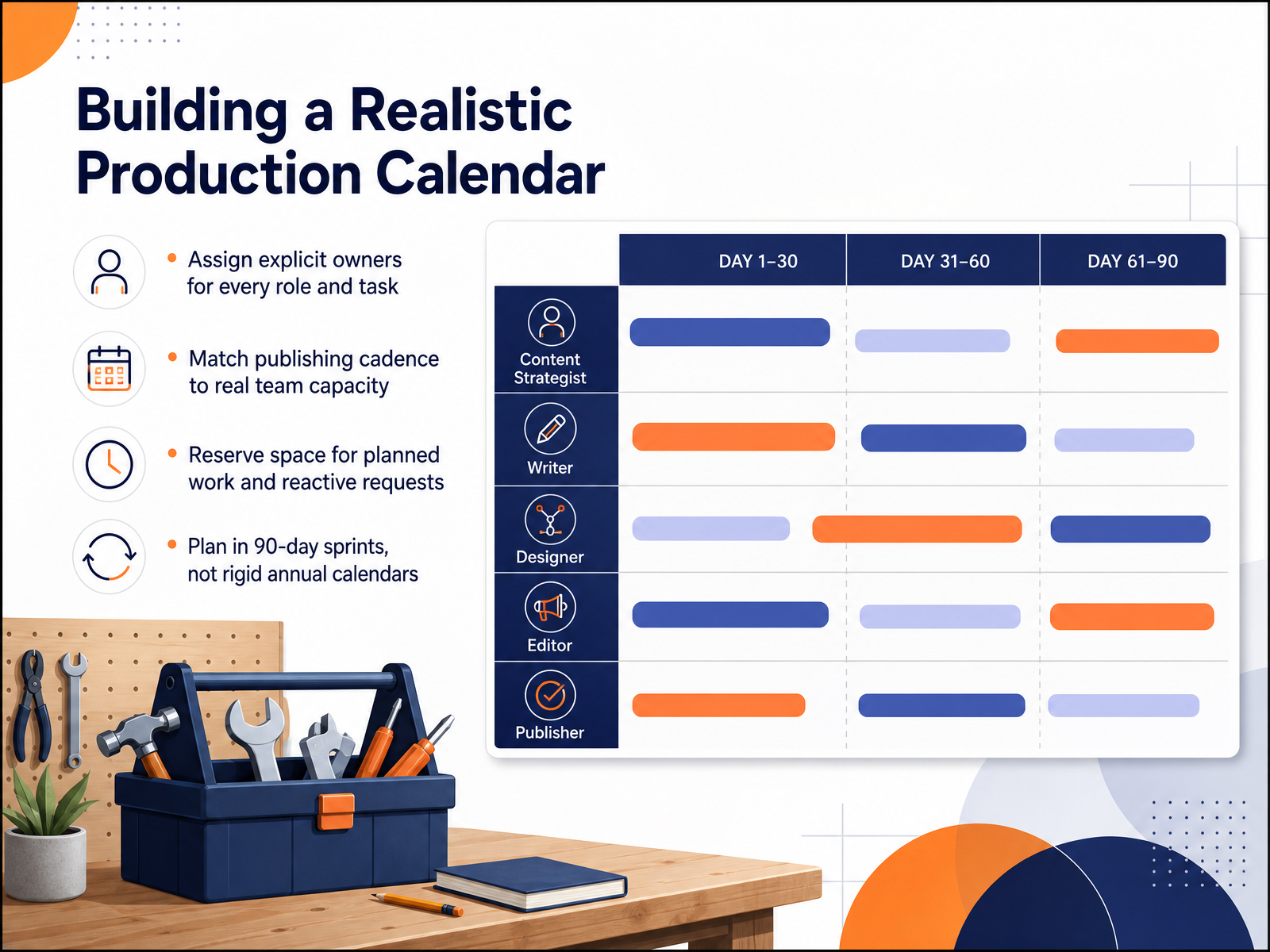
 - 09Building a Realistic Production CalendarNow let’s turn that plan into a calendar your team can actually follow. First, assign one clear owner to every role and task. When people see a name next to a step, work stops slipping through the cracks. Next, match your publishing cadence to real capacity. If your team can reliably produce two strong pieces a week, do not plan for five. You also need breathing room for reactive requests, like a product launch, a customer story, or a quick trend response. A good rule is to leave about twenty percent of your calendar open. And instead of locking in a full year, plan in ninety-day sprints. That keeps the calendar flexible enough to adjust while still giving you a clear near-term path. So, use owners, realistic capacity, open space, and short planning cycles. Up next, we’ll get into execution workflows, quality, and consistency.
 1 min
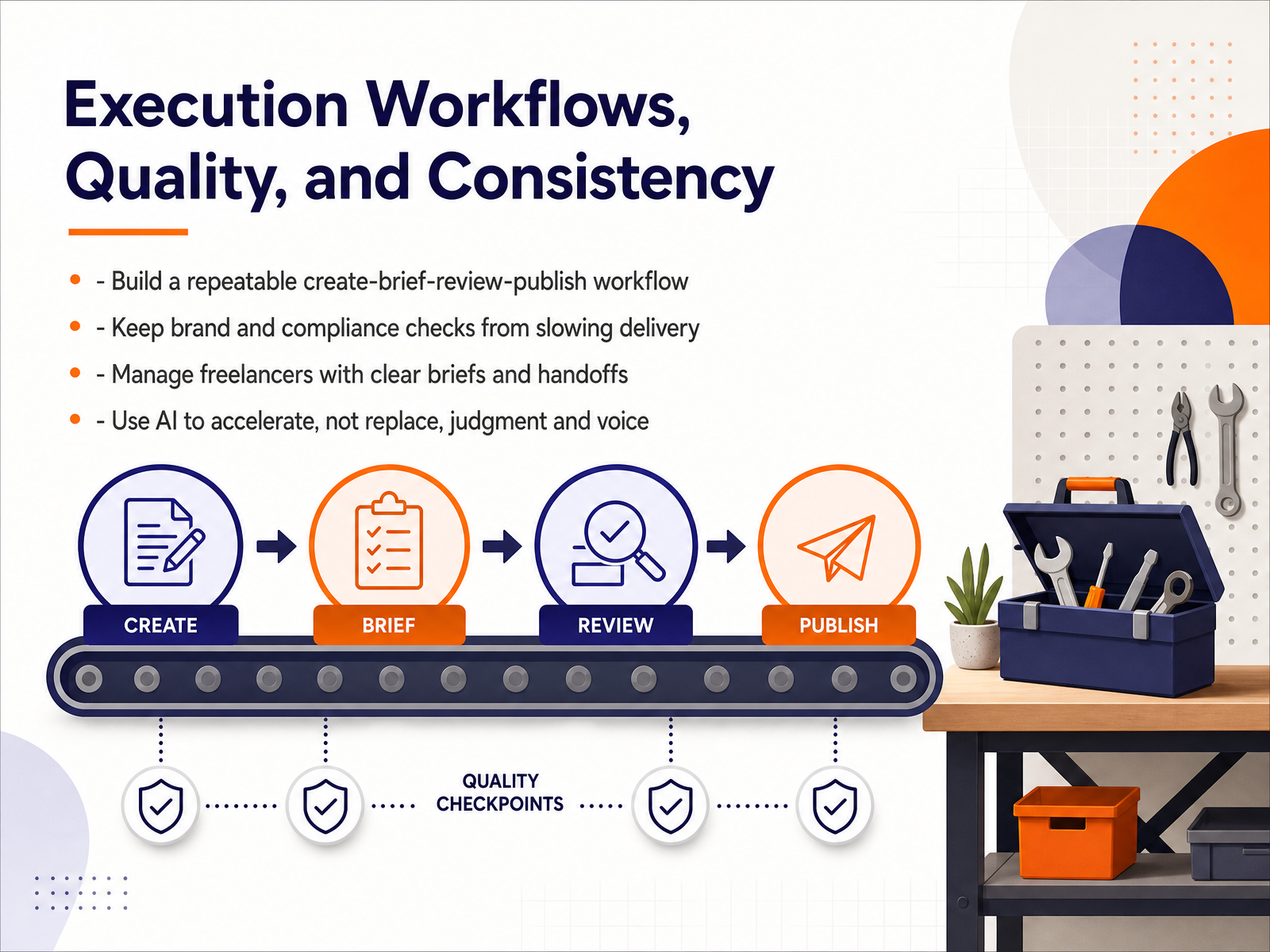
1 min - 10Execution Workflows, Quality, and ConsistencyNow let’s turn execution into a steady rhythm instead of a last-minute scramble. Build one repeatable workflow with four steps: create, brief, review, and publish. That alone removes most bottlenecks. For brand and compliance checks, put a simple checklist up front in the brief so review doesn’t slow delivery at the finish line. When you work with freelancers, handoffs matter more than talent. Give them a clear brief, a source file, a deadline, and one named reviewer. That cuts back-and-forth almost immediately. And yes, use AI for drafts, repurposing, or a first editing pass, but never let it replace your judgment or your brand voice. Let it speed up the work you already know how to do. Once this workflow is running, you can measure what’s actually working. In the next section, we’ll talk about measurement, reporting, and learning loops.
 1 min
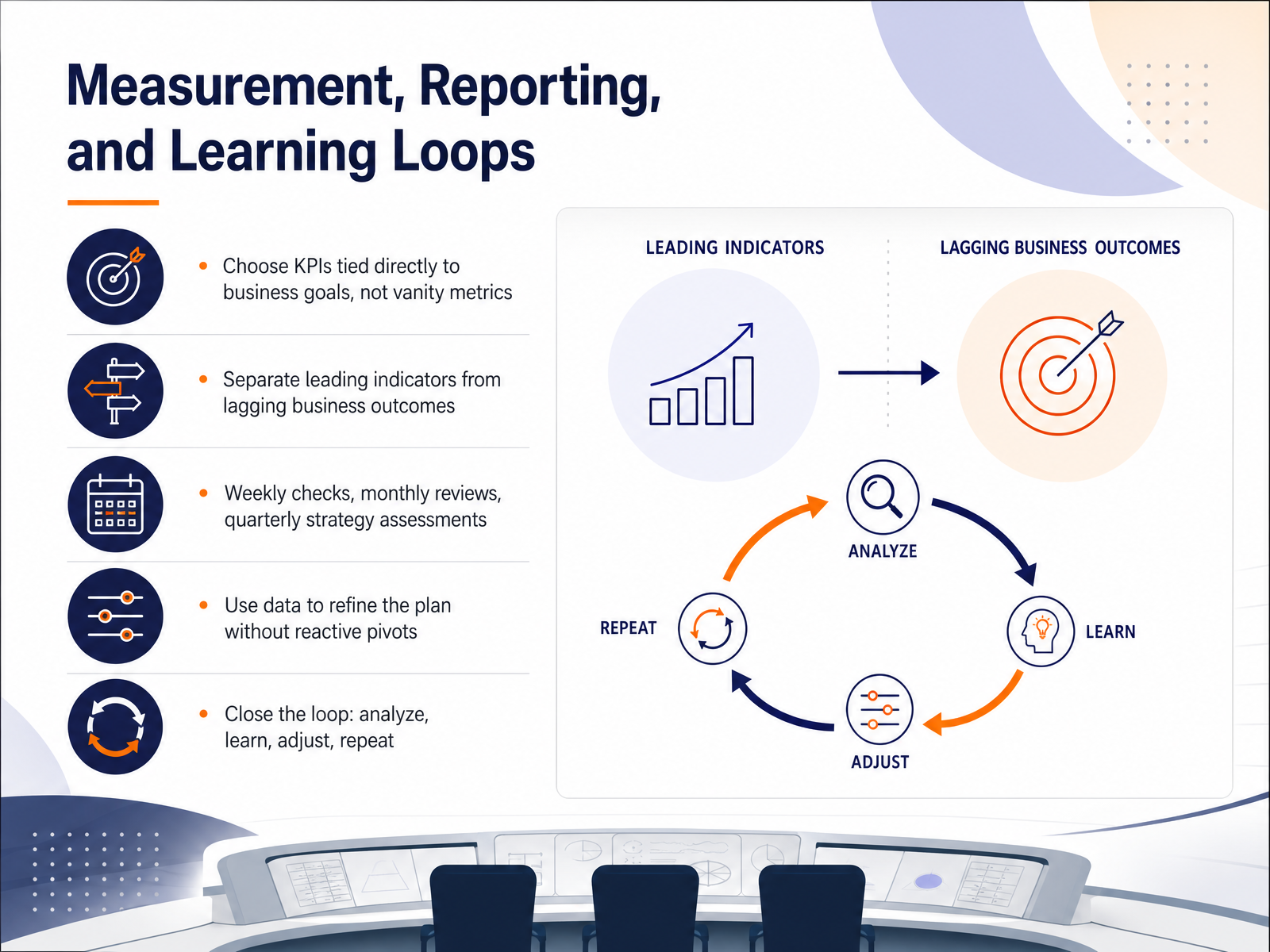
1 min - 11Measurement, Reporting, and Learning LoopsNow let’s talk about how you’ll know the plan is actually working. Start by choosing key performance indicators that map directly to your business goals. If the goal is pipeline, track marketing qualified leads, not just page views. Then separate leading indicators, like email click rate or demo requests, from lagging outcomes, like revenue or retention. Check leading indicators every week, run a deeper monthly review, and step back each quarter to assess strategy. When the data shifts, use it to refine your plan, not to rip it up and start over. Treat small dips as signals to adjust, not reasons to panic. Close the loop each cycle. Analyze what happened, learn from it, make one clear adjustment, and repeat. That rhythm keeps your content plan alive and useful. Next, let’s move into budget, tools, and resource planning so you can execute without overcommitting the team.
 1 min
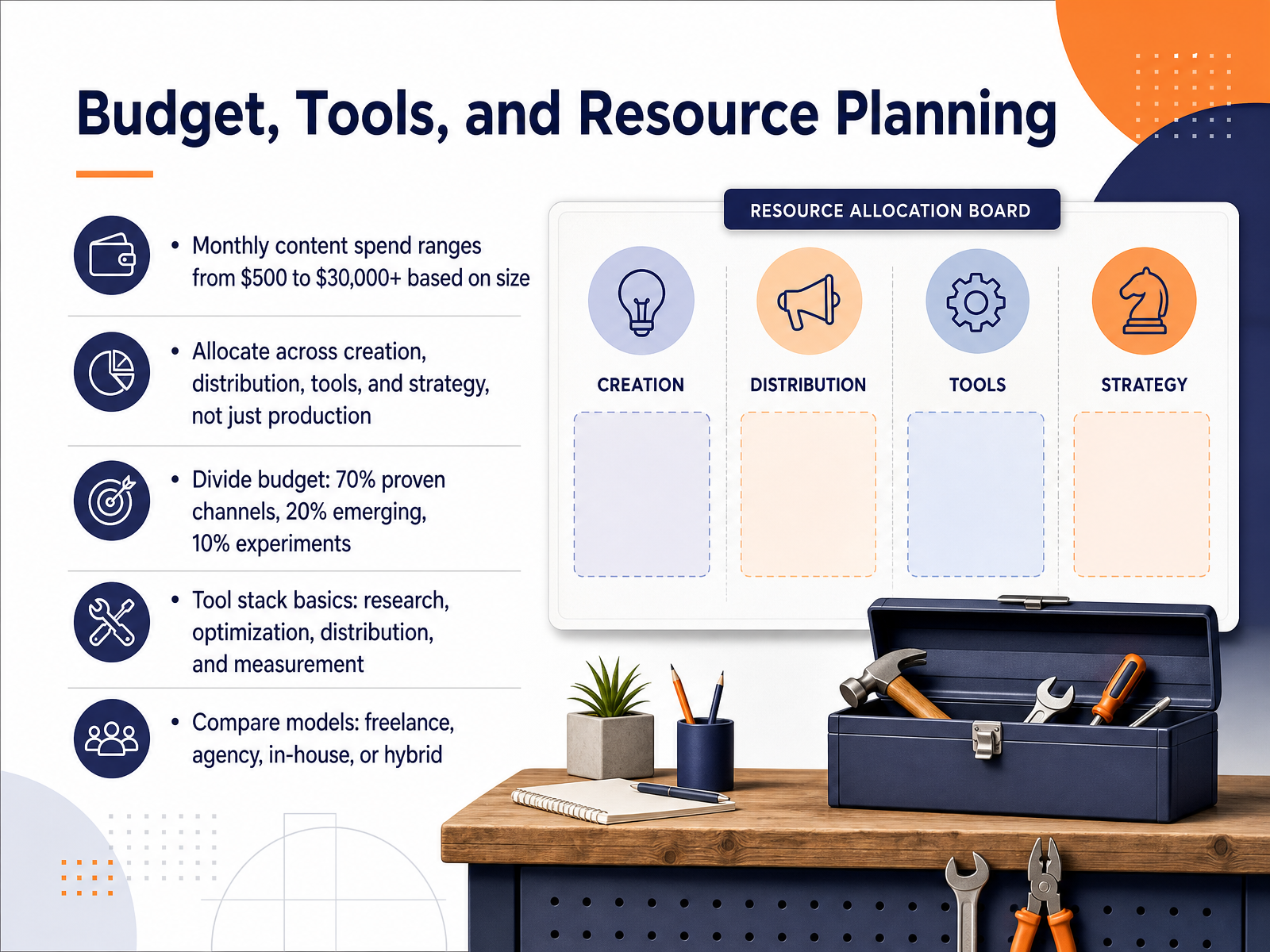
1 min - 12Budget, Tools, and Resource PlanningNow let's talk about the practical side: budget, tools, and resources. Monthly content spend can range from around five hundred dollars for a solo operation to over thirty thousand dollars for a large enterprise. The key is to allocate across four areas, not just production. That means creation, distribution, tools, and strategy. A good starting rule is seventy percent of budget on proven channels, twenty percent on emerging formats, and ten percent on experiments. For tools, you don't need a huge stack. Cover the basics: one for research, one for optimization, one for distribution, and your measurement tools. And when thinking about talent, compare your options. Freelancers offer flexibility, agencies provide capacity, in-house gives control, and a hybrid model can give you the best of all three. Plan the budget before you scale the content. That way, every dollar has a job. Up next, we'll look at keeping the plan alive through iteration.
 webfx.comthestacc.comprojectcostestimator.com+22 min
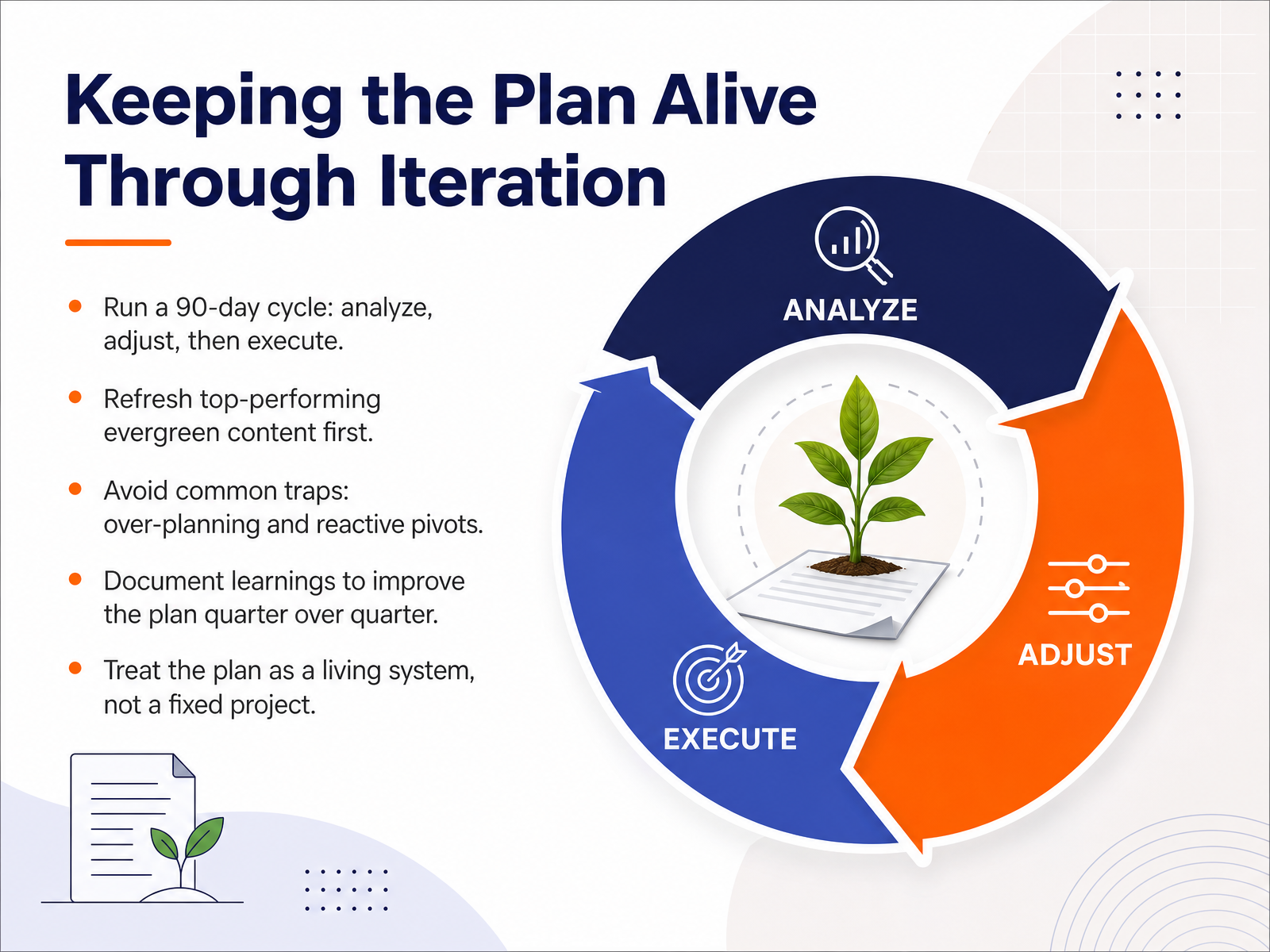
 - 13Keeping the Plan Alive Through IterationA content plan only works if you keep checking it against reality. I recommend running short ninety day cycles. Look at what performed, adjust your priorities, then execute the next batch. Start by refreshing top performing evergreen content first. A small update to a post that already ranks or converts usually beats creating something brand new. Watch out for two common traps. Over planning means you spend more time editing the spreadsheet than publishing. Reactive pivots mean you chase every new trend and never finish your core work. After each cycle, write down what you learned. It can be a few bullet points in the same doc. That simple habit makes the next quarter noticeably sharper. Treat this plan as a living system, not a one time project. Small consistent adjustments compound. And that mindset is exactly what you will need when you move into your first ninety days and turn this plan into real published work.
 2 min
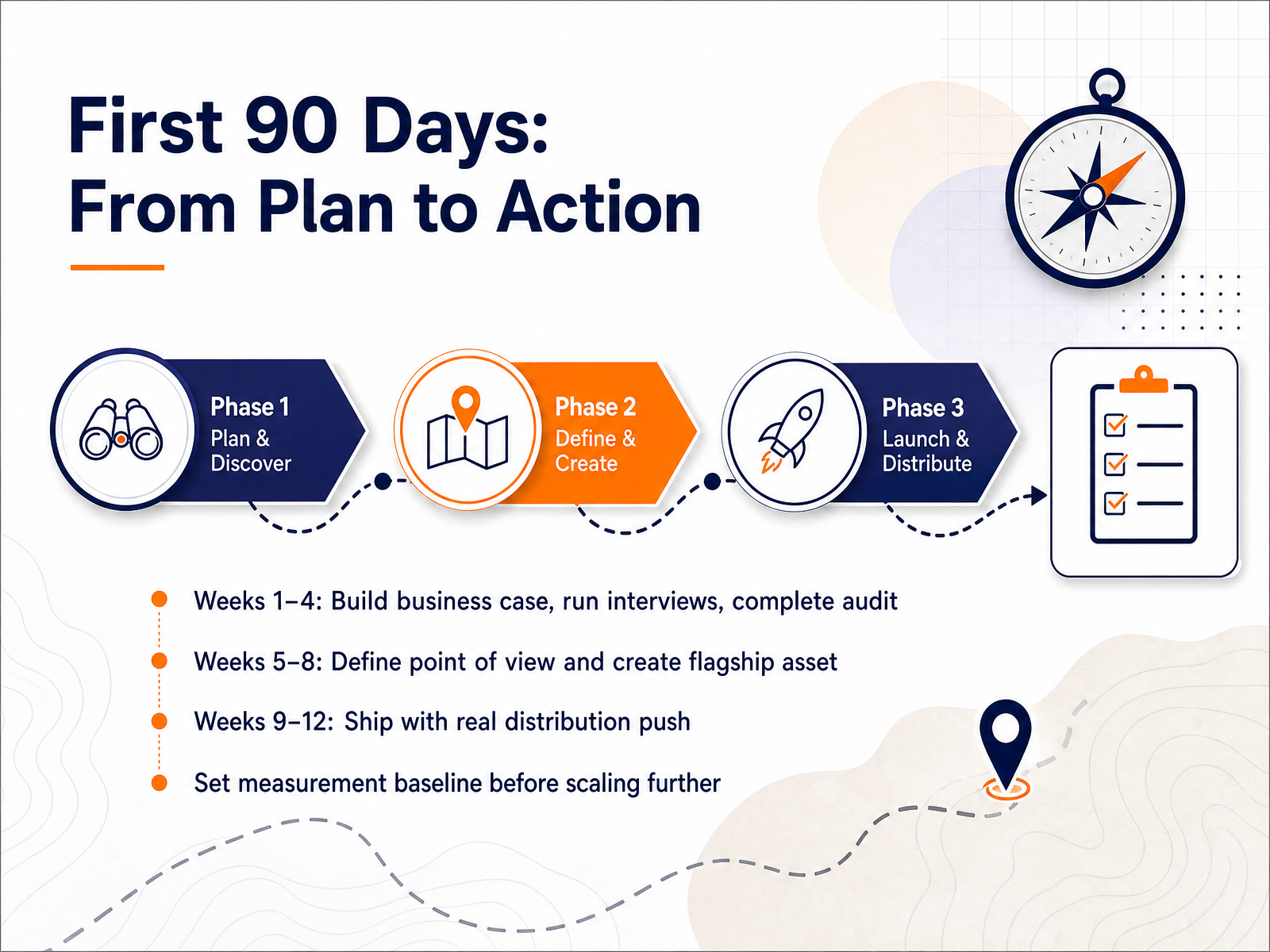
2 min - 14First 90 Days: From Plan to ActionLet’s turn this plan into your first ninety days of action. Weeks one through four are about earning the right to execute. Build the business case, run customer and internal interviews, and complete a quick content audit. You want a clear picture of what exists, what is missing, and what the business actually needs. Weeks five through eight are for focus. Define your point of view, then create one flagship asset that proves it. This is the piece you will be known for, so keep the scope tight and the quality high. Weeks nine through twelve are about shipping with a real distribution push. Publish the asset, adapt it for your key channels, and actively place it where your audience already spends time. Before you scale further, set your measurement baseline. Capture current traffic, engagement, and conversion numbers so you have a clean before and after. That evidence is what earns the next round of budget and trust. Thank you for joining this session. Start small, stay consistent, and let the results build your case.
 2 min
2 min
Take the deck with you
Download this course as a file — free, no sign-up needed.
- PDF handoutEvery slide page, ready to print or share.15 pages · 3.4 MBDownload
- Narrated PowerPointThe deck that presents itself — every slide carries the digital human's narration video.15 pages · 13.0 MBDownload
- PowerPoint slidesThe full deck as a .pptx — open it in PowerPoint, Keynote, or Google Slides.15 pages · 3.3 MBDownload
Free to use in your own training — please keep the PersonWise credit page at the end.
Have your own deck? Turn it into a course
Sources consulted
Web sources consulted while building this course.
- How To Create A Content Marketing Plan (2026 B2B Guide) — seriesxmarketing.com
- How to Develop a Content Strategy in 7 Steps (From Start to Finish) — blog.hubspot.com
- A Framework for Building a B2B Content Marketing Strategy — blockclub.co
- Content Marketing Strategy: How to Build One in 2026 — marketful.com
- B2B Content Marketing: Strategy, Examples, Best Practices (2026) — thegrowthsyndicate.com
- How to Build a Content Distribution Strategy in 2026 — backlinko.com
- Content Distribution Strategy: A 2026 Guide That Works — distribution.ai
- Multi-channel content distribution: How to scale content reach in the era of Loop Marketing — blog.hubspot.com
- Content Distribution: Your Everything Guide, From Psychology to Strategy — buffer.com
- Content Distribution Channels to Drive Demand — leadfeeder.com
- Content Marketing Pricing in 2026 [350+ Surveyed] — webfx.com
- Content Marketing Budget: How Much to Spend in 2026 — thestacc.com
- Content Marketing Cost in 2026 (Real Spend Data) — projectcostestimator.com
- The 4 best content marketing tools of 2026 - expert tested — techradar.com
- How Much Does Content Marketing Cost? [2026 Pricing Guide] — brandonrollins.com