Content Marketing Portfolio Development
Begin
14 pages · ~28 min
Content Marketing Portfolio Development
This training helps aspiring content marketers build a professional portfolio. Learners will select and present their best work to showcase their skills to employers and clients.
What you’ll learn
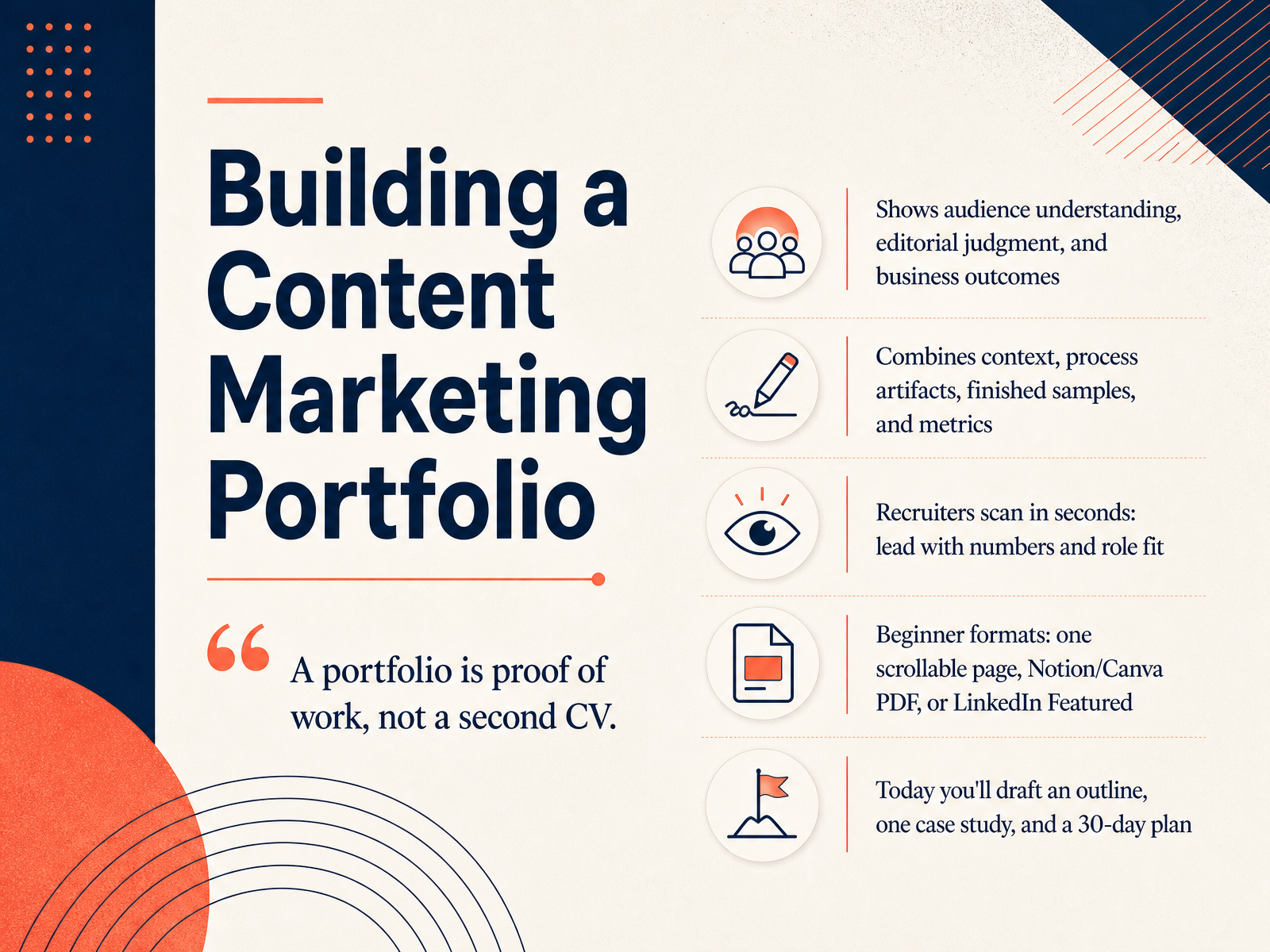
- 01Building a Content Marketing PortfolioWelcome. I'm really glad you're here, because by the end of today, you'll have something real to show for it. Here's the core idea for this whole course. A portfolio is proof of work, not a second CV. A CV says what you claim. A portfolio shows what you can actually do. It shows audience understanding, editorial judgment, and business outcomes. And it combines four things: context, process artifacts, finished samples, and metrics. Recruiters scan in seconds, so lead with numbers and role fit. Your headline might be, grew blog traffic three hundred and forty percent in six months. That lands differently than passionate about storytelling. If you're just starting out, you don't need a fancy website. A single scrollable page, a Notion or Canva PDF, or your LinkedIn Featured section all work. What matters is the story behind each piece. Today you'll draft three things: a portfolio outline, one case study, and a thirty-day action plan. So take a breath, and let's get to work. Next, we'll look at what a strong portfolio actually proves.markampus.commasaischool.comaadme.co+22 min
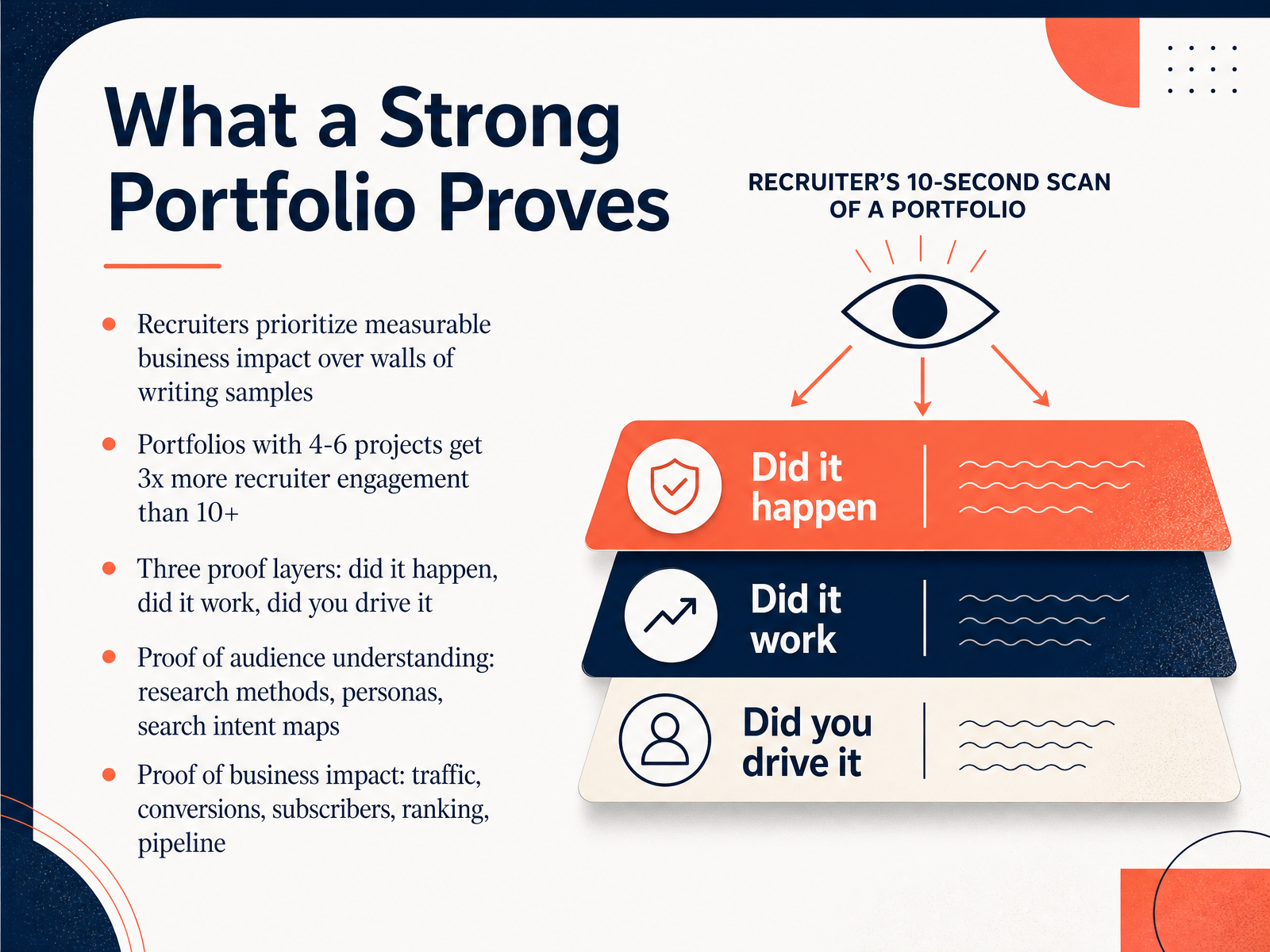
- 02What a Strong Portfolio ProvesLet's talk about what a strong portfolio actually proves. Here's the shift to make first. Recruiters don't reward walls of writing samples. They reward evidence of measurable business impact. In fact, portfolios with four to six focused projects get about three times more recruiter engagement than portfolios with ten or more. So think in proof layers. Layer one, did it happen? Show the work is real with screenshots or analytics. Layer two, did it work? Show traffic, conversions, subscribers, rankings, or pipeline. Layer three, did you drive it? Show your research, your strategy, your decisions. That second layer often comes from proving you understand your audience, through personas, research methods, and search intent maps. You don't need a huge body of work. You need a few projects that clearly demonstrate real understanding and real results. Next, let's map these goals to the roles you're targeting.
Role-Aligned Goals: Writer, Strategist, Social, Email, Freelance.
 popout.pageapplybuddy.ailinkedin.com+22 min
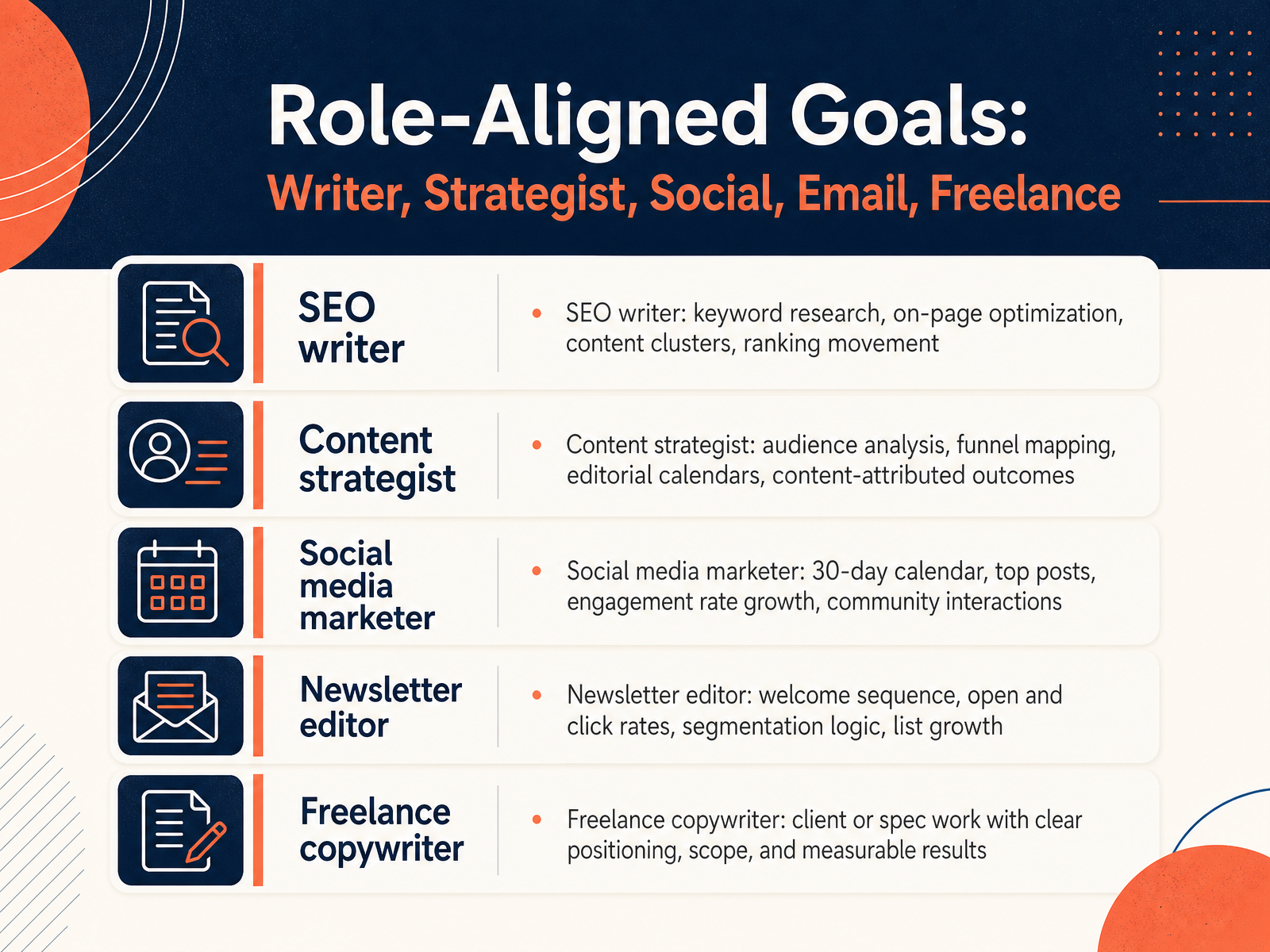
 - 03Role-Aligned Goals: Writer, Strategist, Social, Email, FreelanceNow let's align your portfolio with the specific role you want. Different content marketing jobs need different proof, so choose projects that match your target title. If you want to be an SEO writer, show keyword research, on-page optimization, content clusters, and ranking movement. Build a niche blog, track it in Search Console, and write a case study around the keywords that climbed. For a content strategist role, demonstrate audience analysis, funnel mapping, editorial calendars, and content-attributed outcomes. A marketing plan for a real business works well here. Social media marketers should run a thirty-day calendar, highlight top posts, show engagement rate growth, and document community interactions. Newsletter editors need a welcome sequence, open and click rates, segmentation logic, and list growth. Freelance copywriters should present client or spec work with clear positioning, scope, and measurable results. Here's the takeaway: pick one goal, build two or three projects that prove it, and document the numbers. Next, we'll look at choosing your portfolio format and hosting platform.
 markampus.commasaischool.comaadme.co+22 min
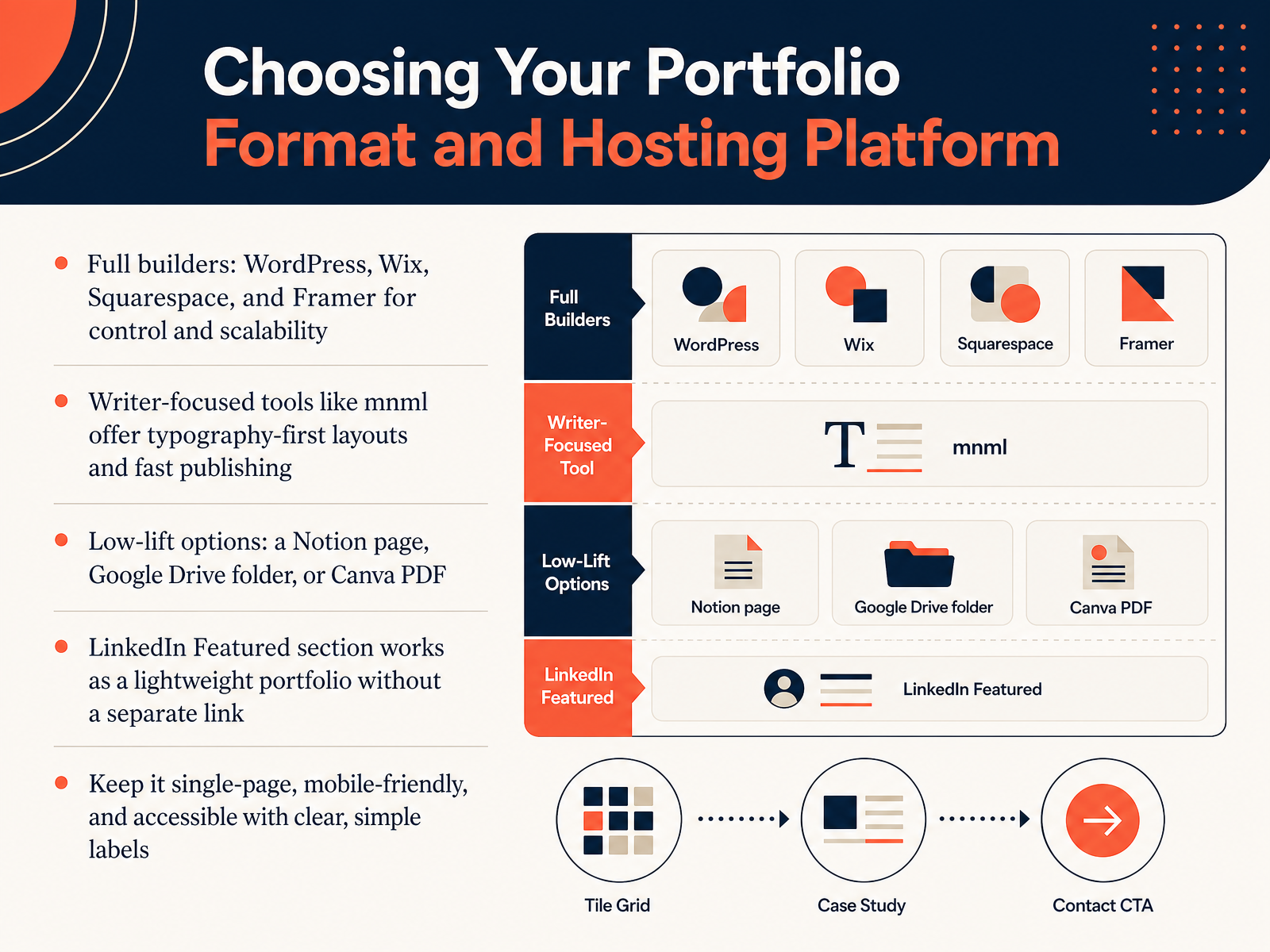
 - 04Choosing Your Portfolio Format and Hosting PlatformNow, how should you actually build and host it? You have options, and the right one depends on your time, budget, and skills. Full builders like WordPress, Wix, Squarespace, and Framer give you the most control and room to grow. If writing is your focus, tools like mnml offer typography-first layouts with fast publishing. Want something quicker? A Notion page, a Google Drive folder, or a Canva PDF all work. Your LinkedIn Featured section can even act as a lightweight portfolio with no separate link. Whatever you choose, keep it single-page, mobile-friendly, and accessible, with clear, simple labels. Pick the option you can publish this week, then move on to Core Skills and Evidence Types to Map.
 portfoliobox.combutternut.aielementor.com+21 min
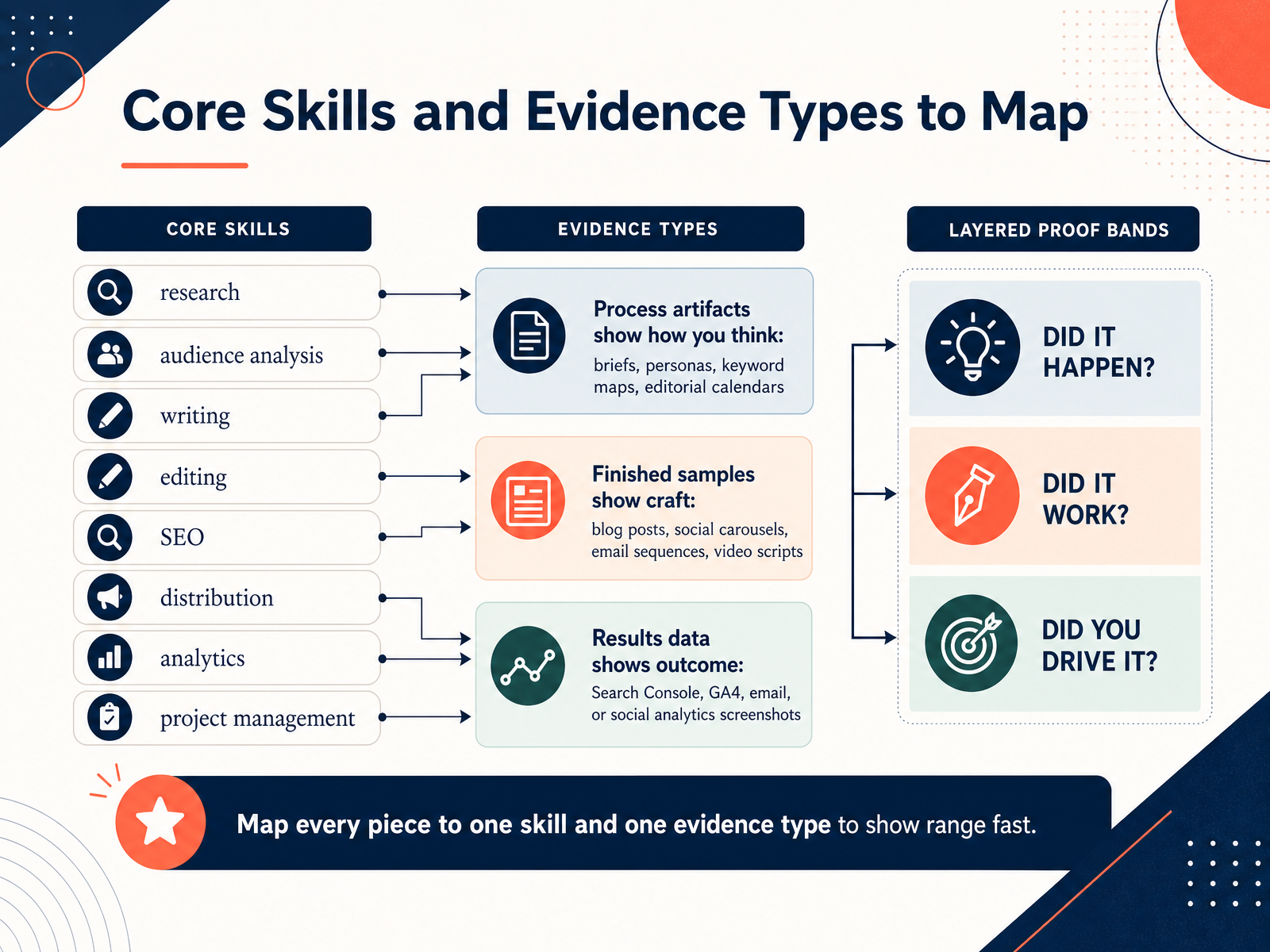
 - 05Core Skills and Evidence Types to MapLet's map your skills to evidence. Start with a skill map: research, audience analysis, writing, editing, SEO, distribution, analytics, and project management. These are the capabilities hiring managers actually screen for.
Then match each skill to an evidence type. Process artifacts show how you think, like briefs, personas, keyword maps, and editorial calendars. Finished samples show craft, like blog posts, social carousels, email sequences, and video scripts. Results data shows outcome, like screenshots from Search Console, GA4, email, or social analytics.
Here's the move that makes this work fast. For every piece in your portfolio, tag it with one skill and one evidence type. That way a recruiter scanning your work sees range in seconds, not a random pile of links. Aim for four to six pieces that each cover something different.
So take five minutes now. List your strongest skills on one side. List your evidence types on the other. Draw lines between them. Any skill with no evidence is a gap you can fill next. Next, we'll look at creating portfolio projects without a formal job.
 writesy.aimarketful.comdeardigitalmarketingnewbie.substack.com+22 min
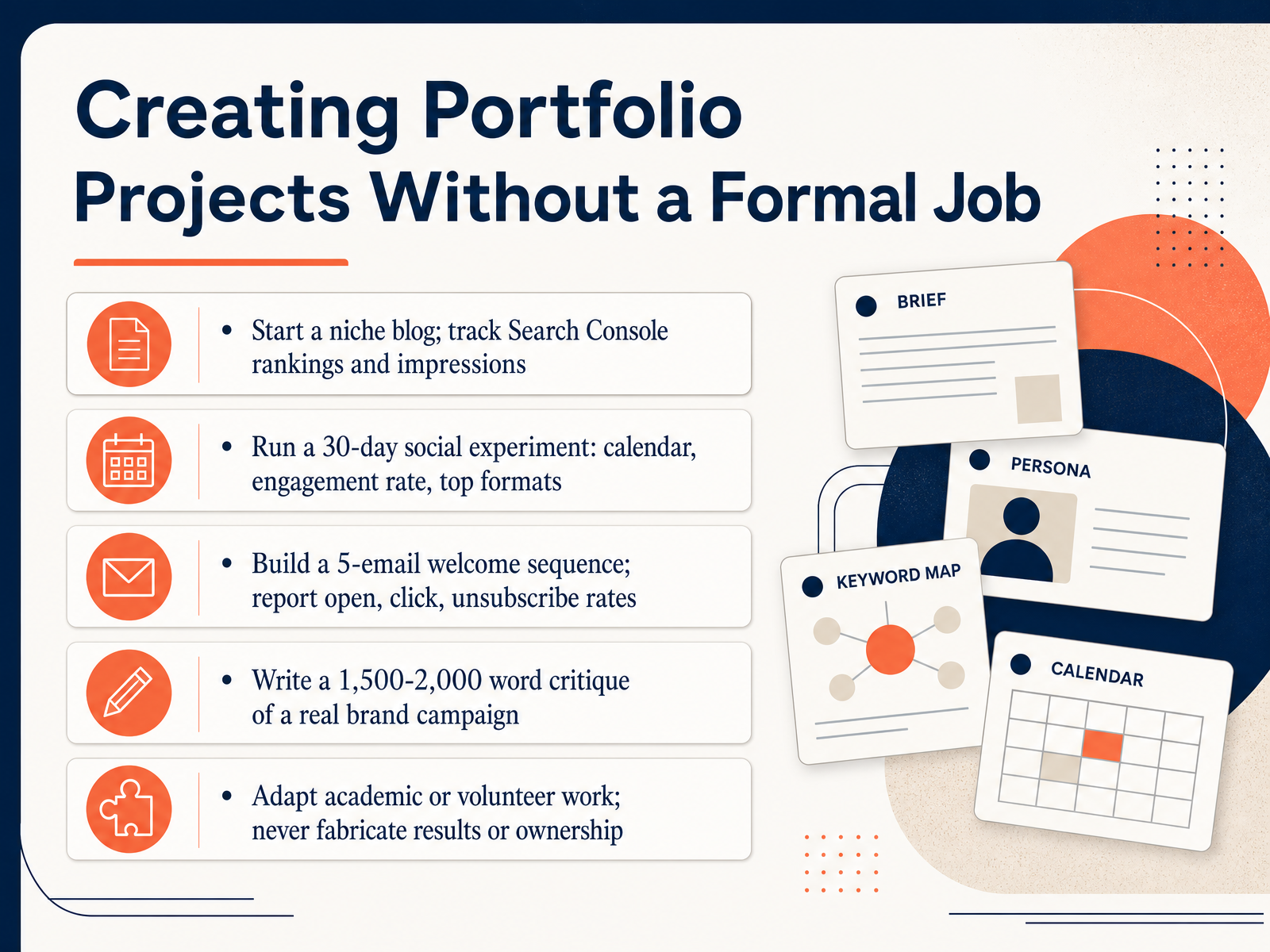
 - 06Creating Portfolio Projects Without a Formal JobLet's talk about building portfolio projects without a formal job. Here's the good news: you don't need a client to prove you can do content marketing. You need projects with real results. Start a niche blog and track your Search Console rankings and impressions. Those screenshots become a case study. Run a thirty-day social experiment with a content calendar, then report your engagement rate and top formats. Build a five-email welcome sequence and measure open, click, and unsubscribe rates. Or write a one thousand five hundred to two thousand word critique of a real brand campaign. You can also adapt academic or volunteer work, just never fabricate results or ownership. Pick one project. Start this week. Next, let's look at ethics, confidentiality, and spec work boundaries.
 markampus.commasaischool.comaadme.co+21 min
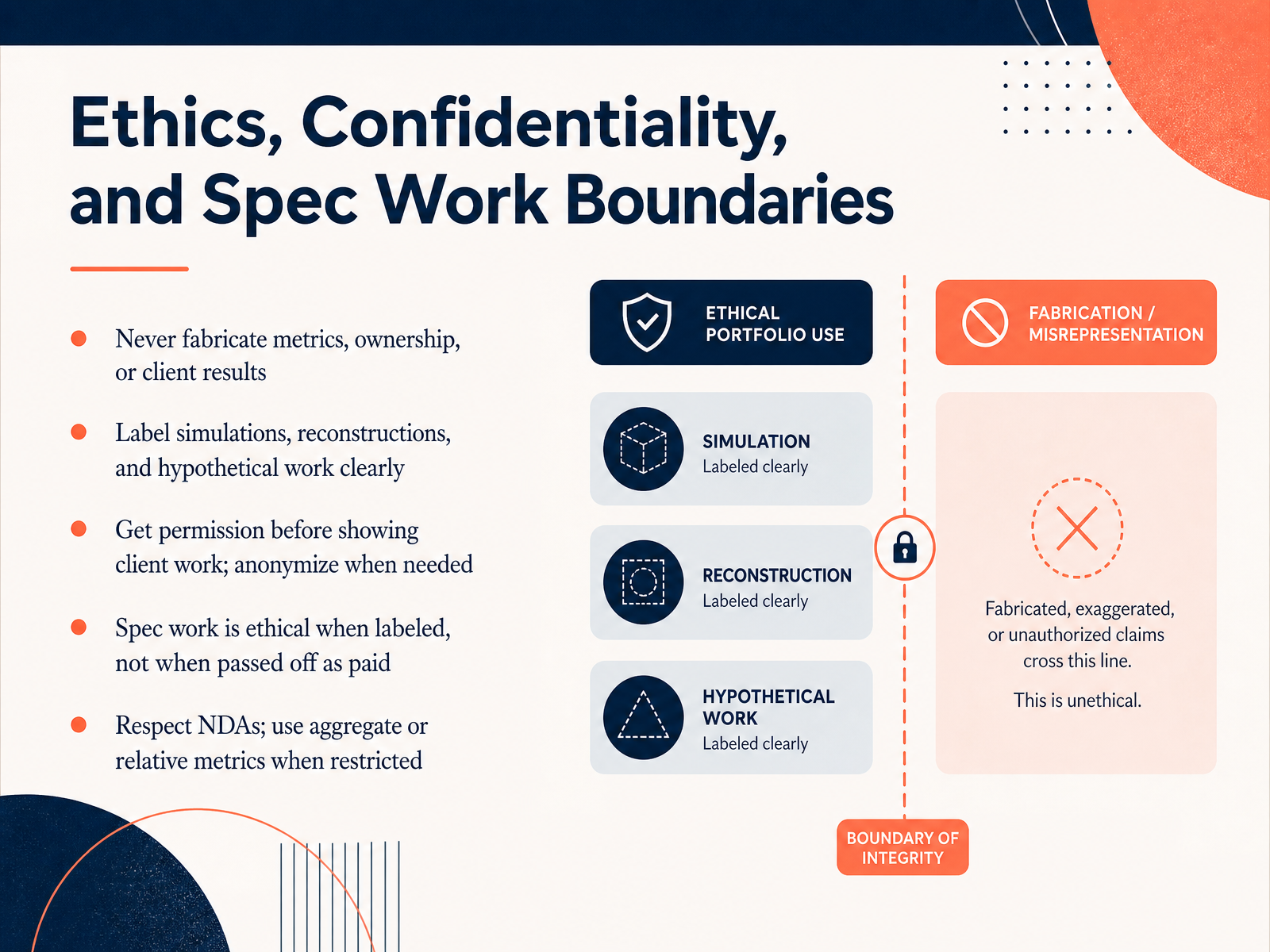
 - 07Ethics, Confidentiality, and Spec Work BoundariesNow let's talk about ethics, because how you present your work matters as much as the work itself. Start with one hard rule that protects your entire career. Never fabricate metrics, ownership, or client results. If a number is wrong or borrowed, it will eventually surface, and trust is the one thing your portfolio cannot repair.
Next, label clearly. If you built a simulation, a reconstruction, or a hypothetical campaign, say so. Spec work is completely ethical when it is labeled. It becomes a problem the moment you pass it off as paid client work.
When you show real client work, get permission first. If confidentiality is a concern, anonymize. Respect non-disclosure agreements. When you cannot share exact figures, use aggregate or relative metrics instead, like traffic doubled or conversion improved by forty percent.
Honesty is not a weakness here. It is your strongest signal of professionalism. Take a moment to check your own portfolio against these four boundaries before we move on. Next, we will look at writing case studies that show impact.
 markampus.commasaischool.comaadme.co+22 min
 - 08Writing Case Studies That Show ImpactNow let's turn your work into proof. Case studies are where your portfolio earns trust.
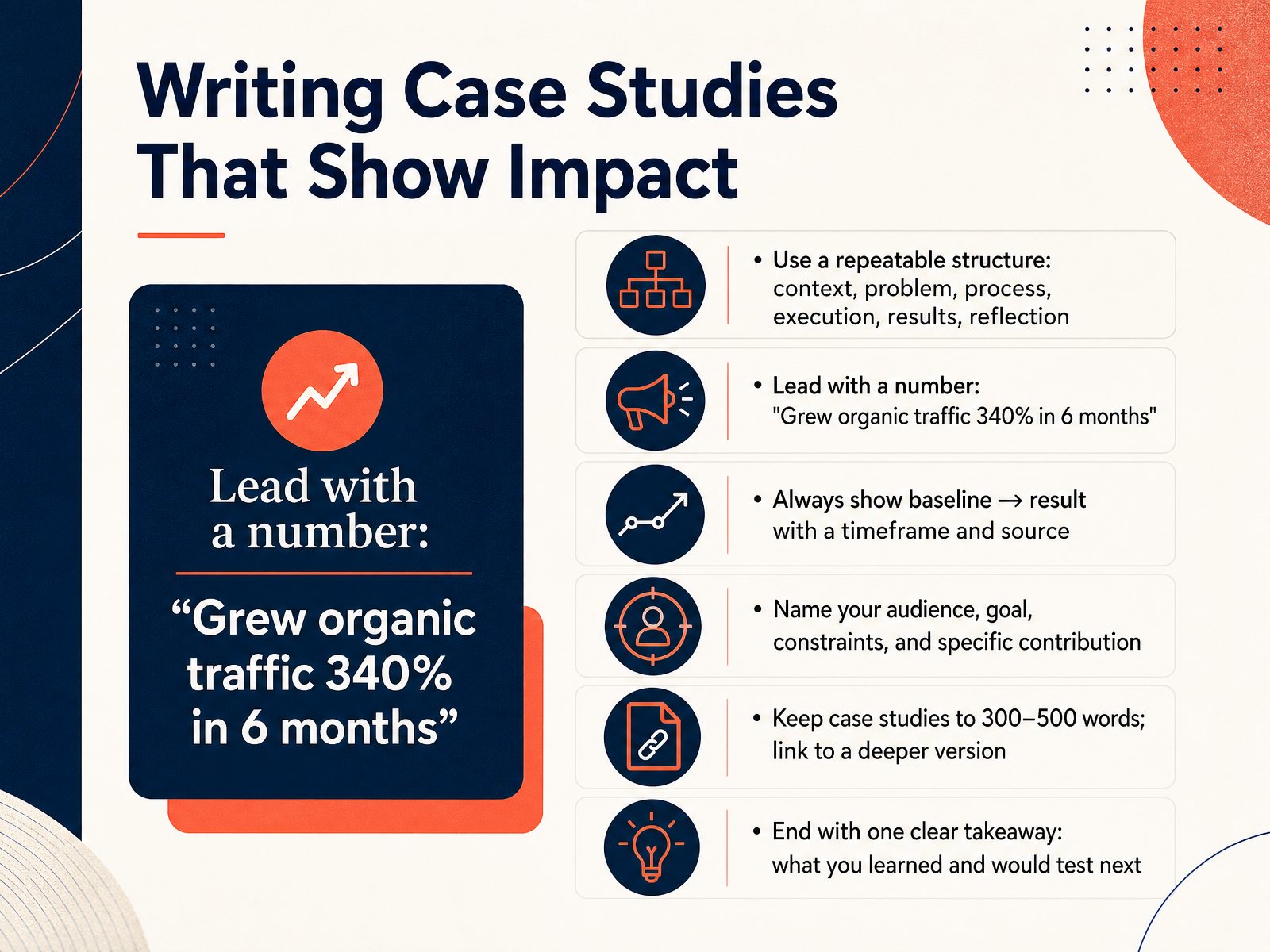
Use a repeatable structure: context, problem, process, execution, results, reflection. And lead with a number. Not "I wrote blog posts," but "Grew organic traffic three hundred forty percent in six months." Hiring managers skim in seconds. A number stops them.
Always show baseline, then result, with a timeframe and a source. So instead of saying traffic improved, you write: baseline two hundred monthly visits, result forty five thousand, over six months, source Google Analytics. That framing is what makes your claim believable.
Name your audience, your goal, your constraints, and your specific contribution. If you worked with a team, say exactly which decisions were yours.
Keep each case study short, around three hundred to five hundred words, and link to a deeper version if someone wants more.
End with one clear takeaway: what you learned and what you would test next. That last line shows judgment, and judgment is what gets you hired.
Next, let's look at packaging the portfolio experience.
 popout.pageapplybuddy.ailinkedin.com+22 min
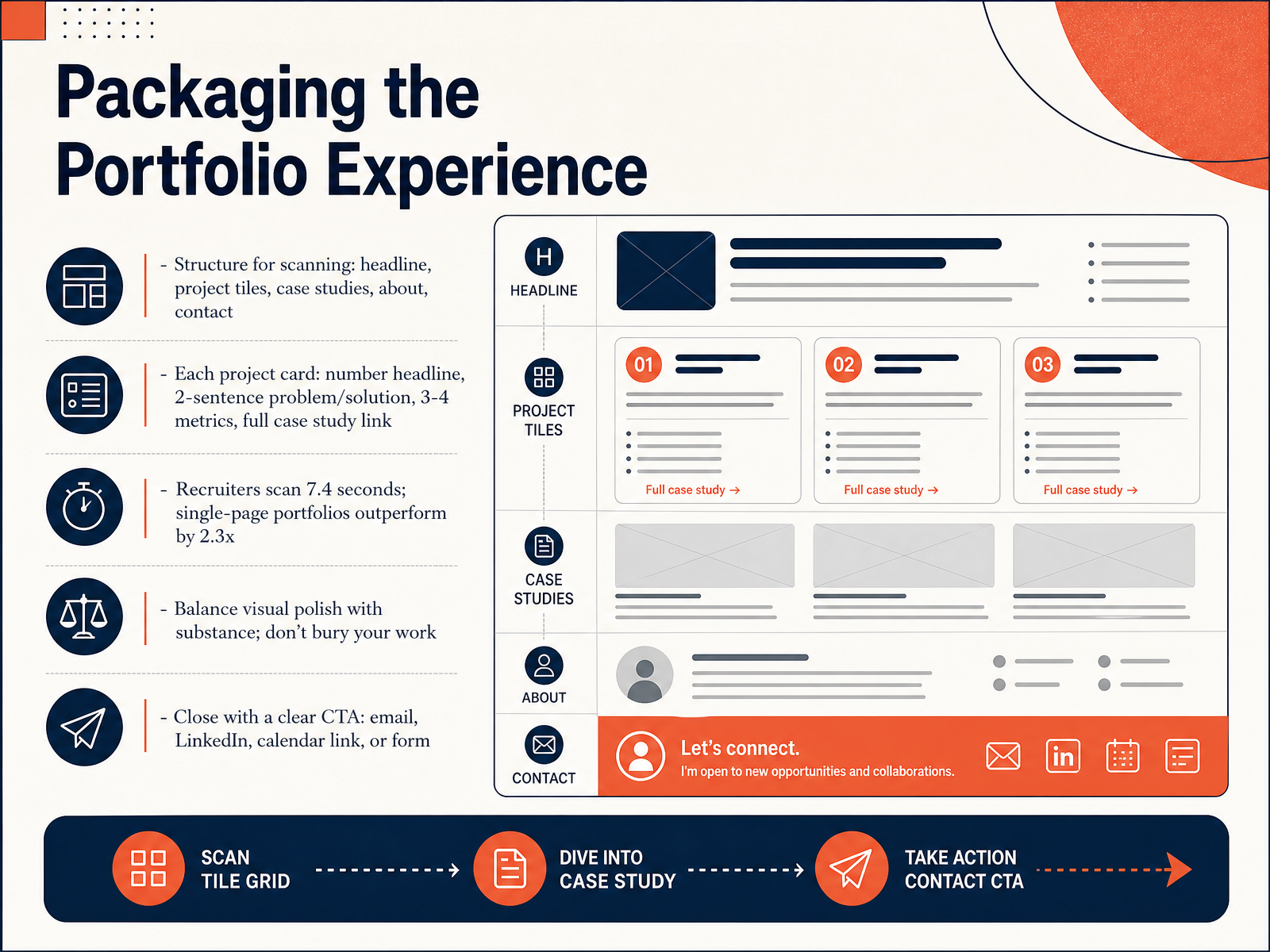
 - 09Packaging the Portfolio ExperienceNow let's talk about packaging the portfolio experience, because how you arrange your work matters as much as the work itself. Recruiters give a portfolio about seven and a half seconds on that first scan. That is it. And single page portfolios outperform multi-page sites by roughly two point three times, because everything is right there. So structure for scanning. Headline first. Then project tiles. Then full case studies. Then your about section. Then contact. For each project card, lead with a headline that includes a number, follow it with two sentences covering the problem and the solution, add three to four metrics, and link to the full case study. Balance polish with substance. Do not bury your best work under animations or a clever design. Close with one clear call to action: your email, your LinkedIn, a calendar link, or a simple form. Make it easy for someone to reach out. Next, we will look at positioning, your about page, and social proof.
 portfoliobox.combutternut.aielementor.com+22 min
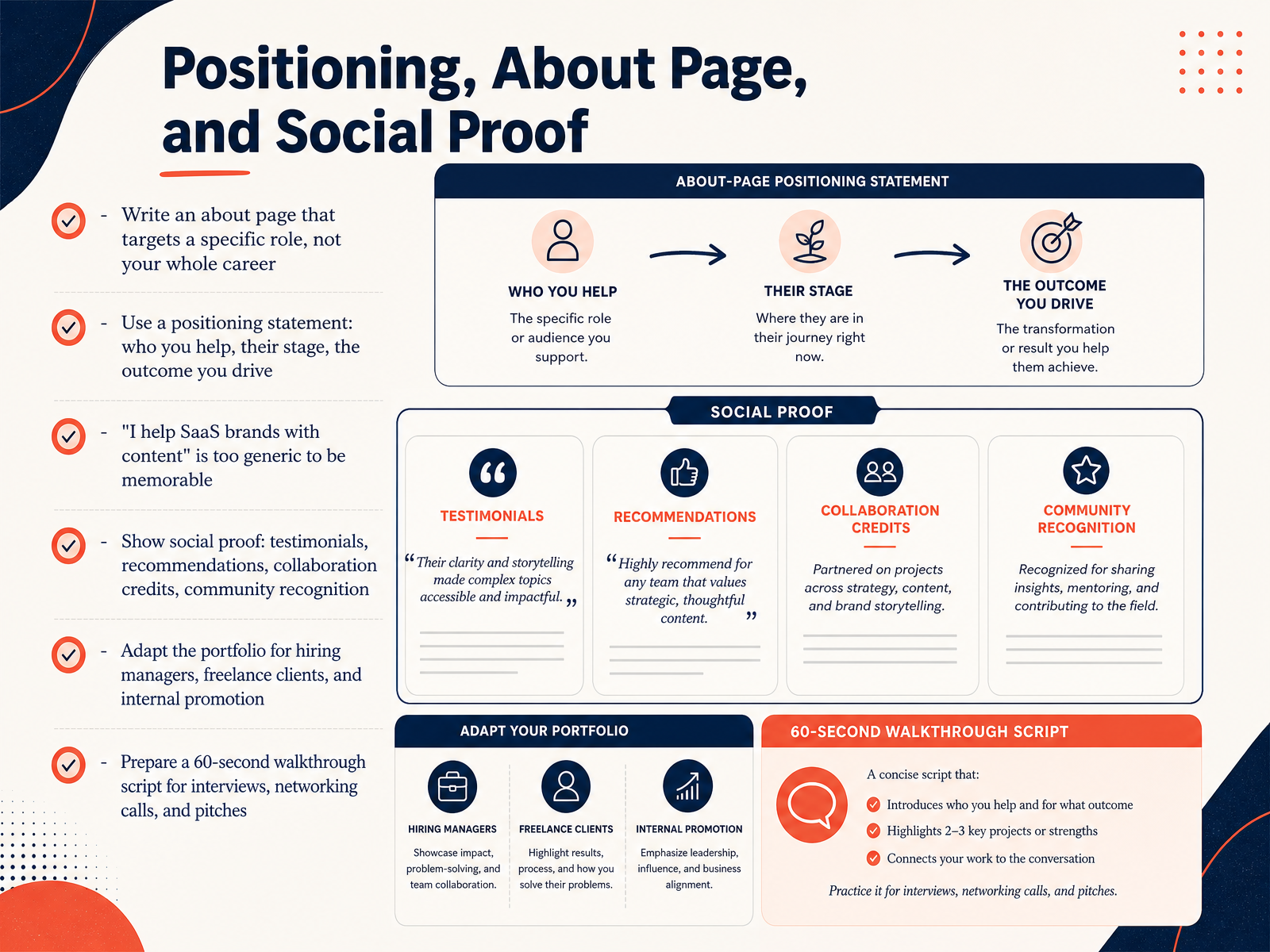
 - 10Positioning, About Page, and Social ProofNow let's talk about how you position yourself, write your about page, and back it all up with social proof. Your about page should target one specific role, not your whole career story. And it should open with a positioning statement: who you help, what stage they're at, and the outcome you drive. Saying "I help SaaS brands with content" is too generic to be memorable. Instead, try something like: "I help early-stage SaaS teams turn blog traffic into qualified pipeline." See the difference? That's specific and it makes you easy to recommend. Next, don't skip social proof. Testimonials, recommendations, collaboration credits, and community recognition all build trust fast. If someone lands on your portfolio and never sees your resume, they should still understand who you are in about thirty seconds. Then adapt your portfolio for the audience in front of you. Hiring managers care about process and results. Freelance clients care about outcomes and reliability. For internal promotion, focus on business impact and influence. And here's a practical move. Prepare a sixty-second walkthrough script of your portfolio. Use it in interviews, networking calls, and pitches. It keeps you clear and confident under pressure. Next, we'll look at publishing, feedback, and iteration.
 popout.pageapplybuddy.ailinkedin.com+22 min
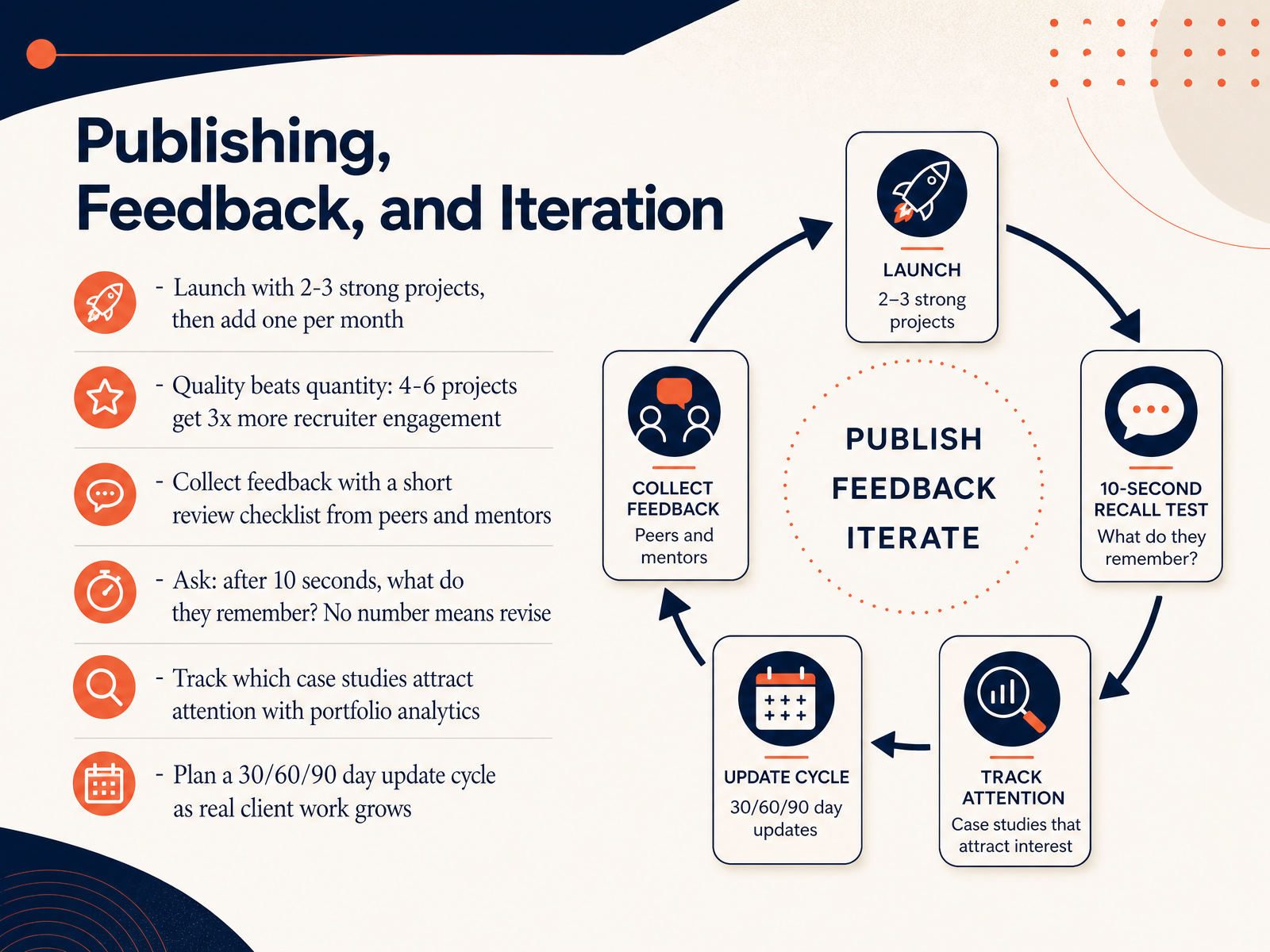
 - 11Publishing, Feedback, and IterationNow let's talk about what happens after you publish. Launch with two or three strong projects, then add one new project each month. Quality beats quantity here. Portfolios with four to six projects get three times more recruiter engagement than portfolios with ten or more. So keep it tight. Next, get feedback. Ask a peer or mentor to run this quick check. After ten seconds, what do they remember? If they cannot recall a specific number or project, you need to revise. Then track the data. Use simple portfolio analytics to see which case studies actually attract attention. Finally, plan a thirty, sixty, ninety day update cycle. As real client work grows, replace weaker pieces and refresh your numbers. Your portfolio should be a living document, not a one-time project. That rhythm keeps it strong. Let's move on to common pitfalls and confidence building.
 popout.pageapplybuddy.ailinkedin.com+22 min
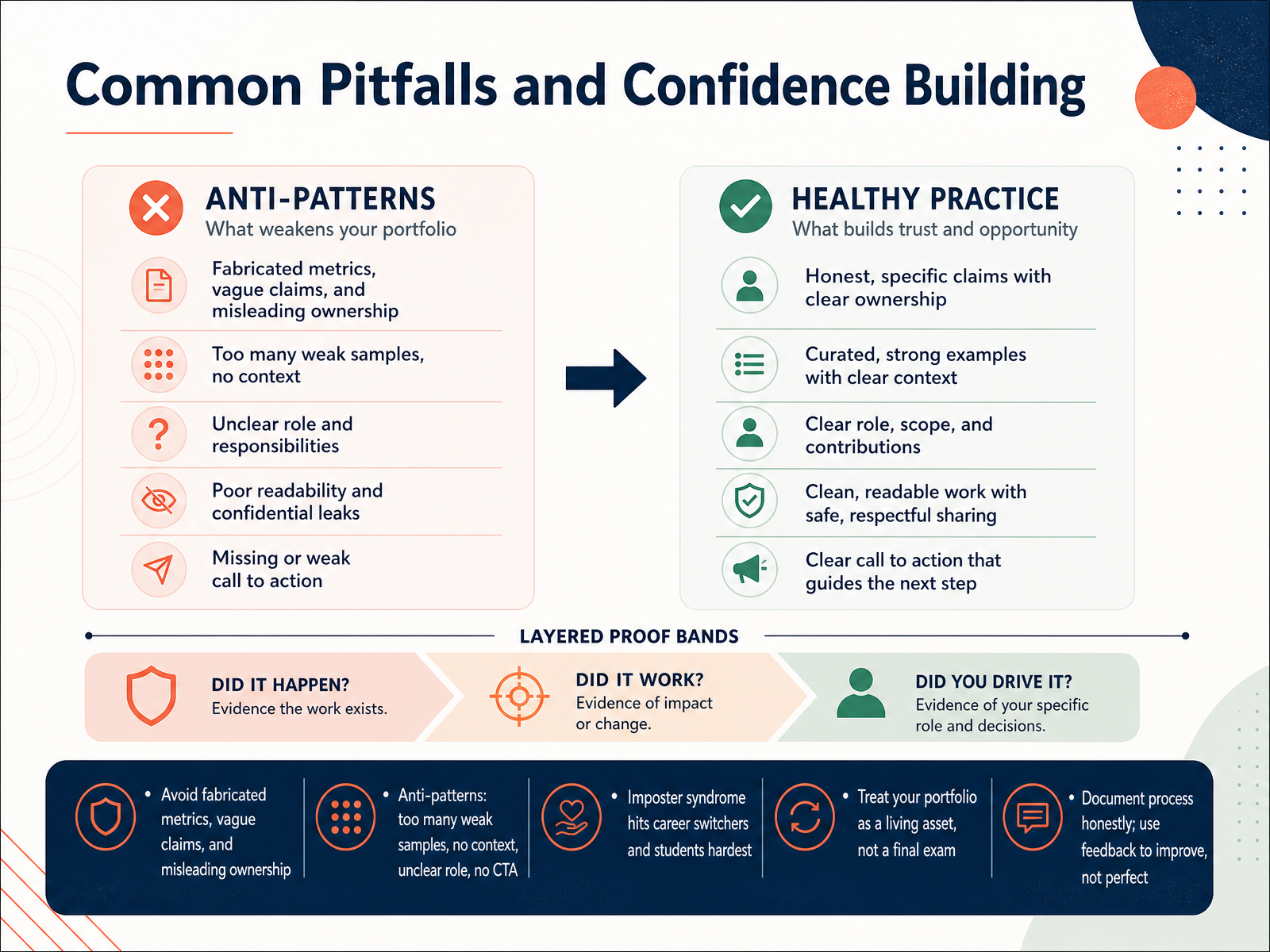
 - 12Common Pitfalls and Confidence BuildingNow let's talk about the traps to avoid, and the confidence to build. First, the honesty rule. Never fabricate metrics, make vague claims, or imply you owned work you only supported. Hiring managers check both layers: did it happen, and did you drive it? If you were a contributor, say so. Honest framing still lands the job. Next, watch for these anti-patterns: too many weak samples, no context, an unclear role, and no call to action. Remember, four to six strong projects beat thirty thin ones, and every project needs a number, a short summary, and your specific role. Now, the confidence part. Impostor syndrome hits career switchers and students hardest, and that is completely normal. Here is the reframe: treat your portfolio as a living asset, not a final exam. You can update it next week. Document your process honestly, including what you would do differently. Recruiters value that judgment more than perfection. Ask three people for feedback, then ship the improved version. Your portfolio grows as you grow. That is the whole point. Next, we turn that mindset into action.
 popout.pageapplybuddy.ailinkedin.com+22 min
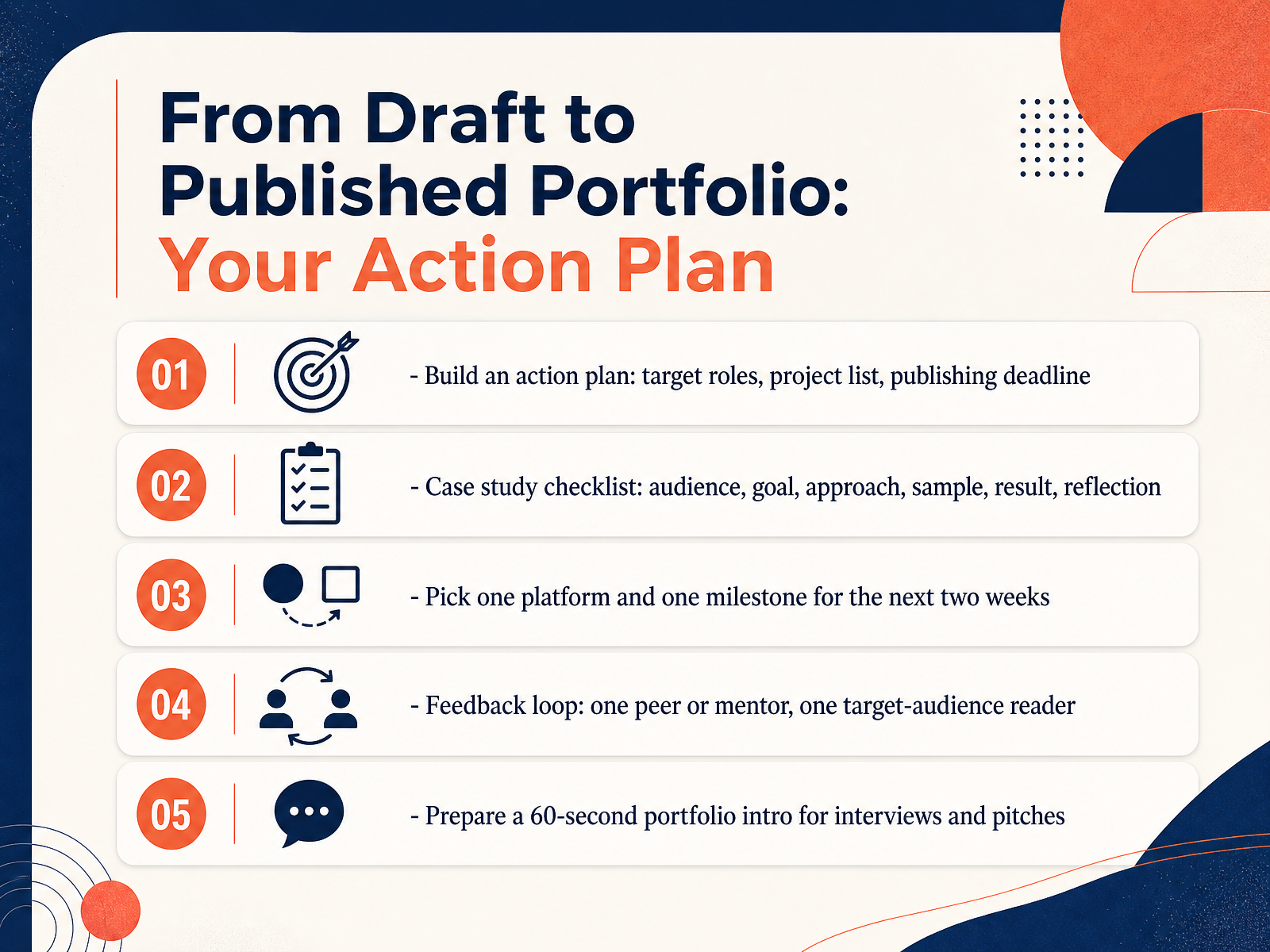
 - 13From Draft to Published Portfolio: Your Action PlanNow let's turn everything into an action plan you can actually execute. Start with three decisions: your target roles, your project list, and your publishing deadline. For example, aiming for a content marketing role, you might choose a niche blog, one email sequence, and a marketing plan, then commit to publishing within four weeks. As you write up each project, follow this checklist: audience, goal, approach, sample, result, and reflection. That structure is what hiring managers and clients scan for first. Next, pick one platform and one milestone for the next two weeks. Just one. Maybe a Notion page with two finished case studies, or your first ten blog posts live. Then build a feedback loop with one peer or mentor plus one person from your target audience. Their reactions show you what a stranger actually sees. Finally, prepare a sixty-second portfolio intro you can say out loud in interviews and pitches. Practice it until it feels natural, not memorized. That short story of who you help, what you built, and what happened is often what gets you the callback. So right now, write your deadline down. One platform, one milestone, one person you will ask for feedback this week. Let's put this into practice in our next session, Portfolio Lab: Building and Refining Your First Case Study.
 markampus.commasaischool.comaadme.co+22 min
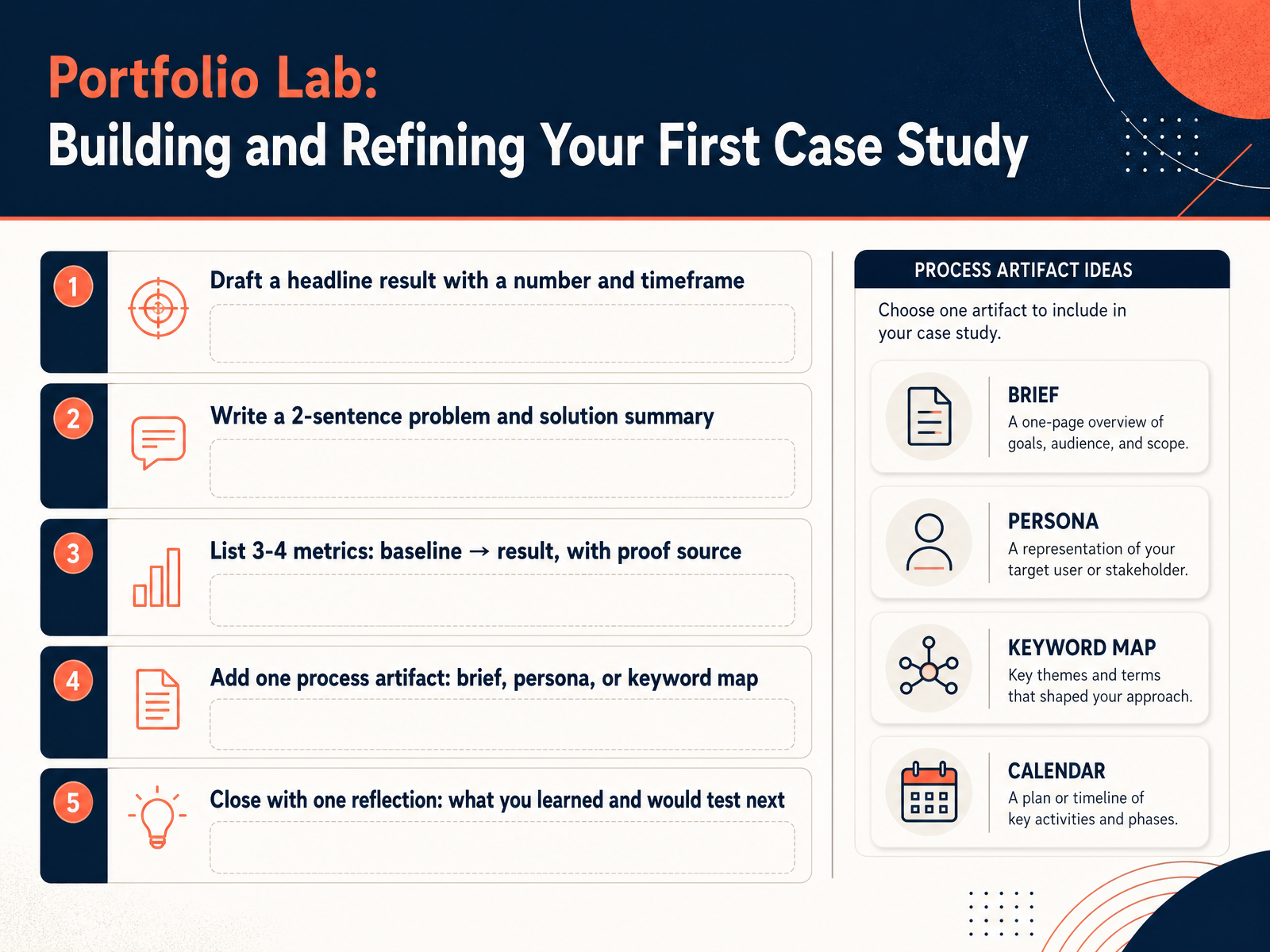
 - 14Portfolio Lab: Building and Refining Your First Case StudyLet's put it all together. Here's your first case study, built step by step.
Start with a headline result. One number, one timeframe. For example, "Grew blog traffic three hundred forty percent in six months." That's the first thing a hiring manager reads, so make it count.
Next, two sentences. One describes the problem. The other describes your solution. Keep it tight, no fluff.
Then list three or four metrics in baseline to result form. So, organic traffic went from two hundred to forty-five thousand monthly visits. Add your proof source next to each one. A dashboard screenshot, a Search Console export, a client-approved quote. That's what makes your numbers believable.
Add one process artifact. Your content brief, your audience persona, or your keyword map. This is what proves you think strategically, not just write well.
Finally, close with a short reflection. What did you learn, and what would you test next? Recruiters love this part because AI can't fake it.
You now have the full structure for a case study that gets noticed. Thank you for showing up and doing this work. Build one this week, keep it honest, and lead with what changed. You're ready for this, and your portfolio is about to prove it.
 popout.pageapplybuddy.ailinkedin.com+22 min
Take the deck with you
Download this course as a file — free, no sign-up needed.
- PDF handoutEvery slide page, ready to print or share.15 pages · 3.8 MBDownload
- Narrated PowerPointThe deck that presents itself — every slide carries the digital human's narration video.15 pages · 15.1 MBDownload
- PowerPoint slidesThe full deck as a .pptx — open it in PowerPoint, Keynote, or Google Slides.15 pages · 3.6 MBDownload
Free to use in your own training — please keep the PersonWise credit page at the end.
Have your own deck? Turn it into a course
Sources consulted
Web sources consulted while building this course.
- How to Build a Marketing Portfolio with No Experience (7 Projects You Can Start Today) | Markampus — markampus.com
- 12 Digital Marketing Project Ideas for Your Portfolio (2026) — masaischool.com
- Digital Marketing Projects for Beginners to Get Hired — aadme.co
- How To Build A Digital Marketing Portfolio With No Experience In 2026 — skillcircle.in
- How to Build a Marketing Portfolio With No Experience -Guide — youngurbanproject.com
- Content Marketing Portfolio Examples That Landed Jobs (2026) | popout.page — popout.page
- Entry-Level Content Marketing Resume Example | 2026 — applybuddy.ai
- In the last 2 months, I've reviewed 20+ content marketing portfolios on my 1:1 calls. And almost every portfolio had at least one of the below-mentioned gaps👇 | Sreyashi Chatterjee — linkedin.com
- Junior Content Writer Resume Example (2026) | WriteCV — writecv.ai
- Marketing Portfolio Examples: 6 Job-Ready Templates (2026) — samssocialmediaclub.com
- The Best Portfolio Website Builder | Create Your Online Portfolio | Portfoliobox — portfoliobox.com
- Content Marketing Manager Portfolio Website Builder | Create with AI | Butternut AI — butternut.ai
- 10 Best Website Builders for Portfolios in 2026 - Elementor — elementor.com
- https://www.framer.com/lp/ad/portfolio — framer.com
- Content Creator Website & Media Kit Builder | Influencer Portfolio in Minutes — sitecanvas.ai
- Content Marketing 101: Complete 2026 Beginner's Guide | Writesy AI Blog — writesy.ai
- Content Marketing for Beginners: Complete 2026 Guide — marketful.com
- Going Back To The Basics Series: What Content Marketing Entails: As a Career and as a Job — deardigitalmarketingnewbie.substack.com
- Top 11 Content Marketer Skills to Master — quasa.io
- How to Become a Content Marketing Manager in 2026 | Markampus — markampus.com