Begin
14 pages · ~28 min
Reading Ancient Greek Vases
This training teaches participants to analyze and interpret ancient Greek vases, focusing on visual storytelling, iconography, and cultural context. Ideal for students and enthusiasts of classical art and archaeology.
A digital instructor presents all 14 pages. Hold “Ask” at any point and ask out loud — the answer comes from this course. No sign-up needed.
What you’ll learn
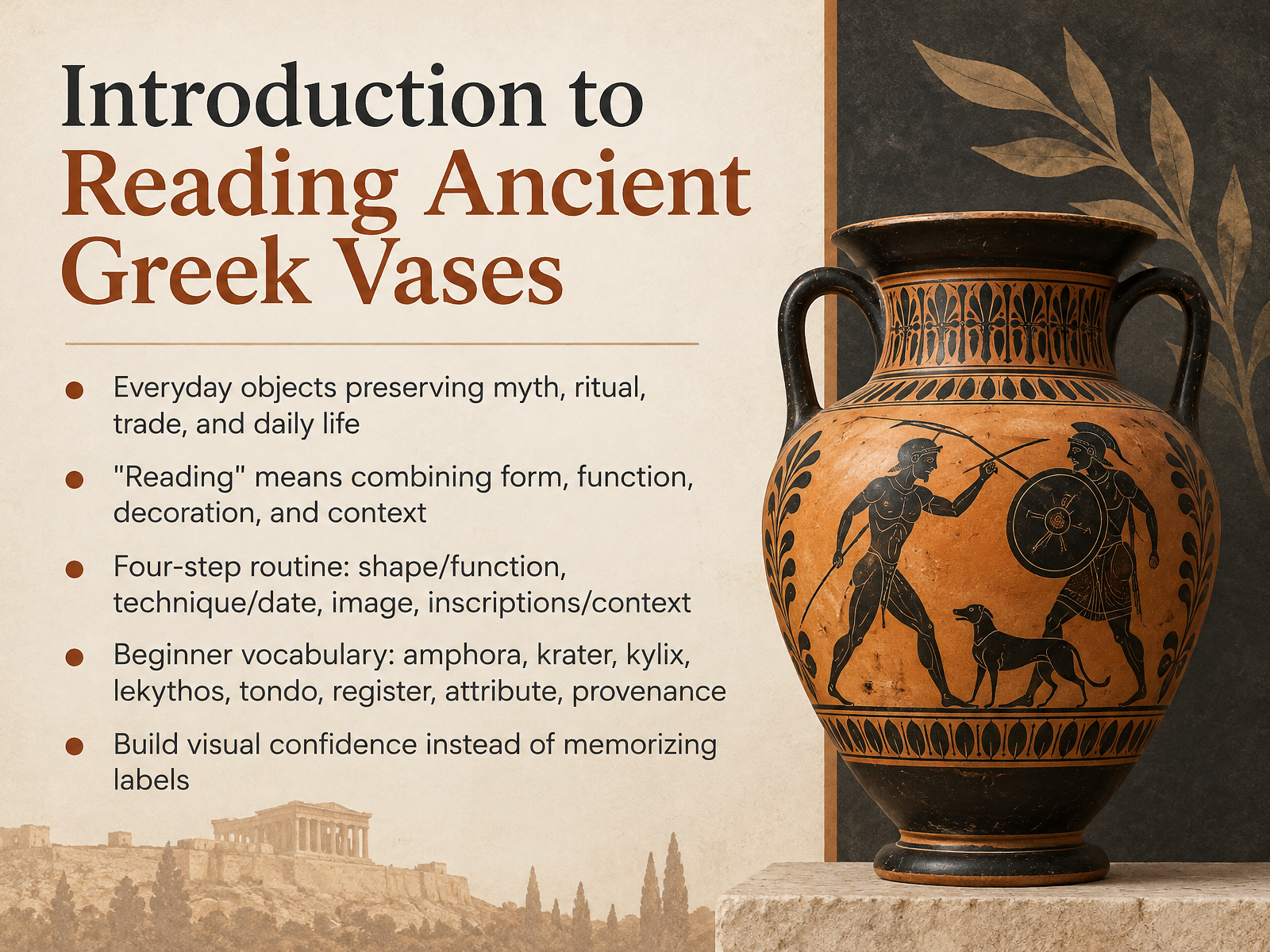
- 01Introduction to Reading Ancient Greek VasesWelcome. I'm glad you're here, and I promise you don't need any prior knowledge of Greek art to enjoy this course. Our goal is simple. Together, we'll learn to read ancient Greek vases the way a guide reads a gallery. These were everyday objects, yet they preserve myth, ritual, trade, and daily life. Reading them means combining four things. Look at the shape and ask what the vase was for. Notice the technique and think about its date. Study the image. Then check inscriptions and context, such as where the vase was found. We'll build a four-step routine from those habits. Along the way, you'll pick up a beginner's vocabulary: amphora, krater, kylix, lekythos, tondo, register, attribute, and provenance. We'll define each one in plain language as we meet it. Our aim is visual confidence, not memorizing labels. Look closely, and ask what you can actually see. Now let's begin with how these pots were made: clay, slip, and the three-stage firing.reed.edugetty.edugetty.edu+22 min
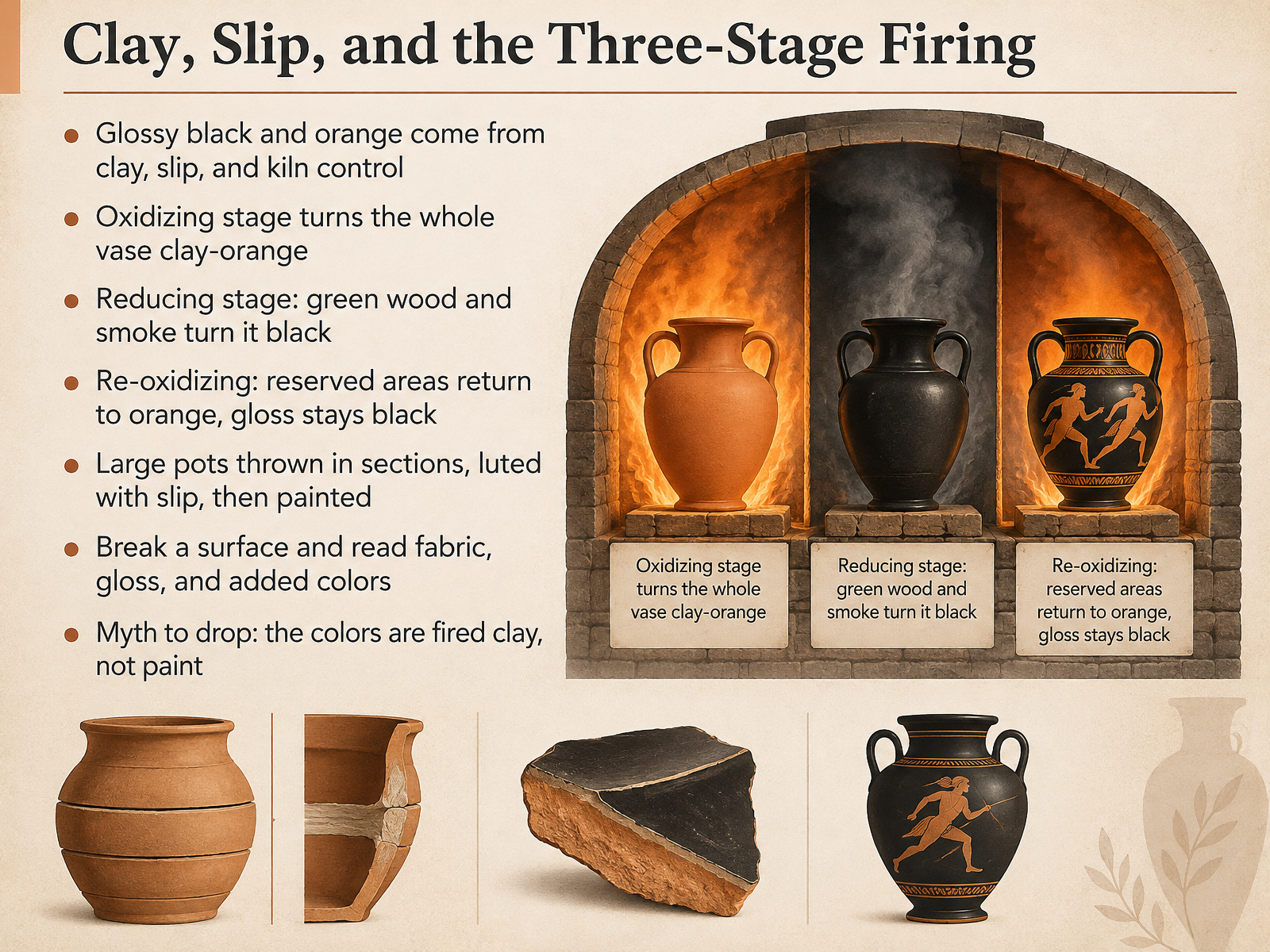
- 02Clay, Slip, and the Three-Stage FiringNow let's look at what these colors actually are. The glossy black and the warm orange come from clay, slip, and kiln control. Slip is simply clay mixed to a liquid, like paint. The pot is fired in three stages. First, an oxidizing stage with plenty of air turns the whole vase clay-orange. Next, green wood is added and the oxygen drops. The smoky kiln turns it black. Finally, air returns. The reserved areas turn orange again, while the glossy slip stays black. Large pots were thrown in sections, joined with slip, then painted. And here's a myth to drop: the colors are fired clay, not paint. Break a surface and you can read the fabric, the gloss, and any added colors. Next, we'll look at shapes and functions, reading the vessel before the picture.
 carc.ox.ac.ukuni-giessen.demetmuseum.org+22 min
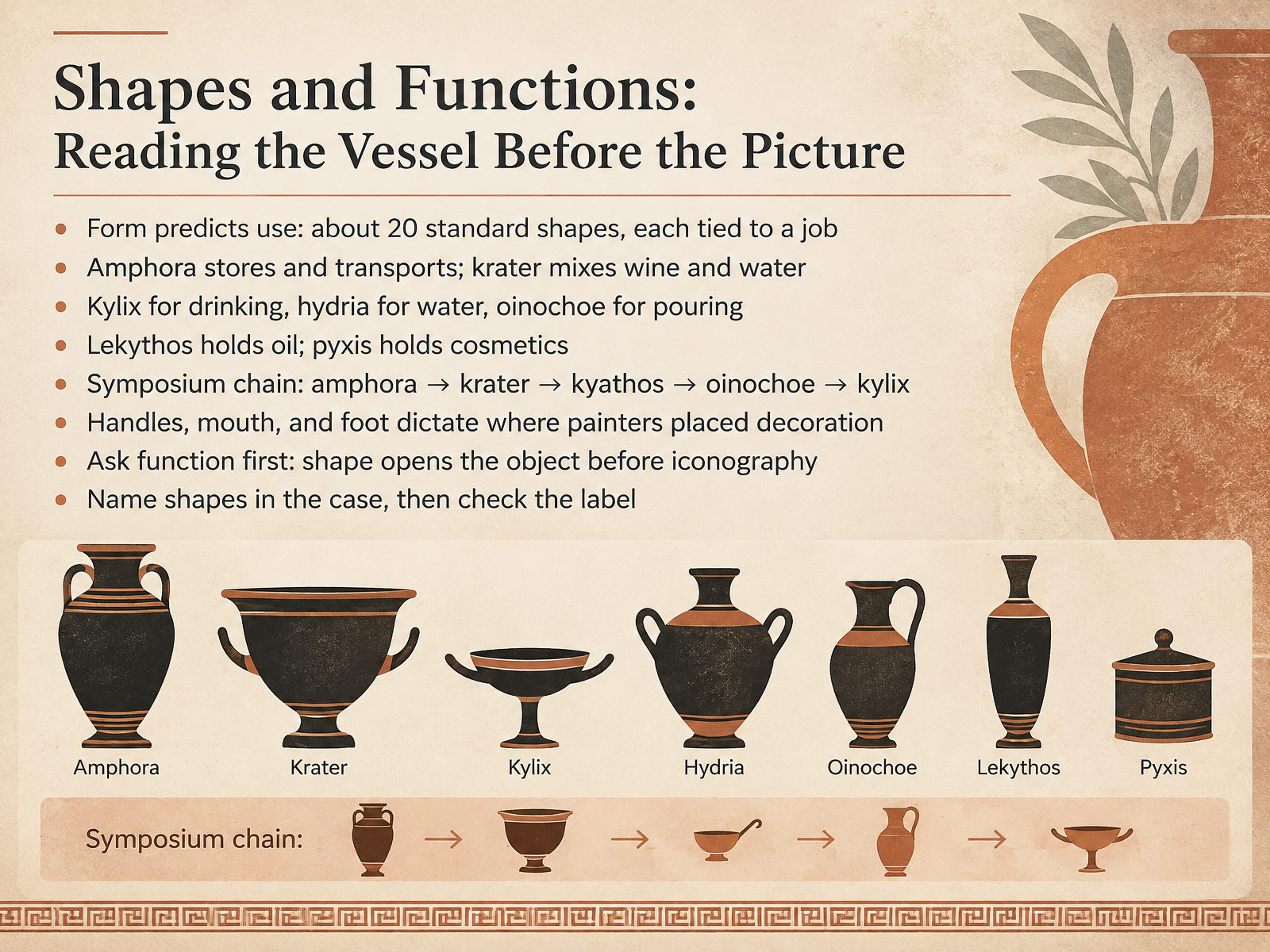
- 03Shapes and Functions: Reading the Vessel Before the PictureLet's start with the vessel itself, before we look at any picture. Greek potters worked from about twenty standard shapes, and each shape was tied to a job. A tall jar with two handles, an amphora, stores and transports wine or oil. A wide, deep bowl, a krater, mixes wine with water. A broad, shallow cup, a kylix, is for drinking. A hydria carries water, and an oinochoe pours. A lekythos holds oil, and a small pyxis holds cosmetics. Notice the handles, the mouth, and the foot. They tell you how a pot was lifted, poured, and set down, and they also dictate where a painter placed decoration. So try this in the case. Name the shape first, then check the label. Now let's see how these shapes changed over time. A Compact Chronology: Geometric to Classical.
 britishmuseum.orgworldhistory.orgworldhistory.org+22 min
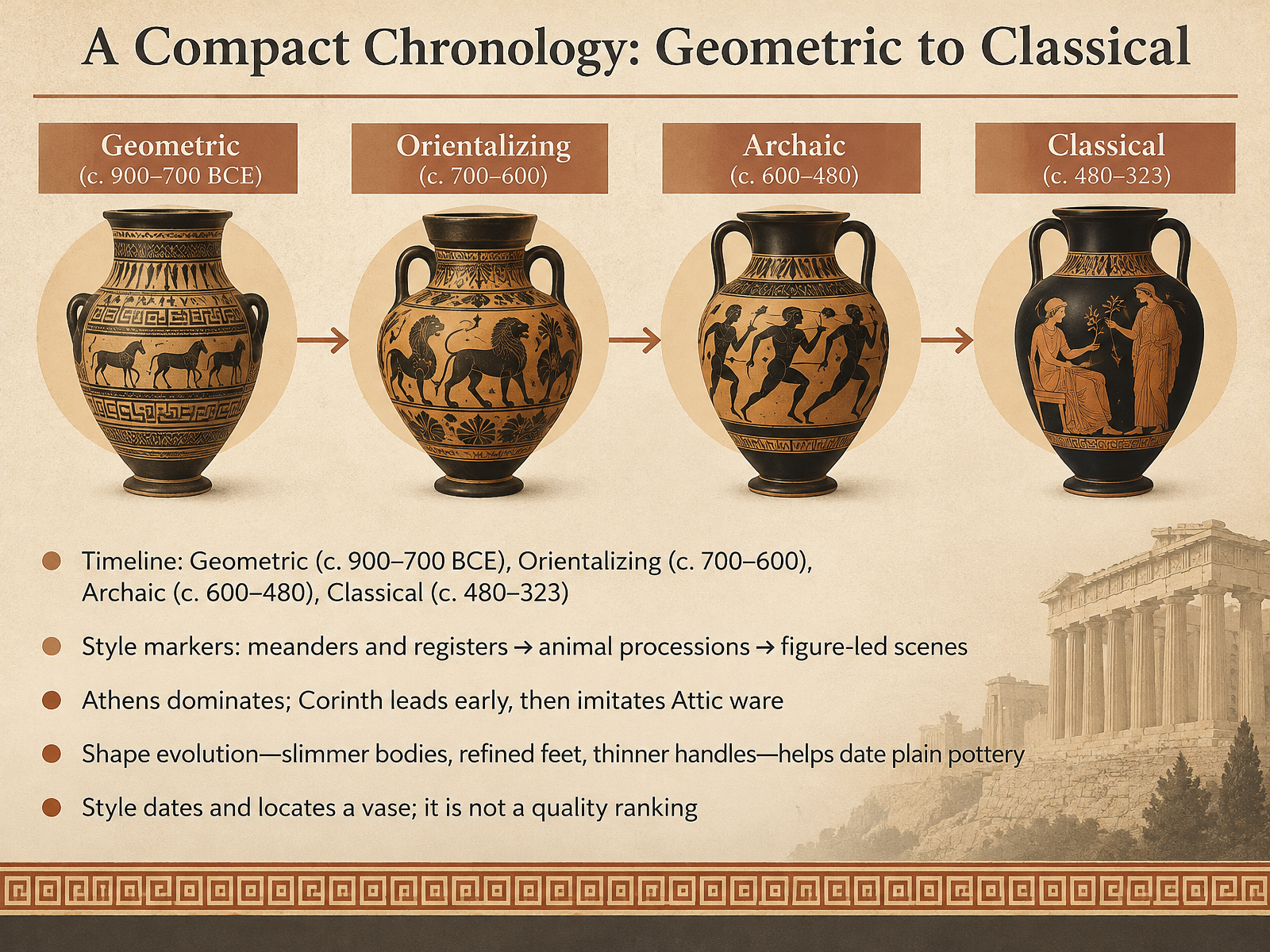
- 04A Compact Chronology: Geometric to ClassicalNow let's set out a simple timeline. Four broad phases, each with its own look. Geometric, around nine hundred to seven hundred BCE. Orientalizing, seven hundred to six hundred. Archaic, six hundred to four hundred eighty. And Classical, from four hundred eighty to three hundred twenty three. Look closely at the decoration and you can see the change. Geometric vases are covered in meanders, those squared spiral patterns, arranged in horizontal bands called registers. Orientalizing work often features animal processions. Later, figure-led scenes take over. Athens dominates, though Corinth leads early, then imitates Attic ware. Shape helps too. Over time, bodies grow slimmer, feet more refined, handles thinner, which dates even plain pottery. And remember, style dates and locates a vase. It is not a quality ranking. Next, we look at how these figures were actually painted. Black-Figure, Red-Figure, and White-Ground Techniques.
 carc.ox.ac.ukuni-giessen.demetmuseum.org+22 min
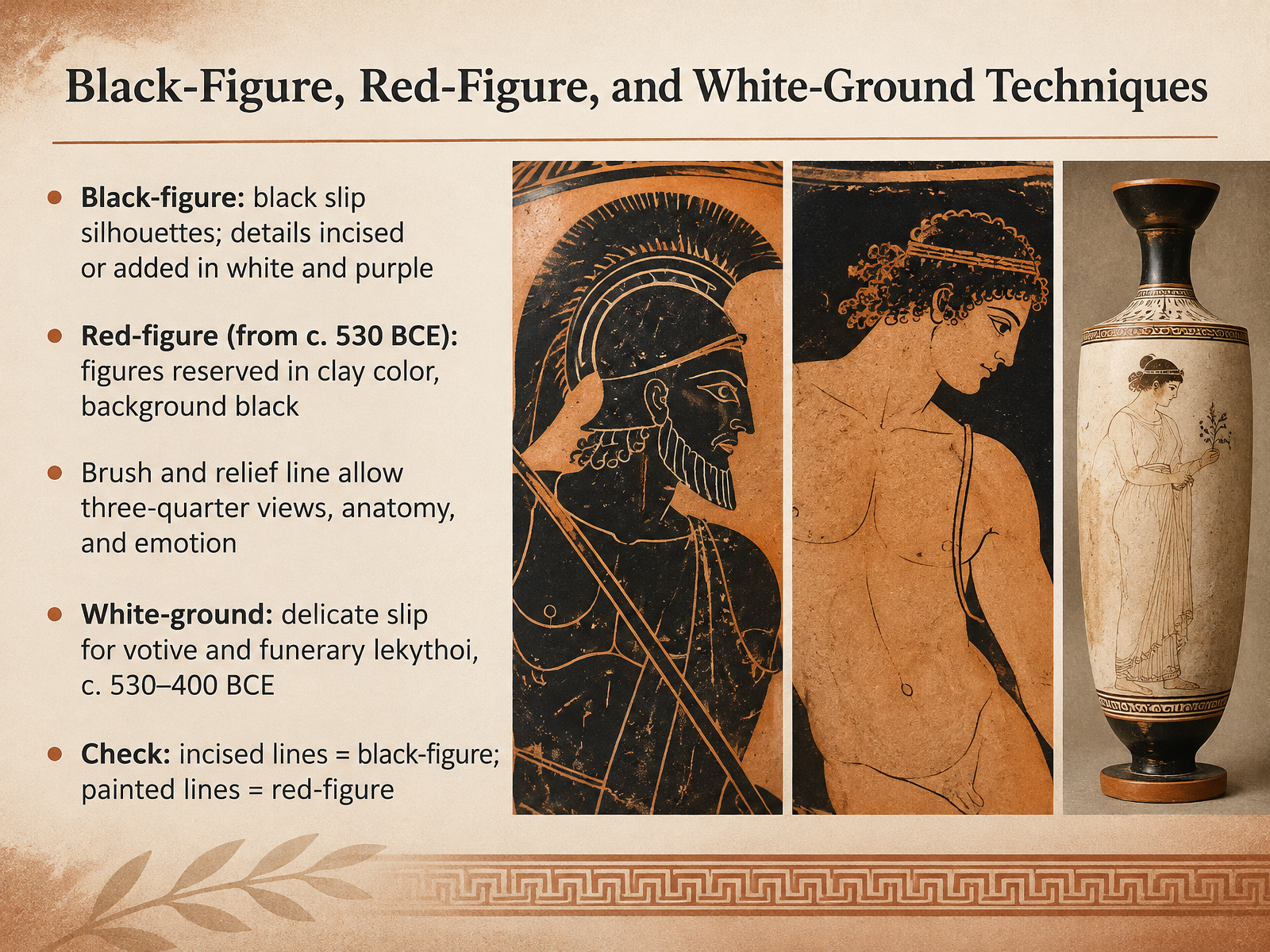
- 05Black-Figure, Red-Figure, and White-Ground TechniquesNow let's look at how Greek vases were actually painted. There are three main techniques to know. First, black-figure. Figures are painted as black silhouettes on the clay's natural orange background. Look closely, and you'll see details scratched into the black with a sharp tool, plus touches of added white and purple. Second, red-figure, invented around five hundred thirty BCE. Here it's reversed. The figures stay the color of the clay, and the background is painted black. Because artists now used a brush instead of a scratching tool, they could paint fine lines, softer folds, and more lifelike faces. Third, white-ground, used from about five hundred thirty to four hundred BCE. A delicate white slip coats the vase, and the painting sits on top. These were mostly small oil flasks, called lekythoi, made for offerings and funerals, not daily use. Here's a quick check. Incised lines mean black-figure. Painted lines mean red-figure. Next, we'll look at how to describe a vase systematically, using fields, registers, and composition.
 carc.ox.ac.ukuni-giessen.demetmuseum.org+22 min
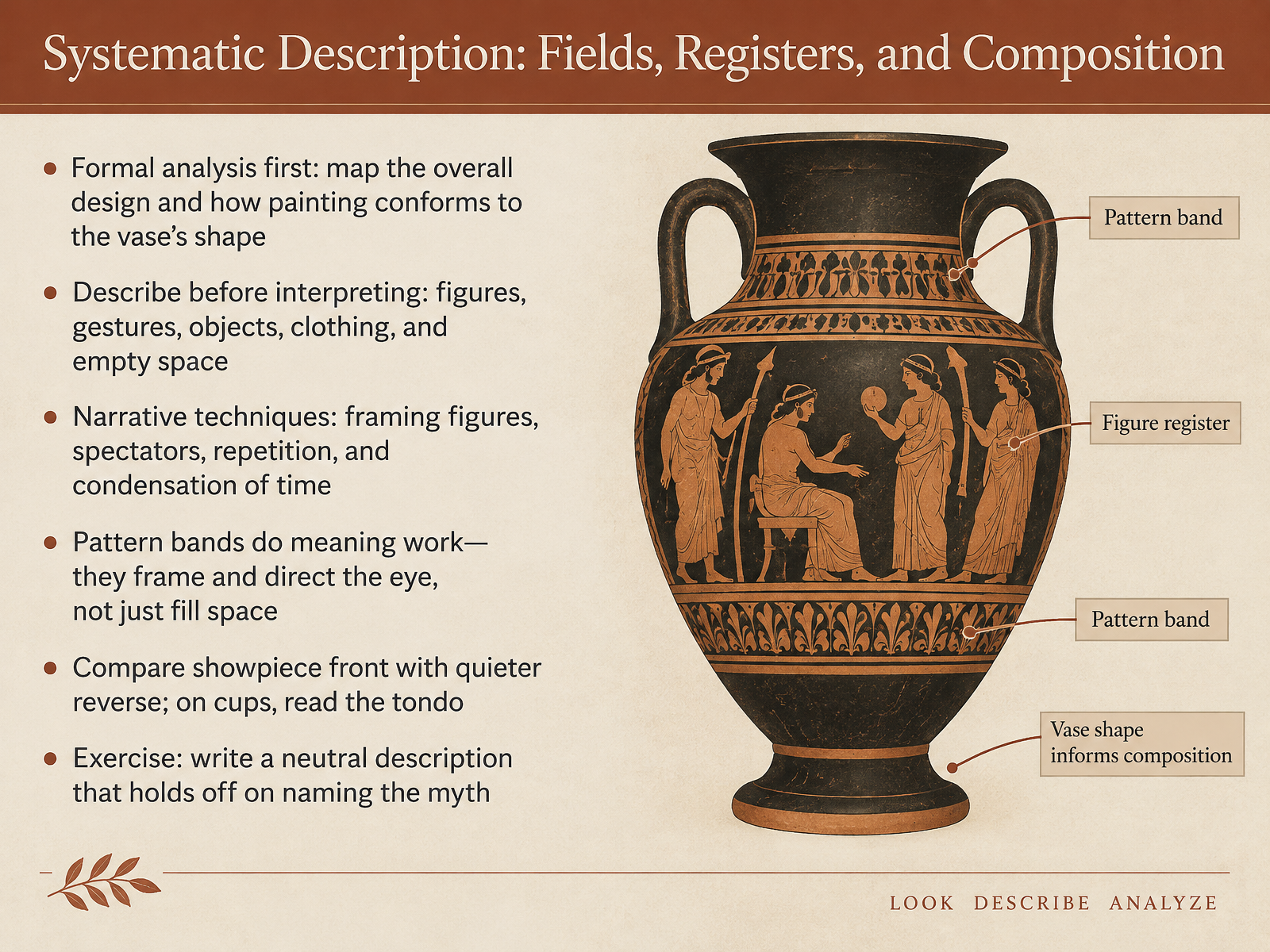
- 06Systematic Description: Fields, Registers, and CompositionNow let's slow down and look at how the decoration is actually built. Start with formal analysis before any interpretation. Picture the whole design, and notice how the painting follows the shape of the vase. Many vases use horizontal bands, called registers, that divide the surface into framed zones and guide your eye toward the main picture. Before you name a myth, describe. Notice the figures and their gestures. Look closely at objects, clothing, and even the empty space between figures. Then the story techniques: framing figures, watching spectators, repetition, and the way one scene can compress different moments into a single image. And those pattern bands do real work. They frame and direct the eye. They are not just filler. Turn the vase around and compare the showpiece front with the quieter reverse. On a drinking cup, look inside to the tondo, the circle at the bottom. Here is your exercise. Write one neutral description that holds off on naming the myth. That pause keeps your looking honest. Next, we'll go further and look at identifying gods, heroes, and scenes.
 reed.edugetty.edugetty.edu+22 min
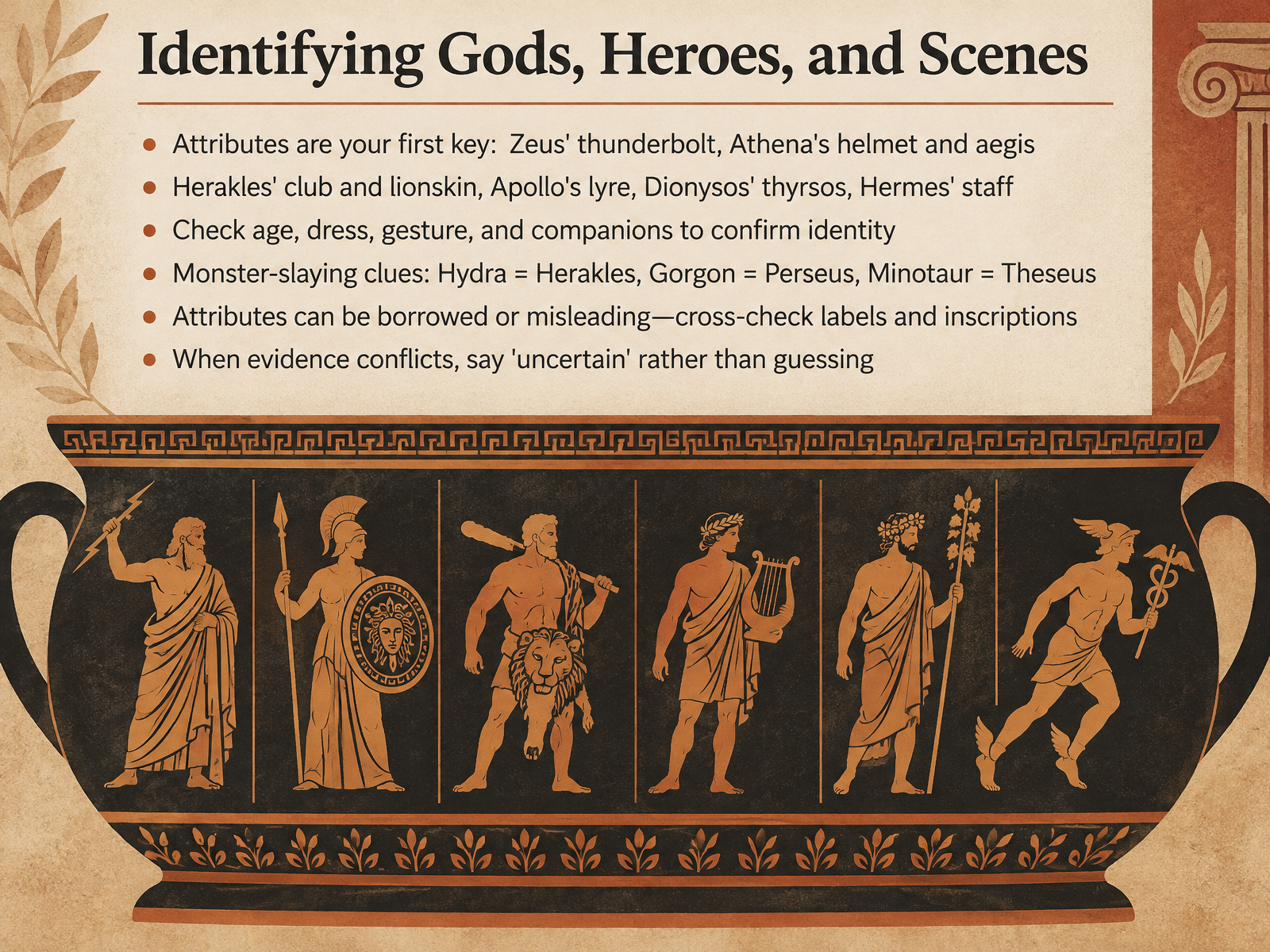
- 07Identifying Gods, Heroes, and ScenesNow let's put names to faces. Attributes are your first key. An attribute is an object or feature that belongs to a specific figure, like a signature. Look closely, and you will spot Zeus with his thunderbolt, or Athena in her helmet with the snake-fringed aegis, that protective bib across her chest. Herakles carries a club and wears a lionskin. Apollo holds a lyre. Dionysos carries a thyrsos, a staff topped with a pine cone. And Hermes holds his messenger's staff. Age, dress, gesture, and companions help confirm the identity. Monsters give strong clues too. One man fighting the Hydra is almost certainly Herakles. A hero facing the Gorgon is Perseus. And a figure battling the Minotaur is Theseus. But be careful. Attributes can be borrowed or misleading, so cross-check any painted labels. When the evidence conflicts, say uncertain rather than guessing. Next, we will look at inscriptions, labels, and signatures.
 warwick.ac.ukreed.edusmarthistory.org+21 min
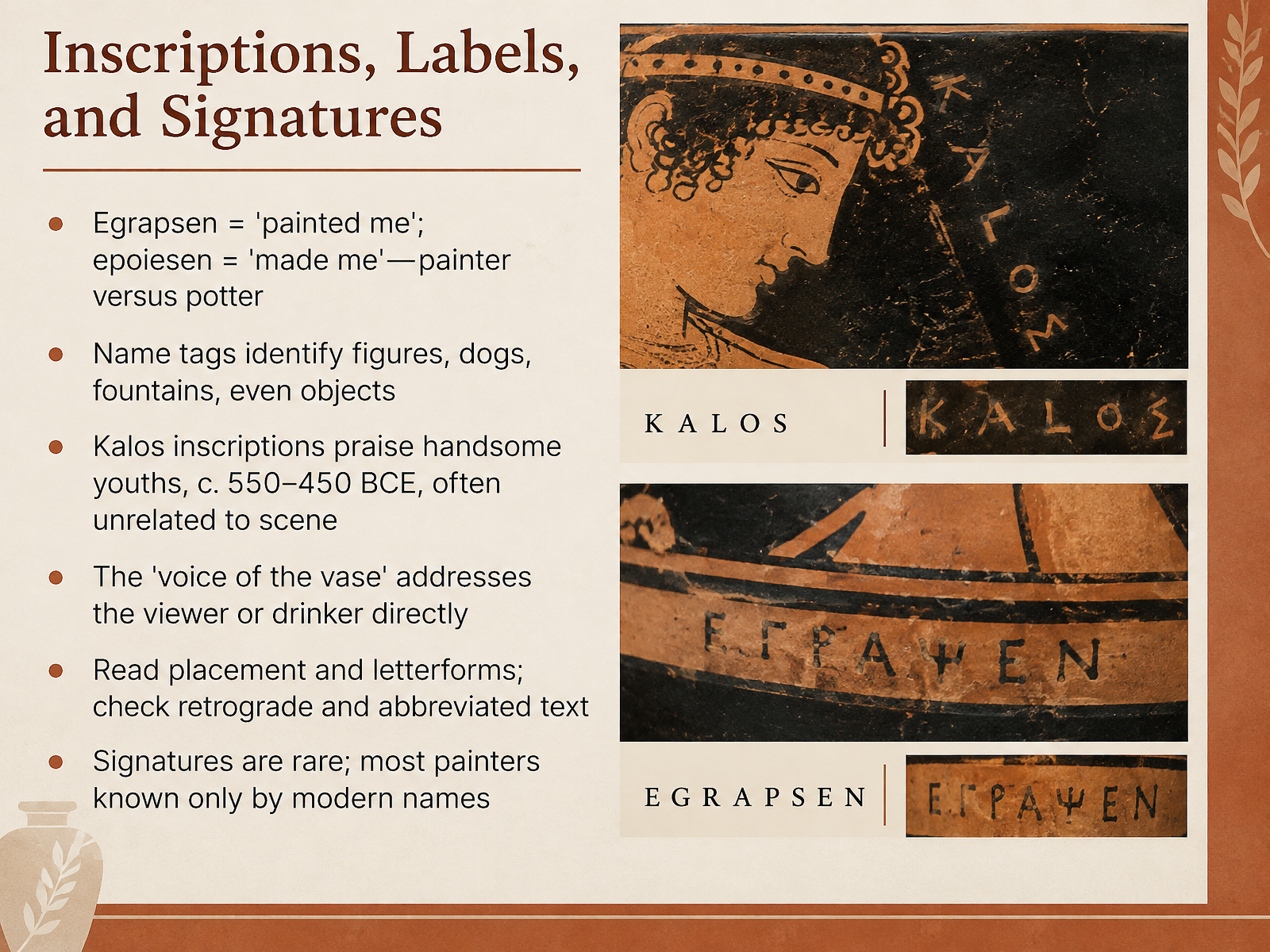
- 08Inscriptions, Labels, and SignaturesNow let's look at the words themselves. Greek vases often carry painted inscriptions, and they fall into a few clear types. Start with signatures. The verb egrapsen means painted me, while epoiesen means made me, so a vase can name both its painter and its potter. Sometimes one person signs as both. Look closely and you may also see name tags, small labels identifying figures, or even a dog or a fountain. Then there are kalos inscriptions, which praise a handsome youth, mostly between five hundred fifty and four hundred fifty BCE. Notice these often have nothing to do with the scene. And the vase itself can seem to speak, greeting the viewer or the drinker directly. As you read, watch the placement and letterforms, and check for text running right to left, or shortened names. Keep in mind that signatures are rare. Most painters are known only by modern names. Next, we turn to painters, workshops, and attribution.
 carc.ox.ac.ukreed.edugetty.edu+22 min
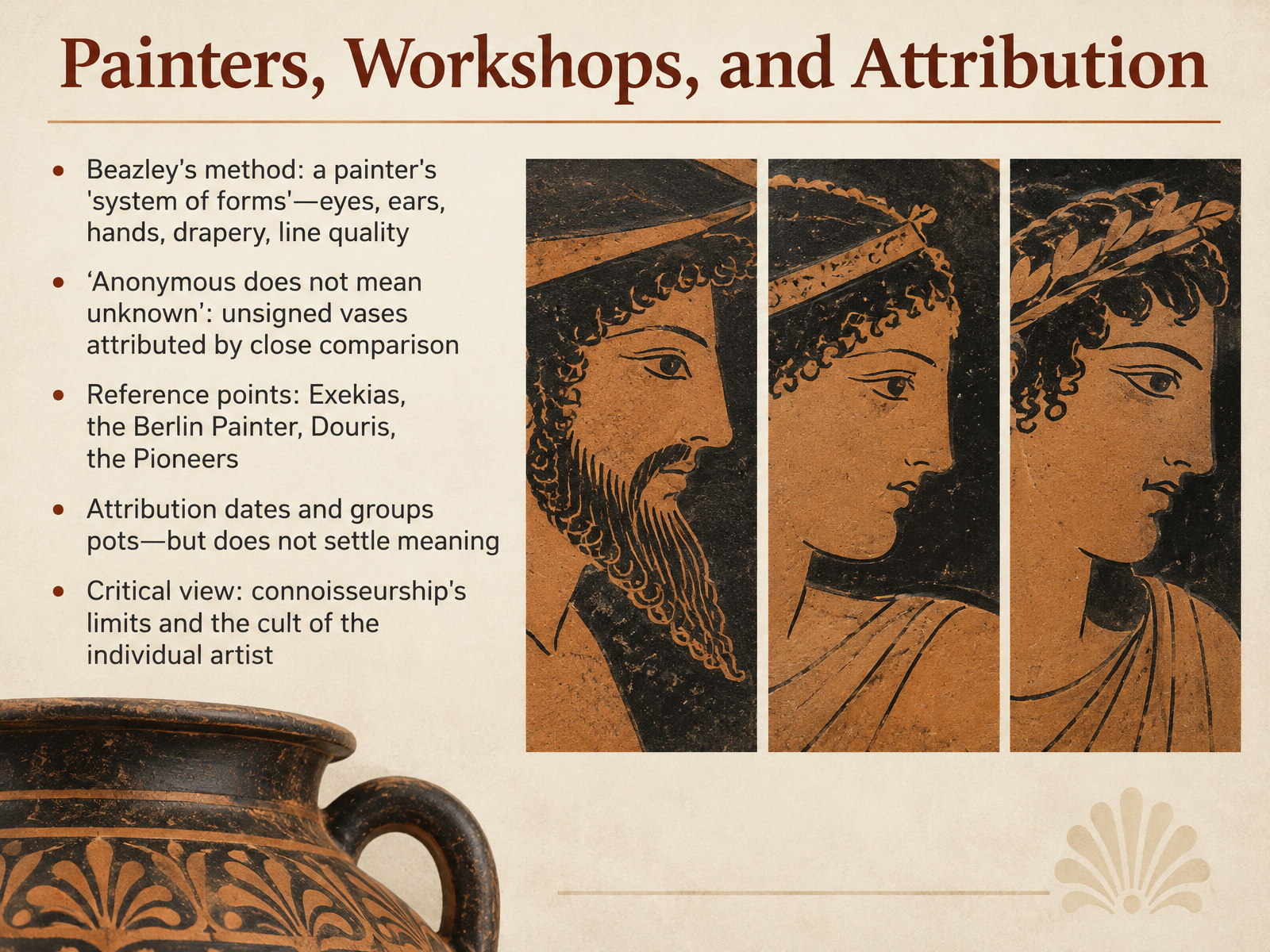
- 09Painters, Workshops, and AttributionNow let's talk about who painted these vases. In the twentieth century, John Beazley studied thousands of unsigned Athenian pots. He looked closely at small details: eyes, ears, hands, the folds of drapery, and the quality of the line. He called this a painter's system of forms. As Beazley liked to say, anonymous does not mean unknown. By comparing a new vase with ones he already knew, he could identify the hand behind it. His reference points include Exekias, the Berlin Painter, Douris, and the Pioneers. Attribution helps us date pots and group them into workshops. But it does not settle what a scene means. And some scholars ask whether we focus too much on the individual artist. Keep that balance in mind as we move from the workshop to the museum, and think about context and provenance.
 ajaonline.orgcarc.ox.ac.ukuni-giessen.de+21 min
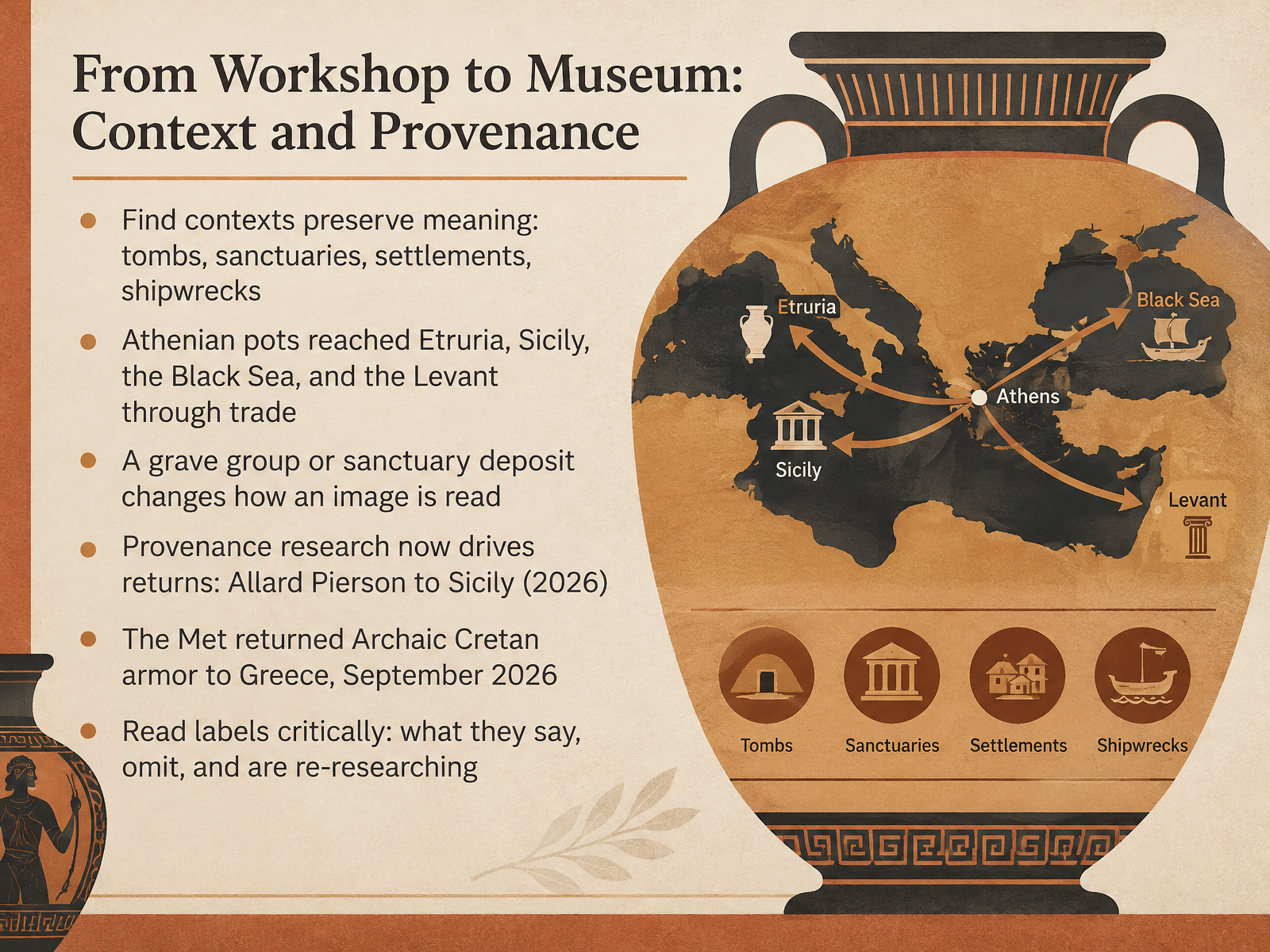
- 10From Workshop to Museum: Context and ProvenanceNow let's step back and ask how a vase got here. Context matters. When archaeologists find a pot in a tomb, a sanctuary, a settlement, or a shipwreck, that setting preserves meaning. Athenian pots travelled widely, reaching Etruria, Sicily, the Black Sea, and the Levant through trade, so a grave group or sanctuary deposit changes how we read the image. Provenance, the documented history of ownership, now drives returns. The Allard Pierson museum returned a vase to Sicily in twenty twenty six, and in September twenty twenty six the Metropolitan Museum returned Archaic Cretan armor to Greece. So read labels critically. Notice what they say, what they leave out, and what is marked as still under research. Next, Damage, Restoration, and How Displays Shape What We See.
 britishmuseum.orgworldhistory.orgworldhistory.org+22 min
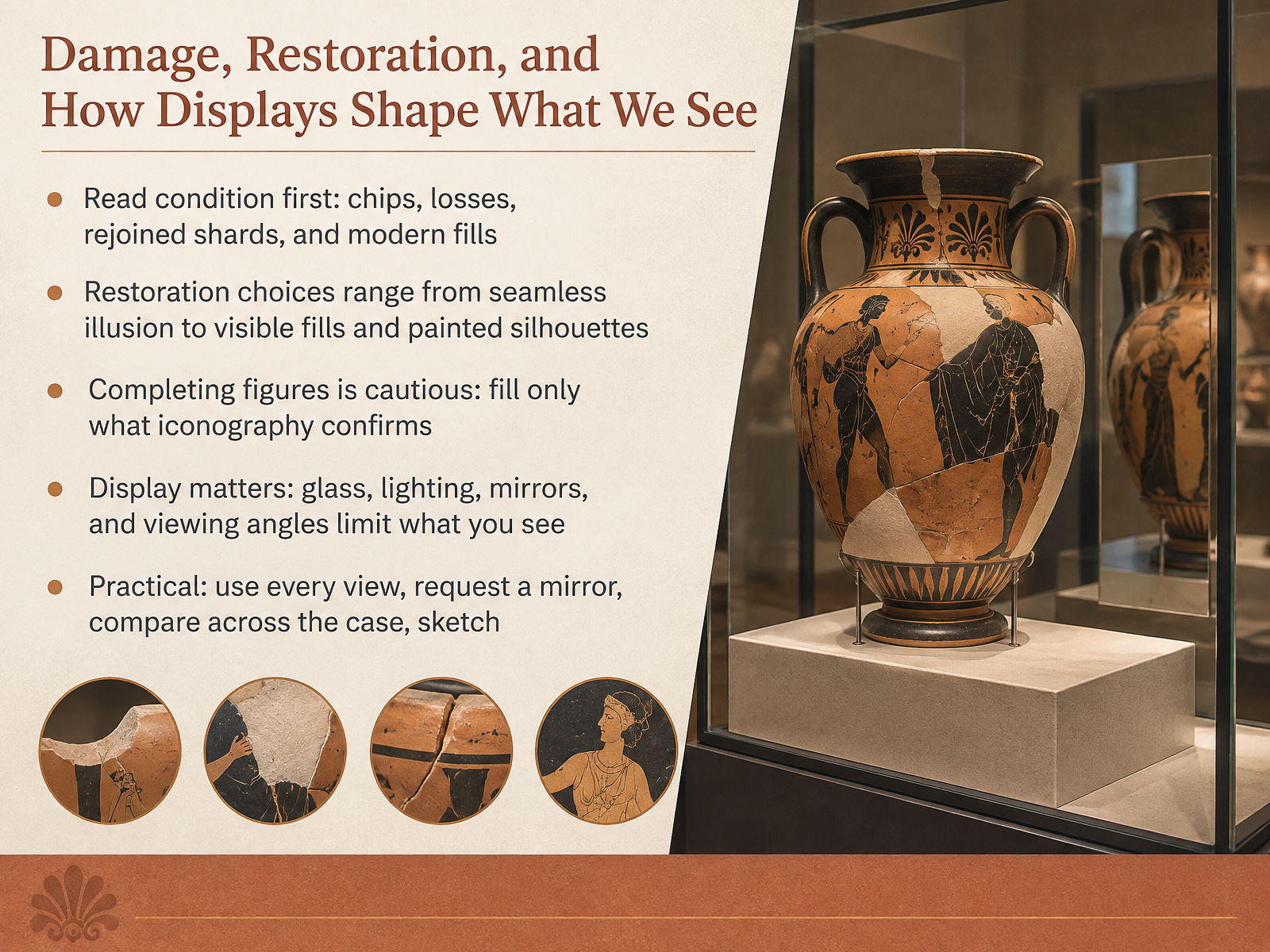
- 11Damage, Restoration, and How Displays Shape What We SeeNow let's talk about condition, restoration, and how a display shapes what you actually see. Start by reading condition first. Look for chips, losses, rejoined shards, and modern fills. These are part of the object's history, not flaws to ignore. Restoration choices vary widely. Some aim at seamless illusion. Others leave visible fills, and some add painted silhouettes of missing figures. Notice how conservators complete figures cautiously. They fill only what the iconography confirms. Display matters too. Glass, lighting, mirrors, and viewing angles all limit your view. So be practical. Use every view you can get. Request a mirror. Compare across the case. And sketch what you see. Close looking turns damage and display into evidence. Next, we'll put these skills to work in Case Study 1: A Symposium Cup and Its Self-Referential Imagery.
 getty.edubritishmuseum.orgreed.edu+22 min
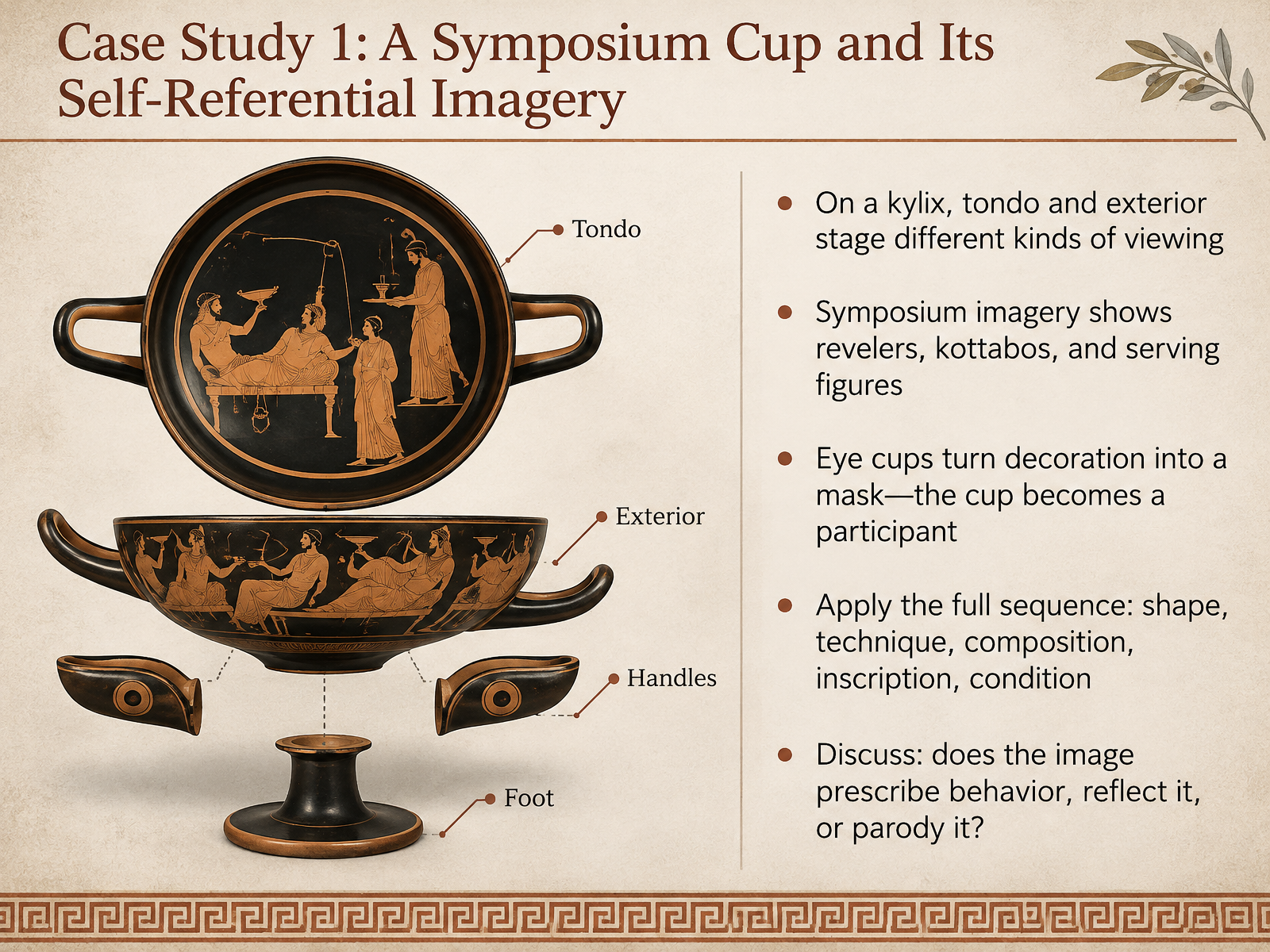
- 12Case Study 1: A Symposium Cup and Its Self-Referential ImageryLet's put the whole sequence to work on a single object. Picture a wide, shallow drinking cup called a kylix, used at a symposium, the all-male drinking party. Notice how it stages two kinds of viewing. The round interior, the tondo, is seen only by the drinker, while the outside is seen by everyone at the party. Look closely at the symposium scenes: revelers, a game called kottabos where drinkers fling wine from their cups, and serving figures. Now consider eye cups, made in Athens between about five hundred thirty-five and five hundred B C E, whose exterior eyes turn the cup into a mask, so the cup becomes a participant in the party. Then run the full sequence: shape, technique, composition, inscription, condition. Finally, discuss: does the image prescribe behavior, reflect it, or parody it? Keep that question open as we turn next to Case Study 2: A Funerary Lekythos and the Work of Mourning.
 britishmuseum.orgworldhistory.orgworldhistory.org+22 min
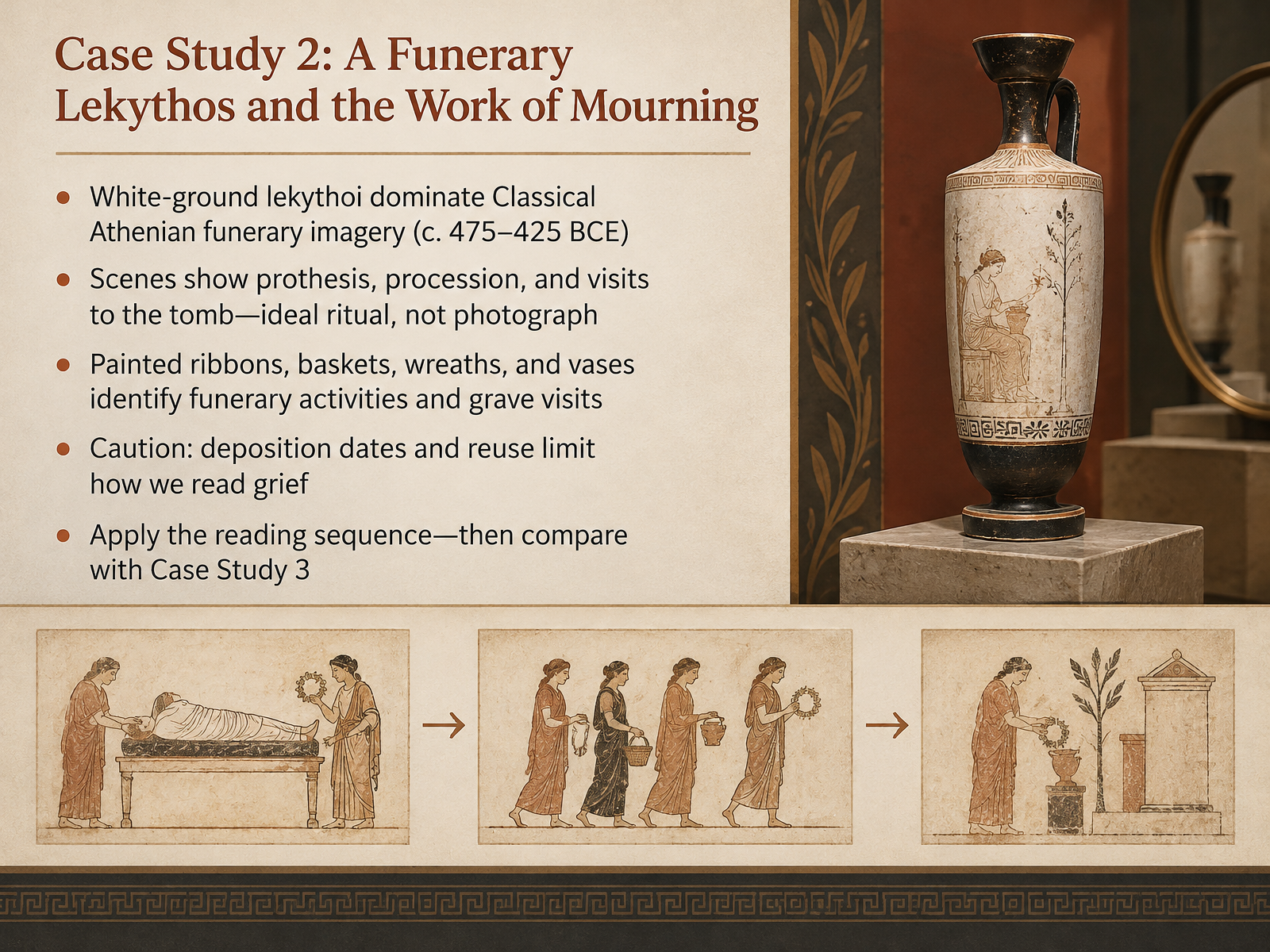
- 13Case Study 2: A Funerary Lekythos and the Work of MourningNow let's put that reading sequence to work on a second case study, an Athenian funerary lekythos. A lekythos is a small, narrow flask, and this one is white-ground, meaning the painter worked pale figures and details onto a white slip background. White-ground lekythoi dominate Classical Athenian funerary imagery between about four seventy-five and four twenty-five B C E. Notice the painted ribbons, baskets, wreaths, and small vases. These cue specific grave-side activities, such as visits to a tomb, rather than a generic scene. Look closely at the figures. You may see scenes of prothesis, the laying out of the dead body, a procession, or mourners approaching a stele, a stone grave marker. Keep in mind these images show an ideal ritual, a carefully performed mourning, not a photograph. And here is a caution. Deposition dates and later reuse limit how directly we read grief. So use the reading sequence, then compare this with our next case, Case Study 3: A Large Figured Vessel with a Contested Narrative.
 carc.ox.ac.ukuni-giessen.demetmuseum.org+22 min
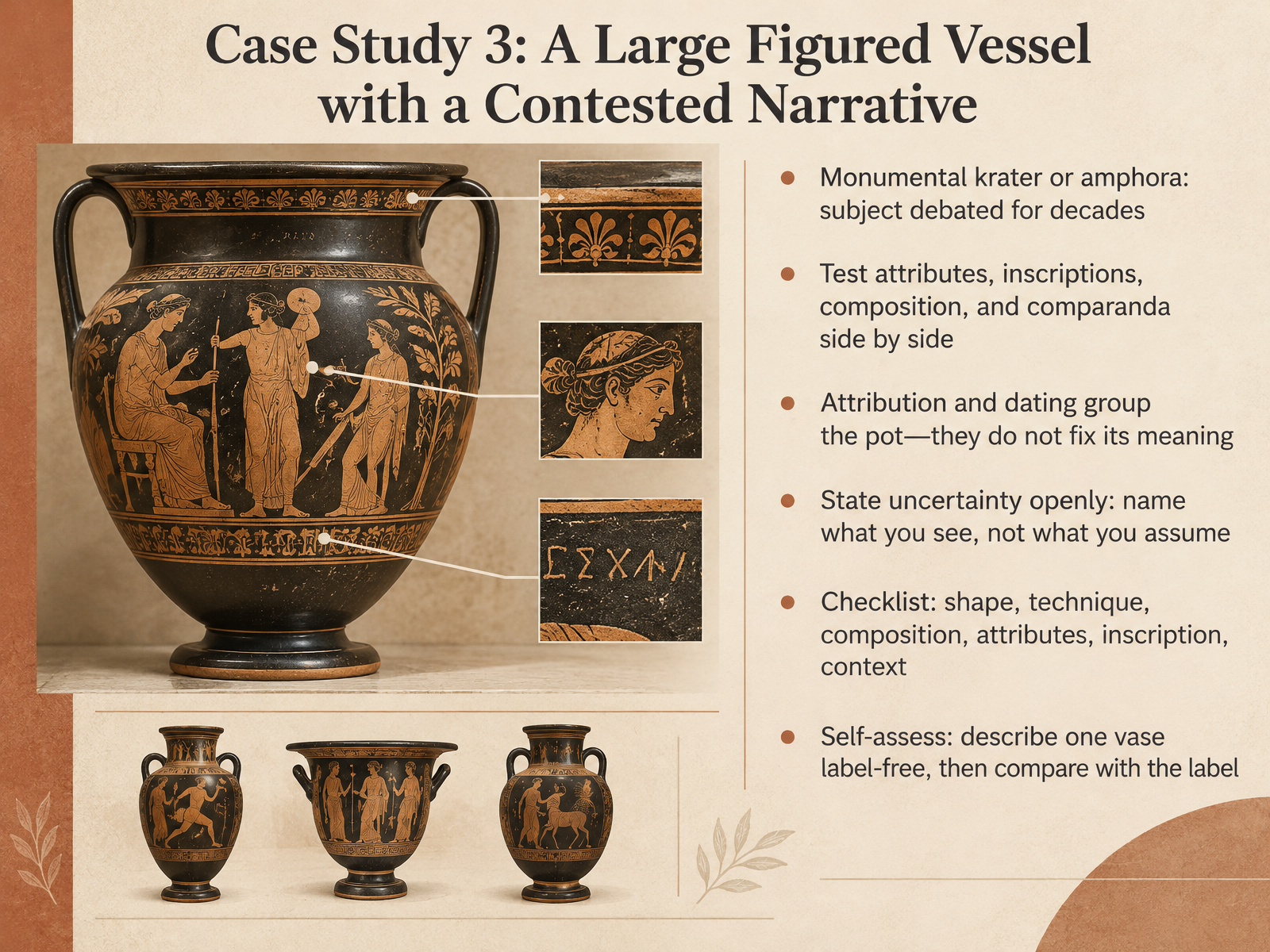
- 14Case Study 3: A Large Figured Vessel with a Contested NarrativeLet's close with one hard case. This large figured vessel, a monumental krater or amphora, has had its subject debated for decades. So put the attributes, any inscriptions, the composition, and comparable vases side by side. Notice what an attribute tells you. A club and lion skin point to Herakles. A trident points to Poseidon. But attributes can be borrowed, so read them with the whole scene. Here is the key idea. Attribution and dating group the pot. They do not fix its meaning. So state uncertainty openly. Name what you see, not what you assume. Use this checklist: shape, technique, composition, attributes, inscription, context. Then test yourself. Describe one vase without its label. Compare your words with the label. Thank you for looking closely with me. Keep practicing, and trust your own eyes.
 warwick.ac.ukreed.edusmarthistory.org+22 min
Take the deck with you
Download this course as a file — free, no sign-up needed.
- PDF handoutEvery slide page, ready to print or share.15 pages · 5.9 MBDownload
- Narrated PowerPointThe deck that presents itself — every slide carries the digital human's narration video.15 pages · 15.8 MBDownload
- PowerPoint slidesThe full deck as a .pptx — open it in PowerPoint, Keynote, or Google Slides.15 pages · 5.9 MBDownload
Free to use in your own training — please keep the PersonWise credit page at the end.
Have your own deck? Turn it into a course
Sources consulted
Web sources consulted while building this course.
- Study Guide: Reading Greek Vases — reed.edu
- 10 Ways to Look at Ancient Greek Vases | Getty News — getty.edu
- Understanding Greek Vases | Publications and Reports | Getty — getty.edu
- How to Read Greek Vases - The Metropolitan Museum of Art — metmuseum.org
- Examining Ancient Greek Art - Virginia Museum of Fine Arts — vmfa.museum
- Techniques and styles — carc.ox.ac.uk
- Pottery — Classical Archaeology — uni-giessen.de
- Athenian Vase Painting: Black- and Red-Figure Techniques - The Metropolitan Museum of Art — metmuseum.org
- Greek Painted Pottery — doi.org
- An Introduction to Greek Ceramics — campuslink.uc.edu
- Ancient Greece: Pots — britishmuseum.org
- https://www.worldhistory.org/article/489/a-visual-glossary-of-greek-pottery/ — worldhistory.org
- Greek vases: names, shapes and functions — worldhistory.org
- Typology of Greek vase shapes — en.wikipedia.org
- About Vases | Panoply Vase Animation Project — panoply.org.uk
- Displaying Myth: The Visual Arts — warwick.ac.uk
- Greek Vase-Painting, an introduction — smarthistory.org
- Greek Vase Painting — ajaonline.org
- Using this digital sourcebook — aceclassics.org.uk
- Painter and potter signatures — carc.ox.ac.uk