Begin
14 pages · ~28 min
Instructional Design Learning Objectives
This training teaches instructional designers to define and apply learning objectives, aligning them with assessment and content for effective course development.
A digital instructor presents all 14 pages. Hold “Ask” at any point and ask out loud — the answer comes from this course. No sign-up needed.
What you’ll learn
- 01Instructional Design Learning ObjectivesWelcome, everyone. Whether you're a training manager, an educator, or a course creator, you know the feeling of pouring time into a program and wondering if it actually moved the needle. That's where this session comes in. Today, we're going to build a practical approach to writing learning objectives that are truly measurable. Not just for compliance, but to drive real business impact and learner success. We'll focus on aligning stakeholders around clear, expected performance outcomes from the very start. We're building on Robert Mager's classic framework, breaking it down into three essential elements: the action, the condition, and the standard. By the end of our time together, you will have the tools to translate vague intentions into observable performance. So, let's get started by looking at why getting this foundation right changes everything.jonathanhalls.comcdc.govcommlabindia.com+21 min
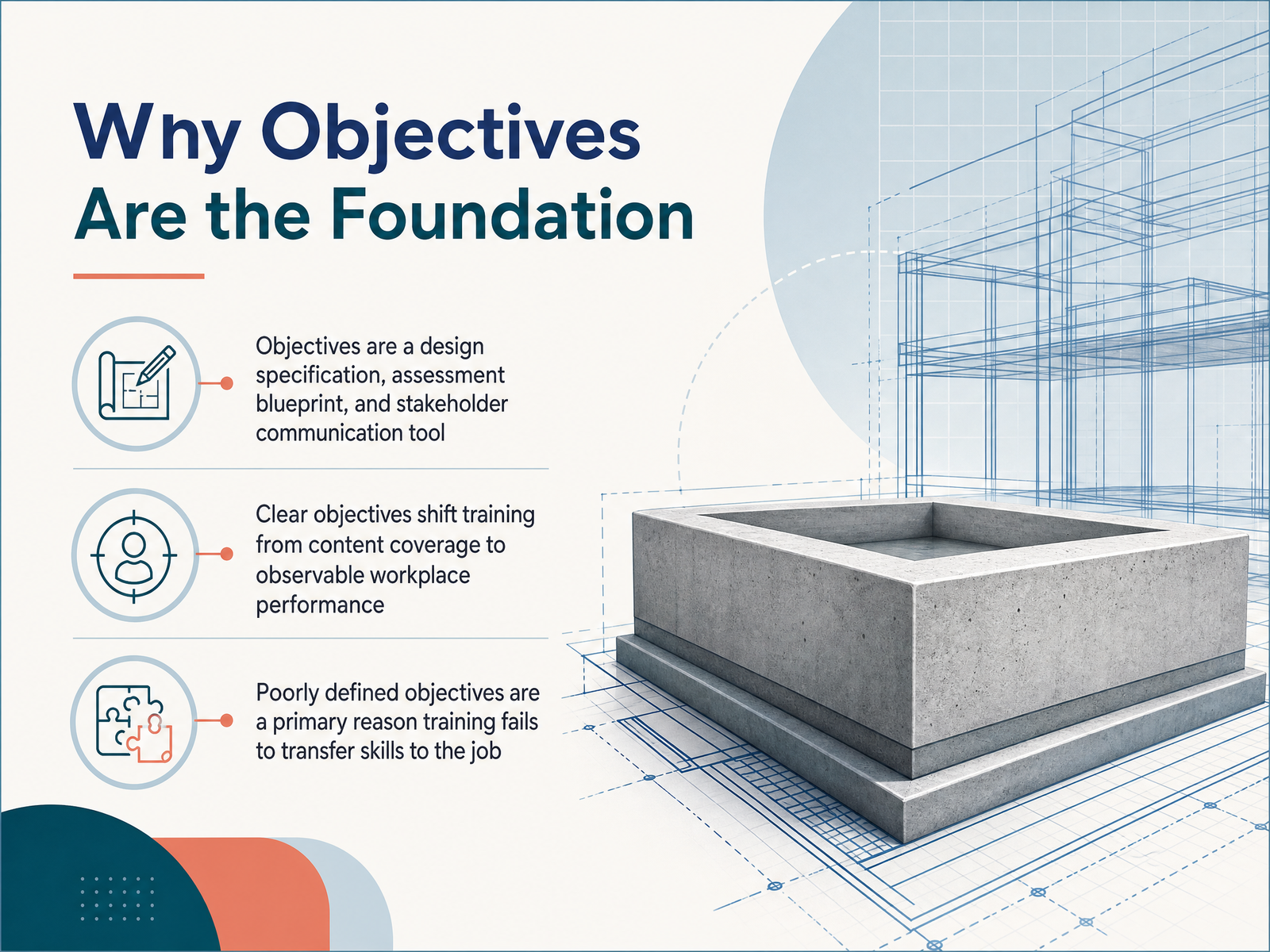
- 02Why Objectives Are the FoundationSo let's talk about why objectives are the true foundation of everything we build. Think of them as a three-in-one tool. First, they're a design specification. They tell you exactly what to build, what activities to include, and what content to leave out. Second, they're an assessment blueprint. If you can't picture how a learner would demonstrate the objective, it's not an objective yet. And third, they're a communication tool. They align stakeholders, from the sponsors who fund the training to the managers who send their people to it. When objectives are clear, training shifts from simply covering content to producing observable workplace performance. And that matters, because poorly defined objectives are one of the primary reasons training fails to transfer skills back to the job. A vague statement like 'understand the process' gives no direction for design, no basis for measurement, and no confidence to managers. So a clear, performance-based objective is not just nice to have, it's your anchor. Next, let's clarify the difference between goals, objectives, and outcomes, because they're often confused.
 jonathanhalls.comcdc.govcommlabindia.com+22 min
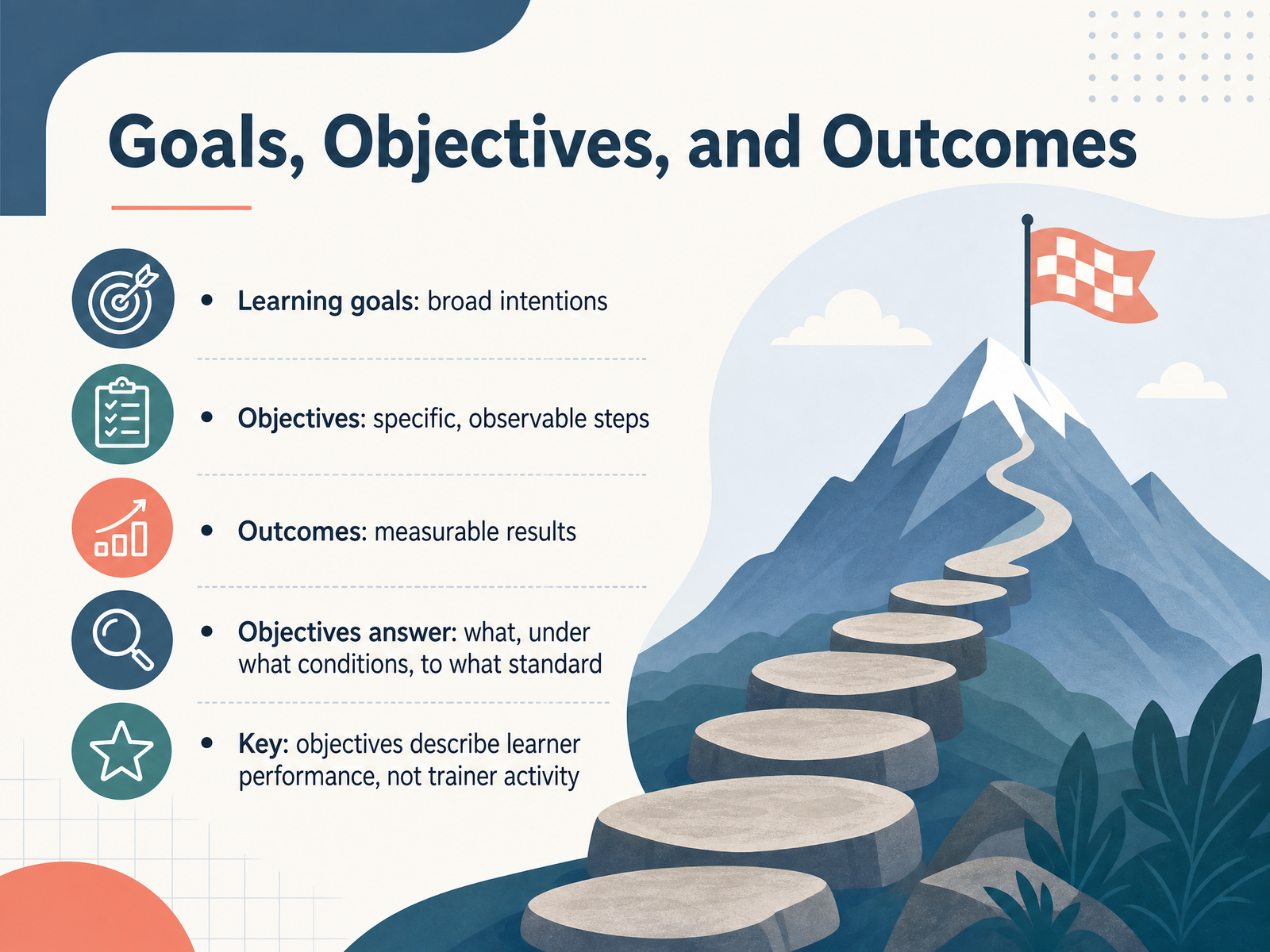
 - 03Goals, Objectives, and OutcomesHere’s where we separate the big picture from the day-to-day details. Terms like goals, objectives, and outcomes get used interchangeably, but they play very different roles. A learning goal is your broad intention. It answers the question, “Where are we heading?” Your objective, on the other hand, is a specific, observable step. And the outcome is the measurable result you can actually see when the objective is met. Think of it this way: the goal says, “I want sales confidence to grow,” but the objective says, “Submit a quote with zero errors using our pricing software.” That’s the precision we need. A strong objective answers three things: what the learner will do, under what conditions, and to what standard. Above all, remember this: an objective describes learner performance, not trainer activity. So skip phrases like “the workshop will cover,” and instead focus on what your participants will actually be able to do when they return to work. Next, let’s look at the three core components that make an objective truly powerful.
 jonathanhalls.comcdc.govcommlabindia.com+22 min
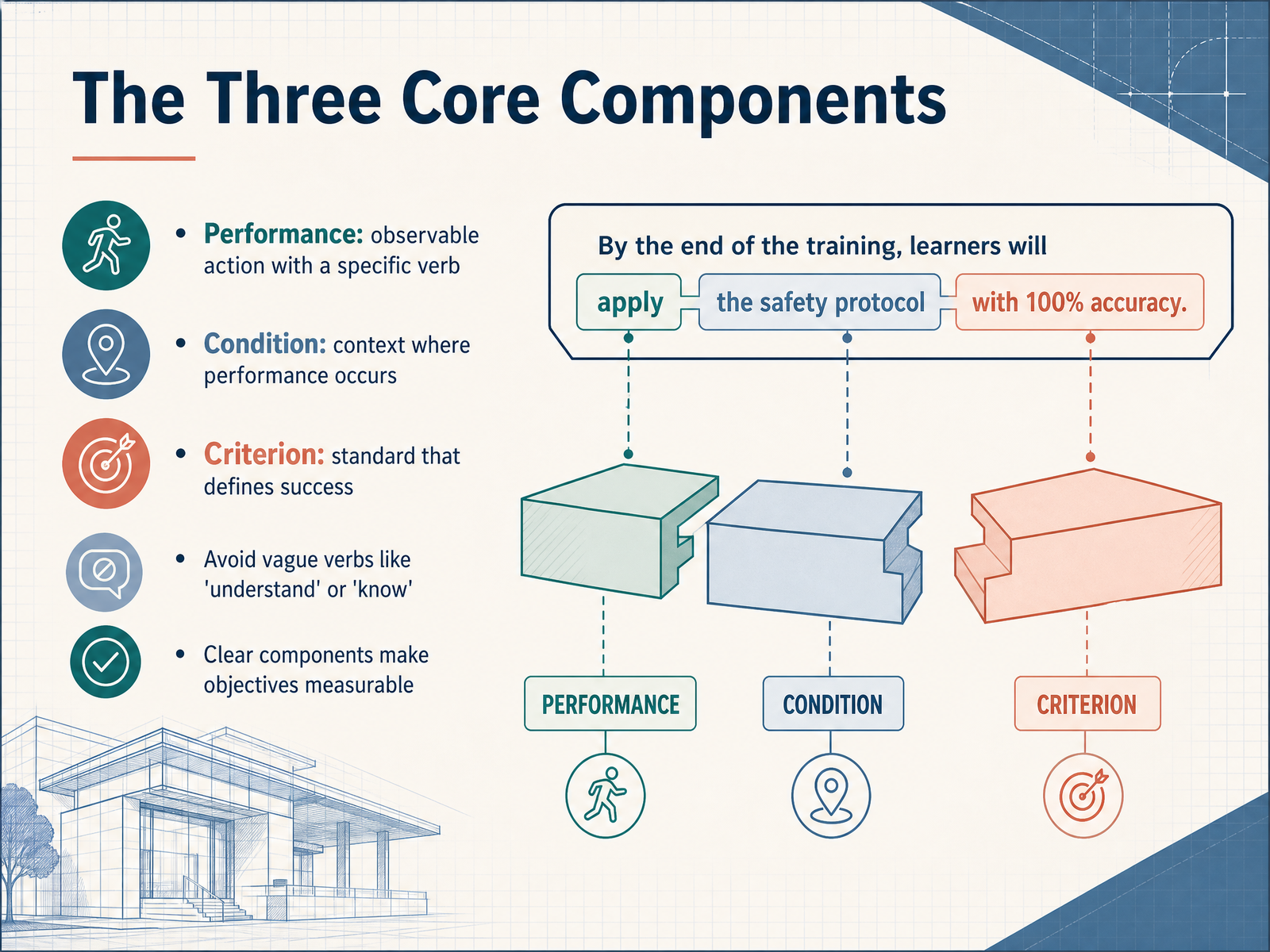
 - 04The Three Core ComponentsLet's look at the three core components that turn a vague idea into a measurable objective. First, performance: the observable action your learner will take. Use a specific verb like demonstrate, analyze, or configure instead of understand or know. You can't watch someone understand, but you can watch them troubleshoot. Second, condition: the context where the performance happens. Is it during a live customer call, in the CRM system, or in a simulated scenario? That context shapes what they need to practice. Third, criterion: the standard that defines success. How well must they perform? Within ten minutes? With ninety percent accuracy? Following a specific checklist? When you include all three, your objective becomes something you can actually measure and assess. Without them, you're left with good intentions, not a training goal. So as you draft your next objective, ask yourself: can I picture a learner doing this, under these conditions, to this standard? That clarity is what makes your training actionable and credible. Coming up next, we'll see how to move from listing content to designing real performance. Stay with me.
 jonathanhalls.comcdc.govcommlabindia.com+21 min
 - 05From Content to PerformanceLet's make a crucial shift together: from covering content to driving performance. The goal isn't to teach a topic; it's to change observable behavior back on the job. So, first, anchor your objectives in real tasks and real decisions. Ask, what exactly will they do differently? Second, identify the gap between their current performance and what's required. Then, choose the right Bloom's level. If the job requires troubleshooting, an objective that merely asks them to 'list' steps won't cut it. Finally, write the objective and test it against the 'so what.' If the learner does this, does the business outcome improve? For example, instead of 'understand the sales process,' write 'conduct a discovery call using our five-step framework.' Now, let's look at how to apply Bloom's Taxonomy in practice.
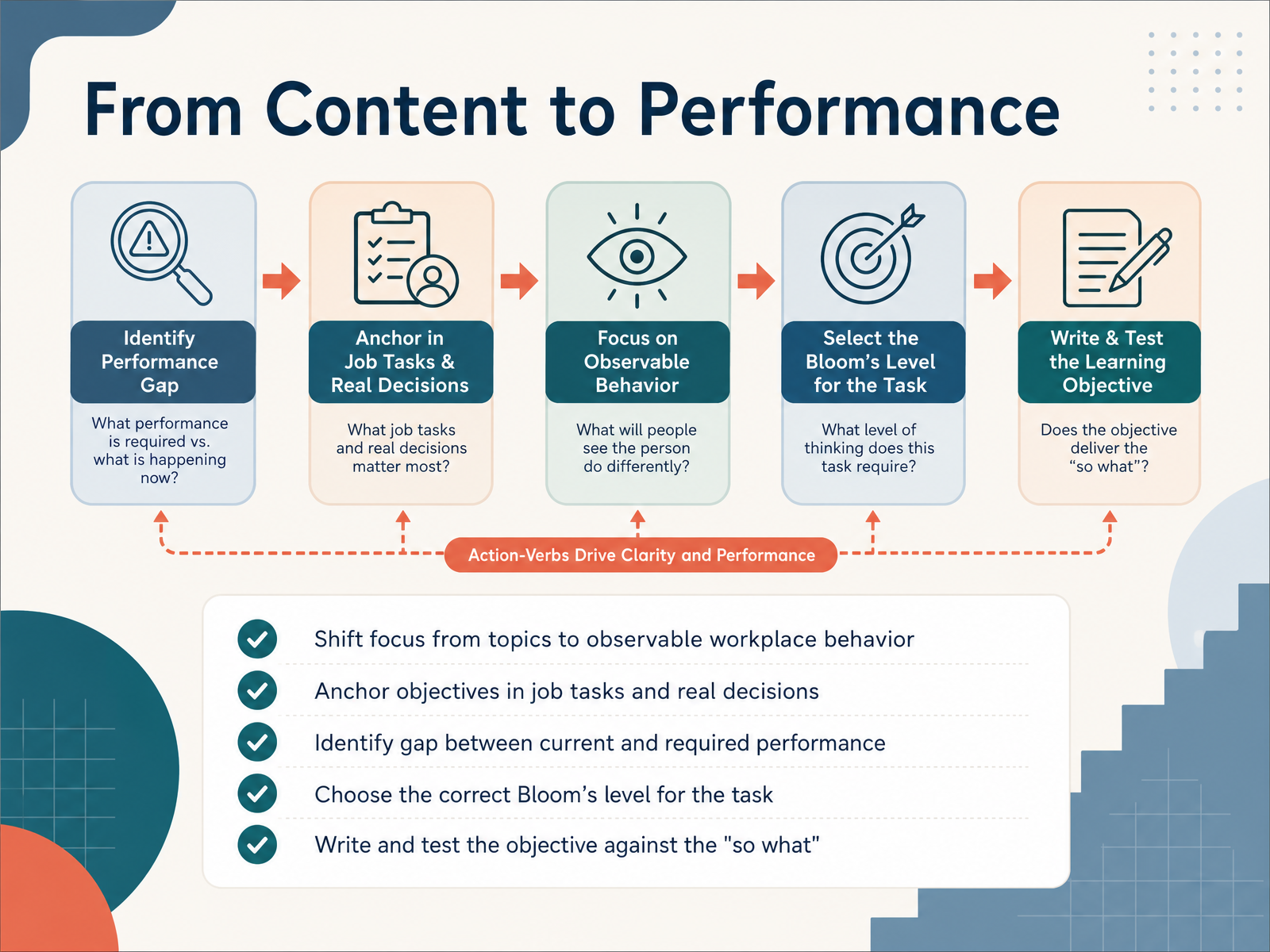 jonathanhalls.comcdc.govcommlabindia.com+21 min
 - 06Bloom's Taxonomy in PracticeLet's make Bloom's Taxonomy practical. The revised levels are Remember, Understand, Apply, Analyze, Evaluate, and Create. Here's the key: match the cognitive level to the real performance demands of the role. If the job requires judgment and application, don't settle for low-level verbs. Saying learners will 'understand' a process isn't enough when they need to troubleshoot it. Choose verbs that make outcomes observable and measurable. Instead of 'understand customer objections,' say 'apply the LAER framework to resolve three common objections in a role-play.' That's a clear, measurable outcome. So, as you draft your objectives, ask yourself: what will learners actually do back on the job, and does my verb match that? Now, let's look at how to anchor those verbs with the conditions and criteria that make your objectives truly complete.
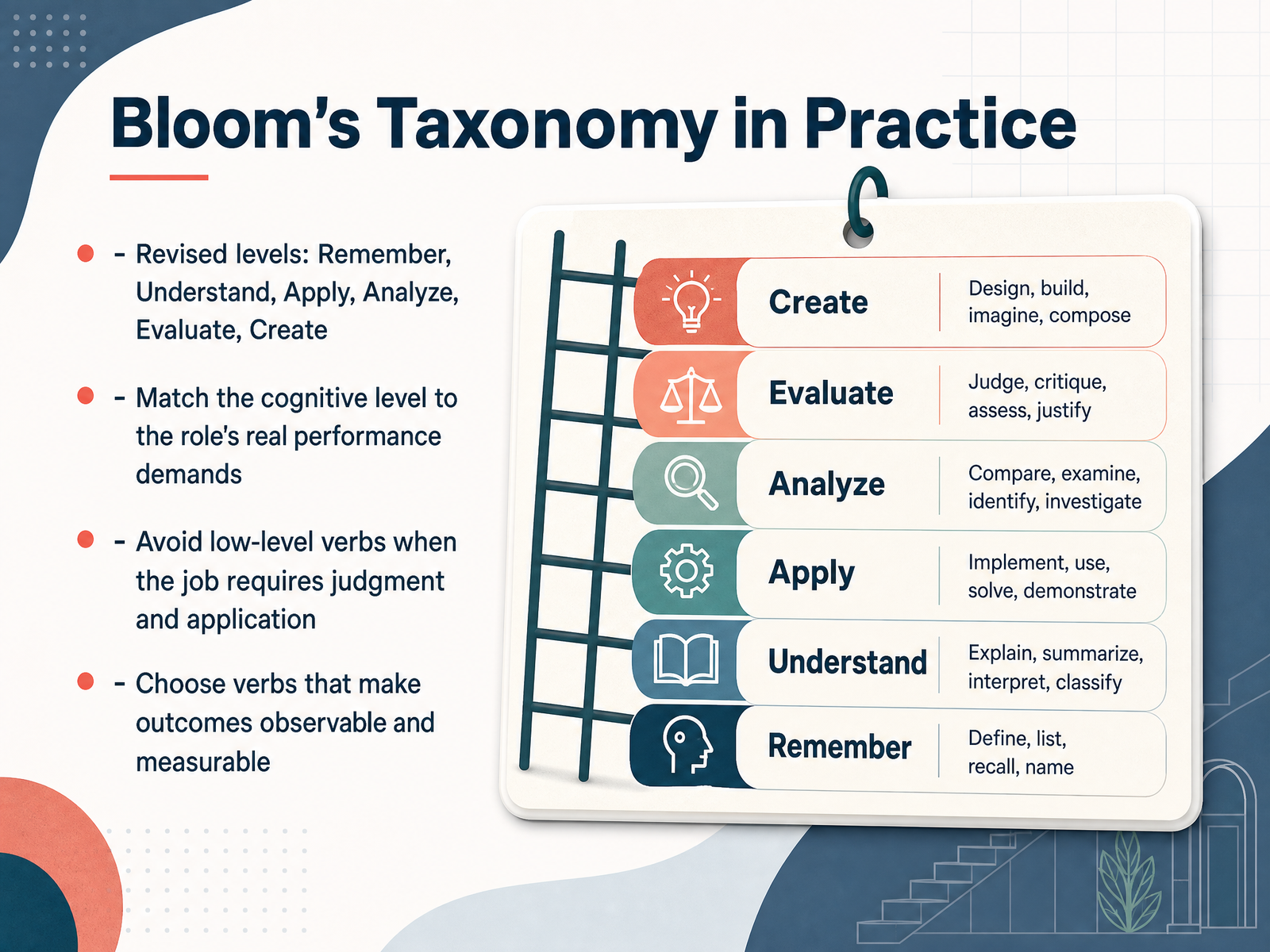 learningandteaching.anu.edu.auacademicaffairs.oregonstate.edusafety.sc.edu+21 min
 - 07Conditions and CriteriaNow let's look at the conditions and criteria that make an objective truly measurable. Think about exactly when, where, and with what tools your learners will perform. Say you're teaching Excel skills. Are they working in a quiet office with full access to the software, or are they on a busy call center floor with just a laptop and a help guide? That context changes the design completely. Once you set the conditions, you need a realistic quality threshold. Don't over-engineer this. You're looking for a standard that proves someone can do the job, not perfection. Compare these two. Weak says, with correct results. Vague, right? If you can't count it or observe it, you can't assess it. Better says, with zero formula errors in Excel. Now that's concrete and assessable. So ask yourself, can I picture exactly what success looks like in the workplace? If you can, you're ready. Next, let's look at how to adapt all of this to your specific audience and delivery format.
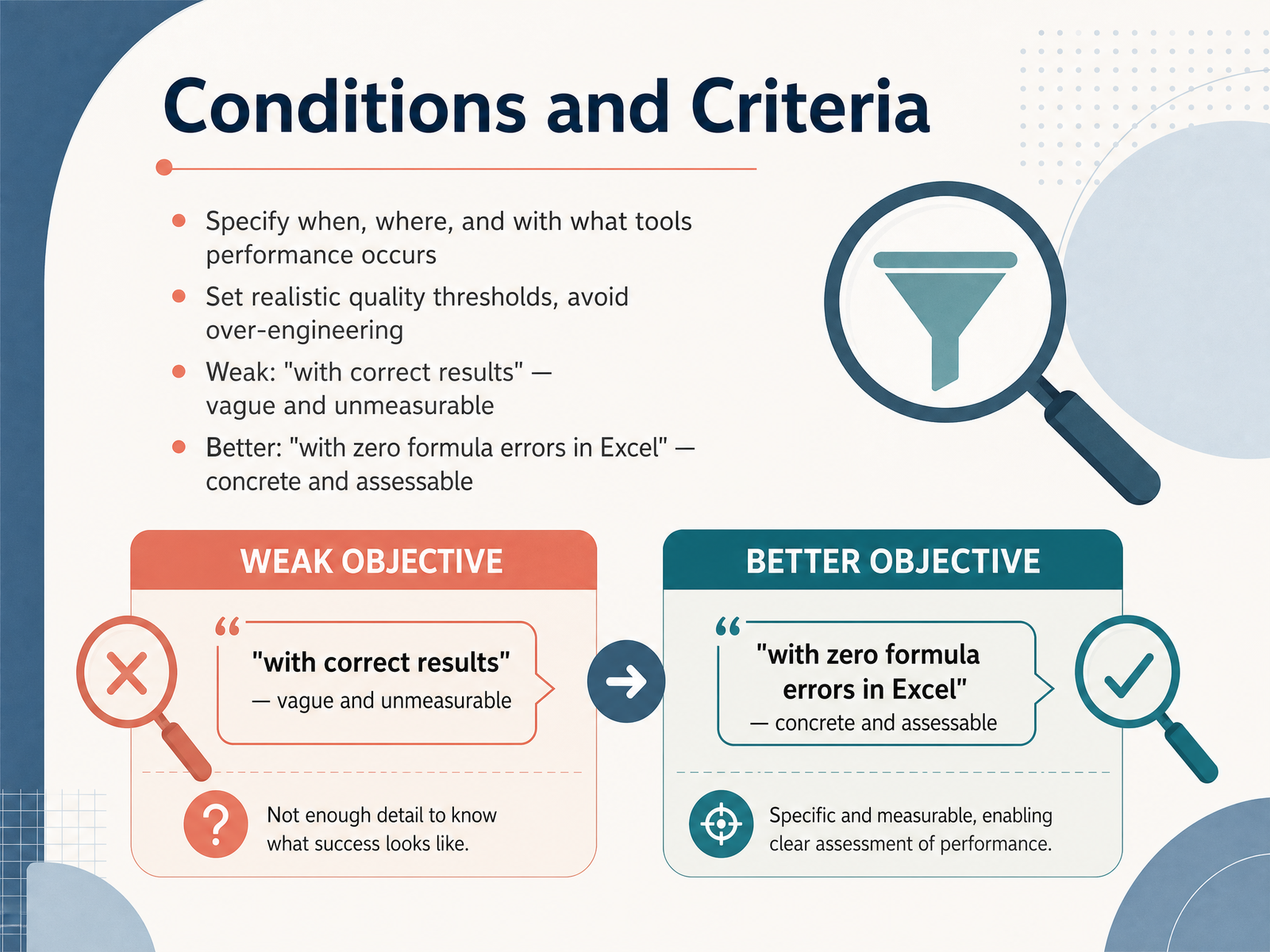 jonathanhalls.comcdc.govcommlabindia.com+22 min
 - 08Adapting to Audience and FormatNow let's talk about adapting your objectives to your audience and delivery format. The same course can't have one-size-fits-all objectives. For instructor-led training, you might emphasize live discussion and immediate feedback. For e-learning, focus on self-paced, observable tasks like completing a simulation. And for blended formats, mix both. Think about your learners' experience level too. New hires need foundational, observable objectives—like 'identify the three steps of our intake process.' Experienced staff can move up to application and analysis, so you might ask them to 'compare two resolution strategies and recommend one.' Leaders need decision-making and evaluation objectives, such as 'assess the risks of a proposed policy change.' One caution: never assume prior knowledge your learners don't have. When in doubt, include a quick pre-assessment or a review module. That way, your objectives are challenging but still achievable. Next, we'll look at aligning your objectives with your assessments.
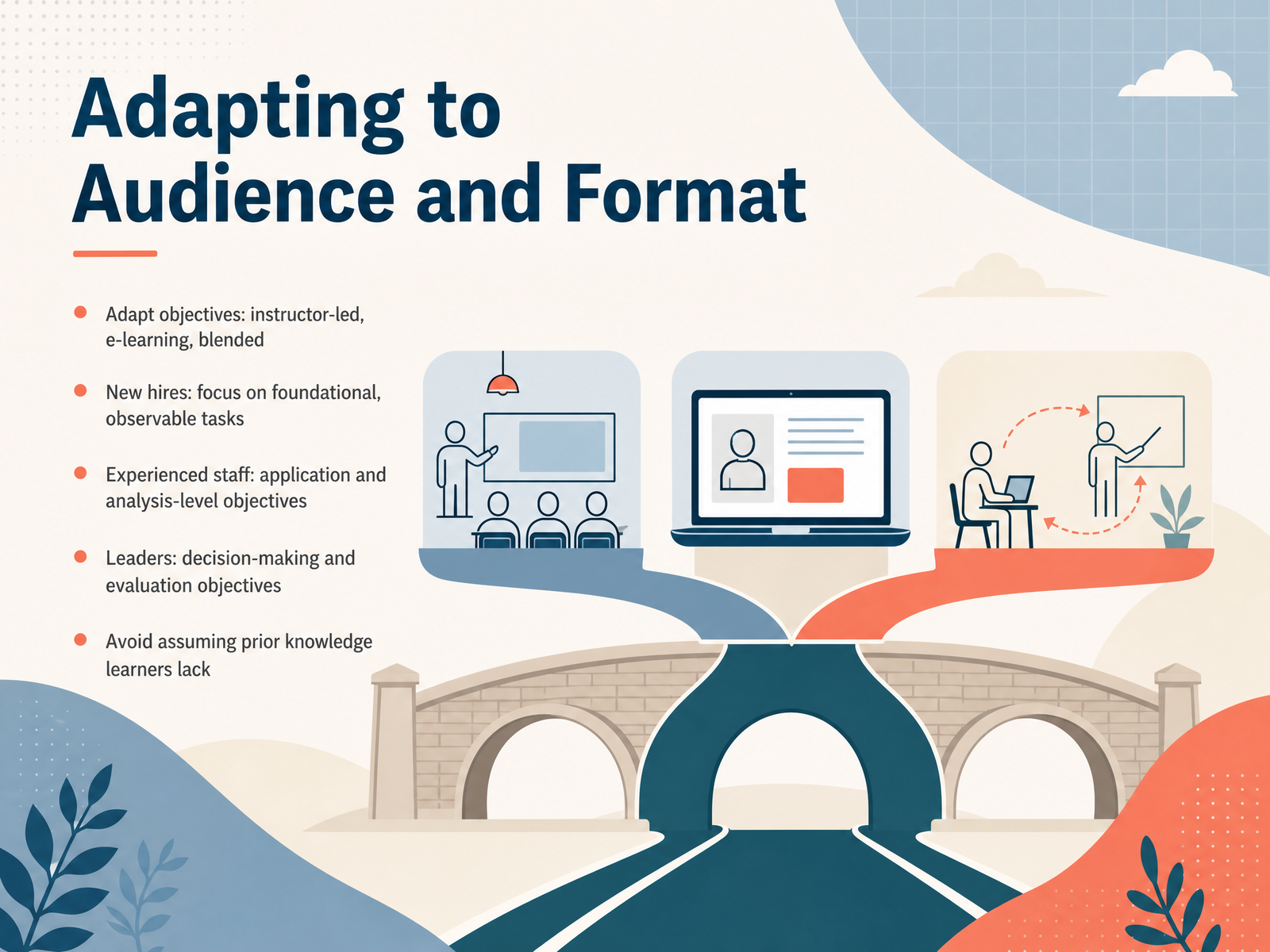 learningandteaching.anu.edu.auacademicaffairs.oregonstate.edusafety.sc.edu+21 min
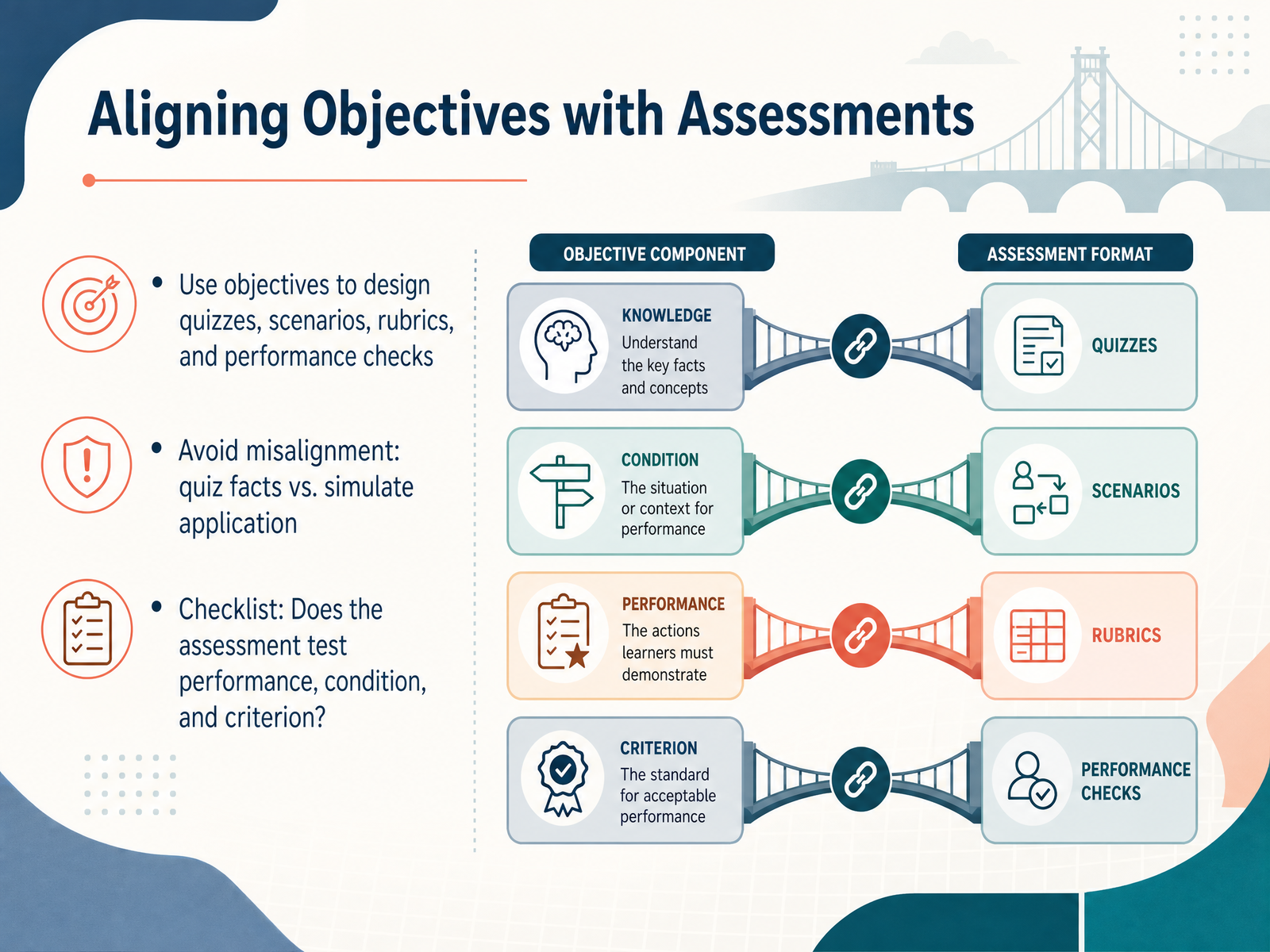
 - 09Aligning Objectives with AssessmentsLet's talk about the bridge between your objectives and your assessments. This is where alignment really lives or breaks. You write an objective that says learners will apply the negotiation model. Then your assessment asks them to recall the five steps from memory. That is a mismatch. Your assessments must test the performance, the condition, and the criterion you named in the objective. So if the objective says analyze a case study, your quiz should present a case study, not ask for definitions. Use your objectives to design quizzes, scenarios, rubrics, and performance checks. A simple checklist helps: does the assessment ask for the observable action? Does it provide the same tools or context you specified? And does it measure the level of accuracy or mastery you defined? When all three match, your results tell you something real. Next, let's look at the common pitfalls that throw alignment off track and how to fix them quickly.
 learningandteaching.anu.edu.auacademicaffairs.oregonstate.edusafety.sc.edu+22 min
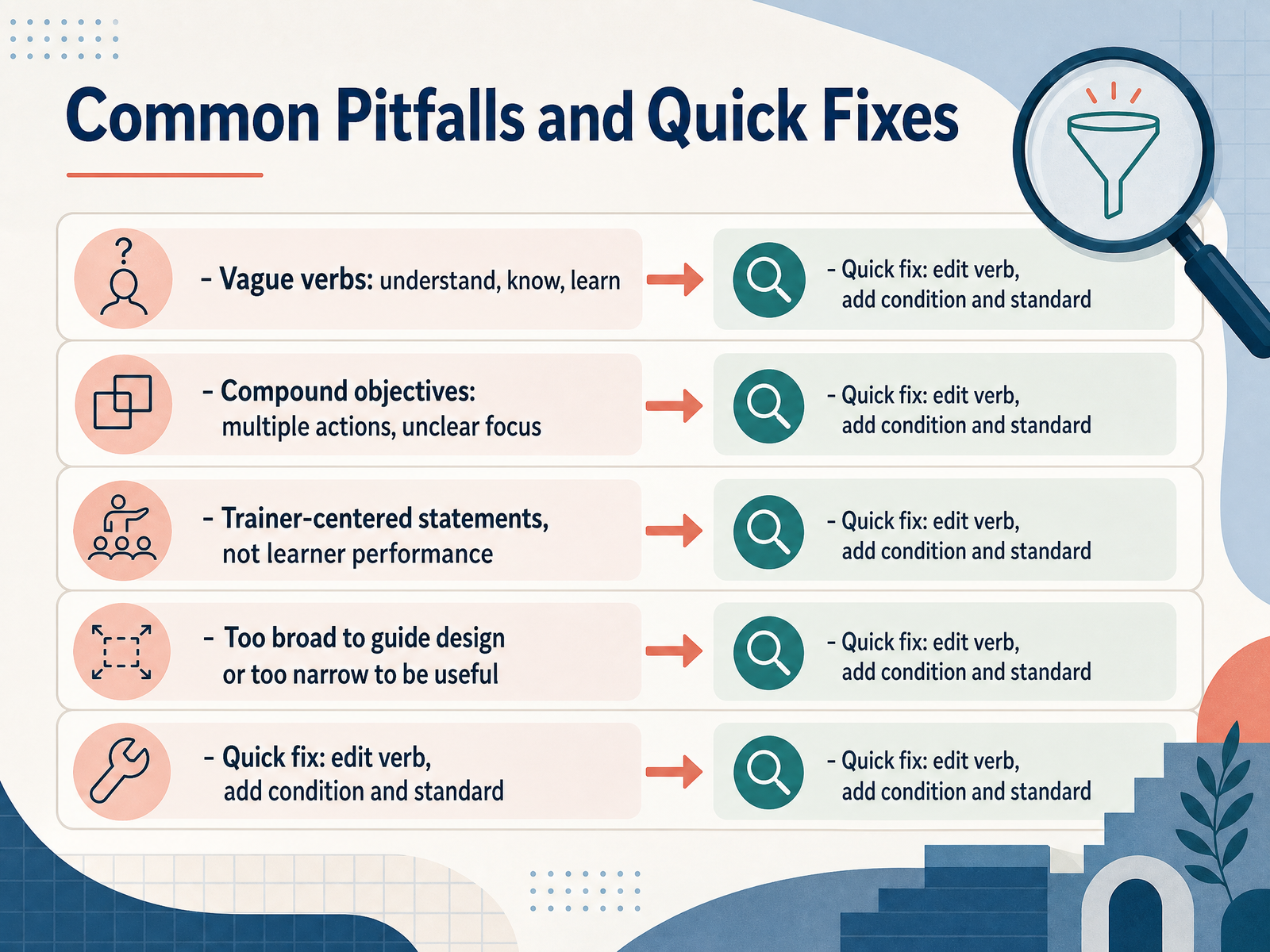
 - 10Common Pitfalls and Quick FixesLet's look at the five pitfalls we see most often. First, vague verbs like understand, know, or learn. They describe internal states, not observable performance. Second, compound objectives that pack multiple actions into one sentence. That splits the learner's focus and your assessment. Third, trainer-centered statements that describe what you will cover, not what the learner will do. Fourth, objectives so broad that they cannot guide design, or so narrow that they only test recall. The quick fix is simple: swap the vague verb for a measurable action, add a condition that sets the context, and specify a standard that defines success. For example, instead of, learners will understand customer objections, write, given a recorded call, the learner will classify each objection using the LAER model with ninety percent accuracy. That one sentence tells the designer what to build and the learner what mastery looks like. Keep your objectives learner-centered, specific, and measurable, and you will avoid most of these traps. Now we will turn this into a simple checklist you can use with your next course.
 eiu.edutips.uark.edulearningandteaching.anu.edu.au+22 min
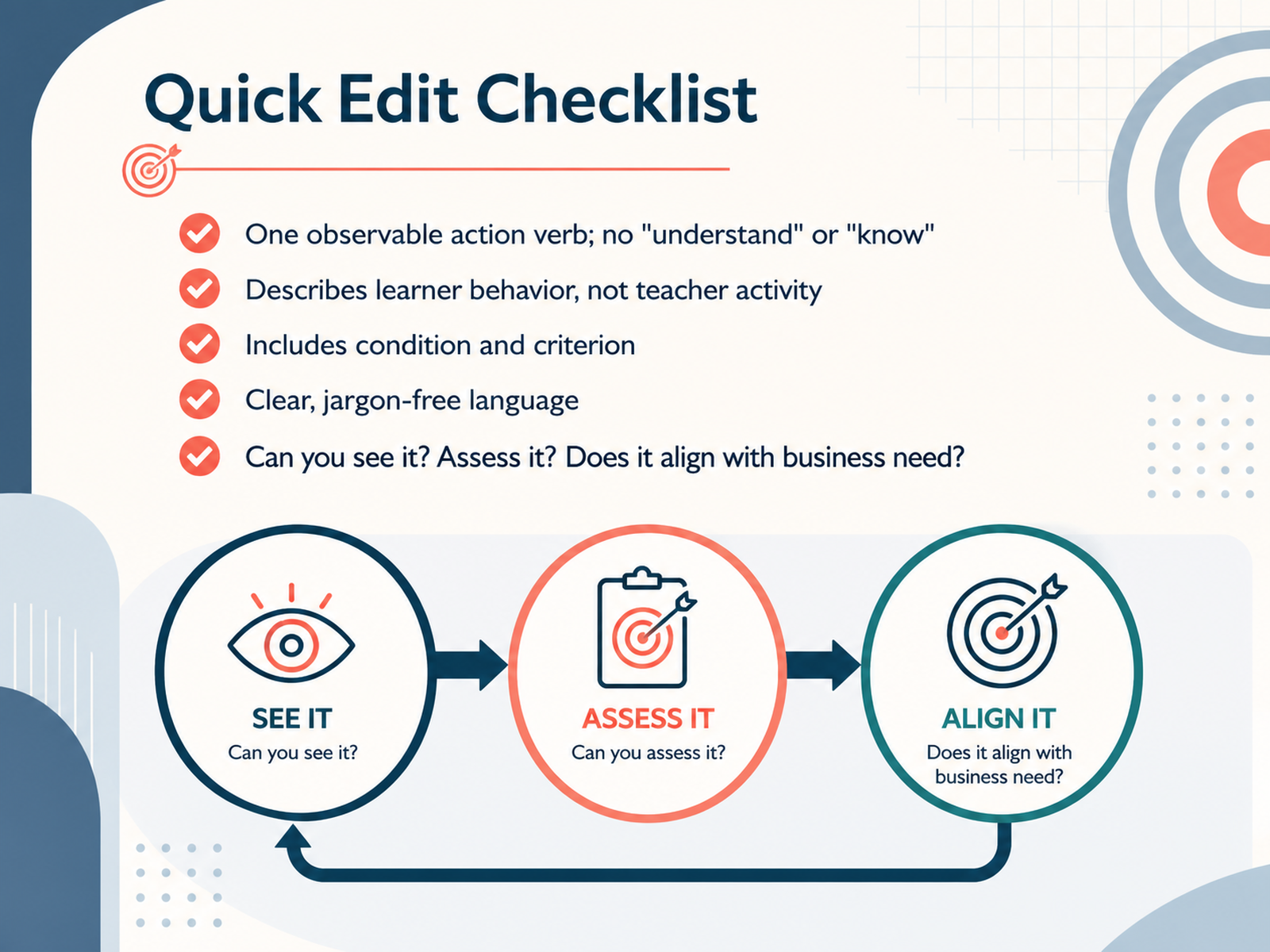
 - 11Quick Edit ChecklistHere is a quick checklist you can run through every time you revise an objective. First, check the verb. Is it observable, like build, compare, or demonstrate? If you used understand or know, swap it out. Next, look at who is doing the action. Does it describe learner behavior or something you will do as the trainer? It must focus on the learner. Then, look for the condition and the criterion. What tools or resources will they have, and what does success look like? Keep the language clear and free of jargon. Finally, the biggest test. Can you see it? Can you assess it from a seat in the classroom? And here is the question that matters most for your stakeholders. Does this objective connect to a real business need? If you cannot see the action or it does not move a business metric, it is not ready yet. Trust that checklist, and your objectives will be laser sharp. Now, let us put this into practice with a short workshop.
 docs.openedx.orgmodelteaching.comcolumbusstate.edu+21 min
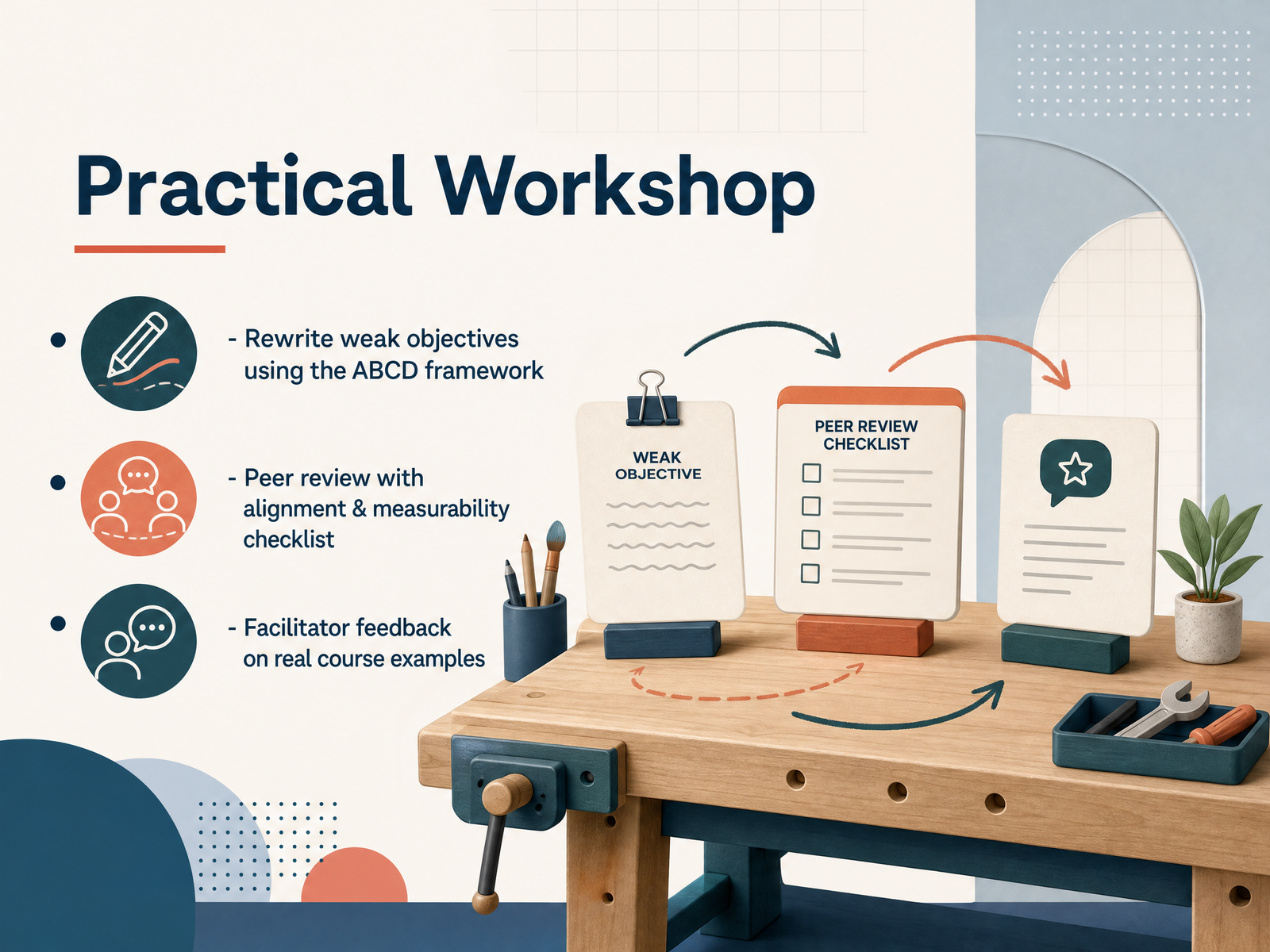
 - 12Practical WorkshopLet's put these concepts into practice. We're going to rewrite weak objectives using the ABCD framework. Start with your audience, define the behavior with a measurable verb, specify the conditions, and set the degree of mastery. Next, we'll do a peer review using an alignment and measurability checklist. Here are two key checks: does the module objective support the course objective, and can you picture a student demonstrating the skill? Finally, I'll provide feedback as we work through your real course examples. I'm here to help you spot those common traps, like using 'understand' or making an objective too wordy. We want clear, concise statements that connect directly to your assessments. Take this chance to workshop your actual material so you walk away with objectives that are ready for your classroom. Now, let's look at how you can take these polished objectives and put them to work in your course design.
 eiu.edutips.uark.edulearningandteaching.anu.edu.au+22 min
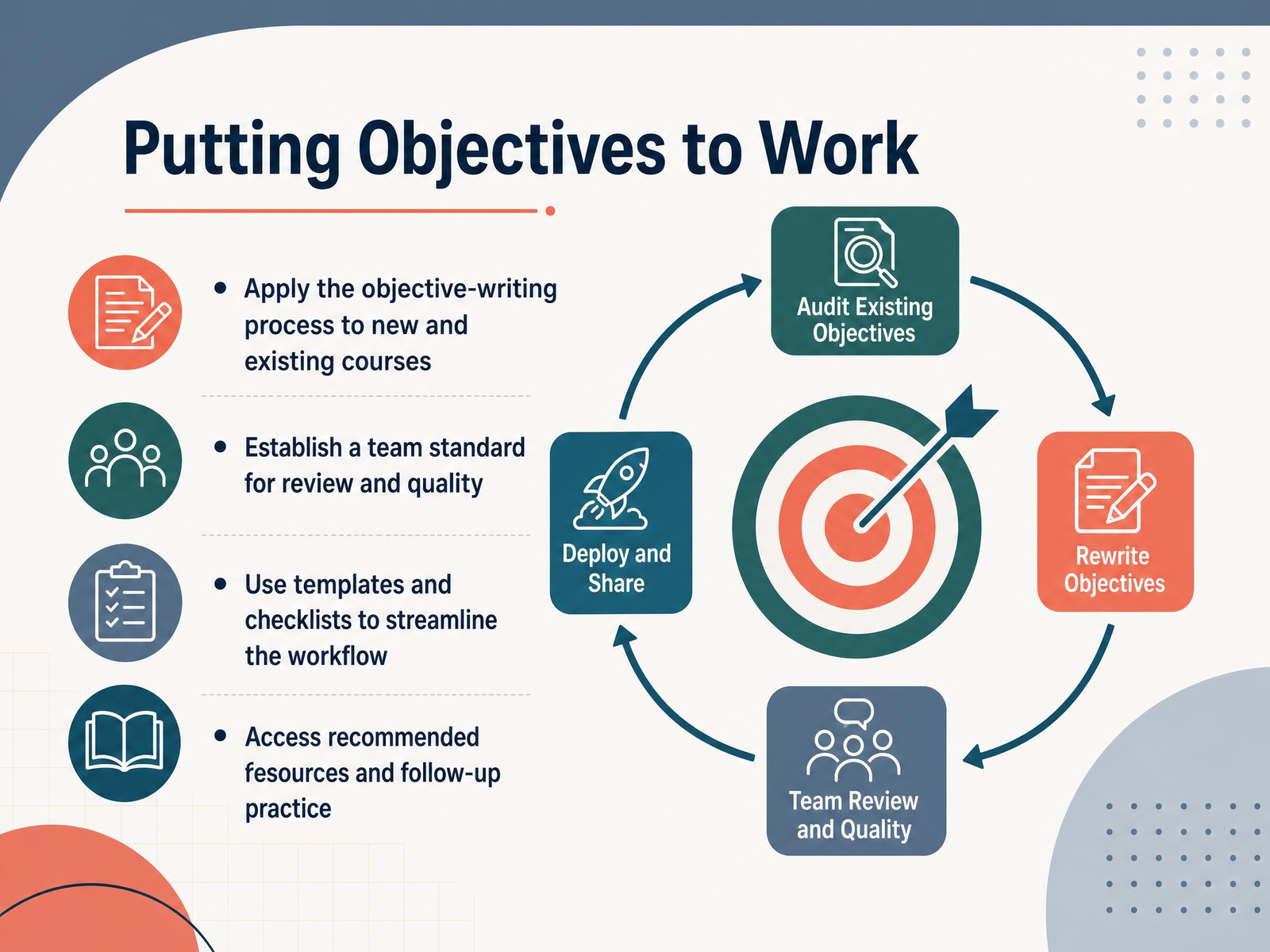
 - 13Putting Objectives to WorkSo let's put all of this into practice. Start by applying the objective-writing process to both new and existing courses. Audit your current programs and see where the objectives can be sharpened. Next, establish a team standard. When everyone uses the same review criteria, quality becomes consistent across all of your offerings. Don't build from scratch either — use templates and checklists to streamline the workflow. The tools you've seen today are designed to make this repeatable and efficient. And finally, dive into the recommended resources we've shared and commit to follow-up practice. The more you write, the more intuitive it becomes. Pick one course this week, rewrite its objectives, and run them past your team. You'll be surprised how quickly the momentum builds. We are almost done, so let's wrap up with the key takeaways and next steps.
 docs.openedx.orgmodelteaching.comcolumbusstate.edu+22 min
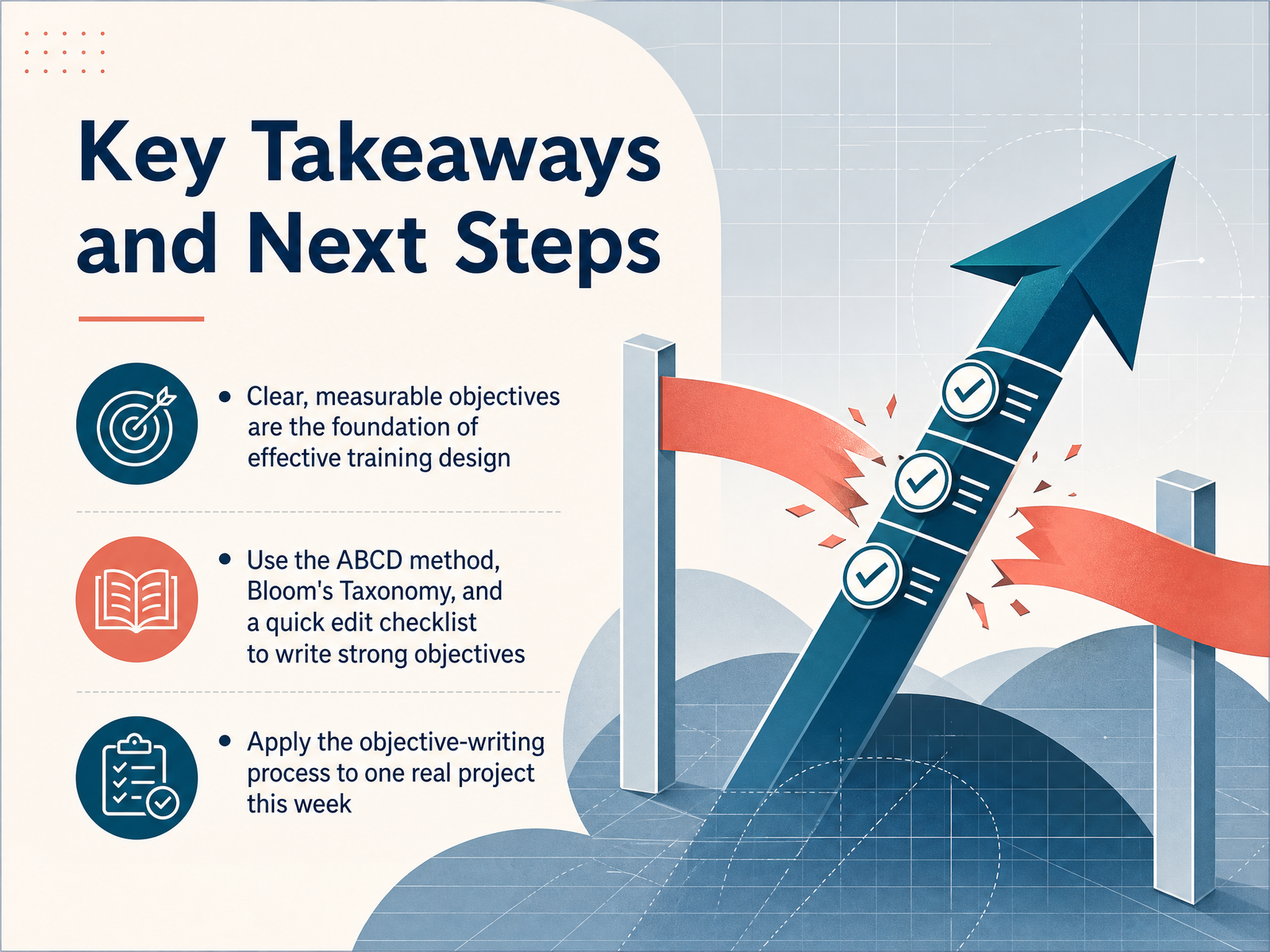
 - 14Key Takeaways and Next StepsThat brings us to the end of our session. Let's quickly pull the key takeaways together. Clear, measurable objectives are the foundation of effective training design — they align your stakeholders, focus your development, and make evaluation possible. Use the ABCD method to structure your objectives, Bloom's Taxonomy to choose the right action verb, and a quick edit checklist to catch vague language before it reaches your learners. Now, here's your next step: I challenge you to apply this process to one real project this week. Pick one course or module, write or rewrite its objectives using what you've learned, and test them against the 'so what' question. You'll feel the difference immediately. Thank you for your time and your commitment to building training that truly performs. I look forward to seeing the impact you create.
 jonathanhalls.comcdc.govcommlabindia.com+21 min
Take the deck with you
Download this course as a file — free, no sign-up needed.
- PDF handoutEvery slide page, ready to print or share.15 pages · 3.5 MBDownload
- Narrated PowerPointThe deck that presents itself — every slide carries the digital human's narration video.15 pages · 23.3 MBDownload
- PowerPoint slidesThe full deck as a .pptx — open it in PowerPoint, Keynote, or Google Slides.15 pages · 3.4 MBDownload
Free to use in your own training — please keep the PersonWise credit page at the end.
Have your own deck? Turn it into a course
Sources consulted
Web sources consulted while building this course.
- How to Write Effective Learning Objectives: A Practical Guide for Workplace Learning - Jonathan Halls — jonathanhalls.com
- Design Training: Learning Objectives | Training Development | CDC — cdc.gov
- Bloom’s Taxonomy for Learning Objectives in Corporate Training — commlabindia.com
- How to Write Effective Learning Objectives (With Examples) | Silver Calico — calicoos.polsia.app
- Learning Objectives That Actually Work: Writing For Behaviour, Not Knowledge - Qquench Ai — qquench.ai
- Selecting action verbs - ANU Learning and Teaching — learningandteaching.anu.edu.au
- Student Learning Outcomes - Measurable Actions | Division of Academic Affairs | Oregon State University — academicaffairs.oregonstate.edu
- Action Verbs for Creating Measurable Learning Outcomes — safety.sc.edu
- Sample Bloom’s Verbs | Teaching and Learning Resource Center — teaching.resources.osu.edu
- Action Verb List | K-State | Kansas State University — k-state.edu
- Developing Learning Objectives | Instructional Design — eiu.edu
- Learning Objectives: Examples and Before & After — tips.uark.edu
- Troubleshooting learning outcomes - ANU Learning and Teaching — learningandteaching.anu.edu.au
- Writing Learning Goals, Objectives and Outcomes | Poorvu Center for Teaching and Learning — poorvucenter.yale.edu
- It is important that learning objectives be specific, measurable, and observable behaviors. Learning outcomes should describe what students should be able to know or do as a result of a learning experience. Words to be avoided include: appreciate, believe, know, learn, understand – these are open to — ctlo.caltech.edu
- https://docs.openedx.org/en/latest/educators/concepts/instructional%5Fdesign/id%5Ftemplates.html — docs.openedx.org
- © Model Teaching from Action Potential Learning, LLC 2018. All Rights Reserved. — modelteaching.com
- Learning Objective Worksheet - Planning Your Online Course — columbusstate.edu
- Crafting module-level objectives and assessments | Mizzou Online: Teaching — teaching.missouri.edu