Begin
13 pages · ~26 min
AI Literacy Assessment Workflow
Learn a practical workflow to assess your team's AI literacy, identifying skill gaps and building a data-driven upskilling plan.
A digital instructor presents all 13 pages. Hold “Ask” at any point and ask out loud — the answer comes from this course. No sign-up needed.
What you’ll learn
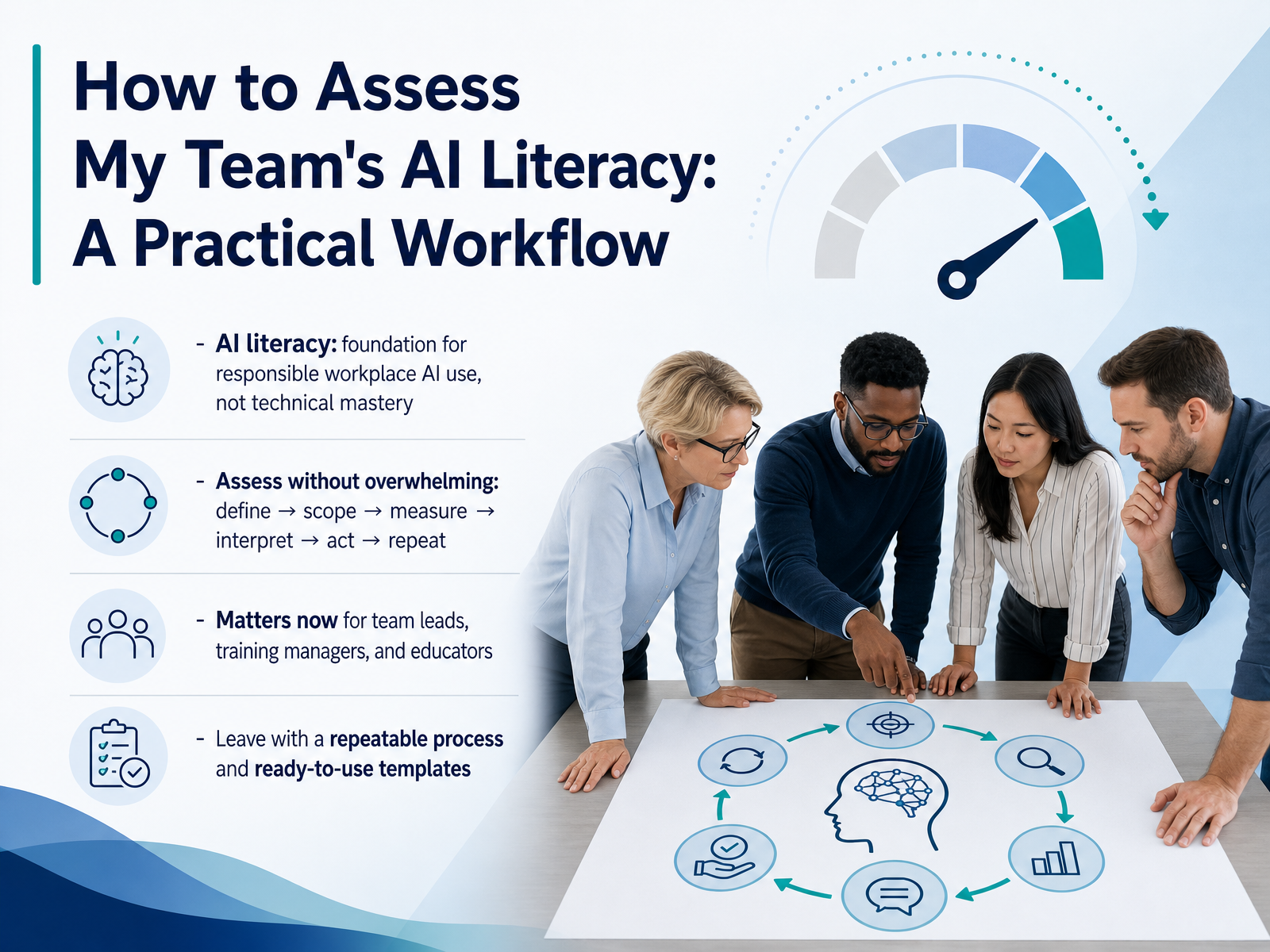
- 01How to Assess My Team's AI Literacy: A Practical WorkflowWelcome. If you lead a team, design training, or teach others, this session is for you. We're here to tackle a practical challenge: how do you actually assess your team's AI literacy? Not in a heavy, academic way. In a way that gives you clear next steps. Here's the good news. AI literacy is not about technical mastery. It's a foundational set of competencies. It means people can use and evaluate AI responsibly in their day-to-day work. That's a much more achievable goal. Our workflow is simple. Define what matters, scope it to your team, measure where you are, interpret the results, act on them, and repeat. This matters now more than ever. Workplace expectations are shifting. And you need a repeatable process. By the end of this session, you'll have that process and ready-to-use templates. You'll know exactly how to support your team. Let's start by getting clear on what AI literacy actually means.dol.govdol.govdol.gov+22 min
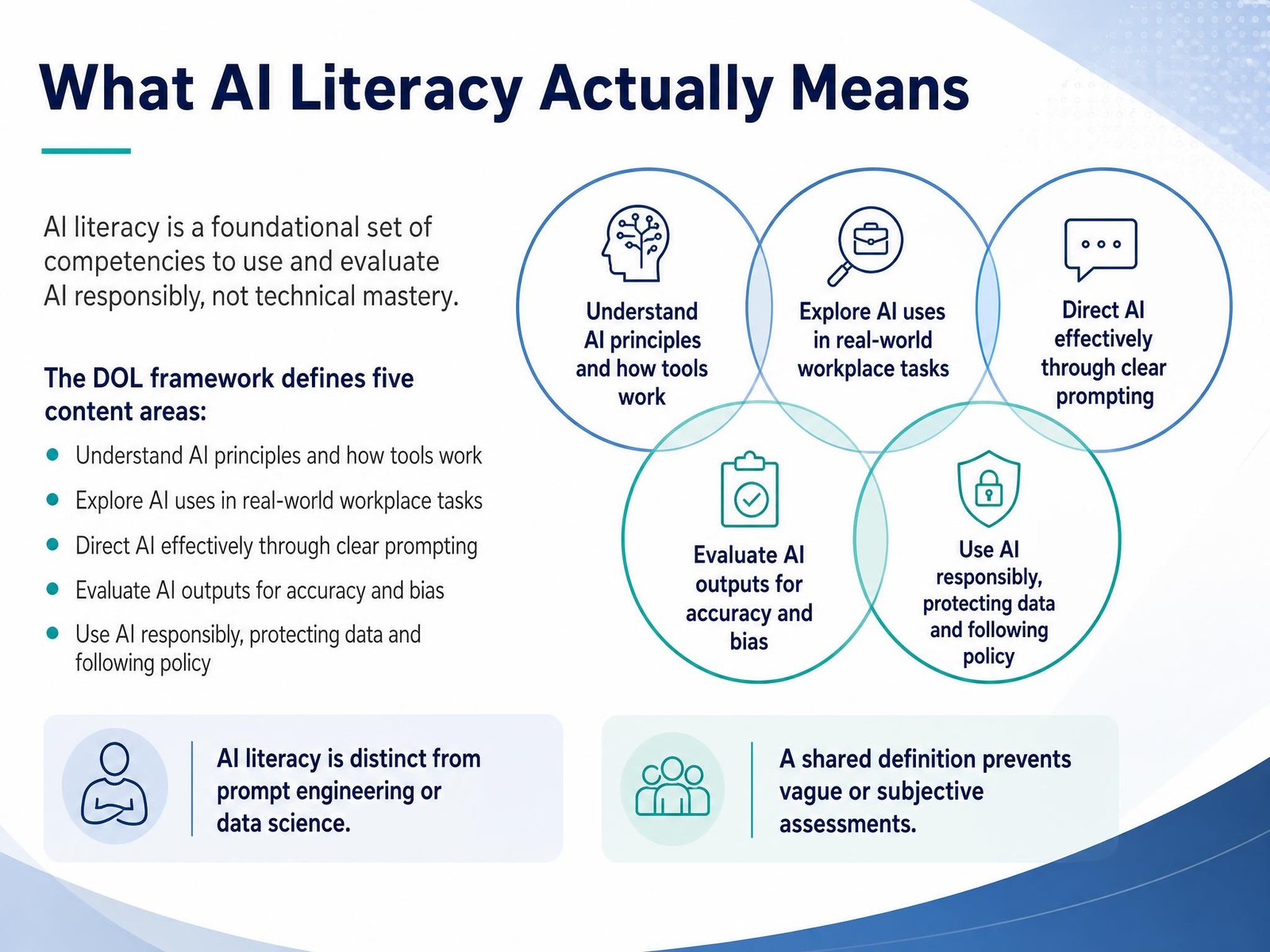
- 02What AI Literacy Actually MeansBefore we can measure anything, we need a shared definition of what we're measuring. Here's the one we'll use: AI literacy is a foundational set of competencies that lets people use and evaluate AI responsibly. It's not about building models or writing code. It's about working with AI tools confidently and safely. The U.S. Department of Labor breaks this into five content areas. First, understand how AI tools work. Second, explore how AI applies to real workplace tasks. Third, direct AI effectively through clear prompting. Fourth, evaluate outputs for accuracy and bias. And fifth, use AI responsibly by protecting data and following policy. You'll notice this is distinct from prompt engineering or data science. Those are deeper specializations. AI literacy is the baseline everyone needs. And having a shared definition like this keeps our assessment from becoming vague or subjective. So before we move on, let's scope out which roles and groups we'll assess. That's next.
 dol.govdol.govdol.gov+21 min
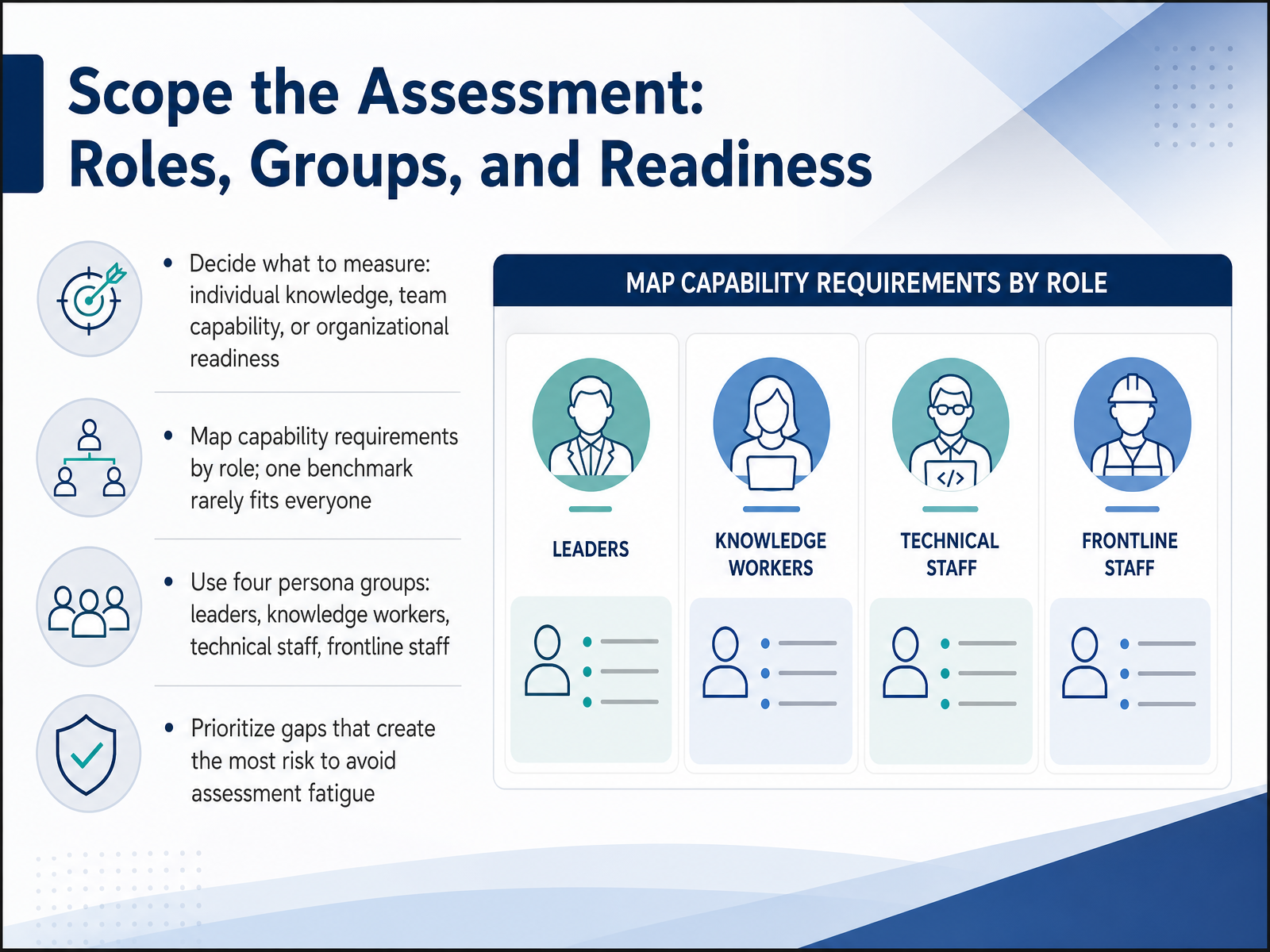
 - 03Scope the Assessment: Roles, Groups, and ReadinessNow, let's scope the assessment before you send out a single survey. The first decision is what you are actually measuring: individual knowledge, team capability, or organization-wide readiness. These are different questions. A senior leader might need to know if the organization is ready for AI adoption, while a team lead needs to know if their analysts can critically evaluate an AI-generated report. Next, map the capability requirements by role. A single benchmark rarely fits everyone. What a risk and compliance officer needs is materially different from what a frontline operations person needs. A practical starting point is four persona groups. Leaders and decision-makers, who need to govern AI use and understand strategic risk. Knowledge workers and analysts, who need hands-on interaction skills and critical evaluation. Technical and data teams, who need deeper conceptual understanding and the ability to assess model limitations. And frontline and operational staff, who need enough literacy to use tools safely and flag concerns appropriately. Finally, prioritize the gaps that create the most risk. Don't try to measure everything at once. If a moderate gap exists in a role that regularly acts on AI output, that is more urgent than a larger gap in a role with limited AI exposure. This focus prevents assessment fatigue and gives you actionable data. Next, let's talk about choosing assessment methods that actually work.
 dl-academy.comaisa.tophosailabs.com+22 min
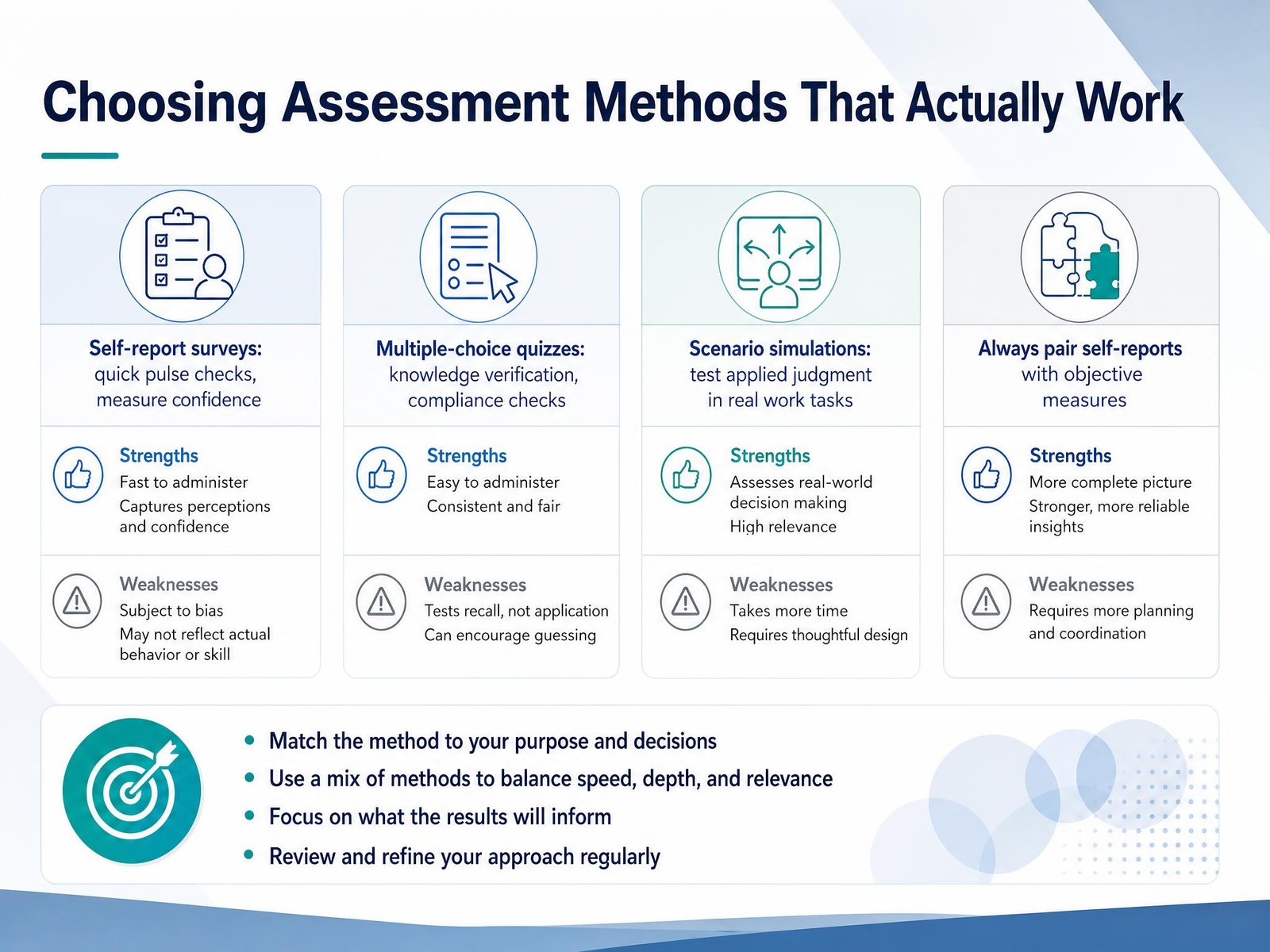
 - 04Choosing Assessment Methods That Actually WorkNow let's talk about choosing assessment methods that actually work. There's no single perfect tool, but there is a right tool for each goal. Start with self-report surveys. They're fast and give you a pulse check on confidence. But remember, confidence is not the same as competence. For knowledge checks, multiple-choice quizzes work well. They verify who knows the basics and handle compliance requirements. However, they can become outdated quickly and only test recall. For judging real-world judgment, use scenario simulations. Give your team a realistic task, like evaluating an AI-generated report for errors. This tests applied skills, not just what they remember. Here's the golden rule: never rely on self-reports alone. Always pair them with an objective measure. The method you choose should match the decision you're making. Need a quick sentiment check? Use a survey. Need to verify compliance? Use a quiz. Need to test if someone can actually do the work? Use a scenario. Match your method to your purpose, and you'll get data you can trust. Now, let's build a practical assessment workflow that puts all this into action. Ready? Let's continue.
 aisa.tokampster.comdl-academy.com+22 min
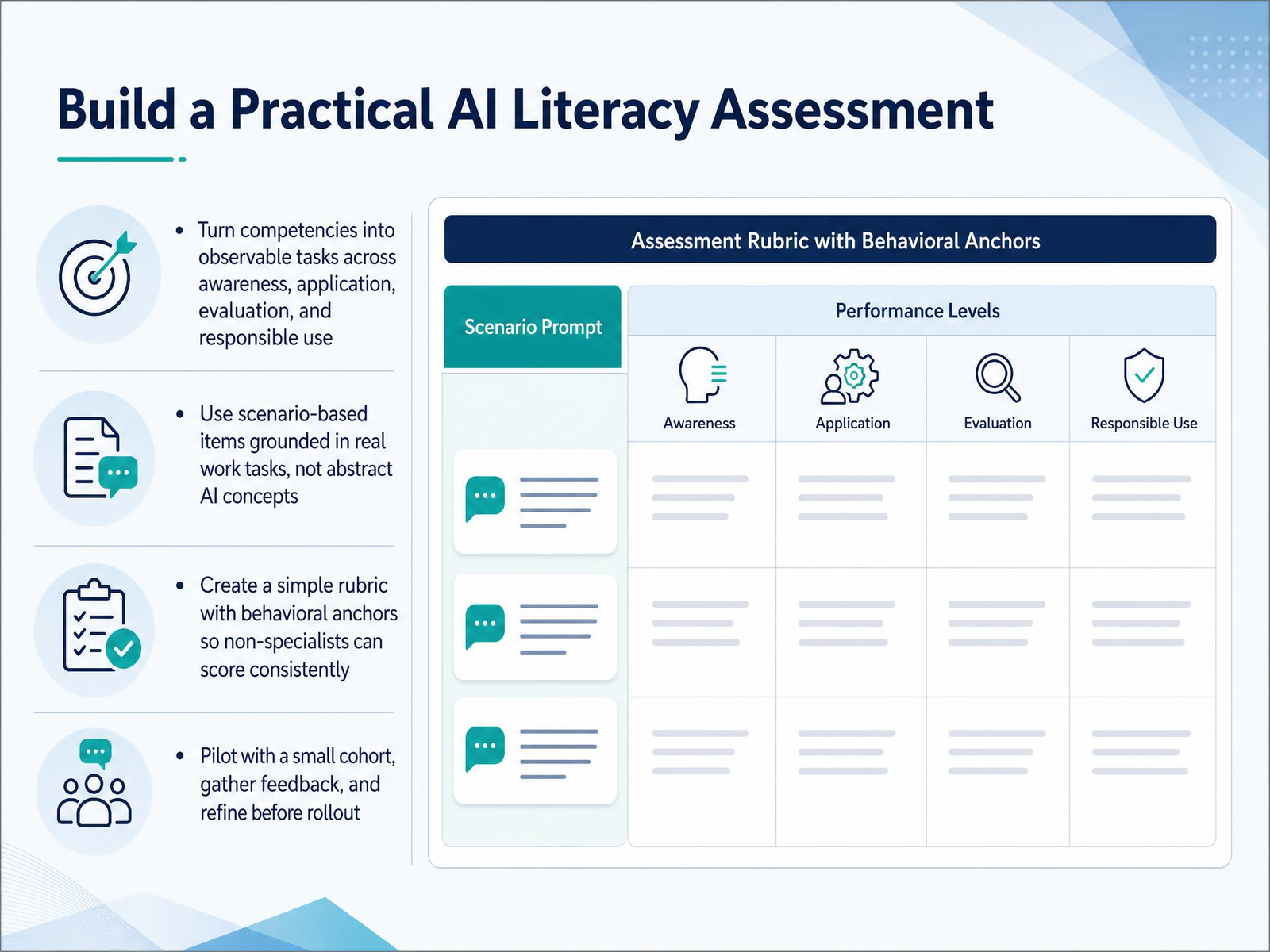
 - 05Build a Practical AI Literacy AssessmentNow let's turn that framework into a practical assessment. First, turn competencies into observable tasks. Don't ask if someone understands AI in the abstract. Instead, watch them do something real with it. Cover the full spectrum: awareness, application, evaluation, and responsible use. Second, build your assessment on scenarios. Ground every question in real work tasks. For example, give your team a draft email from an AI tool and ask them to identify what's missing, or what's risky. This tests judgment, not just recall. Third, create a simple rubric with behavioral anchors. Define what a 'competent' response looks like in plain language. That way, two different managers evaluating the same answer will score it the same way. Finally, pilot before you roll out. Test the assessment with a small group. Gather their feedback on clarity and fairness. Refine the questions and the rubric. Then, and only then, roll it out to the wider team. This keeps the process low-stakes and focused on growth, not performance review. Now that we have the tool, let's talk about running it without causing panic.
 montgomerycollege.edupertamapartners.comdatalion.com+21 min
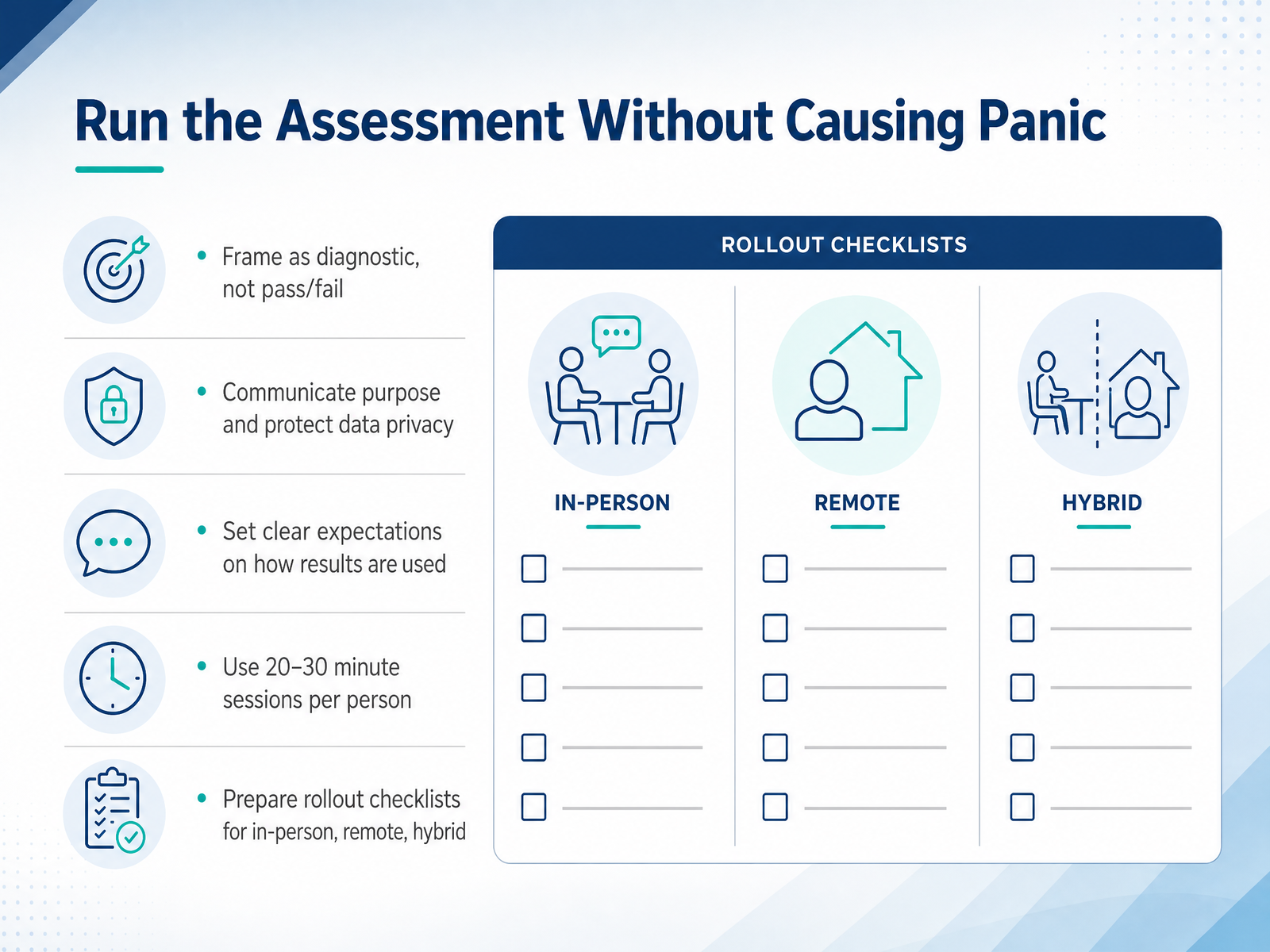
 - 06Run the Assessment Without Causing PanicNow let's talk about running the assessment without causing panic. The number one rule is to frame it as a diagnostic, not a pass or fail test. This is not about catching anyone out; it's about finding out where the team is so you can invest in the right training. First, communicate the purpose clearly. Tell your team exactly why you are doing this and what will happen with the results. Be transparent about data privacy. Explain that individual scores are confidential and only shared in aggregate to guide training decisions. When you set these expectations upfront, you get honest responses instead of people gaming the system. Second, keep the sessions short. You want twenty to thirty minutes per person, maximum. That is enough time to see how someone works with AI in a live setting, without making it a huge ordeal. Finally, prepare a rollout checklist for every format. For in-person, book a quiet room. For remote, test the tech beforehand. For hybrid, ensure everyone has the same experience and can participate equally. The goal is to create a low-stakes, focused environment. When people know the process is supportive and private, they will show you their real workflow. That is the data you actually need. Next up: how to interpret the results without overreacting.
 dl-academy.comaisa.tophosailabs.com+21 min
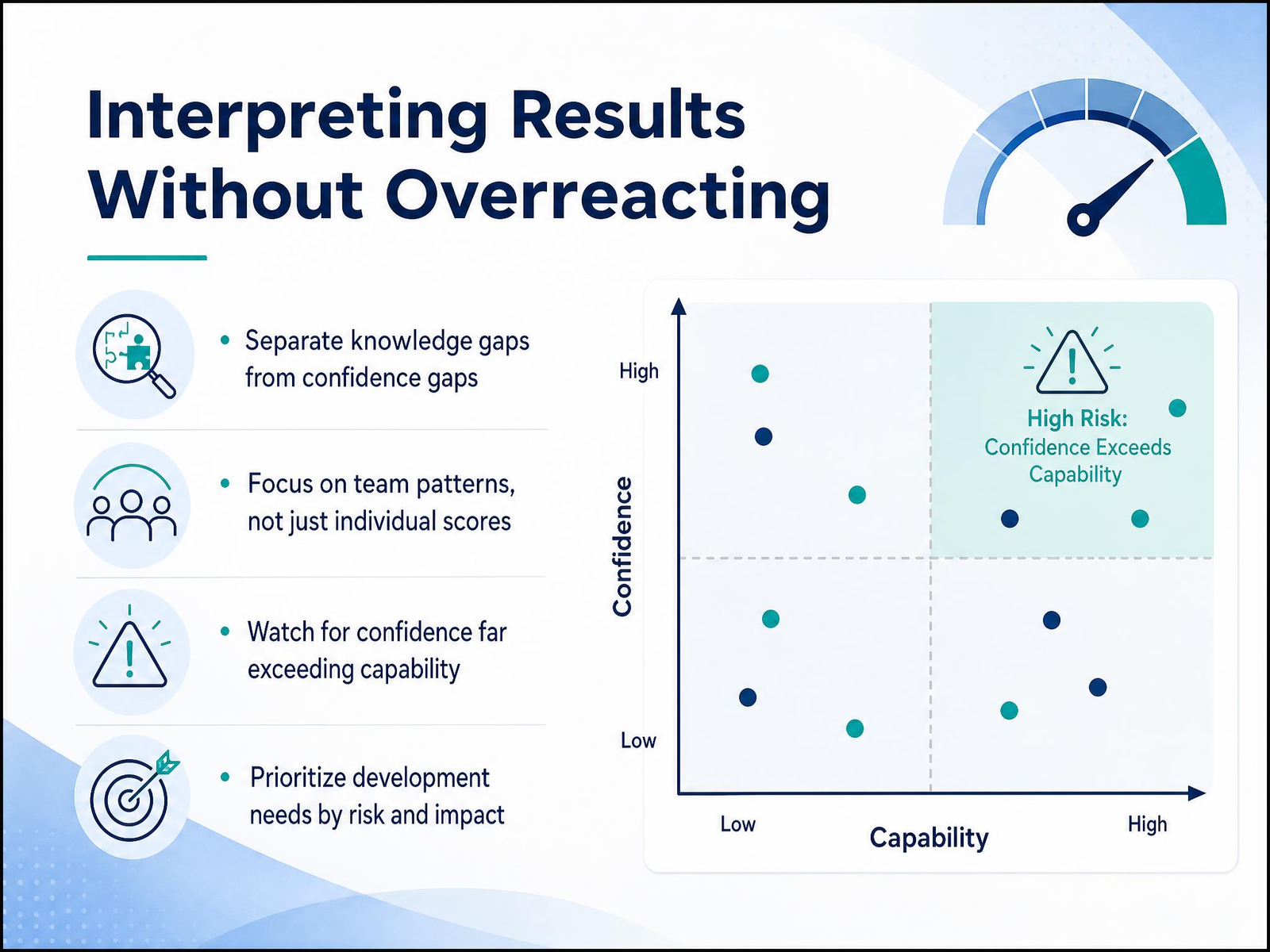
 - 07Interpreting Results Without OverreactingNow that you have your results, the real work begins. Interpretation is where assessments succeed or fail. Start by separating knowledge gaps from confidence gaps. A team member may score low on a quiz but be quite capable in practice. Another may rate themselves highly yet stumble on scenario-based tasks. These are very different problems. Knowledge gaps need training. Confidence gaps need practice and experience. Next, focus on team patterns, not just individual scores. If forty percent of your team struggles with the same skill, that is a systemic gap requiring a team-level solution. A single low scorer is a different situation entirely, and personal coaching. Watch for confidence far exceeding capability. The people who rate themselves highest are often the least skilled. This is the gap that creates real risk, because they will not ask for help. Finally, prioritize development needs by risk and impact. If a moderate gap sits in a role that regularly acts on AI outputs, that is more urgent than a large gap in a low-stakes role. The goal is not to be perfect. It is to be clear on where your energy creates the most value. This is how you move from raw data to a practical training plan, which is exactly where we go next.
 riotiq.comdl-academy.comaisa.to+21 min
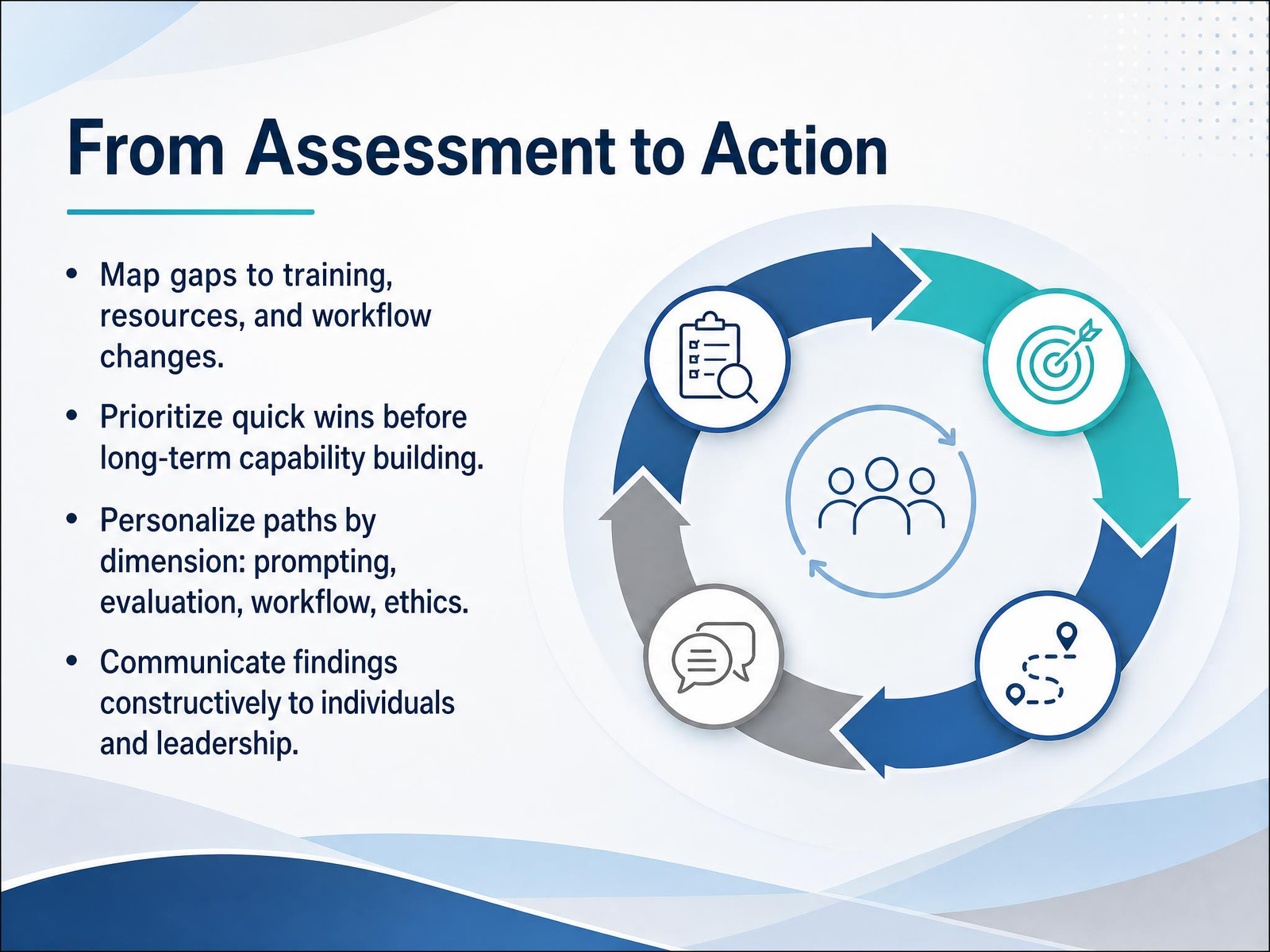
 - 08From Assessment to ActionOnce you have the assessment results, resist the urge to file them away. The real value is in turning those insights into action. Start by mapping each gap to a specific remedy: training, better resources, or a change in workflow. Prioritize quick wins first, things you can fix this month, to build momentum. Then plan the longer-term capability building. Personalize the plan for each person by dimension: prompting, evaluating output, workflow integration, and ethics. A strong prompter may still need help verifying results. Finally, share the findings constructively, both with individuals and with leadership. Frame it as a development roadmap, not a report card. This keeps the focus on growth. And remember, your next step is to make assessment a repeating workflow.
 riotiq.com1 min
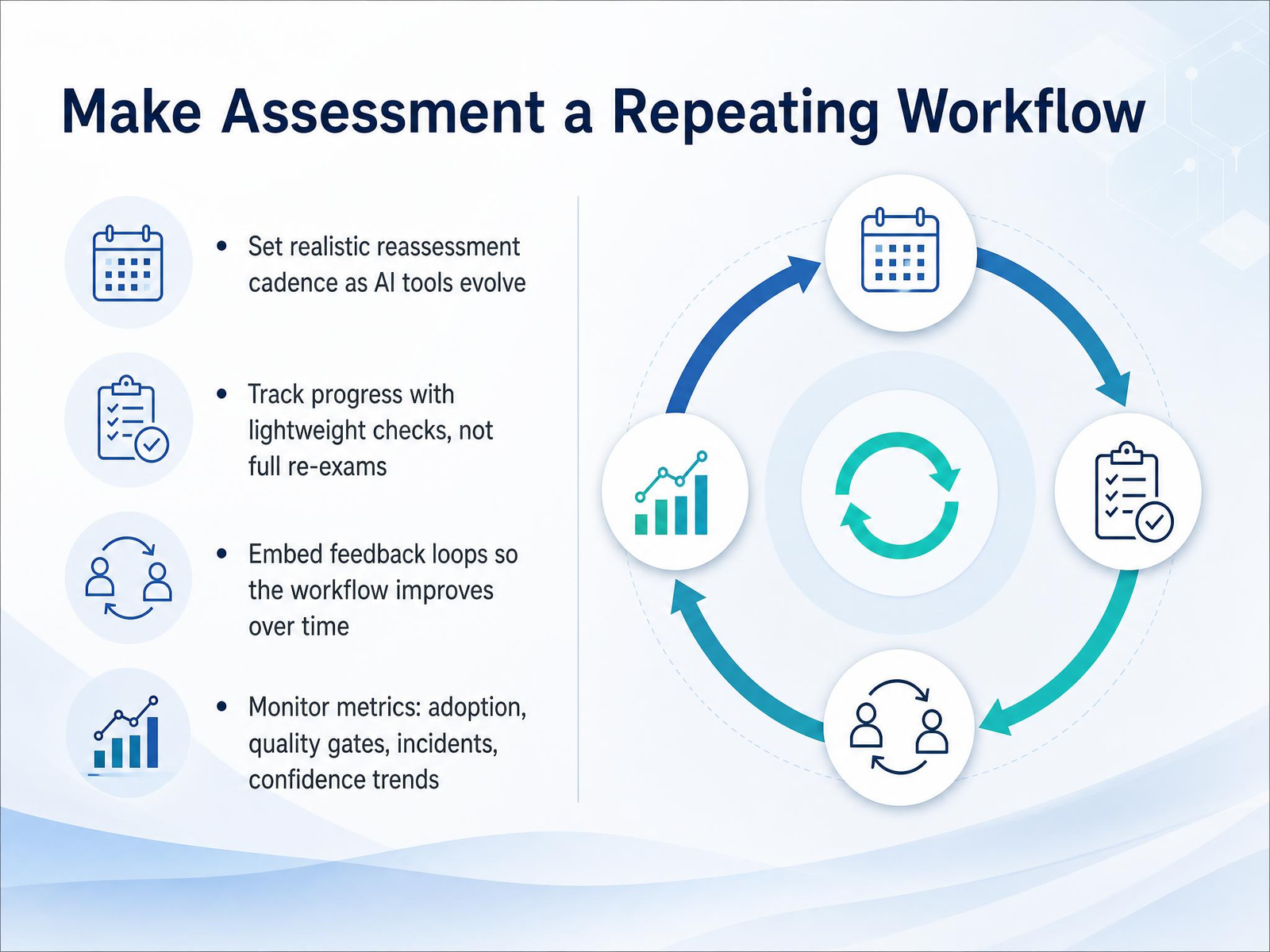
 - 09Make Assessment a Repeating WorkflowLet's talk about making this a repeating workflow. AI tools evolve quickly, so your assessment should not be a one-time event. Set a realistic cadence. For most teams, rechecking every ninety days makes sense. You want to catch shifts in skill before they become problems. Avoid full re-exams. Use lightweight checks instead. A quick pulse survey, a short output review drill, or a focused observation can tell you most of what you need. Build in feedback loops. Ask your team what is working in the workflow and what is not. Adjust the process based on what you hear. Then, monitor the right metrics. Track adoption rates to see who is using AI tools. Watch quality gates to confirm review steps are in place. Note any incident reports. And keep an eye on confidence trends, even though self-reports are a weak signal, they are directionally useful. The goal here is simple. Make assessment a rhythm, not a reaction. Up next, we will look at templates, tools, and common objections.
 dl-academy.comaisa.tophosailabs.com+22 min
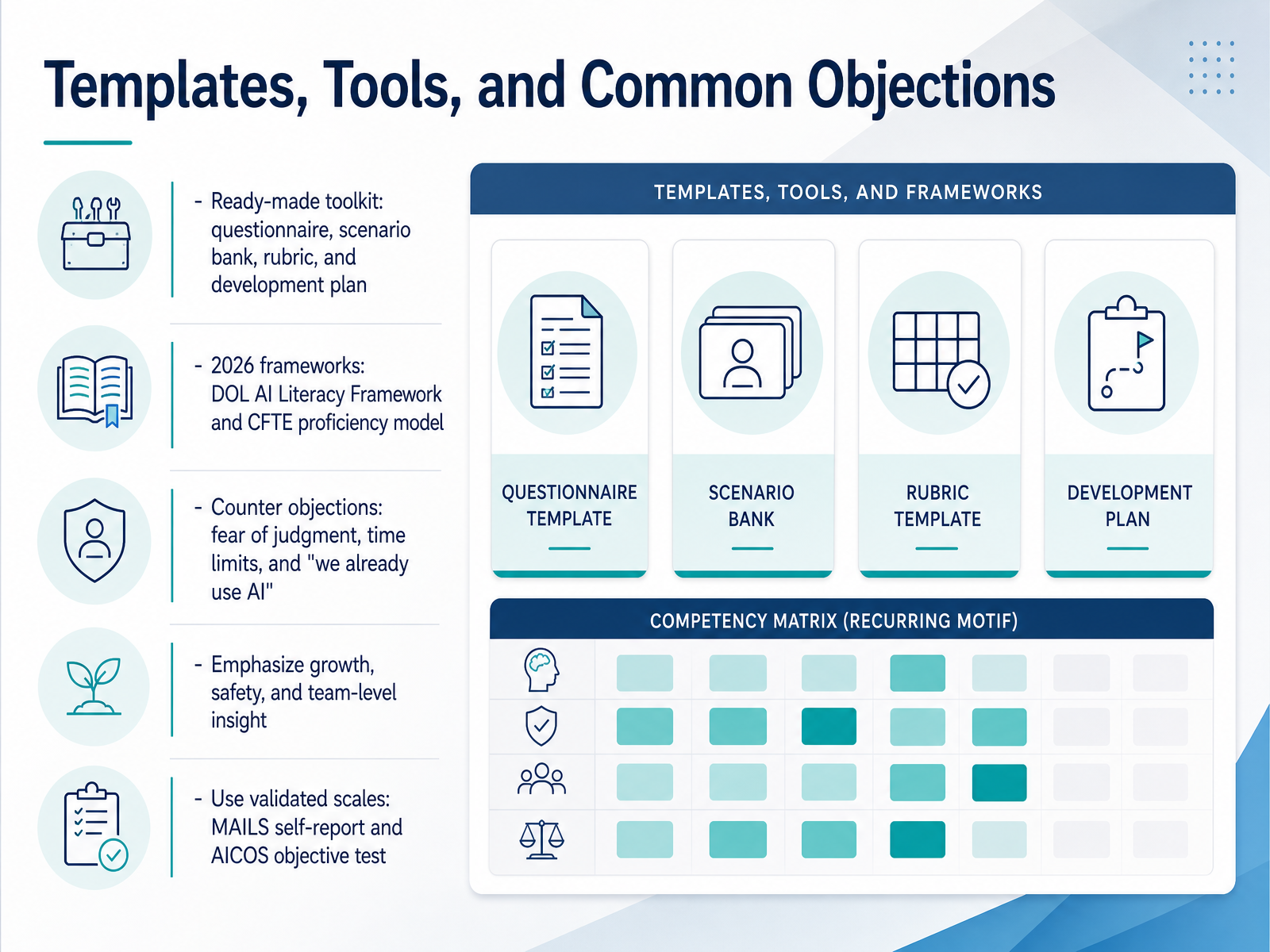
 - 10Templates, Tools, and Common ObjectionsLet's talk about what you actually need to run this assessment. First, use a ready-made toolkit. This includes a questionnaire, a scenario bank, a scoring rubric, and a development plan. You don't need to build these from scratch. For structure, look at the 2026 frameworks from the Department of Labor and the CFTE proficiency model. They give you clear levels, from basic literacy to applied practitioner. Now, let's address the common objections you will hear. Fear of judgment. Make it clear this is not a performance review. Frame it as a growth opportunity. Time limits. Keep the assessment short, around fifteen to twenty minutes. And the classic, we already use AI. That's great, but tool use is not the same as understanding risks and limits. Emphasize growth, safety, and team-level insight. For measurement, use validated scales. Combine the MAILS self-report for confidence with the AICOS objective test for actual knowledge. This gives you the full picture. Up next, I will walk you through your complete end-to-end checklist.
 datalion.comdol.govdol.gov+22 min
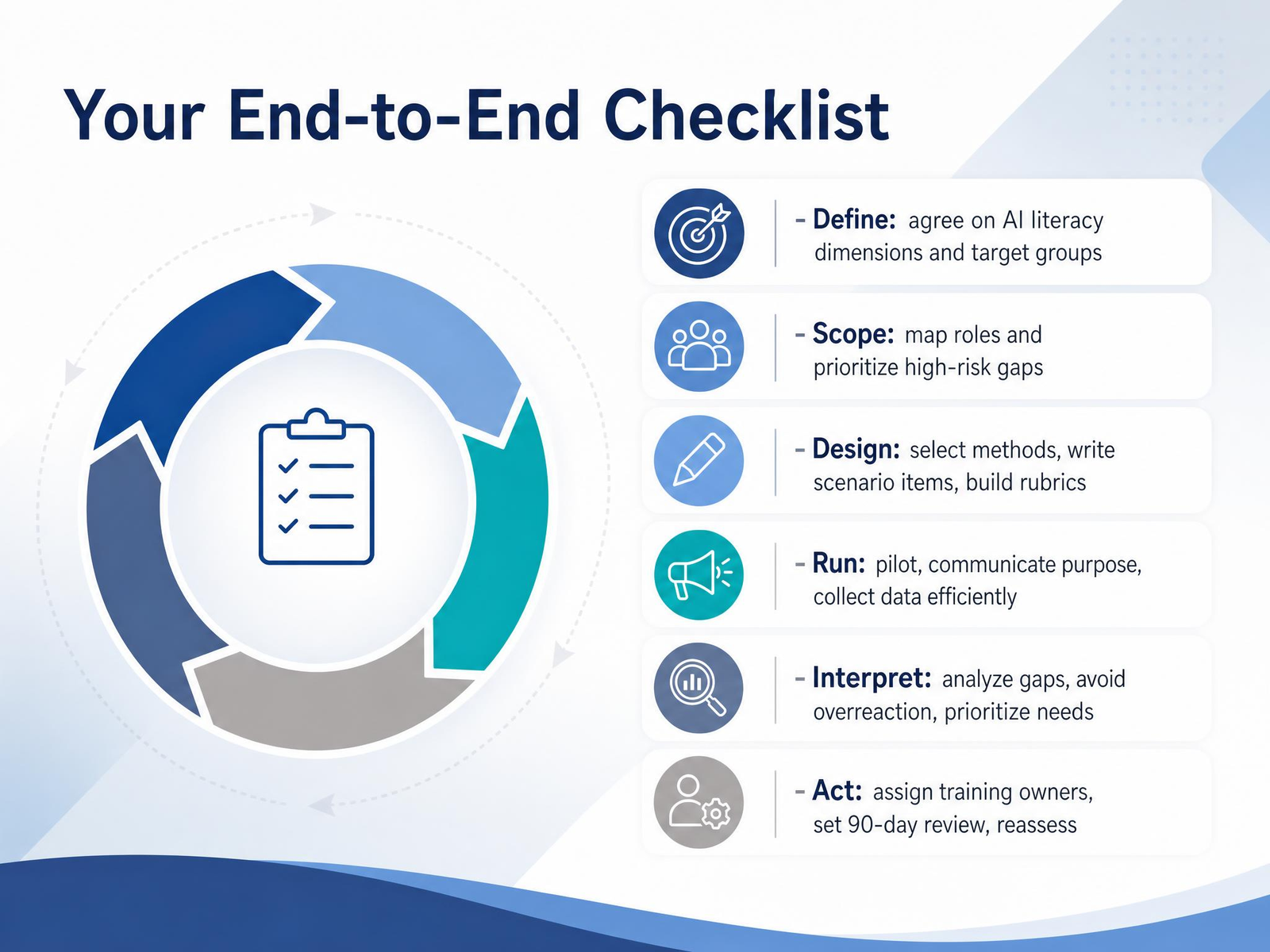
 - 11Your End-to-End ChecklistNow, let's pull it all together into one end-to-end workflow. Start with the define stage: agree on what AI literacy means for your team and which roles you're assessing. Don't skip this — it keeps everything else focused. Next, scope: map your roles, then prioritize the gaps that carry the highest risk for your daily work. Then comes design. Select your methods, write scenario-based items that mirror real tasks, and build rubrics with clear behavioral anchors. Before you launch, run a small pilot. Communicate the purpose honestly — this is about development, not performance review. Collect the data efficiently, then move to interpretation. Look for patterns across the whole group, not isolated outliers. Avoid overreacting to one low score. Prioritize the gaps that affect the most people or the most critical work. Finally, act. Assign a training owner for each priority gap, set a ninety-day review date, and reassess at that point. Remember: assess, train, reassess. That cycle is what turns this checklist into lasting improvement. Now, let's talk about the immediate next steps you can take with your team starting this week.
 datalion.comriotiq.com2 min
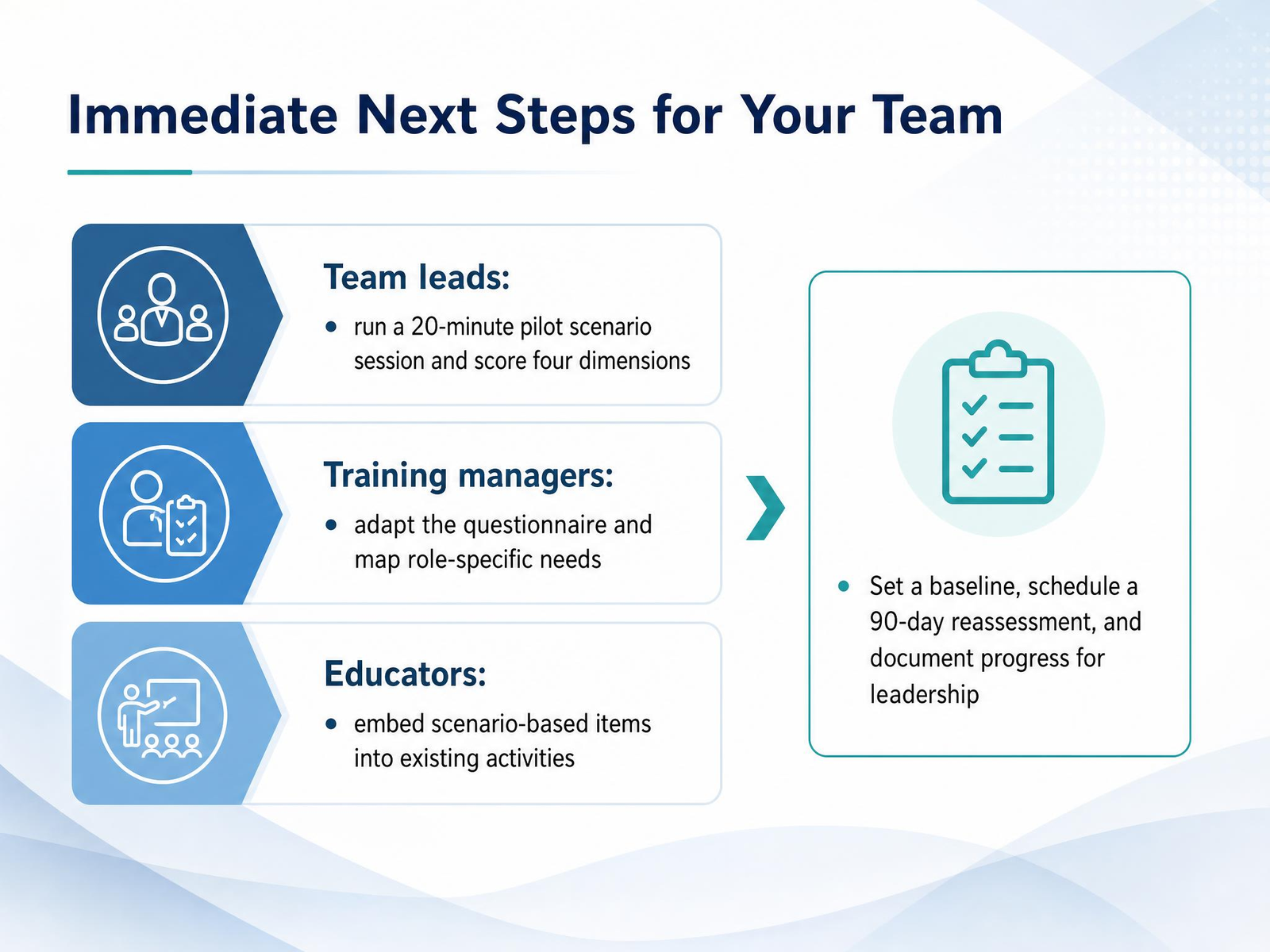
 - 12Immediate Next Steps for Your TeamNow let's turn assessment into action. Here is your immediate next step checklist, broken down by role. If you are a team lead, run a twenty-minute pilot scenario session this week. Score your team on four dimensions: applying, understanding, evaluating, and ethics. Keep it low-stakes and practical. If you are a training manager, adapt the questionnaire to reflect your team's daily tools and map the specific needs for each role. Don't use a generic list. Focus on what your sales, support, or operations people actually touch. If you are an educator, embed these scenario-based items into activities your learners already do. That way, you are measuring judgment, not just recall. Finally, set your baseline score today. Schedule a ninety-day reassessment and document the progress for leadership. That documented cycle is what turns a one-time snapshot into a real improvement story. Up next, key takeaways and resources to keep this work moving.
 datalion.comriotiq.com1 min
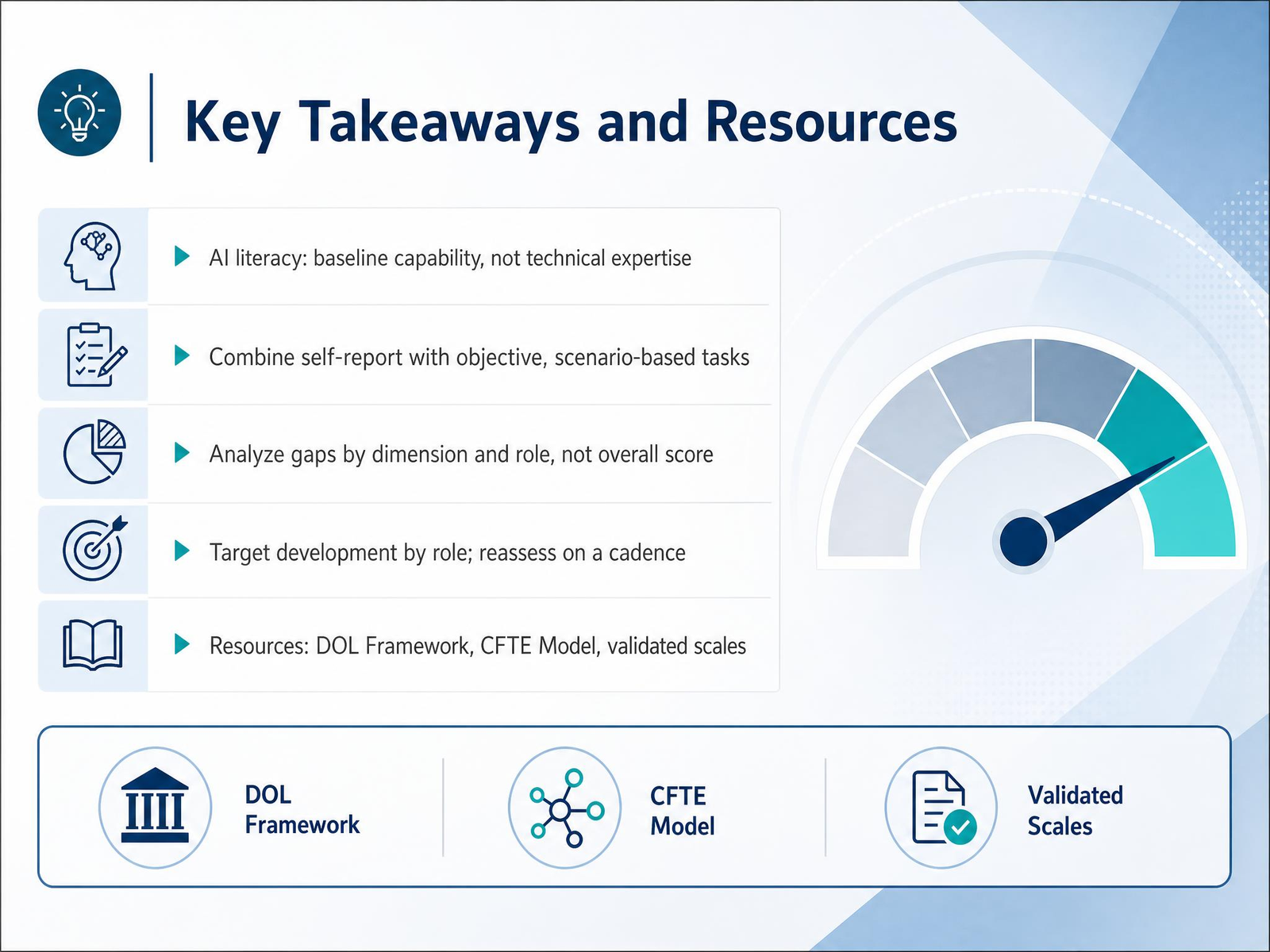
 - 13Key Takeaways and ResourcesSo let's wrap up with what matters most. AI literacy is a baseline capability, not technical expertise. Your people don't need to build models, but they do need to use and evaluate them responsibly. Remember to combine self-report with objective, scenario-based tasks. Confidence alone can mislead you. Look at the gaps by dimension and by role, not just an overall score. A single number hides where the real risks are. Then target development by role and reassess on a regular cadence. Skills in this space change fast, so make this a repeatable process, not a one-time event. For deeper support, explore the DOL Framework and the CFTE Model. They give you solid, validated structures to build on. You now have a practical, low-stakes workflow to assess your team's AI literacy. Start small, keep it supportive, and let the data guide your next step. Thank you, and good luck.
 dol.govdol.govdol.gov+22 min
Take the deck with you
Download this course as a file — free, no sign-up needed.
- PDF handoutEvery slide page, ready to print or share.14 pages · 2.9 MBDownload
- Narrated PowerPointThe deck that presents itself — every slide carries the digital human's narration video.14 pages · 13.4 MBDownload
- PowerPoint slidesThe full deck as a .pptx — open it in PowerPoint, Keynote, or Google Slides.14 pages · 2.7 MBDownload
Free to use in your own training — please keep the PersonWise credit page at the end.
Have your own deck? Turn it into a course
Sources consulted
Web sources consulted while building this course.
- The U.S. Department of Labor’s Artificial Intelligence Literacy Framework — dol.gov
- TEN 07-25 | U.S. Department of Labor — dol.gov
- US Department of Labor releases AI literacy framework providing ... — dol.gov
- Attachment I (Accessible PDF).pdf | U.S. Department of Labor — dol.gov
- CFTE AI Proficiency Framework | A Reference Framework for AI Proficiency — ai-fication.org
- Guide: How to assess your organisation's AI literacy gap — dl-academy.com
- The AI Skills Gap: How to Benchmark and Upskill Your Existing Team | AISA — aisa.to
- Run an AI Skills Assessment for Ops Teams — phosailabs.com
- AI Readiness Assessment: Does Your Team Have the Right Skills? — codility.com
- Assessing AI Literacy Needs — Knowledge Bridge — knowledgebridge.ai
- AI Assessment Methods Compared: How to Actually Measure AI Skills | AISA — aisa.to
- How to Measure AI Literacy (and Why Self-Assessment Isn't Enough) — kampster.com
- AI Literacy Assessment Revisited: A Task-Oriented Approach Aligned with Real-world Occupations — arxiv.org
- AI Assessments: Best Practice for Valid, Fair Psychometrics — robwilliamsassessment.co.uk
- AI Literacy for Career & College Success Microcredential Rubric — montgomerycollege.edu
- AI Skills Assessment Framework: Literacy, Fluency & Mastery — pertamapartners.com
- AI Literacy Questionnaire (EU AI Act Art. 4): Template – DataLion — datalion.com
- AIL AT WORK | Human-Computer Interaction — hci.uni-wuerzburg.de
- AI Literacy Assessment Revisited: A Task-Oriented Approach Aligned with Real-world Occupations — doi.org
- A Step-by-Step Guide to Interpreting Skill Assessment ... — riotiq.com