AI Literacy Core Skills
Begin
14 pages · ~28 min
AI Literacy Core Skills
This training equips learners with foundational AI literacy skills, covering core concepts and practical applications to confidently and responsibly use AI tools in professional settings.
What you’ll learn
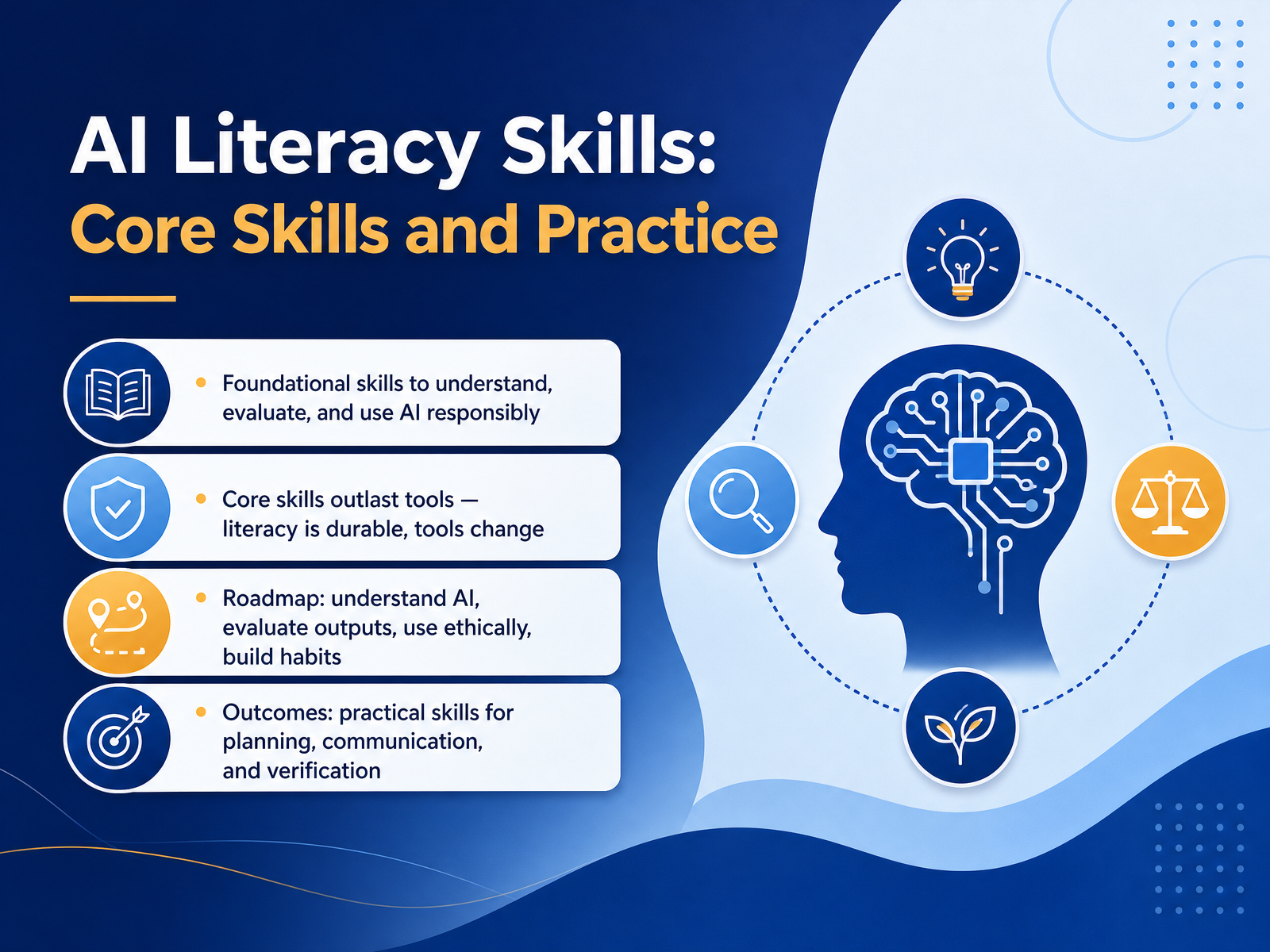
- 01AI Literacy Skills: Core Skills and PracticeWelcome. This is a course about AI literacy, and I want to start with a simple promise. You don’t need to be a technologist to lead here. You need clarity, and you need practice. Today, we’re going to build the foundational skills to understand, evaluate, and use AI responsibly. The tools will change. The literacy we build together is what lasts. Our roadmap is practical: we’ll look at what AI actually is, how to judge its outputs, how to use it ethically, and how to build daily habits that protect your judgment. You’ll leave with concrete skills for planning, for communicating, and for verifying what a machine tells you. This is about staying grounded, making informed decisions, and keeping the human in charge. Let’s begin by getting clear on what AI literacy really means for your work.sciencedirect.comailiteracyframework.orgfrontiersin.org+21 min
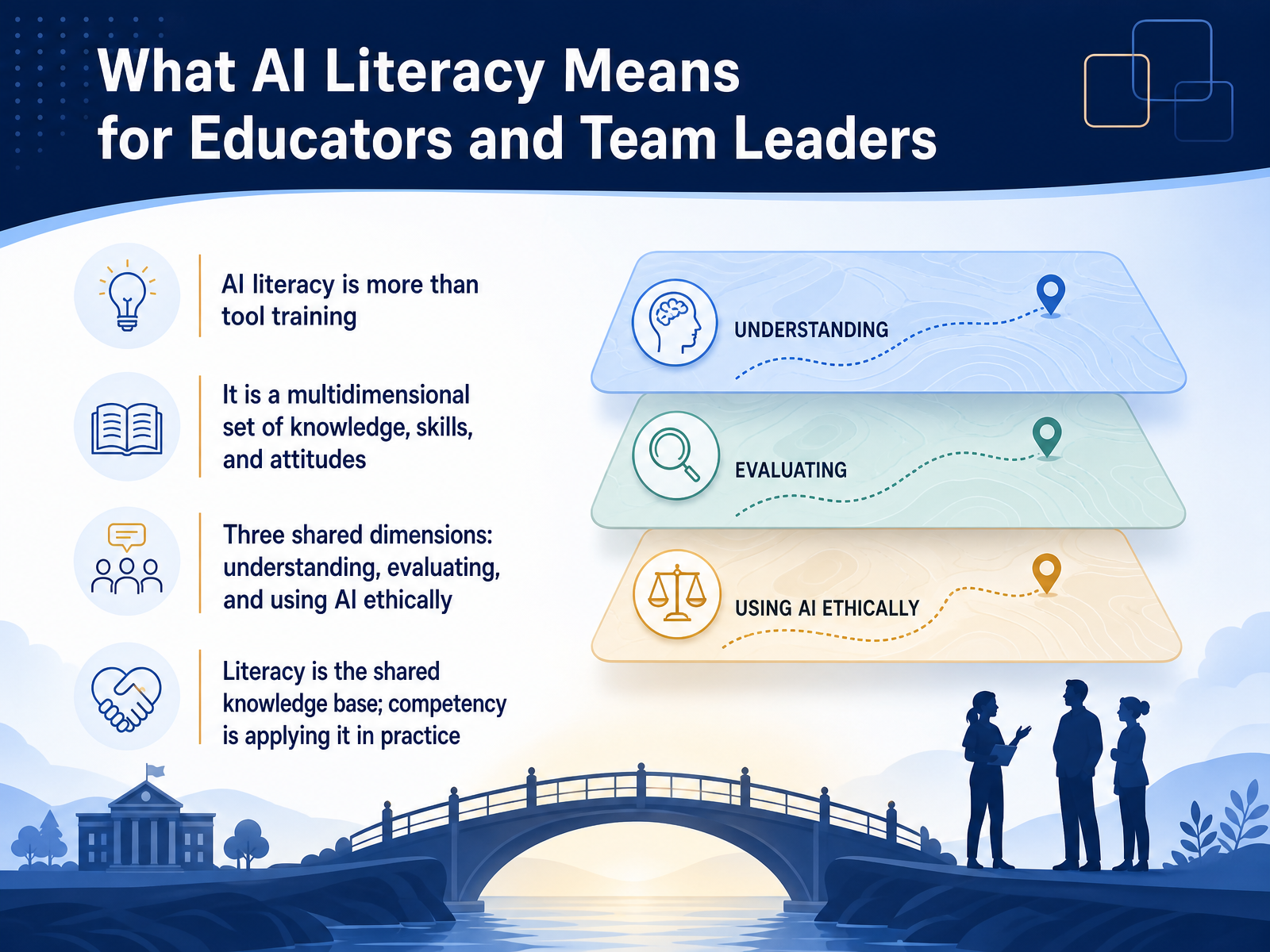
- 02What AI Literacy Means for Educators and Team LeadersLet’s take a moment to clarify what AI literacy really means for those of us in education and leadership. It’s not just about learning to click buttons in a new tool. AI literacy is a broader set of knowledge, skills, and attitudes that help us work with AI thoughtfully and responsibly. There are three shared dimensions we all need. First, understanding what AI can and cannot do, and how it makes decisions. Second, evaluating AI outputs critically, rather than accepting them at face value. And third, using AI ethically, which means considering privacy, bias, and the impact on learners and teams. Think of it this way. Literacy is the common foundation we all stand on. It’s the shared knowledge base that lets us talk to each other about AI in a meaningful way. Competency is what happens when we actually put that knowledge into practice, applying it to real lesson plans, team workflows, or policy decisions. As educators and leaders, our goal is to move our people from simple awareness to confident, ethical application. That distinction matters, and it will guide everything we explore together. Now, let’s look at why making AI literacy a priority is so urgent in today’s landscape.
 2 min
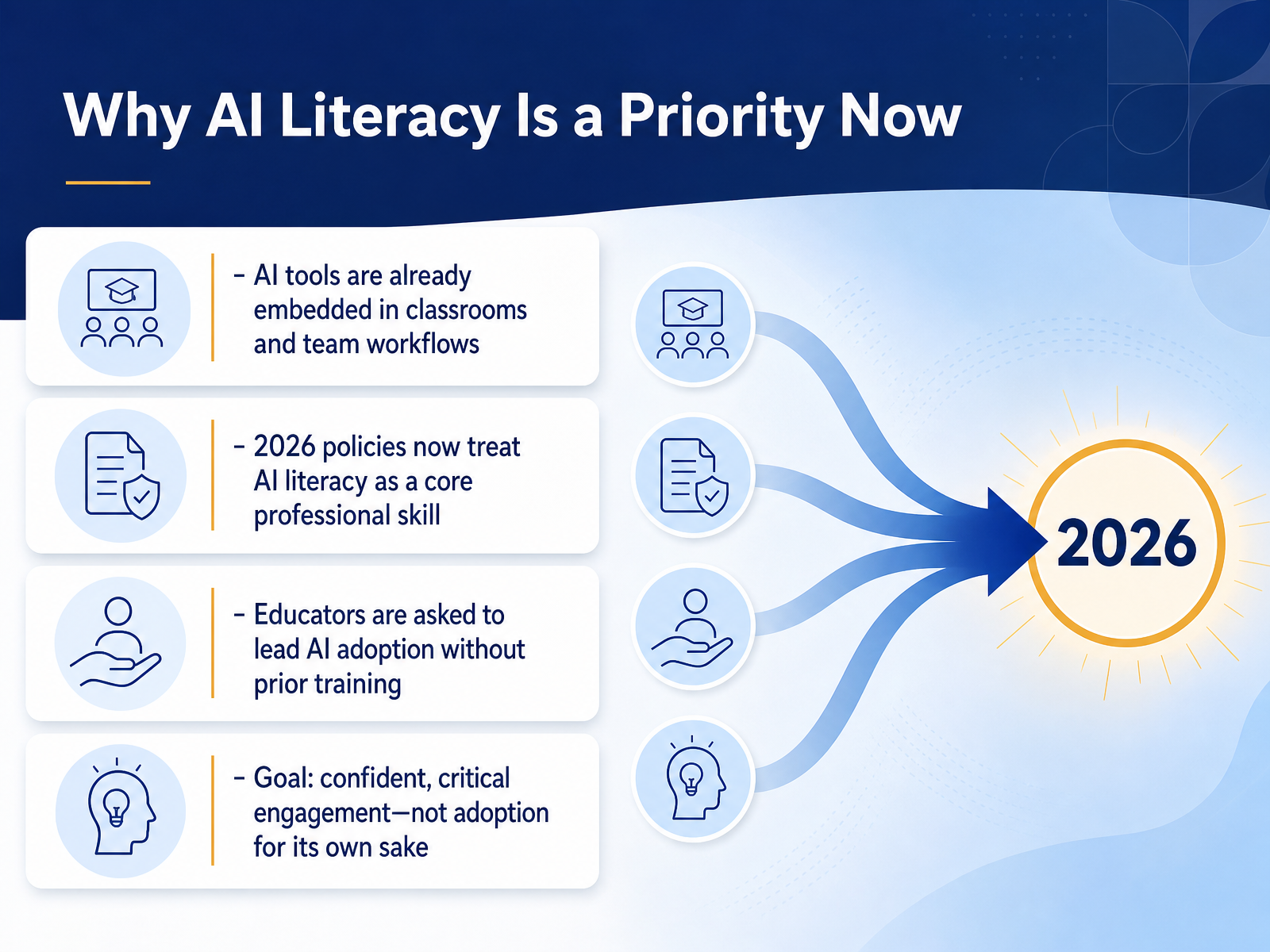
2 min - 03Why AI Literacy Is a Priority NowSo why is AI literacy a priority right now? Because AI tools are already woven into classrooms and team workflows, whether we plan for them or not. Think of a teacher using a chatbot to draft a lesson plan, or a team lead summarizing a report with AI. These aren't futuristic scenarios; they're happening today. By 2026, policies in many organizations and education systems treat AI literacy as a core professional skill, not an optional extra. That means you're being asked to lead AI adoption, often without prior training. It can feel like a heavy load, but here's the goal: confident, critical engagement, not adoption for its own sake. You don't need to master every tool. You need to understand what AI can and can't do, ask good questions about its outputs, and decide when it truly helps. That's the kind of literacy that keeps you in control, and it's exactly what we'll build together. Next, we'll look at how AI systems actually work, so you can spot their strengths and limits with confidence.
 link.springer.comoecd.orgfrontiersin.org+22 min
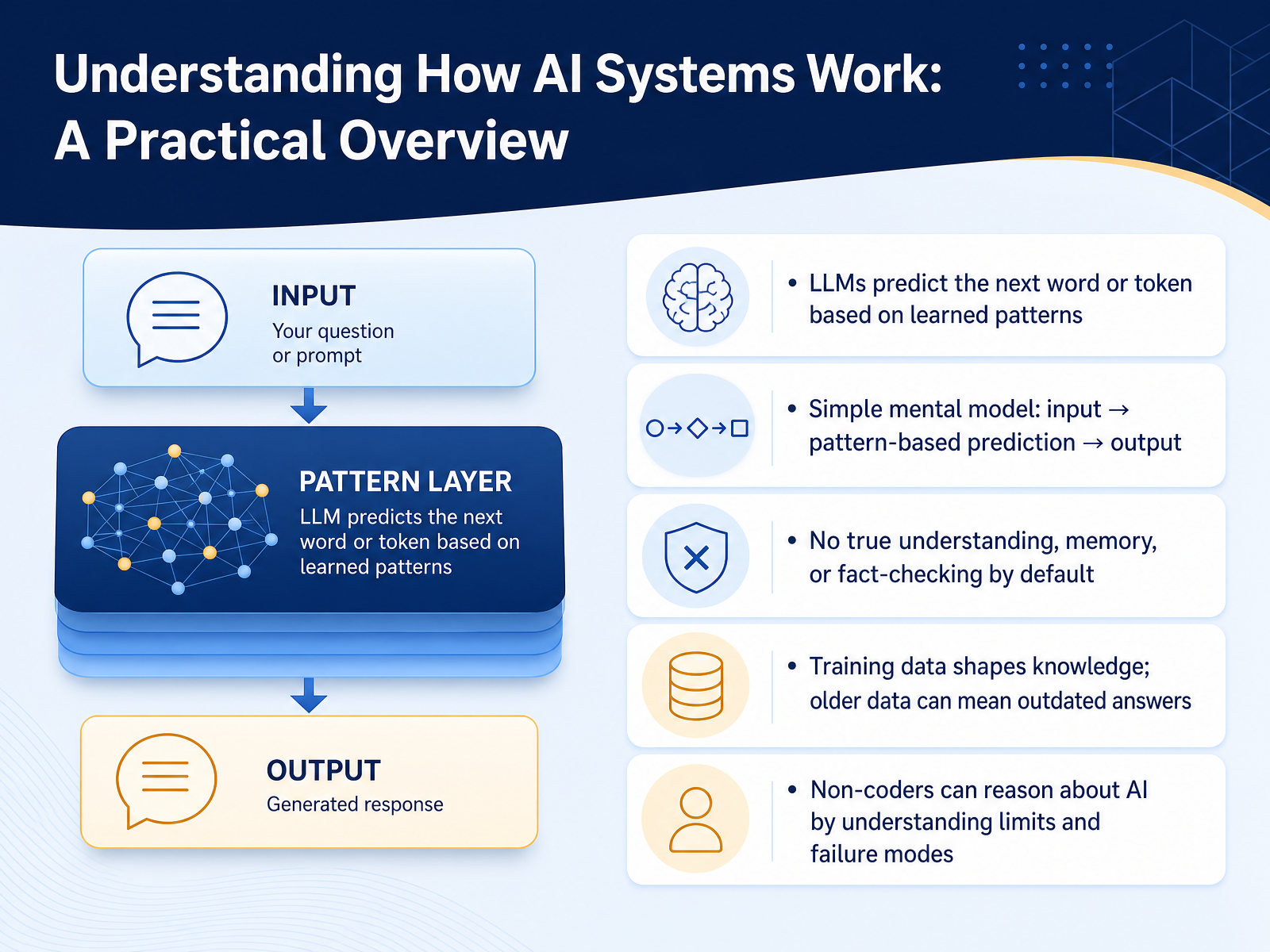
 - 04Understanding How AI Systems Work: A Practical OverviewLet’s take a practical look at how these systems actually work. At the core, a large language model does one simple thing: it predicts the next word, or token, based on the words that came before it. You give it input, it makes a pattern-based prediction, and it produces output. That’s the whole loop. It’s not reading a database of facts. It’s not checking the internet. And it doesn’t truly understand what it’s saying. It’s generating the most likely sequence of language based on what it learned during training. That training data shapes everything it knows. If the data is older, the answers can be outdated. And because it’s designed to sound plausible, not to be correct, it can confidently produce wrong information. That’s why it’s so important to reason about the limits, not just the capabilities. Think of it like a brilliant new colleague who’s read a huge amount but has no real-world experience. You’d verify their work before sending it out. Same goes here. In our next segment, we’ll look at what AI does well, and where it genuinely struggles.
 online.hbs.edubeginnersinai.orgaws.amazon.com+21 min
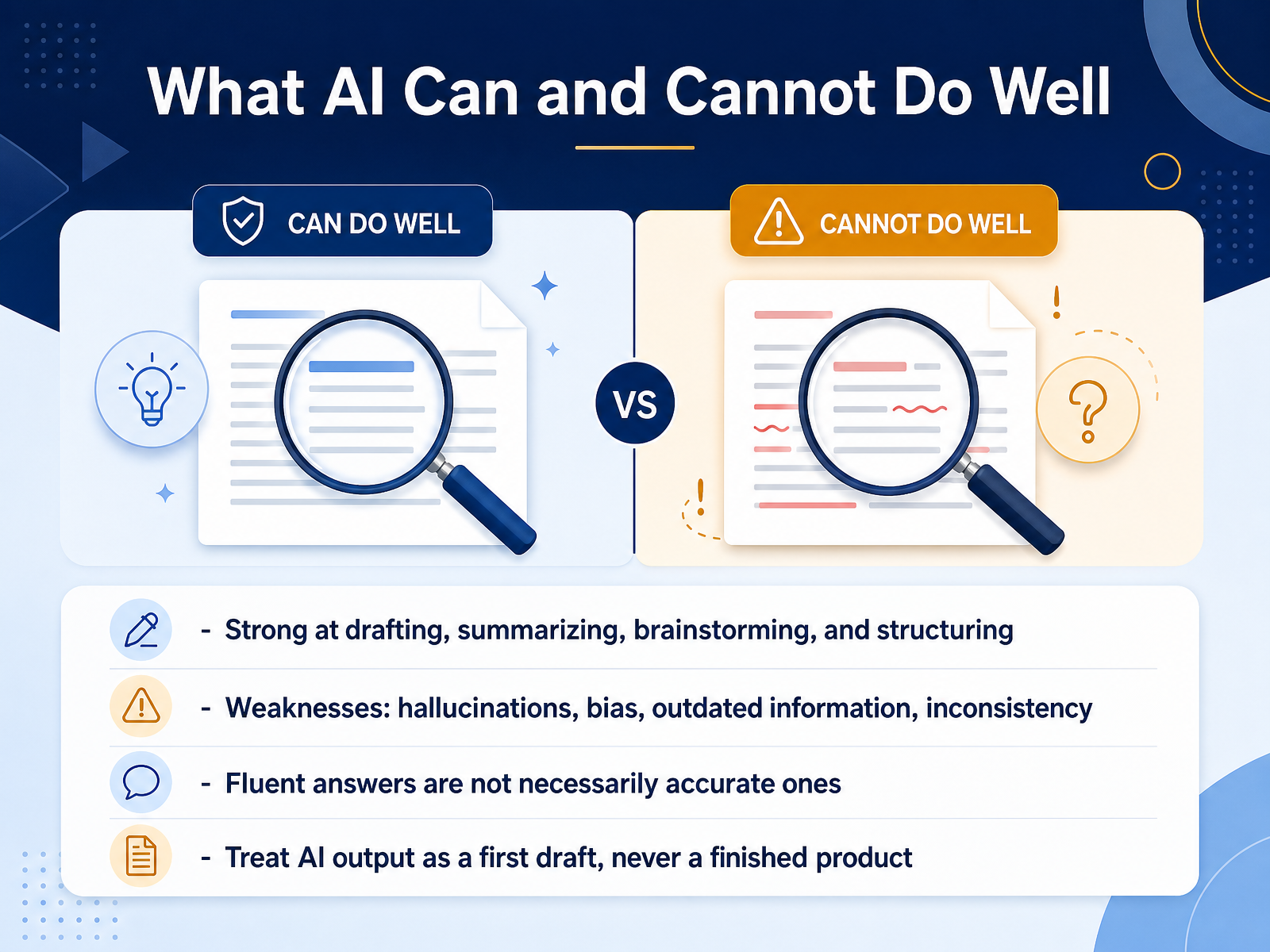
 - 05What AI Can and Cannot Do WellLet’s be clear about what generative AI is genuinely good at, and where it falls short. It excels at drafting, summarizing, brainstorming, and structuring information. It can take a messy pile of notes and shape them into a coherent outline. That is a real strength. But here’s the part that matters: those fluent, confident answers are not always accurate. AI models can produce what we call hallucinations—statements that sound completely plausible but are entirely made up. They also carry bias from the data they were trained on, can be outdated, and are often inconsistent. Ask the same question twice, you might get two different answers. This is not a flaw to be fixed in the next update; it’s fundamental to how these tools work. So the practical takeaway is simple: treat everything AI gives you as a first draft, never a finished product. A useful starting point for your own thinking, but always something to verify, refine, and take ownership of. This habit of careful review is exactly what we’ll build on next, as we look at recognizing hallucinations, bias, and misinformation.
 link.springer.comoecd.orgfrontiersin.org+22 min
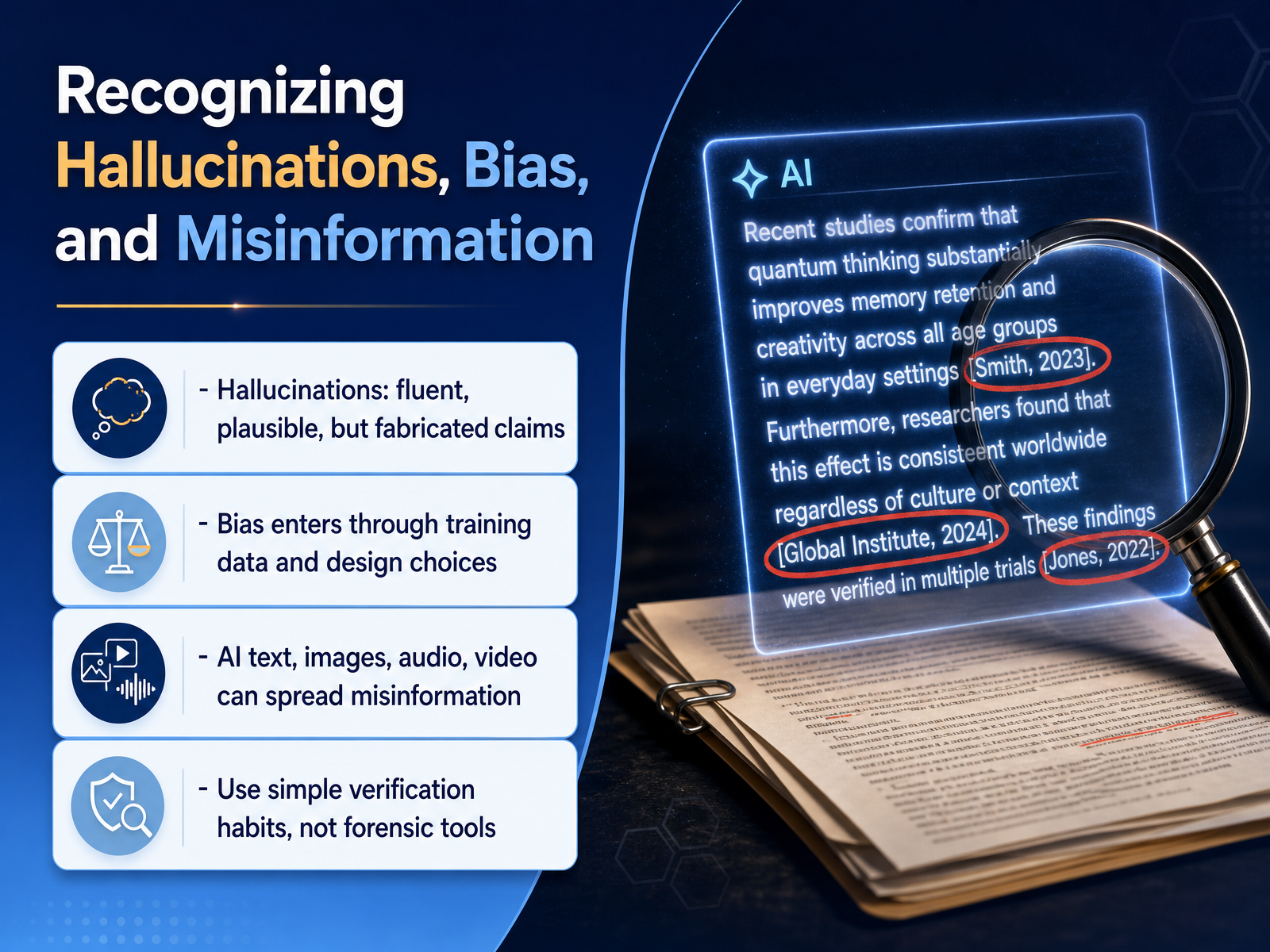
 - 06Recognizing Hallucinations, Bias, and MisinformationLet’s talk about what happens when AI gets it wrong. AI can produce output that sounds fluent, confident, and entirely plausible — but is completely fabricated. That’s called a hallucination, and it can happen in text, images, audio, or video. Bias is another issue. It enters through the data the AI was trained on, and through the choices made in how the system was designed. So the same tool can give different, or unfairly skewed, results for different groups of people. And when AI generates misleading content, it travels fast — especially when it’s emotional or attention-grabbing. The good news? You don’t need forensic tools to spot problems. You just need simple verification habits: check the source, cross-reference the claim, ask who created it and why. For example, if a student shares an AI image or article, take a moment to trace it back. If you can’t verify it, flag it. These habits build the critical thinking muscle that makes responsible AI use possible. Next, we’ll look at some practical ways to verify AI outputs in your daily work.
 link.springer.comoecd.orgfrontiersin.org+21 min
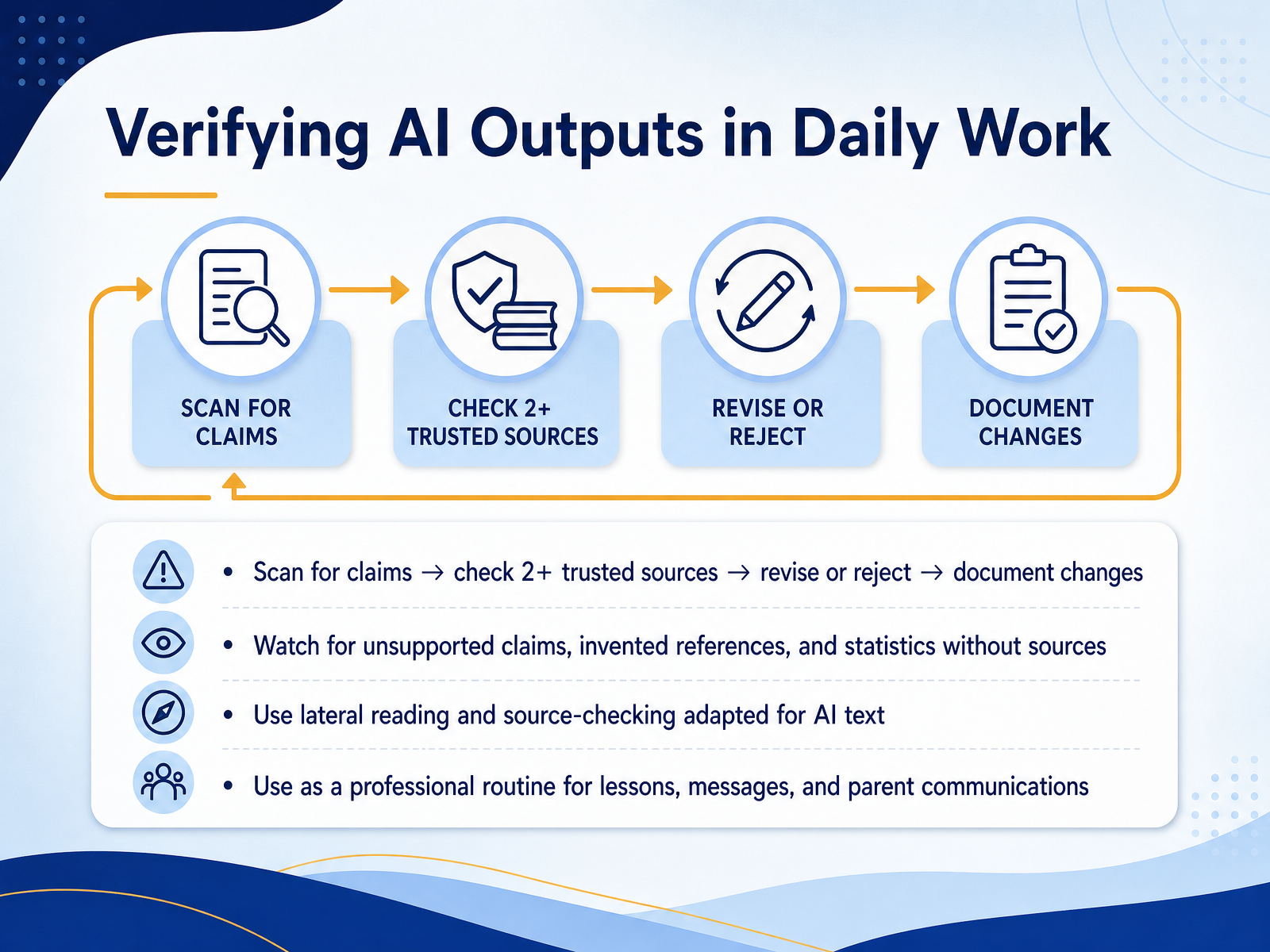
 - 07Verifying AI Outputs in Daily WorkNow let's turn to a practical routine you can use every day: verifying AI outputs. Think of AI as a helpful assistant that sometimes gets things wrong with full confidence. So before you use any AI-generated text, run it through a simple check. First, scan for claims. Look for anything that states a fact, a number, or a source. Then, check those claims against at least two trusted sources you already know are reliable. If something doesn't hold up, revise it or reject it. Don't just leave it in place. And if you make changes, document them. This is especially important when you're preparing lesson materials, drafting messages to parents, or writing communications for your team. Also, watch for red flags. Unsupported claims, invented references, and statistics without a source are common patterns. The AI may sound confident, but that doesn't mean it's accurate. Use a lateral reading approach, just like you would with any online information. Open new tabs, find the original source, and cross-check. Make this a professional habit, not an occasional favor. It takes a minute, and it keeps your work credible and trustworthy.
 otan.usenglishempowermentcenter.orgbu.edu+21 min
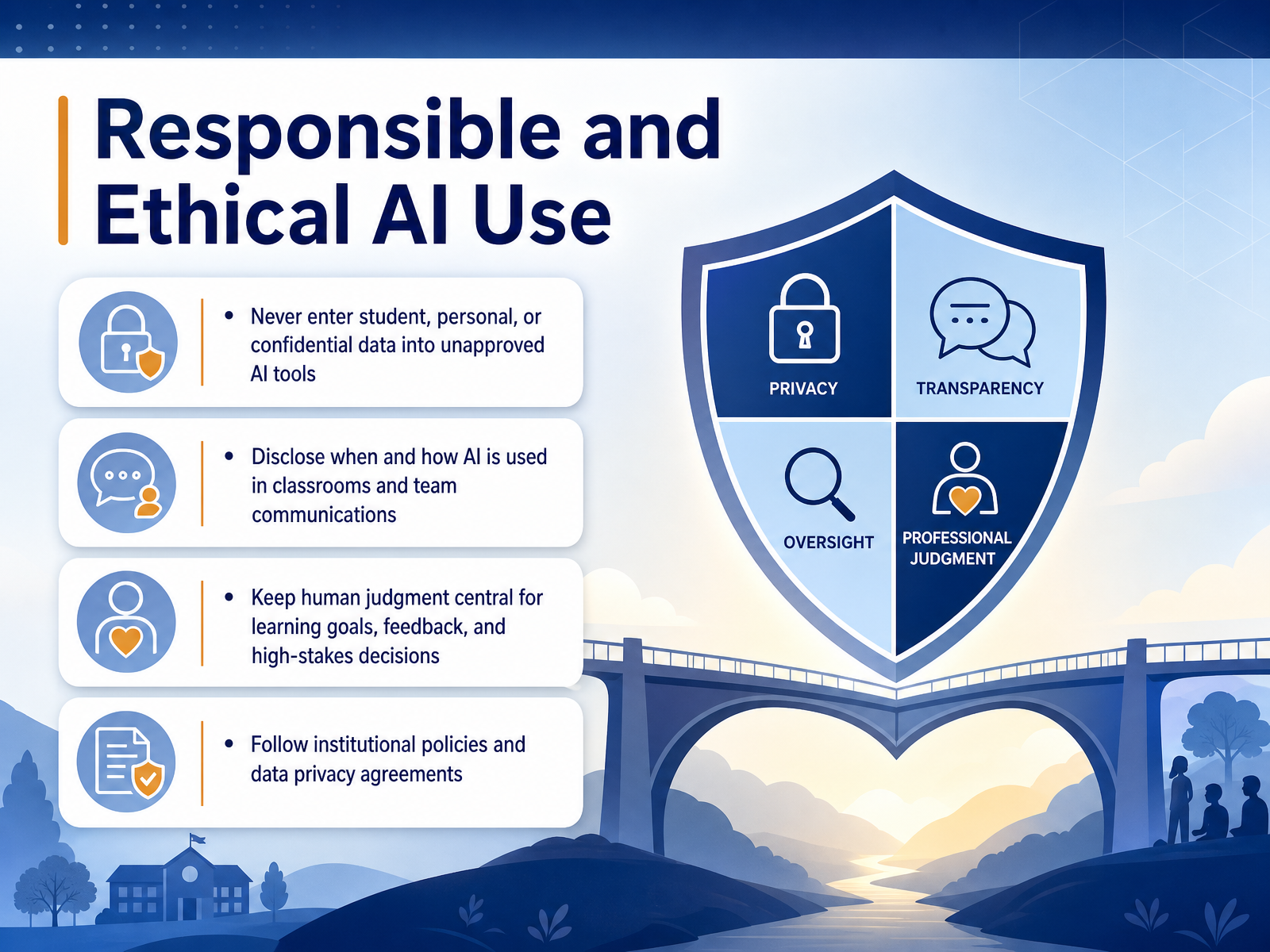
 - 08Responsible and Ethical AI UseNow let’s turn to the practical side of responsibility, because how we handle AI says a lot about the trust we build with our students and our teams. The core rule is simple: never enter student, personal, or confidential data into AI tools that haven’t been approved. Even a quick check of a name or a grade could create a privacy issue you can’t undo. For example, if you want to draft a letter about a student’s progress, use a version that contains no identifying details. Transparency matters just as much. Let students and parents know when AI has helped shape a lesson, an activity, or a feedback comment. A short note removes uncertainty and keeps everyone on the same page. Human judgment stays at the center. AI can suggest learning goals or draft feedback, but you decide what’s appropriate for each student, especially in high-stakes decisions like grading or placement. And finally, always follow your institution’s policies and data privacy agreements. These guardrails exist to protect everyone, including you. So the takeaway is this: responsible AI use isn’t about avoiding the tool, it’s about using it with care and clear intent. Next, we’ll look at prompting skills for practical tasks.
 op.europa.eu2 min
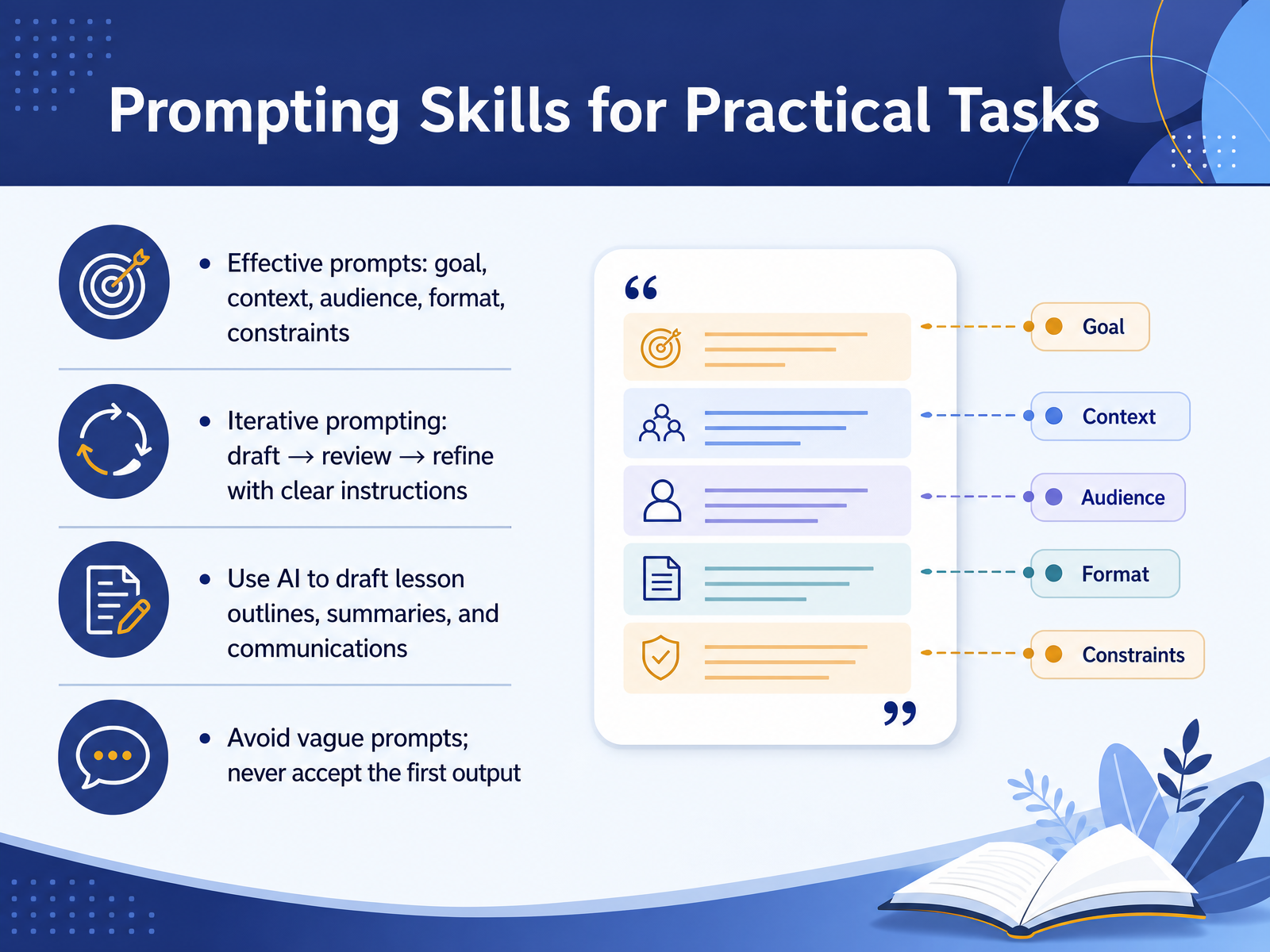
 - 09Prompting Skills for Practical TasksNow let's get practical with prompting. A strong prompt starts with four key elements: your goal, the context, your audience, and the format you want. For example, instead of saying 'Make me a lesson plan,' try 'Create a 45-minute lesson on ecosystems for my seventh-grade class, with a hands-on activity and an exit ticket.' That gives the AI a clear target. Once you get a draft, don't settle. Use iterative prompting: review the output, decide what to adjust, and give specific instructions like 'Shorten the hook' or 'Add examples for visual learners.' This draft-review-refine cycle is where the real quality comes from. Use AI to create outlines, summaries, and communications—it's a strong first-draft partner. But avoid vague requests like 'Do something interesting with poetry.' And never accept the first output as final. Treat it as a solid starting point, then shape it with your professional judgement. Next, let's look at how to evaluate what the AI generates.
 1 min
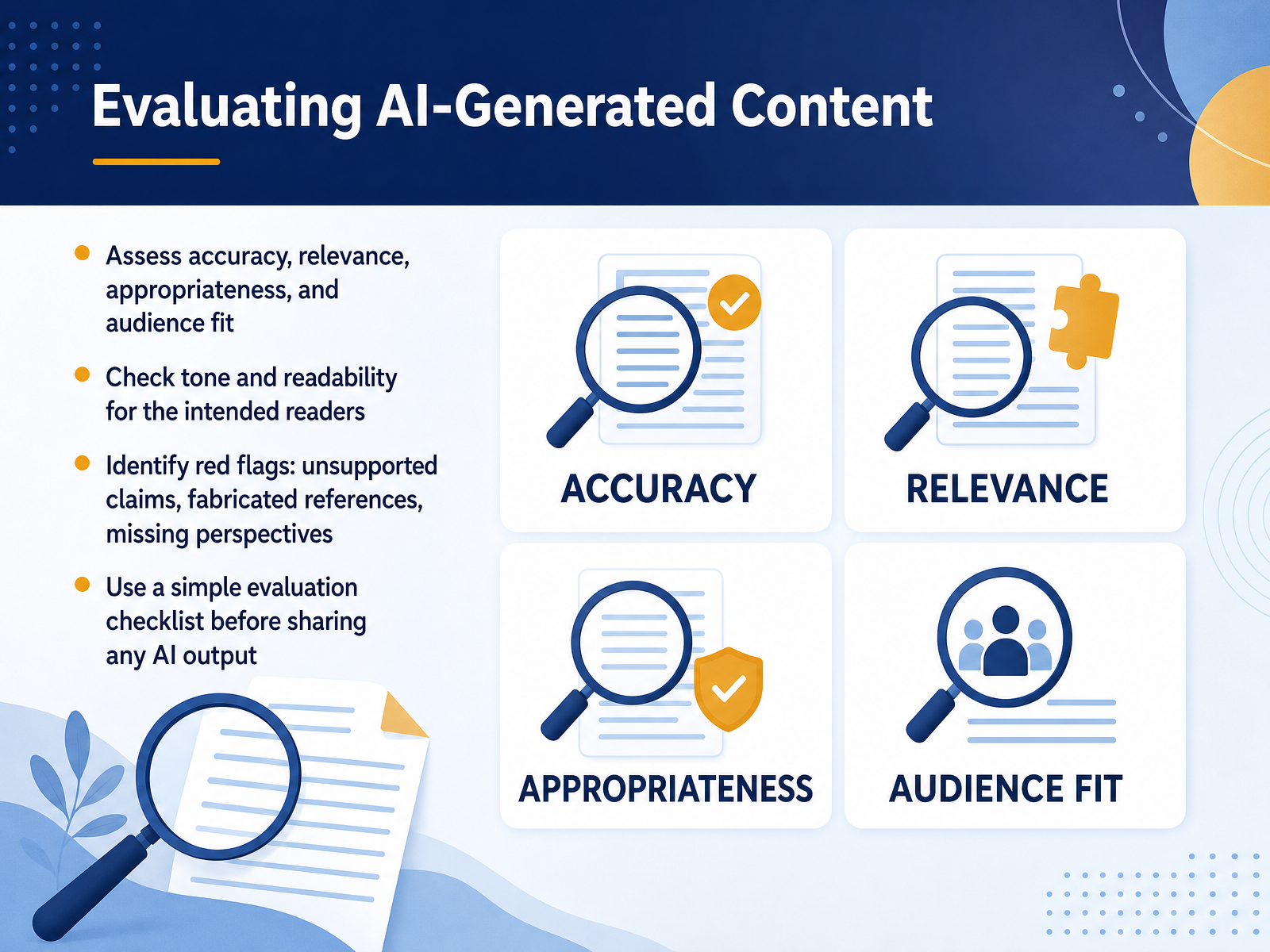
1 min - 10Evaluating AI-Generated ContentNow let's talk about how to evaluate AI output, because not everything it generates is ready for your students. Start with a simple review of accuracy, relevance, and audience fit. Does it match the learning level of your learners? Is the tone appropriate for them? Keep an eye out for red flags like confident-sounding claims that have no support, references that may be fabricated, or a single perspective that misses other voices. It's worth using a simple checklist before you share anything: Does this answer hold up? Is it complete? Would I say this to a colleague? Treat AI output as a strong draft, not a final product, and you will protect your learners and your credibility
 otan.usenglishempowermentcenter.orgbu.edu+21 min
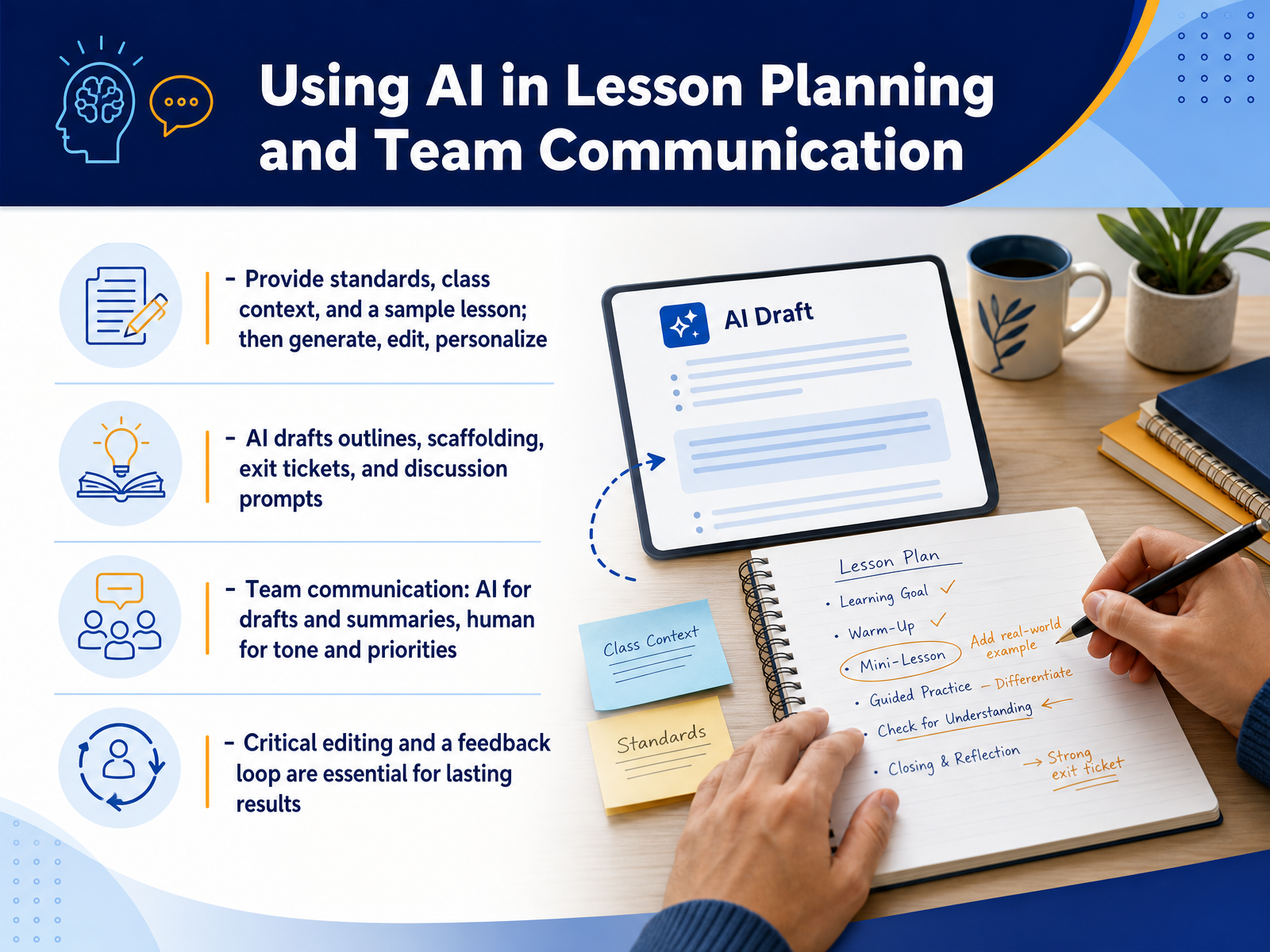
 - 11Using AI in Lesson Planning and Team CommunicationNow let's look at two areas where AI can make a real difference right away: lesson planning and team communication. For planning, the key is to provide context upfront. Give the tool your standards, a snapshot of the class, and one lesson you're proud of. Then, in about twenty minutes, you get a full week of drafts. But those drafts are just the starting point. Read each one critically. Swap activities, adjust scaffolding, and personalize the examples for your students. The AI handles the structure; you handle the judgment. The same principle applies to team communication. AI is excellent at drafting announcements or summarizing long meeting notes. It can even help you find a more diplomatic tone. But you set the priorities, and you make the final call on what matters most. In both cases, critical editing is non-negotiable. Build a simple feedback loop: after the lesson or the meeting, note what worked and what didn't, and feed that back into your prompts next time. That's how you turn a generic tool into a system that genuinely understands your context. Keep that mindset, and we'll look next at keeping educator judgment central.
 2 min
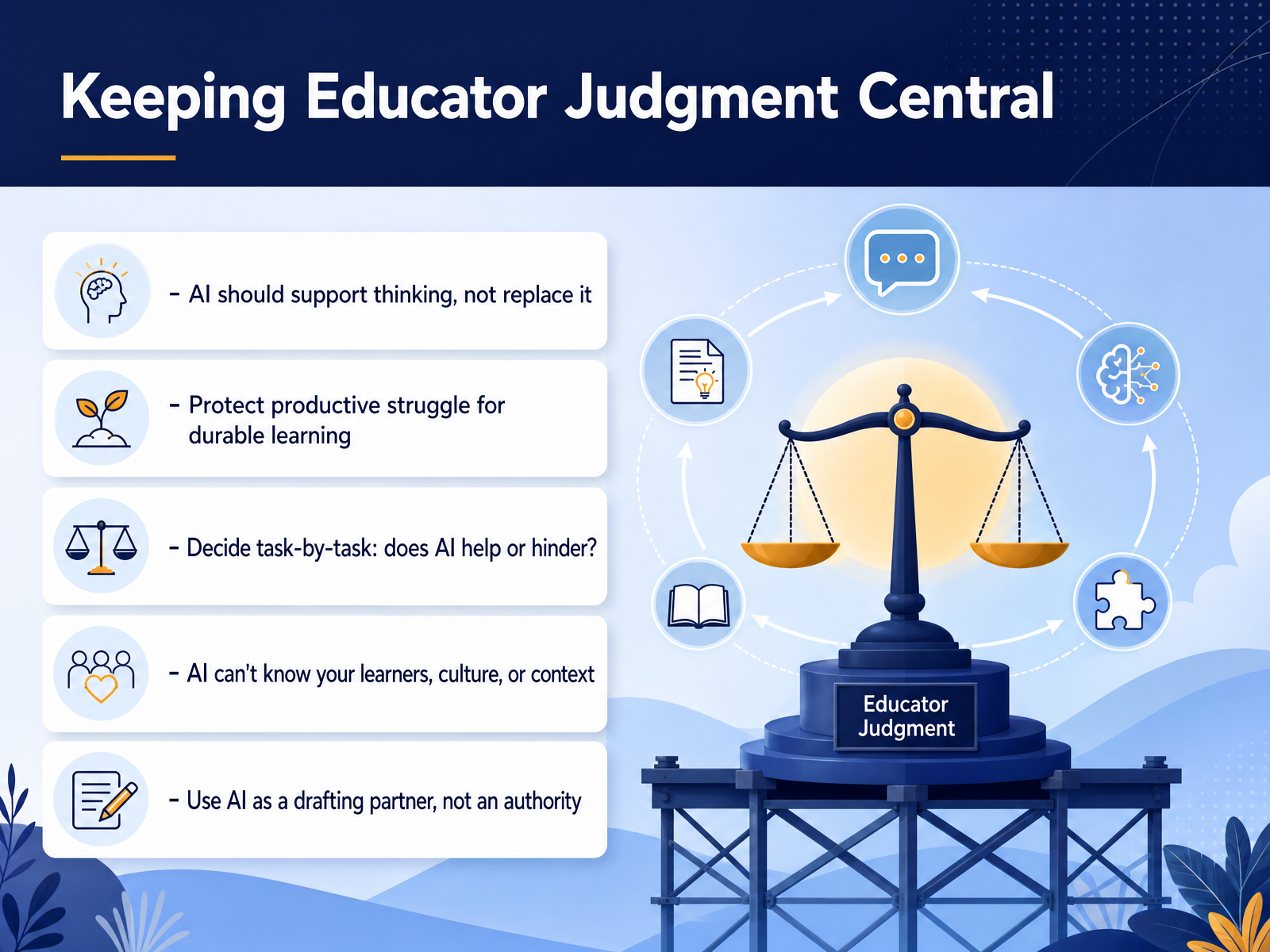
2 min - 12Keeping Educator Judgment CentralNow let's talk about keeping educator judgment central. AI should support thinking, not replace it. In practice, that means using it to spark ideas, not to supply final answers. For example, when a student struggles with a concept, a quick AI explanation might feel helpful, but it can bypass the productive struggle that leads to durable learning. So decide task by task: does AI help or hinder here? For brainstorming or summarizing, it can help. For analyzing a text or debugging code on your own, it might hinder. Remember, AI can't know your learners, your culture, or your context. You do. So treat AI as a drafting partner, not an authority. It offers a starting point, but you bring the judgment, the relationship, and the final call. When you keep that balance, your learners gain both the skill and the confidence to think critically with AI. Next, we'll look at how to teach AI literacy to your learners and teams.
 link.springer.comoecd.orgfrontiersin.org+21 min
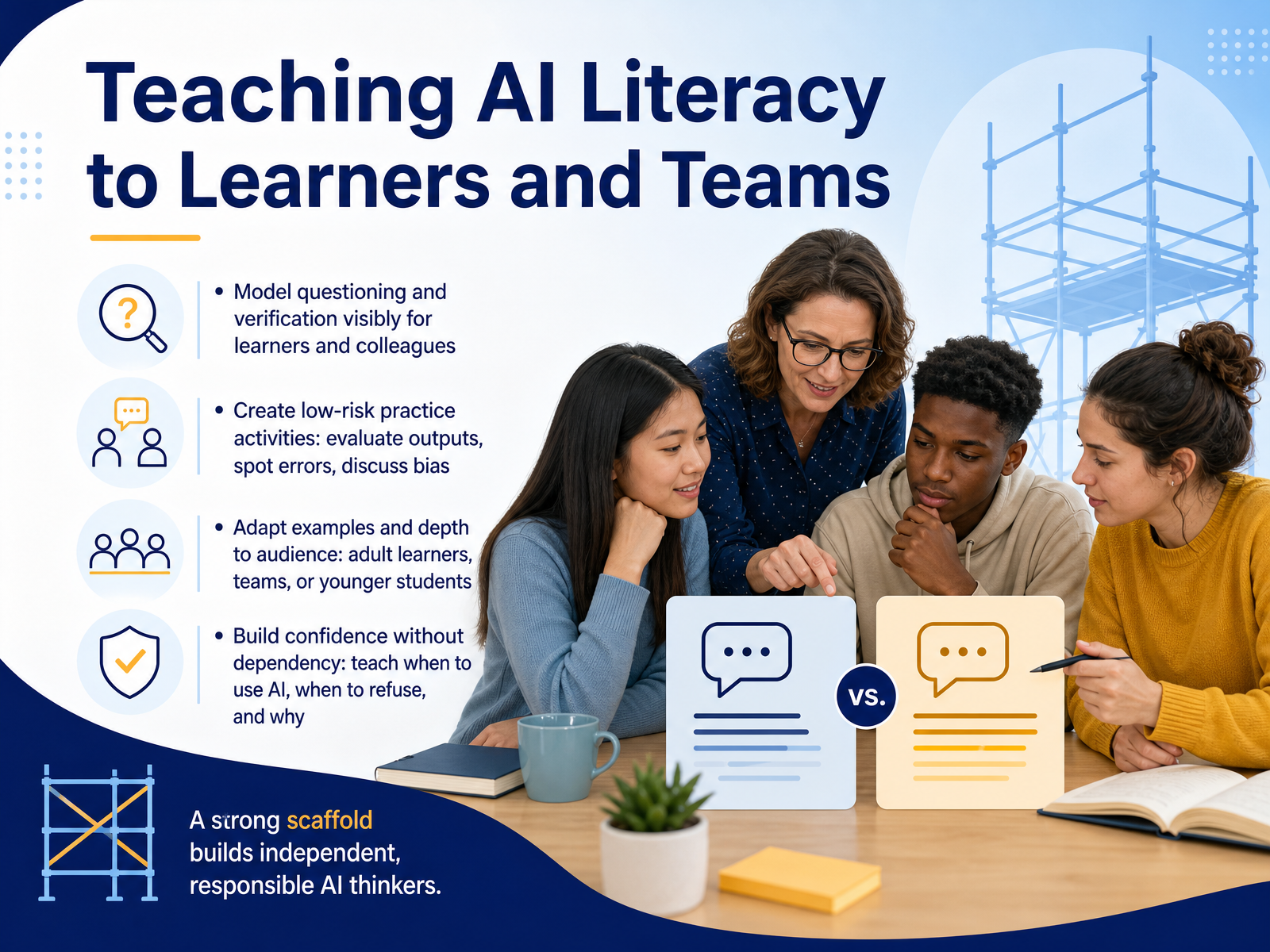
 - 13Teaching AI Literacy to Learners and TeamsSo how do we actually teach AI literacy to our learners and our teams? It starts with modeling. When you question an AI output out loud, or verify a fact in front of your group, you're showing them the habit, not just telling them about it. Then, create low-risk practice. Have them evaluate an AI response, spot the error, discuss where bias might be creeping in. Keep the stakes low so the learning sticks. And remember to adapt your examples to your audience. Adult learners may connect with job applications or customer service. Teams may care about workflow efficiency. Younger students might respond to creative tasks or game-like examples. The depth and tone shift with them. Finally, build confidence without dependency. Teach when AI is genuinely helpful, when it's better to refuse, and why. The goal is not to make AI users who rely on it for everything, but critical thinkers who choose it wisely. When your people can say no to AI just as comfortably as yes, you've done your job. Next, we'll look at how to turn this into a daily practice that lasts.
 otan.usenglishempowermentcenter.orgbu.edu+21 min
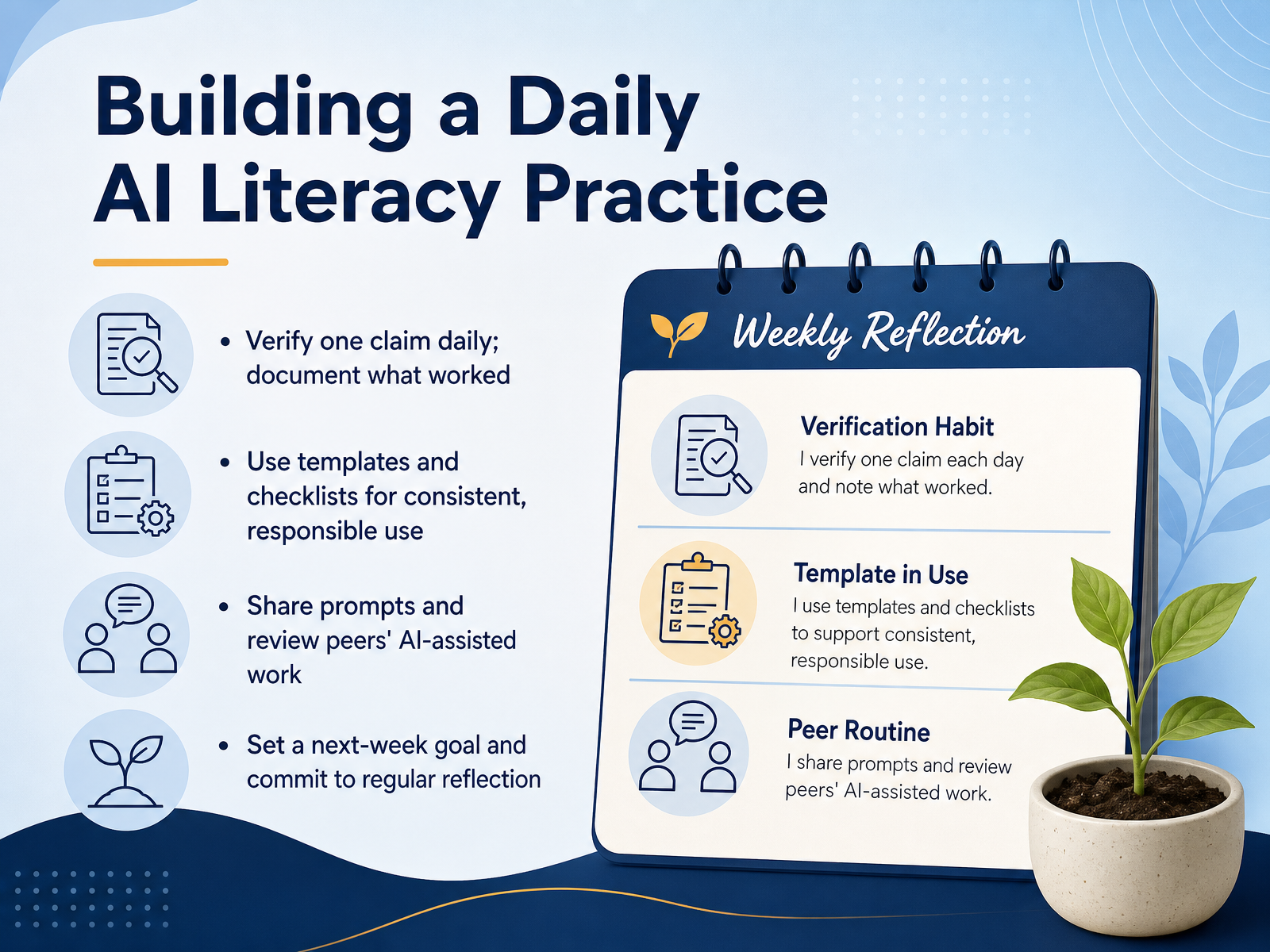
 - 14Building a Daily AI Literacy PracticeWe've covered a lot of ground together, and of course, the real learning happens in the doing. So let's make this practical. This week, simply verify one AI output each day with an outside source, and note what you find. Did it check out? Did it miss something? That small ritual builds critical judgment fast. Next, lean on templates and checklists, especially for privacy checks and bias reviews. They keep your use consistent and responsible, even on a busy day. Then, make your practice social. Share your best prompts with a colleague and ask to see their AI-assisted work in return. Peer review is where blind spots disappear. Finally, set one concrete AI-related goal for next week. It might be using AI to draft a rubric, or maybe it's deciding not to use it for a task you should do yourself. The goal matters less than the reflection. These four habits, verify, structure, share, and reflect, will outlast any single tool. Thank you for your commitment to leading with care and curiosity. You're ready to put this into practice, one thoughtful step at a time.
 otan.usenglishempowermentcenter.orgbu.edu+22 min
Take the deck with you
Download this course as a file — free, no sign-up needed.
- PDF handoutEvery slide page, ready to print or share.15 pages · 3.6 MBDownload
- Narrated PowerPointThe deck that presents itself — every slide carries the digital human's narration video.15 pages · 15.0 MBDownload
- PowerPoint slidesThe full deck as a .pptx — open it in PowerPoint, Keynote, or Google Slides.15 pages · 3.5 MBDownload
Free to use in your own training — please keep the PersonWise credit page at the end.
Have your own deck? Turn it into a course
Sources consulted
Web sources consulted while building this course.
- Enhancing AI literacy for educators: Where to start and to ... — sciencedirect.com
- Empowering Learners for the Age of AI — ailiteracyframework.org
- AI literacy for teacher educators: a holistic curriculum ... — frontiersin.org
- Artificial Intelligence Literacy and Competency in Pre-Service Teacher Education — mdpi.com
- Understanding AI Literacy - Stanford Teaching Commons — teachingcommons.stanford.edu
- “Generative AI literacy across education and business: competencies, obstacles, and benefits—a systematic literature review” | International Journal of Educational Technology in Higher Education | Springer Nature Link — link.springer.com
- OECD Digital Education Outlook 2026 | OECD — oecd.org
- Frontiers | Navigating opportunities and challenges of generative AI in higher education: towards responsible, equitable, and human-centered integration — frontiersin.org
- Frontiers | The safety gap: restoring productive struggle through pedagogically aligned generative AI — frontiersin.org
- Frontiers | Generative AI in higher education: a meta-analysis of intellectual and social–emotional outcomes — frontiersin.org
- What Are Large Language Models (LLMs) & How Do They Work? — online.hbs.edu
- https://beginnersinai.org/what-is-llm/ — beginnersinai.org
- What is LLM? - Large Language Models Explained — aws.amazon.com
- A jargon-free explanation of how AI large language models work - Ars Technica — arstechnica.com
- Large Language Models Explained Simply | eli5.cc — eli5.cc
- Building AI Literacy in Adult Education: A Framework for ... — otan.us
- AI Literacy: Preparing Our Learners for a Changing World - English Empowerment Center — englishempowermentcenter.org
- AI Literacy for Educators: A 2026 Guide for Teachers — bu.edu
- https://www.educatorstechnology.com/wp-content/uploads/2026/04/Critical-AI-Literacy-short-Guide-for-Teachers.pdf — educatorstechnology.com
- Guidelines on the ethical use of artificial intelligence and data in teaching and learning for educators - Publications Office of the EU — op.europa.eu